Archive for February 7, 2012

Obama’s Super-Bowl Fumble on Iran

February 7, 2012

Obama’s Super-Bowl Fumble on Iran | Consortiumnews.

Exclusive: In a televised interview before the Super Bowl, President Obama had the chance to send a clear signal to Israel not to launch a preemptive war against Iran but instead offered ambiguous remarks that Israeli hard-liners might read as a partial green light, reports ex-CIA analyst Ray McGovern.


By Ray McGovern

Before President Barack Obama’s interview with NBC’s Matt Lauer, aired before the Super Bowl on Sunday, Israeli Prime Minister Benjamin Netanyahu probably hoped that, if Obama discussed Iran, he would give him the strong backing that Israeli leaders crave, freeing them to lash out at Iran — militarily, if they so choose.

Few could have been more keenly interested than he in what the President would say in an interview beamed to a hundred million American TV viewers. The problem was that Netanyahu could not have been completely sure of what to expect, given the confusing mixed signals coming out of Washington in the past several weeks.
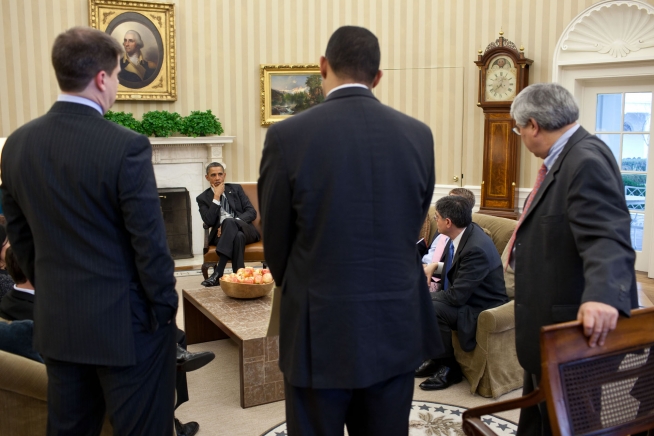
President Obama with advisers in the Oval Office (White House photo by Pete Souza)

Some of those signals had been disquieting to Netanyahu and other Israeli hard-liners — for example, Defense Secretary Leon Panetta saying flat-out on Jan. 8 that Iran is NOT “trying to develop a nuclear weapon” – undercutting the key casus belli for war – and Joint Chiefs Chairman Martin Dempsey visiting Israel on Jan. 19, reportedly to repeat that in person and warn his hosts against provoking war with Iran.

In Netanyahu’s world, though, functionaries like Panetta and Dempsey are to be listened to politely but not taken all that seriously. It is what the American President says, in public, that may require more attention — and that is enhanced when he has the eyes and ears of multiple millions of super-prime-time viewers.

For Obama’s part, he was walking a political tightrope, having sent out two of his top national security aides to signal Israel that he doesn’t want a new war in the Middle East, but not wanting to give his hawkish Republican rivals new reasons to question his support for Israel.

Obama is reportedly hopeful that a peaceful settlement can still be reached over Iran’s nuclear program, but he understands that he has little margin for error in this high-wire act of political diplomacy – especially with so many crosswinds in an election year.

So, President Obama decided to forgo his best chance to inject a loud, unmistakable note of caution into recent warmongering over Iran, not only in Israel but also among influential neocons in the United States who have been jumping up and down, demanding another preemptive war over hypothetical WMDs, much as they did with Iraq.

When the interview was over, Netanyahu could breathe a sigh of relief. With Obama’s words and body language, there was nothing that would constitute a red light and some things that Netanyahu might interpret hopefully as nearly a green light.

Heightened Danger

Bottom Line: The way the President chose to handle Lauer’s leading questions on Israel-Iran tensions has brought the world closer to hostilities that would deeply destabilize not only that region but the world economy.

Lauer: [Regard] building tension between Israel and Iran:  It seems now the Israelis are signaling they may act, and conduct a strike inside Iran at their nuclear sites sooner than later. Do they have your full support for that raid?

Obama: I don’t think Israel has made a decision on what they need to do. I think they, like us, believe that Iran has to stand down on its nuclear weapons program, and we have mobilized the international community in a way that is unprecedented. And they [the Iranians] are feeling the pinch, they are feeling the pressure.

But they have not taken the steps they need to take diplomatically; which is [for the Iranians] to say, “We will pursue peaceful nuclear power; we will not pursue a nuclear weapon.” Until they do so, I think Israel, rightly, is going to be very concerned, and we are as well.

Lauer: Has Israel promised you that they would give you advance warning to any such attack? Should they give you that warning?

Obama: I won’t go into the details. I will say that we have closer military and intelligence consultation between our two countries than we’ve ever had.  And we are going to make sure we work in lockstep, as we proceed to try to solve this — hopefully diplomatically. …

Our preferred solution here is diplomatic; we’re going to keep on pushing on that front. But we’re not going to take any options off the table, and I’ve been very clear that we’re going to do everything we can to prevent Iran from getting a nuclear weapon and creating an arms race, a nuclear arms race in a volatile region.

Delicate Positioning

Though the various elements of Obama’s delicate positioning are there – such as his desire for a diplomatic solution to the crisis and his hope to avoid another war – there were also problematic references that reinforced the case for a preemptive Israeli strike, such as the President’s bizarre assertion that Iran must declare that its nuclear program is for peaceful purposes only – when that is exactly what Iran has been saying for years.

So, did Obama fumble or intentionally drop the ball? I think the latter, but it hardly matters. The consequences are pretty much the same either way.

The Israelis could not have been sure that Obama would decide to regurgitate their prevarication about Tehran’s notional nukes and contradict what his own Defense Secretary had said just four weeks ago, but that is what the President did.

What probably exceeded the Israeli leadership’s fondest expectations, though, was Obama’s pledge that in addressing Iran’s alleged nuclear ambitions, the U.S. will “work in lockstep” with Israel.

(“Lockstep?” What does Webster’s say of “lockstep?”

noun:

1 –  a mode of marching in step by a body of men going one after another as closely as possible;

2 –  a standard method or procedure that is mindlessly adhered to …

adjective:

–      in perfect, rigid, often mindless conformity or unison.)

Obama poured icing on Israel’s cake when he emphasized that Israeli-U.S. military and intelligence consultation has never been closer. The result? Up in smoke went any possibility of plausible denial of foreknowledge on Washington’s part, if — despite Panetta’s oft-repeated pleas that Israel and the U.S. must “work together” — Israel follows its customary practice of shunning any advance warning (much less requests for permission), in favor of seeking post-hoc forgiveness for launching armed attacks.

Carte Blanche for Israel?

For those of us who thought that the White House, recognizing the stakes involved and the benefit of keeping some space between Washington and Tel Aviv, had been trying to restrain the Israelis from attacking Iran, it is hard to fathom why Obama took the line he did.

His words were less surprising to those who have long since concluded that in the coming months he will choose to act out of a felt need to be at least in as much in “lockstep” with Israel as any Republican contender — never mind the risk of giving Netanyahu the impression that there are few if any restraints on what Israel might do to Iran.

It’s also possible that Obama has concluded that there isn’t much he can do to restrain Netanyahu who has strong reason to believe that whatever the President of the United States may want doesn’t really matter when the Congress and much of the Fawning Corporate Media are already in lockstep behind whatever Israel does.

Think back on when Netanyahu gave Obama a public tongue-lashing in the Oval Office and then went to Capitol Hill to receive a hero’s welcome from Republicans and Democrats who engaged in a bipartisan competition to see who could jump to their feet the fastest and applaud the loudest.

Whatever school of thought you may favor regarding Obama’s Iran “strategy,” let me suggest that you put yourself in Netanyahu’s shoes as he watches the pre-game interview. Do you agree that he is likely to come away with the idea that Obama has just applied a fresh coat of high-gloss paint to the box into which the Israelis and their supporters believe they have painted him?

Four months ago, I wrote an article entitled “Israel’s Window to Bomb Iran,” as the war-drumming on Iran began its crescendo. What has happened since has reinforced my assessment that:

“The key factor in any Israeli decision to send its aircraft and missiles to Iran is the degree to which Netanyahu and other hard-line Likud leaders believe that President Obama is locked into giving blanket support to Israel — particularly as Election 2012 draws near.

“The Israelis might well conclude that the formidable effectiveness of the Likud Lobby and kneejerk support of the U.S. Congress as well as still powerful neoconservatives in the Executive Branch (and on the opinion pages of major American newspapers) amount to solid assurance of automatic support for pretty much anything Israel decides to do.

“If Israel translates this into a green light to attack Iran, the rest of the world — even Washington — may get little or no warning.”

We need to add two important new factors since then:

1- Somehow the main focus has shifted from (a) how soon Iran could get a nuclear weapon to (b) how soon Israel is likely to attack Iran’s nuclear facilities — whether they are shown to be related to nuclear weapons development, or not.

2- The evolving discourse in the Fawning Corporate Media (FCM) has accustomed many Americans to assume that the Israelis would be within their rights to start a war on a convenient “IF” — i.e., IF the Iranians are working on a nuclear weapon. Never mind that Defense Secretary Panetta stated publicly just four weeks ago that they are NOT.

Of course, Panetta was simply reiterating the consensus conclusion of the 16 U.S. intelligence agencies that declared in 2007 that Iran had halted work on a nuclear weapon in 2003 and that it did not appear that such work had resumed. And even if you don’t want to believe the U.S. intelligence community and Panetta, there was the recent acknowledgement by Israeli Defense Minister Ehud Barak that the Mossad apparently has concluded the same thing.

Barak gave the interview on Jan. 18, the day before JCS Chairman Martin Dempsey arrived for talks in Israel:

Question: Is it Israel’s judgment that Iran has not yet decided to turn its nuclear potential into weapons of mass destruction?

Barak: … confusion stems from the fact that people ask whether Iran is determined to break out from the control [inspection] regime right now … in an attempt to obtain nuclear weapons or an operable installation as quickly as possible.  Apparently that is not the case. …

Question: How long will it take from the moment Iran decides to turn it into effective weapons until it has nuclear warheads?

Barak: I don’t know; one has to estimate. … Some say a year, others say 18 months. It doesn’t really matter. To do that, Iran would have to announce it is leaving the [UN International Atomic Energy Agency] inspection regime and stop responding to IAEA’s criticism, etc.

Why haven’t they [the Iranians] done that? Because they realize that … when it became clear to everyone that Iran was trying to acquire nuclear weapons, this would constitute definite proof that time is actually running out. This could generate either harsher sanctions or other action against them. They do not want that.

[For more details, see Consortiumnews.com’s “U.S./Israel: Iran NOT Building Nukes.”]

Yet, in the United States, the FCM’s constant repetition that Iran is working on a nuclear weapon – despite the intelligence consensus that Iran is NOT doing so – has created widespread acceptance for an Israeli preemptive war. In many circles, the idea is almost greeted with a yawn, with another yawn given to the notion that “of course” the U.S. would have to march “in lockstep” with Israel, if it got into a war.

A few days ago, I was given eight full TV minutes on RT to discuss whether it is a good idea to start wars in the subjunctive mood, and what I believe are Israel’s true aims vis-à-vis Iran. In my view, the principal aim, pure and simple, is regime change in Tehran, not the destruction of Iran’s notional nukes.

Remember, there have been U.N. inspectors crawling all over Iran, which has yet to be shown to be in violation of the basic Nuclear Non-Proliferation Treaty, which Iran has signed and Israel has not. (Another relevant fact that is typically left out of FCM articles about the theoretical possibility of Iran building one nuke is that Israel has a sophisticated – and undeclared – arsenal of some 300 nukes.)

Is it conceivable that this kind of information has been kept from President Obama?

Ray McGovern works with Tell the Word, a publishing arm of the ecumenical Church of the Saviour in inner-city Washington. He served for 30 years as an Army officer and a CIA intelligence analyst and now serves on the Steering Group of Veteran Intelligence Professionals for Sanity.

War with Iran is coming

February 7, 2012

War with Iran is coming – Israel Opinion, Ynetnews.

Op-ed: Israel will bomb Iran’s nuke sites earlier than predicted, with Western and Arab support.

A war is coming. We need a miracle to avert it. Both sides have been preparing for it for years. The two states are earmarking resources, holding drills, utilizing intelligence means, creating uncertainty, and publicly presenting positions that offer no way back. Israel and Iran are currently facing a growing cold war situation and are on an almost certain collision course. A war is coming.

In only few cases did a cold war not turn into an all-out war. One of the prominent cases is that of the Soviet regime’s collapse in the 1980s and its defeat in the Cold War against the West. The United States won without firing a single shot. It used its economic-technological supremacy as a strategic threat, while Western ideology won hearts on the other side of the Iron Curtain. The threat of nuclear war passed after the regime in Moscow changed

The Israeli-Iranian case is much more volatile and it’s hard to foresee a happy ending. Israel is willing to do (and will do) anything to prevent Iran from acquiring nuclear weapons. No Israeli prime minister and no IDFchief of staff will assume the responsibility for a nuclear Tehran.

Israel can live with the current Iran: A state capable of producing a nuclear bomb, while being two to three years away from arming the first missile with the first nuclear warhead. However, Israel will not allow Iran to cross the military nuclear threshold. There is no way in the world Israel would compromise on that.

“Cannot live with” and “cannot accept” are diplomatic phrases marking a declaration of war. And it will be a predictable war; at this point, commentators and gamblers are giving it 90% chance of materializing. Hence, preparations for it must be accurate. In practice, they have been completed already. Unless Iran caves in, an Israeli operation against Tehran’s nuclear sites is inevitable.

Iranian irrationality

Can the Iranian leadership cave in? Yes, it can. The regime in Tehran is not being asked to curb the entire nuclear project, but rather, to pursue what Iran itself said was its legitimate aspiration: Nuclear energy for peaceful purposes. This means an immediate halt to the secret military program, willingness to fully open nuclear sites to foreign inspectors, and agreeing to transfer the enriched uranium overseas.

Such agreement won’t undermine the regime’s popularity: It will be received enthusiastically in Tehran’s markets, especially as the economic sanctions will be lifted. Nuclear arms are perceived as an imperialist gadget in Iran. The country can do without them.

The lack of symmetry may prompt an optimistic conclusion: Under growing pressure of sanctions, which are now biting and comprehensive, the Iranian regime would indeed cave in. It would forego the military nuclear option for at least the next 12 years and make do with electrical plants. The regime’s popularity won’t be hurt because of this; the opposite is true.

Yet these are rational considerations, while Iran’s leadership displays irrationality. Its secret desire for nuclear weapons is irrational, its hostility to Israel is irrational, the way its economy is being managed is irrational, and its support for Syrian President Assad serves as further proof of its irrationality.  

Hence, there is no telling how the ayatollah regime would respond to growing international pressure. Iran’s leaders are playing a cat-and-mouse game with the US and with Israel. The Iranians think they’re the cat, but they’re in fact the mouse.

Hence, we shall almost certainly see a war here. Israel will bomb Iran’s nuclear military sites earlier than predicted, while enjoying Western and Arab assistance and backing. The sirens will wake us up early in the morning. The Home Front Command’s spokesman will instruct us to enter our sealed rooms without panicking. And the rest will be history.

New Israel Air Force chief is a victory for common sense

February 7, 2012

New Israel Air Force chief is a victory for common sense – Haaretz Daily Newspaper | Israel News.

Until now, Amir Eshel has exhibited a can-do attitude. One hopes he will stay that way, together with the chief of staff and the heads of the intelligence community – particularly at a time when the government is headed by a pair who seem imbued with fighting spirit.

Haaretz Editorial

The appointment of Maj. Gen. Amir Eshel as the next Israel Air Force commander is a victory for both common sense and IDF Chief of Staff Lt. Gen. Benny Gantz. Logic dictated that an experienced and talented officer like Eshel, who is currently head of the Plans and Policy Directorate and has gone through every filter and preparation the air force has to offer, would win the confidence of the higher echelons and be given command of the military’s most important arm.

There was no place for the efforts of Prime Minister Benjamin Netanyahu to skew the competition for the benefit of his military secretary, Maj. Gen. Yohanan Locker. Nor for the public call of Defense Minister Ehud Barak to equate the appointment of the air force commander with that of the deputy chief of staff or Military Intelligence chief – two instances when the defense minister’s position outweighs that of the chief of staff.

Major-General Amir Eshel - Nir Kafri Major-General Amir Eshel.
Photo by: Nir Kafri

From the start, Eshel’s appointment was self-evident, but there is something beneficial in the winding path the process took until its final resolution, only three months before the expected retirement of Maj. Gen. Ido Nehushtan.

Like Gantz – whom neither Netanyahu nor Barak wanted as chief of staff but were forced to accept after their candidate, Yoav Galant, was invalidated – Eshel does not owe his appointment to these two senior cabinet members, who seem to be trigger happy on Iran.

Not that anyone would suspect that an officer of his stature, whose assertiveness and integrity are known to all, would adapt his own views to those of his superiors. Nevertheless, it’s good that Gantz’s decision was ratified despite Eshel’s stance on this crucial issue and not because of it.

In the General Staff under former IDF chief Gabi Ashkenazi, Eshel was regarded as one of its most sober, levelheaded members. It was the same during Gantz’s first year as well, and it will need to be as Eshel assumes the triple task of builder of the IAF’s air power; commander of aerial strategy (with structural friction sure to emerge with the commander of the new longe-range Depth Command, whose creation the IAF opposed ); and chief adviser on aerial matters to the General Staff and government.

Of all the defense organizations, the air force stands out for the way it grooms commanders and skilled fighters. Their main fault is that they tend to remain small-minded and limit themselves to implementing the policy imposed on them from above.

Until now, Amir Eshel has exhibited a can-do attitude. One hopes he will stay that way, together with the chief of staff and the heads of the intelligence community – particularly at a time when the government is headed by a pair who seem imbued with fighting spirit.

Europe Fears a Summer Attack on Iran

February 7, 2012

Europe Fears a Summer Attack on Iran – IPS ipsnews.net.

Analysis by Julio Godoy

MUNICH, Germany, Feb 7, 2012 (IPS) – The appeals to Israel by numerous European diplomats attending the Munich security conference last weekend have led to growing concern that Israeli plans to attack Iran are imminent.

The very number of warnings to Israel, and the emphasis with which diplomats have expressed concern, suggest that Israeli plans to attack Iran are real and scheduled to be carried out this June or July, analysts say.

Declarations by U.S. senator Joseph Lieberman about a consensus among Israeli allies that the sanctions recently imposed should make a visible impact on Iranian nuclear policies “before the end of next June” if military strikes are to be avoided, are also seen as pointers that the attacks could take place in the summer.

Experts on foreign relations say that the Israeli government’s military plans against Iran might also be seeking to influence U.S. presidential elections due in November.

According to Francois Heisbourg, president of the French International Institute for Strategic Studies, Israel would carry out the attacks against Iran long before the U.S. elections.

This way, Heisbourg said, Israel would not have to fear “any immediate political consequences, since none of the U.S. candidates would dare to oppose the attack during the campaign.”

An Israeli attack would seek to destroy Iranian nuclear research and production facilities. The governments in Israel, the U.S. and Western Europe accuse Iran of secretly working to build a nuclear weapons arsenal.

However, the actual objective is to force a regime change in Tehran, former Israeli leading diplomat Avi Primor admits.

In a comment in the Munich-based daily Die Sueddeutsche Zeitung, Primor said “many people (in government circles in Tel Aviv) urge the attacks are carried out before June.”

In his comment, Primor described the risks of such an attack. “Iran would launch a massive bomb attack to Israel. But also Iranian allies in the Palestinian territories and Lebanon would attack Israel.”

Iran would also block the Strait of Hormuz, “thus stopping the transport of 20 percent of the global oil production,” Primor added. Such a move would “plunge the world economy further into chaos.”

Such warnings notwithstanding, Primor wrote that a war against Iran would force the Iranian population to revolt against the regime in Tehran. “The Persian masses would certainly not accept the deprivations of a war, and would repeat their revolt of 2009,” Primor claimed.

Primor said it is probably impossible to stop Iranian nuclear research. “The fundamental question is less to convince Iran to give up its nuclear ambitions, but to make sure that a democratic regime takes control of the Iranian nuclear facilities.”

Many analysts agree with Primor that an attack would lead to an all-out war in the Middle East, further increasing instability in Arab countries such as Syria, Egypt, Yemen and the Palestinian Territories already facing heavy political turmoil. They say a war would also destabilise other governments in the region in Algeria and Morocco.

Independent German political analyst and Arab expert Michael Lueders says a U.S.-Israeli attack against Iran would be “plain stupidity”. He said Iran has military power far superior to that of Saddam Hussein’s Iraq. “Iran has been expecting a major military attack for more than ten years, and has prepared correspondingly,” Lueders told IPS.

Other experts point out that Iranian military capabilities include efficient anti-aircraft defence systems capable of inflicting heavy damage to Israeli and U.S. airborne forces. They say Iranian military leadership studied U.S. strategies closely during the occupation of Iraq, and might have learned useful lessons.

The Iranian navy is reported to be able to close the Strait of Hormuz, and a blockade there would create economic chaos at a time when the global economy is again plunging into recession.

“The geopolitical disruptions such a war would provoke across the region would far exceed our worst nightmares,” Lueders said.

Such a view is widespread in Europe, even among governments considered unconditional Israeli allies, such as Germany. At the Munich security conference, German defence minister Thomas de Maziere urged Israel to “avoid military adventures.”

The conference’s director Wolfgang Ischinger said any Israeli attack against Iran would mark a “bankruptcy of diplomacy.”

Ischinger said that “even Israel knows that a military strike against Iran represents a very bad option. First, it is not sure that the strike would successful. Second, there is the question of the international legitimacy of such an attack. And third, an Israeli military strike would worsen further the Arab and regional animosity against the Western world.”

In launching a war against Iran, Israel “would create a new source of fire, and would put terrorism again at the heart of international politics,” Ischinger added.

Iran Is Playing Game for Keeps

February 7, 2012

ABQJournal Online » Iran Is Playing Game for Keeps.

Richard Cohen

There are three red lines when it comes to Iran’s nuclear program. The first is the moment when Iran tunnels so deeply underground that Israeli bombs will be incapable of doing real damage. The second is when the tunneling goes even deeper and the United States’ “bunker buster” bombs will be insufficient. And the third, well, that has already passed. It is the conviction that the current Iranian regime will never let Israel live in peace.

That third red line is of utmost importance. It explains why Israel is more likely than not to strike Iran, even if it triggers a conflagration that involves U.S. as well as Israeli targets – and shoots the price of oil through the ceiling. That last may cause even steadfast supporters of Israel to wonder if a little Jewish state is worth $15-a-gallon gas. For Israel, that’s a small price to pay.

The fact is that the Iranian regime is doubly unstable. It faces considerable domestic opposition, but it also can be astonishingly violent. In addition to the attempt on the life of the Saudi ambassador to Washington, Iran had its own former prime minister stabbed to death in a Paris hotel room, allegedly was behind the bombing of a Buenos Aires Jewish center (85 dead) and is blamed for the bombing of Khobar Towers in Saudi Arabia, in which 19 U.S. airmen were killed. This is a dangerous regime.

The Obama administration operates as if these incidents are departures from the norm. The Israelis see them as the norm – and more to come. President Obama wants the Iranian regime to turn its nuclear sword into a plowshare. The Israelis would welcome such a development, but they would not trust it. The regime they know will, sooner or later, revert to its nuclear weapons program. It’s in its DNA.

In his State of the Union address, Obama was pretty clear about U.S. intentions: “Let there be no doubt: America is determined to prevent Iran from getting a nuclear weapon, and I will take no options off the table to achieve that goal.” The next sentence had a different, more forgiving, tone: “But a peaceful resolution of this issue is still possible, and far better, and if Iran changes course and meets its obligations, it can rejoin the community of nations.”

This – the vaunted carrot – is startlingly naive. Where is the evidence to suggest that the men who now run Iran will slap their foreheads, say zowie (in Farsi) and conclude that they were wrong to pursue a nuclear weapons program? More likely, they will conclude that North Korea survives because it defied the U.S. and continued to develop nuclear weapons. And Iran will further conclude that if it had a nuke back in 1980, Saddam Hussein would never have invaded – a war that lasted eight years and cost Iran as many as 1 million lives. Israelis are not the only ones who say, “Never again.”

The Obama administration announced the Iranian attempt on a Saudi diplomat in Washington – and then did nothing about it. Washington seems neither angry nor the least bit annoyed. This is a serious miscalculation – reasonableness gone amok. The lesson for Iran is stall and prevaricate, because Washington lacks the stomach to be ugly. In the view of the Saudis, it even abandoned Egyptian President Hosni Mubarak, a dictator but more pro-American than the authoritarian regime that’s likely going to replace him.

The real danger for Israel and the Middle East in general is not an Iranian nuclear attack on Israel – although the use of a proxy to do something like that cannot be ruled out. (How to retaliate against a terrorist organization?) Instead, the danger is that Israel will lose its nuclear monopoly and Iran can loosen Hezbollah (50,000 or so rockets) from the north and Hamas (even more rockets) from the south on Israel. A nuclear Iran would probably mean a nuclear Turkey, Egypt and Saudi Arabia as well. An increasingly unstable Middle East would become even more so. There’s no sleep here for anyone.

The ultimate remedy is Iranian regime change. This is not as improbable as it sounds. The Tehran regime is hardly popular and will become even less so as economic sanctions bite even harder. In the meantime, Obama must ensure that Iran perceives no daylight between the U.S. and Israel, and no chance that Washington will become naive about Iran’s intentions. This looming crisis is not only about Israel. It’s about America, too. There are more red lines coming.

Israel to ask for airforce military facility in Cyprus’

February 7, 2012

‘Israel to ask for airforce military facility … JPost – Defense.

By YAAKOV KATZ 02/07/2012 14:19
Netanyahu could make request during February Cyprus visit; Cypriot media says talks currently at ‘exploratory stage’ regarding use of Paphos base; Israel might want facility to defend growing natural gas resources.

Greek F-16 at Cyprus' Paphos base [illustrative] By REUTERS/Andreas Manolis

Israel will ask Cyprus to station Israel Air Force fighter jets at a military facility on the island, news reports in Cyprus reported on Tuesday.

According to the reports, Israel will make the request during Prime Minister Binyamin Netanyahu’s visit to Cyprus later this month. It is unclear if the request will be to station a permanent presence on the island or to establish a base that can provide logistical support for the IAF during operations in the region.

It is possible that Israel is seeking to establish a base in Cyprus to be able to more effectively protect the growing number of gas fields it is discovering in the Mediterranean Sea.

According to the report in the Famagusta Gazette, the talks are currently at an “exploratory stage” regarding the possibility of using the Andrea Papendreou airbase in Paphos, in southwest Cyprus. The base reportedly used to host Greek F-16s.

Last month, Defense Minister Ehud Barak and his Cypriot counterpart Demetris Eliades signed two agreements aimed at bolstering defense cooperation between the countries. The agreements were signed during Eliades’s visit to Tel Aviv. The possibility of establishing the base in Cyprus, reportedly came up during their discussions.

Israel and Cyprus already enjoy close ties. The Cypriot Air Force sent fire extinguishing planes to Israel to help put out the Carmel Forest fire last year and in 2009, Cyprus stopped a cargo ship suspected of carrying Iranian arms.

Turkey plans new int’l Syria initiative after UN ‘fiasco’

February 7, 2012

Turkey plans new int’l Syria initiative … JPost – International.

By REUTERS 02/07/2012 12:40
Turkish PM announced new plans for new initiative against Assad gov’t after Russia, China veto at UN; Arab League: Russia, China lose credit in Arab world.

Turkish Prime Minister Recep Tayyip Erdogan By REUTERS/Umit Bektas

Turkey is preparing a new initiative with those countries who oppose the Syrian government, Prime Minister Recep Tayyip Erdogan said on Tuesday, describing China’s and Russia’s veto of a UN resolution on Syria a “fiasco.”

“We are going to start a new initiative with those countries that stand by the people, not the Syrian government. We are preparing this,” Erdogan told a meeting of his ruling AK Party in Ankara, giving no further details on the initiative.

“The process that occurred at the United Nations in relation to Syria is a fiasco for the civilized world,” he said.

Russia and China vetoed a UN resolution last week that backed an Arab League plan calling Syrian President Bashar Assad to quit.

The Arab League chief said on Monday that Russia and China had lost diplomatic credit in the Arab world by vetoing a UN resolution on Syria and may have sent a message to Damascus that it had a free hand to crack down on protests.

But Nabil Elaraby said he would continue working with Moscow and Beijing and other UN Security Council members to end the violence that spiked on Monday with the bombardment of the Syrian city of Homs, which activists said killed 95 people.

Elaraby told Reuters the veto had been a “reality check” for Syria’s opposition groups, who have so far refused the League’s call to engage with Assad’s government, showing them that it was not Arabs blocking tougher action on Damascus but rather world powers who were not united.

China, meanwhile, is considering sending an envoy to the Middle East to discuss the crisis in Syria, the foreign ministry said on Tuesday, as it sought to assuage popular anger at its veto.

Chinese Foreign Ministry spokesman Liu Weimin said on Tuesday his country was committed to being a friend to the Arab world and may send its own envoy there.

Speaking about Russia’s decision to send its foreign minister and intelligence chief to Syria, Liu said “We hope that Russia’s mediation can be successful.”

“China has all along paid close attention to the development of the Syria situation,” Liu told a daily news briefing.

Israel’s Silent March to War With Iran

February 7, 2012

Israel’s Silent March to War With Iran – Forward.com.

Little Chatter on the Street About War Few Will Oppose

Drumbeat for War: Israeli Defense Minister Ehud Barak has suggested that war is coming, saying that Iran must be stopped from continuing with its nuclear program.

getty images
Drumbeat for War: Israeli Defense Minister Ehud Barak has suggested that war is coming, saying that Iran must be stopped from continuing with its nuclear program.


By Larry Derfner

The atmosphere in Israel is pretty surreal these days. The whole world seems to be asking whether we’re going to bomb Iran’s nuclear facilities this year — the whole world except this Israeli part of it.

There is zero tension in the air, and awfully little interest in the subject as far as I can gather. There are the usual red-headlined stories in the tabloids about what Iran might be building or planning or saying, and warnings by Israeli military/intelligence people, and skepticism about America’s determination, not to mention the rest of the world’s. But the question of what Israel may do about Iran, of whether we’re going to start a war or not, is not really in the air.

Mahmoud Ahmadinejad

Mahmoud Ahmadinejad

In the final week of January, Ronen Bergman, Israel’s best-known intelligence reporter, wrote a New York Times Magazine cover story based on interviews with Defense Minister Ehud Barak and other top security officials, in which he predicted that Israel would attack Iran this year. The day afterward, Time magazine came out with a big story that leaned toward the opposite conclusion.

Meanwhile, former Israel Defense Forces chief, Gabi Ashkenazi, who was thought to oppose an attack, said, “When the moment comes, I don’t know if we won’t be alone, and for this reason Israel must also rely on itself” — a pretty clear indication of battle-readiness. Then The New York Times published a story titled “Israel Senses Bluffing in Iran’s Threats of Retaliation,” which further reinforced the idea that Israel is preparing for war.

Then Barak gave reporters in Davos a capsule version of what he told Bergman — that it was “urgent” to stop the Iranians because they are “deliberately drifting into what we call an immunity zone where practically no surgical operation could block them.”

All this was in the space of a few days. And in the most watched, most influential Israeli news show of the week, the Friday night Channel 2 news magazine, none of it was mentioned. The lead stories were the sex scandal in the Prime Minister’s Office, a case of infanticide and finger pointing over the Mount Carmel Fire.

After all the juicy stuff was done, the subject of Iran did come up — from the angle of what the Iranians might be planning and what the Americans might be planning, but only one brief sentence was mentioned in passing about what the Israelis might be planning.

I think a clue to understanding this strange, sleepy quiet over the imminent prospect of war came in a question that the Channel 2 reporter asked Dennis Ross. If the sanctions didn’t succeed in stopping Iran’s push for nuclear weapons, the reporter asked, did President Obama “have the determination and leadership to go after Iran all the way?” (I don’t remember Ross’s reply; I imagine it was that “the president has said that all the options are on the table.”)

Not a very objective question, was it? But when an opinion is unanimous, it can be easily mistaken for objective fact, and in Israel the opinion seems virtually unanimous: The best course of action, naturally, would be for America to bomb Iran, but if America doesn’t do it, Israel has to.

With the conspicuous exception of former Mossad chief Meir Dagan, no prominent public figure here has made the argument that Israel can live with a nuclear Iran, while everybody and his mother has made the argument that we can’t. We’ve been hearing it constantly for a decade or longer.

So what is there for the public to think about? Either the Americans are going to bomb Iran and we’ll catch the blowback, or we’ll do it ourselves and we’ll catch the blowback. We certainly can’t let the Iranians get the bomb — they’re Nazis, they’re Shaheeds, they all want to die, they’re having kids and going to work and investing their money with one thing in mind: annihilating the Jews, after which the Jews will annihilate them, all 75 million of them, and they’ll all go to heaven and get their 72 virgins each. We can’t let these kinds of people have nuclear weapons. Only us.

This may be a caricature of Israeli thinking, but it’s based on reality. Between the endless Holocaust analogies; the habit of seeing and hearing only the worst, the scariest, in Muslims anywhere, and the near-total absence of influential dissenting voices, the Israeli public’s mind has been made up on Iran for a long time.

Three years ago, opinion polls during the war in Gaza showed 80% to 90% Israeli Jewish support. One poll, from a company called TNS Teleseker, registered 94.2% approval. That’ll be a hard record to beat if, and when, we start dropping bombs on Iran. Hard, but from the looks of it, not impossible.

Tehran ‘ready to impose oil ban’ on Europeans

February 7, 2012

Tehran ‘ready to impose oil ban’… JPost – Iranian Threat – News.


By REUTERS 02/07/2012 10:17
Parliamentarian says move in retaliation to “Zionist-backed” sanctions imposed by EU countries; Iran Foreign Ministry calls US sanctions on central bank “antagonistic,” ineffective “psychological war.”

Iranians burn US flag [file]

By Reuters

TEHRAN – Iran’s parliament said on Tuesday it was ready to impose a ban on oil exports to some European states, the country’s English-language Press TV reported.

“In retaliation to the Zionist (Israel)-backed measure of the European countries to ban Iran oil, we are ready to impose a ban on oil exports to some European countries,” lawmaker Mohammad Javad Karimi-Qoddusi said.

The European Union accounted for a quarter of Iranian crude oil sales in the third quarter of 2011.

Also Tuesday, Iran rejected as a “antagonistic” a tightening of US sanctions that targets the Islamic state’s central bank and gives US banks new powers to freeze assets linked to the Iranian government.

“It is an antagonistic move… a psychological war which has no impact… There is nothing new, it has been going on for over 30 years,” Foreign Ministry spokesman Ramin Mehmanparast told a weekly news conference.

“Sanctions will not have any impact on our nuclear course.”

The move, in an executive order signed by President Barack Obama, was the latest measure to target the Central Bank of Iran, and was intended to close loopholes in existing sanctions Tehran has faced.

Tension with the West rose last month when Washington and the European Union imposed the toughest sanctions yet on Iran in a bid to force it to provide more information on its nuclear program. The measures are aimed at shutting off the second-biggest OPEC oil exporters’ sales of crude.

Tightening international sanctions against Iran look set to push up inflation and further erode its currency. Few areas of Iran’s economy remain untouched by the sanctions.

In a letter to Congress, Obama said Iranian banks were hiding transactions to undercut the financial sanctions the United States and other powers have imposed in response to Iran’s nuclear program, which the West says is aimed at building bombs.

Iran says it needs nuclear technology to generate electricity and not to build bombs.

“Bold Alligator 2012” drills 20,000 troops on US East Coast for Persian Gulf action

February 7, 2012

DEBKAfile, Political Analysis, Espionage, Terrorism, Security.

DEBKAfile Exclusive Report February 7, 2012, 9:53 AM (GMT+02:00)

Bold Alligator 2012 exercise

Some 20,000 marines, seamen and air crews from half a dozen countries, a US nuclear aircraft carrier strike group and three US Marine gunship carriers are practicing an attack on a fictitious mechanized enemy division which has invaded its neighbor. It is the largest amphibian exercise seen in the West for a decade, staged to simulate a potential Iranian invasion of an allied Persian Gulf country and a marine landing on the Iranian coast. Based largely on US personnel and hardware, French, British, Italian, Dutch, Australian and New Zealand military elements are integrated in the drill.
Bold Alligator went into its operational phase Monday, Feb. 6, the same day as a large-scale exercise began in southern Iran opposite the Strait of Hormuz. This simultaneity attests to the preparations for a US-Iranian showdown involving Israel behind the words on Feb. 5 of US President Barack Obama (“I don’t think Israel has decided whether to attack Iran”) and Ayatollah Ali Khamenei on Feb. 3 (“The war itself will be ten times as detrimental to the US.”).
Monday, Feb. 6, the US president ordered the tightening of sanctions by freezing Iranian assets in America and blocking the operations of Iranian banks including its central bank.
US Rear Adm. Kevin Scott and Brig. Gen. Christopher Owens are coordinating the exercise over large stretches of coastal terrain in Virginia, North Carolina and Florida and Atlantic Ocean from the USS Wasp amphibian helicopter carrier. It is led by the USS Enterprise nuclear carrier with strike force alongside three amphibian helicopter carriers, the USS Wasp, the USS Boxer and the USS Kearsage. On their decks are 6,000 Marines, 25 fighter bombers and 65 strike and transport helicopters, mainly MV-22B Ospreys with their crews. Altogether 100 combat aircraft are involved.
The exercise is scheduled to end on February 14, a week before the winding up of the Iranian drill, after which the participants are to be shipped out to Persian Gulf positions opposite Iran. Altogether three American aircraft carrier strike groups, the French Charles de Gaulle carrier and four or five US Marines amphibian vessels will be posted there, debkafile‘s military sources report.
On Feb. this site first disclosed a flow in unprecedented numbers of US military strength to two strategic islands, Yemeni Socotra and Omani Masirah, within range of the Strait of Hormuz and Iran.

US naval officials insist that the exercise has nothing to do with Iran, but the scenario is a giveaway. A mechanized division from the fictitious hostile country of Garnet (Iran) has invaded its neighbor, Amber (Saudi Arabia), which has asked for coalition assistance to halt the enemy’s northern advance. Garnet has already mined harbors (Hormuz) and established anti-ship missiles on its coastline.

Coalition forces are required to develop strategy for defeating the enemy and carry the combat onto its (Iranian) soil. Hence, the preponderance of amphibian Marines in the exercise.


