Archive for February 2, 2012

Israel’s profound choice on Iran – latimes.com

February 2, 2012

Israel’s profound choice on Iran – latimes.com.

No one disputes that Iran poses a threat to Israel. What will Netanyahu decide?

https://i0.wp.com/www.latimes.com/media/photo/2012-02/189195060-01165951.gif

By Chuck Freilich

February 2, 2012

In the end it will come down to Prime Minister Benjamin Netanyahu. His senior officials will make their cases, but he alone will have to make one of the most critical decisions inIsrael’s history: whether to attackIran’s nuclear program. I do not envy him.

There has been much media speculation lately about possible Israeli military action, largely from those who have never borne the crushing weight of momentous national decisions. Israel has made many controversial decisions over the decades, some mistaken. One thing that cannot be said is that it has taken major military action lightly. Rarely if ever have the stakes been higher.

The debate in Israel over the Iranian nuclear threat is narrow but critical nonetheless. No one in Israel disputes that a nuclear Iran would pose a dire threat to its security and that Israel should go to great lengths to prevent this from happening. Some believe that Iran is an extremist but essentially rational actor, and can thus be deterred. Others believe the threat to be truly existential — that Iran’s theocratic commitment to Israel’s destruction may lead it to take unimaginable steps and risks — and thus that Israel must do everything it can to prevent that.

Neither side can afford to be wrong. Netanyahu, by all indications of the existentialist mind-set, certainly cannot.

In this case, as in no other, it behooves critics of Israel generally and Netanyahu specifically to approach the issue with caution and humility. If one can legitimately argue whether a nuclear Iran truly is an existential threat to Israel, Netanyahu’s perception of it as such is sincere.

Imagine him alone in his office, prior to the final decision: on the one hand, a threat to Israel’s very existence, and the Jewish people have already undergone one Holocaust in recent history. Israel was established so that the Jewish people would never again face the threat of extermination. Never again.

Conversely, the consequences of acting are also potentially dire, even assuming a successful attack. Iran already has the technical means to produce a nuclear bomb, and an attack could set the program back by no more than a few years — of value in itself but not a solution.

Moreover, according to Israeli estimates, Iran has hundreds of Shahab missiles capable of striking Israel. And along with Syria, Iran has provided Hezbollah with an almost unfathomable arsenal of more than 50,000 rockets, designed precisely for this scenario, which can blanket all of Israel from Lebanon.

There is no reason to believe that Hezbollah will not use this arsenal. During the 2006 Lebanon war, Hezbollah fired 4,000 rockets at Israel, about one-third of its 13,000-missile arsenal at the time; if it were to employ a similar ratio today — and it could be far larger — the results would cause a level of destruction Israel has never before experienced. Hamas too has a large rocket arsenal in waiting, but “just” thousands.

Furthermore, the destabilization of the regimes in Egypt and Syria, following the Arab Spring, greatly increases the dangers that they too might be drawn into the confrontation. Syria, because it may have an interest in deflecting domestic unrest by focusing public attention on an external enemy. Egypt, because the new Islamist-based government will, at very best, be far less committed to peace with Israel. An explosion of popular fury on the Egyptian and Arab street may force it to act.

The international community, which is finally beginning to take serious measures to deal with the Iranian threat — nearly 20 years after Israel and the U.S. first began warning of it — will undoubtedly respond harshly to an Israeli action and in some cases even impose sanctions. The Obama administration has made clear that it firmly opposes military action, although its own measures have failed to address the threat. Israel has lived with international recriminations before, but it cannot afford an overly severe response from the U.S., its one major ally, on whom it would be even more dependent in a post-attack period.

So herein lies the dilemma: a potential risk to the nation’s existence versus the uncertain results of military action, the likelihood of a devastating Iranian/Hezbollah response, the risk of an end to the peace with Egypt and even a military confrontation and regional war, severe international opprobrium and a partial rift with the United States.

Netanyahu alone will have to make the final decision. May he choose wisely.

Chuck Freilich, a senior fellow at Harvard’s Kennedy School, was a deputy national security advisor in Israel during Labor and Likud governments.
Likely Hezbollah Drone Explodes at Secret Israeli Airbase

February 2, 2012

Likely Hezbollah Drone Explodes at Secret Israeli Airbase « Tikun Olam-תיקון עולם: Make the World a Better Place.

(Unverified report from the Leftist “Tikun Olam.” –  JW)

sdot micha airbase

Sdot Micha airbase

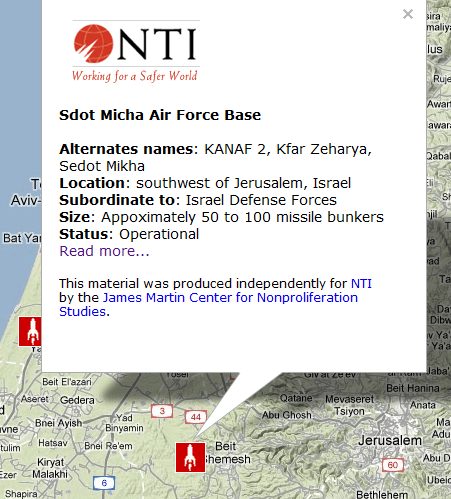
An exclusive report from a confidential highly-placed Israeli source says that a booby-trapped drone crashed and exploded at the top-secret Israeli airbase Sdot Micha.  Sdot Micha (also profiled here) is the home of the Israeli missile arsenal including its long-range Jerichos capable of striking Iran.  There were civilian and military eyewitnesses to the crash, which happened within the perimeter fence of the facility, which covers a large area just outside Bet Shemesh.

The eyewitnesses and Israel’s wish to avoid pressure to retaliate against the Iranians, necessitated the publication of a media cover story.  The story claims an advanced Israeli drone crashed near the Yesodot moshav, 10 miles from Sdot Micha.  Israel also claims the drone took off from Tel Nof airbase.  Eyewitnesses may be able to produce video documentation of the precise location of the crash unless it is impounded by the IDF.

The cover story reminds me in crucial ways of a similar one put out by the U.S. when it lost control of its advanced drone inside Iran.  It did everything in its power to make the world believe that the drone crashed by accident and we vehemently denied it was brought down by Iranian electronic warfare capability.  The more we denied the more people believed we were protesting too much.

Though crashing a drone inside Israel would appear to have Iran’s fingerprints all over it (they would certainly have greatest motivation), it’s hard to believe that Iran could fly a drone 1,000 miles with such precision.  So blame will inevitably fall upon Hezbollah, a Syrian-Iranian ally, which often procures its most advanced weaponry from Iran.  Hezbollah would’ve launched the drone from southern Lebanon.  But I find it unlikely it could master the technological know-how to bring this off without Iranian engineering assistance.

There were no Israeli casualties and the drone explosion caused no significant damage at the base.  But the very fact that Iran or its allies have escalated the psychological war of nerves in such a fashion will raise the temperature inside Israel once the true story is known.  It will confirm among the hawks like Bibi, Barak and Bogie Yaalon the imperative to attack Iran.  And the average Israeli man in the street will be that much more accepting of war given this new level of threat.  But the “beauty” (if such a phrase is appropriate) of a drone attack is that, like the Mossad assassination of nuclear scientists, it’s hard to figure out precisely who is to blame for the attack.  In that sense, it raises the temperature, but does so in a carefully calibrated way.

The fact that Israel could not detect such a threat and stop it before it did its damage indicates also some gaps in Israel’s defensive systems.  Admittedly, drones are hard to defend against and Iran/Hezbollah may not have many at their disposal.  But they clearly can do significant damage as we’ve seen from U.S. drone strikes in Pakistan.  Imagine a drone equipped with a warhead (the current one appeared only to be booby-trapped, but not equipped with a warhead or missile) taking aim at the Kirya?  That, of course, would be the next stage of development and one Israel might expect in the not too distant future.  Certainly, a far more sophisticated step than merely crashing a drone into an airbase.  But by no means beyond the realm of possibility for Iranian engineers at some point.

I have always argued that there is a price to pay for Israel’s black ops campaign against Iran.  In this case, the price was very low.  But it will not always be so.  There’s always a price to pay.  The only question is when you’ll have to pay and how much.

Dempsey Told Israelis U.S. Won’t Join Their War on Iran

February 2, 2012

Dempsey Told Israelis U.S. Won’t Join Their War on Iran – IPS ipsnews.net.

By Gareth Porter*


WASHINGTON, Feb 1, 2012 (IPS) – Chairman of the Joint Chiefs of Staff Gen. Martin Dempsey told Israeli leaders Jan. 20 that the United States would not participate in a war against Iran begun by Israel without prior agreement from Washington, according to accounts from well-placed senior military officers.

Dempsey’s warning, conveyed to both Prime Minister Benjamin Netanyahu and Israeli Defence Minister Ehud Barak, represents the strongest move yet by President Barack Obama to deter an Israeli attack and ensure that the United States is not caught up in a regional conflagration with Iran.

But the Israeli government remains defiant about maintaining its freedom of action to make war on Iran, and it is counting on the influence of right-wing extremist views in U.S. politics to bring pressure to bear on Obama to fall into line with a possible Israeli attack during the election campaign this fall.

Obama still appears reluctant to break publicly and explicitly with Israel over its threat of military aggression against Iran, even in the absence of evidence Iran has decided to build a nuclear weapon.

Dempsey’s trip was highly unusual, in that there was neither a press conference by the chairman nor any public statement by either side about the substance of his meetings with Israeli leaders. Even more remarkable, no leak about what he said to the Israelis has appeared in either U.S. or Israeli news media, indicating that both sides have regarded what Dempsey said as extremely sensitive.

The substance of Dempsey’s warning to the Israelis has become known, however, to active and retired senior flag officers with connections to the JCS, according to a military source who got it from those officers.

A spokesman for the Joint Chiefs of Staff, Commander Patrick McNally, offered no comment Wednesday when IPS asked him about the above account of Dempsey’s warning to the Israelis.

The message carried by Dempsey was the first explicit statement to the Netanyahu government that the United States would not defend Israel if it attacked Iran unilaterally. But Defence Secretary Leon Panetta had given a clear hint in an interview on “Face the Nation” Jan. 8 that the Obama administration would not help defend Israel in a war against Iran that Israel had initiated.

Asked how the United States would react if Israel were to launch a unilateral attack on Iran, Panetta first emphasised the need for a coordinated policy toward Iran with Israel. But when host Bob Schieffer repeated the question, Panetta said, “If the Israelis made that decision, we would have to be prepared to protect our forces in that situation. And that’s what we’d be concerned about.”

Defence Minister Barak had sought to dampen media speculation before Dempsey’s arrival that the chairman was coming to put pressure on Israel over its threat to attack Iran, but then proceeded to reiterate the Netanyahu-Barak position that they cannot give up their responsibility for the security of Israel “for anyone, including our American friends”.

There has been no evidence since the Dempsey visit of any change in the Netanyahu government’s insistence on maintaining its freedom of action to attack Iran.

Dempsey’s meetings with Netanyahu and Barak also failed to resolve the issue of the joint U.S.-Israeli military exercise geared to a missile attack, “Austere Challenge ’12”, which had been scheduled for April 2012 but had been postponed abruptly a few days before his arrival in Israel.

More than two weeks after Dempsey’s meeting with Barak, the spokesman for the Pentagon, John Kirby, told IPS, “All I can say is that the exercise will be held later this year.” That indicated that there has been no major change in the status of U.S.-Israeli discussions of the issue since the postponement of the exercise was leaked Jan. 15.

The postponement has been the subject of conflicting and unconvincing explanations from the Israeli side, suggesting disarray in the Netanyahu government over how to handle the issue.

To add to the confusion, Israeli and U.S. statements left it unclear whether the decision had been unilateral or joint as well as the reasons for the decision.

Panetta asserted in a news conference Jan. 18 that Barak himself had asked him to postpone the exercise.

It now clear that both sides had an interest in postponing the exercise and very possibly letting it expire by failing to reach a decision on it.

The Israelis appear to have two distinct reasons for putting the exercise off, which reflect differences between the interests of Netanyahu and his defence minister.

Netanyahu’s primary interest in relation to the exercise was evidently to give the Republican candidate ammunition to fire at Obama during the fall campaign by insinuating that the postponement was decided at the behest of Obama to reduce tensions with Iran.

Thus Mark Regev, Netanyahu’s spokesman, explained it as a “joint” decision with the United States, adding, “The thinking was it was not the right timing now to conduct such an exercise.”

Barak, however, had an entirely different concern, which was related to the Israeli Defence Forces’ readiness to carry out an operation that would involve both attacking Iran’s nuclear facilities and minimising the Iranian retaliatory response.

A former U.S. intelligence analyst who followed the Israeli military closely told IPS he strongly suspects that the IDF has pressed Barak to insist that the Israeli force be at the peak of readiness if and when they are asked to attack Iran.

The analyst, who insisted on anonymity because of his continuing contacts with U.S. military and intelligence personnel, said the 2006 Lebanon War debacle continues to haunt the thinking of IDF leaders. In that war, it became clear that the IDF had not been ready to handle Hezbollah rocket attacks adequately, and the prestige of the Israeli military suffered a serious blow.

The insistence of IDF leaders that they never go to war before being fully prepared is a primary consideration for Barak, according to the analyst. “Austere Challenge ’12” would inevitably involve a major consumption of military resources, he observes, which would reduce Israeli readiness for war in the short run.

The concern about a major military exercise actually reducing the IDF’s readiness for war against Iran would explain why senior Israeli military officials were reported to have suggested that the reasons for the postponement were mostly “technical and logistical”.

The Israeli military concern about expending scarce resources on the exercise would apply, of course, regardless of whether the exercise was planned for April or late 2012. That fact would help explain why the exercise has not been rescheduled, despite statements from the U.S. side that it will be.

The U.S. military, however, has its own reasons for being unenthusiastic about the exercise. IPS has learned from a knowledgeable source that, well before the Obama administration began distancing itself from Israel’s Iran policy, U.S. Central Command chief James N. Mattis had expressed concern about the implications of an exercise so obviously based on a scenario involving Iranian retaliation for an Israeli attack.

U.S. officials have been quoted as suspecting that the Israeli request for a postponement of the exercise indicated that Israel wanted to leave its options open for conducting a strike on Iran’s nuclear facilities in the spring. But a postponement to the fall would not change that problem.

For that reason, the former U.S. intelligence analyst told IPS he doubts that “Austere Challenge ’12” will ever be carried out.

But the White House has an obvious political interest in using the military exercise to demonstrate that the Obama administration has increased military cooperation with Israel to an unprecedented level.

The Defence Department wants the exercise to be held in October, according to the military source in touch with senior flag officers connected to the Joint Chiefs.

*Gareth Porter is an investigative historian and journalist specialising in U.S. national security policy. The paperback edition of his latest book, “Perils of Dominance: Imbalance of Power and the Road to War in Vietnam”, was published in 2006.

Nearing a decision on Irannhall Conservative

February 2, 2012

Nearing a decision on Iran – Cal Thomas – Townhall Conservative.

One of several casualties of the vitriolic name-calling between Republican presidential candidates Mitt Romney and Newt Gingrich is what to do about Iran.

In interviews, Romney has spoken about tougher sanctions, but it’s been difficult to consider the candidates’ positions on Iran — or much else — with the childish talk about who is the bigger liar.

James Clapper, director of National Intelligence, testified Tuesday before the Senate Intelligence Committee. Clapper said that while American sanctions are likely to have a greater impact on Iran’s nuclear program, they are not expected to lead to the demise of Iran’s leadership.

Clapper said, “We assess Iran is keeping open the option to develop nuclear weapons, in part by developing various nuclear capabilities that better position it to produce such weapons, should it choose to do so.”

Given the apocalyptic statements from Iran’s leadership, is anyone in doubt about Iran’s intentions? Clapper said Iran is expanding its capability to enrich uranium and that the end product can be used for either civil or weapons purposes.

Clapper acknowledged “Iran’s technical advancement, particularly in uranium enrichment, strengthens our assessment that Iran has the scientific, technical, and industrial capacity to eventually produce nuclear weapons, making the central issue its political will to do so.”

The central issue for Israel and the United States is this: can Iran be stopped by a pre-emptive attack, or must we wait until it launches — or threatens to launch — a nuclear missile at Israel, or explodes — or threatens to explode — “suitcase bombs” in U.S. cities?

In the English edition of “Israel Hayom,” the largest circulation Hebrew daily in Israel, former Israeli diplomat Yoram Ettinger writes about the history of pre-emptive strikes that did not materialize and the consequences of waiting to be attacked before acting.

Ettinger believes the reluctance to engage in a pre-emptive strike on Iran’s nuclear facilities “is harmful, ignores precedents, plays into Iran’s hands and threatens Israel’s existence” because it conveys “hesitancy, skepticism and fatalism, aiming to preclude pre-emption and assuming that Israel can co-exist with a nuclear-armed Iran,” which of course it cannot, anymore that the United States could have co-existed with Cuba when the Soviet Union placed nuclear missiles there during the Kennedy administration.

The continuing problem for the United States is that every modern administration has falsely believed that what Israel and America do or don’t do can deter the stated objectives of radical Arab and Muslim leaders.

The history and consequences of American and Israeli reluctance to engage in pre-emption has been chronicled by Ettinger. Here are two of several examples: Oct. 5, 1973: Israeli Prime Minister Golda Meir rejected the option of a pre-emptive strike against mobilizing Egyptian and Syrian troops. Meir didn’t want to appear as the aggressor and damage ties with the U.S., which was pressuring Israel to do nothing, probably out of fear the incendiary situation would be “inflamed.” Following the resultant Yom Kippur War, many came to view the cost of waiting as greater than it might have been had Israel attacked first.

In June 1981, Israeli Prime Minister Menachem Begin considered a pre-emptive strike against Iraq’s nuclear reactor. Most of the intelligence and military leadership in Israel opposed action. Begin concluded, correctly, the cost of restraint would be greater than the cost of action. The surprise Israeli air strike took out the reactor under construction near Baghdad. The United Nations Security Council denounced the attack and the Reagan administration issued the pro forma denunciations of Israel’s actions, though there were reports the president tacitly approved. The results were favorable to Israel and the U.S., delaying further action against Saddam Hussein until Desert Storm in 1991 and his ultimate overthrow in 2003.

Now Israel and the U.S. are faced with another choice: a pre-emptive strike that would setback, or destroy Iran’s nuclear capabilities, or wait and see what might happen. Does anyone — other than Ron Paul — deny the disaster that might occur if Iran had a nuclear device and the capability to deliver it against targets in Israel and America?

As the joke goes, “denial is not just a river in Egypt.”

Cal Thomas is co-author (with Bob Beckel) of the book, “Common Ground: How to Stop the Partisan War That is Destroying America“.

Egypt’s Muslim Brotherhood uses Palestinian Hamas as channel to Tehran

February 2, 2012

DEBKAfile, Political Analysis, Espionage, Terrorism, Security.

DEBKAfile Exclusive Report February 1, 2012, 10:13 PM (GMT+02:00)


Hamas leader Khaled Meshaal and Jordan’s King Abdullah

As one Palestinian Hamas leader, Prime Minister Ismail Haniyeh, heads to Tehran, the Hamas politburo in Damascus, contrary to reports in the West of a cutoff, firmly maintains his ties with the Assad regime, the Iranian Revolutionary Guards operating in the Syrian capital and Beirut as well as with Hizballah, debkafile‘s Israeli and Western military sources report.

debkafile‘s intelligence sources also stress there is no sign of Hamas leaders seeking to break their ties with Iran, which has for years supplied them with funds and weapons.

Indeed, the forthcoming Haniyeh visit to Tehran is welcomed by the Egyptian Muslim Brotherhood, Hamas’s parent organization, as the lock for opening a secret back channel through which the Brotherhood is keen to mend its fences with the Iranian leadership.

Some Hamas politburo officials have indeed left Damascus, but its operations and intelligence command centers remain in situ. debkafile‘s Middle East sources report that Meshaal for the past two years has resided in the Qatari capital of Doha, and his wife and children live in Amman, Jordan; his deputy, Musa Abu Marzouk, moved this year with his family from Damascus to Cairo; Mohammad Nazal, Hamas political bureau secretary, relocated with family to Jordan; and Imad al-Alami, who commanded Hamas cells in Lebanon and moved in the past six months to Doha.
The rest of the staff hold down the Hamas fort in the Syrian capital under the command of intelligence chief Izat Rishak who is in regular touch with the various Syrian intelligence and security commands in Damascus and Iranian Revolutionary Guards officers.

Izak has risen to the status of Hamas strongman, according to our sources, and the recognized superior commander of the Gazan military wing Ezz e-din al-Qassam and its chief Muhammad Jabary.

Some Western and Israeli circles have presented the Hamas as bolting from its Damascus headquarters as evidence that the Palestinian fundamentalists have turned their backs on the radical Iranian-Sytrian-Hizballah bloc and opted to throw in their lot with the pro-Western moderates of the Arab world. Speculation has been rife that Meshaal, 55, who was said to have offered to resign the politburo post after 14 years, was about to line up with the Palestinian Authority Chairman, Fatah leader Mahmoud Abbas and his tactic of declaring  opposition to terrorism and advocacy of “popular resistance” to Israel.

This, according to our sources, is far from the true state of affairs.

Our Middle East sources cite the conditions under which Meshaal was allowed to officially visit Amman Sunday, Jan. 29 for the first time since King Abdullah’s father Hussein threw him out of the kingdom in 1999.
Abdullah II, who works closely with Saudi and Qatari intelligence, refused to receive the Hamas leader and his delegation as an independent delegation. They were only admitted as part of the entourage of Qatari Crown Prince Tamim bin Hamad al-Thani. The Hamas group was forced to wait outside until the king and the Qatari prince had finished their conversation and only then were invited to enter the palace guest chamber.

Over the lunch the Jordanian monarch held for his guests, the Qatari prince and entourage sat at the top table with the king, while the Hamas officials were relegated to a smaller side table.
The king made it clear that Meshaal was only invited to Amman after signing a Palestinian unity accord with Mahmoud Abbas in Cairo last month. His next visit was contingent on his upholding it. On no account would the Jordanian king hear of Hamas opening offices in Jordan or carrying out any diplomatic or military business from the kingdom – certainly not among West Bank Palestinians.

The Hamas leader promised to refrain from activity among Jordan’s Palestinian community.
Our Middle East sources say that the Jordanian monarch was briefed by Riyadh and Doha before receiving Meshaal & Co.  According to their intelligence, Meshaal and his three colleagues ‘ removal from Damascus had nothing to do with any wish to distance their organization from the beleaguered Assad regime. They received orders from the Muslim Brotherhood in Egypt to relocate outside the Syrian capital for three reasons:

1. The Hamas politburo could not afford to be seen in bed with Assad while his regime was hounding the Syrian Muslim Brotherhood to extinction.

2. The Hamas politburo was ordered to get ready to seize control of the Palestinian Authority in Ramallah – as the terrorist group did in Gaza – as part of the Muslim Brotherhood’s strategy for attaining rule in Tunisia, Libya, Egypt and soon Syria.

3. The Egyptian Muslim Brotherhood’s relations with Tehran and Damascus are at a low point but need not always stay that way. Maintaining the ties between the Palestinian Hamas and Iran gives the Brotherhood a useful back channel for mending relations. Haniyeh is travelling to Tehran with the Egyptian Brotherhood’s blessing.

Therefore, the claim that Khaled Meshaal has turned moderate and away from extremist Iran and Syria has no foundation in fact.

Chief of Staff: Next War will be Short and Harsh

February 2, 2012

Chief of Staff: Next War will be Short and Harsh – Defense/Security – News – Israel National News.

Maj. Gen. Gantz: Eight Syrian divisions between Golan and Damascus could become active “tomorrow morning.”
By Gil Ronen

First Publish: 2/1/2012, 10:57 PM


Chief of General Staff, Lt. Gen. Benny Gantz, painted a worrying picture of the military threat to Israel in a speech at the annual Herzliya Conference on Wednesday.

“The threats against Israel have not disappeared,” he said. “What was relevant in the past remains relevant. Eight Syrian military divisions are stationed between the Sea of Galilee and Damascus. These forces are currently inactive, but that may change tomorrow morning.”

“An extraordinary amount of [enemy] ordnance covers every region of Israel,” Gantz said. “Every region in Israel is currently under threat. Our enemies are trying to create a military system that skips over Israel’s defense capabilities and directly targets the strategic depth of the State of Israel.”

The enemy wants to damage Israel’s ability to function in the next war, he explained. They want to “wreak destruction and generate a victory story for the day after. They understand that the campaign will be short and harsh, but they will try and hit us hard to generate these achievements.” All this, he said, is part of the ongoing Arab strategy of “strategic attrition” against Israel, adopted when conventional wars proved unable to defeat the Jewish state.

Gaza and Lebanon are “two of the largest ammunition and weapon ‘storage facilities’ I know,” he said, owned by Hizbullah, Islamic Jihad, and other terror organizations. “The Middle East is currently arming more than any other region in the world, and we are the target of all this ammunition.”

“Our enemies acknowledge the strength of the IDF, they have seen it in the past and they understand what a western force with high-tech weapons is capable of.” Besides conventional military means, he said, they have taken to operating from within urban regions, where they take advantage of innocent civilian populations. “In Lebanon there are buildings that contain both civilian residential apartments and a ‘rocket room ‘– in the same building.”

According to Lt. Gen. Gantz, aside from complex fronts our enemies are also “planning attacks using high-tech rockets, portable systems such as anti-tank missiles, and accurate, target-specific and long-distance missiles. We saw this during the Second Lebanon War. Our Navy forces and strategic posts in the Mediterranean Sea are also under threat.”

The enemy is mainly targeting the Israeli home front and civilian population, “as an attempt to harm our operative capabilities.”

Lt. Gen. Gantz stressed that in the face of the different threats the IDF must continue to develop offensive capabilities, alongside accurate intelligence capabilities and air defenses for defending civilian populations. “It is crucial to ensure our infantry maneuvering capabilities. It must be strong, well-trained and well-equipped, since it will be required to operate in a field more challenging than ever. This is not an anti-tank missile fired from 300 meters we are taking about – this is an anti-tank missile that is accurately fired from six kilometers away.”

Lt. Gen. Gantz said that the IDF has grown much stronger in the past few years but needs to maintain this trend. “We are a powerful nation and if we don’t maintain this strength, we simply will not exist.”

Shalom: Sanctions on Iran Must be Toughened Now

February 2, 2012

Shalom: Sanctions on Iran Must be Toughened Now – Defense/Security – News – Israel National News.

Deputy Prime Minister Silvan Shalom: If the sanctions against Iran are not toughened, it will take over the Middle East.
By Elad Benari

First Publish: 2/2/2012, 6:43 AM


Vice PM Silvan Shalom

Vice PM Silvan Shalom
Yoni Kempinski

Deputy Prime Minister Silvan Shalom said on Wednesday that harsher sanctions must be imposed on Iran in order to stop its nuclear program. He made the comments during a panel with government ministers from other countries, which was held as part of the 12th Annual Herzliya Conference.

“Israel is the sole partner of the West, the only country in the Middle East that the West can trust and if the international community and the West do not want Iran to take over and dominate the oil resources of the entire world, the sanctions must be toughened and broadened,” Shalom said.

He added, “We are very, very close to the deciding point and imposing harsh and widespread sanctions also on Iran’s Central Bank is critical at this time. Sanctions may lead to a change of perception in Iran. Now they think that acquiring nuclear weapons will keep the regime’s survivability, but sanctions will lead to the necessary recognition that only if they abandon the nuclear program will they be able to continue to rule.”

Shalom, who said Israel welcomes the European Union’s decision to slap an embargo on Iranian oil, stressed that Iran wishes to control the oil reserves in the entire Middle East, and as such, sanctions on its Central Bank should be the next step. He added that Russia and China are refusing to impose sanctions on the Islamic Republic because they do not want to allow the Western world to control their oil reserves.

“It is time that the world understands that we are all in this together against the threat of terrorism and the Iranian nuclear program,” said Shalom. “The world should support our position, both on the Iranian issue as well as on the Palestinian issue.”

Also taking part in the discussion was Canada’s Foreign Minister, John Baird, who said the West shares the challenge of terrorism with Israel.

“We see Iran developing nuclear weapons and approaching the moment where they will press the button, we hear what they say and know how far they can reach with their actions and therefore we need to take this seriously,” said Baird. “This is the time to double the sanctions and make them tougher.”

“There is a desire to avoid international crises and China is a very important customer, but they should think if they want the Iranians to put bombs in Egypt and if they want instability in Iran,” added Baird.

The day after Assad

February 2, 2012

The day after Assad – Israel Opinion, Ynetnews.

Op-ed: CNN correspondent Nic Robertson offers a rare look inside turbulent Syria

Nic Robertson

It wasn’t until I left Syria that I found the voice I’d been looking for. I was only hours out of the capital, and it came by surprise, a chance meeting at an airport on my way back to London.


He was a Syrian Christian, a member of one of the country’s larger minorities. They make up about 10% of the population. Many are businessmen; many have benefited from President Bashar al-Assad‘s rule.

His message was clear: We want change, but we don’t want uncertainty. “The opposition needs to reach out to us, tell us their vision of Syria.” Then, he said, they’d have 60% to 70% support: “Everyone in the middle ground, enough to overthrow the president.”


He was speaking out because he could, with no need to fear that al-Assad’s secret police would come knocking on his door. In Damascus and the rest of Syria, it had been different. None of the intellectuals, the businessmen, the others “in the middle” wanting al-Assad’s corrupt regime replaced dared raise the conversation beyond the mildest hint at change of some sort; “but not, of course, the president” is required.


Just one day of covering pro- and anti-government rallies convinced me of how polarized the country has become. People are metaphorically retreating to their confessional bunkers.


Al-Assad’s rallying cry is that only he can protect the country’s minorities: Christians like the man I met at the airport, Alawite like himself, about 15% of the population. He keeps the ethnic Kurds, a little less than 10%, on his side by courting their biggest tribes.


It’s a tactic that’s working. The Kurds don’t back him, but they haven’t turned against him as they did against his father. The Alawites who make up most of the officer corps in the army are still loyal, as are the Christians. But not without reservation.


A source close to the Saudi ruling circle told me Alawite generals threaten to abandon al-Assad if he makes them turn their guns on civilians in the streets of Damascus.


Several Westerners with detailed knowledge of the country expressed their frustration with the opposition, too. Why don’t they reassure the minorities they won’t face retribution once al-Assad is gone? They ask.


One opposition figure had threatened to wipe the Alawites off the map; another group said they would try al-Assad’s top 100 generals for war crimes. So far, according to these Westerners, leading opposition groups have not distanced themselves from the calls that serve only to reinforce al-Assad’s claims.


Blood spilled on both sides

Al-Assad’s track record charts a far different course. He and his father before him have assiduously sold their secular brand of socialism as the panacea for internal conflict. The truth is different, according to the Westerners: Al-Assad has been fermenting sectarian tensions. It is a lie that he is the defender of the minorities, they say.


It’s hard to escape the feeling in Damascus that the moment to reach out is being lost. But it’s easy to see why.


Al-Assad is utterly committed to a security crackdown, and the opposition is getting armed and fighting back. Blood is being spilled on both sides; more families are being affected and attitudes hardened.


It’s rapidly getting to the point where even if opposition leaders did want to reach out to the man or woman in the middle or an army general or two, the base supporters will have no stomach for compromise.


At anti-government rallies, time and again, we saw anger and frustration boiling over, people literally screaming in our faces for fear we didn’t get the desperation of their plight. Al-Assad’s strong-arm tactics denying free speech have ensured that the street voice for reform has metastasized into something far more malevolent.


In places like Homs, the cradle of the uprising, the writing is on the wall for the rest of the country. Some neighborhoods have thrown out the government completely, such as in the Baba Amr district, where the Free Syrian Army has control. Communities have divided on sectarian lines. Many Christians have fled to Damascus.


Garbage is piled high in the streets, electricity is cut, civilian causalities mount, and on the other side of the impromptu front-line barricades, the death toll of government soldiers creeps up as well.


A drive around Homs reveals a medieval-style siege, multiple checkpoints to move between neighborhoods, even a deep new ditch in places rings the city. But the uprising continues.


The opposition in Homs is better organized. A new council has been formed, it has a budget – money, some say, is coming from the Gulf – and runs medical and humanitarian supplies.


But the council is not the only show in town. Salafists are moving in too, Islamic radicals, many with terror tactics honed in neighboring Iraq. Reports abound of infighting both inside and outside Syria, the hard-liners already jockeying for post-al-Assad power.


If war escalates, as it surely seems it will, expect a long and bloody campaign. As the man in the middle I met on my way back to London told me: “We are afraid of the men with guns, afraid the radicals will impose their backwards views on us.”


CNN’s Nic Robertson and crew recently returned from a rare look inside Syria, where the government has been placing restrictions on international journalists and refusing many of them entry at all. While there, Robertson followed Arab League monitors already in the country and talked to the residents.

‘Begin military plans to thwart Iran nukes’

February 2, 2012

‘Begin military plans to thwart … JPost – Iranian Threat – News.

02/02/2012 03:02
Visiting Israel, ex-CIA chief James Woolsey calls for US air strikes to decimate the Iranian Revolutionary Guards.

Ex-CIA chief James Woolsey By REUTERS

Iran is working to obtain a nuclear weapon, a former CIA chief said Wednesday while visiting Israel, and the US should begin military preparations to block the Islamic Republic from reaching that goal.

“To believe anything other than that Iran is working to get a nuclear weapon is hopelessly naive,” James Woolsey said in an interview on the sidelines of the Herzliya Conference.

“At some point someone is going to have to decide to use force to prevent Iran from getting a nuclear weapon. I’d argue that those who say we can deal adequately with Iran through deterrence are quite naive.

“National survival is at issue. In the near term that’s the case for Israel, but in the somewhat longer term it is [the case] for the US, which from Iran’s point of view, is the ‘Great Satan,’” he continued. “This is a world-class problem, not an eastern Mediterranean or Persian Gulf problem. The politics of the world will change if this regime gets the bomb.”

Woolsey, a graduate of Yale Law School, was CIA director under president Bill Clinton from 1993 to 1995. The veteran intelligence official identifies himself as a Democrat, but has held high-level positions in administrations from both major parties, and has long advocated a robust US foreign policy, particularly in the Middle East.

Today, the 70-year-old is chairman of Foundation for Defense of Democracies, a Washington think tank.

Woolsey said commentators who view the Iranian nuclear threat through the prism of Cold War deterrence are misreading history.

“By the 1960s, the Soviets were operating with a nearly dead ideology,” he said.

“Though the Soviet leadership had many flaws – and I’m delighted we won the Cold War instead of them – by that time fanaticism was not one of their characteristics, at least for most of them.”

Debates over whether the Iranian regime is rational, he said, also miss the point.

“People who believe there are only two categories of individual – the rational and the stark-raving mad – are quite untutored in human psychology and human history,” he said.

“It’s not only raving lunatics who want to destroy a country, culture or civilization they hate.”

Woolsey said Iran’s theocratic leadership promotes an aggressive, totalitarian ideology akin to Nazi Germany and Fidel Castro’s Cuba.

“During the Cuban Missile Crisis, Castro knew Cuba would be destroyed, but he didn’t care. He felt that if the United States were destroyed, he’d be carrying out his life’s mission,” he said. “As for Hitler, he had a two-part plan: Kill the Jews and take over Europe. Iran’s President Ahmadinejad says he’s got a plan as well: Kill the Jews and take over the Middle East.

“There’s no basis for the proposition that if you’re so intemperate as to decide to use a nuclear weapon you are a blithering, incoherent fool. You might be a shrewd, nasty fool.”

Containing the Iranian threat, he said, will require a credible show of military force aimed at Iran’s Revolutionary Guards.

“They’re at the heart of this regime – they’re the instrument of oppression, and they run the Basij militia. They control the nuclear, space and ballistic- missiles program, as well as the Quds Force,” he said, referring to the Guards branch responsible for overseas operations.

“They’re at the heart of everything repressive internally, or aggressive externally.”

Woolsey suggested sending approximately five carrier battle groups – each comprising an aircraft carrier and its escort vessels – to the Indian Ocean, accompanied by bomber support, if possible.

“What these [battle groups] are capable of doing – should the trigger be pulled – is taking out everything related to the Revolutionary Guards,” he said. “Not the civilian infrastructure, not the electric grid, not the regular army, not civilian institutions.”

Still, he said, certain questions would need to be answered before forcibly engaging Iran, including: “How fast the nuclear enrichment is going; whether they’re working on a plutonium bomb as well; whether they’re working on a weapon that could be delivered, or something that would simply be detonated in the desert somewhere – like North Korea does to make clear they’re a nuclear power; or whether they’re more ambitious.

“All these could affect the specific tactics, but I don’t think these should affect the vigor of the sanctions, or preparations to take out the Guards.”

In such a scenario, he said, ground forces would be unnecessary.

“No one is suggesting ground troops or mass bombing of parts of Iran,” said Woolsey. “Instead, it would be an operation similar to what might have been suggested to the Royal Air Force sometime in the mid-1930s to take out the Gestapo, SS and stormtroopers.”

“The US conducted air operations like this twice in the 1990s in Serbia – once on behalf of the Bosnians, and once on behalf of the Kosovars – both Muslim peoples, by the way,” he added. “We didn’t lose a single aircraft or pilot, and now in Kosovo there is a Bill Clinton Avenue and statue.”

US, EU, Arab allies exploring prospects for Assad exile

February 2, 2012

US, EU, Arab allies exploring prospects fo… JPost – Middle East.

By REUTERS 02/02/2012 06:45
3 countries willing to take in Syrian leader, including UAE, sources say; “There are significant questions of accountability for the horrible abuses that have been committed,” US official cautions.

Syria's President Bashar Assad speaks in Damascus
By REUTERS/Syrian TV

WASHINGTON – The United States, European governments and Arab states have begun discussing the possibility of exile for Bashar Assad despite skepticism the defiant Syrian president is ready to consider such an offer, Western officials said on Wednesday.

While talks have not progressed far and there is no real sense that Assad’s fall is imminent, one official said as many as three countries were willing to take him as a way to bring an end to Syria’s bloody 10-month-old crisis.

Two sources said no European states were prepared to give Assad sanctuary, but one official said the United Arab Emirates might be among those open to the idea.

Talk of exile has surfaced amid mounting international pressure on Assad and a diplomatic showdown over a proposed Arab League resolution at the United Nations aimed at getting him to transfer power. He has responded by stepping up assaults on opposition strongholds.

With the White House insisting for weeks that Assad’s days in power are numbered, it was unclear whether this marks an attempt to persuade the Syrian leader and his family to grasp the chance of a safe exit instead of risking the fate of Libya’s Muammar Gaddafi, who was hunted and killed by rebels last year.

But with Assad showing he remains in charge of a powerful security apparatus and the Syrian opposition fragmented militarily, it could also be an effort to step up psychological pressure and open new cracks in his inner circle.

The officials, who spoke on condition of anonymity, said neither the United States nor the European Union had taken the lead on the idea, which has been advocated by Arab nations as a way to try to end the violence in Syria.

“We understand that some countries have offered to host him should he choose to leave Syria,” a senior Obama administration official said, without naming any of the countries.

Before that could happen, however, the question of whether Assad would be granted some kind of immunity would have to be tackled — something the Syrian opposition as well as international human rights groups would likely oppose.

“There are significant questions of accountability for the horrible abuses that have been committed against the Syrian people,” the senior US official said.

“Ultimately these issues will be deliberated by the Syrian people in concert with regional and international partners,” the official said. “This is about what Syrians need to end this crisis and begin the process of rebuilding their country.”

While US officials maintained that exile was worth exploring among other options, one European official voiced doubt it would work, saying Assad had given no indication that he might accept a graceful exit.

Officials stressed the discussions of the exile option for Assad were at an early stage and there was no agreed plan on how such an exit might be orchestrated.

A European official said EU members were willing to consider the idea of Assad going into exile but that there was “no way we’d have him in our countries.”

Much could depend on the fate of a European-Arab-drafted resolution in the UN Security Council that would call for Assad to hand powers to his deputy to defuse the uprising against his family’s dynastic rule.

Russia said on Wednesday it would veto any resolution on Syria that it finds unacceptable, after demanding any measure rule out military intervention to halt the bloodshed touched off by protests against Assad.


