Archive for January 28, 2012

Syrian opposition council accuses Iran of role in bloody crackdown

January 28, 2012

Syrian opposition council accuses Iran of role in bloody crackdown.

Saturday, 28 January 2012

Syrian protesters step on a poster of Syrian President Basahr al-Assad and Lebanon's Hezbollah leader Sayyed Hassan Nasrallah during a protest against Syrian President Bashar al-Assad in Saqba, Jan. 27, 2012. (REUTERS)

Syrian protesters step on a poster of Syrian President Basahr al-Assad and Lebanon’s Hezbollah leader Sayyed Hassan Nasrallah during a protest against Syrian President Bashar al-Assad in Saqba, Jan. 27, 2012. (REUTERS)

The opposition Syrian National Council on Saturday accused Iran of “participation” in the bloody crackdown on protests in Syria and called on Tehran to stop supporting the Damascus regime.

“The Council condemns the participation of the Iranian regime in the massacre of Syrians who demand freedom and call on it to stop taking part in the repression of the Syrian revolution in order to protect relations between the two peoples,” Samir Neshar, a member of the SNC’s executive committee, said at a news conference in Istanbul.

On Saturday, a group of Syria’s opposition Free Army released a video showing what it was said were seven Iranians, including five members of the Revolutionary Guards, captured in the city of Homs.

The video showed travel documents of the captives, some of whom appeared to be speaking Farsi.

“I am Sajjad Amirian, a member the Revolutionary Guards of the Iranian armed forces. I am a member of the team in charge of cracking down on protesters in Syria and we receive our orders directly from the security division of the Syrian air force in Homs,” one of the captives said.

“I urge Mr. Khamenei to work on securing our release and return to our homes,” he added.
The armed Syrian opposition group, which called itself the “al-Farouq brigade of the Free Syrian Army,” also released a statement calling for Iran’s Supreme leader Ali Khamanei to “acknowledge in explicit and unambiguous words the existence of elements of Iran’s Revolutionary Guards in Syria in order to help the Assad’s regime in its crackdown on the Syrian people.”

The group also urged Khamanei to withdraw all Revolutionary Guard fighters from Syria, pledging that that it would then release all captive Iranian fighters.

The group said five of those abducted were military men working with the Syrian air force intelligence and two showed “civilian status” as employees in a power plant in Homs.

It added that all the seven captives entered Syria during the uprising and passports of the five military men did not contain visas, adding that it would soon release the two Iranians with civilian status.

Syrian opposition groups have previously accused Iran and the Lebanese Hezbollah group of assisting forces of President Bashar al-Assad in their bloody crackdown on protesters.

The Syrian Revolutionary Coordination Union reported on Jan. 17 that a group of Hezbollah fighters had hit civilian protesters near Damascus with Russian-origin BM-21Grad rockets.

“The attack was coordinated with the forces of President Bashar Assad,” the Syrian opposition group said.

A source from the Iranian Revolutionary Guard Corps (IRGC) told Al Arabiya on Jan. 16 that the “Iranian government has not yet interfered in situation in Syria,” but stressed that Tehran was committed to a joint defense treaty with Damascus.

“We and our brethren in Iraq and Lebanon are protecting Syria,” the source explained in a clear reference to Nouri al-Malikil’s government and Hezbollah, both allies of Iran.

Despite reports stating that so far the situation in Syria is “stable,” the IRGC, the source pointed out, is still worried of a division or a coup in the Syrian army.

According to American officials who believe the IRGC is taking part in the fight against Syrian opposition, Maj. Gen. Qassem Suleimani, commander of IRGC al-Quds Force, which specializes in operations outside Iran, was in Damascus this month.

Gen. Suleimani’s visit, they argued proved that Iran’s support for the Syrian regime includes the provision of arms and military equipment.

They added that they are sure Suleimani met with the most senior officials in the Syrian regime, including president Bashar al-Assad.

The joint defense treaty between Syria and Iran was signed in June 2006 by a former Syrian defense minister, Hassan Turkmani, and his Iranian counterpart, Mustafa Mohamed Najjar, in Tehran.

Arab League, Russia in talks over Syria situation

January 28, 2012

Arab League, Russia in talks over Syria situ… JPost – Headlines.

By REUTERS 01/28/2012 16:31

CAIRO – The Arab League is in talks with Russia ahead of a meeting at the UN Security Council in New York to discuss the escalation of violence in Syria, the deputy secretary-general told Reuters.

“There are ongoing talks and consultations between the Arab League and Russia over the Syria file,” Ahmed Bin Hali said at the League in Cairo on Saturday.

“Yesterday there was a call between the Russian Foreign Minister Sergei Lavrov with Secretary-General Nabil el-Araby regarding the latest developments in the Syrian situation.”

Russia’s UN Ambassador Vitaly Churkin said a European-Arab draft resolution on Syria circulated to the UN Security Council on Friday was unacceptable in parts, but Russia was ready to “engage” on it.

“The purpose of all the Arab League’s international talks is to ensure enough support for the Arab plan regarding Syria which will be presented to the Security Council in the middle of this week,” Bin Hali said.

IAEA officials head to Iran seeking cooperation on nuclear issue

January 28, 2012

IAEA officials head to Iran seeking cooperation on nuclear issue – Haaretz Daily Newspaper | Israel News.

Sources says the visit will not involve inspections of nuclear facilities but rather on resuming talks on Iran’s disputed nuclear program.

By DPA

Officials from the United Nations nuclear agency departed for Iran on Saturday for talks aimed at allaying concerns that Iran is seeking a nuclear weapon.

“We are looking forward to start with a dialogue, a dialogue that is overdue since very long,” International Atomic Energy Agency (IAEA) chief inspector Herman Nackaerts said before boarding a plane in Vienna, where the agency is based.

Herman Nackaerts Jan. 28, 2012 (Reuters) Herman Nackaerts (L), head of a delegation of the International Atomic Energy Agency (IAEA), talks to journalists on his way to Iran at the international airport in Vienna, January 28, 2012.
Photo by: Reuters

“In particular we hope that Iran will engage with us on our concerns regarding the possible military dimensions of Iran’s nuclear program,” added Nackaerts, who is heading the team along with Rafael Grossi, a top advisor to IAEA director Yukiya Amano.

Iran has said it will cooperate with the IAEA team during their three-day visit but indicated it would not give up uranium enrichment, which it considers a sovereign right.

“We have always been open with regards to our nuclear issues and the IAEA team coming to Iran can make the necessary inspections,” Ali-Akbar Velayati, advisor to Supreme Leader Ayatollah Ali Khamenei, told the ISNA news agency.

“We will however not withdraw from our nuclear rights as we have constantly acted within international regulations and in line with the laws of the non-proliferation treaty,” said Velayati.

There has been speculation in Iran that the IAEA team might be allowed to visit the Fordo uranium enrichment facility south of the capital Tehran, which will become operational next month.

However, sources close to the Vienna-based IAEA said the visit would not involve inspections of nuclear facilities but would focus on resuming talks on Iran’s disputed nuclear program, which the West suspects has a military dimension.

Iran has since 2008 declined to fully cooperate with the IAEA and denies it is seeking a nuclear bomb.

The visit could pave the way for the resumption of the talks between Iran and world powers Britain, China, France, Germany, Russia and the United States. The last round of talks in January 2011 ended without a breakthrough.

Column One: The Zionist imperative

January 28, 2012

Column One: The Zionist imperativ… JPost – Opinion – Columnists.

We must hope that world Jewry will recognize today that the fate of the Jewish people in Israel and throughout the world is indivisible.
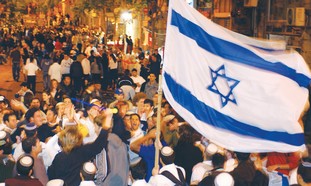
Israelis celebrating Independence Day By Ariel Jerozolimski European and American perfidy in dealing with Iran’s nuclear weapons program apparently has no end. This week we were subject to banner headlines announcing that the EU has decided to place an oil embargo on Iran. It was only when we got past the bombast that we discovered that the embargo is only set to come into force on July 1.

Following its European colleagues, the Obama administration announced it is also ratcheting up its sanctions against Iran… in two months. Sometime in late March, the US will begin sanctioning Iran’s third largest bank.

At the same time as the Europeans and the Americans announced their phony sanctions, they reportedly dispatched their Turkish colleagues to Tehran to set up a new round of nuclear talks with the ayatollahs. If the past is any guide, we can expect for the Iranians to agree to sit down and talk just before the oil embargo is scheduled to be enforced. And the Europeans – with US support – will use the existence of talks to postpone indefinitely the implementation of the embargo.

There is nothing new in this game of fake sanctions. And what it shows more than anything is that the Europeans and the Americans are more concerned with pressuring Israel not to attack Iran’s nuclear installations than they are in preventing Iran from becoming a nuclear power.

Obama has a second target audience – American Jews. He is using his fake sanctions as a means of convincing American Jews that he is a pro-Israel president and that in the current election season, not only should they cast their votes in his favor, they should sign their checks for his campaign.

Both Prime Minister Binyamin Netanyahu and Defense Minister Ehud Barak were quick this week to make clear that these moves are insufficient. They will not force Iran to abandon its nuclear weapons program. More is needed.

As to American Jewry, the jury is still out.

In truth, American Jewry’s diffidence towards taking a stand on Iran, or recognizing Obama’s dishonesty on this issue specifically and his dishonesty regarding his position on US-Israel ties generally is not rooted primarily in American Jews’ devotion to Obama. It isn’t even specifically related to American Jewry’s devotion to the political Left. Rather it has to do with American Jewish ambivalence to Israel.

The roots of that ambivalence – which is shared by other Western Jewish communities to varying degrees – predate Obama’s presidency.

Indeed, they predate the establishment of the State of Israel. And now, as the US and the EU have given Iran at least another six months to a year to develop its nuclear bombs unchecked, it is worth considering the nature and influence of this ambivalence.

Today’s principal form of Jew-hatred is anti- Zionism. Anti-Zionism is similar to previous dominant forms of Jew hatred such as Christian anti-Judaism, xenophobic and racist anti- Semitism, and Communist anti-Jewish cosmopolitanism in the sense that it takes dominant, popular social trends and turns them against the Jews. Anti-Zionism’s current predominance owes to the convergence of several popular social trends which include Western post-nationalism, and anti-colonialism.

The problem that anti-Zionism poses for American Jewry is that it forces them to pay a price for supporting Israel. This is problematic because Zionism has never been fully embraced by American Jewry. Since the dawn of modern Zionism, the cause of Jewish self-determination placed American Jewish leaders in an uncomfortable dilemma.

UNLIKE EVERY other Diaspora Jewish community, the American Jewish community has always perceived itself as a permanent community rather than an exilic community. American Jews have always viewed the United States as the new Promised Land.

With the formation of the modern Zionist movement in the late 19th century, American Jews found themselves on the horns of a dilemma. Clearly, the state of world Jewry was such that national self-determination had become an existential necessity for non-American Jews.

But while supporting Jewish refugees and a scrappy little country was okay, support for the Zionist cause of Jewish national liberation involved an acceptance of the fact that Israel – not the US – is the Jewish homeland. Moreover, it involved accepting that there are Jewish interests that are independent of – if not necessarily in contradiction with – American interests. For instance, irrespective of the prevailing winds in Washington, and regardless of whether the US supports Israel or not, it is a Jewish interest that Israel exists, thrives and survives.

In a recent op-ed in Haaretz, Hebrew University political science professor Shlomo Avineri contrasted world Jewry’s massive mobilization on behalf of Soviet Jewry in the 1970s and 1980s and their relative silence today in the face of Iran’s Holocaust denial and open calls for the annihilation of the Jewish state. Avineri is apparently confounded by the disparity between Western Jewry’s behavior in the two cases.

But the cause of the disparity is clear. Supporting the right of Soviet Jews to emigrate was easy. Unlike Israel, Soviet Jews were powerless.

As such, they were pure victims and supporting them cost Diaspora Jews nothing in terms of their position in their societies. Just as important, the cause of freedom for Soviet Jewry was perfectly aligned with the West’s Cold War policies against the Soviet Union.

The frequent Jewish demonstrations outside Soviet legations provided Western leaders with another tool to fight the Cold War.

In contrast, supporting Israel, and the cause of Jewish freedom and self-determination embodied by Zionism, is not cost-free for Diaspora Jews. At root, to support Israel and Zionism involves accepting that Jews have inherent rights as Jews. To be a Zionist Jew in the Diaspora means that you embrace and defend the notion that the Jews have the right to their own interests and that those interests may be distinct from other nations’ interests. That is, to be a Zionist involves rejecting Jewish assimilation and embracing the fact that Jews require national independence and power to guarantee our survival. And this can be unpleasant.

PRO-ISRAEL AMERICAN Jews have historically tried to tie their support for Israel to larger, more universal themes, in order to extricate themselves from the need to admit that as Jews and supporters of Israel they have a right and a duty to support Jewish freedom even if it isn’t always pretty. Again, for Israel’s first several decades, it was about helping poor Jews and refugees. In recent years, the predominant defense has been that Israel deserves support because it is a democracy.

Certainly, these are both reasonable reasons for supporting Israel. But neither support for Israel because it was poor nor support for Israel because it is free is a specifically Zionist reason for supporting Israel. You don’t have to be a Zionist to support poor Jewish refugees and you don’t have to be a Zionist to support democracy.

You do have to be a Zionist however, to defend the Jews in Israel and throughout the world in a coherent manner when the predominant form of Jew-hatred is anti-Zionism.

You have to be willing to accept and defend the right of the Jewish people to freedom and self-determination in our national homeland against those who deny that right. You have to be a Zionist to defend Israel’s right to survive and thrive even though it is no longer poor and its democratically elected government is not liked by the Obama administration.

And you have to be a Zionist to realize that since Jewish survival is dependent on Jewish power, and anti-Zionists reject the right of Jews to have power, that anti-Zionists seek to bring about a situation where Jewish survival is imperiled.

The weakness of American Jewry’s response to Iran’s genocidal intentions towards Israel is of a piece with its weak response to the forces of anti-Zionism generally and to Jewish anti- Zionists particularly. Since 2007, the US government has effectively ruled out the use of force against Iran’s nuclear weapons program and embraced a policy of pursuing negotiations with ayatollahs while enacting impotent sanctions to quell congressional pressure. At least in part, this policy is due to the US’s assessment that a nuclear Iran does not pose a high-level threat to US national security.

Both then-president George W. Bush and later Barack Obama determined that an Israeli military strike against Iran’s nuclear weapons program does pose a high-level threat to the US. As a consequence, both administrations have taken concerted steps to prevent Israel from attacking Iran.

On the merits, both of these policies are easily discredited. But the fact that they continue to be implemented shows that they are supported by a large and powerful constituency in Washington.

To oppose Iran’s nuclear program effectively, American Jews are required to oppose these strongly supported US policies. And at some point, this may require them to announce they support Israel’s right to survive and thrive even if that paramount right conflicts with how the US government perceives US national interests.

That is, it may require them to embrace Zionism unconditionally.

No doubt, if they do so, their own conditions will improve. They will finally be able to speak coherently against the gathering forces of anti-Zionism – both from within the Jewish community and from without. This in turn will act as a lightning rod for inspiring American Jews to embrace their Judaism.

With their leaders having abjectly failed to contend with the most powerful form of Jew-hatred, it is no wonder that so many Diaspora Jews are leaving the fold. If they reverse course and go after their attackers, American Jewish leaders will give community members a meaningful reason to proudly embrace their identity.

In a speech this week at the Knesset, Netanyahu explained the different lessons the Holocaust teaches the international community on the one hand, and the Jews on the other.

As far as its universal lessons are concerned, Netanyahu said, “The lesson is that the countries of the world must be woken up, as much as possible, so that they can organize against such crimes.

The lesson is that the broadest possible alliances must be forged in order to act against this threat before it is too late.”

As for the Jews, Netanyahu embraced Zionism’s core principle: “With regard to threats to our very existence, we cannot abandon our future to the hands of others.
“With regard to our fate, our duty is to rely on ourselves alone.”

We must hope that world Jewry will recognize today that the fate of the Jewish people in Israel and throughout the world is indivisible and rally to Israel’s side whatever the social cost of doing so. But even if they do not recognize this basic truth, the imperatives of Zionism, of the Jewish people, remain in place.

Will Will Saudi Arabia send the troops?

January 28, 2012

Will Saudi Arabia sent the troop… JPost – Iranian Threat – News.

With Iran threatening its oil exports, some experts say the kingdom will help defend shipments.

Prince Turki Al-Faisal of Saudi Arabia. By REUTERS/Molly Riley

JEDDAH, Saudi Arabia – Iran’s relationship with Saudi Arabia – once seen as improving following Iranian President Mahmoud Ahmadinejad’s 2007 visit to Riyadh – has deteriorated to the point that the Saudi Arabians may consider military intervention by joining the US to protect oil shipped in the Strait of Hormuz.

Iran threatened to choke off oil transportation in the Gulf following the US President Barack Obama’s tightening economic sanctions at the end of December and again this week when the European Union voted to gradually impose a ban on Iranian oil. Last week, Chinese leader Wen Jiabao made a round of visits in the Gulf in a move seen by many observers as securing alternatives to Iranian oil.

Saudi Prince Turki al-Faisal told Al-Arabiya television last week that the Saudi government is taking Iran’s threats seriously.

“I personally don’t think Saudi Arabia will participate with the military, but it’s a direct threat to our national interests and a direct threat to our industrial installations on the coast,” Ali al-Tawati, a Saudi military affairs analyst and professor at the College of Business Administration in Jeddah told The Media Line. “That region is a most precious region with most of our resources coming from there.”

Tensions between the two countries increased when Saudi Oil Minister Ali Al-Naimi promised that the kingdom could boost oil production by 2.7 million barrels per day (bpd)  to make up for any shortfall caused by sanctions on Iran. The pledge elicited a veiled threat from Iran Foreign Minister Ali Akbar Salehi, who warned Saudis it “will create all possible problems later.”

Iran’s threats “could be interpreted by Saudi Arabia as an act of war,” Tawati said.

Nervousness about where all this could lead has been reflected in the international oil market in recent weeks, where the price of benchmark Brent crude has risen. Early Wednesday morning in London it was trading at $110.34 a barrel. In the third quarter of 2011, Saudi Arabia was the leading OPEC oil producer, delivering 9.34 million bpd, compared with Iran’s 3.53 million bpd.

The issue is not whether Iran is capable of closing the Strait to oil shipping, but how long it can maintain a full or partial blockade. Tawati suspects three months at most. “The whole world will make a coalition to stop it,” he said. “Iran is trying to stop 40% of the oil production getting through. That’s an international threat.”

Tawati said Iran cannot count on support  from its Asian customers as evidenced by Wen’s courting of Saudi Arabia to make its gas and oil wealth available to Chinese investors. China is Iran’s biggest oil customer, with the Islamic republic exporting 572 million bpd to China in December. Saudi Arabia delivered 1.12 million bpd to China during the same period.

“Most of the oil that goes to China, Korea and Eastern Asia is from the Gulf,” Tawati said. “We sell most of our oil to the East. Japan is not going to support Iran, and neither will China nor Korea. If Iran wants to make an action that affects the whole world, it will need support and no one will support it.”

Ehsan Ahrari, professor of national security and strategy at the Joint and Combined Warfighting School at the Armed Forces Staff College in Norfolk, Virginia, said he expects the Gulf Cooperation Council (GCC) to join the US to keep the Strait open. “If not with the military, then 100% in support to the point of spending millions, of not billions, in assistance,” Ahrari told The Media Line.

The question remains, however, whether Saudi Arabia and its GCC neighbors – Bahrain, Kuwait, Qatar, Oman and United Arab Emirates (UAE) – have the military might to defend  themselves from Iranian aggression.

The GCC has the 40,000-strong Peninsula Shield Force (PSF) based in the Eastern Province city of Hafar Al-Batin. Last spring, the force sent 1,500 troops to help quell Shiite demonstrators and protect government installations in Bahrain. But the PSF has never engaged in a full fledged military operation since its founding in 1984. It did not participate in the 1990-1991 Gulf War, although the Royal Saudi Air Force flew sorties for coalition forces.

Nevertheless, GCC leaders have recently gone on a spending spree buying military hardware. Saudi Arabia has been the biggest spender, purchasing from the US about $60 billion worth of F-15 fighter jets, Apache and Black Hawk helicopters, bunker-buster bombs and Patriot missiles. The Pentagon sold an estimated $3.5 billion worth of an anti-ballistic missiles and military technology to the UAE, while Kuwait is set to buy 200 Patriot missiles.

“Saudis do a very good job of exercising diplomacy, but in terms of acting as a military force, they don’t have the capability,” said Ahrari, adding that Saudi Arabia’s military doesn’t possess the skills to engage in combat. “I never understood that simply buying high tech equipment makes a military force. They must have the know-how and infrastructure to make it work.”

Tawati disagreed, but acknowledged the PSF may not be prepared to defend Gulf interests. “It isn’t developed enough to work as a joint military action, but we need to develop it to take military action or reaction.”

Tawati said Saudi Arabia possesses more technologically advanced weaponry than Iran and has the training to go with it. “We don’t usually buy weapons without training, support and the experts that come with the weapons. Tawati pointed to Saudi Capt. Iyad al-Shamarani, who shot down two Iraqi Mirage fighters during the Gulf War, as evidence of Saudi mettle and technical prowess in combat. The air battle effectively ended Iraq’s attempt at air superiority.

A Middle East analyst for Israel’s Ministry of Foreign Affairs, who asked not to be identified because Israel is not directly involved in the Gulf crisis, told The Media Line that Israel may indirectly be affected by standoff between the GCC and Iran. Crucial to the current climate between Saudi Arabia and Iran is the Islamic Republic’s attempts to expand its influence to GCC countries, he said.

The Saudis have long held that the deadly clashes between Shiites and Saudi security forces in the Eastern Province and demonstrations in Bahrain are products of Iranian meddling.

“Saudi Arabia’s primary concerns are to maintain the stability of the region and to contain Iran’s interference, which the Saudis perceive as a destabilizing factor and as a threat to the Saudi regime,” the Israeli government official said. “The Sunni-Shiite rift plays a role in this regional rivalry, and it has been escalated by Iran’s attempts to employ Arab Shiite sentiment for its regional policies.”

He added that continuing sanctions are taking a heavy toll of the Iranian economy. “An Iranian military adventure against the US, Saudi Arabia, Gulf states – and perhaps also attacking Israel – would worsen Iran’s diplomatic and economic difficulties,” he said.

He added Iran’s Islamist leadership will consider the implications of a military confrontation, “but you can never be sure about it when political rationale is mixed with an extremist religious viewpoint.”

While building a more comprehensive military force is vital to protect the GCC’s oil interests, alternatives to shipping oil through the Strait of Hormuz have largely been ignored. A 745-mile east-west pipeline connecting the Eastern Province’s Abqaiq oil processing facility to the Red Sea port of Yanbu is operating under capacity. Only 2.5 million bpd move through the pipeline although it has a capacity of twice that amount, according to the US-based Global Equity Research.

The Saudi government has expanded the Yanbu facility as insurance against trouble at the Strait of Hormuz, but capacity remains stagnant.

“We can export 50 to 60% of our oil away from the Strait of Hormuz, and we lessen to a certain extent [disruption],” Tawati said. “We need to invest in other alternatives. We need a resolution, and, in fact, we now need the United Nations Security Council to make a decision to discuss the issue because of the threat to close an international strait.”

Arab League freezes monitoring Arab League freezes monitoring mission in Syria in … JPost – Middle East

January 28, 2012

Arab League freezes monitoring mission in … JPost – Middle East.

By REUTERS 01/28/2012 15:40
Continued violence leads Arab league to “immediately stop” monitoring mission, though it will remain in Syria; 17 activist bodies reportedly dumped in streets of Hama.

Arab League headquarters in Cairo By REUTERS

CAIRO – The Arab League has suspended its monitoring mission in Syria because of an escalation of violence, it said on Saturday.

“Given the critical deterioration of the situation in Syria and the continued use of violence … it has been decided to immediately stop the work of the Arab League’s mission to Syria pending pretension of the issue to the league’s council,” the league’s secretary-general said in a statement.

“The secretary-general has also asked the head of the mission to take all the necessary procedures to ensure the safety and well-being of the mission’s members.”

The mission would remain in Syria, a source at the league had earlier told Reuters, but would temporarily halt its work.

Arabs, Western countries want UNSC resolution on Syria death toll

The Arab League and Western countries are pushing for a UN Security Council resolution on Syria, where the United Nations says more than 5,000 people have been killed in protests against the rule of President Bashar Assad which began in March.

The UN Security Council discussed a draft European-Arab resolution on Friday aimed at halting the bloodshed. Russia, which joined China in vetoing a previous resolution in October, said the draft was unacceptable in its present form, but said it was willing to “engage” on it.

A date for the meeting of the league’s council on Syria had not yet been set, a delegate at the league said.

On Saturday, activists said the bodies of 17 men arrested by Assad’s forces during an armored assault this week on the city of Hama were found dumped in the streets after being shot in the head.

The reported killings mark an escalation in a five-month military crackdown on Hama, 240 km (150 miles) north of Damascus, where armed rebels are now backing protesters after tanks stormed the conservative Sunni Muslim city in August.

Hamas Leader Khaled Meshal Abandons Damascus Base – NYTimes.com

January 28, 2012

Hamas Leader Khaled Meshal Abandons Damascus Base – NYTimes.com.

GAZA — Khaled Meshal, the leader of the Palestinian Islamist movement Hamas, has effectively abandoned his longtime base in Syria, where a popular uprising has left thousands dead, and has no plans to return, Hamas sources in Gaza said Friday.

“The situation there does not allow the leadership to be present,” a Hamas official in Gaza said. “There are no more Hamas leaders in Damascus.” The official and others, who spoke on the condition of anonymity, said Hamas leaders had left the Syrian capital because of security concerns.

But they said that Hamas, which rules here in Gaza, had not yet made a decision about closing its Syrian offices or where to moves its headquarters. Mr. Meshal has spent most of the past month on the move in the region.

Hamas had hailed the Arab revolts that toppled the governments in Tunisia, Egypt and Libya, but it was embarrassed when Syrian dissidents moved against President Bashar al-Assad, who has played host to exiled Palestinian leaders for years.

On Sunday, Mr. Meshal is scheduled to make his first official visit to Jordan since he was deported in 1999. Qatar, one of Mr. Assad’s most vocal Arab critics, played mediator in arranging for Mr. Meshal’s visit to Jordan, which is expected to include a meeting with King Abdullah II. Jordan was the first Arab country to urge Mr. Assad to step down.

Hamas announced this month that Mr. Meshal wished to step down as the chief of the movement’s political bureau, which he has led since 1996, but the exact nature and meaning of his resignation remain unclear. Some said the announcement was a sign of an internal power struggle, others as a maneuver aimed at displaying his popularity. Still others said that Mr. Meshal had his eyes on a bigger position beyond Hamas.

Ethan Bronner contributed reporting from Jerusalem.

Syrian Rebels Make Inroads With Help of Armed Fighters

January 28, 2012

Syria Armed Force Helps Rebels Gain Ground – NYTimes.com.

SAQBA, Syria — If the scene here on Friday was anything to judge by, the armed opposition to the Syrian government was making inroads and had won control of this town at the doorstep of the capital, Damascus, and perhaps of several other neighborhoods, signaling an escalation of violence in this beleaguered country.

At a funeral for one of the more than 5,400 victims of Syria’s unfolding civil war, fighters from the opposition Free Syrian Army kept watch, their faces covered with scarves and balaclavas as they stood at the edge of a square, carrying assault rifles and grenade launchers. Thousands of demonstrators marched behind the coffin beneath the green, white and black banner of the opposition — not the Syrian government’s flag. Suspected state security agents were grabbed by the crowd.

The growing violence and assertiveness of the loosely organized military force hinted at the expanding role of armed fighters in a movement that began peacefully more than 10 months ago and that now seems to attract more defectors from Syria’s military by the day. After months of a withering government crackdown on the opposition, many protesters have come to welcome the fighters as a bulwark against the security forces loyal to President Bashar al-Assad.

The Free Syrian Army’s leadership is based over the border in Turkey. It is unclear whether it has any organizational control over the local, ad hoc militias in Syria that one person described as “franchises.” The scene in the square in Saqba showed that the ranks of the fighters had been buttressed by army conscripts and others, including air force veterans. In some places the militias are filled with local men, and in others, like Saqba, many of the defectors come from other parts of the country, welcome but somewhat mysterious guests.

“We don’t know who their commanders are,” said Rafaat Obeid, 37, one of the demonstrators. “We know they protect us.”

The growing numbers of armed rebels — and the determination of the government crackdown — has led to a rising tide of violence. The leader of the Arab League’s observer mission acknowledged on Friday that killings had accelerated despite the delegates’ presence. In a statement, the mission chief, Lt. Gen. Muhammad Ahmed al-Dabi of Sudan, warned of the “significant” escalation of violence in the previous three days and said it threatened negotiations aimed at ending the conflict.

Few of Syria’s opposition strongholds were safe on Friday as a government offensive unfolded across the country. The streets of Homs, Hama and Idlib came under shelling and sniper fire and were choked by clashes with opposition activists.

In the Free Syrian Army, the government faces what is surely a gathering threat. The rebels have fanned out across the country, forming militias that seem to be organizing mostly at a local level.

Khaled Abou Salah, a spokesman for the Homs Revolution Council, said brigades of Free Syrian Army soldiers in the city answered to neighborhood commanders who coordinated their efforts with officers in other parts of the country. The corps included engineers specializing in explosives and civilians, often men wanted by the government. Their ranks were growing, he said.

“Each time they bring new forces here, some of them defect,” he said.

In interviews last week, some residents of Homs, including several Christians and Alawites, expressed fears that hard-line Sunnis known as Salafis were forming armed groups and stoking violence. Those fears — which some said were overblown and ignored similar Sunni worries — reflected mounting concerns among secular activists that as the conflict drags on, an Islamist presence in some militias was giving the uprising an increasingly sectarian character.

One prominent leftist activist in Homs, heeding the concerns, said he was pressing his fellow activists to renounce the armed movement and stick to peaceful protests.

The tensions played out this week between secular and Islamist activists, with the Islamists pushing to name the weekly Friday protests “Al Jihad,” as other activists pushed for “the Right to Self Defense.” The secular activists won.

“The Syrian uprising is not a Sunni jihad against unbelievers,” said Rami, a protest leader in Damascus. “It is a Syrian uprising against a dictator’s regime, and for that reason there are protesters from Alawite, Christian, Druze, Ismaili and other sects,” he said.

In Saqba, a Free Syrian Army commander echoed that sentiment, saying that the fighters in the city crossed sectarian lines. “My colleagues’ names are George, and Joseph,” he said.

They had defected from military bases all over the country, with many saying they had fled after being ordered to fire on the protests. Men from Saqba had begged to join the brigade, usually motivated by revenge after the death of a relative.

Increasingly, the opposition movement seems to be facing a cornered but resilient foe. Arab and Western nations have intensified their efforts in the last week to isolate Mr. Assad’s government, demanding that he hand over power.

At the United Nations on Friday, Morocco presented a new draft Security Council resolution echoing the Arab League’s stance that Mr. Assad cede power to pave the way for a national unity government. The measure was opposed by Russia — and Syria — for hinting at sanctions and an arms embargo, and what the Assad government said was an effort to impose a solution from the outside.

“They deal with us as if we are a former colony that should subjugate itself to their will,” said Bashar Jaafari, the Syrian ambassador. “Syria will not be Libya; Syria will not be Iraq; Syria will not be Somalia; Syria will not be a failed state.”

Instead, the government promised to strike “firmly” at the armed gunmen, like the army defectors in Saqba, who it says represent the true face of an opposition it has branded as terrorists. The message has found sympathetic ears, not only among Mr. Assad’s large base of supporters but also other Syrians who fear that a growing armed insurgency will destabilize the country.

Within the past few days, the security forces have descended on Douma, 10 miles from Damascus, to take back neighborhoods they had ceded to armed gunmen. They did the same in Hama, where the bodies of dozens of executed prisoners were found on Thursday.

In another sign that the conflict might be escalating, there were unconfirmed reports on Friday of large protests in Aleppo, the country’s second largest city and a center of commerce that has stayed largely quiet.

Activists said that at least nine protesters were killed when plainclothes security officers attacked the demonstrations.

Homs was the site of the worst bloodletting. Activists said at least 40 people, including children, had been killed in sectarian killings and government shelling there since Thursday.

Increasingly, the opposition is meeting violence with violence. Opposition figures have warned about the new direction of the uprising as some militias have attacked the security forces as well as people seen — rightly or wrongly — as its supporters.

In Aleppo, Free Syrian Army officers were behind the recent assassination of a prominent businessman who was widely believed to be one of the main financiers of the shabiha, or plainclothes security officers, said Col. Ammar Alwawi, a Free Syrian Army officer in Turkey, who said the militia had been warning the government’s supporters for months to “return to the people.”

“There’s no other option now,” he said.

A Free Syrian Army member who identified himself as Lt. Sayf, said 35 soldiers from the militia were behind a bombing at a checkpoint near Idlib on Friday that killed at least two members of the government’s security forces.

Speaking of his role in the attack, Lieutenant Sayf said, “I thank God, with his blessings, no one from our army got injured and all security at the checkpoint were killed.”

Sabqa itself was hardly safe on Friday. In recent weeks, beneath the tall, dingy apartment blocks of the city, the fighters have fought off government attacks from snipers and tanks. More recently, mortar rounds have landing in the neighborhood, they said. At one point, there was a stampede, after rumors of a government attack.

Residents were mostly at ease in the square, where they talked about the violence of recent months, saying that more than 30 local residents had died.

“I’ve never felt safe in my house — in my country,” Jamal Attaya said as thousands marched past him. “The protests couldn’t go on without them,” he said, referring to the fighters.

Reporting was contributed by Huwaida Saad and an employee of The New York Times from Damascus, Syria; an employee of The New York Times from Beirut, Lebanon; and Neil MacFarquhar from the United Nations.

Argentina nabs Iranian-Hizballah cell, aborts third Habad attack

January 28, 2012

DEBKAfile, Political Analysis, Espionage, Terrorism, Security.

DEBKAfile Exclusive Report January 28, 2012, 8:50 AM (GMT+02:00)


San Carlos de Bariloche targeted for terror

Argentina has captured a three-man Iranian-Hizballah cell and is hunting for the rest of the network, according to exclusive debkafile sources. Its counter-terror police were a step ahead of attacks plotted against several of the 10 Habad centers in the country, part of a worldwide joint terrorist offensive against Israeli and Jewish targets. Two strikes were thwarted earlier this month in Thailand and Azerbaijan.
The three-man cell was captured in the Argentine resort town of San Carlos de Bariloche, 1,680 kilometers from Buenos Aires, a favorite starting-point for Israeli backpackers touring Patagonia and the Andes. The town is situated on the banks of Lake Naheil Huapi, a major tourist attraction of the Rio Negro district which is famous for its beauty.

Argentina’s anti-terrorist Federal Special Operations Group, known as T4, waylaid the three terrorists on tips from US and Israeli intelligence. In their possession were incriminating documents and maps.
Habad hospitality centers and Jewish institutions in the country were then shut down and given extra security guards, as was the Israeli embassy in the capital.

In 1992, the embassy was attacked by Iranian terrorists killing 29 people and injuring 242. debkafile‘s intelligence and counter-terror sources reveal that one of the things the investigation seeks to discover this time is whether the captured Iranian-Hizballah cell was given a safe house, guidance and aid by family members of World War II Nazi criminals who won sanctuary in Argentina.. At the time of the Israeli embassy bombing twenty years ago, the Iranian and Hizballah terrorists were suspected of working hand in glove with local pro-Nazi elements.  Argentina, Germany and Israel never confirmed this.

However, San Carlos de Bariloche is known as a post-1945 Nazi haven. Two books by British writers published in 2011 even claimed that Adolf Hitler and Eva Braun had managed to escape from Berlin and reach safety in this region. This rumor was always denied.
The terror alert Buenos Aires declared this week was also communicated to Chile, Peru, Uruguay and Mexico, in case additional Iranian-Hizballah teams were heading for Israeli and Jewish targets there too.

The plot Argentina foiled after Thailand and Azerbaijan indicates that Iranian intelligence and Hizballah’s special security arm are in the midst of a worldwide terror offensive against Israel and Jews. Habad centers were picked out because their doors are always open to travelers, easily identifiable and accessible. They are often packed with large numbers of Jewish and Israeli visitors. The attackers are therefore assured of a big splash in the international media – if they pull off an attack.
In November 2008, Lashkar e-Taiba, the Pakistani arm of al Qaeda, seized Habad House in Mumbai and murdered eight Israelis and American Jews before blowing the building up. The rabbi’s small child was the only survivor, rescued from the captured building by his Indian nanny.
In Bangkok, a member of the Iranian-Hizballah terrorist team, on his way with at least two confederates to blow up the Habad center after holding its occupants hostage and killing them, was captured two weeks ago, thwarting the attack. Then, on Jan. 19, Azerbaijani authorities nailed an Iranian intelligence-Hizballah cell in Baku in time to save the local Habad community center in the city.

Joint Iranian-Hizballah terrorist tentacles have already reached into three continents for an all-out drive to reach their prey – so far without success, owing to the cooperation among counter-terror agencies which remain on sustained high alert.

EMP: From a Warsclerotic reader wishing to remain anonymous.

January 28, 2012

JW,

Did not want to your post openly. I have agreed with your EMP attack scenerio for a long time. I have been trying to find the time to run it past Dr. Carlos Kopp with whom I have discussed airpower issues before, but my duties as a professor have increased as of late.

Take a look a this webpage http://www.ausairpower.net/dew-ebomb.html

I will try to email him this weekend about the feasibility of surgical EMP strikes. I know BeBe and Barak know they will have to do somethings since Obama and his ilk believe that a nuclear Iran will create a deterrent situation–can we say delusional.

I am unsure if Israel could deal with the fallout–no pun intended–from a full out EMP attack, and the chaos it would cause. On the other hand airdropped and Popeyes launched EMP bombs could take out the nuclear infrastructure and inflict enough damage to deter the Ayatollahs from a counter attack on Israel.

Taking out a couple of cities like Bander Abbas and Beusher as well as an oil producing area like Khoramanshahr would cause enough damage to make them think about retaliation especially if BeBetold them that the next cities to be hit are Mashar, Isfehan, Tabriz, Qom and Tehran in that order.

Limited strikes might give the Green movement the opportunity to get rid of the Ayatollahs which would bring sanity to Iran.

I guess my whole point is that an all out EMP attack would be like crossing the line the US did at Hiroshima. The USA could at that time–not sure if we could now–I am not sure Israel should cross roughly the same line today. For deterrent value it would be great but with the Islamists taking over in Egypt, Libya etc. it may be too much.

The Arabs want the Iranians taken down but if they are obliterated then the old “war on Islam” battle cry echos across the Middle East. Limited strikes will keep the Sunni’s on Israel’s side–did I just write that ??? Anyway–this is my line of thinking right now.

If I get time this weekend I will develop the surgical strike idea a bit more and see what Carlos thinks about it–it all revolves around the output of a 1000LBS size EMP bomb.

The absolute silence about EMP weapons almost makes me think that is what the IDF is up to.

I looked at the naval base at Beucher today on google maps. Something like four or five frigates and three subs were there.

One gps guided emp bomb could render all the combatants inoperable–now that is a weapon. The irony would be that Israel would be the one to keep the Straits open !!! A fat and happy al-Saud family might be the price Israel might have to pay for a successful SEMP strike.


