Archive for June 2011

‘Syria’s nuclear plant linked to 3 other facilities’

June 12, 2011

‘Syria’s nuclear plant linked to 3 other f… JPost – Middle East.

Syrian nuclear site


The report did not give details on the facilities or on their locations.

It was also claimed in the report that Syrian authorities’ excuse to import large amounts of equipment meant for “nuclear activities” between 2002 and 2006 was that the equipment was to intended for “civil purposes.”

Syria undertook extensive measures to hide the suspected nuclear facility at Deir al-Zor so that it would stay out of the public eye, the report added.

Syrian authorities, according to the report, further contended that uranium residue found near the facility came from “Israeli missiles” that tried to destroy it.

The report concluded that the Syrian facility was similar to North Korea’s Yongbyon nuclear reactor, which was used by the North Korean government for nuclear weapons testing before the IAEA forced it to shut down.


Assad’s purge of Jisr a-Shughour and Erdogan’s election

June 12, 2011

DEBKAfile, Political Analysis, Espionage, Terrorism, Security.

DEBKAfile Exclusive Analysis June 12, 2011, 8:30 AM (GMT+02:00)

Syrian soldiers in Jisr a-Shughour

It took Syrian president six days to send troops and tanks to punish the small northern town of Jisr a-Shughour near the Turkish border for attacking and killing 120 Syrian security personnel last Monday. Although thousands of residents fled, the operation which began Friday June 10 ran into stiff resistance. Syrian TV later reported that security forces had arrested a large number of “armed group” leaders responsible for “violent acts” and wounded and killed many more – “despite the numerous ambushes set up against the army units.” Refugees report a major purge is taking place in the defiant town and its buildings leveled. According to some reports, the soldiers are shooting defectors.

Saturday night, June 11, the US accused Syria, of creating a humanitarian crisis and urged it to stop offensive – still avoiding any reference to President Bashar Assad by name as the party responsible for the crisis.
It took Assad several days to attack Jisr a-Shughour because he couldn’t decide which unit to send to the rebellious town: He first sent the 85th Armored Brigade on this mission and then replaced it with the 47th Armored Brigade under the command of his brother Gen. Maher Assad, together with the expanded 555th commando battalion. As the Syrian army’s top-notch unit, the 47th Brigade had been held in reserve in Damascus for defending the regime in a last resort. The opposition took advantage of its absence from the capital for an attempt to raise a protest rally which was broken up before it drew substantial numbers.

The small border town has acquired strategic importance way beyond its size and location – and not only as a potential tipping point for the uprising against the Assad regime.

The battles there will impinge on how the Turkish Prime Minister Tayyip Erdogan fares in the general election Sunday, June 12 and the Muslim Brotherhood’s position in the Arab Revolt (Jisr a-Shughour is one of its bastions). Iran, as President Assad’s foremost ally, has a stake there, especially after Saudi military intervention stalled its push into the Gulf Emirates on the backs of Shiite protesters.
Erdogan is generally expected to achieve a major election victory in his run for a third term in office after 10 years – and even possibly a majority in parliament for reforming the constitution to unite the posts of prime minister and president.

He can boast of important achievements in his 10 years in office, but is after the major triumph of acknowledgement as head of the paramount Muslim power. A Sunni Muslim rebel win against Assad’s Iran- and Hizballah-backed forces in the Battle of Jisr a-Shughour would show that Erdogan played the right horse after failing to ride the wind of protest in the Arab world.

Its eruption threw the bloc formed by Turkey, with Iran, Syria and Hizballah onto the wrong side of the Arab revolt. The Turkish prime minister played no role in the Egyptian uprising and, in Libya, both Muammar Qaddafi and the Benghazi rebel government Benghazi scorned his feelers for influence when they saw him gyrating between going with NATO of which Turkey is a member, siding with Qaddafi and aiding the rebels.
The Turkish prime minister’s decision to send troops into to Syria and establish a buffer zone on the Syrian side of the border (as DEBKfile first reported Friday, June 10) is a gamble which places him in opposition to Tehran, spells finis to the Turkish-Iranian pact and ends his hopes of acting as a bridge between Sunnis and Shiites.

Sunni Muslims across the Middle East are watching the battle of Jisr a-Shughour and assessing the numbers of Sunni defections from the Syrian army fighting their coreligionists there. If they are substantial and spill over into military units in other parts of Syria, this battle could become the tipping-point of the uprising against Bashar Assad. It would also be the Muslim Brotherhood’s first military achievement since the Arab Revolt began, after holding themselves aloof from the uprisings in Tunisia, Egypt, Yemen and Libya.

MORE DEATHS IN SYRIA AS ASSAD BEGINS NEW CAMPAIGN AGAINST CIVILIAN PROTESTERS

June 10, 2011

MORE DEATHS IN SYRIA AS ASSAD BEGINS NEW CAMPAIGN AGAINST CIVILIAN PROTESTERS.

Al Arabiya

A Syrian protester is silhouetted behind a Syrian flag during a demonstration against President Bashar Al Assad. (File photo)

A Syrian protester is silhouetted behind a Syrian flag during a demonstration against President Bashar Al Assad. (File photo)

Syrian forces shot dead at least 20 protesters and wounded scores more on Friday, activists and witnesses said, in a widening military crackdown on popular unrest that has sent thousands of civilians fleeing into Turkey this week.

The Local Coordination Committees, a group that documents anti-government protests in Syria, said 10 of the deaths occurred Friday in the northwestern province of Idlib, according to The Associated Press.

The group said many of the casualties occurred when Syrian tanks shelled Maaret Al Numan, a town in Idlib.

The Syrian army swept into a northwest border town where clashes raged earlier this week and begun to arrest “armed” opponents, state television said, while tens of thousands of people marched anew around Syria despite President Bashar Al Assad’s increasing resort to armed repression.

“Long live Syria, down with Bashar Al Assad!” protesters shouted in many of the rallies staged after Friday prayers across the country of 23 million.

Security forces shot dead at least two demonstrators taking part in a rally in the Qaboun district of the capital Damascus, the Syrian Observatory for Human Rights said. Some troops fired from rooftops at marchers, activists said.

Residents said government forces also killed two protesters in the village of Busra Al Harir in the southern Hauran plain and also fired on thousands defying a heavy security presence in the southern city of Deraa, fount of the three-month-old revolt seeking the removal of authoritarian President Assad.

“There was a demonstration of 1,000 people when security police fired from their cars,” a Busra Al Harir resident said, giving the names of the dead as Abdelmuttaleb Al Hariri and Adnan Al Hariri. The latter was an amputee, residents said, according to Reuters.

However, state television said unidentified gunmen killed a member of the security forces and a civilian in Busra Al Harir.

A fifth protester was shot dead in the Mediterranean port city of Latakia, the Syrian Observatory for Human Rights said.

Syria has barred most independent media from the country, making it difficult to verify accounts of the bloodshed.

Witnesses told Reuters by telephone that some of the protesters shot by security forces in Deraa—including two who were hit in the head and chest—were hurriedly carried by youths to a nearby makeshift clinic.

Some 2,800 Syrian civilians have fled cross the northwest border into Turkey. Turkish officials said Jisr Al Shughour, a town of 50,000, was largely abandoned by residents fearing a military assault following the clashes earlier this week.

One witness told Agence-France Presse that “military forces bombarded the villages around Jisr Al Shughour in their advance on the town.”

“Soldiers torched wheat fields in the village of Al Ziyara,” 15 kilometers (nine miles) southeast of Jisr Al Shughur, he said.

Buffer zone along Syria-Turkey border

A Turkish newspaper said Ankara was looking into creating a buffer zone along the border as a contingency if hundreds of thousands of Syrians were drive out by the military campaign to stamp out protests against 41 years of Assad family domination.

Syrian authorities said that “armed gangs” killed more than 120 security personnel in Jisr Al Shughour earlier this week.

But rights campaigners said scores of civilians had been killed after some soldiers refused to shoot at protesters and fighting broke out between loyalist and mutinous forces.

Human rights activists aired a YouTube video purporting to be from Lieutenant Colonel Hussein Armoush saying he had defected with several soldiers to “join the ranks of the masses demanding freedom and democracy.”

“We had sworn in the armed forces to direct our fire at the enemy and not on our own defenseless people. Our duty is to protect citizens and not to kill them,” he said in the video, whose authenticity could not be immediately verified.

Fifty-seven Syrians from Jisr Al Shughour were in hospital in Turkey, its state-run Anatolian news agency said on Friday. Ahmad Abdellatif, 27, who lay paralyzed in hospital with three bullet wounds, said Syrian military intelligence agents on rooftops had fired on him and other unarmed people who assembled in a public garden after a funeral for a protester.

Abu Ata, who was shot in the back, said he was among Red Crescent workers in identifiable orange uniforms who came to aid mourners at another funeral this week when they came under fire from rooftops. “It was a deliberate hit aimed to kill,” he said.

Demonstrators demanding the “downfall of the regime” and chanting slogans in support of compatriots in Jisr Al Shughour took to the streets in the oil-producing eastern province of Deir Al Zor, the central cities of Hama and Homs, the main Mediterranean port of Latakia and the Tabaqa region on the Euphrates River in Raqqa province, activists and residents said.

Tend of thousands of people march nationwide

Tens of thousands of people marched unchallenged in Hama, they said, well above the turnout of the previous Friday when security forces killed at least 70 protesters.

Protests were also reported in five Damascus suburbs, Syria’s second largest city Aleppo and Maarat Al Numan near Jisr Al Shughour, but their size was not immediately clear.

Inhabitants said at least 15,000 troops along with some 40 tanks and troop carriers had deployed near Jisr Al Shughour.

“Jisr Al Shughour is practically empty. People were not going to sit and be slaughtered like lambs,” said one refugee who crossed on Wednesday and who gave his name as Mohammad.

Residents said troops and armored vehicles heading for the town had stormed Sarmaniya village, 10 km (six miles) south of Jisr AL Shughour, and cut off the region’s communications.

“They began as usual by firing heavy machineguns into the village. But the people of Sarmaniya had mostly left. Hundreds of troops and security forces have defected in the last several days. They (pro-Assad forces) might be thinking that they will find some in Sarmaniya,” said the witness, who was speaking by phone from the outskirts of Jisr Al Shughour.

The International Committee of the Red Cross (ICRC) urged Syria to allow its aid workers wider access to the civilian population without further delay, including people who have been wounded or detained in the military clampdown on public dissent.

Rights groups say over 1,100 civilians have been killed since March in the revolt to press demands for more political freedoms and an end to corruption and poverty.

The latest reports of Mr. Assad’s military campaign against protesters intensified international concerns over his handling of popular pressure for democratization inspired by uprisings against entrenched autocrats elsewhere in the Arab world.

US Defense Secretary Robert Gates said on Friday the legitimacy of Assad’s rule was open to question. “I would say the slaughter of innocent lives in Syria should be a problem and a concern for everybody,” Gates told a seminar in Brussels.

“Whether Assad still has the legitimacy to govern his own country, I think is a question everyone needs to consider.”

World powers reaction

Britain, France, Germany and Portugal have asked the UN Security Council to condemn Mr. Assad, although veto-wielding Russia has said it would oppose such a move as counter-productive.

World powers have shown no appetite for any Libya-style military intervention in Syria because it sits on a major fault line of Middle East conflict, allied with Iran against nearby Israel. The Syrian leadership has shrugged off mild punitive sanctions imposed so far, and verbal reprimands from abroad.

Anatolian news agency said the number of Syrians seeking refuge across the border had reached 2,792.

At the Yayladagi refugee camp, nestled in a scenic valley close to the Syrian frontier, children played football while families sat talking under trees sheltering them from the baking Middle East summer sun. Police kept journalists away.

Turkish Prime Minister Tayyip Erdogan reiterated on Thursday that Turkey would keep its gates open to people from Syria. But he complained that Damascus was taking the issue “very lightly” and Ankara could not defend its “inhumane” reply to the unrest.

“Unfortunately they do not behave humanely,” Mr. Erdogan said in a television interview late Thursday carried by Anatolia news agency, describing the treatment of the bodies of women slain by the security forces as an “atrocity,” according to AFP.

Mr. Assad, 45, has promised reforms, even while cracking down on unrest posing the gravest threat to his 11 years of iron rule.

(Abeer Tayel, a senior editor at Al Arabiya English, can be reached at: abeer.tayel@mbc.net. Dina Al-Shibeeb, also a senior editor at Al Arabiya English, can be reached at: dina.ibrahim@mbc.net)


Could Assad vent his wrath on Israel?

June 10, 2011

Could Assad vent his wrath on Israel? – JPost – Defense.
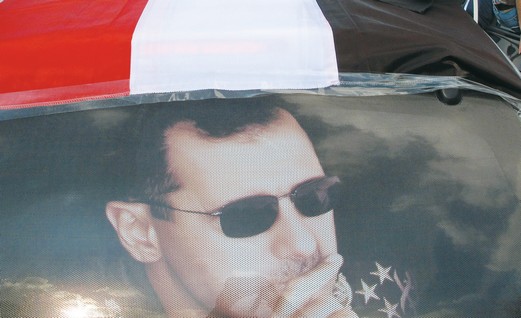
Picture of Syria’s President Bashar Assad

  Some nations may be able to turn a blind eye to atrocities in other countries. The United States of America is different. And as president, I refused to wait for the images of slaughter and mass graves before taking action.”

President Barack Obama made this statement on March 28 in an address to the National Defense University, during which he explained America’s rationale for approving a military campaign to stop Libyan leader Col. Muammar Gaddafi’s violent crackdown on protesters.

The war in Libya is almost three months old and seems to be continuing, but one question that remains unanswered is why the above policy of not turning a blind eye to atrocities doesn’t apply to other countries in the Middle East – like Syria, for example.

By Thursday, the death toll in Syria was believed to have already reached over 1,500 people, but the international community, led by the US, could not even find itself in agreement over the language of a resolution censuring Syria that some countries in Europe wanted to push through the Security Council.

So why the difference? In a word: Israel.

Israel does not share a border with Libya, but it does share one with Syria, and there are fears in the IDF that in the event of foreign military intervention there, Israel would feel the brunt of Bashar Assad’s retaliation.

While Assad is already believed to be trying to divert attention from his lethal crackdown on protesters by encouraging Palestinians to raid the Israeli border, as occurred this past Sunday, this is just the tip of the iceberg of what Syria can do.

One intelligence assessment speaks of the possibility that, under extreme pressure – caused politically or militarily – Assad might decide to attack Israel with more than just angry Palestinians from the Yarmouk refugee camp near Damascus.

Instead, he would have available the thousands of ballistic missiles Syria has manufactured over the years, as well as an extensive chemical arsenal, bolstered as a replacement for the nuclear reactor Israel destroyed in 2007.

For this reason, Jerusalem is quietly warning about the potential consequences of Western military action aimed at toppling Assad. This does not mean, of course, that Israel wants Assad to remain in power; in reality, the opposite is true. But the concern cannot be ignored; what will happen the day after Assad falls, and into whose hands will the ballistic missiles and chemical weapons fall?

At the same time, senior IDF officers believe that there is no turning back for Assad and that after killing some 1,500 of his own people, he will not be able to rule again as he once did. What this means practically is still unclear, but the hope is that it will ultimately lead to a larger break in the Iranian axis that connects Tehran, Damascus and Beirut, and will further isolate Iran and cut off supplies to Hezbollah.

Syria’s close allies – Hezbollah and Iran – are also extremely concerned with the ongoing demonstrations in Syria and the potential impact on them.

Western intelligence agencies have raised the possibility that Hezbollah is trying to transfer advanced weaponry it reportedly maintains on Syrian soil to Lebanon due to the ongoing turmoil in the country.

The group is believed to have stored advanced arms in Syria – including longrange Scud missiles- as part of its logistical deployment along Israel’s northern border.

Iran is also not waiting for Assad, and just this week – in the midst of the ongoing upheaval in the Middle East – announced that it was implementing plans to triple its production of uranium. It also said that the secret nuclear facility it was caught covertly building near the city of Qom in 2009 would no longer remain empty and would be equipped with advanced centrifuges for the enrichment of higher-grade uranium.

The Iranian announcement came just two days after International Atomic Energy Agency (IAEA) Director-General Yukiya Amano said the nuclear watchdog had obtained information that “seems to point to the existence” of possible military dimensions to Iran’s nuclear program.

Amano’s announcement came just a few weeks after the IAEA released its latest report on Iran’s nuclear program, pointing to a significant increase in the enrichment of uranium – up from 133 kilograms per month to 156 kg. – with a total of just over 4 tons of low-enriched uranium (LEU), enough for at least two nuclear weapons if enriched again to higher military-grade levels.

While Iran is still encountering some technological difficulties, overall it seems to have overcome the setback caused last year by Stuxnet, the virus that attacked its uranium enrichment plant at Natanz and is believed to have destroyed over 1,000 centrifuges.

In simpler terms, Iran is taking advantage of the current shift in the world’s focus from its illicit nuclear activities to the ongoing upheaval in the Middle East, and is moving forward with enriching uranium. The decision on Tuesday to send submarines to the Red Sea is another indication of Iran’s growing confidence and its belief that it will not pay a price for any of these provocations.

There are a number of reasons for the confidence. While the current sanctions in place against Iran have had some effect, they are overshadowed and undermined by the increase in the price of oil. In addition, while other tyrants in the Middle East are battling for survival, in Iran the protests have waned and almost disappeared.

According to Israeli intelligence assessments, Iran wants to wait until it has enough fissionable material to produce an arsenal of nuclear weapons, which means it will need several more tons of low-enriched uranium. From the stage when it decides to break out and begin enriching uranium at military levels, until the point that it has a testable nuclear device, it will likely be a year.

Iran’s confidence also appears to have received a boost from the recent media mayhem in Israel over former Mossad chief Meir Dagan’s comments about Jerusalem’s military option vis-à-vis the Iranian nuclear issue. Dagan said it was a “stupid idea” to attack Iran, and pointed out the “impossible” regional challenge Israel would face following such an attack.

For Tehran, these comments fell on welcoming ears. For years, the Iranians have questioned Israel’s military capabilities. Now here comes Dagan – their archnemesis – and gives them a reason to. Dagan’s justification for doing this – his concern with Israel’s current political leadership – might be genuine, even though it was done with the awareness that it would eat away at the deterrence Jerusalem has tried for years to create in the face of the Iranian threat.

Strategic Affairs Minister Moshe “Bogie” Ya’alon has long spoken about the importance of creating a “credible military option” for Iran’s nuclear program. According to Ya’alon, it is not enough to speak about the option; it is also necessary to show the Iranians that it is real, viable and effective.

“They need to fear that the military option is real and can be used,” Ya’alon has said in the past.

To back up this argument, Ya’alon has referred to Tehran’s 2003 decision to suspend its enrichment of uranium and weapons program. That move was based on fear that after the US invasion of Iraq, it was next in line. President George W. Bush had already listed Iran has part of the “Axis of Evil” mentioned in his 2002 State of the Union address.

Judging by its recent decisions, Iran no longer feels threatened. As it continues to provoke the world without paying a price, there is unfortunately no reason it should.

‘Iran caught 10 times trying to send arms to terrorists’

June 10, 2011

‘Iran caught 10 times trying to … JPost – Iranian Threat – News.

The Victoria followed by Navy speedboat

  Iran has been caught red-handed in 10 different attempts in recent years to transfer weaponry to terrorists throughout the Middle East, including a recent case, in April, when a shipment of advanced missiles was caught en-route to Taliban forces in Afghanistan, according to a United Nations report obtained Thursday by The Jerusalem Post.

The report was submitted three weeks ago to the Security Council by a UN group of experts that monitors compliance with UN sanctions imposed on Iran. The report was leaked to the Internet and obtained by a number of leading Israeli defense analysts.

The report documents all 10 cases of arms smuggling, including the case of the Victoria cargo ship, which was stopped by the Israel Navy earlier this year carrying arms for Hamas. In the most recent case cited, British forces in Afghanistan found a weapons shipment of advanced Iranian-made anti-ship missiles and 122 mm. rockets en route to Taliban forces in Afghanistan.

In March, Turkish authorities stopped an Iranian cargo plane bound for Syria. At the time, Turkey tried to downplay the news, but the UN report reveals that authorities discovered dozens of AK-47 assault rifles and close to 2,000 mortar shells. The report confirms that the arms originated in Iran and were supplied by the Revolutionary Guard Corps.

The report further reveals that Iran test fired two of its most advanced long-range missiles – the Shihab 3 and the Sajil – in February.

The tests were not reported at the time by the Iranians, or by the United States or Israel, both of which track such missile launches.

Tal Inbar, head of the Space Research Center at the Fisher Institute for Air and Space Strategic Studies, analyzed the UN report and said the missile tests were significant since Iran was making efforts to hide its ballistic missile program, something that raises suspicions about the nature of the program and its connection to the Islamic Republic’s illicit nuclear drive.

“For a number of years, they have been trying to display shorter-range rockets like the Qiyam and the Fateh 110,” Inbar said. “In the most recent military parade, they did not even did not even show the Shihab.”

The report, which also discusses the regular exchange of ballistic missile technology between Iran and North Korea, said financial sanctions appeared to be having an effect on Tehran, as demonstrated by “the range of measures taken by Iran to circumvent them.”

“These measures are expensive and time-consuming to set up and administer. They include arrangements to enable sanctioned Iranian banks to maintain access to the international financial sector through normal business conducted by non-sanctioned Iranian banks,” the report said. “Nevertheless, despite financial restrictions, Iran appears able to continue to pay for procurement from abroad for its prohibited nuclear and ballistic missile programs.”

Syrian forces fire to kill at Damascus protest

June 10, 2011

Syrian forces fire to kill at Damascus pro… JPost – Middle East

Syrian refugee children in Turkey

  AMMAN – Syrian security forces shot dead at least two protesters when they fired at a pro-democracy rally in the Qaboun district of Damascus on Friday, the Syrian Observatory for Human Rights said.

“It seems that it was a big demonstration, given the direct use of live ammunition,” Observatory director Rami Abdelrahaman said, adding that the information came from witnesses.

Other activists said that security forces fired automatic rifles, some from rooftops, at the demonstration, which demanded the removal of President Bashar Assad.

In an escalation of rhetoric towards Syrian President Bashar Assad yet unseen from Ankara, Turkish Prime Minsiter Recep Tayyip Erdogan called the Syrian crackdown on protesters “inhumane,” and described it as barbaric, Turkish newspaper Today’s Zaman reported on Friday.

As some 2,500 refugees have fled to Turkey in recent days from Syria’s northern region where troops and tanks are amassing ahead of an expected offensive, blasted the tactics employed by Syria’s elite army units, led by President Assad’s brother, Maher.

“Sadly, they don’t behave like humans,” Erdogan said of the Syrian army’s 4th Division, commanded by Maher Assad, according to the report. “Now the barbarity… [soldiers] pose [for a photo] in such an ugly way at the bedside of women who they killed,” the Turkish prime minister added, “these images cannot be digested.”

It was by far Erdogan’s strongest call against the Bashar Assad, who he has previously described as a “good friend.”

Addressing moves in the United Nations Security Council to impose stronger sanctions against Assad and his regime, Erdogan said, “We can’t [support] Syria amidst all this as Turkey. We still have relatives [in Syria].”

Recalling a telephone conversation with the Sryian leader several days ago, Erdogan lamented, the Syrian leadership “take[s] this very lightly,” according to the report.

Also on Friday, US Defense Secretary Robert Gates said the legitimacy of the rule of Syrian President Bashar Assad was open to question after the killing of protesters by security forces.

“I would say the slaughter of innocent lives in Syria should be a problem and a concern for everybody,” Gates told a seminar in Brussels.

“Whether Assad still has the legitimacy to govern his own country, I think is a question everyone needs to consider,” he said.

The Syrian army began a military operation in a restive town near the Turkish border, state television said on Friday, as the country braced for more violent protests against the rule of Syrian President Bashar Assad.

The Syrian government said earlier that “armed gangs” killed more than 120 security personnel in Jisr al-Shughour, a town of 50,000, earlier this week.

“Our correspondent in Jisr al-Shughour told us now that in response to people’s calls, units from the Syrian Arabic Army started its duties in Jisr al-Shughour … to arrest armed members,” the television said.

Rami Abdulrahman of the Syrian Observatory for Human Rights said residents in the northwestern town told him the army was still advancing towards the town. “They can hear gunfire and so far we do not have any casualty reports,” he told Reuters.

Thousands of Syrians in the region fled into Turkey on Thursday fearing the military assault. At least 15,000 troops had deployed near Jisr al-Shughour, which residents said had largely emptied of people.

The latest reports of a government crackdown intensified international concerns over Syria’s handling of pro-democracy protests, inspired by uprisings across the Arab world.

Britain, France, Germany and Portugal have asked the UN Security Council to condemn Assad, although veto-wielding Russia has said it would oppose such a move.

World powers have shown no appetite for any Libya-style military intervention in Syria, which has so far shrugged off sanctions and verbal reprimands from abroad.

Syria has barred most independent media from the country, making it difficult to verify accounts of the violence.

Assad, 45, has promised reforms even while cracking down on unrest buffeting the country that has become the gravest threat to his 11-year authoritarian rule. Friday prayers have been a focus of protests throughout the revolt.


Iran says it will triple uranium production capacity

June 8, 2011

Iran says it will triple uranium… JPost – Iranian Threat – News.


  TEHRANIran will shift its production of higher grade uranium to an underground bunker and triple its production capacity, it said on Wednesday in a defiant response to accusations it is trying to produce atomic bombs.

“This year, under the supervision of the (International Atomic Energy) Agency, we will transfer 20 percent enrichment from the Natanz site to the Fordow site and we will increase the production capacity by three times,” the head of Iran’s atomic energy agency, Fereydoun Abbasi-Davani, told reporters after a cabinet meeting, the state broadcaster IRIB reported.

Iran only disclosed the existence of the Fordow site, in a mountain bunker, in September 2009, after Western intelligence had detected it and said it was evidence of covert nuclear work.

The decision to move production there and increase output drew immediate condemnation from the West, which has imposed a series of sanctions on Iran to try to force it to halt enrichment — a process that can make weapons material if done to a much higher level.

“This announcement is a provocation,” the French Foreign Ministry said in a statement.

“It reinforces the international community’s existing concerns over the intransigence of the Iranian authorities and their persistent violation of international law.”

The European Union voiced deep concern as well, saying Tehran was increasing its defiance of the UN Security Council.

The 27-nation EU, in a statement read out by Hungary’s ambassador at a board meeting of the IAEA, said it noted with “grave concern” Iran’s lack of cooperation with the UN nuclear watchdog.

“We note with particular concern the announcement made only today by Iran that it will increase its capacity to enrich (uranium) to 20 percent, thereby further exacerbating its defiance of the United Nations Security Council.”

Iran has always denied it is developing nuclear weapons and says it is enriching uranium for electricity production and medical applications.

But its decision last year to raise the level of enrichment from the 3.5 percent purity needed for normal power plant fuel to 20 percent worried countries that saw it as a significant step towards the 90 percent needed for bombs.

The Vienna-based IAEA, whose board was due to discuss Iran’s nuclear program, probably later on Wednesday, said it had only learned of the plan from media reports.

“Iran has not yet informed the agency of any such decision,” IAEA spokeswoman Gill Tudor said.

Israel’s new battlefield: Iranian submarines

June 8, 2011

Israel’s new battlefield: Iranian submarines – Israel News, Ynetnews.

The recent wave of uprisings across the Arab world provided Iran with numerous strategic and tactical opportunities to expand its status as a regional hegemon.


The announcement that Tehran has dispatched submarines to the Red Sea, in what is the first such deployment by Iran’s Navy in distant waters, is the latest step in a series of actions the Islamic Republic has taken to secure its power in the region.

Permanent presence of warships and submarines in the Gulf of Aden and the Red Sea allows Tehran to keep surveillance of IDF Navy activities, which foreign reports claim Israel is conducting in the Red Sea and the eastern basin of the Mediterranean Sea.


According to the reports, Israeli naval activity aims to thwart arms smuggling from Iran to the Gaza Strip. The cargos leave from Iranian ports, pass through Yemen and reach Sudan’s Red Sea coast. From Sudan they are transported by land to Egypt and then to the Sinai Peninsula.


Another smuggling route is on board unsuspected merchant ships, which sail directly across the Red Sea, through the Suez Canal and all the way to Port Said in Egypt, where the cargo is unloaded from the ships and loaded on another vessel that sails to Syria. The cargo can also be transported by land, through the tunnels, into the Gaza Strip.


Providing assistance to Hezbollah

The reports claim that the IDF and Navy employ constant operational and intelligence efforts to thwart smuggling attempts, including sinking Iranian ships in the Gulf of Aden and the Red Sea, attacking convoys en-route from Sudan to Egypt and seizing cargo ships suspected of carrying weapons to Syria or to Hamas.


Iranian naval presence in the Red Sea enables the Revolutionary Guard to track Israeli activity and secure arms shipments by warning the vessels carrying the weapons or the smugglers waiting on shore, and perhaps in the future – by directly confronting with Israeli naval forces.

Arms seized on Victoria ship (Photo: Tsafrir Abayov)


Foreign reports also stated that Israel has been deploying various vessels, including submarines, to patrol along the Iranian coastline in order to gather intelligence on the nuclear and ballistic missile programs and prepare for future altercations.


These Israeli submarines, the reports claim, are equipped with the latest cruise missiles that can carry nuclear warheads. If these reports are true, Iranian presence in the Red Sea might also be geared toward tracking and thwarting such activity.


But Iran is not stopping there. It wants to establish a naval military presence in the eastern basin of the Mediterranean Sea by dispatching its fleet through the Suez Canal.


Tehran regards this as an important step that will demonstrate to the Arab world and the Iranian people that it is a regional power, which is capable of military deployment in distant waters.


Iran’s military presence also aimed at hinting to its allies – Syria, Hezbollah and Hamas – that it can provide them with assistance if needed.


Iran needs alternatives

The recent uprisings in Syria and the uncertainty surrounding the future of Bashar Assad’s regime further highlights the urgency Iran is facing.


If and when the Syrian president is overthrown, Iran is expected to lose several important assets in Syria, including intelligence bases from which it keeps track of Israeli intelligence activity, and roads connecting between Syria and Lebanon, by which Iran provides Hezbollah with logistic aid and transports Revolutionary Guard members.

Iranian submarines. Coming our way? (Archive photo: AFP)


The unstable political situation in Syria can also potentially harm the connection with Hamas and Islamic Jihad’s headquarters in Damascus, with which Iran conducts most of its contact.


Iran needs to prepare alternatives in case the Alawi regime collapses. Khamenei and Ahmadinejad know that the Syrian Sunnis will turn a cold shoulder to Iran, or even become hostile, and so will other elements that might take the place of the current leadership.


Naval presence in the eastern Mediterranean and strengthening ties with Egypt may provide the answer, albeit a partial one.


The Iranians are acting determinately, but with caution – step by step. Their naval presence in the Gulf of Aden began last year under the guise of helping international efforts against Somali Piracy.


The big leap was taken in February, when Tehran asked the Egyptian authorities to allow two of its warships to cross the Suez Canal. The pretext was “a friendship and peace flotilla” to Syria.


Egypt’s Higher Military Council, still overcoming the latest events in Tahrir Square and the fall of Mubarak, authorized the move in an attempt to prove that it had shifted its policies from those of the previous regime, which has been hostile to Iran since the 1979 Islamic Revolution in the country.


In the near future, we can expect to see more Iranian attempts to dispatch fleets through the Suez Canal and perhaps amassment of large Iranian naval forces in the Red Sea and Mediterranean coasts. This trend can be slowed down if the Americans decide to assert their influence over Egypt’s Higher Military Council.

The Bombing of Osirak: Lessons From the 30th Anniversary of Israel’s Strike on Iraq’s Nuclear Reactor

June 8, 2011

Bennett Ramberg, Ph.D.: The Bombing of Osirak: Lessons From the 30th Anniversary of Israel’s Strike on Iraq’s Nuclear Reactor.

Thirty years ago today, eight F16-A aircraft armed with sixteen Mark 84 2000-pound bombs took off from their base in Etzion, Israel on a mission that established a new post-World War II standard to halt the spread of atomic weapons with armed force. The target: the French designed nuclear reactor known as Osirak situated near Baghdad. With the failure of diplomacy, sabotage and assassination to arrest construction, Prime Minister Menachem Begin determined that he would not leave the country’s fate to chance. By day’s end, Saddam Hussein’s first attempt to build a nuclear arsenal lay in a smoldering heap


Although three decades have passed, the daring Osirak strike continues to fascinate. But it also raises profound questions about the comparative benefits of force to stop nuclear proliferation. If military attack can immaculately reduce or eliminate the bomb’s spread as Israel demonstrated, why don’t countries apply the strategy more often? Why do we shirk today, for example, from using force to halt the likes of North Korea or Iran?


The answer lies on a bet countries repeatedly have preferred, one that banks on deterrence, diplomacy and/or hope that nuclear armed states will restrain themselves (DDR) from using nuclear arsenals. History shows DDR has worked in the past. What DDR cannot predict is future success. But history also demonstrates that neither can the Osirak template. A closer examination of both demonstrates the conundrum.


Preempt or not became an early order of business for the United States as the Cold War took off. Calls from the likes of Winston Churchill and Bertrand Russell promoted military action to halt the Kremlin’s nuclear program. While the United States historically had not shied away from initiating force, in the aftermath of World War II it recoiled. “It might be desirable to strike the first blow [against the Soviet Union but] it is not politically feasible under our system to do so or to state that we will…” The author, George Lincoln, a Pentagon planner in 1945. Although presidents beyond Truman did not exclude preemption against a Kremlin coiled to strike, it relied on DDR to address the nuclear risk. With the Soviet Union’s 1991 demise, the strategy seemed fulfilled.


But during the Cold War other challenges emerged. By the time John Kennedy entered office in 1961, increasingly the United States viewed China as the bête noir. As Beijing mounted its nuclear effort, an anguished president called on the bureaucracy to come up with options. In August 1963, the Joint Chiefs responded, “exhaust” non military alternatives first. In a September 15, 1964 memo written respectively by Secretaries of Defense and State Robert McNamara, Dean Rusk and National Security Advisor McGeorge Bundy, President Johnson’s senior foreign policy team concurred: “We are not in favor of unprovoked unilateral U.S. military action against Chinese nuclear installations at this time.” On October 16, 1994, Beijing tested its first device. Relying on DDR, Washington learned to live with the nuclear armed China.


In the years that followed, decision makers in and outside the Untitled States faced similar challenges. In each instance — the Soviet Union/China, India/Pakistan, Egypt/Israel, the US/North Korea — DDR prevailed. Concerns that preemption would ignite an immediate costly conventional war outweighed apprehension about the future risk of nuclear war.


Israel proved to be the most striking exception. Twice — the attack on Osirak and the September 2007 attack on Syria’s nuclear reactor — it bet air power could eliminate nuclear dangers. But the Osirak template also demonstrated limits. Iraq reconstituted its nuclear capability. But for the post-1991 Persian Gulf War’s insertion of inspectors with orders to destroy the country’s WMD stocks, Saddam would have had his bomb. Likewise it remains uncertain if Israel’s strike on Syria destroyed all vital elements of the enterprise. But for the moment Syria poses no nuclear threat.


Ultimately, Osirak’s legacy lies in its demonstration of military means to halt proliferation if other methods fail. But it is not the perfect solution. At best, it buys time banking that political developments may reduce the inclination of adversaries to go nuclear. It is a bet, but so is DDR. Both represent the best and the limits of counter proliferation policy strategy in today’s continuing uncertain nuclear world.

Iranian subs to the Red Sea – a riposte to UN nuclear watchdog’s indictment

June 8, 2011

DEBKAfile, Political Analysis, Espionage, Terrorism, Security.

DEBKAfile Exclusive Report June 7, 2011, 11:01 PM (GMT+02:00)

An Iranian sub in distant waters

The deployment of Iranian “military submarines” in the Red Sea, announced Tuesday June 7, was Tehran’s response to the latest International Atomic Energy Agency’s report accusing Iran of nuclear work with “possible military purposes.” It was also a pointed comment on the controversy in Israel over whether or not to go for the military option. President Mahmoud Ahmadinejad then delivered his most uncompromising statement yet on Iran’s nuclear program, calling it “a train with no brakes or reverse gear.”
Iran claimed its submarines had long-range capabilities without specifying how many or what types had been sent to the Red Sea. Our Western military sources estimate that two vessels of the Qaem type defined as “semi-heavy.” Information about this submarine is sparse in the West: It is thought to be a multi-task 1,000-ton submarine capable of firing missiles from deep water with room for naval commando units trained to raid strategic targets.
Shortly after Tehran’s submarine announcement, Iranian President Mahmoud Ahmadinejad called a news conference in which he presented Iran’s nuclear case in exceptionally categorical and inflexible terms. After dismissing the UN watchdog’s report as “lacking legal credibility,” he declared: “The nuclear issue is like a train which has no brakes and no reverse gear, which means there will be no compromise.”
IAEA chief Yukiya Amano also criticized Iran Monday, June 6, for not cooperating with international nuclear experts at the start of a weeklong board meeting in Vienna.
This too was Tehran’s reply the Wisconsin Project on Nuclear Arms Control, whose key findings were published by debkafile on June 3:  “By April 2011, Iran had accumulated a quantity of U-235 that can be enriched in short order to sufficient 90 percent (weapons grade) uranium for producing four nuclear bombs, steadily stockpiling the material in secret from 2008.”
According to our Iranian sources, the Iranians felt bound to respond to the information that the Israeli Navy has taken delivery – or will shortly – of two new Dolphin submarines armed according to foreign sources with nuclear missiles. The arrivals will expand Israel’s nuclear-capable sub fleet to five – or a 66 increase.

Ahmadinejad’s hardnosed comments were aimed too at Washington, where German Chancellor Angela Merkel and President Barack Obama held talks inter alia on the nuclear issue and agreed to pile more sanctions on the Islamic Republic if it continued to forge ahead with its nuclear weapons program.
Israel’s Dolphin subs are manufactured in German shipyards. The chancellor agreed to speed up delivery of the last two Israel commissioned and made the gesture of easy terms of payment, despite the economic crisis besetting Europe.
The way Tehran announced the Red Sea deployment of its submarines indicated an intention to push the radius of its defense lines farther from home waters in the Persian Gulf to the Red Sea in case of military attack on its nuclear program.
debkafile‘s military sources reckon that Iran will next send the submarines through the Suez Canal up to Syria’s naval base of Latakia on the Mediterranean.
Five months ago, Iran sent two warships, one of them bearing missiles for its Lebanese proxy Hizballah, along the same route to the same destination. The Egyptian military junta permitted the warships to pass through Suez just a week after Hosni Mubarak was ousted as president, signaling clearly that Cairo was turning a new leaf in relations with Tehran and its Palestinian ally, Hamas, after years of animosity with Mubarak’s Egypt.

Six days after those first warships docked in Syria, on Feb. 26, Moscow agreed to sell Syria advanced Yakhont SS-N-26 sea missiles. Every Israeli effort, backed by Washington, to discourage the Russians from letting Syria have those weapons was rebuffed. They may well arrive in Syria at the same time as the Iranian subs.

The interconnection of these steps was underscored two days later, on Feb. 28, when the commander of the Iranian Navy, Adm. Habibollah Sayyari, arrived in Latakia, inspected a guard of honor and declared that Iran had acquired its first Mediterranean base.

Neither the United States nor Israel reacted to these strategic milestones. The second round of Iranian warships, the submarines, heading through the Suez Canal to Syria, may also go without response.


