Archive for August 15, 2010

Eagleburger: World’s Going to War Over Iranian Nukes

August 15, 2010

Eagleburger: World’s Going to War Over Iranian Nukes.

By: David A. Patten

Former U.S. Secretary of State Lawrence Eagleburger says that unless civilized nations act soon to thwart Iran’s nuclear ambitions “the world’s going to go to war over this.”

His remark came in reaction to the news that Russia has announced it will begin loading nuclear-fuel rods into an Iranian nuclear reactor on Aug. 28.

Russia says international nuclear watchdogs will monitor the fueling process. Russia also states that Iran has guaranteed in writing that it will send all its spent fuel rods to Russia for processing, to prevent enriched material from being used in nuclear weapons.

But former ambassador to the U.N. John Bolton said Friday fuel rods at Iran’s Bushehr reactor could soon be used by Iran to produce weapons-grade material.

Bolton also ruled out any attack on the reactor once it is loaded with uranium fuel due to the risk of radioactive contamination of the Persian Gulf region.

Eagleburger clearly shared Bolton’s alarm at Friday’s developments.

“There will be a real blow up,” Eagleburger told Fox News host Neil Cavuto. “Somebody will end up using one of these things.

“If Iran gets the weapon it’s going to use it,” added Eagleburger, who served in four presidential administrations, including a brief stint as Secretary of State under former President George H.W. Bush. “I think they’re on the way to getting it, and we’re going to let it happen.

“And when I say ‘we,'” he continued, “I don’t just mean the U.S. I mean the civilized world, the Russians.

“They are going to regret someday what they have done because their neighbor, Iran, is going to have a nuclear weapon and it’s going to throw it around like mad. And Israel will certainly be the first target. And the world’s going to go to war over this. It very much has a potential of happening… As sure as I’m sitting here I know it’s coming.”

Eagleburger said international nonproliferation went awry “when we let the North Koreans get the weapon.”

That event, he said, started the world “down the wrong track and we’ve been on it ever since.

Eagleburger said the ongoing game of nuclear chicken that Iran appears to be playing reminds him of events leading up to the Second World War.

“When you’re as old as I am,” he told Cavuto, “if you remember how much this sounds like the workup to WWII, when everybody was letting things go by, letting things happen, and nobody was doing anything to stop what was clearly a track toward war. And we’re doing it again, we’re doing it again.

“We know enough about nuclear weapons that we know this thing is going to happen. It may well be a historic time. The issue is going to be whether the Israelis decide at some point they have to act.

“If they do, it will be for reasons that I at least understand, but the world will not understand them. And the Israelis will be attacked for doing what they have to do to protect themselves, but it probably won’t be enough,” he said.

Eagleburger predicted Israel would unfairly suffer international condemnation if it attacks Iran’s nuclear facilities.

“What would you do if you were an Israeli and somebody said he was going to build a nuclear weapon and it was going to be used against Israel?” he asked.

Eagleburger said the entire international community would bear responsibility for not stopping Iran.

Israeli-Saudi interests

August 15, 2010

Israeli-Saudi interests.


Jerusalem is not thrilled with a huge arms deal materializing between the US and Saudi Arabia. As part of the $60 billion 10-year package, the Saudis will reportedly be receiving 70 UH-60 Black Hawk helicopters, 60 Longbow Apache attack helicopters, 84 Boeing F-15s and upgrades for older combat planes, as well as flight simulators, spare parts and long-term support for the planes. In addition, Kuwait wants the latest Patriot missile defense system, and Oman might be buying 18 F-16 fighter jets.

From an Israeli perspective, the deals are highly problematic. Washington’s intention is to build up the Gulf states’ confidence in the face of an increasingly belligerent Iran. But these fighter planes can just as soon be used against the Jewish state as against the Islamic Republic. The present Saudi regime seems stable. But what would happen in the event of a coup d’etat or if a rogue pilot went wild?

Still, Israel is not expected to oppose the deal, for a variety of reasons. The F-15s being sold to the Saudis will not be equipped with standoff systems – long-range missiles to be used against land and sea targets. Also, the US and Israel may clinch a deal for the sale of about 20 F-35 Joint Strike Fighter jets, which would help us maintain an uncontested military edge. In addition, US lawmakers can always hold up parts of the deal or seek assurances that Israel’s core military interests will be protected when all the details of the sale are presented to Congress next month. And if the US does not sell to the Gulf states, EU countries or even Russia, which are much less receptive to Israeli interests, might fill the vacuum.

It is also worth noting that military cooperation between the US and Israel is at its peak. This month, for instance, the two countries conducted their largest-ever joint infantry exercise in Israel. Since his appointment in 2007, Chairman of the Joint Chiefs of Staff Adm. Michael Mullen has visited Israel four times. US military aid is expected to reach a new high of $3b. in 2011, and the Obama administration has already committed itself to the $205 million Iron Dome short-range rocket defense system to protect cities neighboring Hamas-controlled Gaza.

But there is one further reason Israel will most likely not oppose the deal. Riyadh and Jerusalem, while hardly allies, share a common enemy in Teheran. The Islamic Republic is threatening to tip the delicate balance of power in the region by attaining nuclear capability. Differences between the Gulf states and Israel, however acute, pale in comparison.

TO FULLY appreciate the change in relations between Israel and the Saudis, it is instructive to revisit the 1981 AWAC surveillance planes deal. It was only through the sheer force of his personality that the newly elected US president Ronald Reagan managed to push the deal through Congress. The Saudis were a central supporter of the PLO and other terror organizations. US assurances that the deal would not hurt Israel’s military edge were rejected by prime minister Menachem Begin, who had just presided over the air strike against Saddam Hussein’s nuclear reactor at Osirak. The Jewish lobby, which fought the AWACs deal, was accused of putting Israeli interests before the US Cold War imperative of blocking Soviet expansion in Afghanistan, Yemen and Ethiopia and protecting American oil interests in the Gulf after the fall of the shah in Iran.

In contrast, today, the US, Israel and the Saudis are on the same page as far as Iran is concerned. In fact, the Gulf states seem the most gung-ho about stopping Iran. The United Arab Emirates’ ambassador to Washington, Yousef al-Otaiba, estimated publicly a few weeks ago (before he backtracked under pressure) that bombing Iran was preferable to an Iranian bomb. A few months ago, Saudi Foreign Minister Prince Saud al-Faisal said sanctions were not enough.

Nonetheless, while the mooted arms deal might reflect geopolitical changes in the area, it is no substitute for the determined action necessary to thwart an intransigent, saber-rattling Iran.

The question remains whether, if the current sanctions effort does not quickly bear fruit, America will take more concrete moves to stop Iran or ultimately remain passive. Iran’s nuclear ambitions are a challenge to this region – as the US evidently recognizes, and the latest arms packages underline – and to the free world. It should not have to fall to Israel to act alone on behalf of Saudi-US-Israeli interests.

Despite Denials, Hamas was Behind the Grads Fired at Eilat

August 15, 2010

Despite Denials, Hamas was Behind the Grads Fired at Eilat – Defense/Middle East – Israel News – Israel National News.

Hamas terrorists carried out two instances of rocket fire at Eilat and Aqaba in the past year, according to the Center for Intelligence Heritage (CIH).
According to CIH, while Hamas did not take responsibility for either attack, and even denied carrying out the second one, its “Izzedine el-Kassam Brigades” are the ones who fired the rockets. CIH bases its determination on Egyptian and Palestinian Authority sources.
Six 122 mm rockets were fired from within the Sinai desert toward Eilat on August 2. Three of them fell within the municipal area of Eilat – one in a sewage treatment pool in the city’s north. No one was hurt from these three rockets.
Two additional rockets hit Aqaba, exploding in front of the Intercontinental Hotel. A Jordanian citizen was killed and five were wounded, one seriously. A sixth rocket fell into the sea.
Earlier this year, on April 22, three Grad 122 mm rockets were fired from Sinai at Eilat and Aqaba. One fell into the sea, south of Eilat. A second hit Aqaba, and remains of a third were discovered by divers 70 meters south of Eilat’s Princess Beach, at a depth of 30 meters.
The rockets were Iranian-made, CIH estimates. These rockets are smuggled into Gaza through tunnels between Sinai and Gaza. Egyptian sources quickly blamed Iran and Hamas for the attacks.

John Bolton – Attack on Iran Reactor

August 15, 2010

Vodpod videos no longer available.

John Bolton – Attack on Iran Reactor , posted with vodpod

New Iranian Submarine Threat Could Send Oil to $200 a Barrel

August 15, 2010

“Knowledge of this attack was not meant for general consumption. It was designed by Tehran as a warning-off message to Washington against US or NATO fleets venturing to intercept Iranian ships in the Strait of Hormuz, the Gulf of Aden or Gulf of Oman and search them for goods prohibited by UN sanctions.”

Iran pulled its punches for the Japanese supertanker to convey a warning that next time, a loaded oil supertanker would not just be dented, but sunk and the Strait of Hormuz blocked to choke the most important oil transit sea lane in the world DEBKA-Net-Weekly’s Iranian sources report.

Vodpod videos no longer available.

New Iranian Submarine Threat Could Send Oil to …, posted with vodpod

Lebanese claim order to shoot came “from the top”

August 15, 2010

Elder of Ziyon: Lebanese claim order to shoot came “from the top” (updated).

From Naharnet:

The Lebanese army was instructed to open fire at Israeli troops in the tree-pruning operation that triggered a deadly clash between Israeli and Lebanese troops, Israel News reported.

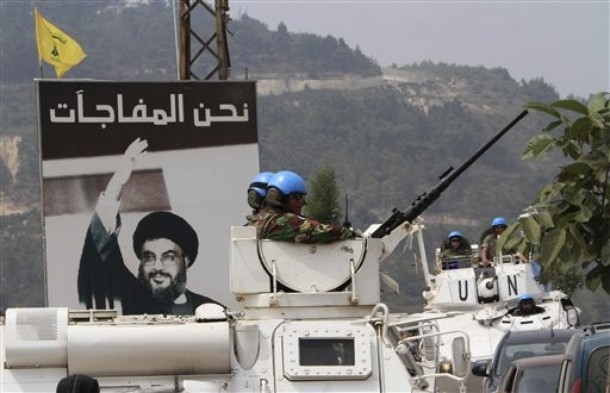
U.N. peacekeepers in front of a picture of Hezbollah leader Hassan Nasrallah,
with an Arabic writing: “we are full of surprises,”

It said that during a late Wednesday meeting between UNIFIL and representatives of the Lebanese and Israeli armies, Lebanese army officer Abdul Rahman Shaitli said soldiers who opened fire on Israeli troops Tuesday were following instructions.

“Soldiers are instructed to open fire. This is the army’s decision,” he was quoted as saying.

Al Manar, Hezbollah’s station, said the same thing.

To Western ears, this is ironic: the Lebanese Army (and, by extension, the government of Lebanon) is essentially admitting that, in full view of UNIFIL, they planned to break the terms of UN 1701 and start what could have easily devolved into a war. This is hardly how one would expect a responsible army or government to act.

Yet there is reason to be skeptical about this claim.

I first saw a Lebanese Army official saying this yesterday, in response to Israeli claims that a Hezbollah-aligned officer (or other rogue officer) decided to do the ambush on his own. The army therefore has at least four incentives to say that it came from the top: It wants to project an image of having full control over its soldiers; it wants to erase any indication that Hezbollah influences the army; it wants to take full credit for a decision that is wildly popular in Lebanon and it wants to contradict whatever Israel says.

On the other side, as Ronen Bergman noted in a WSJ article reproduced here, the timing seems more than coincidental – the event happened hours before a scheduled major speech by Nasrallah on the fourth anniversary of the end of the 2006 Lebanon war. And the LAF – and Hezbollah – knew about this dastardly tree-pruning operation for days, if not weeks. Bergman quotes Israeli intelligence as saying that a LAF brigade commander gave the order to shoot, and the LAF is now providing cover.

Israel should call their bluff. If what Lebanese officials are now claiming is true, then they planned an act of war and Israel should call for an international investigation of the incident. Such an investigation cannot have a bad outcome for Israel: either it would show serious problems in LAF command structure, including Hezbollah influence, or it will show that Lebanon is indeed acting recklessly in violation of 1701.

(Unless, of course, it is staffed with Goldstone-type people who will end up looking for and finding only evidence Israel started shooting first!)

UPDATE: The Sydney Morning Herald says it has evidence that indeed the orders came form the top:

A senior diplomatic source, who spoke to the Herald on condition of anonymity, said preliminary investigations by UN personnel monitoring the border also indicated the Lebanese army planned the attack.

The source said the UN Interim Force in Lebanon advised Lebanese army commanders early on Tuesday morning that the Israelis would be removing a tree on their side of the border early in the afternoon.

Several hours before the Israelis moved in to begin that work, a senior Lebanese army unit arrived at the Lebanese village of al-Adeisa, which overlooks the site where the tree was to be removed, and took control of the area.

They were accompanied by several journalists linked to media outlets controlled by the radical Shiite movement Hezbollah, which controls southern Lebanon, the source said.

Shortly after 12.15pm, when the Israelis moved a crane close to the border fence to begin removing the tree, a Lebanese army sniper took aim at the commanders who were supervising the operation from a hill on the Israeli side of the border.

The sniper was aiming for the most senior IDF officers present, not the person operating the crane where the alleged border infringement took place,” the source told the Herald.

These were not warning shots fired towards the area of the crane. Someone took careful aim at the Israeli commanders who were standing several hundred metres away.”

One shot hit Colonel Dov Harari in the head, killing him instantly. Another shot caused shrapnel wounds to the chest of a captain, who is in hospital in a serious condition.

The source said questions were being asked about why a senior Lebanese army unit had arrived in the area in the hours before the attack, and why they were accompanied by journalists close to Hezbollah.


