Posted tagged ‘Yemen’

Houthi Yemen coup moves Iran’s Middle East hegemonic ambitions forward – upheld by Washington

February 9, 2015

Houthi Yemen coup moves Iran’s Middle East hegemonic ambitions forward – upheld by Washington, DEBKAfile, February 8, 2015
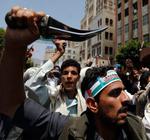
Houthi_fighters_downtown_Sanaa_5.2.15Victorious Houthi fighters in downtown Sanaa

It is hard for those governments to make up their minds where to look for the most acute menace to their national security – the US-Iranian nuclear deal taking shape, or the give-and-take between Washington and Tehran in Yemen and Iraq. 

******************

The strings of the pro-Iranian Houthi rebels’ coup which toppled the Yemeni government in Sanaa were pulled from Tehran and Washington. US intelligence and shared US-Iranian support helped the Houthis reach their goal, which is confined for now to parts of central Yemen and all of the North.

Friday, Feb. 6, the rebels dissolved parliament and seized power in the country of 24 million. They propose to rule by a revolutionary council. President Abed Rabbo Mansour Hadi and his cabinet who were forced to resign last month are under house arrest.

DEBKAfile’s Saudi intelligence sources reveal that the dominant figure of the uprising was none other than Ali Abdullah Saleh, president of Yemen from 1990 until he was ousted in 2012.

A member of the Zaydi branch of Shiite Islam like the Houthis, he led them to power with the same enthusiasm with which he fought their insurgency during his years in power. By rallying his supporters in the army, intelligence and security services, he enabled the rebels to take over these departments of government and overpower the Hadi regime with only minimal resistance.

They were also able to commandeer $400 million worth of modern American munitions.

The Houthis secretly call themselves “Ansar Allah” and have adopted the “Death to America, Death to Israel” slogans routinely heard in government-sponsored parades and demonstrations on the streets and squares of revolutionary Tehran.

Amid the political turmoil in Sanaa, the US Sunday resumed drone strikes against AQAP.

The six Arab countries of the Gulf Cooperation Council, led by Sunni-ruled Saudi Arabia and the United Arab Emirates, issued a statement Saturday, Feb. 7, calling for the UN Security Council to “put an end to this coup, an escalation that cannot be accepted under any circumstances.”

The Iranian-US gambit has resulted in different parts of Yemen falling under the sway of two anti-American radical forces – the pro-Tehran Houthis and Al Qaeda in the Arabian Peninsula (AQAP).

The new Saudi King Salman starts his reign with a double-barreled threat facing the kingdom from its southern neighbor, Yemen – posed by an Iranian pawn and a proactive branch of Al Qaeda.

Ten days ago, when US President Barack Obama visited Riyadh, the Saudi monarch voiced his concern about the alarming situation developing Yemen. However, Obama replied noncommittally with general remarks.

In Washington, administration spokesmen Saturday tried pouring oil on the troubled waters roiled by US support for the Iranian maneuver in Sanaa and the return of Abdullah Saleh to the Yemeni scene.

“We’re talking with everybody,” one US official said, explaining that the United States was ready to talk to any Yemeni factions willing to fight Al Qaeda.

His colleagues tried to downplay Tehran’s hand in the Houthi coup. “The Houthis get support from Iran, but they’re not controlled by Iran,” said another official in Washington.

Our military and intelligence sources report that Yemen is not the only Middle East platform of the joint US-Iranian military, intelligence and strategic performance. The second act is unfolding in Iraq.

Saudi Arabia, the Gulf emirates, Jordan and Israel are therefore watching the evolving US-Iranian cooperation in fighting al Qaeda’s various affiliates in the region with deep forebodings, lest it is merely a façade for the Obama administration’s espousal of Tehran’s regional ambitions.

It is hard for those governments to make up their minds where to look for the most acute menace to their national security – the US-Iranian nuclear deal taking shape, or the give-and-take between Washington and Tehran in Yemen and Iraq.

Yemen’s Houthi rebels take over government in coup

February 6, 2015

Yemen’s Houthi rebels take over government in coup

Rebels announce five-member presidential council tasked with forming technocrat government and dissolve parliament.

06 Feb 2015 12:40 GMT

via Yemen’s Houthi rebels take over government in coup – Al Jazeera English.


The Shia rebel group stormed the presidential palace and key government buildings on January 22 [Reuters]

Yemen’s Shia Houthi rebels have announced that they have dissolved parliament and installed a five-member “presidential council” which will form a transitional government to govern for two years.

In a televised statement on Friday from the Republican Palace in the capital, Sanaa, the rebel group said that it would set up a transitional national council of 551 members to replace the dissolved legislature.

The “constitutional declaration”, attended by tribal and military representatives as well as by the outgoing interior and defence ministers, came after a Wednesday deadline set by the Shia militia for political parties to resolve the crisis passed with no agreement.

The United Nations said that it would not acknowledge the announcement made on Friday afternoon, calling it a unilateral decision.

Al Jazeera’s Hashem Ahelbarra, who has reported extensively from Yemen, said that “the spectacular rise of the Houthis” could further fuel sectarian tensions in the country.

“This is going to be seen by the Sunnis in the country as a Shia takeover of Yemen… [which will] definitely excacerbate the sectarian divide in the country,”

The Houthi rebels moved into Sanaa from their northern stronghold of Saada in September last year seeking a broader political partnership in running the country.

They seized the presidential palace and key government buildings on January 22, prompting President Abd Rabbu Mansour Hadi and his prime minister to tender their resignations. Hadi and his cabinet are being held under house arrest by the rebels.

Under Yemeni law, only the president can issue constitutional declarations.

UN envoy leaves to Saudi Arabia

The Houthis, who are believed to be backed by Iran, called on their supporters to take to the streets for evening celebrations, which are expected to follow the declaration. They also deployed armed men and pick-up trucks with anti-aircraft guns on main streets and around key institutions.

The development comes after days of failed talks sponsored by UN envoy to Yemen, Jamal Benomar.

Benomar reportedly left Yemen for Saudi Arabia for talks on Friday.

According to senior politicians who attended the talks, the Houthis insisted on the formation of a presidential council with representatives from northern and southern Yemen.

Yemeni parties demanded assurances that the formation of the council will go hand-in-hand with a withdrawal of Houthi forces from key institutions and the release of Hadi and Cabinet members from house arrest.

Other parties in the talks wanted the parliament convene and possibly announce early elections, which the Houthis opposed, claiming the parliament had no legitimacy and that its mandate had expired.

Mohammed al-Sabri, a top politician from a multi-party alliance called the Joint Meeting Parties, described the Houthis’ actions as a “coup,” predicting it would lead to “international and regional isolation of Yemen”.

Last year, the UN Security Council placed two Houthi leaders and deposed President Ali Abdullah Saleh, also believed to be a main backer of the Houthis, on a sanctions list for their role in derailing Yemen’s transition.

Source: Al Jazeera and agencie

President Obama’s ‘successful’ counterterrorism strategy in Yemen in limbo

January 25, 2015

President Obama’s ‘successful’ counterterrorism strategy in Yemen in limbo, Long War Journal, Thomas Joscelyn & Bill Roggio, January 24, 2015

If this is what a successful counterterrorism strategy looks like, we’d hate to see failure.

**********************

When announcing the US strategy to “degrade and ultimately destroy” the Islamic State in both Iraq and Syria, President Barack Obama said he would model it after America’s counterterrorism strategy in Somalia and Yemen, “one that we have successfully pursued…for years.”

Immediately after Obama’s speech, we at The Long War Journal questioned the wisdom of describing Somalia and Yemen as “successfully pursued” counterterrorism operations. Al Qaeda’s official branches, Shabaab in Somalia and al Qaeda in the Arabian Peninsula (AQAP) in Yemen, remain entrenched in their respective countries, despite some setbacks here and there. AQAP’s core leadership cadre is intact. And both al Qaeda branches continue to control territory while working to conduct attacks outside of their countries. [For details, see LWJ report, US strategy against Islamic State to mirror counterterrorism efforts in Yemen, Somalia.]

In the four plus months since Obama described Yemen as a successful engagement, things have gone from bad to worse. The Iranian-backed Shiite Houthis have broken out from the northern provinces and overran the capital. Just this week, President Hadi, who was perhaps America’s greatest ally on the Arabian Peninsula as he actively endorsed and facilitated US counterterrorism operations, including controversial drone strikes against AQAP, was forced to step down. The prime minister has also resigned and the government has dissolved.

During this timeframe, the US drone program against AQAP has stalled. The last US drone strike in Yemen that has been confirmed by The Long War Journal took place on Nov. 12, 2014. This is especially remarkable given that AQAP has claimed credit for the assault on Charlie Hebdo’s offices in Paris, and the terrorists themselves said that AQAP sent them.

Unsurprisingly, US officials are now telling Reuters that counterterrorism operations in Yemen are “paralyzed” with the collapse of the Hadi government (the long gap in strikes in the face of the Charlie Hebdo attack is a clear indication that US CT operations are in limbo). Yemen’s military is also said to be in disarray.

If US officials expect the Houthis to be willing participants against AQAP, they are mistaken. The Houthis, while enemies of AQAP, are no friends of the US. While their movement was not created by Iran, they have adopted the Iranians’ motto: “Death to America.” Additionally, any action against AQAP only serves to strengthen the Houthis, and by extension, Iran.

Meanwhile, without a central government and effective military, Sunnis may be tempted to back AQAP against the Shiite Houthis, thereby increasing AQAP’s recruiting pool. There is already evidence that this is happening.

If this is what a successful counterterrorism strategy looks like, we’d hate to see failure.


King Abdullah of Saudi Arabia dead at 90, state TV reports

January 23, 2015

King Abdullah of Saudi Arabia dead at 90, state TV reports, Fox News, January 22, 2015

abdullahinternal15151June 27, 2014: Saudi King Abdullah speaks before a meeting with U.S. Secretary of State John Kerry at his private residence in the Red Sea city of in Jiddah, Saudi Arabia. (AP)

A former American diplomat close to the Saudi royal family told Fox News the death of King Abdullah, coupled with the collapse of the government in Yemen, is a “worst case scenario” for the U.S. because current events are allowing Iran to extend its reach and influence in the region.

***************

DEVELOPING: King Abdullah of Saudi Arabia, the powerful U.S. ally who joined Washington’s fight against Al Qaeda and sought to modernize the ultraconservative Muslim kingdom has died at 90, according to Saudi state TV.

His expected successor is his 79-year-old half-brother, Prince Salman, who recently has taken on the ailing Abdullah’s responsibilities.

The announcement came in statement read by a presenter on Saudi state TV, which aired video of worshippers at the Kaaba in Mecca.

Saudi state TV said he died after midnight Friday.

A former American diplomat close to the Saudi royal family told Fox News the death of King Abdullah, coupled with the collapse of the government in Yemen, is a “worst case scenario” for the U.S. because current events are allowing Iran to extend its reach and influence in the region.

With the collapse of President Hadi’s government in Yemen, the former diplomat said Teheran’s influence is now seen in at least four Middle Eastern capitals – Sana’a in Yemen, Baghdad in Iraq, Damascus in Syria, and to a lesser extent in Beirut, Lebanon.

More than his guarded and hidebound predecessors, Abdullah assertively threw his oil-rich nation’s weight behind trying to shape the Middle East. His priority was to counter the influence of rival, mainly Shiite Iran wherever it tried to make advances. He and fellow Sunni Arab monarchs also staunchly opposed the Middle East’s wave of pro-democracy uprisings, seeing them as a threat to stability and their own rule.

And while the king maintained the historically close alliance with Washington, there were frictions as he sought to put those relations on Saudi Arabia’s terms. He was constantly frustrated by Washington’s failure to broker a settlement to the Israel-Palestinian conflict. He also pushed the Obama administration to take a tougher stand against Iran and to more strongly back the mainly Sunni rebels fighting to overthrow Syrian President Bashar Assad.

The Jewish Press » » US Warships in Red Sea, Prepare to Evacuate Embassy in Yemen

January 21, 2015

At least two US warships have been moved to the Red Sea in case the Embassy in Yemen is evacuated.

By: Hana Levi Julian

Published: January 21st, 2015

via The Jewish Press » » US Warships in Red Sea, Prepare to Evacuate Embassy in Yemen.

The capital of Yemen is Sana'a
The capital of Yemen is Sana’a
Photo Credit: Wikimedia

The USS Iwo Jima and the USS Fort McHenry warships sailed into the Red Sea on Wednesday.

Both are positioned to take on foreign service employees and their families fleeing the U.S. embassy in Yemen, if deemed necessary. Iranian-backed Shi’ite Houthi rebels overtook the presidential palace after a long barrage of shelling in Yemen’s capital, Sana’a, on Tuesday, according to CNN. Information Minister Nadia Sakkaf told the news network, “The President has no control [over the country.”

Yemeni President Abdu Rabu Mansour Hadi is believed to be in his private residence, and was not in the presidential palace at the time of the attack. However, the president’s residence is reportedly under attack as well, as is the prime minister’s residence as well, according to Sakkaf.

The attack on the presidential regime apparently comes in response to a decision to introduce a new constitution without the approval of the Houthi constituency. On Saturday, Houthi rebels also abducted presidential chief of staff Ahmed bin Mubarak in Sana’a.

The southern city of Aden is still reportedly under the control of the government regime, which closed the Aden port and sealed roads leading into and out of Sana’a, according to Yemeni state television. But the government has little other control, and it may just be a matter of time before even that much is wrested away by Al Qaeda.

Meanwhile, the situation is becoming increasingly perilous for foreigners in the country – and for Americans in particular, given the ongoing “war on terror” being waged by the U.S. against Al Qaeda.

Yemen is home to Al Qaeda in the Arabian Peninsula (AQAP) – the Al Qaeda branch that partnered with Islamic State in Iraq and Syria (ISIS) in the recent Paris terror attacks. AQAP claimed direct responsibility for the massacre attack on the offices of the French ‘Charlie Hebdo’ satiric weekly magazine.

The takeover of the Yemeni presidential palace came just a day after clashes between government forces and Houthi rebel fighters left nine people dead and 67 others wounded.

That clash followed an attack Monday night on a U.S. embassy vehicle in Sana’a. It is not clear who fired at the vehicle, which was clearly marked. U.S. diplomatic personnel were in the car at the time. No one was injured according to a report by Fox News Insider. So far the embassy is still open.

“[We] are deeply concerned about the turn of events in Yemen over the last few days,” a State Department official also told U.S.-based ABC News. “[We are] continuing to closely monitor developments…and adjust the embassy’s security posture response in accordance to the situation on the ground.”

Report: Shia Rebels Seize Control of Yemeni Capital Palace

January 20, 2015

The Shia rebel Houthis reportedly seized control of the Yemeni capital palace.

By: Lori Lowenthal Marcus

Published: January 20th, 2015

via The Jewish Press » » Report: Shia Rebels Seize Control of Yemeni Capital Palace.

The capital of Yemen is Sana'a

The capital of Yemen is Sana’a
Photo Credit: Wikimedia

The civil war in Yemen appears to have spiked dramatically Tuesday, Jan. 20.

The Associated Press is reporting that the Houthi rebels have seized control of the presidential palace in Yemen’s capital, Sana’a.

If the report is true, it is significant not only as a matter of internal Yemini interest. Yemen is yet another playing field in the Middle East in which the Islamic Republic of Iran is testing its strength. Iran is understood to be a major supporter of the Houthi rebels, which is a Shia Muslim group.

The Yemini government is Sunni. The United States as well as Saudi Arabia have assisted the Yemeni government in countering Houthi forays.

The Houthis have long controlled the north of Yemen, but since the 2011 “Arab Spring,” they have repeatedly pushed further and further south.

Al-Qaeda is also active in Yemen.


More here

http://www.bbc.com/news/world-middle-east-30903516

Iran Tightens Grip on Yemen

October 8, 2014

Iran Tightens Grip on Yemen, National Review On LineAndrew C. McCarthy, October 8, 2014

(Obama continues to tell us that Islam helped to make America what she is today and is not his our enemy. Since we seem to have some, who might they be? Surely not the soon-to-be Islamic Nuclear Republic of Iran. — DM)

It is the height of folly to believe we can degrade and ultimately destroy anti-American jihadist organizations while continuing to turn a blind eye to Iran’s essential support for those organizations, while accommodating the mullahs on nuclear weapons, and while idling as Tehran’s agents seize control of key strategic territory (see Mr. Gerstman’s excerpt from Michael Segall’s analysis of Iran’s goals in Yemen and beyond). Again, we cannot defeat our enemies without recognizing who they are.

******************

Iran, the enemy of the United States that the Obama administration nonetheless regards as a potential ally and stabilizing influence in the Middle East, has seized substantial control of Yemen.

Under the apt headline, “While you were watching ISIS, Iran took Yemen,” Legal Insurrection’ David Gerstman sifts through reports from the Washington Post and Reuters, relating that the Houthi, Shiite jihadists backed by Tehran’s mullahs, have wrested “control of almost all state buildings, from the airport and the cental bank to the Defense Ministry.” They have likewise festooned Sanaa with signs proclaiming their mullah-echoing slogan, “Death to America, death to Israel, a curse on the Jews and victory to Islam.”

As Mr. Gertzman observes, the same chant is routinely heard from Iran’s forward jihadist militia, Hezbollah. Hezbollah means the “Party of Allah” and the Houthisimilarly call themselves “Ansal Allah,” the “Supporters of Allah.” And, taking another page out of the Hezbo playbook, the Houthi are blocking the appointment of a new prime minister – just as Hezbollah has done in Lebanon in the terror group’s role as, to quote the Post report, “top down brokers dominating the government and running a virtual state-within-a-state.

As in Syria, the Shiites are opposed by the combination of the “moderate” Muslim Brotherhood – i.e., the Islah party, whose power-sharing arrangement with the rump of the ousted Sunni government the Houthi reject – and the local al Qaeda franchise (al Qaeda in the Arabian Peninsula), which continues to attack Houthitargets.

Not to beat a dead horse, but we are in a global conflict in which the Islamic State is only one component of the enemy – and not the most significant one. I argued it this way a few weeks back:

The main challenge in the Middle East is not the Islamic State; it is the fact that the Islamic State and its al-Qaeda forebears have been fueled by Iran, which supports both Sunni and Shiite terrorism as long as it is directed at the United States. There cannot be a coherent strategy against Islamic supremacismunless the state sponsors of terrorism are accounted for, but Obama insists on seeing Iran as a potential ally rather than an incorrigible enemy.

It is the height of folly to believe we can degrade and ultimately destroy anti-American jihadist organizations while continuing to turn a blind eye to Iran’s essential support for those organizations, while accommodating the mullahs on nuclear weapons, and while idling as Tehran’s agents seize control of key strategic territory (see Mr. Gerstman’s excerpt from Michael Segall’s analysis of Iran’s goals in Yemen and beyond). Again, we cannot defeat our enemies without recognizing who they are.

Yemen president warns of civil war

September 23, 2014

Yemen president warns of civil war

Abdrabuh Mansour Hadi alleges foreign conspiracy and pledges to restore state authority in the capital city of Sanaa

.Last updated: 23 Sep 2014 14:10

via Yemen president warns of civil war – Middle East – Al Jazeera English.


Heavily armed Houthi fighters cruised the streets in four-wheel-drive vehicles [Reuters]
 

Yemeni President Abdrabuh Mansour Hadi has vowed to restore state authority and warned of a “civil war” in the Sunni-majority country as Shia rebels were seen in near-total control of the capital, Sanaa.

“Sanaa is facing a conspiracy that will lead towards civil war,” Hadi said in a speech at the presidential palace on Tuesday, two days after the rebels took control of all other key state institutions in the capital, overshadowing a UN-brokered peace deal.

“Many powers came together, either those who lost their interests in yemen or those pushed by their personal grievances to take their revenge on their country rather than on individual, or the opportunistic who take advantage of any disaster to attack the country,” said Hadi.

Al Jazeera’s Mohamed Vall, reporting from Sanaa, said that the president’s comments had created a lot of confusion in the country.

“It’s not clear to many people here. They don’t know what he means. Is the conspiracy the fact that he was made to sign a deal that he didn’t like to sign? Or conspiracy whether he now has second thoughts about the Houthi takeover and he sees it in it’s real nature? He did not mention who is behind this conspiracy,” said our correspondent.

Hundreds of rebel fighters manned checkpoints on the airport road and other major throughfares in the capital on Tuesday, while heavily armed patrols cruised the streets in four-wheel-drive vehicles, AFP news agency reported.

‘Sanaa will not fall’

Rebels were posted outside the public offices they entered on Sunday, which include the main government building, parliament, army headquarters and the central bank, alongside small detachments of military police.

But Hadi insisted that “Sanaa will not fall.”

UN envoy Jamal Benomar, who brokered Sunday’s agreement aimed at ending deadly fighting between the rebels and Sunni Islamists, said the rebels’ taking of key institutions virtually without resistance seemed to signify the “collapse” of the security forces in Sanaa.

As Benomar spoke, the peace accord seemed to be holding after a week of clashes between Shiite rebels and Sunni fighters that the government said killed at least 200 people.

The Houthi rebels, who last year rebranded themselves as Ansarullah (Supporters of God), waged a decade-long insurgency in the mountainous north before launching a bid for power in Sanaa last month.

Meanwhile, Reuters news agency citing witnesses and a local official, reported that a drone similar to that used by the US to track down and attack suspected members of al-Qaeda in the Arabian Penisula, crashed in the southern part of the country on Tuesday.

Witnesses said the aircraft crashed after it hit a mountain near the city of Beihan in the southern Yemeni Shabwa province.

A local official confirmed the aircraft crashed after it struck Shoab Mountain near Beihan and said that Yemeni troops and members of a local militia allied with the government quickly surrounded the area of the crash to keep onlookers away.

Mashaal Vows Cease-Fire a Step to New ‘Resistance’ War against Israel

August 29, 2014

By: Tzvi Ben-Gedalyahu

Published: August 28th, 2014

via The Jewish Press » » Mashaal Vows Cease-Fire a Step to New ‘Resistance’ War against Israel.


Hamas chief Khalid Mashaal rallies supporters in Gaza (archive).
Photo Credit: Screenshot

Hamas’ supreme leader Khaled Mashaal dashed any hopes of long-term peace with Israel in a speech in Qatar on Thursday in which he shot from the hip at Israel and also at his terrorist organization’s new partner, the rival Fatah movement headed by Palestinian Authority chairman Mahmoud Abbas.

His lengthy speech in Qatar, which has financed Hamas terror and which fought Egyptian cease-fire proposals, followed by one day a “victory” speech by Ismail Haniyeh, the senior Hamas political leader in Gaza. Mashaal’s silence while Haniyeh accepted the cease-fire is a clear sign of a fierce power struggle between Hamas in Gaza and between Mashaal and Qatar, which holds the purse strings.

Mashaal also claimed victory, with lies that Hamas missiles hit the Ben Gurion Airport, which is not true, and that more than 5 million Israelis hid in bomb shelters, a gross exaggeration. However, there is no doubt that Hamas succeeded in scaring the daylight out of millions of Israelis, interrupting a few flights and generally turning half of Israel into sitting ducks.

And this won’t be the last time, regardless of a cease-fire, he warned.

“Whatever happened [in Gaza] is not the end to this story, and this is not the last operation to free Palestine. It was an important stop on the way to victory,” Mashaal declared.

His speech threw every obstacle possible on the road to negotiations with Israel. The talks are supposed to begin in a month, leaving open the possibility, or probability, that Prime Minister Binyamin Netanyahu is carrying on secret negotiations that will be formalized in 30 days.

The Prime Minister suffered another blow to any trust that Israelis may have for him with a report on Thursday that he met secretly with Jordanian King Abdullah, and perhaps Abbas, prior to the cease-fire, circumstantial evidence that Israel negotiated under fire, contrary to Netanyahu’s promise.

If Mashaal gets his way, there won’t be any talks because one of the new powers in Gaza is slated to be Abbas, whose security forces would patrol Gaza borders, according to the Egyptian proposal. That would provide Cairo with another tactic to get rid of Hamas.

Mashaal nailed Abbas to the wall in his speech, accusing him of throwing cold water on the resumption of the intifada during the war by allowing his security forces to limit protests.

“The next operation needs to use all of the Palestinian capabilities, not just part of them,” Mashaal said. “The resistance is holy and weapons are holy. There is no such thing as a country without weapons.”

A country or not, Gaza still has at least 2,000 rockets as well as anti-tank rockets and presumably anti-aircraft missiles. It still has rocket factories, one of which was filmed in production by Hamas during one of the failed cease-fires during the war.

Netanyahu had demanded that any halt in violence would be accompanied by disarming Hamas, but this week’s cease-fire only left the issue to be put on the negotiating table, along with Hamas’s demands for a deep-sea port and an airport.

Mashaal’s speech was full of hate and crude accusations that Israel inflicted a “Holocaust” on Gaza by “destroying schools and hospitals,” which all but the most extreme anti-Israel media now know were used by Hamas as rocket launching and terrorist command centers.

“We are against what Hitler did to the Jews, and Israel committed a second Holocaust in Gaza. Israel is an embarrassment to Jews and to the entire world,” according to Mashaal.

His rhetoric was aimed at Abbas as well as Israel. If and when negotiations begin, Egypt and the United States will be on the side of Abbas, who despite his unity government with Hamas has proved politically smart by a patient and single-minded tactic of using international support to slowly but surely win concession after concession from Israel until there is nothing left to negotiate.

Including Gaza as part of the Palestinian Authority works to Abbas’ benefit because it will solidify position that a Palestinian Authority state needs to on contiguous territory, meaning that Sderot residents can start packing up and leaving their homes as well as their bomb shelters, which would save Hamas lots of time and money when digging terror tunnels from the Western Negev to Ashdod.

Mashaal’s aim is the same as Mashaal, but his strategy is different When Mashaal says that there will be another war to “free Palestine,” he is referring to all of Israel, from Kiryat Shmona in the north to Eilat in the south, and from the Dead Sea in the east to the Mediterranean Sea on the west.

Abbas talks about a “two-state solution,” the magic phrase that sends U.S. Secretary of State John Kerry into hallucinations and hypnotizes the foreign media into pretending that the Palestinian Authority’s maps of “Palestine” don’t include the existence of Israel.

But Mashaal reminded everyone in his speech that he has people on his side.

He thanked his sponsors for terror, namely Qatar, Turkey, Yemen and Algeria, and he thanked South Africa and Latin American countries for boycotting Israel.


