Posted tagged ‘Yemen’

Kerry Negotiating Ceasefire W/Death to America Terrorists After They Attack US Ships

October 14, 2016

Kerry Negotiating Ceasefire W/Death to America Terrorists After They Attack US Ships, Front Page Magazine, Daniel Greenfield

kerry_whitehousegov-1

John Kerry never changes. Whatever happens, he can always be found rushing to appease the enemies of this country. After Iranian backed Houthi Islamic Jihadists attacked a US ship, Kerry has jumped into action to do his usual thing

As the U.S. launched missile attacks Thursday on Houthi-controlled areas of Yemen, behind the scenes Secretary of State John Kerry has been trying to negotiate a temporary cease-fire and reinvigorate a political process to end the country’s civil war.

The conflict has dragged on for over two years now, since the Shiite rebels seized control of the capital of Sanaa in September of 2014. The conflict escalated in March 2015 and since then over 4,000 civilians have been killed, the U.N. has said.

“What the Secretary has been pushing hard for is to get back … to a cessation of hostilities, a 72-hour cessation of hostilities which can at least then create some kind of climate where a political dialogue or a dialogue can begin again,” State Department Deputy Spokesperson Mark Toner said Thursday.

Here’s whom Kerry wants a dialogue with. The Houthis are not “rebels”, they’re Islamic Jihadists, backed by Iran. Their slogan is, “Allah Akbar, Death to America, Death to Israel, A curse upon the Jews, Victory to Islam.”

But part of that is Kerry and Obama’s slogan too. Meanwhile Obama’s NSC put out a statement warning the Saudis about further attacks on the Houthis.

U.S. security cooperation with Saudi Arabia is not a blank check. Even as we assist Saudi Arabia regarding the defense of their territorial integrity, we have and will continue to express our serious concerns about the conflict in Yemen and how it has been waged. In light of this and other recent incidents, we have initiated an immediate review of our already significantly reduced support to the Saudi-led Coalition and are prepared to adjust our support so as to better align with U.S. principles, values and interests, including achieving an immediate and durable end to Yemen’s tragic conflict. We call upon the Saudi-led Coalition, the Yemeni government, the Houthis and the Saleh-aligned forces to commit publicly to an immediate cessation of hostilities and implement this cessation based on the April 10th terms.

Maybe Kerry and the Houthis can bond over their mutual hatred of America.

Column One: From Yemen to Turtle Bay

October 14, 2016

Column One: From Yemen to Turtle Bay, Jerusalem Post, Caroline Glick, October 13, 2016
sana-yemen


As far as Obama is concerned, Iran is a partner, not an adversary.

****************************

Off the coast of Yemen and at the UN Security Council we are seeing the strategic endgame of Barack Obama’s administration. And it isn’t pretty.

Since Sunday, Iran’s Houthi proxies in Yemen have attacked US naval craft three times in the Bab al-Mandab, the narrow straits at the mouth of the Red Sea. The Bab al-Mandab controls maritime traffic in the Red Sea, and ultimately controls the Suez Canal.

Whether the Iranians directed these assaults or simply green-lighted them is really beside the point. The point is that these are Iranian strikes on the US. The Houthis would never have exposed themselves to US military retaliation if they hadn’t been ordered to do so by their Iranian overlords.

The question is why has Iran chosen to open up an assault on the US? The simple answer is that Iran has challenged US power at the mouth of the Red Sea because it believes that doing so advances its strategic aims in the region.

Iran’s game is clear enough. It wishes to replace the US as the regional hegemon, at the US’s expense.

Since Obama entered office nearly eight years ago, Iran’s record in advancing its aims has been one of uninterrupted success.

Iran used the US withdrawal from Iraq as a means to exert its full control over the Iraqi government. It has used Obama’s strategic vertigo in Syria as a means to exert full control over the Assad regime and undertake the demographic transformation of Syria from a Sunni majority state to a Shi’ite plurality state.

In both cases, rather than oppose Iran’s power grabs, the Obama administration has welcomed them. As far as Obama is concerned, Iran is a partner, not an adversary.

Since like the US, Iran opposes al-Qaida and ISIS, Obama argues that the US has nothing to fear from the fact that Iranian-controlled Shiite militias are running the US-trained Iraqi military.

So, too, he has made clear that the US is content to stand by as the mullahs become the face of Syria.

In Yemen, the US position has been more ambivalent. In late 2014, Houthi rebel forces took over the capital city of Sanaa. In March 2015, the Saudis led a Sunni campaign to overthrow the Houthi government. In a bid to secure Saudi support for the nuclear agreement it was negotiating with the Iranians, the Obama administration agreed to support the Saudi campaign. To this end, the US military has provided intelligence, command and control guidance, and armaments to the Saudis.

Iran’s decision to openly assault US targets then amounts to a gamble on Tehran’s part that in the twilight of the Obama administration, the time is ripe to move in for the kill in Yemen. The Iranians are betting that at this point, with just three months to go in the White House, Obama will abandon the Saudis, and so transfer control over Arab oil to Iran.

For with the Strait of Hormuz on the one hand, and the Bab al-Mandab on the other, Iran will exercise effective control over all maritime oil flows from the Arab world.

It’s not a bad bet for the Iranians, given Obama’s consistent strategy in the Middle East.

Obama has never discussed that strategy.

Indeed, he has deliberately concealed it. But to understand the game he has been playing all along, the only thing you need to do listen to his foreign policy soul mate.

According to a New York Times profile published in May, Obama’s deputy national security adviser Ben Rhodes is the president’s alter ego. The two men’s minds have “melded.”

Rhodes’s first foreign policy position came in the course of his work for former congressman Lee Hamilton.

In 2006, then-president George W. Bush appointed former secretary of state James Baker and Hamilton to lead the Iraq Study Group. Bush tasked the group with offering a new strategy for winning the war in Iraq. The group released its report in late 2006.

The Iraq Study Group’s report contained two basic recommendations. First, it called for the administration to abandon Iraq to the Iranians.

The group argued that due to Iran’s opposition to al-Qaida, the Iranians would fight al-Qaida for the US.

The report’s second recommendation related to Israel. Baker, Hamilton and their colleagues argued that after turning Iraq over to Iran, the US would have to appease its Sunni allies.

The US, the Iraq Study Group report argued, should simultaneously placate the Sunnis and convince the Iranians of its sincerity by sticking it to Israel. To this end, the US should pressure Israel to give the Golan Heights to Syria and give Judea and Samaria to the PLO.

Bush rejected the Iraq Study Group report. Instead he opted to win the war in Iraq by adopting the surge counterinsurgency strategy.

But once Bush was gone, and Rhodes’s intellectual twin replaced him, the Iraq Study Group recommendations became the unstated US strategy in the Middle East.

After taking office, Obama insisted that the US’s only enemy was al-Qaida. In 2014, Obama grudgingly expanded the list to include ISIS.

Obama has consistently justified empowering Iran in Iraq and Syria on the basis of this narrow definition of US enemies. Since Iran is also opposed to ISIS and al-Qaida, the US can leave the job of defeating them both to the Iranians, he has argued.

Obviously, Iran won’t do the US’s dirty work for free. So Obama has paid the mullahs off by giving them an open road to nuclear weapons through his nuclear deal, by abandoning sanctions against them, and by turning his back on their ballistic missile development.

Obama has also said nothing about the atrocities that Iranian-controlled militia have carried out against Sunnis in Iraq and has stopped operations against Hezbollah.

As for Israel, since his first days in office, Obama has been advancing the Iraq Study Group’s recommendations. His consistent, and ever escalating condemnations of Israel, his repeated moves to pick fights with Jerusalem are all of a piece with the group’s recommended course of action. And there is every reason to believe that Obama intends to make good on his threats to cause an open rupture in the US alliance with Israel in his final days in office.

Prime Minister Benjamin Netanyahu’s phone call with Secretary of State John Kerry on Saturday night made this clear enough. In the course of their conversation, Netanyahu reportedly asked Kerry if Obama intended to enable an anti-Israel resolution to pass in the UN Security Council after the presidential election next month. By refusing to rule out the possibility, Kerry all but admitted that this is in fact Obama’s intention.

And this brings us back to Iran’s assaults on US ships along the coast of Yemen.

Early on Sunday morning, the US responded to the Houthi/Iranian missile assaults by attacking three radar stations in Houthi-controlled territory. The nature of the US moves gives credence to the fear that the US will surrender Yemen to Iran.

This is so for three reasons. First, the administration did not allow the USS Mason destroyer to respond to the sources of the missile attack against it immediately. Instead, the response was delayed until Obama himself could determine how best to “send a message.”

That is, he denied US forces the right to defend themselves.

Second, it is far from clear that destroying the radar stations will inhibit the Houthis/Iranians.

It is not apparent that radar stations are necessary for them to continue to assault US naval craft operating in the area.

Finally, the State Department responded to the attack by reaching out to the Houthis. In other words, the administration is continuing to view the Iranian proxy is a legitimate actor rather than an enemy despite its unprovoked missile assaults on the US Navy.

Then there is the New York Times’ position on Yemen.

The Times has repeatedly allowed the administration to use it as an advocate of policies the administration itself wishes to adopt. Last week for instance, the Times called for the US to turn on Israel at the Security Council.

On Tuesday, the Times published an editorial calling for the administration to end its military support for the Saudi campaign against the Houthis/Iran in Yemen.

Whereas the Iranian strategy makes sense, Obama’s strategy is nothing less than disastrous.

Although the Iraq Study Group, like Obama, is right that Iran also opposes ISIS, and to a degree, al-Qaida, they both ignored the hard reality that Iran also views the US as its enemy. Indeed, the regime’s entire identity is tied up in its hatred for the US and its strategic aim of destroying America.

Obama is not the only US president who has sought to convince the Iranians to abandon their hatred for America. Every president since 1979 has tried to convince the mullahs to abandon their hostility. And just like all of his predecessors, Obama has failed to convince them.

What distinguishes Obama from his predecessors is that he has based US policy on a deliberate denial of the basic reality of Iranian hostility. Not surprisingly, the Iranians have returned his favor by escalating their aggression against America.

The worst part about Obama’s strategy is that it is far from clear that his successor will be able to improve the situation.

If Hillary Clinton succeeds him, his successor is unlikely to even try. Not only has Clinton embraced Obama’s policies toward Iran.

Her senior advisers are almost all Obama administration alumni. Wendy Sherman, the leading candidate to serve as her secretary of state, was Obama’s chief negotiator with the Iranians.

If Donald Trump triumphs next month, assuming he wishes to reassert US power in the region, he won’t have an easy time undoing the damage that Obama has caused.

Time has not stood still as the US has engaged in strategic dementia. Not only has Iran been massively empowered, Russia has entered the Middle East as a strategic spoiler.

Moreover, since 2001, the US has spent more than a trillion dollars on its failed wars in the Middle East. That investment came in lieu of spending on weapons development. Today Russia’s S-400 anti-aircraft missiles in Syria reportedly neutralize the US’s air force.

US naval craft in the Bab al-Mandab have little means to defend themselves against missile strikes.

The US’s trillion-dollar investment in the F-35 fighter jet has tethered its air wings to a plane that has yet to prove its capabilities, and may never live up to expectations.

Israel is justifiably worried about the implications of Obama’s intention to harm it at the UN.

But the harm Israel will absorb at the UN is nothing in comparison to the long-term damage that Obama’s embrace of the Iraq Study Group’s disastrous strategic framework has and will continue to cause Israel, the US and the entire Middle East.
US Tomahawks destroy Iran’s radar bases in Yemen

October 13, 2016

US Tomahawks destroy Iran’s radar bases in Yemen, DEBKAfile, October 13, 2016

uss_mason_fires__9-10-16_an_sm-2-1

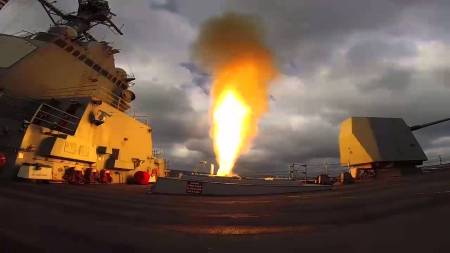
Tomahawk cruise missiles launched by US Navy destroyer USS Nitze early Thursday, Oct. 13, destroyed three Iranian-Yemeni coastal radar stations, after C-802 anti-ship missiles supplied by Iran to Yemeni Houthi rebels were fired at US naval vessels off the Yemeni coast. The stations were built and  operated  by Iran’s Revolutionary Guards (IRGC) for their Yemeni proxies to back up a threat to blockade the Red Sea.

From Oct. 9, the new missiles four times targeted the US flotilla shortly after it arrived to patrol the Red Sea and the Bab al-Mandeb Strait. Neither the US nor Iran has acknowledged their mounting confrontation over control of these strategic waters, which Tehran is waging through its Yemeni proxy.

DEBKAfile was first to disclose this confrontation in a special report Wednesday. (see below)

Iran’s Guards are repeating the mode of operation they employed a decade ago at another Middle East flashpoint. On July 14, 2006, Hizballah used an earlier version of the C-802 to attack and cripple the Israeli Hanit missile ship on the day this Iranian Lebanese proxy launched the Second Lebanese War against Israel. Rev Guards seized control of Lebanese shore radar station to guide their aim.

A highly advanced radar installation is required for the use of the C-802. Two radar stations set up outside Yemen’s two principal Red Sea ports, Mokha and Hudaydah earlier this month were operated by Rev. Guards missile and radar teams until they were destroyed Thursday, DEBKAfile’s military sources report. The third station was added for triangulation. The destruction of all three by a US Tomahawk has knocked out the Houthis’ ability to use C-802 missiles and Iran’s threat to blockade the Red Sea.

To drive this lesson home, the US Pentagon issued the following statement:

“Destroying these radar sites will degrade their ability to track and target ships in the future. These radars were active during previous attacks and attempted attacks on ships in the Red Sea, including last week’s attack on the USA-flagged vessel “Swift-2”, and during attempted attacks on USS Mason and other ships as recently as yesterday.

The official was referring to the United Arab Emirates US-flagged transport ship that was badly damaged last week in the Bab al-Mandeb strait by a Houthi missile..

DEBKAfile reported earlier:

Contrary to Tehran’s assurance to Washington in August that Iranian arms supplies to Yemeni Houthi rebels had been suspended, the rebels took delivery last week of the largest consignment of Iranian weapons to date.

According to DEBKAfile’s military sources, the shipment included highly sophisticated Scud D surface-to-surface missiles with a range of 800km; and C-802 anti-ship missiles (an upgraded version of the Chinese YJ-8 NATO-named CSS-N-8 and renamed by Iran Saccade).

They came with Iranian Revolutionary Guards officers and radar systems to fine-tune the targeting of these missiles by Iran’s Yemeni proxies.

The Scuds were given to the Houthi forces fighting in northern Yemen on the Saudi border, while the C-802s were delivered to the Houthis’ Ansar Allah faction, which is under direct Iranian Rev Guards command.

The missiles were posted at special launch bases constructed by Iran outside Yemen’s two principal Red Sea ports of Mokha and Hudaydah.

Since no more than 62km of Red Sea water divides the Saudi and African coasts, the Iranian missiles are well able to block shipping and tanker traffic plying to and from the Gulf of Suez and the Persian Gulf. Therefore, the threat of blockade hangs imminently over one-third of Saudi and Gulf Emirate oil exports.

The same threat hangs over Israeli civilian and naval shipping from its southern port of Eilat through the Gulf of Aden and out to the Indian Ocean.

One of the most troubling aspects of this pivotal new menace to an international waterway was that US, Saudi, Egyptian and Israeli intelligence agencies missed the huge consignment of Iranian missiles as it headed towards Yemen. Neither did they pick up on the construction by Iranian military engineers of three ballistic missile bases – one facing Saudi Arabia and two Red Sea traffic.

Tehran’s Yemeni proxies moreover landed large-scale military strength on Perim island in the mouth of the Bab al-Mandeb strait, the chokepoint for ingress and egress from the Red Sea.

Since the strait is just 20km wide, control of this island empowers this force to regulate shipping movements through this strategic strait.
Tehran wasted no time after all its assets were in place to begin using them:

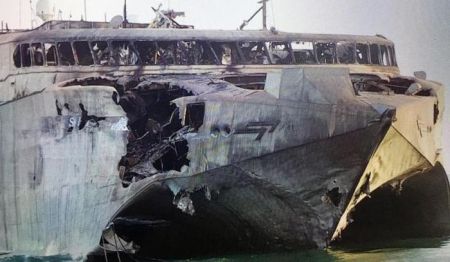
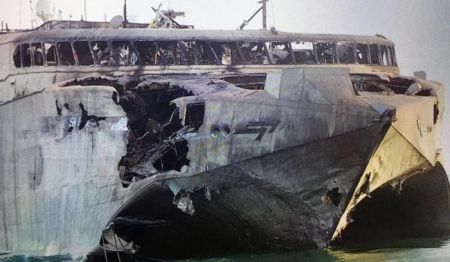
1. On Oct. 1, Iran’s Houthi surrogates launched C-8-1 missiles against a United Arab Emirates transport HSV-2 Swift logistics catamaran as it was about to pass through the strait. The ship, on lease from the US Navy, was badly damaged. No information was released about casualties.

uae_hsv-2_1-1-16-1

DEBKAfile’s military and intelligence sources discerned that the aim of this attack was to choke off the movements of UAE warships from the southern Yemeni port of Aden, where large Emirate and Saudi forces are concentrated, to the Eritrean port of Assab, where the UAE has established a large naval base.

This attack did finally evoke a US response. The guided missile destroyers, USS Mason and USS Nitze, were dispatched to the Red Sea, along with the USS Ponceafloat forward staging base, to patrol the strait opposite the Yemeni coast

2. This did not deter Tehran or its Yemeni pawns: On Oct. 9, they fired an additional barrage of C-802 at the American flotilla, which according to a US spokesman, missed aim.

The Mason hit back with two Standard Missile-2s and a single Enhanced Sea Sparrow Missile.

There has been no official word about whether these weapons destroyed a Yemeni launching site. But the event itself was a landmark as the first direct Iranian-Houthi attack of its kind on an American naval vessel.

3. That same day, the Houthis fired Scud-D missiles at the Saudi town of Ta’if, 700 km from the Yemeni border and only 70km from the Muslim shrine city Mecca. This was meant as a direct assault on the Saudi royal house and its claim to legitimacy, by virtue of its role as Guardian of the Holy Places of Islam.

In America’s heated presidential campaign, the Democratic contender Hillary Clinton boasts repeatedly that as Secretary of State she helped “put the lid on Iran’s nuclear program without firing a single shot.”

That is factually true. America did not fire a single shot. Iran did the shooting and still does, constantly upgrading its arsenal with sophisticated ballistic missiles.

Iranian warships deployed off Yemen coast after US bombs Houthi targets

October 13, 2016

Iranian warships deployed off Yemen coast after US bombs Houthi targets

report Published time: 13 Oct, 2016 13:32

Source: Iranian warships deployed off Yemen coast after US bombs Houthi targets – report — RT News

FILE PHOTO Iranian navy warship © Stringer / Reuters

Iran has deployed a fleet of warships to the Gulf of Aden, according to the Tasnim news agency. The deployment follows US cruise missile strikes on Yemeni positions thought to be under Houthi rebel control.

The Iranian Navy has sent the warships to international waters for a mission that includes entering the area off the southern coast of Yemen, Tasnim reported on Thursday. The area is among the world’s busiest maritime trade routes.

“Iran’s Alvand and Bushehr warships have been dispatched to the Gulf of Aden to protect trade vessels from piracy,” Tasnim reported earlier, as quoted by Reuters.

Read more

FILE PHOTO © Eric Garst

Saudi Arabia, which has fought a long war with Yemen’s Houthi rebels, accuses Iran of supporting the group – a charge denied by Tehran.

The US military carried out “limited self-defense strikes” in Yemen on Thursday, in retaliation for recent attacks on an American naval destroyer, USS Mason, which has been operating north of the Bab Al-Mandab Strait.

According to the Pentagon’s initial assessments, three “radar sites” in the Houthi rebel-controlled area of Yemen were destroyed in the attack.

The attack on coastal targets was carried out by Tomahawk cruise missiles launched from the destroyer USS Nitze, NPR reported.

The Houthis have denied carrying out the attack, however. A military source reportedly told Saba news agency – a media outlet run by the group – that the assault did not come from areas under its control.

More from RT.com

First Iranian-Yemeni missile attack on US flotilla

October 12, 2016

First Iranian-Yemeni missile attack on US flotilla, DEBKAfile, October 12, 2016

uss_mason_fires__9-10-16_an_sm-2

Contrary to Tehran’s assurance to Washington in August that Iranian arms supplies to Yemeni Houthi rebels had been suspended, the rebels took delivery last week of the largest consignment of Iranian weapons to date.

According to DEBKAfile’s military sources, the shipment included highly sophisticated Scud D surface-to-surface missiles with a range of 800km; and C-802 anti-ship missiles (an upgraded version of the Chinese YJ-8 NATO-named CSS-N-8 and renamed by Iran Saccade).

They came with Iranian Revolutionary Guards officers and radar systems to fine-tune the targeting of these missiles by Iran’s Yemeni proxies.

The Scuds were given to the Houthi forces fighting in northern Yemen on the Saudi border, while the C-802s were delivered to the Houthis’ Ansar Allah faction, which is under direct Iranian Rev Guards command.

The missiles were posted at special launch bases constructed by Iran outside Yemen’s two principal Red Sea ports of Mokha and Hudaydah.

Since no more than 62km of Red Sea water divides the Saudi and African coasts, the Iranian missiles are well able to block shipping and tanker traffic plying to and from the Gulf of Suez and the Persian Gulf. Therefore, the threat of blockade hangs imminently over one-third of Saudi and Gulf Emirate oil exports.

The same threat hangs over Israeli civilian and naval shipping from its southern port of Eilat through the Gulf of Aden and out to the Indian Ocean.

One of the most troubling aspects of this pivotal new menace to an international waterway was that US, Saudi, Egyptian and Israeli intelligence agencies missed the huge consignment of Iranian missiles as it headed towards Yemen. Neither did they pick up on the construction by Iranian military engineers of three ballistic missile bases – one facing Saudi Arabia and two Red Sea traffic.

Tehran’s Yemeni proxies moreover landed large-scale military strength on Perim island in the mouth of the Bab al-Mandeb strait, the chokepoint for ingress and egress from the Red Sea.

Since the strait is just 20km wide, control of this island empowers this force to regulate shipping movements through this strategic strait.

Tehran wasted no time after all its assets were in place to begin using them:

1. On Oct. 1, Iran’s Houthi surrogates launched C-8-1 missiles against a United Arab Emirates transport HSV-2 Swift logistics catamaran as it was about to pass through the strait. The ship, on lease from the US Navy, was badly damaged. No information was released about casualties.

uae_hsv-2_1-1-16

DEBKAfile’s military and intelligence sources discerned that the aim of this attack was to choke off the movements of UAE warships from the southern Yemeni port of Aden, where large Emirate and Saudi forces are concentrated, to the Eritrean port of Assab, where the UAE has established a large naval base.

This attack did finally evoke a US response. The guided missile destroyers, USS Mason and USS Nitze, were dispatched to the Red Sea, along with the USS Ponce afloat forward staging base, to patrol the strait opposite the Yemeni coast

2. This did not deter Tehran or its Yemeni pawns: On Oct. 9, they fired an additional barrage of C-802 at the American flotilla, which according to a US spokesman, missed aim.

The Mason hit back with two Standard Missile-2s and a single Enhanced Sea Sparrow Missile.

There has been no official word about whether these weapons destroyed a Yemeni launching site. But the event itself was a landmark as the first direct Iranian-Houthi attack of its kind on an American naval vessel.

3. That same day, the Houthis fired Scud-D missiles at the Saudi town of Ta’if, 700 km from the Yemeni border and only 70km from the Muslim shrine city Mecca. This was meant as a direct assault on the Saudi royal house and its claim to legitimacy, by virtue of its role as Guardian of the Holy Places of Islam.

In America’s heated presidential campaign, the Democratic contender Hillary Clinton boasts repeatedly that as Secretary of State she helped “put the lid on Iran’s nuclear program without firing a single shot.”

That is factually true. America did not fire a single shot. Iran did the shooting and still does, constantly upgrading its arsenal with sophisticated ballistic missiles.

U.S. forces now on the ground supporting combat operations in Yemen, Pentagon says

May 7, 2016

U.S. forces now on the ground supporting combat operations in Yemen, Pentagon says

May 6 at 2:30 PM

Source: U.S. forces now on the ground supporting combat operations in Yemen, Pentagon says – The Washington Post

An MH-60S Sea Hawk helicopter, assigned to the “Chargers” of Helicopter Sea Combat Squadron 26, prepares to land on the flight deck of guided-missile destroyer USS Gonzalez (DDG 66). (U.S. Navy photo by Mass Communication Specialist 3rd Class Pasquale Sena)

The Pentagon has placed a small number of U.S. advisors on the ground in Yemen to support Arab forces battling al-Qaeda, military officials said on Friday, signaling a new American role in that country’s multi-sided civil war.

Navy Capt. Jeff Davis, a Pentagon spokesman, said U.S. personnel had been in the country for about two weeks, supporting Yemeni and Emirati forces that are fighting a pitched battle against militants near the southeastern port city of Mukalla.

“We view this as short-term,” Davis told reporters.

Officials said the U.S. military is also providing Emirati forces with medical, intelligence and maritime support, and is flying surveillance and aerial refueling missions. It has also staged a ships from the 13th Marine Expeditionary Unit off Yemen’s coast. The flotilla includes the USS Boxer, an amphibious assault ship with Marine infantry and aircraft, and two destroyers, the USS Gravely and the USS Gonzalez.

Col. Patrick Ryder, a spokesman for U.S. Central Command, said the United States was helping the Arab forces plan operations as part of its “limited” mission in and around Mukalla.

“We welcome operations undertaken by Yemeni Forces, with the support of Arab Coalition Forces, to liberate the Yemeni port city of Mukalla from control by al- Qaeda in the Arabian Peninsula (AQAP),” Ryder said in an email.

A U.S. official, speaking on condition of anonymity to discuss sensitive operations, said that the U.S. presence, approved at the request of the United Arab Emirates, was “way small.”

Even a tiny military footprint marks a milestone for U.S. involvement in the Yemeni conflict, which brought an end a year and a half ago to a long-running U.S. mission there against AQAP.

After the internationally recognized Yemeni government, unable to contain Shiite Houthi rebels, collapsed at the end of 2014, the United States was forced to pull out Special Operations troops who had been training and advising their Yemeni peers.

[Yemen is turning into Saudi Arabia’s Vietnam]

The departure was a blow to U.S. efforts to battle AQAP, which has long been considered the most menacing al-Qaeda branch and which has seized on the chaos of the ongoing conflict to strengthen its military position.

Since then, the United States has confined its military activities mostly to supporting a Saudi-led coalition battling the Houthi rebels, which the Kingdom sees as an Iranian proxy force. The Pentagon has provided some intelligence and aerial support to the Saudi-led air war.

The new American advisory team will support the Emirati troops and Yemeni forces loyal to the old government as they seek to capi­tal­ize on recent headway against AQAP in Mukalla, which was seized by militants last year.

Ilan Goldenberg, a senior fellow at the Center for a New American Security, said the U.S. presence would reinforce an encouraging trend. “This is exactly the type of [situation] where a little bit of American support goes a long way,” he said.

President Obama’s preference for using small Special Operations teams to conduct targeted operations or advise partner forces has been a hallmark of his global security strategy.

American officials also considered the Mukalla offensive a success because it marked an unprecedented coalition action against AQAP. U.S. officials have long encouraged Saudi Arabia to broaden its focus in Yemen beyond the Houthis, and have also complained of high civilian casualties in a conflict that has killed at least 6,000 people.

The United Nations continues to seek a political solution in peace talks in Kuwait City.

Military officials declined to say what type of U.S. personnel were on the ground in Yemen or provide their exact location. “They are not in harm’s way,” the U.S. official said.

[U.S. targets al-Qaeda in Yemen airstrike that kills dozens, Pentagon says]

Even after the end of its training mission, the United States has tried to contain AQAP’s growth using periodic airstrikes of its own.

Davis said the United States has conducted four strikes against al-Qaeda militants since April 23, killing 10 militants and wounding one. In March the Pentagon announced it had killed more than 70 al-Qaeda fighters in Yemen in one of the largest U.S. strikes conducted in the country since the beginning of operations there.

According to a Long War Journal database, the United States has conducted roughly 140 airstrikes in Yemen since 2002.

Saudi Arabia, Yemen and the Politicized UN

February 16, 2016

Saudi Arabia, Yemen and the Politicized UN, Gatestone InstituteRichard Kemp and Jasper Reid, February 16, 2016

♦ The UN’s assertion that the Saudi-led coalition has committed war crimes in Yemen is unlikely to be true. UN experts have not been to Yemen, depending instead on hearsay evidence and analysis of photographs.

♦ The UN has a pattern of unsubstantiated allegations of war crimes against the armed forces of sovereign states. Without any military expertise, and never having visited Gaza, a UN commission convicted the Israel Defense Force of deliberately targeting Palestinian civilians in the 2014 conflict. It was an assessment roundly rejected by America’s most senior military officer, General Martin Dempsey, and an independent commission.

♦ The Houthis have learned many lessons from Hamas and Islamic Jihad in Gaza, groups also supported by Iran. Those lessons include the falsification of civilian casualty figures and their causes. The UN swallowed the fake Gaza figures hook, line and sinker, and are now making the same error in Yemen.

♦ The Houthis exploit gullible or compliant reporters and human rights groups to facilitate their propaganda, including false testimony and fabrication of imagery.

♦ Forensic analysis shows that rather than deliberately targeting civilians, the Saudis and their allies have taken remarkable steps to minimize civilian casualties.

The United Nations, Amnesty International and other groups have accused the Saudi-led coalition of war crimes in Yemen. A leaked UN report claims the bombing campaign against Iranian-supported Houthi insurgents seeking violently to topple the legitimate government of Yemen has conducted deliberate, widespread and systematic attacks on civilian targets.

If the UN’s assertion is true, and the coalition is deliberately and disproportionately killing thousands of innocent civilians, it is a war crime. But it is unlikely to be true. The UN has produced no actual evidence of war crimes. None of their allegations is based on investigation on the ground. Their experts have not been to Yemen, depending instead on hearsay evidence and analysis of photographs.

The UN has a pattern of unsubstantiated allegations of war crimes against the armed forces of sovereign states. Only last year, without any military expertise, and never having visited Gaza, a UN commission convicted the Israel Defense Force of deliberately targeting innocent Palestinian civilians in the 2014 conflict. It was an assessment roundly rejected by America’s most senior military officer, General Martin Dempsey, the Chairman of the Joint Chiefs of Staff.

Dempsey’s own findings were confirmed by an independent commission of experienced senior military officers and officials from nine countries. The High Level Military Group found that Israel had not committed war crimes, but had in fact set a bar for avoiding civilian casualties so high that other armed forces would struggle to reach it.

Moreover, last September the UN said that a US airstrike against a hospital in Kunduz, Afghanistan, was “inexcusable” and “possibly a war crime.” Few military forces in the world take greater precautions to prevent civilian casualties on the battlefield than the US. Anyone who has actually experienced combat knows that while such incidents are tragic, when carried out by Western forces, they are far more likely to be the result of human error or the chaos of battle than deliberate war crimes.

There is every reason to believe that the UN is again crying wolf. There is no doubt that thousands are dying in Yemen in horrific circumstances. But we cannot just accept the UN’s figures and its attribution of the proportion of deaths being inflicted by the Saudi coalition. Most of the data comes from the Houthi insurgents, either directly or via non-governmental organizations (NGOs), and is simply accepted as fact. The Houthis have learned many lessons from Hamas and Palestinian Islamic Jihad in Gaza, groups also supported by Iran. Those lessons include the falsification and distortion of civilian casualty figures and their causes. The UN swallowed the fake Gaza figures hook, line and sinker, and are now making the same error in Yemen.

As with Israel’s defensive campaign in Gaza in 2014, and the continued U.S. military support to the Afghan regime, the Saudis’ war to defend the government of Yemen and curb Iranian aggression in the region is lawful and legitimate. Therefore, the illegality of civilian deaths must be assessed according to the laws of armed conflict, in particular whether adequate precautions were taken to avoid them, whether they were proportionate to the military objectives and whether they were necessary to achieve legitimate military goals. The UN cannot possibly make such judgements without a more far-reaching and thorough investigation, and especially not on the basis of information provided by Saudi Arabia’s enemies and by interpreting photographs.

Most of us do not like the way that the Saudi regime runs their country according to the strict application of Islamic Sharia law, and we abhor their record on human rights. But the Saudi military ethos is well known and understood by Western military leaders, including from the U.S. and UK, who have worked closely with them for many years. The reality is, as our officers currently serving alongside them will attest, that the Saudis and their allies are not deliberately trying to kill innocent civilians. Indeed, they are doing their best to minimize civilian casualties. The question is whether their best is good enough.

Saudi Arabia and its coalition allies have the most sophisticated Western combat equipment, including planes, attack helicopters, drones and precision-guided munitions. But they lack battle experience. The exception to this is the Emirati forces within the coalition. They have had many years of combat experience alongside Western militaries, including in Somalia, Kosovo, Libya and Afghanistan. Because of that, they have acquitted themselves in Yemen with great professionalism and effectiveness at sea, on the ground and in the air.

But the lack of experience of the other coalition members puts them many years behind our own forces in wielding the highly complex 21st century capabilities of intelligence, surveillance, reconnaissance, communication and targeting.

Yet the coalition faces the same tough challenges that we face on battlefields everywhere. Their Houthi adversaries fight according to the well-developed doctrine of their backers, the Iranian Quds Force. Like Hizballah, Hamas, the Taliban, Al Qaeda and the Islamic State, their techniques include deliberately killing civilians, fighting from within the population and forcing innocents to become human shields.

1474

Completely ignoring the laws of war, they exploit their enemies’ adherence to them. They lure their opponents to attack and kill civilians. They exploit gullible or compliant reporters, international organizations and human rights groups to facilitate their propaganda, including false testimony and systematic fabrication of imagery. The aim is to instigate international condemnation in order to constrain their militarily superior enemies.

We have seen credible forensic analysis of strikes in Yemen that directly contradict the findings of the UN. Forensic analysis shows that rather than deliberately targeting civilians, the Saudis and their allies have taken remarkable steps to minimize civilian deaths. Of note, they have learned much from Israel’s conduct of operations in Gaza. This has included the use of guided munitions to conduct precision attacks against insurgents while seeking to reduce collateral damage.

Why would coalition forces spend vast amounts of money in a cripplingly expensive conflict firing precision strike munitions, and put their valuable pilots at risk, if they wanted to massacre civilians? Why not use much cheaper unguided munitions or Assad’s indiscriminate barrel-bombs?

The overwhelming majority of civilian deaths caused by the Saudi-led coalition have been due not to deliberate targeting, but to inexperienced pilots and unsophisticated intelligence and targeting capabilities in the face of an enemy that fights from within the civilian population. And to that the friction, confusion, stress and fog of war that leads even the most sophisticated, experienced and restrained military forces, such as American, British and Israeli, to sometimes kill civilians unintentionally. Contrary to the UN’s claim, this is unlikely to amount to war crimes.

Like every conflict in the Middle East, the war in Yemen is almost intractable, takes a heavy toll on innocent civilians, and is unlikely to end in anything approaching a perfect solution. But Saudi Arabia and its allies are making considerable efforts to restore stability to the country and its legitimate government.

Instability in Yemen undermines Western interests, including oil supplies. Instability also allows Al Qaeda and the Islamic State — proven and lethal threats to the US and the West — to flourish there.

By confronting the Houthis in Yemen, Saudi Arabia is also confronting Iran, which represents an even greater threat to the region and to the world. Emboldened by U.S. President Barack Obama’s nuclear deal, enriched by the release of billions of dollars of previously frozen funds, encouraged by the imminent boost in oil revenues, Iranian imperial aggression is today rampant in Iraq, Syria, Lebanon and Yemen.

However unpalatable to many, Saudi Arabia is and will remain a vital ally of the West. We must continue to support them in the fight in Yemen. We must not allow the false, ill-informed and increasingly shrill condemnations by the UN, human rights groups and the media to undermine Saudi’s fighting effectiveness as they have sought to do against other legitimate government forces fighting lawless insurgents in so many other places.

Saudi and Egyptian marines capture Iran-held island at Red Sea chokepoint

December 11, 2015

Saudi and Egyptian marines capture Iran-held island at Red Sea chokepoint, DEBKAfile, December 11, 2015

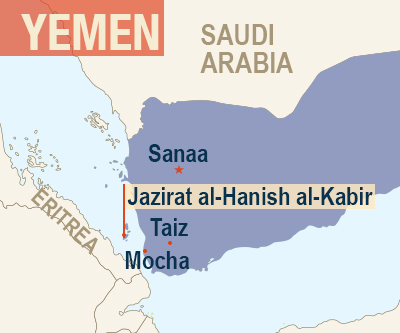
HANISH-map

In a pivotal breakthrough in the Yemen civil war, Thursday, Dec. 11 the naval forces of Saudi Arabia, Egypt and the UAR took by storm from Yemen’s Iran-backed Houthi rebels the Greater Hanish island, which is part of the strategic archipelago commanding the Strait of Bab al Mandeb. This is reported exclusively by DEBKAfile’s Middle East sources.

This highly strategic strait links the Indian Ocean with the Gulf of Aden and the Red Sea – i.e. Africa and Asia – and is the world’s fourth busiest chokepoint for international oil traffic.

Captured by Yemeni rebels last May, the island was converted by Iranian officers into an armed base and one of Tehran’s largest depots for the supply of arms to its forces and proxies in the region. A fleet of small boats and fishing vessels kept the Yemeni Houthis amply armed for fending off the Saudi-led Arab coalition fighting to restore the exiled Yemeni government.

The Hanish island base also provided Iran with a commanding position for spreading its influence in Ethiopia and Eritrea on the eastern African seaboard.

Taking the island was a major breakthrough for the coalition, after long months of combat that was crowned by their capture of the southern Yemeni seaport of Aden in the past three months. With the occupation of Greater Hanish, Saudi-led forces are now in position not just to cut off Iran’s weapons supplies to the Yemeni rebels, but also to break its grip on the vital strait that connects the Persian Gulf to the Mediterranean via the Suez Canal.

Iran maintained on Greater Hanish Island advanced radar and electronic tracking stations for keeping an eye on military movements on the southern Saudi border with northern Yemen. They could also shadow oil tanker and other shipping passing through the Red Sea, and stake out Israel’s south- and east-bound sea traffic as it passed through the Gulf of Aqaba.

DEBKAfile’s military and intelligence sources reveal that Saudi Arabia and Egypt finally decided that the seizure of the strategic island could not be delayed when last month, Iran won a permit to establish an air and sea base in Djibouti, the Horn of Africa nation opposite the Gulf of Aden’s entrance to the Red Sea.

Djibouti derives much of its revenue from renting out tracts of land to foreign nations seeking bases of operation in the Horn of Africa and the Red Sea. American and French bases are situated no more than 214 km from Greater Hanish Island.

Riyadh, Cairo and the UAE agreed that they could not afford to let Iranian air and naval forces gain control of the Bab El-Mandeb Strait from its twin footholds on the island and in Djibouti.

They were not the only interested parties. It may be taken for granted that their operation to take over Greater Hanish was quietly assisted by Western and Middle East interests that had been watching Iran’s takeover of these vital ocean pathways with grave concern.

Saudi king wants Obama to tackle Iranian ‘mischief’

August 31, 2015

Saudi king wants Obama to tackle Iranian ‘mischief,’ Al-Monitor, August 31, 2015

U.S. US Secretary of Defense Ashton Carter meets with Saudi Arabia's King Salman bin Abdul-Aziz Al Saud (R) at Al-Salam Palace in Jeddah, Saudi Arabia, July 22, 2015. (photo by REUTERS/Carolyn Kaster) Read more: http://www.al-monitor.com/pulse/originals/2015/08/saudi-king-washington-visit-iran-deal.html#ixzz3kPeQtHQK width= U.S. Defense Secretary Ash Carter meets with Saudi Arabia’s King Salman bin Abdul Aziz (R) at Al-Salam Palace in Jeddah, Saudi Arabia, Wednesday, July 22, 2015.

King Salman bin Abdul-Aziz Al Saud’s three-day visit, strategically scheduled just days before Congress votes on the agreement, offers the Saudi leader a powerful platform to insist that the United States help combat Iranian “mischief.” The king is seeking assurances in the fight against Iran’s proxies across the region, as well as with elements of the nuclear deal itself.

The visit “underscores the importance of the strategic partnership between the United States and Saudi Arabia,” White House spokesman Josh Earnest said Aug. 27.

“The president and the king will discuss a range of issues and focus on ways to further strengthen the bilateral relationship, including our joint security and counterterrorism efforts,” Earnest said. “They will also discuss regional topics, including the conflicts in Yemen and Syria, and steps to counter Iran’s destabilizing activities in the region.”

Despite deep reservations about the deal, sources close to the Saudi government say that unlike Israel, the kingdom quickly concluded that it could not be defeated in Congress and that no better alternatives were likely to emerge.

Riyadh, however, has repeatedly made clear that its support is conditioned on a tough inspection regime and snapback sanctions. Salman may seek further assurances on those aspects of the deal in light of recent reports that allege that Iran will be allowed an unusual amount of autonomy with regard to inspections of its military installation at Parchin.

“The agreement must include a specific, strict and sustainable inspection regime of all Iranian sites, including military sites, as well as a mechanism to swiftly re-impose effective sanctions in the event that Iran violates the agreement,” the Saudi Embassy in Washington said after the deal was announced.

Most of the discussion is expected to center on non-nuclear issues, however.

Salman and President Barack Obama, who will meet Sept. 4 at the White House, are expected to further flesh out Washington’s promise of increased military support for the Gulf Cooperation Council countries — including a potential missile defense shield — as discussed during the US-GCC Camp David summit in May. That meeting, which was skipped by four of the top six regional leaders — including Salman — aimed to reassure the Gulf nations of America’s commitment to their security amid the perceived rapprochement with Iran.

“This is an opportunity to reset this relationship when there are some pretty considerable concerns on both sides,” said David Weinberg, a Gulf analyst with the Foundation for Defense of Democracies. “It comes in the context of the United States trying to reassure the Gulf states about the Iran deal, as well as to focus on this Camp David agenda in terms of concrete US security assistance. It’s reasonable to assume that that’s going to be a big focus of the trip as well.”

Much of the conversation is expected to focus on military hardware: The Saudis are seeking upgrades to their F-15s along with other advanced weaponry, but Israel is said to have raised concerns during Defense Secretary Ashton Carter’s recent visit to the region. Congress may object to such sales if lawmakers deem that they would undermine Israel’s so-called qualitative military edge.

The Saudis will be interested “in how much the White House will invest itself so that it can get the technology that it wants,” former Obama National Security Council Middle East adviser Prem Kumar told Al-Monitor. They will want to see if the White House “will spend some political capital on the Hill.”

Another topic of interest is the proposed creation of a GCC-wide “rapid reaction force” to take on external threats. The White House paid lip service to the idea in its joint statement from the Camp David summit, but the idea has failed to gain traction among concerns by Qatar and Oman that it would be dominated by the Saudis.

“In terms of GCC-wide reassurance, the Saudis are interested to hear what the US is prepared to do to support the GCC rapid reaction force, the joint Arab defense force, if that is going to materialize,” Kumar said.

Beyond military requests, Salman is likely to seek US backing for his more muscular approach to foreign policy compared with his predecessor. That includes beefed-up US support for his campaign against the Houthis in Yemen and a renewed focus on getting rid of President Bashar al-Assad in Syria.

For Riyadh, said former Saudi Embassy political analyst Fahad Nazer, a nuclear Iran “is more of a long-term issue. They’re concerned about the here-and-now.”

“The Saudis at this point have kind of parted ways with their traditional behind-the-scenes diplomacy and trying to mediate between warring factions,” Nazer said. “[They’ve realized] it’s time for them to take the helm of ensuring their own interests.”

In Yemen, “The Saudis want the US to get more involved, beyond intelligence and logistical support to the Saudi-led coalition,” said Kumar, now vice president with the Albright Stonebridge Group. Already, the Pentagon in recent weeks has more than doubled its advisers on the ground providing targeting intelligence for airstrikes and helping the Saudis roll back the Houthis, according to the Los Angeles Times.

Those battlefield successes have led some Saudi cheerleaders to argue that the intervention in Yemen offers a “template” for similarly emboldened leadership in Syria. While Nazer and others doubt Riyadh will go that far, the Saudis have recently announced their own proposal to withdraw support for Sunni rebels if Iran removes its forces and Hezbollah fighters with a view to parliamentary and presidential elections under UN supervision.

“I think there are a couple concrete things” on the Saudi wish list, Kumar said. “First is to increase support for the Syrian opposition, in some form or other. Safe zones, maybe direct pressure on the [Assad] regime, that would not necessarily undercut diplomatic initiatives.”

The king’s visit isn’t just about politics, however. He will be accompanied by a large entourage of ministers and business executives, and some of them are expected to stay on after the royal visit.

The US-Saudi Arabian Business Council has announced a daylong investment forum with the ministers of finance as well as commerce and industry.


Russia and US woo Saudis to help save Assad – albeit putting Israel and Jordan in danger from S. Syria

August 9, 2015

Russia and US woo Saudis to help save Assad – albeit putting Israel and Jordan in danger from S. Syria, DEBKAfile, August 9, 2015

Lavrov_Kerry_and_al-Jubeir-_Doha_3.8.15Lavrov, Kerry, Al-Jubeir at Doha

[N]either Israel nor Jordan has been co-opted to this big power initiative, as though they are not concerned. However, both have a big stake in Saudi Arabia’s next decisions. If Riyadh is won over by US-Russian blandishments and goes back on its decision to boycott Assad, the Saudi-Israeli-Jordanian effort to support Syrian rebel control of southern Syria will fall apart. This will open up both countries to new perils on their  northern borders.

************************

Building on the nuclear accord signed in Vienna last month, the Obama administration has been in close communion with Moscow and Tehran on regional moves to save the Assad regime, as the key to their next regional policies, including a united front against the Islamic State.. Saudi Arabia and its Gulf partners are being assiduously wooed to join the new alignment being set up for this purpose. The live wire in getting them all together is Omani Foreign Minister Khalid bin Mohamed Al-Attiyah, the secret broker who brought Iran and the United States to the negotiating table for a nuclear accord. This was first reported in the last DEBKA Weekly.

Wednesday, Aug. 7, Obama threw out his first hint on this development: “The window has opened a crack for us to get a political resolution in Syria, partly because both Russia and Iran, I think, recognize that the trend lines are not good for Assad,” he said. “Neither of those patrons are particularly sentimental; they don’t seem concerned about the humanitarian disaster that’s been wrought by Assad and this conflict over the last several years, but they are concerned about the potential collapse of the Syrian state. And that means, I think, the prospect of more serious discussions than we’ve had in the past.”

The US president then affirmed more strongly in a CNN interview Sunday, Aug. 9:  “Is there the possibility that having begun conversations around this narrow issue [the nuclear accord with Iran] that you start getting some broader discussions about Syria, for example, and the ability of all the parties involved to try to arrive at a political transition that keeps the country intact and does not further fuel the growth of ISIL and other terrorist organizations? I think that’s possible,” Obama said. “But I don’t think it happens immediately.”

The administration and its prospective partners are united by the will to destroy ISIS – in its Syrian stronghold, for starters – but are divided on much else, DEBKA file reports. And so the process is moving forward in careful steps.

Their initial focus is on Syria, the bloody battleground which in less than five years has left at least 300,000 dead and more than 10 million people homeless.

The plan the group started out with in the last ten days was a swap as simple as it was ruthless: Saudi Arabia and the United Arab Emirates would slow their assistance to Syrian rebel groups, against whom President Bashar Assad’s army and allies would hold their fire; Iran, for its part, was to start withdrawing its support from the Yemeni Houthis insurgents.

The informal truce in Syria would be the stage for the Assad regime and rebel groups to start discussing a new government with room for opposition parties. The Islamists of the Islamic State and Al Qaeda’s Nusra Front would not be invited.

In Yemen, Tehran would cut back on the arms and intelligence which have enabled the Houthi insurgents to stand up to the combined forces of Saudi Arabia, the UAE and Egypt. The pro-Western Yemeni President Abd Rabo Mansour Hadi would be restored to his palace in Sanaa and invite the insurgent leader, Abdu Malik Al-Houthi, to discuss his partnership in a new government.

This deal was tantamount to a joint US-Russian guarantee of Bashar Assad survival in power in return for a Tehran-Riyadh compact for Hadi’s reinstatement in Sanaa.

These arrangements were debated back and forth in exchanges, some semi-secret, among the leading actors for most of July. The visit to Riyadh of the Syrian intelligence chief Maj. Gen. Ali Mamlouk was set up by Moscow as a major push forward.

The plan was for the entire enterprise to be brought out in the open and sealed in Doha, Qatar, Tuesday, Aug. 3 at a conference attended by US Secretary of State John Kerry, Russian Foreign Minister Sergey Lavrov, Saudi Foreign Minister Adel Al-Jubeir and other top Gulf diplomats.

Iranian Foreign Minister Mohammed Javad Zarif was not there. But he put a strong oar into the proceedings by calling in at Muscat, Oman the day before the conference and subsequently on Friday Aug. 7. Assad also kept his hand in by sending his foreign minister Walid Moallem to Tehran and Muscat last week.

But then, at Doha, just as the package was ready to unveil, the Saudi foreign minister pulled away and blew it up with two provisions: a) Riyadh would not countenance Bashar Assad being allowed to stay in office, and: b) Saudi Arabia would not do business with any representative of the Assad regime.

This put a large spoke in the main wheel of the initiative and also scuttled some of the secondary plans depending on it.

But by then, a lot was happening in the Yemeni and Syrian war arenas:

1. Saudi and UAE armored forces had landed in Aden and were closing in on the Yemeni capital, Sanaa. The Houthi rebels, trained and armed by Iran, were forced to retreat without negotiations on their future role in government.

2. Syrian rebel leaders, sensing the approaching betrayal, sent a secret delegation to Tehran to discuss terms for opening negotiations with Assad. They too were left at sea about the deals in play among Washington, Moscow, Tehran and Riyadh over their future.

Saturday, Aug.8, the Russians, egged on by the Americans, set about winning Riyadh into the fold, Foreign Minister Al-Jubeir was invited to pay a visit to Moscow Tuesday, Aug. 11, for talks about the Syrian conflict and the war on the Islamic State.

Refusing to accept that the new initiative had been grounded in Doha, Moscow presented the visit as continuing the ongoing dialogue on the issues raised at that encounter.

DEBKAfile’s military and intelligence sources note that neither Israel nor Jordan has been co-opted to this big power initiative, as though they are not concerned. However, both have a big stake in Saudi Arabia’s next decisions. If Riyadh is won over by US-Russian blandishments and goes back on its decision to boycott Assad, the Saudi-Israeli-Jordanian effort to support Syrian rebel control of southern Syria will fall apart. This will open up both countries to new perils on their  northern borders.