Posted tagged ‘West Bank’

EU Gives Hamas Green Light to Attack Israel

December 22, 2014

EU Gives Hamas Green Light to Attack Israel, Gatestone InstituteKhaled Abu Toameh, December 22, 2014

Although the EU court has said that its controversial decision was “technical” and was not a reassessment of Hamas’s classification as a terrorist group, leaders of the Islamist movement believe that the move will eventually earn them legitimacy in the international arena.

The EU court’s decision represents a “severe blow to the Palestinian Authority and Egypt,” according to Palestinian political analyst Raed Abu Dayer.

Any victory for Hamas, albeit a small and symbolic one, is a victory for the Islamic State, Al-Qaeda, Islamic Jihad, the Muslim Brotherhood and other fundamentalist groups, and causes tremendous damage to those Muslims who are opposed to radical Islam.

Hours before the EU court’s decision was made public, Hamas leader Mahmoud Zahar announced that his movement would never recognize Israel, and that Hamas seeks to overthrow the Palestinian Authority and seize control of the West Bank.

The EU court’s decision also coincided with a rapprochement between Hamas and Iran. Now, the Iranians and other countries, such as Turkey and Qatar, are likely to interpret the EU court’s decision as a green light to resume financial and military aid, including rockets and missiles, to Hamas — not only to Gaza but to the West Bank as well — to support those Palestinians whose aim it is to eliminate Israel.

Less than 48 hours after a top European Union court ruled that Hamas should be removed from the bloc’s list of terrorist groups, supporters of the Palestinian Islamist movement responded by firing a rocket at Israel. The attack, which did not cause any casualties or damage, did not come as a surprise.

Buoyed by the EU court’s ruling, Hamas leaders and spokesmen see it as a “political and legal achievement” and a “big victory” for the “armed struggle” against Israel.

Musa Abu Marzouk, a top Hamas leader, issued a statement thanking the EU court for its decision. He hailed the decision to remove his movement from the terrorist list as a “victory for all those who support the Palestinian right to resistance.”

When Hamas leaders talk about “resistance,” they are referring to terrorist attacks, such as the launching of rockets and suicide bombings against Israel. In other words, Hamas has interpreted the court’s decision as a green light to carry out fresh attacks as part of its ambition to destroy Israel.

The rocket that was fired from the Gaza Strip at Israel only days after the court decision is not likely to be the last.

Although the EU court has said that its controversial decision was “technical” and was not a reassessment of Hamas’s classification as a terrorist group, leaders of the Islamist movement believe that the move will eventually earn them legitimacy in the international arena.

Ironically, the EU court’s decision coincided with Hamas celebrations marking the 27thanniversary of its founding. Once again, Hamas used the celebrations to remind everyone that its real goal is to destroy Israel. And, of course, Hamas used the event to display its arsenal of weapons that include various types of rockets and missiles, as well as drones.
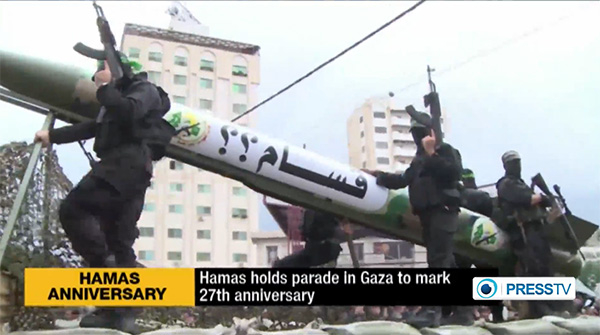
845 (1)Thousands of armed Hamas troops showed off their military hardware at a Dec. 14, 2014 parade in Gaza, marking the organization’s 27th anniversary. (Image source: PressTV video screenshot)

Hours before the EU court decision was made public, Hamas leader Mahmoud Zahar announced that his movement would never recognize Israel. Zahar also made it clear that Hamas seeks to overthrow the Palestinian Authority [PA] regime and seize control over the West Bank.

The EU court’s decision also coincided with increased efforts to achieve rapprochement between Hamas and Iran. Recently, a senior Hamas leadership delegation visited Tehran as part of efforts to mend fences between the two sides. The main purpose of the visit was to persuade the Iranians to resume military and financial aid to Hamas. The visit, according to senior Hamas officials, appears to have been “successful.”

“There are many signs that our relations are back on the right track,” explained Hamas’s Musa Abu Marzouk. “Hamas and Iran have repaired their relations, which were strong before the Syrian crisis.” Relations between Hamas and Iran deteriorated due to the Islamist movement’s refusal to support the regime of Syrian President Bashar Assad.

Now the Iranians are likely to interpret the EU court decision to remove Hamas from the list of terrorist groups as a green light to resume financial and military aid to the movement.

Iran’s leaders recently announced that they intend to dispatch weapons not only to the Gaza Strip, but to the West Bank as well, as part of Tehran’s effort to support those Palestinians who are fighting to eliminate Israel.

Moreover, the EU court’s move will also embolden other countries that provide Hamas with political and financial aid, first and foremost Qatar and Turkey. Oil-rich Gulf countries such as Kuwait, Bahrain, Oman and Saudi Arabia will now face pressure from many Arabs and Muslims to join Qatar, Turkey and Iran in extending their support to Hamas.

The biggest losers, meanwhile, are Palestinian Authority President Mahmoud Abbas and Egypt’s President Abdel Fattah el-Sisi. Over the past few months, the two men have been doing their utmost to undermine Hamas and end its rule over the Gaza Strip.

Abbas has been fighting Hamas by blocking financial and humanitarian aid and arresting its supporters in the West Bank, while Sisi continues to tighten the blockade on the Gaza Strip and destroy dozens of smuggling tunnels along the border with Egypt.

The EU court’s decision represents a “severe blow to the Palestinian Authority and Egypt,” noted Palestinian political analyst Raed Abu Dayer. “As far is Abbas is concerned, the decision grants Hamas political legitimacy and challenges his claim to be the sole legitimate leader [of the Palestinians]. With regards to Egypt, the European court decision calls into question rulings by Egyptian courts that Hamas is a terrorist organization.”

Even if the EU court decision is reversed in the future, there’s no doubt that it has already caused tremendous damage, especially to those Muslims who are opposed to radical Islam.

Any victory for Hamas, albeit a small and symbolic one, is a victory for the Islamic State, Al-Qaeda, Islamic Jihad, the Muslim Brotherhood and other fundamentalist groups around the world.

The decision has left many Arabs and Muslims with the impression that Hamas, after all, is not a terrorist organization, especially if non-Muslims in Europe say so through one of their top courts. Even worse, the decision poses a real and immediate threat to Israel, as evident from the latest rocket attack.

If the Europeans have reached the conclusion that Hamas is not a terrorist organization, then why don’t their governments openly invite tens of thousands of Hamas members and supporters to move to London, Paris and Rome? And they should not forget to ask the Hamas members to bring along with them their arsenal of weapons.
The Palestinians’ UN Charade Collapses

December 19, 2014

The Palestinians’ UN Charade Collapses, Commentary Magazine, December 19, 2014

[T]he endless quarrels between Obama and Netanyahu over the peace process are so pointless. No matter how much Obama tilts the diplomatic playing field in the Palestinians’ direction or how often he and his supporters prattle on about time running out for Israel, Abbas has no intention of signing a peace agreement. The negotiations as well as their maneuverings at the UN and elsewhere are nothing but a charade for the PA and nothing Netanyahu could do, including offering dangerous concessions, would change that. The sooner Western leaders stop playing along with their game, the better it will be for the Palestinian people who continue to be exploited by their leaders.

*****************

In the end, there wasn’t much suspense about the Obama administration’s decision whether to support a United Nations Security Council resolution endorsing a Palestinian state. After weeks of pointless negotiations over proposed texts, including a compromise endorsed by the French and other European nations, the wording of the proposal that the Palestinians persuaded Arab nations to put forward was so outrageous that even President Obama couldn’t even think about letting it pass because it would undermine his own policies. And the rest of the international community is just as unenthusiastic about it. In a very real sense this episode is the history of the Arab-Israeli conflict in a nutshell: the world wants to do something for the Palestinians but their leaders are more interested in pointless shows than in actually negotiating peace or doing something to improve the lives of their people.

The resolution that was presented to the Security Council was so extreme that Jordan, the sole Arab nation that is currently a member, didn’t want anything to do with it. But, after intense lobbying by the Palestinian Authority representative, the rest of the Arab nations prevailed upon Jordan and they put it forward where it will almost certainly languish indefinitely without a vote since its fate is preordained.

The terms it put forward were of Israeli surrender and nothing more. The Jewish state would be given one year to withdraw from all of the territory it won in a defensive war of survival in 1967 where a Palestinian state would be created. That state would not be demilitarized nor would there be any guarantees of security for Israel which would not be granted mutual recognition as the nation state of the Jewish people, a clear sign that the Palestinians are not ready to give up their century-long war against Zionism even inside the pre-1967 lines.

This is a diktat, not a peace proposal, since there would be nothing for Israel to negotiate about during the 12-month period of preparation. Of course, even if the Palestinians had accepted the slightly more reasonable terms proposed by the French, that would have also been true. But that measure would have at least given the appearance of a mutual cessation of hostilities and an acceptance of the principle of coexistence. But even those concessions, let alone a renunciation of the “right of return,” was not possible for a PA that is rightly fearful of being supplanted by Hamas. So long as Palestinian nationalism remains wedded to rejection of a Jewish state, no matter where its borders might be drawn, no one should expect the PA to end the conflict or actually make peace.

Though many of us have been understandably focused on the question of how far President Obama might go to vent his spleen at Israeli Prime Minister Netanyahu and his government, that petty drama is, as it has always been, a sideshow distraction from the real problem at the core of the Middle East peace process: Palestinian rejectionism.

Though the administration has tirelessly praised PA leader Mahmoud Abbas as a champion of peace in order to encourage him to live up to that reputation, he had other priorities. Rather than negotiate in good faith with the Israelis, Abbas blew up the talks last year by signing a unity pact with Hamas that he never had any intention of keeping. The purpose of that stunt, like the current UN drama, isn’t to make a Palestinian state more likely or even to increase Abbas’s leverage in the talks. Rather, it is merely a delaying tactic, and a gimmick intended to waste time, avoid negotiations, and to deflect any pressure on the PA to either sign an agreement with Israel or to turn it down.

That’s not just because the Palestinians wrongly believe that time is on their side in the conflict, a dubious assumption that some on the Israeli left also believe. The reason for these tactics is that Abbas is as incapable of making peace as he is of making war.

This is not just another case of the Palestinians “never missing an opportunity to miss an opportunity,” in Abba Eban’s immortal and quite accurate summary of their actions over the years. It’s that they are so wedded to unrealistic expectations about Israel’s decline that it would be inconceivable for them to take advantage of any opening to peace. That is why they turned down Israeli offers of statehood, including control of Gaza, almost all of the West Bank, and a share of Jerusalem, three times and refused to deal seriously with a fourth such negotiation with Netanyahu last year.

And it’s why the endless quarrels between Obama and Netanyahu over the peace process are so pointless. No matter how much Obama tilts the diplomatic playing field in the Palestinians’ direction or how often he and his supporters prattle on about time running out for Israel, Abbas has no intention of signing a peace agreement. The negotiations as well as their maneuverings at the UN and elsewhere are nothing but a charade for the PA and nothing Netanyahu could do, including offering dangerous concessions, would change that. The sooner Western leaders stop playing along with their game, the better it will be for the Palestinian people who continue to be exploited by their leaders.

The Countdown to the Next Gaza Conflict Has Begun

December 19, 2014

The Countdown to the Next Gaza Conflict Has Begun, Gatestone InstituteYaakov Lappin, December 19, 2014

(Please see also Hamas reconstructing terror tunnels using Israeli materials. — DM)

Hamas could, with a fair amount of ease, cause Israel to end its security blockade by accepting the terms of the international Quartet. These include recognizing the state of Israel, renouncing violence and abiding by past agreements.

Of course, those would contravene Hamas’s ideology of Islamist jihad and move it away from its current trajectory of organized violence and religious hatred, the foundations upon which it was established in the 1980s by the Muslim Brotherhood.

For now, it seems, Hamas will try, as it has been doing for months, to orchestrate terrorism in the West Bank, on the opposite side of Israel, while upholding its truce in Gaza.

The Israel Defense Forces, too, has spent recent months preparing to respond if there is a fresh round of hostilities.

More than three months have passed since the end of the fifty-day conflict between Hamas in Gaza and Israel this past summer, yet all of the catalysts that helped spark that war remain in place and are pushing the sides into their next clash.

845Thousands of armed Hamas troops showed off their military hardware at a Dec. 14, 2014 parade in Gaza, marking the organization’s 27th anniversary. (Image source: PressTV video screenshot)

One of the reasons Hamas launched a war in July this year was to try to end its strategic isolation, which became severe after the downfall of the Muslim Brotherhood in next-door Egypt. Hamas also sought to improve its crumbling economic situation as the ruler of the Gaza Strip; its dire situation was illustrated by Hamas’s inability to pay 40,000 of its Gazan employees their monthly salaries.

Hamas could, with a fair amount of ease, cause Israel to end its security blockade by accepting the terms of the international Quartet. These would include recognizing the state of Israel, renouncing violence and abiding by previous diplomatic agreements. Of course, those would contravene Hamas’s ideology of Islamist jihad and move it away from its current trajectory of organized violence and religious hatred, the foundations upon which it was established in the 1980s by Palestinian members of the Muslim Brotherhood.

Today, however, the same problems that plagued Hamas prior to the summer war have become worse. Gaza is hemmed in to the south by a hostile Egypt under the rule of President Abdel Fattah El-Sisi. Egypt is systematically cutting off the smuggling tunnels that linked Sinai to the Gaza Strip. This means that Hamas is no longer easily able to smuggle either weapons or goods it can tax before they enter Gaza’s market.

Israel’s naval security blockade, designed to prevent the smuggling of arms or materiel that can be used to build weapons, remains in place, as does Israel’s tight security control of its border crossings with the Gaza Strip. Israel has in recent months begun permitting the entry of construction materials to encourage Gaza’s reconstruction efforts, and assisted in the export of Gazan agricultural goods to places such as the West Bank.

Most critically, however, Hamas’s hopes for $5.4 billion of international aid money, pledged by donor states for Gaza’s post-war recovery, remain unrealized. The money has barely begun to trickle in, due to an ongoing crisis with the Fatah-run Palestinian Authority [PA] in Ramallah.

Under the terms set by the international community, the money must enter Gaza through a joint PA-Hamas mechanism. Due to ongoing Fatah-Hamas divisions, such a mechanism appears far from being built.

The latest illustration of these intra-Palestinian tensions can be found in the coordinated, multiple bomb attacks in November on the homes of Fatah officials in Gaza — attacks carried out by Hamas’s military wing.

Meanwhile, the approximately 100,000 Gazans whose homes were destroyed by the fighting in the summer remain without a fixed roof over their heads in the winter, creating another source of pressure on Hamas.

These factors have led Hamas’s military wing to warn publicly that a new explosion of violence against Israel is imminent. “We are saying to all sides — if the siege on Gaza and the obstacles for reconstruction remain, there will be a new explosion,” stated Abu Obeida, the spokesman of Hamas’s military wing, the Ezzedine al-Qassam Brigades.

The warning was answered this week by Israel’s Defense Minister, Moshe Ya’alon, who said, “We now base the quiet in the Gaza Strip on deterrence. At this stage they are deterred, but we must be ready at any given time for the possibility that we will have to again act with full force.”

While it would not be in Hamas’s interests to spark a new destructive conflict so soon after a bruising one, if faced with the possibility that its regime in Gaza might collapse, it may decide to do so.

Hamas has, since the moment that hostilities ended in August, resumed rocket production in Gazan plants, albeit at a slower rate than before the conflict. Hamas has also most likely restarted work to dig more tunnels from Gaza into Israel, which are designed to inject guerrilla squads into Israel to commit terrorist kidnappings and murders.

The Israel Defense Forces, too, has spent recent months preparing to respond if there is a fresh round of hostilities. It assesses that Israeli deterrence has been fully replenished; it is also reluctantly prepared should the volatile situation in Gaza push deterrence aside.

For now, it seems, Hamas in Gaza will try, as it has been doing in recent months, to orchestrate terrorism in the West Bank, on the opposite side of Israel, while upholding its truce in Gaza. If Hamas’s standoff with Fatah continues, however, and the host of factors that pushed Hamas into the last war do not change, the countdown to the next war may be shorter than many think.

‘Hamas will liberate West Bank, just like Gaza’

December 14, 2014

‘Hamas will liberate West Bank, just like Gaza,’ Israel Hayom, December 14, 2014

Senior Hamas official Mahmoud al-Zahar reveals group’s true intentions in Judea and Samaria, says, “We will repeat the same steps in the West Bank as preparation for our arrival in all of Palestine” • PM speaks with Greek counterpart after Athens attack.

141854662560693664a_bMahmoud al-Zahar called security cooperation between Israel and the PA a “national disgrace” | Photo credit: Reuters

Senior Hamas official Mahmoud al-Zahar over the weekend revealed the Palestinian terrorist organization’s true intentions in Judea and Samaria.

In a speech marking the 27th anniversary of the group’s creation, al-Zahar said, “Just as we liberated Gaza, just as we established a real national government there, just as we built a victorious army, just as we built a protective police force, and just as we have created security apparatuses with which to fight the enemy, we will repeat the same steps in the West Bank as preparation for our arrival in all of Palestine.”

Prior to the IDF’s Operation Protective Edge against Hamas in Gaza this past summer, and following the collapse of diplomatic talks with the Palestinian Authority, the PA and Hamas held successful talks to establish a unity government, which was formed in early June. Hamas, however, simultaneously worked to topple the Fatah-led PA, and the infrastructure it had built in Judea and Samaria was uncovered in mid-August by Israel’s Shin Bet security agency and dismantled. The Shin Bet arrested 93 Hamas operatives working to establish the group’s military infrastructure in Judea and Samaria, an infrastructure that included money and weapons caches, safe houses and more.

Orchestrating these efforts was senior Hamas operative Salah al-Arouri, from the terrorist group’s headquarters in Turkey.

Until now, Hamas had denied reports it was seeking control of Judea and Samaria. Last week al-Zahar accused Fatah of “treating Hamas like an enemy instead of as a political rival.”

In a statement issued on his behalf, al-Zahar blamed Fatah for the siege imposed on Gaza, and he accused the PA of preventing construction materials from entering Gaza while Israel was allowing such goods to cross the border. Al-Zahar also condemned security cooperation between Israel and the PA, calling it a “national disgrace.”

Meanwhile, Prime Minister Benjamin Netanyahu spoke with his Greek counterpart, Antonis Samaras, on Friday following Thursday night’s shooting attack on the Israeli Embassy in Athens. Over 50 bullets were fired at the building, but no one was harmed in the attack. Greek security forces believe the attack was perpetrated by a radical left-wing organization, and were investigating any connection to a similar shooting attack on the German ambassador’s residence in Athens last year.

Israel’s Foreign Ministry issued a statement following the shooting, calling on the international community “to condemn anti-Israel incitement spread around the world by Palestinian leaders and pro-Palestinian groups.”

Palestinian song glorifies terror trend of driving into crowds

November 11, 2014

Palestinian song glorifies terror trend of driving into crowds, Fox News, November 11, 2014

(Why won’t “apartheid” Israel be reasonable, as Obama demands, and commit suicide? — DM)

palpic2Images in Palestinian media glorify terrorists who drive their cars into crowds of innocent Israelis. (PalWatch.org)

The disturbing Palestinian trend of driving into crowds – dubbed “vehicular terrorism” by the Israeli government – has been celebrated in a twisted new hit song called “Run Over the Settler.”

The car attacks, coupled with random stabbings that have occurred with frightening frequency in recent weeks, have sparked fears of a new “intifada,” or uprising, in Israel. But in the Palestinian territories of Gaza and the West Bank, the attacks are being glorified in song, and in the words of leaders.

“Run them over, burn the next in line,” goes the song, sung by Anas Garadat and Muhammad Abu Al-Kayed and translated by Palestinian Media Watch. “Don’t leave a single settler. Wait for them at the intersection. Let the settler drown in red blood.”

The car attacks began on Oct. 22, when a Palestinian named Abd Al-Rahman Al-Shaloudi slammed his car into a crowded train station in Jerusalem in an apparently intentional act that killed a 3-month-old Israeli-American baby and an Ecuadorian woman. Last Thursday, Palestinian and known Hamas operative Ibrahim Al-Akari rammed a van into a group of pedestrians in Jerusalem, killing a police officer, and on Monday morning, two terrorist attacks occurred hours apart, leaving one woman dead and several others injured. The attacker in the second incident, who stabbed three people at a bus station, had originally intended to use his vehicle as a weapon, according to reports.

In the song, the apparently accidental death of a 2-month-old Palestinian girl is used as justification for the intentional attacks. In that case, the Israeli driver reportedly even called for an ambulance for the stricken child and her brother.

Israeli Police spokesman Mickey Rosenfeld said the attacks have prompted extra measures to safeguard the public.

“Extra police units have been mobilized in different areas with the emphasis on Judea and Samaria [the West Bank], Jerusalem and Tel Aviv, following yesterday’s attack there,” Rosenfeld told FoxNews.com. “We have also stepped up Border Police operations around Palestinian areas such as Nablus, Bethlehem, and Hebron, and there is increased security being implemented on a ground level, including regular patrols and road blocks.”

But stopping Palestinian terrorists from suddenly veering onto sidewalks and striking with easily concealed knives is a daunting task, Rosenfeld acknowledged.

“We’re working both on an intelligence level and an operational level,” Rosenfeld said. “The intelligence level consists of finding potential suspects before they manage to reach the streets, and on an operational level we have larger numbers of undercover officers in public places ahead of time, that can immediately respond and react when necessary.”

He also confirmed that despite the violence of the last few weeks, regular co-operation is continuing between Israeli and Palestinian police.

Not so with Palestinian media and cultural institutions, however. Local newspapers and television programs have used cartoon images to laud the killings, adding fuel to an already combustible situation.

On Monday, the Hamas-supported Al Quds University in Jerusalem proudly unveiled an exhibit glorifying Mutaz Hijazi, who attempted to assassinate the controversial Rabbi Yehuda Glick at the Begin Center in Jerusalem on Oct. 29.

Glick, who was shot four times at close range, had been in the forefront of calls for Jews to be allowed to pray freely on the Temple Mount, site of the Golden Dome and Al Aqsa Mosque, and previously of the Second Jewish Temple. Their demands, supported by only a handful of extreme right-wing politicians who have come in for heavy criticism in the Israeli mainstream for inflaming religious tensions, seek to change the status quo at the religious site that has existed since Israel gained control of Jerusalem in 1967.

Glick is recovering from his injuries, but Hijazi, a long-standing member of Islamic Jihad, was tracked down by Israeli security services and killed. He is being hailed as a heroic martyr by Palestinian media and by some Palestinian politicians who, in contrast to their Israeli counterparts, appear to be doing little publicly to ease the spiraling situation.

But while Israeli leaders have called for Glick to stifle demands to pray at the sacred site, Palestinian leaders continue to praise violent terrorists. A spokesman for Palestinian Authority President Mahmoud Abbas recently referred to terrorist killers as “heroic martyrs… saturating the land of the homeland with their pure blood and igniting the flames of rage.”

Ministers approve bill to extend Israeli law to West Bank, without annexing

November 9, 2014

Ministers approve bill to extend Israeli law to West Bank, without annexing territory

New bill will see West Bank military commander ratify Israeli law as military decrees in territory, thus extending Israel’s law to settlements without formally annexing them; supporters say bill will protect settlers rights, while leftist says ‘its apartheid policy’.

Moran Azulay

Published: 11.09.14, 17:22 / Israel News

via Ministers approve bill to extend Israeli law to West Bank, without annexing … – Israel News, Ynetnews.


A new and controversial bill extending Israel’s laws to West Bank settlements without formally annexing the area was approved Sunday by the Ministerial Committee for Legislation, thus overcoming the first legal obstacle en route to becoming a law.

While settlers living in the West Bank are formally subject to military rule, the bill will see the region’s military commander ratify bills passed in Israel’s Knesset as military decree, thus de facto extending legislation passed in Israel to the occupied territories.

The news comes at a volatile time for Israel, with tensions between Jews and Arabs reaching new heights with violence spearing across the nation, as well as international pressure on Israel growing, with more and more states passing bills vowing to recognize a Palestinian state.

The bill – dubbed The Norms Law – was sponsored by rightists MK Orit Struk (Bayit Yehudi) and MK Yariv Levin (Likud) and saw four ministers object and six vote in favor. The Ministerial Committee for Legislation is a committee of ministers charged with choosing which bills go forward with the legislation process.

Justice Minister Livni, who voted against the bill, slammed it, saying “the real goal of this bill is to normalize an abnormal situation – an expanding occupation masquerading as civil rights.”

According to the bill, the IDF’s Central Command – which is the sovereign in the Israeli controlled parts of the West Bank and serves as the area’s governor – will ratify the laws in an ad hoc manner some 45 days after they complete the legislation process.

According to Struk and Levin, the bill will serve both Israelis and Palestinians, however it is far from certain this will be the case, as it is unclear to which areas the law will be extended and moreover, it is not retroactive – and will only pertain to laws passed after the Norms Law is ratified – thus Palestinians will not be given the right to vote, for example.

Meanwhile, the committee chairwomen Justice Minister Tzipi Livni and Finace Minister Yair Lapid vowed to fight the bill.

“Judea and Samaria (the West Bank) is home to 350,000 Israeli citizens that vote for the Knesset, but their lives are not managed by it because the Israeli law does not apply. This is unacceptable situation which harms residents and undoubtedly infringes on their rights, discriminating against them,” the bill touted.

According to its sponsors, the bill is intended to extend basic rights to settlers, for example, labor laws which currently do not apply to the areas.

The bill also noted that in Judea and Samara there is currently a mix of Ottoman, Jordanian British and Israeli laws which are applied arbitrarily to certain areas, but not to them all: “The new (proposed legal) mechanism will equalize the norms prevalent in the area in an gradual and responsibly manner and stipulated that any bill ratified by the Knesset will be put into effect within 45 days by the IDF military commander’s decree.”

Meretz Chairwomen Zehava Gal-On slammed the bill, saying “The Knesset is attempting to take on the responsibilities of a military commander in the territories, who is the sovereign of an occupied territory, and extend on settlements the norms prevalent in Israel, a sovereign country.”

“This stands in complete contradiction with international law which Israel has accepted. Whoever chooses to live in the settlements knows this is occupied territory. Now they want to conduct a de facto annexation while only extending the law to settlers, which creates a policy of apartheid.


Israel’s Security and Unintended Consequences

October 23, 2014

Israel’s Security and Unintended Consequences, Gatestone InstituteRichard Kemp, October 26, 2014

(Please see also Terror attack by vehicle in Jerusalem – 3-month old baby killed — DM)

Would General Allen — or any other general today — recommend contracting out his country’s defenses if it were his country at stake? Of course not.

The Iranian regime remains dedicated to undermining and ultimately destroying the State of Israel. The Islamic State also has Israel in its sights and would certainly use the West Bank as a point from which to attack, if it were open to them.

There can be no two-state solution and no sovereign Palestinian Arab state west of the Jordan, however desirable those things might be. The stark military reality is that Israel cannot withdraw its forces from the West Bank.

Fatah leaders ally themselves with the terrorists of Hamas, and, like Hamas, they continue to reject the every existence of the State of Israel.

If Western leaders actually want to help, they should use all diplomatic and economic means to make it clear to the Palestinians that they will never achieve an independent and sovereign state while they remain set on the destruction of the State of Israel.

When in 1942 American General Douglas MacArthur took command of the defense of Australia against imminent Japanese invasion, one of the plans he rejected was to withdraw and fight behind the Brisbane line, a move that would have given large swathes of territory to the Japanese.

Instead, he adopted a policy of forward defense: advancing northwards out of Australia to attack the Japanese on the island of New Guinea. MacArthur then went on to play a pivotal role in the defeat of the Japanese empire.

At the end of last year, during the Israeli-Palestinian negotiations involving U.S. Secretary of State John Kerry, another extremely able and widely respected American General, John Allen, drew up a plan progressively to withdraw Israeli forces from the West Bank and hand over Israel’s forward defense to a combination of Palestinian Arab forces, international monitors and technology.

Given the range of existential threats emanating from, or through, the West Bank today, known and unknown threats that will develop tomorrow, and the exceptional geographical vulnerability of the State of Israel, such a proposal is blatantly untenable. No other country would take risks with the lives of its people and the integrity of its territory by contracting out their defenses in this way — nor should it.

753General Douglas MacArthur (left) strongly believed in forward defense. General John Allen (right) also believes in forward defense — but for U.S. forces only, not for the Israel’s military defending its borders.

Britain, for example, where no such existential threats exist, even refuses to adopt the EU’s Schengen arrangements, which would hand over the security of UK borders to Poland, Slovakia, Hungary, Spain, Italy and its other European neighbors. It is a long-standing opt-out that looks wiser by the day as international jihadist aggression against the West increases.

General MacArthur would never have recommended the “Allen Plan.” MacArthur, however, was not then under the same political pressure as General Allen. If he had been, he would have repulsed it. In 1934, as Army Chief of Staff, he argued against President Franklin D. Roosevelt’s intention to cut drastically the Army’s budget with such vehemence that he vomited on the steps of the White House as he was leaving.

Would General Allen – or any other general today – recommend a similar plan to his own president, if it were not Israel’s security, but the security of the United States, that was at stake? Of course he would not.

Indeed, U.S. generals unsuccessfully argued the opposite course of action when U.S. President Barack Obama decided on a total withdrawal of US forces from Iraq in 2011, a move that made inevitable the resurgence of large-scale violent jihad.

General Allen is now leading the American and allied forward defensive operations against the Islamic State in Syria and Iraq [ISIS]. In the face of what he has defined as a “clear and present danger to the US,” he is not recommending withdrawal of American forces back into the continental United States and reliance on Arab forces, peacekeepers and technology to protect U.S. interests. The reverse, in fact, is true.

The reverse is also true for the forward defensive operations of the U.S. and its Western allies against violent jihad in Yemen, Pakistan, Afghanistan, Mali, Somalia and elsewhere. All are significant threats to the West, yet none is as immediate and dangerous as the threat to Israel from an undefended West Bank.

Despite the determination of so many in the West erroneously to view the Israel-Palestine conflict as a mere territorial dispute that could be settled if only the so-called “occupation” ended, the forward defensive measures necessary for other Western nations are necessary for Israel as well. The stark military reality is that Israel cannot withdraw its forces from the West Bank — either now or at any point in the foreseeable future.

For those willing to see with clarity and speak with honesty, that conclusion has been obvious for many years. It is even more obvious, perhaps, for leaders with direct responsibility — such as General MacArthur had in Australia in 1942 — than for those who do not have to live with the consequences of their actions — such as General Allen in Israel in 2013.

Recent events have made this reality even more certain. Through incessant rocket fire and the construction of a sophisticated tunnel system to abduct and massacre Israeli civilians on a large scale, Hamas has just delivered another powerful object lesson in the consequences of IDF withdrawal.

Fatah leaders may take a somewhat different stance for international consumption, but they ally themselves with the proscribed terrorists of Hamas. And, like Hamas, in reality they continue to reject the very existence of the State of Israel. They apparently continue to want only a one-state solution: Arab rule from the river to the sea, with the ethnic cleansing of the Jews that would follow.

They are consistently encouraged in this intent, both wittingly and unwittingly, by Western nations, particularly in Europe. Not least by Sweden’s commitment in September to support a unilateral Palestinian state, the UK Parliament’s recent vote for the same thing, and similar moves across Europe that are likely in the coming weeks and months.

Especially with such encouragement, there is no possibility that Palestinian Arab political leaders’ rejection of the Jewish State will modify in the foreseeable future. The launch pad that an IDF-free West Bank would provide for attacks against Israel is so dangerous it makes even Gaza look about as threatening as Switzerland.

The external threats are at least as serious as those from within the West Bank. Despite the wishful thinking of many Western leaders and the alluring grins from Tehran, the Iranian regime remains dedicated to undermining and ultimately destroying the State of Israel. By funding and fomenting violence, Iran’s leadership will continue to exploit the Palestinian Arab populations in both Gaza and the West Bank to these ends.

Those who are currently arguing for Israeli military withdrawal from the West Bank and the establishment of a sovereign state must have missed the war General Allen is fighting against the Islamic State [IS] and their jihadist bedfellows across the border in Syria. The Islamic State also has Israel in its sights and would certainly use the West Bank as a point from which to attack, if it were open to them. In the hands of international monitors and Palestinian Arab forces, the West Bank would be wide open to them.

We have only to look at the reaction to aggression of almost all international peacekeepers over the decades to know they would not last five minutes. And we have only to look at the performance of the battle-hardened Syrian and Iraqi armies when confronted by Islamic State fighters to know how long Palestinian Arab forces would withstand such aggression, whether by infiltration or frontal assault.

Whatever happens to the Islamic State in the future, this resurgent Islamist belligerence is not a flash in the pan. On the contrary, it has been building for decades, and President Obama, UK Prime Minister David Cameron and other world leaders acknowledge it as a generational struggle.

This means that for Israel, as far as the West Bank is concerned, both the enemy within and the enemy without are here to stay. And if the IDF has no choice but to remain in the West Bank to defend Israel, there can be no two state solution and no sovereign Palestinian Arab state west of the Jordan, however desirable those things might be.

Nor can there be a one-state solution with democratic rights for all because that would spell the end of the one and only democratic and Jewish state and the beginning of a new autocracy and the next exodus of the Jews.

For those who do not want that to happen, the harsh reality is continuation of the status quo. But the status quo can be significantly improved, by gradual and progressive increases to PA autonomy in the West Bank, to the point where a state exists in virtually all aspects other than military security. That progress can only be achieved through low-key bilateral negotiations with concessions from both sides. It cannot be achieved by Kerry-like peace processes that demand big sweeping strokes to deliver groundbreaking, legacy-delivering announcements.

Nor can such progress be achieved in the face of a Western world that reflexively condemns every move Israel makes and encourages the Palestinian Arabs to believe that the fantasy of a two-state solution or a one-state solution on their terms can become a reality in the foreseeable future.

As so often in the paradoxical world of geopolitics, the well-meaning actions and words of national leaders and international organizations have unintended consequences. For the Israel-Palestine situation, the unintended consequences of Western actions are to deprive Palestinian Arabs of increased freedom and prosperity and to undermine the security of the only stable, liberal democratic state in the Middle East. If the West actually wants to help, its leaders need to face up to this unpalatable truth rather than continue to delude the Palestinian people as well as themselves.

Instead, Western leaders should use all available diplomatic and economic means to make it clear to the Palestinians that they will never achieve an independent and sovereign state while they remain set on the destruction of the State of Israel and while they continue to brainwash future generations to believe in that goal.

PA forces clash with Hamas protesters in West Bank

August 23, 2014

PA forces clash with Hamas protesters in West Bank

Palestinian security personnel thwart demonstrators’ attempt to advance on IDF checkpoint in Hebron

By Times of Israel staff August 22, 2014, 8:05 pm

via PA forces clash with Hamas protesters in West Bank | The Times of Israel.


Palestinian demonstrators throw stones towards Palestinian security forces blocking the road to an Israeli checkpoint in the center of the West Bank town of Hebron on August 22, 2014, following a demonstration to show support for Hamas. (Photo credit: AFP/ Hazem Bader)
 

alestinian Authority security forces clashed with hundreds of Hamas supporters in the West Bank city of Hebron on Friday. Tear gas was used by the forces to disperse the crowd, which was advancing on an IDF checkpoint near the city, Israel Radio reported.

Earlier, demonstrators threw a firebomb at IDF troops manning a checkpoint near Hebron. The structure sustained damage but there were no injuries.

Hamas spokesman Fawzi Barhoum heavily condemned the Palestinian Authority security forces for breaking up the Hebron demonstration, calling the dispersal a “disgraceful and disrespectful” act designed to serve Israel, Ynet reported.

Violent clashes between Palestinian protesters and IDF forces also took place near Bethlehem, the Palestinian Ma’an News Agency reported.

Supporters of the Gaza-based terror group held a series of demonstrations across the West Bank in solidarity with the terror group and the people living in the coastal enclave.


A Palestinian boy, along with supporters of Hamas, holds a representation of a rocket as others shout slogans to protest against Israel and to support people in Gaza, during a demonstration in the West Bank city of Ramallah, Friday, Aug. 22, 2014 (photo credit: AP /Majdi Mohammed)
 

According to Palestinian news channel Wattan, protesters were shouting slogans denouncing Egyptian President Abdel Fatah el-Sissi and the Egyptian stance in the conflict, accusing it of serving Israel. Other demonstrators, including children, were holding cardboard models of rockets.

On Monday, Israel’s Shin Bet security service claimed it had thwarted a Hamas coup attempt in the West Bank aimed at toppling Palestinian Authority President Mahmoud Abbas and starting a third intifada uprising.

The Shin Bet said it arrested more than 90 Hamas operatives in May and June, confiscated dozens of weapons that had been smuggled into the West Bank, and seized more than $170,000 aimed at funding attacks. It produced photos of the confiscated weapons and cash and a flowchart of the Hamas operatives who had been questioned, and said they planned a series of massive attacks on Israeli targets, including the Temple Mount, in order to start a widespread conflagration. Indictments are expected to be filed against at least 70 of the suspects.

Abbas said later Monday that the revelation was “a grave threat to the unity of the Palestinian people and its future.”