Nearly half of Russians fear that Moscow’s bombing campaign in Syria could spark World War III, a poll showed Monday.
Moscow, an ally of Syrian leader Bashar al-Assad, has been staging bombing raids in Syria since September 2015.
Forty-eight percent of Russians were concerned that “heightened tensions in relations between Russia and the West could grow into World War III,” according to a poll conducted by independent pollster Levada Centre last week.
That figure was up from 29 percent in July this year.
Moscow’s air strikes have negatively affected the way Russia is perceived internationally, 32 percent said, up from 16 percent in November.
Nevertheless, 52 percent of Russians said they back Moscow’s air strikes, while 26 percent said they opposed them.
Asked whether Russia should continue “intervening in what is going on in Syria,” 49 percent said yes, while 28 percent said no.
Western powers and rights groups have accused Syrian and Russian forces of carrying out indiscriminate attacks on civilian infrastructure in the country, particularly around the former economic powerhouse Aleppo, parts of which have been reduced to rubble.
Moscow announced on October 18 it was halting strikes on Aleppo in a moratorium that has so far lasted 14 days.
Noscomunicamos The Russian leader is reportedly mounting an enormous military mission to take control of the ISIS terror group’s stronghold of Raqqa. The city is the self-declared capital of ISIS in Syria and is patrolled by as many as 5,000 jihadi members.
Putin is set to mobilise 150,000 reservists who he conscripted into the military in September. Following the Paris attacks, Putin hinted he was ready to join forces with the West to tackle Islamic State. He told David Cameron: “The recent tragic events in France show that we should join efforts in preventing terror.”
Israeli President Reuven Rivlin (L) meets with Russian President Vladimir Putin. Photo by Mark Neyman/GPO
Israeli Presidents very rarely find themselves in a position to decide policy or negotiate with foreign powers — their role as heads of state is similar to that of the British monarchs, a symbol of government rather than the real thing. But on Wednesday President Reuven Rivlin found himself in the unexpected position of delivering a critical message to the leader of the second largest world power, President Vladimir Putin, and charting the start of a new relationship between Israel and Russia over Syria.
As the world discovered on Monday this week, President Putin announced that the war in Syria had been won and he was pulling the bulk of the Russian military contingency from the battlefield. It was a brilliant move on the part of the Russian leader, whose main achievement since the start of his involvement in Syria had been to wipe out the Western- and Saudi-funded rebels, leaving President Bashar al-Assad as the only viable alternative to the ISIS hordes. He outmaneuvered President Obama by several steps, and left Middle East leaders gasping with astonishment. This included Israel’s leadership. In fact, the original message President Rivlin was asked to deliver to Putin on his pre-scheduled state Visit Wednesday, was a call to coordinate the activities of the IDF and the Russian army in the Syrian Golan heights, along Israel’s north-eastern border.
On Monday night that message had to be scrapped and a completely new policy had to be charted on the spot, in advance of the Wednesday meeting in the Kremlin. “I felt that I was thrown into battle as the envoy of the prime minister, the defense minister and the chief of staff,” Rivlin related. His mission, outlined in a hurry on Monday night, was to draw Israel’s lines in the sand as far as the post-Russian Syrian arena was concerned.
In the end, those lines in the sand were not so hard to figure out, and Rivlin delivered the message succinctly: there will be no entry of Iranian forces into the Syrian Golan heights; there will be no transfer of advanced Russian weapons and technology into the hands of Hezbollah; there will be no Israeli retreat from the Golan heights. Those are the issues over which Israel, if pushed, would go to war.
According to reports in Israel’s media, Putin’s response was friendly and understanding — at least on the surface. He repeated his commitment to Israel’s security, if only, he joked, because so many Russians live and visit there. Putin then inquired about the steps Israel is prepared to take to advance peace with the Palestinian Arabs and President Rivlin responded with the list of efforts and gestures Israel has made since 1993 to reach peace, and promised that—short of national suicide—Israel would continue to try everything in its power to reach peace.
There will be a meeting between Putin and Prime Minister Netanyahu soon, but until then, over in Jerusalem, they appreciated Rivlin’s unscheduled relief pitching.
The Russian fleet in the Caspian Sea has launched 18 cruise missiles, hitting seven terrorist targets in Syria on Friday, Russian Defense Minster Sergey Shoigu has reported to President Vladimir Putin.
“On November 20, the warships of the Caspian Fleet launched 18 cruise missiles at seven targets in the provinces of Raqqa, Idlib and Aleppo. All targets were hit successfully,” he said.
The last time the Caspian Fleet took part in the anti-terror operation in Syria was on October 7.
Islamic State (IS, formerly ISIS/ISIL) are suffering huge losses as a result of the Russian offensive, Shoigu said, adding that data on the ground shows that the flow of terrorists arriving in Syria has decreased, while more and more militants are fleeing the warzone to head north and south-west.
Over the past four days, Russian air forces have conducted 522 sorties, deploying more than 100 cruise missiles and 1,400 tons of bombs of various types, the minister stated.
He added that a strike with multiple cruise missiles in the province of Deir ez-Zor had killed more than 600 militants.
Shoigu stressed that the number of aircraft taking part in the operation has been doubled and now consists of 69 jets conducting 143 sorties on a daily basis.
He also added that the Russian military has started cooperating with its French counterparts, as ordered by President Putin.
The Defense Ministry has published a video showing Russian servicemen at the Khmeimim airbase in Syria writing ‘For our people’ and ‘For Paris’ on bombs that were later dropped on the terrorists.
Meanwhile, Russian Foreign Minister Sergey Lavrov and US Secretary of State John Kerry have talked by phone to discuss the need for joint efforts to combat Islamic State in Syria. The pair also discussed the need for talks between Damascus and the Syrian opposition, the Russian Foreign Ministry said in a statement.
President Vladimir Putin has agreed with the Federal Security Service to halt all Russian flights to Egypt following an October 31 passenger plane crash in Sinai that killed all 224 people on board.
“As long as we haven’t established the causes of the incident, I consider it appropriate to suspend the flights of Russian aircraft to Egypt. This primarily applies to the tourist flow,” FSB director Aleksandr Bortnikov told a meeting of the Russian Anti-Terror Committee on Friday.
Egypt has provided Russian investigators with access to all the fragments of the crashed plane as well as the baggage, he said. There is need for “absolute objectivity” and “confirmed data” to establish the causes of the disaster, he added.
Kremlin spokesman Dmitry Peskov said that Putin agreed with the recommendations of the Federal Security Service (FSB). He added that Putin had instructed the government to ensure the safe return of Russian citizens from Egypt and to cooperate with the Egyptian authorities on establishing air traffic security.
Peskov said that the decision to suspend flights was “solely connected with security” reasons, and doesn’t suggest that Moscow considers the A321 crash to be a terrorist attack.
Russia’s civil aviation regulator has started drawing up plans to suspend flights between Russia and Egypt, the agency’s chief, Alexander Neradko, said Friday.
Around 45,000 Russians are currently on holiday in Egypt, TASS cited figures provided by Russia’s tourism agency.
Swabs and scrapings from all fragments of the [crashed] plane, baggage and soil have been taken by Russian experts,” said the head of the Russian Emergencies Service, Vladimir Puchkov, during the meeting.
“I underline once more that the necessary samples have been taken from all the elements that can contain traces of explosives,” he added. “If there were explosives on the plane, we will be able to determine it.”
The Airbus A321 belonging to Russian Kogalymavia, which uses the brand name Metrojet, crashed in Egypt 20 minutes after takeoff from Sharm el-Sheikh airport on October 31. All 217 passengers and seven crewmembers on board died in the disaster, making it the deadliest incident of this kind in Russian aviation history. There was no distress call prior to the crash.
Following the disaster, the head of Russian aviation agency Rosaviatsia, Aleksandr Neradko, said that all the signs suggested that the destruction of the plane occurred “in the air and at a great altitude.” The evidence for that was the remains of the plane and the bodies, which have been scattered over an area measuring about 8 km by 4 km, he said.
The airline of the ill-fated passenger jet said on Monday that the plane must have been damaged by a force in flight and couldn’t have just broken apart.
On Tuesday, US media cited sources in the intelligence community saying that that a US infrared satellite had detected a heat flash in the same vicinity, indicating that an explosion may have occurred on board.
On Thursday, UK Prime Minister David Cameron announced that it was “more likely than not” that a bomb caused the crash. His comments were met with doubts from Moscow. During a telephone conversation between Cameron and Putin on Thursday, the PM was accused of “acting before he knows the facts,” according to tabloid paper the Sun.
On Wednesday, Britain halted flights from and to the resort city of Sharm el-Sheikh over concerns that the Russian passenger jet was downed by a bomb on board.
Earlier in the week, a militant group associated with Islamic State (IS, formerly ISIS) claimed to have shot down the Russian plane, but this claim has been deemed unreliable.
The Syrian chess game has evidently entered into its critical phase: Vladimir Putin has thwarted the West’s plan to overthrow Assad at every turn, prompting a fierce outcry from Washington’s war hawks.In September 2014, Kenneth M. Pollack, a former CIA intelligence analyst, proposed a plan entitled “An Army to Defeat Assad.” The CIA analyst envisaged the creation of a US Syrian proxy army that would take over the Syrian government forces (and deal a blow to Islamic State). However, the toppling of Bashar al-Assad was marked by Pollack as the overriding priority.
“Once the new army gained ground, the opposition’s leaders could formally declare themselves to represent a new provisional government. The United States and its allies could then extend diplomatic recognition to the movement, allowing the US Department of Defense to take over the tasks of training and advising the new force – which would now be the official military arm of Syria’s legitimate new rulers,” Pollack elaborated.
In January 2015, the Pentagon announced that it kicked off a plan aimed at training Assad’s opposition fighters, strikingly similar to that offered by Pollack in September 2014.So, nothing hinted at any trouble until September 30, when Russia suddenly threw a wrench in Washington’s ingenious plan.
“To get to the root of the current crisis in Syria and the Middle East overall, we must look at US policy overall,” Germany-based American political analyst Phil Butler explained in an exclusive interview to Sputnik.
“The current divisions within Syria and Northern Iraq are to a degree fabricated. Secular, religious, and even tribal differences in this region have been leveraged for centuries to divide Syria, as well as other nations in the region. You’ve mentioned Ken Pollack, and appropriately, I might add. Pollack, who’s held many official positions within the Washington policy making establishment, is actually one of the authors of chaos in this region. Discussing such “bred” academics is a deep well, but suffice it to say the division of Yugoslavia, the wars in Iraq and Afghanistan, the Arab Spring overall, the Georgia war, and the current Ukraine mess are all facets of the same flawed gem of US hegemony,” the analyst told Sputnik.
According to Butler, the current mission in Syria is not intended to be a splintering as we saw with Kosovo, in the Balkans.
“As for the ‘plan’ in Syria, I believe there were ‘contingencies’ mapped out. As amoral as these schemes may be, they are not concocted by idiots. Contingency 1, in my view, was the literal overthrow of Assad. Vladimir Putin’s moves, Russia’s, have thwarted this potential at every turn. Contingency number two obviously involves another Yugoslavia in the making. And finally, overall tribalism and chaos in the region helps the US, and particularly Israel gain strength in the region by weakening neighbors,” the political analyst stressed.
Meanwhile, Western reputable media sources have reported of an upcoming offensive on Raqqa, ISIL’s “capital,” the Pentagon is preparing to launch along with its Arab and Kurdish military allies.However, Middle East Eye reported on October 14 that there is no sign of such preparations on the ground: “The US-led anti-IS coalition dropped 50 tons of weapons to the newly created Syrian Arab Coalition on Monday in the Hasakah province, in order to avoid angering Turkey. But so far, no US weapons can be seen on the frontlines close to Raqqa, nor any sign of rebel troop preparations.”
“The reason we have not seen these latest weapons shipments being used, is the complexity of strategy on the ground has changed. No standing force, Al-Nusra, ISIL, or other jihadists put together, could withstand Russian air power. I believe we are about to see Assad’s opposition morph their strategy to full guerrilla warfare as was the case in Afghanistan. We will see fewer conventional “offensives” in the future, and far more localized attacks, the Pentagon will try and create another Afghanistan,” Butler explained commenting on the issue.
However, in contrast to the US’ covert war against the USSR in Afghanistan, there were no US jet fighters in the region and thus far, no threat of a direct confrontation between the two global powers.
Today, there are many military “actors” in the skies of Syria and Iraq. Does it mean the Pentagon’s Afghani strategy may unexpectedly transform into a direct confrontation between US/NATO and Russia?
“As for the threat of direct confrontation between the US and Russia in Syria, the possibility does exist. In this case however, I believe such a confrontation is actually another contingency for Washington,” the American political analyst underscored.
“While US military doctrine these days is set to avoid direct confrontation, on the other hand America and citizens in the “West” have been primed for it. Consider that most Americans, have been brainwashed substantially to believe Vladimir Putin has already invaded half a dozen countries. As crazy as this sounds, pretend you live in small American town and you listen to CNN or Fox before bed every night. This potential, to be dragged into a wide conflagration set up by Washington, is why you see Vladimir Putin making very conservative and precise moves on the stage,” he told Sputnik.
“Having said this, given all we have seen since 9/11, it would take a fairly major incident to excuse such a confrontation,” Phil Butler concluded.
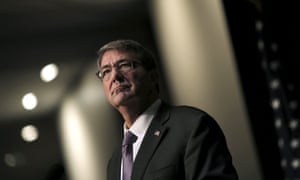
US defense chief: we will deter Russia’s ‘malign and destabilizing influence’ Ash Carter says US will not cooperate as long as Russia pursues a ‘misguided strategy’ in Syria but Moscow says it has been rebuffed in calls for consultation
Carter said the US ‘will take all necessary steps’ to counter Russian ‘influence, coercion and aggression’. Photograph: Carlos Barria/Reuters
The US defense chief has vowed to take “all necessary steps” against a resurgent Russia which is challenging a frustrated Washington in eastern Europe and the Middle East.
Ash Carter, the US defense secretary, said the Russian president, Vladimir Putin, had wrapped his country in a “shroud of isolation” which only a drastic change in policy could reverse.
“We will take all necessary steps to deter Russia’s malign and destabilising influence, coercion and aggression,” Carter said, attacking Russian military intervention in Ukraine and Syria.
The speech at a US army convention on Wednesday included some of the strongest language yet by the Obama administration, which came into office determined to “reset” relations with Russia and move them in a more cooperative direction.
Carter said that as long as Russia pursued a “misguided strategy” in Syria to bolster its client Bashar al-Assad, “we have not, and will not, agree to cooperate with Russia”.
Meanwhile, Russia claimed that the United States snubbed its overtures for high-level consultations on Syria, refusing to send a delegation to Moscow or receive a high-ranking Russian delegation.
On Tuesday, Putin said he wanted to send a delegation led by the Russian prime minister, Dmitry Medvedev, to the US. Moscow said the suggestion was first raised during a meeting between Putin and Barack Obama on the sidelines of the UN general assembly last month.
“Literally today, we got an official reply,” the foreign minister, Sergei Lavrov, said on Wednesday. “We have been told that they can’t send a delegation to Moscow and they can’t host a delegation in Washington either.”
Putin’s spokesman, Dmitry Peskov, said on Wednesday evening: “Given the current situation in Syria, refusing dialogue does not help to save the country and region from the Islamic State.”
There was no immediate response to the claim from US officials, though the accusation stands in contrast to two weeks of unresolved requests from the Pentagon to the Russian defence ministry for a clear procedure to avoid midair conflict.
While the US Defense Department last week held out hope for “deconfliction”, three rounds of talks have yet to result in clear rules for US and Russian pilots and their commanders, despite a series of undisclosed proposals and counterproposals. A third video conference made “progress” on Wednesday, and was described as “focused narrowly on the implementation of specific safety procedures” by a Pentagon spokesman, Captain Jeff Davis.
Lavrov said on Wednesday that agreement was close and procedures “should become operational any day now”.
The diplomatic disagreement over the international community’s response to the Syrian war reflects the positions of two distinct coalitions with divergent goals. Russia, Iran and the Syrian regime of the dictator Assad have accelerated a military offensive against Assad’s Syrian enemies.
The pro-Assad coalition is reportedly aiming to retake Aleppo in the coming days, with Russian warplanes supporting Iranian ground forces.
The US and much of the west are focused instead on a relatively slower campaign against the Islamic State, which formally opposes Assad but has turned its attention to consolidating its hold on eastern Syria and north-western Iraq.
On the other hand, when the strategy has failed, Putin has not shied from going it alone, launching the air campaign in Syria just two days after his speech at the UN calling for a coalition, and giving the US just an hour’s notice, via diplomats in Baghdad.
“I believe some of our partners simply have mush for brains,” Putin said, complaining that the US did not appear to have a firm set of goals in Syria.
In the balance for the US is the Iraqi government, which pivots between US and Iranian sponsorship. The Iraqi government of Haider Abadi, installed with the aid of the US last year, has begun flirting with the Russian-Iranian-Assad coalition in frustration with what it considers insufficient US support against Isis.
Iraq now hosts an intelligence fusion centre with Russian, Syrian and Iranian liaisons and reportedly has begun using situational awareness generated from the centre to bomb Isis positions.
Russia has said it would be willing to consider expanding its airstrikes to Iraq but only if it was asked to do so by Iraqi authorities.
The US has made clear it will not participate in the intelligence centre, out of concern that its Russian and Iranian adversaries would gain access to US information; the US maintains its own independent intelligence cell with the Iraqis. The Iraqi defence ministry has provided “assurances that our information will be appropriately protected”, Warren said on 1 October.
Meanwhile Carter said that he did not know if Putin would take “the opportunity to change course”.
“From the Kamchatka peninsula through south Asia, into the Caucasus and around to the Baltics, Russia has continued to wrap itself in a shroud of isolation. And only the Kremlin can decide to change that.”
Defence cooperation with partners and military hardware sales will drive Russian growth, even while Russia’s foreign policy remains completely peaceful, Russian President Vladimir Putin said in a wide-ranging interview with Rossiya-1 television channel presenter Vladimir Solovyov. President Putin particularly spoke about the excellent defence cooperation with India, giving the example of the BrahMos missile, and other joint ventures, creating a “high-tech production sector” in India. The interview was conducted after the massive bomb explosions in Ankara over the weekend rekindled fears of increased terrorist strikes in the wake of the Russian aerial raids on Syria.
Vladimir Solovyov: The defence industry will drive growth?Vladimir Putin: “Yes, that’s right. This is the way things work all around the world; in the United States, Europe, China and India.
We built the BrahMos missile together with our Indian partners, for example, and developed a whole new sector in Indian industry. India’s scientists worked very actively. This was a real step towards developing a high-tech production sector in India. Our Indian partners are very happy and have proposed developing this programme further, and we intend to do so.”
Despite defence cooperation and military hardware sales set to restore the Russian economy on a growth trajectory, Russia’s foreign policy has always been a peaceful one, the President said. He also denied any ambitions of taking over smaller former Soviet Republics as has been widely speculated.
“Russia has a peaceful foreign policy, and this is no exaggeration. If you look at the political map of the world and Russia’s place on it, it is obvious that we have no need for others’ territory or natural resources. We have enough resources of our own and we have no need for war or conflict with anyone else,” President Putin said.
“In 1990, it was Russia that started the divorce process between the republics making up the former Soviet Union. We showed good will and gave these countries their independence. This happened not as a result of civil war or conflict, but was a consensus decision, and Russia’s stance played a central role in this decision.
We therefore have no desire to restore the empire or rebuild the Soviet Union, but we do have a duty to defend Russia’s independence and sovereignty. This is what we have been doing and will continue to do.”
“As for the economic dimension, coming back to what I said before, we drew up the plans to modernise and rearm our country’s armed forces with the most up-to-date systems several years ago. It was 10 years ago now that we started working on these plans and formulating the tasks ahead. Let me say again that this was all about natural replacement of aging weapon systems,” the Russian President said in a rare interview.
“Another circumstance I want to note in this respect is that all of this work involves advanced technology, and the tasks we are carrying out in the defence industry will push us into developing not just applied but also fundamental science and will have benefits for the entire economy.”
Referring to the sanctions which have hurt the Russian economy and increased the urgency to look for import substitution, President Putin said, “Let me say a few words about import replacement in this respect. We purchased abroad many of the components we were using in the defence industry. But it was always clear that importing more sensitive components and technology and even spare parts for the defence industry was not a very far-sighted policy, to put it mildly.
Having petrodollars made it easy to buy things abroad of course, but we need to develop science and industry here in Russia. In this sense, the import replacement that our partners’ actions have pushed us into is actually precisely what our country needs. We are therefore not creating problems for our economy, but on the contrary, are raising it to new levels of technological progress.”
Vladimir Solovyov: The terrorist attack in Turkey raises questions that many are asking themselves now in Russia. We are fighting terrorism, which threatens our country too, and are trying to stop it before it reaches our borders. But are we ready here at home to resist attempts to once again bring suffering and death to our soil?
Vladimir Putin: “If you think about it, we have already become used to hearing of a terrorist attack here, a terrorist attack there. Unfortunately, we have not yet got rid of this threat. Back at the time when I took the decision to launch operations against international terrorist groups following the attack on Dagestan, many people said to me that we cannot do this for all sorts of reasons, said there is a risk the terrorists will do this, try that.
I came to the conclusion that if we fear that the terrorists will so something, they will definitely do it. We must take pre-emptive action. Of course, there are risks, but let me say that these risks existed anyway, even before we began our operations in Syria.”
Turning point? EU Commission head says relations with Russia ‘must be improved,’ US ‘can’t dictate’ Published time: 9 Oct, 2015 04:13 Edited time: 9 Oct, 2015 09:10
Europe must treat Russia with more decency, improve the relationship, and not let EU policies be dictated by Washington, European Commission President Jean-Claude Juncker said in a surprise speech in Germany.
READ MORE: NATO to create new HQs in Hungary & Slovakia, boost response forces – Stoltenberg
It is now critical for the EU to work on its relations with Russia, Juncker said in the southern German town of Passau: “We must make efforts towards a practical relationship with Russia. It is not sexy but that must be the case, we can’t go on like this.”
Moreover, the US needs to keep its influence out of EU relations with other countries, Juncker added.
“Russia must be treated decently … We can’t let our relationship with Russia be dictated by Washington.”
EU-Russia relations have deteriorated since the EU imposed sanctions on Russia for its alleged role in the Ukrainian conflict. The Russian government has unswervingly denied these allegations.
In the meantime, some progress has recently been reported in eastern Ukraine, as the armed forces of the self-proclaimed Lugansk People’s Republic (LNR) have begun withdrawing weapons under 100 mm caliber from the conflict zone. Ukraine’s Joint Staff has also announced the start of a withdrawal of artillery from the region.
The withdrawal of weapons is part of the Minsk agreements, which was agreed upon by the leaders of the Normandy Four, namely France, Germany, Ukraine and Russia, in February. The deal required a ceasefire, a weapons withdrawal, constitutional reforms, legislative recognition of a special status for the unrecognized republics, and release and exchange of prisoners on an all-for-all basis.
READ MORE: Top Ukraine official backs idea ‘to help ISIS take revenge on Russian soldiers in Syria’
However, lasting truce was only reached in late August. Kiev and the self-proclaimed Donetsk and Lugansk republics maintain the armistice has been holding since September 1, although both sides still occasionally accuse each other of violations.
Moscow continues to stress the importance of direct dialogue between Kiev and representatives of the Donetsk and Lugansk People’s Republics.
Russian President Vladimir Putin told CBS’s ‘60 Minutes’ at the end of September that all countries need to respect Ukraine’s sovereignty.
“At no time in the past, now or in the future has or will Russia take any part in actions aimed at overthrowing the legitimate government,” Putin said, adding that Moscow “would like other countries to respect the sovereignty of other states, including Ukraine. Respecting the sovereignty means preventing coups, unconstitutional actions and illegitimate overthrowing of the legitimate government.”
READ MORE: Moscow ready for more sanctions, regardless of Ukraine crisis – Foreign Ministry
EU sanctions against Russia could be renewed at the end of this year, however, even though some European countries have been hit hard by the fall in trade triggered, in part, by Moscow’s counter-sanctions on food imports.
EU sanctions include restrictions on lending to major Russian state-owned banks, as well as defense and oil companies. In addition, Brussels has imposed restrictions on supplying weapons and military equipment to Russia, as well as military technology, dual-use technologies, high-tech equipment, and technologies for oil production. A number of Russian and Ukrainian officials have also been blacklisted by the West.








 anneinpt
 artaxes
 danmillerinpanama
 davidking1530
 Peter Hofman
 Joseph Wouk
 Peter
Peter Louisiana Steve
 WarSclerotic
Recent Comments