Posted tagged ‘Venezuelan National Constitutuent Assembly’

Negotiation, not dialogue (or negation) [Venezuela]

September 24, 2017

Negotiation, not dialogue (or negation), Venezuela News and ViewsDaniel Duquenal, September 23, 2017

The fact of the matter is that the regime is on the defensive. The sanctions are starting to work. The latest sign that credit is withheld on gasoline import is that there are growing lines at gas stations. If it is true that the forced election of the constituent assembly had a perverse way to boost provisionally the regime it is also true that one month and a half has passed since the assembly was [seated] and there is no evidence that it is doing something positive to solve the problems of the country.  The regime is in denial but the truth is that the world that counts is united against the regime.  Russia and China, when all is said, may have a limited role since what will bring down the regime is its economic failure. Russia cannot save Maduro with bombers like in Syria…

Meanwhile the week ended with Canada imposing sanctions on 40 high ranking dictatorship personnel.  The symbolism does not escape us, the 40 thieves of Ali Baba finally starting to suffer consequences.

******************************

This past week has been eventful. It started with a new attempt at dialogue that nobody but the regime wants, to the strong words against Venezuela dictatorship from TrumpMacronSantosMichetti, and more, taking place at the UN general assembly.

That dinner table was certainly better supplied than those of Caracas

There were all sorts of activities during the festivities, like Trump hosting a dinner for the heads of a few Latin American states highly critical of Venezuela’s dictatorship.  Venezuela was mentioned in several speeches at the tribune, invariably condemnatory, except from the usual suspects like Evo’s speech, very poorly attended for that matter.  We even have the money quote from Trump, who may be wrong and obnoxious a lot of the time, but when he is right, he is right, hands down:

“The problem in Venezuela is not that socialism has been poorly implemented,
but that socialism has been faithfully implemented”

These expected actions against Maduro’s regime are what explains why a few days ago the regime asked for “dialogue” with the opposition, to be held in Santo Domingo.

Certainly, as it has become usual, the regime starts dialogue as a dilatory instrument to bring down Venezuelan opposition when the going gets too intense. But this time around it is different and the regime is not going to get once again a free pass: months of protests, political prisoners and political murders cannot be dismissed by the world democracies. What in last century would have been considered as collateral effect cannot be ignored anymore in the XXI century.

As usual a volley of declarations and counter declarations has been launched since the “dialogue” started. No point going over the confusing details.  The summary is as follow:

– all seems to indicate that it is the regime that this time around truly asked for a new dialogue and went out of their [way] to effect it, as the opposition this time around was not in the mood (at least not as long as the regime fulfills at least one of its previous commitments).

– if the regime succeeded in bringing back allies like the Dominican Republic to host the talks, and Zapatero ready for a new failure, it did not go as planned. First, the opposition announced that it would talk only to Santo Domingo president. Second, that a new set of countries would be guarantors of any new talk, not anymore the more complaint countries or devious double agents like Zapatero. e.g., now at least France will be attending for Europe.

– before the talks the head of the National Assembly, Julio Borges, came from a very successful tour in Europe’s main capitals (Paris, Berlin, Madrid and London, only Rome missing, for now).  He received full support from those who matter: Macron, Merkel, Rajoy and May. On the other hand Venezuela sent its foreign minister to do a counter tour and he was only receive by foreign ministers at best, and scolded each time.

– even though everywhere Arreaza was told that the constituent assembly would not recognized, the regime keeps trying to force its recognition by sending the president of that illegal assembly as its chief negotiation in Santo Domingo. To little effect so far we must say.

– eventually, in front of a losing strategy, as more and more inside the opposition state that there should be no talk until AFTER the state elections, the regime has started sabotaging the process with all sorts of manipulations and lies. The thing here is that the radicals inside the regime do not want any negotiation and the opposition, and the world, only wants a negotiation. Not a dialogue, a negotiation. There is a difference.

The fact of the matter is that the regime is on the defensive. The sanctions are starting to work. The latest sign that credit is withheld on gasoline import is that there are growing lines at gas stations. If it is true that the forced election of the constituent assembly had a perverse way to boost provisionally the regime it is also true that one month and a half has passed since the assembly was sat and there is no evidence that it is doing something positive to solve the problems of the country.  The regime is in denial but the truth is that the world that counts is united against the regime.  Russia and China, when all is said, may have a limited role since what will bring down the regime is its economic failure. Russia cannot save Maduro with bombers like in Syria…

But at least the regime has one satisfaction: the “dialogue” has divided deeply the opposition, before the crucial elections of next months. Those elections will be fraudulent and more, but going in disperse order with too many promoting abstention will not help. For some reason the lies of the regime about dozens of “secret” meetings, those that the opposition is willing to recognize the constituent assembly (without describing what the opposition will get in exchange) have found a wide public of, well, hysterical oppos. Then again the resurrection of Rosales or Zambrano as envoys to Santo Domingo has not been a PR coup for the MUD…..

So we have all sorts of people that preach that we should not go to vote because this would give some legitimacy to the regime. True, but in part at best for the regime. International opinion at the government levels will not be swayed by an election where harsh handed tactics of the regime will be closely monitored by their embassies.

But that saddest part of it all is that the abstention party virulence, from Maria Corina Machado to twitter warriors of the nebulous “resistencia”, is not offering any other strategy. They do not want to vote yet they are not telling us what to do, and even less, are not willing to place themselves in the front lines of whatever it is that they have in mind. Well, Maria Corina would go on the front line, but she is unable to say where the fucking front line is.

I do not know where all of this will lead us. We cannot even be certain whether the regional elections will be held. We can be sure that the regime is following a close pulse of the electoral mood, and in particular the abstention movement who thank the deities seems to peter some already.  The point is that the regime must balance the risk of losing badly the regional elections but proving to the world that a democratic transition is coming, or stick to a goal of at least 40% governors, no trickery spared, no political violence too gross.  In short, a lose lose of sorts for the regime, with a radical and radicalizing constituent assembly which nobody seems really in control of.

Meanwhile the week ended with Canada imposing sanctions on 40 high ranking dictatorship personnel.  The symbolism does not escape us, the 40 thieves of Ali Baba finally starting to suffer consequences.

And Europe sanctions are expected any time soon…………
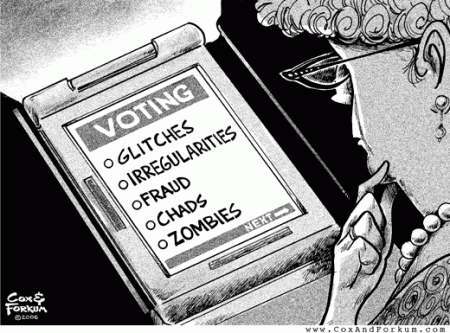
The [Venezuelan] constituent assembly electoral fraud

July 23, 2017

The constituent assembly electoral fraud, Venezuela News and ViewsDaniel Duquenal, July 22, 2017

The opposition has no choice. Not only it cannot validate such an election by participating in it, but it is obliged by principles, ethics, human rights and simple decency to oppose it in any way it can. Even if this implies violence at the end of the road.

****************************************

After finishing a series of posts to explain how we have reached the current situation I thought that it may be good to have targeted entries as we get ready for July 30.  Let’s start with the constitutional assembly to be elected on July 30th, if the regime has its way.

Regardless of the legality and scope of that assembly the very electoral system to be used makes it totally unacceptable and forces the opposition to a confrontation. Here is an incomplete laundry list of all that is wrong with the constitutional assembly voting system:

A: the electoral body

*Not all votes are equal. If you vote in Baruta district (235.000 electors) you need at least thirteen of you to compensate for a single vote from, say, Buroz district (17.000 electors).   That is right, one vote of a Buroz denizen is equal to 13 votes of a Baruta denizen and they are both in the SAME state. No need even for an inter state comparison. Why? Because the election to the assembly is one representative per district, regardless of population.

*Not even all districts are equal! All capital districts have for some unexplained reason the right to elect two representatives. Considering that capital districts voted overwhelmingly for the opposition in 2001 it is one way to limit the possible voting impact. In effect to win the two seats you need to double the votes of the other party. So the opposition, if it participated in the vote, would see that advantage neutralized in part.  But that is not all, the capital city is not necessarily the biggest district of the state.  For example in Trujillo the capital has 43.000 electors for two seats and the main city Valera 104.000 electors for a single seat.

*Some people get to vote twice.  The election includes the election of people by specified constituencies based on their social composition. For example registered students get to vote for their additional representatives. Or retirees for theirs.  Which means that if you are not assigned to one of these lists then you get to vote only once and everybody else twice. Amen of the inequalities within these social groups that are impossible to measure exactly considering the paucity of information in the electoral board, CNE, web page.

*The regime is the one who decides who goes where in the sectoral vote. The regime requested lists from organizations to build up the sectorial lists of electors; but as a matter of fact the only organizations that the regime recognized are those already controlled by the regime. As such many students do not get to vote, many trade union activists do not get to vote, many electors from consejos comunales do not get to vote. In the case of the consejos the regime never recognized many of them because their elected council did not yield a result that pleased the regime.

It has been calculated that even if the opposition decided to participate in the election the regime would get a majority of seats with as little as 30% of the vote. Between the sectoral lists and the districts that are tightly controlled by the regime through dependency of el pueblo for basic food, 60% of the vote would not be enough for the opposition to get a majority.

But the problem to begin with is that even if the opposition would have wanted to participate it couldn’t have done so with fainess.

B: the electoral fraud

*What already existed for material fraud is still valid.  By this I refer to the material advantage of the regime. The CNE has allowed in all elections the regime to use freely the resources of the state for the electoral campaigns of the regime’s candidates.  To man the meetings state vehicles are freely used, state/taxpayer is freely used, goodies are distributed, etc…

*What already existed for media fraud is still valid, and then some more. In past campaigns the opposition had an extremely limited access to state media and a limited access to the remaining private media. In addition the regime abused of its cadena privilege which means that it did hours and hours of simultaneous broadcast on all TV and radio stations in favor of the regime. This time around there are more cadenas and less newspapers than before.  In short, outside of social media the opposition cannot raise its voice much, if at all.  More damningly the regime can freely insult and lie about the opposition and this one cannot reply, cannot debate.  If you are not on internet, or on cable TV with foreign channels, in most of the country you hear only the regime voice.

*Electoral system proofing has not been done. Normally there are a series of steps the CNE takes to prove that the election is fair. These include surveys of electoral machines, public testings, auditing of electoral rolls, etc. None of these has been done even if the CNE claims it did. No witness for these.  No published days when these tests were done.

*The secret of the vote is compromised.  The regime has been going full drive into promoting the “carnet de la patria” as the valid document to control the chavista masses (or exchavista but still in need of social programs). Thus the perception exists that those with the carnet de la patria will have their vote monitored, or at the very least would be found out if they decided to abstain.

*Electoral blackmail is the norm. More than ever el pueblo is threatened with reprisals if the regime does not win the election. And the reprisals will go against those who do not show upo to vote. The blackmail and scare tactics are full throttle and the opposition cannot combat them.

*Multiple vote by regime adherents is a given. The regime has decided to do without the inking of the fingers of those who vote, one of the lone ways to ensure that nobody can vote twice.  But that is not all, Now, under the excuse of violence the regime has decided to create special voting centers outside of “violence zone”. That is, if you support the regime and do not feel free to vote for it at you normal voting stations you can go to one of those special centers. The thing here is that these centres are set on the run and the controls are not explained. This reeks of major ballot stuffing.

*No electoral control.  Since the opposition will not participate then there will be no witnesses inside the polling stations. Note that to send witnesses you need to run in the election. It is difficult for people to just enter to observe the voting day and the counting. And if they were allowed to enter their opinions and input would be nil and they could be chased out.

*Not even visual control. The regime has decided that the “protection” area for the voting center will go from 100 yards to 500. In other words the press will not be able to film close enough to figure out whether there will be people voting and in what numbers. Thus it will be easier to pad results as participating estimations will be very difficult to do.

*There is no set voting hours. The regime has played loose and fast with voting schedules even if the voting stations are empty. The reason is that because of the fingerprinting identification the regime can now in real time who came to vote. The establishment of the carnet de la patria was also a way to renew the registration of all the people who depend from some form of social benefit, even if these benefits are not reaching them anymore.  As such the regime knows the adresses of those who have not showed up to vote by noon and thus has plenty of time to seek them and force them to come and vote. If voting hours need to extended so be it.  Needless to say that those dragged from home to vote will be easily scared into voting for the regime.

Conclusion.

It is clear, perfectly clear that the voting system is absolutely unfair, totally biased to favor the regime. Even with its best effort the opposition cannot win this election. It could still win a referendum or a normal election since at least it would have witnesses in the voting centers and the representation would be proportionate to the actual population. But this time around all has been designed for the regime to win the election even if it is trashed at the level of the popular vote.

The opposition has no choice. Not only it cannot validate such an election by participating in it, but it is obliged by principles, ethics, human rights and simple decency to oppose it in any way it can. Even if this implies violence at the end of the road.


