Posted tagged ‘Venezuelan National Constituent Assembly’

Venezuela 2017: Socialist Policies Take Humanitarian Toll as Country Enters Dictatorship

December 24, 2017

Venezuela 2017: Socialist Policies Take Humanitarian Toll as Country Enters Dictatorship, BreitbartBen Kew, December 24, 2017

(Venezuelans who despise the Marudo regime and have the means to do so have probably left already.  One of the first things Chavez did when thousands of oil workers went on strike was to fire them all and replace them with others who knew nothing about working at an oil refinery. Chavez was bad and Maduro is worse. — DM)

Emigration has also become a major issue, with the outflux of Venezuelan migrants reaching unprecedented levels. Venezuela has surpassed Syria as the number one source of asylum requests into the United States, while the neighboring country of Colombia has begun drawing up plans for refugee camps should the country’s humanitarian crisis continue to worsen.

“2017 was the year when the international community finally accepted that the Venezuelan regime has morphed into a real narco-state with dangerous implications for the region,” former Venezuelan Ambassador to the U.N. Diego Arria told Breitbart News.

“2018 will mark the implosion of the crumbling Venezuela economy, the spread of massive poverty and hunger, becoming the worst humanitarian tragedy of any country in the region,” he continued. “Altogether this should lead to an increasing popular revolt that might convince the military to stop supporting this a bankrupt narco-state, under the increasing pressure of international sanctions.

*********************************

Although Venezuela’s problems began with the election of the authoritarian left-wing revolutionary Hugo Chávez in 1998, 2017 was the year that the country’s problems became too catastrophic for even the world’s most ardent socialists to defend.

Politically, the year has been defined by Nicolás Maduro’s socialist government’s increasingly blatant efforts to rule the country decree, while an embattled and disunified opposition continue to fail in their attempts to unify the country to bring down the government.

In January, Maduro appointed Aragua state governor Tareck El Aissami as the nation’s new vice president, a figure with strong links to major drugs trafficking outlet across Latin America and the jihadi terror organization Hezbollah. Together, the pair has schemed to turn the country into a one-party state.
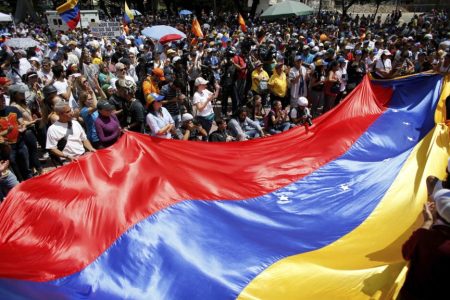
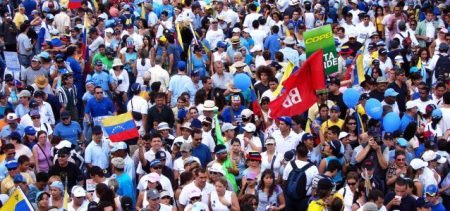
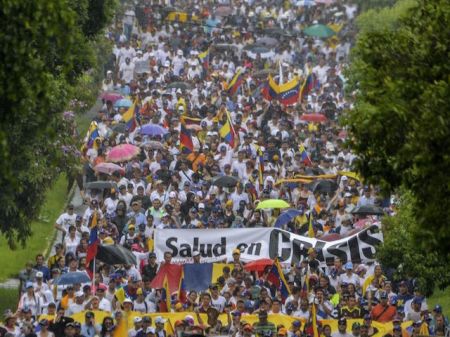
The country’s crisis came to a head in April after opposition leaders called for daily protests that would rock the nation to its core. Thousands of Venezuelans took to the streets every day to fight for their freedom and were met with shocking levels of brutality by security forces, which included the use of rubber bullets, tear gas, and water cannons, that led to the deaths of 125.

The protests were primarily a response to increasing political persecution by the Maduro regime, as well as plans to rewrite the country’s constitution by creating an illegal lawmaking body known as the “national constituent assembly” that usurped the power of elected lawmakers and replaced them with government-approved cronies.

The Maduro regime eventually prevailed in their attempts to install the lawmaking body, which they legitimized through an election marred by violence which was later found to have been fraudulent. The body has since moved to pass laws to increase the regime’s authority, which include a law “against hatred and fascism” and bringing charges against political opponents.

Despite widespread unpopularity, Maduro’s United Socialist Party of Venezuela (PSUV) has also had considerable electoral success in both mayoral and regional elections, boycotted by many opposition parties. The State Department later confirmed that both elections were plagued by a number of irregularities, including the banning of international observers, voter intimidation, and the closing of polling stations in opposition-controlled areas.

Maduro has also ruled that main opposition parties can no longer stand in next year’s presidential election, declaring that they will “disappear from the political map.”

The government has also ratcheted up political persecution. Thousands of political dissidents remain in prison, including opposition leader Leopoldo López. Meanwhile, figures such as Mayor of Caracas Antonio Ledezma and Attorney General Luisa Ortega Diaz, a former government loyalist, have also fled the country.

Economic turmoil has also plagued the regime, amid skyrocketing rates of inflation that have rendered the Bolivar currency practically worthless as well as a failure to meet a number of debt payments amounting to around $200 billion.

Two of the regime’s main creditors are China and Russia. Despite managing to agree on a debt restructuring package with Russia, China appears to have lost patience, and last month filed a lawsuit filed a lawsuit against the country’s state-run oil firm Petroleum of Venezuela (PDSVA) over a series of missed payments.
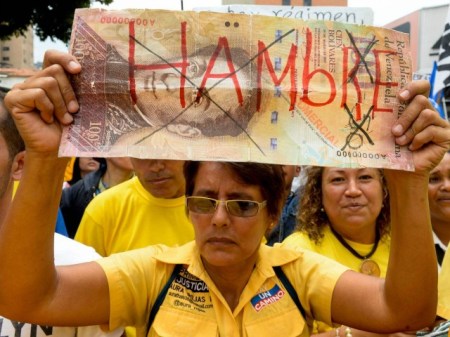
Yet amid all the political and economic turmoil, Venezuela is also facing the worst humanitarian crisisin its history. With a monthly minimum wage of around $1.50, millions of families can no longer afford enough food to eat, basic medical necessities, or power in their homes.

Shocking cases include teenage girls turning to prostitution, the butchering of zoo animals for food, and even cases of cannibalism as people struggle to feed themselves.

2017 has also seen the value of the Venezuelan bolivar collapse to levels comparable to Zimbabwe or the Weimar Republic, with one American dollar now worth 112,000 bolivares, as Maduro continues to hike the country’s minimum wage to fight against what he claims is an “economic war” led by the United States.

The crisis has attracted worldwide attention, particularly in the United States. The White House imposed multiple economic sanctions against the regime, as well as personal sanctions against Maduro and other government officials.

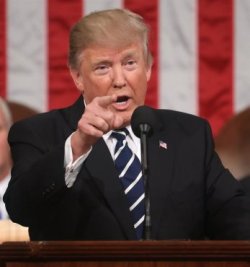
President Donald Trump has also become a prominent voice on the crisis, claiming that America “will not stand by as Venezuela crumbles,” and has even mulled the possibility of military action as a solution.

Maduro has since urged his country’s military to prepare for war with the U.S, urging them to have “rifles, missiles, and well-oiled tanks at the ready … to defend every inch of the territory if need be.” He has also ordered civilians to join in “civic-military exercises” at government-run boot camps to prepare for a potential invasion.
LUIS ROBAYO/AFP/Getty Image

Emigration has also become a major issue, with the outflux of Venezuelan migrants reaching unprecedented levels. Venezuela has surpassed Syria as the number one source of asylum requests into the United States, while the neighboring country of Colombia has begun drawing up plans for refugee camps should the country’s humanitarian crisis continue to worsen.

“2017 was the year when the international community finally accepted that the Venezuelan regime has morphed into a real narco-state with dangerous implications for the region,” former Venezuelan Ambassador to the U.N. Diego Arria told Breitbart News.

“2018 will mark the implosion of the crumbling Venezuela economy, the spread of massive poverty and hunger, becoming the worst humanitarian tragedy of any country in the region,” he continued. “Altogether this should lead to an increasing popular revolt that might convince the military to stop supporting this a bankrupt narco-state, under the increasing pressure of international sanctions.”
Trashed at Lima: Maduro goes from PR fail to PR fail [Venezuela]

August 10, 2017

Trashed at Lima: Maduro goes from PR fail to PR fail, Venezuela News and ViewsDaniel Duquenal, August 9, 2017

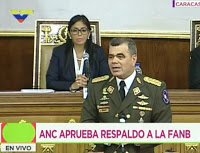
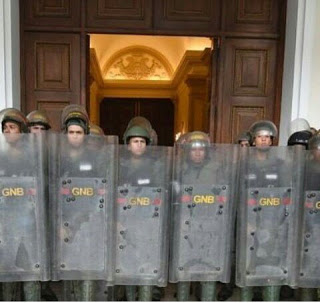
In the middle of the night the nazional guard and the constituent assembly chair took over the old senate chamber of Venezuelan Congress which had been transformed into a ceremonial room. The problem is that the hall is not big enough for the 550 constituents as it can hold barely 450.  But the point here is to piss off the National Assembly and slowly but surely edge them out of existence.

For good measure the National Assembly was barred to enter its chambers for its scheduled session, least the couple of dozens that did make it into congress house would attack the 500+ constitutionals.  Nice to see the nazional guard deployed in a legislative room. Nothing militaristic or repressive in the regime. No serreee…

The constituent is above all

That they are overcrowded sitting on party pliable and uncomfortable chairs did not stop the constituents to declare themselves as of today of being above any of the existing powers and institutions. For our own good, apparently. (1)

Note that the complete results are not yet out and these creeps are already ruling as if nothing, fraud declarations remaining investigated, of course.

To make sure that we know who is in charge truly (besides Cuba, of course) we even had the visit of the defense minister in full drag, as a guest of honor. That is right, a constituent assembly of the people starts by bowing to a general.

Today was thus quite a democratic display. And right on time as the Lima reunion was taking place, to make sure to confort them in their soon to come decisions.

In Lima the s… hit the fan

Many countries were invited to a meeting outside of any international organization to discuss what to do about Venezuela. That is, the countries that are decided to do something about it, without the bothers that sell out countries do to stop any measure against the dictatorship (2). They met today at Lima.  Of those who met, 12 decided to sign a declaration which is as strong as you will ever see any. And apparently Jamaica was about to add its name though they did not. Nobody understands why Uruguay did not go along since last week end they agreed to kick out Venezuela from Mercosur. At any rate, the 12 signatories have agreed to further meetings as sanctions are implemented and that anyone wanting to join the principled positions could so so.

The WSJ has a summary in English, though if you can read Spanish I urge you to read the short and drastic declaration.  The important points to be drawn from it are:

  • Venezuela is a dictatorship (written in diplomatese, but that is the exact translation)
  • They will not recognize the constituent assembly nor any decision that this one takes.
  • For any future legal/financial contact between those countries (the largest in the Americas, the rest counts for nothing anyway) these will only be accepted if the legal and legitimate National Assembly approves them. That is, there is no possible contracts to be made state to state, and business to business/state unless the NA approves them. Also, Venezuela cannot send new ambassadors unless voted by the NA. And other consequences.
  • Ban any weapon shipment to Venezuela, in particular of repressive nature.
  • These countries will actively seek that Venezuela will be removed from any international organization that pretends to be democratic.

In short, Venezuela is declared a pariah state.

Meanwhile in Caracas the dictatorship could only gather the ALBA (Cuba and Caracas client states) and emit a long and ridiculous declaration that even included the wall. Maybe feel good, but totally out of step with the moment, which shows you that even the sophisticated Cuban diplomacy is losing its footing.

It is to be noted that the US was not, on purpose, in Lima and so it cannot be accused of remote directing the whole thing. As a matter of fact, if you read the Lima declaration you will be stricken by its novelty and creativity. Venezuela is truly seen as a continental problem and all agree that it is best that the US sanctions are taken separately from other sanctions so that the Cuban propaganda cannot use tired old cliches.

We’ll see.  Meanwhile the image of Maduro has gone down quite a lot today. As a matter of fact he even asked the ALBA to speak on his behalf tot he Lima group….

————————-

1) On that note the high court keeps condemning opposition mayors without trials, removing them form office and jailing them for 15 months under the pretense that they did not keep order in their districts even though it is public knowledge that the dictatorship has taken away any means that they could have used to maintain public order. It is simply put a purge following a kangaroo court. Some are already in jail, some have chosen exile. About half of the opposition mayors elected last time have been thus removed. And going.

2) As of this post the words regime and dictatorship are interchangeable when referring to Venezuela. This is not a democracy anymore, there are no valid elections anymore, there is no rule of law anymore.  As for Maduro, he will not be referred anymore as president Maduro, unless irony is required. From now on Maduro is the dictator of Venezuela.

As for the leftist that keep supporting the dictatorship, like Corbyn, Melanchon, Iglesias, IU, and other, I will come with wonderful epithets to underline their falsehood, hypocrisy and absolute lack of true democratic instincts.  Readers suggestions welcome.

The fraud [in Venezuela]

August 1, 2017

The Fraud, Venezuela News and Views, Daniel Duquenal, July 31, 2017

(Please see also, Treasury Sanctions the President of Venezuela. — DM)

Since I am writing late and you certainly read all major papers in the world and blogs and tweets…  I will be short and sweet and didactic if possible.

What happened in Venezuela was an historical electoral fraud of major proportions. So blatant, so nakedly obvious is the fraud that within hours more than a dozen countries have announced they would not recognize the result. And more to come.  Only outlaw regimes like Cuba, or commies disguised as lefties in Europe like Iglesias or Melanchon can recognize the result.

Let’s go by part.

The electoral fraud. It was openly visible. International journalists reported on it even before the voting centers closed. Pictures comparing centers of July 16th and yesterday were posted and the difference in attendance was obvious. Voting centers were empty to lightly attended, or outright closed. Only the one at the Poliedro had people that supposedly accounted from the all the “violence areas that did not allow people to vote”. And yet, the attendance there looked like the normal one at a regular major voting center, not the one that was supposed to welcome dozens of voting centers. Well, it seemed like that if you have a scientific and critical mind which is something that the lumpen chavismo does not have. Otherwise they would not be chavistas.

The electoral fraud was concrete. I have told you the experience of my S.O. and that by itself is enough for me. Simply put, there was NO control. Simply put, people could vote wherever they wanted. Simply put people could vote as often as they wanted. Simply put there were no witnesses so voting table attendants could activate voting stations and fill up the boxes with as many ballots as they wanted.

The electoral fraud started from the start. I have listed already all the parameters that made this vote a fraud. You just need to add what I have written above.

The results themselves were deliberately proclaiming the fraud. The results were simply unbelievable. So unbelievable that one cannot fathom the need of the regime for such an atrocious lie. With empty streets, empty voting centers, closed ones, the regime could not show true videos of massive attendance like the ones the opposition got without any trouble on July 16th. Never mind that it was forbidden for independent press to visit most voting centers. Since the fraud was so obvious the regime just played it to the full. That is what happens when you have no shame left. It announced a result bigger than what the opposition claimed on July 16th. Which incidentally is almost three times as the numbers announced in midafternoon though “leaks”. That is: the regime is claiming that at least twice as many people went to vote than what actually took part in the vote. Since this is a dictatorship there is no way to investigate this. And even if the leakers were to come forward proof in hand, to what court in Venezuela can we go to complain?

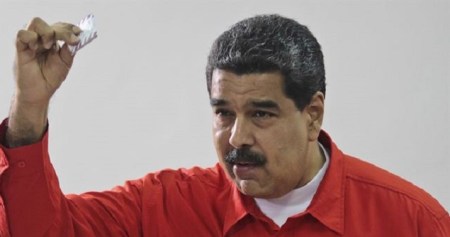
The results are meaningless and aim only at the chavista lumpen and brain washed. Think of it this way. Maduro claims that 8 million people voted for his fraud in the middle of the major economic crisis that we have experienced in our history. No food, no jobs, no medicine, violence from crime skyrocketing, etc, etc…  And he gets almost as many votes as Chavez was getting ten years ago at his prime of massive flux of dollars and cash payment to “el pueblo”.  Gimme a break! The other results that are meaningless are who won what. That is, when the injection of votes is so fragrant, so abusive that whoever won whatever seat somewhere it is because votes were allocated to that person according to the regime wishes. We will soon find out, I guess, what section of chavismo has come on top, not through votes but through counting the votes in the greatest Stalinist dictum. You know, the one where he says that elections do not depend on the votes but on who counts them.


I think this is enough. If you are not convinced by this then you are either dumb or of bad faith or cashing on, which is the same as bad faith. I am sorry, I live in a dictatorship, I cannot play nice anymore.

—————

And let’s not forget that an election run under repression and a violence that left more than a dozen people killed has NO validity.

Treasury Sanctions the President of Venezuela

August 1, 2017

Treasury Sanctions the President of Venezuela, U.S. Department of the Treasury via Global Security.org, July 31, 2017

As a result of today’s actions, all assets of Nicolas Maduro subject to U.S. jurisdiction are frozen, and U.S. persons are prohibited from dealing with him.

“Yesterday’s illegitimate elections confirm that Maduro is a dictator who disregards the will of the Venezuelan people. By sanctioning Maduro, the United States makes clear our opposition to the policies of his regime and our support for the people of Venezuela who seek to return their country to a full and prosperous democracy,” said Secretary of the Treasury Steven T. Mnuchin. “Anyone who participates in this illegitimate ANC could be exposed to future U.S. sanctions for their role in undermining democratic processes and institutions in Venezuela.”

***********************************

Washington — Today, the U.S. Department of the Treasury’s Office of Foreign Assets Control (OFAC) designated the President of Venezuela, Nicolas Maduro Moros, pursuant to Executive Order (E.O.) 13692, which authorizes sanctions against current or former officials of the Government of Venezuela and others undermining democracy in Venezuela. These sanctions come a day after the Maduro government held elections for a National Constituent Assembly (Asamblea Nacional Constituyente, or ANC) that aspires illegitimately to usurp the constitutional role of the democratically elected National Assembly, rewrite the constitution, and impose an authoritarian regime on the people of Venezuela. As such, it represents a rupture in Venezuela’s constitutional and democratic order. The Maduro administration has proceeded with the ANC even though Venezuelans and democratic governments worldwide have overwhelmingly opposed it as a fundamental assault on the freedoms of the Venezuelan people. The creation of the ANC follows years of Maduro’s efforts to undermine Venezuela’s democracy and the rule of law.

As a result of today’s actions, all assets of Nicolas Maduro subject to U.S. jurisdiction are frozen, and U.S. persons are prohibited from dealing with him.

“Yesterday’s illegitimate elections confirm that Maduro is a dictator who disregards the will of the Venezuelan people. By sanctioning Maduro, the United States makes clear our opposition to the policies of his regime and our support for the people of Venezuela who seek to return their country to a full and prosperous democracy,” said Secretary of the Treasury Steven T. Mnuchin. “Anyone who participates in this illegitimate ANC could be exposed to future U.S. sanctions for their role in undermining democratic processes and institutions in Venezuela.”

Nicolas Maduro was elected President of Venezuela on April 14, 2013, following the death of former President Hugo Chavez. Maduro held previous roles in the Venezuelan government, including as Executive Vice President and Minister of Foreign Affairs.

Under Maduro, the Venezuelan government has deliberately and repeatedly abused the rights of citizens through the use of violence, repression, and criminalization of demonstrations. At his direction, the regime’s security forces have systematically repressed and criminalized opposition parties through arbitrary detention, military prosecution of civilians, and the excessive use of force against demonstrators. Any member of the opposition or critic of the regime risks being detained, imprisoned, assaulted, tortured, and assassinated.

In addition to committing widespread human rights abuses, Maduro’s regime has mismanaged the economy and engaged in systemic corruption. Despite having among the world’s largest oil reserves, tens of millions of Venezuelans are going hungry because the Government refuses to import sufficient food for the Venezuelan people, engages in rampant corruption around currency and the exchange rate regime, and rejects offers of humanitarian aid.

Treasury undertook the action, in consultation with the State Department, pursuant to Executive Order 13692. The U.S. government and democratic governments worldwide continue to call on the Venezuelan government to halt the ANC process and allow Venezuela’s democratic processes and institutions to function as intended. We urge those who were elected to the Constituent Assembly to decline to take office.

Venezuela Is Now Either Cuba Or North Korea

July 31, 2017

Venezuela Is Now Either Cuba Or North Korea, Hot Air, Jazz Shaw, July 31, 2017

Sometimes I really hate it when I’m right. The “vote” in Venezuela yesterday went largely as expected, with the government of tyrant Nicolas Maduro claiming that upwards of eight million people voted to essentially wipe out the elected legislature and replace it with some window dressing which essentially makes him dictator of the country. This is a condition which could last for his entire life unless his people manage to find a way to oust him from office.

The vote was, of course, largely a sham. And as NBC News was reporting throughout the day, many of the polling places were frequently empty as Maduro’s many opponents boycotted the bogus proceedings.

Many polling stations were largely empty and more than 70 percent of the country was opposed to the vote in the first place, according to opinion surveys. Critics called it a naked power grab by President Nicolas Maduro.

As protesters clashed with police across the increasingly volatile country, only about 9 percent of eligible voters went to the polls, Delsa Solórzano, a prominent leader of the opposition party Un Nuevo Tiempo, said at a news conference Sunday night.

The country’s election authorities, meanwhile, put the number of voters at 8.1 million, equaling a 41.5 percent turnout.

Noticing something of a disparity there? Nearly three quarters of the country was opposed to and sitting out the vote according to recent polls. Election monitors put the turnout at 9% (which actually might be on the low side) and yet Maduro’s “election officials” said it was over 40%. Even if that was a valid figure, that’s still pretty low for something this historic in terms of completely reshaping the country’s government structure.

CNN describes just how much power Maduro has now and also grimly notes that the body count went up as even more protesters – including two teenagers – were slaughtered by his militias.

The election will allow Maduro to replace Venezuela’s current legislative body — the National Assembly — with the new assembly, which would be made up 545 members, all nominated by his administration.

Deadly clashes between protesters and police marred Sunday’s vote, which followed weeks of violent street protests in which many people have been killed or injured. On Sunday the death toll rose sharply with at least six people — including two teenagers — killed at protests and a National Guard officer also reported dead by the attorney general’s office.

More than 8,089,000 people or about 41.53% of registered Venezuelan voters cast ballots Sunday, according to Venezuela’s National Electoral Council.

Now the rest of the world has to decide what, if anything, to do about it. As far as the United States goes, our U.N. Ambassador, Nikki Haley immediately declared the vote to be “a sham” and said that the United States “would not accept the results.” Our State Department put out a statement condemning the results as well and promising a “strong and swift response”, though in somewhat gentler terms. But what does that mean? More sanctions? I’m not sure Maduro particularly cares at this point.

Unless there’s a drastic (and probably violent) change in course, the stage seems to be set. Maduro has completed his takeover and will now be able to rule essentially as a dictator. He’ll probably gather the support of a few other authoritarian regimes, but even that will be limited until he can get his oil production back up. (Assuming he can manage it.) For now, Venezuela will likely become a hermit kingdom, much in the style of either Fidel Castro’s Cuba during the early years or North Korea’s present regime. And the real losers in all of this will be the Venezuelan people. They are currently starving while living on some of the richest farmland on the continent and their government is almost bankrupt while sitting atop some of the largest proven crude oil reserves in the world. These are the fruits of socialism. Watch closely if you are cheering for similar policies in the United States.

To sanction [Venezuela], or not

July 25, 2017

To sanction, or not, Venezuela News and ViewsDaniel Duquenal, July 24, 2017

So the talk is on sanctions again since the US/Trump have announced that they are considering strong sanctions if Maduro insists on electing a constitutional assembly next Sunday.

What I am dismayed for is to read that some people that should know better do not want sanctions. One example is Moises Naím who is usually so right on things but who is not quite this time around (1). The argument advanced by those who oppose sanctions are that 1) they do not work 2) they hurt the population more than the regime and 3) they can boost the regime if this one can wrap itself in the flag of nationalism.

Yes and no, and the more so in the case of Venezuela.  Let’s try to clarify ideas as I did for the electoral fraud of next Sunday.

We cannot judge Venezuelan situation on the basis of other examples because the conditions are unique. Venezuela is actually a war torn economy upon which not a single bomb has fallen. As such the population is already going through lack of food, lack of medicine, lack of basic services, and all getting worse by the day. Any of those refusing sanctions should explain to us how things can get much worse. Yes, they can, we can get outright killed but that could also happen without sanctions.

Would sanctions work? It depends on two things, which type of sanction and the will to enforce them. I agree with Naim on this part: for Trump to stop Venezuelan oil imports would not do much and if anything gain sympathy for the regime. But there are other options with oil. The one I would like is to forbid the sale of gasoline and gasoline components to Venezuela. The shortages of gas would certainly affect us a lot, but would also affect the regime a lot.  It would be difficult for the regime to replace its US purchases because they would need to sell oil to the US, get paid and only then buy cash in hand from other countries since the regime has no more credit. Buying gas and condiments to the US can be a much easier swap, faster to obtain for a country who lacks of everything but gas. You know where our priorities are…….

But I digress. My point is that there are different type of sanctions, some that may actually be more effective than stopping oil purchases. It could be even as simple as a 2 dollar tax per barrel on Venezuelan import to finance shale oil exploration. Venezuela financing the competition that would put it out of the market. No embargo, we can still sell oil to the US…..

But would those sanctions be used effectively by the regime? At first maybe. But a little bit only. The regime has spent so much time attacking the evil empire in the North and yet nobody associates the current crisis with the United States. Well, outside of the yellow dog chavistas.  What worked for the Castros will not work as easily for chavismo. Too many inside chavismo are aware that the crisis comes from the corruption and incompetence and the “I do not give a shit” attitude of the camarilla around Maduro and the army.  On this I am not as sanguine as Moises Naim.  The regime has wrapped itself too much around the flag for 18 years. The poor thing is just worn out.

Finally the “it does not work” argument. Well, it did work for South Africa. The salt boycott of India is a strategy that a determined people can use though in Venezuela people hate sacrifices of any type: pais de antojados.  It failed in Cuba because the US made it unilateral without managing to get real allies first, a mistake it did not do with Iran or Russia.

I suppose that what I am trying to say is that sanctions would more likely fail because of the nature of the Venezuelan people than the sanctions themselves. We do not want to suffer even though we self inflicted our current suffering.  But it is “ours” so at some level people do not mind as much as they should.  I know, there is no logic but that is the way people are here. My house keeper speaks volumes against Maduro and food shortages. And yet she has to go to her first protest march. She has no time. She is afraid of tear gas. She does not fit in. She whatever excuse, but I have heard her swear at Maduro when she comes back from a food line empty handed. Go figure.

So what to do?  Sanctions we must receive. But they should be bold and harsh against anyone in the regime, the type of sanctions that will make it impossible for them to leave Venezuela or enjoy the loot outside of Venezuela.  Also Venezuela should be excluded from as many organizations as possible under the excuse of pariah state. These humiliations will pay off. Mercosur is already on its way to boot Venezuela out.

Unfortunately there will be a need for sanctions that piss off el pueblo, who will be hurt anyway by the sanctions against the regime personnel who will try to compensate their overseas losses by further looting inside.  In Cuba the people never had a choice as to whether support Castro against the US and the embargo. In Venezuela we still can do it and should be told so.

So, messers Trump and Rubio, bring sanctions out. Just do not start with oil embargo.

————————————
1) While I was looking for the reference for the Naim article I fell upon this pretty despicable piece of anti Semitic garbage. The web page Entorno Inteligente that once upon a time was worth checking up has become a haven of the worst kind of chavismo. That entry shows you how far on the deep end chavismo has gone.

World Leaders Must Recognize Results of Venezuelan Popular Consultation and Actively Support the Country’s Opposition

July 18, 2017

World Leaders Must Recognize Results of Venezuelan Popular Consultation and Actively Support the Country’s Opposition, Center for Security Policy, Luis Fleischman, July 17, 2017

(Please see also, Trump Warns Venezuela: ‘US Will Take Strong & Swift Economic Actions’ — DM)

Latin American leaders and President Trump must make a courageous decision now. The world will hopefully follow.

**********************************

The Venezuelan opposition scored a major victory on Sunday July 16th, as millions of Venezuelans rejected the regime of Nicolas Maduro in a popular referendum.

This referendum, also called a “popular consultation” in legal terms, was organized by the Venezuelan opposition, approved by the legislative power (which is in the hands of the opposition), and disapproved by the Electoral National Council or CNE (which is totally being ran as a puppet of the Maduro government).

This public consultation was initiated by the opposition after three months of popular protests against the regime of Nicolas Maduro that left 100 people dead, including a woman killed on the day of the vote by government thugs, also known as “colectivos.”  The idea of the referendum is embedded in Article 71 of the Venezuelan constitution of 1999 approved and supported by Maduro’s predecessor Hugo Chavez. According to this constitutional article, “issues of special national importance can be subjected to popular referendum either by initiative of the President, by a vote by the majority of the members of the National Assembly, or by a petition of a minimum of 10% of those who are registered to vote.

Likewise, the referendum finds ground in article 350 of the constitution that allows civil disobedience or non-recognition of a regime or authority whose behavior contradicts the values and principles of the Republic, fails to guarantee democratic governance, or undermines the rights of Venezuelan citizens.

The referendum was also conducted in reaction to Maduro’s call for a new constituent assembly that would reform the current constitution. Maduro’s constitutional reform has been widely interpreted as an attempt to consolidate the de-facto dictatorship he has imposed on the Venezuelan people. In fact, it is an anti-constitutional constitution.

Thus, the referendum sought to reject Maduro’s “constitutional” initiative by asking the question, “Do you reject the constitutional assembly without the previous approval of the people of Venezuela?” The consultation also poses the question“are the Venezuelan Armed Forces to obey the 1999 Constitution and abide by the decisions of the National Assembly?”

This second question is the result of the fact that throughout the years the Chavez and Maduro regimes have co-opted the armed forces by purging certain officers and promoting others in order to subordinate the armed forces to the political project of the regime. Thus, the Armed Forces have ceased to be subjected to the constitution and the laws of the state and instead they have become tools of the regime’s prerogatives and arbitrary will.

The last question asked of the citizens is if they approve that the renewal of the public powers and the restoration of free elections is to be followed by a government of national unity.

The third question, in fact, asked the people if they are interested in new free elections that could lead to a transition from the current authoritarian rule.

The referendum was not approved by the CNE. Therefore, this body has claimed the result of the consultation is not binding. On the other hand, the opposition claims the results should be binding because the National Assembly has the constitutional authority to convene it.

Regardless of whether the Maduro government recognizes this referendum or not, or whether its results are legally binding or not, in a country where the government itself is illegitimate, the referendum reflects this very illegitimacy.

Interestingly enough, when the CNE decided not to provide its stamp of approval to the referendum, it also remained powerless to conduct any type of fraud. Elections organized and approved by the government have always been suspected of being fraudulent. In fact, in the last parliamentary election, where the opposition  won the majority, Maduro attempted to manipulate the results. However, such move was halted by the Minister of Defense Vladimir Padrino, most probably afraid of a popular uprising.

Now after Sunday’s victory, the National Assembly feels it has a mandate to name a new transitional government, new ministers, new electoral authorities, and new Supreme Court justices.  (The “zero hour”)

This “zero hour” also means that the population is encouraged to resist and strike until the Maduro regime collapses.

But the “zero hour” also applies to us, the international community, and to the United States in particular.

This time the overwhelming defeat suffered by the Maduro government reflects the real will of the people and most importantly, their courage to express rejection of the Venezuelan dictatorship. The world must see this and react with the moral integrity that the situation requires. Respect the results of this referendum and support the opposition.

Latin American countries and the entire international community, including the United States, must recognize the results of the popular consultation as legitimate.  Latin American presidents that supported OAS action on Venezuela must be the first ones to do it.

The world needs to proceed to apply sanctions, particularly mega sanctions. President Donald Trump must set the pace. Freeze the assets of CITGO, the American branch of the Venezuelan oil-giant PDVSA, and the main lobbying force in the U.S. on behalf of this dictatorship that is also a narco-state with ties to terrorists. The political and military leadership of Venezuela must be isolated, sanctioned, and their assets must be frozen. Dissidence must be encouraged among those who are part of the government.  There have been already some acts of desertion within Chavista ranks, and this popular consultation may bring more defectors.

Latin American leaders and President Trump must make a courageous decision now. The world will hopefully follow.

Trump Warns Venezuela: ‘US Will Take Strong & Swift Economic Actions’

July 18, 2017

Trump Warns Venezuela: ‘US Will Take Strong & Swift Economic Actions’, Latin American Herald Tribune, July 18, 2017

Statement from President Donald J. Trump

Yesterday, the Venezuelan people again made clear that they stand for democracy, freedom, and rule of law. Yet their strong and courageous actions continue to be ignored by a bad leader who dreams of becoming a dictator.

The United States will not stand by as Venezuela crumbles. If the Maduro regime imposes its Constituent Assembly on July 30, the United States will take strong and swift economic actions.

The United States once again calls for free and fair elections and stands with the people of Venezuela in their quest to restore their country to a full and prosperous democracy.

By Heather Nauert
Spokesperson
US Department of State

The United States applauds the courage and determination of Venezuelans who exercised their rights to freedom of expression, association, and peaceful assembly in defense of their democracy on July 16. Yesterday’s vote was a massive repudiation of the proposed National Constituent Assembly, which would undermine Venezuela’s democratic institutions. The vote by millions of Venezuelans was an unequivocal affirmation in support of free and fair elections as well as respect for the existing constitution.

Further, we condemn the loss of life in Catia, Caracas and deplore the violence. We call on the Venezuelan government to bring the attackers to justice.

Millions of Venezuelans’ voices must not be ignored. The United States calls on the Government of Venezuela to abandon the proposed National Constituent Assembly. We encourage governments in the hemisphere and around the world to call on President Maduro to suspend this process which only seeks to undermine democracy in Venezuela.

As the President stated earlier today, the United States is prepared to take strong and swift economic actions if the Government of Venezuela proceeds with the National Constituent Assembly action.

Venezuela’s Hydrogen Bomb – 30 June 2017 by Latin American Herald Tribune on Scribd