Posted tagged ‘USA’

U.S. forces now on the ground supporting combat operations in Yemen, Pentagon says

May 7, 2016

U.S. forces now on the ground supporting combat operations in Yemen, Pentagon says

May 6 at 2:30 PM

Source: U.S. forces now on the ground supporting combat operations in Yemen, Pentagon says – The Washington Post

An MH-60S Sea Hawk helicopter, assigned to the “Chargers” of Helicopter Sea Combat Squadron 26, prepares to land on the flight deck of guided-missile destroyer USS Gonzalez (DDG 66). (U.S. Navy photo by Mass Communication Specialist 3rd Class Pasquale Sena)

The Pentagon has placed a small number of U.S. advisors on the ground in Yemen to support Arab forces battling al-Qaeda, military officials said on Friday, signaling a new American role in that country’s multi-sided civil war.

Navy Capt. Jeff Davis, a Pentagon spokesman, said U.S. personnel had been in the country for about two weeks, supporting Yemeni and Emirati forces that are fighting a pitched battle against militants near the southeastern port city of Mukalla.

“We view this as short-term,” Davis told reporters.

Officials said the U.S. military is also providing Emirati forces with medical, intelligence and maritime support, and is flying surveillance and aerial refueling missions. It has also staged a ships from the 13th Marine Expeditionary Unit off Yemen’s coast. The flotilla includes the USS Boxer, an amphibious assault ship with Marine infantry and aircraft, and two destroyers, the USS Gravely and the USS Gonzalez.

Col. Patrick Ryder, a spokesman for U.S. Central Command, said the United States was helping the Arab forces plan operations as part of its “limited” mission in and around Mukalla.

“We welcome operations undertaken by Yemeni Forces, with the support of Arab Coalition Forces, to liberate the Yemeni port city of Mukalla from control by al- Qaeda in the Arabian Peninsula (AQAP),” Ryder said in an email.

A U.S. official, speaking on condition of anonymity to discuss sensitive operations, said that the U.S. presence, approved at the request of the United Arab Emirates, was “way small.”

Even a tiny military footprint marks a milestone for U.S. involvement in the Yemeni conflict, which brought an end a year and a half ago to a long-running U.S. mission there against AQAP.

After the internationally recognized Yemeni government, unable to contain Shiite Houthi rebels, collapsed at the end of 2014, the United States was forced to pull out Special Operations troops who had been training and advising their Yemeni peers.

[Yemen is turning into Saudi Arabia’s Vietnam]

The departure was a blow to U.S. efforts to battle AQAP, which has long been considered the most menacing al-Qaeda branch and which has seized on the chaos of the ongoing conflict to strengthen its military position.

Since then, the United States has confined its military activities mostly to supporting a Saudi-led coalition battling the Houthi rebels, which the Kingdom sees as an Iranian proxy force. The Pentagon has provided some intelligence and aerial support to the Saudi-led air war.

The new American advisory team will support the Emirati troops and Yemeni forces loyal to the old government as they seek to capi­tal­ize on recent headway against AQAP in Mukalla, which was seized by militants last year.

Ilan Goldenberg, a senior fellow at the Center for a New American Security, said the U.S. presence would reinforce an encouraging trend. “This is exactly the type of [situation] where a little bit of American support goes a long way,” he said.

President Obama’s preference for using small Special Operations teams to conduct targeted operations or advise partner forces has been a hallmark of his global security strategy.

American officials also considered the Mukalla offensive a success because it marked an unprecedented coalition action against AQAP. U.S. officials have long encouraged Saudi Arabia to broaden its focus in Yemen beyond the Houthis, and have also complained of high civilian casualties in a conflict that has killed at least 6,000 people.

The United Nations continues to seek a political solution in peace talks in Kuwait City.

Military officials declined to say what type of U.S. personnel were on the ground in Yemen or provide their exact location. “They are not in harm’s way,” the U.S. official said.

[U.S. targets al-Qaeda in Yemen airstrike that kills dozens, Pentagon says]

Even after the end of its training mission, the United States has tried to contain AQAP’s growth using periodic airstrikes of its own.

Davis said the United States has conducted four strikes against al-Qaeda militants since April 23, killing 10 militants and wounding one. In March the Pentagon announced it had killed more than 70 al-Qaeda fighters in Yemen in one of the largest U.S. strikes conducted in the country since the beginning of operations there.

According to a Long War Journal database, the United States has conducted roughly 140 airstrikes in Yemen since 2002.

Russia to form 3 new divisions to counter NATO buildup

May 4, 2016

Russia to form 3 new divisions to counter NATO buildup

Published time: 4 May, 2016 09:04 Edited time: 4 May, 2016 10:03

Source: Russia to form 3 new divisions to counter NATO buildup — RT News

© Vladimir Semenuk / Sputnik

Russia is to deploy two new divisions in the west and one in the south to counterbalance NATO’s increased military presence near Russian borders, Defense Minister Sergey Shoigu announced.

The Defense Ministry is taking a number of measures to respond to the NATO military buildup at the Russian border,” Shoigu said on Wednesday. “Before the year’s end two new divisions will be formed in the Western Military District and one in the Southern Military District.

Earlier there were reports in the Russian media that three new divisions with 10,000 troops each may be deployed in Rostov-on-Don, the Smolensk Region and the Voronezh Region.

NATO has been sending additional forces to Poland, the Baltic States and elsewhere near Russian borders since 2014. It claimed that the deployments were necessary to build confidence of Eastern European members in the face of “Russian aggression.”

READ MORE: US deploys F-22 stealth fighter jets to Romanian base on Black Sea

The perceived aggression was exemplified by the example of Crimea, which seceded from Ukraine after a coup in Kiev. The former Ukrainian region voted in a referendum to join Russia, which was described as an illegal annexation through military force by the new government in Kiev and its foreign allies.

READ MORE: NATO to send 4,000 troops to border with Russia – report

Moscow rejected the reasoning and said that the alliance was using the political crisis in Ukraine to justify its existence by playing the old Russia scaremongering card.

During a top-level meeting at the ministry, Shoigu also said that Russia has rapped-up military training and production of advanced military hardware in response to the NATO threat.

Cessation of hostilities in Aleppo to be announced in coming hours

May 3, 2016

Cessation of hostilities in Aleppo to be announced in coming hours – Lavrov

Published time: 3 May, 2016 11:55 Edited time: 3 May, 2016 13:34

Source: Cessation of hostilities in Aleppo to be announced in coming hours – Lavrov — RT News

A cessation of hostilities in the Syrian city of Aleppo will be announced in the coming hours, Russian Foreign Minister Sergey Lavrov said on Tuesday after talks with UN Syria envoy Staffan de Mistura.

Lavrov added that the US and Russian militaries are currently holding talks on the Aleppo ceasefire.
“I hope that in the coming hours such an agreement will be announced,” the minister said after the meeting in Moscow.

According to UN special envoy Staffan de Mistura, the stalled Syria peace talks could be resumed if an Aleppo ceasefire is agreed. He added that there is now a possibility to relaunch the ceasefire by extending local truces.

I have a feeling and a hope that we can relaunch this,” De Mistura said. “We all hope that … in a few hours we can relaunch the cessation of hostilities. If we can do this, we will be back on the right track.”

Lavrov also announced the creation of a new Russian-US monitoring center in Geneva, Switzerland, which will oversee ceasefire violations in Syria.

“We are grateful to the UN for its help in solving logistical issues on the creation of this center in Geneva where the militaries of the two countries will discuss face-to-face specific developments on the ground,” he said.

Moscow is also urging Washington to distinguish between extremists and the Syrian opposition, Lavrov added.

To make the ceasefire work and make it inclusive, our partners must do everything possible to remove the moderate opposition, which relies on foreign support, from the positions occupied by the terrorists.

Lavrov also called for an extended ceasefire in Syria. “Of course, there are separate groups who would like to undermine the cessation of hostilities, to provoke an escalation [of the crisis]. We can’t let them do it,” he said.

Lavrov also warned against any calls for a ground operation in Syria.

Russia is concerned, and not just us alone, about Turkey’s shelling of the Syrian territory, continued creation of certain security zones in Syria, not to mention the increasing calls for a ground operation.”

Moscow is convinced “that such calls come from those who are not interested in the real political settlement [of Syrian crisis] and who rely on a military solution.”

“We are convinced that this is the way to a catastrophic situation, and such appeals should be stopped,” Lavrov said.

In April, the Geneva peace talks were gridlocked after the Saudi-backed Syrian opposition withdrew from the negotiations, citing the deteriorating situation in Aleppo.

Acknowledging the increasingly shaky state of the ceasefire in Syria, de Mistura then expressed hope that Russia and the US could breathe new impetus into the process, halting the fighting on the ground and solidifying the political transition process.

On Monday, the Free Syrian Army refused to recognize partial ceasefires or local lulls in violence, claiming that if the UN-backed truce was not implemented in full, the group would reserve its right to withdraw from the Geneva talks and respond to any attacks.

U.S. Delivers 3,000 Tons Of Weapons And Ammo To Al-Qaeda & Co in Syria

April 9, 2016

U.S. Delivers 3,000 Tons Of Weapons And Ammo To Al-Qaeda & Co in Syria

by b

April 08, 2016

Source: M of A – U.S. Delivers 3,000 Tons Of Weapons And Ammo To Al-Qaeda & Co in Syria

The United States via its Central Intelligence Agency is still delivering thousands of tons of additional weapons to al-Qaeda and others in Syria.

The British military information service Janes found the transport solicitation for the shipment on the U.S. government website FedBizOps.gov. Janes writes:

The FBO has released two solicitations in recent months looking for shipping companies to transport explosive material from Eastern Europe to the Jordanian port of Aqaba on behalf of the US Navy’s Military Sealift Command.Released on 3 November 2015, the first solicitation sought a contractor to ship 81 containers of cargo that included explosive material from Constanta in Bulgaria to Aqaba.

The cargo listed in the document included AK-47 rifles, PKM general-purpose machine guns, DShK heavy machine guns, RPG-7 rocket launchers, and 9K111M Faktoria anti-tank guided weapon (ATGW) systems. The Faktoria is an improved version of the 9K111 Fagot ATGW, the primary difference being that its missile has a tandem warhead for defeating explosive reactive armour (ERA) fitted to some tanks.

The Janes author tweeted the full article (copy here).

One ship with nearly one thousand tons of weapons and ammo left Constanta in Romania on December 5. The weapons are from Bulgaria, Croatia and Romania. It sailed to Agalar in Turkey which is a military pier and then to Aqaba in Jordan. Another ship with more than two-thousand tons of weapons and ammo left in late March, followed the same route and was last recorded on its way to Aqaba on April 4.

We already knew that the “rebels” in Syria received plenty of weapons during the official ceasefire. We also know that these “rebels” regularly deliver half of their weapon hauls from Turkey and Jordan to al-Qaeda in Syria (aka Jabhat al-Nusra):

Hard-core Islamists in the Nusra Front have long outgunned the more secular, nationalist, Western-supported rebels. According to FSA officers, Nusra routinely harvests up to half the weapons supplied by the Friends of Syria, a collection of countries opposed to Assad, ..

U.S. and Turkey supported “rebels” took part in the recent attack on Tal al-Eis against Syrian government forces which was launched with three suicide bombs by al-Qaeda in Syria. This was an indisputable breaking of the ceasefire agreement negotiated between Russia and the U.S. It is very likely that some of the weapons and ammunition the U.S. delivered in December were used in this attack.

Millions of rifle, machine-gun and mortar shots, thousands of new light and heavy weapons and hundreds of new anti-tank missiles were delivered by the U.S.. Neither Turkey nor Jordan use such weapons of Soviet provenience. These weapons are going to Syria where, as has been reported for years by multiple independent sources, half of them go directly to al-Qaeda.

From historic experience we can be sure that the consequence of this weaponizing of takfiris will be not only be the death of “brown people” in the Middle East, but also attacks on “western” people and interests.

Skyscrapers falling in New York and hundreds of random people getting killed in Paris, Brussels, London and (likely soon) Berlin seem not enough to deter the politicians and “experts” that actively support this criminal war on Syria and its people.

US deploys F-15s to Iceland, Netherlands

April 3, 2016

US deploys F-15s to Iceland, Netherlands

Published time: 3 Apr, 2016 14:45

Source: US deploys F-15s to Iceland, Netherlands — RT News

A U.S. Air Force F-15 fighter © Ints Kalnins / Reuters

The US has deployed 12 F-15C Eagles and around 350 airmen in Europe as part of Operation Atlantic Resolve (OAR), the Pentagon’s demonstration of force designed to deter what the US calls Russian aggression against Europe.

The aircraft and troops were sent from the Barnes Air National Guard Base in Massachusetts and the Fresno Air National Guard Base in California for a six-month tour to Iceland’s Keflavik and the Dutch Leeuwarden Air Base.

Read more

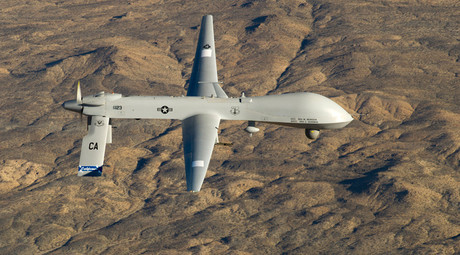
A U.S. Air Force MQ-1 Predator © U.S. Air Force / Tech. Sgt. Effrain Lopez / Handout

The American fighters “will conduct training alongside NATO allies and partners as part of OAR to strengthen interoperability, demonstrate US commitment to a Europe that is whole, free, at peace, secure, and prosperous and to deter further Russian aggression,” the USAF said in a statement.

During the tour the aircraft will forward-deploy to the Eastern European nations of Bulgaria, Romania and Estonia.

The deployment is one of several planned by the Pentagon. Next month it is planning to send six F-15s to Finland, which is not a NATO member, but an active participant in many of the bloc’s activities.

Iceland is the only NATO member that has no military of its own, although it has a small coast guard force. The country used to host a US airbase during the Cold War, but it was shut down in 2006. Two years later US warplanes started paroling Iceland’s airspace.

The US and NATO are pushing for a stronger military presence in Europe, and particularly in Eastern Europe and the Baltic, close to Russia’s border. They argue that such deployment is necessary to deter Russia from military aggression.

Moscow says Western hawks are simply using the perceived Russian threat to justify greater military spending.

New Syrian constitution by August: Russia, US push for political solutions at Moscow talks

March 25, 2016

New Syrian constitution by August: Russia, US push for political solutions at Moscow talks

Published time: 25 Mar, 2016 03:16

Source: New Syrian constitution by August: Russia, US push for political solutions at Moscow talks — RT News

Russian Foreign Minister Sergei Lavrov (R) and U.S. Secretary of State John Kerry shake hands following a news conference at the Kremlin in Moscow, Russia, March 24, 2016. © Andrew Harnik / Reuters

Russia’s Sergey Lavrov and the US’ John Kerry agreed to push for a political transition in Syria by having a new draft constitution ready by August. The Kremlin-hosted talks revealed a softer, more cooperative tone on Syria, as well as Ukraine.

The discussions lasted over four hours and involved Russian President Vladimir Putin, Russian Foreign Minister Sergey Lavrov, US Secretary of State John Kerry, and US Ambassador to Russia John F. Tefft.

“We agreed on a target schedule for establishing a framework for a political transition [in Syria] and also a draft constitution, both of which we targeted by August,” Kerry told journalists at a joint news conference with Lavrov following the meeting.

Lavrov also said that both parties had agreed to use their influence to push the Syrian government to engage in “direct talks” with the opposition in order to accelerate discussions on a political transition that could help end Syria’s civil war.

“As the immediate task, we have agreed to push for the soonest start of direct talks between the government delegations and the whole spectrum of the opposition” that will help to create “a transitional governance structure” for Syria, Lavrov said.

Read more

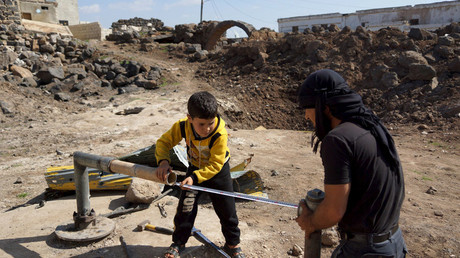
Civilians fix damaged water pipes in the rebel held al-Ghariyah al-Gharbiyah town, in Deraa province, Syria February 28, 2016. © Alaa Al-Faqir

The Russian FM pointed out that there are still a number of issues that Moscow and Washington don’t agree on, but maintained that this would not prevent them from cooperating “on an equal footing” on the problems on which they have found common ground.

“The US has plenty of partners who do not agree with them… It does not mean that the differences on one particular issue should stop them from talking at all,” Lavrov said.

At the start of the talks, Kerry told Lavrov that the partial truce in Syria was working and reducing the level of violence in the country. “It’s fair to say three weeks ago there were very, very few people who believed a cessation of hostilities was possible in Syria,” Kerry said. “The result of that work has produced some progress. There has been a fragile nevertheless beneficial reduction in violence.”

The tone of Russia-US relations appeared softer than it has been for some time on many issues, including Syria and the conflict in eastern Ukraine, as both parties demonstrated an apparent desire to improve bilateral relations.

Kerry said that the productive eleven-month collaboration of Russian cosmonaut Mikhail Kornienko and American astronaut Scott Kelly on the International Space Station (ISS) should serve as an example for cooperation between the two world powers.

“When they were telling me about how they spent their time in space, they highlighted that their close cooperation demonstrated not only what the two astronauts could do, but what two countries could achieve together as well,” Kerry said at the press conference.

Read more

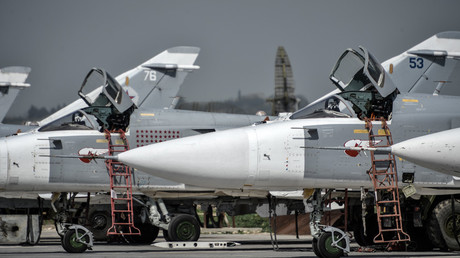
Russian Su-24 tactical bombers at the Hmeimim airbase in the Latakia Governorate of Syria. © Ramil Sitdikov

As an example, Lavrov noted that Russian and US experts could hold joint consultations to discuss the most effective ways to fight cybercrime.

When it came to Ukraine, both sides agreed that the Minsk Accords must be fully implemented.

“We have indeed pledged to ensure that Donbass, that the self-proclaimed republics of Donetsk and Lugansk [DPR and LPR], implement what they and their representatives signed under in Minsk,” Lavrov said, while calling on his US counterpart to ensure that similar pressure is put on Kiev.

Kerry reiterated that once the agreement is “fully implemented,” the US will be ready to roll back sanctions on Russia.

Meanwhile, Lavrov confirmed that Moscow is closely monitoring the health of Ukrainian national Nadezhda Savchenko. “We have confirmed that Savchenko’s health condition, that many try to speculate on, presents no concerns,” Lavrov said. “She is under constant monitoring of Russian doctors.”

Savchenko, a Ukrainian Air Force officer detained in Russia in 2014, was found guilty of murdering two Russian journalists near Lugansk in eastern Ukraine, and of illegally crossing the Russian border. The decision was made by a court in the southern Russian town of Donetsk on Monday.

Kerry, who has called for Savchenko to be sent back to Ukraine, told reporters that Putin indicated that at some point “we will be able to address the issue of Savchenko.”

Following the talks in Moscow, Aleksey Pushkov, the chairman of the Parliamentary Committee for International Relations, noted that Russia and the US are beginning to develop a closer relationship based on America’s pressing needs, which are forcing the US to forget about its previous goal to isolate Russia.

“About Kerry’s visit: there is nothing more powerful in politics than need. Under its influence, forgetting about isolating Russia, the US has begun to move,” Pushkov tweeted.

Obama Admin Engaged in Secret Talks to Pay Iran

March 23, 2016

Obama Admin Engaged in Secret Talks to Pay Iran Nearly $2 Billion Officials admit delays in informing Congress, say more payments to come

BY:
March 23, 2016 5:00 am

Source: Obama Admin Engaged in Secret Talks to Pay Iran

The Obama administration has spent three years engaged in secret talks with Iran that resulted in the payment of nearly $2 billion in taxpayer funds to the Islamic Republic, with more payouts likely to come in the future, according to a recent letter issued by the State Department and obtained exclusively by the Washington Free Beacon.

The administration’s disclosure came in response to an inquiry launched in January by Rep. Mike Pompeo (R., Kan.), who was seeking further information about the Obama administration’s payment of $1.7 billion in taxpayer funds to Iran, which many viewed as a “ransom payment” for Iran’s release that month of several U.S. hostages.

The administration’s official response to Pompeo was sent earlier this week, just days after a Free Beacon report detailing a months-long State Department effort to stall the lawmaker’s inquiry.

“We apologize for the delay in responding,” Julia Frifield, an assistant secretary for legislative affairs, states in the letter’s opening.

Obama administration officials first began talks to settle a number of outstanding legal claims leveled against the United States by Iran in 2014. The administration predicts that more taxpayer-funded payments are likely to be granted to the Islamic Republic in the future, according to the letter.

Frifield in her letter goes on to defend the $1.7 billion payment to Iran and discloses that the administration is open to providing Tehran with more money if it is willing to settle these decades-old legal disputes with the United States.

“We are confident that this was a good settlement for the American taxpayer,” the State Department said.

Iran’s legal row with the United States surrounds the breakdown of a massive arms deal that was nixed in the aftermath of Iran’s 1979 Islamic revolution, which resulted in the capture of the U.S. embassy and American personnel stationed there.

Many of these claims remain unsettled and are still being litigated by the Iran-U.S. Claims Tribunal at the Hague.

The Obama administration has been working behind the scenes since at least 2014 to reach settlement agreements with Iran to avoid court decisions, according to the letter, which identifies at least two separate discussions held in June 2014 and January 2015.

The administration anticipates that more settlements will come, meaning that the United States will likely be forced to pay Iran via a taxpayer legal fund operated by the Treasury Department.

“The United States is continuing to vigorously litigate these claims at the Tribunal, but is also open to discussing further settlements of claims with Iran, as we have done throughout the life of the Tribunal, with the aim of resolving them in furtherance of U.S. interests,” the letter states.

Iran’s “fact-intensive claims involve over 1,000 separate contracts between Iran and the United States,” according to the letter, which explains that January’s $1.7 billion payment settled just one of many outstanding disputes.

The Obama administration fails to directly address Pompeo’s questions seeking to determine if the legal settlement was finalized as part of an incentive package meant to motivate Tehran to free imprisoned Americans.

“It would not be in the interest of the United States to discuss further details of the settlement of these claims in an unclassified letter due to the ongoing litigation at the Tribunal,” the State Department writes. “However, we would be prepared to provide a closed briefing on such issues if it would be useful to there.”

“When Iran releases American hostages, and then, on that same day, President Obama announces he is paying Iran $1.7 billion, Congress of course has to ask the hard questions,” said one source familiar with the investigation. “And when the Obama administration admits that over $1 billion in taxpayer money is going to the Iranian regime, Congress is obligated to respond. The State Department has ducked and dodged–providing a history lesson on international tribunals, focused on actions decades ago, instead of addressing dangerous misdeeds that were potentially just committed. That is suspicious.”

Under the specific terms of January’s settlement, Iran was to be paid a $400 million balance and an additional $1.3 billion in interest from a taxpayer fund maintained by the Treasury Department, a State Department official confirmed to the Free Beacon at the time.

That settlement—along with additional settlements—was reached outside of the recently implemented nuclear deal and is separate from the $150 billion in unfrozen cash assets the United States is obligated to give to Iran under that agreement, the official said.

The $1.7 billion payment was announced just prior to the release of five U.S. prisoners who had been held in Iran, sparking accusations that the deal is tantamount to a ransom payment

Obama Admin Stalling Investigation Into Iran ‘Ransom Payment’

March 18, 2016

Obama Admin Stalling Investigation Into U.S. ‘Ransom Payment’ to Iran Congress in dark as admin ignores questions about taxpayer money for Tehran

BY:
March 17, 2016 11:00 am

Source: Obama Admin Stalling Investigation Into Iran ‘Ransom Payment’

The Obama administration is being accused of stalling a congressional investigation into a purported $1.7 billion taxpayer-funded “ransom payment” to Iran in exchange for the release of several U.S. prisoners, according to documents and information provided to the Washington Free Beacon by sources familiar with the matter.

The administration initially came under fire from congressional critics in January, when it was announced that the United States had settled a longstanding legal dispute with Iran over the breakdown in a decades-old arms sale.

Under the terms of the settlement, Iran was to be paid a $400 million balance and an additional $1.3 billion in interest from a taxpayer fund maintained by the Treasury Department, a State Department official confirmed to the Free Beacon in January.

The settlement was reached outside of the recently implemented nuclear deal and is separate from the $150 billion in unfrozen cash assets the United States is obligated to give to Iran under that agreement, the official said.

The $1.7 billion payment was announced just prior to the release of five U.S. prisoners who had been held in Iran, leading to accusations that the deal is tantamount to a ransom payment. Iranian officials, at the time, independently described the transaction as a form of ransom.

While the Obama administration immediately denied that the two issues were linked, lawmakers remained skeptical and pushed for more answers.

Rep. Mike Pompeo (R., Kan.) reached out to Secretary of State John Kerry on Jan. 21 to outline his concerns and request further disclosures about what he called a “ransom payment” to Iran, according to a letter sent by the lawmaker and obtained by the Free Beacon.

The State Department has not responded and is said to have ignored multiple follow-up requests from Pompeo’s office, according to sources familiar with the situation.

When asked Thursday whether a response is in the works, a State Department official told the Free Beacon, “We take seriously all correspondence from Congress and respond accordingly.”

The administration’s delay is causing frustration on Capitol Hill and prompting accusations that the State Department is stalling congressional efforts to investigate how the settlement with Iran was reached.

“The State Department likes to drag its feet on responding to Congress, particularly on issues related to the Iran nuclear deal,” one source familiar with the situation said. “This stonewalling is reminiscent of recent testimony by a senior Department of Homeland Security official who would not answer members’ questions on refugees and visas.”

“Congress is only trying to do its job of holding President Obama accountable and ensuring taxpayer dollars are spent wisely,” the source added. “The Obama administration’s refusal to answer legitimate questions leaves the American people to wonder what they are hiding.”

In Pompeo’s case, the State Department initially confirmed its receipt of the letter in January but did not provide information as to when officials might respond. The administration subsequently failed to respond to further requests for a response issued over the following months, sources said.

Pompeo’s investigation surrounds “the timing and details” of the cash transfer to Iran of $1.7 billion, according to his letter.

The administration’s behavior “indicates it might be a ransom payment and it is likely interpreted as such by our adversaries,” he wrote. “We may be seeing a dangerous precedent in action as three Americans, reportedly kidnapped by Iranian-backed Shia militias in Baghdad, remain missing.”

“Many find this timing suspicious,” he said. “I fear this payment is the latest incident that is establishing a dangerous precedent that will lead to more Americans being captured abroad.”

The lawmaker sought further information on “the relationship” between the $1.7 billion settlement and the release of the five American prisoners. He also wants to determine whether the lawsuit was ever discussed in “conversations with the Iranians about the release of American hostages.”

“Did you secure an assurance from the Iranians that they will not use this $1.7 billion to fund terrorism?” he asked.

Pompeo goes on to request details about additional legal claims by Iran, asking: “How much money does Iran assert we still owe them? How many more billions can we expect the Obama administration to hand to the Ayatollah?”

Other sources familiar with the matter also chastised the administration for dragging its feet.

“This is one of the main ways the Obama administration hides its Iran foreign policy,” said one foreign policy consultant who works intimately with Congress on the Iran portfolio. “Sometimes they over-classify information to keep it secret, sometimes they mislead lawmakers about their intentions, but a lot of the time they engage in this kind of sandbagging.”

“By the time anyone gets any answers, whatever catastrophic policy they were hiding has become the new normal,” the source said.

 Kerry Pirouettes Halfway Out on a Limb About ISIS and Genocide

March 17, 2016

Kerry is willing to list the ways in which ISIS is horrific and to say HE THINKS it is committing genocide, but unwilling to definitively say it is.

By: Lori Lowenthal Marcus Published: March 17th, 2016

Source: The Jewish Press » » Kerry Pirouettes Halfway Out on a Limb About ISIS and Genocide

U.S. Secretary of State John Kerry. March 17, 2016.
Photo Credit: screen capture http://www.state.gov

In a statement on Wednesday, March 17, U.S. Secretary of State John Kerry went halfway out on a limb and announced that ‘in his judgment,’ ISIS is committing genocide against Yezidis and Christians and Shia Muslims and other living things.

But –fair minded man that he is — Kerry refused to say definitively that ISIS actually is committing genocide.  Such a definitive statement, Kerry insisted, could only be made by an international court.

Once upon a time, our world had people — they were called “leaders” — who were not afraid to name evil, and condemn evil when they saw it.  Can you imagine Churchill or Roosevelt issuing a statement that, in their opinion, the Nazis were evil, but that any definitive conclusion on the subject would have to be issued by someone else?

So if you see other reports about Kerry’s statement today, you may find headlines saying the U.S. has announced that ISIS is committing genocide. Sadly, though, Kerry did not quite say that. He said ISIS (he now calls it Daesh, its Arabic acronym) is doing lots of terrible things that the U.S. and its coalition partners detest and want to stop.

Kerry mentioned, at the outset, the taking over of major cities and seizing of territory in Syria and Iraq, committed by ISIS over the past two years. He mentioned that ISIS has overrun major cities, seized territory in Syria and Iraq.

Those are not the first things most humanitarians would list, when listing the atrocities which ISIS has committed.

Kerry then boasted about the U.S. efforts, that it “responded quickly by denouncing these horrific acts and – more importantly – taking coordinated actions to counter them.” He mentioned the international coalition which is working “to halt and reverse Daesh’s momentum.” And ticks off the coalition’s successes and actions.

Kerry boasts that the international coalition has “attacked their revenue sources, and disrupted their supply lines,” and is currently working on a diplomatic initiative to end the civil war in Syria.

Then the U.S. Secretary of State gets to the heart of his statement: how to characterize what ISIS is doing. Is it genocide? Is it simply extreme aggressiveness? Is it random killing, albeit on a large and gruesome scale?

And here it is that Kerry disappoints. He cannot bring himself to actually state: ISIS is committing genocide.

In the administration’s world of moral relativism, in that world in which legal niceties trump reality, the Secretary of State of the greatest nation in global history can only come up with: “in my judgment, Daesh is responsible for genocide against groups in areas under its control, including Yezidis, Christians, and Shia Muslims.”

And then he musters a lengthy legal and factual basis for his flaccid statement. Yes, “Daesh is genocidal by self-proclamation, by ideology, and by actions – in what it says, what it believes, and what it does. Daesh is also responsible for crimes against humanity and ethnic cleansing directed at these same groups and in some cases also against Sunni Muslims, Kurds, and other minorities.”

Okay, then, but Kerry continues to hedge because heaven forbid he actually flat-out accuses ISIS of genocide. He cannot do that, you see, because there is not yet a complete record: it is “impossible to develop a fully detailed and comprehensive picture of all that Daesh is doing and all that it has done.”

Further down in his statement, Kerry lays out the the rather compelling – one would think – argument that ISIS is committing genocide, to wit, that ISIS “kills Christians because they are Christians; Yezidis because they are Yezidis; Shia because they are Shia. This is the message it conveys to children under its control. Its entire worldview is based on eliminating those who do not subscribe to its perverse ideology. There is no question in my mind that if Daesh succeeded in establishing its so-called caliphate, it would seek to destroy what remains of ethnic and religious mosaic once thriving in the region.”

Still, even after naming what it is that ISIS does, is doing and promises to continue doing, Kerry states that the opinion that he draws from all the evidence currently available does not amount to an actual and official position.

Why?

Because Team USA believes it is not worthy of making such a determination. Nope. They want a legal determination to be made by a judge or legal tribunal after all the facts are put forward, though an independent investigation.

Kerry wrote:

I want to be clear. I am neither judge, nor prosecutor, nor jury with respect to the allegations of genocide, crimes against humanity, and ethnic cleansing by specific persons. Ultimately, the full facts must be brought to light by an independent investigation and through formal legal determination made by a competent court or tribunal.

It isn’t as if Kerry or his staff are even vaguely unaware of all the horrors ISIS has committed and promises to continue to commit. Kerry ticks off many of them, near the end of his lengthy statement: faith-based sexual slavery, mass rape, starvation, forced dehydration, executions, forced conversions and destruction of cultural heritage treasures.

Kerry said he wanted his statement to assure the victims of ISIS that the U.S. “recognized and confirms the despicable nature of the crimes that have been committed against them.”

Recognize and confirm? Yes. Name it for what it is? Not yet.

And what is to be served by refusing to take that last final step? Nothing, except to make clear that the U.S. does not value, and therefore neither should anyone else, its ability to pass judgment.

ISIS Massacre of Christians Not “Genocide,” Obama Administration Insists

March 17, 2016

ISIS Massacre of Christians Not “Genocide,” Obama Administration Insists

by Raymond Ibrahim March 17, 2016 at 4:30 am

Source: ISIS Massacre of Christians Not “Genocide,” Obama Administration Insists


  • According to the Obama administration, the Islamic State is committing genocide against certain religious minority groups — excluding Christian minorities. But ISIS is on record saying that its eradication of Christians is due to their religious identity.
  • The Obama administration’s rejection of the word “genocide” fits a familiar pattern.
  • When asked about the plight of Christians under ISIS, Colonel Steve Warren said “We’ve seen no specific evidence of a specific targeting toward Christians.”
  • Although Christians number 10% of Syria’s population, only 2% of refugees accepted into the U.S. from there are Christian. (The majority — almost 98% — are Sunni Muslims, the same sect to which ISIS belongs and thus are not persecuted.)

According to the Obama administration, the Islamic State is committing genocide against certain religious minority groups — excluding Christian minorities. During a February 29 press briefing, White House spokesman Josh Earnest was asked: “Is the Islamic State carrying out a campaign of genocide against Syria’s Christians?” He replied:

Well, we have long expressed our concerns with the tendency of — well, not a tendency — a tactic employed by ISIL to slaughter religious minorities in Iraq and in Syria. You’ll recall at the very beginning of the military campaign against ISIL that some of the first actions that were ordered by President Obama, by the United States military, were to protect Yazidi religious minorities that were essentially cornered on Mt. Sinjar by ISIL fighters. We took those strikes to clear a path so that those religious minorities could be rescued.

Due to the obvious equivocation — it is unclear how Obama’s efforts “to protect Yazidi religious minorities” answers a question about persecuted Christians — the question was repeated: “But you’re not prepared to use the word ‘genocide’ yet in the situation [regarding Christians]?”

Earnest’s response:

My understanding is the use of that word involves a very specific legal determination that has at this point not been reached.

What is this “very specific legal determination” that encompasses Yazidis but excludes Christians? The Islamic State’s treatment of Christians would seem to fit under the UN’s definition of “genocide“:

Genocide means any of the following acts committed with intent to destroy, in whole or in part, a national, ethnical, racial or religious group, as such: (a) Killing members of the group; (b) Causing serious bodily or mental harm to members of the group; (c) Deliberately inflicting on the group conditions of life calculated to bring about its physical destruction in whole or in part;…

ISIS is guilty of “killing members of the [Christian] group” and causing them “serious bodily or mental harm.” Although two separate videotaped mass executions (one of 21 Egyptian Christians and another of 30 Ethiopian Christians) were reported by the mainstream media, accounts of torture, rape, mutilation, crucifixion, and massacres of Christians are regularly reported on Arabic and alternate media.

The Islamic State has also been responsible for “deliberately inflicting on the group [Christians] conditions of life calculated to bring about its physical destruction in whole or in part.” ISIS has placed these “conditions of life” — more literally known in Islamic doctrine as the “Conditions of Omar” — on Christians. They included a number of humiliations and debilitations — from the suppression of Christian worship to the extortion of money (jizya) — a “protection” tax designed to “encourage” Christians to convert to Islam or flee.

ISIS seems further committed to expunging all physical traces of Christianity in the areas it conquers. It has demolished dozens of ancient churches; at least 400 churches in Syria have been destroyed since the war, as well as countless statues and crucifixes. ISIS has also desecrated Christian cemeteries and ordered the University of Mosul to burn all books written by Christians and decreed that all schools in Mosul and the Nineveh Plain that bore Christian names (some since the 1700s) be changed.

Then there are the numbers. In Iraq, Christians, who totaled 1.4 million in 2003, are now down to about 300,000. In Syria, Christians, who totaled 1.25 million in 2011, are now down to about 500,000.

The Syriac Orthodox Church of St. Ephrem in Mosul, Iraq, before it was captured by the Islamic State (left), and after.



Finally, ISIS is on record saying that its eradication of Christians is due to their religious identity.

Due to all these indicators, many groups and rights activists believe that ISIS’s treatment of Christians “fits the definition of ethnic cleansing,” in the words of the Simon-Skjodt Center for the Prevention of Genocide at the U.S. Holocaust Memorial. A European Parliament resolution adopted in April 2015 stated that “Christians are the most persecuted religious group. … according to data the number of Christians killed every year is more than 150,000.”

Even so, the Obama administration’s rejection of the word “genocide” fits a familiar pattern:

  • When asked about the plight of Christians under ISIS, Colonel Steve Warren said “We’ve seen no specific evidence of a specific targeting toward Christians.”
  • Although Christians number 10% of Syria’s population, only 2% of refugees accepted into the U.S. from there are Christian. (The majority of refugees — almost 98% — are Sunni Muslims, the same sect to which ISIS belongs and thus are not persecuted.)
  • When inviting scores of Muslim representatives, the State Department has repeatedly denied visas to solitary Christian representatives.
  • When a few persecuted Iraqi Christians crossed the border into the U.S., they were thrown in prison for several months and then sent back to the war zone.
  • When persecuted Coptic Christians planned on joining Egypt’s anti-Muslim Brotherhood revolution of 2013, the Obama administration, in the person of Ambassador Anne Patterson, counseled them not to.
  • When persecuted Iraqi and Syrian Christians asked for arms to join the opposition fighting ISIS, D.C. refused.

Raymond Ibrahim, author of Crucified Again: Exposing Islam’s New War in Christians (a Gatestone Publication, published by Regnery, April 2013), is a Shillman Fellow at the David Horowitz Freedom Center and Judith Friedman Rosen Writing Fellow at the Middle East Forum.