The Watchman – Episode 4: The Iran Threat to America
American warships entering the Black Sea will prompt “response measures” from Moscow, a top Russian diplomat has warned, adding that another US aircraft carrier in the Mediterranean is clearly an attempt to show force ahead of an upcoming NATO summit.
Source: Moscow warns of response after US sends destroyer to Black Sea — RT News

© Maritime Staff Office of the Defense Ministry of Japan / Reuters
The USS Porter (DDG-78), armed with assault cruise missiles and an Aegis Ballistic Missile Defense System (primary weapon: Standard Missile 3), entered the Black Sea this week.
American warships do enter the Black Sea now and then. Certainly, this does not meet with [Russia’s] approval and will undoubtedly lead to planning response measures,” Andrey Kelin, the head of the Russian Foreign Ministry’s European Cooperation Department, told RIA Novosti on Friday.
He also disapproved of the deployment of the USS Harry S. Truman in the Mediterranean ahead of the NATO summit in Warsaw in July as muscle-flexing.
“There is nothing special about the movement of US vessels in this case. We know that aircraft carriers are moving in the Mediterranean Sea and elsewhere, they have a right to do so, this is freedom of navigation,” he said.
“But in general, this is a definite increase in [Russia-US] relations and all this is done ahead of the NATO summit in Warsaw – this is a demonstration of force,” he added.
The NATO summit will be held in Polish capital Warsaw on July 8-9, preceded by a series of large-scale war games in Eastern Europe and the Baltic states. The largest training exercise is taking place in Poland, where over 31,000 troops from 24 countries are taking part in NATO’s Anaconda 2016 war drills – the largest war games in Eastern Europe since the Cold War.
The Anaconda 2016 NATO military exercise involves 24 NATO and “partner nations,” including the US, the UK, Germany, Canada, Spain, Sweden, Turkey and others.
NATO has been signaling Moscow to hold another meeting ahead of the Warsaw gathering, although Russia is still considering the proposal and a final decision has not been made yet, Kelin said.
US-led NATO has been in more frequent contact with the Russian military following the disruption of relations that resulted from the reunification of the Crimea Peninsula with Russia in March 2014.
NATO decided to break off all contact with Russia in 2014, when Viktor Yanukovych was ousted as Ukraine’s president during the so-called Euromaidan riots. A NATO-Russia Council meeting was held in June 2014, but the council was then subject to a lengthy break and meetings have only recently restarted.
“We will see how things move forward. But overall, we can absolutely not give up on the most important channel of cooperation and dialogue,” RIA Novosti quoted Kelin as saying.
US urges Israel to avoid ‘escalating tensions’ after attack After Jerusalem announces slew of measures, State Department says it should also consider ‘the impact on Palestinian civilians’
By Sue Surkes
June 10, 2016, 12:03 am
Source: WATCH: US urges Israel to avoid ‘escalating tensions’ after attack | The Times of Israel
The US State Department called on Israel on Thursday to take into account “the impact on Palestinian civilians” in its response to Wednesday’s terror attack at Tel Aviv’s Sarona Market, in which four people were killed and 16 injured, three of them seriously.
Spokesman Mark Toner was responding to questions about a slew of measures announced by the Israeli security cabinet in the wake of the attack.
Toner called on Israel to respond to the shooting “would be designed to not escalate tensions any further, but we certainly respect their desire to express outrage and to protect the safety of their people.”
Pressed about the decision to withhold the bodies of attackers, he said that Israel “obviously should weigh” whether the steps it takes will exacerbate the conflict. Still, he said, “we understand” why Israel would adopt measures such as revoking entry permits and beefing up its presence in Palestinian areas.
“We understand the Israeli government’s desire to protect its citizens after this kind of terrorist attack and we strongly support that right, but we would hope that any measures it takes would also take into consideration the impact on Palestinian civilians who are just trying to go about their daily lives,” he said.
Earlier in his briefing, Toner said he condemned the terrorist attack “in the strongest possible terms,” adding, “These kinds of attacks can never be justified.”
International condemnations poured in in the hours following the attack.
The European Union said in a statement that “Wednesday night’s terror attack in the Sarona complex in Tel Aviv exposed scores of innocent civilians and families to indiscriminate fire. Four people were killed and more seriously injured. Our thoughts are with the families of the dead and injured.”
“Those responsible for these murders must be brought to justice,” the EU continued. “Those who praise this attack must be condemned.”
UN Secretary-General Ban Ki-moon said in a statement denouncing the shooting that “there is no justification for terrorism nor for the glorification of those who commit such heinous acts.”
“The Secretary-General is shocked that the leaders of Hamas have chosen to welcome this attack and some have chosen to celebrate it,” Ban’s office said in a statement. “He calls upon the Palestinian leadership to live up to their responsibility to stand firmly against violence and the incitement that fuels it.”
Netanyahu vows: ‘Syria won’t be a launchpad against Israel’ Talking to Moscow’s Jewish leaders, PM admits Israeli activity in Syria, says he talked with Putin about new regional ‘arrangement.’
By Nitsan Keidar
First Publish: 6/8/2016, 2:57 PM
Source: Netanyahu: ‘No Syrian launchpad against Israel’ – Defense/Security – News – Arutz Sheva
After meeting with Russian President Vladimir Putin on Tuesday, Prime Minister Binyamin Netanyahu on Wednesday held a conference with the leaders of Moscow’s Jewish community where he spoke about Israeli activity in Syria.
The event, which was held during Netanyahu’s official visit to Russia, was attended by around 100 community leaders and businessmen including Russian Chief Rabbi Berel Lazar, Moscow Chief Rabbi Pinchas Goldschmidt and Russian Jewish Federation chief Yuri Kanner.
During the meeting, Netanyahu was asked about Syria and the future of relations with Syrian President Bashar al-Assad, whose regime is being propped up primarily by Russian and Iran.
“You ask about the future of (Israel’s) relations with President Assad? I would ask what is the future of President Assad in general?,” replied Netanyahu, noting on the internecine civil war that has raged since 2011.
“We do not interfere in this issue. We’re making sure that Syria won’t become a launchpad for attacks against Israel.”
He clarified that Israel is ensuring it will not be attacked from Syria by taking occasional action, and said the IDF will strike Syrian and Iranian troops or Hezbollah terrorists and members of other Islamist groups in the region if they pose a threat to the Jewish state.
“There are enough enemies. My policy is to take all necessary steps to prevent attacks, and we act from time to time when the need arises,” he acknowledged.
The statement is one of the few times Netanyahu has admitted Israeli activity over the border.
While Arab reports had long alleged that Israeli jets conducted airstrikes on arms transfers for Iran’s Lebanese terror proxy Hezbollah, Israel has remained tight-lipped on the subject. However, last December Netanyahu acknowledged that Israel is active in Syria.
In his remarks on Wednesday regarding Syria, Netanyahu added that, “I also ordered to build a field hospital that helped thousands of Syrians, babies, children, women, and men, with awful wounds. We are treating them there and at our hospitals. Humanitarian aid and a firm stand on our lines for the security of Israel.”
Noting on the fractured nature of Syria, he said, “I don’t know if it is possible to turn the Syrian omelette back into an egg.”
“The countries around us, Syria among them, some of them have already split apart, and therefore a different arrangement is needed. I spoke with President Putin about this at length, and the important thing is that what replaces them (the countries) doesn’t bring more tragedies and does not endanger our countries.”
While Netanyahu did not elaborate what the “different arrangement” in the Middle East that he spoke with Putin about would consist of, he recently has expressed willingness to hold negotiations with the Palestinian Authority (PA) as well as states such as Egypt in working on a regional peace deal. Details of what such a deal might entail remain unclear.
Netanyahu also noted on the growing ties between Israel and Russia during the meeting, and thanked the Jewish leaders for being instrumental in making that happen.
The UNO, the EU and Daesh schizophrenia by Thierry Meyssan Intergovernmental organisations are supposed to unite the efforts of member-states in order to achieve results that they could not manage alone. We might therefore conclude that the UNO and the EU are coordinating the fight against Daesh. Instead of which, these two organisations are hindering the forces on the ground and masking state support for international terrorism.
Voltaire Network | Damascus (Syria) | 6 June 2016
Source: The UNO, the EU and Daesh schizophrenia, by Thierry Meyssan

Jeffrey Feltman, the Director of Political Affairs for the UNO, and Federica Mogherini, the High Representative of the EU for Foreign Affairs and Security Policy. Are these senior civil servants working for peace or are they lying for the cause of US imperialism?
If, during the Cold War, research credits for social and political studies were oriented towards the study of «totalitarism» – in other words, the assimilation of Nazism and Stalinism – they were reoriented towards «terrorism» just after the attacks of the 11 September 2001. Suddenly, thousands of experts appeared, all financed in order to justify, a posteriori, the official version of the attacks, the wars in Afghanistan and Iraq, and the proclamation of the Patriot Act.
Thirteen years later, the phenomen repeated itself on the occasion of the proclamation of the Caliphate by Daesh. It was now less a question of fighting a vague terrorist threat than engaging in a war against a genuine though unrecognised state, and anticipating the transfer of arms, money and combatants that it generates.
Two intergovernmental organisations, the UNO and the European Union, have accomplished a colossal job of work defining a strategy for the «prevention of violent extremism» and the fight against Daesh. The General Assembly of the United Nations will examine this work on the 30 June and the 1 July. Obviously, one may fear that the «prevention of violent extremism» may be no more than a justification for the repression of any form of opposition.
When we read the available documents — those (1) of the Secretary General of the UNO [1], (2) the UN Counter-Terrorism Committee (Resolution 1373), (3) the Analytical Support and Sanctions Monitoring Team [2], and (4) the European Union External Action Service [3] — we are overcome with vertigo at what looks less like a battle plan than an elaboration of politically correct rhetoric.
The UNO and the EU base their work exclusively on Western sources which are far removed from the terrain – not only do they never make a single mention of the information transmitted by Iraq, Syria and Russia, but seem to ignore the very existence of such information. And yet it was handed to the Security Council by ambassadors Mohamed Ali Alhakim, Bachar Ja’afari and Vitali Tchourkine. The documents are freely available.
Syria, and to a far lesser degree, Iraq, furnished information concerning the transfer of money, arms and jihadists on a day-to-day basis, while Russia distributed five thematic reports concerning
 1. the illegal commerce of hydrocarbons [4];
2. the recruiting of foreign terrorist combatants [5];
3. the trafficking of antiques [6];
4. the deliveries of arms and ammunition [7];
5. the components intended for the fabrication of improvised explosive devices [8].
All these documents directly implicate Saudi Arabia, Qatar and Turkey. These three states – allies of Washington – have all responded with generalised denials without ever discussing the slightest element of the charges.
Daesh is functional on the four strategic objectives of the United States, namely the fomenting of a civil war between the Sunnis and the Shia in Iraq, the project for the partition of Iraq into three federalised parts, the project for cutting the road linking Iran and Lebanon, and the project for the overthrow of the Syrian Arab Republic. To the point where we might ask ourselves – if Daesh didn’t exist, would Washington have had to invent it?
It would be a mistake to believe that the occulting of the documents mentioned above is the result of anti-Iraqi, anti-Syrian or anti-Russian prejudice. Indeed, the Western sources, both public and private, which support their evidence are also ignored. For example, declassified documents from the U.S. Defense Intelligence Agency [9], or the articles in Jane’s, the favourite magazine of NATO officers [10]. No, the UNO and the EU approach the question of Daesh with one clear and simple a priori – this state popped up quite spontaneously, without any help whatsoever.
The UNO’s blindness is such that its Secretary General, Ban Ki-moon, attributes to the International Coalition led by Washington the victories obtained through the sacrifices made by the Iraqi and Syrian Arab armies, the Lebanese Resistance, as well as the massive engagement of the Russian army.
The «result» of fifteen years of the «war against terror», we are assured, is to have killed more than a million and a half civilians in order to eliminate 65,000 to 90,000 presumed terrorists, and to have moved from an obscure terrorist threat (Al-Qaïda) directly to a terrorist state (Daesh)! After having explained that fifteen member-states of the UNO have «failed» (Failed States) despite years of international aid, we are supposed to believe that within a few months a group of illiterate conscripts has managed, on its own, to create a state and threaten world peace.
Al-Qaïda has moved quietly from the status of «threat» to that of «ally», depending on the situation. It was able to finance the AKP in Turkey [11], help NATO overthrow Mouamar el-Kadhafi in Libya and do a «good job» in Syria, while still being listed by the UNO as a terrorist organisation. No-one has judged it constructive to explain this evolution and this contradiction. In any case, it doesn’t matter any more, since the status of «enemy» is now occupied by Daesh.
Over the last fifteen years, we have watched the Western camp develop its theory about 9/11 and the threat of Al-Qaïda. After the publication of my critisism of this cock and bull fable [12], and despite the fact that terrorist attacks have multiplied, we have seen public opinion begin to doubt the sincerity of their governments, then move gradually away from their official declarations to the point of not believing them at all any more. All this while certain heads of state – in Cuba, Iran [13], and Venezuela – have publicly declared that they are not falling for it.
Given that this time, the opposition point of view is defended from the beginning by numerous states, including two permanent members of the Security Council – Russia and China – are we going to spend the next fifteen years becoming schizophrenic about the «danger of Daesh»?
Translation
Pete Kimberley
[1] “First UN report on ISIL”, “Second UN report on ISIL”, Voltaire Network, 9 February and 31 May 2016.
[2] “Report of the Analytical Support and Sanctions Monitoring Team pursuant to Security Council resolutions 1526 (2004) and 2253 (2015) concerning Islamic State in Iraq and the Levant (ISIL) (Da’esh), Al-Qaida and the Taliban and associated individuals and entities”, March 4th, 2016.
[3] “Towards a comprehensive EU approach to the Syrian crisis”, Voltaire Network, 24 June 2013. “Elements for an EU regional strategy for Syria and Iraq as well as the Da’esh threat” (Confidential leaked document), Voltaire Network, 6 February 2015. “Council conclusions on the EU Regional Strategy for Syria and Iraq as well as the ISIL/Da’esh threat”, Voltaire Network, 16 March 2015. “One year after: the impact of the EU Regional Strategy for Syria, Iraq and against Da’esh” (European External Action Service. Mena Directorate. Working document), Voltaire Network, 10 May 2016. “EU Council conclusions on the EU Regional Strategy for Syria and Iraq as well as the Da’esh threat”, Voltaire Network, 23 May 2016.
[4] “Illegal trading in hydrocarbons by ISIL”, Voltaire Network, 29 January 2016.
[5] “Russian intelligence report on Turkey’s current assistance to Daesh”, Voltaire Network, 18 February 2016.
[6] “Russian Intelligence report on Daesh’s smuggling of antiquities”, Voltaire Network, 8 March 2016.
[7] “Second Russian intelligence report on Turkey’s current assistance to Daesh”, Voltaire Network, 18 March 2016.
[8] “Russian intelligence report on Turkey’s current assistance to Daesh”, Voltaire Network, 17 May 2016.
[9] “The DIA report on jihadists in the Levant” (FOIA document), August 12th, 2012. Download.
[10] « Les États-Unis violent le cessez-le-feu en Syrie et arment Al-Qaïda », Réseau Voltaire, 25 avril 2016. « Qui arme les jihadistes durant le cessez-le-feu ? » (vidéo), par Thierry Meyssan, Télévision nationale syrienne , Réseau Voltaire, 30 avril 2016.
[11] “Erdoğan received Al-Qaeda’s banker in secret”, Translation Alizée Ville; “Al-Qaeda, NATO’s Timeless Tool”, by Thierry Meyssan, Translation Roger Lagassé, Al-Watan (Syria) , Voltaire Network, 6 January 2014.
[12] 9/11, The big lie, Thierry Meyssan, Carnot Publishing, March 2002.
[13] “Statement by Mahmoud Ahmadinejad at 67th UN General Assembly”; “Al-Qaeda blasts Ahmadinejad for his stance on 9/11”, Voltaire Network, 26 September and 2 October 2011.
Russia to give strongest air support to Syrian army in Aleppo area – Lavrov
Published time: 6 Jun, 2016 12:32 Edited time: 6 Jun, 2016 12:59
Source: Russia to give strongest air support to Syrian army in Aleppo area – Lavrov — RT News

Igor Kovalenko / Sputnik
“We will decide on how our air forces should act, depending on the situation,” Lavrov said in a media conference following talks with his Finnish counterpart. “This will not be a surprise for the Americans.”
Al-Nusra Front, an al Qaeda offshoot in Syria, went on an offensive in Aleppo last week. The Russian military blamed the US for stalling Russian airstrikes against the terrorist group’s forces in the region. The US said moderate rebel groups mingled with the terrorists in some areas and that Russia should use caution and not strike those groups by mistake.
“We believe there was plenty of time for the ‘normal’ opposition to leave Nusra Front territories since February. Those who didn’t part ways with the terrorists have only themselves to blame,” Lavrov added.
Moscow hopes that the US is not trying to do anything behind Russia’s back, Lavrov said.
“We expect our partners to cooperate with us honestly and not try to use our regular contacts to secretly go with a Plan B, C or D behind our back.”
Russia and the US jointly support a peace process in Syria that aims to produce a transition government approved by both the so-called “moderate rebel” groups and the government of Syria. A truce between all sides who claim to share this goal was established in February, reducing the violence in the war-torn country.
READ MORE: 270 civilians killed in terrorist shelling in Syria as Al-Nusra regroups – Russian MoD
Terrorist groups Al Nusra Front and Islamic State are not part of the process and do not uphold the ceasefire. Russia accuses certain other Islamist militant groups operating in Syria of not being honest and siding with the terrorists, but the US opposes designating those groups as legitimate targets for military attacks, arguing that they have the backing of Saudi Arabia and a place at the negotiating table in Geneva.
The situation is further complicated by the sheer number of armed groups in Syria and the complexity of their allegiances and rivalries, which makes distinguishing terrorists and “moderate rebels” often problematic.
US asks Russia not to target Al-Qaeda branch in Syria – Russian FM Lavrov
Published time: 4 Jun, 2016 01:04 Edited time: 4 Jun, 2016 02:48
Source: US asks Russia not to target Al-Qaeda branch in Syria – Russian FM Lavrov — RT News
“They [the US] are telling us not to hit it [al-Nusra Front], because there are also ‘normal’ opposition groups [on those territories],” Lavrov said in an interview with local Russian media that was published on the Russian Foreign Ministry’s website.
The minister also stressed that “such opposition groups should leave terrorist positions,” adding that “we have long agreed on that.” Russia first set a deadline for the “moderate” opposition to leave territories occupied by al-Nusra Front extremists, but then agreed to give them more time to withdraw.

In the interview, Lavrov said that Russia believes that taking specific and more effective measures to fight the Islamic State (IS, former ISIS/ISIL) and al-Nusra Front terrorist groups should be the top priority for Russia and the US if the Syrian crisis is to be resolved.
READ MORE: Russian fighter jets destroy ISIS oil facilities close to Turkish border (VIDEO)
“It is important to provide humanitarian access to the settlements blocked by one side or another, to secure the ceasefire and to prevent its violation, as well as to launch the political process… but, as important as these goals are, terrorism is our common threat, and there should be no doubt about that,” he said, adding that, in the meantime, al-Nusra Front has been attempting to merge with other armed opposition groups.
Lavrov also said that the political process in Syria is being held back by radical opposition groups that refuse to come to the negotiating table and set preconditions for peace talks. He added that it is important to set aside these demands and focus on the fight against terrorism.
The minister also emphasized that Russia and the US are involved in a close and intensive dialog on Syria that includes regular telephone calls between Lavrov and his US counterpart, John Kerry, and a video-conference channel set up between the Russian Center for Reconciliation in Syria located at the Khmeimim airbase in Latakia and the US base in the Jordanian capital of Amman, as well as a joint US-Russian center in Geneva.
Lavrov had held a telephone conversation with US Secretary of State John Kerry at the initiative of the US side earlier the same day, the Russian Foreign Ministry said in a statement.
The two ministers discussed “the fight against ISIS and the need to urgently distance the moderate opposition from the Jabhat al-Nusra group, as well as efforts to cut off the flow of weapons and militants coming from abroad to beef up terrorist organizations,” the statement said.
In the meantime, Kerry, who is in Paris, told journalists that he had discussed the upsurge in violence in Syria during the phone call with Lavrov, explaining that the two had worked specifically on “ways to try to strengthen the enforcement and accountability for this cessation,” AP reported.
In the meantime, the US State Department said that Washington has asked Russia to be “more careful” in targeting its airstrikes against al-Nusra Front, as hitting civilians or opposition groups while attacking the jihadists could eventually give more support to the terrorist groups.
“[The US State] Secretary conveyed to Russia and the Assad regime that they need to carefully distinguish between these terrorist groups operating on the ground and those parties to the cessation of hostilities,” US State Department Deputy Spokesman Mark Toner said during a briefing on Friday, adding that the US agrees that IS and al-Nusra Front “pose a real threat to the security on the ground in Syria.”
Geopolitical analyst Patrick Henningsen told RT he believes Washington is not doing enough to convince so-called “moderate” rebel groups to part ways with terrorists.
By designating militants who share the same areas and positions with terrorists as “moderate opposition,” the US is actually providing the terrorists with a safe haven, Henningsen reasoned. The terrorist groups are profiting from such neighborly relations the same way they make use of civilians.
“The classification of moderate rebels is a type of the human shield,” he said.
Hennigsen claims that the lack of a clear signal to the rebel groups coming from Washington is the result of a deliberate strategic choice made by the US government, which wants the military conflict to drag on.
“All this talk of co-mingling, this is all double-speak,” he noted, adding that Washington is “trying to play both sides this to continue this conflict” and has no intention of actually resolving the issue.
Congress to Compel Obama Disclosure of $1.7 Billion ‘Ransom Payment’ to Iran Bill requires White House to reveal details about Iranian capture of U.S. sailors
BY: Follow @Kredo0
June 1, 2016 4:58 am
Source: Congress to Compel Disclosure of $1.7B ‘Ransom Payment’ to Iran

Credit: Iranian state media
New legislation could force the Obama administration to disclose if it paid Iran $1.7 billion in taxpayer funds as part of a “ransom payment” earlier this year to secure the release of 10 U.S. sailors who were abducted at gunpoint by the Iranian military, according to a copy of the legislation and conversations with lawmakers.
The bill, jointly filed by Rep. Mike Pompeo (R., Kan.) and Sen. John Cornyn (R., Texas), comes on the heels of a Washington Free Beacon report disclosing that the Obama administration has been suppressing potentially “shocking” details related to the January abduction of the sailors, who were held at gunpoint by Iranian soldiers and forced to apologize on camera.
The legislation, dubbed the No Impunity for Iranian Aggression at Sea Act, would compel the Obama administration to issue a report to Congress detailing whether it paid Iran a $1.7 billion settlement as part of the hostage release. It also would level sanctions against Iran for possible breach of Geneva Convention rules governing legal military detainment.
Lawmakers and others have suspected for months that taxpayer money was partly used to secure the release of the sailors and other imprisoned Americans, though the administration has been adamant the issues are not linked.
The new legislation would require the White House to certify whether any federal funds, including January’s $1.7 billion payment, were doled out to Iran as part of a “ransom” to secure the release of these sailors and citizens imprisoned in Iran.
The legislation noted that the administration released the money to Iran just a day after it freed several U.S. citizens from prison.
The bill would further require the White House to determine if Iran’s treatment of the sailors—which included filming them crying—constitutes a violation of the Geneva Conventions or international laws governing innocent passage in international seas, according to the bill.
If it is determined that Iran violated either of these accords, the legislation would force the White House to list and sanction every Iranian complicit in the detainment.
Pompeo, a member of the House’s intelligence committee, told the Free Beacon on Tuesday that the White House continues to stonewall efforts to determine precisely what happened to the sailors.
“After the Iranians captured ten U.S. Navy sailors, President Obama mentioned these brave men and women only in passing in his last State of the Union address,” Pompeo told the Free Beacon. “Since then, instead of investigating whether the Iranians violated the Geneva Convention and the right of innocent passage, the Obama administration has only offered apologies and then fired an American Naval officer. There has been no criticism of the Iranians, no public explanation of why these Americans were forced on their knees, hands on their heads, or why they were forced to confess—nothing from President Obama that would send a signal that this is an unacceptable way to treat American sailors.”
Pompeo said that he and Cornyn are seeking to ensure there are “consequences on the Iranians responsible.”
“The Obama administration cannot just focus on its inherently flawed nuclear deal and hope inflammatory incidents like this blow over,” he said.” The implications for the safety of Americans and the U.S. military are too great.”
Rep. Randy Forbes (R., Va.) disclosed to the Free Beacon earlier this month that classified details surrounding the incident are being withheld by the administration. It could be more than a year before this information becomes public, Forbes said.
“I think that when the details actually come out, most Americans are going to be kind of taken aback by the entire incident, both how Iran handled it and how we handled it,” Forbes said. “I think that’s going to be huge cause for concern for most Americans. That’s why I’ve encouraged members of Congress to get that briefing so they do know exactly what did take place.”
US ‘provocations’ may force China to declare air defense zone in S. China Sea – report Published time: 1 Jun, 2016 10:28
Source: US ‘provocations’ may force China to declare air defense zone in S. China Sea – report — RT News

© AFP
A source close to China’s People’s Liberation Army (PLA) told the South China Morning Post daily that security conditions in the region, namely the US military presence, would define the timing of the ADIZ declaration.
“If the US military keeps making provocative moves to challenge China’s sovereignty in the region, it will give Beijing a good opportunity to declare an ADIZ in the South China Sea,” the source told the newspaper.
The country’s Defense Ministry told the South China Morning Post in a written statement that it was “the right of a sovereign state” to designate an ADIZ.

“Regarding when to declare such a zone, it will depend on whether China is facing security threats from the air, and what the level of the air safety threat is,” the ministry wrote.
In November 2013, Beijing set up an ADIZ in the East China Sea, causing an immediate backlash from Tokyo, Seoul and Washington. It covered the Diaoyu Islands, which Tokyo controls and calls the Senkakus.
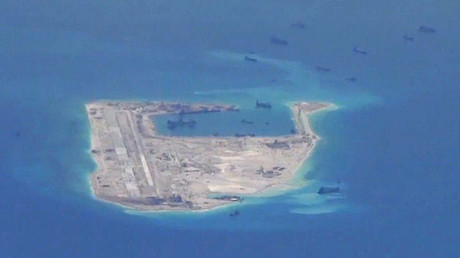
Tensions have run high between Washington and Beijing over a reclamation project in the South China Sea, where China has built artificial islands. Beijing has various territorial disputes in the area – which is rich in deposits of natural resources – with Brunei, Malaysia, the Philippines, Taiwan and Vietnam.
To bolster its claim over the disputed territory, Beijing has been rapidly setting up defense installations in the area. The US Navy is actively opposing the Chinese initiative, deploying additional warships to the disputed zone and conducting maneuvers near the Chinese artificial islands. It has also flown over them, using the “freedom of navigation” principle as justification.
Beijing has called the US involvement in the dispute the “greatest” threat to the region.
“We urge them to stop stirring up a storm in a teacup and stop sowing seeds of discord so as to maintain peace and stability in the South China Sea, which conforms to the common interests of all parties,” Yang Yujun, spokesman for the Ministry of National Defense (MND) said at a briefing, China Military Online reported.
Last month Beijing asked the US to stop its surveillance activities near China after two of its fighter jets carried out what the Pentagon labeled an “unsafe” intercept of a US military reconnaissance aircraft over the South China Sea.
The incident added fuel to the fire in the already tense relations between the two countries.
“What needs to be pointed out is that the US always likes to distort facts and draw media attention to the distance between the military aircraft of the two sides. But in essence, the root cause for security hazards and potential accidents in the air and at sea between China and the US is the long term, large-scale and frequent close-in reconnaissance activities against China by the US military vessels and aircraft,” a Chinese Defense Ministry spokesman said.
The petroyuan is the big bet of Russia and China by Ariel Noyola Rodríguez After the economic sanctions that the United States and the European Union imposed against Russia, Moscow and Beijing put together an imposing energetic team that has radically transformed the world oil market. In addition to increasing their interchange of hydrocarbons exponentially, both oriental powers have decided to put an end to the domination of the dollar in fixing the prices of the black gold. The petroyuan is the instrument of payment of strategic character that promises to facilitate the transition to a multipolar monetary system, a system that takes various currencies into account and reflects the correlation of forces in the current world order.
Voltaire Network | Mexico City (Mexico) | 20 May 2016
Source: The petroyuan is the big bet of Russia and China, by Ariel Noyola Rodríguez
In place of humiliating Russia, the “economic war” that Washington and Brussels had promoted was counterproductive, since it only contributed to fortify the energy team between Moscow and Beijing. We recall that in May of 2014 the Russian company Gazprom agreed to supply gas to China up to 38 billion cubic meters annually during three decades (starting in 2018) through the signing of a contract for 400 billion US dollars with the China National Petroleum Corporation (CNCP) [1].
At the present time both powers coordinate the work of an ambitious plan of strategic projects that include the construction of gas and oil pipelines as well as the combined operation of refineries and large petrochemical complexes. Without proposing to do so, the coming together of Moscow and Beijing has produced deep changes in the world oil market in favor of the Orient, dramatically undermining the influence of Western petroleum companies.
Even Saudi Arabia, that until recently was the principal supplier of petroleum to the Asian giant, has been undermined by Kremlin diplomacy. While from 2011 the petroleum exports of Saudi Arabia to China were growing at a rhythm of 120 thousand barrels per day, those of Russia grew at a velocity of 550 thousand barrels per day, that is to say, almost five times more rapidly. In fact, in 2015 the Russian companies managed to overcome the sales of petroleum from the Saudis four times: Riyadh had to conform with being the second provider of crude to Beijing in May, September, November and December [2].
It is worth noting that the countries that make up the European core have also seen their share of the market diminished in the face of the Asian region: Germany, for example, was supplanted by China at the end of 2015 as the greater buyer of Russian petroleum [3]. In this way, the great investors operating in the world oil market can hardly believe how, in a few months, the principal purchaser (China) became the favorite client of the third major producer (Russia). In accord with the Vice-President of Transneft (the Russian company charged with the implementation of national oil pipelines), Serge Andronov, China is disposed to import a total volume of 27 million tones of Russian petroleum during 2016 [4].
The Russian-Chinese energy alliance is proposed to go longer. Moscow and Beijing have made their interchanges of petroleum a channel of transition towards a multipolar monetary system, that is to say, a system that is no longer based on the dollar alone, but takes into account various currencies and above all, that reflects the correlation of forces in the current world order. The economic sanctions imposed by Washington and Brussels drove the Russians to eliminate the dollar and the euro from their commercial and financial transactions, since otherwise, they would be too exposed to suffer sabotage in the moment of realizing buying and selling operations with their principal trading partners.
For this reason, from mid-2015, the hydrocarbons that China buys from Russia are paid in yuans, not in dollars, information that has been confirmed by high executives of Gazprom Neft, the petroleum branch of Gazprom [5]. This has lead to the use of the “people’s currency” (‘renminbi’) in the world oil market and at the same time allows Russia to neutralize the economic offensive launched by the United States and the European Union. The underpinnings of a new financial order supported by the petroyuan is emerging: the Chinese money is preparing to become the axis of commercial exchanges of the Asian-Pacific region with the principal petroleum powers.

Toda Russia realizes its interchanges of petroleum with China in yuans, in the future the Organization of the Petroleum Exporters Countries (OPEC) will do the same if China demands it. Or will the cult of Saudi Arabia for the dollar make them lose one of their principal clients? [6] Other geoeonomic powers have already followed the path of Russia and China, since they have understood that in order to establish a more balanced monetary system, the “de-dollarization” of the world economy is a priority.
No less important is that after the fall of oil prices, more than 60% (from mid-2014), the Chinese banks have become a decisive financial support for the joint energy infrastructure works. For example, to establish as soon as possible the Russian-Chinese gas pipeline “Force of Siberia”, Gazprom requested from the Bank of China a five-year loan for an amount equivalent to 2 billion euros this past month of March [7]. This is the greatest bilateral credit that Gazprom has contracted with a financial institution to date. Another example is the loan that China gave Russia some weeks ago for a total of 12 billion US dollars for the Yamal LNG project (for liquefied natural gas) in the Arctic region [8]. Obviously, the foreign policy of Russia in energy have not lost any strength due to isolation, on the contrary, it is now enjoying its best moments, thanks to China.
In conclusion, the hostility of the leaders of the United States and the European Union against the government of Vladimir Putin has precipitated the strengthening of the Russian-Chinese team that at the same time has only increased the weight of the Orient in the world market of hydrocarbons. The great bet of Moscow and Beijing is the petroyuan, the strategic instrument of payment that brings with it a challenge to the dominion of the dollar in the fixing of prices for black gold.




 anneinpt
 artaxes
 danmillerinpanama
 davidking1530
 Peter Hofman
 Joseph Wouk
 Peter
Peter Louisiana Steve
 WarSclerotic
Recent Comments