Posted tagged ‘Uranium for Russia’

Trio of GOP-Led Committees to Investigate Obama-Era Uranium Deal With Russia

October 25, 2017

Trio of GOP-Led Committees to Investigate Obama-Era Uranium Deal With Russia, Washington Free Beacon, October 25, 2017

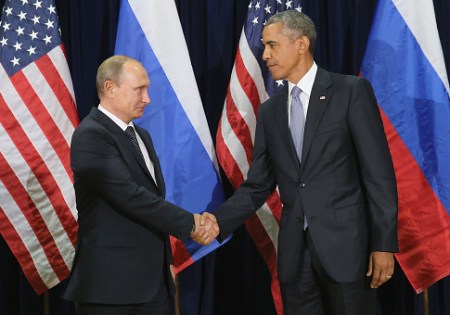
Russian President Vladimir Putin and former President Barack Obama / Getty Images

A lawyer for a confidential FBI informant said Tuesday FBI officials told him that information about a Russian nuclear bribery scheme he was helping to uncover had reached the highest levels of government—that former President Barack Obama and other senior officials had been briefed on the illegal influence-peddling.

At least one of those presidential briefings occurred before the Obama administration’s approval of a Russian takeover of a large U.S. uranium mine in the fall of 2010, the lawyer said FBI officials told her client.

The deal gave the Kremlin control of up to 20 percent of U.S. uranium supply.

“While he has no first-hand information about what was in the president’s daily briefings, he was told unequivocally by the agents that information from the bribery case had been shared with the president and other senior officials and was given praise for providing that evidence,” the attorney, Victoria Toensing, told the Hill.

Rep. Peter King, (R.,N.Y.), a member of the Intelligence Committee, on Tuesday told reporters that he is particularly concerned about the Uranium One deal because he and three other top Republicans, including Rep. Ileana Ros-Lehtinen, (R., Fla.), had warned against approving it in 2010.

King said he knows those concerns were brought to “the highest levels” of the Obama administration because he received a letter in response from then-Treasury Secretary Tim Geithner, who served on the Committee on Foreign Investment in the United States (CFIUS), “saying it was getting full scrutiny.”

“Seven years ago this month, I raised these objections with the Treasury secretary who said they were being fully investigated,” he said. “Obviously, we want to see what happened with that inquiry, what information was brought to their attention and what they knew then, and why they acted or didn’t act and put it into context of what has come out since then.”

Any evidence that senior Obama administration officials, not to mention the president himself, was taking the FBI’s probe into a sweeping Russian bribery scheme seriously before the U.S. government approved Russia’s acquisition of Canada-based Uranium One could provide critical insights into why the U.S. government signed off on the deal amid the probe.

The Russian bribery scheme involved kickbacks, extortion, and money laundering, the Hill and Circa News reported over the last week. The Uranium One chairman through his family foundation donated $2.35 million to the Clinton Foundation, and individuals with ties to the Russian nuclear industry also donated to the charity.

Revelations about the FBI probe also are refocusing attention on a $500,000 payment from a Kremlin-tied Russian bank to former President Bill Clinton and whether it was part of Moscow’s multi-million dollar scheme to sway then-Secretary of State Hillary Clinton to sign off on the deal giving Russia a controlling stake in Uranium One.

Bill Clinton had tried to meet with a top aide to Russia’s president at the time, Dmitry Medvedev, during the trip in question. The aide was a board director of the Russian state-controlled company. He met instead with Vladimir Putin, who was serving as prime minister at the time.

Clinton delivered the paid speech in Moscow the same month the Russians began the process of acquiring the U.S. uranium.

Hillary Clinton’s role in the approval of the Uranium One deal and Bill Clinton’s $500,000 speaking fee were first scrutinized in 2015 in the book Clinton Cash, by Peter Schweizer. The New York Times later wrote about the millions in donations to the Clinton Foundation from Uranium One board members and others with ties to the Russian nuclear industry.

New reporting last week by the Hill and Circa News about the existence of the FBI criminal investigation dating back to 2009 has once again thrown a spotlight on the deal.

The Justice Department slowly and quietly pursued the case for several years, bringing only one charge of money laundering against Vadim Mikerin, a Russian nuclear agency executive, with little fanfare and press coverage in 2014.

Hillary Clinton on Monday called the renewed focus on the uranium deal “baloney” and accused Republicans of trying to distract from the multiple probes into Russian meddling in the presidential election, including the one lead by Special Counsel Robert Mueller, who served as FBI director during the Obama administration.

Three Congressional Committees are now investigating the Uranium One deal to try to find out if Clinton and other Obama Cabinet officials, purposely turned a blind eye to bribery and other illegal activity from major Russian players, including a top Russian nuclear executive, before the U.S. government approved the deal.

Key members of Congress who the Obama administration are required to brief about any high-level, classified foreign policy and national security issues, say they weren’t briefed on the FBI’s Russian bribery investigation.

“This is just the beginning of this probe—we’re not going to jump to any conclusions at this time,” Rep. Devin Nunes (R., Calif.), who chairs the Intelligence Committee, told reporters Tuesday. “One of the things, as you know, we’re concerned about is whether or not there was an FBI investigation, was there a DOJ investigation, and if so why was Congress not informed of this matter?”

Nunes stepped aside from his committee’s investigation into Russia’s ties to the Trump campaign and Moscow’s meddling in the U.S. presidential election earlier this year after a White House meeting about an aspect of the probe spurred criticism he was too conflicted to lead the investigation.

The new Uranium One revelations raise serious conflict-of-interest issues involving several Obama administration officials who either knew or should have known about the bribery scheme involving key Russian nuclear executives, several GOP lawmakers argue.

Clinton in her role as secretary of state sat the Committee on Foreign Investment in the United States, along with several other cabinet members, including Attorney General Eric Holder. CFIUS is the inter-agency government entity that approved the acquisition of Uranium One deal by a subsidiary of Rosatam, Russia’s state-controlled nuclear-energy arm.

Holder, as the top Justice Department official, would undoubtedly know about a probe involving senior-level Russian officials.

Robert Mueller, the special prosecutor who is now presiding over the federal government’s investigation into Russian ties to associate of President Donald Trump, was FBI director at the time. He would not only know about the probe, he would likely have signed off on it.

“We’ll be focusing on how the inter-agency process worked in this and how we don’t think that it worked out very well,” said Rep. Ron DeSantis, (R., Fla.), who chairs the House Oversight panel’s national security subcommittee.

The House Oversight and House Intelligence Committees on Tuesday announced a joint probe into the Uranium One deal and the Justice Department’s handling of the Russian bribery investigation and prosecution.

Sen. Chuck Grassley, (R., Iowa), who chairs the Judiciary Committee, has been investigating the Uranium One deal for several weeks. He wants to know whether the Justice Department has “fully investigated” whether “the Russians compromised the Obama administration’s decision to smooth the way for the transaction.”

“It turns out that during the transaction, the Justice Department had an ongoing criminal investigation for bribery, extortion, and money laundering into officials for the Russian company making that purchase,” Grassley said last week. “Russians involved in the conspiracy were reportedly coordinating with high-level officials close to Vladimir Putin,” he added.

Grassley also wants the Justice Department to release the confidential informant from a non-disclosure agreement he signed during the Obama administration and has questioned whether Deputy Attorney General Rod Rosenstein would be allowed to conduct any investigation into the Obama’s handling of the uranium sale to the Russians.

Rosenstein was the U.S. attorney in Maryland who investigated and prosecuted the Russian bribery scheme.

Before they knew about the FBI’s Russian racketeering probe, and some of the recent revelations provided by the FBI confidential informant, Republican critics of the Uranium One deal believed it was simply an example of the Obama administration and other naïve U.S. politicians supporting a Russia reset and freer trade between the two nations.

Ever since the fall of the Soviet Union, the U.S. had been building strong business ties to Russia, including commerce involving nuclear energy. Former President George H.W. Bush inked a deal to allow U.S. nuclear providers to buy uranium from Russia’s nuclear warheads that had been downgraded from the highly enriched weaponized levels.

Critics of greater cooperation between the two nations complained former President George W. Bush tried to continue the civilian nuclear cooperation despite concerns that Russia was then providing Iran with nuclear technology and providing Syria with advanced conventional weapons in violation of nonproliferation laws.

Bush only withdrew the proposed nuclear accord after Russia invaded Georgia. The Obama administration quickly picked up where Bush had left off, submitting a new U.S.-Russia nuclear cooperation agreement to Congress in 2010 despite evidence of Russia’s continued involvement in Iran’s nuclear and conventional weapons program, and Moscow’s role in running interference for Iran at the United Nations Security Council.

By Obama’s second year in office, Putin’s ambitions to expand his nuclear energy business operations inside the U.S. were well under way, and Mikerin, the Russian official who headed a U.S.-based subsidiary of Rosatom called Tenam USA, had played a key role in fulfilling those goals.

The same year the Obama administration approved the Uranium One deal it reportedly issued a visa for Mikerin.

The visa was awarded even though the FBI had already gathered “substantial evidence” in the fall of 2009 that he was involved in the Russian racketeering scheme, the Hill has reported. The Justice Department arrested and charged Mikerin with extortion several years later, legal documents show.
Dismantling the Deep State: From JFK to HRC

October 24, 2017

Dismantling the Deep State: From JFK to HRC, FrontPage MagazineLloyd Billingsley, October 24, 2017

(Has anybody out there read MacBird? It’s

 a 1967 satire by Barbara Garson that superimposed the transferral of power following the Kennedy assassination onto the plot of Shakespeare’s Macbeth.

Thus John F. Kennedy becomes “John Ken O’Dunc”, Lyndon Johnson becomes “MacBird”, Lady Bird Johnson becomes “Lady MacBird”, and so forth. As Macbeth assassinates Duncan, so MacBird is responsible for the assassination of Ken O’Dunc; and as Macbeth is defeated by Macduff, so MacBird is defeated by Robert Ken O’Dunc (i.e. Robert Kennedy). This action is significantly influenced by the Three Witches, representing Students, Blacks, and Leftists.

— DM)

JFK conspiracy theories drag in just about everybody but the 1963 New York Yankees. As a theory on the left has it, the city of Dallas itself was responsible, along with the entire state of Texas, bristling as it was with Bircher anti-communists.  Whatever the new release contains, it is not likely to satisfy the left, which remains in the subjunctive mood. For his part, President Trump can use the release to kick off revelations on more recent events. 

For example, the U.S. Department has Hillary’s emails about Benghazi and such but is delaying release of them until 2020. Donald Trump’s Secretary of State Rex Tillerson should give the word to reveal the emails immediately, and in full. This will be a big win for the people, and a loss for the deep state denizens who seek to suppress the truth. 

********************************

As Reuters reports, President Trump, subject to receipt of further information, plans to allow “the opening of long-secret files on the November 1963 assassination of President John F. Kennedy due for release next week.” This move is long overdue and sets a precedent for further revelations on the deep state.

Few if any events have been more picked over than the Kennedy assassination. The gunman was Lee Harvey Oswald, an American Communist who had lived in the USSR. Seven months earlier, Oswald deployed the same Mannlicher-Carcano rifle in an attempt to kill U.S. general Edwin Walker, a staunch anti-communist.

JFK conspiracy theories drag in just about everybody but the 1963 New York Yankees. As a theory on the left has it, the city of Dallas itself was responsible, along with the entire state of Texas, bristling as it was with Bircher anti-communists.  Whatever the new release contains, it is not likely to satisfy the left, which remains in the subjunctive mood. For his part, President Trump can use the release to kick off revelations on more recent events.

For example, the U.S. Department has Hillary’s emails about Benghazi and such but is delaying release of them until 2020. Donald Trump’s Secretary of State Rex Tillerson should give the word to reveal the emails immediately, and in full. This will be a big win for the people, and a loss for the deep state denizens who seek to suppress the truth.

Prominent among them is Thomas Pickering, a former ambassador charged with investigating what occurred at the State Department before and after the Benghazi attack. His report failed to criticize senior officials, including Clinton and undersecretary Patrick F. Kennedy. Pickering also allowed Clinton aide Cheryl Mills to read his report before it was released and failed to interview Secretary of State Clinton.  As he explained, he had already decided she was not responsible.

Clinton’s Shadow Diplomat,  an investigative report from the Center for Security Policy, charts Pickering’s overlapping roles as Clinton’s foreign policy advisor, an advisory board member for two Iranian advocacy groups, and a paid director for Trubnaya Metallurgicheskaya Kompaniya (TMK), a Russian firm selling pipeline equipment to Iran and Syria.

While on the TMK board, Pickering was emailing Secretary of State Clinton and her staff, and arguing for an end to sanctions on Iran. Those emails, from the private server, will reveal much about Clinton and her shadow diplomat.

Like Clinton, the privileged Pickering believes he deserves special protection. Trump and Tillerson have good reason to release the emails immediately and in full.

It may not have been the JFK assassination, but at Benghazi in 2012 radical Islamic terrorists killed four Americans, Tyrone Woods, Glen Doherty, Sean Smith and U.S. Ambassador Christopher Stevens. As a former ambassador, Pickering should want the people to know the full truth of how those murders went down.

Secretary of State Hillary Clinton said it was all about a protest over some video, the story Susan Rice brokered on television news. Was that the case? Or did Clinton know it was a terror attack from the start and pass off a fake story?

If former First Lady and Secretary of State Clinton was not responsible, who was? Why did Pickering protect her? The President of the United States, the most powerful man in the world, needs to make sure that all comes out.

Likewise, as The Hill reported, the Obama Justice Department blocked an undercover witness “from telling Congress about conversations and transactions he witnessed related to the Russian nuclear industry’s efforts to win favor with Bill and Hillary Clinton and influence Obama administration decisions.”

Eric Holder no longer runs the Justice Department. Jeff Sessions, President Trump’s pick for the post, should see that that this witness tells all he knows. After all, this is about 20 percent of U.S. uranium falling under the control of Russia, a nation Democrats allegedly regard as a dangerous adversary of the United States.

This is the story President Trump wants the media to cover, the real story of Russian interference. As he pushes for exposure, the president should not neglect another deadly terrorist attack.

November 5 marks eight years since U.S. Army psychiatrist Nidal Hasan, a self-described “Soldier of Allah,” gunned down 13 unarmed Americans at Fort Hood and wounded more than 30 others. U.S. intelligence knew Hasan was communicating with jihadist Anwar al-Awlaki but did nothing to stop Hasan’s mass murder.

Who were the people who knew but did nothing? What penalty, if any, did they suffer? Are they still working in American government, and in what capacity? What other terrorist actions did they ignore?

The commander-in-chief of U.S. armed forces should make that information known. Like the Clinton Benghazi and uranium revelations, that would be a huge win for the American people. It would also be a huge defeat for the privileged deep state operatives, who place such little value on American lives, and the old-line establishment media that peddle their lies.

Hillary Calls Uranium One Stories ‘Debunked’

October 23, 2017

Hillary Calls Uranium One Stories ‘Debunked’, Daily CallerRobert Donachie, October 23, 2017

While Clinton says that anyone who believes that she helped Russia is in the wrong, The New York Times report details how she and her husband directly helped Russia get a vested interest in the U.S. oil market.

The New York Times reported in April 2015 that the Clinton’s had a hand in helping a Russian energy company obtain drilling rights in the U.S. The Russian company had to get State Department help to purchase the Canadian company Uranium One, which made the Russian agency — Rosatom — one of the largest uranium producers in the world. Rosatom purchased the Canadian company — UrAsia — in January 2005, obtaining its uranium stakes stretching from Central Asia to Western America.

Clinton did not back up her assertion the reports are bogus with hard evidence.

***********************************

Former Secretary of State Hillary Clinton said the stories about her and former President Clinton helping Russia obtain drilling rights in the U.S. through Uranium One have been “debunked” and are just people peddling “bologna.”

“I would say it’s the same bologna they’ve been peddling for years, and there’s been no credible evidence by anyone. In fact, it’s been debunked repeatedly and will continue to be debunked,” Clinton said in an October interview with C-SPAN.

WATCH:

While Clinton says that anyone who believes that she helped Russia is in the wrong, The New York Times report details how she and her husband directly helped Russia get a vested interest in the U.S. oil market.

The New York Times reported in April 2015 that the Clinton’s had a hand in helping a Russian energy company obtain drilling rights in the U.S. The Russian company had to get State Department help to purchase the Canadian company Uranium One, which made the Russian agency — Rosatom — one of the largest uranium producers in the world. Rosatom purchased the Canadian company — UrAsia — in January 2005, obtaining its uranium stakes stretching from Central Asia to Western America.

Clinton did not back up her assertion the reports are bogus with hard evidence.

“But here is what they are doing and I have to give them credit,” Clinton said on C-SPAN. “Trump and his allies, including Fox News, are really experts at distraction and diversion. So the closer the investigation about real Russian ties between Trump associates and real Russians, as we heard Jeff Sessions finally admit to in his testimony the other day, the more they want to just throw mud on the wall. I’m their favorite target. Me and President Obama, we are the ones they like to put in the cross hairs,” Clinton said.

Leaders of the Canadian mining industry, who have donated in excess of $25 million according to the Clinton Foundation’s website, built and eventually sold the Russians the aformentioned company that is today known as Uranium One.

Before the Rosatom acquired the Canadian mining stakes, UrAsia had to obtain the vast uranium stakes it held at the time of the merger.

Frank Giustra, a major mining investor in Canada and owner of UrAsia, won a landmark uranium deal in Kazakhstan just days after visiting with Mr. Clinton. The two men boarded Mr. Giustra’s private jet to Kazakhstan where they met with the country’s autocratic president, Nursultan A. Nazarbayev. Mr. Clinton, in addition to helping Giustra, undermined American foreign policy by expressing his personal support for Nazarbayev’s desire to head an international elections monitory group, reports The New York Times.

Shortly after the former president and Mr. Giustra visited the nation, the then embryonic UrAsia signed a preliminary contract “giving it stakes in three uranium mines controlled by the state-run uranium agency Kazatomprom.” Following this very private visit, Mr. Giustra donated some $31.3 million to the Clinton Foundation and five months later Mr. Giusta held a fundraiser for the joint Clinton Giustra Sustainable Growth Initiative where he alone pledged $100 million dollars.

UrAsia merged with Uranium One and almost immediately the new company began picking up uranium holdings in the United States. The company soon purchased in excess of 38,000 acres of across Texas, New Mexico, Wyoming, Utah, and other western states as well. Following this large acquisition, Uranium One stated it’s intent on making itself a “powerhouse in the United States uranium sector with the potential to become the domestic supplier of choice for U.S. utilities,” reports the New York Times.

Some $8.65 million dollars in donations were made to the Clinton Foundation by Uranium One and former UrAsia investors between 2008 and 2012.

The new rising global uranium conglomerate experienced a sharp and decisive blow when it’s stock fell 40 percent. Fearing the loss of their holdings in Middle East, Uranium One looked to the US embassy in Kazakhstan to negotiate for them with the nation’s officials, reports the New York Times. These discussions would have gone directly through Secretary of State Clinton, but the Clinton campaign did not respond to inquiries about this deal.

A few days after these negotiations, a subsidiary of Rosatom purchased “17 percent of Uranium One.” Not even a year later the Russian government offered Uranium One stakeholders a “generous offer,” that would give the Russian agency a “51 percent controlling stake.”

The US government had to sign off first, a decision that must go through the Committee on Foreign Investment in the United States, which includes executive members of the cabinet, the secretaries of the Treasury, Defense, Homeland Security, Commerce and Energy, and the secretary of state.

John Barrasso, a Senator from Wyoming where Uranium One had its largest operation, wrote President Barack Obama, saying it “would give the Russian government control over a sizable portion of America’s uranium production capacity.” During this time, a Russian bank that would assign a “buy rating to Uranium one stock” paid Mr. Clinton $500,000 dollars to speak in Moscow.

The decision had to go through the Committee, which included Secretary Clinton. At the time, her husband, in addition to the speaking arrangements, was “collecting millions in donations from people associated with Uranium One.” The Committee approved the deal in October of 2010.

The only reported Uranium Official to give to the Foundation was the chairman, Ian Tefler, who gave in 2007 less than $250,000. Mr. Tefler’s family charity the Fenwood Foundation, however, donated millions of dollars from 2009 to 2013, reports the New York Times.

The Committee approved sale of the Canadian mining stakes provided the Russians with direct control of “one-fifth of all uranium production” in the United States, reports the New York Times. While the Russians were taking control of Uranium One between 2009 and 2013, Canadian records highlight a “flow of cash made its way” into the pockets of the Clinton Foundation.

Rosatom took 100 percent stake in Uranium One in 2013 and shortly thereafter privatized the company.

FBI Arrested Russian Spies Getting Close to Hillary Clinton in Lead-Up to Uranium One Deal

October 21, 2017

FBI Arrested Russian Spies Getting Close to Hillary Clinton in Lead-Up to Uranium One Deal, PJ MediaTyler O’Neil, October 20, 2017

(Please see also, Hillary Clinton, Uranium and a Russian Spy Ring. — DM)

Bill Clinton’s speech, and the Renaissance Capital report, came while the Committee on Foreign Investment in the United States (CFIUS) was considering the sale of Uranium One to Rosatom, a Russian company which had been under FBI investigation at the time.

The FBI kept the investigation secret, even when it would have stopped the disastrous Uranium One approval. There is still no explanation as to why it was kept secret at this vital point. Robert Mueller, the current head of the investigation into Russian connections to President Donald Trump, led the FBI at the time, and some have started calling for his recusal from the Trump-Russia investigation, because he kept the Rosatom investigation quiet.

Despite the FBI investigation, CFIUS fast-tracked the Uranium One approval, finishing it in 52 days, rather than the mandatory 75-day review process.

To make matters worse, Uranium One’s chairman directed $2.35 million in contributions to the Clinton Foundation.

********************

In 2010, the FBI arrested ten Russian spies as part of “Operation Ghost Stories.” According to a top FBI official, the agency had to act quickly because the “deep cover” agents had come very close to “a sitting US cabinet member.” They had already infiltrated then-Secretary of State Hillary Clinton’s inner circle, befriending a Democratic fundraiser close to Clinton.

Clinton’s Russian connections have attracted more scrutiny following recent revelations of an FBI investigation into Russian company Rosatom, which gained control of 20 percent of U.S. uranium in the 2010 Uranium One deal. The fact that the Russian spies attempted to infiltrate Clinton’s network just before the Uranium One deal has been previously reported by PJ Media’s Pat Poole, and the connection to the recent revelations of the FBI investigation into Rosatom was reported by Center for Security Policy analyst J. Michael Waller in The Daily Caller Friday.

“We were becoming very concerned,” Frank Figliuzzi, the FBI’s assistant director of counterintelligence, told the BBC in 2012. “They were getting close enough to a sitting US cabinet member that we thought we could no longer allow this to continue.”

There are many reasons to suggest Clinton was this “sitting US cabinet member.” In June 2010, Barbara Morea, president of Morea Financial Services in Manhattan, confirmed that “Cynthia Murphy,” Russian External Intelligence Service (SVR) spy Lidiya Guryeva, was a longtime employee and vice president at the company. The company managed the finances of Alan Patricof, one of New York’s top Democratic donors, who fundraised for Clinton’s Senate and presidential campaigns.

Federal court documents reported that Guryeva had “several work-related personal meetings” with “a prominent New York-based financier.” The complaint added that Guryeva and her husband reported back to Moscow that the financier was “prominent in politics,” “an active fundraiser for” a major political party, and a “personal friend” of a current Cabinet official. Patricof fit every one of these descriptions.

Orders from Moscow suggested Patricof might “provide [Guryeva] with remarks re US foreign policy, ‘roumors’ [sic] about White house internal ‘kitchen…'” Worse, the court document also noted that Guryeva “explained to [her husband] that he would not be able to work at the top echelons of certain parts of the United States Government — the State Department, for example.”

While the documents never mention Hillary Clinton by name, the evidence all points in her direction. Guryeva was focused on Patricof, a close friend of Clinton’s, sought to gain information about the White House from a source close to Clinton, and expressed a familiarity with the State Department, the agency Hillary Clinton ran.

Patricof confirmed that he appeared to have been the target, and said he had never talked politics with Guryeva.

Clinton spokesmen at the time insisted that the secretary of State was not the Russian spy ring’s target, but Figliuzzi’s comment suggests a fear that the SVR agents would get too close to a certain cabinet member.

The FBI arrested the Russian spies on June 28, 2010, one day before Bill Clinton gave a speech in Moscow to a Kremlin-connected investment bank, Renaissance Capital. Clinton received $500,000 for this speech.

At the time, Renaissance Capital analysts suggested investors place their money on Uranium One, a Canadian company with control over 20 percent of U.S. uranium. In a July 2010 research report, Renaissance analysts called the company “the best play” in uranium markets.

Bill Clinton’s speech, and the Renaissance Capital report, came while the Committee on Foreign Investment in the United States (CFIUS) was considering the sale of Uranium One to Rosatom, a Russian company which had been under FBI investigation at the time.

The FBI kept the investigation secret, even when it would have stopped the disastrous Uranium One approval. There is still no explanation as to why it was kept secret at this vital point. Robert Mueller, the current head of the investigation into Russian connections to President Donald Trump, led the FBI at the time, and some have started calling for his recusal from the Trump-Russia investigation, because he kept the Rosatom investigation quiet.

Despite the FBI investigation, CFIUS fast-tracked the Uranium One approval, finishing it in 52 days, rather than the mandatory 75-day review process.

To make matters worse, Uranium One’s chairman directed $2.35 million in contributions to the Clinton Foundation.

As Center for Security Policy analyst J. Michael Waller pointed out at The Daily Caller, Clinton had even more questionable ties to Russia. As secretary of State, she pledged to “reset” relations with Russia. She opposed what would become the Magnitsky Act to sanction Russian oligarchs. She also told Russian television that “our goal is to help strengthen Russia.”

At the very beginning of her tenure at State, Clinton arranged for 28 American tech CEOs and venture capitalists (17 of them Clinton Foundation donors) to visit a Russian high-tech hub called Skolkovo. The U.S. military calls this hub “an overt alternative to clandestine industrial espionage.” This visit happened in May 2010, a month before the Ghost Stories arrests.

The Obama administration wasted no time in sending the ten spies back to Russia. The U.S. exchanged them for four Russian nationals on July 10, less than two weeks after their arrest.

Waller charged that Clinton “folded America’s strong hand of cards. The US had ten relatively young, highly trained Russian spies in custody with immense, fresh knowledge of SVR statecraft.”

In exchange, the U.S. got Igor Sutyagin (an arms control researcher whom Amnesty International classified as a political prisoner), Sergei Skripal (a Russian military intelligence official convicted of spying for Britain), Aleksandr Zaporozhsky (a Russian intelligence operative imprisoned for cooperating with the U.S.), and Gennady Vasilenko (a KGB officer suspected of being a double agent).

“Clinton didn’t want leverage,” Waller argued. “She wanted the issue to go away. She toiled feverishly to get the 10 Ghost Stories spies back to Moscow as quickly as possible. She accepted whatever Putin would give her to pass off as a face-saving swap.”

This quick swap raises questions, especially when compared to the last spy exchange with Moscow. In 1985, President Ronald Reagan exchanged four Soviet bloc spies for five Polish prisoners and 20 alleged American spies in the Soviet bloc. This spy exchange was carefully orchestrated over a period of years, not days.

Normally, the FBI would want to keep its prize captures to either prevent them from reentering the spy business, to turn them and get information, or to use them for bargaining. It is notable that the U.S. got rid of these spies in less than two weeks.

Given Russian (and Uranium One) contributions to the Clinton Foundation and the “reset” Clinton spearheaded, it stands to reason the secretary of State wanted to suppress the fact that Russian spies tried to infiltrate her network. The story of Clinton’s ties to Russia could not be allowed to see daylight.

Now, not only has it been revealed that Rosatom executives were under FBI investigation while CFIUS was approving the Uranium One deal and that Mueller — hilariously the man investigating Trump‘s connections with Russia — and others kept that investigation secret, but also federal documents show Russian spies attempted to infiltrate Clinton’s inner circle, just as she took money from Kremlin-linked banks.

As the true story of Russia’s U.S. infiltration unravels, every thread traces back to one extremely disliked former presidential candidate, and it isn’t Donald Trump.

Hillary Clinton, Uranium and a Russian Spy Ring

October 20, 2017

Hillary Clinton, Uranium and a Russian Spy Ring, Power LinePaul Mirengoff, October 20,2017

J. Michael Waller, writing in the Daily Caller, says that new FBI information about corruption in a Clinton-approved uranium deal with Russia raises questions about Clinton’s actions after the FBI broke up a deep-cover Russian spy ring in 2010. The FBI ran an elaborate and highly successful operation called Ghost Stories to monitor and rip apart a deep-cover Russian agent network. It tracked a ring of Russian spies who lived between Boston and Washington, D.C. under false identities.

In 2010, thanks to the Ghost Stories operation, the FBI arrested 10 spies. According to Waller, “Secretary of State Clinton worked feverishly to return the Russian agents to Moscow in a hastily arranged, lopsided deal with Putin.”

If this is true, why did Clinton do so? Waller ties her actions to the Russia uranium deal:

For the Clintons, the FBI’s biggest counterintelligence bust in history couldn’t have come at a worse time. . .It all happened as the uranium deal was in play: An arrangement to provide Moscow’s state Rosatom nuclear agency with 20 percent of American uranium capacity, with $145,000,000 to pour into the Clinton Family Foundation and its projects.

Indeed, the day the FBI arrests occurred the day before Bill Clinton was to give a speech in Moscow. A Kremlin-connected investment bank, Renaissance Capital, paid the former president $500,000 for the hour-long appearance.

At the time of the arrests, a spokesperson for Hillary Clinton told told ABC News that there was “no reason to think the Secretary was a target of this [Russian] spy ring.” But this statement appears to have been false.

Waller notes:

Redacted evidence that the FBI submitted to a federal court shows that Russia’s External Intelligence Service (SVR), the former KGB First Chief Directorate, targeted Clinton in 2008 and tried to burrow into her inner circle the next year when she was secretary of state. (Press reports often confuse Russia’s main internal security entity, the Federal Security Service, or FSB, with the SVR.)

It’s natural that a Russian spy ring might target the Secretary of State regardless of who held that position. Thus, Team Hillary’s false denial that the spies targeted her seems like a case of “the lady” protesting too much.

Indeed, Waller reports an extraordinary level of targeting aimed at Hillary Clinton, considered an easy mark due to her “blind ambition” and “insatiable desire for cash to enrich her family, friends, and political machine.”:

From New York, SVR agent Lidiya Guryeva had Clinton in her sights. Guryeva had a real-life job, under the assumed name Cynthia Murphy, as vice president of a high-end tax services company in lower Manhattan. Guryeva’s prime targets, FBI evidence and later news reports show, were Clinton and no fewer than five members of her inner circle. . . .

While the FBI’s unclassified information is vague, it is clear that Guryeva’s target was an early Obama administration member from New York who handled foreign policy after having run for high-level public office. Clinton is the only person fitting that description.

One can’t blame Hillary Clinton for being the target of spies. But it is fair to examine the State Department’s posture towards Russia, as well as her Foundation’s dealings, during the time its spies were trying to influence her. Waller reminds us:

Clinton pledged at Foggy Bottom to “reset” relations with the Putin-controlled regime. She blamed the former George W. Bush administration for the bad feelings. To the Kremlin’s relief, she opposed what would become the Magnitsky Act to sanction Russian criminal oligarchs and regime figures. . . .

In addition, says Waller:

[Clinton] immediately used her position as America’s top diplomat to pour Russia-related money into her family foundation. One of her earliest acts as secretary of state was personally to authorize the State Department to arrange for 28 American tech CEOs and venture capitalists – 17 of them Clinton Foundation donors – to visit a Russian high-tech hub called Skolkovo. With Skolkovo, the SVR doesn’t need to steal when it can arrange legal purchases.

The US military calls Skolkovo “an overt alternative to clandestine industrial espionage.” The Skolkovo visit, which reportedly began as a Clinton Foundation initiative, occurred in May, 2010, a month before the arrests.

When the FBI broke up the Russian spy ring, Eric Holder claimed the sudden arrests were made to prevent one of the spies from fleeing the United States. However, FBI counterintelligence chief Frank Figliuzzi later gave a different reason: “We were becoming very concerned they were getting close enough to a sitting US cabinet member that we thought we could no longer allow this to continue.”

According to Waller, Hillary Clinton, almost certainly the cabinet member is question, had her own concern:

Hillary Clinton was mining Kremlin cash for her personal benefit while secretary of state, at the exact time Putin’s SVR spies were targeting her and penetrating her inner circle. She had every personal motivation to make the spy problem disappear and deny that she had been a target. . . .

She toiled feverishly to get the 10 Ghost Stories spies back to Moscow as quickly as possible. She accepted whatever Putin would give her to pass off as a face-saving swap.

The swap occurred during the Fourth of July weekend, when few in Washington were paying attention.

All Putin gave up, according to Waller, was an SVR officer who had been an American double agent, an open-source researcher whom Amnesty International considered a political prisoner, a Russian military intelligence colonel who spied for the British, and an elderly ex-KGB man from Soviet times.

In exchange, Putin received ten relatively young, highly trained Russian spies in custody with immense, fresh knowledge of SVR statecraft.

Waller concludes by asking these questions:

Precisely what did the FBI know about Russia’s spy service targeting Hillary Clinton and her inner circle? Why did Clinton deny through spokespersons that she had been a Russian target? Why did she work so feverishly to get the spies out of the United States and back to Russia?

Why has the FBI leadership not been more vocal in touting one of its greatest counterintelligence successes ever? And why did nobody in the FBI leadership raise this issue during the 2016 Russian election meddling controversy?

It would be premature to say that the answer to any of these questions lies in the Russia uranium deal and the “Clinton cash” associated with it. But, if Waller has reported accurately, it is not too early to entertain, and to investigate, the possibility.

House Intelligence Panel is Reviewing Uranium One Deal Amid New Evidence of Russian Bribery

October 20, 2017

House Intelligence Panel is Reviewing Uranium One Deal Amid New Evidence of Russian Bribery, Washinton Free Beacon, October 20, 2017

Getty Images

Grassley on Thursday called on the Justice Department to lift a gag order on an FBI informant barring him from speaking to Congress about the Russian bribery scheme and any links to the Obama administration’s decision to approve the Moscow takeover of a U.S. uranium mine.

The Justice Department during the Obama administration reportedly threatened to prosecute the informant if he disclosed details of his involvement in the investigation to Congress.

******************************************

The House Intelligence Committee has started asking federal agencies about the Obama administration’s approval of a Russian acquisition of a large uranium mine—a deal that is now under new scrutiny amid revelations about a sweeping Russian bribery scheme from an FBI informant.

The panel so far is only making “preliminary inquiries” and has not launched a formal, full-scale investigation, according to a knowledgeable GOP source.

Information from the FBI informant and court documents about a criminal investigation and prosecution of Russian officials for bribery—and whether key U.S. government agencies knew about the probe—are raising new questions about the uranium deal and whether the United States should have approved it.

New details about the extensive Russian bribery scheme and the U.S. government’s prosecution of it, reported by the Hill newspaper and Circa News, also has drawn renewed attention to millions of dollars the Clintons received from Russians with ties to the state-owned entity involved in the acquisition.

The House Intelligence panel’s questions follow public statements this week from Sen. Chuck Grassley (R., Iowa), the chairman of the Senate Judiciary Committee, who said on Wednesday he started investigating the new information about the uranium deal last week and pressed Attorney General Jeff Sessions about it during a committee hearing Wednesday.

Sessions would not say whether the Justice Department had launched an official investigation into the matter but told Grassley that his concerns about the deal “would be reviewed.”

Grassley during the Wednesday hearing said the Clinton Foundation had received millions of dollars from “interested parties” in the uranium deal and highlighted a $500,000 payment former President Bill Clinton received for a speech in Moscow before a Russian-government-aligned bank.

Grassley on Thursday called on the Justice Department to lift a gag order on an FBI informant barring him from speaking to Congress about the Russian bribery scheme and any links to the Obama administration’s decision to approve the Moscow takeover of a U.S. uranium mine.

The Justice Department during the Obama administration reportedly threatened to prosecute the informant if he disclosed details of his involvement in the investigation to Congress.

Grassley said he said he also questioned the circumstances surrounding the uranium deal in 2015.

Sen. John Barrasso (R., Wyo.) asked the Justice Department this week for documents related to the FBI’s investigation into the uranium deal, as the Washington Free Beacon reported Thursday.

Barrasso’s concerns about the deal first began in 2010, when he learned that Rosatom, Russia’s state-owned nuclear arm, would be acquiring up to 20 percent of U.S. uranium, in a deal with Canada-based Uranium One.

The senator, a senior member of the GOP leadership who sits on the Energy and Natural Resources Committee, says the Obama administration never responded to his requests for information after reports that Bill Clinton had received the $500,000 sum for speaking to a Moscow state-aligned bank and several Uranium One officials donated $2.35 million to the Clinton Foundation.

Key House Republicans provided some of the harshest public warnings about the deal in 2010 before it was approved.

Four top House Republicans raised the alarm about the Uranium One deal with Russia, citing “widespread and continuing” Russian corruption and urging a top Obama official to block it.

The lawmakers sent a letter to then-Treasury Secretary Timothy Geithner in October 2010 urging him not to approve the sale of the U.S uranium mine to a subsidiary of Rosatam, Russia’s state-owned energy firm that serves as its main nuclear agency. They released the letter in a press release Oct. 5, 2010. The U.S. government moved forward and approved the deal later that month.

The GOP lawmakers who signed the letter are: Reps. Ileana Ros-Lehtinen of Florida and Peter King of New York, along with then-Reps. Spencer Bachus of Alabama and Howard “Buck” McKeon of California. The lawmakers at the time served, respectively, as the ranking members of the House Foreign Affairs, Homeland Security, Financial Services and Armed Services Committees.

“Rosatom is a state-owned entity, overseen by a government that has shown little if any inclination to effectively address the widespread and continuing corruption within Russia, particularly its energy sector,” the lawmakers wrote at the time.

The Republicans said the deal also raises serious questions because “Russia has a record of transferring dangerous materials and technologies to rogue regimes, such as those in Iran and Syria.”

“Its willingness to provide nuclear assistance to any regime with cash and its repeated attempts to undermine U.S. nonproliferation efforts disqualifies Russia from being regarded as a reliable partner,” they wrote.

As treasury secretary, Geithner served on the Committee on Foreign Investment in the United States (CFIUS), the federal interagency that considers the national security implications of foreign investments. He served alongside some of the most powerful members of President Obama’s cabinet, including Secretary of State Hillary Clinton, Attorney General Eric Holder, and Defense Secretary Robert Gates.

Members of Congress now want to know if CFIUS and other U.S. agencies that signed off on the transaction were aware of the FBI’s criminal probe into the Russian bribery scheme. As attorney general, Holder would have known about the FBI probe.

In addition to the Russian corruption issues, the GOP lawmakers warned that Rosatom also had a history of training Iranian scientists and designed and built Iran’s Bushehr nuclear power plant, which they said had just become operational a few months prior, in August, 2010.

Russia, they asserted, was already supplying that nuclear plant with enriched-uranium fuel rods, and has signaled its interest in building further nuclear reactors in Iran.

“This cooperation has caused great distress that it could advance Iran’s nuclear ambitions, be it through the extraction of weapons-grade plutonium from the reactor or the use of Bushehr (and any future additional reactors) as a cover for the prohibited transfer of other sensitive technology,” they wrote. “It has also undermined longstanding efforts to compel Iran to abandon its pursuit of nuclear weapons.”

Officials for Uranium One USA, the entity that owned the U.S. uranium mine, said before the deal went through that they were skeptical the transaction would result in the transfer of any mined uranium to Iran.

The lawmakers pushed back on that idea, arguing that they “remain convinced” that Iran could receive uranium supplies through direct or secondary proliferation.

Just a few years earlier, in 2007, Rosatom had signed an agreement to help build nuclear facilities in Burma and train Burmese scientists, despite U.S. concerns about the Burmese government.