Posted tagged ‘UN’

Abbas Denies Clairvoyance but Promises No Gaza Violence for 2 Years

October 17, 2014

Abbas promises donors the impossible, as the donors smile and continue pouring in the aid money.

By: Lori Lowenthal Marcus

Published: October 17th, 2014

via The Jewish Press » » Abbas Denies Clairvoyance but Promises No Gaza Violence for 2 Years.


Acting leader of the PA Mahmoud "I'm no psychic" Abbas.
Acting leader of the PA Mahmoud “I’m no psychic” Abbas.
Photo Credit: Issam Rimawi/Flash90


Despite humbly admitting to U.S. Secretary of State John Kerry that he is “not a psychic,” acting Palestinian Authority leader Mahmoud Abbas told the U.S. diplomat that “during this year and next year there won’t be any type of clashes.”

Abbas gave this astonishing reassurance to Kerry who, along with representatives of other donor nations, had expressed concerns about the ceasefire which ended this summer’s 50 day conflict between the Hamas-led Gaza Strip and Israel.

The concerns were raised in the context of donor aid pledged to rebuild areas of Gaza which suffered serious damage during the conflict.

The pledge made by Abbas was intended to assure the donors that their money would not simply go up in smoke during the next round of fighting triggered by Hamas rockets and terror tunnels into Israel.

“We told them we are responsible for the ceasefire,” Abbas told Arab businessmen at his headquarters in Ramallah, according to the Palestinian Arab Maan news site.

Really? The PA hasn’t even been capable of stopping Gazan violence against PA members, how will they stop Hamas from committing violence towards Israel?

Not only is Abbas promising to stop all violence towards Israel, he’s also promising his careful oversight regarding how and where the billions of dollars of aid money is spent.

“We informed the whole world that the government will take charge of the issue of aid and no one else,” Abbas added, “and it will send them to the correct addresses.”

Next we can expect Abbas to assure the donors that the money spent will be put in the ground and grow new money, which will be tended by tiny green men with radar antennas instead of ears. The donor nations, including the U.S., will dutifully report this back to their nations’ leaders in the hopes of persuading them to provide even more aid money.

Never mind that the Palestinian Authority is even less trustworthy than Hamas when it comes to honesty and financial integrity.

The demise of ‘responsibility to protect’ at the U.N.

October 15, 2014

The demise of ‘responsibility to protect’ at the U.N., Washington Times, Clifford D. May, October 14, 2014

(The UN’s “responsibility to protect” doctrine now applies principally to groups favored by the multicultural international community, such as the “Palestinians” from wicked Israel, disfavored by the international community. Those needing protection from Islamic terror must look elsewhere. But where? The U.S. of Obama?– DM)

UN logoIllustration on the illusion of “Responsibility to Protect” by Linas Garsys

[I]’s ludicrous to propose that the U.N. Security Council — whose permanent members include neo-Soviet Russia and anti-democratic China — should be vested with the authority to pass judgment on the legitimacy of such missions.

While the Islamic State is currently attracting the most attention, it is the Islamic Republic of Iran — which has been using proxies to kill Americans on and off for the past 35 years — that could soon have nuclear weapons as well as missiles to deliver them to targets anywhere in the world. Hezbollah and other terrorist groups offer an alternative means of delivery. Iran’s radical Shia rulers are more sophisticated than the Sunni jihadis displaying disembodied heads on pikes. However, their goals differ little from those of their rivals.

[T]he notion of an international community that can prevent or halt mass atrocities is a chimera.

***************

Remember R2P? Not to be confused with R2-D2 (a robotic character in the “Star Wars” movies), “Responsibility to Protect” was an international “norm” proposed by United Nations Secretary-General Kofi Annan following the genocide in Rwanda in 1994 and the mass murders in the Bosnian town of Srebrenica a year later. The idea was for the “international community” to assume an obligation to intervene, militarily if necessary, to prevent or halt mass atrocities.

Why has R2P not been invoked to stop the slaughters being carried out in Syria and Iraq? Why isn’t it mentioned in regard to the Syrian-Kurdish city of Kobani, which, as I write this, may soon be overrun by barbarians fighting for what they call the Islamic State?

Here’s the story: In 2009, Mr. Annan’s successor, U.N. Secretary-General Ban Ki-moon, issued a report on “implementing” R2P. The foreign-policy establishment cheered. For example, Louise Arbour, a former U.N. high commissioner for human tights, called R2P “the most important and imaginative doctrine to emerge on the international scene for decades.” Anne-Marie Slaughter, an academic who served under Hillary Clinton at the State Department, went further, hailing R2P as “the most important shift in our conception of sovereignty since the Treaty of Westphalia in 1648.”

In 2011, President Obama cited R2P as his primary justification for using military force to prevent Libyan dictator Moammar Gadhafi from attacking the opposition stronghold of Benghazi.

If that was the apogee of R2P, the nadir was not far off. The intervention in Libya has led to chaos and bloodshed with no end in sight. Meanwhile, in Syria, four years ago this spring, Bashar Assad brutally cracked down on peaceful protesters.

Mr. Obama made Mr. Assad’s removal American policy but overruled the recommendation of his national security advisers to assist Syrian nationalist opposition groups. Civil war erupted. Self-proclaimed jihadis from around the world flocked to Syria to fight on behalf of the Sunnis. The opposition was soon dominated by the al Nusra Front, an al Qaeda affiliate, and the Islamic State (also known as ISIS or ISIL), whose leader, Abu Bakr al-Baghdadi, broke with al Qaeda and, audaciously, declared himself caliph, or supreme leader.

As for Mr. Assad, he is supported by the Islamic Republic of Iran, deploying both its elite Quds Force (designated in 2007 by the U.S. government as a terrorist organization) and Hezbollah, a Lebanon-based militia loyal to Iran’s supreme leader, Ayatollah Ali Khamenei. Russia also backs Mr. Assad, even supplying on-the-ground military intelligence specialists.

With no U.N.-approved R2P effort to rescue the innocent civilians of the region from these brutal forces, the death toll in Syria and Iraq has topped 200,000, and the number of refugees is in the millions.

Failed experiments, like crises, should not go to waste. Among the lessons to be learned from the R2P debacle: First, the notion of an international community that can prevent or halt mass atrocities is a chimera. If such work is going to get done, the United States has to do it, perhaps supported by a coalition of the willing and, with few exceptions, not particularly able. Second, it’s ludicrous to propose that the U.N. Security Council — whose permanent members include neo-Soviet Russia and anti-democratic China — should be vested with the authority to pass judgment on the legitimacy of such missions. Third, American power should be used primarily in pursuit of American interests. Sometimes that will include humanitarian interventions, but that’s a decision for Americans to make.

This, too, should be clear: While the Islamic State is currently attracting the most attention, it is the Islamic Republic of Iran — which has been using proxies to kill Americans on and off for the past 35 years — that could soon have nuclear weapons as well as missiles to deliver them to targets anywhere in the world. Hezbollah and other terrorist groups offer an alternative means of delivery. Iran’s radical Shia rulers are more sophisticated than the Sunni jihadis displaying disembodied heads on pikes. However, their goals differ little from those of their rivals.

In response to this dire and deteriorating situation, Mr. Obama should be instructing his advisers to present him with a range of strategic options. I’d recommend conceptualizing the global conflict not as disconnected “overseas contingency operations,” and not as akin to World War II, but more like the Cold War. That is to say, the United States should plan for a long, low-intensity struggle. In particular, we should support those willing to fight the jihadis who threaten them.

Economic weapons can be powerful if used correctly, which has not been the case in the past. For example, though sanctions brought Iran’s rulers to the negotiating table, premature relief from sanctions pressure has encouraged Iranian intransigence as the talks proceeded.

Also long overdue is a serious war of ideas — it’s insufficient to leave that to Bill Maher and Ben Affleck on HBO. Bottom line: We are not really engaged in a conflict against “violent extremism” or even “terrorism.” What we’re confronting are ideologies derived from fundamentalist readings of Islamic scripture. Proponents of those ideologies stress the supremacy of one religion — much as communists stressed the supremacy of one class, and Nazis of one race. There is no reason to suppose that saying this clearly, rather than obfuscating, will radicalize Muslims not already favorably inclined toward killing infidels.

Our aim should be, to borrow a phrase from Mr. Obama, to “degrade and eventually defeat” jihadism. Nothing is more imperative than preventing Iran’s rulers from taking the next, short steps toward a nuclear-weapons capability that they clearly intend to use to threaten not just their neighbors, but also Americans for decades to come. For an American president, this is where the R2P needs to begin.


Iranian Speaker: Stop focusing on ‘trivial matters’ like centrifuges

October 15, 2014

Iranian Speaker: Stop focusing on ‘trivial matters’ like centrifuges

US rejects Tehran, Moscow’s suggestion to extend deadline for nuclear talks; ‘There is still time to get this done, if everybody can make the decisions they need to,’ says State Department official.

ReutersLatest Update: 10.15.14, 14:09 / Israel News

via Iranian Speaker: Stop focusing on ‘trivial matters’ like centrifuges – Israel News, Ynetnews.

US nuclear negotiators should stop focusing on Iran’s number of centrifuges and should push for a deal, which could help build confidence between Iran and the coalition of countries fighting against Islamic State militants, a senior Iranian politician said on Wednesday.

“This is something like a trivial matter and we should not bargain over trivial matters,” Iran’s Parliament Speaker Ali Larijani, formerly Iran’s top nuclear negotiator, told a news conference in Geneva. “This is not going to be useful, this is not going to solve any real problems.”

The confidence-building Larijani said, could also help in efforts to combat the Islamic State. And while there is no natural, direct link between discussions over Iran’s nuclear infrastructure and the struggle against Islamic State fighters, Larijani said, that the discussions “can be linked because there is confidence to be built here.”

‘Deal can still be reached by deadline’

A US State Department official said Wednesday world powers and Iran were not discussing extending the November 24 deadline for reaching an accord over Tehran’s nuclear program, adding there was still time to strike a deal.

However, the State Department official said there were still some significant gaps in negotiating positions on Iran’s uranium enrichment program: “We don’t know if we’ll be able to get to an agreement, we very well may not.”

The official spoke ahead of a meeting on Wednesday between US Secretary of State John Kerry, Iranian Foreign Minister Mohammad Javad Zarif and European Union foreign policy chief Catherine Ashton in Vienna.

Kerry, Ashton and Zarif in nuclear talks (Photo: Reuters)

“We’re not talking about extension or anything like that in the room. We’re talking about getting this done by the 24th (of November),” the US official said.

Iran and the six major powers – the United States, France, Germany, China, Russia and Britain – aim to end a decade-old dispute over Tehran’s nuclear program by a self-imposed November 24 deadline. The talks are centred on curbing Iran’s atomic activities in exchange for a lifting of sanctions hurting its economy.

One of Iran’s chief negotiators, Deputy Foreign Minister Abbas Araqchi, last week raised the possibility that the talks could be extended, and Russian Foreign Minister Sergei Lavrov on Tuesday said the deadline date was not “sacred”.

“I’m sure that a compromise is possible,” said Lavrov, during a visit to Paris where he met US Secretary of State John Kerry on Tuesday.

“I can’t guarantee you that it would be reached by November 24. This date is not sacred,” he told Russian television. “We are striving to reach a result before this date, but I’m sure that the main thing is not artificial schedules but the essence of the agreements. That is the main thing for us.”

But the State Department official said: “There is still time to get this done. There’s enough time to get the technical work done, to get the political agreement … if everybody can make the decisions they need to.”

“We keep chipping away … In places gaps have narrowed, but the Iranians have some fundamental decisions to make.”

Kerry said in Paris on Tuesday he did not believe that reaching a lasting accord within six weeks was out of reach, although he noted that many issues remained to be resolved.

Iran rejects Western allegations that it is seeking nuclear weapons capability, but has refused to halt uranium enrichment, and has been hit with US, EU and UN Security Council sanctions as a result.

Iranian Foreign Minister Mohammad Javad Zarif said the sides “might need more time” to discuss the issues and potential solutions, Iran’s ISNA news agency reported on Wednesday.

“We are reviewing all the possible solutions to end the disputes. The fact that there are eye-catching disputes, does not mean they cannot be resolved,” it quoted Zarif as saying after meeting Ashton in Vienna on Tuesday, where they will hold talks with Kerry on Wednesday.

“We have not reached a common conclusion yet, but I think it can be reached if there is a political will,” he added.

The Proof ISIS Used Chemical Weapons

October 14, 2014

The Proof ISIS Used Chemical WeaponsLebanese

Military fighters and Hezbollah documented the seizure of ISIS chemical weapons in north-eastern Lebanon.

These images are added to evidence that ISIS attacked the Kurds using chemical weapons.

Israel is closely following these developments with concern.

Oct 14, 2014, 05:03 PM | Rachel Avraham

via Israel News – The Proof ISIS Used Chemical Weapons – JerusalemOnline.


More proof that ISIS used chemical weapons? Photo Credit: Channel 2


As the west continues to fight against ISIS, more and more evidence has been gathered that ISIS used chemical weapons against civilians. New images from the battle areas have emerged that may provide further proof for the use of chemical weapons by the dangerous Islamist terror organization.

The images were taken about two weeks ago in the city of Arsal in north-eastern Lebanon, where Hezbollah and the Lebanese Army fought against ISIS. They documented what appeared like chemical weapons. According to Lebanese reports, the weapons were caught in the hands of ISIS terrorists who were killed fighting.

At the same time, a report by a researcher at the Inter-Disciplinary Center in Herzliya revealed evidence that Kurds, who fought against ISIS in northern Syria, were targeted with chemical weapons. According to them, ISIS terrorists in recent weeks have begun to use the dangerous weapons, which they obtained when they took over weapons depots within the country.

Indeed, it is quite possible that the weakening of the Assad regime and the loss of the Syrian government’s stronghold led to ISIS terrorists getting their hands upon chemical weapons. Recently, the UN published that at least 8 percent of Syria’s chemical weapons are still in the government’s hands. Also Syrian officials admitted that they established four facilities, among them a research and development institute, which they still have not revealed and is in their possession.

Israel is following with concern the intelligence on chemical weapons in Syria and fears that ISIS terrorists could approach the border; they believe they have no reason not to use such weapons on Israeli army patrols in Mount Hermon and the Golan Heights.

Telling the truth in the hall of lies

October 2, 2014

Telling the truth in the hall of lies, Israel Hayom, Dror Eydar, October 2, 2014

1. It was not unnecessary. Prime Minister Benjamin Netanyahu’s address at the United Nations General Assembly was only unnecessary in the eyes of the usual suspects. And in the eyes of Netanyahu’s enemies. But the speech was broadcast to millions of American viewers from coast to coast. This refutes the leftist commentators’ claim that the speech was directed only at an Israeli audience.

Israelis know the things he said in his speech, but we need a messenger to relay our truth to the world. It is important that once every year, the head of the Jewish state comes to New York to tell the truth at the United Nations hall of lies. It is among the duties of any statesman worthy of his title.

The leftist commentators also claimed that in his genocide speech, Palestinian Authority President Mahmoud Abbas served the Israeli Right. Wrong. He doesn’t work for us. He revealed his true self, and that is a truth that the Left rejects.

2. Channel 2 commentator Amnon Abramovich slammed Netanyahu’s speech for lacking a solid peace plan. Labor and Meretz chairs Isaac Herzog and Zehava Gal-On echoed the assertion. And what about them? Do they have a plan? This is not the 1980s; we’ve already tried the Left’s snake oil solutions. Never mind the Israeli radicals and the Arab Knesset factions — they’d rather see us all go to hell and Israel cease to exist in its current form, or at all — but what does the rational, reasonable Left have to offer on the topic? What do they mean when they call for a “diplomatic solution” to the conflict?

Here is the Left’s ingenious plan, in a nutshell: A withdrawal to 1967 borders (with land swaps for settlement blocs), including a withdrawal from the Jordan Valley and the division of Jerusalem (including the Old City!) and an agreement resolving the refugee problem. The Left is divided on the question of how many refugees should be allowed to “return” to Israeli soil. This plan includes the evacuation/expulsion of (approximately) 100,000 Jews. They will be given the option of remaining where they are, under Palestinian sovereignty. Yeah, right.

The Palestinians have already twice rejected reckless deals involving this plan (offered by former prime ministers Ehud Barak and Ehud Olmert). But let’s say that they were open to it: Excuse me, have we lost our minds? We withdrew from Lebanon — we got Hezbollah. We withdrew from Gaza — we got Hamas. The Israeli Left claims they won’t allow Hamas to take control over the Palestinian Authority — what are they planning to do, then? Dictate to our neighbors who they elect to power? And then, when the Arab winter begins to encroach on the Samarian hills, will they continue to conceal the truth behind catchphrases like “peace agreement” and “diplomatic horizon”?

3. I heard a radio program on which Israeli poet Nathan Zach complained about the establishment of Jewish towns and communities so close to the Gaza border. Why so close to Gaza? Is there not enough room throughout the Negev? With this complaint, Zach was trying to justify the fact that Hamas fires rockets at us. We pushed them, and they reacted… poor Hamas. The heroes living in the kibbutzim and communities along the Gaza border have now become illegitimate in the eyes of the crazy Left. They are now in the same category as the settlers.

4. The man who embodies the idea of a double standard, Israeli Arab MK Ahmad Tibi, concluded recently that saying that the IDF is the most moral army in the world is actually an oxymoron because occupation contradicts morality. He was being gentle. Last year, Tibi called the IDF an army of murderers. But we are not occupiers, Mr. Tibi. Most of the Palestinian population is currently under self rule, in the Palestinian Authority, which functions as a state. As for the rest of Judea and Samaria — it is the land of our forefathers. In any case, we never conquered land belonging to a Palestinian entity (which never existed), so at worst the land is disputed, not occupied.

As far as we’re concerned, the Arabs are the ones who invaded our land in the seventh century. Ever since the 1880s, the Zionist waves of immigration (aliyah) brought with them hundreds of thousands of people from Arab states. They came here looking for work, while the Jews were coming back to their homeland – the only place for them on earth. That is why the IDF is not an army of occupation but rather a force tasked with protecting Jews from what the Arabs of the region planned to do to us in 1948 and failed. They call their failure to kill us “Nakba” – a catastrophe.

Toward the end of his remarks, Tibi mentioned that he didn’t like the photo that Netanyahu showed at the U.N. (of rocket launchers next to children in Gaza), but that this does not justify the murder of hundreds of children. This begs the question: Putting all other rocket launch squads aside, should the particular launcher in the photo have been bombed, according to Tibi? If not, should we have waited for the rockets to explode on our children?

5. At the Channel 2 News studio, Opposition Leader Isaac Herzog was joined by three journalists who share his views. Tibi was also made to feel at home there. How is it that the only representative of the Israeli majority on the Channel 2 program, Communications Minister Gilad Erdan, was not joined by a single journalist who thinks differently than his or her colleagues?

The irony of endorsing Palestinians while bombing ISIS

October 1, 2014

The irony of endorsing Palestinians while bombing ISIS, Washington Times Editorial, Louis Rene Beres, September 30, 2014

(Irony? Perhaps it’s idiocy as well. In any event, please see also In Iraq, Syria, US lifts rules meant to protect civilians. — DM)

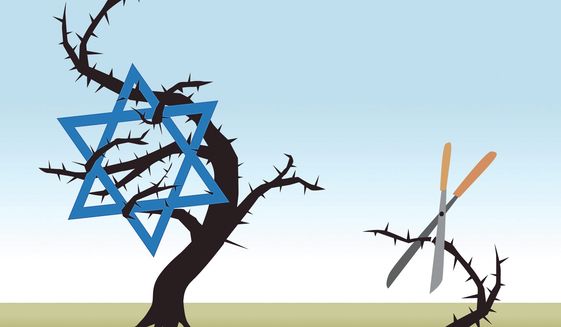
Hamas ISIllustration on Netanyahu’s comment that ISIS and Hamas “are branches on the same poisonous tree” by Linas Garsys/The Washington Times

Even while bombing ISIS, aka the Islamic State, Mr. Obama continues to endorse the creation of a Palestinian state, a plainly jihadist country that would inevitably be run by some adversarial combination of Hamas and the PA. . . . Why, it is time for . . . [Obama] to inquire, should we be fighting Islamist terrorists in one part of the Middle East, and simultaneously supporting distinctly similar others, just a short distance away?

**********************

Speaking to the United Nations General Assembly on Monday, Israeli Prime Minister Benjamin Netanyahu responded strongly to an earlier verbal attack launched by Palestinian Authority Chairman Mahmoud Abbas. To be sure, as Mr. Netanyahu pointed out, Palestinian allegations of an Israeli-inflicted genocide were not only preposterous but also deeply ironic. After all, both the PA and Hamas are unambiguously on record in favor of eradicating Israel altogether, an open expression of criminal intent.

Addressing another irony, Mr. Netanyahu pointed out that “ISIS and Hamas are branches of the same poisonous tree,” and that there can be absolutely no justification to fighting one while supporting the other. “Hamas is ISIS, and ISIS is Hamas,” the prime minister declared correctly. On all of these points, however, it is not entirely clear that President Obama is on the same page.

Even while bombing ISIS, aka the Islamic State, Mr. Obama continues to endorse the creation of a Palestinian state, a plainly jihadist country that would inevitably be run by some adversarial combination of Hamas and the PA. Somehow, Mr. Obama doesn’t want to acknowledge that any Palestinian Arab state would promptly exhibit the very same jihadist tendencies as our own current terrorist targets in Syria, Iraq and elsewhere. Why, it is time for him to inquire, should we be fighting Islamist terrorists in one part of the Middle East, and simultaneously supporting distinctly similar others, just a short distance away?

Where are we now heading? At some point, if they can finally reconcile, the PA and Hamas will declare the existence of a fully sovereign Palestinian state. Any such state, however, whatever its theoretical “self-determination” rationale, and whatever its finally agreed-upon administrative form, would enlarge the risks of terrorism and war.

Already, Palestinian orientations to aggression are very easy to decipher. Official PA maps identify Israel as merely a part of Palestine. In essence, both the PA and Hamas have agreed upon a cartographic destruction of Israel proper — not a “two-state solution,” but rather a conspicuously “final solution.”

Any Palestinian state could have a directly detrimental impact on American strategic interests and, of course, on Israel’s physical survival. After Palestine, Israel, facing an even more expressly formidable correlation of enemy forces, would require greater self-reliance. Any such enhanced self-reliance would then call for a more coherent and more openly disclosed nuclear strategy, one focusing comprehensively upon deterrence, pre-emption, and war-fighting capabilities; and a corollary and interpenetrating conventional war strategy.

By definition, a Palestinian state would make Israel’s conventional war capabilities increasingly problematic. In response, Israel’s national command authority would likely make the country’s still-implicit nuclear deterrent less ambiguous. Any such retreat from deliberate nuclear ambiguity, if incremental and limited, and if undertaken in coordinated conjunction with certain calibrated efforts to control escalation, could serve Israel as a potentially potent force multiplier.

Ending long-standing policy of keeping its “bomb in the basement” might enhance Israel’s security for a time, but could also heighten overall chances of hostile nuclear weapons use. If, for example, Iran were allowed to “go nuclear,” which now seems rather certain, belligerent nuclear violence would not necessarily be limited to Israel and Palestine. Ultimately, it could take the form of a genuinely unprecedented nuclear exchange.

Significantly, a nuclear war could arrive in Israel not only as a “bolt-from-the-blue” surprise missile attack, but also as a manifestly catastrophic outcome, intended or otherwise, of escalation. If, for example, an enemy state such as Iran were to initiate “only” conventional or biological attacks upon Israel, Jerusalem might still opt to respond with certain fully nuclear reprisals. Or, if this enemy state were to commence hostilities employing solely conventional attacks upon Israel, Jerusalem’s non-nuclear reprisals might then be met, in a still palpably uncertain strategic environment, with certain enemy nuclear counterstrikes.

In all such adversarial circumstances, Israel would be compelled to successfully demonstrate escalation dominance. The challenge to Jerusalem of any such complex demonstration could be significantly enlarged by the presence of a new and probably pernicious state ofPalestine.

The establishment of a Palestinian state could immediately undermine Israel’s necessary demonstration of escalation dominance. Jerusalem would then need to raise even further the capability threshold of its relevant conventional forces. A more persuasive Israeli conventional deterrent, to the extent that it could prevent enemy-state conventional or biological attacks in the first place, would then be required to reduce Israel’s now-expanded risk of exposure to an outright nuclear war.

After Palestine, and without any reasonable doubt, the area’s correlation of forces would become markedly less favorable to Israel. Now, the only credible way for Israel to consistently deter large-scale conventional attacks would be to maintain visible and large-scale conventional force capabilities. Of course, enemy states contemplating first-strike attacks upon Israel, using chemical or biological weapons, would be apt to take most seriously Israel’s nuclear deterrent. Whether or not this Israeli nuclear deterrent had remained entirely or partially undisclosed could also affect Jerusalem’s deterrent credibility.

In sum, Israel still needs a sufficiently strong conventional capability to deter or possibly to pre-empt conventional attacks, enemy aggressions that could lead, via escalation, to unconventional war. Doubtlessly, Mr. Obama’s road map would only further impair Israel’s already minimal strategic depth, and, if duly recognized by enemy states, Israel’s associated capacity to wage conventional war. These key calculations should finally be understood in Washington, as well as in Jerusalem, not only for Israel’s sake, but also because a Palestinian state would quickly become receptive to assorted jihadist preparations for expanding anti-American terrorism.


Reports: ISIS Within a Mile of Baghdad

October 1, 2014

Reports: ISIS Within a Mile of Baghdad

Tuesday, 30 Sep 2014 09:34 PM

By Todd Beamon

via Reports: ISIS Within a Mile of Baghdad.


(Getty Images)
 

Islamic State militants are reportedly within a mile of Baghdad despite battling Iraqi forces and U.S.-led airstrikes, and there is “immense fear among everybody,” the vicar of the only Anglican church in Iraq said Tuesday.

“We are at a crisis point,” Canon Andrew White, vicar of St George’s Church in Baghdad, told Sky News. “People know ISIS are coming nearer.”

The Islamic State is also known as ISIS.

White’s work is supported by the Foundation for Relief and Reconciliation in the Middle East, which said late Monday in a Facebook posting: “The Islamic State are now less than 2km away from entering Baghdad.”

“They said it could never happen, and now it almost has. Obama says he overestimated what the Iraqi army could do,” the posting said, referring to President Barack Obama.
“Well, you only need to be here a very short while to know they can do very very little,” the posting said.

He told Sky News that the U.S.-led airstrikes against ISIS are doing little more than killing civilians.

“People are being killed by the attacks of the coalition,” he said.

“This is horrendous,” he said about the Islamic State’s advance into Iraq’s capital city. “We have civilians being killed, yet [the Islamic State] are moving toward Baghdad.”

Renewed fighting has also occurred in such central Iraqi cities as Baquba and Ramadi, Sky News reports, as ISIS fighters appear to have advanced within 3 miles of Kobani, a critical border town in Syria, despite the airstrikes.

The reports come as the White House remains in damage-control mode after Obama told CBS’ “60 Minutes” on Sunday that U.S. intelligence officials had underestimated the ISIS threat.

The suggestion angered congressional Republicans, leading Mike Rogers, chairman of the House Intelligence Committee, to charge that “this was not an intelligence community failure, but a failure by policymakers to confront the threat.”

Obama had said:

“Our head of the intelligence community, Jim Clapper, has acknowledged that I think they underestimated what had been taking place in Syria.” He was referring to James Clapper, director of national intelligence.

White House spokesman Josh Earnest sought to clarify Obama’s remarks, noting that he was not blaming anyone as the U.S. sought global cooperation in the airstrikes that seek to weaken ISIS strongholds in Syria and Iraq.

“That is not what the president’s intent was,” Earnest said Tuesday. “What the president was trying to make clear” was “how difficult it is to predict the will of security forces that are based in another country to fight.”

In his Sky News interview, White said of Baghdad: “I’ve never known the city like it is at the moment.”

“Streets which are usually choc-a-bloc with traffic, cars and people are almost empty. People are too fearful to even leave their homes.”

He said that his church most likely would be “very high up” on the Islamic State’s target list and that “I must be at the top of the list.”

White told Sky News that one Iraqi soldier told him that if he was confronted by ISIS he would “take off his uniform and run,” and that he was in the army “because he needs the money.”

“This, sadly, is the kind of attitude of so many of these forces who should be coming to our aid and help,” he said.

According to The Daily Mail, airstrikes over the weekend appeared to have halted ISIS militants’ advance at Ameriyat al-Falluja, a small city about 18 miles south of Fallujah and 40 miles west of Baghdad.

But most of the fighters were undaunted — and many are making their way to the suburbs of Baghdad, the Daily Mail reports.

In a Facebook posting earlier Monday, White said: “Over 1,000 Iraqi troops were killed by ISIS yesterday, things are so bad.”

“All the military airstrikes are doing nothing,” he added. “If ever we needed your prayers, it is now.”

US condemns Abbas’s UN speech as ‘provocative’

September 27, 2014

US condemns Abbas’s UN speech as ‘provocative’

Netanyahu aides also denounce allegations by PA leader, term statements as ‘speech of incitement filled with lies’, after Abbas called recent bout of fighting in Gaza ‘a series of absolute war crimes’.

Ynetnews Published: 09.27.14, 12:14 / Israel News

via US condemns Abbas’s UN speech as ‘provocative’ – Israel News, Ynetnews.


The United States on Friday condemned Palestinian Authority President Mahmoud Abbas’s speech at the United Nations, in which he accused Israel of planning another “Nakba” and committing acts of genocide in Gaza during Israel’s Operation Protective Edge.

“President Abbas’ speech today included offensive characterizations that were deeply disappointing and which we reject,” State Department spokeswoman Jen Psaki said. “Such provocative statements are counterproductive and undermine efforts to create a positive atmosphere and restore trust between the parties.”

Senior officials in Prime Minister Benjamin Netanyahu’s office denounced the allegations as “a speech of incitement filled with lies.”

In the speech, Abbas called the previous round of fighting against Gaza “a series of absolute war crimes carried out before the eyes and ears of the entire world, moment by moment.” The devastation unleashed, he asserted, “is unmatched in modern times.”

He further stated that “the Israeli government undermined chances for peace throughout the months of negotiations,” referring to the failed 9-month-long peace process undertaken before the latest violence in Gaza. “Israel has consistently sought to fragment our land and our unity.”

Foreign Minister Avigdor Lieberman also commented on Abbas’ speech Friday saying that, “Abu Mazen’s (Abbas’) words at the UN General Assembly sharply clarify again that Abu Mazen doesn’t want and can’t be a logical partner for a political settlement. Abbas isn’t a member of joint government with Hamas for no reason.”

The Foreign Minister said that “Abbas complements Hamas in his political terrorism and storytelling against Israel. So long as he’s chairman of the Palestinian Authority, Abbas will lead to the continuation of the conflict. He has proved time and again that he is not a man of peace, but rather Arafat’s heir.”

In the same speech, Abbas did not offer his own deadline for an Israeli withdrawal, as some had predicted, nor did he say anything about joining the International Criminal Court as his aides have repeatedly said he is prepared to do.

And while he signaled he would seek accountability for alleged war crimes by Israel against Palestinians during this summer’s 50-day war in Gaza, he made no mention of taking the case to the International Criminal Court.

“We will not forget and we will not forgive, and we will not allow war criminals to escape punishment,” Abbas said in his 30-minute address.

The devastating war has weakened Abbas domestically, with his Hamas rivals enjoying a surge of popularity among Palestinians for fighting Israel.

He is under pressure at home to come up with a new political strategy after his repeated but failed attempts to establish a Palestinian state through US-mediated negotiations with Israel.

Before Friday’s speech, his aides had said he would launch a new bid for a UN Security Council resolution to set a three-year timetable for Israel to pull out of Palestinian lands captured in the 1967 war. They added that a UN rejection of the Palestinian request would prompt Abbas to seek membership in international agencies, including the International Criminal Court.

That would open the door to war crimes charges against Israel for its military actions in Gaza and Jewish settlement construction on West Bank land the Palestinians want for a future state.


UN Security Council unifies behind anti-IS measures

September 25, 2014

UN Security Council unifies behind anti-IS measures

Special UN Security Council meeting chaired by Obama sees international support rise for anti-Islamic State airstrikes in Syria;

EU warns against possible attacks by al-Qaeda in bid to regain spotlight

Yitzhak Benhorin

Published: 09.25.14, 09:12 / Israel News

via UN Security Council unifies behind anti-IS measures – Israel News, Ynetnews.


The UN Security Council unified behind the international attempt to fight the Islamic State group and demanded on Wednesday that all states make it a serious criminal offense for their citizens to travel abroad to fight with militant groups, or to recruit and fund others to do so.

UHHHHH, hamas , qatar and so on ??? who can believe this ? what about arming terrorist, sory freedom fighters, oposition forces so you want, by who ??


At a meeting chaired by US President Barack Obama, the 15-member council unanimously adopted a US-drafted resolution that compels countries to “prevent and suppress” the recruitment and travel of militant fighters to foreign conflicts.

The resolution will be penned by over 100 nations and de facto removed legal hurdles for US airstrikes in Syria, which unlike Iraq, did not invite the US’ intervention.

Not for Isareli aistrikes on the hamas terorist ??

“The United States of America will work with a broad coalition to dismantle this network of death,” Obama told the General Assembly of the United Nations. “Today I ask the world to join in this effort.”

So now can Israel dismantle hams ?

“We will use our military might in a campaign of airstrikes to roll back ISIL,” he declared, using an alternative acronym for the group.


UN Security Council (Photo: AFP)

After his address, Obama chaired a meeting of the UN Security Council which unanimously approved a binding resolution on stemming the flow of foreign jihadists to Iraq and Syria.

The resolution requires all countries to adopt laws that would make it a serious crime for their nationals to join jihadist groups such as ISIS and the Nusra Front, Al-Qaeda’s branch in Syria.

And what about hamas ?

Obama described the resolution as “historic” at the special session of the Council, only the sixth time in UN history that the council was convening at the level of heads of state.


US President Barack Obama (Photo: AFP)

The UN action reflects mounting international concern over rising numbers of foreign fighters joining the Islamic State militant group and the threat they pose when returning home. Some 12,000 fighters from more than 70 nations have joined extremist groups in Syria and Iraq, experts say.

British Prime Minister David Cameron told the Security Council that the beheadings of two American journalists and a British aid worker by a fighter with an apparent British accent “underlines the sinister, direct nature of this threat.”

The council resolution is under Chapter 7 of the UN Charter, which makes it legally binding for the 193 UN member states and gives the Security Council authority to enforce decisions with economic sanctions or force.

It targets fighters traveling to conflicts anywhere in the world, but does not mandate military force.

Obama is building a global coalition against Islamic State, which has captured swaths of Syria and Iraq and urged its followers to attack citizens of various countries. The United States has led air strikes against the group in Iraq and Syria.

“The words spoken here today must be matched and translated into action,” Obama told the Security Council after the adoption of the resolution. “For if there was ever a challenge in our interconnected world that cannot be met by one nation alone, it is this – terrorists crossing borders and threatening to unleash unspeakable violence.”

Obama chaired the Security Council because the United States is president of the body for September.

The UN resolution expresses concern that “foreign terrorist fighters increase the intensity, duration and intractability of conflicts, and also may pose a serious threat to their states of origin, the states they transit and the states to which they travel.”

Australian Prime Minister Tony Abbott told the council that the passports of more than 60 Australians had been suspended to stop them from joining extremist groups in the Middle East. Both Abbott and Cameron outlined their efforts to strengthen laws.

Terror target: Israel

The European Union’s counterterrorism coordinator, Gilles de Kerchove said al-Qaeda may try to show its relevance by carrying out attacks in Europe, the United States or Israel, the European Union’s counterterrorism coordinator said on Wednesday.

De Kerchove warned of the risk of competition between Islamic State and al-Qaeda, which has renounced its offshoot as too brutal.

“It is possible that Al-Qaida may want to mount attacks to show that the organization is still relevant, they are still in the game,” De Kerchove told a European Parliament committee.

He said some militants had moved from Afghanistan and Pakistan to Syria, where they formed part of the al-Qaeda-linked Khorasan Group.

He added that it appeared they planned to recruit Europeans who had travelled to Syria to fight and persuade them to use their passports to return and mount attacks in Europe, Israel and the United States.

While Islamic State was the main target of a US-led air assault in Syria this week, American officials said they also targeted the Khorasan Group, with the aim of disrupting a plot against US or European targets that the Pentagon said was “nearing the execution phase.”

De Kerchove estimated that more than 3,000 Europeans were in Syria, had been there or planned to go there to fight, and that there was a real risk some of them could return and bring violence back to Europe.

“We have seen that in Brussels with the killing of four persons at the Jewish Museum. It raises their level of tolerance of violence to such a level that there is a risk when they come back that killing is something normal,” he said.

Nobel Peace Prize-winning president urges U.N. to destroy Islamic State

September 24, 2014

Nobel Peace Prize-winning president urges U.N. to destroy Islamic State, Washington Times

The One at the UNU.S. President Barack Obama addresses the 69th session of the United Nations General Assembly at the U.N. headquarters, Wednesday, Sept. 24, 2014.

[W]e have reaffirmed that the United States is not and never will be at war with Islam. Islam teaches peace.” He added, “The only language understood by killers like this is the language of force.”

In advance of next week’s meeting at the White House with Israeli Prime Minister Benjamin Netanyahu, Mr. Obama said the situation in the Middle East looks “bleak” and laid down a marker for negotiations between Israel and the Palestinians.

“Let’s be clear: the status quo in the West Bank and Gaza is not sustainable,” Mr. Obama said. “We cannot afford to turn away from this effort — not when rockets are fired at innocent Israelis, or the lives of so many Palestinian children are taken from us in Gaza. So long as I am president, we will stand up for the principle that Israelis, Palestinians, the region, and the world will be more just with two states living side by side, in peace and security.”

**********************

Exactly one year after proclaiming that the world was “more stable,” President Obama urged the United Nations Wednesday to confront rising emergencies around the globe, from terrorists rampaging in Syria and Iraq to Russia’s invasion of Ukraine to the deadly Ebola epidemic in West Africa.

“We come together at a crossroads between war and peace, between disorder and integration, between fear and hope,” Mr. Obama told the United Nations general assembly. “Each of these problems demands urgent attention.”

Mr. Obama said pledged the U.S. will spend more on the emergencies, and blamed the international community for allowing the problems to fester.

“We collectively have not invested adequately in the public health system of developing countries,” he said. “We have not confronted forcefully enough the intolerance, sectarianism and hopelessness that feeds violent extremism in too many parts of the globe.”

He again criticized Russia’s “aggression” in Ukraine and said the world would lift sanctions against Moscow if Russia de-escalates the war.

Despite renewing America’s war against terrorists in the Middle East, Mr. Obama said his administration is not engaged in a “class of cultures.”

“I have made it clear that America will not base our entire foreign policy on reacting to terrorism,” he said. “Rather, we have waged a focused campaign against al Qaeda and its associated forces — taking out their leaders, and denying them the safe-havens they rely upon.

“At the same time, we have reaffirmed that the United States is not and never will be at war with Islam. Islam teaches peace.”He added, “The only language understood by killers like this is the language of force.”

Later Wednesday, Mr. Obama is expected to urge the U.N. Security Council to pass a broad new resolution that would impose global travel bans on fighters intent on enlisting in overseas wars, a measure aimed at the Islamic State. Administration officials have said they believe the resolution has enough support to be approved.

In his speech to the U.N. last year, Mr. Obama said “the world is more stable than it was five years ago.” He said “new circumstances” would allow the U.S. to shift away from a “perpetual war footing.”

Two days after expanding airstrikes into Syria against the militant group, Mr. Obama asked the world “to join in this effort.”

“Those who have joined [the Islamic State] should leave the battlefield while they can,” the president said. “Those who continue to fight for a hateful cause will find they are increasingly alone.”

He also urged nations and Muslim communities to reject sectarian strife, calling for “a new compact among the civilized peoples of this world to eradicate war at its most fundamental source: the corruption of young minds by violent ideology.”

“That means cutting off the funding that fuels this hate,” he said. “It’s time to end the hypocrisy of those who accumulate wealth through the global economy, and then siphon funds to those who teach children to tear it down.”

Mr. Obama said it’s “true” that the U.S. “has plenty of problems within our own borders,” and pointed as an example to the civil unrest spawned by a white police officer shooting black teenager Michael Brown in Ferguson, Mo., in August.

“In a summer marked by instability in the Middle East and Eastern Europe, I know the world also took notice of the small American city of Ferguson, Missouri — where a young man was killed, and a community was divided,” Mr. Obama said. “So yes, we have our own racial and ethnic tensions. And like every country, we continually wrestle with how to reconcile the vast changes wrought by globalization and greater diversity with the traditions that we hold dear.”

But Mr. Obama said Americans “welcome the scrutiny of the world, because what you see in America is a country that has steadily worked to address our problems and make our union more perfect.”

“America is not the same as it was 100 years ago, 50 years ago, or even a decade ago,” he said. “Because we fight for our ideals, and are willing to criticize ourselves when we fall short.”

In advance of next week’s meeting at the White House with Israeli Prime Minister Benjamin Netanyahu, Mr. Obama said the situation in the Middle East looks “bleak” and laid down a marker for negotiations between Israel and the Palestinians.

“Let’s be clear: the status quo in the West Bank and Gaza is not sustainable,” Mr. Obama said. “We cannot afford to turn away from this effort — not when rockets are fired at innocent Israelis, or the lives of so many Palestinian children are taken from us in Gaza. So long as I am president, we will stand up for the principle that Israelis, Palestinians, the region, and the world will be more just with two states living side by side, in peace and security.”