Manufacturing Excuses So Iran Can Get Nukes, Gatestone Institute, Peter Huessy, September 24, 2014
(Islam is the religion of peace death and a nuclear armed Iran will act accordingly. — DM)
We assume Iran’s leaders will abide by the very international rules they are dedicated to destroying.
When we refer to Iranian missiles as a legitimate form of “deterrence,” we just fool ourselves into imagining that Iranian missiles, which support aggression, are no different from American and allied missiles, which prevent and deter aggression.
The U.S. has said it would not address Iran’s 30-plus years of sponsorship of terror nor is extensive ballistic missile program, even though the U.S. officially designates Iran as the leading state-sponsor of terror in the world.
While security threats have been increasingly serious, the United States and its allies have not been willing honestly to face the challenges of our time — especially from the coalition of oil-rich, rogue state sponsors of terror and their jihadist affiliates.
Instead they have been content to push for declining defense budgets and jettisoning their security obligations. This has — and is — making it increasingly difficult to find the leadership necessary to lead a coalition of nations to defeat the threats we face.
The United States is making three critical mistakes.
First, much of the deterrent effect of U.S. military power is being squandered. Not only have the U.S. and its NATO allies neglected their defense needs and cut defense budgets by a collective $2 trillion from the base budgets of 2009[1], but many leaders have adopted the view that military power is the problem, not part of the solution.
In the United States, critics of wars in both Afghanistan and Iraq have claimed that U.S. military power was the cause of much of the terrorism and aggression we see around the world. They see less military presence — even a complete withdrawal from parts of the world — as the key to a more peaceful world.[2]
This “blame America first” view was wrong in 1984 — as Ambassador Jeanne Kirkpatrick explained then — and it is wrong now. “They [San Francisco Democrats] said that saving Grenada from terror and totalitarianism was the wrong thing to do,” Kirkpatrick said then. “They didn’t blame Cuba or the communists for threatening American students and murdering Grenadians — they blamed the United States instead. But then, somehow, they always blame America first.”[3]
The second mistake the U.S. is making is not taking the threats we face seriously. Oddly, this seems true even when we admit that the threats are real and warrant action.
In June 2000, for instance, the top administration counter-terrorism expert, Richard Clarke, told a private Congressional briefing that, “we [the U.S.] could not prioritize the terrorist threats we faced because there were too many.” He concluded that therefore the administration could not “prioritize how to spend counter-terrorism funds.”[4]
The third mistake, also one of long standing, is that we have relied on false assumptions. One is that our adversaries adhere to international law, support “stability,” hold similar humanitarian concerns and are afraid of “being isolated.”
The other is we can persuade our adversaries to change by threatening them with paying an economic price for aggressive behavior. We hope that our adversaries will fear that “tough” economic sanctions levied on them will be painful enough to compel them to stop acting aggressively.
Then we hope that our adversaries will conclude that there is no long-term benefit even to starting aggression in the first place, and that therefore a series of peaceful deals are possible — theoretically as the only “reasonable alternative” our adversaries have.
From this rosy, wishful view we often see our adversaries’ intransigence only as a reaction to our “unfair” negotiating position, or to our supposedly threatening behavior — and not due to our determination to prevent them from carrying out their aggressive designs.
The late Senator Arlen Specter, for instance, traveled to Iraq in June 1990 and concluded that Saddam Hussein was “sincere” and had no territorial designs on his neighbors. On his return to Washington, he led a successful effort to block the imposition of sanctions against Iraq by the Bush Sr. administration, arguing Saddam Hussein had no territorial ambitions against Kuwait. Two months later Saddam invaded Kuwait.[5]
Taken together, dismantling a credible military capability, minimizing dangers to our security and failing to understand the intentions of our enemies markedly increases the danger to our Republic and our allies especially at a time when strong U.S. leadership is increasingly uncertain.
Probably the most serious of these mistakes is undermining the respect once given America’s combined military and diplomatic power. The United Arab Emirates and Egypt bombed Libya this past month without consulting the U.S. — this a time when Washington believes there is an effective central government in Tripoli, a conclusion clearly not shared by the UAE or Egypt.
Adam Garfinkle of the Foreign Policy Research Institute explains with understated disbelief: “According to [US] Administration fantasists, a competent and democratically elected Libyan central government exists and is in basic control of the country—excepting maybe a little militia kerfuffle, you know—so outsiders should not be dropping ordnance on warring groups so that the United Nations can work its diplomatic magic.”
In addition, Mahmoud Abbas of the Palestinian Authority is going to unveil a new initiative to resolve (he claims) the Palestinian-Israeli conflict but has announced the plan will not be shared beforehand with the United States.
When the red line on Syria’s use of chemical weapons disappeared during the first political sandstorm, it was clear the U.S. was contributing to this enfeebled state of affairs.
Meanwhile, even as U.S. intelligence sources for the past year have warned both Congress and administration officials of the expansion and growing danger to both Syria and Iraq from the armed Islamic State of Iraq and Syria ISIS], it was dismissed by the administration as a “JV” [junior varsity] affiliate of the more “serious” threat of Al Qaeda.
A Congressional Reference Service had reported to Congress in June 2014: “Senior U.S. officials have [over the past year] stated that ISIL poses a serious threat to the United States and maintains training camps in Iraq and Syria”.
After three videotaped beheadings of American journalists and British aid worker, even the American people, who have no stomach for more war, are said by at least one recent poll — by an overwhelming margin approaching 90% — to want a strong U.S. response to the threat from ISIS.[6]
Withdrawing precipitously from the international arena — avoiding “war” — does not buy peace. Avoiding war buys only more bad actors who march in wherever a vacuum has been created — creating, ironically, even greater threats.
American leaders have failed to lead the country toward what needs to be done simply because what needs to be done looked unpopular.
As former Secretary of State Henry Kissinger warned: “A free standing diplomacy is an ancient American illusion. History offers few examples of it. The attempt to separate diplomacy and power results in power lacking direction and diplomacy being deprived of incentives.”
When confronted with similar isolationist public perceptions, Prime Minister Margaret Thatcher and President Ronald Reagan, because of their extraordinary “complete cultural self-belief” succeeded. “[T]he world shifted toward them” as they led the U.S. and Great Britain with a policy of “peace through strength,” not “peace through retreat.”
The lawyer and constitutional scholar, John W. Howard, summed matters up:
“America has squandered 60 years of assiduous diplomacy and expanding American influence in the Middle East… Successive presidents, Republican and Democrat alike, carefully navigated the esoteric alleyways of shifting Middle Eastern politics to American advantage. American primacy was solidified by the decline and collapse of the Soviet Union, leaving a uni-polar sphere of influence. If there is one principle underlying Middle Eastern political culture, it is an acute sense of the importance and consequences of power and alliances.”
In confronting even those threats we admit must be faced, consider the deployment of missile defenses in Europe. They are a good thing, especially if you happen to be a state near Russia.
Many in the media, Hollywood, politics and academia, however, have charged that U.S. missile defense deployments in Europe “might upset the Russians” or “fuel an arms race.”
Their criticism started with the first proposed defense deployments early in the George W. Bush administration and continued long after the Polish and Czech governments had agreed to install the missiles and their associated radars.
The Bush-era pledge of a missile defense shield was scrapped, however, in 2009 by the current U.S. administration. Today, as Russia violates the Budapest memorandum of 1994 by invading Ukraine, we are still — again! — told that the new deployments of missile defense elements will “inflame tensions.”[7]
The missile defense components in Europe, specifically those now in Spain and England, but also those planned for Poland and Romania, were initiated primarily in response to missiles deployed by Iran, not the other way around.
Today, it is both Russian and Iranian missiles that are creating tensions. Both countries are carrying out terrorist acts or acts of aggression, safe in the belief that they are secure from being challenged because there is no threat from the West or its missiles.
This lack of seriousness extends to our allies as well. We are about to deploy a limited number of new THAAD [Terminal High Altitude Air Defenses] batteries in South Korea. These missile defenses are also a good thing, especially if you happen to be a state near North Korea, Russia or China.
But a spokesman for the South Korean government felt compelled to reassure Russia and China that the missile defenses are “only to protect American troops” and not part of any emerging South Korean “missile defense cooperative effort” with the United States.[8]
Conversely, Russia threatens to deploy Iskander nuclear-tipped missiles in the Crimea along with other nuclear-armed cruise missiles with the range to threaten all of Western Europe. Missiles of between 500-5500 kilometers are currently forbidden by the 1987 U.S.-Russia INF treaty — an agreement the US has formerly charged Russia with violating. If such missiles were deployed in the Crimea, their range could cover all of Europe.
Opponents of U.S. and NATO missile defense deployments admit Russia has already deployed such threatening missiles even absent any US missile defense. However, they are already charging that should the U.S. accelerate its plans for missile defenses in Europe to defend against these Russian missiles, “it would do nothing to reduce the Russian threat and would likely give Moscow reason to move Iskander short-range missiles closer to NATO.”[9]
In the face of recent Russian aggression against Ukraine, the U.S. initially put into place only relatively weak and limited sanctions against certain Moscow entities.
One part of those sanctions would prohibit prominent Russians from banking in New York City, but Russians have long since moved their money out of Russia, and would certainly not give up their pretensions to reconstituting their empire; they will continue to try to “shoot” Ukraine back into being the subsidiary of a new Russian state.
Since then, U.S. sanctions have been measurably strengthened, but the first action was what was noticed, and it was lacking in seriousness. Even today, as it is still not clear what further sanctions the U.S. is prepared to put into place, the sheer lack of resolve is associated with a lack of seriousness.
Another example of the U.S. lack of seriousness regarding national security threats is what former Army War College Russian expert Steve Blank calls the “cottage industry” of manufacturing excuses for Russian aggression.
One essay published by The Nation proclaimed that Putin’s invasion of Ukraine was really not an invasion because, after all, Ukraine was not a real country. The essay went on to excuse Russian aggression even further with the explanation that the “non-invasion” had simply taken place out of concern for “corruption” in the Kiev government — corruption being long known as a key concern of the Russian government![10]
Then, in addition to making excuses for our enemies, we go out of our way to announce to our adversaries that the U.S. military power will be used only in a very limited way. Airstrikes are to be only “pin pricks.” Military campaigns are advertised as “unbelievably small.” There will be “no boots on the ground,” or only “for limited objectives” or “only to protect American personnel.”
Years ago, President Eisenhower is reported to have warned his successor: “Never tell your enemies what you willnot do.”[11] Minimalist tactics, while perhaps popular, denote a lack of seriousness, which our adversaries see as incentives for continuing their aggression, while our friends further doubt our resolve and strength.
We appear to pick only those tools of war designed not to upset our political supporters rather than the tools needed to get the job done.
Then we assume that our enemies actually share some of our common objectives — such as “stability”, not being “isolated” and wanting “approval” from the “international community.”
The U.S. also deliberately handicaps itself by apparently believing that some kind of UN-sponsored “deal” — which no one will implement, that is if they even try — purporting to uphold international law, is the only workable solution to the threats we face.
After 9/11, Admiral James Loy, the Commander of the Coast Guard, explained to the author how helpful the United Nations International Maritime Organization [IMO] was in working to guard against attacks on our ports. The IMO effort was successful, he explained, because members of most host countries, and associated private commercial interests, all had an extremely strong economic interest in maintaining free trade and international commerce.[12]
Other U.N. institutions, however, are far less serious in the extreme. Not only has the UN’s Human Rights Council, for example, been chaired by Iran, but its current members include such “champions” of human rights such as Venezuela, Cuba, China, Pakistan, Russia, and Saudi Arabia. Further, over 70% of all the council’s past decade of inquiries have been about the supposed crimes or human rights violations of the only open, transparent, democratic human-rights adherent in the region: Israel.
The newest U.N.-approved inquiry about Gaza is being directed by London professor William Schabas, a Canadian citizen who reportedly refuses to describe Hamas as a terrorist outfit. That the U.S. continues to fund nearly a quarter of the budget of such a fraud once again shows the degree of contempt in which the U.S. holds its taxpayers.
Nowhere is this disingenuousness more evident than in the more than three decades of U.S. relations with the Islamic Republic of Iran. During this period, the U.S. has engaged in a variety of charades with Tehran, always with the Americans assuming that they would end with a deal in which the U.S. would no longer be the “Great Satan” and the mullahs would no longer seek nuclear weapons.[13]
In the current discussions with Iran over its nuclear program, however, the U.S. has said it would not address Iran’s 30-plus years of sponsorship of terror nor its major ballistic missile production programs — even though the U.S. officially designates Tehran as the leading state-sponsor of terror in the world and has repeatedly assessed its missile programs as dangerous.
The U.S. also seems not to understand that Iran calls America the “great arrogance” for a reason — because America was the major country putting together the “rules of the road” internationally after World War II.
Naturally, it is precisely these rules or “norms” — such as those governing international trade, the right to have nuclear weapons, which currencies are convertible, and, most critically, the rules against the use of force, assassinations and terrorism in conducting international relations — that Tehran seems to want to drop into the next ash-heap of what it considers historically bad ideas.
There is a message there, but we are not listening. We assume Iran’s leaders will abide by the very international rules they are dedicated to destroying.[14]
The U.S. administration also seems to be trying to downplay the extent to which Tehran’s extraordinarily robust missile production program, costing tens of billions of dollars, is now a threat now to the U.S., or will be into the future.
When asked whether a third East Coast missile-defense site would be beneficial to protect America from Iranian missiles, the administration reassures the American people that the mullah’s missiles cannot reach New York. (Yet.)
Spencer Ackerman of the Washington Post, in a February 24, 2012 essay, quotes intelligence officials: “Calm down, Iran’s missiles can’t (and won’t) hit the East Coast.” Former CIA Mideast analyst Paul Pillar assures us that, “the intelligence community does not believe the Iranians are anywhere close to having an ICBM”.
Even when the U.S. acknowledges that Iranian missiles can hit targets throughout the Middle East and much of Europe, especially U.S. allies and key security facilities, some intelligence analysts find a way to make such missiles seem less threatening.
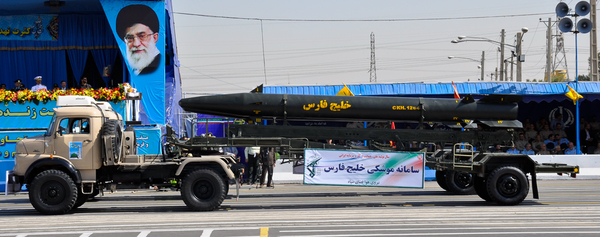
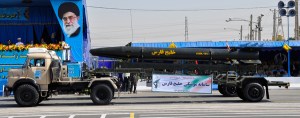 An Iranian “Khalij Fars” mobile ballistic missile on parade in Iran. (Image source: Wikimedia Commons)
U.S. intelligence reports to Congress, for example, proclaim in all seriousness that Iran’s missiles, and even its nuclear programs, exist merely to ensure regime survival.
The Arms Control Association, for instance, approvingly quotes an administration report that, “Since the revolution, Iran’s first priority has consistently remained the survival of the regime” and that is why they are building and deploying ballistic missiles.
Iran’s missiles, we are told, are a “deterrent.” The deterrent, it is implied — is to protect Iran from the US and its allies.
Well, who can argue with that? Without their missiles and their nuclear weapons program (which, we are repeatedly assured they do not have — yet), they would be wide open to a U.S. invasion, don’t you see? And if the United States or Israel has nuclear weapons, why cannot Iran? So, the thinking seems to go, if we just leave Iran alone, then Iran’s missiles and bombs might very well go away.
This viewpoint is more widespread than many might believe. The former Director General of the United Nations International Atomic Energy Administration [IAEA], Mohamed Mustafa ElBaradei, admonished the United States and the Bush administration: “You can’t bomb your way through countries” to stop nuclear proliferation. He was implying that the U.S wanted to end nuclear proliferation in Iran, Iraq and Libya to give the U.S. a free hand to commit serial aggression against them.
During his entire time as head of the IAEA, ElBaradei also repeatedly downplayed or ignored the nuclear weapons threats from North Korea, Iran and Iraq. He said it was unfair for some countries such as the U.S. to have nuclear weapons while denying them to others, such as Iran.
He was also opposed to the liberation of Iraq, and claimed that the use of military force made terrorist problems worse. He ridiculed the U.S. and British elimination of the Libyan nuclear program largely because his agency, the IAEA, had “mysteriously” missed its very existence although it was their responsibility to monitor exactly such activities.[15]
One Times of India story put it this way: “Disarmament is for wimps. Go get your nukes if you can”.
The Washington Post ran an essay on December 2, 2013, in which nuclear-abolitionist Joe Cirincione of the Ploughshares Fund was quoted complaining, “Why is the U.S. okay with Israel having nuclear weapons but not Iran?” — again implying that U.S. concern over Iran’s potential nuclear proliferation was “unfair.”
A Christian Science Monitor essay concluded about the troubling lesson of Libya’s President Muammar Qaddafi giving up his nuclear weapons: that if he hadn’t, the U.S. and NATO would not have bombed him out of power.[16]
This sounds logical, but it is wrong. The U.S. government worked with the Libyan government to get rid of its nuclear program — which had not produced nuclear weapons fuel, let alone nuclear warheads. The two governments discussed normalizing relations after the elimination of Qaddafi’s nuclear program.
The bombing of Libya in 2011-12 took place in reaction to the terrorist threat emerging in Benghazi and the potential for mass killings in Libya. The bombing may have been misguided, but it was not triggered by Libya giving up its nuclear program in 2007.
Thus, by alleging that the US concern with Iranian or Libyan nuclear weapons programs is less than genuine, arms controllers and others in the U.S. then claim that Iran’s reluctance to abide by the rules of the Nuclear Non-Proliferation Treaty — which prohibits all but the permanent five members of the UN Security Council from having nuclear weapons — is understandable.
This view then leads to calls for even greater U.S. concessions to Iran — in order to “get a deal.” After all, it is claimed, Iran obviously has a legitimate reluctance to give ups its nuclear program with the knowledge that once Libya gave up its nuclear centrifuges in 2007, the U.S. then bombed Libya and helped overthrow the Qaddafi government four years later in 2011.
That supposed lesson is also being applied to Ukraine. In the 1994 Budapest Memorandum, Ukraine transferred its nuclear arsenal back to Russia with the assurance that Russia would guarantee Ukraine’s borders.
Today, some lawmakers in Kiev and critics of the 1994 deal have concluded that if Ukraine still possessed nuclear weapons, Russia would not have invaded either Crimea or Donetsk.
Yet at the time, Ukraine’s new leaders had no desire to become a new nuclear power and so they happily worked with the U.S. government to remove the Soviet-era nuclear weapons from their soil.
Glenn Greenwald, writing in the Guardian, echoes the idea that U.S. adversaries such as Iran have to keep whatever nuclear program they have because such weapons — once acquired — would allow Iran to “deter U.S. attacks.”[17]
The implication is that, as the U.S is such an out-of-control threat, Iran has every good reason to seek and build nuclear weapons.
The entire premise, however, that rogue states should resist having their nuclear programs dismantled because they are then more likely “to be invaded,” is wrong.
There are roughly 190 countries in the world with no nuclear weapons. Although they all lack nuclear weapons, the U.S., and its NATO and East Asian allies, have not invaded any of them and have no intention of invading them.
Afghanistan and the Taliban were removed from power because, with Osama bin Laden, they were partners in the 9-11 attacks.
Iraq was liberated from the murderous regime of Saddam Hussein because, since 1991, the Baghdad government had done everything not to comply with 17 UN resolutions; it had undermined and violated sanctions; it had armed and gave sanctuary to terrorists, and it remained committed to securing WMDs.[18]
When we refer to Iranian missiles as a legitimate form of “deterrence,” we just fool ourselves into imaging that Iranian missiles, which support aggression, are no different from American and allied missile defenses, whichprevent and deter aggression.
We have come to see Iran as a mirror image of ourselves. We assume Iran’s nuclear weapons and ballistic missiles are solely for deterrence and regime survival because, after all, that is why we in the US have both nuclear weapons and ballistic missiles — to protect our security.
But Iran’s ballistic missiles and potential nuclear weapons are to protect Tehran’s projection of power and terrorist activities, which are critical to its goals of dominating the Middle East, uniting all Muslims under its version of Islamic Shariah law, and gain the prize of having control over nearly 70% of the world’s conventional oil and gas resources — a hardly benign objective.
Judging from recent failures to counter Syria, Libya, Russia and ISIS, the U.S.’s squandering of its military might, taking a casual view of threats, and misunderstanding its enemies has led it to becoming an object of ridicule, instead of an object of fear, trust or respect.
Those can only be gained through the serious waging of war — economic, political, diplomatic and militarily — until our adversaries and enemies are defeated. Only then will they cease to fight.
[1] America in Retreat: The New Isolationism and the Coming Global Disorder by Bret Stephens (forthcoming Nov 18, 2014)
[2] See Sandy Davis, Progressive Democrats of America, “We Need To End the Disastrous Failure Of The War On Terror by Sandy Davis, February 4, 2014; or ABC News Blog: “Ron Paul Recruits Anonymous to Attack Rudy’s Foreign Policy,” May 22, 2007; and Jack A. Smith, “Terrorism–Cause and Effect”, May 29, 2010, anti-War.com; and Glen Greenwald on Salon: “A Rumsfeld-era reminder about what causes Terrorism”, October 20, 2009.
[3] Jeanne Kirkpatrick “They Always Blame America” from Jim Geraghty, The Campaign Spot, National Review, April 24th, 2013.
[4] This was explained in a detailed June 2000 letter from Congressman Chris Shays to Richard Clarke following the latter’s appearance before Shays Subcommittee on National Security, Emerging Threats and International Relations of the Committee on Government Reform.
[5] This is but one example of many cited by Michael Rubin of the American Enterprise Institute in his new book “Dancing with the Devil: The Perils of Engaging Rogue Regimes“, 2014, p. 209. Rubin notes that Senator Specter later acknowledged he had been “played by Saddam”.
[6] CNN poll as reported in FDD, 8 Sept 2014, “Majority of Americans Alarmed by ISIS”
[7] MDA Digest, September 4, 2014
[8] MDA Digest, September 4, 2014
[9] MDA Digest, August 29, 2014; and Tom Collina, “Nukes are Not the Answer to Containing Russia,” in Breaking Defense, April 11, 2014
[10] Stephen Cohen cited in the Daily Kos, February 20, 2014, “Stephen Cohen accuses Obama Administration of Coup Attempt in Ukraine” by Mark Lippman
[11] This quote was referenced by General Jack Keane, (US Army-Ret) on Fox News, Monday September 8, 2014.
[12] Admiral John Loy told me this about the IMU in a 2006 conversation we had at one of my NDUF Congressional breakfast seminars where he was the featured speaker. For an excellent review of the distortions of the UN see “UN Perversion of Human Rights“, J. Puder, Frontpage, September 8, 2014.
[13] Michael Ledeen in his “Accomplice to Evil: Iran and the War Against the West”, 2009; and Michael Ledeen, “How to Protect Against a Bad Deal With Iran“, The Hill, July 9, 2014.
[14] In a January 2014 Carnegie Europe report titled “Tehran Calling: Understanding a New Iranian Leadership”, Cornelius Adebahr says the norms Iran has had difficulty adhering to are “prohibitions against using assassinations and terrorism as legitimate tools of diplomacy” although he says the use of such tools by Iran is only “alleged” although he does admit “Iran does not accept all norms governing today’s international system”.
[15] Match Blog, October 26, 2004 and Ben Smith in Politico, January 31, 2011, quoting Malcolm Hoenlein, of the Conference of Presidents of Major American Jewish Organizations.
[16] See Reza Sanati, in the Christian Science Monitor, August 30, 2011, “A troubling lesson from Libya: Don’t give up nukes”. And NewsMax, “Ukraine Pays Price for US Advice to Give Up Nuclear Weapons” March 20, 2014; Ukrainian legislator Pavlo Rizanenko sums up the Crimea crisis: “If you have nuclear weapons, people don’t invade you.” See also “Ukraine’s Broken Nuclear Promises”, by Owen Matthews, March 19, 2014, Newsweek.
[17] Critics of US policy toward North Korea and Iran often assert both rogue states have or seek nuclear weapons to deter the United States from attacking — a variation on the “Always Blame America First Theme”. Here are two such essays: “DPRK Briefing Book: Confronting Ambiguity: How to Handle North Korea’s Nuclear Program”, by Phillip Saunders, Arms Control Association, March 3, 2003; and Glenn Greenwald, “The true reason US fears Iranian nukes: they can deter US attacks” in theguardian.com, Tuesday 2 October 2012. Greenwald also asserts “GOP Senator Lindsey Graham echoes a long line of US policymakers: Iran must not be allowed to deter US aggression”.
[18] On March 17, 2014, former Congressman Ron Paul wrote an essay in USA Today in which he said we have no interest in a fight “many thousands of miles from the US” about a country and people of “which we know almost nothing.” In the 2008 book “Munich: The 1938 Appeasement Crisis” by David Faber, British Prime Minister Neville Chamberlain is quoted saying this on September 27, 1938, just before traveling to Munich to sign a peace agreement with Chancellor Adolph Hitler:
“How horrible, fantastic, incredible it is that we should be digging trenches and trying on gas-masks here because of a quarrel in a far-away country between people of whom we know nothing. It seems still more impossible that a quarrel that has already been settled in principle should be the subject of war.“
In light of the lack of seriousness with which we are treating the threats we face, it is instructive to refer to an exchange that reportedly took place between then Prime Minister Chamberlain and Winston Churchill. In this story Churchill told Prime Minister Chamberlain when the latter complained that preparing to defend England against Nazi aggression “might upset trade with Germany”: “Well, yes, Mr. Prime Minister”, said the representative from Epping/Woodford, “That would be the idea.”
 US Vice President Joe Biden (L) meets with Turkey’s President Recep Tayyip Erdogan at Beylerbeyi Palace in Istanbul, Nov. 22, 2014. (photo by REUTERS/Murad Sezer)





 WarSclerotic
Recent Comments