Posted tagged ‘U.S. military’

Manhunt in Jordan for killers of 3 US servicemen

November 5, 2016

Manhunt in Jordan for killers of 3 US servicemen, DEBKAfile, November 5, 2016

al-jafr_4-11-16

Jordanian forces, along with US special forces and helicopters, are engaged in a massive manhunt for the Islamist gunmen who murdered three US military trainers and seriously injured others Friday, Nov. 4 at the Prince Faisal Air Base near the southern Jordanian town of Al-Jafr.

Although Jordanian officials first reported the American servicemen were shot in their car while trying to enter the air base, the attack is being treated as a well-planned ISIS or Al Qaeda terrorist ambush that is thought to have been perpetrated by three to five gunmen.

Both the US and Jordanian authorities prefer to keep the identity of the perpetrators dark, DEBKAfile’s counterterrorism sources report. It is therefore hard to determine whether the killers were Jordanian servicemen on the base or outsiders.

The presentation of the shootout as caused by a misunderstanding that arose when the American trainers failed to halt at the gate of the base is certainly far from the truth. The gunfire on the US vehicle came from directions – one from inside the gate and two from the outside.

This was the most serious Islamist terrorist attack on the 2,000 US soldiers serving in Jordan, largely on training missions and in support of operations in neighboring Iraq and Syria. The base lies 288km south of Amman in a remote desert location near the Saudi border.

The precise timing of the attack indicated that the terrorists had precise intelligence about the movements of the US servicemen. A joint Jordanian-US inquiry is taking place to find how this sensitive information reached the gunmen.

DEBKAfile’s military sources add that Israel’s army and police also reinforced patrols on the Jordanian border Saturday in case the gunmen on the run from Jordanian and US search parties tried to slip across into the Israeli Negev and cut through to Egyptian Sinai. They could call on local Bedouin smugglers to help them reach the northern regions of the peninsula which are swarming with ISIS networks.

The attack on the US trainers in Jordan occurred just 24 hours after ISIS leader Abu Bakr al-Baghdadi made a rare audio tape appearance to urge suicide bombers” all over the world to destroy the cities of the unbelievers.”

Our Islamist terror experts interpreted this as a coded message to ISIS sleeper cells in Western cities and the Middle East to go into action.

It also coincided with the anniversary of the Nov. 9, 2015 terrorist attack at the Jordanian Police Academy outside Amman. Then, a Jordanian officer opened fire on a group of Western military trainers killing two Americans and a South African.

ISIS hits Kirkuk, opens a 2nd front behind Mosul

October 21, 2016

ISIS hits Kirkuk, opens a 2nd front behind Mosul, DEBKAfile, October 21, 2016

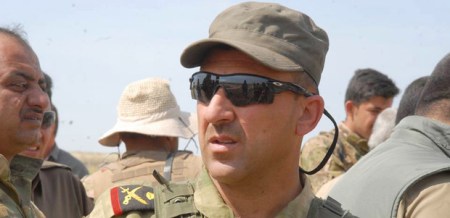
kurdgenKurdish General. Mariwan Mohammed

No one doubted that the US-Iraqi-Kurdish offensive to liberate Mosul would be drawn out and fraught with unforeseen setbacks before the Islamic State was finally thrown out of its Iraqi capital. But on Oct. 21, five days into the Mosul operation, the ISIS terrorists landed their most severe blow, when Islamist fighters and suicide bombers suddenly hurled themselves on the Iraqi oil city of Kirkuk in a coordinated attack.

DEBKAfile’s military sources report that taking advantage of a chance to catch the US, Iraqi and Kurdish generals leading the attack on Mosul unawares, the Islamist fighters were able to open a second front to the rear of the main battle arena against ISIS.

Kirkuk is some 175km southeast of Mosul and 230km from Baghdad. By hitting this important oil city, the terrorists came close to enough to menace the autonomous Kurdish Regional Government region and its capital, Irbil, and expose the Kurdish Peshmerga troops fighting for Mosul.

Our military sources note that a large Peshmerga force of some 11,000 troops had been posted to secure the town and its oil fields, under the command of Gen. Mariwan Mohammed.

But then, on Wednesday, Oct. 19, the US-Iraqi-Kurdish joint command of the Mosul offensive decided that Kurdish reinforcements were necessary to provide the operation with greater impetus. The extra Peshmerga troops were accordingly ordered to set out from Khazar, 40 km east of Mosul, and join the coalition offensive.

However, what they missed, despite the mainly American spy satellites, drones and reconnaissance planes collecting intelligence, was an ISIS concentration clandestinely building up at Hawja, 57km east of Kirkuk. According to our military sources, some of the jihadists reported by the Western media to have turned tail on the run from Mosul had been gathering to the southeast, some 57km from Kirkuk. They stood ready to attack that town.

Their opportunity came when the large Kurdish group exited Kirkuk and headed out to Mosul. Kirkuk was left exposed without defenders.

Friday morning, the Islamic State launched its surprise attack on the defenseless oil city. Its fighters and suicide bombers slammed into four police stations, Kurdish security offices, residential neighborhoods and a power station to the north. Clashes continued during the day with unknown casualty figures on both sides.

At some point, the governor claimed control of the city was regained but residents reported the clashes continued.

ISIS said in a statement it had seized “half the city” and had also attacked the Dubiz power plant, killing all the security forces inside, but the claims were not possible to verify.

The big Mosul offensive is stuck, halted by ISIS

October 19, 2016

The big Mosul offensive is stuck, halted by ISIS, DebkaFile, October 19, 2016

mosul_offensive_declaration_16-10-16-1

Less than a day after its launch, the big Mosul offensive prepared for more than a year by the US, the Iraqi army, Kurdish forces and others, ground to a halt Tuesday Oct. 17, DEBKAfile’s military sources report – although none of the parties admitted as much.  Iraqi Prime Minister Haidar Al-Abadi said his troops were busy opening up corridors for some million civilians to escape, while US sources suggested that the Islamic State would use primitive chemical weapons against the advancing Iraqi and Kurdish forces.

Both had the ring of cover stories to account for the spearhead forces, the Iraq army’s 9th Armored Division and the Federal Police special anti-terror units, being thrown back Tuesday on their way to Mosul from the east and the south, while still 10-15km short of the city. They sustained heavy losses in lives and hardware.

The 9th Division and its newly-supplied heavy US Abrahams tanks were stopped at al-Hamdaniyah outside Mosul and retreated, recalling a previous defeat at ISIS hands in June 2014, when troops of the same division fled under Islamist attack, leaving their tanks behind.

The Iraqi anti-terror force withdrew from the village of al-Houd outside Mosul, a move which left the Kurdish Peshmerga no option but to stop its sweep of the villages around the city or expose their flanks to ISIS suicide and car bomb assaults.

Tuesday night, both Iraqi and Kurdish commanders announced a pause in their advance and said they would meet Wednesday to decide how to proceed.

The Kurdish Peshmerga’s role in the battle of Mosul has run into a further major impediment, which likewise has not been publicly aired. It turned out Tuesday that at least 3,000 of the 12,000 Kurdish fighters taking part in the offensive came from the banned Turkish underground PKK (Kurdish Workers Party) which is fighting the Turkish government. They came down from their northern Iraqi strongholds in the Sinjar and Qandil mountains. Ankara thereupon warned Washington and Baghdad in a strong ultimatum that unless those fighters were pulled off the field, Turkish troops would step in to attack them.

A second front within a front would effectively torpedo the entire Mosul liberation campaign against ISIS before it gets underway.

The first bricks of the military Tower of Babel predicted by DEBKAfile in the background report below were set in place sooner than expected.

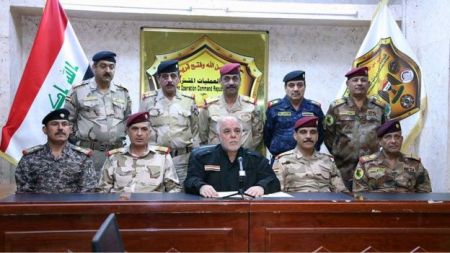
Sunday night, Oct. 16, Iraqi Prime Minister Haidar al-Abadi, supported by a bevy of generals, announced that the military operation to recapture Mosul from its two-year occupation by the Islamic State had begun.

Three formally approved participants are taking part in the operation, DEBKAfile’s military sources report:

1. American special operations, artillery and engineering units – equipped with floating bridges for crossing the Tigris River – plus the US air force for massive bombardment to crush enemy resistance.

2. Iraqi army armored divisions, special ops forces, regular troops and anti-terror police units.

3. The Iraqi Kurds’ Peshmerga.

The Iraqi prime minister pledged formally that only Iraqi fighters would enter Mosul, i.e. no Americans, Kurds or other non-Iraqi forces.

It was a pledge that neither the Iraqi Sunni and Shiite combatants nor the Kurdish and Turkmen fighters trusted him to uphold, after similar promises went by the wayside in the US-led coalition battles fought in the past two years to retake the Iraqi towns of Ramadi, Tikirit, Baiji and Fallujah from ISIS.

The first forces to enter those cities were by and large pro-Iranian Iraqi Shiite militias, especially the Bader Brigades and the Popular Mobilization Units, under Iran’s supreme Middle East commander Gen. Qassem Soleimani. Nonetheless, despite the ravages they wrought in those Sunni cities, US air support was forthcoming for their advance, while in Washington US officials pretended they were helping Iraqi government army units.

With regard to the Mosul campaign, Obama administration officials and military officers, like the Iraqi prime minister, insist there will be no repetition of the Iranian-backed Shiite invasion and conquest of yet another Sunni city, where a million inhabitants still remain.

mosul_offensive_17-10-16-1

They don’t explain how this will be prevented when those same pro-Iranian Iraqi Shiite forces are already massing northeast of Mosul, near the Iraqi-Syria border, and standing by for the order to advance into the city.

Tehran quite obviously has no intention of being left out of the epic capture of Mosul.

Neither is another uninvited party, Turkish President Tayyip Erdogan. He too has positioned a Turkish military concentration in Iraq, in defiance of strong objections from Washington and Baghdad. Turkish troops stand ready to move forward to do Erdogan’s will and achieve three strategic goals:

a) To actively frustrate Kurdish Peshmerga entry to Mosul, although its 15,000 fighters out of the 25,000 invasion force are a vital element of the spearhead thrust into the city. Ankara has warned that if Kurds set foot in Mosul, Turkish troops will follow.

b)  To block the path of Syrian Kurdish YPG militiamen from entering Iraq and linking up with their Iraqi brothers-in-arms.

c) To provide backing, including Turkish air support, for the Iraqi Turkmen militias still present in the Turkmen quarter of Mosul.

DEBKAfile’s military sources count six assorted military groupings taking part in the liberation of Mosul. They have nothing in common aside from their determination to drive the Islamic State out.

They are utterly divided on the two main aspects of the offensive: How to achieve their common goal and what happens to Mosul after the Islamist invaders are gone.

The underlying US rationale for embarking on this high-wire operation is President Barack Obama’s aspiration to achieve Mosul’s liberation before his departure from the White House in January, in the hope that this landmark success will provide a major distraction from his administration’s failed policies in Syria.

The Islamic State might have been expected to take advantage of the prior warning of the offensive for a stand in defense of the Iraqi capital of Abu Bakr Al-Baghdadi’s caliphate and so exploit the conflicting interests of the invading force.

But ISIS leaders decided against waiting for the combined offensive. Indeed, according to DEBKAfile’s sources, thousands of jihadis made tracks out of the city two or three months ago, relocating the bulk of their combat strength and institutions in two new locations: in the western Iraqi desert province of Anbar at a site between the Jordanian and Saudi borders and eastern Syria. Several hundred fighters were left behind in Mosul to harass the US-Iraq-Kurdish armies as they advance into the city and exploit the invaders’ discord to retain a foothold in Mosul.

Mosul assault – a military Tower of Babel

October 17, 2016

Mosul assault – a military Tower of Babel, DEBKAfile, October 17, 2016

mosul_offensive_declaration_16-10-16

The underlying US rationale for embarking on this high-wire operation is President Barack Obama’s aspiration to achieve Mosul’s liberation before his departure from the White House in January, in the hope that this landmark success will provide a major distraction from his administration’s failed policies in Syria.

****************************

Sunday night, Oct. 16, Iraqi Prime Minister Haidar al-Abadi, supported by a bevy of generals, announced that the military operation to recapture Mosul from its two-year occupation by the Islamic State had begun.

Three formally approved participants are taking part in the operation, DEBKAfile’s military sources report:

1. American special operations, artillery and engineering units – equipped with floating bridges for crossing the Tigris River – plus the US air force for massive bombardment to crush enemy resistance.

2. Iraqi army armored divisions, special ops forces, regular troops and anti-terror police units.

3. The Iraqi Kurds’ Peshmerga.

The Iraqi prime minister pledged formally that only Iraqi fighters would enter Mosul, i.e. no Americans, Kurds or other non-Iraqi forces.

It was a pledge that neither the Iraqi Sunni and Shiite combatants nor the Kurdish and Turkmen fighters trusted him to uphold, after similar promises went by the wayside in the US-led coalition battles fought in the past two years to retake the Iraqi towns of Ramadi, Tikirit, Baiji and Fallujah from ISIS.

The first forces to enter those cities were by and large pro-Iranian Iraqi Shiite militias, especially the Bader Brigades and the Popular Mobilization Units, under Iran’s supreme Middle East commander Gen. Qassem Soleimani. Nonetheless, despite the ravages they wrought in those Sunni cities, US air support was forthcoming for their advance, while in Washington US officials pretended they were helping Iraqi government army units.

With regard to the Mosul campaign, Obama administration officials and military officers, like the Iraqi prime minister, insist there will be no repetition of the Iranian-backed Shiite invasion and conquest of yet another Sunni city, where a million inhabitants still remain.

mosul_offensive_17-10-16

They don’t explain how this will be prevented when those same pro-Iranian Iraqi Shiite forces are already massing northeast of Mosul, near the Iraqi-Syria border, and standing by for the order to advance into the city.

Tehran quite obviously has no intention of being left out of the epic capture of Mosul.

Neither is another uninvited party, Turkish President Tayyip Erdogan. He too has positioned a Turkish military concentration in Iraq, in defiance of strong objections from Washington and Baghdad. Turkish troops stand ready to move forward to do Erdogan’s will and achieve three strategic goals:

a) To actively frustrate Kurdish Peshmerga entry to Mosul, although its 15,000 fighters out of the 25,000 invasion force are a vital element of the spearhead thrust into the city. Ankara has warned that if Kurds set foot in Mosul, Turkish troops will follow.

b)  To block the path of Syrian Kurdish YPG militiamen from entering Iraq and linking up with their Iraqi brothers-in-arms.

c) To provide backing, including Turkish air support, for the Iraqi Turkmen militias still present in the Turkmen quarter of Mosul.

DEBKAfile’s military sources count six assorted military groupings taking part in the liberation of Mosul. They have nothing in common aside from their determination to drive the Islamic State out.

They are utterly divided on the two main aspects of the offensive: How to achieve their common goal and what happens to Mosul after the Islamist invaders are gone.

The underlying US rationale for embarking on this high-wire operation is President Barack Obama’s aspiration to achieve Mosul’s liberation before his departure from the White House in January, in the hope that this landmark success will provide a major distraction from his administration’s failed policies in Syria.

The Islamic State might have been expected to take advantage of the prior warning of the offensive for a stand in defense of the Iraqi capital of Abu Bakr Al-Baghdadi’s caliphate and so exploit the conflicting interests of the invading force.

But ISIS leaders decided against waiting for the combined offensive. Indeed, according to DEBKAfile’s sources, thousands of jihadis made tracks out of the city two or three months ago, relocating the bulk of their combat strength and institutions in two new locations: in the western Iraqi desert province of Anbar at a site between the Jordanian and Saudi borders and eastern Syria. Several hundred fighters were left behind in Mosul to harass the US-Iraq-Kurdish armies as they advance into the city and exploit the invaders’ discord to retain a foothold in Mosul.
Russia & Turkey carve anti-US enclaves in Syria

October 15, 2016

Russia & Turkey carve anti-US enclaves in Syria, DEBKAfile, October 15, 2016

rusturk

US President Barack Obama told Pentagon and military chiefs he met Friday, Oct. on Oct. 14, that instead of arming anti-Assad rebel groups in Syria, Washington was going back to negotiations with Moscow for cooperation in achieving a cessation of hostilities in the Syrian war.

US Secretary of State John Kerry therefore scheduled his umpteenth meeting with Russian Foreign Minister Sergey Lavrov for Saturday in Lausanne. This time, the foreign ministers of Turkey, Turkey, Iran, Saudi Arabia and possibly Qatar, tagged along.

Beyond the high words, recriminations and the unspeakable horrors attending the battle for Aleppo, Obama never seriously considered providing the anti-Syrian rebels holed up in Aleppo with the anti-air weapons they need to shoot down the Russian and Syrian warplanes blitzing them – any more than UK Foreign Secretary Boris Johnson’s statement that it was time for British military involvement in the Syrian war was for real

Above all, Britain is short of the military heft for backing up hypothetical intentions.

The options for serious Western intervention in the Syrian war are constantly diminishing for the reasons outlined here by DEBKAfile’s military sources:

1.  American missiles have no way of reaching Syrian rebel groups, certainly not those still fighting in eastern Aleppo. Neither Russia, nor Turkey, whose army now controls 5,000 sq. km of northern Syria, would let them through to that destination.

2. Had Turkish President Tayyip Erdogan chosen to do so, he could have simply ordered his army to open up a route for the supply of missiles to the rebels who are hemmed in in Aleppo by Russia, Syrian, Iranian and Hizballah forces. He is withholding that order because the military deals he concluded with President Vladimir Putin last week in Istanbul override any concerns he may have for the fate of those rebels or Aleppo’s population.

3. Those deals in a word sanctify the Turkish “security zone” in northern Syria which is covered by a no-fly zone for all but Russian and Turkish flights. They also provide for the Syrian rebels retreating from the various Syrian war zones, including Aleppo, to be taken in and absorbed in the Turkish enclave. Erdogan would thus become the senior patron of the Syrian opposition rebel movement, barring only the Al-Qaeda-affiliated Nusra Front and other Islamic extremist groups. This would enable him to steal from the United States, Saudi Arabia, Jordan and Qatar their sponsorship roles and their influence in the anti-Assad movement.

4. Ankara’s military alliance with Moscow is steadily eroding Turkey’s ties with the United States as well as NATO. Matters have gone so far that the two capitals or in advanced discussion of the supply of Russian air defense missiles to the Turkish army.

DEBKAfile’s intelligence sources reveal that under discussion is the installation in Turkey of a system of advanced Russian missiles linked to the Russian anti-air missile shield under construction in Syria.

Turkey would thus become the first member of NATO to arm itself with a Russian anti-air missile shield.

How was this allowed to happen?

According to our sources, Putin and Erdogan are moving fast to cash in on President Obama’s repugnance for military intervention in Syria and his waning powers at the tail end of his presidency.

Furthermore –

a) Neither is configuring Syrian President Bashar Assad into their calculations. They are going forward with their plans while ignoring him and his drastically diminished army as factors worth consideration.

b)  Their objectives are similar and interlocking:  Both are intent on developing their respective enclaves in northern Syria, Moscow for a long-term military presence in the country: likewise, Ankara.

Up until now, the Obama administration stood firm against the two goals, which is why Washington and Moscow were unable to achieve any real cooperation over a secession of hostilities in the war-torn country;  even when Kerry and Lavrov struck a truce accord on Sept 9, it never held up beyond a few hours.

Most recently, Putin and Erdogan tried signaling the US president that their sole ambitions with regard to Syria’s future lie in the two military enclaves now under construction.

Obama saw this as a sufficient basis to continue withholding advanced arms from Syrian rebel groups and to go for another round of diplomacy with Russia – with Turkey hitching a ride this time on the opposite side of the table..

US Tomahawks destroy Iran’s radar bases in Yemen

October 13, 2016

US Tomahawks destroy Iran’s radar bases in Yemen, DEBKAfile, October 13, 2016

uss_mason_fires__9-10-16_an_sm-2-1

Tomahawk cruise missiles launched by US Navy destroyer USS Nitze early Thursday, Oct. 13, destroyed three Iranian-Yemeni coastal radar stations, after C-802 anti-ship missiles supplied by Iran to Yemeni Houthi rebels were fired at US naval vessels off the Yemeni coast. The stations were built and  operated  by Iran’s Revolutionary Guards (IRGC) for their Yemeni proxies to back up a threat to blockade the Red Sea.

From Oct. 9, the new missiles four times targeted the US flotilla shortly after it arrived to patrol the Red Sea and the Bab al-Mandeb Strait. Neither the US nor Iran has acknowledged their mounting confrontation over control of these strategic waters, which Tehran is waging through its Yemeni proxy.

DEBKAfile was first to disclose this confrontation in a special report Wednesday. (see below)

Iran’s Guards are repeating the mode of operation they employed a decade ago at another Middle East flashpoint. On July 14, 2006, Hizballah used an earlier version of the C-802 to attack and cripple the Israeli Hanit missile ship on the day this Iranian Lebanese proxy launched the Second Lebanese War against Israel. Rev Guards seized control of Lebanese shore radar station to guide their aim.

A highly advanced radar installation is required for the use of the C-802. Two radar stations set up outside Yemen’s two principal Red Sea ports, Mokha and Hudaydah earlier this month were operated by Rev. Guards missile and radar teams until they were destroyed Thursday, DEBKAfile’s military sources report. The third station was added for triangulation. The destruction of all three by a US Tomahawk has knocked out the Houthis’ ability to use C-802 missiles and Iran’s threat to blockade the Red Sea.

To drive this lesson home, the US Pentagon issued the following statement:

“Destroying these radar sites will degrade their ability to track and target ships in the future. These radars were active during previous attacks and attempted attacks on ships in the Red Sea, including last week’s attack on the USA-flagged vessel “Swift-2”, and during attempted attacks on USS Mason and other ships as recently as yesterday.

The official was referring to the United Arab Emirates US-flagged transport ship that was badly damaged last week in the Bab al-Mandeb strait by a Houthi missile..

DEBKAfile reported earlier:

Contrary to Tehran’s assurance to Washington in August that Iranian arms supplies to Yemeni Houthi rebels had been suspended, the rebels took delivery last week of the largest consignment of Iranian weapons to date.

According to DEBKAfile’s military sources, the shipment included highly sophisticated Scud D surface-to-surface missiles with a range of 800km; and C-802 anti-ship missiles (an upgraded version of the Chinese YJ-8 NATO-named CSS-N-8 and renamed by Iran Saccade).

They came with Iranian Revolutionary Guards officers and radar systems to fine-tune the targeting of these missiles by Iran’s Yemeni proxies.

The Scuds were given to the Houthi forces fighting in northern Yemen on the Saudi border, while the C-802s were delivered to the Houthis’ Ansar Allah faction, which is under direct Iranian Rev Guards command.

The missiles were posted at special launch bases constructed by Iran outside Yemen’s two principal Red Sea ports of Mokha and Hudaydah.

Since no more than 62km of Red Sea water divides the Saudi and African coasts, the Iranian missiles are well able to block shipping and tanker traffic plying to and from the Gulf of Suez and the Persian Gulf. Therefore, the threat of blockade hangs imminently over one-third of Saudi and Gulf Emirate oil exports.

The same threat hangs over Israeli civilian and naval shipping from its southern port of Eilat through the Gulf of Aden and out to the Indian Ocean.

One of the most troubling aspects of this pivotal new menace to an international waterway was that US, Saudi, Egyptian and Israeli intelligence agencies missed the huge consignment of Iranian missiles as it headed towards Yemen. Neither did they pick up on the construction by Iranian military engineers of three ballistic missile bases – one facing Saudi Arabia and two Red Sea traffic.

Tehran’s Yemeni proxies moreover landed large-scale military strength on Perim island in the mouth of the Bab al-Mandeb strait, the chokepoint for ingress and egress from the Red Sea.

Since the strait is just 20km wide, control of this island empowers this force to regulate shipping movements through this strategic strait.
Tehran wasted no time after all its assets were in place to begin using them:

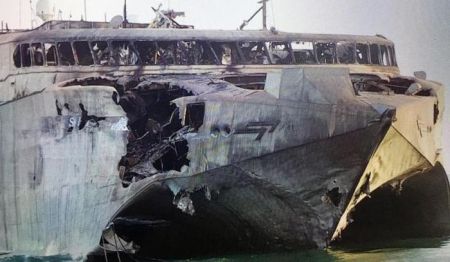
1. On Oct. 1, Iran’s Houthi surrogates launched C-8-1 missiles against a United Arab Emirates transport HSV-2 Swift logistics catamaran as it was about to pass through the strait. The ship, on lease from the US Navy, was badly damaged. No information was released about casualties.

uae_hsv-2_1-1-16-1

DEBKAfile’s military and intelligence sources discerned that the aim of this attack was to choke off the movements of UAE warships from the southern Yemeni port of Aden, where large Emirate and Saudi forces are concentrated, to the Eritrean port of Assab, where the UAE has established a large naval base.

This attack did finally evoke a US response. The guided missile destroyers, USS Mason and USS Nitze, were dispatched to the Red Sea, along with the USS Ponceafloat forward staging base, to patrol the strait opposite the Yemeni coast

2. This did not deter Tehran or its Yemeni pawns: On Oct. 9, they fired an additional barrage of C-802 at the American flotilla, which according to a US spokesman, missed aim.

The Mason hit back with two Standard Missile-2s and a single Enhanced Sea Sparrow Missile.

There has been no official word about whether these weapons destroyed a Yemeni launching site. But the event itself was a landmark as the first direct Iranian-Houthi attack of its kind on an American naval vessel.

3. That same day, the Houthis fired Scud-D missiles at the Saudi town of Ta’if, 700 km from the Yemeni border and only 70km from the Muslim shrine city Mecca. This was meant as a direct assault on the Saudi royal house and its claim to legitimacy, by virtue of its role as Guardian of the Holy Places of Islam.

In America’s heated presidential campaign, the Democratic contender Hillary Clinton boasts repeatedly that as Secretary of State she helped “put the lid on Iran’s nuclear program without firing a single shot.”

That is factually true. America did not fire a single shot. Iran did the shooting and still does, constantly upgrading its arsenal with sophisticated ballistic missiles.

PU**YGATE: Horrors! Trump Caught in Guy Talk!

October 8, 2016

PU**YGATE: Horrors! Trump Caught in Guy Talk! Dan Miller’s Blog, October 8, 2016

(The views expressed in this article are mine and do not necessarily reflect those of Warsclerotic or its other editors.– DM)

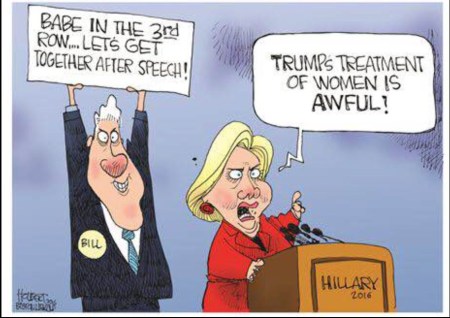
The left apparently believes that the Trump campaign must end in disgrace because, in 2005, Trump was recorded (apparently surreptitiously) bragging in a private conversation with George H.W. Bush’s nephew, Billy Bush, about how he tried (but failed) to get a Hollywood starlet to have sex with him. For shame! Wait a minute. That’s “guy talk” and most healthy males occasionally engage in it when not in mixed company. Methinks I smell a bit of hypocrisy.

“Girl talk?” I don’t know. Do they discuss how sexy voting should be?

Juanita Broaddrick, one of Bill Clinton’s “alleged” rape victims, had this to say about Trump’s words:

“How many times must it be said,” she tweeted Saturday morning.

“Actions speak louder than words. (Donald Trump) said bad things! (Hillary Clinton) threatened me after (Bill Clinton) raped me.”

Broaddrick’s dose of perspective comes as the mainstream media has been silent and uninterested in the ongoing accusations against Bill Clinton and Hillary’s attempts to silence his accusers.

But in the last 24 hours, they’ve reported ad nauseam about Trump’s 2005 locker room talk caught on a hot mic.

clinton-babes-copy

I agree with this statement in an article at Kingsjester’s Blog:

This has to be one of the biggest exercises in hypocrisy that I have ever seen.

Modern American Liberals are the same ones who brought us a crucifix in a jar of urine and a painting of Christ with elephant dung smeared all over it, applauding them both as avant-garde art and the “artists” who created those vile exhibits as “artistic geniuses”.

The same followers of the political philosophy who have been supporters  of relative morality and situational ethics, are now acting so grossly offended by an 11-year-old video of Donald J.Trump engaging in a private conversation with a friend, in which he used a word that can be heard in every men’s and boys’ locker room across this nation, that they are curled up in their safe spaces, clutching their pearls and their blankie, sucking their thumbs, and crying out for their Mommy to “make the bad man stop”. [Emphasis added.]

The overwhelming hypocrisy of it all is that they want Americans to be so reviled by Donald Trump’s use of that word that they overlook the documented fact that Bill Clinton is a Serial Adulterer and that Hillary Clinton swears like a drunken sailor and has admitted in documents released by Julian Assange yesterday that she is “far removed from the troubles of Middle Class Americans”. [Emphasis added.]

I stole this cartoon from that article, and it fits:

bus-to-wh-600-li

I also agree with this article at Canada Free Press titled Liberals are Prudes — Who Knew?

oneill100816

Recently much ado has been made of some crude comments that Donald Trump made some years back.  Media mavens are all aflutter with outraged disgust.  I do not know what convent these shocked sisters came from, but I have heard similar male braggadocio my entire adult life.  Perhaps they need to get out more. [Emphasis added.]

Apparently many of the pundits we watch on TV have been closet Puritans all this time – who knew?  Many of them are the same ones that informed us that displaying Christ crucified in a jar of human urine is art; that murdering fetuses in order to harvest their organs is not obscene, and who insist that our children be taught the ins and outs of fornication at younger and younger ages (pun noted)—so one can be forgiven for being somewhat surprised by their air of affronted prudery.  Poor dears, one does wish them a speedy recovery – hand out the smelling salts please.

So Donald Trump has feet of clay—guess what?  I like him that way! I am so sick of polished, slick talking, glad-handing, backstabbing, dishonest corrupt politicians that I could scream.  I’ll take the real deal—I’ll take Trump with his rough edges and sharp elbows, warts and all, over any of the oh-so-refined thoroughly corrupt bought-and-paid-for globalists being shoved down our throats.  Now they are disgusting.

Trump’s “nasty” talk was hardly unique. Here are some audio cuts of former presidents, and even the current president for whom Ms. Dunham thought voting for would be sexy, being “nasty:”

In one of his many addresses to his troops during World War II, General George Patton commented that “a man who won’t f**k won’t fight.” The quote is from a 2011 Washington Post article titled “No sex, please. We’re soldiers.” That address, like many of General Patton’s others, was well laced with profanity; it helped to motivate the troops and they loved it. Would today’s “metrosexuals?” They would not likely admit it even if they did.

Patton’s grim expression did not change. “There are four hundred neatly marked graves somewhere in Sicily”, he roared into the microphone, “All because one man went to sleep on the job”. He paused and the men grew silent. “But they are German graves, because we caught the bastard asleep before they did”. The General clutched the microphone tightly, his jaw out-thrust, and he continued, “An Army is a team. It lives, sleeps, eats, and fights as a team. This individual heroic stuff is pure horse shit. The bilious bastards who write that kind of stuff for the Saturday Evening Post don’t know any more about real fighting under fire than they know about fucking!”

The men slapped their legs and rolled in glee. This was Patton as the men had imagined him to be, and in rare form, too. He hadn’t let them down. He was all that he was cracked up to be, and more. He had IT!

“We have the finest food, the finest equipment, the best spirit, and the best men in the world”, Patton bellowed. He lowered his head and shook it pensively. Suddenly he snapped erect, faced the men belligerently and thundered, “Why, by God, I actually pity those poor sons-of-bitches we’re going up against. By God, I do”. The men clapped and howled delightedly. There would be many a barracks tale about the “Old Man’s” choice phrases. They would become part and parcel of Third Army’s history and they would become the bible of their slang.

. . . .

He could, when necessary, open up with both barrels and let forth such blue-flamed phrases that they seemed almost eloquent in their delivery. When asked by his nephew about his profanity, Patton remarked, “When I want my men to remember something important, to really make it stick, I give it to them double dirty. It may not sound nice to some bunch of little old ladies at an afternoon tea party, but it helps my soldiers to remember. You can’t run an army without profanity; and it has to be eloquent profanity. An army without profanity couldn’t fight its way out of a piss-soaked paper bag.” [Emphasis added.]

I remember that many years ago (1959 or 1960) when I was in ROTC at Yale — then an all-male college — an instructor (an Army captain) mentioned that he hadn’t seen one of the cadets with his date much over the weekend. The cadet responded, “even the best ***** gets moldy.” We all laughed.

From the Washington Post article linked above,

As late as the 1980s, officers’ clubs on military bases in the United States and abroad regularly featured performances by strippers. “I think we used to call them exotic dancers,” Scales recalled.

Some things have changed in our current enlightened age. Obama is gung-ho for diversity in the military and wants as many women and “others” as possible in combat branches. While the left still praises “art” such as “a crucifix in a jar of urine and a painting of Christ with elephant dung smeared all over it,” it finds guy talk and cartoons depicting Mohammad disgusting.

Paul Ryan was apparently “sickened” by Trump’s remarks.

He decried Trump’s newly revealed comments in stark terms.

“I am sickened by what I heard today,” Ryan said. “Women are to be championed and revered, not objectified. I hope Mr. Trump treats this situation with the seriousness it deserves and works to demonstrate to the country that he has greater respect for women than this clip suggests.”

Congressman Ryan must be “sickened” quite easily, but then perhaps there was never any guy talk in his presence, lest he “sicken.” Assuming that many others also are unaware that men engage in guy talk when women are absent and find Trump’s insulting comments outrageous, perhaps they should keep in mind that he is an equal opportunity insulter. Although he does not likely engage in guy talk with women and does not have sex with men, otherwise he treats men and women the same.

Leftists insist that we be politically correct and say nothing that they find offensive  — No cartoons depicting Mohammad, no disparaging references to Sharia law, Islamist persecution of non-Muslims, sex slaves and even Muslim females, no “racist” comments that “Black Lives Matter” is racist, and no opposition to uncontrolled, unvetted immigration and resettlement of refugees from Islamic areas where Sharia law and Islamist violence are endemic. And, of course, there must be no mention of Hillary’s many lies, her corruption, the Clinton Foundation, or her foul treatment of Bill’s bimbos. That would be “sexist” or something. Boo hoo.

Obama set for Mosul battle, leaves Aleppo to Putin

October 8, 2016

Obama set for Mosul battle, leaves Aleppo to Putin, DEBKAfile, October 8, 2016

(Please see also, The Obama administration is pushing Iraq into further chaos. — DM)

aleppo_destruction

Obama is brooking no distractions from his main objective, He hopes the Mosul operation will be over and done with by mid-December, so that when he exits the White House in January, he will have chalked up a major victory against the Islamic State as part of his legacy.

****************************

The warlike rhetoric heard from Washington over the plight of the stricken Syrian town of Aleppo does not represent any current Obama administration plan for military intervention to halt the ever-mounting carnage.

President Barack Obama’s mind is elsewhere.

This was discovered by his national security adviser Susan Rice every time she tried to arrange for Defense Secretary Ashton Carter and the Chairman of the Chiefs of Staff Gen. Joseph Dunford to be received by the president. After the collapse of diplomacy with Moscow for a cessation of hostilities, they had drawn up a plan for limited US military intervention in Syria that would enable essential humanitarian aid to reach the population.

Obama refused to hear what the trio had to say and the plan was shelved.

DEBKAfile’s Washington sources report that, for now, the US president’s mind is fixed exclusively on the preparations for the Oct. 19 offensive for the liberation of the Iraqi city of Mosul from ISIS occupation. US, Iraqi, Iraqi and Kurdish forces are aligned for the battle.

Obama is brooking no distractions from his main objective, He hopes the Mosul operation will be over and done with by mid-December, so that when he exits the White House in January, he will have chalked up a major victory against the Islamic State as part of his legacy.

In the process, the Democratic president intends to debunk the Republican candidate Donald Trump’s criticism of his administration as showing weakness in the face of ISIS.

Russian President Vladimir Putin is exploiting Obama’s preoccupation with the Mosul offensive to snatch a free hand for pushing the Aleppo battle to its barbaric limit. He is letting Bashar Assad and his allies conduct a scorched earth policy – even if this means reducing Syria’s second town to ruins.

Russian and Syrian jets are bombing the city, building by building, leaving the 8,000 rebels still fighting there with little hope of survival, since food, water, medicine or ammunition and anti-air missiles are out of their reach. The only form of resistance remaining to them is marksmen sniping from the rubble in an attempt to slow the advance of Syria, Iranian and Hizballah foot soldiers.

Obama, Putin and Assad are not alone in sentencing Aleppo to its doom: Turkish President Tayyip Erdogan, after grabbing 5,000 sq. km of northern Syria, is letting his army stand by idly as every attempt to bring life-saving assistance from Turkey to the beleaguered population is thrown back.

The Turkish leader is shielding himself with his secret deal with Putin, whereby his army is given a free hand in northern Syria without Russian interference, while the Aleppo arena becomes a Russian-Syrian precinct that is off-limits to Turkey.

This secret deal has also neutralized the US special operations forces deployed in northern Syria as well as the small Syrian rebel militias they trained and sponsor. Washington has therefore lost any leverage for swaying events in that part of the country. Since they are hemmed in on all sides, Obama refuses to hear of any military intervention in an area under Russian-Turkish control.

As he sees the larger picture, the northern Syrian devolution as a sphere of Turkish-Russian influence is balanced by US-Iraqi-Kurdish domination of northern Iraq

On paper, the US plans and preparations afoot for the liberation of Mosul are impressive.

Elite US troops are being pumped into the Mosul region – 600 just this week. Altogether an estimated 12,500 US servicemen are assigned for the offensive, which is due to be launched in 11 days, on Oct. 19.

This is the largest American military force to fight in Iraq since the battles against Al Qaeda during 2006-2007.

US military engineers are working overtime on the construction of bases around Mosul for the intake of US and Iraqi army units. The Kurdish Republic’s Peshmerga army is in position to the north.

Two new US facilities have just been completed. One is near the Mosul Dam, which regulates the flow of the Tigris River bisecting the targeted city. A second is located in the Bashiqa Mountains north of Mosul.

The two bases plus Kurdish army posts are designed as jumping-off points on the city from the south, east and Uninvited military forces are hovering nearby hoping to pick up a piece of the action. Among them are Turkish military units, local Iraqi militias, such as Turkmen, which the Turkish army is training for combat, and pro-Iranian Iraqi militias, such as the Badr Brigades and the Popular Mobilization Forces.

US commanders are intent on keeping these hangers-on out of the action, because their participation in the Mosul offensive would deepen the discord dividing Iraq’s Shiite, Sunni and Kurdish communities, and throw the city into chaos after the jihadists are driven out. US officers failed to check the sectarian violence that erupted in another Sunni-dominated town, Fallujah, in the wake of the battles for its recovery from ISIS in May and June.

Russia deploys advanced anti-missile system to Syria for first time, US officials say

October 4, 2016

Russia deploys advanced anti-missile system to Syria for first time, US officials say, Fox News, October 3, 2016

The SA-23 can fire two different types of missiles. A smaller missile is used against aircraft and cruise missiles and is known by NATO as Gladiator. The larger missile is used against intermediate-range ballistic missiles and jamming aircraft and is known as Giant. Both missiles use the same type of warhead containing over 300 pounds of explosives, according to military-today.com.

**********************

EXCLUSIVE: Russia has deployed an advanced anti-missile system to Syria for the first time, three US officials tell Fox News, the latest indication that Moscow continues to ramp up its military operations in Syria in support of President Bashar al-Assad.

It comes after Russia’s actions led to the collapse of a cease-fire and the cut-off of direct talks with the U.S.

While Moscow’s motives are not certain, officials say the new weapon system could potentially counter any American cruise missile attack in Syria.

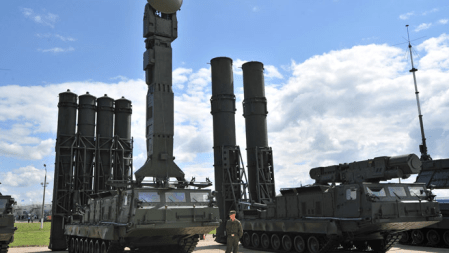
Components of the SA-23 Gladiator anti-missile and anti-aircraft system, which has a range of roughly 150 miles, arrived over the weekend “on the docks” of a Russian naval base along Syria’s Mediterranean coastal city of Tartus, two US officials said.

It is the first time Russia has deployed the SA-23 system outside its borders, according to one Western official citing a recent intelligence assessment. The missiles and associated components are still in their crates and are not yet operational, according to the officials.

The U.S. intelligence community has been observing the shipment of the SA-23 inside Russia in recent weeks, according to one official.

While the purpose is not clear, one US official asked sarcastically, “Nusra doesn’t have an air force do they?” speaking about the Al Qaeda-linked group in Syria.  The Islamic State also does not fly any manned aircraft or possess cruise missiles, in a sign that Russia is directing its actions to protect itself against any potential attack from the United States or its allies.

The SA-23 can fire two different types of missiles. A smaller missile is used against aircraft and cruise missiles and is known by NATO as Gladiator. The larger missile is used against intermediate-range ballistic missiles and jamming aircraft and is known as Giant. Both missiles use the same type of warhead containing over 300 pounds of explosives, according to military-today.com.

Three years ago, President Obama weighed military action against the Assad regime’s chemical weapons facilities as well as airbases housing the regime’s attack helicopters and jets. US Navy ships in the eastern Mediterranean were prepared to launch Tomahawk cruise missiles in a limited strike to cripple the regime.

Russia deployed a separate air defense system, the S-400, to Syria after a Russian jet was shot down by a Turkish warplane last November.  Since the S-400 deployment, the U.S. military has been careful about flying  manned aircraft inside the range of the system, despite repeated pledges by the US military that its airstrikes in Syria are focused on ISIS, not the Assad regime.

Monday, the Pentagon announced it conducted an airstrike potentially killing a “prominent” al-Qaeda linked operative in Syria.  Officials said they were still assessing the strike and have not released the name of their target.

Hours after the State Department announced it was cutting off talks with Moscow, President Vladimir Putin said he had suspended a Russia-U.S. deal on the disposal of weapons-grade plutonium. Putin’s decree released by the Kremlin cited Washington’s “unfriendly actions.”

Top US officials have recently accused Russia and the Syrian regime of indiscriminant bombing in Syria using incendiary and bunker busting bombs on civilians. Two weeks ago, a UN aid convoy was bombed, killing dozens of aid workers attempting to deliver critical supplies to the more than 200,000 Aleppo residents trapped inside the eastern portion of the city, once Syria’s most populated. In the past week, hundreds of civilians, including children, have been killed, according to local reports.

Russia began its air campaign in Syria on Sept. 30, 2015 following a weeks-long buildup of fighter jets and attack aircraft.  Long-range bombers flying from Russia and Iran have also been used to attack Syrian rebels, some backed by the United States.

Days after Russian bombs started falling in Syria, President Obama predicted that Russia and Iran would find themselves mired in a “quagmire.”

“[A]n attempt by Russia and Iran to prop up Assad and try to pacify the population is just going to get them stuck in a quagmire. And it won’t work,” he told reporters in a White House press conference on Oct. 2, 2015.

On Friday, the one-year anniversary of the Russian strikes, the State Department acknowledged that Russia had succeeded in its goal of propping up the Assad regime.

“It is a grim anniversary…It is hard not to assess that they have succeeded in bolstering the regime,” said Mark Toner, a State Dept. spokesman.

The Obama administration is pushing Iraq into further chaos

September 30, 2016

The Obama administration is pushing Iraq into further chaos, Washington Post, Editorial Board, September 29, 2016

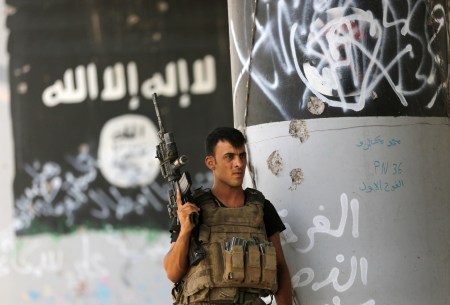
mideast_islamic_state_analysis-6073a-1671A member of Iraqi counterterrorism forces stands guard near Islamic State group militant graffiti in Fallujah, Iraq, in June. (Hadi Mizban/Associated Press)

Though the absence of such political solutions facilitated the rise of the Islamic State, the Obama administration is not pushing for them. It is not using its considerable leverage — U.S. air support will be vital to liberating Mosul — to insist on better political preparations or the exclusion of Shiite militias. Instead, eager for the operation to begin before President Obama leaves office, it has been encouraging Mr. Abadi to speed up the Mosul offensive, while leaving the Day After problem to the Iraqis. That is a highly risky course.

******************************

AN ASSAULT by U.S.-backed Iraqi forces on Mosul, the largest stronghold of the Islamic State, is expected within weeks — far sooner than seemed likely a few months ago. Unfortunately, the acceleration is not good news. The government of Iraqi Prime Minister Haider al-Abadi is rushing the operation forward even though it lacks a strategy to secure and govern the multiethnic city of roughly 1 million people once the terrorists are driven out. It is recruiting sectarian militia forces that have a record of abusing civilians and seizing territory for themselves. Plans for protecting refugees, who may number in the hundreds of thousands, are sketchy.

In short, the Mosul offensive is setting the stage for a potentially catastrophic Day After problem. Though the United States has painfully experienced what such poor preparation can lead to, in Baghdad in 2003 and Libya a decade later, it is pushing the Abadi government to move still faster.

Military experts are more concerned about the aftermath than the fight itself. Brig. Gen. William F. Mullen, who was deputy commander for U.S. operations in Iraq until June, predicted last week that Islamic State defenses in Mosul could collapse quickly. “And then what?” he asked at a forum at the Washington Institute for Near East Policy. The Iraqi government’s plan, he said, amounts to “chips will fall and we’ll sort it out when we get to that.”

“That’s not a good plan,” Mr. Mullen said. “This is going to be ugly.”

It’s not hard to foresee where the ugliness will come from. Though the Mosul attack is expected to be led by U.S.-trained Iraqi counterterrorism units, Mr. Abadi has said Shiite militia forces also will participate. Iraqi Kurdish units may also move in from the north. Controlled by Iran rather than the Baghdad government, several of the Shiite militias were accused of atrocities during and after operations in the Sunni cities of Ramadi and Fallujah. There is ample reason to fear similar abuses against Sunnis in Mosul.

Once the Islamic State is vanquished, the various forces may turn on one another. Kurdish and Shiite fighters already have sparred in nearby Diyala province. Turkey has threatened to intervene on behalf of ethnic Turks in the city. Though a Sunni police force is being trained, it is a fraction of the size needed to prevent human rights abuses and factional fighting.

Plans for governance are equally threadbare. Iraqi leaders reportedly want to restore the former provincial governor and council, but that could be contested by another former governor with his own Sunni force. More important, the Baghdad government has taken no serious steps to resolve long-standing disputes with Sunni and Kurdish leaders over territory, revenue and the delegation of powers to local governments.

Though the absence of such political solutions facilitated the rise of the Islamic State, the Obama administration is not pushing for them. It is not using its considerable leverage — U.S. air support will be vital to liberating Mosul — to insist on better political preparations or the exclusion of Shiite militias. Instead, eager for the operation to begin before President Obama leaves office, it has been encouraging Mr. Abadi to speed up the Mosul offensive, while leaving the Day After problem to the Iraqis. That is a highly risky course.