Posted tagged ‘U.S. military’

China’s Secret Military Plan: Invade Taiwan by 2020

October 3, 2017

China’s Secret Military Plan: Invade Taiwan by 2020, Washington Free Beacon, October 3, 2017
Chinese President Xi Jinping / Getty Images

Democratic-ruled Taiwan poses an existential threat to China’s communist leaders because the island, located some 90 miles off the southeast coast “serves as a beacon of freedom for ethnically Chinese people everywhere,” the book states.

“Consequently, the PLA considers the invasion of Taiwan to be its most critical mission, and it is this envisioned future war that drives China’s military buildup.”

For the Pentagon, China’s plan to seize Taiwan has worried those in the Air Force who expect Chinese missile and other attacks on nearby U.S. bases, notably Japan’s Kadena air base, a central U.S. military hub in the Pacific.

American Navy officials fear Chinese submarines will sink U.S. aircraft carriers or the USS Blue Ridge, the region’s only command ship.

“No one seemed clear on exactly what might happen, but all were sure a future Chinese surprise attack would be worse than Pearl Harbor and 9/11 combined,” the book says.

Others note that a Taiwan conflict could rapidly escalate to a U.S.-China nuclear war.

*********************************

China has drawn up secret military plans to take over the island of Taiwan by 2020, an action that would likely lead to a larger U.S.-China conventional or nuclear war, according to newly-disclosed internal Chinese military documents.

The secret war plan drawn up by the People’s Liberation Army (PLA), the Chinese Communist Party’s armed forces, calls for massive missile attacks on the island, along with a naval and air blockade that is followed by amphibious beach landing assaults using up to 400,000 troops.

The plans and operations are outlined in a new book published this week, The Chinese Invasion Threat by Ian Easton, a China affairs analyst with the Project 2049 Institute, a think tank.

The danger of a Taiwan conflict has grown in recent years even as current tensions between Washington and Beijing are mainly the result of U.S. opposition to Chinese militarization in the South China Sea and China’s covert support of North Korea’s nuclear and missile programs.

“Of all the powder kegs out there, the potential for a war over Taiwan is by far the largest and most explosive,” the 290-page book states, adding that the growing likelihood of a war over Taiwan will dominate worries within the Pentagon for years to come.

“China has made clear that its primary external objective is attaining the ability to apply overwhelming force against Taiwan during a conflict, and if necessary destroy American-led coalition forces,” the books says.

Democratic-ruled Taiwan poses an existential threat to China’s communist leaders because the island, located some 90 miles off the southeast coast “serves as a beacon of freedom for ethnically Chinese people everywhere,” the book states.

“Consequently, the PLA considers the invasion of Taiwan to be its most critical mission, and it is this envisioned future war that drives China’s military buildup.”

Parts of the PLA invasion scheme were first revealed publicly by the Taiwan Defense Ministry in late 2013. The plan calls for military operations against the island to be carried out by 2020.

The invasion program was confirmed by Chinese leader Xi Jinping during the major Communist Party meeting five years ago when Xi committed to “continue the 2020 Plan, whereby we build and deploy a complete operational capability to use force against Taiwan by that year.”

Other internal PLA writings that surfaced recently indicate China is ready to use force when it believes non-military means are not successful in forcing the capitulation to Beijing’s demands, and if the United States can be kept out of the battle.

Current U.S. law under the 1979 Taiwan Relations Act requires the United States to provide defensive weaponry to Taiwan to prevent the use of force against the island.

China currently is using non-lethal means—psychological, diplomatic, propaganda, and informational warfare—against Taiwan. Once these are exhausted, the plan for large-scale amphibious assault will be carried out.

Any attempt by the Chinese military to take the island will be difficult and costly, the book says. The island has rough, mountainous terrain that has created a wind tunnel effect in the strait that produces very difficult weather for carrying troop and weapons transports, both air and sea.

Taiwan is around 230 miles long and 90 miles wide. Taiwanese military forces have been preparing for an invasion since Chinese nationalist forces first took refuge on the island at the end of the civil war with the communists in 1949.

However, since the 1980s, China has been rapidly building up its military capabilities for a battle to forcibly unify the island with the mainland. Over 1,000 ballistic and cruise missiles currently are stationed within range of the Taiwan.

According to the book, China’s invasion plan is known as the Joint Island Attack Campaign.

“Only by militarily occupying The Island can we fundamentally conquer the ‘separatist’ force’s natural living space, and totally end the long military standoff across the Strait,” one PLA field manual states.

The war plan calls for rapidly capturing the capital Taipei and destroying the government; seizing other major cities and clearing out surviving defenders; and occupying the entire country.

Military operations will emphasize speed and surprise to overwhelm coastal defenses and create so much destruction in the early phase that Taiwan would surrender before the U.S. military can deploy forces to the area.

“The conceptual plan, which is referred to in internal PLA writings as the Joint Island Attack Campaign, appears to be highly centralized and updated regularly based on the latest intelligence, weapons production, and lessons learned from exercises and training,” the book says.

The campaign is one of China’s most closely held secrets but has been discussed in internal military manuals and technical writings that recently leaked from within the PLA.

“These provide an extraordinarily detailed look into Chinese thinking on this campaign,” the book says.

The step-by-step invasion process will involve three phases: blockade and bombing, amphibious landing, and combat operations on the island.

Several layers of a naval and air blockade and massive missile strikes on 1,000 targets will be used in the first phase. China then plans to launch sea-borne assaults with an armada of warships against 14 possible beach sites.

“Before the invaders began landing along Taiwan’s coast, the PLA would launch wave after wave of missiles, rockets, bombs, and artillery shells, pounding shoreline defenses, while electronic jammers scrambled communications,” the book says.

The PLA believes a future invasion of Taiwan is inevitable, although the exact time is uncertain.

China regards Taiwan as a “renegade province” and considers reuniting the island with the mainland part of larger Chinese strategic goals of achieving global dominance.

“In the end, only by directly conquering and controlling the island can we realize national unification … otherwise ‘separatist’ forces, even if they momentarily compromise under pressure, can reignite like dormant ashes under the right conditions,” one PLA document states.

A PLA field manual warns that Taiwan’s geography and defenses will require massive and masterful military campaigns that will be extremely challenging, requiring great sacrifices.

A restricted PLA manual, “Course Book on the Taiwan Strait’s Military Geography” warned military officers that external militaries could use Taiwan to cut off China’s trade lines and for use as a U.S. military base to blockade China.

Also, many of China’s seaborne oil imports, pass through the Taiwan Strait and are highly vulnerable to military interdiction. “So protecting the security of this strategic maritime passageway is not just a military activity alone, but rather an act of national strategy,” the manual says.

China also regards Taiwan as a critical chokepoint for Japan and could be used by China to choke its rival.

On the information warfare front, China plans to use the internet and other media outlets to wage psychological warfare aimed at weakening Taiwan’s resistance prior to a main attack.

Psychological warfare actions will be combined with legal and media warfare and other political warfare tools.

An internal Chinese military report outlines the use of information operations:

Utilize legal warfare and public opinion warfare together with psychological warfare to divide and erode the island’s solid willpower and lower the island’s combat strength. Of these, utilize legal warfare against the enemy’s political groups and their so-called ‘allies’ as a form of psychological attack. Clearly make the case that a joint attack campaign against the main island is legally justifiable and based on a continued, and internal, war of liberation…utilize public opinion warfare against the enemy’s military groups as a form of psychological attack. Point out the benefits of giving up their support for ‘independence’ with effective messaging themes…Use the Internet media heavily against non-governmental groups on the island and the masses as a form of psychological attack. Proactively spread propaganda regarding the benefits of unification for the nation and the people, and erode the social foundation of the ‘separatist’ forces on the island.

Taiwan’s leaders also will be targeted in bombing strikes, including the presidential office in Taipei and other government leadership headquarters.

A PLA document tells military leaders to find leadership organizations and their defenses.

“Then you should use high tech weapons that have a strong capability to penetrate their airspace with precision and destructiveness to execute fierce strikes against their head person(s),” the document says. “Assure they are successfully knocked out with one punch.

Chinese commandos also will be used to abduct or kill Taiwan’s key political and military leaders, weapons experts, and scientists using clandestine means and direct attacks.

China, according to the book, would “almost certainly” fail in its full-scale invasion of Taiwan but its military appears driven to prepare and carry out such an attack.

“China’s leaders recognize the roadblocks in their path and will continue to invest heavily in strategic deception, intelligence collection, psychological warfare, joint training, and advanced weapons,” the book says.

“Barring countervailing efforts, their investments could result in a world-shaking conflict and an immense human tragedy.”

For the Pentagon, China’s plan to seize Taiwan has worried those in the Air Force who expect Chinese missile and other attacks on nearby U.S. bases, notably Japan’s Kadena air base, a central U.S. military hub in the Pacific.

American Navy officials fear Chinese submarines will sink U.S. aircraft carriers or the USS Blue Ridge, the region’s only command ship.

“No one seemed clear on exactly what might happen, but all were sure a future Chinese surprise attack would be worse than Pearl Harbor and 9/11 combined,” the book says.

Others note that a Taiwan conflict could rapidly escalate to a U.S.-China nuclear war.

“The trigger could very well be an accident or innocent act, something calculated as benign but perceived as hostile,” the book says. “It may go down in history as an infamous event, or it may not be understood what exactly happened. Like the case of World War I, the true cause may be debated for a century and still undecided.”

Rick Fisher, a senior fellow at the International Assessment and Strategy Center, said the book presents important policy prescriptions for deterring war. The use of restricted Chinese military writings also provides new clues to Chinese intentions, plans and its ambitions to conquer Taiwan.

“What Easton has done is provide a vital warning to America and its allies, China could try to invade Taiwan as early as the first half of the next decade,” Fisher said. “That means we are right now in a Taiwan Straits crisis and we need to react like we are in a crisis or we risk falling into a war we have successfully avoided since 1950.”

Moscow: US-backed SDF faces “destruction.” Pro-Iranian Iraqi force crosses into Syria

September 21, 2017

Moscow: US-backed SDF faces “destruction.” Pro-Iranian Iraqi force crosses into Syria, DEBKAfile, September 21, 2017

Israel’s strategic situation took several steps back in the first week of the New Year, chiefly: The US pulled back from E. Syria under Russian threat, allowing Iran to move in.

In just one week, the dire perils, which many military and political experts warned against for years, are suddenly looming on Israel’s northern border.

        1. From Sept.15-17, Syrian and Hizballah forces crossed the Euphrates to the eastern bank on pontoon bridges provided by Russia.
        2. Last Saturday, Sept. 16, Russian jets bombed the US-backed Syrian Defense Forces (SDF) in the Deir ez-Zour region, as a warning against their obstructing the eastward impetus of those Syrian and Hizballah units.
        3. On Monday, Sept. 18, US Marines began blowing up buildings at the Zaqaf military base in eastern Syria and then retreating to the Jordanian border. The US set up Zaqaf early this year in the Syrian Desert as a barrier against this very Syrian/Hizballah crossing to impede their advance to the Syrian-Iraqi border.
        4. The following day, on the heels of the US withdrawal, Hizballah troops took charge of the Zaqaf base.
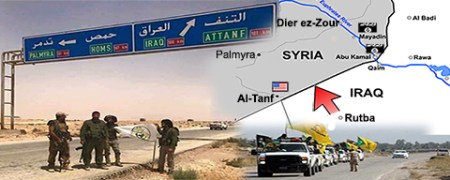
        5. On Wednesday, Sept. 19, the Iraqi Hashd Al-Sha’abi (Popular Mobilization Units – PMU) crossed into Syria and linked up with the Syrian-Hizballah force. The PMU is under the direct command of Gen. Qassam Soleimani, head of Iranian military operations in Syria and Iraq.
        6. Iran, through its Iraqi, Lebanese and other foreign Shiite pawns, is now in control of 230km of the Syrian border, from Abu Kamal (still held by ISIS) in the north, to Al Tanf in the Syrian-Iraqi-Jordanian border triangle in the south – where, too, US and coalition special forces have begun packing up ready to exit.
          Iran in recent years imported some 20,000 Afghan and Pakistani Shiite fighters to reinforce the Syrian army and Hizballah in their battles for Bashar Assad. The new Iraq arrivals boost that figure by tens of thousands and more are coming in all the time.
        7. On Thursday, Sept. 21, the growing disconnect between Moscow and Washington over Syria suddenly erupted into an open breach with a crude threat from the Kremlin: “Russia has officially informed the United States via a special communications channel that Russian forces will strike immediately US-backed forces if they attack or shell Syrian or Russian task forces operating near the Deir Ez-Zour city. Any attempts at shelling from the areas where the militants of the Syrian Democratic Forces are based will be immediately curbed. Russian forces will suppress firing points in these areas using all means of destruction.”

      A threat of this degree of ruthlessness has not been encountered in the Middle East for decades, it may recall Moscow’s threat to Israel in 1956 to end its invasion of the Sinai without delay or else…

      Where do these menacing steps leave Israel?

        • The US has washed its hands of central and southeastern Syria.
        • Russia is wholly, unreservedly and openly in lockstep with the Syrian army, Iran and Hizballah in all their objectives in the war-torn country, and moreover, willing to threaten any pro-American entity with total military punishment. Is this an indirect message to Israel too?
          Iraqi Shiite forces are surging into Syria; they have given Tehran the gift of control of a 230km segment of the border.

      And what does the IDF chief of staff, Lt. Gen. Gady Eisenkott have to say about all this?  In an interview to Israeli media as recently as Wednesday, Sept. 19, when it was all happening, he said: “If Iran  does entrench itself in Syria, that will be bad news for the entire region, including the moderate Sunni camp, and even more for the countries of Europe.”

He went on to explain: “That is why we have given the Iranian threat and halting its expanding influence very high priority as an issue to be dealt with.”

Gen. Eisenkott underlined the IDF’s focus as being to prevent [Israel’s foes] from obtaining weaponry, i.e. missiles – of high targeting precision.

The trouble is that, while the IDF focuses on this objective, commendable in itself, Russia and Iran are focusing and in full flight on a far wider-ranging goal, the precise and systematic deepening of Iran’s military presence in Syria. Iran and Hizballah have already established military commands at Arnaba just 6 km from Israel’s Golan border.

Yet the IDF chief is still talking about this as an untoward event that may – or may not – come some time in the future.

US-Russian pincer for ISIS in Euphrates Valley

September 10, 2017

US-Russian pincer for ISIS in Euphrates Valley, DEBKAfile, September 10, 2017

The US and Russia have just agreed to each provide air support for a conjoined pincer movement to pin the Islamic State down in its last strongholds of Abu Kamal and Mayadin in the Euphrates Valley, DEBKAfile reports from exclusive intelligence sources.

The number of jihadists assembled there, mainly from Mosul and Raqqa, is estimated at 10,000.

The new US-Russian understanding, our military sources say, provides a roadmap for twin offensives – one led by Syrian regime, Hizballah and pro-Iranian militia armies; the second, by the pro-US Syrian Democratic Forces (SDF),  the Kurdish YPG and the Syrian Arab Shammari Sanadid Brigade. The first will fight under Russian air cover and the second under US air support. The tribesmen are fighting with the blessing of Saudi Arabia.

The two columns will advance through two separate corridors.

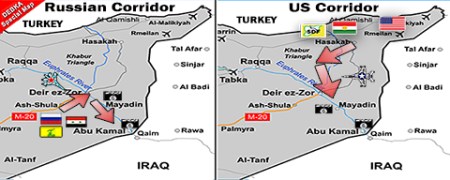
The Russian-backed formation will head east from the town of Ash-Shula along the M20 highway. En route, they are tasked with completing the capture of Deir ez-Zour, after breaking through the ISIS siege last week, and mopping up ISIS fighters outside the town. After that, they will head northwest to their final destination, the border town of Abu Kamal.

The US-backed force will set out from the northern Syrian Kurdish province of Hasakeh and push on to the Khabur River, a tributary of the Euphrates. (See map.)  After crossing the Khabur, they will head along the Euphrates bank for the same destination, Abu Kamal.

Since the Russian and US air forces will both be operating in a very tight space, the US war room at the CENTCOM commander center in Baghdad and the Russian Hmeimim Air base in Syrian Latakia, will be coordinating aerial operations closely enough to prevent accidental collisions.

An agreement was reached between the US and the Syrian regime to drop references to “de-escalation zones”  and instead talk about “deconfliction.”

Although the two powers have reached an unprecedented measure of accord for working together with their respective allies and proxies for a concerted effort to wipe out the last ISIS strongholds along the Syrian-Iraqi border, nonetheless certain areas are still unresolved:

1. Which of the two will take charge of the oil fields of Deir ez-Zour? Control of this oil-rich region region is a valuable strategic prize for the winner.

2. Which of the two formations will actually lead the battles for Abu Kamal and Mayadin?

3.  And which of the two will be left in control of the Syrian-Iraqi border running through the Euphrates Valley?

Leaving any of these these points up in the air is a recipe for major clashes between the pro-Russian and pro-US forces which have banded together pro tem against the Islamic State’s last stand.

US set to quit Al Tanf. Pro-Iranian force moves in

September 8, 2017

US set to quit Al Tanf. Pro-Iranian force moves in, DEBKAfile, September 8, 2017

While Israeli jets were bombing the Syrian CERS chemical facility at Masyaf, 38km west of the central Syrian town of Hama, early Thursday, Sept 7,  control of the Syrian-Iraqi border to the east was quietly changing hands.

DEBKAfile tracks the ongoing process:

  • Washington was winding up discussions with Moscow on terms for US special forces to evacuate the Al Tanf post they were holding in the Syrian-Iraqi-Jordanian triangle and hand it over to the Syrian army.Quitting Al Tanf is tantamount to the US withdrawal from southeastern Syria and its handover to Syria and its allies, including Hizballah.
  • US-backed Syrian rebel units are also about to leave their posts in the southern town of Daraa, having completed negotiations for a deal with the Russian officers manning this de-escalation zone and Hizballah officers. They have agreed to hand in their weapons and either join up with Syrian government units or disperse.. For the first time in the Syrian civil war, Hizballah announced an important development in the name of Russia.
  • Units of Tehran’s Iraqi surrogate, the Popular Mobilization Units (PMU), Thursday night began crossing the border and taking up positions in southeastern Syria. The PMU, although formally integrated in the Iraqi national army, takes its orders from Iran’s supreme Middle East commander, the Al Qods chief Gen. Qassem Soleimani.
  • Early Friday, Sept. 8, Damascus issued a warning to the US and Kurdish forces fighting to liberate Raqqa from the Islamic State, not to continue southeast towards the ISIS stronghold at Abu Kamal. This was the announcement: “The Syrian Army High Command views the liberation of the Deir Ez-Zour border city of Abu Kamal as an imperative military endeavor that cannot be dictated by the US Coalition and their allies.”
  • The connotation of this Syrian announcement is obvious: With the way clear for Syrian and Hizballah troops to move into the al-Tanf post, only Abu Kamal remains to be captured for them to achieve full command of all 600km of the Syrian-Iraqi border. Tehran’s key strategic objective of an open land corridor through Iraq to Syria and the Mediterranean will then be in the bag.

Thursday night, Israel’s Defense Minister Avigdor Lieberman, while ducking confirmation of the Israeli air strike in Masyaf, affirmed instead: “We shall not allow the formation of a Shiite corridor from Iran to Lebanon.”

He was followed by Israeli Military Intelligence (AMAN) commander Maj. Gen. Hertzi Levy, who said “We are dealing resolutely with the threats against us.”

Unfortunately, neither of these declarations appears to correlate with the real events unfolding nearby in southeastern Syria. Predominantly hostile powers are carving out new, strategic facts in that region, which pose great harm to Israel’s national security.

Fat Kim threatens Trump (again)

September 5, 2017

Fat Kim threatens Trump (again), American ThinkerGary Gindler, September 5, 2017

(This is the most fascinating, and best, suggestion on dealing with North Korean nukes I have read thus far –  force China to take care of the problem. Please see also, Chinese Official Says China Might Invade Taiwan If “Peaceful Reunification Takes Too Long.” — DM)

It’s time for Trump to make an unconventional move – a move no one expects.

It is better not to increase the U.S. military potential in the region.  On the contrary, it is better to completely withdraw all American troops from both South Korea and Japan.

In fact, American troops need to be relocated not into the continental U.S., but to Taiwan.

This move by Trump will make China stop playing the role of an outside observer.  China will be faced with a choice – either China joins Trump on this issue, or she will never get back Taiwan, where the headquarters of the 7th U.S. Navy Fleet will now be located.

Of course, America’s allies in the region, Japan and South Korea, in the face of the withdrawal of U.S. troops, will quite justifiably demand new guarantees of protection from the U.S. government.  America should renew its lend-lease program from the Second World War and lease over to Japan and South Korea, for a term of 99 years, all the nuclear weapons they will ask for.  The military budgets of these countries will skyrocket.  China’s inaction toward the Fat Kim regime will lead to the fact that in addition, China will get two unfriendly nuclear powers armed to the teeth at her own border.

***********************

After Kim Jong-un tested his hydrogen bomb, everything in the world went just as we could expect.  Someone started saber-rattling, and someone insisted that the problem of nuclear North Korea cannot be solved by military means under any circumstances.

Both use very serious arguments.  Those who support appeasement of Kim quite reasonably note that the capital of South Korea, with its 25 million-strong population, is at an artillery salvo distance from the border with North Korea.  Even a limited volley from the north will lead to hundreds of thousands of civilian casualties.  Supporters of a massive blow to North Korea argue that it is better to have thousands of casualties among Koreans than to wait until the hydrogen bomb explodes over San Francisco and Americans become the victims.

Both sides have numerous supporters in the highest echelons of power in Washington.

Meanwhile, Fat Kim does not present a threat to the United States at present.  Fat Kim is a threat to President Trump.

Fat Kim is not a dumb bump.  He’s just one of the players in the next political show of the Axis countries.  The North Korean crisis allows others hostile to America – countries such as Iran, Russia, and Syria (i.e., Axis countries) – to check Trump’s resolve.  China is not a member of this Axis, but it watches Trump with great pleasure as he tries to get out of this entrapment.

All the Axis countries are linked by longstanding nuclear technology ties.  Of all the Axis countries, only Syria lacks this technology (the Syrian nuclear reactor, which was built by North Korean engineers, was bombed by Israel in 2007).

The Axis countries are waiting for Trump’s move.  A standard geopolitical analysis shows that there are many options for Trump, but they all range from bad to very bad.

It’s time for Trump to make an unconventional move – a move no one expects.

It is better not to increase the U.S. military potential in the region.  On the contrary, it is better to completely withdraw all American troops from both South Korea and Japan.

In fact, American troops need to be relocated not into the continental U.S., but to Taiwan.

This move by Trump will make China stop playing the role of an outside observer.  China will be faced with a choice – either China joins Trump on this issue, or she will never get back Taiwan, where the headquarters of the 7th U.S. Navy Fleet will now be located.

Of course, America’s allies in the region, Japan and South Korea, in the face of the withdrawal of U.S. troops, will quite justifiably demand new guarantees of protection from the U.S. government.  America should renew its lend-lease program from the Second World War and lease over to Japan and South Korea, for a term of 99 years, all the nuclear weapons they will ask for.  The military budgets of these countries will skyrocket.  China’s inaction toward the Fat Kim regime will lead to the fact that in addition, China will get two unfriendly nuclear powers armed to the teeth at her own border.

If Trump adds to this the ban on trade with all countries that have trade relations with North Korea, then China, with four fifths of its economy dependent on the U.S. market, will suffer the most.

There is every reason to believe that China will make a reasonable choice.  Most likely, she will do this much earlier than the first transport from Japan with the U.S. Marine Corps docks in Taipei.  It is unreasonable to assume that China does not have a well conceived plan for rapid regime change in North Korea.

If wisdom escapes the Chinese communists, then as the icing on the cake, they will get a united Korea at their side.  Capitalistic.  And nuclear.


Trump-Putin deal imperils Israeli, Jordan borders

August 12, 2017

Trump-Putin deal imperils Israeli, Jordan borders, DEBKAfile, August 12, 2017

Local US-backed Syrian rebel groups disbanded without a shot, went over to the Syrian government side and handed in their US-supplied weapons to Syrian army and Hizballah fighters.

Sooner or later, the Sweida model will be replicated in Quneitra. Neither the Russian troops nor UN peacekeepers will fight to stop it happening. By then, the Syrian rebel groups, in whose support Israel invested for years as a buffer against hostile Syrian, Iranian and Hizballah forces, are already falling apart. Disowned by their Saudi backers, they are being crushed by the US-Russian “de-escalation” steamroller. Israel like Jordan will soon find three hostile forces sitting pretty just across its border, far too close for safety.

******************************

The transformation of a small, strategic wedge of land between the Syrian, Israeli, Jordanian and Iraqi borders is going forward apace without arousing much interest – even in Israel, where it should cause the most concern, DEBKAfile reports.

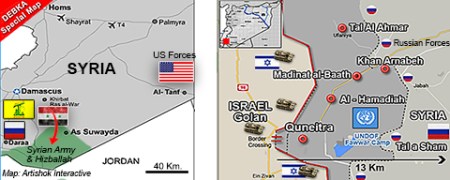
On Wednesday, Aug. 8, two Russian army companies of Ingushet troops from the northern Caucasus set up a command post in the Syrian village of Tal al-Shahm, 13km from Israel’s Golan border. Its commander, Col. Alexei Kozin, has thus taken charge of Syria’s border with Israel. As DEBKAfile reported last month, his task is to set up 10 control checkpoints along that border.

This border area was designated as one of four de-escalation zones agreed on between Presidents Donald Trump and Vladimir Putin at their meeting in Hamburg on July 7.

According to understandings reached between Washington, Moscow and Jerusalem, the UN separation force (UNDOF) will return to its Fawar base opposite Quneitra as a buffer between IDF and Russian forces. Its past history in this role between IDF and Syrian forces was never exactly impressive.

A piece of diplomacy consistent with this process was contributed by Russian foreign Minister Sergey Lavrov on Friday, Aug. 11. It was an assurance that Russia would take into account Israel’s interests in Jerusalem in the framework of Israeli-Palestinian peace talks.

It also fits in with the surprising statement from Washington on the same day, namely, that Donald Trump, although in the midst of a fearsome crisis with North Korea with military overtones, is planning to send his senior adviser, son-in-law Jared Kushner and Israel-Palestinian peace broker Jason Greenblatt, on an early visit to the Middle East to continue this mission.

To see how these disparate elements fill out the whole picture, we turn 70km east from Quneitra on the Syria Golan to the battles ongoing at Sweida in southeastern Syria opposite the Jordanian and Iraqi borders. Russian troops moved into the key town of Daraa, abutting on the Jordanian border on July 13. Like in Quneitra, a month later, they set up command posts to monitor the first de-escalation or ceasefire zone to be set up under the Hamburg accord.

The Russian troops’ assignment was to stop the fighting there and execute the withdrawal of the combatant forces, the Syrian army, Iran, and its foreign Shiite militias, including Hizballah, to a distance of 40km from the border.

But that arrangement never stood up.

Nearly four weeks later, on Wednesday night, Aug. 9, on the same night that Russian troops moved into Quneitra, the Syrian army and Hizballah launched a major offensive in Sweida province. Three days later, by Saturday, they had forced the local rebel forces to retreat into Jordan and seized 57km of Syria’s southern frontier with the Hashemite Kingdom.

Neither the Russians nor the American interfered with the Syrian-Hizballah-led push, although the Russians took responsibility for maintaining the ceasefire, and US special forces were and still are posted to the east of Sweida at Al-Tanf in the Syrian-Jordanian-Iraqi border triangle.

(See attached map)

DEBKAfile’s military sources add that the Syrian-Hizballah offensive violated the ceasefire deal. Local US-backed Syrian rebel groups disbanded without a shot, went over to the Syrian government side and handed in their US-supplied weapons to Syrian army and Hizballah fighters.

The Sweida episode demonstrated how the Syrian-Iranian-Hizballah alliance sees its way to using the Trump-Putin ceasefire zones accord as an open door for seizing control of southern Syria and grabbing the Jordanian and Israeli borders.

The Syrian rebel movement is disintegrating at an alarming rate following the “Jubeir earthquake,” as it has become known – another momentous event which Western and Israeli front pages have chosen to ignore.

Last week, Saudi Foreign Mniser Adel al-Jubeir reportedly informed a delegation of Syrian opposition leaders invited to Riyadh that his government was pulling its support from their fighting militias, in the wake of President Trump’s decision to reduce US military action in Syria solely to the war on ISIS – and therefore end US resistance to the Assad regime.

Saudi officials did not deny the report, only termed it “inaccurate.”

But meanwhile, the decisions by Riyadh and Washington to abandon the anti-Assad cause spread like wildfire among Syrian rebel groups. Many responded by laying down their arms and surrendering.

The fate of the rebel movement after six years of cruel warfare against the dictator Bashar Assad should be an object lesson to other recipients of American and Russian promises. Therefore, Lavrov’s pledge to take Israel’s interests in Jerusalem into account should be taken with a pinch of salt. He was most likely shooting a line to allay Israeli skepticism about the prospect of Russian troops keeping Syrian, Iranian and Hizballah troops at bay from its northern border – even through this pledge was underwritten by Washington.

Instead of taking the two powers at their word, Israel need only watch what is going on in the last few hours just across the border at Sweida, to appreciate the value of such promises.

Sooner or later, the Sweida model will be replicated in Quneitra. Neither the Russian troops nor UN peacekeepers will fight to stop it happening. By then, the Syrian rebel groups, in whose support Israel invested for years as a buffer against hostile Syrian, Iranian and Hizballah forces, are already falling apart. Disowned by their Saudi backers, they are being crushed by the US-Russian “de-escalation” steamroller. Israel like Jordan will soon find three hostile forces sitting pretty just across its border, far too close for safety.

U.S. and Guam Shielded From North Korean Missiles by High-Tech Defenses

August 10, 2017

U.S. and Guam Shielded From North Korean Missiles by High-Tech Defenses, Washington Free Beacon, August 10, 2017

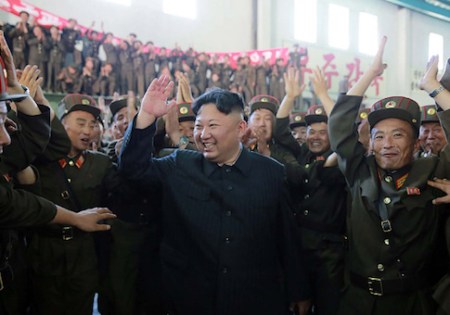
Kim Jong Un / Getty Images

Amid growing missile threats from North Korea, American missile defenses based in Alaska, California, and Guam, as well as on Navy ships, are capable of knocking out North Korean nuclear missiles, according to military leaders and experts.

Missile Defense Agency Director Air Force Lt. General Samuel Greaves said Wednesday he is confident current defenses would be effective against Pyongyang’s missiles.

“Yes, we believe that the currently deployed ballistic missile defense system can meet today’s threat, and we’ve demonstrated that capability through testing,” Greaves told a conference in Alabama.

Contrary to critics who say ground-based interceptors and naval anti-missile systems are unreliable, retired Air Force Lt. Gen. Trey Obering, a former MDA director, says the Ground-based Midcourse Defense (GMD) provides the best protection from a long-range North Korean strike.

Yet other shorter-range defenses such as the land-based Terminal High Altitude Area Defense, or THAAD, and the Navy’s ship-based Aegis SM-3 missiles can knock out medium and intermediate-range North Korean missiles, and if given enough satellite warning could attack North Korea’s ICBM warheads, he said.

“Any interceptor can intercept any missile, given the right parameters,” Obering said in an interview.

“I have high confidence that if we were attacked by North Korea we would be able to defend ourselves.”

President Trump has declared North Korea will not be allowed to develop a nuclear missile capable of striking the United States. On Tuesday he warned that continued North Korean threats against the United States would result in “fire and fury like the world has never seen.”

North Korea responded by announcing that an attack on the American Pacific island of Guam is being considered.

On Wednesday, the official KCNA news agency dismissed Trump’s warning as a “load of nonsense.”

“Sound dialogue is not possible with such a guy bereft of reason and only absolute force can work on him,” the state media organ said.

The heated rhetoric prompted Defense Secretary Jim Mattis to reiterate U.S. military capabilities, including missile defenses, in a statement Wednesday.

“The United States and our allies have the demonstrated capabilities and unquestionable commitment to defend ourselves from an attack,” Mattis said.

Noting the unified vote condemning North Korea at the United Nations on Saturday, Mattis said “Kim Jong Un should take heed” of those who agree North Korea poses a threat to global security and stability.

North Korea “must choose to stop isolating itself and stand down its pursuit of nuclear weapons,” he said, adding that Pyongyang “should cease any consideration of actions that would lead to the end of its regime and the destruction of its people.”

Mattis said Trump was notified of the growing missile threat and his first orders were to emphasize the readiness of both missile defenses and nuclear deterrent forces.

The defense secretary added that the “combined allied militaries now possess the most precise, rehearsed and robust defensive and offensive capabilities on earth,” and noted that the Kim Jong Un regime’s actions “will continue to be grossly overmatched by ours and would lose any arms race or conflict it initiates.”

Air Force Gen. John Hyten, commander of U.S. Strategic Command, said recently that he is concerned about growing missile threats from both North Korea and Iran and wants better sensors and interceptors for missile defenses.

“I’m concerned about any missile threat that is growing and can either range our allies or the United States,” he said in Omaha last month.

“But when I look at where we need to invest in future missile defenses, I see the most important thing that we have to invest in right now would be increased sensor capabilities because we need to be able to characterize the threat wherever it is on the globe in order to be able to effectively respond to it with defenses.”

Hyten also favors adding sensors in space “because you can’t have access to enough land points in the world to have a full sensor capability, so we need to go to space.”

Next is the need for improved interceptors.

“We have interceptors right now that are good enough to deal with the basic North Korean threat that is out there right now,” Hyten said. “But the threat is maturing fast and we have to improve our interceptor capability fast enough to stay with them.”

The Pentagon is developing an advanced kill vehicle that will be added current interceptors in Alaska and California. New technology is also available to deal with maneuvering warheads.

Hyten said he would favor building space sensors and better interceptors before setting up a third based on the East Coast for the Ground-based Midcourse Defense.

The Pentagon is currently conducting a major review of ballistic missile defense policy that will set the course of current and future defenses.

“There’s a ballistic missile defense review underway right now that will say where we have to go in terms of capacity, whether it’s more in the West, more in the East,” Hyten said.

“But I continue to advocate to make sure we don’t in the discussion on capacity miss the need for improved sensors and improved interceptors that will really enable decisions we have coming out of the review.”

The ground based missile defenses that would be used against a North Korean ICBM include 36 interceptors mainly based at Fort Greely, Alaska with a smaller number located at Vandenberg Air Force Base in southern California.

The interceptors are equipped with kinetic kill vehicles that travel at very high speeds and ram into enemy warheads in space.

Command centers are located in Colorado Springs and Fort Greely.

Obering said the command and control for missile defense is highly automated because of the need to respond very quickly to a missile launch by North Korea that would be spotted by special military satellites focused on North Korea.

Once detected the system predicts an “impact fan” of potential target areas and if the track indicates it is going to hit the continental United States, Alaska or Hawaii.

“If that fan touches any of the defended area that is programed into the Ground Based Midcourse system, the system automatically alerts,” Obering said.

The alert notifies commanders that a missile is inbound heading for a specific area. Then electronic sensors around the world, including radar, begin searching for the missile.

The sensor information is then fed into the fire control system that assesses which data is more reliable and selects an interceptor to attack the warhead.

“The system then determines what would be the most optimum shot, either from Vandenberg or Alaska,” Obering said. “The human has to enable it. It has to say, ‘Ok, you’re authorized to launch.’ But everything else is done automatically.”

For Guam, currently a THAAD battery is deployed to the island and Aegis missile defenses ships also are likely being deployed near the island in the event North Korea would attempt to strike the island.

North Korea has three ICBMs, the Taepodong-2, Hwasong-13, and Hwasong-14. Those would not be used for strikes on Guam. Other medium-range or intermediate range missiles such as the Musudan or Hwasong-12 could be used.

Those missiles can be countered by THAAD and Aegis ships.

Obering said current defenses are capable against North Korean missiles today but need to be upgraded. “We certainly need to add more interceptors, we need to add more sensors and we need to do much more in terms of fielding advanced capabilities to stay ahead of the North Korean threat and the Iranian threat as well,” he said.

The MDA budget should be increased to $10 billion to $12 billion annually, he said.

For example, in addition to using space satellites for warning, satellites should be used for tracking in order to provide more precision for missile defenses.

“When you do that, you get dramatically improved sensor coverage,” Obering said. Space based sensors would bolster the three most effective missile defenses: GMD, THAAD and Aegis.

Another step to increase the lethality of missile defenses would be to use what is called cooperative engagement capabilities—the ability to use multiple tracking and guidance sensors on various missile defense systems.

For example, the Navy’s SM-3 missile has a range greater than the Aegis radar and thus could be extended by using data from other longer-range radar.

“That’s what we mean by an integrated system—the ability to take any sensor and marry it with any interceptor,” Obering said.

Cooperative engagement has been tested several times and more are scheduled.

Obering said missile defenses are proving opponents wrong. Many arm control advocates for decades opposed all missile defenses by arguing the defenses undermined arms control agreements.

“Just imagine where we would have been in the late 1990s and early 2000s if we would have listened to the critics and listened to those who said we don’t need to field missile defenses,” he said.

Without missile defenses, there would be only two options for military commanders: preemptive attacks or retaliation after being attacked.

“And now we have another option and that’s very critical,” Obering said.

House passes NDAA authorizing huge spending boost for Trump’s Defense Department

July 14, 2017

House passes NDAA authorizing huge spending boost for Trump’s Defense Department, Washington ExaminerTravis J. Tritten, July 14, 2017

Senators are now weighing an NDAA authorizing $700 billion in spending, which also blows past Trump’s defense budget and also hikes aircraft, ship and troop numbers.

That bill has not yet made it to the Senate floor but could be considered before senators leave Washington at the end of the month for the summer recess.

**********************************

The House on Friday passed a defense policy bill that calls for more ships, aircraft, and soldiers, and authorizes $696 billion in defense spending in fiscal year 2018, well above President Trump’s request.

The House approved the National Defense Authorization Act after days of debate that saw lawmakers block many controversial amendments to the bill, including a proposed ban on transgender medical care for troops and the closure of excess military facilities. The House defeated that in a narrow 209-214 vote.

On Friday morning, the House also shot down a proposal from Rep. Trent Franks, R-Ariz., that would have required the Defense Department to assess the use of violent Islamic religious doctrine to support terrorism. Lawmakers defeated that amendment in another close vote, 208-217, which was followed by cheers on the floor from some Democrats.

A measure creating a new Space Corps military service survived debate and remained in the bill despite opposition from Defense Secretary Jim Mattis, Air Force leaders and the White House.

Despite these disputes, the NDAA passed easily in a bipartisan, 344-81 vote. Majorities in both parties supported it, and just eight Republicans voted against it along with 73 Democrats.

The House-passed NDAA bill would add 17,000 soldiers to the Army, something requested by the service but unfunded under the president’s budget, as well as authorize purchase of four additional Navy ships, 17 more F-35 fighter jets, and eight more F/A-18 Super Hornet jets. The House bill is comprised of two sections, one that would authorize $631.6 billion in base defense spending, and $65 billion in overseas war spending.

Trump requested a $603 billion defense plan in May that was already an increase over last year’s funding, but still focuses on shoring up existing forces and pushes his promised military buildup into 2019.

The House’s NDAA defense bill must be reconciled with Senate plans, but the vote Friday was another sign the two chambers may push big increases for the military for the coming fiscal year.

Senators are now weighing an NDAA authorizing $700 billion in spending, which also blows past Trump’s defense budget and also hikes aircraft, ship and troop numbers.

That bill has not yet made it to the Senate floor but could be considered before senators leave Washington at the end of the month for the summer recess.

Trump Admin Authorizes Strikes on Iranian-Backed Forces

July 5, 2017

Trump Admin Authorizes Strikes on Iranian-Backed Forces, Washington Free Beacon, July 5, 2017

(Please see also, Astana Peace Talks Fail over Syrian Safe Zones. — DM)

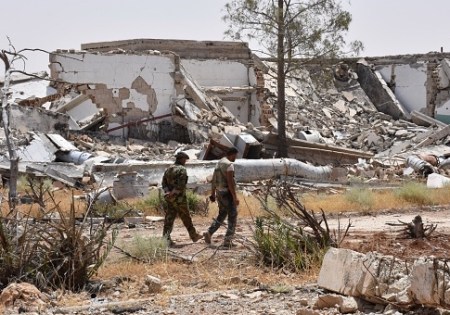
Syrian regime and pro-regime forces inspect an area recently recaptured from the Islamic State near Aleppo / Getty Images

U.S. forces have been instructed to take all measures needed to protect American interests in Syria, including military measures, as part of a new strategy that comes after top officials in the Trump administration assessed that Iran is deliberately probing American weaknesses and reactions on the Syrian battlefield, according to senior Trump administration officials who spoke to the Washington Free Beacon.

Iran-backed forces, including Hezbollah, have already initiated multiple encounters with the United States by violating agreements worked out between Washington and Moscow aimed at preventing the various factions targeting ISIS inside Syria from coming into conflict. This is part of a campaign that analysts inside and outside the White House believe is aimed at testing the Trump administration’s resolve, sources said.

“That was very clearly a process of the Iranians and Hezbollah and [the] Syrian regime probing and testing our limits, and testing how much we were willing to do,” one senior Trump administration official said. “In every case, it was a matter of them testing and probing, and us responding by defending ourselves.”

These clashes were the result of pro-Syrian regime forces, including Iran and Hezbollah, “violating a de-confliction measure that had been worked out with the Russians,” the official said. “The forces violated the measure.”

The Trump administration has instructed U.S. forces to respond to Iranian attacks with force if necessary.

“What they found out very quickly,” said the official, was “us responding by defending ourselves. What was established was that we’re determined to defend ourselves.”

This new strategy is being implemented at the same time the Trump administration turns its attention to the Iranian Revolutionary Guards Corps (IRGC), the Islamic Republic’s paramilitary force that coordinates operations in Syria and other warzones.

Trump administration officials view the IRGC as being part of “every malignant protrusion of the Iranian regime,” according to one administration official, who said the White House is dually focused on choking off this force.

The actions by U.S. forces are part of a broader pushback against Iran, ranging from battlefield responses to diplomatic action, according to a veteran Iran policy analyst who has been briefed by the White House both on parts of the Syria strategy and on parts of an ongoing Iran policy review being conducted by the administration.

The Free Beacon first reported many details of the review several weeks ago, including actions by the Trump administration to potentially block the sale of U.S. commercial aircraft to Tehran.

“For the first time since the U.S. intervened into the Syrian conflict, American forces have been authorized to do take all measures to defend U.S. interests against Iranian provocations and aggression,” said the source. “This is part of a concrete strategy that has already been implemented in part, and is being bolstered every day, but very senior Trump officials. No more of watching U.S. forces get rolled in Syria, and also no more of thanking Iran after they seize our sailors in the Gulf.

One senior Trump administration official familiar with the Iran policy review said the White House is currently “in the thick of it,” evaluating a range of options to confront Iran’s global terror operations.

The review expands far beyond the landmark nuclear deal, according to the administration officials.

“The tack we’ve taken is not to put the [Iran deal] at the center of the policy,” one senior administration official said. “The goals we set out focus on how to neutralize the threat the Iranian regime poses to the US and its allies in the region.”

U.S. official see the nuclear deal as secondary given Iran’s continued terrorist operations and pursuit of illicit arms. This is why the IRGC’s activities have become a source of concern in the White House.

“You find the IRGC in every malignant protrusion of the Iranian regime,” the senior administration official said. “They’re in Yemen, Iraq, Syria, Hezbollah in Lebanon,” and elsewhere.

As the U.S. plots its course with Iran, the Islamic Republic continues to invest in a massive military buildup that many believe has been partially funded by the economic sanctions relief granted under the former Obama administration.

Iranian military officials announced on Monday that the country will soon implement its own version of Russia’s advanced S-300 missile defense system, which Tehran purchased in a controversial arms deal opposed by many Western nations.

“Steady work efforts are being made on Bavar 373 missile system and a number of tests have been carried out on this system, and these tests will continue until the date of delivery,” according to Iranian military officials, who predicted the system would be perfected by March of next year.

Ignatius: Fighters in Syria Cheer Mention of Trump’s Name

July 3, 2017

Ignatius: Fighters in Syria Cheer Mention of Trump’s Name, Washington Free Beacon, July 3, 2017


Washington Post columnist David Ignatius said Monday that during his travels in Syria, rebel fighters there cheered any mention of President Donald Trump’s name.

Appearing on MSNBC’s “Morning Joe,” Ignatius prefaced his comments by warning that he would say something “sympathetic to Trump.” It was only the second airing of the show since Trump touched off a firestorm with his tweets mocking Joe Scarborough and Mika Brzezinski.

“As I traveled across Syria meeting with Syrian fighters who were trying to take down the regime of Bashar al-Assad, every time the name President Trump was mentioned, there were cheers from the audience,” he said in a clip flagged by Legal Insurrection.

One Syrian Kurdish commander, Ignatius said, colorfully remarked Trump had the equivalent of what would be called “cajones” in Spanish. Ignatius said Trump’s looser approach allowed commanders on the ground to more expeditiously carry out operations.

“More seriously, the big attacks that have taken place around Raqqa, one in particular, a surprise landing by helicopter, I was told, by the top U.S. commanders, would not have taken place if it hadn’t been for President Trump’s decision to delegate military authorities down to the level of command,” Ignatius said. “Under Obama, that would have taken a couple weeks of White House meetings, and they still wouldn’t have made up their mind.”

In March, the U.S. airlifted hundreds of fighters in an attack to help cut off Raqqa, the Islamic State’s proclaimed capital. The New York Times reported this was a result of Trump’s delegating approach.

Trump ordered a retaliatory strike against Syria in April after Assad’s regime killed more than 80 people in a chemical attack. Last week, the White House publicly threatened him with a “heavy price” if he carried out another attack.

U.S. Ambassador to the United Nations Nikki Haley said Trump’s warning to the Syrian regime to not deploy a chemical weapons attack saved “many innocent men, women and children.”