Posted tagged ‘U.S. military’

Abbas: PA to halt security coordination with Israel if peace talks aren’t revived

November 29, 2014

Abbas: PA to halt security coordination with Israel if peace talks aren’t revived

via Abbas: PA to halt security coordination with Israel if peace talks aren’t revived.


Talestinian Authority President Mahmoud Abbas ( abu mazen ).. (photo credit:REUTERS) o

Palestinian Authority President Mahmoud Abbas on Saturday threatened to halt security coordination with Israel unless the peace talks are revived.

“We are no longer able to live with the status quo,” Abbas said in a speech before an emergency meeting of Arab foreign ministers in Cairo.

He also reiterated the Palestinians’ refusal to recognize Israel as a Jewish state.

“We recognize the State of Israel, but we won’t recognize a Jewish state at all,” Abbas stressed.

The meeting was held to discuss the latest developments surrounding the Palestinian issue in light of Abbas’s plan to seek a UN Security Council resolution that sets a timeline for Israel’s withdrawal to the pre-1967 lines.

Abbas is hoping to win the Arab ministers’ support for his plan in wake of US pressure to refrain from presenting it to the Security Council.

Abbas has said in the past that he intends to present the plan to the Security Council by the end of this month.

“The situation in the West Bank is dangerous and can’t continue as it is,” Abbas said in his speech. “The most dangerous thing facing the Palestinian cause at this time is the continuation of the status quo.”

He said that Israel knows very well that there would be no Palestinian state without the Gaza Strip. Israel, he charged, is continuing with its policy of creating facts on the ground by building settlements on Palestinian territories.

“Israel does not know where its borders are and is refusing to define them,” Abbas said. “We will present an Arab plan to the Security Council calling for the establishment of a Palestinian state. All indications are that US mediation efforts to revive the peace talks have failed.”

He said that the PA had asked US Secretary of State John Kerry to work together to draft the resolution that would be presented to the Security Council. The PA also asked Kerry to put pressure on Israel to stop settlement construction, Abbas added.

Encircling Baghdad: The Country that Became a City-State

November 11, 2014

Encircling Baghdad: The Country that Became a City-State, Gatestone InstituteLawrence A. Franklin, November 11, 2014

(Please see also ISIS Expected to Take Aim at the ‘Baghdad Belt’ and Analysis: ISIS, allies reviving ‘Baghdad belts’ battle plan. — DM)

The goal of the Islamic State might be to create enough chaos in the capital city of Baghdad to cause a mass exodus of its Shia population southward, thus ceding Baghdad to the Sunnis by default.

Is it still possible to salvage if not Iraq, at least Baghdad? Sunni Muslim troops, led by ISIS (now the so-called Islamic State, or IS) and fighting against the Iraqi government, have virtually surrounded Baghdad. Iraq’s largest province, al-Anbar, is almost totally occupied by anti-regime forces. Only a portion of Fallujah remains outside of occupation by the IS-led forces. After the IS took over the city of Hit, regular Iraqi units fell back into a defensive posture at al-Asad, the largest military facility in Anbar. Several key population centers to the north and northeast have also fallen, and there is still heavy fighting around the oil refineries of the northern city of Baiji.

IS’s gains north of Baghdad last month prompted U.S. aircraft bombing sorties. Since June, the central government also has lost ground east of the capital; Diyala Province barely remains under Shia control. After the collapse of government forces in Hillah, south of the capital, and IS’s mid-June seizures of Iskandariyah and Mahmoudiyah, barely six miles south of the Baghdad, routes to Iraq’s Shia heartland have also now been jeopardized.

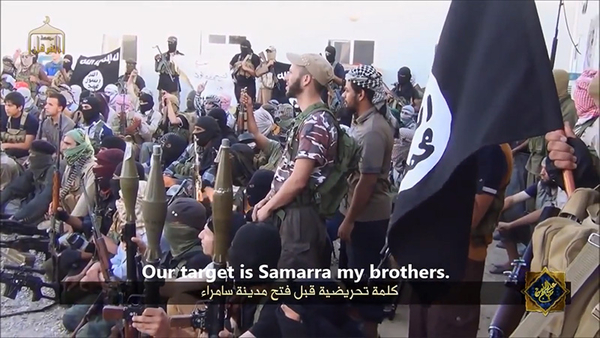
786Islamic State fighters receive a pre-battle briefing and sermon before their attack on Samarra, 125km north of Baghdad.

While the fall of the capital is certainly not imminent, IS’s strategy appears clear. Opposition forces will likely continue to tighten the noose around Baghdad in an attempt to create a sense of isolation. IS will avoid, for now, any large-scale assault on Baghdad for three reasons: it does not have the manpower; Shia militias outnumber enemy forces and will fight zealously to keep the Shia in control of the capital; and a major attack might cause remaining U.S. ground forces to become actively involved in the conflict.

One indicator that American forces might join the fight in a more serious way, if Baghdad appeared truly threatened, was the Pentagon decision on October 12 to employ Apache Attack helicopters against IS forces when they approached Baghdad International Airport. This week, on November 8, U.S. President Barack Obama also approved sending up to 1,500 more U.S. troops to Iraq, although stressing that that “would not be in combat.” The increase would raise the number of U.S. troops in Iraq to just under 3,000, or about eight times fewer than likely needed to re-salvage Iraq.

Meanwhile, fighting has come within two miles of the capital, with IS taking Abu Ghraib.

At present, the IS-led Sunni coalition appears determined to inculcate a feeling of despair among the capital’s Shia citizenry. The daily suicide bombing attacks in Shia neighborhoods must be taking a psychological toll. The suicide bombers are foreign fighters, mostly from North Africa. In the past few months alone, they have killed hundreds of Shia citizens. The operational planners of these assaults apparently know the layout of the capital, a familiarity that suggests they may have been former Baath Party military officers under the reign of Saddam Hussein.

The daily roadside bombs and car bombs are adding to the concern that the security situation in the capital is spiraling out of control. Moreover, there can be little doubt that some within the Sunni neighborhoods are giving logistical and intelligence support to the encircling IS. That intelligence certainly appears to have been available in the October 14 targeted killing of Baghdad’s pro-Iranian commander of the Badr Brigade, Ahmad al-Khafaji. Additional pro-Sunni elements probably have established a network of safe houses to support enemy infiltrators.

The day that the fate of Iraq as a united state irrevocably turned toward disintegration occurred in December 2013, when the largely Shia security forces stormed the Sunni protest camp in Anbar Province’s capital of Ramadi. Not even those tribal sheikhs who may have hoped for reconciliation with the Shia-led regime could reverse the process of permanent alienation. After former Iraqi Vice President Nouri al-Maliki’s fall from power on August 14, newly installed Prime Minister Haider al-Abadi has fared no better. Moreover, he seemingly has even less influence within the governing Shia coalition than al-Maliki originally possessed. He has moved too slowly, it seems, to reach out to Sunnis. Furthermore, with IS at the gates of Baghdad, the new administration did not name a new Minister of Defense and Interior until October 17.

The goal of IS’s siege strategy may be to create enough chaos in Baghdad to cause a mass exodus of its Shia population southward to the Shia provinces of Najaf and Karbala, thus ceding Baghdad to the Sunnis by default.

‘ISIS Sees Turkey as Its Ally’: Former Islamic State Member Reveals Turkish Army Cooperation

November 9, 2014

‘ISIS Sees Turkey as Its Ally’: Former Islamic State Member Reveals Turkish Army Cooperation

By Barney Guiton

Filed: 11/7/14 at 10:35 AM | Updated: 11/8/14 at 11:28 AM

via ‘ISIS Sees Turkey as Its Ally’: Former Islamic State Member Reveals Turkish Army Cooperation.

Read Omer’s full story: ‘It Was Never My Intention to Join ISIS’


Smoke rises from the Syrian town of Kobane, Turkish army tanks take position on the Turkish side of the border, October 8, 2014. Umit Bektas/Reuters


A former member of ISIS has revealed the extent to which the cooperation of the Turkish military allows the terrorist group, who now control large parts of Iraq and Syria, to travel through Turkish territory to reinforce fighters battling Kurdish forces.

A reluctant former communications technician working for Islamic State, now going by the pseudonym ‘Sherko Omer’, who managed to escape the group, told Newsweek that he travelled in a convoy of trucks as part of an ISIS unit from their stronghold in Raqqa, across Turkish border, through Turkey and then back across the border to attack Syrian Kurds in the city of Serekaniye in northern Syria in February.

“ISIS commanders told us to fear nothing at all because there was full cooperation with the Turks,” said Omer of crossing the border into Turkey, “and they reassured us that nothing will happen, especially when that is how they regularly travel from Raqqa and Aleppo to the Kurdish areas further northeast of Syria because it was impossible to travel through Syria as YPG [National Army of Syrian Kurdistan] controlled most parts of the Kurdish region.”

Until last month, NATO member Turkey had blocked Kurdish fighters from crossing the border into Syria to aid their Syrian counterparts in defending the border town of Kobane. Speaking to Newsweek, Kurds in Kobane said that people attempting to carry supplies across the border were often shot at.

YPG spokesman Polat Can went even further, saying that Turkish forces were actively aiding ISIS. “There is more than enough evidence with us now proving that the Turkish army gives ISIS terrorists weapons, ammunitions and allows them to cross the Turkish official border crossings in order for ISIS terrorists to initiate inhumane attacks against the Kurdish people in Rojava [north-eastern Syria].”

Omer explained that during his time with ISIS, Turkey had been seen as an ally against the Kurds. “ISIS saw the Turkish army as its ally especially when it came to attacking the Kurds in Syria. The Kurds were the common enemy for both ISIS and Turkey. Also, ISIS had to be a Turkish ally because only through Turkey they were able to deploy ISIS fighters to northern parts of the Kurdish cities and towns in Syria.”

“ISIS and Turkey cooperate together on the ground on the basis that they have a common enemy to destroy, the Kurds,” he added.

While Newsweek was not able to independently verify Omer’s testimony, anecdotal evidence of Turkish forces turning a blind eye to ISIS activity has been mounting over the past month.

Omer, the son of a successful businessman in Iraqi Kurdistan, initially went to Syria to join the Free Syrian Army’s fight against Bashar al-Assad, but found himself sucked in to ISIS, unable to leave. He was given a job as a communication technician, and worked at the ISIS communications bureau in Raqqa.

“I have connected ISIS field captains and commanders from Syria with people in Turkey on innumerable occasions,” said Omer.

“I rarely heard them speak in Arabic, and that was only when they talked to their own recruiters, otherwise, they mostly spoke in Turkish because the people they talked to were Turkish officials of some sorts because ISIS guys used to be very serious when they talked to them.”

Omer was then transferred to a battalion travelling to fight Kurdish forces in Serekaniya, north-eastern Syria, and describes travelling through Turkey in a convoy of trucks, staying at safehouses along the way, before crossing back into Syria at the Ceylanpinar border crossing.

Before crossing the border back into Syria, he says: “My ISIS commander reassured us once again that it was all going to be all right because cooperation had been made with the Turks. He frequently talked on the radio in Turkish.”

“While we tried to cross the Ceylanpinar border post, the Turkish soldiers’ watchtower light spotted us. The commander quickly told us to stay calm, stay in position and not to look at the light. He talked on the radio in Turkish again and we stayed in our positions. Watchtower light then moved about 10 minutes later and the commander ordered us to move because the watchtower light moving away from us was the signal that we could safely cross the border into Serekaniye.”

Once in Serekaniye, Omer says he surrendered to Kurdish forces when they attacked his camp. He was held for several months before his captors were convinced that he had not been a fighter in ISIS and had not taken part in violence.

Islamic State threat prompts new security warnings across U.S. military

October 31, 2014

Islamic State threat prompts new security warnings across U.S. military, Military TimesAndrew deGrandpreLance M. BaconJeff Schogol, October 30, 2014

bildeMilitary commands and individual service members are tightening up on security amid the growing threat posed by the Islamic State. (Tech. Sgt. Sandra Niedzwiecki / Air Force)

Perhaps the most chilling statement came from the Pentagon, where late last week officials with the building’s internal security force sent employees a memo calling service members and law enforcement officers “legitimate targets.” Such attacks, according to the memo, could involve knives, guns or bombs — and most likely would be perpetrated without warning. The memo cites unspecified sources within the intelligence and law enforcement communities.

****************

Military facilities around the U.S. are on alert, urging troops and their families to take precautions amid continued threats of violence from the Islamic State group.

The responses to that threat are being driven not just by the need to ensure protective measures are taken, but also to address increasing concerns being voiced by troops and family members who are worried about safety for their loved ones and themselves. It marks a shifting mindset, from one of full confidence that the military community was safe on its home turf to an unsettling sense that that is where they are newly vulnerable.

The Defense Department refuses to discuss the protective measures it has taken on behalf of the country’s 2.1 million service members, and to date Washington has not issued universal guidance. But many senior leaders and installation commanders are taking matters into their own hands, issuing clear warnings of the potential for “lone-wolf” style attacks like those carried out in mid-October on military personnel in Canada.

On Wednesday, for instance, the Marine Corps distributed a servicewide announcement instructing personnel to report “even the most minor suspicious activity” and to watch what they share on social media. Doing so, the message says, will help reduce the likelihood of an attack.

At MacDill Air Force Base in Tampa, Florida, officials with the 6th Air Mobility Wing took the Marine Corps’ warning a significant step further. Troops assigned to the base, home to the headquarters of U.S. Central Command and U.S. Special Operations Command, should downplay their military affiliation while in public. Uniforms, even military T-shirts and car bumper stickers, could put people at risk, it says.

‘Legitimate targets’

Perhaps the most chilling statement came from the Pentagon, where late last week officials with the building’s internal security force sent employees a memo calling service members and law enforcement officers “legitimate targets.” Such attacks, according to the memo, could involve knives, guns or bombs — and most likely would be perpetrated without warning. The memo cites unspecified sources within the intelligence and law enforcement communities.

“We disseminated this advisory, not because of a specific threat, but as a reminder for Pentagon employees to be vigilant at home, at work, during travel and in their communities, by using individual protective measures,” said Christopher Layman, a spokesman for the Pentagon Force Protection Agency.

At installations across the country, troops and their families are increasingly on edge, sources tell Military Times. “At least a third to half of my friends in the military spouse community have changed their last names on their Facebook profiles,” said Kristine, the wife of an active-duty Marine who, like other military spouses interviewed for this report, asked that her last name not be published.

“I have chosen to leave mine as it is, but I did change my profile picture to one which doesn’t show any military association,” she said.

Bonny, spouse of an Air Force crew chief, acknowledged feeling “scared to death” by recent communication from her husband’s command at Langley Air Force Base along the Virginia coast. They have since attended a commander’s call and a meeting with leaders in the Key Spouses program. Officials told the families gathered that they could not give details on the severity of the threat but recommended they shut down social media accounts.

While it was an initial consideration, “we came to the decision that we are not going to live our lives in fear over this,” Bonny said. She and her family opted instead to max out privacy settings, remove military and location references and teach their kids to be especially careful on social media, which the parents closely monitor.

A bigger problem for her is soothing the fears of other loved ones. “Our families and friends are worried more than us, probably because we are accustomed to threats, and extremely upset that they have to lose social media ties,” Bonny said. “For military families that’s huge because of distance.”

Distance of a different kind is an issue for Brandon, a sailor whose wife also serves on active duty.

“I am not scared for myself. I’ve got the man upstairs, along with 2,000 rounds and six weapons fighting on my side,” he said. “I am only scared for those times I am on duty and my wife and daughter are alone.”

Brandon said he takes seriously the threat posed by the Islamic State. He taught his wife how to shoot weapons and they both carry sidearms wherever they go. They deleted social media accounts, as well.

“It made me realize how ridiculously accessible we are through Facebook,” he said. “Little stuff like shutting that off gets you off the map. This terrorist group is organized and they are not dumb. I would not second-guess them at all.”

Ramping up precautions

Select Navy commands also issued warnings as airstrikes against Islamic State targets in Iraq and Syria, many carried out by Navy warplanes flying from aircraft carriers in the Persian Gulf, ramped up in October. Officials in Jacksonville, Florida, and Norfolk, Virginia, have encouraged sailors and their families to guard against common operational security mistakes like posting personnel rosters or scheduled ship movements.

And while the response varies from base to base and service to service, online safety is a consistent theme. Spokespersons for three Army posts — Fort Hood, Texas, Fort Bragg, North Carolina, and Fort Belvoir, Virginia — each said their installations had adopted no additional security measures. Yet a recent directive published by the Army Threat Integration Center calls on troops to disable mobile apps that track their whereabouts and to avoid posting anything on social media that reveals where their kids attend school or would otherwise allow someone to know ahead of time where they’ll be.

Kristine, who runs a family support site called USMC Life, has a substantial digital presence. Her site’s Facebook community alone has more than 200,000 followers. In recent days she rechecked her privacy settings to ensure her personal profile is locked down, and she’s purged from her website the last names of her staff members.

Even so, Kristine downplayed the risk associated with one’s digital footprint, saying it would take considerable effort to target someone electronically. Military officials are using these threats as an opportunity to compel people to behave more responsibly online, she said.

“There’s a larger chance of the Islamic State targeting us through random acts of violence around local military installations, or by following people’s cars by tracking DoD stickers, or additional military decals on their vehicles,” she said. “For me, this is just one more reason to move to 100-percent ID scan at the gate and ditch the military decals on our cars.”

The growing sense of troops and family members as individual targets owes not just to domestic concerns but also to recent incidents overseas, such as a bold Islamic State kidnapping plot in Turkey that raised questions about safety for the thousands of troops and family members stationed in that country.

Earlier in October, U.S. military officials in Europe told local-level commanders they should consider instructing troops not nor wear their uniforms off base.

And inside a week in the same month, two Canadian soldiers were killed in separate attacks by individuals believed to be terrorist sympathizers.

Military Upset with White House ‘Micromanagement’ of ISIS War

October 31, 2014

Military Upset with White House ‘Micromanagement’ of ISIS War, Daily BeastJosh RoginEli Lake, October 31, 2014

(The impatient (non-Islamic) Islamic State seems unwilling to play “dither along with us” with the Obama Administration while awaiting news that the You Tube video which caused the entire mess has been taken down and its creator suitably punished. Please see also U.S. strategy against Islamic State hits major hurdles. — DM)

1414748715741.cached

[M]ilitary officers and civilian Pentagon leaders tell The Daily Beast, is the ISIS war’s decision-making process, run by National Security Advisor Susan Rice. It’s been manic and obsessed with the tiniest of details. Officials talk of sudden and frequent meetings of the National Security Council and the so-called “Principals Committee” of top defense, intelligence, and foreign policy officials (an NSC and three PCs in one week this month); a barrage of questions from the NSC to the agencies that create mountains of paperwork for overworked staffers; and NSC insistence on deciding minor issues even at the operational level.

“We are getting a lot of micromanagement from the White House. Basic decisions that should take hours are taking days sometimes,” one senior defense official told The Daily Beast.

*****************

The Pentagon brass placed in charge of implementing Obama’s war against ISIS are getting fed up with the short leash the White House put them on.

Top military leaders in the Pentagon and in the field are growing increasingly frustrated by the tight constraints the White House has placed on the plans to fight ISIS and train a new Syrian rebel army.

As the American-led battle against ISIS stretches into its fourth month, the generals and Pentagon officials leading the air campaign and preparing to train Syrian rebels are working under strict White House orders to keep the war contained within policy limits. The National Security Council has given precise instructions on which rebels can be engaged, who can be trained, and what exactly those fighters will do when they return to Syria. Most of the rebels to be trained by the U.S. will never be sent to fight against ISIS.

Making matters worse, military officers and civilian Pentagon leaders tell The Daily Beast, is the ISIS war’s decision-making process, run by National Security Advisor Susan Rice. It’s been manic and obsessed with the tiniest of details. Officials talk of sudden and frequent meetings of the National Security Council and the so-called “Principals Committee” of top defense, intelligence, and foreign policy officials (an NSC and three PCs in one week this month); a barrage of questions from the NSC to the agencies that create mountains of paperwork for overworked staffers; and NSC insistence on deciding minor issues even at the operational level.

“We are getting a lot of micromanagement from the White House. Basic decisions that should take hours are taking days sometimes,” one senior defense official told The Daily Beast.

Other gripes among the top Pentagon and military brass are about the White House’s decision not to work with what’s left of the existing Syrian moderate opposition on the ground, which prevents intelligence sharing on fighting ISIS and prevents the military from using trained fighters to build the new rebel army that the President has said is needed to push Assad into a political negotiation to end the conflict.

The New York Times reported Wednesday that Defense Secretary Chuck Hagel himself is among the critics of Obama’s strategy in Syria. Hagel wrote a memo last week to National Security Advisor Susan Rice warning that Obama’s Syria strategy was unclear about U.S. intentions with respect to Syrian President Bashar al Assad, undermining the plan.

Hagel stood by the memo Thursday. “We owe the president and we owe the National Security Council our best thinking on this. And it has to be honest and it has to be direct,” he told reporters.

But the top uniformed military leaders in charge of the operation are also struggling to work around the White House policy constraints and micromanagement, including Joint Chiefs Chairman Gen. Martin Dempsey, Gen. Lloyd Austin, commander of CENTCOM, and Gen. Michael Nagata, the SOCOM lead official in charge of the Syrian train and equip program, according to multiple officials and persons briefed by those generals.

Nagata has been tasked to build a new rebel army from scratch but is not permitted to work with existing brigades, meaning he must find and vet new soldiers, mostly sourcing from Syrian refugee camps in Turkey, Jordan, and Lebanon. What’s more, the size of the program will produce only 5,000 fighters a year after the training begin, most of whom who will serve as “local defense forces” and not actually go after ISIS, according to two officials briefed on the plan. Of those forces, 500 would be given additional training in “counterterrorism.” That’s a small attack force to face an ISIS military that is estimated to have tens of thousands of fighters.

Dempsey told reporters Thursday that the recruiting and vetting of soldiers for the new Syrian rebel army has not yet begun, although sites for the training camps have been chosen.

“At this point we still don’t know how long it’s going to take to send in the trained guys,” a senior Defense official said. “The situation is changing so much on the ground it’s hard to plan it out.”

Dempsey has twice made public statements that seemed to reveal his dissatisfaction with the White House policy. Last month, he said it would take 12,000 to 15,000 ground troops to effectively go after ISIS in Iraq and Syria. Earlier this month, he suggested that U.S. ground troops might be necessary to fight ISIS in the future, a comment he later walked back.

Many military officials, including at CENTCOM’s headquarters in Tampa and their air base in Qatar (where the ISIS air campaign is run) are barred from even communicating with Syrian opposition representatives unless those rebels are on a White House / State Department approved list. Many Syrian opposition leaders complain that Free Syrian Army brigades fighting ISIS now are offering help in making the ISIS strikes effective, but are getting no response from the administration.

The international coalition against ISIS, led on the U.S. side by retired Gen. John Allen and State Department official Brett McGurk, is working with Sunni tribes in Iraq to coordinate against ISIS. But they are not working with the corresponding tribes on the Syrian side of the mostly non-existent Iraq-Syria border. ISIS has slaughtered hundreds of these tribesmen in Eastern Syria who refused to yield to the group’s demands.

Meanwhile, the Free Syrian Army, largely written off by the White House, has been suffering heavy losses to ISIS as well as to the al-Qaeda affiliated al Nusrah Front, which has opened up a third fighting front against the FSA in cities like Idlib. FSA brigades that have been vetted by the U.S. government, including the Syrian Revolutionaries Front and Harakat Hazm, have seen their non-aggression pact with al Nusrah disappear.

“Al Qaeda has captured a number of villages from the FSA in Idlib and the fighting continues to be intense. The FSA needs urgent Coalition support in this fight because if Al Qaeda captures Jabal al-Zawiyeh in Idlib, extremists will be positioned to cut off a critical line of supply from the Turkish border,” said Oubai Shahbandar, advisor to the Syrian National Coalition. “So the question is: Will Coalition airstrikes help the FSA fight al Qaeda or will they allow Al Qaeda to overrun moderate forces?”

NSC Spokeswoman Bernadette Meehan declined to comment on the criticisms coming from the Pentagon and military about the White House’s approach to ISIS and training the Syrian rebels. But on Wednesday, Deputy National Security Advisor Tony Blinken, who is rumored to be Obama’s choice to replace Bill Burns as Deputy Secretary of State, defended the White House strategy but said that FSA is just not a viable partner.

“For more than two years working with and supporting the moderate opposition, we’ve made some gains in making it more effective and trying to position it as a counterweight to Assad.  Now we’re intensifying that support,” he said at the Carnegie Endowment for International Peace. “The coalition can do real damage to ISIL through the air. But without forces on the ground to hold territory from which ISIL has been removed, we will not be able to shrink and eventually eliminate the safe haven.”

Secretary of State John Kerry said Thursday that there is no military solution to the Syria crisis and said the U.S. is reaching out to countries like Russian and Iran to seek a new political negotiation. Syrian National Coalition President Hadi al Bahra told The Daily Beast last month that there is no genuine interest in the West for a new political process, which he described as being “in a coma.”

“There have been so many things said on Syria that were not delivered, nobody thinks the President really wants to do anything on Syria. Even currently serving officials realize that you cannot bomb your way out of this and you need to have a plan for a political solution, but we don’t have it,” said Andrew Tabler, senior fellow at the Washington Institute for Near East Policy. “There’s needs to be a fully thought out strategy with a political dimension that involves the opposition. If you don’t do that, you can’t solve this problem.”

It’s official: U.S. will build new Syrian rebel force to battle Islamic State

October 16, 2014

It’s official: U.S. will build new Syrian rebel force to battle Islamic State, McClatchy DC, Hannah Allam, October 15, 2014

(Phase Two of “Operation We Got It Wrong Again.” Will Kurds or newbies be supplied, equipped and trained? By whom will the “moderates” be vetted and trained? By now focusing on the Syrian political opposition, will we be distancing ourselves from Assad’s supporter Iran?– DM)

Airstrike KobaniSmoke rises following an airstrike by US-led coalition aircraft in Kobani, Syria, during fighting between Syrian Kurds and the militants of Islamic State group, Oct. 9, 2014. (AP Photo/Lefteris Pitarakis)

This time, Allen said, the United States and its allies will work to strengthen the political opposition and make sure it’s tied to “a credible field force” that will have undergone an intense vetting process.

******************

— John Allen, the retired Marine general in charge of coordinating the U.S.-led coalition’s response to the Islamic State, confirmed Wednesday what Syrian rebel commanders have complained about for months – that the United States is ditching the old Free Syrian Army and building its own local ground force to use primarily in the fight against the Islamist extremists.

“At this point, there is not formal coordination with the FSA,” Allen told reporters at the State Department.

That was perhaps the bluntest answer yet to the question of how existing Syrian rebel forces might fit into the U.S. strategy to fight the Islamic State. Allen said the United States’ intent is to start from scratch in creating a home-grown, moderate counterweight to the Islamic State.

For most of the three years of the Syrian conflict, the U.S. ground game hinged on rebel militias that are loosely affiliated under the banner of the Free Syrian Army, or FSA. Their problems were no secret: a lack of cohesion, uneven fighting skills and frequent battlefield coordination with the al Qaida loyalists of the Nusra Front.

This time, Allen said, the United States and its allies will work to strengthen the political opposition and make sure it’s tied to “a credible field force” that will have undergone an intense vetting process.

“It’s not going to happen immediately,” Allen said. “We’re working to establish the training sites now, and we’ll ultimately go through a vetting process and beginning to bring the trainers and the fighters in to begin to build that force out.”

The Syrian arena is important, Allen said, but to the U.S., “the emergency in Iraq right now is foremost in our thinking.” There will be a simultaneous training-and-equipping campaign for Iraq, where the U.S.-trained military collapsed during the Islamic State’s summer offensive.

Allen said the new training program is “for those elements of the Iraqi national security forces that will have to be refurbished and then put back into the field,” with the ultimate goal of reclaiming Iraqi territories seized by the Islamic State.

Allen sounded confident that the United States and its allies could juggle two massive training efforts even as the Islamic State has shown itself to be resilient under weeks of coalition airstrikes.

“We have the capacity to do both, and there is significant coalition interest in participating in both,” Allen said of the twin force-building efforts in Iraq and Syria.

But, as he stressed repeatedly in his remarks, “it’s going to take a while.”

Ahmad Tomeh, who was just re-elected prime minister of the Syrian opposition’s interim government, told McClatchy that Allen met six leaders of the political opposition during his trip to Istanbul last week, but had no talks with any of the ground commanders, including the vetted, trained commanders the U.S. has been supporting. They asked for increased help, Tomeh said, but got no commitment.

‘Inherent Resolve’: Military campaign against ISIS gets a name

October 15, 2014

‘Inherent Resolve’: Military campaign against ISIS gets a name, Fox News, October 15, 2014

(How about naming the enemy, Islamism? That would not be suitably multicultural. Here are some of the names for the U.S. military operation suggested by Foreign Policy Situation Report readers (via e-mail):

The response to my request for names of the US mission against IS was overwhelming. It’s hard to draw any conclusions from the names offered, but I will say this: SitRep has an engaged, intelligent and global audience (I got responses from all over the world), and the names offered up show a huge disparity in opinion. Some show resolve, while others reflect a growing criticism – one might say cynicism – of Obama’s strategy. Some of the best are below; email me if you’d like to receive the full list.

Operation Empty Chair; Operation Oops, Sorry About That; Operation Good Intentions; Operation Seriously?  Again?; Operation Passive-Aggressive; Operation Coalition of the Dragged Kicking and Screaming; Operation Did I Leave My Keys Here?; Operation Slam Dunk; Operation IS you IS, or IS you Ain’t? Operation Syri-ous about Iraqi Freedom; and Operation Iraqi Freedom 2: Electric Boogaloo.

Make sense. How about “Inherent Dithering?” — DM)

ff_isis_101514US strategy failing as ISIS militants march on

More than two months after the U.S. first launched airstrikes against the Islamic State, the military mission has a name: “Inherent Resolve.”

A senior military source confirmed to Fox News that “Inherent Resolve” officially has been chosen as the title of the operation.

The name comes after questions were raised about why the administration had not named a mission that has escalated to involve several coalition partners and hundreds of airstrikes in both Iraq and Syria.

As of Sunday, the U.S. had conducted nearly 400 strikes in both countries. The number has risen since then – on Wednesday, the U.S. military said it launched another 18 airstrikes overnight near the contested Syrian city of Kobani, intensifying an air campaign against Islamic State militants’ efforts to capture the city near the Turkish border.

Why the mission was not named until now is unclear.

Every U.S. military intervention since the invasion of Panama in 1989, code-named Operation Just Cause, has had a name.

Even the operation to combat Ebola in West Africa was given an operational name the same day it was announced: Operation United Assistance.

An unnamed Defense official was quoted in a recent Wall Street Journal report suggesting the administration was reluctant to name the anti-ISIS mission because: “If you name it, you own it. … And they don’t want to own it.”

But Pentagon spokesman Rear Adm. John Kirby rejected that claim.

He said earlier this month that officials were considering a potential title. Kirby explained that one reason for waiting to name the operation has to do with the complex evolution of the mission.

ISIS: Can the West Win Without a Ground Game?

October 10, 2014

ISIS: Can the West Win Without a Ground Game? Middle East Forum, Jonathan Spyer, October 2014

(It should be (but appears not to be) obvious to our “leaders” that before we have a chance of “winning” the fight against the Islamic State, et al, we need to define “win” and to decide who are our allies and who are our enemies. That has not yet happened. As to ground troops, how many will we need to do what and where? Those questions need to be answered as well, based largely on answers to the first set of questions. — DM)

[A] lack of strategic understanding of the nature of the conflict being waged is preventing the development of a coherent response to the specific problem of the Islamic State, along with the parallel problems of Shia terror groups such as Hezbollah, and the ambitions of the Islamic Republic of Iran. At root is the failure to grasp the implacable nature of political Islam in both its Sunni and Shia variants at the present time.

From this original error, all further errors, and as we can see there are many, inevitably follow.

**********************

The United States and its allies have launched a military campaign whose stated goal is, in the words of President Barack Obama, to “degrade and ultimately destroy” the Islamic State (I.S., also known as ISIS or ISIL) established by Sunni jihadis in a contiguous land area stretching from western Iraq to the Syrian-Turkish border.
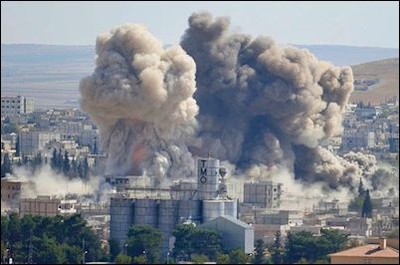
686Smoke rises from a U.S. air strike on Islamic State positions in Kobani.

As the aerial campaign begins in earnest, many observers are wondering what exactly its tactical and strategic objectives are, and how they will be achieved. A number of issues immediately arise.

Any state—even a provisional, slapdash, and fragile one like the jihadi entity now spreading across Iraq and Syria—cannot be “destroyed” from the air. At a certain point, forces on the ground will have to enter and replace the I.S. power. It is not yet clear who is to play this role—especially in the Islamic State’s heartland of Raqqa province in Syria.

In Iraq, the national military and the Kurdish Pesh Merga are now having some successes at chipping away at the Islamic State’s outer holdings. The role of U.S. air support is crucial here. But the center of the Islamic State is not Iraq, and both the Iraqi forces and the Pesh Merga have made clear that they will not cross the border into Syria. This leaves a major question as to who is to perform this task, if the objectives outlined by President Obama are to be achieved.

The answer we have heard most often of late is that elements among the Syrian rebels will be vetted by the U.S., trained in cooperation with the Saudis, and then deployed as the force to destroy the IS on the ground.

If this is indeed the plan, it is deeply problematic.

The Syrian rebels are characterized by extreme disunity, questionable effectiveness, and the presence of hardline Sunni Islamist elements among their most committed units. There are certainly forces of an anti-jihadist ideology among them—the most well-known being the Syrian Revolutionaries Front, headed by Jamal Ma’arouf from the Jebel Zawiya area in northern Syria, and the smaller Harakat Hazm. Both movements have benefitted from Western aid in recent months.

The problem, however, is that these organizations are quite prepared to work with salafi groupings whose worldview is essentially identical to that of the I.S., even if their methods are somewhat different. Thus, if we observe the recent fighting between Assad’s forces and rebels in the Quneitra area along the border with the Israeli Golan Heights, it is clear that the main contribution to rebel achievements came from the Jabhat al-Nusra group, which constitutes the “official franchise” of the core al-Qaeda group in Syria.

Reliable sources confirm that Nusra cooperates with other rebel groups in southern Syria and has even been prepared to minimize its own role, so as to allow other groups to present achievements as their own to Western and Arab patrons and thus secure a continued flow of arms, benefiting all factions.

What this means is that by championing these rebel elements as the ground force which will seek to enter and destroy a weakened I.S. in Raqqa province, the U.S. would be putting itself in the position of supporting one group of Sunni jihadis against another.

In Iraq, while the Kurdish Pesh Merga cooperates de facto with Iran, their alliance is pragmatic and tactical, one that the Kurds would gladly break given the possibility of clear Western sponsorship.

But the fierce condemnations in recent days (even by supposedly “pro-Western” rebel groups such as Hazm) of the U.S. bombing raids into Syria indicate that there is a deeper problem here. The alliance between these Sunni rebel groups and the salafis has a common anti-Western component to it.

It is, in any case, not clear if these Sunni rebels will prove able to defeat the I.S., but even if they were to do so, the presence of radical anti-Western elements among them attests to the danger of a policy of support and sponsorship of them.

Of course, the Sunni jihadis are not the only dangerous players on the ground. Another possible, no less troubling, outcome of the air campaign against the Islamic State could be the return of Bashar al-Assad’s forces to eastern Syria, from which they have been largely expelled over the last year. It is not at all hard to imagine a scenario in which once the I.S. has been weakened by Western air attacks, the Syrian military and its Iranian-backed allies will be able to make gains.

Indeed, the Iranian Revolutionary Guard Corps (IRGC) are already present in northern Iraq (and, of course, in Syria as well) and IRGC personnel have taken part in the fighting in Iraq in recent weeks. Qods force teams are reportedly located at Samarra, Baghdad, Karbala, and the former al-Sahra Air Base near Tikrit. Iran has deployed seven SU-25 ground attack aircraft which have played a role in offering air support to the Kurds and Iraqi special forces.

Following intensive Western bombing, the possibility of the Islamic State eventually being sandwiched between pro-Iranian forces on either side before being destroyed would be a real one. This would achieve the desired goal of destroying the jihadi entity, but it could end up handing a major victory to the Assad regime and its Iranian backers—enemies of the West of significantly greater potency and seriousness than the Islamic State itself.

Such a result would be somewhat reminiscent of the Iraq invasion of 2003, in which the destruction of the Sunni regime of Saddam Hussein ended up largely helping Iran.

How does the West get out of this mess? The discussion about which ground force should be used to replace the Islamic State is itself confused by a much larger misunderstanding regarding the nature of the war now taking place in Iraq and in Syria (and periodically spilling over into Lebanon).

The I.S. has now been depicted as the main problematic factor emerging from this conflict. But the Islamic State is in fact merely a particularly extreme and brutal manifestation of a broader process taking place in this area, in which political Islam of a Sunni variety is at war with the Shia political Islam of Iran and its proxies (especially Hezbollah and the Assad regime).

The I.S. may promote a particularly lurid and repulsive version of Sunni political Islam, but in its beliefs and in its practices it does not represent some unique presence in the Syrian and Iraqi context. Rather, it is little more than a particularly virulent manifestation of a strain of politics and ideology which is the primary cause of the conflict taking place across the region.

In the two scenarios discussed above, both quite plausible outcomes of a Western air campaign, the I.S. would be defeated and replaced by another version of Islamism—either that of its fellow Sunnis, or that of the rival Shi’ites.

A third possibility, however, is that the White House does not actually intend to pursue a policy intended to physically destroy the Islamic State in its heartland in northern Syria. Certainly, more recent statements emerging from the Administration appear to be preparing to “walk back” the President’s comments.

White House Chief of Staff Denis McDonough said in mid-September that success for U.S. policy vis-à-vis the I.S. would come when the group “no longer threatens our friends in the region, no longer threatens the United States.” This sounds like the introduction to a more modest policy of degrading I.S. capabilities, rather than seeking to “destroy” the Islamic State.

Of course, such a modified objective would end the dilemma over which ground forces to ally with. On the other hand, it would also have the effect of a tacit admission that the U.S. did not intend to promote its policy as originally stated by the President in the aftermath of the horrific murder of two U.S. citizens by the Islamic State.

But whether or not the goal of destroying the Islamic State is pursued with vigor, the current failure to see accurately what is happening in the Levant and Mesopotamia looks set to remain. This, in turn, looks set to prevent the emergence of a coherent policy and a coherent allocation of resources.

What is taking place across Syria and Iraq, and across their borders into Lebanon, Turkey, and Iran, is a sectarian war, made possible because of the decline of the police states which for half a century kept the lid on sectarian differences. The regional ambitions of Iran, which has clients and proxies in all three countries, exacerbate this dynamic. The attempts by Saudi Arabia to block Iran’s advance toward the Mediterranean, and by Qatar and Turkey to sponsor various Sunni jihadi elements, have produced a far more confused, and far less effective, Sunni side in this struggle.

The struggle itself, in turn, can be traced back to the failure by these states to develop coherent notions of citizenship or stable national identities in the post-Ottoman period. In other words, this war has been a long time coming, but now it is here.

Because the nature of this struggle is not widely grasped in the West, policy appears somewhat rudderless. This is reflected in the current discussion regarding the response to the Islamic State.

First, Assad was the enemy. This was made clear enough not only by his support for Hezbollah and attempts to nuclearize, but also by his unspeakable brutality and use of chemical weapons against his own citizens.

Then, when the brutality of some of the rebels became apparent, Western public interest in supporting the rebels receded. Soon the I.S. emerged as the new bogeyman. Declarations for its destruction became de rigueur, though it is far from clear how this is going to be carried out—and a de facto alliance with Iran and its clients, at least in Iraq, has emerged. This was seen in the expulsion of the I.S. from the town of Amerli, a pivotal moment in the major setbacks faced by the organization in recent days. In that town, Shi’ite militias were backed by American air power—to telling effect against the Sunni jihadis.

But is it really coherent policy to be backing murderous Shi’ite sectarians against murderous Sunni ones? It is not. Of course, when the West backs the Sunni rebels in Syria, the precise opposite is happening. Weaponry donated to “moderate” rebels then inevitably turns up in the hands of Sunni jihadis, who do most of the fighting associated with the Syrian “rebellion.” The result is that in Iraq the U.S. is helping one side of the Sunni-Shia war, and in Syria it’s helping the other side.

Only when it is understood that the West cannot partner with either version of political Islam does it become possible to formulate a coherent policy toward the Sunni jihadi forces, on the one hand, and toward the Iran-led bloc, on the other.

Such a policy must rest on the identification and strengthening of non-Islamist forces willing to band together and partner with the West. Not all of them are perfect characters, but they all understand the threat that political Islam poses.

Most obviously, there is a line of pro-American states along the southern side of the arena of the war. These are Israel, Jordan, and in a far more partial and problematic way, Saudi Arabia. Both Israel and Jordan have demonstrated that they are able to successfully contain the spread of the chaos coming out of the north. Both are well-organized states with powerful militaries and intelligence structures. Jordan has clearly benefitted from the deployment of U.S. special forces to prevent incursions by the I.S. Israel has also made clear that its resources will be available to assist the Jordanians should this be required. (Egypt, too, while not in the immediate vicinity of the conflict, can be a silent partner as well—as its campaign against the Muslim Brotherhood and tough line against Hamas have shown, it is nothing if not a virulent opponent to political Islam.)

This is what the proper coordination of allied states is supposed to look like. And it works in containing the conflict. To the east of the war’s arena is of course Iran. To its west is the Mediterranean Sea. To its north is a long, contiguous line of Kurdish control, shared between the Kurdish Regional Government of President Massoud Barzani in northern Iraq, as well as the three enclaves created by the PKK-linked Democratic Union Party (PYD) in northern Syria. The YPG militia, which is the military force in these enclaves, has fought the I.S. almost since its inception, and has largely prevailed in keeping the jihadis out of the Kurdish areas.

As part of a strategy of containment, the West should increase support for and recognition of both the Kurdish enclaves in the north of Syria and the Kurdish Regional Government itself. Both are elements capable of containing the spread of the jihadis from the north. It has become clear in recent days that the Pesh Merga, despite early setbacks, is a useful instrument in preventing the further advance westward of the Islamic State, and in so doing protecting the investment of international oil companies in the oil-rich parts of Iraq. The YPG militia, though poorly equipped, has also avoided major losses.

Such a principle of alliance will also encourage the West to reconsider the involvement of Turkey. As events of the last few years have shown, Turkey cannot be a reliable ally in the struggle against political Islam, because its ruling party, AKP, is itself an Islamist party. This is not a theoretical formulation. Turkey’s support for Islamist militias in northern Syria and its opening of its border for them has been a major contributing factor in the proliferation of these elements. There is also considerable evidence that Turkey at the very least turned a blind idea to the activities of the I.S. in the border area in 2013, and may well have offered some help to the jihadis in their fight with the YPG.

In order to grasp the rationale for a policy of dual containment, the nature of the war between rival sectarian forces must be grasped. There is also a need for the clear understanding that the effort to preserve at all costs the territorial integrity of “Iraq” and “Syria” is mistaken. Rather, what should take place is support for those forces committed to order, as listed above, and non-support for the forces of political Islam.

In other words: If political Islam (rather than one specific jihadi group, to quickly be replaced by another) is the real problem, then the real solution is to ally, forcefully and over the long haul, with those forces most committed to stopping it: Israel, Jordan, the Saudis, and the Kurds.

So it may be seen that a lack of strategic understanding of the nature of the conflict being waged is preventing the development of a coherent response to the specific problem of the Islamic State, along with the parallel problems of Shia terror groups such as Hezbollah, and the ambitions of the Islamic Republic of Iran. At root is the failure to grasp the implacable nature of political Islam in both its Sunni and Shia variants at the present time.

From this original error, all further errors, and as we can see there are many, inevitably follow.
Changing only our rules of engagement won’t help much – Updated October 6th

October 6, 2014

Changing only our rules of engagement won’t help much – Updated October 6th, Dan Miller’s Blog, October 6, 2014

(The rather “defeatist” views expressed here are mine and do not necessarily reflect those of Warsclerotic. — DM)

I posted this article from Israel Hayom at Warsclerotic, of which I am an editor. The article argues that to fight the Islamic State we need to change our rules of engagement. The parenthetical comment at the top of the Warsclerotic post is mine and is reproduced below.

(Could the U.S. and her allies put effective boots on the ground, or have the boots and the nation become too multiculturally damaged to do what needs to be done? More than the rules of war needs to change.

When the U.S. responded to the Russian supplied, trained and initially led North Korean invasion on June 25, 1950, we had been at peace for only five years. We were tired and wanted peace to continue but war came to us unexpectedly; it should have been expected. Our peacetime boots were badly supplied, trained and, more often than not, led. Some but not enough officers and senior noncoms had experienced war and knew what to do. Very few in the lower enlisted ranks had or did and “bug out” became a much used phrase. The NK troops had been hardened in combat, were adequately supplied, well trained and well led. Those who did not fight were executed. They pushed us back nearly to Pusan. By mid-September, we had more better led and trained troops; they had also become very angry at the NK troops, and intense anger is a powerful force multiplier. The NK tide was reversed, for a couple of years.

Were we now to try to put green boots on the ground to do what is necessary against well trained, led and financed Islamic troops, a  majority  of the public would oppose it and it would be politically unpopular. Were we to put boots on the ground anyway, they would likely need to undergo lengthy and deadly immersion-style baptism by fire. There would be substantial casualties and the opposition would increase.

Should we do it anyway if only the rules of engagement change? Can we, or is that now a fantasy? — DM)

Can the Obama Nation field a well trained, led and supplied contingent, of adequate size, to defeat the “non-Islamic” Islamic State, its cohorts and friends? Or are we too multicultural and decadent? Is our multicultural focus more on such nonsense as, for only one example, “gender equality” in the military than on winning wars?

I have few if any concerns about real gender equality. Kurdish women fighting against the Islamic State have disabused me of most that I once had. Please watch the video embedded below. One of the commanders was asked why she joked and smiled when around her troops. She answered, “I have to in order to keep their morale high.” That is a statement one would expect from a seasoned and competent commander.

However, when politically correct gender “equality” means that military training and other standards are lowered so that young ladies can serve, it becomes gender inequality and diminishes the effectiveness of our military. It would be only slightly less absurd, and only slightly less dangerous — to them and to those around them — to send such green “boots” on the ground into combat wearing high heel shoes and carrying only their purses.

Compare the Kurdish women fighters to this specimen of our deranged, multicultural and politically correct society:

Back to the Korea “police action:” President Truman had served in World War I as an artillery battery commander and rose to colonel in the reserves. Although a far from perfect Commander in Chief, he knew more about war than Obama could ever learn. Obama has no desire to learn; the “smartest person” in any room, He commonly ignores advice from those who have learned. Truman knew about the need for good military discipline, Obama has very little discipline himself and does not.

We fared poorly during the June 25 through mid-September period in South Korea. Could we now expect green boots on the ground to do even as well if plucked from a peaceful, multicultural environment and sent to fight against the Islamic State, et al, no less brutal than were the North Korean and later Chinese forces? Is there sufficient reason to try, now, even though our “kinetic activity” can not be successful with air power alone?

Do we even know the enemy, when Obama and others continue to refer to Islam as the “Religion of Peace” and praise its contributions to American culture? From Obama’s 2014 Eid Greeting:

While Eid marks the completion of Ramadan, it also celebrates the common values that unite us in our humanity and reinforces the obligations that people of all faiths have to each other, especially those impacted by poverty, conflict, and disease.

In the United States, Eid also reminds us of the many achievements and contributions of Muslim Americans to building the very fabric of our nation and strengthening the core of our democracy. [Emphasis added.]

When the Islamic State is erroneously deemed non-Islamic? When we continue to label Islamic terrorism at home as “workplace violence?” When, shortly after the recent Oklahoma beheading by an Islamist, Obama sends a special messenger from the White House to deliver a belated note of thanks to the mosque he attended for “helping rebuild the Moore community after a destructive tornado tore through the city in 2013.” [Emphasis added.]

Your service is a powerful example of the powerful roots of the Abrahamic faiths and how our communities can come together with shared peace with dignity and a sense of justice,” President Barack Obama said.

The Imam, the leader of the prayer service, stated during his sermon that the Muslim faith has been called a “cancer that needs to be cut off from the American society.

It seems unlikely, at best, that we — or at least too many of us — know the enemy that cannot be named.

According to the linked Israel Hayom article,

Islamic State is not an organization that can be defeated with slow, uncertain, limited action. It cannot be defeated without “boots on the ground.” It is imperative to hit them with force; with waves of growing intensity. They must be attacked continuously, without breaks, without cease-fires and with the utmost determination. [Emphasis added.]

I agree, and wish that we could field a fighting force of that caliber to move quickly and effectively, before too many get clobbered and before we have to bring them all home, many in body bags. We seem less able to do that now than we were during the opening months of the “police action” in Korea. Since we can’t defeat the Islamic State, et al, with “slow, uncertain, limited action,” can we dispatch boots in the tens of thousands to do the job effectively? For the reasons suggested above, that seems even less likely.

Unfortunately, fantasy now trumps reality; until that changes, we should not send green boots into combat; we have few others to send. We. Are. Screwed.


Iran Orders Elite Troops: Lay Off U.S. Forces in Iraq

October 6, 2014

Iran Orders Elite Troops: Lay Off U.S. Forces in Iraq, Daily BeastEli Lake, October 6, 2014

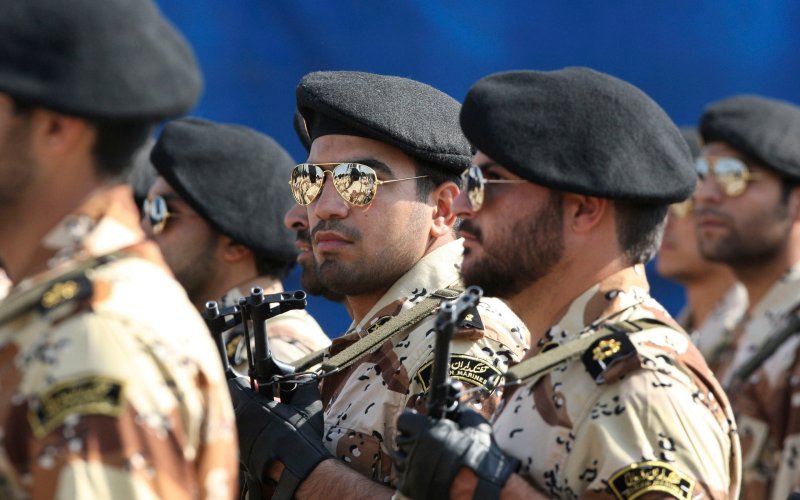
Quds forcesVahid Salemi/AP

U.S. intelligence officials tell The Daily Beast that the apparent Iranian decision not to target American troops inside Iraq reflects Iran’s desire to strike a nuclear bargain with the United States and the rest of the international community before the current negotiations expire at the end of November.

“They are not going after Americans,” one senior U.S. intelligence official told The Daily Beast familiar with the recent assessments. “They want the nuclear talks to succeed and an incident between our guys and their guys would not be good for those talks.”

******************

The last time Iranian and American forces were in Iraq, the two sides quietly fought each other. Now Iran’s Quds Force officers in Iraq are purposely leaving the Americans alone.

Pay no attention to the Shi’ite militias threatening to kill U.S. troops in Iraq. The elite Iranian forces backing those militias have been ordered not to attack the Americans.

That’s the conclusion of the latest U.S. intelligence assessment for Iraq. And it represents a stunning turnaround for Iran’s Quds Force, once considered America’s most dangerous foe in the region.

U.S. intelligence officials tell The Daily Beast that the apparent Iranian decision not to target American troops inside Iraq reflects Iran’s desire to strike a nuclear bargain with the United States and the rest of the international community before the current negotiations expire at the end of November.

“They are not going after Americans,” one senior U.S. intelligence official told The Daily Beast familiar with the recent assessments. “They want the nuclear talks to succeed and an incident between our guys and their guys would not be good for those talks.”

The Quds Force, named for the Arabic word for Jerusalem, are believed to have hundreds of troops in Iraq. As the primary arm of the Iranian state that supports allied terrorist organizations, their operatives worried Obama’s predecessor so much that the Treasury Department began sanctioning its members in 2007 for sabotaging the government of Iraq. The U.S. military accused the Quds Force of orchestrating cells of terrorists in Iraq. In 2012, Wired magazine dubbed Quds Force leader Qassem Suleimani the most dangerous person on the planet. In 2013, the New Yorker arrived at a similar conclusion, and claimed he has “directed Assad’s war in Syria.”

More recently, the Treasury Department has accused the Quds Force of international heroin trafficking and conducting terrorism and intelligence operations against the Afghanistan government. That’s why it’s so extraordinary that the Quds Force would be perceived to be laying off U.S. forces in Iraq.

But in some ways, the assessment is not surprising. Both Iran and the United States share a common enemy in the Islamic State of Iraq and al-Sham (ISIS). In late August, U.S. airpower and Iranian-backed militias broke the ISIS siege on the town of Amerli. Suleimani, the commander of the Quds Force, was photographed in Amerli, after the town was liberated from ISIS.

The latest assessments from the U.S. intelligence community also interpret Iran’s behavior in part as linked to the ongoing negotiations between Iran, the United States, the United Kingdom, France, Germany, Russia and China.

A U.S. intelligence official said the Quds Force behavior was the equivalent of a confidence building measure, a diplomatic term that refers to a concession offered to improve the atmosphere of negotiations. (Iran had already offered to play a more “active role” in the regional fight against ISIS, in exchange for nuclear concessions.)

The latest U.S. nuclear proposal to Iran would be favorable to the Islamic Republic and allow Iran to keep many of its declared centrifuges so long as they were disconnected from one another. Iran’s declared facilities in Qom and Natanz use a centrifuge process to enrich uranium into nuclear fuel.

The latest U.S. assessment also undercuts the public warnings from Iranian backed militias in Iraq that are doing much of the fighting now against ISIS.

Last month, the three largest Shiite militias told President Obama not to send ground troops into Iraq. But because the Quds Force is so instrumental in funding, training and in some cases providing strategic direction to these militias, it would suggest these public warnings were merely idle boasts.

To date, the Pentagon acknowledges that there are more than 1,600 U.S. forces inside Iraq, but these forces do not engage in combat missions, according to the Defense Department. Instead, the U.S. presence in Iraq is to advise Iraqi and Kurdish forces, assess the state of those forces and protect U.S. facilities inside Iraq.

Earlier this month in New York, Iran’s foreign minister Javad Zarif said the presence of foreign forces inside Iraq “creates domestic opposition and domestic resentment.” But in response to a question about the Shi’ite militias’ warnings against the United States, he also stressed that Iran did not support “anything that would complicate the situation” in Iraq..

The recent public warnings from groups like the Mahdi Army and the Asa’ib al-Haq were reminiscent of Iraq between 2006 and 2009. That’s when Shiite militias, working closely with Iran’s Quds Force, placed the sophisticated improvised bombs on routes traveled by U.S. forces. In the later years of the conflict, American forces captured what they said were dozens of Quds Force operatives working inside Iraq.

Exactly how long this informal Quds Force truce lasts is anyone’s guess. But Kimberly Kagan, the president of the Washington-based Institute for the Study of War and a one-time adviser to Gen. David Petraeus, cautioned that this alliance of convenience could break down quickly. “Without a doubt, Iranian backed elements have declared their intention many times in the past to attack the U.S. inside Iraq,” she said. “Whether or not those elements have immediate intentions to attack the United is irrelevant. They are declared enemies of the United States.”

That said, Kagan added that she believed “The Iranians do have a short term interest in being on their best behavior during these nuclear negotiations.” Those negotiations are set to expire at the end of November.