Posted tagged ‘U.S. Congress’

Boehner invites Israeli PM Netanyahu to address Congress

January 21, 2015

Boehner invites Israeli PM Netanyahu to address Congress, The Washington TimesStephen Dinan, January 21, 2015

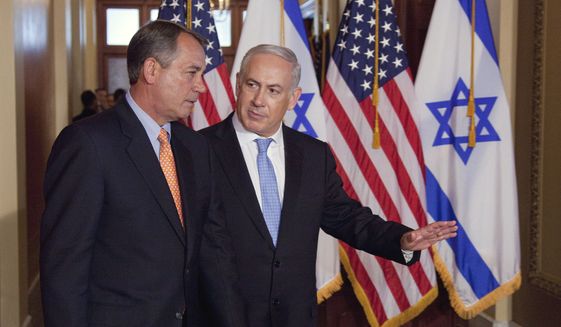
us-israel-iranjpeg-088fd_c0-0-3500-2040_s561x327FILE – In this May 24, 2011 file photo, Israeli Prime Minister Benjamin Netanyahu walks with House Speaker John Boehner of Ohio to make a statement on Capitol Hill in Washington. Boehner has invited Netanyahu to address Congress about Iran.

House Speaker John A. Boehner said Wednesday he’s invited Israeli Prime Minister Benjamin Netanyahu to speak to a joint session of Congress in February.

“In this time of challenge, I am asking the prime minister to address Congress on the grave threats radical Islam and Iran pose to our security and way of life,” Mr. Boehner said. “Americans and Israelis have always stood together in shared cause and common ideals, and now we must rise to the moment again.”

The invitation comes a day after President Obama told Congress he would veto any legislation imposing stiffer sanctions on Iran — a move that has bipartisan support on Capitol Hill, but which the president said would squelch chances for a deal to control Iran’s nuclear program, and could move closer to war.

The speech is slated for Feb. 11. Mr. Netanyahu has addressed Congress twice before, in 1996 and again in 2011.


Making sense of Obama’s counter-intuitive approach to negotiations with Iran

January 19, 2015

Making sense of Obama’s counter-intuitive approach to negotiations with Iran, Power LinePaul Mirengoff, January 18, 2014

Obama doesn’t want just any nuclear deal. Obama wants a deal Iran will feel good about so that he can make more deals with the ruling clerics. He sees Iran as the key to a grand bargain in the Middle East, one that will thwart ISIS and bring stability — on Iran’s terms — to the region. Israel, of course, excepted.

********************

Last week, President Obama and British Prime Minister Cameron pleaded with Congress not to pass new sanctions legislation against Iran. Such legislation, which has strong bipartisan support, could undermine ongoing negotiations, they argued. “Just hold your fire” until we complete negotiations, Obama urged.

But Obama’s position seems nonsensical on its face. The sanctions legislation Congress contemplates passing does exactly what Obama instructs Congress to do. As the Washington Post’s editors remind us, the Menendez-Kirk legislation would impose sanctions only if Iran reaches no agreement before the June 30 deadline it previously agreed to. “Fire” is “held” until then.

If anything, as the Post argues, the legislation would make a deal with Iran more likely. For unless Obama is going to cave entirely (a definite possibility, sadly), Iran will have to make concessions. And Iran is more likely to make concessions if the consequence of no deal is a stepped-up sanction regime.

In other words, the legislation to which Obama objects would give him a bargaining chip. The fact that Obama doesn’t want one (he says he’d veto the Menendez-Kirk bill) should tell Congress that he’s not interested in playing hardball in negotiations with Iran.

Iran is playing hardball, though. It has manufactured two bargaining chips. First, it recently announced that is has begun the construction of two new nuclear reactors.

Second, Iran has referred the case of Jason Rezaian, a Washington Post reporter held prisoner in Tehran, for processing by the “Revolutionary Court.” Rezaian has been denied basic humanitarian treatment by his captors — for example, his weight is down by 40 pounds, according to his mother — and has neither been informed of the charges against him nor allowed to consult with his lawyer, according to the Post.

Put simply, Rezaian is a hostage to the nuclear negotiations. And why not? The Castro brothers got what they wanted from Obama using the same approach.

As with Cuba, Iran is actually using a belt and suspenders approach. Obama has always wanted to lift sanctions on Cuba and he clearly wants a nuclear deal, any deal, with Iran. With Cuba, he was able to obtain the photo ops accompanying a prisoner release to make his concessions easier for Americans to swallow. The Rezaian captivity means that Obama may be able to do the same with a nuclear deal with Iran.

But Obama doesn’t want just any nuclear deal. Obama wants a deal Iran will feel good about so that he can make more deals with the ruling clerics. He sees Iran as the key to a grand bargain in the Middle East, one that will thwart ISIS and bring stability — on Iran’s terms — to the region. Israel, of course, excepted.

This, I believe, is why Obama opposes congressional action that would strengthen his bargaining position. Obama is fine with bargaining from weakness with Iran, and wants to earn credit with the mullahs for standing up on their behalf to Congress, including members of his own party.

A final note. The Post’s editors should be commended for the strong position they advance in today’s editorial. A few days age, I suggested that the Post was experiencing something resembling Stockholm syndrome in its reporting on Iran. If so, the syndrome has not spilled over to its editorial page.

Mahmoud Abbas: Failing the Palestinians and Peace

December 29, 2014

Mahmoud Abbas: Failing the Palestinians and Peace, Front Page Magazine, December 29, 2014

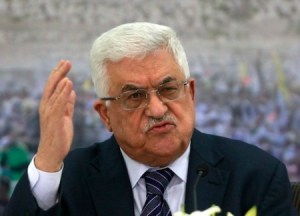
Mahmoud Abbas

[T]he increased authoritarianism of Abu Mazen is reflected in a recent survey by the Palestinian Center for Policy and Survey Research. It indicates that 66% of Palestinians are afraid to criticise Abu Mazen and the PA, and 80% consider the PA institutions to be corrupt and infected with nepotism.

***************

Mahmoud Abbas, (aka Abu Mazen) has been a failure as the Palestinian “Rais.” He failed to lead the Palestinian Authority (PA) toward peace with Israel, and he mismanaged the alleged goal to achieve statehood for the Palestinians. Instead of facing the tough issues and making compromises required in negotiating peace and statehood with the Israelis, Abbas chose an alliance with the Gaza controlled terrorist group Hamas. Following Abbas’ pact with Hamas last April, Israel broke off peace negotiations with the Palestinians, just days before the talks brokered by Secretary of State John Kerry were scheduled to expire.

Abbas isn’t only confusing Israelis, Americans, and is his Europeans patrons, he is perplexing his own Palestinian consituents. Following last summer’s Gaza War between Hamas and Israel, Abbas threatened to join the International Criminal Court (ICC) and saught to indict Israel on war crimes. PA Foreign Minister Riad al-Maliki met with the Chief Prosecutor of the ICC last August to explore ways of joining the court by PA President Abbas signing the Rome Statute.  When, however, the U.S. Congress threatened to cut off all funding to Palestine if Abbas filed war crimes charges against Israel, Abbas backed off. At the same time though, Israel’s Prime Minister threatened to counter-sue, alleging that the rockets fired by Hamas terrorists into Israeli civilian areas constituted “double war” crimes.

The Israeli Law Center called Shurat-HaDin, led by Nitsana Darshan-Leitner submitted a complaint against Mahmoud Abbas in the ICC for “war crimes.” The complaint claims that Abbas may be tried for his responsibility in the missile attacks targeting Israeli cities, executed by the Palestine Liberation Organization (PLO), which Abbas heads. It charges that Fatah, also led by Abbas, was responsible for several missile attacks on Israeli cities. Darshn-Leitner pointed out that Fatah leader Abbas may be tried by the ICC. Abbas is a citizen of Jordan and Jordan is a member-state of the ICC. The ICC has jurisdiction over crimes committed by a citizen of a member state. Darshan-Leitner added, the organization “will not allow Fatah to carry out rocket attacks on Israeli population centers, while hypocritically advocating Palestinian membership in the ICC. Abbas falsely believes that alleged crimes against Arabs are the only ones that should be prosecuted.”

A week ago, Abbas threatened again. This time he fingered the security co-ordination with Israel following the death of Ziad Abu Ein, 55, PA Minister without Portfolio. He promptly backtracked. On November 29, 2014, Abbas declared  that if the United Nations Security Council rejects the Palestinian statehood resolution, he will seek membership in the ICC. He said, “We will seek Palestinian membership in international organizations, including the International Criminal Court in the Hague. We will also reassess our ties with Israel, including ending the security cooperation between us.”

Abbas’ latest gambit is a UN Security Council (UNSC) resolution that would force Israel to withdraw from Judea and Samaria (West Bank) within two-years. According to press reports, U.S. Secretary of State John Kerry requested to postpone the Palestinian initiative at the UNSC until after the Israeli elections, (March 17, 2015) but the Palestinians refused. PA Foreign Minister Riad al-Maliki intimated to reporters that there was disagreement between the Americans and Palestinians on how the elections in Israel would or wouldn’t advance the PA UNSC resolution. Kerry believed that a UNSC vote before the elections would impact adversely on the winners. In other words, a vote before the elections would strengthen Netanyahu and the Right in Israel. Maliki argued that a vote before January, 2015 would be rather positive.

At a closed meeting last week with 28 EU ambassadors, John Kerry revealed that he was asked by former Israeli president Shimon Peres and Tzipi Livni to prevent the Palestinian initiative at the UNSC because it will help “Netanyahu and Bennett (Jewish Home Party chairman) in the upcoming elections.” Maliki posited that Kerry himself has not abided by his pledge not to intervene in the Israeli elections.

Also last week in London, Secretary of State Kerry met with Saeb Erekat, the chief Palestinian negotiator, and according to a PA senior official, Kerry posed a number of U.S. principles that should be included in the Palestinian UNSC resolution. Kerry supposedly refused the two year time period demand by the PA for Israeli withdrawal. The resolution as Kerry suggested should include recognition of Israel as a Jewish state, as well as U.S. opposition to declare Jerusalem as a joint capital for Palestine and Israel. Erekat rejected the U.S. proposals. Kerry declared afterward that the U.S. does not accept the Jordanian (presenting the Palestinian resolution)  and French resolutions. He warned that if the Palestinians insist on presenting the resolutions, the U.S. would use its veto power. Erekat rejected Kerry’s ideas, and insisted that the resolutions would be submitted. As of December 25, 2014, Abbas rejected an Arab League request to delay the submission of the Palestinian statehood until January when five new members who support the Palestinian cause will join the Security Council.

Abbas’ gambits notwithstanding, the increased authoritarianism of Abu Mazen is reflected in a recent survey by the Palestinian Center for Policy and Survey Research. It indicates that 66% of Palestinians are afraid to criticise Abu Mazen and the PA, and 80% consider the PA institutions to be corrupt and infected with nepotism. Last summer, according to the survey, support for Abbas (Abu Mazen) declined to 35% from 50%. “There is no doubt about the fact that outlawing freedoms and rights, especially of professional unions, is a factor in Abbas’ decline in popularity,” said Dr. Khalil Shikaki, one of the survey takers.

PA security agents inspect what is written in the social media, and threaten those who criticize Abbas. Abu Mazen critics point out that after a decade in power he is controlling all systems of government to such an extent as to minimize all resistance. Perceived political rivals such as Mohammad Dahlan, who once served as Abu Mazen’s assistant, and Salam Fayyad, the former Prime Minister of the PA, are vilified by Abbas. Following the Palestinian Unity government formation, headed by Rami Hamdallah last May, elections were to follow. But, once again, internal squabbling prevented it, and added to it was Abbas’ fear of a Hamas victory.

Abu Mazen’s strategy for the establishment of a Palestinian state has reached a cul-de-sac.  None of his gambits proved successful. His rivalry with Hamas is bitter and ongoing, despite the alliance he forged at the expense of negotiations with Israel. And, like his predecessor Yasser Arafat, he balks at the idea of ‘ending the conflict’ with Israel. He knows full well that this might be a death sentence for him, targeting him for assassination. It is for this reason that Abbas and the PA are unlikely to forgo the “right of return” of Palestinian refugees to Israel. Israel for its part, cannot accept such a demographic suicide. This is why Abbas would rather avoid negotiations with Israel and bypass it by going to the UNSC. It is also the ostensible reason why peace with Israel cannot be achieved, and as a result, the Palestinian people continue to suffer political and economic deprivation. Abbas has not been the solution to the Palestinian problems; rather, he has been responsible for failing them.
The U.S. President is Not Omnipotent

December 28, 2014

The U.S. President is Not Omnipotent, Algemeiner, December 28, 2014. This article was originally published by Israel Hayom.

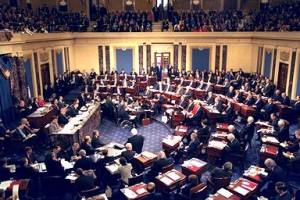
full-senate-300x200The United States Senate.

Will the 114th Congress follow in his footsteps, or will it abdicate its constitutional responsibilities?

Congress has often abdicated its constitutional power in the area of foreign policy, failing to fully leverage the power of the purse: funding, defunding and “fencing.”

***************

White House and State Department officials contend that, irrespective of Congress, President Barack Obama can apply effective diplomatic, commercial and national security pressure and coerce Israel to partition Jerusalem and retreat from Judea and Samaria to the 9-15 mile-wide pre-1967 sliver, surrounded by the violently turbulent and unpredictable Arab street.

U.S. Ambassador to Israel Dan Shapiro recently voiced this inaccurate underestimation of the power of Congress — which has traditionally opposed pressure on Israel, echoing the sentiments of most constituents — saying, “What is unmistakable about our foreign policy system is that the Constitution provides the president with the largest share of power.”

The assertion that U.S. foreign policy and national security are shaped by presidential omnipotence can be refuted by the U.S. Constitution as well as recent precedents. The Constitution was created by the Founding Fathers, who were determined to limit the power of government and preclude the possibility of executive dictatorship. They were apprehensive of potential presidential excesses and encroachment, and therefore assigned the formulation of foreign policy and national security to both Congress and the president. Obviously, the coalescing of policy between 535 legislators constitutes a severe disadvantage for the legislature.

According to the Congressional Quarterly, the U.S. Constitution rectified the mistakes of its predecessor, the Articles of Confederation, upgrading the role of Congress to the primary branch of the U.S. government. “Hence, the first article of the Constitution is dedicated to Congress. The powers, structure, and procedures of the national legislature are outlined in considerable detail in the Constitution, unlike those of the presidency and the judiciary.”

Unlike all other Western democracies — where the executive branch of government dominates the legislature, especially in the area of international relations and defense — the U.S. Constitution laid the foundation for the world’s most powerful legislature, and for an inherent power struggle over the making of foreign policy between the legislature and the executive, two independent, co-equal and co-determining branches of government. Moreover, while the president is the commander in chief, presidential clout depends largely on congressional authorization and appropriation in a system of separation of powers and checks and balances, especially in the areas of sanctions, foreign aid, military assistance, trade agreements, treaty ratification, appointment confirmation and all spending.

Congressional power has been dramatically bolstered since the Vietnam War, Watergate, the Iran-Contra affair and globalization, which have enhanced the involvement of most legislators in international issues, upgraded the oversight capabilities of Congress, dramatically elevated the quality and quantity of some 15,000(!) Capitol Hill staffers and have restrained the presidency.

However, Congress has often abdicated its constitutional power in the area of foreign policy, failing to fully leverage the power of the purse: funding, defunding and “fencing.” Legislators prefer to focus on domestic issues, which represent their constituents’ primary concerns and therefore determine their re-electability. Hence, they usually allow the president to take the lead in the initiation and implementation of foreign and national security policies, unless the president abuses their trust, outrageously usurping power, violating the law, assuming an overly imperial posture, pursuing strikingly failed policies, or dramatically departing from national consensus (e.g., the deeply rooted, bipartisan commitment to the Jewish state). Then, Congress reveals impressive muscle as befits a legislature, which is the most authentic reflection of the American people, unrestrained by design, deriving its power from the constituent and not from party leadership or the president, true to the notion that “the president proposes, Congress disposes.”

For example:

  • On August 1, 2014, Democratic senators forced Obama to separate the $225 million funding of Iron Dome batteries from the highly controversial $2.7 billion immigration and border security bill.
  • Since 1982 the Senate has repeatedly refused to ratify the Convention on the Law of the Sea, and since 1999 it has rejected ratification of the Comprehensive Test Ban Treaty.
  • The January 2013 defense authorization bill tightened restrictions on the transfer of terrorists from Guantanamo to the U.S. In May 2009, Majority Leader Harry Reid foiled Obama’s attempt to close down the detention camp.
  • On February 17, 2011, Obama reluctantly vetoed a U.N. Security Council condemnation of Israel’s settlement policy, due to bipartisan congressional pressure.
  • In September 2012, a $450 million cash transfer to the Muslim Brotherhood regime in Egypt was blocked by Congress.
  • The 2012 budget cut into Obama’s foreign aid spending request by more than $8 billion.
  • In 2009, bipartisan congressional opposition prevented the appointment of Charles Freeman to chair the National Intelligence Council.
  • In 1990-1992, Congress approved a series of amendments, expanding U.S.-Israel strategic cooperation to unprecedented levels despite presidential opposition.
  • In 1990, President George H. W. Bush failed in his attempt to cut Israel’s foreign aid by 5 percent due to congressional opposition.
  • In January 1975, the Jackson-Vanik Amendment was signed into law, in defiance of the president.
  • Congress ended U.S. military involvement in Vietnam (the 1973 Eagleton, Cooper and Church Amendments), Angola (the 1976 Clark Amendment) and Nicaragua (the 1982-1984 Boland Amendments).
  • In 1991, Senator Daniel Inouye fended off administration pressure to withdraw an amendment to upgrade the port of Haifa facilities for the Sixth Fleet: “According to the U.S. Constitution, the legislature supervises the executive, not vice versa.”

Will the 114th Congress follow in his footsteps, or will it abdicate its constitutional responsibilities?

Obama set on obstructing Netanyahu’s re-election

December 4, 2014

Obama set on obstructing Netanyahu’s re-election, DEBKAfile, December 4, 2014

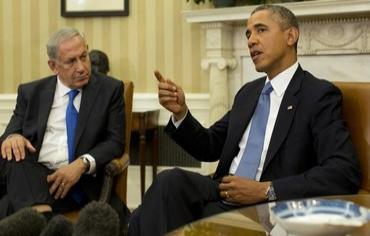
Obama Netanyahu 2013

The White House is still working on a detailed plan of action, but has lost no time in setting up appointments for the president to receive heads of the parties sworn to overthrow Netanyahu – among others, ex-minister Lapid, opposition leader Yitzhak Herzog of Labor and Tzipi Livni (The Movement), who was fired this week as Justice Minister along with Lapid.

******************

President Barack Obama and his White House National Security team headed by Susan Rice have decided to seize on the political crisis besetting the Israeli government and the upcoming general election on March 17 for action to bar Binyamin Netanyahu’s reelection to a fourth term as prime minister.

This decision reverberated through Future party leader Yair Lapid’s assertion Wednesday night, Dec. 3, after he was sacked as finance minister, that Binyamin Netanyahu would not be next prime minister. He laid claim to the premiership himself.

The Obama administration has maintained close ties with Lapid during the foreshortened 22 month-life of the departing Israeli government.

The White House is still working on a detailed plan of action, but has lost no time in setting up appointments for the president to receive heads of the parties sworn to overthrow Netanyahu – among others, ex-minister Lapid, opposition leader Yitzhak Herzog of Labor and Tzipi Livni (The Movement), who was fired this week as Justice Minister along with Lapid.

They will be accorded attractive photo-ops with Obama and joint communiqués designed to signify to the Israeli voter that the US president would favor their election to the future government and the country as a whole would gain tangibly from a different government to the incumbent one.

This White House campaign would be accompanied by leaks from Washington for putting Netanyahu and his policies in a derogatory light. Messages to this effect were transmitted to a number of serving political figures as an incentive to jump the Likud-led ship to opposition ranks. The US administration has begun hinting that it may emulate the Europeans by turning the screws on Israel as punishment for the prime minister’s signature policy of developing West Bank and Jerusalem development construction.

Accounts reaching DEBKAfile speak of an outburst of joy in the White House over news of the Netanyahu government’s breakup. It was seen as an opportunity to finally get rid of Binyamin Netanyahu and a golden opportunity to bring Israel back to negotiations with the Palestinians with the Obama administration finally chalking up a success.

At the same time, some senior sources in the US capital confided to DEBKAfile that administration joy over political developments in Israel could quickly prove premature – either in view of another round of violence overtaking the Middle East, or by once again misreading Israel’s political map before stepping in and so failing in its object. But for now the circles around the US president are “highly optimistic” about their chances of forcing Netanyahu’s exit, comparing them to the former success of the first President George Bush in forcing the ouster of the late Yitzhak Shamir as Israeli prime minister in the 90s.

Meanwhile, on Wednesday night, Dec. 3, US Congress passed the US.-Israel Strategic Partnership Act that raises by $200 million the value of emergency US weapons stocked in Israel to a total of $1.8 billion, and guarantees Israel’s qualitative military edge over its neighbors and foes. The motion, passed by a voice vote in the House after clearing the Senate unanimously last September, also promotes closer links in energy, water, homeland security, alternative fuel technology and cyber-security. The bill now goes to President Obama for his signature.