Posted tagged ‘U.S. Congress’

Not Even Two Hurricanes Can Stop Trump Derangement Syndrome

September 8, 2017

Not Even Two Hurricanes Can Stop Trump Derangement Syndrome, PJ MediaRoger L Simon, September 7, 2017

(Please see also, Why Did Trump do a Deal with the Democrats on Funding the Government? — DM)

Would it be too optimistic to expect two giant hurricanes — one flooding a good swatch of Texas and Louisiana and the other about to lay waste to the Eastern seaboard — to shut up the Trump bashers for ten minutes?

Apparently so, because no sooner does the president make an agreement with Schumer and Pelosi to raise the debt ceiling as well as set up a large fund for Harvey recovery and out they come from the left and right — from the left to crow about some sort of “victory” and from the right to complain that the deal didn’t lower the deficit.

Deficit? It’s as if Trump should have been playing hardball and calling for a government shutdown while Irma was tearing through Florida, sending the Pirates of the Caribbean into Tennessee with people fishing in their living rooms, if they’re lucky enough to have a living room anymore.

The shrinks talk about having “the right conversation at the right moment.”  Making a fuss about the deficit in the midst of twin national catastrophes the likes of which we haven’t seen in decades and will cost who knows how many billions to repair is the exact opposite.  It’s having the most counter-productive conversation at the worst possible moment.

And it’s even stupider because the new debt ceiling agreement is only for three months. In a short while they can fight that deficit all they want. As they say in Queens, “shaddup awreddy!”

As for the Democrats, left or otherwise, they should forget about that victory and save the high fives for the touch football game (if they still play that).  That party’s so far out to lunch now they can’t tell the kitchen from the laundry room. Trump can afford to be generous because they barely exist and no one can recall when they last won an election.  Nobody remembered Schumer’s new, new deal — or whatever it was — the day after he announced it. And it’s only going to get worse and everyone knows it. Liberalism isn’t just dead, it’s decomposed. Hillary Clinton’s forthcoming book evidently blows up what’s left of the house.  No wonder Trump-bashing is all the Democrats do.  It’s all they’ve got.

But that of course doesn’t stop the Republicans from shooting themselves in the foot and everywhere else.  Even in the midst of two hurricanes, they seem clueless.  Congress and the media remain in a horse race to the bottom while Trump, who seems decisive and in command, is seeing his numbers rise.   Some Republicans appear miffed that they have been cut out of the process in favor of the even more execrable Schumer and Pelosi.  Good. The Republicans need a kick in the you-know-what and a lot more.  Mitch McConnell did something much dumber than incurring Trump’s wrath when he said the “naive” president expected too much too soon from Congress. The majority leader revealed his own inadequacy. “Qui s’excuse, s’accuse,” as the French say.  He who excuses himself, accuses himself.

Despite the constant media drum beat and ceaseless leaks, Trump is looking more impressive eight months into his presidency than at inauguration.  Only he and his cabinet are getting anything done.  And the more he does, the angrier his opposition gets because, in the world of the Beltway, you’re not supposed to do anything, no matter which side you’re on.  It’s as if  giant “Do Not Disturb” signs had been put on all freeway entrances to Interstate 495 (aka the Beltway).

No one is more despised than the person who wants to upset the status quo, particularly an especially rigid one. He or she might show everyone else up.  (Want to know why Maxine Waters hates Trump with such a passion?  Simple.  She’s been the congresswoman from South Central for umpteen decades and NOTHING has improved. In fact, the life of black people in her district has only gotten worse.  What if Trump does something?)

But inevitably, great natural catastrophes shake things up in unforeseen ways.  That’s why most contracts have force majeure clauses.  We’re in the midst of  double force majeure at the moment with some even greater majeure forces on the Pacific horizon of, dare we say it, thermonuclear proportions.  With all of this, at some point, Trump Derangement Syndrome has got to give. One would assume that anyway. But clearly we haven’t gotten there yet

Why Did Trump do a Deal with the Democrats on Funding the Government?

September 7, 2017

Why Did Trump do a Deal with the Democrats on Funding the Government? Investment Watch Blog, Mark Angelides, September 7, 2017

President Trump has been painted by the media as someone caught between two parties that hate him. And whilst this is probably true, he has shown the Republican critics (who have refused to support him) that he can get along without them. By not being partisan in this, he has reduced their power over him. The GOP would like to believe that the president can only act with the GOP consent, but they are so mired in the idea of partisan politics, that they forgot that there was another party waiting.

This decision may not be popular with anyone, but at the very least, he is showing that he can break deadlocks and get things moving. I say give him a chance.

***************************

On Wednesday, an agreement was made between President Trump and leading Democrats Chuck Schumer and Nancy Pelosi on a “short-term bump” in raising the debt ceiling. Major Republican players are extremely annoyed that the president seems to have completely cut them out of this and just gone his own way.

And here’s the thing, Trump was most likely right to do this. He has not had much support from Republicans for his policies and he has had zero support from Democrats or the MSM. He may just have found a way to deal with both in one small meeting.

The deal was cut ostensibly to allow funds for Hurricane Harvey relief efforts, but there is a much bigger picture behind this.

Firstly, Trump has been lambasted by the press for not getting things done, he just has, and it’s for funding that not even the most anti-Trump anchor can give him criticism for. By being the guy to “take the hit” for getting relief money out there, he has become “bullet proof” from media attacks (at least on this decision). It is the Democrats and the Republicans who now look like obstructionists on necessary relief funds.

Secondly, Trump was elected, in part, because he is seen as a “deal maker.” Well, he’s made a deal alright. He went in with his own agenda and did what he thought was best. Republicans may not like it, but then they don’t like anything that does not give them the overall power, anyway.

Thirdly, this was most likely not about just the relief efforts. Trump wants Tax Reform on the table and with participants in the discussion who “owe him a favour.” Marc Short, the White House legislative director, said that “We believe that it’s something to clear the deck,” and would allow Congress to “focus on tax reform for the American people.”

And finally, President Trump has been painted by the media as someone caught between two parties that hate him. And whilst this is probably true, he has shown the Republican critics (who have refused to support him) that he can get along without them. By not being partisan in this, he has reduced their power over him. The GOP would like to believe that the president can only act with the GOP consent, but they are so mired in the idea of partisan politics, that they forgot that there was another party waiting.

This decision may not be popular with anyone, but at the very least, he is showing that he can break deadlocks and get things moving. I say give him a chance.

Menendez’s corruption trial brings out the Dems’ arrogance of power

September 2, 2017

Menendez’s corruption trial brings out the Dems’ arrogance of power, American ThinkerMonica Showalter, September 2, 2017

Menendez in the dock means he will miss key Senate votes and the Democrats may lose their veto power on major issues. It means tax reform might pass, Obamacare may yet get its stake through the heart, and illegal immigrants may finally have to obey immigration laws. The Republicans’ Senate majority might actually mean something, assuming John McCain isn’t able to throw a spanner into the works.

*****************************

A federal judge has smacked down Democratic Sen. Bob Menendez’s bid to move his corruption trial dates around his Senate schedule, noting that the very request was a likely bid to impress the jury with how important he was.

Obviously, the answer to that little ‘don’t you know who I am?’ bid, was no.

Which demonstrates the sort of arrogance of power the judicial system and voters are looking at as the New Jersey Democrat seeks to maintain his political power even while facing corruption charges.He expects a judge to alter his appointments, juries to break up their schedules or be sequestered as he goes off to vote and sheriffs to get overtime for excessive downtime, all because he is so important, so special. In this case, he’s been accused of bribery, taking cash and campaign gifts from a Florida doctor who was scamming the Medicare system and expected Menendez to be his ‘protection.’ He even had Harry Reid plead his case to the Obama White House to make the charges go away. It didn’t  succeed.

With Reid out of the picture, Menendez is now trying to muscle a judge into allowing him to continue to wield his political power as freely as he always has and never mind the court dates. In this case, it’s astonishing as a power move, given that Menendez looks pretty guilty of this one and will probably be packed off to prison by the trial’s end.

Can you imagine Alaska Republican Ted Stevens, who was also accused of corruption but found innocent, trying to pull such a maneuver? He never did.

And that brings up why Menendez might just be so desperate to maintain his political power. Menendez in the dock means he will miss key Senate votes and the Democrats may lose their veto power on major issues. It means tax reform might pass, Obamacare may yet get its stake through the heart, and illegal immigrants may finally have to obey immigration laws. The Republicans’ Senate majority might actually mean something, assuming John McCain isn’t able to throw a spanner into the works.

Elizabeth Warren, when asked about the Menendez issue, found herself alarmed at the prospect after she was thrown off guard by a town hall questioner. So you can bet the talking points are being written up as I write this, to frame the issue as judicial dirty tricks. Which is ironic. The only reason Menendez found himself in the dock at all was that he opposed the Obama administration on a key measure and White House payback was a … beach. They sicced the Justice Department onto the longtime corrupt senator in retaliation. Which may mean much of the Obama legacy can be erased.

All the same, this is about arrogance of power, not railroading. Stevens was the one who was railroaded because he was found to be innocent but still lost his Senate seat. Menendez simply retains his entitlement mentality. He and his fellow Democrats are convinced they should be able to rule under any circumstances. A federal judge reminded him otherwise.


INTO THE FRAY: The Taylor Force Act – Putting “Palestine” in perspective

September 1, 2017

INTO THE FRAY: The Taylor Force Act – Putting “Palestine” in perspective, Israel National News, Dr. Martin Sherman, September 1, 2017

The proposed bill, which was recently passed in the Senate Foreign Relations Committee with overwhelming bipartisan support, is designed to stop American financial aid to the Palestinian Authority [PA] until it ceases its generous payments to individuals who commit acts of terrorism and to the families of deceased terrorists.

Perversely, under the prevailing conditions, the more gruesome the act of terror and the longer the sentence imposed on the perpetrator, the greater the remuneration!

Indeed, as the Wall Street Journal points out, under existing circumstances, “U.S. aid becomes a transfer payment for terrorists”.

This is clearly an unconscionable situation and hence legislation to contend with it, and correct it, was not only appropriate, but imperative.

At the end of the day, the clash between Jew and Arab over the Holy Land is a clash between two collectives. For the Jewish collective, the Palestinian collective is—and must be treated as it sees itself: An implacable enemy, not a prospective peace partner.

*********************************

Congress is finally considering legislation to stop the Palestinian Authority from incentivizing violence…This has to stop, and the Taylor Force Act…attempts to do that. As it currently stands, the act would cut U.S. foreign assistance to the ‘West Bank’ and Gaza in its entirety if the “payments for acts of terrorism against United States and Israeli citizens …do not stop…. There should definitely be no ‘pay to slay’, but…[b]eing smart counts for more than being right. And the smart approach is one that also recognizes that innocent Palestinians…should not be forced to pay for the mistakes of a government they cannot control. – David Makovsky et al“The Smart Way to End ‘Pay to Slay’”, Foreign Policy, August 2, 2017.

Lesley Stahl, on CBS’s 60 Minutes on the effects of US led sanctions against Iraq (May 12, 1996): We have heard that half a million children have died. I mean, that’s more children than died in Hiroshima. And, you know, is the price worth it?” 

Madelaine Albright, then U.S. ambassador to the United Nations , subsequently President Clinton’s Secretary of State: I think this is a very hard choice, but the price — we think the price is worth it.

Recently, three members of the well-known think-tank, the Washington Institute for Near East Policy, posted an article on the new legislative initiative, named the Taylor Force Act after the West Point graduate and veteran, who was killed in a terrorist attack in Israel last year.

Appropriate and imperative

The proposed bill, which was recently passed in the Senate Foreign Relations Committee with overwhelming bipartisan support, is designed to stop American financial aid to the Palestinian Authority [PA] until it ceases its generous payments to individuals who commit acts of terrorism and to the families of deceased terrorists.

Perversely, under the prevailing conditions, the more gruesome the act of terror and the longer the sentence imposed on the perpetrator, the greater the remuneration!

Indeed, as the Wall Street Journal points out, under existing circumstances, “U.S. aid becomes a transfer payment for terrorists”.

This is clearly an unconscionable situation and hence legislation to contend with it, and correct it, was not only appropriate, but imperative.

The need for a punitive response to the egregious “pay for slay” custom of the PA was conceded by the previously mentioned Washington Institute article, entitled “The Smart Way to End ‘Pay to Slay’”.

Penned by David Makovsky,  distinguished fellow  and director of the project on the Middle East Peace Process, veteran diplomat Dennis Ross, distinguished fellow and counsellor on the U.S.-Israel Strategic Relationship, and Lia Weiner, a research assistant, it clearly proclaims “There should definitely be no ‘pay to slay’… This has to stop.”

“…the ‘mistakes’ of a government they cannot control”.

However, it cautions against an across-the-board cessation of US funds to the PA, calling for a more nuanced (read “watered-down”) application of the punitive cuts: “Threats of sweeping cuts to Palestinian aid may hurt the cause more than they help.” They warn that “To entirely defund U.S. aid to the ‘West Bank’ and Gaza is…to halt economic and social progress there”, proposing instead an approach that “recognizes that innocent Palestinians…should not be forced to pay for the mistakes of a government they cannot control”.

But making the innocent members of the population pay for the nefarious deeds of governments they “cannot control” has been the hall mark of American policy across the globe for years—even when those governments have been far more tyrannical than the PA.

Indeed, why should “innocent Palestinians” merit greater consideration than “innocents”   in a range of despotic regimes against which the US has imposed punishing, at times crippling, economic penalties—such as Iraq, Iran and North Korea?

For example the US-led UN sanctions against Saddam Hussein-controlled Iraq inflicted wide-spread suffering (see introductory excerpt) on innocent Iraqis—including women, infants and the elderly—who, arguably, had much less chance of influencing the actions of their government than do the “innocent Palestinians” with regard to Abbas’s PA.

A government reflecting popular preferences

Indeed, while it is true that they “have not been able to vote in an election for more than a decade”, and to a large measure cannot “control” the current PA government, they certainly did empower it.  In fact, it is in many ways, a government of their making—and theirs alone.

After all, in the last elections held in 2006, the Islamist terror organization Hamas and PA president Abbas’s Fatah won just over 90% of the vote—with the former winning 74 and the later 45 of the 132 seats in the Palestinian Legislative Council. Interestingly, the third largest party was a faction representing the radical hardline Popular Front for the Liberation of Palestine (PFLP), a terrorist group founded by the infamous George Habash and headed today by Ahmed Saadat, currently in an Israeli prison for his part in planning the 2001 assassination of Israeli minister, Rehavam Zeevi .

Moreover, parties focusing on socio-economic reforms and human rights fared extremely poorly. Thus, the “Third Way” headed by former PA prime minister Salam Fayyad and a former PA Minister, the well-known Hanan Ashrawi, won a paltry 2 seats, while the National Coalition for Justice and Democracy,  headed by prominent physician and human rights activist  Eyad El-Sarraj won, well…none

“Palestine”: What the polls predict

However, not only did the last elections show a vast endorsement of rejectionist views (both Fatah and Hamas –and the PFLP–vehemently reject any recognition of Israel as the nation-state of the Jews), but recent public opinion polls provide little cause for optimism that this is likely to change.Indeed, should Abbas leave his post, the most popular candidates are Fatah’s Marwan Barghouti, currently serving multiple life sentences in Israel for a myriad of lethal acts of terror, and Hamas’s Ismail Haniyeh. 

Moreover, findings for legislatives elections show that almost 70% would vote for either Fatah or Hamas, 10% for all other parties, with over 20% being undecided.

Thus, there is little reason to believe that—were new elections to be held—they would produce a sea-change for the better in the composition of the PA, or its policy.  In fact, there is considerable room for concern that the very opposite might well be true.

But perhaps most damaging to Makovsky, Ross and Weiner’s contention that “innocent Palestinians…should not be forced to pay for the mistakes of a government they cannot control” is the finding that there is near unanimous public endorsement  for the very financial support that the Taylor Force Act is intended to terminate.

“Pay to Slay” & Vox Populi 

Stunningly (or not), a July 2017 survey by Palestinian Center of Policy and Survey Research, headed by the well-known Palestinian pollster, Dr. Khalil Shikaki, found that “an almost total consensus rejects pressure on the PA to terminate payments to Palestinian security prisoners” and   “91% are opposed to the suspension of PA payments to Palestinian security prisoners [i.e. jailed terrorists- MS] in Israeli jails; only 7% support such measure”.

This is precisely the reality mirrored in an article that appeared in Tablet Magazine this week by Alex Kane, according to which” the prisoner payment program is one of the most popular PA programs, and it would be political suicide for the PA to halt it.

So, in stark contradiction to the impression conveyed by Makovsky, Ross and Weiner, the “pay to slay” policy is not something foisted on a reluctant peace-seeking  “innocent” Palestinian population , but is, in fact enthusiastically embraced by it—reflecting nothing more (or less) than vox populi.

Indeed, it is more than a little disturbing to see such “luminaries” as Makovsky and Ross propagating views demonstrably detached from reality, in what appears to be  a misplaced endeavor to create the false impression that, overall, the Palestinians,  share their  worldview—when, in fact,  they clearly seem to have a very different one…

Self-contradictory, self-obstructive “rationale”

But beyond the fact that their contentions sit uneasily with the empirical evidence, they appear to have additional disconcerting implications. Thus, they endorse the view that “although a tough message [should be] sent to the PA about the consequences of incentivizing violence”, they recommend that measures undertaken should “prevent any deterioration in the quality of life for Palestinians lest that lead to greater radicalization”.

This appears to reflect a curious rationale which suggests that if one is punished for bad behavior, then one’s behavior will become…worse???

This never was a consideration in, say, Serbia, where markets, hospitals, buses, bridges and old age facilities—to name but a few civilian targets that were hit in high altitude bombing sorties in the US-led NATO attacks in the Balkans War of the 1990s.

Indeed, the claim that harsh punitive measures against an authoritarian regime will only make the regime –or the population under its control—more recalcitrant flies in the face of the most basic elements of deterrence theory. After all, if the threat of harsh measures cannot coerce the regime to modify its behavior, why should measures less harsh do the trick?

Moreover, if the collective is not forced to feel the consequences of actions carried out in its name- there is clearly no reason for these actions to cease.  This is particularly true in the case of the “pay to slay” practice, which, while it may be implemented by an authoritarian regime, is widely endorsed by the general public. In this context, the rationale advanced by Makovsky, Ross et al appears to be at once both self-contradictory and self-obstructive.

 Clash of collectives 

It is of course somewhat discomforting to see such well-placed and well-connected pundits misread the lay-of-the-land so profoundly. For such gross misperception can only help perpetuate the conflict and its attendant suffering.

Firstly, these misperceptions nourish the false premise that privation drives radicalization, which is clearly disproven by the radicalization of many seemingly well-integrated Muslim youth in Europe, and the fact that in several Arab countries the greatest animosity towards Israel is harbored by the professional, well-to-do echelons of society.

Secondly, they obscure the real nature of the Israel-Arab conflict and hence, hamper the efforts to bring it to an end—diverting efforts toward bogus “causes”.

In this regard, then-defense minister Moshe-“Bogey” Yaalon, in a November 2015 address, correctly diagnosed the conflict as a clash of collectives i.e.  “…predominantly a war of wills, of two societies with conflicting wills”.

But, if the clash is essentially one between collectives, surely victory will require one collective breaking the will of the rival collective. Accordingly, ensuring that said rival can maintain its daily routine hardly seems the most promising stratagem to adopt in an effort to break its will and achieve victory.Indeed, if anything, it would seem the exigencies for a collective victory over an adversarial collective would dictate the diametrically opposite endeavor – disrupt the daily routine of the adversary. After all, misdeeds perpetrated in the name of the Palestinian collective must carry a price, which the collective pays – for if not, it will have no incentive to curb them.

Implacable enemy not prospective peace partner

The Palestinian population is thus not some hapless victim of the terror groups, as some might suggest but the very crucible from which such groups have emerged. It has by its own hand, by its deeds and declarations, made it clear that it will not—except on some temporary, tactical basis –brook any manifestation of Jewish political independence/national sovereignty) “between the River and the Sea”.

At the end of the day, the clash between Jew and Arab over the Holy Land is a clash between two collectives. For the Jewish collective, the Palestinian collective is—and must be treated as it sees itself: An implacable enemy, not a prospective peace partner.

Accordingly, the conflict, as one between collectives cannot be individualized .One collective must emerge victorious, the other vanquished. Only then, after victory/defeat, can the issue of personal misfortune be addressed.

This, then, is the perspective in which Palestinian society must be placed—and the perspective from which the formulation of the Taylor Force Act be addressed.

Martin Sherman is the founder and executive director of the Israel Institute for Strategic Studies.

OPINION | Byron York: FBI fights public release of Trump dossier info

September 1, 2017

OPINION | Byron York: FBI fights public release of Trump dossier info, Washington ExaminerByron York, August 31, 2017

Grassley and the Judiciary Committee seem determined to uncover the full story of the dossier. To do so, they’ll have to use all the powers of Congress, because, when it comes to ordinary citizens, the Justice Department believes they have no right to know.

*****************************

Senate investigators have had problems getting the FBI to reveal information about the Trump dossier. They’re not the only ones. Outside groups filing Freedom of Information Act requests are running up against a stone wall when it comes to the dossier.

On March 8, Judicial Watch filed a FOIA request for documents regarding the bureau’s contacts with Christopher Steele, the former British spy who dug for dirt in Russia on candidate Donald Trump in the months before the 2016 presidential election. Steele’s effort was commissioned by the oppo research firm Fusion GPS, which at the time was being paid by still-unidentified Democrats who supported Hillary Clinton. Just weeks before the election, the FBI reportedly agreed to support Steele’s oppo project — an extraordinary action in the midst of a campaign which Senate Judiciary Committee Chairman Chuck Grassley said raised “questions about the FBI’s independence from politics.”

So Judicial Watch asked the Justice Department for:

Any and all records of communications between any official, employee, or representative of the Federal Bureau of Investigation and Mr. Christopher Steele, a former British intelligence officer and the owner of the private firm Orbis Business Intelligence.

Any and all records regarding, concerning, or related to the proposed, planned, or actual payment of any funds to Mr. Steele and/or Orbis Business Intelligence.

Any and all records produced in preparation for, during, or pursuant to any meetings or telephonic conversations between any official, employee, or representative of the Federal Bureau of Investigation and Mr. Christopher Steele and/or any employee or representative of Orbis Business Intelligence.

Any and all records produced in preparation for, during, or pursuant to any meetings or telephonic conversations between any official, employee, or representative of the Federal Bureau of Investigation and Mr. Christopher Steele and/or any employee or representative of Orbis Business Intelligence.

The idea was that the records would shed light on the basic questions regarding the dossier. Just what did the FBI do? Why? And — this is very important to Grassley — did the FBI ever use the “salacious and unverified” (the words of former FBI Director James Comey) information in the dossier as a basis for applying for warrants to put Americans under surveillance?

The Justice Department’s response to Judicial Watch was simple: No. And not just no: The Department would not even confirm or deny whether any such documents or communications even existed.

So on May 16, Judicial Watch filed suit, seeking to force release of the information. In response, the department told Judicial Watch to forget about it. “Plaintiff’s claims are moot,” Justice lawyers wrote, “because Defendant has notified Plaintiff of its decision to neither confirm nor deny the existence of any responsive records, and the reasons for that decision.”

The reasons the department referred to were contained in nearly identical letters sent to Judicial Watch on March 29 and May 16. “The nature of your request implicates records the FBI may or may not compile pursuant to its national security and foreign intelligence functions,” a Justice Department FOIA official wrote. “Accordingly the FBI cannot confirm or deny the existence of any records about your subject as the mere acknowledgment of such records existence or nonexistence would in and of itself trigger harm to national security interests.” The letter cited legal exemptions to FOIA based on national security.

“Moreover, as a federal law enforcement agency,” the letter continued, “a confirmation by the FBI that it has or does not have responsive records would be tantamount to acknowledging the existence or nonexistence of a pending investigation it has not previously acknowledged.”

The problem, of course, is that the FBI has already acknowledged the existence of a counterintelligence investigation into the Trump-Russia affair. Comey himself did it in Hill testimony on March 20, noting that it is not the Justice Department’s usual practice to confirm such things, but the Trump-Russia matter was of such great public importance that Comey decided to go ahead:

As you know, our practice is not to confirm the existence of ongoing investigations, especially those investigations that involve classified matters, but in unusual circumstances where it is in the public interest, it may be appropriate to do so as Justice Department policies recognize. This is one of those circumstances.

I have been authorized by the Department of Justice to confirm that the FBI, as part of our counterintelligence mission, is investigating the Russian government’s efforts to interfere in the 2016 presidential election and that includes investigating the nature of any links between individuals associated with the Trump campaign and the Russian government and whether there was any coordination between the campaign and Russia’s efforts. As with any counterintelligence investigation, this will also include an assessment of whether any crimes were committed.

As for the dossier itself, in public testimony before the Senate Intelligence Committee on June 8, Comey specifically discussed briefing President-elect Trump on its contents in January.

And of course, the dossier, in all its “salacious and unverified” glory, was published in full by Buzzfeed.

Finally, the Justice Department appointed Robert Mueller to serve as the special counsel in the case. The department announced the appointment publicly and released the document outlining Mueller’s responsibilities.

These were not low-key, hush-hush actions. But apparently no one told the Justice Department’s FOIA bureaucracy that the department and the FBI had, in a very big way, confirmed the existence of the Trump-Russia investigation.

In addition, there are indications that Mueller himself does not object to the public release of information regarding the dossier. The Senate Judiciary Committee has held so-called “deconfliction” meetings with Mueller’s office in which officials discussed whether this or that aspect of the committee’s investigation might interfere with Mueller’s probe. (Such discussions are mostly a matter of courtesy, since the Senate can ultimately do what it wants.) It appears Mueller’s office did not object to the Senate interviewing Fusion GPS chief Glenn Simpson, with the full knowledge that all or part of that interview might be publicly released. While it’s not clear what Simpson told the committee — the public should hope it is released in full — given the committee chairman’s concerns, it’s guaranteed that Simpson was asked about Steele’s interactions with the FBI.

But when it comes to the Freedom of Information Act, the FBI is resisting the release of even the most basic information. “They’re fighting us on everything,” Judicial Watch chief Tom Fitton told me recently. “They’re fighting us tooth and nail.”

Grassley and the Judiciary Committee seem determined to uncover the full story of the dossier. To do so, they’ll have to use all the powers of Congress, because, when it comes to ordinary citizens, the Justice Department believes they have no right to know.

Congress Seeks to Cut U.S. Aid to Islamic Charity Tied to Terror

August 29, 2017

Congress Seeks to Cut U.S. Aid to Islamic Charity Tied to Terror, Washington Free Beacon, August 28, 2017

Getty Images

A new congressional measure seeks to cut all U.S. funding for an Islamic charity that has been banned in some countries for providing assistance to Hamas and other terror-tied organizations, including the Muslim Brotherhood, the Washington Free Beacon has learned.

The new measure, which was proposed as an amendment to Congress’s yearly appropriations bill, which sets U.S. expenditures, would ban any taxpayer funds from being provided to Islamic Relief Worldwide, or IRW, a global charitable organization that has been linked to Hamas and the Muslim Brotherhood.

IRW is banned in some Middle Eastern countries for its alleged support of terror organizations, though the United States has continued to provide taxpayer funds to the organization under the Obama administration, sparking outrage among some lawmakers and regional experts.

The move to ban U.S. funding to IRW was authored by Rep. Ron DeSantis (R., Fla.), a member of the House Foreign Affairs Committee, who told the Free Beacon that the U.S. taxpayers should not be giving to any organization tied to terror movements, particularly the Muslim Brotherhood, which continues to support extremist activities.

“U.S. tax dollars cannot go to groups involved in funding terrorism,” DeSantis told the Free Beacon. “Any group tied to Hamas or the Muslim Brotherhood should be ineligible for funding.  It is a slap in the face of the American taxpayer to allow such groups to receive federal funding.”

IRW has been a source of tension for some time. Congressional leaders and terrorism experts expressed shock at the Obama administration in 2015, when the Free Beacon disclosed the U.S. Agency for International Development, or USAID, a taxpayer funded group, had awarded IRW $100,000 in grants.

The Obama administration awarded IRW another $270,000 in 2016 via a grant from the Department of Health and Human Services.

The effort to ban IRW from receiving any further taxpayer funds is part of a larger effort by DeSantis and others to isolate Muslim Brotherhood-tied organizations and other terror groups that have cashed in on American taxpayer funds through a range of questionable third-party organization.

IRW is banned in both the United Arab Emirates and Israel after investigations determined the group has ties to Hamas, the Muslim Brotherhood, and other extremist entities bound up in terror financing schemes, according to multiple reports.

An independent investigation by the Israeli government sparked allegations the charity was providing material support to Hamas and its operatives.

The charity “provides support and assistance to Hamas’s infrastructure,” Israel’s Ministry of Foreign Affairs charged in 2006. “The IRW’s activities in Judea, Samaria, and the Gaza Strip are carried out by social welfare organizations controlled and staffed by Hamas operatives.”

IRW was also cited as a “hub for donations from charities accused of links to al Qaeda and other terror groups,” according to a separate investigation conducted by the Gatestone Institute.

The charity’s “accounts show that it has partnered with a number of organizations linked to terrorism and that some of the charity’s trustees are personally affiliated with extreme Islamist groups that have connections to terror,” according to report, which was authored by terrorism analyst Samuel Westrop.

Israeli authorities arrested IRW’s Gaza coordinator, Ayaz Ali, in 2006 due to his alleged work on Hamas’s behalf.

“Incriminating files were found on Ali’s computer, including documents that attested to the organization’s ties with illegal Hamas funds abroad (in the UK and in Saudi Arabia) and in Nablus,” Israel’s foreign affairs ministry said at the time. “Also found were photographs of swastikas superimposed on IDF symbols, of senior Nazi German officials, of Osama Bin Laden, and Abu Musab al-Zarqawi, as well as many photographs of Hamas military activities.”

Time to redefine ‘one China’ policy to mean ‘one democratic China’

August 25, 2017

Time to redefine ‘one China’ policy to mean ‘one democratic China’, Washington TimesRalph Z. Hallow, August 24, 2017

US President Donald Trump and Chinese President Xi Jinping, right, shake hands as they arrive for a meeting on the sidelines of the G-20 Summit in Hamburg, Germany, Saturday, July 8, 2017. (Saul Loeb/Pool Photo via AP)

ANALYSIS/OPINION:

NASHVILLE – Fed up with America’s 55 years of appeasement of communist China, the GOP’s national governing body is poised to tell Beijing to go take a hike.

China and its panda-hugging friends — think Henry Kissinger – have been campaigning to get Congress and the Trump administration to say when exactly it will stop selling arms to democratic Taiwan.

“Nuts!” and “Never!” are the two words Republicans here would like to tell Beijing, but they’re aiming for slightly more diplomatic language to say the same thing.

In no mood to put up with Beijing’s slick attempts to ripen Taiwan for a takeover by the communist Mainland, the Republican National Committee members holding their annual summer meeting here have decided to put the national GOP on record in support of the latest round of arms sales with Spräng murarna och nå dina mål to Taiwan that President Trump has approved.

Some big-deal Republicans here are also officially backing a warning to Beijing to lay off its attempts to smother free speech in Hong Kong. The 1,000 square-mile island state, with a population of 7.3 million (a million fewer than in New York City), was a paradigm of freedom when it was a British colony. It has felt the suffocating effect of the People’s Republic of China since the Brits turned Hong Kong over to Beijing in 1997. (Talk about appeasement.)

But Taiwan is where the smelly stuff is beginning to hit the fan, thanks first to none other than Richard M. Nixon, He inked a joint communiqué with the communist People’s Republican of China in 1972. That communiqué had the U.S. agreeing – teeth gritting time — that communist Mainland China is the only China on earth and that thing calling itself the Republic of China residing on the island of Taiwan is a figment of the anti-communist imagination.

Two other shameful communiqués followed. In 1979 under Jimmy Carter, the U.S. agreed cut off diplomatic relations with the Republic of China and never to use the word “China” in referring to it again.

Perhaps it’s mere legend, but Mr. Carter did work up the gumption to refuse to say there are no rings around the planet Mars.

In 1982 under — believe it or not — Ronald Reagan, the U.S. in a third joint communiqué agreed to gradually reduce arms sales to Taiwan. That triggered private meetings around the country at which some leading GOP conservatives debated whether it was high time to form a third party.

Congress and President Carter did do something right in 1979, passing and signing the Taiwan Relations Act. It requires America to sell defensive military systems and hardware to Taiwan so it can defend itself from Beijing’s military hordes.

The truth is of course that even if all of Taiwan’s14,000 square miles were filled to the brim with state-of-the-art weaponry, the 23 million Taiwanese would last a few ticks of the clock against Mainland China’s 1.38 billion population spread over the Mainland’s 3.7 million square miles.

But a Taiwan with up-to-date weapons would at least give the U.S. time to live up to another Taiwan Relations Act provision. This one commits the U.S. to muster its military might to defend Taiwan if it China attacks it. Retired Army Colonel Peter S. Goldberg, an RNC member form Alaska, is expected to win full RNC approval on Friday for his Taiwan resolution endorsing Mr. Trump’s approval of new arms sales to Taiwan.

“I see Goldberg’s RNC resolution in support of President Trump’s arms sales to Taiwan as sending a strong message to people who are pushing for a fourth joint U.S.-China Communiqué,” said resolution co-sponsor Solomon Yue, who was born in communist China and lived there until escaping to America in early adulthood.

Mr. Yue and other GOP leaders think what’s developing here is much broader than ensuring Taiwan’s military capability.

“The message is, ‘We will fight to stop any attempt to sunset the Taiwan Relations Act, including by redefining America’s ‘one-China’ policy to say, ‘We support ‘one democratic China modeled after Taiwan,’” said Mr. Yue, an elected RNC member from Oregon.

Former Idaho GOP Chairman Stephen Yates thinks a new one-China policy is past due.

“If there is to be a joint communiqué, it should say nothing about setting a date to end arms sales to Taiwan and should simply affirm support for a peaceful, democratic China, rather than use an empty slogan like ‘one-China,’” said Mr. Yates, who was deputy national security adviser to then-Vice President Dick Cheney and is now is now gathering financial fuel for his Idaho GOP lieutenant gubernatorial nomination bid.

Another resolution, this one by Florida RNC member Peter Feaman, in effect tells Beijing to keeps it freedom-smothering mitts off Hong Kong’s people. Mr. Feaman is also expected to win unanimous approval from the 168 RNC members for his resolution.

Muslims have the most to lose if we play dumb on Islamic terrorism

August 14, 2017

Muslims have the most to lose if we play dumb on Islamic terrorism, Washington Examiner, Clifford Smith, August 11, 2017

(Militant photo via AP, File)

Politically, it is difficult to have an honest discussion about the difference between Islam, a religion with many interpretations, and radical Islamism, a totalitarian political ideology. In previous years, Sen. Ben Sasse, R-Neb., and (now former) Rep. Loretta Sanchez, D-Calif., have been criticized for remarks they made discussing this distinction, due to fear such distinctions were somehow “Islamophobic.”

Unfortunately, it seems that little has changed. Last month, by a vote of 208-217, the U.S. House of Representatives voted down an amendment to the National Defense Authorization Act (NDAA) by Rep. Trent Franks, R-Ariz., that would require the Defense Department to conduct “strategic assessments of the use of violent or unorthodox Islamic religious doctrine to support extremist or terrorist messaging and justification.”

The rejection of this amendment is disappointing on its merits. A better understanding of radical Islam would enhance our national security, and the Pentagon in particular could put these insights to use.

Even more dispiriting are the floor statements by several members of Congress in opposition to the amendment, which highlight the immense moral and intellectual confusion that exists in America concerning Islam.

Rep. Pramila Jayapal, D-Wash., complained that the amendment doesn’t “apply its arbitrary surveillance equally” by “includ[ing] assessments of White supremacist terrorism or terrorism committed against abortion clinics and doctors.”

While no one is defending anti-abortion related and race-related murders, they aren’t serious national security threats at the moment. There have been, at most, 11 murders in the history of the United States as the result of violent anti-abortion sentiments. Islamist Nidal Hasan killed more than that in just a few minutes in the Fort Hood Massacre, and that’s just one attack. White supremacist violence is a bigger problem, as demonstrated by the Charleston church shooting. But it is diffuse, unorganized, and lacking in foreign support and connections.

While few people in the U.S. military are likely to come face to face with an angry and armed racist or anti-abortion activist in the line of duty, radical Islamists make it their business to kill Americans in nearly every corner of the world.

Rep. Jamie Raskin, D-Md., opined that “(T)errorist killers have used religious doctrines and concepts from every major religion on earth … Focusing on (Islam) exacerbates the problem by fomenting the myth that religious fanaticism and terrorism are unique to the charlatans and predators of Islam.”

But the question is whether religiously-inspired threats to U.S. national security emanate predominantly from Muslims at this particular moment in time. And they do.

It is certainly true that, historically, many sects of many religions have been exploited to justify murder and violence in pursuit of power. However, it is unsupportable to say that all religions are the same, or that all religions have equally threatening ideological trends at all points in history.

Top Lawmaker Pushes Trump Admin to Freeze Pakistani Assets Tied to IT Breach Scandal

August 3, 2017

Top Lawmaker Pushes Trump Admin to Freeze Pakistani Assets Tied to IT Breach Scandal, Washington Free Beacon, , August 3, 2017

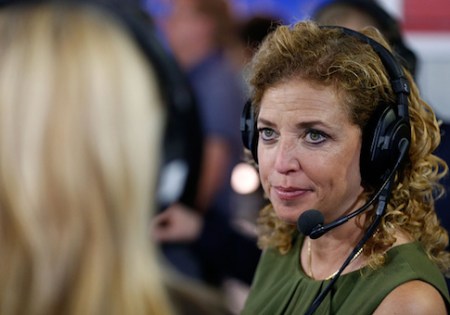
Debbie Wasserman Schultz / Getty Images

A leading lawmaker on the House oversight committee is urging the Trump administration to pursue a court order freezing recent wire transfers to Pakistan made by Democratic IT staffers who are accused of stealing computer equipment from House lawmakers’ offices and penetrating internal congressional networks, the Washington Free Beacon has learned.

Rep. Ron DeSantis (R., Fla.), an oversight committee member and chair of its national security subcommittee, petitioned Attorney General Jeff Sessions to disclose if federal investigators are moving to freeze recent wire transfers of nearly $300,000 by Imran Awan, a top IT staffer for Rep. Debbie Wasserman Schultz (D., Fla.) and scores of other Democrats who was recently arrested on charges of bank fraud.

Awan and several of his family members are believed to have stolen computer equipment used by Congress and penetrated sensitive networks linked to the House Foreign Affairs Committee and other networks.

Awan and others allegedly involved in the scandal remained on the congressional payroll for months after their activity became public, prompting calls by senior lawmakers for an independent investigation in Wasserman Schultz’s handling of the situation.

Awan is also believed to have defrauded the House of Representatives by using taxpayer funds to buy computer equipment that is now missing.

DeSantis, who has spearheaded efforts to move forward with the probe into this scandal, told the Free Beacon on Thursday that the Trump administration must take immediate steps to freeze any assets that may have been transferred by Awan to Pakistan.

“The DOJ needs to do what it can to freeze proceeds from any illicit transactions made by Awan,” DeSantis said. “Given the allegations against him it would be unthinkable that he’d be allowed to funnel hundreds of thousands of dollars to Pakistan.”

In his letter to Sessions, DeSantis seeks to ascertain what steps the DOJ is taking to investigate Awan and his wife, Hina Alvi, who is also tied to the scandal.

“Given the alarming amount of funds that were wired to Pakistan, has the Department of Justice utilized the United States Department of Treasury Financial Crimes Enforcement Network (FinCEN) to investigate the financial records of Awan and Alvi to discover evidence of other potential crimes?” DeSantis asks.

“Have any U.S. financial institutions filed reports of suspicious activity on any bank account held by Awan or his wife?” the letter continues.

“Is the Department of Justice investigating whether any funds generated from the sale of stolen property of the House of Representatives were included as part of the wire transfer to Faisalabad, Pakistan?” DeSantis asks.

“Finally, will the Department seek a court order freezing the proceeds of any real estate transaction or from the sale of stolen technological equipment?”

DeSantis has described the situation as one of the biggest congressional scandals in the past 30 years, and other sources intimately familiar with the matter have told the Free Beacon that Congress has been roiled by the situation.

There is concern that sensitive information potentially obtained by Awan and other Democratic staffers could be used against lawmakers who may have been bound up in the penetration of sensitive congressional networks.

“I hope that we can work together to undo the serious damage done by these individuals while in the employment of the House of Representatives,” DeSantis writes. “While we can never tolerate breaches of the public trust, the wire transfer to Pakistan is particularly alarming as Pakistan is home to numerous terrorist organizations. I look forward to your timely response into these matters.”

The Free Beacon first disclosed earlier this week that Congress is seeking a brief from Capitol Police into their investigation of the situation, which some feel has proceeded too slowly.

Senior congressional sources say that investigators should set their sites on Wasserman Schultz, who has been accused of stonewalling on the matter. Some have even called for Wasserman Schultz to resign.

“The extent of the potential breaches has been made more clear” in recent weeks, according to one senior congressional source who would only speak on background when discussing the sensitive matter. “The inexplicable nature of the conduct of Wassermann Schultz and others has broadened” congressional interest.

Lawmakers are confused as to why Wasserman Schultz continued paying Awan and other staffers implicated in the breach for several months after this information came to light.

“At best for her that is gross misapplication of public funds that could merit resignation alone,” the source said. “There’s got to be more to that story.”

Trump endorses new immigration bill to cut green-card limits, favor English speakers

August 2, 2017

Trump endorses new immigration bill to cut green-card limits, favor English speakers, Washington TimesDave Boyer and Stephen Dinan, August 2, 2017

Immigrant-rights groups accused Mr. Trump of catering to “white nationalists,” saying that non-white immigrants are far more prevalent among low-skilled, poor English-speaking immigrants who would be disadvantaged under the points system.

The measure would prohibit new immigrants from collecting welfare, which Mr. Trump called “a very big thing.”

*****************************

President Trump threw his support Wednesday behind a Senate bill that would cut legal immigration in half and implement a new merit-based system that emphasis English-speaking immigrants who can demonstrate job skills.

Meeting at the White House with GOP Sens. David Perdue of Georgia and Tom Cotton of Arkansas, the bill’s sponsors, the president said the revised legislation “would represent the most significant reform to our immigration system in half a century.”

The measure, known as the RAISE Act, “will reduce poverty, increase wages and save taxpayers billions and billions of dollars,” Mr. Trump said.

 The legislation would slash legal immigration in half, to 500,000 per year, over the next decade. The senators said it would replace the current permanent employment-visa framework with a skills-based system that rewards applicants based on their individual merits.

Mr. Cotton said the current immigration system is “an obsolete disaster” in which only 1 immigrant in 15 comes to the U.S. because of their job skills.

“I think it’s a symbol that were’ not committed to working-class Americans,” Mr. Cotton said of the current system.

The new system would reward education, English-language ability, high-paying job offers, past achievements, and entrepreneurial initiative. The White House said it would be similar to the merit-based immigration systems used by Canada and Australia.

The measure prioritizes immediate family members of U.S. residents, including spouses and minor children, but would end preferences for extended family members and adult children.

Mr. Trump said the U.S. has for decades issued green cards to “record numbers of low-wage immigrants,” and said it puts pressure on unskilled workers who are U.S. citizens already.

“It has not been fair to our people, to our citizens, and to our workers,” the president said.
He said the new system would “favor applicants who can speak English, financially support themselves and their families, and demonstrate skills that will contribute to our economy.”

Americans are divided on the right level of legal immigration. About 40 percent want to see the numbers cut, while another 40 percent want them to stay the same. The remaining 20 percent want to see increases.

The U.S. system is widely seen as broken, however, with immigrants — both legal and illegal — often having more say in the matter than the government itself. Extended families, business relationships and even a random lottery are used to award permanent visas.

Congress has pondered imposing a points system before, a decade ago, when then-President George W. Bush pushed for a massive overhaul that also would have legalized illegal immigrants. That bill died in the Senate.

Immigrant-rights groups accused Mr. Trump of catering to “white nationalists,” saying that non-white immigrants are far more prevalent among low-skilled, poor English-speaking immigrants who would be disadvantaged under the points system.

“Let’s call it as we see it: this is a white nationalist agenda masquerading as a bill about skill levels,” said Frank Sharry, executive director of America’s Voice.

The measure would prohibit new immigrants from collecting welfare, which Mr. Trump called “a very big thing.”

“They’re not going to come in and immediately go and collect welfare.They can’t do that,” he said.

The president of Numbers USA, a group seeking tighter immigration limits, said the legislation “will do more than any other action to fulfill President Trump’s promises as a candidate to create an immigration system that puts the interests of American workers first.”

“Our recent polling confirms that American voters overwhelmingly want far less immigration because they know mass immigration creates unfair competition for American workers,” said the group’s president, Roy Beck. “Seeing the president standing with the bill’s sponsors at the White House gives hope to the tens of millions of struggling Americans in stagnant jobs or outside the labor market altogether.”

The modern U.S. immigration system was established in 1965 when Congress decided the country should broaden traditional avenues of entry, abolish nationality quotas and expand family reunification.

The result was a system where about two-thirds of the green cards issued each year are for immediate relatives of U.S. citizens, while employment green cards account for about 15 percent. Refugees and asylees also account for about 15 percent.

Then there’s the diversity visa lottery, established in 1990, which doles out green cards based on chance. The goal was to give potential immigrants who don’t have family ties or job prospects a shot at making it to the U.S.

The new bill would nix the lottery, with the Trump administration saying it “serves questionable economic and humanitarian interests.”

The new bill would also limit permanent resident status for refugees to 50,000 a year, which the White House says is in line with the average over the past 13 years.

Cornell University Law School professor Stephen Yale-Loehr, who studies immigration policy, said the chances of Congress approving the legislation in the next two years are slim.

“It has been very hard for Congress to fix our broken immigration system,” he said. “Like health care reform and tax reform, immigration reform is complex and controversial.”