Posted tagged ‘U.S. Congress and Iran’

Initial Thoughts on Trump’s Iran Speech: Do All Roads Lead to a Pull-out?

October 13, 2017

Initial Thoughts on Trump’s Iran Speech: Do All Roads Lead to a Pull-out?, Power LinePaul Mirengoff, October 13, 2017

If we take Trump’s speech at face value, it seems to me that all roads lead to terminating the deal. If Congress doesn’t act, Trump says he will terminate the deal.

**********************

President Trump has just given an address that outlines how he plans to proceed against Iran. The two main points are: (1) he will impose new sanctions to punish Iran’s Revolutionary Guard and (2) he will not certify the Iran nuclear deal.

The refusal to certify means that Congress has 60 days to act. Trump is asking it to adopt legislation, apparently already formulated, that would remedy the flaws in the Iran deal.

This legislation would become the basis for attempting, if possible with the help of our allies, to renegotiate (in effect) key terms of the deal with Iran. In the negotiations we would, among other things, try to improve the inspection regime and eliminate the sunset provisions (the ones that allow Iran eventually develop nukes).

Crucially, it seems to me on first analysis, Trump said that if Congress doesn’t act along these lines in 60 days, he will “terminate” the deal. The president thus attempts to light a fire under a Congress which, absent his threat, almost certainly would not act. He also attempts to light a fire under our allies who seemingly have no real desire to renegotiate with Iran.

If we take Trump’s speech at face value, it seems to me that all roads lead to terminating the deal. If Congress doesn’t act, Trump says he will terminate the deal.

If Congress acts, it can’t rewrite the deal. All it can do is formulate demands that, if not met by Iran, will result in termination, assuming Trump follows the hard line he took today.

If faced with congressional action and presidential resolve, Iran might agree to certain minor fixes to the deal. But it’s difficult for me to imagine the regime agreeing, for example, to drop the sunset clause.

Only a restoration of the crippling sanctions once in place would have any hope of achieving this result. But that hope would be faint. In any event, it’s unlikely that we could ever rally our allies to impose the truly crippling sanctions that former president Obama lifted.

If my preliminary analysis is correct, then Trump has taken the first step towards pulling the U.S. out of the Iran deal. He has done more, in other words, than just “splitting the baby” — i.e, satisfying hawks by decertifying and satisfying moderates by not pulling out of the deal or enlisting Congress for that purpose. If we take the speech at face value, we are on the road to pulling out.

The “compromise,” is that we are doing so in a measured way — one that is less easy for Democrats and U.S. allies persuasively to denounce. Trump is enlisting their aid by asking them to participate in a process that, in theory, could improve the deal to the point where the U.S. would stay in it.

In practice, the likelihood of substantially improving the deal seems slight. However, it is reasonable for Trump to give it a try, and reasonable for Democrats and our allies to participate in the effort.

I’ll conclude by saying that Trump’s speech was outstanding. In 20 minutes or so, he laid out the history of Iran’s evil-doing; excoriated the Iran deal Obama agreed to; and laid out his course of action going forward.

Will the administration follow that course or will key members persuade Trump to employ off-ramps? It’s difficult to say, or even to guess who the key members of the administration will be down the road. I’m inclined, though, to think that Trump will follow the course he laid out so solemnly today.

These observations are preliminary ones. I’m sure we’ll have more to say upon further reflection.

Congress Seeks Deadline on Iran Accepting Tougher Nuclear Deal Standards

October 13, 2017

Congress Seeks Deadline on Iran Accepting Tougher Nuclear Deal Standards, Washington Free Beacon, October 13, 2017

Rep. Peter Roskam / Getty Images

Roskam’s legislation would mandate that Iran permit unfettered, unannounced, and indefinite access to all of Iran’s contested nuclear sites, including military spots that have been completely off-access to international nuclear inspectors.

Iran opposes such proposals, claiming that its military sites will never been opened to the international community.

*************************************

Congress is set to consider new legislation that would require Iran to accept tough new conditions on the landmark nuclear deal or face a rash of harsh new economic sanctions aimed at thwarting the Islamic Republic’s continued nuclear buildup, according to a draft of new legislation exclusively viewed by the Washington Free Beacon.

On the heels of President Donald Trump’s announcement that he will decertify Iranian compliance with the nuclear agreement, top GOP lawmakers are already working on legislation that would compliment the White House’s announcement and move forward with efforts to harshly penalize Tehran if it does not accept rigid new standards on its nuclear activities within the next six months, according to a copy of draft legislation circulating in the House of Representatives.

The new legislation, spearheaded by Rep. Peter Roskam (R., Ill.), would reimpose all economic sanctions lifted by the former Obama administration as part of the nuclear agreement if Iran refuses to comply with tough new standards restricting its ballistic missile program, arms buildup, and failure to permit access to a range of military sites suspected of engaging in nuclear work.

The legislation also would effectively kill provisions of the nuclear agreement known as sunset clauses. These are portions of the deal that would rollback restrictions on Iran’s advanced nuclear research and weapons buildup within the next five to six years.

Trump, as well as allies in Congress, maintains the original nuclear accord contains several key flaws that permit Iran to cheat on the deal and receive sweetheart bonuses—such as sanctions relief and other assets—despite evidence of multiple violations of the agreement.

Sources who spoke to the Free Beacon about the effort to tighten the deal said that many in Congress would be willing to reimpose all key sanctions on Iran if it does not agree to abide by the stricter enforcement regulations.

“The days of appeasing the Mullah’s every wish and sitting back and watching as the terrorist state goes nuclear are over,” said one senior congressional official intimately familiar with the new proposal. “Congress overwhelmingly opposed Obama’s disastrous deal with Iran. Now’s the time to assert our constitutional responsibility to defend our nation and use all tools of U.S. power to permanently prevent an nuclear armed Iran.”

This new legislation is similar to the policy approach advocated by senior Trump administration officials, such as Secretary of State Rex Tillerson, who told reporters late Thursday the administration is looking to create a parallel nuclear deal that gives Congress a larger role in ensuring Iranian compliance.

These would include “trigger points that are specific to the nuclear program itself, but also deals with things like their ballistic missile program,” according to Tillerson.

Roskam’s new legislation, called the JCPOA Improvement Act of 2017, seeks to do precisely this.

In addition to banning Iran from developing, testing, and operating ballistic missile technology—which was never addressed in the original nuclear agreement – the new legislation would impose even stricter regulations on the amount of nuclear enrichment Iran can legally engage in.

It also would stop Iran from installing advanced nuclear centrifuges that can enrich uranium, the key component in a nuclear weapon, much faster than older versions of this equipment. Under the original nuclear agreement, known as the Joint Comprehensive Plan of Action, or JCPOA, Iran would have been granted the right to operate advanced centrifuges within the next several years.

Congress also is seeking to address Iran’s development of heavy water nuclear reactors that provide a secondary pathway to a nuclear weapon via the use of plutonium, a by-product of such equipment, according to the draft legislation and sources who spoke to the Free Beacon.

The Obama administration had worked to ensure that, under the agreement, Iran retained its right to operate such reactors, despite opposition in Congress and elsewhere. Iran has already inked several deals with Russia to assist in the construction of new light and heavy water reactors, though this new legislation could complicate that matter.

Another key portion of the original agreement that has been vehemently criticized by Trump and congressional allies surrounds caveats that give Iran more than a month before consenting to inspections of its nuclear sites.

Roskam’s legislation would mandate that Iran permit unfettered, unannounced, and indefinite access to all of Iran’s contested nuclear sites, including military spots that have been completely off-access to international nuclear inspectors.

Iran opposes such proposals, claiming that its military sites will never been opened to the international community.

If Iran does not agree to the new restrictions proposed in the legislation, Congress has the ability to reimpose all sanctions that were lifted as part of the original accord. This represents a major new tool for Congress as it works to thwart Iran’s continued military endeavors across the Middle East and its pursuit of advanced new weaponry.

Under the new legislation, any future attempt to rescind these new restrictions would be subject to a vote in the United Nations Security Council, according to the bill.

Trump Admin Will Not Commit to Designating IRGC as Terror Group

October 11, 2017

Trump Admin Will Not Commit to Designating IRGC as Terror Group, Washington Free Beacon , October 11, 2017

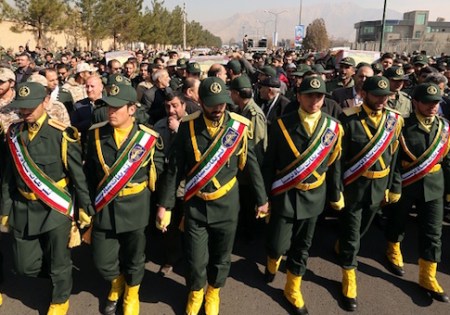
Members of the Iran’s Revolutionary Guard Corps / Getty Images

Trump last week signed new sanctions legislation mandating that the United States extend a terror designation to the IRGC, marking the first time in U.S. history a foreign country’s military branch would be hit with such a designation.

However, the State and Treasury Departments would not confirm Wednesday that the administration intends to make good on this law, which was approved by Congress with bipartisan support.

***********************************

The Trump administration will not commit to designating the Islamic Revolutionary Guard Corps, or IRGC, Iran’s elite fighting force, as terrorists, despite a congressional mandate to do so by the end of the month, according to multiple U.S. officials and other administration insiders who told the Washington Free Beacon that holdovers from the Obama administration are working to stymie the effort.

While President Donald Trump is expected to announce this week that he will not certify Iran as in compliance with the landmark nuclear deal, it remains unclear if he will follow through with congressionally approved plans to extend a terror designation to the IRGC, a move that has prompted Iran to threaten greater attacks on U.S. forces in the Middle East.

The IRGC is responsible for numerous terror attacks on American troops over the years and has played a key role in interfering with U.S. operations in Syria. A bipartisan consensus in Congress has already backed such a designation, but key Obama-era holdovers and top national security officials who have the president’s ear are urging him to refrain, according to multiple sources who spoke to the Free Beacon.

Top lawmakers and insiders who spoke to the Free Beacon about the growing uncertainty over how best to hold Iran accountable for its terror activities expressed frustration over what they view as the administration’s inability to follow through with its foreign policy promises, particularly as they relate to Iran, which has increasingly targeted U.S. forces with military action.

New reports emerged Wednesday afternoon that Trump’s planned speech on Iran may be scaled back and not take place until Friday, if it does at all.

Trump last week signed new sanctions legislation mandating that the United States extend a terror designation to the IRGC, marking the first time in U.S. history a foreign country’s military branch would be hit with such a designation.

However, the State and Treasury Departments would not confirm Wednesday that the administration intends to make good on this law, which was approved by Congress with bipartisan support.

The administration may be getting cold feet due to the objections of key U.S. officials and those in the Treasury Department who view such a designation as harmful to American companies that have business interests in Iran, where the IRGC controls a majority of the economy, sources said.

“The IRGC is responsible for wreaking havoc throughout the Middle East and, through its Quds Force, for killing hundreds of American troops in Iraq,” Rep. Ron DeSantis (R., Fla.), a member of the House Foreign Affairs Committee and chair of its National Security Subcommittee, told the Free Beacon.

“The IRGC represents a quintessential terrorist group and should be designated as such,” DeSantis said.  “Whereas the Obama administration flew pallets of cash to the IRGC, the Trump administration should act to hold the IRGC accountable.  Designating it as a terrorist group is a good first step.”

Neither the State Department or White House would confirm to the Free Beacon plans to follow through with this designation, prompting speculation that the process may be held up over objections by Obama-era holdovers in the Trump administration who view the move as a shot at dismantling the former president’s nuclear deal.

“Congress didn’t ask the president to designate the full IRGC,” according to one veteran Middle East policy advisor who lobbies Congress on Iran sanctions. “They told the president to do it by veto proof majorities. Obama holdover lawyers and his establishment staffers are telling him he can use loopholes to just go after some entities and circumvent Congress.”

These same voices are continuing to advise Trump against decertifying Iranian compliance with the deal, despite the president’s personal belief that the Islamic Republic has flagrantly violated what he has repeatedly described as a bad deal.

“These are the same people advising him to certify the nuclear deal, which was also rejected by bipartisan majorities in Congress,” the source said. “They’re wrong and if they stay wrong, lawmakers will eventually make it an oversight issue.”

A State Department official declined repeated requests for clarification on what the administration intends to do about the IRGC, but told the Free Beacon officials remain “deeply troubled by Iran’s longstanding provocative activities including its support for terrorism and destabilizing activities in the region.”

“We are committed to holding Iran accountable for its behavior,” the official said. “The United States retains the authority to respond to Iran’s support for terrorism, human rights abuses, and destabilizing activities. The U.S. government constantly reviews information, through an interagency process, to evaluate potential sanctions violators for targeting under existing sanctions authorities.”

A Treasury Department official did not respond to a request for comment on the matter.

Iranian officials vowed last week to strike U.S. forces and bases in the region if the Trump administration moves forward with extending a terror designation to the IRGC.

Rep. Sean Duffy (R., Wis.), a vocal opponent of the Iran deal, told the Free Beacon that Iran would be wise to back down from its threats.

“President Obama’s terrible Iran deal predictably emboldened the Iranian regime to build up their military and antagonize the region,” Duffy said. “Iran may have been able to bully our previous president, but the American people elected President Trump to stand up for the United States on the world stage.”

“The Iranian regime is already on notice for being the world’s largest state-sponsor of terror, and it would be wise for them to back down from their belligerent posture,” Duffy added.

ANALYSIS: Certified or decertified, Iran faces tough road ahead

October 10, 2017

ANALYSIS: Certified or decertified, Iran faces tough road ahead, Al Arabiya, Heshmat Alavi, October 9, 2017

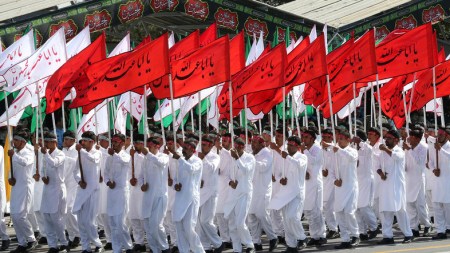
Members of Iranian armed forces march during a parade in Tehran, Iran, September 22, 2017. President.ir/Handout via REUTERS.

The new mentality sought by Washington is to address all of Iran’s belligerence and not allow its nuclear program and the JCPOA devour all of the international community’s attention.

The new US response, including blacklisting Iran’s notorious Revolutionary Guards, to be announced by Trump is said to cover missile tests, support for terrorism and proxy groups checkered across the Middle East, hopefully human rights violations at home, and cyberattacks.

Iran has a history of resorting to such measures, including targeting Saudi oil interests. Raising the stakes for Iran, Trump described a meeting with his top military brass on Thursday evening as “the calm before the storm.” Neither the US President nor the White House provided further details, yet rest assured Tehran received the message.

**************************

All eyes are on US President Donald Trump and his upcoming Iran speech later this week to clarify his decision to certify or decertify Tehran’s compliance with a nuclear agreement, officially known as the Joint Comprehensive Plan of Action (JCPOA), designed to curb the regime’s controversial atomic drive.

This has Iran’s regime on its toes, as senior elite in Tehran understand fully how the US can lead the international community in adopting strong measures against its broad scope of malign activities. Expected to be addressed is also a wide range of concerns over Iran’s dangerous policies in relation to its ballistic missile advances, meddling in Middle East states and supporting terrorist proxy groups as explained in a new video.

‘Iran’s unacceptable behavior’

Iran’s rogue behavior, currently imposing its influence on four major regional capitals of Baghdad, Beirut, Damascus and Sanaa, are the result of the Obama administration’s “overly lenient foreign policy, which sought to promote America’s priorities through consensus, rather than through the frank display of power,” as put by a recent The New Yorker piece.

“Lifting the sanctions as required under the terms of the JCPOA has enabled Iran’s unacceptable behavior,” US Secretary of State Rex Tillerson said in a late September meeting with his P5+1 counterparts and Iran’s top diplomat Mohammad Javad Zarif.

The Trump administration is also deeply concerned over Iran’s proxies mining the strategic Bab el-Mandeb Strait waterway, aiming its indigenous missiles from Yemen towards cities in Saudi Arabia and other Gulf countries, and from southern Lebanon towards Israel. This is Tehran in action with the objective of taking advantage of the destruction left behind by ISIS across the region, especially in Syria and Iraq.

“The Iranian regime supports terrorism and exports violence, bloodshed and chaos across the Middle East,” Trump told reporters before a Thursday evening meeting with senior military leaders at the White House. “That is why we must put an end to Iran’s continued aggression and nuclear ambitions,” he said. “They have not lived up to the spirit of their agreement.”

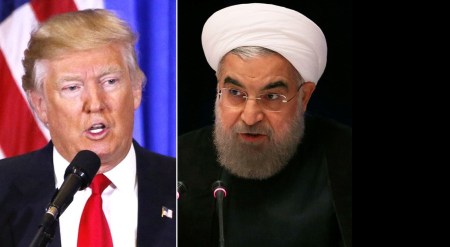
Trump has put Iran “on notice” over charges that Tehran violated a nuclear deal with the West by test-firing a ballistic missile. (Reuters)

Joint effort

Parallel to the White House there are voices on Capitol Hill advocating the new approach weighed by the administration.

“The president should decline to certify, not primarily on grounds related to Iran’s technical compliance, but rather based on the long catalog of the regime’s crimes and perfidy against the United States, as well as the deal’s inherent weakness,” Senator Tom Cotton said last week at a speech in the Council on Foreign Relations.

As the Trump administration seeks to place necessary focus on Iran’s illicit Middle East ambitions and actions, talks are also ongoing as we speak over how to amend the JCPOA’s restrictions.

“Sunset clauses,” Iran’s ballistic missile development and testing, and an inspections regime lacking the bite to gain necessary access into the regime’s controversial military sites. Under the current framework Iran can easily conduct nuclear weapons research and development in military sites and claim such locations do not fall under the JCPOA jurisdiction.

While it is expected of Trump to decertify Iran, he most likely will not go the distance to completely pull America out of the nuclear agreement. Obama refused to send the JCPOA to Congress for discussion and approval. Trump, however, seems set to place the decision to impose further sanctions on Iran upon the shoulders of US lawmakers.

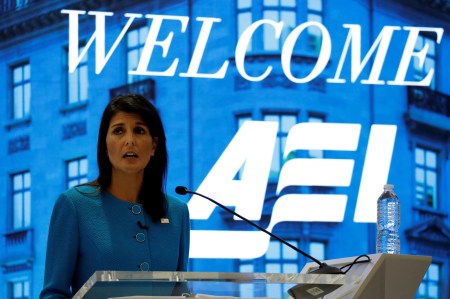
US Ambassador to the United Nations Nikki Haley speaks about the Iran nuclear deal at the American Enterprise Institute in Washington, on September 5, 2017. (Reuters)

More than ‘one piece’

The new mentality sought by Washington is to address all of Iran’s belligerence and not allow its nuclear program and the JCPOA devour all of the international community’s attention.

The new US response, including blacklisting Iran’s notorious Revolutionary Guards, to be announced by Trump is said to cover missile tests, support for terrorism and proxy groups checkered across the Middle East, hopefully human rights violations at home, and cyberattacks.

Iran has a history of resorting to such measures, including targeting Saudi oil interests. Raising the stakes for Iran, Trump described a meeting with his top military brass on Thursday evening as “the calm before the storm.” Neither the US President nor the White House provided further details, yet rest assured Tehran received the message.

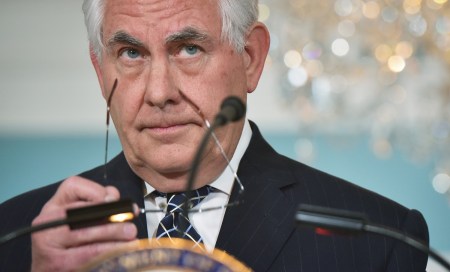
US Secretary of State Rex Tillerson delivering a statement on Iran in the Treaty Room of the State Department in Washington, DC, on April 19, 2017. (AFP)

Fear renders contradiction

Sensing an increasingly escalating tone from Washington, Tehran signaled its first sign of fear by expressing readiness to discuss its ballistic missile program, according to Reuters. And yet less than 24 hours later, Iranian officials said no offers were made to negotiate such restrictions.

“Iran regards defensive missile programs as its absolute right and will definitely continue them within the framework of its defensive, conventional and specified plans and strategies,” Iranian Foreign Ministry spokesman Bahram Qassemi said, according state media.

Iranian President Hassan Rouhani also felt the need to make remarks to save face before the regime’s already depleting social base. “In the nuclear negotiations and agreement we reached issues and benefits that are not reversible. No one can turn that back, not Mr. Trump or anyone else,” Rouhani said at a recent Tehran University ceremony, according to state media.

Of course, we all remember how prior to the JCPOA signing in 2015 senior Iranian officials went the limits in describing any “retreat” regarding their nuclear program as a “red line.” To make a long story short, Tehran is comprehending how the times are changing at a high velocity, endangering its domestic, regional and international interests. And unlike the Obama years, its actions will not go unanswered.

Senator Cotton made this crystal clear at his speech: “Congress and the President, working together, should lay out how the deal must change and, if it doesn’t, the consequences Iran will face.”

Iran Caught Shipping Soldiers to Syria on Commercial Flights in Violation of Nuclear Deal

August 23, 2017

Iran Caught Shipping Soldiers to Syria on Commercial Flights in Violation of Nuclear Deal, Washington Free Beacon, August 23, 2017

New photographs obtained by congressional leaders show Iran shipping militant soldiers to Syria on commercial airline flights, a move that violates the landmark nuclear agreement and has sparked calls from U.S. lawmakers for a formal investigation by the Trump administration, the Washington Free Beacon has learned.

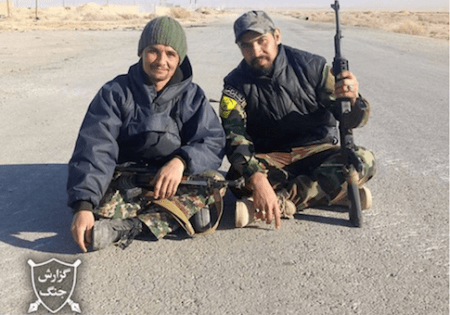
Photographs published by a Washington, D.C., think-tank and provided to Congress show Iran using its flagship commercial carrier, Iran Air, to ferry militants to Syria, where they have joined the fight against U.S. forces in the region.

The new photographic evidence has roiled congressional leaders, who accuse Iran of violating the nuclear deal, which prohibits it from using commercial air carriers for military purposes. These lawmakers are demanding the Trump administration investigate the matter and consider imposing new sanctions on Iran.

The release of these photographs allegedly showing Iran Air’s illegal activity comes as top U.S. air carrier manufacturer Boeing moves forward with a multi-billion dollar deal to sell Iran Air a new modern fleet. Many in Congress have opposed the deal due to Iran’s longstanding use of commercial aircraft for military purposes, such as transporting weapons and troops to regional hotspots such as Syria and elsewhere.

Iran Air’s central role in the illicit transportation of militant forces to Syria could complicate Boeing’s efforts to move forward with the sale, which still requires approval from the Trump administration’s Treasury Department.

Congressional leaders are now calling for a suspension of all licenses permitting these sales in light of the new evidence, according to a letter obtained by the Free Beacon.

“Iran’s use of commercial aircraft for military purposes violates international agreements as well as Iranian commitments under the JCPOA,” or Joint Comprehensive Plan of Action, according to the delegation of lawmakers pushing for an investigation. “We believe these photos mandate a thorough investigation of these practices and a comprehensive review of Iran’s illicit use of commercial aircraft.”

“During this investigation, the United States should suspend current and future licenses for aircraft sales to Iran,” the letter goes on to say.

Those calling for an investigation include Reps. Peter Roskam (R., Ill.), Lee Zeldin (R., N.Y.), Andy Barr (R., Ken.), and David Reichert (R., Wash.).

“Iran Air has engaged in Iran’s illicit transport of military goods and personnel to Syria since implementation of the” nuclear deal, the lawmakers write.

The Treasury Department has vowed in the past to consider and investigate any new evidence revealing Iran’s illicit use of commercial aircraft. The lawmakers are urging the Trump administration to make good on this promise.

“In light of these assurances to both investigate evidence of Iranian wrongdoing and to re-designate Iranian airlines engaging in sanctionable activity, we strongly urge you to investigate the enclosed photos,” the lawmakers write. “If as a result of your investigation, you find Iran Air guilty of conducting military transports with commercial aircraft, it should be re-designated.”

The new photographs, reportedly taken in 2016 and 2017, show Iranian fighters aboard Iran Air planes on their way to Syria to pick up arms in support of embattled President Bashar al-Assad.

The militants are believed to be affiliated with the Fatemiyoun Brigade, an Afghan Shiite militia, according to the Foundation for Defense of Democracies, which first disclosed the photographs to Congress.

“These photos seem to display militiamen sitting on seats clearly labeled with the Iran Air logo,” the lawmakers inform the Treasury Department. “These individuals are not Afghani civilians; they are believed to be members of an Iranian-backed militia, trained and funded by Iran’s Islamic Revolutionary Guard Corps (IRGC), actively fighting for the Assad regime in the Syria.”

Iran Air is guilty of “facilitating the ongoing atrocities committed against the Syrian people by the Assad regime and its allies,” the lawmakers write.

The issue has become all the more pressing in light of recent attacks by Iranian-backed militias on U.S. forces operating in Syria.

“We strongly urge you to swiftly investigate and conduct a comprehensive review of Iran Air’s role in supporting Iran and the Assad regime militarily, and hold accountable those found guilty of such activity,” the lawmakers write.

Bi-Partisan Support for Bill to ‘Hold Iran Accountable’

June 16, 2017

Bi-Partisan Support for Bill to ‘Hold Iran Accountable’, Iran News Update, June 16, 2017

“It’s worth noting that the JCPOA is not unlike the Paris climate accord.

“I don’t think many people in our country or many people in this body realize that it is a non-binding political agreement that was entered into by one man using presidential executive authority and can easily be undone by one man using presidential executive authority.

“In fact, in many ways, it is easier than the Paris accord considering the president doesn’t have to take an action to exit this agreement.

All he has to do is decline to waive sanctions. I think that has been missed.

****************************

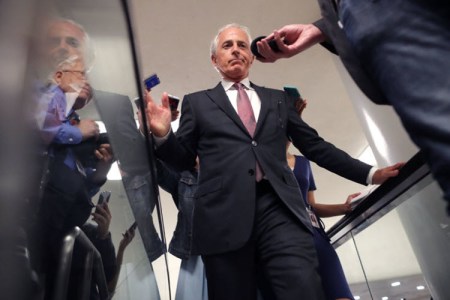
Chairman of the Senate Foreign Relations Committee, Senator Bob Corker (R-Tenn.), spoke before the Senate on Wednesday, in a bill he authored, the Countering Iran’s Destabilizing Activities Act of 2017. The legislation, has 60 bipartisan cosponsors, and is expected to pass the Senate this week. It will expand sanctions against Iranian for ballistic missile development, support for terrorism, transfer of conventional weapons to or from Iran, and human rights violations.

Senator Corker’s speech is reproduced as follows:

“Mr. President,

I rise today to speak about the Countering Iran’s Destabilizing Activities Act of 2017, which passed the Senate Foreign Relations Committee last month by a vote of 18 to 3.

“I’d like to thank the members of our committee and the co-authors of this bill for working in a constructive, bipartisan fashion to craft this legislation.

“I think it is a good example of how the Senate can still work together to tackle complex and difficult issues.

“I was in the SCIF recently – a place where senators go to read classified information – reviewing intelligence, and it truly is astounding what Iran continues to do around the world.

“For a people that are capable of so much, their foreign policy is shockingly counter to their own interest.

“We see destabilizing act after destabilizing act – from missile launches, to arms transfers, to terrorist training, to illicit financial activities, to targeting Navy ships and detaining American citizens – the list goes on and on.

“And it’s past time for us to take steps to protect the interests of the United States and our allies.

“This bill is the first time Congress has come together since the JCPOA – the Iran nuclear deal – to do just that.

“For far too long, the agreement – which I strongly opposed, as did our ranking member and presiding officer – has dictated U.S. policy throughout the Middle East.

“It’s worth noting that the JCPOA is not unlike the Paris climate accord.

“I don’t think many people in our country or many people in this body realize that it is a non-binding political agreement that was entered into by one man using presidential executive authority and can easily be undone by one man using presidential executive authority.

“In fact, in many ways, it is easier than the Paris accord considering the president doesn’t have to take an action to exit this agreement.

“I don’t think most Americans understand that. He doesn’t have to take action to exit the agreement. All he has to do is decline to waive sanctions. I think that has been missed.

“But no matter what the president decides, this bill makes it clear that the Congress intends to remain involved and will hold Iran accountable for their non-nuclear destabilizing activities.

“What the nuclear agreement failed to do was allow us to push back against terrorism, human rights issues, violations of U.N. security council resolutions relative to ballistic missile testing, and to push back against conventional arms purchases, which they are not supposed to be involved in.

“As many of us predicted at the time, Iran’s rogue behavior has only escalated since implementation of the agreement, and this bipartisan bill will give the administration tools for holding Tehran accountable.

“Let me say this. I don’t think there’s anybody in this chamber who doesn’t believe that the Trump administration – I know there’s been a lot of disagreements recently about foreign policy issues in the administration – but I don’t there’s anybody here that believes they are not going to do everything they can to push back against these destabilizing activities.

“And what we’ll be doing today and tomorrow with passage of this legislation is standing hand-in-hand with them as they do that.

“It also sends an important signal that the U.S. will no longer look the other way in the face of continued Iranian aggression.

“I want to recognize the important work of my colleagues in making this legislation possible.

“Senator Menendez has been a champion for holding Iran accountable, in this bill but also in decades of work on this issue. He truly is an asset to the Senate, and I thank him for his commitment to many issues, but especially this one.

“Senators Cotton, Rubio, and Cruz all played an important role in drafting this legislation as well.

“But finally, let me say this. This would not have been possible without the support and tireless effort of the ranking member, Senator Cardin, and his great staff. It has truly been a pleasure for me to work with him on the Russia bill that we will be voting on today at 2:00 p.m. but also on this legislation.

“We come from two very different places, representing two very different states, and yet are joined by the fact that we care deeply about making sure that the foreign policy of this country is in the national interest of our citizens and that we as a Congress and as a United States Senate are doing everything we can to drive positive foreign policy.

“I want to thank him for that and tell him I am really proud of the strong bipartisan momentum behind this legislation, which his leadership has helped make happen, and I look forward to passage of this bill.”

Iran’s 1988 Mass Executions Result in US Congress Resolution

June 2, 2017

Iran’s 1988 Mass Executions Result in US Congress Resolution, Iran News Update, June 2, 2017

A recently introduced resolution in the U.S. Congress, H.Res. 159, refers to the horrific mass executions of political prisoners by the Islamic Republic of Iran. Mike McCaul, the House Homeland Security Chair, introduced the resolution, and it was cosponsored by Ed Royce, the House Foreign Affairs Committee Chair, as well as Ranking Member Eliot Engel, and Rules Committee Chair Representative, Peter Sessions.

It came as Iranian President Hassan Rouhani, recently re-elected to a second term, and was addressing the 71st Session of the United Nations General Assembly.

The Associated Press reported that thousands of people gathered outside the United Nations to protest Iran’s human rights abuses, executions, and the 1988 massacre of more than 30,000 prisoners.

Speakers for the Resolution included former Democratic vice Presidential candidate, Senator Joe Lieberman, and Sir Geoffrey Robertson, former Head of UN war crimes tribunal for Sierra Leone. Robertson wrote a report on Iran’s 1988 massacre, published on the United Nations Arts Initiative.

The resolution “condemns the Government of the Islamic Republic of Iran for the 1988 massacre of political prisoners and [calls] for justice for the victims.”

It adds that “over a 4-month period in 1988, the Government of the Islamic Republic of Iran carried out the barbaric mass executions of thousands of political prisoners and many unrelated political groups. … [A]ccording to a report by the Iran Human Rights Documentation Center, the massacre was carried out pursuant to a fatwa, or religious decree, issued by then Supreme Leader Ayatollah Ruhollah Khomeini, that targeted the People’s Mojahedin of Iran (PMOI), also known as the Mujahedeen-e-Khalq (MEK).”

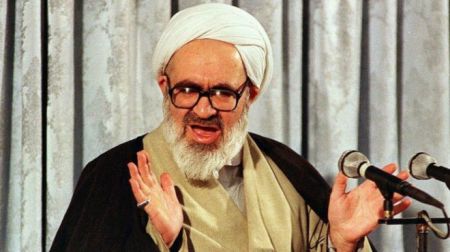
The resolution quotes one of Iran’s own senior former officials, the late Hussein Ali Montazeri, a grand ayatollah who served as Khomeini’s chief deputy, who said the 1988 massacre was ‘’the greatest crime committed during the Islamic Republic, for which history will condemn us.”

Accordingly, in 1988, the Islamic Republic executed the thousands of prisoners who had even slight affiliations with the main opposition movement Mujahedin-e Khalq (MEK), because of their political beliefs. The victims were buried in mass graves in Iran after they were shot or hung over a period of just a few months.

Amnesty International reported on November 2, 2007, ‘’between 27 July 1988 and the end of that year, thousands of political prisoners [in Iran], including prisoners of conscience, were executed in prisons nationwide.”

Noted by H.Res. 159, “Those personally responsible for these mass executions include senior officials serving in the current Government of Iran; … [P]risoners were reportedly brought before the commissions and briefly questioned about their political affiliation, and any prisoner who refused to renounce his or her affiliation with groups perceived as enemies by the regime was then taken away for execution.”

Accordingly, “thousands of people, including teenagers and pregnant women, imprisoned merely for participating in peaceful street protests and for possessing political reading material, many of whom had already served or were currently serving prison sentences,” were among the victims.

Stated in the congressional resolution, “[P]risoners were executed in groups, some in mass hangings and others by firing squad, with their bodies disposed of in mass graves.”

According to Amnesty International, ‘’the majority of those killed were supporters of the PMOI [MEK], but hundreds of members and supporters of other political groups . . . were also among the execution victims.’’

The resolution further states, “The later waves of executions targeted religious minorities, such as members of the Baha’i faith, many of whom were often subjected to brutal torture before they were killed.” It add “The families of the executed were denied information about their loved ones and were prohibited from mourning them in public”.

The resolution mentions a recently disclosed audiotape, where Hussein Ali Montazeri can be heard to say that the 1988 mass killings were “the greatest crime committed during the Islamic Republic, for which history will condemn us.”

Amnesty International’s report concluded, “there should be no impunity for human rights violations, no matter where or when they took place. The 1988 executions should be subject to an independent impartial investigation, and all those responsible should be brought to justice, and receive appropriate penalties’’

The resolution says, “The current Supreme Leader Ali Khamenei was reportedly aware of, and later publicly condoned the massacre.”

The Montazeri audiotape was released by Ayatollah Hossein Ali Montazeri’s son, Ahmad, a moderate cleric, who posted the confidential audio of his father on his website. He was ordered by the intelligence to remove it, and was later arrested.

On the tape, Montazeri states, “You [Iranian officials] will be in the future etched in the annals of history as criminals. The greatest crime committed under the Islamic Republic, from the beginning of the Revolution until now, which will be condemned by history, is this crime [mass executions] committed by you.”

Ironically, the people Montazeri is addressing and warning on the tape appear to enjoy high positions currently. They include:

• Mostafa Pourmohammadi was appointed by the Hassan Rouhani to be justice minister. After the release of a tape, Pourmohammadi defended the commission of the massacre and said he is “proud“ to have carried out “God’s commandments” in killing the political opponents.

• Ebrahim Raeisi was appointed as the head of Astan Quds Razavi, which has billions of dollars in revenues.

• Hussein Ali Nayeri is now the deputy of the Supreme Court of Iran. In his memoir, Montzari writes that he told Nayeri to stop the executions at least in the month of Moharram religious holidays, but according to the BBC, Nayeri said, “We have executed so far 750 people in Tehran… we get the job done with [executing] another 200 people and then we will listen to whatever you say.”

These people are only few of those who were involved in the 1988 massacre. They have been awarded more senior positions, power, and money.

Montazeri warned them, “Beware of 50 years from now, when people will pass judgment on the leader (Khomeini) and will say he was a bloodthirsty, brutal and murderous leader.”

The message from Iran’s ex-heir Supreme Leader highlights the methods that the officials of the Islamic Republic use to oppress the opposition. Executions or brutal punishments are common, as Iran ranks top in the world when it comes to executions per capita. Crimes against humanity continue to occur. These are the means that the government uses to silence the opposition.

Human rights organizations, the United Nations, and the International Criminal Court (ICC) must conduct investigations, and bring those who have committed and continue to commit these crimes to justice. Calls for justice are increasing. Those who commit crimes against humanity should be held accountable.

Congress must follow up on the recent Congressional resolution.