Posted tagged ‘Turkey’

Mashaal: ‘A strong Turkey means a strong Palestine’

December 27, 2014

Mashaal: ‘A strong Turkey means a strong Palestine’In address to ruling party supporters,

Hamas leader praises Erdogan, Davutoglu; crowd shouts ‘down with Israel’

By Ricky Ben-David December 27, 2014, 4:15 pm

via Mashaal: ‘A strong Turkey means a strong Palestine’ | The Times of Israel.


Hamas chief Khaled Mashaal answers AFP journalists' questions during an interview in the Qatari capital of Doha, on August 10, 2014. (photo credit: AFP/al-Watan Doha/Karim Jaafar)

Hamas chief Khaled Mashaal answers AFP journalists’ questions during an interview in the Qatari capital of Doha, on August 10, 2014. (photo credit: AFP/al-Watan Doha/Karim Jaafar)

xiled Hamas leader Khaled Mashaal hailed Turkey’s leaders Saturday in Konya province in central Anatolia during a surprise speech to officials and supporters of the ruling AK party, saying he hoped to “liberate Palestine and Jerusalem” with them.

Mashaal congratulated the people of Turkey for “for having [Prime Minister Ahmet] Davutoğlu and President Recep Tayyip Erdoğan” as heads of state, adding that “a strong Turkey means a strong Palestine … Inshallah, God is with us and with you on the road to victory.”

“Inshallah we will liberate Palestine and Jerusalem again in the future,” Mashaal said.

The Hamas leader was introduced to the crowd gathered for the annual event by Davutoglu himself. His speech was frequently interrupted by supporters shouting “down with Israel!” and “God is great.”

“A democratic, stable and developed Turkey is a source of power for all Muslims,” Mashaal went on, adding “I greet all the brave people who claim Jerusalem … Our flag is the symbol of all the oppressed in the world.”

Mashaal often shows up at the ruling party’s events. He also attended the AKP’s congress in 2012 when President Recep Tayyip Erdogan was serving as prime minister.

Davutoglu, in his speech Saturday said Turkey’s red flag featuring a crescent with a star was a “symbol of the innocent in the world.”

“God is witness … we will make this red flag a symbol of the innocent. This red flag will fly side by side with the flags of Palestine, free Syria and all other innocents’ flags anywhere in the world,” he told the congress.

Turkey and Hamas have seen a rapid rapprochement as Israel’s ties with Ankara continued to deteriorate. The AK party has had close ties with Hamas since its rise in 2001, led by Davutoglu and Erdogan. The two have been known for their frequent outbursts against Israel over the years.

In August during Israel’s Operation Protective Edge, Erdogan accused Israel of being “more barbaric than Hitler.” Israel launched the campaign on July 8 to stop rocket fire from Gaza and destroy tunnels dug under the border by Hamas for attack purposes.

Jerusalem has also accused Turkey of allowing Hamas to operate on its soil, a charge Ankara strongly denies.

Last month, Israel appealed to the NATO coalition — of which Turkey is a member – and to the US leadership to take steps against Ankara for enabling Hamas terrorists to operate and plan terror attacks against Israelis from its territory.

Israel has alleged on several recent occasions that Hamas cells operating in the West Bank and planning major terror attacks were doing so under the guidance and leadership of Hamas’s Saleh al-Arouri, who was deported from the West Bank to Turkey in 2010, while Ankara turns a blind eye to his actions.

Last month, the Shin Bet security service said members of a Hamas terror ring in the West Bank, run from the organization’s headquarters in Turkey, sought to carry out an array of major attacks, including on Jerusalem’s main soccer stadium and its light rail line.

Arouri, they said, built up and funded the network, and has effectively established a Hamas command post in Turkey which is leading terror efforts in the West Bank. Arouri is reportedly aided by dozens of operatives, some of whom were deported by Israel in the wake of the Gilad Shalit prisoner deal in 2011.

The officials accused Turkey as well as Qatar — the current home of Hamas leader Khaled Mashaal — of enabling Hamas to operate freely within their territories to carry out attacks against Israel and undermine the Palestinian Authority.

In October, Defense Minister Moshe Ya’alon said Hamas had two command centers: one in the Gaza Strip, which has been ruled by the Islamist group since 2007, and one in Turkey.

Israel’s ties with Turkey became strained after Israel’s Operation Cast Lead in Gaza in 2008-2009, but nosedived in May 2010 when the Mavi Marmara ferry was boarded by Israeli commandos as it attempted to break the naval blockade of the Gaza Strip. In the ensuing melee, after the Israeli soldiers were attacked with iron bars and wooden bats, troops opened fire and nine Turkish activists were killed; 10 Israeli soldiers were injured.

AFP and Times of Israel staff contributed to this report.

The unlikely founding fathers of the Islamic State

December 24, 2014

The unlikely founding fathers of the Islamic State

 By Missing Peace

via The unlikely founding fathers of the Islamic State | Missing Peace | missingpeace.eu | EN.


Islamic State

The rise of the Islamic State (sometimes called ISIL) is commonly seen in the West as something that emerged more or less out of the blue. US President Obama for instance has said the dramatic rise of IS was not anticipated by the intelligence services of the US.

That’s not true, however. At about the time that Obama made this claim, European diplomats stationed in Syria told a journalist working for an Asian newspaper that the CIA had repeatedly warned the US government of the danger posed to America by the IS. The CIA termed it the greatest threat to the US since the Second World War, according to the diplomats.

So it may be more accurate to say it was Obama himself who underestimated the danger of the Islamist movement, and who chose to ignore the CIA’s warnings.

Why? Because heeding those CIA warnings would have meant admitting that US policy in Syria and Iraq had failed, and that his disengagement policy in the Middle East needed significant adjusting.

Von Oppenheim’s Jihad strategy

As we will see,the Islamic State ‘s current campaign of Jihad is not only unsurprising but is in large measure the result of a strategy that has been known for  more than a hundred and twenty years and was devised by a German diplomat of Jewish origin.

That diplomat was Max von Oppenheim, born in Cologne in 1860 to a Jewish banking family whose members converted to Catholicism after his birth.

Von Oppenheim traveled throughout the Middle East in the last years of the 19th century, visiting Syria, Mesopotamia (now called Iraq), the Persian Gulf, Morocco and Egypt. After his return to Germany, he published his observations in a two-volume book. He studied law and, later, Arabic in Egypt, and in 1896 was became an attaché at German’s embassy in Cairo, Egypt.

During that Egyptian stint, von Oppenheim authored 467 reports on the Middle East, including a lengthy report on the rise of the Pan-Islamic movement. These influenced and to an extent even determined German policies in the region. He eventually became a key adviser to the German emperor Wilhelm.

On the eve of Wilhelm’s visit to the Middle East in 1889, von Oppenheim recommended that Germany support the emerging Islamist movement. This, he argued, would benefit German interests in the region. On one hand, the Germans were without colonies in the Middle East. On the other, the area’s Muslims sought an end to the dominance of the Christian powers – Great Britain, France and Russia – in a region with a Muslim-majority population. There was therefore a shared interest. The Muslims alone were not able to bring an end to foreign domination. And German was anxious to expand its influence in the Middle East at the expense of the French and British.

In his report to the emperor on Pan-Islamism, Von Oppenheim explained that the Muslims already had established a Caliphate, an overarching state, in the Middle East in the seventh century and that state had existed for centuries. The German diplomat argued that the Ottoman Turks had managed to breathe new life into this state and had succeeded in attracting Muslimloyalty to the Sultan/Caliph.

The Muslim masses increasingly viewed the Ottoman leader as the protector of Islam and its holy sites, Von Oppenheim wrote. He concluded that if the Sultan would issue a fatwa calling for Jihad, three hundred million Muslims could be counted upon to rise in revolt and put an end to Anglo-French dominance in the Middle East.

The mission, in his words, was therefore “to unleash Muslim fanaticism that would border on madness”.

Von Oppenheim’s plan led to a pact between Germany and the Ottoman Empire.  However, the concept of a massive jihad that might have produced a German-Turkish victory over the Allies in the First World War failed completely.

Mainly, this was the result of fundamental errors in his analysis. Von Oppenheim ignored the internal divisions in the Muslim world, for instance. And he over-estimated the extent of Arab acceptance of the Turkish Caliph’s authority.

But along with a group of German Middle East experts, Von Oppenheim succeeded in establishing Islamist groups that did in fact begin to execute the planned Jihad in certain Muslim countries.

In November 1914, he dispatched a 136-page plan entitled “Revolutionizing the Islamic territories of our enemies” to his emperor. The plan was quickly approved and Von Oppenheim’s team was provided with the necessary funds. Shortly afterwards, Von Oppenheim’s terrorist groups began deploying suicide attacks as a means of achieving their goals. In India, for instance, a group of 25 Jihadists attacked British targets.

German experts

The German experts recognized that there was a risk the forces of jihad would eventually be out of control and turn into an offensive against the West. The unfolding of events after the defeat of Germany and Turkey in World War I and the emergence of Franco-British domination over the Middle East resulting in the Sykes Picot agreement proved them right.

Sykes-Picot, in particular, resulted in a redefined Middle East of states whose borders were drawn by the French and British. These borders however failed to take account of the tribal nature that had long characterized the Middle East. They also ignored the sharp divisions between Sunni and Shiite Muslims.

The so-called Arab Spring in 2010 represented a kind of turning point. Dictatorships in the area had prevented some of the states that emerged under British-French influence from falling apart. Their leaders had more or less succeeded in curbing sectarian violence within their borders.

But then came the fall of dictators like Iraq’s Saddam Hussein, Egypt’s Hosni Mubarak and Gaddafi of Libya. These changes, plus the uprising against Assad in Syria and the reduction in the United States’ Middle East influence finally offered Islamists the opportunity to establish a new order based on their interpretation of Islam.

Immediately after proclaiming the establishment of an Islamic State in Iraq and Syria, ISIL was able to triumphantly announce – with a certain degree of justification – that the Sykes-Picot era had finally come to an end.

Hitler and Husseini

Following the failure of Von Oppenheim’s plan in World War I, a second German attempt was made by Hitler through his alliance with the Islamist, Haj Amin al-Husseini.

Husseini originally harbored pan-Arab ambitions, aspiring to become the leader of the Arab world. He eventually settled for becoming the Grand Mufti of Palestine and the de facto leader of the Palestinian Arabs.

Husseini and Hitler shared a deep hatred of the Jews and other common interests. Hitler sought an Arab leader who would promote his agenda of world domination in the Middle East. Husseini in turn needed a Western ally who would prevent the creation of a Jewish state in Palestine and put an end to Western domination of Muslim countries.

Husseini’s collaboration with the Nazis is well known. It went well beyond preventing the emergence of a Jewish state in the Middle East. For example, Hitler took the decision to embrace the so-called ‘Entlosung ’, the strategy of systematically exterminating European Jewry, a few hours after a meeting with Husseini. During that meeting, Husseini had exerted pressure on Hitler to solve the “Jewish problem” once and for all.

In 1944, Husseini succeeded in preventing a deal between the Germans and the Allied forces in which 5,000 Jewish children would be exchanged for Allied prisoners of war, and frustrated the escape of 14,000 Jewish children from Hungary. Almost all of these children were later murdered in the Nazi death camps.

Husseini spent much of World War II living in Berlin, establishing his headquarters in a confiscated Jewish mansion. The Nazis provided him with funds to undertake a range of Islamic projects in Europe and beyond.

He developed a plan to establish death camps in Arab countries for the intended extermination of the Jews in the Middle East. This failed because of the 1942 defeat of the advancing German army at El Alamein, Egypt and the collapse of Hitler’s Africa Korps.    Most of the Middle East’s Jews thus escaped the Holocaust.

Husseini escaped prosecution for war crimes after World War II, largely for political reasons. He was thus able to continue to lead the jihad against Israel and keep the Islamist movement alive. In May1946, carrying a false passport, he escaped from French custody and fled to Egypt. Once in Cairo, he founded a new army al-Jihad al-Muqaddas, under the leadership of another Nazi collaborator, al-Qawuqii. With a training camp near the Libyan border, its soldiers prepared for the ”struggle against the Zionists” and participated in the War of Independence in 1948.

Following the Arab defeat in the 1948 war, Husseini united the Islamists under his leadership in a new organization called the Islamic World Congress (IWC). Among its other prominent members: Sayyid Qutb, the ideologue of the Muslim Brotherhood; and the Iranian Islamic spiritual leader Abd al-Qasim al-Kashani. One of Kashani students was Ruhollah Khomeini who went on in 1979 to lead Iran’s Islamic revolution.

Husseini moved the headquarters of the Islamic World Congress (IWC) to Karachi, Pakistan,in 1949. He appointed Dr. Inamullah Khan as its Secretary General. Khan, known for his hatred of Jews, nevertheless became the recipient of the prestigious 1988 Templeton Prize for Progress in. This prize had been awarded in previous years to Mother Teresa and Aleksandr Solzhenitsyn.

Syrian Islamist Maaruf al-Dawalibi, who had also collaborated with the Nazis, was Husseini’s successor. In 1984, he declared at a United Nations seminar that Hitler had been right when he wanted to exterminate the Jews because of their belief that they were God’s chosen people. In the same speech, he repeated the classic anti-Semitic blood libel that the Talmud commands the Jews to drink the blood of non-Jews at Passover.

Jihad in Europe

Said Ramadan, the son-in-law of the founder of the Muslim Brotherhood, Hassan al-Banna, was asked by Husseini to spread the Islamist ideology in Europe. In 1958, Ramadan fled to Geneva due to the repression of the Muslim Brotherhood in Egypt and Syria. In 1959, Ramadan wrote a dissertation on Islamic Sharia law called “Islamic Law: Its Scope and Equity” for the University of Cologne in which he called upon European Muslims to fight against Western secular culture in Europe.

Ramadan, aided by money from al-Husseini’s Nazi funds and later with the financial help of Saudi Arabia, began a process whereby local Muslim communities in Europe came under the control of the IWC and the Muslim Brotherhood. By 2000, many Muslim communities in Europe had adopted the Islamist ideology of the Muslim Brotherhood and were led by members of the organization.

After Ramadan’s death, Ali GhalebHimmat, one of his lieutenants, became the leader of one of Europe’s most important beachheads of radicalIslam – a mosque in the German city of Munich. The mosque had beenestablished by Muslims who had fought for the Nazis.

Together with the Syrian Islamist Yusuf Mustafa Nada Ibada, Himmat built a global financial network for the Muslim Brotherhood. In 1988, they founded the al-Taqwa bank that was involved in financing the Al Qaeda attack on the United States on 11 September 2011. The main architect of the attack on the US was Aiman al-Zawahiri, the current leader of Al Qaeda. He is the grandson of Abd al-WahhabAzzam, who was the spiritual leader of Hajj Amin al-Husseini. Al-Wahhab was the brother of Abd al-Rahman Azzam , the first Secretary General of the Arab League. During World War II, Abd al-Rahman Azzam worked as a secret agent for the Nazis under al-Husseini.

From Hassan al-Banna to ISIL

Prior to his membership of Al-Qaeda, the Egyptian Al-Zawahiri was the leader of Tanzim al-Jihad, the group responsible for the assassination of President Anwar Sadat. He was strongly influenced by Sayyid Qutb, the ideologue of the Muslim Brotherhood.

In one of his writings, he wrote that Qutb started the Islamic revolution against the enemies of Islam in the Middle East and beyond. This bloody revolution continues up to this day, wrote Al-Zawahiri. He fully endorsed Qutb’s view that the establishment of the kingdom of Allah on earth cannot be achieved through prayer and preaching alone. In order to reach this goal, it was necessary that those who did not recognize Allah’s authority should be killed.

According to Qutb and al-Zawahiri, Islam permits killing people in Jihad for Allah.

Al-Zawahiri also explained the importance of the mobilization for Jihad against the enemies of Islam. Since the end of the Anglo-French domination in the Middle East, these enemies had been replaced by the United States and Israel.

This Jihad is not – like the Sufi version of Islam says – a spiritual struggle of the Muslim, but is the ultimate battle between Islam and the infidels and their societies. This is the main theme that connects all Islamist groups and that is practiced by Al Qaeda, Hamas, Hezbollah, Islamic State, Boko Haram (whose name means Western education is forbidden) and many other Islamist movements.

In this view, Jihad against the Jews (and other infidels) becomes a primary religious duty. In this respect, there is no difference between the ideas of Khomeini, Khamenei, Al Qutb, Bin Laden, Al-Zawahiri, al-Husseini, IS leader al-Baghdadi, the current Brotherhood ideologue Yusuf al-Qaradawi and Hamas leaders.

All have said publicly that the Jews control the world and that they are the enemies of Allah and must be expelled from Muslim land (meaning Palestine) or they are to be killed. They also stated that Jihad should continue until Islam rules the world.

So the ideology of the Islamic State is not new. It is rooted in the ideology of Islamists who previously, not coincidentally, collaborated with the Nazis.

The similarities between the methods of IS and those of the Nazis are striking as well as the ideology that underlies those methods. For Islamic State, the ‘ubermensch’ is a Muslim who has abandoned the state of barbaric negligence (Jahaliyah) which in IS view also prevails in Arab countries and that is typical of the West. Jahaliyah existed before the advent of Muhammad and the goal of Islamists is to bring the Umma, the Islamic world community, back to the early days of Islam and the path of the upright Caliphs who led the Islamic empire at the time.

Muslim Brotherhood founder Hassan al-Banna, who was an admirer of Hitler and Mussolini, had the model of the SS in mind when he founded the so-called shock battalions. These battalions intended to do what ISIL is now doing in Iraq and Syria. So it comes as no surprise that a variation on al-Banna’s slogan can now be seen on the black flags of Islamic State: ‘Allah is our objective, the Koran is our constitution, the Prophet our leader; struggle is our way and death for Allah is our highest aspiration. ‘

This article is partly based on research by Middle East expert professor Barry Rubin

EU Gives Hamas Green Light to Attack Israel

December 22, 2014

EU Gives Hamas Green Light to Attack Israel, Gatestone InstituteKhaled Abu Toameh, December 22, 2014

Although the EU court has said that its controversial decision was “technical” and was not a reassessment of Hamas’s classification as a terrorist group, leaders of the Islamist movement believe that the move will eventually earn them legitimacy in the international arena.

The EU court’s decision represents a “severe blow to the Palestinian Authority and Egypt,” according to Palestinian political analyst Raed Abu Dayer.

Any victory for Hamas, albeit a small and symbolic one, is a victory for the Islamic State, Al-Qaeda, Islamic Jihad, the Muslim Brotherhood and other fundamentalist groups, and causes tremendous damage to those Muslims who are opposed to radical Islam.

Hours before the EU court’s decision was made public, Hamas leader Mahmoud Zahar announced that his movement would never recognize Israel, and that Hamas seeks to overthrow the Palestinian Authority and seize control of the West Bank.

The EU court’s decision also coincided with a rapprochement between Hamas and Iran. Now, the Iranians and other countries, such as Turkey and Qatar, are likely to interpret the EU court’s decision as a green light to resume financial and military aid, including rockets and missiles, to Hamas — not only to Gaza but to the West Bank as well — to support those Palestinians whose aim it is to eliminate Israel.

Less than 48 hours after a top European Union court ruled that Hamas should be removed from the bloc’s list of terrorist groups, supporters of the Palestinian Islamist movement responded by firing a rocket at Israel. The attack, which did not cause any casualties or damage, did not come as a surprise.

Buoyed by the EU court’s ruling, Hamas leaders and spokesmen see it as a “political and legal achievement” and a “big victory” for the “armed struggle” against Israel.

Musa Abu Marzouk, a top Hamas leader, issued a statement thanking the EU court for its decision. He hailed the decision to remove his movement from the terrorist list as a “victory for all those who support the Palestinian right to resistance.”

When Hamas leaders talk about “resistance,” they are referring to terrorist attacks, such as the launching of rockets and suicide bombings against Israel. In other words, Hamas has interpreted the court’s decision as a green light to carry out fresh attacks as part of its ambition to destroy Israel.

The rocket that was fired from the Gaza Strip at Israel only days after the court decision is not likely to be the last.

Although the EU court has said that its controversial decision was “technical” and was not a reassessment of Hamas’s classification as a terrorist group, leaders of the Islamist movement believe that the move will eventually earn them legitimacy in the international arena.

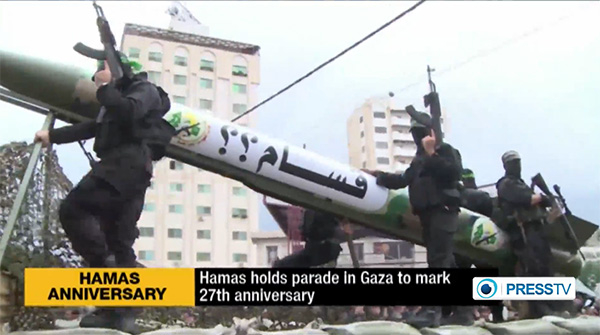
Ironically, the EU court’s decision coincided with Hamas celebrations marking the 27thanniversary of its founding. Once again, Hamas used the celebrations to remind everyone that its real goal is to destroy Israel. And, of course, Hamas used the event to display its arsenal of weapons that include various types of rockets and missiles, as well as drones.

845 (1)Thousands of armed Hamas troops showed off their military hardware at a Dec. 14, 2014 parade in Gaza, marking the organization’s 27th anniversary. (Image source: PressTV video screenshot)

Hours before the EU court decision was made public, Hamas leader Mahmoud Zahar announced that his movement would never recognize Israel. Zahar also made it clear that Hamas seeks to overthrow the Palestinian Authority [PA] regime and seize control over the West Bank.

The EU court’s decision also coincided with increased efforts to achieve rapprochement between Hamas and Iran. Recently, a senior Hamas leadership delegation visited Tehran as part of efforts to mend fences between the two sides. The main purpose of the visit was to persuade the Iranians to resume military and financial aid to Hamas. The visit, according to senior Hamas officials, appears to have been “successful.”

“There are many signs that our relations are back on the right track,” explained Hamas’s Musa Abu Marzouk. “Hamas and Iran have repaired their relations, which were strong before the Syrian crisis.” Relations between Hamas and Iran deteriorated due to the Islamist movement’s refusal to support the regime of Syrian President Bashar Assad.

Now the Iranians are likely to interpret the EU court decision to remove Hamas from the list of terrorist groups as a green light to resume financial and military aid to the movement.

Iran’s leaders recently announced that they intend to dispatch weapons not only to the Gaza Strip, but to the West Bank as well, as part of Tehran’s effort to support those Palestinians who are fighting to eliminate Israel.

Moreover, the EU court’s move will also embolden other countries that provide Hamas with political and financial aid, first and foremost Qatar and Turkey. Oil-rich Gulf countries such as Kuwait, Bahrain, Oman and Saudi Arabia will now face pressure from many Arabs and Muslims to join Qatar, Turkey and Iran in extending their support to Hamas.

The biggest losers, meanwhile, are Palestinian Authority President Mahmoud Abbas and Egypt’s President Abdel Fattah el-Sisi. Over the past few months, the two men have been doing their utmost to undermine Hamas and end its rule over the Gaza Strip.

Abbas has been fighting Hamas by blocking financial and humanitarian aid and arresting its supporters in the West Bank, while Sisi continues to tighten the blockade on the Gaza Strip and destroy dozens of smuggling tunnels along the border with Egypt.

The EU court’s decision represents a “severe blow to the Palestinian Authority and Egypt,” noted Palestinian political analyst Raed Abu Dayer. “As far is Abbas is concerned, the decision grants Hamas political legitimacy and challenges his claim to be the sole legitimate leader [of the Palestinians]. With regards to Egypt, the European court decision calls into question rulings by Egyptian courts that Hamas is a terrorist organization.”

Even if the EU court decision is reversed in the future, there’s no doubt that it has already caused tremendous damage, especially to those Muslims who are opposed to radical Islam.

Any victory for Hamas, albeit a small and symbolic one, is a victory for the Islamic State, Al-Qaeda, Islamic Jihad, the Muslim Brotherhood and other fundamentalist groups around the world.

The decision has left many Arabs and Muslims with the impression that Hamas, after all, is not a terrorist organization, especially if non-Muslims in Europe say so through one of their top courts. Even worse, the decision poses a real and immediate threat to Israel, as evident from the latest rocket attack.

If the Europeans have reached the conclusion that Hamas is not a terrorist organization, then why don’t their governments openly invite tens of thousands of Hamas members and supporters to move to London, Paris and Rome? And they should not forget to ask the Hamas members to bring along with them their arsenal of weapons.

Israel air strikes wiped out Russian hardware for thwarting US no-fly zone plan over Syria

December 10, 2014

Israel air strikes wiped out Russian hardware for thwarting US no-fly zone plan over Syria, DEBKAfile, December 8, 2014

Israeli_jets_of_bombing_two_installations_inside_Syria7.12.14Israel jets bombing Syrian targets

High-ranking American military sources revealed Monday, Dec. 8, that Israel’s air strikes near Damascus the day before wiped out newly-arrived Russian hardware including missiles that were dispatched post haste to help Syria and Hizballah frustrate a US plan for a no-fly zone over northern Syria.

The advanced weapons were sent over, as DEBKAfile reported exclusively Sunday, after Russian President Vladimir Putin learned that the Obama administration and the Erdogan government were close to a final draft on a joint effort to activate a no-fly zone that would bar Syrian air force traffic over northern Syria.

The Kremlin has repeatedly warned – of late in strong messages through back channels – that the establishment of a no-fly or buffer zone in any part of Syria would be treated as direct American intervention in the Syria war and result in Russian military intervention for defending the Assad regime.

According to the US-Turkish draft, American warplanes would be allowed to take off from the Turkish airbase of Incirlik in the south for operations against Syrian warplanes, assault helicopters or drones entering the no-go zone. Thus far, Ankara has only permitted US surveillance aircraft and drones the use of Incirlik for tracking the movements of Islamic State fighters in northern Syria.

The Obama administration was long deterred from implementing a no-fly zone plan by the wish to avoid riling Moscow or facing the hazards of Syria’s world-class air defense system.

But Washington was recently won over to the plan by a tacit deal with Damascus for American jets to be allowed entry to help Kurdish fighters defend their northern Syrian enclave of Kobani against capture by al Qaeda’s IS invaders.

However, the US administration turned down a Turkish demand to extend the no-fly zone from their border as far as Aleppo, Syria’s largest city, over which Syrian army forces are battling rebels and advancing slowly into the town.

The no-fly zone planned by US strategists would be narrow – between a kilometer and half a kilometer deep inside Syria. However Moscow is standing fast against any such plan and objects to US planes making free of Syrian airspace, a freedom they are now afforded over Kobani.

To drive this point home, the Russians delivered a supply of advanced anti-air missiles and radar, whose use by the Syrian army and transfer to Hizballah in Lebanon were thwarted by the Israeli air strikes Sunday.

Moscow reacted swiftly and angrily with a Note to the United Nations Monday accusing Israel of “aggressive action” and demanding “that such attacks should not happen again… Moscow is deeply worried by this dangerous development, the circumstances of which demand an explanation.”

The Assad regime has held back from reacting to past Israeli air raids for preventing advanced weaponry from reaching Hizballah. This time, spokesmen in Damascus warned that their government’s response would be clandestine and cause Israel “unimaginable harm.”

Can President Obama Pass Disraeli’s Test?

December 5, 2014

Can President Obama Pass Disraeli’s Test? American ThinkerKen Blackwell and Bob Morrison, December 5, 2014

(Please see also Reports: Obama Mulling Sanctions on Israel. — DM)

Applying the Disraeli Test to this administration, President Obama’s policies fail on every count. No wonder our present foreign policy seems to stray so far from true American principles and interests.

***************

British Prime Minister Benjamin Disraeli famously said: “The Lord deals with the nations as the nations deal with the Jews.” Winston Churchill was an avid student of Disraeli’s “Tory Democracy” and passed Disraeli’s test easily, as Steven Hayward wrote recently in the Weekly Standard.

This raises a most interesting question: How would President Obama fare on a Disraeli test? His policy toward the Jewish State of Israel leads us to question whether this outstanding student, this graduate of Columbia University and Harvard Law School, could pass a simple, three-question test suggested by one of the Nineteenth Century’s leading statesmen.

President Obama made it a point to skirt around Israel during the entire four years of his first term, while making it his point to go to Turkey, Egypt, and Saudi Arabia in those years.

First, what about Turkey? In 2009, President Obama congratulated that secular republic on its commitment to democratic rule. Turkey is the only member of NATO with a Muslim majority. As such, Turkey’s 50-year alliance with the U.S. and its longtime support for Israel — the only Muslim land in the Near East to give such support — were certainly an important factor worthy of consideration in U.S. foreign policy. But under President Recep Tayyip Erdogan, Turkey has moved farther and farther away from the United States and closer to Russia.

As to Israel, Turkey has become a leading sympathizer of the Hamas terrorist-led regime in Gaza, attempting to run the Israeli blockade of Gaza and charging Israel with violating the human rights of the Arabs of Palestine. Interestingly, while Israel formally supports the idea of statehood for Palestinian Arabs, Turkey denies statehood for its hugeKurdish minority of 20 million. In fact, the Kurds are by far the largest ethnic group in the Mideast denied a state.

Does President Obama hold the Turks to the same standard that he applies to the Israelis? Not at all. He has not begun to press the Turks on Kurdish rights. Until 2000, it was illegal for a person holding Turkish citizenship to identify himself as a Kurd. Contrast this with Israel, where Arabs not only can so identify, they actually sit in the Israeli parliament, the Knesset, as Arabs and form legal Arab political parties.

Now, what of this administration’s view of Egypt? President Obama speedily recognized the Muslim Brotherhood-dominated government in Egypt headed by Mohamed Morsi. Morsi — educated in the U.S. but strongly rejecting American principles of religious liberty and constitutional government — quickly brought Egypt to the brink of chaos. Morsi planned a visit to the U.S. — one eagerly anticipated by the Obama administration — even though Morsi announced he would press the White House to pardon a terrorist.

Morsi wanted Obama to release Sheikh Omar Abdul Rahman, in prison for his part in the first terrorist attack on the World Trade Center. That attack killed seven Americans in 1993.

National Review’s Andrew C. McCarthy provided this stunning profile of Mr. Obama’s obeisance to the Muslim Brotherhood in Egypt.

Reports that the State Department was discussing a transfer of the Blind Sheikh back to Egypt surfaced months ago, in the context of a potential swap for democracy activists the Supreme Council of the Armed Forces was then detaining. The administration then issued a visa to Hani Nour Eldin, a member of the Islamic Group — the Blind Sheikh’s terrorist organization, to which it is a felony to provide material assistance. The purpose was to invite Eldin to, yes, the White House, for consultations with top American national-security officials on prospective relations between the United States and the new, Islamist Egypt. As the administration had to know he would do, he pressed his top agenda item: The United States must return the Blind Sheikh as a “gift to the revolution.”

Fully willing to give hundreds of millions in U.S. aid to Morsi, Mr. Obama promptly yanked that aid when Egypt’s military finally pulled the plug on the Muslim Brotherhood’s misrule in Egypt.

That leaves Saudi Arabia as the final question in Mr. Obama’s “Disraeli Test.” It is illegal for a Jew to live in Saudi Arabia. Any Saudi national who converts to Judaism is beheaded for apostasy. In February, 1945, President Roosevelt appealed to Saudi Arabia’s founding monarch, Abdulazziz, for the Jewish survivors of the Holocaust. Even then, the Saudis were unyielding. FDR, hoping to touch the desert despot’s heart, told him that three million Jews had been murdered in Poland. It was one of the first confirmations by a world statesman of the plight of European Jewry. Abdulazziz’s reaction to this horrific news? There was obviously no need for a Jewish state in the Mideast since there would now be plenty of room for Europe’s surviving Jews — in Poland!

Despite this history of no peace with Israel, no recognition of Israel, no compromise with Israel, President Obama shamefully bowed to the King of Saudi Arabia. No American president had ever bowed to anyone before.

Applying the Disraeli Test to this administration, President Obama’s policies fail on every count. No wonder our present foreign policy seems to stray so far from true American principles and interests.


Is the Islamic State finding refuge in Turkey?

December 3, 2014

Is the Islamic State finding refuge in Turkey? Al-Monitor, Ahmet Insel, December 2, 2014

(Please see also The new Ottoman Emperor. — DM)

According to the Kobani watchers in Caykara [Mahzer] village, Islamic State (IS) forces crossed from Turkey and attacked the Kurdish People’s Protection Units (YPG) forces controlling the Syrian side of Mursitpinar border, crossing from the rear. IS badly wants to capture the crossing.

Did the IS car bomb attack at Mursitpinar Saturday morning [Nov. 29] originate from Turkey? Information provided by official sources about how the attack was carried out is murky. The Mahzer crowd congregating directly behind the Mursitpinar crossing insist the bomb-laden vehicle came from Turkey, broke the lock on the gate and crossed to Syria.

Even more interesting are reports that the presence of IS elements in Turkey is not confined to this attack. People who had to abandon their homes in the Mursitpinar area and settle in nearby villages because of security reasons say IS has been entering the houses they had to abandon.

Egrice [Betke] village is about a kilometer from the border. There are 18 native households plus 12 families that came over from Syria. Native villagers are also hosting a few families who had to evacuate their homes in Etmenek near Mursitpinar in Turkey. If you talk to these people from Etmenek you will hear that IS militants have been crossing the border at will and entering the abandoned buildings and even staying in them. One Etmenek villager said, “My uncle’s house is near my house. Although it is banned, we sometimes go over to our homes and then return here. When I went there last time I saw IS people in my uncle’s house.” Another villager also claimed his house was taken over by IS.

You hear similar accounts from the Caykara-Mahzer crowd who hail from Kucuk Ermenek. Some say Turkish soldiers are at one end of the village and IS militants at the other. We are talking about settlements on the Turkish side around Mursitpinar and its fringes. IS taking over Soil Products Office silos along the border and firing down on YPG forces from [inside] is not the only case of IS militarily violating the Turkish border.

At Egrice village you can see hundreds of cars Kobani refugees were not allowed to bring with them to Turkey. In the same place you also see cattle herds which are not allowed to cross to Turkey because of risk of foot and mouth disease. Villagers say the animals are slowly dying and IS elements frequently come to the car park and take any vehicle they want. Villagers say they send their children to take care of the animals and Turkey has been providing them with animal feed.

On top of the water tower you can see the IS flag. According to refugees from Kobani, the Syrian side of the border, from Mursitpinar to Akcakale, is under the control of IS.

Those who constantly watch the border from Caykara insist that IS had attacked YPG from the rear by crossing the border from Turkey. For them, the lack of intervention by the Turkish military tasked with border security is a sign that Turkey prefers to have IS control the border crossing.

But even more worrying are the allegations that IS people have been freely entering abandoned houses on the Turkish side. There is no need to elaborate what kind of security fears this causes in the region and how it amplifies the distrust felt for security forces. Contradictory statements by senior civil servants and their ignoring of eyewitness accounts only intensify people’s lack of confidence.

As much as it is important to provide a full and clear explanation of the attack at the Mursitpinar crossing, it’s vital to give proper responses to claims that IS militants are freely entering and leaving Mursitpinar and its fringes.


The new Ottoman emperor

December 3, 2014

The new Ottoman emperor, Israel Hayom, Clifford D. May, December 3, 2014

[T]here is mounting evidence that weapons and fighters are crossing from Turkey into Syria, where they are delivered to Islamic State fighters. Turkish officials are turning a blind eye, or maybe even facilitating the traffic. Stolen oil is moving in the other direction, sold to raise cash for Islamic State. Inside Turkey, as well, Schanzer and Tahiroglu write, Islamic State has “established cells for recruiting militants and other logistical operations.” Last weekend, Turkey’s main Kurdish party accused the Erdogan government of allowing Islamic State fighters to attack the Syrian Kurdish town of Kobani from within Turkey.

******************

Turkey should have been part of the solution. Instead it has become part of the problem. The problem, of course, is the spread of jihadism throughout the Middle East, North Africa and beyond.

Turkish policies have been aiding and abetting the Nusra Front, an al-Qaida affiliate; the Islamic State group, which has turned large swaths of Syria and Iraq into killing fields; the Islamic Republic of Iran, still ranked by the U.S. government as the world’s leading sponsor of terrorism and well on its way to becoming nuclear-armed; and the Muslim Brotherhood, including Hamas, the group’s Palestinian branch.

Troubling, too, is the rhetoric we’ve been hearing from Turkish leaders. Turkish Science, Industry and Technology Minister Fikri Isık claimed last week that it was Muslim scientists who first discovered that the earth is round. Two weeks earlier, Turkish President Recep Tayyip Erdogan insisted that Muslim sailors reached the Americas 300 years before Columbus — only to find that well-established Muslims in Cuba had built a beautiful mosque.

Such myth-making might be dismissed as nothing more than attempts to play to Islamic pride. Less easy to excuse is Erdogan’s increasing xenophobia. “Foreigners,” he recently observed, “love oil, gold, diamonds, and the cheap labor force of the Islamic world. They like the conflicts, fights and quarrels of the Middle East.” He added that Westerners “look like friends, but they want us dead, they like seeing our children die. How long will we stand that fact?”

If Turkey were just another tin-pot dictatorship, none of this would much matter. But Turkey is a Muslim-majority (98 percent) republic with a dynamic economy (not dependent on the extraction of petroleum), a member of NATO (making it, officially, an American ally), and a candidate for membership in the European Union (though that possibility now appears remote).

Just three years ago, U.S. President Barack Obama listed Erdogan as one of five world leaders with whom he had especially close personal ties. He regarded the Turkish leader as a moderate, his interpreter of — and bridge to — the tumultuous and confusing Islamic world.

Today, as detailed in a new report by Jonathan Schanzer and Merve Tahiroglu, my colleagues at the Foundation for Defense of Democracies, Erdogan is refusing to allow the American-led coalition formed in August to launch strikes against Islamic State from Turkish soil.

Worse, there is mounting evidence that weapons and fighters are crossing from Turkey into Syria, where they are delivered to Islamic State fighters. Turkish officials are turning a blind eye, or maybe even facilitating the traffic. Stolen oil is moving in the other direction, sold to raise cash for Islamic State. Inside Turkey, as well, Schanzer and Tahiroglu write, Islamic State has “established cells for recruiting militants and other logistical operations.” Last weekend, Turkey’s main Kurdish party accused the Erdogan government of allowing Islamic State fighters to attack the Syrian Kurdish town of Kobani from within Turkey.

The FDD report cites numerous sources alleging that Turkey also has given assistance to the Nusra Front. To be fair: The Turkish government, like the Obama administration, seeks the fall of Syrian dictator Bashar Assad, satrap of the Islamic Republic of Iran. A Turkish official is quoted as saying that Nusra fighters are essential to that effort, adding: “After Assad is gone, we know how to deal with these extremist groups.”

Do they? Hamas is an extremist group and one of its top leaders, Saleh al-Arouri, has been permitted to set up his headquarters in Turkey. In August, Israel’s Shin Bet security agency said it had thwarted a Hamas-led plot to topple Palestinian Authority President Mahmoud Abbas — and that Arouri was behind it. Arouri also claimed responsibility — in the presence of Turkey’s deputy prime minister — for the kidnapping and murder of three Israeli boys in the West Bank early last summer, an act of terrorism that led to the 50-day war between Israel and Hamas in Gaza.

There’s more: credible allegations that Turkey has helped Iran’s rulers evade sanctions; the fact that Turkey imprisons more journalists than any other country; Erdogan’s comparison of Israelis to Nazis (guess which he regards as more “barbaric”); and his pledge to “wipe out Twitter. I don’t care what the international community says. They will see the Turkish republic’s strength.”

To understand what Turkey has become, it helps to know a little about what Turkey used to be. Istanbul was once Constantinople, a Christian capital of the ancient world. In 1453, it fell to the fierce armies of the Ottoman Empire and the Islamic caliphate. Islam’s political and religious leaders soon established the Sublime Porte, the central government of their growing imperial realm.

Almost 500 years later, in the aftermath of World War I, the empire collapsed and the caliphate was dissolved. Modern Turkey arose from the ashes thanks to the leadership of Mustafa Kamal Ataturk, a visionary general who believed that progress and prosperity could be achieved only by separating mosque and state. His goal was to make Turkey a nation, one as modern and powerful as any in Europe.

A century later, the world looks rather different. There are good reasons to believe Europe is in decline and America in retreat (these are disparate phenomena). While it may be delusional to believe that Columbus encountered Muslims in the Caribbean, it is not crazy to believe that, over the decades ahead, fierce Muslim warriors will profoundly alter the world order once more.

Viewed in this light, Erdogan looks like a neo-Ottoman, one who dreams of commanding Muslims — and those who have submitted to them — in many lands. If that’s accurate, the rift between Turkey and the West can only widen.

Erdogan slams US on Syria again, days after Biden visit

December 1, 2014

Erdogan slams US on Syria again, days after Biden visit, Al-Monitor, Week in Review, November 30, 2014

U.S. VP Biden meets with Turkey's President Erdogan in IstanbulUS Vice President Joe Biden (L) meets with Turkey’s President Recep Tayyip Erdogan at Beylerbeyi Palace in Istanbul, Nov. 22, 2014. (photo by REUTERS/Murad Sezer)

Turkish President Recep Tayyip Erdogan calls US “impertinent” on Syria, says West likes seeing Muslim children die; Israel considers extension of Iran nuclear talks as better than a bad deal.

*********************

Turkish President Recep Tayyip Erdogan said on Nov. 26 that he is “against impertinence, recklessness and endless demands” coming from “12,000 kilometers away” (7,456 miles), his latest not-so-veiled rebuke of US policy toward Syria.

Erdogan’s outburst came four days after US Vice President Joe Biden departed Turkey. Biden, the latest in a seemingly endless stream of senior US official visitors to Ankara, spoke of the “depth” of the US-Turkish relationship and how the United States “needs” Turkey. The US vice president praised Turkey’s turnaround, for now, in its ties with Iraq, as reported this week by Semih Idiz, and Turkey’s handling of close to 1.6 million Syrian refugees (the UN High Commissioner for Refugees puts the number at approximately 1.1 million).

Despite the predictable deadening public platitudes, Biden’s visit, like those of other senior US officials, was a flop for the anti-Islamic State (IS) coalition. Erdogan prefers to hold his support against IS as ransom for a US-backed buffer or no-fly zone inside Syria. Not that the Turkish president, or others hawking such a plan, present any “day after” strategies for Syria; explain how a buffer zone or “doubling down” on the Syrian opposition would do anything more than prolong the war and wreck what remains of the Syrian state; lay out how the United States can avoid another Libya or another Iraq (that is, a failed state or a prolonged occupation) if it pursues regime change in Syria; identify where a post-transition stabilization force may come from given the limitations of Syrian rebel forces; or explain why the jihadists would not gain the upper hand in a divided post-Assad Syria with such a weak and fragmented opposition.

Turkey’s unwillingness to combat IS and other terrorist groups stands in contrast with US allies Saudi Arabia, United Arab Emirates, Jordan and Bahrain, as well as Iran, all of whom have concerns about US policy but are nonetheless engaged in combat operations against terrorists in Syria and Iraq.

Bruce Riedel explains how Saudi Arabia, which uncovered an IS-linked cell operating in the kingdom this week, is struggling with managing the threat from IS and its regional rivalry with Iran, but is nonetheless playing a leading role in the anti-IS coalition. Hossein Mousavian points out that among the “ground forces” combating IS, besides US-supported Syrian rebel forces, are the Iraqi and Syrian armies and Hezbollah, which are all backed by Iran. According to Mousavian, Tehran could be ready to do more if a nuclear deal is reached. Ali Hashem reports this week on Hezbollah’s role in Iraq, and Ali Mamouri chronicles the higher profile role that Iran Quds Force leader Qasem Soleimani is playing with Iraqi forces battling IS. Iraqi Kurdistan Region President Massoud Barzani, whose forces are also on the frontlines of the battle against IS, praised Iran’s role, saying in August that “Iran was the first country to provide us with weapons and ammunition” to confront the IS advance toward Erbil. Syrian government warplanes bombed Raqqa, an IS stronghold, on Nov. 25, although the United States accused Syria of killing many civilians in the process. US-led coalition forces also conducted airstrikes against IS forces in Raqqa this week.

Erdogan appears to be the odd man out in the coalition, compared with the actions of the other regional powers, and his policies and statements should raise broader questions about the direction of Turkish foreign policy, including what it means for Turkey’s membership bid in the EU and its role in NATO. Idiz writes that Erdogan appears to be turning his back on Turkey’s EU membership bid. On Nov. 28, the eve of Pope Francis’ visit to Turkey, Erdogan offered the following about Western countries: “Believe me, they don’t like us,” AFP reported him as saying. “They look like friends, but they want us dead — they like seeing our children die. How long will we stand that fact?”

The United States might soon tire of the all-pain, no-gain appeals to Turkey and simply ask Erdogan to pick a side in the US war against terrorists, making clear, as US President Barack Obama recently said, that the United States is not planning to remove Syrian President Bashar al-Assad at this time. Turkey is a critical US ally that must play a constructive role in Syria and the region, but the trends are becoming alarming. The United States, for its part, does not “need” Turkish bases to train anti-IS or anti-Assad rebels, does not “need” Turkish troops in Syria, and certainly does not “need” a buffer or no-fly zone, unless Washington is longing for a quagmire. What the coalition “needs” is for Turkey to crack down, hard, on the terrorist transit, trade and financial networks operating through Turkey into Syria, which have contributed to the rise of these groups over the past three years. Turkey’s intensified efforts at border security and counterterrorism cooperation would be a major contribution to the coalition. It does not seem to be an unreasonable ask, even if Ankara disagrees with the US approach to Assad.

As this column wrote on Nov. 16, it is the prospect of a nuclear deal with Iran, and the potential for regional cooperation with Iran, that is the key to a settlement of many of the region’s problems, including a political settlement in Syria and whether Assad stays or goes: “US interests in both defeating IS and securing a political settlement to end the Syria war depend on Iran’s good offices in Damascus. The United States cannot deal with Assad, but Iran can. Iran, like Washington’s regional allies, has a high tolerance for the spilling of Syrian blood. If the United States wants to deal Iran out in Syria, especially in the context of a bid to oust Assad, then Iran’s card will be to make the awful situation in Syria go from bad to worse. Iran is not necessarily immovable on Assad’s survival. Iran’s four-point plan for Syria includes a decentralization of power away from the Syrian presidency. Iranian officials privately signal that Assad may not be untouchable, under the right conditions, but such conversations — if they are to bear fruit — can only occur with Iran in a spirit of collaboration, not confrontation. Otherwise, Iran will simply hunker down, and the war will go on.”

Israel OK with extension of Iran nuclear talks

The seven-month extension of the P5+1 nuclear talks with Iran has sparked reactions across the region. Laura Rozen reports from Vienna that progress was made as the Nov. 24 deadline approached but observers are still divided on whether this can be turned into a finished deal in the upcoming months.

Ben Caspit writes of the furious diplomatic effort by Israel to fend off what it would consider a bad deal: “Israel has invested enormous amounts of energy in this. Over the past few months, and especially in the last few weeks, Minister of Intelligence Yuval Steinitz, who has coordinated these efforts, has become a ‘frequent flyer,’ plowing through the relevant capitals right and left. And Steinitz wasn’t alone in this. Senior Israeli intelligence officials also made frequent trips abroad to present their colleagues in different relevant capitals with intelligence documents, intelligence per se, and plenty of new information obtained by the Mossad and other Israeli intelligence agencies about the dangers inherent in that ‘bad agreement.’

“As the deadline approached this week, Steinitz intensified his activities, making two more quick visits, to London and to Paris, and meeting with German Foreign Minister Frank-Walter Steinmeier. Steinitz’s message, backed as always with intelligence reports, expert assessments and various analyses: ‘The agreement under discussion is a terrible agreement. It leaves room for huge potential breaches, which means that it is propped up on weak foundations. If those gaps are not sealed, it would be preferable to avoid reaching any agreement whatsoever than to sign the current one.’”

Retired Israel Defense Forces Gen. Michael Herzog writes that Israel views the extension of the talks as the least of all possible evils, “The truth is that Israel’s ability to influence the relationship between Iran and the West has reduced considerably. The credibility of its military option (which still exists) has decreased in the eyes of the United States and Iran, and its tense relationship with US President Barack Obama’s administration makes it difficult to engage in open dialogue between the two country’s top leaders. At this stage, as long as Iran is not hurtling toward the critical nuclear threshold, all that is left for Israel to do is to maintain the hope that Iran will continue to be intransigent, and that the US Congress will continue to play tough.”


Isis launches attack on Kobani from inside Turkey for first time

November 29, 2014

Isis launches attack on Kobani from inside Turkey for first timeAssault by Islamic State militants reportedly began with suicide attack on border between Turkey and strategic Syrian town

Saturday 29 November 2014 13.18 GMT

via Isis launches attack on Kobani from inside Turkey for first time | World news | theguardian.com.


Kobani, Syria
Kobani has been under Isis assault since September, but the militants have never attacked it from Turkey before. Photograph: Jake Simkin/AP


Islamic State (Isis) has launched an attack on the Syrian border town of Kobani from Turkey for the first time, a Kurdish official and activists said.

The assault began with a suicide attack by a bomber in an armoured vehicle on the border crossing between Kobani and Turkey, the Syrian Observatory for Human Rights (SOHR), a UK-based opposition group, said.

Nawaf Khalil, a spokesman for Syria’s Kurdish Democratic Union party, said that Isis “used to attack the town from three sides” but “today, they are attacking from four sides”.

Turkey has previously backing the Syrian rebels fighting to topple the country’s president, Bashar al-Assad, has it has been reluctant to help the Kurds in Kobani for fear of stoking Kurdish ambitions for an independent state.

There was no comment from Ankara on Saturday about Isis fighters launching the assault from Turkish soil.

SOHR said heavy fighting also took place south-west of the town, where Isis brought in tanks to reinforce their fighters.

The group began its Kobani offensive in mid-September, capturing parts of the town and dozens of nearby villages. The town later became the focus of air strikes by the US-led coalition against the militants.

Kurdish fighters have slowly been advancing in Kobani since late October. Hundreds of people have been killed in the fighting

SOHR said on Saturday that the latest fighting killed at least eight Kurdish fighters and 17 jihadists.

ISIS Will Take Over The Most Dangerous Muslim Nation On Earth, Take Its Nukes.

November 25, 2014

ISIS Will Take Over The Most Dangerous Muslim Nation On Earth, Take Its Nukes, And Commit The Bloodiest Massacre Of Christians

By Shoebat Foundation on November 24, 2014

via ISIS Will Take Over The Most Dangerous Muslim Nation On Earth, Take Its Nukes, And Commit The Bloodiest Massacre Of Christians We Will See – Walid Shoebat.


By Walid Shoebat (Shoebat Exclusive)

ISIS now has camped in Pakistan and all across Pakistan, the black standard of the Islamic State has been popping up all over from urban slums to Taliban strongholds, the ISIS logo and name have appeared in graffiti, posters and pamphlets and a cluster of militant commanders in Pakistan declared their allegiance to Abu Bakr al-Baghdadi, the caliph of the Islamic State as ISIS presence there increases by the day. But the one trillion dollar question is will the world leaders secure Pakistan’s nuclear weapons from falling into the hands of ISIS? It doesn’t look like it and the prospects of ISIS gaining nuclear bombs are very likely as the news from Pakistan reveals.

To ensure that no nuclear weapons falls into the hands of ISIS, there is only one option, that the US takes control of Pakistan’s nukes and disarms Pakistan. But is this scenario even feasible? Hardly.

The problem in the West is that its comparing the ISIS problem with its previous predecessor Al-Qaeda so the western news consumers are not paying as much attention to how fast the Islamic State is moving and it’s not wasting time like al-Qaida did before and its moving in lightening speed.


140804068ISIS-ajakan264434b2e2b1d9c2aa84a0cb273e4df55f712a3c


ISIS is moving quick. And now there is even more. The Pakistani media reported recently that a group of 10 commanders from ISIS are currently in Baluchistan to seek allegiance of Tehrik-i-Taliban Pakistan (TTP) and the Baloch freedom movement. This happened just a few weeks after a group of TTP under Maulana Fazlullah, voiced support for the terror group and swore allegiance to ISIS leader Abu Bakr al-Baghdadi. It was not only Maulana Fazlullah who teamed up with ISIS, another local group called Jamaatul Ahrar, also declared its support for ISIS. Jamaatul Ahrar’s leader, Ehsanullah Ehsan, was quoted by Reuters as saying: “We respect them. If they ask us for help, we will look into it and decide.” According to the Daily Mail, the spokesperson of TTP and six senior figures have declared loyalty to ISIS.

The presence of ISIS was also confirmed by the Pakistani government. The presence of ISIS in Pakistan and allegiance of TTP groups is truly a disturbing news and is likely to have serious consequences for a country that is already in turmoil due to incompetent governance, economic crises and political tension. However, this is not the sole reason behind ISIS desire to start operations in Pakistan. There are multiple encouraging points that brought ISIS to the country that is already in turmoil. Large parts of Pakistan, Baluchistan and FATA are at the age of bifurcations. ISIS support to the freedom fighters of Baluchistan and jihadis of FATA will accelerate the freeing process of these provinces which will eventually become basis for ISIS in the region.

“The message they’re trying to convey is they are brutal to their enemies, and they are righteous in their cause,” says Karl Kaltenthaler, an expert on the rise of Islamic extremism and professor at the University of Akron. “If you mess with them, you’re going to pay a high price, and they will stop at nothing to achieve the triumph of their vision for Islam.”

And to top it all, just in the last two months, Shoebat.com reported all across the Muslim world, ISIS has magnetized a litany of major terrorist organizations to give the Bay’at (allegiance) and join under ISIS such as Jund al-Khilafah (Soldiers of the Caliphate, In North Africa), Ansar al-Shariah (Libya), Taliban (Pakistan), The Islamic Movement of Uzbekistan (Pakistan’s North Waziristan), Al-Tawhid ​Battalion (Pakistan, Afghanistan), Al-Nusra (Lebanon), Al Qaeda in the Arabian Peninsula (Yemen), Ansar al-Tawhid in the Land of Hind (India), Anṣār Bayt al-Maqdis (Sinai) and Jund al-Khilafah (Egypt).

And if you think the situation in Iraq and Syria is bad think again, 98% of Pakistanis support Jihad and they have no problems with all the blood and gore of ISIS. Shoebat.com interviewed Farrukh Seif who is on the ground in Pakistan and had some very interesting observations about the seriousness of the situation:

The Nuclear Danger

Pakistan has some unprotected nuclear weapons and ISIS certainly has its eyes on that and beyond any doubt it will strive to reach those weapons.While the global leaders certainly understand that there is an extreme threat to global security if the risk that ISIS could get a hold of nuclear weapons, yet all world leaders especially Americans do is hold several international conferences on addressing the issue. ISIS is much stronger than Al-Qaeda and was able to hold some sort of chemical weapons in Iraq which they used against the Kurds.


nasr-missile-test

The way one can predict the outcome of things is to study the track record, if chaos happened in a corrupt nation with such an abysmal record, the rule is, that chances of worse repetitions are not far off, its not as if Pakistan, the most corrupt and most Islamist nation in the world is immune from smuggling the capability, among all the nuclear states Pakistan is the only country that leaked and transferred nuclear technology to the countries that are still under UN and US sanctions. It is also the only nuclear state that shelters and protect terrorist organizations such as Al-Qaeda, the Taliban, Haqani Network and now the infamous ISIS. The Pakistani nuclear scientist Abdul Qadeer Khan, leaked nuclear secrets to North Korea, Libya and Iran. Abdul Qadeer Khan not only accepted the full responsibility for transferring sensitive technology to mentioned states but he also revealed in 2004, that the former military ruler, General Pervez Musharraf, the top authority in Pakistan himself was involved neck-deep in nuclear proliferation.

465127033_v2

ISIS will strive for acquiring nuclear weapons in Pakistan and will get it, its only a matter of time. Assuming even if ISIS don’t fight for it, there are elements in Pakistan that may sell either nuclear technology or nuclear weapons to ISIS. If ISIS obtains nuclear weapons in Pakistan a new chapter of terrorism will emerge, and ISIS will turn into an invincible force. This time the world will have to deal with nuclear terrorism in Pakistan which will be fueled by drug money from Afghanistan and ISIS oil money from Iraq and will certainly have severe consequence not only for Pakistan but for the whole world.

Pakistan not only sheltered the worlds most wanted terrorist, Osama Bin Laden, but also protected him for several years inside its military town, Abbottabad while for years it denied it had anything to do with Al-Qaeda while its leader was in close proximity of the main military basis. And if Pakistan also protects Ayman Al Zawahiri, Jalal din Haqani, Mullah Omer and many others whats to stop it from protecting Caliph Abu-Bakr al-Baghdadi? Pakistan unlike any other nation in the world has thousands of radical madrassas (Muslim religious schools) that can easily produce as many warriors for ISIS as they want and has the major bulk of radical mullahs (preachers) that can easily justify ISIS’s mission and activities in Pakistan to produce and supply as many suicide bombers as needed and the killing machine will catapult into apocalyptic scenario.

beheading

Pakistan’s military establishment is the most terrorist friendly entity in the world and considers terrorist groups as strategic assets for proxy wars in India and Afghanistan. Currently the ongoing sectarian violence in Pakistan’s Baluchistan and Khyber Pakhtunkhwa provinces offer greater opportunities for ISIS to operate in Pakistan.

There is little time left and the situation for Christians in Pakistan will be dire for Rescue Christians to move as fast as possible to rescue enslaved Christians. One can imagine when ISIS rules regions in north Pakistan, Christian persecution will be unlike anything we have ever seen.

PLEASE HELP US HELP PAKISTANI CHRISTIANS