Posted tagged ‘Turkey’

Jordan’s king accuses Turkey of sending terrorists to Europe

March 26, 2016

Jordan’s king accuses Turkey of sending terrorists to Europe #Abdullah’sWar Abdullah tells US politicians that radicals are being ‘manufactured in Turkey… as part of Turkish policy’

Last update:
Saturday 26 March 2016 9:20 UTC

Source: Jordan’s king accuses Turkey of sending terrorists to Europe | Middle East Eye

Jordan’s king, Abdullah, and the Turkish president, Recep Tayyip Erdogan (AFP)

King Abdullah of Jordan accused Turkey of exporting terrorists to Europe at a top level meeting with senior US politicians in January, the MEE can reveal.

The king said Europe’s biggest refugee crisis was not an accident, and neither was the presence of terrorists among them: “The fact that terrorists are going to Europe is part of Turkish policy and Turkey keeps on getting a slap on the hand, but they are let off the hook.”

Asked by one of the congressmen present whether the Islamic State group was exporting oil to Turkey, Abdullah replied: ”Absolutely.”

Abdullah made his remarks during a wide-ranging debriefing to Congress on 11 January, the day a meeting with the US president, Barack Obama, was cancelled.

The White House was forced to deny that Obama snubbed one of America’s closest allies in the Middle East, attributing the cancellation to “scheduling conflicts,” although Obama and Abdullah met briefly at Andrews Air Force Base a day later.

Present at the meeting in Congress were the chairmen and members of the Senate Intelligence, Foreign Relations and Armed Services committees, including Senators John McCain and Bob Corker, and Senators Mitch McConnell and Harry Reid, the Senate Majority and Minority leaders respectively.

According to a detailed account of the meeting seen by MEE, the king went on to explain what he thought was the motivation of Turkey’s president, Recep Tayyip Erdogan.

Abdullah said that Erdogan believed in a “radical Islamic solution to the region”.

He repeated: “Turkey sought a religious solution to Syria, while we are looking at moderate elements in the south and Jordan pushed for a third option that would not allow a religious option.”

The king presented Turkey as part of a strategic challenge to the world.

“We keep being forced to tackle tactical problems against ISIL [the Islamic State group] but not the strategic issue. We forget the issue [of] the Turks who are not with us on this strategically.”

He claimed that Turkey had not only supported religious groups in Syria, and was letting foreign fighters in, but had also been helping Islamist militias in Libya and Somalia.

Abdullah claimed that “radicalisation was being manufactured in Turkey” and asked the US senators why the Turks were training the Somali army.

The king invited the US politicians present to ask the presidents of Kosovo and Albania about the Turks.

Abdullah said that both countries were begging Europe to include them, before Erdogan did.

Abdullah was supported in his remarks by his foreign minister, Nasser Judeh, who said that the Albanian president (Bujar Nishani) was a Catholic married to a Muslim, and that that was a model which should be protected in a Muslim majority country.

Judeh said that when the Russian bombing campaign prevented Turkey from establishing safe zones in northern Syria to stop refugees from coming to Turkey, “Turkey unleashed the refugees onto Europe”.

Both Judeh and Abdullah bridled at the $3bn deal offered by Europe to Turkey, noting that Turkey had only 2m Syrian refugees out of a population of 70m, whereas Jordan was facing “a bigger problem proportionally”.

Jordan and Turkey are officially allies. The Turkish prime minister, Ahmed Davutoglu, cancelled an official visit to Jordan after the latest bomb attack in Turkey, which on 13 March killed 34 people in Ankara.

The Kurdish Freedom Falcons (TAK), an offshoot of the PKK, or Kurdistan Workers’ Party, claimed responsibility for the bombing.

The postponed visit is due to take place this weekend and Davutoglu will be mindful that Abdullah told senators that Turkey was using the Kurds as an “excuse” for its policies in Syria.

Galip Dalay, research director at Al Sharq Forum and senior associate fellow on Turkey and Kurdish Affairs at Al Jazeera Center for Studies, said it was wrong to portray Turkey as having a strategic goal of establishing an Islamist government in Syria.

He said: “Turkey did its best in the first eight months of the Syrian crisis to find a political solution to the crisis, which would have included [Syrian President] Bashar Assad. Back then, Turkey was criticised in the region and the West for being too soft on the Assad regime and being too optimistic about the possibility of reform. When it became clear, after eight months of arduous attempts, that Assad had no intention of initiating a political and democratic process to meet the demands of the protestors, Turkey threw its weight behind the opposition.”

Dalay said that the claim Turkey was buying oil from the Islamic State group was a Russian fabrication concocted by Moscow after Turkey shot down the Russian fighter. “Turkey is not the only one saying there is no evidence to support this claim. The United States said it too.”

The Turkish government would not comment officially on Abdullah’s reported remarks on 11 January. But a senior Turkish source accused the king of becoming “the spokesman for Bashar al-Assad”.

He said the portrait emerging from these remarks was not one of a king speaking but of a “Western journalist with a fuzzy state of mind and little familiarity with the region”.

He said: “Turkey is definitely carrying out an intense struggle against Daesh [a reference to the Islamic State group]. Bombings take place in Turkey, not in Jordan. When this is the case, groundless accusations by King Abdullah are totally unacceptable.

“Moreover, his tackling of the Daesh issue with such unfounded information also raises the question about whether Jordan could play a meaningful role in the fight against Daesh.”

He said the king’s claims that IS was selling oil to Turkey were not only absurd but showed that Abdullah did not have the slightest idea about what was going on in Syria.

“The king’s statements and accusations against Turkey are not the first. Unfortunately, all of his allegations are the same as the slanders frequently expressed by the Assad regime.

“It would be to Jordan’s and the region’s interest if Jordan, as a friend of Turkey, were to work for a strategic cooperation with a strategic power like Turkey, instead of acting like the spokesperson of Assad.”

ISIS, oil & Turkey: RT films trove of jihadist docs detailing illegal trade with Ankara (EXCLUSIVE)

March 24, 2016

ISIS, oil & Turkey: RT films trove of jihadist docs detailing illegal trade with Ankara (EXCLUSIVE)

Published time: 24 Mar, 2016 03:00 Edited time: 24 Mar, 2016 05:12

Source: ISIS, oil & Turkey: RT films trove of jihadist docs detailing illegal trade with Ankara (EXCLUSIVE) — RT News

Islamic State documents, including invoices, which militants abandoned while retreating in haste. / RT

An RT Documentary crew filming in northern Syria has seen Islamic State (IS, ISIS/ISIL) documents abandoned by retreating terrorists and found by the Kurds that, along with captured IS recruits, provide a stunning insight into the alleged Turkey-IS oil trade links.

Shortly after the outbreak of the Syrian war, IS became a game-changer in Iraq and, in particular, Syria. Beheadings on camera, mass killings, and enslavement, as well as apparent connections to the Paris and Brussels attacks had become synonymous with the terror group, giving it wide publicity.

Running a viable militant organization with such remarkable capabilities would be impossible without some logistical and financial support from the outside.

Turkey, which has been actively engaged in the Syrian war since the outset, has repeatedly denied claims that it is aiding IS. However, while Ankara insists that it is the jihadist group’s sworn enemy, facts on the ground often tell a different story.

RT has spoken to several witnesses who were involved in Islamic State’s trade activities and accessed the terror group’s documents, which provide insight into how and where foreign militants enter Syria to join the terrorist “state.”

Abandoned buildings used by ISIS militants in northern Syria.

Detailed oil invoices

The RT Documentary team did most of its filming in the town of Shaddadi, located in the Syrian province Hasakah, which has been partly overrun by IS jihadists. Following the liberation of Shaddadi, which is home to some 10,000 people, RT filmed Kurdish soldiers walking around what used to be the homes of IS fighters and examining piles documents that had been left behind.

Some of the files seized at the scene turned out to be detailed invoices used by IS to calculate daily revenues from their oil fields and refineries, as well as the amount of oil extracted there. All the documents had Islamic State’s symbol at the top.

Example of an Islamic State invoice specifying the quantity of oil sold.

The files showed that “IS has kept very professional records of their oil business,” said the author of the new RT Documentary on Islamic State filmed in northern Syria, who chose to remain anonymous for security reasons.

Every invoice included the name of the driver, the vehicle type driven, and the weight of the truck, both full and empty, as well as the agreed upon price and invoice number.

One of the discovered invoices dated 11 January, 2016, says that IS had extracted some 1,925 barrels of oil from Kabibah oil field and sold it for $38,342.

IS oil goes to Turkey – IS fighters come via Turkey

RT spoke to local residents who had been forced to work in the IS oil industry about what it was like working at the terrorist-controlled oil refinery and where the extracted oil was sold.

The locals attested that “the extracted oil was delivered to an oil refinery, where it was converted into gasoline, gas and other petroleum products. Then the refined product was sold,” the RT documentary’s author said. “Then intermediaries from Raqqa and Allepo arrived to pick up the oil and often mentioned Turkey.”

Important information revealing the connection between IS and Turkey was provided by a Turkish militant previously captured by the Kurds. The IS recruit said on camera that the terrorist group does, in fact, sell oil to Turkey.

“Without even us asking the fighter directly, he admitted that the reason why it was so easy for him to cross the Turkish border and join IS was, in part, due to the fact that Turkey also benefited. When asked how, he said that Turkey gets something out of it – something such as oil.”

RT was also able to speak with a Kurdish soldier in the area, who displayed a collection of passports he had gathered from the dead bodies of IS fighters. The documentary crew’s exclusive footage shows the documents of several jihadists who had come from all over the world, including countries such as Bahrain, Libya, Kazakhstan, Russia, Tunisia, and Turkey.

Passports belonging to Islamic State fighters bearing stamps from Istanbul, Turkey.

Most of these foreign fighters seemed to have come via Turkey, as all of their passports contained entry stamps issued at Turkish border checkpoints.

A YPG member also provided some photos that were retrieved from a USB drive allegedly belonging to future IS militants. One photo showed three men standing in front of the Obelisk of Theodosius, known today as Sultanahmet Meydani, a famous landmark in Istanbul. The next photo showed the three among other fellow militants somewhere in Syria – all armed and equipped.

One of the IS fighters that RT interviewed revealed that there had been no border guards waiting for them when they crossed from Turkey into Syria.

Islamist propaganda printed in Istanbul

Turkey’s logistical support for extremist fighters trying to overthrow Syrian President Bashar Assad’s government, or at least its non-interference with their cross-border movements, has been widely reported, but little has been said about the ideological support coming from Turkish soil.

Among the documents left behind by the terrorists at an IS-run hospital, RT’s crew discovered an Islamist propaganda leaflet printed in Arabic titled “How to wage a perfect battle against the criminal Assad’s regime,” which described ways to combat the Syrian government.

Curiously, the brochure was printed in Turkey, with the cover openly displaying the postal address and phone number of an Istanbul printing house, supplemented by Facebook contacts.

Cover of an Islamist, anti-Assad propaganda leaflet printed in Istanbul, Turkey.

“Many of the people spoke about the connection with Turkey. Turkey is the direct neighbor of IS. If it was willing to close the ‘connection’ between Turkey and IS, the terrorist organization could no longer survive,” the author of the RT documentary said, recalling interviews with Kurds and captured IS recruits. “If IS would stop receiving weapons, new recruits, food, and other help from Turkey, then IS would lose a big sponsor.”

Turkey benefits from Islamic State because the terrorist group provides it with cheap oil and is fighting both Syria’s government and Kurdish population. This is an opinion shared by both Kurds and their mortal enemies from the jihadist organization. The IS documents obtained by RT may provide additional evidence revealing the dirty game being played by the government of Turkish President Recep Tayyip Erdogan in Syria.

Groundwork laid to defeat ISIS in Palmyra, Syria – Russian military

March 18, 2016

Groundwork laid to defeat ISIS in Palmyra, Syria –

Russian military

Published time: 18 Mar, 2016 15:09 Edited time: 18 Mar, 2016 16:10

Source: Groundwork laid to defeat ISIS in Palmyra, Syria – Russian military — RT News

© Mikhail Voskresenskiy / Sputnik

All conditions are in place to surround and defeat Islamic State (IS, former ISIS/ISIL) in Palmyra, Syria, Sergey Rudskoy, chief of the main operations department of the Russian General Staff, told reporters.
Read more

A general view shows the damage at the ancient al-Atroush mosque in the old city of Aleppo, Syria January 28, 2016. © Abdalrhman Ismail

“Everything necessary has been provided for the encirclement and definitive defeat of IS armed groups in Palmyra,” Rudskoy said, adding that the Syrian Army had already taken control over all dominant heights and major roads around the city. The terrorists’ logistical support has also been cut off.

The Syrian army and patriotic opposition fighters, backed by the Russian Air Force, are conducting a large-scale operation to liberate the city.

The Russian Air Force make an average of 20-25 sorties per day lending support to the operation aimed at liberating Palmyra, the spokesman said, stressing that Russia will continue to carry out airstrikes targeting IS and Al Nusra Front in Syria.

Last week, Syrian government forces and people’s militia groups backed by Russian airstrikes managed to come close to the city. On Thursday, they reportedly entered the Palmyra museum complex.

Russia is withdrawing most of its forces from Syria and ending its five-month anti-terror operation launched on September 30, 2015. The decision was taken by Russian President Vladimir Putin on March 14, who said that the operation’s objectives have been largely achieved.

Russia’s backing allowed Syrian forces to free 400 populated areas and over 10,000 square kilometers [3,860 square miles], Russian Defense Minister Sergey Shoigu said when he reported to Putin on March 14, adding that terrorists had been forced out of Latakia and Aleppo provinces while Palmyra was “blocked.”

Russia also continues to monitor observance of the ceasefire with more than 70 drones.

On Thursday, Putin said Russia could deploy its forces back to Syria in a matter of hours in necessary, although he stressed that Moscow would not want to see such a development.

The Russian Defense Ministry reiterated there had been a sustained decrease in the number of ceasefire violations adding that Russia’s ceasefire monitoring center recorded only five such cases over the last 24 hours in comparison to “dozens of violations” recorded earlier.

Turkey’s Erdogan Goes Full-Dictator: Designates Journalists And Teachers As “Terrorists”; Arrests Lawyers

March 17, 2016

Turkey’s Erdogan Goes Full-Dictator: Designates Journalists And Teachers As “Terrorists”; Arrests Lawyers TSubmitted

by Tyler Durden on 03/17/2016 02:00 -0400

Source: Turkey’s Erdogan Goes Full-Dictator: Designates Journalists And Teachers As “Terrorists”; Arrests Lawyers | Zero Hedge

“It is not only the person who pulls the trigger, but those who made that possible who should be defined as terrorists, regardless of their title,” Turkish President Tayyip Recep Erdogan said on Monday, in an attempt to convince parliament to include journalists, politicians, academics, and activists under the country’s anti-extremism laws.

Erdogan’s comments came a day after the latest in a string of suicide bombings ripped through Ankara, killing 34 and wounding more than 100 in Kizilay. Since then, Turkey has arrested nearly 50 people with “suspected ties” to the PKK against which Erdogan is waging a highly personal crusade.

Apparently, the President doesn’t think parliament is moving fast enough on his “request” to expand the definition of “terrorist” because in a speech on Wednesday, he effectively instructed lawmakers to get moving before also urging parliament to deal with “the issue of immunities.”

Erdogan desperately wants to prosecute HDP members who he says are guilty of “inciting terrorism.” “We must swiftly finalize the issue of immunities,” he said. “Parliament must take steps on this issue swiftly,” he added, as if the first statement was in some way unclear.

(Erdogan gets it, why don’t you?)

But frankly, we’re not even sure why he bothers parliament with these things. Erdogan is going to do whatever Erdogan wants to do. We’re talking about a man who arrested two of the country’s preeminent journalists and had the nerve to charge them with “deliberately aiding a terrorist organization” when what they were in fact doing was exposing Erdogan for… wait for it… deliberately aiding a terrorist organization.

And if that’s not absurd enough for you, there are countless other examples including an incident which saw a medical doctor put on trial for posting a picture of the President next to a picture of a fictional creature from a Tolkein novel on social media.

Turks are in fact so scared of their “leader” that just last month, a Turkish truck driver literally sued his own wife for cursing at Erdogan when he spoke on television. “I warned her,” the man later said.

True to form, Erdogan didn’t wait on parliament to expand the definition of “terrorist” before he went ahead and arrested three academics for “terrorist propaganda” after they made the mistake of publicly asking the government to stop the siege on Cizre and other cities in the predominantly Kurdish southeast.

“More than 2,000 academics signed a petition in January criticizing military action in the southeast, including round-the-clock curfews aimed at rooting out PKK militants who have barricaded themselves in residential areas in southeastern cities,” Reuters notes. “The petition outraged President Erdogan, who said the academics would pay a price for their ‘treachery’“.

A few days ago, a group of lawyers made the mistake of holding a press conference to defend the academics who signed the aforementioned petition. On Tuesday, Erdogan arrested the lawyers too.

Finally, when a British citizen who teaches at Bilgi University showed up at the courthouse to support the lawyers, he was also arrested. His crime, in his own words: “I am accused because I had several invitations to Kurdish new year (celebrations on March 21) published by the HDP – the third-largest party in the Turkish parliament – in my bag.”

So there you go. Lessons learned all around we suppose.

Better still, the President says he plans to start campaigning in April for his long-planned push to expand the powers of the presidency (because clearly he’s not powerful enough). Erdogan will look to rewrite the constitution (literally) in order that it might, in Bloomberg’s words, “feature a strengthened presidency while retaining a key role for the parliament.”

Yes, “a key role for parliament,” where the third largest party is about to have their immunity stripped away so that Erdogan can prosecute the whole lot of them for being terrorists.

Erdogan, Bloomberg goes on to write, “has devoted much energy to expanding the executive role of what’s traditionally been a largely ceremonial post, arguing that strong leadership will help extend a record of economic growth [but] only holds 317 seats in the 550-member parliament, short of the 330 votes needed to take a new charter to a public vote.”

Trust us. He’ll get it to a referendum. Votes or no votes. And then he’ll rig the referendum.

Clearly, Nihat Ali Ozcan at the Economic Policy Research Foundation in Ankara (who spoke to Bloomberg) doesn’t get it: “The PKK is engaged in a direct confrontation with Erdogan with the aim of preventing him from turning his office into an executive presidency. However, Erdogan may benefit from a growing nationalist backlash in his campaign for a presidential system, as long as he maintains his crackdown on the PKK.”

Gee, do you think so?

That’s been the entire gambit since last June’s elections. Erdogan lost ground to the pro-Kurdish HDP and so, he used the war on ISIS as an excuse to deliberately restart the conflict with the PKK in order to convince the public that it needs his protection lest the entire country should descend into chaos. Three months and a whole lot of lost lives later, AKP performed better in a November redo election that Erdogan – gun to his head – was “forced” to call when the coalition building process was sabotaged fell apart in August.

We have no doubt that Erdogan will succeed one way or another in his bid to rewrite the constitution. Even if it kills him. Or wait. No. Even if it kills you.

“Muslim Jerusalem”: Turkey’s Message of “Peace” to Israel

March 17, 2016

“Muslim Jerusalem”: Turkey’s Message of “Peace” to Israel, Gatestone InstituteUzay Bulut, March 17, 2016

♦ Turkey’s attempts at “normalizing relations with Israel” apparently do not actually aim to normalize the relations.

♦ “We do not forget Gaza and Palestine even in our dreams, let alone in negotiations. … Whatever is wrong for Palestine is also wrong for us. We discussed these issues in detail during our meetings with my dear friend, Khaled Mashaal [leader of Hamas]. This is the main objective behind the talks of normalizing ties with Israel.” – Ahmet Davutoglu, Prime Minister of Turkey.

♦ Do Turkish government representatives also tell their Israeli colleagues that Khaled Mashaal is their “dear friend”? Do they also divulge that the only aim of the negotiations is to get compensation for the Mavi Marmara incident and to remove the “blockade” on Gaza, possibly again so that weapons to be used against Israel can come in?

Turkey’s attempts at “normalizing relations with Israel” apparently do not actually aim to normalize the relations.

As often happens in the Middle East, there are two sound-tracks going on — one perhaps in English to Israel, and one in Turkish to Turkey’s citizens. Both sound-tracks cannot be right.

On July 1, 2010, Turkey’s Prime Minister Ahmet Davutoglu addressed his parliament:

“Jerusalem is our issue. Contrary to what you assume, it is not a territory of Israel. According to the international law, East Jerusalem is a part of the state of Palestine and is one of the territories under occupation. Al-Aqsa Mosque is in East Jerusalem, too. Al-Aqsa Mosque is not Israeli territory and will not be. If peace happens one day, — and that is what I mean — East Jerusalem will be the capital of Palestine and a meeting of the Arab league will be held there, as well. We are giving a message of peace here. Yes, there will be peace and East Jerusalem will be the capital of Palestine.”

Jerusalem, he said, was a Turkish issue because of its period of Ottoman rule:

“Even the religious sites in east Jerusalem are administered according to the Ottoman ‎precedent. There is no other practice. There is no other law. The Ottoman precedent is still ‎valid.”

Then, referring to the Mavi Marmara incident, in which a Turkish flotilla, trying to break Israel’s maritime blockade of the Gaza Strip, was intercepted by Israel, he said:

“This is the first time Israel has been isolated to this extent in the world. We have seen enormous solidarity. That is why its [Israel’s] government has started to break down. It is going to break down. It is our national honor to follow the law of Turkish citizens.”

Davutoglu, foreign minister at the time of the Mavi Marmara incident, added that Turkey would continue to isolate Israel in international platforms.

Since Davutoglu became prime minister in August, 2014, his stance against Israel has not changed.

On April 26, 2015, in an AKP party rally in the province of Erzincan, he targeted Kemal Kilicdaroglu, the head of the Republican People’s Party (CHP), and alleged that Kilicdaroglu had asked earlier “Why do we not have ambassadors in Syria, Egypt and Israel?”

“Kilicdaroglu asks us a question on the side of Israel. They would be scared of asking questions to Israel. For their masters get instructions from them [Israelis].”

He then went on to explain his government’s criteria of forming international friendships:

“One: We cannot be friends with tyrants. Two: We cannot be friends with those who [stage or support] coup d’états. Three: We cannot be friends with those who trample upon human dignity. One: We are the friend of the oppressed. Two: We are defenders of liberties. Three: We always say justice.

“As long as Israel persecutes Gaza, as long as it enters Jerusalem, and Al-Aqsa Mosque with its combat boots, our becoming friends with Israel is out of the question. We will not be [their friend].”

Earlier on July 18, 2014, Kilicdaroglu, the leader of the CHP, had criticized Erdogan for not keeping promises about Gaza:

“Erdogan made an announcement after the Mavi Marmara incident: ‘I will go to Gaza in April.’ Then he said, ‘I will go to Gaza but not in April, in May.’ But it did not happen again. Then John Kerry told him: ‘Do not go to Gaza. Then Erdogan made another announcement: ‘The statement of Kerry was not nice. The date has been set. I will go to Gaza.” How many Junes have passed? Is the prime ministry of the Turkish republic so cheap?”

Even if you join the chorus of bashing Israel publicly and continually, no bashing seems to be enough for the government authorities. What is more tragic is that Turkish political parties, the histories of all of which are filled with many massacres and ethnic cleansing campaigns against minorities, seem to be in a competition to condemn, pressure or punish Israel for defending itself.

On May 26, 2015, Davutoglu attended the opening ceremony of an airport named after Salah al-Din al-Ayubbi (“Saladin”), a Muslim sultan of Kurdish origin and the founder of the Ayyubid dynasty of Egypt and Syria, who invaded Jerusalem in 1187. “We decided to name this airport after Salah al-Din al-Ayubbi to say Jerusalem eternally belongs to Muslims,” Davutoglu said. “Those who say ‘Jerusalem is the holy site of Jews’ should be ashamed.”

His remarks were aimed at Selahattin Demirtas, the co-head of the pro-Kurdish Peoples’ Democratic Party (HDP), who had earlier said publicly that Jerusalem belongs to Jews. Then he called out to Sultan Saladin:

“Just as you said ‘Jerusalem does not belong to the Crusaders,’ be our witness that we will keep on saying Jerusalem belongs to Muslims. We have not been friends with those who entered Al-Aqsa Mosque with their combat boots. And we will not be [their friend]”.

In Istanbul, on May 30, 2015, before hundreds of thousands of people who were celebrating the 562nd anniversary of the fall of Constantinople, Davutoglu delivered another speech, targeting two of the Turkish parliament’s opposition parties and their leaders: Selahattin Demirtas, the co-head of the Peoples’ Democratic Party (HDP), and Kemal Kilicdaroglu, the head of the Republican People’s Party (CHP).

“Tomorrow is the anniversary of the Mavi Marmara [incident]. Demirtas asks for your votes. I am calling out to my Kurdish brothers with faith and conscience. Demirtas betrays the martyrs of Mavi Marmara and betrays Salah al-Din al-Ayubbi and says ‘Jerusalem belongs to Jews.’ How can one who votes for such a person find peace? I am also asking the candid voters of the CHP who have always held their heads up high against imperialism: How will you vote for Kilicdaroglu who does business with Israel and with those who have staged a coup in Egypt?”

Then, on December 22, 2015 Davutoglu was “suddenly” talking about the ongoing negotiations with Israel: “Talks with Israel are going on positively,” he said, “but there has not been a final solution yet.” Regarding the apology that was made by Israel to Turkey, Davutoglu said:

“The breakdown of our relations with Israel is about the incident of Mavi Marmara and the martyrdom of our dear citizens there. After the incident, we announced that we have three conditions in order to normalize our relations with Israel. Israel will apologize to Turkey; it will pay compensation to the families of martyrs, and the blockade on Gaza will be removed. The first condition was met in 2013 when Israeli PM Netanyahu made an apology. The apology was made openly and clearly and was also confirmed in writing just on the same day. The State of the Republic of Turkey has lived the honor of being the first state that has made Israel apologize for such an incident.

“The negotiations to meet other conditions are going on between the two parties [Turkey and Israel]. … Speculation made about this matter should not be taken seriously. Whatever our position was yesterday, it is the same today, and it will remain same tomorrow. Turkey insists on its demands of the compensation and the removal of the blockade on Gaza.”

From Israel’s point of view, removing the sea blockade would permit Hamas, which rules Gaza and is openly dedicated to destroying Israel, to import weapons intended for that end — the very reason the blockade was established in the first place.

As for his meeting on December 20, 2015, with Khaled Mashaal, Chairman of the Hamas Political Bureau, Davutoglu implied that they were on the side of their Palestinian brothers every time and everyplace:

“Turkey will keep providing limitless support for the people of Palestine. No one should have any doubt that until the free state of Palestine with Jerusalem as its capital is established, our support will continue.

“None could dare question our sensitivity towards the cause of Palestine. Whoever says that ‘Turkey is forgetting about the people of Gaza and is in the process of approaching Israel by ignoring its support for Palestine’ commits the biggest slander against us. We do not forget Gaza and Palestine even in our dreams, let alone in negotiations. No one can lecture us about Palestine. Whatever is wrong for Palestine is also wrong for us. We discussed these issues in detail during our meetings with my dear friend, Khaled Mashaal. This is the main objective behind the talks of normalizing ties with Israel. We would never take a step that would hurt Palestine, Gaza and we would never hesitate to take any step from which they [Palestinians] would benefit.”

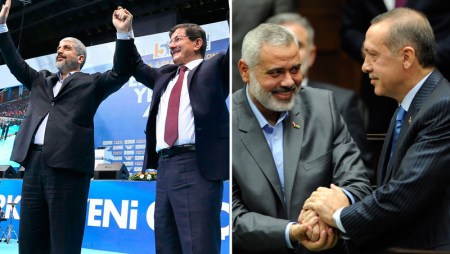
1514Cozying up to Hamas: Turkish Prime Minister Ahmet Davutoglu poses with Khaled Mashaal, Chairman of the Hamas Political Bureau (left). Turkish President Recep Tayyip Erdogan poses with Hamas Gaza leader Ismail Haniyeh (right).

Turkey — after damaging or even destroying its relations with almost all of its neighbors – is now at the door of Israel, which the Turkish government has condemned several times by referring to it as “more barbaric than Hitler” and even expressed its wish of establishing “a Muslim Jerusalem.”

Due to such negative statements regarding Israel, the Turkish public has largely been brainwashed and filled with intense prejudice against Israel. Ridding them of it will be extremely difficult.

Turkish leaders would do well to stop seeing Israel solely as a “source of weapons and trade” with whose strength and cooperation they can do anything they want while they continue to bully their neighbors and minorities.

Turkish leaders might also do well publicly to recognize the sovereignty of the state of Israel. Actually, it may even be too late for the Turkish government to make positive statements about Israel. Turkish politicians have relied so much on their anti-Israel rhetoric to get public support that many of their voters would most probably go into a rage if they heard their political representatives say something nice about Israel.

They would also do well to stop making demonizing statements about the Jewish state and saying completely different things to their Israeli colleagues than they do to the Turkish public.

Sadly, the current Turkish government does not seem to have the potential to do so.

Turkey’s attempts at “normalizing relations with Israel” seem to aim more at gaining deeper Israeli support — economic, diplomatic and military — from which to benefit; but the “not so friendly” references to Israel by Turkish officials will not stop

Do Turkish government representatives also tell their Israeli colleagues that Khaled Mashaal is their “dear friend”? Do they also divulge that the only aim of the negotiations is to get compensation for the Mavi Marmara incident and to remove the “blockade” on Gaza, possibly so that weapons to be used against Israel can come in again? Is Israel to gain nothing out of a possible normalization? More importantly, do Turkish officials openly tell their Israeli counterparts that they eventually aim to see a “Muslim Jerusalem”?

No Anatolian city is to Turks what Jerusalem is to Jews historically, culturally and theologically. What is deeply rooted in Anatolia is Christianity. What would Turkish officials think if Israeli officials also told their citizens about “reviving the Christian cities of Anatolia”?

Probably, however, neither the Jewish roots of Jerusalem nor the Christian roots of Anatolia mean anything to Davutoglu and his representatives; many Islamic extremists think that Islam has been the only true religion since the beginning of time, and they deny the authenticity of other religions.

If Turkish authorities were to aim at an honest and productive deal with Israel, as well as real peace between Arabs and Jews, they would also address the problem of Arab violence against Jews in Israel, and say that they would strive to reduce it.

Also, instead of trying to legitimize Mashaal, a genocidal terrorist leader, Davutoglu could have said: “For peace to prevail in Israel, Hamas should also change its violent ways and aim for peaceful coexistence with Israel. We are ready to do our best to bring both sides together in a non-violent way.”

Unfortunately, Davutoglu did not say anything of the kind. He talked about “the pride of making Israel apologize,” thereby revealing that Turkey’s government officials do not see this apology as just a diplomatic gesture made for the sake of compromise; they see it as one of their triumphant acts through which they insulted and subjugated the Jewish state.

If Turkey is still so fond of Hamas and is still so dedicated to its dreams of establishing a “Muslim Jerusalem,” what good could emerge from these talks with Israel?

Until a different approach in Turkey prevails, these talks and deals seem destined to bring great damage to Israel.

#JusticeForKurds: RT calls on UN to probe Turkey’s alleged killing of Kurdish civilians

March 17, 2016

JusticeForKurds: RT calls on UN to probe Turkey’s alleged killing of Kurdish civilians

Published time: 17 Mar, 2016 05:04 Edited time: 17 Mar, 2016 13:15

Source: #JusticeForKurds: RT calls on UN to probe Turkey’s alleged killing of Kurdish civilians — RTNews

RT has launched a petition calling for a UNHRC-led investigation into claims of alleged mass killing of Kurdish civilians. It is said to have been committed by the Turkish military during Ankara’s crackdown on Kurds in the country’s southeast.

RT’s petition on Change.org: We urge UNHRC to investigate alleged mass killing of Kurds in Turkey

An RT crew visited Cizre in Turkey’s Sirnak province following reports of a brutal military crackdown on the civilian population in the area. It allegedly included slaughtering of hundreds of civilians trapped in basements. The reports which surfaced in February stated that some 150 people were burned to death.

RT’s William Whiteman witnessed shocking scenes of destruction in the southeastern Turkish town, and collected horrifying accounts of an alleged massacre of Kurdish civilians there.

Witnesses who survived the offensive by the Turkish military provided Whiteman with terrifying details on what had happened in the now-devastated area, and showed the location of the alleged mass killing.

The footage shot by RT journalists in Cizre has been submitted to Human Rights Watch (HRW), the international and Middle East branches of Medics Without Borders (MSF), the International Committee of the Red Cross (ICRC), the Office of the United Nations High Commissioner for Human Rights (OHCHR), and Amnesty International.

RT asked if the international organizations were planning to investigate the claims of Turkish forces’ atrocities against civilians, and if any statements would be made. None of them have responded in detail, citing a variety of reasons.

Amnesty International emailed saying they “will not be able to comment on this at this time and must decline your offer.” HRW said their Turkish researchers “are still looking into the allegations, but are not available to comment at present.”

The ICRC said they do not have a Turkish office, thus cannot investigate the situation in its southeast. The UN Human Rights Commissioner’s office in Geneva only offered a press-release dated February 1, while MSF have not replied as of this publication.

“We want to attract widespread public attention and call for an independent international investigation led by UNHRC into the alleged mass killing of Kurds in south-eastern Turkey,” the petition launched by RT on the Change.org platform says.

Follow RT’s LIVE UPDATES on Turkey’s military crackdown on Kurds in anti-PKK op

Russian Foreign Minister Sergey Lavrov called for an investigation into reports of massive human rights abuse in south-eastern Turkey against Kurdish nationals.

“Any reports, particularly those documented ones, about rude and large scale human rights abuse and violations of international humanitarian law must be investigated. There are special international procedures for that,” Lavrov said.

Turkey has claimed it will continue its operations against Kurdish militia, saying its aim is “to ensure peace in the region.”

The US State Department said it has “certainly acknowledged Turkey’s right to defend itself against terrorists,” referring to the Kurdistan Workers’ Party (PKK), the militant group leading a guerrilla war against Turkey, but added that Ankara must “do so in accordance with international law and obligations that they have.”

On January 1, 200 academics from around the world signed a petition denouncing Turkey’s military operation against the Kurds. The document was branded “terrorist propaganda” by the Turkish government, and over 20 academics were detained by the Turkish authorities for signing it.

READ MORE: Arrested Turkish academics called for peace talks – petition signee to RT

Reports of Turkish troops slaughtering scores of civilians trapped in the basements of Cizre first surfaced in February. A member of the Turkish parliament from the pro-Kurdish Peoples’ Democratic Party accused the military of having “burned alive” around 150 people, while they were trapped in basements in different buildings.

“Some corpses were found without heads. Some were burned completely, so that autopsy is not possible,” Feleknas Uca told Sputnik news agency, adding that “most” of those killed were Kurds. In his unverified report, the MP warned that more people could face a similar fate, as more than 200 remained trapped inside buildings across the region.

READ MORE: ‘Turkish Kurds trapped in Cizre victims of brutal state terror’

Prior to the Turkish MP’s claims, the ANHA news agency reported the discovery of over a hundred bodies in the Sur and Cudi neighborhoods of Sirnak’s Cizre district. DNA samples were taken from the victims to identify the bodies, as the corpses were so badly burned that relatives were only able to identify 10 of them, according to the report.

In February, the Turkish Human Rights Foundation said that since August 16, 2015 until February 5, 2016 at least 224 civilians (42 children, 31 women, 30 people over the age 60) lost their lives in the regions and during periods when curfews were officially declared. It added: “It is estimated that, according to the 2014 population census, at least 1,377,000 residents have been affected” by those curfews and the fundamental rights of those people “have been explicitly violated.”

READ MORE: ‘This is a crackdown on civilian population, not PKK’: Kurdish politician on Ankara’s south-east op

Amnesty International reported in January that the Turkish military operation conducted under round-the-clock curfews was putting the lives of tens of thousands of people at risk and was “beginning to resemble collective punishment.”

“Cuts to water and electricity supplies combined with the dangers of accessing food and medical care while under fire are having a devastating effect on residents, and the situation is likely to get worse, fast, if this isn’t addressed,” said John Dalhuisen, Amnesty International’s director for Europe and Central Asia.

Turkey warplanes hit Kurdish PKK camps in northern Iraq

March 14, 2016

Turkey warplanes hit Kurdish PKK camps in northern Iraq – Turkish army

Published time: 14 Mar, 2016 08:16 Edited time: 14 Mar, 2016 09:27

Source: Turkey warplanes hit Kurdish PKK camps in northern Iraq – Turkish army — RT News

© Murad Sezer
Turkish warplanes bombed camps belonging to the Kurdistan Workers’ Party (PKK) in the north of Iraq early on Monday, Turkey’s army has confirmed. The strikes come less than 24 hours after a car bomb in Ankara killed at least 37 people.

A total of 11 fighter jets were involved in the bombardment of the PKK positions. Eighteen targets were hit, including ammunition depots and shelters, the Turkish military said in a statement, as cited by Reuters.

Turkey believes the PKK is a terrorist organization and Ankara has blamed the Kurdish separatist group for a number of recent terrorist attacks in the country, including Sunday’s car bomb at a transport hub in the Turkish capital, which killed at least 37 people and injured dozens more.

Turkish security officials claimed on Monday that a woman who joined the PKK in 2013 was one of the two suspects behind the car bombing in Ankara, according to Reuters. They said that the woman was born in 1992 and was from the eastern Turkish city of Kars.

Read more

Turkish F-16 fighter jets. © Fatih Saribas

Speaking after the attack, Turkish President Recep Tayyip Erdogan said he would bring terrorism “to its knees,” and that the Turkish state would “never give up using its right of self-defense.”

“All of our security forces, with its soldiers, police and village guards, have been conducting a determined struggle against terror organizations at the cost of their lives,” Erdogan said in a written statement, as cited by the Hurriyet Daily News. “These attacks, which threaten our country’s integrity and our nation’s unity and solidarity, do not weaken our resolve in fighting terrorism but bolster our determination,” he added.

The Turkish Air Force bombed at least five PKK targets in Iraq on March 9, with Ankara claiming 67 militants were killed.

On December 9, 10 Turkish F-16 fighter jets targeted Kurdish positions in northern Iraq, with the Turkish military saying that its targets were “destroyed in an aerial campaign.

These strikes came days after Turkey had deployed about 150 troops and 25 tanks to a base in Iraq’s Nineveh province, without bothering to get permission from Baghdad. Ankara argued that its soldiers were sent to northern Iraq after a threat from Islamic State (IS, formerly ISIS/ISIL) to Turkish military instructors training anti-terrorist forces in the area.

Erdogan had rejected a request from Baghdad to withdraw the troops, claiming that the Turkish military is present in Iraq “as instructors.”

A two-year truce to a decades-long conflict between Ankara and the Kurds was shattered in July. Turkey has launched a security crackdown in the predominantly Kurdish south east of Turkey, while also striking Kurdish positions in Iraq and Syria.

On Monday, Turkey announced it would implement a new 24-hour curfew in the south-eastern town of Sirnak to try and carry out operations against Kurdish militants.

Speaking to RT, Ertugrul Kurkcu, Honorary President of the Peoples’ Democratic Party (HDP), said that Ankara’s crackdown was failing to distinguish between the militants and the general civilian population who support Kurdish rights.

“This is a crackdown not on the PKK, but on the civilian population and Kurds who have been supporting our party, who have been supporting Kurds’ rights,” he said.

“And they were targeted during this crackdown. The government’s figures are incorrect… According to our figures, until this day, 652 civilians have lost their lives during the curfew in the cities of Cizre, Silopi, Sirnak and Nusaybin. And of these, 97 are children and 94 are women.”

US embassy issued warning on impending attack in Ankara 2 days before Sunday blast

March 14, 2016

US embassy issued warning on impending attack in Ankara 2 days before Sunday blast

Published time: 14 Mar, 2016 09:09 Edited time: 14 Mar, 2016 09:26

Source: US embassy issued warning on impending attack in Ankara 2 days before Sunday blast — RT News

Emergency workers work at the explosion site in Ankara, Turkey March 13, 2016 © Stringer
The US embassy in Turkey issued a security warning to American citizens two days before a blast caused by a suicide car bomb hit the center of Ankara on Sunday evening. At least 37 people were killed and 125 injured in the explosion.

The American embassy had warned on its website about a “potential plot to attack Turkish government buildings and housing in the Bahcelievler neighborhood,” in Çankaya District, where the Turkish National Library is located among other landmarks. “US citizens should avoid this area,” the embassy stated.

“We advise US citizens to review their personal security plans, remain aware of your surroundings and local events, monitor local news stations for updates, and follow local authority instructions,” it added on Friday.

The Sunday blast, the second attack in the administrative heart of the city in under a month, occurred near Guven Park and Kizilay Square, several kilometers from Bahcelievler. The site of the explosion is close to the Justice and Interior Ministries, a top courthouse, and the former office of the country’s prime minister. The blast, which could be heard several kilometres away, appears to have been triggered by a car exploding near a bus stop, Turkish broadcaster TRT reported, adding that the site is a major transportation hub.

“It’s a car bomb, [it happened] in the heart of Ankara… and today is Sunday, many people may be outside,” Turkish journalist Onur Burcak Belli told RT by phone, adding that the scene of the blast is “very close to a shopping mall.”

While no one has claimed responsibility for the attack, two senior security officials told Reuters that the initial findings suggested that members of the outlawed Kurdistan Workers’ Party (PKK) or an affiliated group were responsible. The PKK has been waging an armed struggle for Kurdish autonomy since 1984.

On Friday, Turkish Interior Minister Efkan Ala said that new military operations against PKK members could be expected in several mostly Kurdish-populated towns in the east of the country. The Turkish military operation against PKK militants in the southeast was launched in July 2015, breaking a ceasefire agreement that had held for two years. The Turkish crackdown against the Kurds has been criticized by human rights groups. Amnesty International reported in January that at least 150 civilians, women and children among them, have been killed in the Turkish military operation, saying that some 200,000 people had been put at risk and were being denied access to services due to strict curfews.

READ MORE: Turkey keeps shelling Kurds, backing terrorist groups in Syria – Russian MoD

In February, 28 people were killed and 61 injured in a blast in Ankara, when a car bomb, reportedly targeting military personnel, went off close to the parliament building. Turkish Prime Minister Ahmet Davutoglu immediately blamed a Syrian Kurdish militia fighter for the attack, which further proved that the YPG was a terrorist organization, the PM said. “Yesterday’s attack was directly targeting Turkey and the perpetrator is the YPG and the divisive terrorist organization the PKK. All necessary measures will be taken against them,” Davutoglu said in a televised speech. Within hours, Turkish warplanes bombed PKK bases in northern Iraq, and shelled YPG positions in northern Syria, a security source told Reuters.

Tanks for nothing! US-backed Syrian rebel division attacked & looted by Al-Qaeda affiliate

March 14, 2016

Tanks for nothing! US-backed Syrian rebel division attacked & looted by Al-Qaeda affiliate

Published time: 14 Mar, 2016 05:52

Source: Tanks for nothing! US-backed Syrian rebel division attacked & looted by Al-Qaeda affiliate — RT News

An Islamist Syrian rebel group Jabhat al-Nusra fighter © Hamid Khatib


In what could be one of the worst failures of the Pentagon’s program to arm Syrian rebels, several bases with American weapons, armored vehicles and US-trained fighters were captured by Al-Nusra Front. The jihadists and “moderate rebels” are blaming each other for the attack.

READ MORE: ‘Truce hasn’t changed anything, terrorists intensified attacks’ – Aleppo residents to RT

Division 13 of the Free Syrian Army (FSA), which had received both US weapons and training, on Sunday said it was attacked by Al-Nusra Front militants – radical Islamist fighters affiliated with Al-Qaeda. The jihadists looted the FSA group’s depots in the town of Maarrat Al-Nuuman in Syria’s Idlib province.

Read more

Though it has widely been reported that weapons and dozens of Division 13 fighters have been captured, there are conflicting accounts of how much the jihadists could actually carry. Some media reports claimed that the haul included US-supplied TOW anti-tank missiles, firearms and ammunition, and unspecified armored vehicles, including a tank. The rebel group’s chief has denied they have lost anti-tank missiles, telling AFP that only “light weapons” have been taken.

Moreover, up to 40 Division 13 fighters have been taken hostage and four killed, the Syrian Observatory for Human Rights has said, though the remote “sources on the ground” routinely cited by the UK-based organization are often hard to verify.

Adding to the rebel group’s dismay, Al-Nusra was also the first to release an online statement – blaming Division 13 for provoking the attack. In turn, the rebels denied attacking Al-Nusra and accused them of an unexpected armed assault on a checkpoint, set up at the request of the local population.

The reason reportedly given by the US-backed group as to why they couldn’t have attacked the Islamists? Too weak for the job.

The feud between the militant factions, once close allies in fighting Syrian President Bashar Assad’s forces, has been brewing for some time, according to AP. Al-Nusra has recently suppressed demonstrations and arrested protesters in the city of Idlib, and reportedly replaced the tricolor of the Syrian rebels with the black Al-Qaeda flag there.

On Friday, in Maaret al-Numan, motorcyclists waving the black flag of Al-Nusra threatened to fire on a protest, shouting “Allahu akbar” or “God is greatest.”

Read more

Members of Al-Qaeda-affiliated Nusra Front. © Ammar Abdullah

Interestingly, Al-Nusra has a history of looting US-backed opposition forces: last summer, jihadists kidnapped members of the US-trained Division 30, while in September a whole stock of US-supplied weapons and hardware was captured.

The Pentagon’s failed rebel-training program was canceled in October, after dozens of US-trained rebels abandoned Division 30 and handed the weapons they had been supplied to Al-Nusra upon crossing from Turkey into Syria.

However, the head of US Central Command, General Lloyd Austin, proposed to restart training for Syria’s so-called “moderate” rebels.

A month later, the US State Department admitted that some of the “moderates” had been successfully recruited by Al-Nusra in Syria.

READ MORE: ‘US created monster of al-Qaeda, yet believes Iran supported 9/11 terrorists’ (OP-ED)

Turkey: Normalizing Hate

March 13, 2016

Turkey: Normalizing Hate, Gatestone InstituteUzay Bulut, March 13, 2016

(Breaking news: Obama, Cruz and Rubio have issued a joint statement blaming Trump. What? OK. Not yet. — DM)

♦ [T]hey have launched an investigation against me in accordance with article 301 because I mentioned ‘peace, brotherhood, and human rights’ in my statement to the press. Hundreds of lawsuits have been brought against lawyers and members of opposition in Turkey because they talked about peace and brotherhood.” — Ilhan Ongor, Co-President of the Adana branch of the Human Rights Association.

♦ Starving or murdering civilians does not, apparently, constitute a crime in Turkey, but speaking out about them does.

♦ Insulting non-Turkish and non-Muslim people has almost become a social tradition in Turkey. Prejudice and hate speech have become normalized.

♦ What makes this hate speech even more disturbing is that these people — Armenians, Greeks, Assyrians, and Jews, among others — are the indigenous peoples of Anatolia, Mesopotamia and Thrace, where they have lived for millennia. Today, as a result of Turkey’s massacres, pogroms and deportations, they have been turned into tiny communities.

According to the 2015 statistics of the European Court of Human Rights (ECHR), 28 lawsuits were opened by applicants against member states regarding their violations of freedom of expression. Ten of those applications (complaints) were made against Turkey’s violations of freedom of expression. Turkey ranked first in that category.

Turkish law professor Ayse Isil Karakas, both a judge and elected Deputy Head of the ECHR, said that among all member states, Turkey has ranked number one in the field of violations of free speech.

“619 lawsuits of freedom of expression were brought at the ECHR between 1959 and 2015,” she said. ” 258 of them — almost half of them — came from Turkey and most were convicted as violations of freedom of expression.”

For a country that fancies itself a candidate for EU membership, that is quite a record. Actually, when it comes to deciding what thoughts are warmly tolerated and what thoughts are severely punished, Turkey is extraordinary. If the statement involves Jew-hating for instance, it is welcomed by many.

Seyfi Sahin, a columnist in the Islamist pro-government newspaper Vahdet, wrote on January 31:

“I believe that the gorillas and chimpanzees living in the forests in northern Africa today are cursed Jews. Those are mutated, perverted people.

“Believe me, this view is stronger and more scientific than the Darwin theory. We Muslims, and those who believe that, do not have the banks, the money, the organizational power in the world of science, or the propaganda power to scream those truths.

“But we have our wisdom, our faith and our Allah. Alhamdulillah (Praise be to Allah).”

In an attempt to back up his “views,” Sahin mentioned that he is also a medical doctor, and quoted Koranic verses 2/65, 5/60 and 7/166. “Those verses are signs that monkeys descended from human beings,” he said. “Allah always tells the truth.”

Throughout his entire piece — which has been widely “liked” and shared on social media — he tried to “prove” his claim that monkeys come from Jews, and his newspaper saw no harm in publishing it. Yet, no one has yet brought him to account for his libelous insults. Who knows? He might even be given an award for this piece.

However, much of the Turkish public and the Turkish state are not so tolerant and welcoming when human rights issues — especially Kurdish issues — are discussed.

According to reports, two lawsuits were filed on January 3 against Sibel Ozbudun, an author and retired associate professor of anthropology known for her writings about minority rights. The indictment claims that through her social media posts, Ozbudun has committed the crime of “openly inciting people to commit an offense” and “making propaganda of the PKK.” The lawsuits were filed after the police received an e-mail from someone denouncing Ozbudun for her posts.

One of the pieces of “evidence” of the prosecutors is a verse, popular in Turkey, shared by Ozbudun on her Facebook page: “I want the country be divided — henchmen, sycophants and slimy ones to one side; honorable, dignified, laborious, patriotic people to the other.”

On another occasion, on December 30, a Turkish instructor and a member of the Social Rights Association, Cise Atalay, during a lecture at Amasya University mentioned human rights abuses. A student called the police; Atalay was arrested for “terrorist propaganda” on the spot. Next, her home and office were searched.

The student who called the police is not alone. Turkish state authorities also regard requests for human rights as “terrorist propaganda” or “insulting the Turkish state.” On January 7, an investigation was launched against the co-president of the Adana branch of the Human Rights Association (IHD), Ilhan Ongor, for violating Article 301 of the Turkish penal code, which makes it illegal “to insult Turkey, the Turkish nation, or Turkish government institutions.”

On November 11, apparently, Ongor had issued a press release in which he said, “Today, in Silvan, a crime against humanity is being committed by the state. They are trying to make the massacres ordinary.” He had been criticizing the recent military attacks against Kurds during a curfew imposed on the Kurdish district of Silvan.

The military attacks had caused starvation, civilian deaths and massive destruction. After his criminal investigation, Ongor said that “People’s right to life is violated while the judiciary is trying to suppress human rights and defenders of freedom.”

“Interestingly, they have launched an investigation against me in accordance with article 301 because I mentioned ‘peace, brotherhood, and human rights’ in my statement to the press. Hundreds of lawsuits have been brought against lawyers and members of opposition in Turkey because they talked about peace and brotherhood.”

Starving or murdering civilians does not constitute a crime in Turkey, apparently, but speaking out about them does.

In Turkey, if someone utters the most vicious or threatening remarks about Armenians, Greeks, Jews, Christians, Kurds, Alevis or other members of a minority, he is never condemned by the state or held to account. But those who speak of human rights abuses, or criticize the state for its violent, repressive actions, will most probably be accused of violations.

After a group of Turkish soldiers and Kurdish PKK guerillas were killed in battle on September 8, the principal consultant of President Tayyip Erdogan and former Chairman of the Constitutional Commission of Turkey’s Parliament, Burhan Kuzu, wrote in his Twitter account:

“So far, thousands of terrorists have been bumped off. This will continue. The corpses of the dead terrorists should definitely have autopsies. Many of them will be found to be uncircumcised. Wake up, my Kurdish brother, wake up now!”

Kuzu seems to be trying to legitimize the killings of PKK members because being uncircumcised implies being Christian or non-Muslim. He also seems to think that the PKK members are not Muslims, and that any non-Muslim deserves to be “bumped off.”

Evidently jumping to conclusions about the possible political leanings of dead people based on their genitalia, and saying that because of their religious background they deserve to be killed, is perfectly acceptable in Turkey. What is more alarming is that Kuzu, who made these statements, is a constitutional law professor.

In 1996, at Turkey’s parliament, the interior minister at the time, Meral Aksener, and a current MP from the Nationalist Movement Party (MHP), said that the leader of the PKK (Kurdistan Workers’ Party), Abdullah Ocalan, was “Armenian semen.” She then clarified the remark by saying, “I did not refer to the Armenians living in Turkey. I referred to the Armenian race in general.”[1]

Humiliating statements about non-Turkish or non-Muslim people are common and popular, even among political circles, but if one makes critical statements about the state policies, one might be prosecuted, or end up in prison — due to the vagueness of Turkey’s “terrorism” laws.

Because of several articles in the Turkish penal code, many individuals face prosecution as if they were actually fighting the government as “members” of the armed Kurdish PKK, and are often sentenced accordingly.[2]

Many peaceful demonstrators have also faced prosecution for exercising their right of freedom of expression, if they shout slogans, hold up banners, or make statements to the press.

The latest victims are the peace activists who demanded an end to the recent military siege in Turkey’s Kurdistan. On December 27, activists from western Turkey started a journey towards Diyarbakir in an attempt to oppose the military siege and civilian deaths in the region. Calling their action “We are walking towards peace,” they arrived in Diyarbakir on December 31 — to be attacked by the police. Four were injured and twenty-four were taken into custody, accused of “carrying out acts on behalf of a terrorist organization.”

1508In December, peace activists walked to the city of Diyarbakir in Turkish Kurdistan in an action they called “We are walking towards peace.” When they arrived, they were attacked by the police. Four were injured and twenty-four were arrested, accused of “carrying out acts on behalf of a terrorist organization.” (Image source: JINHA)

The state tradition of violating the freedom of expression goes back to the foundation of the Turkish republic in 1923. The new regime established by the Republican People’s Party (CHP) — with its laws and “independence tribunals” — totally crushed any kind of political opposition and freedom of opinion.

The 1925 Law on the Maintenance of Order gave the government that founded the Turkish republic extraordinary authority through which it could suppress all kinds of opposition and ban any group or publication it viewed as threatening its authority.

In 1926, all major national newspapers except Cumhuriyet and the official Ankara daily, Hakimiyet-i Milliye were closed.[3]

In another autocratic policy, the “independence tribunals” were founded in 1920 — and functioned periodically until 1929 — to prosecute the dissidents of the government and hand down swift capital punishment for them.

“The members of the independence tribunals were chosen from the parliament,” wrote the historian Ayse Hur.

“But those members — except for the prosecutors — were not jurists. On the doors of the tribunals were written ‘Independence tribunals are afraid of Allah only’ and they were not responsible for their rulings but all of the civilian and military bureaucrats were responsible for the executions of punishments without delay.

“No evidence was needed to give rulings. It was very rare that the defendants had lawyers. There was neither time for that nor lawyers courageous enough. The rulings were given in accordance with the personal convictions of judges and those who were tried did not have a right of appeal. The punishments (and hangings) were carried out right away. The rulings were given and executed so swiftly that sometimes the wrong people were hanged instead of real defendants.”

“By the time the independence tribunals were disbanded two years later,” wrote professor Michael M. Gunter, “more than 7400 Kurds had been arrested, 660 had been executed, hundreds of villages had been destroyed, and thousands of other Kurds had been killed or exiled.”[4]

The tribunals were legally closed down in 1929, but the laws concerning independence tribunals remained in force until 1949. They continued functioning as the nightmare of the opponents of the regime until the end of the one-party regime of the Republican People’s Party (CHP) in 1950.

Sadly, the new Turkish regime founded in 1923 did not aim to foster a culture of free opinions and free debate. And the rest of Turkey’s history has mostly been about repeated violations of freedom of expression. Almost all opinions that are different from the state’s official ideology are targeted, criminalized and repressed.

Turkey has pursued discriminatory and violent policies towards minority groups, but discussing those policies often constitutes a crime.

Omer Asan, a Turkish author and publisher, was accused by Turkish courts of “spreading separatist propaganda” through “Pontus, Pontic Culture,” a book he wrote. The title means “sea” in Greek, and is a historical Greek designation for the territory located in the eastern Black Sea region of Turkey. The inhabitants of Pontus were some of the very first converts to Christianity. From 1914 to 1923, out of approximate 700,000 Pontic Greek Christians, as many as 350,000 were killed by Muslim Turks in a genocidal campaign. Almost all the rest were driven out of their homes during the forced population exchange between Greece and Turkey.

That act marked the end of one of the ancient Greek civilizations in Asia Minor. The ancient region known as Pontus has been almost totally Turkified and Islamized up until today.

The book was, among other things, the subject of a television program in which a theology professor accused Asan of “being a traitor friendly to Greece” and of “wanting to reintroduce Orthodox Christianity to a Muslim region.”

In January 2002, the National Security Court ordered the seizure of the book.[5]

In March, 2002 the State Security Court brought criminal proceedings against Asan. He was charged with disseminating separatist propaganda by asserting that there were still some communities influenced by Pontic Greek culture in the province of Asan’s hometown, Trabzon, and the surrounding area.

In 2007, the European Court of Human Rights convicted Turkey of violating Asan’s right to free speech.

Why is Turkey disturbed by critical thoughts, questions and books, but not by those who call Armenians “sperm,” Jews “monkeys” or who talk about the private parts of dead Kurds? Insulting non-Turkish and non-Muslim people has almost become a social tradition in Turkey. Prejudice and hate speech have become normalized.

What makes this hate speech even more disturbing is that these people — Armenians, Greeks, Assyrians, and Jews, among others — are the indigenous peoples of Anatolia, Mesopotamia and Thrace, where they have lived for millennia. Today, as a result of Turkey’s massacres, pogroms and deportations, they have been turned into tiny communities.

After committing crimes against these native people, Turkey not only denies the realities of this history, but insults and threatens the remaining members of those groups. It also represses whoever would like to discuss these issues. The only people who seem to enjoy “freedom” completely are those engaging in hate speech.

Citizens of other countries who live in Turkey are also exposed to prohibitions on free speech.

Norma Cox, an American academic who worked as a lecturer at Turkish universities during the 1980s, was deported and banned from re-entering Turkey by order of the Turkish Ministry of the Interior in 1986, 1989 and 1996. She has been unable to return to Turkey ever since.

The Ministry of the Interior claimed that Cox had been expelled and banned because of her separatist activities against national security, “namely statements she had made about Turks assimilating Kurds and Armenians, and Turks forcing Armenians out of the country and committing genocide.”

Cox’s application to the European Court of Human Rights (ECHR) said: “Expressing opinions on Kurdish and Armenian issues at a university, where freedom of expression should be unlimited, could not be used as a justification for any sanctions, such as the ban on her re-entry into Turkey.”

In 2010, the ECHR convicted Turkey of violating Cox’s freedom of expression.[6]

While hate speech and racism are warmly tolerated and even promoted by state authorities, free debate on Turkey’s social and political issues such as the Kurdish question and the PKK, Armenian genocide, history of Anatolian and Pontic Greeks, and the Christian roots of Anatolia, among others, are criminalized.

Turkey thereby systematically violates Turkish citizens’ freedom of information or right to know, a right recognized by the United Nations.

The researcher Lisa Reppell, who analyzed Turkey’s cases in the ECHR, wrote:

“The category in which Turkey stands out most significantly is freedom of expression. … Though by number of incidences, freedom of expression judgments are a smaller percentage of Turkey’s judgments, violations of this category are much more common in Turkey than in any other member state. Out of a total of 544 judgments handed down by the Court between 1959 and 2013, 41 percent of all freedom of expression violations have come from cases against Turkey.”

Turkey is a mental prison. In Turkey, knowledge of history and respect for human rights are neither valued nor popular; hatred, bans and discrimination are.

Despite Turkey’s unchanging pattern of violating freedom of expression, the country was officially recognized as a candidate for full membership of the European Union in 1999, and is a part of the “Western Europe” branch of the Western European and Others Group (WEOG) at the United Nations.[7]

For decades, Europe has treated Turkey almost as if Turkey were a part of Europe. Turkey, however, has never behaved like a modern European state or even a state that truly aspires to be one.

Perhaps Turkish authorities in charge of the country’s tourism affairs should prepare more truthful videos or posters. They might say: “Come to Turkey, where Asking for Peace is a Crime., but Asking for Uncircumcised People To Be Killed Is Normal.”

Or: “Watch your books and remarks! We Are So Sensitive That Even the Mention of Greeks and Christians Offends Us.”

Another poster could say, “In This Country, Recognizing the Armenian Genocide Is a Crime but Calling Someone “Armenian Sperm” is Just Fine. Welcome to Turkey!”

_________________

[1] “Armenian semen” is one of the most popular swear words in Turkey, often used for Kurds, as well. Kurds, or Kurds who request national rights, are “accused” of being Armenian. Many people in Turkey, including military personnel openly refer to Kurds or Kurdish activists as “Armenians,” “dirty Armenians,” “Armenian bastards,” “Armenian sperm” or “Armenian semen.”

[2] For more details, see: “Protesting as a Terrorist Offense: The Arbitrary Use of Terrorism Laws to Prosecute and Incarcerate Demonstrators in Turkey,” by Human Rights Watch, November 1, 2010.

[3] “The History of Turkey”, by Douglas Arthur Howard, Greenwood Publishing Group, 2001.

[4] “The A to Z of the Kurds”, by Michael M. Gunter, Scarecrow Press, 2009.

[5] For details about Asan’s case at ECHR, please see: European Court of Human Rights, 840; 27.11.2007 Asan V. Turkey.

[6] Cox’s application to the ECHR also said:

“[T]he Ministry’s allegations against her had not been proved. Even assuming that she had said those things at the university, she had remained within the permissible limits of criticism. Furthermore, she had never been prosecuted for having expressed those opinions. The action taken against her by the Ministry had therefore been devoid of any legal basis.”

For details about Cox’s case at ECHR, see “Case of Cox v. Turkey“, Application no. 2933/03, 20 May 2010

[7] In 1987, Turkey’s application to accede to the European Economic Community, the predecessor of the European Union (EU), was made. Since 1963, Turkey has been an associate member. Turkey became a member of the Council of Europe in 1949; the Organization for Economic Co-operation and Development (OECD) in 1961; and the Organization for Security and Co-operation in Europe (OSCE) in 1973. It was an associate member of the Western European Union from 1992 to its end in 2011. It also signed a Customs Union agreement with the EU in 1995.