Posted tagged ‘Turkey – Syria war’

Russian role in Aleppo’s fall impacts US politics

December 16, 2016

Russian role in Aleppo’s fall impacts US politics, DEBKAfile, December 16, 2016
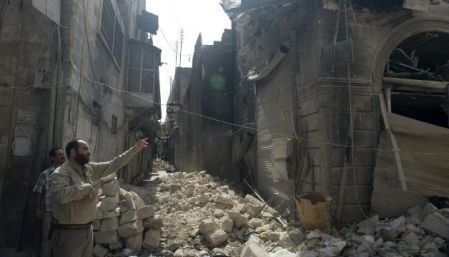
aleppo-damage_9-15

The Putin factor comes in handy for the latest tactic in a series pursued since the November 8 election, for delegitimizing Trump’s victory and negating his fitness to reach the White House.

This campaign may resonate strongly on America’s future policy and position as a world power, because it is designed to block Trump’s path to a deal with Putin for resolving the Syrian conflict. The Obama administration has no wish to see the new president succeed where it failed for nearly six years.

********************************

Aleppo’s fall to the Assad regime with the surrender Thursday, Dec. 15, of the Syrian rebel forces locked in a corner of the eastern districts was the most disastrous military and strategic setback to befall the Obama administration for two years. It started evolving in September 2015, when Russia stepped up its military intervention in the Syria war and rescued Bashar Assad.

When Aleppo succumbed to the Russian-backed government army and its allies, Iran, Hizballah and fellow Shite militias, it did not fall alone.  It brought down the entire architecture of US-backed positions in northern Syria. The US had invested in and trained local groups, such as the Syrian Kurdish militia and the rebel Free Syrian Army, as the bedrock for its policy and interests in the conflict. Those groups have melted away.

The acknowledged overlords of northern Syria today are Russian President Vladimir Putin and Turkish President Recep Tayyip Erdogan, who can claim the Aleppo victory. Bashar Assad and Iran are reduced to playing second fiddle. But whereas the Al Qods chief Iranian general Qassem Soleimani commands pro-Iranian forces in the region, America has been divested of all its military assets and has no real say in the next chapter of the horrific war.

Hence US Secretary of State John Kerry’s despairing appeal Thursday in a press briefing to bring the bloodshed and suffering to an end: “We can’t have another Srebrenica” – a reference to the Serbian slaughter of 8,000 Bosnian Serbs in 1985 – he said.

Kerry has toiled tirelessly for a diplomatic solution to the dreadful Syrian war, but his appeal falls on senses hardened by the many Srebrenicas perpetrated in more than five years of conflict. Hundreds of thousands of civilians and soldiers have been slaughtered – according to an unofficial estimate up to a million – and many subjected to chemical warfare. The secretary can’t count on the Kremlin to relent and so, even after the last Syrian rebels and their families are out of Aleppo, the killing will go on.

In Washington, 10,000 kilometers away, the Aleppo calamity is being dished up as a political tool. The claim was heard Thursday that the “same Vladimir Putin” who sponsored the atrocities in Aleppo, also interfered in the US presidential election by sending hackers to influence the results in favor of Donald Trump. The claim is touted by Obama administration spokesmen and the Democratic Party, whose candidate Hillary Clinton lost the election. It appears to be fodder for a Democratic party drive building up for the president-elect’s impeachment even before he is sworn in as president on Jan. 20.

The Putin factor comes in handy for the latest tactic in a series pursued since the November 8 election, for delegitimizing Trump’s victory and negating his fitness to reach the White House.

This campaign may resonate strongly on America’s future policy and position as a world power, because it is designed to block Trump’s path to a deal with Putin for resolving the Syrian conflict. The Obama administration has no wish to see the new president succeed where it failed for nearly six years.

Putin will have no qualms about capitalizing on Washington’s preoccupation with its internal power struggle and will build up as many gains in Syria as he can before Donald Trump takes over. Obama’s threat Friday, Dec. 12, to retaliate for Russia’s efforts to influence the presidential election will just provoke the Russian president to move faster and more determinedly in his grab for more assets in Syria.
Israel jets mark go-it-alone policy on Syria

November 30, 2016

Israel jets mark go-it-alone policy on Syria, DEBKAfile, November 30, 2016

raidfire480Arab media show damage caused by air strikes to Syrian army compound in Damascus

Although Erdogan is notorious for his wildly unpredictable decision-making, it is more than likely that before going public on his radical change of heart on Assad, he was in touch with the new national security team taking shape in Washington. If that was the case, then Donald Trump was using Erdogan to notify Putin that the entire architecture of their understandings on Syria was now at risk.

If the Arab media reporting on Israeli air attacks on Syrian military and Hizballah targets in Damascus from Lebanese air space are confirmed, Jerusalem will be shown to have followed Ankara in backing away from those short-lived, understandings, opting instead for an independent policy in its own security interests with regard to Syria.

*****************************

Arab media carried conflicting reports wich described Israeli warplanes striking in and around Damascus overnight Tuesday, Nov. 29, with “four long-range Popeye” missiles fired from Lebanese air space on the government-held town of Al-Saboorah, a western suburb of Damascus, near the highway to Beirut.

A Lebanese newspaper reported that a Syrian army ammunition depot was destroyed in one of the raids, while other strikes hit and damaged a Hizballah arms convoy bound for Lebanon on the Damascus-Beirut Highway. There was also speculation, later denied, that one of the air strikes aimed at assassinating a senior Hizballah figure.

None of these reports were confirmed by Israel or any other official source.

Even so, Israel’s reported military action against enemy targets in Syria is bound to have repercussions in the next 24 hours, since, whatever took place, broke out of the secret overarching understandings on Syria reached provisionally this month between US President elect Donald Trump, Russian President Vladimir Putin and Turkey’s Recep Tayyip Erdogan.

Those understandings hinged strongly on joint US-Russian cooperation in the war on the Islamic State in Syria, supported by the coalition fighting for the Assad regime, namely, the Syrian army and its allies, the Lebanese Hizballah and foreign Shiite militias under the command of the Iranian Revolutionary Guards.

As the sub-text of the “big power” understandings, an outline was drafted between the next US administration, Moscow, Jerusalem, Amman and the UAE on arrangements for stabilizing Syria’s southern borders with Israel and Jordan.

Talks on these arrangements were first disclosed in an exclusive DEBKAfile report on Nov. 21, after they had already produced the unheralded return of the UN observers to the Golan demilitarized zone outside Quneitra.

But then, Sunday, Nov. 27, Russian warplanes staged a sudden series of airstrikes against Syrian rebel concentrations in the very region under discussion, southern Syria. After a three-month pause in these attacks, Moscow appeared to have waited for major Syrian government progress in Aleppo, to go against those understandings and send Russian jets into action over Jasim and Daraa in order to wipe out the rebel forces holding out in the South. Heavy casualties were sustained by those forces.

The Russian action was seen by the incoming Trump administration and Jerusalem as presaging the next danger-fraught step: To round out the raids, the Syrian army would come flooding into the South, along with Hizballah and other Shiite militias fighting under Iranian Revolutionary Guards command.

Tuesday saw two further ruptures in the trilateral understandings on Syria.

Assad announced he was gearing up for a decisive victory in Aleppo, notwithstanding a request from Trump’s advisers to Putin to hold back from the final step and refrain from retaking every last eastern district from rebel hands..

This was followed by an unforeseen statement by Erdogan: “The Turkish military launched its operations in Syria to end the rule of President Bashar al-Assad.”

This sentiment pivoted sharply away from the secret Trump-Putin understandings endorsed by the Turkish leader that was contingent on Assad remaining in power.

Although Erdogan is notorious for his wildly unpredictable decision-making, it is more than likely that before going public on his radical change of heart on Assad, he was in touch with the new national security team taking shape in Washington. If that was the case, then Donald Trump was using Erdogan to notify Putin that the entire architecture of their understandings on Syria was now at risk.

If the Arab media reporting on Israeli air attacks on Syrian military and Hizballah targets in Damascus from Lebanese air space are confirmed, Jerusalem will be shown to have followed Ankara in backing away from those short-lived, understandings, opting instead for an independent policy in its own security interests with regard to Syria.

Turkish warplanes bomb US-backed Kurdish militias in Syria

October 20, 2016

Turkish warplanes bomb US-backed Kurdish militias in Syria , DEBKAfile, October 20, 2016

Turkish warplanes carried out more than 20 sorties early Thursday morning in northern Syria, attacking positions, vehicles and convoys of US-backed Kurdish militias fighting the Islamic State organization. The targets were in a number of villages around the city of Aleppo. There were conflicting reports on the number of casualties, with the Turkish army reporting that 200 Kurdish fighters had been killed while the militias claimed that there were only about 20 fatalities. DEBKAfile‘s intelligence sources report that the Turkish attack may cause the Kurds to withdraw their forces from the US-led offensive to capture the Iraqi city of Mosul, and not help the US capture the Syrian city of Raqqa afterwards.

Russia & Turkey carve anti-US enclaves in Syria

October 15, 2016

Russia & Turkey carve anti-US enclaves in Syria, DEBKAfile, October 15, 2016

rusturk

US President Barack Obama told Pentagon and military chiefs he met Friday, Oct. on Oct. 14, that instead of arming anti-Assad rebel groups in Syria, Washington was going back to negotiations with Moscow for cooperation in achieving a cessation of hostilities in the Syrian war.

US Secretary of State John Kerry therefore scheduled his umpteenth meeting with Russian Foreign Minister Sergey Lavrov for Saturday in Lausanne. This time, the foreign ministers of Turkey, Turkey, Iran, Saudi Arabia and possibly Qatar, tagged along.

Beyond the high words, recriminations and the unspeakable horrors attending the battle for Aleppo, Obama never seriously considered providing the anti-Syrian rebels holed up in Aleppo with the anti-air weapons they need to shoot down the Russian and Syrian warplanes blitzing them – any more than UK Foreign Secretary Boris Johnson’s statement that it was time for British military involvement in the Syrian war was for real

Above all, Britain is short of the military heft for backing up hypothetical intentions.

The options for serious Western intervention in the Syrian war are constantly diminishing for the reasons outlined here by DEBKAfile’s military sources:

1.  American missiles have no way of reaching Syrian rebel groups, certainly not those still fighting in eastern Aleppo. Neither Russia, nor Turkey, whose army now controls 5,000 sq. km of northern Syria, would let them through to that destination.

2. Had Turkish President Tayyip Erdogan chosen to do so, he could have simply ordered his army to open up a route for the supply of missiles to the rebels who are hemmed in in Aleppo by Russia, Syrian, Iranian and Hizballah forces. He is withholding that order because the military deals he concluded with President Vladimir Putin last week in Istanbul override any concerns he may have for the fate of those rebels or Aleppo’s population.

3. Those deals in a word sanctify the Turkish “security zone” in northern Syria which is covered by a no-fly zone for all but Russian and Turkish flights. They also provide for the Syrian rebels retreating from the various Syrian war zones, including Aleppo, to be taken in and absorbed in the Turkish enclave. Erdogan would thus become the senior patron of the Syrian opposition rebel movement, barring only the Al-Qaeda-affiliated Nusra Front and other Islamic extremist groups. This would enable him to steal from the United States, Saudi Arabia, Jordan and Qatar their sponsorship roles and their influence in the anti-Assad movement.

4. Ankara’s military alliance with Moscow is steadily eroding Turkey’s ties with the United States as well as NATO. Matters have gone so far that the two capitals or in advanced discussion of the supply of Russian air defense missiles to the Turkish army.

DEBKAfile’s intelligence sources reveal that under discussion is the installation in Turkey of a system of advanced Russian missiles linked to the Russian anti-air missile shield under construction in Syria.

Turkey would thus become the first member of NATO to arm itself with a Russian anti-air missile shield.

How was this allowed to happen?

According to our sources, Putin and Erdogan are moving fast to cash in on President Obama’s repugnance for military intervention in Syria and his waning powers at the tail end of his presidency.

Furthermore –

a) Neither is configuring Syrian President Bashar Assad into their calculations. They are going forward with their plans while ignoring him and his drastically diminished army as factors worth consideration.

b)  Their objectives are similar and interlocking:  Both are intent on developing their respective enclaves in northern Syria, Moscow for a long-term military presence in the country: likewise, Ankara.

Up until now, the Obama administration stood firm against the two goals, which is why Washington and Moscow were unable to achieve any real cooperation over a secession of hostilities in the war-torn country;  even when Kerry and Lavrov struck a truce accord on Sept 9, it never held up beyond a few hours.

Most recently, Putin and Erdogan tried signaling the US president that their sole ambitions with regard to Syria’s future lie in the two military enclaves now under construction.

Obama saw this as a sufficient basis to continue withholding advanced arms from Syrian rebel groups and to go for another round of diplomacy with Russia – with Turkey hitching a ride this time on the opposite side of the table..

US, Russia trade blows in Syria on Kurds’ backs

August 20, 2016

US, Russia trade blows in Syria on Kurds’ backs, DEBKAfile, August 20, 2016

rus us kurds

The near-clash between US and Syrian warplanes over Kurdish Hassaka in northern Syrian Friday Aug. 19 sprung out of the Obama administration’s decision the day before to try and draw the line on the growing Russian-Iranian-Turkish-Syrian collaboration in the conjoined Syrian-Iraqi arenas, DEBKAfile’s military sources report.

It occurred when US jets flew in protective formation over the Kurdish positions, the day after they were attacked by Syrian (some Middle East sources say, Russian) jets.

The US jets came within a mile of the two Syrian Su-24 fighter jets approaching the Kurdish enclave of Hassaka, and warned them off. Without responding the Syrian planes turned tail.

The US Defense Department reported that when the incident began, “coalition forces on the ground” tried reaching the Syrian jets on a “common radio frequency” but received not response. The spokesman did not specify which “coalition forces” he was referring to.

According to some Middle East sources, the Su-24s which attacked Hassaka Thursday were Russian – not Syrian.

Friday, US officials activated the US command center in Jordan for a complaint and warning to the Russian command center nearby, but they too were greeted with silence.

It may be assumed that the Russian tracking and reconnaissance systems spread across Syria and the eastern Mediterranean picked up the American communications and, had they wanted to, could have passed the US warnings on to Bashar Assad.

But the appearance Friday of another pair of Syrian jets over the Kurdish town indicated that the Russians had decided to pretend ignorance.

After the attack on Hassaka, a number of US special operations forces were pulled out of their northern Syrian positions. They were there as instructors and advisers to the Syrian Kurdish YPG militia and the Syrian Democratic Forces (SDF), with tens of US officers attached to every Kurdish platoon and SDF battalion.

It is now up to Washington to decide what happens next.

Russian President Vladimir Putin has obviously embarked on a new anti-American game based on the far-reaching deal he struck with Turkish President Tayyip Erdogan in St. Petersburg on Aug. 9. Part of that deal was a pledge by Moscow to help Turkey block all avenues for the Kurdish minority to attain full independence in Syria or Iraq, where it enjoy semi-autonomy, and allow a Kurdish state to rise from Irbil to the Mediterranean.

Iran and Syria’s Assad fully support the Turkish goal in their own interests.

The air strike against the Kurds of Hassaka therefore set a kind of foundation stone for the new Russian-Turkish-Iranian alliance in the region, whose establishmentDEBKAfile was first to uncover exclusively on Aug. 9, after the Putin-Erdogan summit.

This emerging pact has already generated strategic military dividends for Russia in the Middle East for Russia unmatched at any time since the Cold War of the mid-20thcentury.

Revolutionary Iran has made Russia the first foreign recipient of an air base on its soil near Hamedan in the west.

Erdogan’s Turkey has hustled the US into evacuating its nuclear arsenal from the southern Incirlik air base, the first time NATO was forced to give up a nuclear stockpile near the Russian frontier. And before the removal was completed, calls were raised in Moscow and Ankara to let Moscow install its warplanes at the strategic Turkish base.

It is hard to see how by sending US warplanes to shield Syrian Kurdish positions against attack, the Obama administration can put the brakes on the Russian-led tactical alignment speeding forward with Iran, Turkey and the Assad regime. To make a difference, the US president would have to interrupt his Martha’s Vineyard holiday and reach a decision he has avoided for the last six years, which is to put substantial American boots on the ground in Syria.

This step is not really on the cards three months before the presidential election and five months before he leaves the Oval Office for good.

In the near future, we are therefore likely to see the Russians and Syrians pressing ahead with their campaign against the Kurds, whereas Obama may opt to confront Putin outside the Syrian quagmire, possibly over Ukraine. Mindful of this likely scenario, Putin flew to Crimea Friday after staging war games there.

Putin-Erdogan deal deadlocks Aleppo, Manjib frays

August 13, 2016

Putin-Erdogan deal deadlocks Aleppo, Manjib frays. DEBKAfile, August 13, 2016

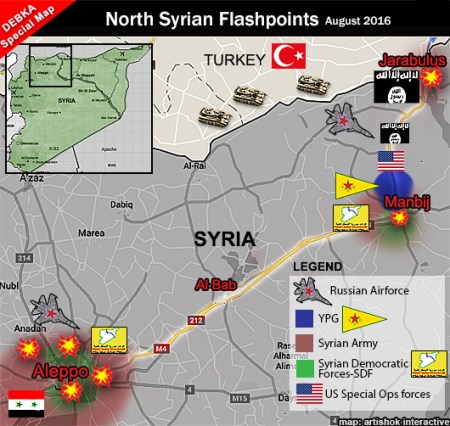
n syria flashpoints

This hopeless standoff is the result of Moscow’s refusal to provide the Syrian army and its allies with enough air support to pull ahead, in the wake of President Vladimir Putin talks with Turkish President Reccep Tayyip Erdogan in St. Petersburg Tuesday, Aug. 9.

*********************

All day Friday and Saturday, Aug.11-12, fighters of Hizballah’s elite Radwan Force – 3,000 in all – streamed to the pivotal Aleppo battlefield from all parts of Lebanon and Syria. DEBKAfile’s military and intelligence sources disclose that they were following the orders of their leader Hassan Nasrallah, who was warned by Tehran that the pro-Assad army fighting for Syria’s second city was flagging in the face of rebel assaults.

The Radwan Force was called in as the only military capable of saving the day for Assad and his allies. This step had been carefully avoided by Nasrallah was required in view of the heavy losses his organization had already suffered for backing the Syrian army – some 1,500 dead in three years – and intense fallout at home.

He has now been forced to sacrifice his last remaining military asset to fight in one of the bloodiest battles ever fought in recent times in the Middle East, even though it promises a swelling procession of Hizballah coffins returning to Lebanon.

According to our military sources, the battle to wrest Aleppo from rebel control, now in its second month, has claimed some 2,000 war dead and 4,000 injured on both sides – not counting the masses of civilians.

Some units have lost more than a quarter of their combatants and dropped out.

Nasrallah knows exactly what is happening in this critical arena. He also understands that a unit which loses 30 percent of its combatants is deemed in military terms unfit to continue fighting and that the battle for Aleppo will be drawn out and bloody. Yet he is willing to commit his entire deck of military resources to keep Bashar Assad’s fighting in Aleppo.

There is no hope of an early resolution in Aleppo, because stalemate between the combatants is exceptionally complicated and thankless. Whenever one side captures terrain, it quickly discovers it was drawn into a trap and under siege.

This hopeless standoff is the result of Moscow’s refusal to provide the Syrian army and its allies with enough air support to pull ahead, in the wake of President Vladimir Putin talks with Turkish President Reccep Tayyip Erdogan in St. Petersburg Tuesday, Aug. 9.

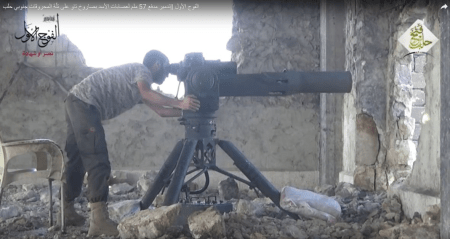
Aleppo_Rebels_ATGM-firings

Erdogan explained that if Assad’s army, along with Hizballah and Iran, defeated the Turkish-backed rebel forces holding Aleppo, he would suffer a serious knock to his prestige and setback for Syrian policy. This was more than he could sustain in the troubled atmosphere in Turkey in the wake of the failed coup against him.

He therefore asked the Russian president to abandon his Bashar Assad, Iran and Hizballah to their fate in Aleppo.

Erdogan was backed up in his request to Putin by a large Turkish military and intelligence delegation which arrived in St. Petersburg the next day to work with their Russian counterparts on setting up a joint military control center in Turkey.

DEBKAfile’s sources disclose the first two tasks assigned the new war room:

1. Russian aerial bombardments over Aleppo would not go beyond keeping the rebels from defeating Syrian and allied forces in Aleppo, but would refrain from supporting offensive action by the latter for routing the former.

2. Turkish air and ground forces would remain in a state of preparedness to ensure that rebel Syrian Democratic Forces (SDF) and the Kurdish YPG militia never moved out of the town of Manjib, from most parts of which they ousted ISIS, to the town of Jarabulus on the Turkish border.I

ISIS had used Manjib as its primary way station for supplies from Turkey 30km to the north. (See attached map). But to drive the jihadists completely out of the Syrian-Turkish border region, the combined rebel forcesmust advance on Jarabulus and expel ISIS from there too.

However, Turkish officers in the joint command center with Russia made it clear that any Kurdish forces allowed to reach that border would come under Turkish army attack.

The Russian president complied with Erdogan’s wishes on the Manjib-Jarabulus front as well as Alepp