Posted tagged ‘Trump’s ambassador to Israel’

Shocking – the new ambassador to Israel

December 18, 2016

Shocking – the new ambassador to Israel, Israel National News, Att’y Stephen M. Flatow, December 17, 2016

A Jewish ambassador to Israel who is more sympathetic to Israel than to the Palestinians, and who will respect the wishes of the Israeli public and government? Shocking!

I’m not being sarcastic. It really is shocking. Critics of Israel are so accustomed to Jewish ambassadors who harass and undermine the Israeli government, that the prospect of someone completely different has left them frothing at the mouth. 

David Friedman, President-elect Trump’s choice for ambassador to Israel, is completely unlike his predecessors. And that’s what drives the critics of Israel crazy.

For many decades, the top tiers of the State Department and the diplomatic corps were closed to Jews. Everyone knew that their ranks were reserved for blue bloods and white shoes–people who came from the “right” segment of society and belonged to the “right” country clubs.

In the 1970s, though, a certain kind of Jew began to squeeze through the doors at Foggy Bottom. They had names like Daniel Kurtzer, Dennis Ross, Aaron Miller, and Martin Indyk. They were different than most Jews because they were stridently critical of Israel and were willing to devote themselves to forcing Israel to make one-sided concessions to the Arabs.

Indyk served as U.S. ambassador to Israel from 1995 to 1997 and again from 2000 to 2001. His haughty attitude was obvious from early on: he boasted to the Washington Post (2-24-97) that he saw his job in Israel as similar to “a circus master” who “cracks the whip” in order to “get [the animals] to move around in an orderly fashion.”

Indyk’s practice of interfering in Israel’s internal affairs was notorious. In 1995, for example, he lobbied Knesset Members to oppose a law that would have reduced the chances of Israel surrendering the Golan Heights to Syria.

One shudders to think of the dangers Israel would face today if Indyk had his way and the Golan was in the hands of either the genocidal Assad regime or its genocidal ISIS opponents.

Indyk tried to pressure Israel’s chief rabbi to oppose a housing project in a part of Jerusalem that Indyk wanted Israel to give up. He also tried to block the selection of a cabinet minister whom he thought was insufficiently dovish. Things got so bad that the chairman of the Knesset Foreign Affairs and Defense Committee took the unprecedented step of publicly declaring: “Ambassador Indyk needs to be reminded that he is not the British High Commissioner,” alluding to the British Mandate that preceded Israel’s independence.

The appointment of the second Jewish ambassador to Israel, Daniel Kurtzer, in 2001, did not improve matters. Kurtzer repeatedly pressured Israel to remove security checkpoints (lest Palestinian Arab travelers be inconvenienced) and make one-sided concessions on settlement construction (while never asking the Palestinian Authority to limit its illegal construction). He denounced Israel’s budgetary allocations–an extraordinary act of interference in Israel’s internal affairs. Kurtzer even publicly called on the Israeli public to put pressure on the government to make more concessions.

When Israel responded to Yasser Arafat’s sponsorship of terrorism in the autumn of 2002 by besieging Arafat’s headquarters in Ramallah, Kurtzer rode to the rescue of the arch-terrorist by demanding that the Israeli government end the siege. This took place nine months after Israel had captured Arafat’s ship, the Karine A, with its fifty tons of weapons–the episode that revealed Arafat had never changed his terrorist spots. Yet there was the Jewish U.S. ambassador to Israel, nine months later, trying to rescue the mass murderer.

The third Jewish ambassador to Israel, Dan Shapiro, has not been much better. In an interview with Israel Army Radio last year, Shapiro indicated that U.S. support for Israel at the United Nations and other international forums was conditional on Israel accepting moving towards creation of a Palestinian state. that kind of linkage was all too reminiscent of the Indyk “crack the whip” approach.

Earlier this year, Ambassador Shapiro falsely claimed that “Israeli vigilantism in the West Bank goes on unchecked,” that “Israel has two standards of adherence to rule of law in the West Bank– one for Israelis and one for Palestinians,” and that Israel’s settlement policy “raises questions about Israeli intentions.”

That was a thinly-veiled way of saying that Israel is not really interested in peace if it permits the construction of a kindergarten in Judea, Samaria, or many parts of Jerusalem. Shapiro’s statements were so mean-spirited and inappropriate that Prime Minister Netanyahu himself issued a stinging rebuke: “The ambassador’s statements, on the day when a mother of six who was murdered is buried, and on a day when a pregnant woman is stabbed – are unacceptable and wrong,” the prime minister said.

So yes, David Friedman is going to be a very different kind of Jewish ambassador to Israel. Unlike his disreputable predecessors, Friedman will respect Israel’s right to make its own decisions, instead of “cracking whips” and dictating to Israel how to behave. Friedman will be on the side of the exemplars of democracy and freedom in the Middle East, not the terrorists and the totalitarians. In short, Ambassador Friedman will work to strengthen ties between America and its loyal ally, Israel, instead of undermining them.

What a difference!

Anti-Israel Lefties Freak Out Over Trump Pick for Ambassador to Israel

December 16, 2016

Anti-Israel Lefties Freak Out Over Trump Pick for Ambassador to Israel, Front Page Magazine (The Point), Daniel Greenfield. December 26, 2016

(There are other “problems” with Friedman: not only is he Jewish, he even speaks Hebrew. Secretary Kerry suffered from neither deficiency. Instead, he reflected Obama’s sense of balance toward Israel and what he hoped would become the sovereign state of Palestine, spreading from sea to shining sea. Seriously though, why would it be detrimental to America, or even to Israel, to help to keep the only democratic, non-Islamic nation in the Middle East alive? — DM)

hitlercries

There’s a fresh wind blowing through a stale room full of embittered lefties. The US Ambassador to Israel isn’t supposed to be pro-Israel. He’s supposed to represent the compelling US interest in the PLO.

Lisa Goldman of the truly vile hate site 972 really loses her mind.

“David Friedman’s views lie to the right of Meir Kahane’s. Trump naming him as Amb to Israel is a FU to the 70% of US Jews who vote Democrat,” she rants.

No, but it is an FU to the 2% of US Jews who vote for the Green Party and hate the Jewish State. But there’s more…

“This is true. It’s on the record. Trump’s ambassador to Israel called fellow Jews who support a 2 state solution “worse than kapos.”

The Kapos often didn’t have a choice. If Not Now and JVP’s howlers of hate do. And they chose to be what they are. We must never forget that.

Jill Jacobs of the anti-Israel group T’ruah is also most unhappy..

“New ambassador to Israel insults all liberal Jews, esp @JeremyBenAmi,” Jacobs whines.

Oh no. Not poor Jeremy Ben Ami. And Jeremy is also discommoded.

“Lord help friends of Israel if someone like David Friedman is making US policy on Israel rather than John Kerry,” Jeremy squeals.

That would indeed be the clearest sign that the Lord is helping Israel.

But David Friedman’s pick has caused a complete meltdown in the underground volcanic cavern serving as J Street’s HQ. J Street was already running back and forth waving its arms over a move of the embassy to Jerusalem, blocking Bolton and freaking out over the Chanukah party.

Now it’s losing what little is left of its ugly little mind.

“Trump’s pick of Friedman for Israel Amb is anathema to values that underlie US-Israel relationship. We’ll fight this with all we’ve got,” Jeremy Ben Ami rants.

The official J Street statement declares, “J Street is vehemently opposed to the nomination of David Friedman to be Ambassador to Israel.”

It’s hard to think of a better recommendation for Friedman than that.

“Well Friedman, the group (@jstreetu) you once called “worse than Kapos” is going to make this a hard 4 years for you,” Brooke Davies of J Street threatens.

“One idea from @jstreetdotorg: The Senate should block the confirmation of this dangerous extremist,” Logan Bayroff demands.

You can see them sweat.

Trump’s envoy: The new administration ‘won’t tell Israel what policies to adopt’

December 16, 2016

Trump’s envoy: The new administration ‘won’t tell Israel what policies to adopt’, Times of IsraelEric Cortellessa, December 16, 2016

WASHINGTON — Sitting in a conference room together 13 years ago, David Friedman told his friend Donald Trump that he just purchased an apartment in Jerusalem.

Trump, the real estate tycoon, was immediately curious to know the particulars. “How big was it? How much did it cost?” Friedman recalled him asking, describing the conversation during an interview last month with The Times of Israel. When Friedman cited the price, Trump was surprised.

“That’s really a lot of money,” he responded, according to Friedman’s recollection. “For that kind of money, why wouldn’t you buy a place in East Hampton? Why do you have to go all the way to Israel for a second home?”

The Long Island native’s answer was probably one that the man soon to be president was not expecting. “The world has been fighting over every inch of Jerusalem for the past 3,000 years,” Friedman told Trump. “There’s nobody fighting over East Hampton.”

Trump’s eyes then “opened up,” Friedman said, “and that initiated a decade-plus conversation about Israel.”

Now, in 2016, that exchange seems to have been more fateful than it initially seemed to Friedman, who was announced on Thursday as President-elect Trump’s nominee to be the next US ambassador to Israel.

And the first move Friedman made in that official capacity was to indicate that Trump plans to follow through on his campaign pledge to move the US embassy from Tel Aviv to Jerusalem, breaking decades of precedent under both Republican and Democratic administrations, and underlining an apparent inclination to do what other presidential candidates have promised but declined to deliver once they took office: recognize the holy city as Israel’s capital.

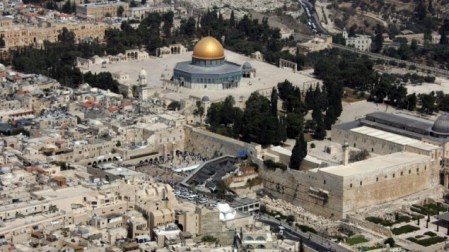
domeoftherockAn aerial view of the Dome of the Rock, left, in the compound known to Muslims as al-Haram al-Sharif and to Jews as Temple Mount, in Jerusalem’s Old City, and the Western Wall, center, the holiest site for Jews, October 2, 2007. (AFP/Jack Guez)

Official US policy has long been to insist that the status of Jerusalem can only be determined through a negotiated settlement between the parties, as both Israelis and Palestinians claim it as their capital.

In a statement Thursday, Friedman, a Hebrew-speaker, declared he was “deeply honored and humbled” that his friend of 15 years selected him to represent America to the Jewish state, and he also left the world with a zinger when he said he looked forward to doing his new job “from the US embassy in Israel’s eternal capital, Jerusalem.”

But Friedman’s declared appetite to move the embassy is not the only reason liberal Jewish organizations have responded to his nomination with something close to horror. The 57-year-old bankruptcy lawyer has also been an outspoken and active supporter of the settlement movement, and has argued that Israel doesn’t face a “demographic threat” to its Jewish character if it fails to separate from the Palestinians.

Friedman serves as president of American Friends of Bet El Institutions, an organization that supports the large West Bank settlement near Ramallah, and over the last year, he has excoriated groups who express criticism of Israel’s settlement policy.

friedman-c2-305x172David Friedman, Donald Trump’s adviser on Israel, talks to Channel 2 News on September 12, 2016. (screen capture: Channel 2)

In June, Friedman accused J Street supporters of being “far worse than kapos” in a column for the right-wing, pro-settlement Israel National News website, using the term for Jews who aided Nazis during the Holocaust. Speaking before the Brookings Institution’s annual Saban Forum earlier this month, he refused to walk back his comparison.

Now that he is slated to become the United States’ top diplomat in Israel — so long as the US Senate confirms his appointment — he will assume one of the most delicate positions in American foreign policy, mediating the US relationship with a close ally in an increasingly unstable region, and after eight tumultuous years of ties between the administration of President Barack Obama and the government of Prime Minister Benjamin Netanyahu.

Last month, Friedman spoke with The Times of Israel about what Trump’s policies and priorities would be toward the Jewish state if he won. Here is what he said.

‘No daylight’ between the US and Israel

When it comes to the US-Israel relationship, Friedman insisted that Trump would represent a sharp break from his predecessor — including in that there would be “no daylight between Israel and America,” a phrase also used in the transition team’s announcement of his selection on Thursday, which indicates a policy of keeping differences out of the public sphere.

“Donald Trump wants to be as supportive of Israel as possible,” Friedman told The Times of Israel. “He doesn’t view Israel as a client state that you just kind of issue directives to. He views Israel as a partner, one of America’s key partners in a global war against Islamic terrorism, so he wants Israel … to be as strong and secure as possible.”

Unlike Obama, who made Israeli settlement construction in the West Bank a fundamental issue of criticism throughout his presidency, Trump will not “put his finger on the scale or tell Israel what policies they should adopt,” Friedman said, adding that his new boss “doesn’t see Israel as in need of any particular correction at this point.”

That principle, he indicated, covers both how Trump will treat the settlement issue and the manner in which Israel seeks to reach an agreement with the Palestinians. The Trump administration will not “dictate to Israel where it can and cannot build” in the West Bank, according to Friedman.

Trump, for his part, has not publicly stated a position on settlements or detailed what kind of a stance he would take. The most common view among Washington’s foreign policy community, and emphatically within the Obama administration, is that, to keep the two-state option alive and ensure Israel’s future as a Jewish and democratic state, the US should try to limit settlement activity to the principal blocs that Israel is expected to retain under any permanent accord.

For his part, Friedman said that a Trump administration “doesn’t see much opportunity for progress until the Palestinians renounce violence and accept Israel as a Jewish state. That’s really a prerequisite.”

One criticism Friedman had of the current president was that Obama saw Israel as “strong” and the Palestinians as “weak,” and thus he believed it was up to the Israelis to take the risks necessary for peace. “Strong vs. weak is less relevant to Trump than the ‘relative conduct of the parties’,” Friedman said.

According to Friedman, Trump was influenced by seeing a video last spring of a stage production put on at a Hamas-affiliated school in Gaza. “Half the kids were dressed up as Israeli soldiers or traditional garb and the other half were dressed up as shahids, and the kids playing terrorists took their fake knives and stabbed all the Jews,” Friedman said of the film. “Fake blood poured on the stage, and the parents all applauded this. In a first grade class.”

knifeA young Palestinian girl attacks ‘Israeli soldiers’ with a knife in a play held in Gaza as part of the ‘Palestine Festival for Children and Education,’ April 2016 (Channel 2 news)

Trump, he said, sees that kind of incitement as “unacceptable and an insoluble impediment to peace.”

But didn’t Trump say he wanted to be neutral?

In February 2016, then-Republican presidential hopeful Trump called Israeli-Palestinian peace “probably the toughest agreement of any kind to make,” but vowed to give it “one hell of a shot.”

He also pledged he would do that by being “sort of a neutral guy,” when pressed by MSNBC’s Joe Scarborough over whether he ascribed fault to either side for failing to reach an accord. “A lot of people have gone down in flames trying to make that deal. So I don’t want to say whose fault is it,” he said. “I don’t think it helps.”

Trump took immediate heat for this promise on the campaign trail, and seemed to indicate a walk-back during his speech at the 2016 AIPAC Policy Conference and elsewhere, but he has not explicitly rescinded this posture.

Friedman argued, however, that his language has been misunderstood. “What he was really referring to was trying to sponsor negotiations that would take place without preconditions,” he said. “That was what he viewed as neutrality, and that’s frankly been the view of the Israeli government for some time.”

Friedman cited Obama’s demand in his first term that Netanyahu place a moratorium on all West Bank settlement construction, as a trust-building measure, to be “an example of the absence of neutrality, but it’s in favor of the Palestinians against the Israelis.”

And what about that two-state solution?

As one of Trump’s top two Israel advisers at the time, along with Jason Dov Greenblatt, Friedman said the candidate had not yet decided exactly how he’d go about handling Israel’s conflict with the Palestinians, but that he would be open to new ideas, including embracing avenues outside the two-state framework.

Friedman stated that, in his discussions with Trump, “a two-state solution is not a priority. I don’t think he is wed to any particular outcome. A two-state solution is a way, but it’s not the only way.”

Unlike the last three presidents, who have tried to push both parties into negotiating a compromise, Trump will let the Israel make its determinations without pressure from the US, said Friedman.

“A Trump administration will try to be helpful with the Israelis bringing stability to the region, to make it as quiet as possible, as peaceful as possible, and ultimately to come up with a long-term solution,” he said. “As far as what that solution is, Trump will be guided by the Israelis’ view, very much so, and will not be seeking to impose any particular path upon the Israeli government.”