Posted tagged ‘Trump appointments’

Trump to nominate EPA critic Pruitt to lead agency

December 7, 2016

Trump to nominate EPA critic Pruitt to lead agency, Fox News, December 7, 2016

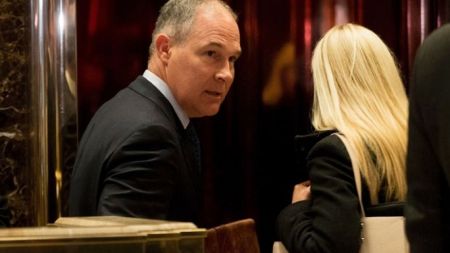
pruitOklahoma Attorney General Scott Pruitt arrives at Trump Tower in New York, Wednesday, Dec. 7, 2016. (AP Photo/Andrew Harnik) (Copyright 2016 The Associated Press. All rights reserved.)

President-elect Donald Trump is planning to nominate Oklahoma Attorney General Scott Pruitt – an outspoken critic of the EPA – to lead the environmental agency, a senior transition source confirmed to Fox News.

Word of Trump’s choice for the Environmental Protection Agency came as the president-elect also named Iowa Gov. Terry Branstad as his pick for ambassador to China and asked retired Gen. John Kelly to lead the Department of Homeland Security.

Pruitt may be the most controversial pick of the three.

Pruitt, 48, has been a reliable booster of the fossil fuel industry and a critic of what he derides as the EPA’s “activist agenda.”

Representing his state as attorney general since 2011, Pruitt has repeatedly sued the EPA to roll back environmental regulations and other health protections. He joined with other Republican attorneys general in opposing the Clean Power Plan, which seeks to limit planet-warming carbon emissions from coal-fired power plants. Pruitt has argued that curbing carbon emissions would trample the sovereignty of state governments, drive up electricity rates, threaten the reliability of the nation’s power grid and “create economic havoc.”

His installment, if confirmed, would mark a significant break with the current EPA approach toward global warming.

In an opinion article published earlier this year by National Review, Pruitt suggested the debate over global warming “is far from settled” and claimed “scientists continue to disagree about the degree and extent of global warming and its connection to the actions of mankind.”

He also filed court briefs in support of the Keystone XL Pipeline project blocked by the Obama administration, which would have run through his state. And Pruitt sued the EPA over the agency’s recently expansion of water bodies regulated under the federal Clean Water Act, which has been opposed by industries that would be forced to clean up contaminated wastewater.

“Respect for private property rights have allowed our nation to thrive, but with the recently finalized rule, farmers, ranchers, developers, industry and individual property owners will now be subject to the unpredictable, unsound and often byzantine regulatory regime of the EPA,” Pruitt said last year.

As word of Pruitt’s nomination spread Wednesday, environmental and liberal groups quickly responded with condemnation.

Public Citizen called him a “terrible choice,” saying in a statement: “Pruitt is cozy with the oil and gas industry and treats the EPA like an enemy.”

Business leaders in his home state, however, lauded Pruitt’s selection, especially those in the oil and gas industry.

“Scott Pruitt is a businessman and public servant and understands the impact regulation and legislation have in the business world,” said Jeffrey McDougall, chairman of the Oklahoma Independent Petroleum Association. “His appointment will put rational and reasonable regulation at the forefront.”

Trump’s Pick for DHS Secretary Warned About Iranian Infiltration of South America

December 7, 2016

Trump’s Pick for DHS Secretary Warned About Iranian Infiltration of South America, Washington Free Beacon, December 7, 2016

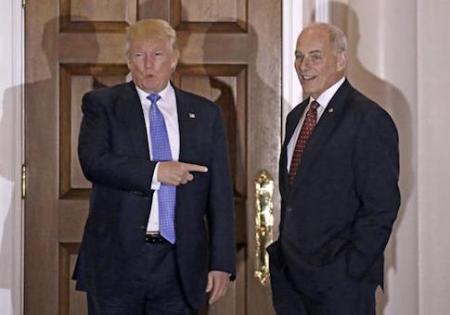
gestures with retired US Marine Corp General John Kelly Donald Trump prospective cabinet members at Trump International Golf Club, New Jersey, USA - 20 Nov 2016 (Rex Features via AP Images)

Trump gestures with retired US Marine Corp General John Kelly Donald Trump prospective cabinet members at Trump International Golf Club, New Jersey, USA – 20 Nov 2016 (Rex Features via AP Images)

President-elect Donald Trump’s pick to head the Department of Homeland Security has been warning for some time about Iranian influence along America’s southern border and in South America in another sign that the incoming administration is seeking to tackle the Islamic Republic’s terrorist footprint from its first days in office.

Retired Gen. John Kelly, a former commander of U.S. Southern Command, has been sounding the alarm about Iran’s efforts to counter U.S. influence in Central and South America, according to past testimony.

Kelly is expected to focus on this issue when he takes over DHS, which has been plagued by criticism about its failed attempts to seal the southern border under the Obama administration.

The selection follows a line of high-profile picks by Trump who are known for their outspoken criticism of Iran and the Obama administration’s diplomacy with the Islamic Republic.

Kelly, during his time as Southcom’s commander, informed Congress last year that Iran is bolstering its ties with Latin American countries in order to use the region as a base for operations.

“Over the last 15 years Iran has periodically sought closer ties with regional governments, albeit with mixed results,” Kelly said in testimony to Congress in March 2015. “Iranian legislators visited Cuba, Ecuador, and Nicaragua to advocate for increased economic and diplomatic cooperation. Iran’s outreach is predicated on circumventing sanctions and countering U.S. influence.”

Iran is building “cultural centers” in these countries to build support for its radical ideology among local Muslim populations, according to Kelly.

“Iran has established more than 80 ‘cultural centers’ in a region with an extremely small Muslim population,” he said. “The purported purpose of these centers is to improve Iran’s image, promote Shi’a Islam, and increase Iran’s political influence in the region. As the foremost state sponsor of terrorism, Iran’s involvement in the region and these cultural centers is a matter for concern, and its diplomatic, economic, and political engagement is closely monitored.”

Kelly has also warned that Hezbollah, a terror organization primarily funded by Iran, has been building support in Latin America. Kelly said terrorist organizations could exploit the porous southern border to infiltrate the United States.

“Members, supporters, and adherents of Islamic extremist groups are present in Latin America,” including Hezbollah, Kelly said in 2014.

Kelly described Iran’s presence in the region as “a matter for concern.”

Trump’s selection of Kelly is winning early support from congressional Republicans who have worked with the former commander.

“In my capacity as chairman of the House Subcommittee on the Western Hemisphere, I have worked firsthand with Gen. Kelly on numerous Western Hemisphere security issues during his tenure as the head of the Southern Command,” Rep. Jeff Duncan (R., S.C.), said in a statement. “He fully understands the threats from ISIS, Iran’s activities in South and Central America, as well as the risks America faces due to our porous southern border.”

“General Kelly has a wealth of experience and knowledge of the threats facing our country in the 21st Century, and I am confident he will help the president-elect form a robust strategy to protect America from radical Islamic extremism here at home, protecting American sovereignty and dealing with the numerous security issues here in the homeland,” Duncan said.

One source in direct contact with the Trump transition team told the Washington Free Beacon that Kelly brings direct experience with Iran’s infiltration of South America.

“General Kelly is an outstanding national security pick. It’s another sign the Trump administration knows exactly how Iran has been destabilizing countries and sowing terror across the globe,” the source said. “The Obama administration too often turned a blind eye to Iranian activities on U.S. soil, and even downplayed an Iranian terror plot to launch an attack in Washington, D.C. Clearly the Trump administration is signaling that it will do exactly the opposite, and will target Iranian aggression across all areas of national security.”

Trump chooses Kelly to lead homeland security

December 7, 2016

Trump chooses Kelly to lead homeland security, Washington ExaminerKeith Koffler, December 7, 2016

trumpkellyPresident-elect Donald Trump talks to media as he stands with retired Marine Gen. John Kelly, right, at the Trump National Golf Club Bedminster clubhouse Sunday, Nov. 20, 2016, in Bedminster, N.J.. (AP Photo/Carolyn Kaster)

President-elect Donald Trump has tapped retired Marine Gen. John Kelly to be secretary of homeland security, putting yet another general into a key national security post, according to reports.

Trump has already made Marine Gen. James Mattis his defense secretary and retired Lt. Gen. Michael Flynn his national security adviser, and he is considering retired Army Gen. David Petraeus for secretary of state.

Kelly, 66, is not expected to face difficulty being confirmed, according to the Post. He is viewed as a border security hawk who will please Trump backers looking for the president-elect to follow through on vows to limit immigration.

Our World: Michael Flynn and what he means for Trump’s foreign policy

December 5, 2016

Our World: Michael Flynn and what he means for Trump’s foreign policy, Jerusalem PostCaroline B. Glick, December 5, 2016

(Please see also, Mosul offensive folds, waiting now for Trump. — DM)
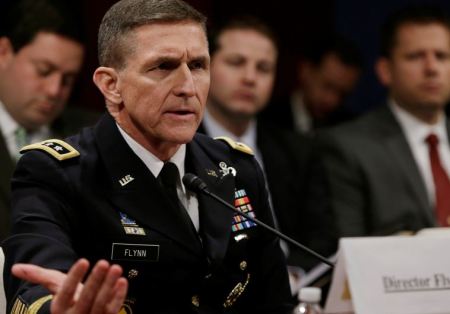
flynnRetired U.S. Army Lt. General Michael Flynn in 2014. (photo credit:REUTERS)

Mattis argued that Iran’s nuclear program was far from the only threat Iran constituted to the US and its allies. By empowering Iran through the nuclear deal, Obama was enabling Iran’s rise as a hegemonic power throughout the region.

With Mattis and Flynn at his side, Trump intends to bring down the Iranian regime as a first step toward securing an unconditional victory in the war against radical Islam.
**************************

In the US and around the world, people are anxiously awaiting US President-elect Donald Trump’s announcement of his choice to serve as secretary of state. There is no doubt that Trump’s choice for the position will tell us a great deal about the direction his foreign policy is likely to take.

But the fact is that we already have sufficient information to understand what his greatest focus will be.

Trump’s announcement last week that he has selected Marine General James Mattis to serve as his defense secretary is a key piece of the puzzle.

Mattis has a sterling reputation as a brilliant strategist and a sober-minded leader. His appointment has garnered plaudits across the ideological spectrum.

In 2013, US President Barack Obama summarily removed Mattis from his command as head of the US Military’s Central Command. According to media reports, Mattis was fired due to his opposition to Obama’s strategy of embracing Iran, first and foremost through his nuclear diplomacy. Mattis argued that Iran’s nuclear program was far from the only threat Iran constituted to the US and its allies. By empowering Iran through the nuclear deal, Obama was enabling Iran’s rise as a hegemonic power throughout the region.

Mattis’s dim view of Iran is shared by Trump’s choice to serve as his national security adviser. Lt. General Michael Flynn’s appointment has been met with far less enthusiasm among Washington’s foreign policy elites.

Tom Ricks of The New York Times, for instance, attacked Flynn as “erratic” in an article Saturday where he praised Mattis.

It is difficult to understand the basis for Ricks’ criticism. Flynn is considered the most talented intelligence officer of his generation. Like Mattis, Obama promoted Flynn only to fire him over disagreements regarding Obama’s strategy of embracing Iran and pretending away the war that radical Islamists are waging against the US and across the globe.

Flynn served under Obama as the director of the Defense Intelligence Agency. He was fired in 2014 for his refusal to toe the administration’s mendacious lines that radical Islam is not the doctrine informing and inspiring the enemy, and that al-Qaida and its fellows are losing their war.

What Obama and his advisers didn’t want to hear about the US’s enemies and about how best to defeat them Flynn shared with the public in his recently published book Field of Fight, which he coauthored with Michael Ledeen, who served in various national security positions during the Reagan administration.

Flynn’s book is a breath of fresh air in the acrid intellectual environment that Washington has become during the Obama administration. Writing it in this intellectually corrupt atmosphere was an act of intellectual courage.

In Field of Fight, Flynn disposes of the political correctness that has dictated the policy discourse in Washington throughout the Bush and Obama administrations. He forthrightly identifies the enemy that the US is facing as “radical Islam,” and provides a detailed, learned description of its totalitarian ideology and supremacist goals. Noting that no strategy based on denying the truth about the enemy can lead to victory, Flynn explains how his understanding of the enemy’s doctrine and modes of operation enabled him to formulate strategies for winning the ground wars in both Iraq and Afghanistan.

And win them he did. As he explains in his book, Flynn oversaw the transformation of the US’s strategies for fighting in both theaters from strategies based on top-down decapitation of the enemy’s leadership to a groundup destruction of the terrorist networks.

Flynn’s strategy, which worked in both countries, was based on the premise that it wasn’t enough to kill “high value” targets. The US needed to develop a granular understanding of the terrorist networks from the village level up the line. Only by taking out the local terrorist leaders would the US be able to destroy the ability of the likes of al-Qaida, the Iranian-controlled Shi’ite militias and the Taliban to quickly mobilize new forces and reignite fighting shortly after every successful US operation.

Flynn’s book contributes three essential insights to the discussion of the global jihad. First, he explains that the Bush and Obama administrations were both unable to translate military victories on the ground into strategic victories because they both refused to join their military war with a war of ideas.

The purpose of a war of ideas is to discredit the cause for which the enemy fights. Without such a war, on the one hand the American people sour on the war because they don’t understand why it is important to win. On the other hand, without a war of ideas directed specifically at the Islamic world, Muslims worldwide have continued to be susceptible to recruitment by the likes of ISIS and al-Qaida.

As Flynn notes, the popularity of radical Islam has skyrocketed during the Obama years. Whereas in 2011 there were 20,000 foreign recruits fighting for ISIS in Iraq and Syria, by 2015, the number had risen to 35,000.

Flynn’s second contribution is his forthright discussion of the central role the Iranian regime plays in the global jihad. Flynn chronicles not only Iran’s leadership of the war against the US in Iraq and Afghanistan. He shows that their cooperation is global and predates 9/11 by several years.

Flynn recalls for instance that in 1996 British troops confiscated an al-Qaida training manual written by Iranian intelligence in a terrorist training facility in Bosnia. Six Iranian “diplomats” were arrested at the scene.

Flynn is unflinching in his criticism of the Obama administration’s moves to develop an alliance with Iran. And he is almost equally critical of George W. Bush’s war against terror.

For instance, Flynn argues, “It was a huge strategic mistake for the United States to invade Iraq militarily.”

Iran, he said was the main culprit in 2001 and remains the main enemy today.

“If, as we claimed, our basic mission after 9/11 was the defeat of the terrorists and their state sponsors then our primary target should have been Tehran, not Baghdad, and that method should have been political – support of the internal Iranian opposition.”

Flynn’s final major contribution to the intellectual discourse regarding the war is his blunt identification of the members of the enemy axis. Flynn states that the radical Islamic terrorist armies operate in cooperation with and at the pleasure of a state alliance dominated by Russia and Iran and joined by North Korea, Venezuela and other rogue regimes. Flynn’s frank discussion of Russia’s pivotal role in the alliance exposes the widely touted claims that he is somehow pro-Russian as utter nonsense.

In Flynn’s view, while Russia is Iran’s primary partner in its war for global domination, it should not be the primary focus of US efforts. Iran should be the focus.

In his words, the best place to unravel the enemy alliance is at its “weakest point,” which, he argues, is Iran.

Flynn explains that the basic and endemic weakness of the Iranian regime owes to the fact that the Iranian people hate it. To defeat the regime, Flynn recommends a strategy of political war and subversion that empowers the Iranian people to overthrow the regime as they sought to do in the 2009 Green Revolution. Flynn makes the case that the Green Revolution failed in large part because the Obama administration refused to stand with the Iranian people.

Flynn is both an experienced commander and an innovative, critical, strategic thinker. As his book makes clear, while flamboyant and blunt he is not at all erratic. He is far-sighted and determined, and locked on his target: Iran.

Whoever Trump selects as secretary of state, his appointment of Mattis on the one hand and Flynn on the other exposes his hand. Trump is interested in ending the war that the forces of radical Islam started with the US not on September 11, 2001, but on November 4, 1979, with the seizure of the US embassy in Tehran.

With Mattis and Flynn at his side, Trump intends to bring down the Iranian regime as a first step toward securing an unconditional victory in the war against radical Islam.

Trump Assembling Team of Fierce Iran Deal Opponents

December 5, 2016

Trump Assembling Team of Fierce Iran Deal Opponents, Washinton Free Beacon, December 5, 2016

President-elect Donald Trump gestures as he speaks during a "USA Thank You" tour event, Thursday, Dec. 1, 2016, in Cincinnati. (AP Photo/Evan Vucci)President-elect Donald Trump gestures as he speaks during a “USA Thank You” tour event, Thursday, Dec. 1, 2016, in Cincinnati. (AP)

President-elect Donald Trump has been assembling a national security team stacked with fierce opponents of last year’s comprehensive nuclear deal with Iran, signaling what is expected to be a major departure from the Obama administration’s final bid to preserve the deal before leaving office, according to multiple sources familiar with Trump’s transition plans.

Trump has been installing well-known opponents of the deal to key national security posts for the incoming administration, including at the White House National Security Council, the CIA, and the Department of Defense.

This includes his selection of retired Marine Gen. James Mattis as secretary of defense, Rep. Mike Pompeo (R., Kan.) as CIA director, and retired Army Lt. Gen. Michael Flynn as national security adviser, picks that have won plaudits for their vocal opposition to the nuclear deal.

“It’s no secret that Flynn considers Iran to be the linchpin of a global alliance of hostile rivals seeking to undermine American interests,” said once source familiar with the backroom talks about future national security picks. “He was in the Middle East during the Iraq war and knows first-hand how Iranian proxies killed hundreds of American troops, and he has seen the intelligence showing that they’ve targeted Americans around the world.”

“As long as Iran keeps acting like an enemy of the United States, his NSC will accurately convey that to the president, and he’s building a staff that will make sure of that,” the source added.

Other recent national security picks include KT McFarland, a longtime national security analyst and commentator who has vocally criticized Iran and the nuclear deal, and Yleem Poblete, who served for nearly two decades as a senior staffer for the House Committee on Foreign Affairs.

A senior congressional aide familiar with Poblete’s work on key national security matters told the Washington Free Beacon that Trump’s picks would not back down from a showdown with Iran as it continues to fund terrorism across the Middle East.

“It’s apparent that President-elect Trump is taking a fundamentally different approach to national security and foreign policy than the current administration,” the source said. “Selecting Rep. Pompeo to head up the CIA, General Flynn as national security adviser, and General Mattis as defense secretary shows that the new administration will not recede from the world stage as the current administration has done, but is willing to reestablish America as a global leader.”

The source said that Trump’s selection of Poblete is a sign that the next president is serious about rewriting America’s policy approach to Iran and other rogue regimes.

Selecting Poblete for the NSC landing team sends a clear signal that the next administration is looking to reverse some of the damage that President Obama has inflicted when it comes to Iran and Cuba and will legitimize and improve the totality of Trump’s foreign policy agenda,” the source said.

Poblete played a key role in crafting sanctions against Iran and was the senior staffer on the Foreign Affairs Committee when they were initially signed into law.

“Poblete is a tough negotiator with the policy chops to advance U.S. national security interests; her vast experience of being one of the main architects of the current sanctions against Iran, her advocacy for freedom and democracy in Cuba, her ardent promotion of transparency and reform at the UN, and her vast experience and expertise with the Middle East will no doubt help strengthen our relationship with Israel,” the source explained.

Trump’s selection of these foreign policy heavyweights comes as Congress overwhelmingly voted last week to extend economic sanctions on Iran for 10 years, a move that elicited an angry response from Tehran.

With Poblete, Flynn, and others steering the ship, the Trump administration is expected to go even further with new sanctions on Iran for its behavior, which includes testing advanced ballistic missiles and threatening actions in the Persian Gulf.

The next administration will likely have to unwind the Obama administration’s final push to provide Iran with continued sanctions relief and cash payouts.

“The Obama administration has 48 days to try and nail down the deal to make it more difficult for the Trump administration to negotiate a follow on agreement that addresses the fatal flaws of the Obama nuclear deal,” Mark Dubowitz, executive director of the Foundation for Defense of Democracies, told the Free Beacon. “Anything they try to do will be at the top of the chopping block when the new administration gets into their seats.”

Trump persuades Ben Carson to take the HUD Cabinet seat

December 5, 2016

Trump persuades Ben Carson to take the HUD Cabinet seat, American ThinkerThomas Lifson, December 5, 2016

(“House Democratic leader Nancy Pelosi is calling the decision to tap Ben Carson as head of Housing and Urban Development a “disconcerting and disturbingly unqualified choice.” — DM)

Newt Gingrich this morning on Fox and Friends gave away the real story behind the announcement today that Dr. Benjamin Carson has been “chosen” (AP’s word) Secretary of Housing and Urban Development.  According to Newt,  Donald Trump has spent two weeks persuading Carson to take the job.

It’s pretty clear to me that the reality show genius about to be inaugurated as president intends to make good on his promise to America’s inner cities quite visibly.  As a real estate developer, he know which incentives to use to attract investors in the inner cities. What’s needed is a sense among African-Americans in particular, but also among everyone afflicted with a sense of hopelessness and economic impotence, that a new era has dawned.  New possibilities are opening up. As Trump proclaimed, “What have you got to lose?”

Now it is Dr. Carson, whose personal story is so inspiring Cuba Gooding, Jr. portrayed him in a hagiographic biopic, who needs to become the spokesman, the embodiment of the new opportunities America is offering under Trump. As Scott Adams rightly points out:

Remember what I taught you in the past year: Facts don’t matter. What matters is how you feel. And when you watch Trump and Pence fight and scratch to keep jobs in this country, it changes how you will feel about them for their entire term.

The thing about hope is that, like fear, it can be contagious.

Dr. Carson is just the man for the job, and that’s why Trump never gave up in persuading him to take the job.

Trump Sec of Defense Pick: Enemy of Islamism and Iran

December 4, 2016

Trump Sec of Defense Pick: Enemy of Islamism and Iran, Clarion ProjectRyan Mauro, December 4, 2016

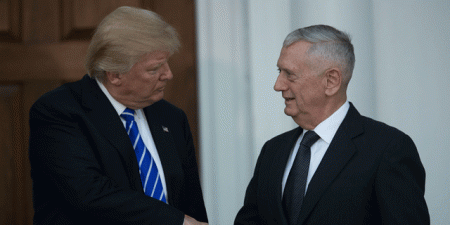
united-states-general-james-mattis-640-320-getty-drew-angerer_0General James Mattis with President-elect Trump (Photo: Drew Angerer/Getty Images)

General Mattis completely and utterly rejects the romanticized interpretation of the Iranian regime as “moderate” or part of the solution to Sunni terrorism. In April, he described the Iranian regime as the “single most enduring threat to stability and peace in the Middle East;” one greater than Al-Qaeda or ISIS.

***************************

President-Elect Trump has chosen Marine Corps General James “Mad Dog” Mattis for secretary of defense, eliciting widespread enthusiasm focusing on his status as the “most revered Marine in a generation” and factory of quotable quotes.

Deserving of more positive attention is his emphasis on confronting Political Islam and the Iranian regime.

General Mattis has advocated for significant changes in both the military fight against the specific Islamist terrorist groups like ISIS and Al-Qaeda, as well as the fight against the Islamist ideology that births them. Although ISIS’ caliphate is on the decline, General Mattis doesn’t settle for an encouraging positive trend. He wants to win quickly and decisively, yet humanely with care for civilians.

In August, he said the strategy still is “unguided by a sustained policy or sound strategy [and is] replete with half measures.”

Mattis was one of the chief architects of the counter-insurgency campaign that turned Iraq around so rapidly that it even surprises many of its supporters.

In testimony to the Senate in 2015, he said, “The fundamental question I believe is, ‘Is political Islam in our best interest?’ If not, what is our policy to authoritatively support the countervailing forces?”

In another speech, General Mattis said that the fundamental flaw in our strategy has been a failure to define Political Islam as the enemy of U.S. interests. He made the correct observation that such a delineation between friend and foe would allow us to identify supportable Muslim allies.

“If we won’t even ask the question [if Political Islam is in U.S. interests], then how do we ever get to the point of recognizing which is our side in the fight? And if we don’t take our own side in this fight, we are leaving others adrift,” he said.

He then referenced his recent trip to Egypt and the widespread perception that the U.S. actually intends to empower the Muslim Brotherhood. The failure to base policy around a rejection of Political Islam inevitably leads to a tolerance or even an embrace of Islamists who surpass the low bar of condemning Al-Qaeda and ISIS.

The Muslims who oppose Islamists are, as Mattis put it, left adrift.

Countless articles have been written claiming that a policy based on fighting “radical Islam,” “Political Islam,” “Islamism” and similar terms will inflame the Muslim world. Islamists and allied institutions will undoubtedly cry foul, as they always have at every minor slight, but the delineation will separate the wheat from the chaff.

Overlooked allies amongst Muslims and non-Muslim minorities will surface as U.S. policy forces the Muslim world to take stances on Islamism and its adhering organizations. New allies will be born as the discussion of Islamism leads to rejections of it. If messaged correctly, the U.S. will end up with more Muslim allies of better quality.

This view of Islamism as the adversary, rather than just specific terrorist groups targeting the U.S. homeland, is why General Mattis rejects the notion of a “moderate” Iranian regime. He was fired by the Obama Administration for his tough questions about the ramifications of current U.S. policy towards Iran.

General Mattis completely and utterly rejects the romanticized interpretation of the Iranian regime as “moderate” or part of the solution to Sunni terrorism. In April, he described the Iranian regime as the “single most enduring threat to stability and peace in the Middle East;” one greater than Al-Qaeda or ISIS.

We recently pointed out that four of Trump’s picks want to designate the Muslim Brotherhood as a Foreign Terrorist Organization and wage a long overdue ideological offensive against Islamism, also known as Political Islam.

Trump then chose K.T. McFarland as deputy national security adviser and Katharine Gorka as part of his Department of Homeland security “landing team” to manage the transition between administrations. Both are strong advocates of an ideological war against Islamism and Gorka has advocated for the Muslim Brotherhood Terrorist Designation Act.

The U.S. war against Islamist extremism now enters a new, decisive phase, but let not our enthusiasm for this strategy blind us from the risks.

The successful implementation of the anti-Islamism strategy is not solely dependent upon Trump’s national security team. It’s dependent upon him.

If his decisions prevent demonstrable success, the ideological strategy will be considered a failed concept. Its advocates will have their credibility tarnished, perhaps unfairly, and the Western response to Islamism will be put on an indefinite hold as the ideology marches on.

Leadership Lessons from Gen. James Mattis (Ret.)

December 3, 2016

Leadership Lessons from Gen. James Mattis (Ret.), Marines via YouTube, October 13, 2016

“Nothing to do with Islam”?

December 3, 2016

“Nothing to do with Islam”? Gatestone InstituteJudith Bergman, December 3, 2016

Until religious leaders stand up and take responsibility for the actions of those who do things in the name of their religion, we will see no resolution.” — The Archbishop of Canterbury, Justin Welby.

“The Islamic State is a byproduct of Al Azhar’s programs… Al Azhar says there must be a caliphate and that it is an obligation for the Muslim world. Al Azhar teaches the law of apostasy and killing the apostate. Al Azhar is hostile towards religious minorities, and teaches things like not building churches… Al Azhar teaches stoning people. So can Al Azhar denounce itself as un-Islamic?” — Sheikh Muhammad Abdullah Nasr, a scholar of Islamic law and graduate of Egypt’s Al Azhar University.

The jihadists who carry out terrorist attacks in the service of ISIS, for example, are merely following the commands in the Quran, both 9:5, “Fight and kill the disbelievers wherever you find them…” and Quran 8:39, “So fight them until there is no more fitna [strife] and all submit to the religion of Allah.”

Archbishop Welby — and Egypt’s extraordinary President Abdel Fattah el-Sisi — has finally had the courage to say in public that if one insists on remaining “religiously illiterate,” it is impossible to solve the problem of religiously motivated violence.


For the first time, a European establishment figure from the Church has spoken out against an argument exonerating ISIS and frequently peddled by Western political and cultural elites. The Archbishop of Canterbury, Justin Welby, speaking in France on November 17, said that dealing with the religiously-motivated violence in Europe

“requires a move away from the argument that has become increasingly popular, which is to say that ISIS is ‘nothing to do with Islam’… Until religious leaders stand up and take responsibility for the actions of those who do things in the name of their religion, we will see no resolution.”

Archbishop Welby also said that, “It’s very difficult to understand the things that impel people to some of the dreadful actions that we have seen over the last few years unless you have some sense of religious literacy”.

“Religious literacy” has indeed been in short supply, especially on the European continent. Nevertheless, all over the West, people with little-to-no knowledge of Islam, including political leaders, journalists and opinion makers, have all suddenly become “experts” on Islam and the Quran, assuring everybody that ISIS and other similarly genocidal terrorist groups have nothing to do with the purported “religion of peace,” Islam.

It is therefore striking finally to hear a voice from the establishment, especially a man of the Church, oppose, however cautiously, this curiously uniform (and stupefyingly uninformed) view of Islam. Until now, establishment Churches, despite the atrocities committed against Christians by Muslims, have been exceedingly busy only with so-called “inter-faith dialogue.” Pope Francis has even castigated Europeans for not being even more accommodating towards the migrants who have overwhelmed the continent, asking Europeans:

“What has happened to you, the Europe of humanism, the champion of human rights, democracy and freedom?… the mother of great men and women who upheld, and even sacrificed their lives for, the dignity of their brothers and sisters?”

(Perhaps the Pope, before rhetorically asking Europeans to sacrifice their lives for their migrant “brothers and sisters” should ask himself whether many of the Muslim migrants in Europe consider Europeans their “brothers and sisters”?)

A statement on Islam is especially significant coming from the Archbishop of Canterbury, the senior bishop and principal leader of the Anglican Church and the symbolic head of the Anglican Communion, which stands at around 85 million members worldwide, the third-largest communion in the world.

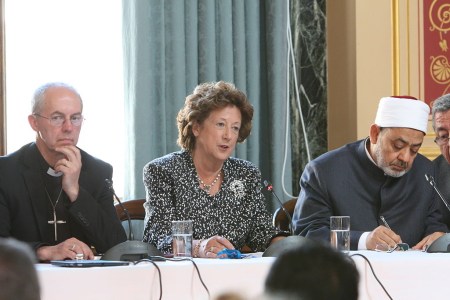
2092The Archbishop of Canterbury, Justin Welby (left), recently said that dealing with the religiously-motivated violence in Europe “requires a move away from the argument that has become increasingly popular, which is to say that ISIS is ‘nothing to do with Islam’… Until religious leaders stand up and take responsibility for the actions of those who do things in the name of their religion, we will see no resolution.” (Image source: Foreign and Commonwealth Office)

Only a year ago, commenting on the Paris massacres, the Archbishop followed conventional politically correct orthodoxy, pontificating that, “The perversion of faith is one of the most desperate aspects of our world today.” He explained that Islamic State terrorists have distorted their faith to the extent that they believe they are glorifying their God. Since then, he has clearly changed his mind.

Can one expect other Church leaders and political figures to heed Archbishop Welby’s words, or will they be conveniently overlooked? Western leaders have noticeably practiced selective hearing for many years and ignored truths that did not fit the “narrative” politicians apparently wished to imagine, especially when spoken by actual experts on Islam. When, in November 2015, Sheikh Muhammad Abdullah Nasr, a scholar of Islamic law and graduate of Egypt’s Al Azhar University, explained why the prestigious institution, which educates mainstream Islamic scholars, refused to denounce ISIS as un-Islamic, none of them was listening:

“The Islamic State is a byproduct of Al Azhar’s programs. So can Al Azhar denounce itself as un-Islamic? Al Azhar says there must be a caliphate and that it is an obligation for the Muslim world. Al Azhar teaches the law of apostasy and killing the apostate. Al Azhar is hostile towards religious minorities, and teaches things like not building churches, etc. Al Azhar upholds the institution of jizya [extracting tribute from non-Muslims]. Al Azhar teaches stoning people. So can Al Azhar denounce itself as un-Islamic?”

Nor did Western leaders listen when The Atlantic, hardly an anti-establishment periodical, published a study by Graeme Wood, who researched the Islamic State and its ideology in depth. He spoke to members of the Islamic State and Islamic State recruiters and concluded:

“The reality is that the Islamic State is Islamic. Very Islamic. Yes, it has attracted psychopaths and adventure seekers, drawn largely from the disaffected populations of the Middle East and Europe. But the religion preached by its most ardent followers derives from coherent and even learned interpretations of Islam”.

In the United States, another establishment figure, Reince Priebus, Chairman of the Republican National Committee and Donald Trump’s incoming White House Chief of Staff, recently made statements to the same effect as the Archbishop of Canterbury. “Clearly there are some aspects of that faith that are problematic and we know them; we’ve seen it,” Priebus said when asked to comment on incoming National Security Adviser former Lt. Gen. Michael Flynn’s view that Islam is a political ideology that hides behind being a religion.

In much of American society, Flynn’s view that Islam is a political ideology is considered controversial, despite the fact that the political and military doctrines of Islam, succinctly summarized in the concept of jihad, are codified in Islamic law, sharia, as found in the Quran and the hadiths. The jihadists who carry out terrorist attacks in the service of ISIS, for example, are merely following the commands in the Quran, both 9:5, “Fight and kill the disbelievers wherever you find them…” and Quran 8:39, “So fight them until there is no more fitna [strife] and all submit to the religion of Allah.”

The question becomes, then, whether other establishment figures will also acknowledge what someone like Archbishop Welby — and Egypt’s extraordinary President Abdel Fattah el-Sisi — has finally had the courage to say in public: that if one insists on remaining “religiously illiterate,” it is impossible to solve the problem of religiously motivated violence.

Threadbare Iran appeasement policy to be rescued with propaganda

December 2, 2016

Threadbare Iran appeasement policy to be rescued with propaganda, Iran Focus, December 2, 2016

(Please see also, Giuliani’s Ties to Iranian Resistance Group MEK Should be Viewed as a Valuable Contribution. — DM)

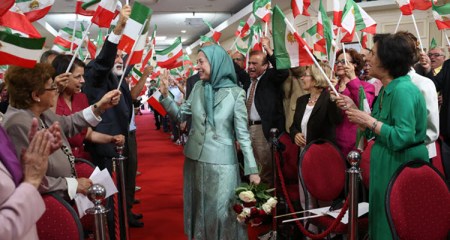
rajavi-700-if

London, 2 Dec – Now that the end is in sight for the Obama administration, the Iranian regime, Iran apologists and Iranian regime lobbies are concerned about the continuation of the appeasement policy. Amir Basiri, an Iranian human rights activist, said in the Washington Examiner that those wanting rapprochement with Tehran are setting propaganda in motion.

This propaganda is in the form of inaccurate and “lopsided reports” and “hastily scribbled op-eds with enticing titles on highly viewed media outlets”. They are attempting to dissuade Trump from selecting anyone with a vocal criticism of the brutal Iranian regime for his cabinet.

One such op-ed was in the Washington Post. In this article Josh Rogin said that Rudy Giuliani has been involved with a dubious group. He was referring to the main opposition to the Iranian regime, the People’s Mojahedin Organization of Iran (PMOI/MEK). This is not the first time he has attacked the PMOI, and he is known for using quotes from the Tehran lobbies in his work. In the op-ed in the Washington Post he called the PMOI “a shady Iranian dissident group”.

Last month, Politico published an article entitled “Giuliani Took Money From a Group That Killed Americans”. This provocative article warns Trump that Giuliani is a questionable choice for his cabinet.

These articles are similar in that they ignore the truth, are based on rumours and are “obtained from sources with economic and political ties to the Iranian regime”. Basiri said that a similar, low-level of reporting can been seen in a New York Times article in which “76 so-called national security experts” call on Trump to reverse his hostility with regards to the Iran nuclear deal, as they think the threat of War in the Middle east has been reduced because of it.

Basiri points out: “The article fails to clarify that the source of the report, which it describes as a group ‘that has advocated improved relations with Iran, even while sharply criticizing Iranian leaders over human rights issues’, is in fact a well-known Tehran lobby with deep economic ties to the Iranian regime.”

The article also fails to mention that billions of dollars worth of concessions have been given to Tehran, which in turn appends it in areas that “fuel mayhem and chaos in the region”.

So this is why the lobbies are “resorting to propaganda and dishonest reporting,” said Basiri.