Posted tagged ‘Trump and U.S. Military’

Trump Orders Military to Shoot Down North Korean Missiles

September 8, 2017

Trump Orders Military to Shoot Down North Korean Missiles, NewsMaxJohn Gizzi, September 7, 2017

AP

President Donald Trump has given military orders for U.S. forces to shoot down and destroy any missile launched from North Korea and moving toward the continental United States, Hawaii, and Guam.

Sources close to the president’s national security team tell Newsmax the order was given to Pentagon brass in the wake of last month’s threat by North Korea to fire a ballistic missile aimed at Guam, a U.S. territory.

“The threat provoked the president,” one source familiar with the decision told Newsmax.

Last Sunday, North Korea detonated a thermonuclear weapon. The communist regime claims they can fit the new device on advanced intercontinental ballistic missiles, known as ICBMs.

This week, South Korean intelligence sources said the North was moving an ICBM in an apparent preparation for another test launch over the northern Pacific and possibly Japan.

The president also is said to be considering a new “shoot down” order for any North Korean missile launched and moving toward Japan or South Korea, another national security source told Newsmax.

“This is a clear exercise of self-defense, and there’s no question we should do it,” former U.S. ambassador to the United Nations John Bolton told Newsmax.

Bolton said U.S. allies South Korea and Japan “are in jeopardy” and said the United States must take steps to protect them under treaty obligations.

The presidential order came after a flurry of recent provocations from Pyongyang.

In August, President Trump ominously warned the North Koreans that continued threats “will be met with fire and fury like the world has never seen.”

Soon after, North Korea answered Trump’s warning by threatening a ballistic missile strike off the territory of Guam.

The president quickly responded, saying any attack against the U.S. would be met with a fierce response.

“Things will happen to them like they never thought possible,” the president said, adding U.S. forces were “locked and loaded.”

The situation appeared to be de-escalating when North Korean strongman Kim Jong Un announced he had met with his military commanders and they would not fire the missile at Guam.

In a threatening move Aug. 29, North Korea launched from their capital Pyongyang what they said was an “ultramodern rocket system” — an intermediate range missile. The missile flew over Japanese territory and landed in the Pacific.

“There is general consensus in the White House and the Pentagon that North Korea is quite close to the ‘red zone’ and that the U.S. must act soon or lose the upper hand,” one official told Newsmax.

Bolton, who has advised the president informally on security matters, said the U.S. is being “driven in the direction of a preemptive strike because North Korea won’t back down.”

“We are close to the finish line,” Bolton said, referring to Pyongyang’s recent missile and nuclear developments. “It highlights how little time we have here.”

Just days after North Korea’s nuclear test detonation, Han Tae Song, the North Korean ambassador to the United Nations in Geneva, told a disarmament conference the U.S. could expect more “more gift packages.”

If the U.S. military does act on President Trump’s orders to shoot down a missile, this would be achieved through different U.S. anti-ballistic programs under the aegis of the Missile Defense Agency.

Among these programs are the 26-year-old Terminal High Altitude Area Defense system, (THAAD), whose “hit to kill” interceptors are designed to shoot down an incoming missile through kinetic energy that explodes the missile on impact.

“It’s called stopping a bullet with a bullet,” one veteran intelligence expert told Newsmax.

The technology appears to be working.

In late August, a day after the North Korea missile flew over Japan, the U.S. Missile Agency conducted a test that successfully struck down a ballistic missile off the coast of Hawaii.

The White House press office and the Pentagon declined to comment on this report.

At Thursday’s White House press conference held with the Emir of Kuwait, the president said while “military action would certainly be an option” in dealing with North Korea, he added “nothing’s inevitable.”

“I would prefer not going the route of the military,” he said.
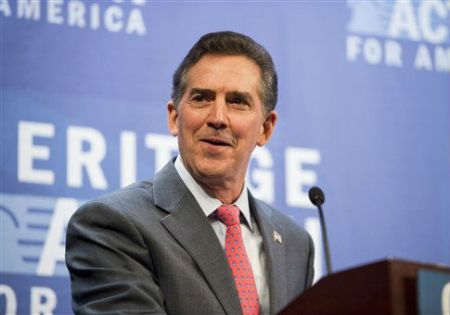
Former Senator DeMint: Russia Needs to See a ‘Strong and Determined U.S.’

January 21, 2017

Former Senator DeMint: Russia Needs to See a ‘Strong and Determined U.S.’, Washington Free Beacon, , January 21, 2017

demint-1Former Sen. Jim DeMint, (R., S.C.), president of the Heritage Foundation / AP

“The implications worldwide of America being perceived as weak are huge; it’s the quickest way to draw us into some kind of conflict”

******************************************

Former Senator Jim DeMint (R., S.C.) says the United States needs to deter aggression from Russia and China by projecting strength and determination and making good on promises to its allies.

DeMint, who runs the conservative Heritage Foundation, criticized the Obama administration for not backing up its promises with force during an interview with the Washington Free Beacon, urging the Trump administration to chart a new course on projecting strength and drawing clear “lines in the sand.”

“The best way to keep peace is for us to be strong and perceived as strong, clear in what we are going to do and what we expect, and then we have to back that up,” DeMint said at the Heritage headquarters in Washington, D.C.

“We don’t want to be drawing lines in the sand that we ignore. Once Obama did that in Syria and other places, said things and didn’t follow up, the rest of the world basically knew that he wouldn’t. So, everyone has been testing us and our allies are nervous,” DeMint said.

DeMint downplayed concerns voiced about Trump’s handling of both Russia and China, saying that representatives from foreign countries with whom he has met have expressed optimism about the prospects for defense under the new administration.

“Most of the delegations—and we’ve had a lot of them since the election— that come through here are optimistic that Trump might reestablish America’s leadership position in the world and develop our strength to the point where they can count on us to keep their enemies at bay, or at least keep them honest,” DeMint said.

Trump has pledged to rebuild America’s military by reversing drawdowns of the armed forces set in motion during the Obama administration and ending sequestration that has eroded the defense budget. He has also telegraphed a willingness to pursue warmer relations with Russia, while taking a harder line on China when it comes to trade and the “one China” policy; both suggestions have drawn scrutiny from the press and critics of the Republican president.

DeMint said he suspects Trump is “toying” with Russian President Vladimir Putin and trying to “draw him in” by making positive statements about Moscow’s leader. The most recent administrations of Barack Obama and George W. Bush both tried to improve relations with Russia, to no avail. Many experts describe current tensions between Washington and Moscow as the highest since the Cold War.

“The best thing that Russia could see is a strong and determined U.S. and I think putting any missile systems all around them and convincing them that all of their development is not going to do anything because we have a missile system that could stop anything,” DeMint said, referring to the U.S. missile defense shields being deployed to Europe that have drawn ire from Moscow.

“Russia is a threat; we need to try to bring them into some kind of civilized [conversation] but we can’t be naïve in the thinking,” he said. “They want to dominate their neighborhood and keep Europe in their influence sphere, and they’re doing a good job.”

DeMint also said Trump is right to “put China on notice” as Beijing continues to build on disputed territories in the South China Sea.

“I don’t think it’s a bad thing that he’s stirring the pot a little bit with China to let them know that they cannot count on the status quo of a passive U.S.,” DeMint said. “Obviously, he has to bring that down into some clear policies, but China respects strength.”

DeMint, who has led Heritage since 2013 after serving two terms in the Senate, spoke to the Free Beacon two days before Trump’s inauguration just blocks away from the U.S. Capitol, outlining the think tank’s defense priorities for the new administration. He referenced at length Heritage’s Index of U.S. Military Strength, an annual assessment that last November shed light on the declines in American military power.

The individual service chiefs have testified before Congress about how budget cuts have compromised modernization and future readiness, agreeing that the U.S. military would not be able to defend the homeland against present and future threats if sequestration continues. Trump’s defense secretary, retired Gen. James Mattis, who was confirmed Friday afternoon, has already committed to ending sequestration.

“It’s not just about defending our country,” DeMint observed on Wednesday. “We have alliances with so many countries that depend on us that what you see now in our [analysis], it doesn’t just expose us. It’s got the rest of the world scrambling as to whether or not we could meet our commitments.”

“The implications worldwide of America being perceived as weak are huge; it’s the quickest way to draw us into some kind of conflict,” he later added.


