Posted tagged ‘Trump and Syria’

Russia ‘furious’ with Assad over gas attack

April 11, 2017

Russia ‘furious’ with Assad over gas attack, Al Monitor,

(From the for “whatever it’s worth” department.– DM)
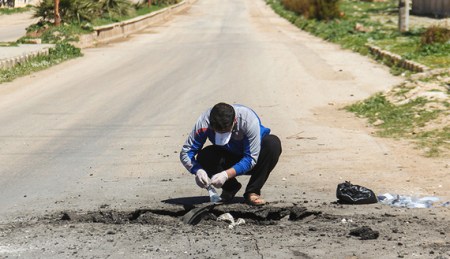
A Syrian man collects samples from the site of a suspected toxic gas attack in Khan Sheikhun, in Syria’s northwestern Idlib province, on April 5, 2017. (Photo credit should read OMAR HAJ KADOUR/AFP/Getty Images)

WASHINGTON — Privately, Russian officials are furious with Syrian President Bashar al-Assad for a suspected April 4 chemical weapons attack in Idlib province that killed over 80 people, Russia analysts said. They see it as threatening to sabotage the potential for US-Russia rapprochement ahead of US Secretary of State Rex Tillerson’s first visit to Moscow this week.

But Russia is also confused by what it perceives as contradictory statements from various top Trump Cabinet officials on whether US policy is shifting to demand Assad’s ouster, to what degree does the United States think Russia is culpable for Assad’s behavior, and more broadly, who from the administration speaks for Donald Trump, they said.

“Assad committed suicide here,” Michael Kofman, a Russia military expert with the Kennan Institute, told Al-Monitor in an interview April 10. Russia “will never forgive him for this.”

The suspected April 4 nerve gas attack on rebel-held Khan Sheikhoun that killed over 80 people, many of them children, “is a complete disaster” for Russia, Kofman said. “It destroyed the legacy of the 2013 deal [to remove Syria’s chemical weapons] that both countries [the United States and Russia] certified. So it made liars of both of us.”

He noted, “It provided all the ammunition to sabotage rapprochement between the United States and Russia. Look at the atmospherics. It caused public embarrassment. [Russian President Vladimir] Putin has to swallow US cruise missile strikes. Notice he has not defended Assad. It looks bad for Russia.”

Kofman added, “It demonstrates … in terms of Putin being a power broker … that the Russian role is very aspirational. It prevented him from doing this.”

“The Russians weren’t happy about what happened,” Nikolas Gvosdev, a Russia expert and professor at the US Naval War College, told Al-Monitor, referring to the April 4 chemical weapons attack. “They don’t like unpredictability … when things happen that throw what they are planning off course.”

“The Russians don’t like to be surprised,” Gvosdev added. “They don’t like … [to be made to] look like they can’t enforce agreements or don’t have as much influence over Assad as they were suggesting.”

Trump discussed Syria during a phone call with British Prime Minister Theresa May on April 10, and according to the British readout, the two leaders said they saw an opportunity to press Russia to break its alliance with Assad.

May and Trump “agreed that a window of opportunity now exists in which to persuade Russia that its alliance with Assad is no longer in its strategic interest,” a Downing Street spokesman said in a press release.

While US officials have said the US cruise missile strikes on the Shayrat air base on April 6 were to punish and deter Syria’s use of chemical weapons, there has been some confusion caused by statements from different Trump Cabinet officials on whether US policy is creeping toward regime change. US officials, including US Ambassador to the United Nations Nikki Haley and national security adviser H.R. McMaster, have also suggested Russia was either complicit or incompetent for Assad’s chemical weapons attack. They have expressed anger that Russia has, in their opinion, tried to publicly sow disinformation about it.

“You know the interesting thing, Chuck, is when this chemical weapons murder happened to so many people, Russia’s reaction was not ‘oh how horrible’ or ‘how could they do this to innocent children’ or ‘how awful is that,’” Haley told Chuck Todd of NBC’s “Meet the Press” on April 9. “Their initial reaction was Assad didn’t do it, the Syrian government didn’t do it.”

“Why were they that defensive that quick?” Haley continued. “The first priority for them was to cover for Assad. So what we knew from intelligence, that the Syrian regime had done this again, as they had done so many times before. We had evidence they had done it. It’s obviously classified, so I’m not the one that would release the information, but it was enough that the president knew.”

Even while pressuring Russia because of its diplomatic and military support to Assad, McMaster reiterated that the United States is still looking for a political resolution to end Syria’s civil war.

“What we really need to do, and what everyone who’s involved in this conflict needs to do, is to do everything they can to resolve this civil war,” McMaster told Fox News Sunday’s Chris Wallace April 9.

“What’s required is some kind of a political solution to that very complex problem, and … it’s very difficult to understand how a political solution could result from the continuation [of] the Assad regime,” McMaster said. “Now we’re not saying that we are the ones who are going to affect that change. What we are saying is, other countries have to ask themselves some hard questions. Russia should ask themselves, what are we doing here? Why are we supporting this murderous regime that is committing mass murder of its own population and using the most heinous weapons available?”

Tillerson, who is scheduled to meet with his Russian counterpart, Foreign Minister Sergey Lavrov, in Moscow April 12, expressed disappointment at Russia’s public criticism of the US airstrikes, but he said he did not conclude Russia was complicit in the Syrian regime’s suspected chemical weapons attack.

“I’m not seeing any hard evidence that connects the Russians directly to the planning or execution of this particular chemical weapons attack, and indeed, that’s why we’ve been trying to be very clear that the Russians were never targeted in this strike,” Tillerson told George Stephanopoulos of ABC’s “This Week” on April 9.

“Why Russia has not been able to achieve that [removal of Syria’s residual chemical weapons] is unclear to me,” Tillerson said. “I don’t draw conclusions of complicity at all; but clearly, they’ve been incompetent, and perhaps they’ve just simply been outmaneuvered by the Syrians.

But Tillerson said he still holds out hope for productive talks with the Russians when he travels there this week, and he hopes Russia can press Assad to never use chemical weapons again.

“I’m hopeful that we can have constructive talks with the Russian government, with Foreign Minister Lavrov, and have Russia be supportive of a process that will lead to a stable Syria,” Tillerson said. “Clearly, they … have the greatest influence on Bashar al-Assad and certainly his decisions to use chemical weapons. They should have the greatest influence on him to cause him to no longer use those. I hope that Russia is thinking carefully about its continued alliance with Bashar al-Assad, because every time one of these horrific attacks occurs, it draws Russia closer in to some level of responsibility.”

The changing US calculus on Assad and Russia is making it harder to see what Russia and the United States would be negotiating when Tillerson meets Lavrov April 12, Gvosdev said.

“The ask and the give are harder to ascertain,” Gvosdev said. “Two weeks ago, it was how do we move this [Syria] political process along.”

But now Tillerson is likely to tell the Russians that domestic politics in the United States is playing a bigger role in this, and “I can offer you less upfront,” Gvosdev speculated. “At a time when the Russian establishment very much … wants certain things upfront.”

“We are no longer talking about sanctions relief, [but how to] prevent new sanctions from being imposed,” Gvosdev said.

Assad’s actions have upended what was an important foreign policy priority for Putin — exploring the potential for cooperation with the United States on Syria and a possible rapprochement — and have seemingly taken sanctions relief off the table for discussion for now, and Russia will not forgive him, Kofman said.

“They are furious; it is very clear,” Kofman said, noting that there has been “no actual statement from Putin in support of Assad.”

“That is why I am saying he has signed his own political death warrant,” Kofman said of Assad. “They [the Russians] will never forgive him. They will wait. The time will come when Syria is stabilized, and they can actually have a change of power at the top. And then come for him.”
 

Official: U.S. Concludes Russia Had Advanced Knowledge of Syrian Chemical Weapons Attack

April 11, 2017

Official: U.S. Concludes Russia Had Advanced Knowledge of Syrian Chemical Weapons Attack, Washington Free Beacon, April 10, 2017

(Russia took all of the Syrian chemical stuff away, just as Saint Barack told us. Saint Bashar wouldn’t use chemical weapons on Syrians even if he had some, and Saint Vlad wouldn’t condone it for a minute if he did. It just a strange coincidence and it must have been a false flag attack, probably by wicked Christians, Jews or Hindus. Evil Trump must have glommed onto it to appear strong and good. Right? — DM.) 

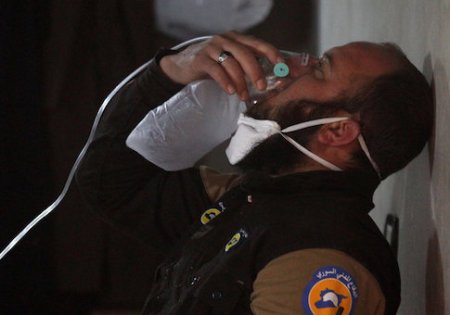
A civil defence member breathes through an oxygen mask, after what rescue workers described as a suspected gas attack in the town of Khan Sheikhoun in rebel-held Idlib, Syria April 4, 2017. REUTERS/Ammar Abdullah

The United States has concluded Russia knew in advance that the Syrian regime would employ chemical weapons in a large-scale attack last week, according to the Associated Press.

Syrian President Bashar al-Assad’s regime reportedly ordered the chemical bombings that hit a rebel-held town in the Idlib Province on April 4. At least 80 people were killed, and video footage of women and children fighting to draw breath because of lethal chemical gas spread around the world.

BREAKING: Senior U.S. official says U.S. has concluded that Russia knew in advance of Syria’s chemical weapons attack last week.

According to a senior official, a Russian-operated drone flew over a Syrian hospital while victims sought treatment, and later a Russian-made fighter jet bombed the hospital. The official said the drone’s presence revealed that Russia knew the attack was coming:

Hours after the drone left, a Russian-made fighter jet bombed the hospital in what American officials believe was an attempt to cover up the usage of chemical weapons.

Until Monday, U.S. officials had said they weren’t sure if the drone was operated by Russia or Syria. The senior official said it still wasn’t clear who was flying the jet that bombed the hospital.

The official said the presence of the drone couldn’t have been a coincidence, and that Russia must have known the chemical weapons attack was coming and that victims were seeking treatment.

President Donald Trump responded to the chemical attack on Thursday, when he ordered the firing of 59 Tomahawk cruise missiles at the Al Shayrat airfield in western Syria, where the chemical attack originated.

The Trump administration has stepped up its rhetoric against Russia in the wake of the Syria attack.

Secretary of State Rex Tillerson spoke Monday at a World War II memorial in Italy to issue a warning against countries that “commit crimes against the innocents.”

“We rededicate ourselves to holding to account any and all who commit crimes against the innocents anywhere in the world,” he said.

United Nations Ambassador Nikki Haley said on Sunday that the administration would not let Russia “cover for this regime anymore.”

“This is something to let Russia know, ‘You know what? We’re not going to have you cover for this regime anymore. And we’re not going to allow things like this to happen to innocent people,'” Haley said on “Meet The Press.”

Trump Sends a Message to China Through Syria

April 10, 2017

Trump Sends a Message to China Through Syria, Front Page Magazine, Daniel Greenfield, April 10, 2017

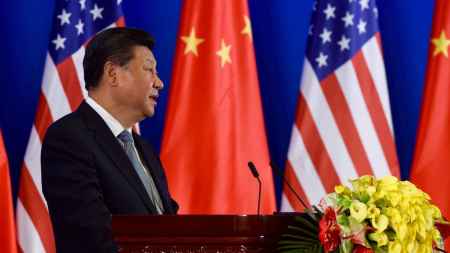
On Thursday evening, President Trump met with China’s President Xi and bombed Syria. The decision came as Trump traveled on Air Force One to meet with Xi at Mar-a-Lago. An hour into their dinner, 59 Tomahawk cruise missiles launched and pounded an airbase in Syria. The message wasn’t just for Assad and Putin. It was for Xi and his North Korean client state. The era of a weak America was over.

Xi had come to America expecting an easy photo op visit. President Trump would urge action on North Korea and Xi would smile coldly and shoot him down. Talk of fairer trade would be similarly dismissed.

And then Xi would go home and laugh that the bold new American leader was another paper tiger.

Except that President Trump had a different plan. Instead of Xi showing how tough he could be, Trump gave him a front row seat to a display of American power. The message was both obvious and subtle.

And President Xi, along with Russia’s Vladimir Putin, North Korea’s Kim Jong-un and Iran’s Supreme Leader Khamenei, aren’t laughing.

The obvious part was as blatant as a 1,000 pound explosive warhead slamming into concrete and steel, and as obvious as upstaging Xi’s efforts to stonewall Trump while warning that North Korea could be next if the Chinese leader continues to be obstinate.

Trump had warned throughout the campaign that he would not be laying his military plans on the table. “You’re telling the enemy everything you want to do!” he had mocked Clinton.

His address to the nation came an hour after the missiles had struck. The element of surprise had held.

And Xi came away with a very different message. The Obama era was over. The new guy was bold, dangerous and unpredictable. Like many of Trump’s American opponents, Xi understood now that the jovial man sitting next to him could and would violate the rules of the game without prior warning.

China would have to be careful. There was a cowboy in the White House again.

And that was the subtle part. Trump does not care very much about Assad. What he truly cares about is American power. Left-wing critics quickly pounced on Trump’s past opposition to strikes on Syria and his criticisms of Obama for not enforcing his own “red line”.

There is no contradiction.

Trump didn’t believe that strikes on Syria were a good idea. But once we had committed to a red line, then we had to follow through if we were going to be taken seriously.

And so Trump enforced Obama’s red line. Not because of Obama or Syria. But because of America.

“When he didn’t cross that line after making the threat, I think that set us back a long ways, not only in Syria, but in many other parts of the world because it was a blank threat,” President Trump said.

President Trump intends to get things done. And he knows it won’t happen with “blank” threats.

Asked about whether the strikes represented a message to Xi and North Korea, Secretary of State Tillerson replied, “It does demonstrate that President Trump is willing to act when governments and actors cross the line and cross the line on violating commitments they have made.”

“President Trump has made that statement to the world tonight,” he added.

The message is more subtle than a 1,000 pound warhead. But not by that much.

President Trump’s move bewildered leftist critics who had to shift from accusing him of having a secret relationship with Russia to accusing him of ruining our relationship with Russia. It also enraged some supporters who maintained a dogmatic non-interventionist position. But Trump doesn’t make decisions based on ideology. He measures policies against real world objectives, not abstract philosophies.

What he has always wanted to do is solve real problems.

The problem he was solving on Thursday wasn’t Assad. President Trump recognizes that Syria is an unsolvable problem and that little good can come of extended engagement with it. There are no good guys in Syria. Only Sunni and Shiite Jihadis and their victims. Syria is and will always be a dead end.

The problem is that Obama thoroughly wrecked American prestige and power over eight years. And that makes it painfully difficult to get anything done when no one in the world will take us seriously.

President Trump sees North Korea’s nuclear weapons as a major threat. But he also sees the crisis as a way to leverage our military might to achieve better trade deals with both partners and rivals. He is not wedded to a globalist or anti-globalist ideology. Instead he sees every problem as an opportunity.

He is not committed to any international coalition, globalist or anti-globalist, except where it temporarily serves American purposes. That is what being a true nationalist actually means.

That is what makes him so unpredictable and so dangerous.

President Trump made a point in Syria. He timed that point for maximum effect. The point isn’t that Assad is a bad man. Though he is. It’s not that he isn’t a Russian puppet, though only the lunatic left could have believed that. The point is that he is determined that America will be taken seriously.

Cruise missile diplomacy isn’t new. Bill Clinton fired over 500 cruise missiles into Iraq. Not to mention Sudan. Bush fired cruise missiles into Somalia. Obama signed off on firing cruise missiles into Yemen and Syria at terrorist targets. The difference is that Trump isn’t just saving face with cruise missile diplomacy.

President Trump’s real objective isn’t the Middle East. It’s Asia. He doesn’t see Russia as our leading geopolitical foe, but China. Syria was the opening shot in a staring contest with the People’s Republic. The moves in this chess game will sometimes be obvious and sometimes subtle. And Trump is usually at his most subtle when he’s being obvious. That’s what his enemies usually miss.

President Trump’s first step in Syria was to reestablish physical and moral authority on the international stage while the President of China had to sit there and watch. He humiliated Democrats and their media operation at the peak of their Russia frenzy. And he sent the message that America is back.

It’s not a bad return on a $60 million investment. We’ve spent much more in the field with less to show for it.

The Obama era in international affairs ended with whimper and a hollow Nobel Peace Prize as a trophy. The Trump era in international affairs began with 59 cruise missiles and a big bang.

US Air Force to quit Incirlik, move to Syria base

April 8, 2017

US Air Force to quit Incirlik, move to Syria base, DEBKAfile, April 8, 2017

When the work is finished, the rising complex of air bases will enable America to deploy twice as many warplanes and helicopters in Syria as the Russians currently maintain.

The five US bases in Syria are part of Trump’s three-pronged strategy which aims at a) fighting Islamist terror; b) blocking Iran’s land and air access to Syria; and c) providing the enclaves of the Syrian Kurdish-PYD-YPG with a military shield against the Turkish army.

********************

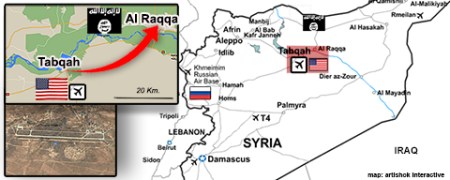
Several US engineering teams are working round the clock to build a big new air base in northern Syria after completing the expansion of another four. They are all situated in the Syrian borderland with Iraq, DEBKAfile’s military forces report.

This was going on over the weekend as senators, news correspondents and commentators were outguessing each other over whether the US missile attack on the Syrian Shayrat air base Friday, in retaliation for the Assad regime’s chemical attack on Khan Sheikhoun, was a one-off or the start of a new series.

As the White House parried those questions, the Trump administration was going full steam ahead on the massive project of preparing to pull US air force units out of the Incirlik air base in southern Turkey, in active American use since 2002. Those units were in the middle of a big moving job to the five new and expanded air bases in Syria. Their hub is to be Tabqa, which is just 110km west of the Islamic State’s Syrian capital, Raqqa. The other five are Hajar airport in the Rmelan region, two small air fields serving farm transport in Qamishli, which have been converted to military us; and a fifth in the Kurdish Kobani enclave north of Aleppo near the Syrian-Turkish border.

Tabqa is also becoming the main assembly-point for the joint US, Kurdish, tribal Arab force that is coming together in readiness for a major charge on Raqqa.

When the work is finished, the rising complex of air bases will enable America to deploy twice as many warplanes and helicopters in Syria as the Russians currently maintain.

The site of the Tabqa air field was captured as recently as late March by the Syrian Democratic Force (Kurdish-Arab fighters) which were flown in and dropped there by the US Air Force’s Air Mobility Command. It was quickly dubbed “Incirlik 2” or “Qayyarah-2” after the US command center running the Iraqi military offensive against ISIS in Mosul.

Tabqa is designed to accommodate the 2,500 US military personnel housed at Incirlik. Like the Americans, the German Bundeswehr is also on the point of quitting Incirlik and eying a number of new locations in Cyprus and Jordan. The Germans are pulling out over the crisis in their relations with Ankara. The Americans are quitting because President Donald Trump wants to chill US ties with Turkish President Reccep Tayyip Erdogan and cooperation with the Turkish army.

The five US bases in Syria are part of Trump’s three-pronged strategy which aims at a) fighting Islamist terror; b) blocking Iran’s land and air access to Syria; and c) providing the enclaves of the Syrian Kurdish-PYD-YPG with a military shield against the Turkish army.

Mark Steyn: Trump hit a reset button for the world

April 7, 2017

Mark Steyn: Trump hit a reset button for the world, Fox News via YouTube, April 7, 2017

US strikes Syrian military airfield

April 7, 2017

US strikes Syrian military airfield, DEBKAfile, April 7, 2017

(Please see also, Condemnation will not stop Assad’s chemical war. — DM)

The US military launched 59 Tomahawk cruise missiles at a Syrian military airfield late on Thursday, April 6, in the first direct American assault on the government of President Bashar al-Assad since that country’s civil war began six years ago. The operation, which the Trump administration authorized in retaliation for a chemical attack killing scores of civilians this week, significantly expanded US military involvement in Syria.

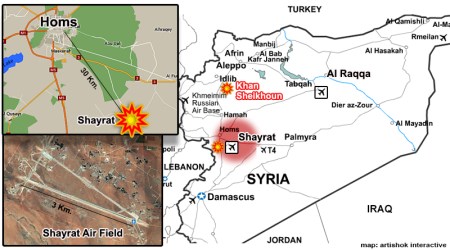
The missiles were launched from two Navy destroyers — the USS Ross and USS Porter — in the eastern Mediterranean. They struck an airbase called Shayrat in Homs province, the site from which the planes that conducted the chemical attack in Idlib are believed to have originated. Syrian military aircraft, infrastructure and runways were hit

“Tonight, I call on all civilized nations to join us in seeking to end the slaughter and bloodshed in Syria and also to end terrorism of all kinds and all types,” president Donald Trump said to reporters from Mar-a-Lago, Florida, where he is hosting China President Xi Jinping and his wife…

“Assad choked out the lives of helpless men, women and children,” he said. He acted because of a “vital national security interest of the United States to prevent and deter the spread and use of deadly chemical weapons.”

DEBKAfile: Washington has no doubt that the Syrian SU-22 bomber which Tuesday dropped a sarin gas bomb on Khan Sheikhoun in Idlib province, killing up to 100 people, was a joint Russian-Iranian-Syrian gambit to divert the Trump administration from a comprehensive plan for Syria. As US President and commander-in-chief he could not ignore this provocation.

Our sources report that the new US administration’s plans for Syria center on an offensive to evict the Islamic State from its Syrian capital, Raqqa, a mission for which US military preparations have been going forward for the past two weeks at five centers. To this operation Moscow, Tehran and Damascus were not averse. But that operation was also designed to rid Syria of Iranian and Hizballah forces – to which they were.

Secretary of State Rex Tillerson said that despite previous agreements, Syria had not surrendered its chemical weapons stockpile, and accused Russia of “failing in its responsibility to deliver on its commitment” to supervise the surrender of those chemical weapons. “Either Russia has been complicit or simply incompetent in its ability to deliver,” Tillerson continued.

The question now is whether Vladimir Putin will decide to hit back at the US operation. Russia did not retaliate for the Israel air strike on March 17 over the northern Syrian T4 air base. If Putin chooses to sit on his hands once again, the same question may be addressed to Iran and Hizballah.

Very possibly, Trump and Putin reached accord on the limits of the US punitive attack in Syrian in long hours of debate during the day between the US State and Defense Departments and the Russian Foreign and Defense Ministries, which were first reported by DEBKAfile 24 hours ago. Pentagon sources report that Washington gave Moscow advance warning of the coming US attack on the Syrian Shayrat base where Russian air force units are also deployed.

Follow-up US military action may yet come after the US president asserted that for him, “many, many lines were crossed” by Assad’s chemical attack and his attitude towards Syria had changed..

Trump’s comprehensive plans for Syria our outlined in the latest DEBKA Weekly. If you are not yet a subscriber, click here for this and other exclusive revelations.

The Message in the Missiles

April 7, 2017

The Message in the Missiles, Power Line, Scott Johnson, April 7, 2017

Last night President Trump authorized the destruction of the air base from which the Syrian butcher Assad had launched insidious sarin gas attacks earlier this week. Our destruction of the air base was executed through the use of 59 Tomahawk cruise missiles. I strongly support President Trump’s authorization of the action. As the great William F. Buckley, Jr. used to say, herewith a few observations:

1. Asked about the gas attacks in a Rose Garden press conference with Jordan’s King Abdullah on Wednesday, President Trump had responded: “It crossed a lot of lines for me. When you kill innocent children, innocent babies, babies, little babies, with a chemical gas that is so lethal, people were shocked to hear what gas it was, that crosses many, many lines, beyond a red line. Many, many lines.”

Trump’s language harked back to President Obama’s bloviation on Syria, but he wasn’t done. He went on specifically to cite Obama’s empty threat regarding Assad’s use of chemical weapons. “I think the Obama administration had a great opportunity to solve this crisis a long time ago when he said the red line in the sand,” Trump said. “And when he didn’t cross that line after making the threat, I think that set us back a long ways, not only in Syria, but in many other parts of the world, because it was a blank threat. I think it was something that was not one of our better days as a country.”

I read President Trump’s statement as the predicate of some form of military reprisal by the United States against Assad. Thus it proved to be.

2. Like President Reagan when he fired the striking air traffic controllers in 1981, President Trump sent several messages with the action taken last night. Here are three of them. The Obama era in American foreign policy is over. He doesn’t issue empty threats.

3. President Obama sought to tie the United States down in the world like the Lilliputians did Gulliver. Among the instruments employed by Obama to restrain the United States was the United Nations. President Trump gave the United Nations the opportunity to weigh in yesterday. When it failed to act, Trump proceeded. Again, the Obama era in foreign policy is over.

4. Trump acted with decisive force to achieve a limited objective. He could have gone further to remove more of Assad’s assets. If the goal was limited to deter Assad from doing what he did again, however, I think it highly likely that the mission was accomplished.

5. President Trump also had an unstated messaged for Iran and North Korea. See note 1 above.

6. President Obama put us in bed with Putin and empowered Russia in Syria with the supposed object of removing Assad’s chemical weapons. The agreement entered into by Obama was a complete and utter fraud. One might think that we would revisit this chain of events and pronounce it a scandal and a disgrace. Apparently not.

7. One might think that the attack on Putin’s Syrian ally would put paid to the line of the Democrat/Media Axis that Trump is somehow Putin’s lapdog, but one might think wrong.

8. President Obama and Secretary Kerry entered into the agreement with Russia to remove Syria’s chemical weapons in September 2013, not even four years ago. Yet it has conveniently disappeared from our collective memory as completely as the Wilmot Proviso and the Bland-Allison Act.

9. President Trump had the lawful authority to do what he did yesterday without congressional approval. It was akin to President Reagan’s 1986 bombing of Libya. Obama’s war to remove Qaddafi in Libya — now that was a problem. Last night, however, Trump acted well within his authority.

10. The Trump crew made a mistake advertising their intent to indulge the continuation of the Assad regime’s before the chemical attacks. They may have contributed to Assad’s brazen crime. It should also be noted, however, that the timing coincided with the two-day summit in Brussels, Belgium where European Union leaders had assembled to discuss funding commitments to support war-torn Syria. One knowledgeable observer called the Assad’s chemical attacks “a direct insult” and warning from Assad: you will keep paying and I will keep killing.


Trump strikes Assad and sends the world a message

April 7, 2017

Trump strikes Assad and sends the world a message, Israel National News, Jack Engelhard, April 7, 2017

(Chinese President Xi Jinping was honored with a huge fireworks display, setting the tone for his discussions with President Trump about such stuff as North Korea and the disputed islands in the South China Sea. Comrade Xi probably could not see it in far-away Syria, but if he didn’t get the message perhaps another fireworks display can be arranged in his honor just to the south of China’s border with North Korea. — DM)

Everything changed last night and the world will never be the same after President Donald Trump ordered the military to take action against Syrian dictator Bashar al-Assad. Two Navy warships fired 50 Tomahawk missiles upon a Syrian airfield from which chemical weapons were dropped on civilians, killing some 80, including children.

It was the slaughter of children that provoked Trump and led him to change his mind about interfering with force in the throes of Syria’s civil war – though he was critical of Obama for declaring a red line during a previous chemical assault but that saw no action from Obama.

Trump sent a message to Assad that indeed there’s a new sheriff in town. At the same time, Trump alerted the nations that this President means business and that the days of taking the United States for granted are over. His UN envoy Nikki Haley has been his voice of change at the UN – warning the nations that the United States has had its fill of Israel bashing while ignoring war crimes throughout the rest of the world.

In his message last night, Trump vowed to stop Assad and asked the civilized world to join him in eradicating terrorism everywhere.

He did not mention North Korean dictator Kim Jong-un. But that is one Supreme Leader that got a wake-up call, as did every other tyrant.

World leaders everywhere will now have to think twice before going ahead rashly. This includes Putin.

Americans got the news at around 8 pm last night. Full coverage was immediate throughout the cable networks.

CNN bested Fox news with sharper and more immediate facts and analysis. Anderson Cooper was factual and let the experts speak.

Fox News’ Shepard Smith was unable to mask his disdain for the President and kept interrupting his analysts with critical and inappropriate asides.

This was no time for backstabbing, but there was more of it on MSNBC.

A time like this, our military in action, is no time for bickering. The news media, so hostile to Trump from day one, will have to find a new voice in which to speak to America, whether Trump speaks their political language or not. Americans won’t tolerate divisiveness while our servicemen are in hostile waters – and certainly not when the job is about putting a stop to the random killing of infants.

For Israel there is a dark undercurrent to Trump’s response. The Palestinian Arabs who’ve been waging terrorism against Israel throughout the years, namely the PA and Hamas, have surely taken note at Trump’s heightened sensibilities toward children – they watch and they learn.

They learn that harming infants is one way to get at Trump, and so Israel must be prepared for a Gaza war aimed not to defeat Israel by arms, but through bombing Israeli towns and villages, and creating terror on the streets, drawing the IDF into a conflict that leaves Israel no choice but to move in at all costs. Otherwise the risk to the Jewish State would be unbearable.

Hamas has perfected the use of human shields to wage warfare through soliciting sympathy…with the PA’s Mahmoud Abbas cheering on.

They did it three times previously – 2008, 2012, 2014.

Hamas and the PA care nothing for the number of children that get killed, Jewish children and even their own children – if it makes a point.

So that’s Israel’s challenge against this epidemic of terrorism that has spread throughout the world.

Trump’s world is a new world and we all better start getting used to it, for the best we trust, and so far, so good.

Pentagon drawing up options for military response to Syria chemical attack

April 6, 2017

Pentagon drawing up options for military response to Syria chemical attack, Washington ExaminerJamie McIntyre, April 6, 2017

The U.S. could use its existing deconfliction channel with the Russians to avoid targets that would cause Russian casualties.

*****************************

The Pentagon is drawing up options for a possible military response to Tuesday’s chemical weapons attack in Syria that killed more than 70 people, and hospitalized hundreds more.

“There are very senior level meetings underway,” said one Pentagon official, “but I have not seen a concrete plan.”

The meetings involve Defense Secretary Jim Mattis and Joint Chiefs Chairman Gen. Joseph Dunford at President Trump’s Mar-a-Lago resort in Florida, and involve consultations with other senior commanders, including Gen. Joseph Votel, head of U.S. Central Command. The meetings are taking place amid new reports of another chemical attack in Syria.

“Options yes. We are in the business of providing options,” a senior military official said. “I would watch this one closely.”

The first official could not say if Trump had specifically ordered the options, or if the meeting constituted “prudent planning,” considering Trump’s Rose Garden statements Wednesday.

“I have that flexibility,” Trump said, “and I will tell you, it’s already happened that my attitude toward Syria and Assad has changed very much. … What happened yesterday is unacceptable to me.”

The U.S. now has a high degree of confidence that the air force of Syrian President Bashar Assad dropped a chemical weapon from an aircraft on the unsuspecting citizens of Khan Sheikhoun, in Syria’s northwest Idlib province, Pentagon officials said.

The symptoms suffered by the victims, including foaming at the mouth and asphyxiation, are consistent with exposure to sarin, a deadly nerve agent.

Pentagon planners have to take into account the presence of Russian forces and Iranian militia if they contemplate airstrikes to punish the Assad regime.

The U.S. could use its existing deconfliction channel with the Russians to avoid targets that would cause Russian casualties.

Before US whacks ISIS-Syria, Al Qaeda is resurgent

March 13, 2017

Before US whacks ISIS-Syria, Al Qaeda is resurgent, DEBKAfile, March 13, 2017

After the breakup of defeated Syrian rebel groups, who were forced to leave the northern town and head for neighboring Idlib, hundreds of rebels remained and refused to lay down arms. Instead, they joined Al Qaeda and have made the Islamist terrorist group the most powerful independent rebel force still fighting in northern Syria as well as in the surrounding areas of the main towns, including Damascus, Homs and Hama.

********************************

The main thrust of the campaign against the Islamic State in Syria ordered by the Trump administration is still ahead, but ISIS forces did not wait in their Raqqa stronghold for the axe to fall. They moved southeast into the Deir ez-Zour region, where they are beating back Hizballah’s elite Radwan Battalion, which has just been deployed there.

But meanwhile a new-old menace has raised its head: Al Qaeda and its Syrian affiliates which are seizing upon the mounting upheaval in the Syria for a fresh wave of terror. Saturday, March 11, two bomb explosions killed 74 pilgrims, most of them Iraqi Shiites, on a visit to an ancient cemetery in the Old City of Damascus. The second explosion was delayed so as to hit full on the Syrian police and rescuers rushing to the scene.

The same Al Qaeda branch planned and perpetrated the large-scale terrorist attack on Syrian government military facilities in the town of Homs on Feb. 25. Two generals were among the scores of dead troops.

Counterterrorism experts are warning US President Donald Trump to tread very carefully in the offensive he is preparing to launch against ISIS in Syria, since this organization’s defeat may well open the door to an Al Qaeda comeback in full and deadly spate to the Syrian arena.

This is what happened in the wake of the Russian-led Syrian victory in Aleppo in January, DEBKAfile’s military and intelligence sources note. After the breakup of defeated Syrian rebel groups, who were forced to leave the northern town and head for neighboring Idlib, hundreds of rebels remained and refused to lay down arms. Instead, they joined Al Qaeda and have made the Islamist terrorist group the most powerful independent rebel force still fighting in northern Syria as well as in the surrounding areas of the main towns, including Damascus, Homs and Hama.

On Jan. 26, Al Qaeda announced its merger with four smaller factions under another new brand name, Hayat Tahrir al-Sham (Liberation of the Levant Organization). The new outfit attracted many new recruits who had never before been attached to Al Qaeda.

Hashim al-Sheikh aka Abu Jabir, who fought the Americans in the Iraq war under Abu Mussab al-Zarqawi, was named leader of the new Islamist terror alliance. Reputed to be a skilled war tactician who never gives up, his appointment attracted another wave of Syrian rebel fighters.

Al Nusra’s first commander, Abu Mohammad al-Joulani, has meanwhile reappeared as head of a group calling itself Hay’at Tahrir al-Sham. Joulani has tried claiming he operates independently of Al Qaeda, although in fact he follows the orders of Ayman Al-Zawahiri to the letter and, according to some sources, is secretly working hand in glove with Hashim al-Sheikh.

An additional source of Al Qaeda’s renewed strength comes from the success of the combined Russian-Iranian-Hizballah forces to smash all the Syrian rebel groups who once fought the jihadist organization. Their disintegration has left Zawahiri’s following in Syria without effective adversaries. But it has Its Achilles heel too in the turf wars among the Syrian branch’s component groups – especially in the northern Idlib Province.

According to our military sources, the Russian, Syrian, Iranian and Hizballah commanders are together weighing an operation for taking control of Idlib. However, there too, if the Syrian rebels, who are fugitive from other fronts, are driven east or the south, Al Qaeda may again turn out to be the winner..

Therefore, even if President Trump and his generals are resolved to focus fully on a military operation to capture the ISIS stronghold of Raqqa – which has meanwhile emptied out of fighter – it is essential to detach enough fighting strength for dealing with the resurgent Al Qaeda. Failing to do so would leave the US forces at the Raqqa front vulnerable to attack from the rear by Al Qaeda, as the Russians and Iranians have found since they conquered Aleppo.