Posted tagged ‘Trump and Russia’

Trump-Putin safe zones deal ousts Iran from Syria

January 26, 2017

Trump-Putin safe zones deal ousts Iran from Syria, DEBKAfile, January 26, 2017

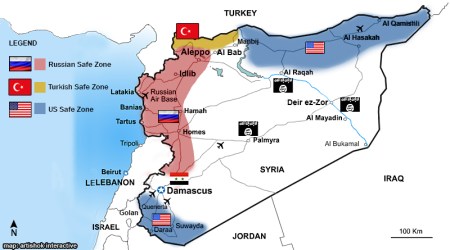
syria_safezones

Russia had originally planned to deploy Syrian military, pro-Iranian Shiite militia and Hizballah forces in battles for the capture of land around the cities of Derra and Quneitra on the Syrian side of the Golan. That plan has been dropped and will be superseded by the deployment in southern Syria of US troops accompanied by Jordanian special forces and Syrian rebels, trained by American instructors in Jordanian military camps.

Israelis will breathe a sigh of relief over the removal of the threat of Iranian and Hizballah forces being deployed along their northern border with Syria.

**************************

Syria stands on the threshold of dramatic changes that will directly impact on the strategic and military situation along the Syrian borders with Israel and Jordan, DEBKAfile reports exclusively. They derive from a deal struck this week by US President Donald Trump and Russian President Vladimir Putin to establish US, Russian and Turkish security zones in Syria. This scheme will transfer military control of the country to those three powers. Each of them will be responsible for a zone whose borders will be defined and agreed upon by Washington, Moscow  and Ankara.

As part of this arrangement, all forces from the Iranian military, the pro-Iranian Shiite militias and Hizballah will be required to leave Syria.

The US military is to have two security zones – one covering the entire area east of the Euphrates River up to the Iraqi border including Kurdish areas (see attached map). This arrangement will partly resurrect the accord reached in late 2015 by US President Barack Obama and Putin, for the division of Syria into areas of influence. All territory east of the Euphrates was allocated to the US, with Russia taking responsibility for all areas west of the river until the Mediterranean coast.

Under the new deal, the Turkish area is to stretch about 650 kilometers along the entire Syria-Turkey border and extend between 35 and 50 kilometers into Syrian territory up to Al-Bab, the town where the Turkish military is engaged in its third straight month of fighting for its capture from ISIS.

DEBKAfile’s military and intelligence sources report that the overriding change on the ground will be the establishment of a second US security zone adjacent to Syria’s borders with Israel and Jordan. It means that the approximately 7,500 US special operations forces troops currently in Jordan will be shifted northward into southern Syria.

Russia had originally planned to deploy Syrian military, pro-Iranian Shiite militia and Hizballah forces in battles for the capture of land around the cities of Derra and Quneitra on the Syrian side of the Golan. That plan has been dropped and will be superseded by the deployment in southern Syria of US troops accompanied by Jordanian special forces and Syrian rebels, trained by American instructors in Jordanian military camps.

Israelis will breathe a sigh of relief over the removal of the threat of Iranian and Hizballah forces being deployed along their northern border with Syria.

The Trump-Putin deal for Syria and its ramifications are explored in the coming issue of DEBKA Weekly (for subscribers) out Friday, with especially attention to the way it leaves Iran and Hizballah high and dry.

If you are not yet a subscriber, click here to sign on.

Samantha Power Reinvents Obama’s Record on Russia

January 25, 2017

Samantha Power Reinvents Obama’s Record on Russia, PJ MediaClaudia Rosett, January 24, 2017

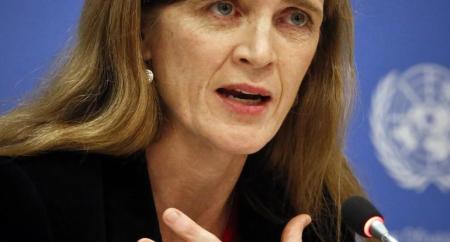
samantharussiaUnited States U.N. Ambassador Samantha Power speaks during her final press conference, Friday, Jan. 13, 2017 at U.N. headquarters. (AP Photo/Bebeto Matthews)

By all means, let’s have a debate about the dangers of American presidents and their administrations purveying “alternative facts.” But could the members of the media most ostentatiously seething over President Trump — and now busy presenting their own alternative facts — please spare us the pretense that the White House is suddenly in danger of losing its credibility. What’s left to lose? We’ve just had eight years of the Obama administration beaming out  alternative facts “narratives” to the mascot-media echo chamber, on the theory that saying something makes it so (“If you like your doctor, you can keep your doctor”; Iran’s “exclusively peaceful” nuclear program; the Benghazi “video”; etc.).

It is Trump’s job to reverse this rot, not to adapt Obama’s fiction techniques to suit himself. But if anyone’s curious about the kind of fakery that Trump and his team should strive to avoid — in the interest of integrity and good policy — Obama’s former ambassador to the United Nations, Samantha Power, has just given us a showcase example. In her farewell speech as UN ambassador, delivered Jan. 17 to the Atlantic Council, Power conjured an entire alternate universe, less by way of presenting alternative facts than by omitting a number of vital facts altogether. The result was to erase from the picture some of the most disastrous failures of the Obama administration, while insinuating that Trump is already complicit in the resulting mess.

Let me stipulate that Power did issue a warning that is valid, important, and urgent. Her topic, as she explained at the start of her speech, was “a major threat facing our great nation: Russia.”

Yep, no question about that. Vladimir Putin’s Russia is a growing threat, as some of us have been arguing for more than a decade.

But it was on Obama’s watch that Russia became a mushrooming threat to a degree that even Obama and his team could not in the end ignore — welcoming Edward Snowden, snatching Crimea from Ukraine, moving back into the Middle East, backing the Assad regime and bombing in Syria, hacking hither and yon, and frustrating Power at the UN with its veto on the Security Council.

It was Obama himself, with his policy of “engagement,” who helped lay the groundwork for this rising threat — deferring to dictators, betraying allies, downsizing the U.S. military, and sneering at those who warned there would be hell to pay. Putin drew the logical conclusions, read this U.S. retreat as an invitation, and made his moves. One might have supposed that after years of Obama apologizing for America, Samantha Power in her swan-song lecture could have summoned the strength of character to apologize for Obama, and for her own role, as one of his top envoys. (Don’t hold your breath).

For Putin, Obama offered the opportunity of a lifetime — to roll right over that old “rules-based order,” which always depended on American leadership, and which Power now warns us is threatened by Russia.  Obama began with the 2009 “reset,” including the gift to Putin of yanking missile defense plans for Eastern Europe. Obama went on to promise Putin “more flexibility” after his 2012 reelection. In the 2012 presidential campaign debates, Obama mocked Mitt Romney’s warnings about Russia, scoffing that “the Cold War’s been over for 20 years.”

When Putin gave asylum in 2013 to American-security cyber-vandal Edward Snowden, mocking Obama as he did so, Obama’s mini-mouse response was to attend a G-20 summit in Russia regardless, but punish Putin by refraining from any bilateral meetings. About that same time, Obama erased his own “red line” on chemical weapons in Syria by way of turning over the problem to Russia. When Russia in 2014 snatched Crimea from Ukraine, Obama answered with sanctions that have done nothing to reverse Russia’s grab. Meantime, Obama’s administration celebrated Russia’s presence as one of the main parties to an Iran nuclear deal that Israel, and many American lawmakers, protested as a grave threat. When Putin sent Russian warships into the Mediterranean and Russian bombers into Syria, Obama responded by hosting international talking shops, while Power gave impotent lectures at the UN.

None of this wilting U.S. policy figured in Power’s speech as part of the problem. She justified the “reset” on grounds that “2017 is not 2009.” (Right, and 2009 was not 1991, when post-Soviet Russia looked like a friend on the ropes. By 2009, Russia had already engaged in such feats as poisoning dissident spy Alexander Litvinenko with polonium-210, meddling in Ukraine’s elections, murdering a series of journalists, and transgressing into Georgia.) Power suggested that in 2009, when Putin’s sidekick, Dmitry Medvedev, was president of Russia, there was more common ground with the U.S. (surely she is aware, as was her flexible boss, that even during that interval, Putin, not Medvedev, was the real power in the Kremlin).

Power in her speech claimed that “anyone who has seen my debates in the UN Security Council with Russia knows that I and my government have long had serious concerns about its government’s aggressive and destabilizing actions.” But in her recitation of specifics, that “long” concern seemed to extend back only to about 2014, as if the previous five years of Obama’s engagement, reset, retreat, flexibility, disappearing red line, ineffectual sanctions and feckless dialogue were irrelevant.

For good measure, Power threw in a classic Obama apology for America (Russian Foreign Minister Sergey Lavrov, recipient of the 2009 “reset” button, must love this routine):

Now, I acknowledge there are times when actions the United States takes in the interest of defending our security and that of our allies can be seen by other nations as offensive moves that threaten their security, and we need to be alert to this, which is why dialogue is so important.

Power then deplored Russia’s policies in which “lying is a strategic asset,” and its goal of “creating a world where all truth is relative, and where trust in the integrity of our democratic system is lost.” Correct on all counts, and an important warning. Yet somehow disingenuous coming from a senior member of the administration that unapologetically turned the National Security Council into a Ben Rhodes narrative workshop, mind-melded with President Obama. She made no mention of that.

Amid all this, Power worked around to the punch line — “we must continue to work in a bipartisan fashion to determine the full extent of Russia’s interference in our recent elections… .” Here again, Russian hacking is without question a threat to be deterred, stopped, punished. But there’s that troubling administration timeline, in which Russian hacking merited merely a public warning before the 2016 presidential election. After the vote, and Trump’s victory, it suddenly emerged on the Obama administration’s twilight agenda as a threat of the first order.

Power made a number of recommendations, some worthy in their own right, but — coming from this particular speaker — staggering for the degree of hypocrisy involved. She said “we have to do a better job of informing our citizens about the seriousness of the threat the Russian government poses.” (Quite right, but where’s that apology owed to Mitt Romney?).

Most memorable was her urging that “we must reassure our allies that we have their backs, and ensure that Russia pays a price for breaking the rules.” Yes, absolutely. But that’s quite an utterance coming from Power, who just last month, as Obama’s willing envoy, betrayed one of America’s closest allies, Israel, at the UN Security Council. It was Power who raised her hand to abstain from the vote on Resolution 2334 — allowing the passage, absent a U.S. veto, of measures deeply damaging to the Jewish state, and extremely difficult for any U.S. administration to now reverse.

Having by turns revised, scrubbed, excused, fudged and recast the Obama record on Russia, Power wrapped up by quoting George Washington and prescribing — who could argue? — that we must be “clear-eyed about the threat Russia poses from the outside” and dedicated to “restoring citizens’ faith in our democracy on the inside.”

Hypocrisy, though unattractive, is not necessarily dangerous. But it becomes so when coupled with political power and employed to cover up important truths. Russia is indeed a serious and growing threat, on multiple fronts. But to confront this requires not a Potemkin facade erected to  deflect attention from years of terrible policy, but an accurate understanding of how we got here. Samantha Power and Barack Obama, with their exit warnings about Russia, owed us at least that much.

Which brings me back to alternative facts, and what we should require of Trump. He inherits a Russia that was in effect invited by the Obama administration to become the grave and growing threat we see today. Putin availed himself richly of that invitation. To remedy this will take American leadership, courage and candor. If anyone in the new Trump administration ends up giving at any stage a speech similar in its Orwellian manipulations to this farewell peroration by Samantha Power, Trump should fire that speaker forthwith. America deserves better.

An Instant thaw of U.S.-Israeli Relations

January 23, 2017

An Instant thaw of U.S.-Israeli Relations, Power LinePaul Mirengoff, January 22, 2017

The Democratic Party and its media pals notwithstanding, it looks like Trump has correctly identified which nations are our friends and which are not. Our friends are the ones whose leaders he’s talking to and setting up meetings with right out of the gate.

It was Barack Obama who struggled to identify our friends. Or maybe, Groucho Marx style, he couldn’t form a bond with any nation that had a high regard for ours.

*****************************

President Trump is fond of saying of almost any problem he identifies “this stops right now.” Unfortunately, many of the problems in question are not so tractable.

But there’s one problem Trump has stopped already — the bad blood between the U.S. and its great ally Israel.

The Washington Post reports that the president talked by phone today with Israel’s prime minister Benjamin Netanyahu. Trump described the conversation as “very nice.” Netanyahu’s office called it “very warm.”

According to the White House, Trump and Netanyahu agreed to consult closely on regional issues, “including the threats posed by Iran.” Trump emphasized the close relationship between the two countries, promised to work toward Israeli-Palestinian peace, and stressed that countering the Islamic State and other radical Islamic terrorist groups will be an administration priority.

Netanyahu expressed his desire to work closely with the Trump administration so that there is “no daylight between” the two countries.

In addition, Trump invited Netanyahu to visit him at the White House in early February. We can be confident that Netanyahu won’t have to cool his heels in a conference room while the president has dinner with his family, as he did when Barack Obama had him at the White House.

Netanyahu won’t be the first foreign leader to meet with Trump. That honor will go to Theresa May, the prime minister of Great Britain. This is as it should be. Like Israel, Britain is a special ally. Unlike Israel, it needs our immediate help on a trade deal as a result of Brexit.

Trump will also have early meetings with Canada’s Justin Trudeau and Mexico’s Enrique Peña Nieto. He spoke with both by phone on Saturday. These talks will pertain to renegotiating NAFTA and, particularly in the case of Mexico, immigration and border security.

This is a president who appears to have his foreign policy priorities straight.

What about Russia? According to the Post, Trump hasn’t yet made contact with Vladimir Putin. A meeting appears to be months away. Meanwhile, Kremlin spokesman Dmitry Peskov told the BBC that it would be “a big mistake” to think that U.S.-Russian relations under Trump would be free from controversy.

The Democratic Party and its media pals notwithstanding, it looks like Trump has correctly identified which nations are our friends and which are not. Our friends are the ones whose leaders he’s talking to and setting up meeting with right out of the gate.

It was Barack Obama who struggled to identify our friends. Or maybe, Groucho Marx style, he couldn’t form a bond with any nation that had a high regard for ours.

This stops right now.

Former Senator DeMint: Russia Needs to See a ‘Strong and Determined U.S.’

January 21, 2017

Former Senator DeMint: Russia Needs to See a ‘Strong and Determined U.S.’, Washington Free Beacon, , January 21, 2017

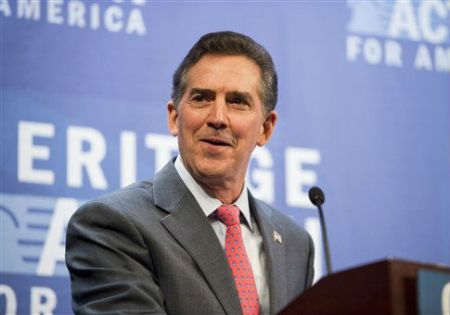
demint-1Former Sen. Jim DeMint, (R., S.C.), president of the Heritage Foundation / AP

“The implications worldwide of America being perceived as weak are huge; it’s the quickest way to draw us into some kind of conflict”

******************************************

Former Senator Jim DeMint (R., S.C.) says the United States needs to deter aggression from Russia and China by projecting strength and determination and making good on promises to its allies.

DeMint, who runs the conservative Heritage Foundation, criticized the Obama administration for not backing up its promises with force during an interview with the Washington Free Beacon, urging the Trump administration to chart a new course on projecting strength and drawing clear “lines in the sand.”

“The best way to keep peace is for us to be strong and perceived as strong, clear in what we are going to do and what we expect, and then we have to back that up,” DeMint said at the Heritage headquarters in Washington, D.C.

“We don’t want to be drawing lines in the sand that we ignore. Once Obama did that in Syria and other places, said things and didn’t follow up, the rest of the world basically knew that he wouldn’t. So, everyone has been testing us and our allies are nervous,” DeMint said.

DeMint downplayed concerns voiced about Trump’s handling of both Russia and China, saying that representatives from foreign countries with whom he has met have expressed optimism about the prospects for defense under the new administration.

“Most of the delegations—and we’ve had a lot of them since the election— that come through here are optimistic that Trump might reestablish America’s leadership position in the world and develop our strength to the point where they can count on us to keep their enemies at bay, or at least keep them honest,” DeMint said.

Trump has pledged to rebuild America’s military by reversing drawdowns of the armed forces set in motion during the Obama administration and ending sequestration that has eroded the defense budget. He has also telegraphed a willingness to pursue warmer relations with Russia, while taking a harder line on China when it comes to trade and the “one China” policy; both suggestions have drawn scrutiny from the press and critics of the Republican president.

DeMint said he suspects Trump is “toying” with Russian President Vladimir Putin and trying to “draw him in” by making positive statements about Moscow’s leader. The most recent administrations of Barack Obama and George W. Bush both tried to improve relations with Russia, to no avail. Many experts describe current tensions between Washington and Moscow as the highest since the Cold War.

“The best thing that Russia could see is a strong and determined U.S. and I think putting any missile systems all around them and convincing them that all of their development is not going to do anything because we have a missile system that could stop anything,” DeMint said, referring to the U.S. missile defense shields being deployed to Europe that have drawn ire from Moscow.

“Russia is a threat; we need to try to bring them into some kind of civilized [conversation] but we can’t be naïve in the thinking,” he said. “They want to dominate their neighborhood and keep Europe in their influence sphere, and they’re doing a good job.”

DeMint also said Trump is right to “put China on notice” as Beijing continues to build on disputed territories in the South China Sea.

“I don’t think it’s a bad thing that he’s stirring the pot a little bit with China to let them know that they cannot count on the status quo of a passive U.S.,” DeMint said. “Obviously, he has to bring that down into some clear policies, but China respects strength.”

DeMint, who has led Heritage since 2013 after serving two terms in the Senate, spoke to the Free Beacon two days before Trump’s inauguration just blocks away from the U.S. Capitol, outlining the think tank’s defense priorities for the new administration. He referenced at length Heritage’s Index of U.S. Military Strength, an annual assessment that last November shed light on the declines in American military power.

The individual service chiefs have testified before Congress about how budget cuts have compromised modernization and future readiness, agreeing that the U.S. military would not be able to defend the homeland against present and future threats if sequestration continues. Trump’s defense secretary, retired Gen. James Mattis, who was confirmed Friday afternoon, has already committed to ending sequestration.

“It’s not just about defending our country,” DeMint observed on Wednesday. “We have alliances with so many countries that depend on us that what you see now in our [analysis], it doesn’t just expose us. It’s got the rest of the world scrambling as to whether or not we could meet our commitments.”

“The implications worldwide of America being perceived as weak are huge; it’s the quickest way to draw us into some kind of conflict,” he later added.

On Watch: Episode 4 – The So-called ‘Hack’

January 17, 2017

On Watch: Episode 4 – The So-called ‘Hack’, Judicial Watch via YouTube, January 17, 2017


The Trump Dossier Puts the Deep State in Deep Doo-Doo

January 15, 2017

The Trump Dossier Puts the Deep State in Deep Doo-Doo, American ThinkerClarice Feldman, January 15, 2017

Mr. Garfinkle of Garfinkle’s New Method Hebrew School in Milwaukee used to frequently echo King Solomon’s admonition; “There’s nothing new under the sun.” I was reminded of that this week when the rapidly unfolding “scandal” of Trump’s purported dealings with Russia hit the news. It has more than a few similarities with the Dan Rather faked-up story of GW Bush’s National Guard service where an anonymous, never-found source supposedly gave Bill Burkett a demonstrably fake report and Dan Rather ran with it. This time a Bush (Jeb) is involved but as an instigator of the story, not a victim. John McCain acts as the intermediary passing the junk on to the Intelligence Community, which makes sure it is published.

If you’re confused about it, let me put it in the context of the most reliable information I’ve been able to put together, noting that I think the story is likely to become even more clear over the next few days. As you will see, the dossier is so ridiculous, if anyone in the Intelligence Community fell for it, he’s too stupid to allow in place, and if no one did but they still played a role in publicizing it, everyone involved needs to be fired

A. Digging Up Dirt on Opponents

In September of 2015 someone — now revealed as a Jeb Bush Super PAC donor — paid  Fusion GPS, a Washington, D.C. outfit, to compile a dossier of dirt on Donald Trump. Fusion engaged Christopher Steele, a former MI-6 agent in London, to do the job. While early accounts of the story refer to him as a “respected source”, he has a history of dumpster diving for Democrats.

Kimberley Strassel at the Wall Street Journal has been reporting on his work for some time and explains why he keeps getting hired: “to gin up the ugliest, most scurrilous claims, and then trust the click-hungry media to disseminate them. No matter how false the allegations, the subject of the attack is required to respond, wasting precious time and losing credibility.”

Steele hadn’t been in Russia for decades and as a former British spy could not have done the work himself. So, as the account in the New York Times continues, “he hired native Russian speakers to call informants inside Russia and made surreptitious contact with his own connections in the country as well.”

Beginning in June and until December Steele delivered his findings — a series of short memos — to GPS. Although post-election no one was paying, Steele continued on this muckraking operation,

The memos suggested that the Russians were trying to influence Trump and stated that one of Trump’s lawyers, Michael Cohen, had met with a Russian official in Prague. (A claim Cohen has credibly rebutted.)

Word of the dossier made it to the FBI via Senator John McCain, a man with an apparently insatiable desire to betray.  McCain, who heard about the dossier from a former diplomatic colleague of Tony Blair (Sir Andrew Wood), dispatched someone (apparently former State Department official David J. Kramer) to London to pick it up, then handed it off to the FBI.

From sources as yet unknown, news of the Steele report made it to journalists who investigated and finding no verification after investigating refused to print it.

The FBI, tried to get permission to tap into a server in the Trump Tower, which was denied, then in a strangely odd act tried twice to get a warrant from FISA to tap into it. Whether this was in response to the dossier, I do not know.  Andrew McCarthy writes in National Review Online:

To summarize, it appears there were no grounds for a criminal investigation of banking violations against Trump. Presumably based on the fact that the bank or banks at issue were Russian, the Justice Department and the FBI decided to continue investigating on national-security grounds. A FISA application in which Trump was “named” was rejected by the FISA court as overbroad, notwithstanding that the FISA court usually looks kindly on government surveillance requests. A second, more narrow application, apparently not naming Trump, may have been granted five months later; the best the media can say about it, however, is that the server on which the application centers is “possibly” related to the Trump campaign’s “alleged” links to two Russian banks — under circumstances in which the FBI has previously found no “nefarious purpose” in some (undescribed) connection between Trump Tower and at least one Russian bank (whose connection to Putin’s regime is not described). That is tissue-thin indeed. It’s a good example of why investigations properly proceed in secret and are not publicly announced unless and until the government is ready to put its money where its mouth is by charging someone. It’s a good example of why FISA surveillance is done in secret and its results are virtually never publicized — the problem is not just the possibility of tipping off the hostile foreign power; there is also the potential of tainting U.S. persons who may have done nothing wrong. While it’s too early to say for sure, it may also be an example of what I thought would never actually happen: the government pretextually using its national-security authority to continue a criminal investigation after determining it lacked evidence of crimes.

The second thrust of the Steele “investigative” report suggested Trump had engaged in some scatological conduct while in Russia, hiring prostitutes to urinate on the bed the Obamas had used there.

These claims were not only unverifiable, they were ludicrous as well, as was the Intelligence Community’s justification for giving them one second’s worth of credence.

As Iowahawk tweeted: “Unconfirmed Denial of Unsourced Blockbuster Allegations Raises Questions, According To Insiders Who Requested Anonymity.”

At American Digest, Gerard Vanderleun explains precisely why:

1) An international business man who has spent decades in the rough and tumble world of real estate development and skyscraper construction and may be presumed to have some sophistication when it comes to wheeling and dealing with governments of all sorts throughout the world travels to

2) Moscow. Not Moscow, Idaho, but Moscow in Russia. That would be Moscow the capital of one of the most paranoid and intrusive governments in the world (Both now and for the 19th and 20th centuries). It is a society and a government with a long history of…

3) Secret police and the clandestine surveillance of its own citizens and visitors to the extent that the US was digging bugs out of the walls of its own embassy in Moscow for decades. When he gets to Moscow he stays at…

4) The Moscow Ritz-Carlton in the “Presidential Suite.” Since such accommodations are typically only taken by the filthy rich and/or representatives of foreign governments such as, say, presidents. And then this sophisticated and reasonably intelligent billionaire real estate developer…

5) Assumes that such a suite in such a capitol city of such a government has no surveillance equipment at all installed in its rooms, bathrooms, closets, and — most importantly — bedrooms. He then asks the hotel staff to show him…

6) The bed in which Barack Obama and his wife slept in when they were in this same “Presidential Suite.” Upon being shown the bed our businessman then…

7) Contacts two high-dollar Russian hookers (who would never, ever, have anything to do with the KGB or other intelligence organs of Russia) and instructs them to…. Wait for it….

8) Urinate on said bed in order to give said businessman some odd sort of thrill and…

9) Said businessman remains utterly positive no agency of the Russian state is running cameras and microphones from every possible angle in the master bedroom in a “Presidential Suite” in a top hotel in the capital of Russia and…

10) The two damp hookers will never, ever, reveal a word about their golden shower in the Ritz Carleton’s “Presidential Suite.”

While I know that millions of morons are nodding like the drinking bird over the glass in their deep and abiding belief in this overflowing crock, I still find it hard to believe that there are smart people out there that really are this stupid. But of course they are not that stupid, not the smart ones. Instead they know this is a crock and yet they find they must drink from it lest their #NeverTrump fantasy world dissolve.

Sad. Their repetitive manic desperation now has foam flecking their lips and jowls as they dive down deep, and not for the last time, into this fuming septic tank of their own political sewage. Without even a snorkel. If they ever get out of the tank they will need a long, long golden shower

B. The Intelligence Community Peddles the Dirt (then feigns dismay that it makes its way into the press).

Among the morons apparently “drinking this up” besides John McCain were high officials in the Intelligence Community, which passed the rumors on to the president and key congressional staff, although — despite conflicting reports about this — apparently never shared it with president-elect Trump. Director of National Intelligence James Clapper claimed to have been “dismayed” that this leaked out after having passed it on. He claimed as well that the Intelligence Community “hadn’t made any judgment on whether the claims within the document were reliable”

As my online friend Cecil Turner observes:  “Former U.S. intelligence officials described the inclusion of the summary — drawn from ‘opposition research’ done by a political research firm — as highly unusual.

“Assuming, of course, that it is. The problem with this sort of thing is that it’s on the borderline between unknown and unknowable. Every character involved is either anonymous or has a name that sounds pseudonymous, and the sources are professional liars.

“Roll eyes, wait for actual evidence. The fact that it leaked strongly suggests there is none.”

CNN, however, lapped it up, informed its readers of the existence of scandalous reports on Trump, and BuzzFeed, a clickbait site owned in part by NBC, then published the dossier, a portion of which, it seems, was provided by infonerd bulletin board 4 Chan.

Asked why it had published an account of this nonsense which other news agencies had refused to print because it was completely unverifiable, CNN blamed BuzzFeed, noting it had not released the details, presumably on the assumption that readers whose curiosity had been piqued by the news wouldn’t want details.

Steele has gone to ground ostensibly because he fears Russian reprisals, but I think it’s because he wants to avoid answering questions about what are obviously fabrications to satisfy political interests who paid for this shoddy product.

As John Bolton commented:

Kassam asked if Bolton had ever heard of the man revealed as the creator of the dossier, former British MI6 officer Christopher Steele. “Could it be the case that somebody has just paid this guy to write these things, so this leak came out?” Kassam asked.

“Well, actually, that thought occurred to me because it’s so bad. I haven’t found anybody, including friends who are experienced in both diplomacy and military and intelligence affairs, who haven’t just laughed at most of it,” Bolton replied.

“It’s filled with anonymous sources, single-source information and whatnot. If I were a corporate customer, and I wanted, in effect, a private investigator — I think that’s what this firm basically is — and I got something back like this, I would refuse to pay. You or I could sit down at a computer right now and type out these 35 pages, just let our imaginations run wild, and if somebody would pay for it, I suppose it’s nice work if you can get it,” he said.

c. Is it Just IC Incompetence or is the Deep State Deliberately Undermining Faith in Trump and Aiding a Russian Disinformation Campaign?

Glenn Greenwald (hardly a Trump fan) thinks it’s more, and on examination of the Intelligence Community’s handling of this tripe, it’s hard to disagree with him. He points out the unprecedented support for Hillary Clinton in this “deep state,” and takes issue with their advancing the Steele memos

…the Deep State unleashed its tawdriest and most aggressive assault yet on Trump: vesting credibility in and then causing the public disclosure of a completely unvetted and unverified document, compiled by a paid, anonymous operative while he was working for both GOP and Democratic opponents of Trump, accusing Trump of a wide range of crimes, corrupt acts, and salacious private conduct. The reaction to all of this illustrates that while the Trump presidency poses grave dangers, so, too, do those who are increasingly unhinged in their flailing, slapdash, and destructive attempts to undermine it.

[snip]

Once CNN strongly hinted at these allegations, it left it to the public imagination to conjure up the dirt Russia allegedly had to blackmail and control Trump. By publishing these accusations, BuzzFeed ended that speculation. More importantly, it allowed everyone to see how dubious this document is, one the CIA and CNN had elevated into some sort of grave national security threat.

ALMOST IMMEDIATELY AFTER it was published, the farcical nature of the “dossier” manifested. Not only was its author anonymous, but he was paid by Democrats (and, before that, by Trump’s GOP adversaries) to dig up dirt on Trump. Worse, he himself cited no evidence of any kind but instead relied on a string of other anonymous people in Russia he claims told him these things. Worse still, the document was filled with amateur errors.

David Goldman, who did support Trump, was more succinct: “Warning the intelligence communities about salacious and politically motivated leaks: the president-elect threatened to drag their shenanigans into the daylight. No one has ever done that to the spooks before. I’m lovin’ it.”

In any event, McCain’s much-touted hearings on Russian interference with the election should prove to be a million laughs.  He obviously believed this nonsense was credible enough to seek it out and pass it on, so I hardly imagine he’s in a position to make credible calls on what the hearings involving these now discredited documents reveal or on  the wisdom and good faith  of the officials involved in leaking them.


Domestic Protests and Trump Inauguration Both Threaten Iran’s Relations with Russia

January 14, 2017

Domestic Protests and Trump Inauguration Both Threaten Iran’s Relations with Russia, Iran News Update, January 13, 2017

(Fascinating article. Please see also, Mystery blasts in Damascus: Syria accuses Israel. “The Russians have taken charge of the Syrian war and no longer bother to consult with the Syrian president or Iran on its conduct.” — DM)

deadmullah

With the US and Russia strongly at odds, it was understood that Moscow would defend its Iranian partners in disputes over the nuclear deal. But if the US and Russia begin to reconcile and engage in greater political coordination under the Trump administration, this situation could be threatened, especially at a time when Iran’s partnership with Russia is also being openly challenged at home.

*****************************

On Wednesday, Voice of America News published an article detailing some of the protests that were seen in Iran on the occasion of the state-organized funeral of former President Ali Akbar Hashemi Rafsanjani. Various slogans were heard to be shouted as part of those protests, and Iranian state media muted the television broadcast of the funeral as a result. These included calls for the release of political prisoners including the Green Movement leader Mir Hossein Mousavi and Mehdi Karroubi. But the funeral also served as an outlet for critical sentiments about the Iranian regime’s relationship with Russia and the associated interventions in the Syrian Civil War.

VOA News noted that demonstrators could be heard shouting “Death to Russia” and “the Russian embassy is a den of spies,” in mimicry of slogans that have been used against the United States by supporters of the Islamic theocracy. The report suggested that these demonstrations reflected both a change in the Iranian government’s view of Russia and widespread popular anxiety about that change. That anxiety in turn adds to questions about the durability of the Iran-Russia alliance, which some analysts have characterized not as an alliance but as a tenuous “partnership of convenience.”

Although Iran and Russia have both been backing Syrian dictator Bashar al-Assad virtually since the outset of the civil war aimed at ousting his government, it has frequently been suggested that the two countries’ interests in the region could begin to diverge in a way that threatened their cooperation. Russia’s partnership with Iran was already threatened by its friendly relations with Iran’s bitter enemy, Israel. And as the Syrian Civil War has dragged on, that threat has apparently intensified with Iran providing anti-Israeli Shiite paramilitary Hezbollah a permanent base in Syria.

Leaving aside the different perceptions of this situation by Tehran and Moscow, it has also been suggested that the latter could be more willing to accept a future for Syria in which Assad is not a long-term player. This difference is arguably reflected in the different degrees of hostility with which the two countries pursue moderate Syrian rebels. Although both have been accused of focusing their efforts on those moderate rebels instead of militant groups like ISIL, Russia guaranteed safe passage to the rebels and to civilians in rebel-controlled territory following the recent conquest of Aleppo. Iran, on the other hand, stopped fleeing Syrians at its own checkpoints and demanded concessions from the rebels to secure their release.

If such differences do reflect broader tensions in the Iran-Russia partnership, it is possible that these could be exploited by other interested parties, particularly incoming US President Donald Trump. Since winning election in November, Trump has continued to advocate for improved relations with Russia, while also maintaining a hard line on such issues as the Iran nuclear agreement.

His prospective Cabinet appointees have largely maintained this same line. The Weekly Standardreports that Trump’s choice for Secretary of State, Rex Tillerson, has called for a thorough review of the nuclear agreement, in the interest of strengthening its enforcement mechanisms and making sure that Tehran is held accountable to its provisions to a greater extent than it was under the Obama administration. Meanwhile, UPI reports that Trump’s Secretary of Defense pick, James Mattis, underscored the importance of such a review when he referred to Iran as the worst destabilizing force in the Middle East.

Speaking more concretely during his Senate confirmation hearing, Mattis described Iran’s “malign influence” as having grown as a result of recent policies, and suggested that it would be the responsibility of the incoming presidential administration to see that the United States counters that influence, particularly in Iraq and Afghanistan. And of course this objective, if adopted by the administration itself, will have serious bearing on its strategy with regard to Syria, where improved relations with Russia could also play a part.

Although Mattis also expressed an interest in taking a fairly hard line on Russia, his comments to this effect are at odds with those of the president elect and in any event, they would have to be reconciled with the desire to undermine the power of a Middle Eastern government that could be significantly constrained by Russia.

The Voice of America article indicated that some Iranian officials are noticeably worried about the effects that improved relations between Moscow and Washington could have on Iran’s plans for its Russian partnership. These effects would probably not be limited to the Syrian Civil War but would also include changes in the ways in which the Iran nuclear deal, or Joint Comprehensive Plan of Action, is understood and enforced.

Earlier this week, the seven parties that had negotiated that agreement met in Geneva, for the last time before US President Barack Obama leaves office and Donald Trump is sworn in. There was some danger of Iran using this meeting to initiate conflict-resolution mechanisms built into the agreement, following comments by the Iranian Foreign Ministry promising “retaliation” and demanding “compensation” from the US for its reauthorization of the Iran Sanctions Act.

The provisions of that act remain suspended under the JCPOA, but US congressmen almost universally considered it important to keep the law in effect for the next ten years, so as to retain a credible threat of the “snap back” of economic sanctions in the event that Iran is caught cheating on the deal. The Iranians, on the other hand, had insisted that any additional sanctions activity – even unenforced activity – would be regarded as a violation of the spirit of the deal.

However, Reuters reported on Wednesday that Tehran had effectively backed down from its previous threats in the context of the meeting. This apparent change in tone may support a conclusion put forward in a previous Iran News Update article, which suggested that Iran was beginning to reorient its strategies regarding the JCPOA, so as to account for the change in prospective responses under the Trump administration as compared to the Obama administration.

Trump’s own threats to tear up or undermine the nuclear deal are one aspect of this, and they may necessitate that Tehran act differently in order to preserve that deal. Previously, the Iranians themselves had suggested a willingness to tear up the agreement, but some analysts took this to be a ploy to gain further concessions at a time when the Obama White House was paranoid about losing its foreign policy legacy. Some also viewed that ploy as successful, considering that Iran made several perceived violations, including two instances of exceeding heavy water limits, but faced no serious consequences under the deal.

But in times to come, the Iranian regime may have to treat more lightly if it wishes to preserve the agreement, which provided Iran with tens of billions of dollars in unfrozen assets, plus unspecified benefits from sanctions relief and new international business. The changing circumstances reflect not only the loss of a conciliatory opponent in the Obama administration, but also the prospective loss of a strong international backer in the Russian government.

With the US and Russia strongly at odds, it was understood that Moscow would defend its Iranian partners in disputes over the nuclear deal. But if the US and Russia begin to reconcile and engage in greater political coordination under the Trump administration, this situation could be threatened, especially at a time when Iran’s partnership with Russia is also being openly challenged at home.

FULL MEASURE: January 08, 2017 – Russia Watching

January 11, 2017

FULL MEASURE: January 08, 2017 – Russia Watching via YouTube, January 11, 2017


Full Kellyanne Conway: Russia “Did Not Succeed” in Swaying Election | Meet The Press

January 8, 2017

Full Kellyanne Conway: Russia “Did Not Succeed” in Swaying Election | Meet The Press, NBC News via YouTube, January 8, 2017


Nunes’s Notes & Queries

January 8, 2017

Nunes’s Notes & Queries, Power LineScott Johnson, January 8, 2017

(As to the likely relationship between Trump and Russia, please see also, Why Trump and US intel clash over Russia. — DM)

Devin Nunes is the chairman of the House Intelligence Committee. Appearing on FOX News Sunday this morning, he had a few heterodox observations about the news surrounding the story of Russian interference in our election (video below, about 10 minutes). The interview captures a few of the dissonant notes that have generally been ignored in the hysterical din to which we are now subject. Rep. Nunes knows what he is talking about and is not a man to be trifled with. The interview in its entirety is worth your time.

https://www.youtube.com/watch?v=90MstqVsuzM

Rep. Nunes refers in the course of his interview to the “gang of eight.” This particular gang of eight comprises the eight congressional leaders who are briefed on classified intelligence matters by the executive branch.

Quotable quote 1: “…so this has been going on for a long time, that Russia is a very sophisticated, bad actor in the cyber realm. Many members of Congress, not just members of the House Intelligence Committee, have been warning the Obama administration about Russia’s continued cyber attacks on this country and they did nothing. And so now as you look forward they lose an election and it appears that they want to change this narrative [by promoting the line] that Russia was responsible for Hillary Clinton losing this election.”

Quotable quote 2: “I am not happy that this report that we were briefed on — just the gang of eight was briefed on Friday morning — yet many news media outlets already had the information that was just briefed to the gang of eight. So this looks like the political rollout of a narrative just a couple of weeks before Donald Trump’s inauguration…by the Obama administration….How does the news media have this information before it’s briefed to the gang of eight?”