Posted tagged ‘Trump and Russia’

US armored column at Manbij to block Russians

March 6, 2017

US armored column at Manbij to block Russians, DEBKAfile, March 6, 2017

But now, as Russian units geared up to enter Manjib, the Trump administration warned Russian President Vladimir Putin that if they did move in, they would face American forces.

The Trump administration has thus taken its first direct military action in Syria to cut off the expansion of Russian forces in the North.

********************

The Pentagon announced Tuesday, March 6, that a US armored convoy was deployed around the disputed northern Syrian town of Manbij, and in an unusual move, released a video depicting the convoy and its men.

A US military spokesman tweeted that the US deployment was a deliberate action taken to assure that forces within the US-led coalition deterred aggression and kept the focus on defeating ISIS.

Affirming that the US-led coalition was aware of the location of Russian-backed Syrian forces, Pentagon spokesman Captain Jeff Davis told reporters Monday.

“They are certainly aware of where we are, and we are aware of where they are. There is no intention between the two of there being any conflict against any party other than ISIS.”

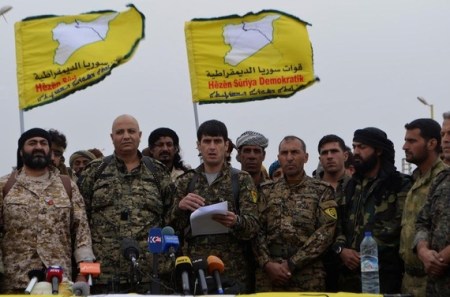
DEBKAfile’s military sources report that the US armored force landed in the middle of a complicated crisis around the important town of Manjib, ever since a mixed Kurdish-Syrian Arab force captured it from ISIS last year with US air and military support.

A few days ago, the Kurdish YPG militia handed over some of the villages and military positions around the town to Russian and Syrian army units, as we revealed in an article (Monday, March 5) on ramped-up Russian-Iranian military cooperation in Syria, in the absence of American moves.

But now, as Russian units geared up to enter Manjib, the Trump administration warned Russian President Vladimir Putin that if they did move in, they would face American forces.

The Trump administration has thus taken its first direct military action in Syria to cut off the expansion of Russian forces in the North.

Our military sources reveal that the Russian units assigned to Manjib consist mainly of a Chechen commando brigade brought over by Moscow three months ago.

Our sources added:  Tuesday afternoon, President Donald Trump phoned Prime Minister Binyamin Netanyahu while he was being questioned by the police at his residence. That call almost certainly dealt with the possibility of a US-Russian military clash in Manjib, two days before Netanyahu sets out of Moscow for talks with the Russian president.

#ObamaGate Is a Lot More than a Hashtag

March 6, 2017

#ObamaGate Is a Lot More than a Hashtag, PJ MediaRoger L Simon, March 5, 2017

(Please see also, Yes, There Could Be Serious Legal Problems if Obama Admin Involved in Illegal Surveillance. — DM)

obama_security_risk_feature_4-11-16-1-sized-770x415xt

If I were a Democrat, I’d be afraid.  I’d be very afraid.

Forget the usual smokescreen of hyper-partisan blather from Chuck Schumer on “Meet the Press” or the myriad calls for Trump’s head from the usual press suspects and consider the situation:  Congressional committees, the FBI, not to mention numerous avid media organizations and who knows who else (NSA? CIA? ASPCA?) have been investigating putative Trump-Russia collusion for some time now and come up with… exactly nothing.

Are they likely to come up with something of significance at this point?  Almost certainly not.

So now we have Trump’s bold, brash, “unhinged” Twitter accusations that Obama wiretapped him.  This came after Mark Levin, Breitbart, Andrew C. McCarthy, Louise Mensch and others I’ve forgotten about or am unaware of reported about two appeals to FISA courts (one denied last summer and one approved in October) for permission to tap phones in Trump Tower. Did they happen?

It seems that tapping of some sort actually occurred because it was virtually acknowledged  in tweets from Obama speechwriter Jon Favreau,  who sprang to action only hours after Trump tweeted, writing : “I’d be careful about reporting that Obama said there was no wiretapping. Statement just said that neither he nor the WH ordered it.” Kevin Lewis, a spokesman for the former president, had almost simultaneously declared:  “Neither President Obama nor any White House official ever ordered surveillance on any U. S. citizen.”  Ordered?  That’s what we used to call plausible deniability and now is known as a wiggle word.

Trump wants this possible surveillance to be investigated along with the rest of the supposed Russia mess — the little that’s left of it to be cleared up.  Meanwhile, that Democratic Party house organ The New York Times is reporting that James Comey himself wants the Justice Department to issue a denial that such a wiretap ever existed — or so the paper’s ubiquitous “sources” say.  Of course the Times itself saw it differently only a couple of months ago. Meanwhile, former DNI James Clapper — who famously told all his fellow citizens a boldface lie about the NSA — has assured the media regarding this particular tap, “I can deny it.” (Yes, you can.)

All this while Barack and Michelle Obama, rather than graciously depart the D. C. scene in the manner of previous presidents, recent ones anyway, have moved into a local estate with their constant companion Valerie Jarrett in some kind of Ménage à Medici as if Barack never had an intention to leave and expects to serve a third term.

My guess is this will all come down to whether our former president knew about this wiretapping — whoever authorized it and wherever it came from — and, if so, when. And also how he reacted to it and what he did from there.  It’s all, in the grand Clintonian tradition, about what the definition of “ordered” is.

Interviewed on “Fox News Sunday,” Sen. Tom Cotton — as close an approximation to “Mr. Smith” as we have in Congress — was asked if the Senate Intelligence panel would address Trump’s wiretapping claim and his answer was a Jimmy Stewart-like “sure.”

Now to why, if I were a Democrat, I’d be afraid.  To explore that you don’t need to be some super-experienced attorney like Andrew McCarthy, although that doesn’t hurt.  Rusty old Occam’s Razor will do — just change the blade and ask some obvious questions somehow overlooked by the MSM in this weekend’s chat shows.  These questions, needless to say, might best be asked under oath by a congressional committee. Later, they might even have to be dealt with in a court of law, as attorney Robert Barnes details well in this article.

Would an attorney general (in this case Loretta Lynch) normally inform the White House of a decision to go to a FISA court for approval of the tapping of a political presidential opponent?  Did Ms. Lynch so inform the White House?  Was there any discussion of this decision between the WH and the DOJ?  Why did the Justice Department decide to go back to the FISA court in October for a second try at approval? Whose idea was that? Did they did have additional information?  What was that?  Was Trump’s name included in the brief the first time but omitted in the second?  Why?  If none of this happened, who made it up and why?  That makes no sense, considering how easy it would be to disprove. Unless, of course, although it’s not supposed to happen, the NSA just regularly taps everything and everybody, including presidential candidates, the president elect, and the president himself.  But why then on Jan 12 of this year, again according to the New York Times, did the Obama administration suddenly broadly extend the powers of the NSA?

I could go on, but you get the point.  The possibilities here are endless. And WikiLeaks already revealed Obama’s extensive use of wiretaps.  It’s a long list.  Nothing particularly new here except this one, if it happened, was aimed at his most important adversary in our democratic republic, threatening the very underpinnings of our country and making Nixon seem like an amateur.  No doubt the Democrats will hide behind national security, but that can only go on for so long.  People in leadership positions like Sen. Cotton are entitled to the facts — and they will get them eventually, perhaps quickly since this is a Trump administration finally, even if so many appointments are being held up.  Also — and this is what the sleaze-artists like Schumer and my own Rep. Adam Schiff know well — Trump has obviously been wiretapped up the you-know-what, probably from numerous sources.  If not, where have all these leaks come from?  Mars?

Yes, There Could Be Serious Legal Problems if Obama Admin Involved in Illegal Surveillance

March 5, 2017

Opinion | Yes, There Could Be Serious Legal Problems if Obama Admin Involved in Illegal Surveillance, Law Newz, March 4, 2017

(Speculative, because fewer than all pertinent facts are now available. However, it’s an interesting legal analysis.– DM)

obama-2-6-e1486411130362

President Trump recently tweeted claiming that former President Obama wiretapped him during his campaign. One can only imagine how nuts the media would have gone if the roles had been reversed: President Trump wiretapping either Obama or the Clintons, though his DOJ could have authority to do just that given the expansive leaks of intelligence information by Obama and Clinton supporters the last few months. Heck, he could wiretap the media at this point, legally and legitimately, as the sources of these unlawful leaks, for which Obama himself set precedent. Do liberals understand what Pandora’s Box Obama opened up by Obama using the powers of the NSA, CIA and FBI to spy on his political opponents? Even Nixon never did that.

If the stories are correct, Obama or his officials might even face prosecution. But, we are still early in all of this and there are a lot of rumors flying around so the key is if the reports are accurate. We just don’t know at this time. The stories currently are three-fold: first, that Obama’s team tried to get a warrant from a regular, Article III federal court on Trump, and was told no by someone along the way (maybe the FBI), as the evidence was that weak or non-existent; second, Obama’s team then tried to circumvent the federal judiciary’s independent role by trying to mislabel the issue one of “foreign agents,” and tried to obtain a warrant from the Foreign Intelligence Surveillance Act “courts”, and were again turned down, when the court saw Trump named (an extremely rare act of FISA court refusal of the government, suggesting the evidence was truly non-existent against Trump); and so, third, Obama circumvented both the regular command of the FBI and the regularly appointed federal courts, by placing the entire case as a FISA case (and apparently under Sally Yates at DOJ) as a “foreign” case, and then omitted Trump’s name from a surveillance warrant submitted to the FISA court, which the FISA court unwittingly granted, which Obama then misused to spy on Trump and many connected to Trump. Are these allegations true? We don’t know yet, but if any part of them are than Obama and/or his officials could face serious trouble.

Can a President be charged with a crime? Only once out of office. While in office, impeachment remains the exclusive remedy in order to avoid a single judicial branch trying to overturn an election, such as a grand jury in any part of the country could. Once out of office, a President remains immune from civil liability for his duties while President, under a 1982 decision of the United States Supreme Court. However, as the Nixon pardon attests, nothing forecloses a criminal prosecution of the President after his presidency is complete for crimes against the country. Obama, the Constitutional lawyer, should know that.

What crimes could have been committed? Ironically, for Democrats falsely accusing Attorney General Sessions, perjury and conspiracy to commit perjury, as well as intentional violations of FISA. Rather shockingly, no law currently forbids misusing the power of the presidency to spy on one’s adversaries. What the law does forbid is lying to any judicial officer to obtain any means of surveillance. What the law does forbid, under criminal penalty, is the misuse of FISA. Both derive from the protections of the Fourth Amendment itself. Under section 1809, FISA makes it a crime for anyone to either “engage in” electronic surveillance under “color of law” under FISA without following the law’s restrictions, or “disclose” or “use” information gathered from it in contravention of the statute’s sharp constrictions.

FISA, 50 USC 1801, et seq., is a very limited method of obtaining surveillance authority. The reason for its strict limits is that FISA evades the regular federal court process, by not allowing regularly, Constitutionally appointed federal judges and their magistrates to authorize surveillance the Fourth Amendment would otherwise forbid. Instead, the Chief Justice handpicks the FISA court members, who have shown an exceptional deference to the executive branch. This is because FISA court members trust the government is only bringing them surveillance about pending terror attacks or “grave hostile” war-like attacks, as the FISA statute limits itself to. Thus, a FISA application can only be used in very limited circumstances.

One important reminder about electronic surveillance. Occasionally, a law enforcement officer will hear or see or record information not allowed by the warrant, but incidental or accidental to otherwise lawful surveillance. Their job is to immediately stop listening, stop recording, and to delete such information. This is what you occasionally see in films where the agent in the van hears the conversation turn away from something criminal to a personal discussion, and the agent then turns off the listening device and stops the recording. Such films simply recognize long-standing legal practice.

FISA can only be used for “foreign intelligence information.” Now that sounds broad, but is in fact very limited under the law. The only “foreign intelligence information” allowed as a basis for surveillance is information necessary to protect the United States against actual or potential “grave” “hostile” attack, war-like sabotage or international terror. Second, it can only be used to eavesdrop on conversations where the parties to the conversation are a foreign power or an agent of a foreign power. An agent of a foreign power cannot be a United States person unless they are knowingly involved in criminal espionage. No warrant is allowed on that person unless a FISA court finds probable cause the United States person is knowingly engaged in criminal espionage. Even then, if it involves a United States person, special steps must be taken to “minimize the acquisition and retention, and prohibit the dissemination, of non publicly available information concerning un-consenting United States persons.”

This includes procedures that require they never identify the person, or the conversation, being surveilled, to the public where that information is not evidence of a particular crime. Third, the kind of information sought concerns solely information about a pending or actual attack on the country. That is why the law limits itself to sabotage incidents involving war, not any form or kind of “sabotage,” explicitly limiting itself to those acts identified in section 105 of Title 18 of the United States Code.

This bring us to Watergate-on-Steroids, or #ObamaGate. Here are the problematic aspects of the Obama surveillance on Trump’s team, and on Trump himself. First, it is not apparent FISA could ever be invoked. Second, it is possible Obama’s team may have perjured themselves before the FISA court by withholding material information essential to the FISA court’s willingness to permit the government surveillance. Third, it could be that Obama’s team illegally disseminated and disclosed FISA information in direct violation of the statute precisely prohibiting such dissemination and disclosure. FISA prohibits, under criminal penalty, Obama’s team from doing any of the three.

At the outset, the NSA should have never been involved in a domestic US election. Investigating the election, or any hacking of the DNC or the phishing of Podesta’s emails, would not be a FISA matter. It does not fit the definition of war sabotage or a “grave” “hostile” war-like attack on the United States, as constrictively covered by FISA. It is your run-of-the-mill hacking case covered by existing United States laws that require use of the regular departments of the FBI, Department of Justice, and Constitutionally Senate-appointed federal district court judges, and their appointed magistrates, not secretive, deferential FISA courts.

Out of 35,000+ requests for surveillance, the FISA court has only ever rejected a whopping 12. Apparently, according to published reports, you can add one more to that — even the FISA court first rejected Obama’s request to spy on Trump’s team under the guise of an investigation into foreign agents of a pending war attack, intelligence agents apparently returned to the court, where, it is my assumption, that they did not disclose or divulge all material facts to the court when seeking the surveillance the second time around, some of which they would later wrongfully disseminate and distribute to the public. By itself, misuse of FISA procedures to obtain surveillance is itself, a crime.

This raises the second problem: Obama’s team submission of an affidavit to to the FISA court. An application for a warrant of any kind requires an affidavit, and that affidavit may not omit material factors. A fact is “material” if it could have the possible impact of impacting the judicial officer deciding whether to authorize the warrant. Such affidavits are the most carefully drawn up, reviewed, and approved affidavits of law enforcement in our system precisely because they must be fully-disclosing, forthcoming, and include any information a judge must know to decide whether to allow our government to spy on its own. My assumption would be that intelligence officials were trying to investigate hacking of DNC which is not even a FISA covered crime, so therefore serious questions arise about what Obama administration attorneys said to the FISA court to even consider the application. If the claim was “financial ties” to Russia, then Obama knew he had no basis to use FISA at all.

Since Trump was the obvious target, the alleged failure to disclose his name in the second application could be a serious and severe violation of the obligation to disclose all material facts. Lastly, given the later behavior, it is evident any promise in the affidavit to protect the surveilled information from ever being sourced or disseminated was a false promise, intended to induce the illicit surveillance. This is criminalized both by federal perjury statutes, conspiracy statutes, and the FISA criminal laws themselves.

That raises the third problem: it seems the FISA-compelled protocols for precluding the dissemination of the information were violated, and that Obama’s team issued orders to achieve precisely what the law forbids, if published reports are true about the administration sharing the surveilled information far-and-wide to promote unlawful leaks to the press. This, too, would be its own crime, as it brings back the ghost of Hillary’s emails — by definition, FISA information is strictly confidential or it’s information that never should have been gathered. FISA strictly segregates its surveilled information into two categories: highly confidential information of the most serious of crimes involving foreign acts of war; or, if not that, then information that should never have been gathered, should be immediately deleted, and never sourced nor disseminated. It cannot be both.

Recognizing this information did not fit FISA meant having to delete it and destroy it. According to published reports, Obama’s team did the opposite: order it preserved, ordered the NSA to search it, keep it, and share it; and then Obama’s Attorney General issued an order to allow broader sharing of information and, according to the New York Times, Obama aides acted to label the Trump information at a lower level of classification for massive-level sharing of the information. The problem for Obama is simple — if it could fit a lower level of classification, then it had to be deleted and destroyed, not disseminated and distributed, under crystal clear FISA law. Obama’s team’s admission it could be classified lower, yet taking actions to insure its broadest distribution, could even put Obama smack-middle of the biggest unlawful surveillance and political-opponent-smear campaign since Nixon. Except even Nixon didn’t use the FBI and NSA for his dirty tricks.

Watergate would have never happened if Nixon felt like he could just ask the FBI or NSA to tape the calls. This is Hoover-esque abuses of the kind Bob Woodward pal, former FBI Assistant Director Mark Felt (otherwise known as Deep Throat), routinely engaged in at the FBI until convicted and removed from office. (You didn’t know that Deep Throat was really a corrupt part of Deep State, did you? Guess who ran the famous COINTELPRO? That’s right — Deep Throat. How would the public have reacted if they knew the media had been in bed with the deep state all the way back then? Maybe that was the reason Woodward, Bernstein and Bradley kept Deep Throat’s identity secret all those years?)

Democrats may regret Sessions’ recusal, as his replacement is a mini-Sessions: a long-respected, a-political, highly ethical prosecutor, Dana Boente, whose reputation is well-warranted from his service at the Tax Division, and who won’t be limited by any perceived ties to Trump, given his prior appointment by Obama. Obama himself appeared scared of Boente, as he removed Boente from the successor-to-Sessions position during the lame-duck part of Obama’s presidency, but Trump restored Boente to that role earlier this month. Democrats may get the investigation they wanted, but it may be their own that end up named in the indictment.

Robert Barnes is a California-based trial attorney whose practice focuses on tax defense, civil rights and First Amendment law. You can follow him at @Barnes_Law

Putin ramps up Syria pact with Iran in US absence

March 5, 2017

Putin ramps up Syria pact with Iran in US absence, DEBKAfile, March 5, 2017

sdf_3-17

Constantly bombarded by allegations that his campaign associated with Russian intelligence, US President Donald Trump has held back from going through with his original plan for teaming up with Moscow in Syria for the important campaigns of wiping out the Islamic State and relieving Syria of Iran’s iron grip.

His entire Middle East policy is up in the air, while he grapples with domestic foes. The much talked-of US coalition with its regional allies, Saudi Arabia, Egypt, Jordan and Israel, is also in abeyance.

Amid the uncertainty about the Trump administration’s future steps, Prime Minister Binyamin Netanyahu is unlikely to make much headway in his talks with Russian President Vladimir Putin in Moscow on Thursday, March 9,

DEBKAfile’s intelligence and military sources report that, even if does persuade Putin to stick to his promise to prevent Iran and Hizballah from deploying troops on the Syrian-Israeli border opposite the Golan, he won’t get far in his bid to prevent Iran from establishing a permanent military and naval presence in Syria.

This is the situation stacking up against Netanyahu:

1. The Trump administration has decided not to decide on Middle East policy – and Syria, in particular – while engaged in dodging his domestic enemies’ Russian arrows.

2. Some of the president’s advisers maintain that the state of indecision in Washington may turn out into an advantage. It might not be a bad thing for Moscow to carry the heavy lifting of tackling ISIS, Iran and Hizballah, rather than putting US troops in harm’s way.

3. Putin is not waiting for Trump and is already on the move, DEBKAfile’s sources report.

Friday, March 3, Russian special operations units recovered the Syrian town of Palmyra from the Islamic State.

That day too, the Syrian Democratic Forces (SDF), composed predominantly of the Syrian Kurdish YPG militia and Arab tribesmen from the north, agreed to hand over their positions in the strategic town of Manjib to the Russians and the Syrian army,

The SDF was created, trained, armed and funded by the United States as the potential spearhead force for the offensive against the Islamic State. This force was able to last year to capture the small (pop: 50,000) northern town of Manjib, 30km west of the Euphrates, thanks only to US aerial bombardments of ISIS positions and American advisers.

How come that this important US ally suddenly surrendered its positions to the Russians and Assad’s army?

There is more than one reason. Firstly, the SDF’s Kurdish and Arab commanders apparently decided to give up on waiting for Washington to come round, especially since the only weapons they had received from the Obama administration for fighting ISIS were Kalashnikov AK-74 rifles.

Moreover, the Kurds’ most implacable arch enemy is breathing down their necks. On March 1, Turkish President Tayyip Erdogan threatened to order his army, which has occupied northern Syria since last year, to seize Manjib. He said: “Manjib is a city that belongs to the Arabs and the SDF must not be in Raqqa either.”

The Kurdish-Arab force decided to take the Turkish leader at his word. Believing him to be close to Trump, its leaders decided their services were being dispensed with. They saw no point therefore in wasting and risking their troops in battles in the US interest.  In this situation, Moscow looked like a better bet.

DEBKAfile’s military sources stress that, when the Russians say they are working with the Syrian army, they really mean the Iranian Revolutionary Guards, the pro-Iranian Shiite militias and Hizballah, because most Syrian army’s units were decimated by nearly six years of civil war, or exist only on paper.

That being so, even if Putin does promise Netanyahu to distance Iranian and pro-Iranian troops from the Syrian-Israeli border, he may not be in a position to honor his pledge. With the Americans far away, they are Russia’s main partners on the ground for achieving his future goals in Syria.

Did the Obama Administration Try Stacking the Deck Against Trump at the Justice Department?

March 4, 2017

Did the Obama Administration Try Stacking the Deck Against Trump at the Justice Department? Weekly StandardMark Hemingway, March 3, 2017

Amid Thursday’s over-hyped brouhaha about Jeff Sessions meeting with the Russian ambassador, a curious detail emerged. In Sessions’ recusal memo, it was explained who at the Justice Department would be handling any investigations into the Trump campaign’s alleged ties to Russia. “Consistent with the succession order for the Department of Justice, Acting Deputy Attorney General and U.S. Attorney for the Eastern District of Virginia Dana Boente shall act as and perform the functions of the Attorney General with respect to any matters from which I have recused myself to the extent they exist,” reads Sessions’ official statement on the matter.

Except that if the Obama administration had its way, Dana Boente wasn’t supposed to be the U.S. attorney to handle these matters in the event that Sessions recused himself. On February 10, USA Today reported the following:

Seven days before he left office, President Obama changed the order of succession without explanation to remove Boente from the list. Obama’s order had listed U.S. attorneys in the District of Columbia, the Northern District of Illinois and the Central District of California.

Why would the Obama administration make this eleventh-hour change to the line of succession at the Justice Department? “At the time, I was told it was done in consultation with Trump transition,” Gregory Korte, the USA Today reporter who wrote the story quoted above, told me Thursday. “Looking back, that’s clearly not the case.”

In fact, it seems like it was quite obviously not the case. The man Obama placed at the head of the line of succession is D.C.’s U.S. Attorney Channing Phillips, who is quite cozy with President Obama and his attorney general, Eric Holder. He is a former senior adviser to Holder, and he stayed on to work under Obama’s next AG Loretta Lynch before Obama appointed Phillips D.C.’s U.S. attorney in 2015. But Phillips goes way back with Holder—Holder first hired Philips in the D.C. U.S. Attorney’s Office in 1994. It’s also safe to say that the AG offices in the Northern District of Illinois and the Central District of California are not hotbeds of Trump supporters.

It looks like the Obama administration was hoping that the reins of power here would unknowingly default to someone unfriendly to Trump in the event Sessions was forced to recuse himself—or even resign, as so many Democrats breathlessly demanded Thursday. (It’s worth noting that Sessions’s claims that he was already considering recusing himself from the Russia investigations because of his role on the campaign seem pretty sincere. Reuters reported last Sunday that the White House was considering the need for Sessions’s recusal long before the teacup tempest about Sessions failing to disclose minor encounters with the Russian ambassador.)

This might seem far-fetched, except to say that the leak-coordinated campaign by former Obama officials to undermine Trump seems to be very real, per the reporting of Lee Smith. Indeed, the New York Times reported Thursday, “In the Obama administration’s last days, some White House officials scrambled to spread information about Russian efforts to undermine the presidential election — and about possible contacts between associates of President-elect Donald J. Trump and Russians — across the government.”


Mark Levin to Congress: Investigate Obama’s ‘Silent Coup’ vs. Trump

March 4, 2017

Mark Levin to Congress: Investigate Obama’s ‘Silent Coup’ vs. Trump, Breitbart, Joel B. Pollak, March 3, 2017

obamacanwalkThe Associated Press

In summary: the Obama administration sought, and eventually obtained, authorization to eavesdrop on the Trump campaign; continued monitoring the Trump team even when no evidence of wrongdoing was found; then relaxed the NSA rules to allow evidence to be shared widely within the government, virtually ensuring that the information, including the conversations of private citizens, would be leaked to the media.

**************************

Radio host Mark Levin used his Thursday evening show to outline the known steps taken by President Barack Obama’s administration in its last months to undermine Donald Trump’s presidential campaign and, later, his new administration.

Levin called Obama’s effort “police state” tactics, and suggested that Obama’s actions, rather than conspiracy theories about alleged Russian interference in the presidential election to help Trump, should be the target of congressional investigation.

Drawing on sources including the New York Times and the Washington Post, Levin described the case against Obama so far, based on what is already publicly known. The following is an expanded version of that case, including events that Levin did not mention specifically but are important to the overall timeline.

1. June 2016: FISA request. The Obama administration files a request with the Foreign Intelligence Surveillance Court (FISA) to monitor communications involving Donald Trump and several advisers. The request, uncharacteristically, is denied.

2. July: Russia joke. Wikileaks releases emails from the Democratic National Committee that show an effort to prevent Sen. Bernie Sanders (I-VT) from winning the presidential nomination. In a press conference, Donald Trump refers to Hillary Clinton’s own missing emails, joking: “Russia, if you’re listening, I hope you’re able to find the 30,000 e-mails that are missing.” That remark becomes the basis for accusations by Clinton and the media that Trump invited further hacking.

3. October: Podesta emails. In October, Wikileaks releases the emails of Clinton campaign chair John Podesta, rolling out batches every day until the election, creating new mini-scandals. The Clinton campaign blames Trump and the Russians.

4. October: FISA request. The Obama administration submits a new, narrow request to the FISA court, now focused on a computer server in Trump Tower suspected of links to Russian banks. No evidence is found — but the wiretaps continue, ostensibly for national security reasons, Andrew McCarthy at National Review later notes. The Obama administration is now monitoring an opposing presidential campaign using the high-tech surveillance powers of the federal intelligence services.

5. January 2017: Buzzfeed/CNN dossier. Buzzfeed releases, and CNN reports, a supposed intelligence “dossier” compiled by a foreign former spy. It purports to show continuous contact between Russia and the Trump campaign, and says that the Russians have compromising information about Trump. None of the allegations can be verified and some are proven false. Several media outlets claim that they had been aware of the dossier for months and that it had been circulating in Washington.

6. January: Obama expands NSA sharing. As Michael Walsh later notes, and as the New York Times reports, the outgoing Obama administration “expanded the power of the National Security Agency to share globally intercepted personal communications with the government’s 16 other intelligence agencies before applying privacy protections.” The new powers, and reduced protections, could make it easier for intelligence on private citizens to be circulated improperly or leaked.

7. January: Times report. The New York Times reports, on the eve of Inauguration Day, that several agencies — the Federal Bureau of Investigation (FBI), the Central Intelligence Agency (CIA), the National Security Agency (NSA) and the Treasury Department are monitoring several associates of the Trump campaign suspected of Russian ties. Other news outlets also report the exisentence of “a multiagency working group to coordinate investigations across the government,” though it is unclear how they found out, since the investigations would have been secret and involved classified information.

8. February: Mike Flynn scandal. Reports emerge that the FBI intercepted a conversation in 2016 between future National Security Adviser Michael Flynn — then a private citizen — and Russian Ambassador Sergey Kislyak. The intercept supposedly was  part of routine spying on the ambassador, not monitoring of the Trump campaign. The FBI transcripts reportedly show the two discussing Obama’s newly-imposed sanctions on Russia, though Flynn earlier denied discussing them. Sally Yates, whom Trump would later fire as acting Attorney General for insubordination, is involved in the investigation. In the end, Flynn resigns over having misled Vice President Mike Pence (perhaps inadvertently) about the content of the conversation.

9. February: Times claims extensive Russian contacts. The New York Times cites “four current and former American officials” in reporting that the Trump campaign had “repeated contacts with senior Russian intelligence officials. The Trump campaign denies the claims — and the Times admits that there is “no evidence” of coordination between the campaign and the Russians. The White House and some congressional Republicans begin to raise questions about illegal intelligence leaks.

10. March: the Washington Post targets Jeff Sessions. The Washington Postreports that Attorney General Jeff Sessions had contact twice with the Russian ambassador during the campaign — once at a Heritage Foundation event and once at a meeting in Sessions’s Senate office. The Post suggests that the two meetings contradict Sessions’s testimony at his confirmation hearings that he had no contacts with the Russians, though in context (not presented by the Post) it was clear he meant in his capacity as a campaign surrogate, and that he was responding to claims in the “dossier” of ongoing contacts. The New York Times, in covering the story, adds that the Obama White House “rushed to preserve” intelligence related to alleged Russian links with the Trump campaign. By “preserve” it really means “disseminate”: officials spread evidence throughout other government agencies “to leave a clear trail of intelligence for government investigators” and perhaps the media as well.

In summary: the Obama administration sought, and eventually obtained, authorization to eavesdrop on the Trump campaign; continued monitoring the Trump team even when no evidence of wrongdoing was found; then relaxed the NSA rules to allow evidence to be shared widely within the government, virtually ensuring that the information, including the conversations of private citizens, would be leaked to the media.

Levin called the effort a “silent coup” by the Obama administration and demanded that it be investigated.

In addition, Levin castigated Republicans in Congress for focusing their attention on Trump and Attorney General Sessions rather than Obama.

U.S. Senator Colludes With Russians to Influence Presidential Election

March 3, 2017

U.S. Senator Colludes With Russians to Influence Presidential Election, PJ MediaJ. Christian Adams, March 2, 2017

kennedy-sized-770x415xc

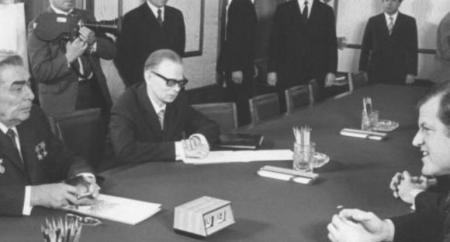
Yes, a United States senator really did collude with the Russians to influence the outcome of a presidential election.  His name was Ted Kennedy.

While Sen. Al Franken (D-Ringling Bros.) and other Democrats have the vapors over a truthful, complete, and correct answer Attorney General Jeff Sessions gave in his confirmation hearing, it’s worth remembering the reprehensible behavior of Senator Ted Kennedy in 1984.

This reprehensible behavior didn’t involve launching an Oldsmobile Delmont 88 into a tidal channel while drunk.  This reprehensible behavior was collusion with America’s most deadly enemy in an effort to defeat Ronald Reagan’s reelection.

You won’t hear much about that from CNN and the clown from Minnesota.

To recap, from Forbes:

Picking his way through the Soviet archives that Boris Yeltsin had just thrown open, in 1991 Tim Sebastian, a reporter for the London Times, came across an arresting memorandum. Composed in 1983 by Victor Chebrikov, the top man at the KGB, the memorandum was addressed to Yuri Andropov, the top man in the entire USSR. The subject: Sen. Edward Kennedy.

Kennedy’s message was simple. He proposed an unabashed quid pro quo. Kennedy would lend Andropov a hand in dealing with President Reagan. In return, the Soviet leader would lend the Democratic Party a hand in challenging Reagan in the 1984 presidential election. “The only real potential threats to Reagan are problems of war and peace and Soviet-American relations,” the memorandum stated. “These issues, according to the senator, will without a doubt become the most important of the election campaign.”

Among the promises Kennedy made the Soviets was he that would ensure that the television networks gave the Soviet leader primetime slots to speak directly to the American people, thus undermining Reagan’s framing of the sinister nature of the USSR.  Event then, the Democrats had the power to collude with the legacy media.  Kennedy also promised to help Andropov penetrate the American message with his Soviet agitprop.

That’s right, folks.  Even 30 years ago, Democrat senators were colluding with America’s enemies to bring down Republicans.

And no, Jeff Sessions didn’t perjure himself.  It’s not even a close call.

So now they are after Jeff Sessions instead of Ronald Reagan.   Ideological comrades throughout the Justice Department are helping out this time.  Just before Trump’s inauguration, the Obamites widely distributed intelligence information throughout the Department of Justice, where their political comrades could be counted on to leak the information after January 20.

This is a problem that will plague President Trump and General Sessions until they drain the swamp at the Justice Department — something that isn’t even close to getting started.  Ideological leftists throughout the DOJ are serving as agents of the Obama regime and undermining the new administration.

For example, even now, the front office at the Civil Rights Division is largely made up of Obama holdovers and “permanent career political” appointees.  The Obamaites expanded the number of deputy assistant attorney general slots throughout the Department of Justice and populated them with the most reliably radical people.  They also appointed swarms of radicals into political offices on January 18 to “assist” the transition.  They, too, are still there watching, observing, and probably “reporting.”

Nobody thinks the noise about Jeff Sessions is a substantive issue. Eric Holder was found in criminal contempt of Congress and there wasn’t a fraction of the sanctimonious outrage from Democrats and CNN like we see today.

Today’s Justice Department drama is a tactic by Democrats to personalize and polarize a target.  It is a strategy to make Jeff Sessions devote time and energy to this instead of protecting America from foreign influences and cleaning up the Justice Department from the lawless rot that Obama caused.  The Democrats prefer the lawless rot, so they want Sessions to be diverted from his job.

Of course the leaks are going to continue until the new administration has the guts to clean the place out of all the radicals that were embedded there.

Leaks are pouring out over large and small matters because so far nobody is afraid of crossing the new administration.  The attacks on Sessions started when some of his own employees decided to leak intelligence information — just like happened to General Flynn.  It will continue unless the administration realizes the media isn’t the only gang in Washington opposed to the interests of the American people.

Iraq hits ISIS in Syria – with Russia, without US

February 25, 2017

Iraq hits ISIS in Syria – with Russia, without US, DEBKAfile, February 25, 2017

If indeed President Donald Trump gave a quiet nod to the four-way Russian-Iranian-Syrian-Iraqi military partnership for fighting this enemy, it would signify the start of US-Russian cooperation for the war on Islamic terror in the Middle East and mean that the two powers were running local forces hand in hand.

But if the Iraqis chose to work in conjunction with Moscow and Tehran, cutting America out, that is a completely different matter. It would indicate that President Vladimir Putin, having noted Trump’s difficulties in lining up his team for a deal with Moscow – and the opposition to this deal he faces from his intelligence agencies – had given up on the US option and was going forward in Syria and Iraq with Tehran instead.

****************************

The Iraqi air force Friday, Feb. 24, conducted its first ever bombardment of the Islamic State in Syria. The target was the southeastern town of Abu Kemal near the Iraqi border, to which ISIS has removed most of its command centers from its main Syrian stronghold in Raqqa. Iraqi Defense Ministry spokesman Brig. Gen. Tahseen Ibrahim stated that Baghdad had coordinated the attack with Moscow, Damascus and Tehran using shared intelligence.

When he was asked if the United State military was involved, he said he did not know.

Likewise, in referring to the Abu Kemal attack, Iraqi Prime Minister Haydar al-Abadi said: “We are determined to follow the terrorism that is trying to kill our sons and our citizens everywhere.” He made no mention of the United States, despite ongoing US support for the Iraqi army’s long offensive to retake Mosul from ISIS.

This omission is of pivotal importance for the future of the war on the Islamic State and America’s involvement in that campaign.

If indeed President Donald Trump gave a quiet nod to the four-way Russian-Iranian-Syrian-Iraqi military partnership for fighting this enemy, it would signify the start of US-Russian cooperation for the war on Islamic terror in the Middle East and mean that the two powers were running local forces hand in hand.

But if the Iraqis chose to work in conjunction with Moscow and Tehran, cutting Ameica out, that is a completely different matter. It would indicate that President Vladimir Putin, having noted Trump’s difficulties in lining up his team for a deal with Moscow – and the opposition to this deal he faces from his intelligence agencies – had given up on the US option and was going forward in Syria and Iraq with Tehran instead.

The Iraqi prime minister’s actions in this regard must have been critical. He may be playing a double game – working with the US commander in Iraq and Syria, Lt. Gen. Stephen Townsend, for the capture Mosul from the jihadis, while at the same time, using Russian and Iranian partners on other anti-ISIS fronts.

DEBKAfile’s military and counterterrorism sources say that in any event the Iraqi air strike presented a major affront to President Donald Trump’s avowed determination to fight radical Islamic terror to the finish. Its timing is unfortunate: Defense Secretary Gen. James Mattis and Joint Chiefs of Staff Chairman Gen. Joseph Dunford are due Monday to submit the review the president commissioned from the Pentagon on policy planning for Syria and the war on terror. Trump’s foreign policy address to Congress is scheduled for the next day.

If the Pentagon’s recommendations hinge on the enlistment of regional military strength for the campaign against ISIS, then Moscow will be seen to have snatched the initiative first.

There are more signs that the war on ISIS may be running away from Washington. The Trump administration has made it clear that it objects to any role for the Turkish army in the offensive to capture Raqqa from ISIS. However, on Saturday, Turkish Foreign Minister Mevlut Cavusoglu, after hailing the victory of the Turkish army over ISIS in the northern Syrian town of Al-Bab, announced that Turkey was planning to lead an operation for the recovery of Raqqa, in cooperation with… France, Britain and Germany, after holding consultations with their representatives. America was not mentioned.

Off Topic | Wayne Barrett, Donald Trump, and the Death of the American Press

February 23, 2017

Wayne Barrett, Donald Trump, and the Death of the American Press, Tablet MagazineLee Smith, February 23, 2017

(Please see also, Off Topic:  A Purblind Press, Unable To Admit Error, Boycotts the President. — DM)

How did we get from ‘Village Voice’ reporters digging up everything there is to know about a flashy New York real estate salesman to not knowing anything about the President of the United States and his ties to Russia?

So when does the other shoe drop? Who’s going to break the story proving beyond a shadow of a doubt that the president of the United States is so deeply connected to Russian President Vladimir Putin that the White House has become a Muscovite colony in all but name?

Time to use some common sense—it’s not going to happen, there is no story. The narrative that Donald Trump is effectively Putin’s prison wife is an information operation orchestrated by Democratic hands, many of whom served in the Obama administration, sectors of the intelligence community, and much of the American press. The purpose of the campaign is to delegitimize Trump’s presidency by continuing to hit on themes drawn from the narrative that Russia “hacked” the election and stole it away from Clinton.

The narrative is contorted because it’s not journalism. It’s a story that could only make sense in a profoundly corrupted public sphere, one in which, for instance, Graydon Carter is celebrated for speaking truth to power with an editor’s letter critical of Trump in a magazine that has no other ontological ground in the universe except to celebrate power.

Oh, sure, there are regular hints that there’s still more to come on Trump and his staff’s ties to Russia—the big one is about to hit. But the steady sound of drip-drip-drip is the telltale sign of a political campaign, where items are leaked bit by bit to paralyze the target. Journalists, on the other hand, have to get their story out there as quickly, and as fully, as possible because they’re always worried the competition is going to beat them to it.

No, if Trump really was in bed with the Russians, the story would already be out there, and I’m pretty sure it would have had a Wayne Barrett byline.

When I worked at the Village Voice in the mid-1990s, my office was right around the corner from Barrett’s and his bullpen of interns, a team that kept the heat on local politicians like Rudy Giuliani, Ed Koch, and others. Barrett was the first journalist who wrote at length about Trump, starting in the mid-1970s. His biography, Trump: The Deals and the Downfall, was published in 1992, and reissued in 2016 as Trump: The Greatest Show on Earth: The Deals, the Downfall, the Reinvention.

When Trump won the nomination and the pace of Trump stories picked up, Barrett became something of an official archivist, with reporters visiting his Brooklyn house to go through his files in the basement. Anyone who wanted to know what Trump’s deal with Russia was, for instance, would want to talk to Barrett because either he or his team of interns, 40 years’ worth, would have it. After all, New York City is the world capital for information on Russians, even better than Israel—because even though the city got a smaller number of post-Cold War immigrants, New York got a higher percentage of mobsters.

Let’s compare the institution of Wayne Barrett, a subset of the institution of journalism, to the so-called Russia dossier, the document placing Trump in a shady underworld governed by Putin and other Russian thugs. The former includes not only Barrett’s body of work over nearly half a century, but that of the hundreds of journalists he trained, and many thousands of sources whose information is, therefore, able to be cross-checked.

The latter, a congeries of preadolescent pornographic fantasy and spy tales, was authored by a British intelligence officer who has gone to ground since the dossier was made public. The dossier started as work made for hire, first paid for by Republican opponents of Trump and then the Clinton camp, and is sourced to Russian “contacts” who are clearly using the document as an opportunity to proliferate an information operation for perhaps various and as yet unknown purposes. The former is journalism. The latter, part oppo research and part intelligence dump, is garbage. Clearly, it is also the new standard in the field, which is why journalists on both sides of the political spectrum are boasting about their willingness to let their bylines be used as bulletin boards for spy services and call it a “scoop.”

Barrett had Trump on a whole variety of issues, but check the records yourself—up until the day of his death, the day before Trump’s inauguration, there’s nothing on Trump and Putin. Does this mean Trump is totally clean? Who knows? But the journalists now clamoring like maniacs about Trump’s ties sure aren’t going to find it. They’re thin-skinned hacks outraged that Trump dared violate the inherent dignity of that most important of American political institutions, the presidential press conference. And as we all know, this is the apex of real journalism, where esteemed members of the press sit side by side with other masters of the craft to see who gets their question televised.

Does Trump really believe the media are “an enemy of the people”? Please. Let’s remember how he rode his wave to fame on the back of the New York Post’s Page Six (and Graydon Carter’s Spy magazine). He still speaks regularly to the head of CNN (aka “Fake News”), Jeff Zucker, who put him on The Apprentice and Celebrity Apprentice at NBC, where Trump sat atop the Nielsens for 13 years. Trump uses his Twitter feed to boost his replacement Arnold Schwarzenegger’s ratings because the president still has a credit as executive producer. No, Trump, doesn’t hate the media. Like Howard Stern, he sees himself as the king of all media. What he’s doing here is playing gladiator in front of an audience that wants to see the lions slain.

Maybe Trump deserves the heat with the fake Russia stories. He backed the Obama birth certificate story, and what goes around comes around. But the American public sure doesn’t deserve a press like this.

Trump adviser Steve Bannon calls the media the opposition party, but that’s misleading. Everyone knows that the press typically tilts left, and no one is surprised, for instance, that The New York Times has not endorsed a Republican candidate since 1956. But that’s not what we’re seeing now—rather, the media has become an instrument in a campaign of political warfare. What was once an American political institution and a central part of the public sphere became something more like state-owned media used to advance the ruling party’s agenda and bully the opposition into silence. Russia’s RT network, the emir of Qatar’s Al Jazeera network—indeed, all of the Arab press—and media typically furnished by Third World regimes became the American press’ new paradigm; not journalism, but information operation.

How did this happen? It’s not about a few journalists, many of whom still do honor to the profession, or a few papers or networks. It’s a structural issue. Much of it is because of the wounds the media inflicted on itself, but it was also partly due to something like a natural catastrophe that no one could have predicted, or controlled.

***

I was at the Voice when the meteor hit. Like many papers back then, dailies and weeklies, the Voice made its money on classified advertising. The New York Times, for instance, had three important classifieds sections—employment, automotive, and housing—but if New Yorkers really wanted to find a great apartment, they’d line up at the newsstand on 42nd Street to get a copy of the Voice hot off the press.

And then the internet came along, and it was all there in one place—for free. The press panicked. The Voice’s publisher at the time, David Schneiderman, announced to the staff that the paper was going free. It made no sense, he argued, to keep charging $1 for what consumers could get on the internet for nothing.

Here’s how the staff heard it: Who would want to pay $1 a week to read Nat Hentoff on civil liberties, Robert Christgau on music, Michael Musto on New York nightlife—or Wayne Barrett on the follies of real-estate mogul Donald Trump? That is, who would want to pay $1 a week to feel themselves a part of what the Village Voice had made them feel part of for decades? But at the time, devaluing content was in fashion—which meant, as few saw back then, the profession was digging its own grave.

The American press’ new paradigm: not journalism, but information operation.

In midtown, Tina Brown had taken The New Yorker, a notoriously sleepy rag that entry-level assistants stacked in a corner of their studio apartments to spend a rainy Saturday with a 10,000-word Ved Mehta article, and turned it into a hot book that everyone from Bill and Hillary Clinton to Harvey and Bob Weinstein was talking about. “Buzz” was Tina’s catchword, and she made her writers stars. But something else was happening on the business side that wasn’t good for the content providers.

Before Brown, The New Yorker made its money by selling the magazine to readers who wanted to feel like a part of the world only The New Yorker made available, a cozy world reflected by the modest, but very profitable, number of subscriptions, which hovered around 340,000. Advertising was an afterthought. It may have been the only magazine in history at which the business side held ads because there wasn’t space for them, or because, well, Mr. Shawn might not like them.

Condé Nast owner Si Newhouse, who bought The New Yorker in 1985, and publisher Steve Florio turned the business model on its head when Brown came on in 1992. Forget about making readers pay for content; instead, bill advertisers for access to your readers—charge them for eyeballs. They slashed the subscription price dramatically and readership swelled by many hundreds of thousands. This enabled the sales team to bump up ad rates to levels on par with other Condé Nast glossies, essentially fashion catalogs, that enjoyed much larger readerships, like Vogue, GQ, and Glamour.

The paradox was that The New Yorker lost money because each of the new subscriptions was costly. Paper, printing, and postage are expensive, and even the new ad rates couldn’t cover the costs now that circulation had grown to something like 800,000—not monthly like Vogue, but weekly.

Instead of paying for the cost of high-level reporting and editing, subscribers now cost The New Yorker money. In Brown’s last year at the magazine, The New Yorker lost $10 million—a giant black hole that her successor would endeavor mightily to fill while retaining the magazine’s new subscribers, who had little knowledge of or attachment to the magazine’s prior mix of literary reporting and sophisticated whimsy. If the subscribers didn’t feel interested and flattered, the magazine was sunk.

With a new media model that devalued content, no one had a very clear picture of the problems ahead. The future was further obscured by what seemed to be an astonishing reflorescence of the press, with tiny internet startups throwing lavish parties in Manhattan bistros and paying writers Condé Nast-level fees. The internet was the messiah, everything was great—until the IT bubble burst and media giants like TimeWarner stopped throwing money at a platform they didn’t understand. So now who was going to pay?

For the next decade, the media couldn’t decide which slogan of the moment carried more weight—“content is king” or “information wants to be free.” Sure, you can give away “information,” but someone has to find some way to cover expenses, and yet no one had figured out how to make internet advertising work. Maybe you really could charge for content. Of course you could—The New Yorker had done it for decades.

Even if you bring your own glass to a lemonade stand, there is no 8-year-old entrepreneur who is not going to charge you for his product. Why didn’t media grandees get it? When they saw their ad-based business model collapse, why didn’t they do the logical thing and raise the price on consumers? Sure, they’d lose some readers and have to cut some staff and departments, but they’d have established a fundamental defense of the product, the industry, and the institution itself—news is worth paying for.

As the old Chinese saying has it, the first generation builds the business, the second generation expands it, and the third spends it all on Italian shoes, houses in the Hamptons, and divorces. For the most part, the people inheriting these media properties didn’t know what they were doing. It took The New York Times more than a decade to settle on billing consumers for its product—after giving it away, charging for it, giving it away again, then billing for “premium content,” etc. By then, it was too late. Entire papers went under, and even at places that survived, the costliest enterprises, like foreign bureaus and investigative teams, were cut. An entire generation’s worth of expertise, experience, and journalistic ethics evaporated into thin air.

In January, Bannon told the Times that the press doesn’t “understand this country. They still do not understand why Donald Trump is the president of the United States.” But the Times had already acknowledged its blunder in a letter to its readers after the election. However, neither Bannon nor the Times seemed to grasp the logistical reasons for the failure—it wasn’t because the paper of record slants left, or because it was too caught up in its own narrative. It’s in large part because it had long ago cut the regional bureaus in the South, the Midwest, etc., that would’ve forced reporters to speak to Americans outside the urban bubble and thereby explain to readers what the world looks like once you wander off the F train.

By the time two planes brought down the World Trade Center towers in September of 2001, everyone in the industry knew the media was in big trouble. The Iraq War partially hid and then later amplified that fact. The media spent millions it didn’t have for coverage it gave away free of a war that the press first supported and then turned against. If journalists prided themselves on their courageous about-faces, to much of their audience it further discredited a press whose main brief is not to advocate for or against, but to report facts.

This is the media environment that Barack Obama walked into—where Post columnist David Ignatius was no more important a media figure than Zach Galifianakis, on whose precious and often funny internet show Between Two Ferns the president marketed the Affordable Care Act. I suspect the Obama White House was a little sad that the press we’d all grown up with was basically dead. As Ben Rhodes, former national security adviser for strategic communications, told The New York Times Magazine, “I’d prefer a sober, reasoned public debate, after which members of Congress reflect and take a vote. But that’s impossible.”

He was right. What was once known as the prestige media became indistinguishable from the other stuff that Facebook gives away. Was it The New York Times or BuzzFeed that published that video about cats terrorized by cucumbers? Or was it Fake News because, in fact, cats aren’t scared of vegetables? It doesn’t matter where it came from, because there is no longer any hierarchy in the press. The media, as Thomas Friedman might say, is flat.

Obama didn’t kill journalism, but he took advantage of it in its weakness, because he knew the press would do anything to feel relevant again. All those 27-year-olds at the Times, the Washington Post and others hired as bloggers—“who literally know nothing,” as Rhodes told the Times Magazine—when the foreign and national bureaus were closed, they didn’t know it wasn’t OK to be a journalist and a political operative at the same time. They thought it made them more valuable, even patriotic, to put themselves in the service of a historic presidency. And they’d replaced for pennies on the dollar all the adults who could have taught them otherwise.

That’s the raw material out of which the Obama administration built its echo chamber, the purpose of which was to drown out the few remaining vestiges of journalism in order to sell the president’s policies. And there really were real journalists still putting in the hours, still doing the work, but the echo chamber, a relentless, frenzied chorus of incoherent and nearly illiterate prose, shouted them down.

Yes, it would have been nice if the American public had a chance to discuss a policy of vital importance to our national security, like the Iran nuclear deal, but the press congratulated itself for silencing those who dissented from Obama’s signature foreign-policy initiative. These weren’t simply critics or opponents of the White House, they weren’t just wrong; no, they were warmongers, beholden to donors and moneyed interests and lobbies, they were dual loyalists.

But it was all OK for the press to humiliate and threaten Obama’s opponents in accordance with the talking points provided by Obama administration officials—they were helping the president prevent another senseless war. That’s for history to decide. What everyone saw at the time was that the press had put itself in the service of executive power. This was no longer simply tilting left, rather, it was turning an American political institution against the American public.

Now with Trump in the White House, commentators on the right are critical of those angry with the press for calling out Trump on the same stuff that Obama got away with. Let’s be above it, they argue. Just because Obama did it doesn’t make it OK for Trump to do it. Fine, obviously, call out Trump—but this isn’t about playing gotcha. It’s about a self-aggrandizing press corps gaslighting the electorate. The public is astonished and appalled that the media has now returned after an eight-year absence to arrogate to itself the role of conscience of the nation.

It’s not working out very well.

Consider the Washington Post, whose new motto is “Democracy Dies in Darkness,” which presumably was OK’d by owner Jeff Bezos, the man who closed virtually every independent bookstore in America. Here’s a recent story about riots in Sweden:

Just two days after President Trump provoked widespread consternation by seeming to imply, incorrectly, that immigrants had perpetrated a recent spate of violence in Sweden, riots broke out in a predominantly immigrant neighborhood in the northern suburbs of the country’s capital, Stockholm.

You’ve probably never seen the phrase “seeming to imply” in the lede of a story in a major American newspaper before—a news story. So did Trump imply, or seem to imply? How are readers supposed to parse “incorrectly” if the story is about the reality of riots in a place where Trump “seemingly” “implied” there was violence? So what’s the point—that Trump is a racist? Or that Trump can see the future?

The press at present is incapable of reconstituting itself because it lacks the muscle memory to do so. Look at the poor New Yorker. During the eight years of the Obama administration, it was best known not for reported stories, but for providing a rostrum for a man to address the class that revered him as a Caesar. Now that the magazine is cut off from the power that made it relevant, is it any wonder that when it surveys the post-Obama landscape it looks like Rome is burning—or is that the Reichstag in flames?

The Russia story is evidence that top reporters are are still feeding from the same trough—political operatives, intelligence agencies, etc.—because they don’t know how to do anything else, and their editors don’t dare let the competition get out ahead. Why would the Post, for instance, let the Times carve out a bigger market share of the anti-Trump resistance? And what’s the alternative? Report the story honestly? Don’t publish questionably sourced innuendo as news?

And still, you ask, how could the Russia story be nonsense? All the major media outlets are on it. Better to cover yourself—maybe it’s true, because the press can’t really be this inept and corrupt, so there’s got to be something to it.

I say this not only out of respect for a late colleague, but in the hope that journalism may once again merit the trust of the American public. Wayne Barrett had this file for 40 years, and if neither he nor the reporters he trained got this story, it’s not a story.

An Émigré Explains Why The U.S. Should Want Russia As An Ally

February 22, 2017

An Émigré Explains Why The U.S. Should Want Russia As An Ally, TheFederalist, February 22, 2017

(Please see also, Is a Trump-Putin Detente Dead? — DM

I am a Russian-born U.S. citizen. Since my old country is all in the news now, unsurprisingly, several people have asked me about the latest spat between the two countries. I have rounded up a few frequently asked questions (FAQ) in no particular order, and here they are.

Question: Is Russia our foe or ally?

Answer: Neither. Lord Palmerston famously quipped, “Great Britain has no friends, only interests,” and the same applies to other countries. The United States and the Union of Soviet Socialist Republics (USSR) were geopolitical adversaries during the Cold War. Prior to that, they were allies in World War II when both faced an existential threat from Nazi Germany and Japan. Now both Russia and the United States are facing a threat of radical Islam, which may bring the two countries together again.

Q: But can we cooperate with the Russians after they captured large chunks of Ukraine and Georgia?

A: Well, the Soviet Union captured Lithuania, Latvia, and Estonia in 1939, yet Franklin Delano Roosevelt and Winston Churchill cooperated with Joseph Stalin and actively supported his war efforts. The West never recognized the annexation of the Baltic republics; it just put that matter on the back burner for the sake of a more urgent goal. Henry Kissinger calls this realpolitik.

Q: Donald Trump has picked Rex Tillerson, the former CEO of Exxon Mobile, as his secretary of State. Tillerson has warm relations with Russian President Vladimir Putin. How do we know which side Tillerson is on?

A: Let me cite a historical precedent. Another famous American oil executive was friendly with Soviet leaders. His name was Armand Hammer. He had numerous personal and business ties with the USSR, starting in the 1920s. In 1957, Hammer became president and CEO of Occidental Petroleum. He used his connections to end the Cold War between the two countries. According to his biographer, Hammer was “a go-between for five Soviet General Secretaries and seven U.S. Presidents.” Paradoxically, Hammer’s efforts on behalf of the USSR made him a darling of the American Left, even though he supported the Republican Party.

Q: Has Putin ordered the murder of Russian journalists and other political opponents?

A: That has not been proven conclusively, but is plausible. Regardless of whether that is the case, it should not determine American foreign policy. That was clear to FDR and Churchill, who were well aware of Stalin’s atrocities.

Q: Did Russia side with Trump in the 2016 U.S. presidential race?

A: Of course, it did. Nations do take sides and interfere in other nations’ internal affairs all the time. For example, the United States actively encouraged the Arab Spring in several countries and even supported Syrian and Libyan “moderate” rebels. It was the job of the sitting U.S. president to prevent any Russian interference in U.S. elections.

Q: Is Russian spying on U.S. institutions a new phenomenon?

A: Absolutely not! However, things change. Between the 1940s and the 1960s, it was the conservative Right that was alarmed by Russian spying and Communist infiltration of the federal government. The Left dismissed that concern, mocking it as looking for “reds under the beds.” Julius and Ethel Rosenberg, who were convicted of spying for Russia and executed, became martyrs of the Left. Even in the 1970s when I arrived in the United States, the Left’s favorite motto was “it’s better be red than dead.” Things really changed in the 1980s.

Q: What happened in the 1980s?

A: When Ronald Reagan became president, he faced fierce opposition from the Left. The media elite ridiculed him as an unsophisticated cowboy and right-wing warmonger for calling the USSR an evil empire. The opposition became violent when Reagan proposed an anti-missile defense system, which the media dismissed as a “star wars” program. However, when an opportunity came up, Reagan held productive summits with former Russian President Mikhail Gorbachev. These summits eventually led to the end of the Cold War.

Q: Is Putin a reincarnation of Stalin?

A: The two leaders represent two different generations separated by a period of 70 years. During those 70 years, the world has changed, and so has Russia. Stalin ruled Russia with an iron fist, while today’s Russians enjoy a degree of freedom. Putin is more pragmatic than Stalin. Yet contemporary Russian society is still quite different from its Western European counterparts, which is perhaps just fine, given that the latter are in a deep crisis now.

Q: Can the United States rely on Russia in the war on radical Islamic terrorism?

A: If it were a matter of life or death, I would always choose to have Russia on my side, rather than a Western ally, such as France. When Russians wage a war, they do it to win, not to satisfy lawyers by following every rule specifying acceptable ways of killing the enemy.

Here is an example. Somalian pirates threatened international shipping in the Indian Ocean between 2005 and 2013 by taking hostages. The American, French, Italian, and other navies rescued many hostages, caught pirates, and sent them to their countries. The arrests, trials, appeals, and imprisonment cost hundreds of millions of dollars. According to a Guardian report, there was a fear that “trials in European courts would encourage, rather than deter, pirates from committing crimes of piracy.”

In contrast, when a Russian destroyer rescued a Russian tanker with its crew from pirates in 2010, they did not arrest the pirates. They disarmed the pirates and set them adrift in an inflatable boat. The released pirates did not reach the coast. Rumor has it that the rescuers made a hole in the boat before releasing it.