Posted tagged ‘Trump and North Korea’

The Fire And Fury Of Presidents

August 25, 2017

The Fire And Fury Of Presidents, Hoover InstitutionVictor Davis Hanson, August 24, 2017

Image credit: Barbara Kelley

In regard to North Korea, measured diplomacy and mellifluous talk over the last three decades have done little but bring us to the point where nuclear-tipped missiles may soon be able to incinerate a U.S. city. Taking the position of “strategic patience” may have met Foggy Bottom’s standards for acceptable diplomacy. But surely the North Koreans saw it as a reckless form of appeasement to be leveraged rather than as magnanimity to be reciprocated.

There are many ways that presidents and their subordinates talk—or keep mum—in times of crisis. Most of them are far more dangerous than promising “fire and fury” when a nut points nuclear missiles at the American homeland.

********************************

We could, obviously, destroy North Korea with our arsenals.” —Barack Obama, April 2016

The media recently went ballistic over President Trump’s impromptu promises of “fire and fury” in reply to the latest North Korean threats—and even more so when he later doubled down under criticism and claimed he had not been tough enough. But American leaders have always resorted to such blunt talk in exacerbating circumstances such as the current one.

Recall Bill Clinton’s now widely quoted remark that it would be “pointless” for North Korea to develop nuclear weapons because using them would mean “the end of their country.” Likewise, President Harry Truman once promised Japan a “rain of ruin from the air, the like of which has never been seen on this earth” after dropping the bomb on Hiroshima. Japan apparently got the message that there was no way out but unconditional surrender. President John F. Kennedy referred publicly to an “abyss of destruction” during the Cuban crisis.

And President Ronald Reagan was the master of the apocalyptic allusion. Remember his hot mic quip: “My fellow Americans, I’m pleased to tell you today that I’ve signed legislation that will outlaw Russia forever. We begin bombing in five minutes”? Or his “evil empire” reference to the Soviet Union, delivered to a group of Florida evangelicals? George W. Bush was channeling Reagan when he dubbed Iran, Iraq, and North Korea an “axis of evil”—“axis” was a World War II allusion that left no ambiguity, especially when married to the Reaganesque use of “evil.”

The media seems to have also forgotten the (now prescient) 2006 Washington Post joint op-ed by former Defense Secretary William Perry and future Defense Secretary Ash Carter. The two former Clinton administration officials called for a preemptory U.S. strike on a North Korea missile site. They mostly discounted the threat that North Korea would hit Seoul in response: “Should the United States allow a country openly hostile to it and armed with nuclear weapons to perfect an intercontinental ballistic missile capable of delivering nuclear weapons to U.S. soil? We believe not. . . .But diplomacy has failed, and we cannot sit by and let this deadly threat mature.”

Later, Perry and Carter backtracked somewhat from such calls for nuclear brinksmanship. But in retrospect, given North Korea’s new nuclear capabilities, their idea of limited preemption might have been right. Regardless, publishing their preemptive call for war did not enrage North Korea to the point of no return.

By using such strong rhetoric, Trump was likely trying to remind North Korea and China that the United States is not necessarily the predictable rational actor they had assumed it was, but is now subject to episodes of fury and anger, especially when its West coast citizens are routinely threatened with extinction.

Of course, there are various ways for a president to sound dangerous—which should be distinguished from the various ways he actually becomes recklessly dangerous by sounding too accommodating or keeping silent.

The most inflammatory thing a recent president has said might have been President Barack Obama’s hot mic, quid pro quo quip. Obama got caught stealthily offering Russia a deal affecting our national security: “On all these issues, but particularly missile defense, this, this can be solved but it’s important for him [Putin] to give me space. . . This is my last election. After my election I have more flexibility.” Given our current uncertainty about the effectiveness of our missile defense systems, Obama’s offer to back off now seems particularly chilling.

Trump’s bombast was at least invoked for the sake of collective U.S. defense. Obama, in contrast, was making concessions for his own gain: “give me space… my election… I have more flexibility.” And talk about electoral collusion! Putin, remember, was especially aggressive only after the 2012 election, as Obama had hoped, when he ceased giving Obama “space” and dropped the pretenses of reset by invading Crimea and eastern Ukraine in 2014, and upped his interference into Western elections.

Trump was also vague in his “fire and fury” warning. If off the cuff, it at least was not foolishly specific, as Obama had been with deadlines to Iran on nuclear proliferation, “step-over lines” to Putin, and “red lines” to Assad. All these threats went unenforced and contributed to an insidious loss of U.S. deterrence capability.

Trump was also likely playing good cop/bad cop. Later, Defense Secretary James Mattis also emphasized the existential consequences facing North Korea. Yet, Secretary of State Rex Tillerson and National Security Advisor H. R. McMaster were focusing on the international community and diplomacy, as a means to emphasize carrots as well as sticks.

The carrot/stick routine was reminiscent of Nixon’s “mad bomber” or “madman theory” of collusion with his supposedly more sober subordinates. Nixon’s Chief of Staff H. R. Halderman later wrote that Nixon insisted on acting the madman and quoted Nixon once as bragging: “I want the North Vietnamese to believe I’ve reached the point where I might do anything to stop the war. We’ll just slip the word to them that, ‘for God’s sake, you know Nixon is obsessed about communism. We can’t restrain him when he’s angry—and he has his hand on the nuclear button,’ and Ho Chi Minh himself will be in Paris in two days begging for peace.”

There are also many ways to be reckless in calm and measured tones. In July 1990, Ambassador to Iraq April Glaspie reportedly assured Saddam Hussein, in careful diplomatese, that the Bush administration had no interest in adjudicating “Arab-Arab” border disputes between Iraq and Kuwait. A relieved Saddam invaded Kuwait a few weeks later. We might have wished that she had hinted about the coming fire and fury had he dared try. Then, at the conclusion of the 1991 Gulf War, George H. W. Bush urged “the Iraqi military and the Iraqi people to take matters into their own hands and force Saddam Hussein, the dictator, to step aside.” They did just that both immediately following Bush’s call and later in the 1990s on the assumption that the United States would help—and were slaughtered by Saddam Hussein as we largely sat by and watched.

No diplomat was more judicious than Secretary of State Dean Acheson. When he carefully offered a review of U.S. defense obligations at the National Press Club in January 1950, he either inadvertently or by design left out mention of South Korea. A few months later, North Korean communists invaded the south in a war that would eventually kill millions.

Susan Rice, former National Security Advisor, has sharply criticized the tough-guy rhetoric of President Trump. She has urged Americans to accommodate themselves to the idea of a nuclear North Korea with missiles pointed at the U.S. mainland, just as Americans had grown accustomed to the threat of nuclear war against the Soviet Union. Her admission seems to be a confession that the Obama administration’s laxity (“strategic patience”) accelerated North Korean missile development—and that the administration always assumed (but never stated publicly) that nuclear missiles pointed at the West coast were acceptable risks.

Much of Rice’s tenure in the Obama administration was characterized by public statements that sounded as calm and careful as they were either unhinged or abjectly untrue: the five public assertions that the Benghazi catastrophe was due to a video; the denial that the Iran agreement contained hidden side deals; the initial denial that she had any responsibility for unmasking and leaking the names of Americans caught up in government intercepts; the assurance that Assad had given up all his chemical weapons; and the false pledge to honor UN resolutions about Libya that limited American action to enforcing no-fly-zones and humanitarian aid—even as it bombed Muammar Gaddafi out of power .

All these declarations were delivered in professional tones and all were rank deceits that did the United States incalculable damage. Indeed, destroying the Gaddafi regime—after it had pledged reform and had given into U.S. pressure to give up its advanced nuclear weapons program—was a disastrous decision that may have convinced Kim Jong-un to resist efforts to de-nuclearize. Why would North Korea now surrender its nuclear weapons, when the last time a dictator did just that, his regime was bombed to smithereens by the U.S. military?

In regard to North Korea, measured diplomacy and mellifluous talk over the last three decades have done little but bring us to the point where nuclear-tipped missiles may soon be able to incinerate a U.S. city. Taking the position of “strategic patience” may have met Foggy Bottom’s standards for acceptable diplomacy. But surely the North Koreans saw it as a reckless form of appeasement to be leveraged rather than as magnanimity to be reciprocated.

There are many ways that presidents and their subordinates talk—or keep mum—in times of crisis. Most of them are far more dangerous than promising “fire and fury” when a nut points nuclear missiles at the American homeland.
North Korea and Iran: The nuclear result of strategic patience

August 23, 2017

North Korea and Iran: The nuclear result of strategic patience, Israel National News, Barry Shaw, August 23, 2017

(Please see also, US Says to Ask IAEA Questions about Inspecting Iran’s Military Sites and Discussion Of Iranian Violations Of JCPOA Is Futile; The Inspection Procedure Designed By The Obama Administration Precludes Actual Inspection And Proof Of Violations. “Strategic patience” —  stupidity or worse? — DM)

While American politics in melt down mode over the Democrats almost yearlong obsession in trying to find a scintilla of evidence with which they can hang Trump on charges of colluding with the Russians, both North Korea and Iran have been busy getting on with developing their nuclear missile programs.

North Korean President Kim Jong-Un has blatantly carried out a series of missile tests that show their capability of launching a nuclear missile strike that will put the west coast of the United States within range. 

When President Trump warned North Korea of the “fire and fury, never seen before” should they test America’s patience, some Democrats and Obama hang-overs, such as Ben Rhodes, the White House Deputy National Security Secretary under President Obama, accused Trump on MSNBC of “extreme and false statements about all manner of things. It’s more concerning,” he said, “when they are about nuclear weapons.”

So who gets it? Ben Rhodes, or President Trump?  Rhodes introduced a security policy of “strategic patience.” Rhodes, it should be remembered, was an ardent promoter of Obama’s nuclear deal with Iran which rewarded the Islamic Republic to the tune of $150 Billion while allowing them to continue their intercontinental ballistic missile development program.

Compare Rhodes criticism to Trump’s statement to Donald Trump’s comments about making nuclear deals with regimes like North Korea on an NBC’s ‘Meet the Press’ TV interview in October 1999. That was a decade and a half before Donald Trump entered politics. Here is what he said about the Administration’s refusal, or inability, to adequately close down North Korea’s nuclear program, “Do you want to do it in five years when they have warheads all over the place, each one of them pointing at New York and Washington, is that when you want to do it, or do you want to do it now?”

In that interview, Trump talking about the US negotiators, and using his familiar verbal style, added that the North Korean leaders “are laughing at us. They think we’re a bunch of dummies.”

Who can say, faced with today’s crisis, that Trump was wrong?

The most recent North Korean testing has seen them use their missile launch capability for carrying miniaturized nuclear weapons which they announced would be placed on their warships to aim at Guam. This is not new technology or intelligence. Revelations show that the US Military Intelligence reported this technology to the Obama Administration back on April 2013, but, operating on Ben Rhodes’s “strategic patience” paradigm, President Obama decided to deny the contents of this intelligence assessment, and do nothing about it. In other words, they covered up the intelligence as being politically inconvenient. Strategic patience bathed in denial has resulted in North Korea arriving at this dangerous moment for the United States and the Trump Administration.

It is worth reminding ourselves that Wendy Sherman was one of the architects of both the North Korean and the Iranian nuclear deals. The North Korean deal was used as the US template for the negotiations with Tehran over their advanced nuclear program.  Both were based on the fallacy of a strategic patience policy of “let’s go easy on them and see what happened in ten years’ time.”

How did the US Intelligence and the Obama Administration allow this dramatic national security failure to occur? This should be required study for leading Strategic and National Security think tanks.

The strategic patience policy is a frightening failure. It is nothing more than politically kicking the can down the road to be picked up by a future Administration when it is about to explode in a mushroom cloud.

America is in crisis mode right now. They are scrambling to come up with a solution to the North Korean nuclear threat, but there appears to be no good solution in sight, particularly when you are dealing with unpredictable rogue regimes. Conflict seems inevitable.

This is the consequence of kicking that can down the road.  Tomorrow, they will wake up to the same crisis when Iran takes the wraps off their project and are ready for a nuclear breakout.

Barry Shaw is the Senior Associate for Public Diplomacy at the Israel Institute for Strategic Studies. 

Trump ‘fire and fury’ is justified; America won’t back down in the face of bullies like North Korea

August 12, 2017

Trump ‘fire and fury’ is justified; America won’t back down in the face of bullies like North Korea, Washington Times,, August 12, 2017

(Let’s give Kim Jong-un a lifetime supply of his favorite booze. A quart should be more than enough. –DM)

Participants carry an American flag during the 4th of July parade in Santa Monica, Calif. on Tuesday, July 4, 2017. Decked out in red, white and blue, Californians waved flags and sang patriotic songs at Independence Day parades

ANALYSIS/OPINION:

The hand-wringers were out in full force this past week, moaning and wailing about President Donald Trump’s rhetoric regarding North Korea.

But why? We are America. We don’t bow down; we don’t quiver in fear.

That the left, the weak-kneed and the RINOs have filled a week of media coverage with rants and dire pronouncements about the supposed dark effect of Trump’s bold message to the regime only shows how far down the progressive path Barack Obama managed to push the nation — how far away from the Founding Father we’ve strayed.

America is the nation that thrives against-all-odds, the country of the come-from-behind.

We’re the nation that took on the greatest sea power in the world, the British, and won; the nation that told a king to stand down — and he did; the nation that forged, on the backs of common people and colonists, with prayer and supplication, the greatest and most powerful country the world’s ever seen.

We’re George Washington on his knees in prayer. We’re George Patton, smashing with tanks across German enemy lines. We’re Desmond Doss, saving dozens of fellow soldiers, bodies and souls, during the bloody battle of Hacksaw Ridge, without even carrying a weapon.

And we’re this, as Trump put it, circa 2017: Able and willing to take on North Korea “with fire and fury and frankly, power, the likes of which this world has never seen before.”

The left, predictably perhaps, slammed Trump for that rhetoric.

“Trump is not helping the situation with his bombastic comments,” said California Sen. Dianne Feinstein.

This, from New York Rep. Eliot Engel: “[T]he president’s unhinged reaction suggest he might consider using American nuclear weapons in response to a nasty comment from a North Korean despot.”

This, from Maryland Sen. Ben Cardin: “Trump’s comments were not helpful and once again show that he lacks the temperament and judgment to deal with the serious crisis the United States confront.s”

This, from New York Sen. Chuck Schumer: “[R]eckless rhetoric is not a strategy to keep America safe.”

The Republican Party’s Sen. John McCain weighed in similarly, intimating Trump was foolish because “the great leaders I’ve seen don’t threaten unless they’re ready to act and I’m not sure President Trump is ready to act.”

But all this boo-hooing does is reinforce the fact that America, under the previous administration, had grown accustomed to a foreign policy that required talk at all costs — diplomacy as both offense and defense, as both wielded weapon and proffered shield.

Let’s remember the roots of our nation — the long-time historical wins of our military, the righteous fights of our citizens, the eleventh- and even twelfth-hour victories in the arenas that range from politics to sports, medicine to science. We are a nation of leaders, not followers, of innovators and triumphant victors, not copycats and red-faced back-of-the-liners.

Trump, who only responded in kind to the fiery rhetoric of North Korea’s bully leader, Kim Jong Un, hat tipped this recognition of America as the leader — as the best the world has to offer — with his response to the collective hand-wringing that went like this: “Maybe [my fire and fury comment] wasn’t tough enough.”

Bam. That’s what Americans do.

This isn’t to say North Korea is a cakewalk, or that Pyongyang’s threats to attack Guam should be taken lightly. But it is to say that when it comes to the war of words, Trump is hitting the nail on the head. North Korea has been shooting off its mouth against America for years, vowing destruction and demise, devastation and death.

Trump’s simple reminder of America’s historical greatness, and modern day strengths, is not a fueler of fire. It’s a tit-for-tat response, a long time in coming. And if this country hadn’t become so consumed by progressive ideology and socialist weakness and leftist and globalist calls for concession at all costs, then the media wouldn’t be so successful in slinging Trump as the bad guy here.

Remember that Kim’s the crazed aggressor. America, both historically and now, is the defender of freedom. We are America — standing tall in the face of adversity, unafraid to make a principled stand, fight a righteous fight, win either war of words or might.

It’s North Korea, not America, not Americans, who should be afraid, very afraid right now.

Korea and the Democrats’ Deep Psychological Fear that Trump Is Right

August 12, 2017

Korea and the Democrats’ Deep Psychological Fear that Trump Is Right, PJ MediaRoger L Simon, August 11, 2017

(When everything else fails, perhaps it’s time to try something different. That’s what President Trump is doing and will continue to do, unless McMaster et al find ways to make him stop. I hope that President Trump gets rid of McMaster, soon. Please see also, Sources: These McMaster Advisors Are Running the ‘Smear’ Campaign to Save His Job. — DM)

President Donald Trump gestures as he answers a question regarding the ongoing situation in North Korea, Friday, Aug. 11, 2017, at Trump National Golf Club in Bedminster, N.J. (AP Photo/Pablo Martinez Monsivais)

One of the unspoken ‘indications’ in the medical sense of the ever-metastasizing Trump Derangement Syndrome is that the sufferers have a deep conscious/unconscious fear that Trump is right. What if the man they have excoriated unremittingly as a barbarian-racist-xenophobe-homophobe -misogynist-nitwit turns out to have been on the correct side of a fair number of issues on which they have failed, sometimes miserably, for decades?  Talk about personality disintegration — it would be hari-kari meets the Wicked Witch of the West. Well, emotionally anyway.

The current North Korea crisis is a perfect case in point. Susan Rice — has this woman no shame — took to the pages of The New York Times to inveigh against Trump for “bluster” regarding the NORKS.  The integrity-challenged former national security adviser was far from alone, however. Virtually all Democrats and their local media minions plus a good swatch of Republicans (including repellently vengeful John McCain) criticized the president for the same thing — using blunt language to counter the crazed dictator in Pyongyang when Trump should have been “diplomatic.”

This although almost any grown-up not comatose knows that “diplomatic” language has been employed by the U.S. ad nauseam for that purpose for the last twenty-five years through three administrations with no discernible impact whatsoever. Indeed, “abject failure” would be an accurate characterization of our diplomatic policy vis-a-vis the NORKS.  If you view this video of Bill Clinton extolling his administration’s “successful,” diplomatically-achieved nuclear deal with Pyongyang back in 2006, the word “nitwit” does come to mind, but it’s not about Trump. Here’s Madeleine Albright in another glorious moment of diplomatic achievement with Kim Jong-un’s dad Kim Jong-il laying on the splendor in Pyongyang Stadium before signing some meaningless agreement whose import is known only to Dennis Rodman.

How do you spell hornswoggled?

Of course, George W. Bush didn’t do much better and Barack Obama — who evidently hid the North Koreans’ development of mini-nuclear warheads for several years from the sensitive ears of the American public, only to leave us in the disastrous situation we are in today —  was considerably worse. This is the same Obama who pushed through the still mysterious Iran Deal handing the NORKs’ best friends the mullahs enough cash to run rampant in Syria. Soon thereafter Barack reneged on his pledge to prevent the use of chemical weapons by that very country’s leader. Sense a pattern?

And yet it’s the “blusterous” Trump who is supposed to be the problem.  Actually, he’s the one left to pick up the pieces of an American reputation in tatters.

Perhaps what we need is a little bluster. It’s an old technique and a sound one — good cop/bad cop. It was played out well by Nixon and Kissinger when Henry went to Beijing to negotiate with Mao and Chou. Kissinger threatened to let his “madman back home” (Nixon) loose unless the Chairman cooperated and made a deal. It worked.

Now we have Trump, Tillerson, Mattis and McMaster playing various levels of good cop/bad cop. They are even reportedly working the backchannels in the old diplomatic game. Let’s hope they learn from the past and do it better this time. Color me skeptical because without a serious military threat, I doubt the Chinese will listen.

Did I say Chinese? Of course, I did, because they are the true audience for what is going on. Mr. Kim is a whack job sideshow. The Chinese are the ones with the power to do something and stop a conflagration. And, like the Democrats and the Never Trumpers, they may be more afraid of Trump than they let on. Unlike Obama, he has shown he is not afraid to use force — and he did that while having dinner with Xi Jinping. Friday night he is supposed to be having a chat with Xi.

By now we may all know what happened — at least the part the leakers deign to tell us — but we do not know what will happen. The facts on the ground have yet to be revealed.

What has been revealed, however, is the psychology of those attacking Trump on this matter. They fear that they will be revealed as having been fools for the last twenty-five years — and indeed they were.

Donald Trump Wins Round One with North Korea

August 11, 2017

Donald Trump Wins Round One with North Korea, BreitbartJoel B. Pollak, August 11, 2017

NICHOLAS KAMM/AFP/Getty Images

Update: Fourth, the Chinese government is now indicating that it will not defend North Korea from a retaliatory strike if the regime attacks the U.S. (which includes Guam). The Global Times, which reflects the view of the Chinese government, indicated that China would stop the U.S. from trying to overthrow the North Korean regime but would not defend North Korea if it struck the U.S. first. That is a significant change from the status quo ante.

The situation remains unstable, and could escalate. But Trump’s rhetoric is not, as former Obama adviser Susan Rice claims, the problem. In fact, it is part of the solution. It has, at the very least, restored some of our deterrence.

*****************************************

The mainstream media are aghast at President Donald Trump’s comments on North Korea as he promises “fire and fury” and warns that American military solutions are “locked and loaded.”

The political elite, and the foreign policy establishment, oscillate between bitter scorn and sheer panic at his tactics. But one does not have to be convinced of Trump’s rhetorical genius to note that he has already re-framed the conflict in a way that is advantageous to the U.S.

First, Trump has radically changed the costs of a potential conflict, for both sides. The dominant paradigm of nuclear face-offs is mutually assured destruction (MAD), which is why the Soviet Union and the U.S. never attacked each other during the Cold War. Most of the discussion about North Korea has followed the same pattern, because of the threat of ICBMs to the U.S. mainland. After Trump threatened to annihilate North Korea, however, Kim Jong-un threatened to attack … Guam. Trump doubled down, indicating that a North Korean attack on Guam would trigger an attack against the regime. That shifted the costs of a war radically in our favor and against theirs.

Second, it is noteworthy that the North Korean threat to Guam did not refer to nuclear weapons, but rather hinted at conventional missile strikes. There is no way to know for sure that the regime would not use nuclear weapons, if indeed the North Koreans can miniaturize them, but a conventional attack is certainly less serious than a nuclear one. In threatening the most violent possible attack, Trump elicited a response that is significantly less threatening.

Third, Trump diverted attention away from North Korea’s more vulnerable neighbors, South Korea and Japan. Of course the North Koreans could attack them if the U.S. launched a war. But instead of talking about the potential deaths of millions of people in densely-populated areas, the world is now talking about the qualms felt by a few people on a remote island. That makes Trump’s words look less scary, and eases pressure for the U.S. to back down.

Update: Fourth, the Chinese government is now indicating that it will not defend North Korea from a retaliatory strike if the regime attacks the U.S. (which includes Guam). The Global Times, which reflects the view of the Chinese government, indicated that China would stop the U.S. from trying to overthrow the North Korean regime but would not defend North Korea if it struck the U.S. first. That is a significant change from the status quo ante.

The situation remains unstable, and could escalate. But Trump’s rhetoric is not, as former Obama adviser Susan Rice claims, the problem. In fact, it is part of the solution. It has, at the very least, restored some of our deterrence.

Trump: What NKorea is doing can’t be allowed

August 11, 2017

Trump: What NKorea is doing can’t be allowed, DEBKAfile, August 11, 2017

(Please see also, US, North Korea have been in backchannel talks for months: Report — DM)

DEBKAfile adds: The Trump administration can’t afford to keep on bouncing high rhetoric back and forth with a small rogue regime endlessly. The president is bound to resort to some sort of military action to cut it short and deny Kim Jong-un the last word.

************************

US President Donald Trump toughened his stance on North Korea in remarks to reporters Thursday night, Aug. 10. Rejecting criticism at home of his “fire and fury” threat for North Korea’s bellicose nuclear and missile programs, Trump said: “They’ve been doing this to our country for a long time, for many years, and it’s about time that somebody stuck up for the people of this country and countries of the world. So, if anything, maybe that statement wasn’t tough enough.”

Asked what could be tougher, he replied “You’ll see. You’ll see.” “The people of this country should be very comfortable,” he said. If they attack the US or its allies, “Things will happen to them like they never thought possible.”

Wednesday night, North Korea’s Strategic Rocket Forces headed by Gen. Kim Rak Gyom, said that under consideration was an “enveloping strike at Guam through simultaneous fire of four Hwasong-12 intermediate-range ballistic rockets in order to interdict the enemy forces on major military bases on Guam and to signal a crucial warning to the US.”

The general said the plan would be ready by mid-August before going to North Korean leader Kim Jong Un for approval.” In a jab at the US president, he added: “Sound dialogue is not possible with such a guy bereft of reason and only absolute force can work on him.”

In reply, Trump would not say whether he is considering a preemptive strike on North Korea, although his words indicated that Washington would not wait for the North Koreans to attack Guam.

He did say that he was still open to negotiation with the “isolated” dictatorship, with China taking part, but added that talks taking place over 25 years “had done little to halt the country’s nuclear program.” “What they’ve been doing, what they’ve been getting away with is a tragedy and it can’t be allowed,” Trump said.

Trump spoke after he and Vice President Mike Pence received a security briefing from White House chief of staff John Kelly and national security adviser H.R. McMaster, both former generals.

Wednesday, US Defense Secretary Jim Mattis warned North Korea in the strongest terms to stop any action that would lead to the “end of its regime” and the destruction of its people.”

He said in a statement: “The DPRK must choose to stop isolating itself and stand down its pursuit of nuclear weapons.

DEBKAfile adds: The Trump administration can’t afford to keep on bouncing high rhetoric back and forth with a small rogue regime endlessly. The president is bound to resort to some sort of military action to cut it short and deny Kim Jong-un the last word.

Susan Rice Urges Donald Trump to ‘Tolerate Nuclear Weapons in North Korea’

August 10, 2017

Susan Rice Urges Donald Trump to ‘Tolerate Nuclear Weapons in North Korea’, BreitbartCharlie Spiering, August 10, 2017

Associated Press

Former President Barack Obama’s National Security adviser, Susan Rice, wants President Donald Trump to accept North Korea as a nuclear power.

“History shows that we can, if we must, tolerate nuclear weapons in North Korea — the same way we tolerated the far greater threat of thousands of Soviet nuclear weapons during the Cold War,” she wrote in a New York Times op-ed, criticizing the president’s “fire and fury” rhetoric in response to the escalating tensions between the two countries.

Rice urged Gen. John Kelly, White House chief of staff, to stop Trump, and she pointedly attacked Dr. Sebastian Gorka, the deputy assistant to the president.

“John Kelly, Mr. Trump’s chief of staff, must assert control over the White House, including his boss, and curb the Trump surrogates whipping up Cuban missile crisis fears,” she wrote.

Rice complained that Trump’s rhetoric was “unprecedented and especially dangerous” and that America would have to be cautious about its response to Pyongyang.

She defended Obama’s actions in response to North Korea, insisting that his administration put them “on edge” by conducting joint military exercises with South Korea and introducing more economic sanctions.

She urged Trump to continue the Obama doctrine on North Korea despite growing hostility from the country.

“Rational, steady American leadership can avoid a crisis and counter a growing North Korean threat,” Rice wrote. “It’s past time that the United States started exercising its power responsibly.”

Trump, Putin, Xi: Talking fades to shows of force

July 31, 2017

Trump, Putin, Xi: Talking fades to shows of force, DEBKAfile, July 31, 2017

(Please see also, Haley Says ‘No Value’ in Another UN Resolution Against North Korea: ‘The Time for Talk Is Over’. — DM)

The message from Beijing was clear: The threat to Chicago and Los Angeles would have to be dealt with by the White House in Washington, not Beijing.

********************************

Over the weekend, three world leaders, US president Donald Trump, Russia’s Vladimir Putin and China’s leader Xi Jinping stepped off the diplomatic path over their differences on world issues and switched to displays of military might.

In a show of force after North Korea’s two ICBM tests, two US B-1B bombers capable of delivering nuclear weapons, escorted by South Korean and Japanese fighters, took off from Guam Saturday, July 29 and cut across the Korean peninsula. There was no word on whether they entered North Korean skies.

Further west, US Vice President Mike Pence toured East European capitals. Speaking in Tallinn, Estonia, he assured “our Baltic allies” – as well as Georgia and Montenegro, his next destinations: “We are with you and will stand with you on behalf of freedom.”  He said that the president would soon sign the latest round of sanctions voted on by Congress, since “Russia’s destabilizing activities and support for rogue regimes and its activities in Ukraine are unacceptable.”

Shortly after President Donald Trump criticized China over failing to deal with North Korea, President Xi Jinping in a general’s uniform viewed a huge military parade Sunday marking the People’s Liberation Army’s 90th anniversary. Xi is the PLA’s commander in chief. Whereas the annual parade usually takes place in Beijing, this one was staged at the remote Zhurihe military base in Inner Mongolia., with the participation of 12,000 soldiers, 100 bombers and fighters and a display of 600 weapons systems, 40 percent of them new products of China’s arms industries.
“The world isn’t safe at the moment,” the Chinese president told his people. “A strong army is needed more than ever.”

The Russian president meanwhile showcased his naval might in a huge parade of vessels stretching from the Dnieper River in Moscow to Saint Petersburg, through the Baltic port of Kaliningrad, to Crimea on the Black Sea and up to Russia’s Syrian base at Tartus.  Taking part were 50 warships and submarines.

Standing on the deck of the presidential warship as it sailed past the Kremlin’s walls, Putin congratulated the Russian navy on its great advances.

He then disembarked, headed to his office and ordered 755 U.S. diplomats to leave the country by Sept. 1, in retaliation for the new round of sanctions against Russia ordered by the US Congress. More than 1,000 people are currently employed at the Moscow embassy and three US consulates in Russia.

“We waited for quite some time that maybe something will change for the better, had much hope that the situation will somehow change, but, judging by everything, if it changes, it will not be soon,” Putin said. “It is time for us to show that we will not leave anything unanswered.” He added menacingly that there are many areas of Russian-American cooperation whose discontinuation would be harmful to the US. “I hope we don’t have to go there,” he said.

These muscle-flexing steps by the three world powers add up to an ominous shift from their brink-of-cold war diplomatic interaction to a new level with the potential for tipping over into limited military clashes.

The penny has finally dropped for Trump that President Xi has no intention of cracking down on North Korea’s Kim Jong-un, even though he declared after a successful second test of an intercontinental ballistic missile that “the US mainland is without our striking range.”

The message from Beijing was clear: The threat to Chicago and Los Angeles would have to be dealt with by the White House in Washington, not Beijing.

Xi may accept that the US president may eventually be forced to take some military action against North Korea’s missile and nuclear facilities. But he may also be counting on such action being a one-off, like the 59-US Tomahawk missile barrage that hit the Syrian air base of Shayrat on April 7.  Because that dramatic strike was not the start of an organized campaign against the regime in Damascus, it failed to unseat Bashar Assad and in fact made him stronger. Once America has vented its anger, the Chinese president hopes its military offensive against Kim will be over and done with.

For six months, Putin waited to see whether Trump was able to beat down the media-boosted war waged against his presidency by political and intelligence enemies at home, much of it focused on the Russian dimension. His patience with the US president and his troubles at home is clearly at an end.

On Sunday, July 30, Russian Deputy Foreign Minister Sergei Ryabkov called the new sanctions “completely weird and unacceptable,” adding “If the US side decides to move further towards further deterioration we will answer, we will respond in kind. We will mirror this. We will retaliate,” he stressed.

The gloves have clearly come off for the ramping up of friction among the three powers in the various world flashpoint arenas, whether in Europe, the Far East, or other places.

Haley Says ‘No Value’ in Another UN Resolution Against North Korea: ‘The Time for Talk Is Over’

July 31, 2017

Haley Says ‘No Value’ in Another UN Resolution Against North Korea: ‘The Time for Talk Is Over’ Washington Free Beacon , July 31, 2017

( Sounds like serious shit… – JW )

Nikki Haley / Getty Images

U.S. Ambassador to the United Nations Nikki Haley said Sunday that she is ready to take action and not just hold more talks following North Korea’s latest intercontinental ballistic missile (ICBM) launch.

Haley released a statement denying that the U.S. was seeking to form an emergency session at the U.N. She said that it would be useless and even counterproductive to further sanction the regime of North Korean leader Kim Jong-un without action.

“There is no point in having an emergency session if it produces nothing of consequence,” she said. “North Korea is already subject to numerous Security Council resolutions that they violate with impunity and that are not complied with by all U.N. Member States.”

“An additional security council resolution that does not significantly increase the international pressure on North Korea is of no value,” Haley said. “In fact, it is worse than nothing, because it sends the message to the North Korean dictator that the international community is unwilling to seriously challenge him.”

She directly addressed China, the regime’s closest ally, and said that Beijing must intervene. China has insisted that it is not responsible for North Korea, even as the U.S. has accused the Chinese leadership of propping up Pyongyang.

“China must decide whether it is finally willing to take this vital step. The time for talk is over,” Haley said. “The danger the North Korean regime poses to international peace is now clear to all.”

President Donald Trump also focused his Twitter fire on China. He said on Saturday that China does nothing on North Korea despite having “easy” options to “solve this problem.”

I am very disappointed in China. Our foolish past leaders have allowed them to make hundreds of billions of dollars a year in trade, yet…

…they do NOTHING for us with North Korea, just talk. We will no longer allow this to continue. China could easily solve this problem!

China hit back on Monday after Trump’s tweets. The Chinese Foreign Ministry, in a statement sent to Reuters, said the international community needs to work together to address the North Korean nuclear issue and that China is not responsible for Pyongyang’s aggression.

South Korea announced Saturday that it will begin talking with the Trump administration about expanding the country’s nuclear capabilities. The Chinese have opposed any actions that would put Seoul in control of nuclear weapons.

Japanese Prime Minister Shinzo Abe also told reporters that the Trump administration promised to “take all necessary measures to protect” Japan.

North Korea launched its latest test missile into Japanese waters on Friday.

Top Armed Services Dem: Russia, China ‘Spectacularly Disingenuous’ on North Korea

July 5, 2017

Top Armed Services Dem: Russia, China ‘Spectacularly Disingenuous’ on North Korea, PJ MediaBridget Johnson, July 5, 2017

(Please see also, North Korean Missiles Reaching USA. President Trump seems to have decided that joint action with China and Russia won’t work and that unilateral action by America will be needed. — DM)

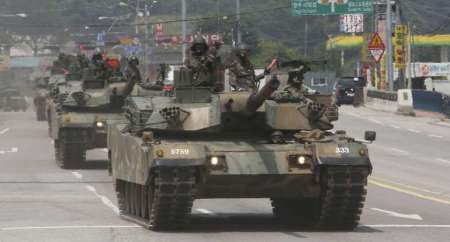
South Korean army K-1 tanks move during the annual exercise in Paju, South Korea, near the border with North Korea, on July 5, 2017. (AP Photo/Ahn Young-joon)

China and Russia issued a joint statement calling Pyongyang’s ICBM test “unacceptable.”

“The two sides propose that the DPRK (North Korea) as a voluntary political decision declares a moratorium on testing nuclear explosive devices and ballistic rocket launches, and the US and South Korea refrain from carrying out large-scale joint exercises,” the statement said. “Parallel to this, the opposing sides should start negotiations and affirm general principles of their relations including the non-use of force, rejection of aggression and peaceful co-existence.”

“Neither one of them is doing a darn thing to stop North Korea. And they want to use it as an excuse to push us out of the region,” he added. “What we have to make clear to them is it’s going to have the exact opposite effect. Once North Korea is able to threaten us and even now, as they threaten our allies, we have to be in there to protect our own interests. 

******************************

The top Democrat on the House Armed Services Committee declared this morning that the “threat from North Korea, regrettably, is not going to be removed” by the “global action” proposed by the Trump administration to curb Kim Jong-un’s behavior.

Pyongyang said Tuesday that it successfully test-fired Hwasong-14, a long-range intercontinental ballistic missile. According to Chosun Ilbo in South Korea, state TV in the North declared the regime “a full-fledged nuclear power… possessed of the most powerful intercontinental-ballistic rocket capable of hitting any part of the world.”

Kim reportedly watched the launch at the scene. The missile, said to be capable of reaching Alaska or Hawaii, flew for 39 minutes before hitting open waters.

Secretary of State Rex Tillerson issued a statement Tuesday evening condemning the July Fourth launch. “Testing an ICBM represents a new escalation of the threat to the United States, our allies and partners, the region, and the world,” he said. “Global action is required to stop a global threat.”

“Any country that hosts North Korean guest workers, provides any economic or military benefits, or fails to fully implement UN Security Council resolutions is aiding and abetting a dangerous regime. All nations should publicly demonstrate to North Korea that there are consequences to their pursuit of nuclear weapons. We intend to bring North Korea’s provocative action before the UN Security Council and enact stronger measures to hold the DPRK accountable,” Tillerson continued.

“The United States seeks only the peaceful denuclearization of the Korean Peninsula and the end of threatening actions by North Korea. As we, along with others, have made clear, we will never accept a nuclear-armed North Korea.”

President Trump and his national security team “are continuing to assess the situation in close coordination with our allies and partners,” he added.

Armed Services Committee Ranking Member Adam Smith (D-Wash.) doubted that Tillerson’s vow would put pressure on North Korea.

“If there is an idea floating around out there for how we can remove that threat, I’m open to it. But we have been circling around this discussion of what we want China to do and what we want sanctions to do and all these other different pieces,” Smith said. “The bottom line is, what we need against North Korea, we need to put the best economic sanctions we can. I think it’s perfectly appropriate for the secretary of state to try to put pressure on other nations to do the same. But the most important thing we need is a credible military deterrent, so that whatever North Korea does in terms of building a missile, they know that if they act against South Korea or against Japan or against us, we will obliterate them.”

“That’s why THAAD [missile defense system] is important. That is why our alliance with South Korea and Japan is important, to have that credible military force, because what’s been proven — and all of the options have been discussed with your previous guests — is that North Korea is going to do it. They want to build nuclear weapons. They want to develop an intercontinental ballistic missile. And short of an all-out war on the Korean Peninsula, we don’t really have an option for stopping them.”

China and Russia issued a joint statement calling Pyongyang’s ICBM test “unacceptable.”

“The two sides propose that the DPRK (North Korea) as a voluntary political decision declares a moratorium on testing nuclear explosive devices and ballistic rocket launches, and the US and South Korea refrain from carrying out large-scale joint exercises,” the statement said. “Parallel to this, the opposing sides should start negotiations and affirm general principles of their relations including the non-use of force, rejection of aggression and peaceful co-existence.”

Smith slammed the statement as “spectacularly disingenuous.”

“Neither one of them is doing a darn thing to stop North Korea. And they want to use it as an excuse to push us out of the region,” he added. “What we have to make clear to them is it’s going to have the exact opposite effect. Once North Korea is able to threaten us and even now, as they threaten our allies, we have to be in there to protect our own interests. China’s not acting against North Korea. And the reason they’re not acting against North Korea is, they don’t want to cut off North Korea’s economic aid. They don’t want North Korea to collapse because they don’t want millions of North Korean refugees pouring across their border. They’re not happy that North Korea is causing such instability in the region, but the alternative of them trying to crush the regime somehow is something they’re not willing to do, and they haven’t been willing to do it through four administrations. So, we need a credible military deterrent, and that is our only option.”

Smith noted that Kim’s actions have been “all about ensuring regime survival,” as he’s “looked at Iraq and Afghanistan and Libya, and they feel that unless they have a nuclear weapon and a credible deterrent of their own, that their regime is in jeopardy.”

“So, all the economic sanctions, all that needs to be done. But understand what I’m saying here. As you have discussed, there is not a good military option,” he said. “Thinking that we can preemptively go in there and somehow take out their capabilities, whatever we do leads to a massive war in the Korean Peninsula… we need our THAAD system in the region. We need a system to give us a shot at shooting down that missile if they decide to launch it. And then we also need a clear diplomatic policy that we will destroy them.”

After the THAAD system was installed in South Korea, Trump said Seoul should fork over a billion dollars for the missile defense. New South Korean President Moon Jae-in recently suspended further THAAD deployment pending a review of the program.

Smith stressed that Russia and China must “stop screwing around.”

“If you guys really want us to be less involved in the region, then you have got to figure out a way to control North Korea,” he said. “Now, I don’t think they’re going to do that. But that means that we have to stay active in the region.”