Posted tagged ‘Trump and North Korea’

U.S. Threatens to Cutoff China, Russia for Undermining Sanctions Against North Korea

September 12, 2017

U.S. Threatens to Cutoff China, Russia for Undermining Sanctions Against North Korea, Washington Free Beacon, September 12, 2017

(Please see also, UN Passes Mega-Ultra Toughest-Ever North Korea Sanctions, Again.– DM)

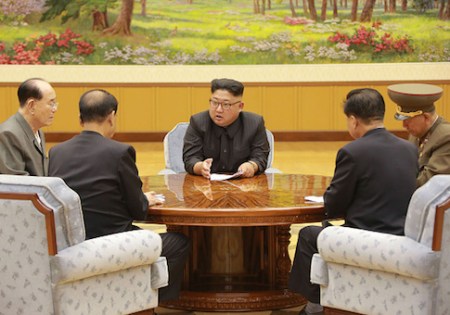
North Korean leader Kim Jong-Un attends a meeting with a committee of the Workers’ Party of Korea about the test of a hydrogen bomb / Getty Images

“Unfortunately, I cannot tell the committee today that we’ve seen sufficient evidence of China’s willingness to truly shut down North Korea’s revenue flows, to expunge North Korean illicit actors from its banking system, or to expel the various North Korean middlemen and brokers who are continuing to establish webs of front companies,” he said.

*****************************

The Trump administration on Tuesday threatened to cut off from the U.S. financial system Chinese and Russian companies helping North Korea smuggle coal overseas to circumvent international sanctions on Pyongyang’s nuclear activities.

Marshall Billingslea, the Treasury Department’s assistant secretary for terrorist financing, provided Congress with intelligence images mapping North Korea’s illicit shipping networks used to mask the origin of exported coal to China and Russia.

The images appear to expose China and Russia’s covert hand in undermining international pressure on the Kim Jong Un regime to give up its nuclear ambitions, despite the two nations voting publicly on several occasions at the United Nations Security Council to strengthen sanctions.

“North Korea has been living under United Nations sanctions for over a decade and it has nevertheless made significant strides toward its goal of building a nuclear tipped ICBM,” Billingslea testified before the House Foreign Affairs Committee, referring to the regime’s pursuit of an intercontinental ballistic missile capable of reaching the United States mainland.

“I urge anyone in the financial services industry who might be implicated in the establishment of shell or front companies for [North Korea], and anyone who is aware of such entities, to come forward with that information now, before they find themselves swept up in our net,” he said.

The Treasury Department estimates North Korean coal shipments bring in more than $1 billion in annual revenue for the regime, in part enabling Kim Jong Un to generate income used to fund ballistic missile and nuclear programs. Though the UN Security Council over the past month has passed two separate sanctions packages targeting North Korea’s coal industry, illicit coal-smuggling networks through China and Russia have watered down the impact, according to the Trump administration.

Citing the intelligence images provided to Congress on Tuesday, Billingslea said North Korean shipping vessels routinely shut off their transponders in violation of international maritime law to avoid detection as they move from North Korea into Chinese or Russian ports to offload sanctioned coal.

The Treasury Department is also tracking North Korea’s effort to penetrate the international financial system through shell companies based in China and Russia to help conceal the regime’s overseas footprint. Billingslea warned the Trump administration will punish any company in violation of UN sanctions by choking it off from the U.S. financial market.

Though he lauded China for supporting a recent round of UN sanctions, he said Beijing has not yet shown it is serious about cutting off North Korean funding.

“Unfortunately, I cannot tell the committee today that we’ve seen sufficient evidence of China’s willingness to truly shut down North Korea’s revenue flows, to expunge North Korean illicit actors from its banking system, or to expel the various North Korean middlemen and brokers who are continuing to establish webs of front companies,” he said.

Israel Has a Playbook for Dealing With North Korea

September 8, 2017

Israel Has a Playbook for Dealing With North Korea, Bloomberg, Zev Chafets, September 7, 2017
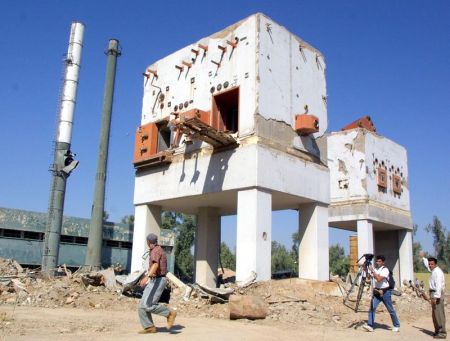
Saddam’s nuclear dream ended in ashes. Photographer: Ramzi Haidar/AFP/Getty Images

North Korea is now truly dangerous — unlike Iraq and Syria, it already has nuclear weapons — and it won’t get less so as time goes on. Trump has said this in no uncertain terms. But so far it is just words. The president may mean it. He also may not. Perhaps he will come to regret tangling with Kim. Maybe he will see it as a beginner’s mistake. He may be tempted to reverse course and try to save face with make-believe sanctions, empty United Nations resolutions or fruitless negotiations. I’m not judging him. I haven’t been in his shoes, and I wouldn’t want to be.

But if the American president does back down, if Kim Jong Un stays in power, keeps his nuclear warheads and ballistic weapons, and gets away with threatening the U.S. and its allies with nuclear destruction, every friend and foe of Washington will be revisiting its strategic playbook. For Israel, so far away from Korea yet so close to Iranian aggression, that book begins with the Begin Doctrine.

************************************

Israel and North Korea are on opposite sides of the Asian landmass, separated by 5,000 miles as the ICBM flies. But Israelis feels close to the nuclear standoff between Washington and Pyongyang. They have faced this sort of crisis before, and may again.

Some history: In the mid-1970s, it became clear to Israel that Iraq’s Saddam Hussein was working on acquiring nuclear weapons and missiles to deliver them. Saddam had already demonstrated an uninhibited brutality in dealing with his internal enemies and his neighbors. He aspired to be the leader of the Arab world. Defeating Israel was at the top of his to-do list.

After coming to office in 1977, Israeli Prime Minister Menachem Begin tried to convince the U.S. and Europe that Saddam was a clear and present danger to the Jewish state, and that action had to be taken. Begin was not taken seriously.

But Begin was serious, and in 1981 he decided that Israel would have to stop the Iraqi dictator all by itself. His political opponents, led by the estimable Shimon Peres, considered this to be dangerous folly. Foreign Minister Moshe Dayan, the legendary former military chief of staff, voted against unilateral action on the grounds that it would hurt Israel’s international standing. Defense Minister Ezer Weizmann, the former head of the air force (and Dayan’s brother-in-law) was also against a military option. He thought the mission would be unacceptably risky.

Begin had no military expertise. But his family had been wiped out in the Holocaust. He looked at Saddam, who was openly threating Israel, and saw Hitler. To Begin, sitting around hoping for the best was not a strategy; it was an invitation to aggression. If there was going to be a cost — political, diplomatic, military — better to pay before, not after, the Iraqis had the bomb.

In the summer of 1981, Begin gave the order. The Israeli air force destroyed the Osirak reactor. The United Nations Security Council condemned the attack. The Europeans went bonkers. The New York Times called it “inexcusable.” But the Israeli prime minister wasn’t looking to be excused by the Times or the Europeans or even the usually friendly Ronald Reagan administration. He enunciated a simple rationale that would come to be known as the Begin Doctrine: Israel will not allow its avowed enemies to obtain the means of its destruction.

The wisdom of this doctrine became clear a decade later, during the Gulf War, when Saddam Hussein made good on his threat to fire Russian-made SCUD missiles at Israeli cities. The SCUDs landed, and caused some damage and a fair amount of panic, but they were not armed with unconventional warheads. Israel had taken that option off the table.

Similarly, in 2007, Israel confirmed what it had suspected for five years: Syria, with North Korean help, was trying to build a nuclear reactor. Prime Minister Ehud Olmert, a Begin disciple, sent Mossad chief Meir Dagan to Washington, to ask for American intervention. The CIA chief, Michael Hayden, agreed with Israel’s contention that Damascus (with Iranian financing) was constructing the reactor. But Hayden convinced President George W. Bush that bombing the site would result in all-out war, and who wants that?

Acting on its own, Israel destroyed the Syrian site (reportedly killing a group of North Korean experts in the process). Hayden was wrong about how Syria would react, as he later admitted. If Israel had been reasonable and listened to the CIA, Bashar al-Assad would have nuclear weapons right now.

A few years later, Prime Minister Netanyahu and Defense Minister Ehud Barak spent billions of dollars preparing and training to take out the Iranian nuclear program. Barak, not a member of Netanyahu’s right-wing Likud Party, explained: “There are instances where it appears it is not necessary to attack now, but you know that you won’t be able to attack later.” In such cases, he said, the “consequences of inaction are grave, and you have to act.”

Israel was prevented from kinetic action by the Barack Obama administration, which along with five other powers cut a deal with Iran in 2015 — over Israel’s vociferous objections. Netanyahu warned that the deal was full of loopholes; it would allow Iran to hide its nuclear program and continue building new means of delivery. This was confirmed in 2016 when Iran tested a new missile. “The reason we designed our missiles with a range of 2000 kilometers,” said Iranian Brigadier General Amir Ali Hajizadeh, “is to be able to hit our enemy the Zionist regime from a safe distance.”

Since then, Iran has stepped up its aggressive enmity toward the Zionist Entity. It has not only continued its nuclear cooperation with North Korea, it has also copied Pyongyang’s tactic of creating a huge artillery threat against civilian populations (through its proxy force Hezbollah in Lebanon and now Syria). This conventional threat to Seoul is what has convinced a great many American commentators that any attack on North Korea would lead to an “unthinkable” number of casualties.

Ruling out harsh thoughts is a luxury Israel doesn’t have. It has installed an efficient missile defense system (something not beyond the means of the South Koreans and the U.S.). It is also training to neutralize the threat of a bombardment. The IDF is currently conducting its biggest military exercise in 19 years. The announced goal is to prepare for war with Hezbollah. Israel does not intend to allow itself to be held hostage by an Iranian threat to its civilian population, or to have its hands tied by the theory of unthinkability.

This week, the Ministry of Foreign Affairs in Jerusalem published a condemnation of North Korea: “Only a determined international response will prevent other states from behaving in the same way.” Clearly, “other states” was a reference to Iran. It was also a message to the U.S.

Israel, by long experience, knows there is no such thing as an “international” community when it comes to security. What is happening now in East Asia is an American production. The Donald Trump administration has been very clear, not to say belligerent, in demanding that North Korea forgo its nuclear weapons and ambitions.

This was also the policy of previous American administrations — but Presidents Bill Clinton, George W. Bush and Obama didn’t really mean it. They let things slide, drew imaginary lines, held talks that went no place and hoped for the best.

The best didn’t happen. It almost never does. North Korea is now truly dangerous — unlike Iraq and Syria, it already has nuclear weapons — and it won’t get less so as time goes on. Trump has said this in no uncertain terms. But so far it is just words. The president may mean it. He also may not. Perhaps he will come to regret tangling with Kim. Maybe he will see it as a beginner’s mistake. He may be tempted to reverse course and try to save face with make-believe sanctions, empty United Nations resolutions or fruitless negotiations. I’m not judging him. I haven’t been in his shoes, and I wouldn’t want to be.

But if the American president does back down, if Kim Jong Un stays in power, keeps his nuclear warheads and ballistic weapons, and gets away with threatening the U.S. and its allies with nuclear destruction, every friend and foe of Washington will be revisiting its strategic playbook. For Israel, so far away from Korea yet so close to Iranian aggression, that book begins with the Begin Doctrine.

This column does not necessarily reflect the opinion of the editorial board or Bloomberg LP and its owners.
Trump Orders Military to Shoot Down North Korean Missiles

September 8, 2017

Trump Orders Military to Shoot Down North Korean Missiles, NewsMaxJohn Gizzi, September 7, 2017

AP

President Donald Trump has given military orders for U.S. forces to shoot down and destroy any missile launched from North Korea and moving toward the continental United States, Hawaii, and Guam.

Sources close to the president’s national security team tell Newsmax the order was given to Pentagon brass in the wake of last month’s threat by North Korea to fire a ballistic missile aimed at Guam, a U.S. territory.

“The threat provoked the president,” one source familiar with the decision told Newsmax.

Last Sunday, North Korea detonated a thermonuclear weapon. The communist regime claims they can fit the new device on advanced intercontinental ballistic missiles, known as ICBMs.

This week, South Korean intelligence sources said the North was moving an ICBM in an apparent preparation for another test launch over the northern Pacific and possibly Japan.

The president also is said to be considering a new “shoot down” order for any North Korean missile launched and moving toward Japan or South Korea, another national security source told Newsmax.

“This is a clear exercise of self-defense, and there’s no question we should do it,” former U.S. ambassador to the United Nations John Bolton told Newsmax.

Bolton said U.S. allies South Korea and Japan “are in jeopardy” and said the United States must take steps to protect them under treaty obligations.

The presidential order came after a flurry of recent provocations from Pyongyang.

In August, President Trump ominously warned the North Koreans that continued threats “will be met with fire and fury like the world has never seen.”

Soon after, North Korea answered Trump’s warning by threatening a ballistic missile strike off the territory of Guam.

The president quickly responded, saying any attack against the U.S. would be met with a fierce response.

“Things will happen to them like they never thought possible,” the president said, adding U.S. forces were “locked and loaded.”

The situation appeared to be de-escalating when North Korean strongman Kim Jong Un announced he had met with his military commanders and they would not fire the missile at Guam.

In a threatening move Aug. 29, North Korea launched from their capital Pyongyang what they said was an “ultramodern rocket system” — an intermediate range missile. The missile flew over Japanese territory and landed in the Pacific.

“There is general consensus in the White House and the Pentagon that North Korea is quite close to the ‘red zone’ and that the U.S. must act soon or lose the upper hand,” one official told Newsmax.

Bolton, who has advised the president informally on security matters, said the U.S. is being “driven in the direction of a preemptive strike because North Korea won’t back down.”

“We are close to the finish line,” Bolton said, referring to Pyongyang’s recent missile and nuclear developments. “It highlights how little time we have here.”

Just days after North Korea’s nuclear test detonation, Han Tae Song, the North Korean ambassador to the United Nations in Geneva, told a disarmament conference the U.S. could expect more “more gift packages.”

If the U.S. military does act on President Trump’s orders to shoot down a missile, this would be achieved through different U.S. anti-ballistic programs under the aegis of the Missile Defense Agency.

Among these programs are the 26-year-old Terminal High Altitude Area Defense system, (THAAD), whose “hit to kill” interceptors are designed to shoot down an incoming missile through kinetic energy that explodes the missile on impact.

“It’s called stopping a bullet with a bullet,” one veteran intelligence expert told Newsmax.

The technology appears to be working.

In late August, a day after the North Korea missile flew over Japan, the U.S. Missile Agency conducted a test that successfully struck down a ballistic missile off the coast of Hawaii.

The White House press office and the Pentagon declined to comment on this report.

At Thursday’s White House press conference held with the Emir of Kuwait, the president said while “military action would certainly be an option” in dealing with North Korea, he added “nothing’s inevitable.”

“I would prefer not going the route of the military,” he said.

Part II: Tough Is Not Enough

September 4, 2017

Part II: Tough Is Not Enough, 38 North, September 4, 2017

(In what fantasy world does the author live? He states,

What sort of deployments (strategic systems, missile defense, precision strike conventional weapons, conventional land, sea, special and air forces) would be a function of both military and diplomatic would need to be hammered out in the National Security Council and with regional allies.

It is inconceivable that the UN Security Council, where each permanent member has a veto, would approve any “deployment of significant and visible assets [which] would make it clear to the DPRK that it cannot compete with the US in the nuclear field regardless of the size, scope, pace and duration of that effort.”  Even were it to happen, North Korea would be told, in advance, how to prepare for whatever America and perhaps our allies will do when North Korea again tests or uses a nuke or missile. 

Please see also, North Korea Nuclear Test Puts Pressure on China and Undercuts Xi. — DM)

North Korea Nuclear Test Puts Pressure on China and Undercuts Xi

In Part I of this seriesI argued that advocates for “getting tough on North Korea” were prone to adopt inappropriate models for a harsher sanctions regime and to ignore the risk of counterproductive North Korean reactions to such sanctions. This is not an argument for no more sanctions. Given North Korean progress on its ICBM and nuclear weapons capabilities, we remain in an ongoing cycle of actions and reactions that may lead to a major war. A very vigorous political/military effort to contain and eventually eliminate the DPRK nuclear threat is essential now before the tensions and ill-considered rhetoric once again create the risk of the US and North Korea bellowing and stumbling their way into a catastrophic conflict. But sanctions should be only one element of the effort. The final push for a stabilization[1] of the North Korean nuclear and missile issue has to include the following components.

Military Deterrence and Defense

The additional deployment of significant and visible assets would make it clear to the DPRK that it cannot compete with the US in the nuclear field regardless of the size, scope, pace and duration of that effort. What sort of deployments (strategic systems, missile defense, precision strike conventional weapons, conventional land, sea, special and air forces) would be a function of both military and diplomatic would need to be hammered out in the National Security Council and with regional allies. The purpose of these forces would be both to provide diplomatic leverage and to prevent Kim from believing a military gamble would pay off.

Sanctions and Targeted Secondary Sanctions

The sanctions campaign should begin with the enforcement of UNSCRs 2270 and 2371. The initial goal would be to get full compliance with some of the difficult-to-enforce provisions, notably the caps on joint ventures and on North Korean labor exports. To this end, the US should target secondary sanctions on Chinese and other third country entities that are violating the UN resolutions. Rather than seeking to squash every sanctions-evading gnat, it should inflict significant pain on one large and vulnerable entity to have a bracing effect on many more. And, it might well create massive ripple effects if it is a key node in North Korea’s sanctions evasion network—for example, Chinese companies outlined in the recent C4ADS report—that are clearly violating UN sanctions and making extensive use of the US banking system. The US may also wish to find a similar target outside the Chinese network of businesses—perhaps one in a friendly Middle Eastern or African country that has chosen to ignore past US efforts to cut connections to Pyongyang. The US should for now avoid steps to coerce others to accept its own definition of sanctions that go beyond the resolutions. It appears that the most recent sanctions by the US Treasury against Chinese, Russian and one Namibian entity, as well as a recent freeze on some aid to Egypt, may fit the model described above.

However, it is unlikely the UN sanctions as currently written will suffice. The US should be building the case now for significant sanctions tightening if North Korea does not shift its current direction. This should best be done in steps, perhaps starting with the change of the labor and investment caps and moving to a full ban as a first iteration with the dusted off version of UNSCR 661 as the final alternative to military conflict. As the risk of conflict moves closer, the US will have to consider when secondary sanctions as a coercive mechanism for third countries needs to be deployed more widely. This is a high-risk enterprise in an already risky situation, but when stacked up against nuclear war in Asia, surely secondary sanctions are preferable.

Many Tracks of Diplomacy

These tough military and sanctions components will do nothing but open the door to miscalculation and war if other “softer” components are ignored or—more likely—mishandled. A stabilization of the Korean nuclear and missile issue is going to require multilateral diplomacy—and only the US has the ability to be at the center of this effort. It cannot subcontract the effort primarily to China. The PRC does not have the entre with some of the players, nor could it speak for the US to the most difficult audience of all: Pyongyang. These rings of diplomatic activity have existed in one form or another for many years, but they will need to be greatly invigorated and placed in the service of a clear set of policy objectives. These rings include:

  • US-ROK and US-Japan: This ring will need to create a solid front on possible military deterrence force deployments and on a sanctions strategy in the United Nations. The Trump administration appears to be in the middle of such an effort.
  • US-PRC: This ring is key. It needs to be removed from undisciplined and uncoordinated public commentary and shifted to sustained bilateral dialogue. Washington will need to enlist Chinese assistance both to create sanctions pressure on Pyongyang and to generate multilateral negotiations and a viable US-DPRK diplomatic channel. The US cannot expect pressure without political dialogue and Beijing cannot expect dialogue without real pressure on Pyongyang. The less we hear about the content of this channel (not to mention the US-DPRK channel) in public the better.
  • UN Security Council: Iraq sanctions failed when P-5 unity in the UNSC failed. The Trump Administration deserves credit for maintaining P-5 unity with the passage of UNSCR 2371, but this will have to be the first of many efforts in the Council.
  • Six Party (US, ROK, China, Russia, Japan and DPRK): At some point this channel will have to generate the political agreements and the framework for a settlement. There is nothing sacred about this particular forum or format, but something like it will have to be active and available for the formal public structure of a diplomatic settlement.
  • A direct US-DPRK channel: With one exception in the second term of the George W. Bush administration, the most rapid and extensive progress I have seen in over 28 years of interchange with North Korea over the nuclear issue has always taken place in a US-DPRK bilateral channel. The potential causes of war lie between Washington and Pyongyang. The US would be well advised to put together a small, tight, empowered negotiating team to create a channel for bilateral discussions. If the leak-prone and undisciplined Trump administration could manage to do so without us all hearing about it, so much the better.

Orchestrating this diplomacy will be one of the most complex challenges of the past 50 years. It is unclear whether the US State Department—suffering from several levels of missing leadership, low morale and persistent and unhelpful interference from the White House—is up to the task. But a way will have to be found to perform it if there is to be success on this issue.

Clarity, Discipline and Accountability in Public Commentary

US diplomacy during the recent dust-up with North Korea over its July ICBM tests was clumsy and amateurish: the incendiary rhetoric coming out of the White House needlessly escalated tensions and the uncoordinated and incoherent public messaging sowed confusion among our allies over US goals and intentions. That said, it did signal that the United States was approaching the limit of its patience over North Korean missile developments. Nevertheless, a policy vacuum continues to exist.

The United States has not made clear to Pyongyang, the American public, or its allies how it would respond to North Korean nuclear intimidation or aggression. There may be a place for strategic ambiguity in deterrence policy under some circumstances but not strategic incoherence. As a result of the loose and imprecise US rhetoric and mixed messaging, all parties are groping for an understanding of what might trigger nuclear conflict in Korea and beyond. To end this confusion and uncertainty, an authoritative figure such as the Secretary of State or Defense should give a policy speech which lays out for the American public, our allies, the Chinese and the North Koreans what American nuclear deterrence policy is vis-a-vis North Korea—and then the White House needs to discipline itself and other agencies to hew scrupulously to this script in all their public messaging on the policy.

The speech or the press backgrounding around it should also designate a single, high level official who would be accountable for the North Korean issue; this is simply not an issue that can survive current White House tong wars, presidential pique or bureaucratic backstabbing. This speech will also be the best place to signal that toughness will be accompanied by dialogue. It needs to open the door to real negotiations with a concrete proposal. This could be done through a proposal to reopen Six Party Talks or through a prearranged signal to Pyongyang that certain words in the speech are an invitation to a private authoritative back-channel discussion.

Goals and Trade Bait

The Obama administration’s efforts on North Korea foundered on a couple of rocks. The first was its inability or unwillingness to commit political capital to an issue that was highly controversial, with a very small (or nonexistent) solution set and a timeline that was less pressing than the Iran nuclear issue. The second was that the only goal for resolving or even trying to resolve the crisis that could garner consensus support was complete DPRK denuclearization. However, given the Obama administration’s unwillingness to invest fully in the issue, the White House’s highly constrained room for political maneuvering and Pyongyang’s commitment to its nuclear strategy, the goal of denuclearization became an obstacle to even starting a process for dealing with Pyongyang’s nuclear and missile progress.

Denuclearization remains a worthy goal and it is the only one that preserves the global nonproliferation regime and the long-term security of the US and its allies. But the first goal of renewed diplomatic engagement needs to be more focused and urgent: to stabilize peace in Northeast Asia and to prevent a stumble into a nuclearized second Korean War. Achieving this goal, by definition, will require North Korea to put limits on its ICBM program, which is the essential immediate need for American security policy. There are interim steps that would be of value in preserving peace and security. The parties might wish to develop mechanisms to prevent accidental war. It might also be a worthy tactical goal to create geographic limits on North Korean missile testing targets, thus putting US territories like Guam and Japanese waters off limits. The US might, at some point, trade off a particular sanction in return for a firm ICBM testing ban or moratorium or a halt to nuclear tests.

At no point should the US take ultimate denuclearization off the table, but it is necessary first to identify immediate steps to stabilize what is a dangerous dynamic. The two great dangers to pursuing more modest, immediate goals will be the accusation the US has “accepted” a nuclear DPRK and the concessions the DPRK may want. Sanctions should be considered legitimate items to trade. Our alliances should not. Our political relationship with the DPRK—including at some point a peace treaty ending the Korean War—should be legitimate points of discussion. Tangible payments to the DPRK should not, given the unfortunate experiences the ROK and US had with such payments in past agreements.

Conclusion

In a policy with any hope of resolving US and global concerns about North Korea’s nuclear and missile threat, sanctions play an important but supporting role. The key to a successful effort to deal with the North Korean threat without war is a combination of military deterrence, sanctions, a complex diplomatic offensive with clear and realistic short-term goals, and perhaps most importantly, a disciplined, clear public elucidation of US deterrence and diplomatic policy for Korea. The “tough” part of this approach (military deterrence and sanctions) is well within the reach of the Trump administration. Whether it has the personnel, structure and capacity for discipline for the diplomatic and public components of the effort is yet unproven.


  1. [1]

    Stabilization is chosen deliberately in this sentence. Denuclearization should be the long term stated goal of the effort but that goal should be placed in the same context as “general and complete disarmament” as used in Article VI of the Nuclear Nonproliferation Treaty. It is a legitimate goal, but one that is far over the horizon. The key goal at this moment is to halt momentum towards having North Korean nuclear weapons capable of reaching the US homeland.

Mattis Holds EMERGENCY Press Conference on North Korea H-Bomb Test 9/3/17

September 3, 2017

Mattis Holds EMERGENCY Press Conference on North Korea H-Bomb Test 9/3/17 via YouTube


https://www.youtube.com/watch?v=tcfiwCZSxFA

North Korea’s latest test: More diplomacy will only make matters worse, says Amb. Bolton

September 3, 2017

North Korea’s latest test: More diplomacy will only make matters worse, says Amb. Bolton, Fox Business, September 3, 2017

(Please see also, Powers may end up with Iranian model for NKorea. — DM)

Bolton said the U.S. has “fooled around” with North Korea for 25 years, and if that continues, the current situation will only worsen.

“It would be a lesson to every nuclear state in the world that if you just have patience enough you can wear the United States down. The notion that we can accept North Korea or Iran with any kind of nuclear capability just means that we will forever be at their mercy,” he said.

*****************************

Following North Korea’s announcement that it successfully tested a thermonuclear device on Sunday, former U.S. Ambassador to the United Nations John Bolton said more diplomacy will only make matters worse regarding the Hermit Kingdom’s nuclear threat to surrounding countries and America.

“I think the only diplomatic option left is to end the regime in North Korea by effectively having the South take it over,” Bolton told “Sunday Morning Futures.” “Anybody who thinks that more diplomacy with North Korea or sanctions, whether against North Korea or an effort to apply sanctions against China, is just giving North Korea more time to increase its nuclear arsenal, increase its ballistic missile capability, increase the accuracy of its guidance systems and put us, South Korea and Japan in more jeopardy.”

The artificial earthquake caused by the test was “five to six times stronger” than tremors created by previous tests; South Korean officials put the magnitude at 5.7 and the U.S. Geological Survey said it was a magnitude 6.3 Opens a New Window., according to The Associated Press.

In addition to the threat of the country launching a thermonuclear weapon, Bolton explained that the willingness of Kim Jong Un to sell anything for money is also quite worrisome.

“They could sell these weapons, ballistic missiles and the nuclear devices themselves to Iran in a heartbeat. North Korea can sell these devices to terrorist groups around the world; they could be used as electromagnetic pulse weapons (EMPs), not necessarily hitting targets, but destroying our electric grid’s capabilities,” the former ambassador said, adding that they could also be used for nuclear blackmail.

President Trump reacted to the news of the alleged test on Twitter saying, “North Korea is a rogue nation which has become a great threat and embarrassment to China, which is trying to help but with little success.”

..North Korea is a rogue nation which has become a great threat and embarrassment to China, which is trying to help but with little success.

He also criticized South Korea for not taking a tougher stand against the communist country.

South Korea is finding, as I have told them, that their talk of appeasement with North Korea will not work, they only understand one thing!


Bolton said the U.S. has “fooled around” with North Korea for 25 years, and if that continues, the current situation will only worsen.

“It would be a lesson to every nuclear state in the world that if you just have patience enough you can wear the United States down. The notion that we can accept North Korea or Iran with any kind of nuclear capability just means that we will forever be at their mercy,” he said.

Trump says ‘appeasement’ will not work after N.Korea nuke test

September 3, 2017

Trump says ‘appeasement’ will not work after N.Korea nuke test, Breitbart, September 3, 2017

(Please see also, Getting Tough on North Korea: Iran and Other Mirages. The thrust of the linked article is that sanctions won’t work and that some form of “a broader political-military effort to stabilize the situation” is necessary.  As asked in my parenthetical comment on the article,

Do we need merely “to stabilize the situation,” or do we need to do something more drastic to change it so that North Korea will (a) cease to be a nuclear threat now and (b) be disabled from becoming one again? “

I think we need to disable North Korea from ever becoming a nuclear power again. While China urges patience, sanctions and appeasement of North Korea, China is threatening to “reunite” Taiwan with military force rather than through appeasement or sanctions. Please see also, Chinese Official Says China Might Invade Taiwan If “Peaceful Reunification Takes Too Long”. Getting rid of North Korea’s nuclear threat has already taken too long. — DM)

AFP

Washington (AFP) – US President Donald Trump declared Sunday that “appeasement with North Korea” will not work, after Pyongyang claimed it had successfully tested a missile-ready hydrogen bomb.

“North Korea has conducted a major Nuclear Test,” Trump said. “Their words and actions continue to be very hostile and dangerous to the United States.”

His comments came hours after the US Geological Survey picked up a 6.3 magnitude “explosion” in North Korea, which Pyongyang confirmed was a nuclear test, its sixth.

The isolated regime said this one was of a hydrogen bomb that could be fitted atop a ballistic missile, sharply raising the stakes in a US-North Korea confrontation.

Trump last month threatened North Korea with “fire and fury” if it continued to threaten the United States, but he refrained from direct threats in his latest tweets.

“South Korea is finding, as I have told them, that their talk of appeasement with North Korea will not work, they only understand one thing!” he said.

“North Korea is a rogue nation which has become a great threat and embarrassment to China, which is trying to help but with little success.”

NKorean missile over Japan triggers sirens

August 29, 2017

NKorean missile over Japan triggers sirens, DEBKAfile, August 29, 2017

(Please see also, How Trump should respond to North Korea’s missile over Japan. — DM)

Kim Jong-un escalated his military stance early Tuesday, Aug. 29, by firing a ballistic missile over Japan’s northern Island of Hokkaido. It broke up into three pieces and landed in Japan’s Pacific, 200km from the island’s coast, after flying 2,700km. The Japanese government issued a warning over radio and TV as sirens blared and text messages were fired off across northern Japan instructing people in the missile’s flight path to take cover.

Trains were delayed as passengers were urged to seek shelter inside stations. “All lines are experiencing disruption,” one sign on Sapporo’s metro system read. “Reason: Ballistic missile launch.”

The UN Security Council called an emergency meeting for later Tuesday, after Prime Minister Shinzo Abe told reporters. “This reckless act of launching a missile that flies over our country is an unprecedented, serious and important threat.”

The test, which appeared to be of a newly-developed intermediate-range Hwasong-12 missile, came as the US and South Korea conducted their annual military exercise. It followed the praise US President Donald Trump and Secretary of State Rex Tillerson heaped on the North Korean dictator for his restraint in holding back a threatened missile attack on Guam.

Christopher R Hill, a former US ambassador in East Asia and the former US negotiator with North Korea, called it the “most serious missile launch yet” on Twitter. The Sunan launch site, near Pyongyang, was used for the first time and could mean that North Korea has expanded the number of sites it can use or that it may have wanted to evade detection.

Neither the Japanese military, nor the US Pacific Navy, which is on a high state of preparedness, made any effort to shoot down the missile, even when it crossed Japanese air space for the first time. Military sources say Kim had evidently caught them all napping and showed up Washington and Tokyo as short of answers for North Korean missile and nuclear advances.

After a 40-minute conversation with Donald Trump, the Japanese prime minister said they had agreed to escalate the pressure on North Korea. South Korea and the United States had discussed deploying additional “strategic assets” on the Korean peninsula, the presidential Blue House said in a statement, without giving any more details. Tillerson spoke of “tougher sanctions.”

The Washington-based Geostrategic Consulting group Strategic Sentinel tweeted that South Korean and US Joint Chiefs chairs had agreed to take strong response including military measures against North Korea. However, both Trump and Abe can hardly avoid responding to Kim’s latest provocation without serious loss of international clout and prestige. Their response is closely watched by other rogue regimes, such as Iran, as a guide to how far they can challenge the Trump administration and the West in general.

How Trump should respond to North Korea’s missile over Japan

August 29, 2017

How Trump should respond to North Korea’s missile over Japan, Washington ExaminerTom Rogan, August 29,2017

Ultimately, Kim has changed the dimensions of the crisis by this missile launch. While a diplomatic solution is both possible and preferable, Trump must ensure everyone knows that time for a peaceful solution is running out.

********************************

Early Tuesday morning Japan time, North Korea fired a missile over Japan’s northern Hokkaido island. The missile launch represents a major North Korean escalation in its ongoing standoff with the United States, South Korea, and Japan.

This is the first time in 8 years that North Korea has fired a missile over Japanese territory, and in doing so Kim Jong Un has seized back the strategic initiative.

Kim’s success in that regard is reflected by Japan’s apparent failure to try and shoot down the missile. In recent weeks, the Trump administration had suggested any launch against Japanese territory would be dealt with aggressively and immediately; implying the use of anti-ballistic missile weapons or retaliation. True, Japan might say that it didn’t act here because the missile’s trajectory was indicative of a Western Pacific impact, but Kim will feel his roll of the dice has been vindicated.

That puts the Trump administration in a difficult position. As I noted last week, while Trump’s tough-rhetoric on North Korea has been largely successful, there was a growing likelihood that Kim would launch a missile test against South Korea or Japan. That option, now rendered, allows Kim to preach defiance while avoiding Guam or another U.S. territory.

Still, the specter of a ballistic missile passing over one of America’s closest allies cannot be ignored. After all, it cuts to the heart of any realistic deterrent policy.

So what should Trump do?

I think four things. First, he should work to establish a consensus with Prime Minister Shinzo Abe of Japan on what to do if another launch takes place. Here, both leaders should state any further missiles on course to transit Japan will be shot down. North Korea must know that this activity cannot become the new norm. Absent that understanding, Kim will be emboldened to further acts of aggression.

Second, the president should direct Nikki Haley to work with the U.N. security council to pass new sanctions legislation on North Korea. This should include the sanctioning of North Korean government accounts used to support its diplomats around the world, and the North’s importation of machinery, electronics, and refined petroleum from China and Russia. While China and Russia might well veto such legislation, it would force China and Russia to take a stand against the international community. With export reliant economies, both nations would worry about the impacts of that vote. An able negotiator, Nikki Haley should call on allies like Britain and France to lobby on America’s behalf.

Third, Trump should order the deployment of additional forces to the U.S. Military’s Pacific Command. As I’ve explained, these deployments should be focused on air and naval striking capabilities. The intent here would not simply serve the prudent preparation for military action against North Korea’s ballistic missile program, but to remind China that the U.S. sees the end game on the horizon. North Korean nuclear-ballistic capabilities are growing in many areas, and China continues to take only mild action. Put simply, either that must change or the U.S. must strike.

Fourth, as soon as is feasibly possible (following his visit to Texas), Trump should visit Tokyo and make a speech in solidarity with U.S. allies in the region. Doing so wouldn’t simply calm our friends in the Asia-Pacific, it would personally stake Trump’s reputation on resolving this crisis. Knowing his ego is considerable, Trump’s arrival might deter those like China and North Korea who would accept the North’s conduct as the new norm.

Ultimately, Kim has changed the dimensions of the crisis by this missile launch. While a diplomatic solution is both possible and preferable, Trump must ensure everyone knows that time for a peaceful solution is running out.

Cadence Column: Asia, August 28, 2017

August 28, 2017

Cadence Column: Asia, August 28, 2017,   via China Daily Mail, August 28, 2017

China should be upset over North Korea for deeper reasons than on the surface. Trump’s “fire and fury” comment a few weeks ago was the clear explanation.

Donald Trump was not in favor of the W. Bush invasion of Iraq. Trump does not like large footprints of war. If this administration authorizes action in North Korea, it would not be anything like Iraq. It would be surgical and instant. There might not be time to react.

With the threat growing from China’s venture missions—flying its flag on man-made islands since it can’t find other ways to fly its flag on more soil—the Pentagon would be foolish not to seek an opportunity for a small demonstration. By not bringing North Korean threats to an absolute halt, China may be giving the US just that opportunity.

China and Russia neither want North Korea to be volatile nor shut down. Perhaps they don’t understand North Korea’s political DNA. It seems they all want to have their cake and eat it too and blame the world if they can’t, a mindset common in Communist regimes.

So, Communism itself is on trial, for its ability to deliver on its goals. But, so on trial also is Democracy’s ability to respond if Communism fails to deliver.


