Military options strengthening Trump’s diplomatic hand with North Korea? Fox News via YouTube, October 9, 2017
(Please see also, Britain leaks battle planning for war North Korea. — DM)
Britain leaks battle planning for war North Korea, American Thinker, Thomas Lifson, October 9, 2017
No doubt, the few North Korean allowed to read the outside world’s media are aware that many of his political opponents, foreign and domestic, consider President Trump mean, irrational, and dangerous. This all works to his psychological advantage.
What makes this leak so important is that it indicates to Kim that Trump is not being abandoned by his allies. On the contrary, they are lining up.
I expect there to be more leaks, some of them from Japanese sources.
President Trump has ditched the old ways of dealing with Kim, all of which have failed. This horrifies the diplomatic establishment. As far as I am concerned, that is not a point against him.
********************************
Great Britain is leaking to the media that it is planning for war with North Korea, signaling Kim Jong-un that President Trump and our allies are serious about the demands to end the nuclear weapons and missile programs.
The UK Daily Mail reports:
The Armed Forces are preparing for a potential war with North Korea, sources have revealed.
Officials have been instructed to draw up plans for how Britain would respond if war broke out with Pyongyang amid heightening tensions between the West and dictator Kim Jong-Un.
One option involves deploying Britain’s new aircraft carrier – due to be handed over to the Navy later this year – to the region before she has undergone flight trials.
Details of the secret operation plan have emerged after Donald Trump warned that ‘only one thing will work’ when it comes to dealing with North Korea, which has continued nuclear and rocket tests despite widespread condemnation.
I am reasonably certain that the leaks are intentional, and that the first purpose is to ratchet the pressure up on Kim Jong-un. He knows that the US could defeat and destroy his regime if it comes to war. Should he manage to land a nuclear strike on US forces or territory, the retaliation would be devastating, a lesson to the world on the perils of using nuclear bombs against the US.

No doubt, the few North Korean allowed to read the outside world’s media are aware that many of his political opponents, foreign and domestic, consider President Trump mean, irrational, and dangerous. This all works to his psychological advantage.
What makes this leak so important is that it indicates to Kim that Trump is not being abandoned by his allies. On the contrary, they are lining up.
In the background for us, but ever-present in the mind of Koreans, north and south, is the specter of Japan arming-up with nukes and ditching its “peace constitution.”
I expect there to be more leaks, some of them from Japanese sources.
President Trump has ditched the old ways of dealing with Kim, all of which have failed. This horrifies the diplomatic establishment. As far as I am concerned, that is not a point against him.
The Kerfuffle Before the Storm, PJ Media, Claudia Rosett, October 7, 2017
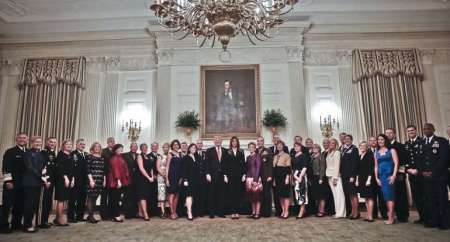 President Donald Trump and first lady Melania Trump, center, poses for a group photo with Senior Military leaders and spouses in the State Dining Room of the White House on Oct. 5, 2017. (AP Photo/Pablo Martinez Monsivais)
The first priority for any president inheriting this virulent global mess should be to try as far as possible to reclaim America’s credibility; to persuade America’s enemies that the bargain sale on U.S. interests is over, and America will, if necessary, wield its full military might to defend itself, its allies and interests. That is vital to deterrence, which — if genuinely effective — is vastly preferable to war.
The conundrum is how America can regain the credibility needed for deterrence, without having to resort to war in order to prove the point. For instance, unless Kim Jong Un truly believes that the U.S. might actually attack North Korea despite the potential horrific cost, why should he back down? Why should he worry about U.S. warships and submarines in the region? It’s an impressive show of military hardware, but is it a credible threat?
For an American president faced with this problem, one move worth attempting would be to gather America’s top military commanders for a meeting at the White House, followed by a dinner with their spouses, and invite the press to come witness and report on this conclave. If, in the midst of this genial scene, the president mentions that this is the calm before the storm, it may be baffling and frustrating to reporters — whose job includes nailing down details. But in capitals such as Moscow, Beijing, Tehran and Pyongyang, it might just help prompt a rethink about the assumption — gleaned from their success in rogue ventures during the tenure of Obama — that America is a hamstrung giant.
There’s always the possibility that it was more than a broad warning — that perhaps Trump is indeed about to launch a specific military action. But to whatever extent this cliffhanger helps concentrate minds in Moscow, Beijing, Tehran and Pyongyang on just how unpleasant it could be to provoke an American storm, it was an important message. Quite possibly a bid to avert a war, rather than start one. Worth the kerfuffle in the press.
***********************************
With the phrase “the calm before the storm,” President Trump on Thursday evening kicked off one of the biggest media kerfuffles since his late-night tweet in May about “the constant negative press covfefe.” That mysterious locution produced a spate of stories speculating sardonically on what the president meant. We’re now hearing a similar round of mockery. But this was no late-night typo in a tweet, and while offended members of the media default to derision, it’s worth considering that the president quite likely sent a useful message to an audience that extends way beyond the White House press corps.
The setting was a dinner for top U.S. military commanders and their spouses, hosted by Trump in the White House State Dining Room. Trump invited reporters in for a brief photo-op. Flanked by military officials who have dedicated themselves to defending America and winning its wars, all gathered with their spouses under a big portrait of President Lincoln. Trump asked the reporters, “You guys know what this represents?”
“Tell us, sir,” said one of the reporters.
“Maybe it’s the calm before the storm,” said Trump. A reporter asked, “What storm?” Trump gave the oblique reply, “We have the world’s greatest military people in this room, I will tell you that.” A reporter asked, again, “What storm?” Trump said, “You’ll find out.”
The entire exchange lasted about 30 seconds. The reporters were thanked and dismissed. The media were left to speculate on whether the “storm” referred to impending military action again North Korea, or maybe plans to back away from President Obama’s Iran nuclear deal, or something else, or nothing at all. Asked again by reporters on Friday what he meant by “the calm before the storm,” Trump again declined to clarify, saying again, “You’ll find out.”
This has been playing as a crazy-Trump story. CNN came out with the headline: “Trump is treating a potential war like a reality show cliffhanger,” and warned, “This is no reality show… His words — whether he means them as a tease, a threat or something in between — can have very real consequences.” Esquire called Trump “Our Reality TV President” and asked, “Will the season finale involve nuclear war with North Korea?” The New York Times called Trump’s comment “ominous.” NBC called it “provocative.” Politico called it “unprompted.” The Huffington Post, in a headline, called it “Bizarre.”
I’d call it smart. We don’t know precisely what the president had in mind. But we do know — or we ought to know — this: In world politics, there is a gathering storm that threatens America and our allies. There is a rising network of tyrannies hostile to American interests and values, including most prominently Russia, China, Iran and North Korea. The U.S. superpower can face down any one of these actors if it must, but the disturbing trajectory is that for years now — whatever their differences — they have effectively been making common cause against America and the requirements of a free and peaceful world order. They do illicit business together; they often back each other diplomatically, and they learn from each other just how much it is possible to get away with. Russia and China have been carrying out joint military maneuvers. North Korea, longtime weapons dealer to Iran, is cultivating an arsenal of nuclear missiles. The threats compound.
This trend accelerated dramatically during the years of America’s policies of retreat, appeasement, and surrender under President Obama. China, as part of its military buildup, sped up its construction of artificial islands topped with military bases clearly designed to threaten freedom of navigation along vital shipping routes in Southeast Asia. Russia snatched Crimea from Ukraine, and got away with it. Terrorist-sponsoring Iran extended its reach in the Middle East, and is currently benefitting from a rotten nuclear deal that paves its way to the bomb, accessorized with ballistic missiles. Syria disintegrated into war, which opened the way for both the rise of ISIS and military inroads by Vladimir Putin’s Russia into the Middle East. Libya, with America leading-from-behind, disintegrated into terrorist-infested chaos.
And North Korea, which had carried out one nuclear test in 2006 on the watch of President Bush, conducted four more tests during the tenure of Obama, along with scores of ballistic missile tests, while Kim Jong Un consolidated his hold on the totalitarian throne inherited in 2011 from his father. Taking advantage of Obama’s “strategic patience” to ramp up a rogue nuclear program, Kim Jong Un’s regime was ready to greet the Trump administration with an arsenal that by now appears quite convincingly to include long-range missiles, miniaturized warheads and the hydrogen bomb.
None of this is a figment of Trump’s imagination. Neither is it a prop on some reality TV show. It is real.
This is not of Trump’s making. But given the rate at which the threats and crises have been compounding, it falls to him to cope with a greatly emboldened group of increasingly well armed and predatory powers. This has been made all the more difficult by the enormous amount of U.S. credibility that was squandered by Obama — who gutted the U.S. military, bore passive “witness” to upheaval in Iran, erased his own red line over chemical weapons in Syria, threw away the hard-won progress in Iraq, bungled Afghanistan and Libya, promised (and delivered) flexibility to Putin, deferred to China, embraced Cuba, shrugged off the rising nuclear threat of North Korea, and assured the American public that the tide of war was receding.
The first priority for any president inheriting this virulent global mess should be to try as far as possible to reclaim America’s credibility; to persuade America’s enemies that the bargain sale on U.S. interests is over, and America will, if necessary, wield its full military might to defend itself, its allies and interests. That is vital to deterrence, which — if genuinely effective — is vastly preferable to war.
The conundrum is how America can regain the credibility needed for deterrence, without having to resort to war in order to prove the point. For instance, unless Kim Jong Un truly believes that the U.S. might actually attack North Korea despite the potential horrific cost, why should he back down? Why should he worry about U.S. warships and submarines in the region? It’s an impressive show of military hardware, but is it a credible threat?
For an American president faced with this problem, one move worth attempting would be to gather America’s top military commanders for a meeting at the White House, followed by a dinner with their spouses, and invite the press to come witness and report on this conclave. If, in the midst of this genial scene, the president mentions that this is the calm before the storm, it may be baffling and frustrating to reporters — whose job includes nailing down details. But in capitals such as Moscow, Beijing, Tehran and Pyongyang, it might just help prompt a rethink about the assumption — gleaned from their success in rogue ventures during the tenure of Obama — that America is a hamstrung giant.
Whether that was Trump’s intention, I don’t know. It sure looked that way. In the phrase that so alarmed CNN and Esquire, there was a useful ambiguity. Trump didn’t guarantee a storm; he merely suggested it could happen. Surrounded by his top military commanders, in the seat of American power that is the White House, the commander-in-chief prefaced his statement about “the calm before the storm” with “maybe.” It was, in a genteel and peaceful setting, a warning not to mess with America.
There’s always the possibility that it was more than a broad warning — that perhaps Trump is indeed about to launch a specific military action. But to whatever extent this cliffhanger helps concentrate minds in Moscow, Beijing, Tehran and Pyongyang on just how unpleasant it could be to provoke an American storm, it was an important message. Quite possibly a bid to avert a war, rather than start one. Worth the kerfuffle in the press.
North Korea taps GOP analysts to better understand Trump and his messages, Washington Post, Anna Fifield, September 26, 2017
 Spectators listen to a television news broadcast of a statement by North Korean leader Kim Jong Un on a public television screen in Pyongyang on Friday. (Ed Jones/AFP/Getty Images)
BERN, Switzerland — North Korean government officials have been quietly trying to arrange talks with Republican-linked analysts in Washington, in an apparent attempt to make sense of President Trump and his confusing messages to Kim Jong Un’s regime.
The outreach began before the current eruption of threats between the two leaders but will probably become only more urgent as Trump and Kim have descended into name-calling that, many analysts worry, sharply increases the chances of potentially catastrophic misunderstandings.
“Their number one concern is Trump. They can’t figure him out,” said one person with direct knowledge of North Korea’s approach to Asia experts with Republican connections.
There is no suggestion that the North Koreans are interested in negotiations about their nuclear program — they instead seem to want forums for insisting on being recognized as a nuclear state — and the Trump administration has made clear it is not interested in talking right now.
At a multilateral meeting here in Switzerland earlier this month, North Korea’s representatives were adamant about being recognized as a nuclear weapons state and showed no willingness to even talk about denuclearization.
(Video at the link. — DM)
But to get a better understanding of American intentions, in the absence of official diplomatic talks with the U.S. government, North Korea’s mission to the United Nations invited Bruce Klingner, a former CIA analyst who is now the Heritage Foundation’s top expert on North Korea, to visit Pyongyang for meetings.
Trump has close ties to Heritage, a conservative think tank that has influenced the president on everything from travel restrictions to defense spending, but no personal connection to Klingner.
“They’re on a new binge of reaching out to American scholars and ex-officials,” said Klingner, who declined the North Korean invitation. “While such meetings are useful, if the regime wants to send a clear message, it should reach out directly to the U.S. government.”
North Korean intermediaries have also approached Douglas Paal, who served as an Asia expert on the National Security Council under presidents Ronald Reagan and George H.W. Bush and is now vice president for studies at the Carnegie Endowment for International Peace.
They wanted Paal to arrange talks between North Korean officials and American experts with Republican ties in a neutral location such as Switzerland. He also declined the North Korean request.
“The North Koreans are clearly eager to deliver a message. But I think they’re only interested in getting some travel, in getting out of the country for a bit,” Paal said.
(Video at the link. — DM)
North Korea currently has about seven such invitations out to organizations that have hosted previous talks — a surprising number of requests for a country that is threatening to launch a nuclear strike on the United States.
Over the past two years in particular, Pyongyang has sent officials from its Foreign Ministry to hold meetings with Americans — usually former diplomats and think-tankers — in neutral places such as Geneva, Singapore and Kuala Lumpur.
They are referred to as “Track 1.5” talks because they are official (Track 1) on the North Korean side but unofficial (Track 2) on the American side, although the U.S. government is kept informed of the talks.
But since Trump’s election in November, the North Korean representatives have been predominantly interested in figuring out the unconventional president’s strategy, according to almost a dozen people involved in the discussions. All asked for anonymity to talk about the sensitive meetings.
Early in Trump’s term, the North Koreans asked broad questions: Is President Trump serious about closing American military bases in South Korea and Japan, as he said on the campaign trail? Might he really send American nuclear weapons back to the southern half of the Korean Peninsula?
But the questions have since become more specific. Why, for instance, are Trump’s top officials, notably Defense Secretary Jim Mattis and Secretary of State Rex Tillerson, directly contradicting the president so often?
“The North Koreans are reaching out through various channels and through various counterparts,” said Evans Revere, a former State Department official who dealt with North Korea and is a frequent participant in such talks. There are a number of theories about why North Korea is doing this.
“My own guess is that they are somewhat puzzled as to the direction in which the U.S. is going, so they’re trying to open up channels to take the pulse in Washington,” Revere said. “They haven’t seen the U.S. act like this before.”
Revere attended a multilateral meeting with North Korean officials in the picturesque Swiss village of Glion earlier this month, together with Ralph Cossa, chairman of the Pacific Forum of the Center for Strategic and International Studies and another frequent interlocutor with Pyongyang’s representatives.
The meeting is an annual event organized by the Geneva Centre for Security Policy, a government-linked think tank. But it took on extra significance this year due to the sudden rise in tensions between North Korea and the United States.
All the countries involved in the now-defunct six-party denuclearization talks — the United States, China, Japan, Russia, and the two Koreas — were represented, as were Mongolia, the Swiss government and the European Union. The Swiss invited the U.S. government to send an official, but it did not.
The North Koreans at the meeting displayed an “encyclopedic” knowledge of Trump’s tweets, to the extent that they were able to quote them back to the Americans present.
Pyongyang’s delegation was headed by Choe Kang Il, deputy director of the Americas division in the Foreign Ministry, and he was accompanied by three officials in their late 20s who wowed the other participants with their intellectual analysis and their perfect American-accented English. One even explained to the other delegates how the U.S. Congress works.
“They were as self-confident as I’ve ever seen them,” said Cossa. Revere added: “They may be puzzled about our intentions, but they have a very clear set of intentions of their own.”
The participants declined to divulge the contents of the discussions, as they were off the record.
But others familiar with the talks said the North Koreans completely ruled out the “freeze-for-freeze” idea being promoted by China and Russia, in which Pyongyang would freeze its nuclear and missile activities if the United States stopped conducting military exercises in South Korea. The United States, Japan and South Korea also outright reject the idea.
Participants left the day-and-a-half-long meeting with little hope for any improvement anytime soon.
“I’m very pessimistic,” said Shin Beom-chul, a North Korea expert at the South’s Institute of Foreign Affairs and National Security, after participating in the meeting in Glion. “They want to keep their nuclear weapons, and they will only return to dialogue after the United States nullifies its ‘hostile policy.’ They want the U.S. to stop all military exercises and lift all sanctions on them.”
Ken Jimbo, who teaches at Keio University in Japan and was also at the meeting, said that North Korea may still be interested in dialogue, but on terms that are unacceptable to the other side.
“North Korea wants to be recognized as a nuclear-weapons state,” Jimbo said. “But when is North Korea ready for talks? This is what I kept asking the North Koreans: How much is enough?”
Nikki Haley takes center stage during Trump’s UN debut, Washington Examiner, Sarah Westwood, September 22, 2017
 Haley, has emerged as the public face of the Trump administration’s foreign policy amid a series of international crises. (AP Photo/Richard Drew)
As President Trump wrapped up his final day at the United Nations General Assembly meeting in New York on Thursday, it was U.N. Ambassador Nikki Haley — not Secretary of State Rex Tillerson — who addressed the White House press corps for an overview of the week’s events and fielded questions on everything from North Korea to Iran.
Her appearance was just the latest instance in which the nation’s chief diplomat ceded the spotlight to Haley, who has emerged as the public face of the Trump administration’s foreign policy amid a series of international crises.
With President Trump and key Cabinet members gathered on Haley’s home turf at the U.N. headquarters this week, the former South Carolina governor was bound to play a prominent role in the public representation of Trump’s agenda.
But Haley took on more this week than her basic responsibility as the administration’s liaison to the U.N. required her to do. She also embarked on a media tour the morning after Trump’s address to the General Assembly to defend his most controversial statements about North Korea, sat beside and introduced Trump at his first event of the week and bookended the trip with wide-ranging press conferences.
Tillerson, on the other hand, took questions from journalists Wednesday evening on Iran but otherwise made few waves of his own at the summit, heightening speculation that Haley could not only eclipse his public profile, but one day ascend to his job.
Haley attempted to shoot down such rumors on Thursday when a reporter asked her directly whether she aspired to become the secretary of state.
“There’s going to be chatter about things. Ever since I was a legislator, people have been talking about what I’m trying to do or supposed to do,” Haley said. “What I’m trying to is do a good job.”
Trump, who has frequently praised Haley, was happy with his U.N. ambassador’s performance this week at the General Assembly gathering, White House press secretary Sarah Sanders said.
“He is very grateful she is on his team and has been pleased with her service and her efforts to promote his agenda,” Sanders told the Washington Examiner.
Richard Gowan, a fellow at the European Council on Foreign Relations, said Haley has seen her clout within the administration reach an all-time high in recent weeks.
“Haley’s influence has varied over time,” Gowan said. “At the start of the year, she played an important role in shaping the new administration’s strategic messaging by taking a firm line on Russia over Ukraine and Syria while the White House was struggling to get on its feet.”
Indeed, in early February, Haley made her debut at the U.N. Security Council by calling for “clear and strong condemnation of Russian actions” in Ukraine and vowing to keep in place Obama-era sanctions against Russia related to its annexation of Crimea. At the time, the Trump administration was still navigating controversy over former national security adviser Mike Flynn’s secret conversations with the Russian ambassador about potentially lifting sanctions.
Gowan noted Haley’s influence seemingly dipped over the summer, when she turned her attention to “issues like cutting the U.N. peacekeeping budget and humanitarian aid” and away from sweeping foreign policy issues.
“But Haley has made a major comeback in the last two months, securing two big Security Council resolutions on North Korea and articulating the administration’s doubts about the [Joint Comprehensive Plan of Action],” Gowan said, referring to the Iran nuclear deal by its formal title. “She seems to be more influential now than any time before.”
Haley has taken perhaps the hardest line against the Iran deal of anyone else in the administration beyond the president himself. Earlier this month, she delivered a widely discussed speech about the JCPOA to the conservative American Enterprise Institute, in which she laid the groundwork for Trump to decertify the deal next month based on provocations that fall outside the parameters of the agreement. Trump must decide by Oct. 15 whether he plans to remain in the deal, although he told reporters on Wednesday that he has already made up his mind on its future.
Gowan said Trump’s successful maiden voyage to the UNGA is likely a result of Haley’s efforts.
“Haley should also get a good deal of credit for stage-managing a pretty disciplined, if extremely hawkish, appearance by Trump at the General Assembly this week,” he said.
Trump came out strongly against the JCPOA in his speech to the U.N. on Tuesday, and has referenced his displeasure with the deal in the days since. Even so, Tillerson said in an interview on Tuesday that Trump wanted to renegotiate — not end — the agreement the president described as “an embarrassment to the United States.”
Tillerson’s reluctance to provide a full-throated indictment of the Iran deal seemingly put him at odds with Haley, who has argued that the issue of Tehran’s compliance with the JCPOA goes beyond its adherence to the letter of the Obama administration’s terms.
Tillerson and national security adviser H.R. McMaster have advocated internally for Trump to recertify the deal next month, while Haley has pushed Trump not to, according to a source familiar with the situation. That source said Haley has been an effective critic both publicly and privately of the JCPOA, although the source warned that the alternative she seems to favor — relying on companion legislation known as the Corker-Cardin law to allow Congress a vote on the deal — could ultimately cause a gridlock that leaves the deal untouched.
Haley’s efforts to amplify Trump’s skepticism of the Iran deal have landed her in the news far more often than Tillerson, who grants fewer interviews to the media and espouses a more nuanced approach to the JCPOA when he does speak to reporters.
And Haley is among a dwindling number of high-profile administration officials on whom Trump has not soured and who has not yet caused a controversy on her own.
Presidential Executive Order on Imposing Additional Sanctions with Respect to North Korea, The White House, September 21, 2017
(As noted at Conservative Tree House,
President Trump and Secretary Mnuchin have structured this executive order in such a way that the downstream consequences from any economic engagement with the DPRK effectively cuts off that entity from ever engaging in commerce or economic activity with the United States.
— DM)
EXECUTIVE ORDER
– – – – – – –
IMPOSING ADDITIONAL SANCTIONS WITH RESPECT TO NORTH KOREA
By the authority vested in me as President by the Constitution and the laws of the United States of America, including the International Emergency Economic Powers Act (50 U.S.C. 1701 et seq.) (IEEPA), the National Emergencies Act (50 U.S.C. 1601 et seq.), the United Nations Participation Act of 1945 (22 U.S.C. 287c) (UNPA), section 1 of title II of Public Law 65-24, ch. 30, June 15, 1917, as amended (50 U.S.C. 191), sections 212(f) and 215(a) of the Immigration and Nationality Act of 1952 (8 U.S.C. 1182(f) and 1185(a)), and section 301 of title 3, United States Code; and in view of United Nations Security Council Resolution (UNSCR) 2321 of November 30, 2016, UNSCR 2356 of June 2, 2017, UNSCR 2371 of August 5, 2017, and UNSCR 2375 of September 11, 2017, I, DONALD J. TRUMP, President of the United States of America, find that:
The provocative, destabilizing, and repressive actions and policies of the Government of North Korea, including its intercontinental ballistic missile launches of July 3 and July 28, 2017, and its nuclear test of September 2, 2017, each of which violated its obligations under numerous UNSCRs and contravened its commitments under the September 19, 2005, Joint Statement of the Six‑Party Talks; its commission of serious human rights abuses; and its use of funds generated through international trade to support its nuclear and missile programs and weapons proliferation, constitute a continuing threat to the national security, foreign policy, and economy of the United States, and a disturbance of the international relations of the United States.
In order to take further steps with respect to the national emergency declared in Executive Order 13466 of June 26, 2008, as modified in scope by and relied upon for additional steps in subsequent Executive Orders, I hereby find, determine, and order:
Section 1. (a) All property and interests in property that are in the United States, that hereafter come within the United States, or that are or hereafter come within the possession or control of any United States person of the following persons are blocked and may not be transferred, paid, exported, withdrawn, or otherwise dealt in:
Any person determined by the Secretary of the Treasury, in consultation with the Secretary of State:
(i) to operate in the construction, energy, financial services, fishing, information technology, manufacturing, medical, mining, textiles, or transportation industries in North Korea;
(ii) to own, control, or operate any port in North Korea, including any seaport, airport, or land port of entry;
(iii) to have engaged in at least one significant importation from or exportation to North Korea of any goods, services, or technology;
(iv) to be a North Korean person, including a North Korean person that has engaged in commercial activity that generates revenue for the Government of North Korea or the Workers’ Party of Korea;
(v) to have materially assisted, sponsored, or provided financial, material, or technological support for, or goods or services to or in support of, any person whose property and interests in property are blocked pursuant to this order; or
(vi) to be owned or controlled by, or to have acted or purported to act for or on behalf of, directly or indirectly, any person whose property and interests in property are blocked pursuant to this order.
(b) The prohibitions in subsection (a) of this section apply except to the extent provided by statutes, or in regulations, orders, directives, or licenses that may be issued pursuant to this order, and notwithstanding any contract entered into or any license or permit granted before the effective date of this order. The prohibitions in subsection (a) of this section are in addition to export control authorities implemented by the Department of Commerce.
(c) I hereby determine that the making of donations of the types of articles specified in section 203(b)(2) of IEEPA (50 U.S.C. 1702(b)(2)) by, to, or for the benefit of any person whose property and interests in property are blocked pursuant to subsection (a) of this section would seriously impair my ability to deal with the national emergency declared in Executive Order 13466, and I hereby prohibit such donations as provided by subsection (a) of this section.
(d) The prohibitions in subsection (a) of this section include:
(i) the making of any contribution or provision of funds, goods, or services by, to, or for the benefit of any person whose property and interests in property are blocked pursuant to subsection (a) of this section; and
(ii) the receipt of any contribution or provision of funds, goods, or services from any such person.
Sec. 2. (a) No aircraft in which a foreign person has an interest that has landed at a place in North Korea may land at a place in the United States within 180 days after departure from North Korea.
(b) No vessel in which a foreign person has an interest that has called at a port in North Korea within the previous 180 days, and no vessel in which a foreign person has an interest that has engaged in a ship‑to‑ship transfer with such a vessel within the previous 180 days, may call at a port in the United States.
(c) The prohibitions in subsections (a) and (b) of this section apply except to the extent provided by statutes, or in regulations, orders, directives, or licenses that may be issued pursuant to this order, and notwithstanding any contract entered into or any license or permit granted before the effective date of this order.
Sec. 3. (a) All funds that are in the United States, that hereafter come within the United States, or that are or hereafter come within the possession or control of any United States person and that originate from, are destined for, or pass through a foreign bank account that has been determined by the Secretary of the Treasury to be owned or controlled by a North Korean person, or to have been used to transfer funds in which any North Korean person has an interest, are blocked and may not be transferred, paid, exported, withdrawn, or otherwise dealt in.
(b) No United States person, wherever located, may approve, finance, facilitate, or guarantee a transaction by a foreign person where the transaction by that foreign person would be prohibited by subsection (a) of this section if performed by a United States person or within the United States.
(c) The prohibitions in subsections (a) and (b) of this section apply except to the extent provided by statutes, or in regulations, orders, directives, or licenses that may be issued pursuant to this order, and notwithstanding any contract entered into or any license or permit granted before the effective date of this order.
Sec. 4. (a) The Secretary of the Treasury, in consultation with the Secretary of State, is hereby authorized to impose on a foreign financial institution the sanctions described in subsection (b) of this section upon determining that the foreign financial institution has, on or after the effective date of this order:
(i) knowingly conducted or facilitated any significant transaction on behalf of any person whose property and interests in property are blocked pursuant to Executive Order 13551 of August 30, 2010, Executive Order 13687 of January 2, 2015, Executive Order 13722 of March 15, 2016, or this order, or of any person whose property and interests in property are blocked pursuant to Executive Order 13382 in connection with North Korea‑related activities; or
(ii) knowingly conducted or facilitated any significant transaction in connection with trade with North Korea.
(b) With respect to any foreign financial institution determined by the Secretary of the Treasury, in consultation with the Secretary of State, in accordance with this section to meet the criteria set forth in subsection (a)(i) or (a)(ii) of this section, the Secretary of the Treasury may:
(i) prohibit the opening and prohibit or impose strict conditions on the maintenance of correspondent accounts or payable-through accounts in the United States; or
(ii) block all property and interests in property that are in the United States, that hereafter come within the United States, or that are or hereafter come within the possession or control of any United States person of such foreign financial institution, and provide that such property and interests in property may not be transferred, paid, exported, withdrawn, or otherwise dealt in.
(c) The prohibitions in subsection (b) of this section apply except to the extent provided by statutes, or in regulations, orders, directives, or licenses that may be issued pursuant to this order, and notwithstanding any contract entered into or any license or permit granted before the effective date of this order.
(d) I hereby determine that the making of donations of the types of articles specified in section 203(b)(2) of IEEPA (50 U.S.C. 1702(b)(2)) by, to, or for the benefit of any person whose property and interests in property are blocked pursuant to subsection (b)(ii) of this section would seriously impair my ability to deal with the national emergency declared in Executive Order 13466, and I hereby prohibit such donations as provided by subsection (b)(ii) of this section.
(e) The prohibitions in subsection (b)(ii) of this section include:
(i) the making of any contribution or provision of funds, goods, or services by, to, or for the benefit of any person whose property and interests in property are blocked pursuant to subsection (b)(ii) of this section; and
(ii) the receipt of any contribution or provision of funds, goods, or services from any such person.
Sec. 5. The unrestricted immigrant and nonimmigrant entry into the United States of aliens determined to meet one or more of the criteria in section 1(a) of this order would be detrimental to the interests of the United States, and the entry of such persons into the United States, as immigrants or nonimmigrants, is therefore hereby suspended. Such persons shall be treated as persons covered by section 1 of Proclamation 8693 of July 24, 2011 (Suspension of Entry of Aliens Subject to United Nations Security Council Travel Bans and International Emergency Economic Powers Act Sanctions).
Sec. 6. (a) Any transaction that evades or avoids, has the purpose of evading or avoiding, causes a violation of, or attempts to violate any of the prohibitions set forth in this order is prohibited.
(b) Any conspiracy formed to violate any of the prohibitions set forth in this order is prohibited.
Sec. 7. Nothing in this order shall prohibit transactions for the conduct of the official business of the Federal Government or the United Nations (including its specialized agencies, programmes, funds, and related organizations) by employees, grantees, or contractors thereof.
Sec. 8. For the purposes of this order:
(a) the term “person” means an individual or entity;
(b) the term “entity” means a partnership, association, trust, joint venture, corporation, group, subgroup, or other organization;
(c) the term “United States person” means any United States citizen, permanent resident alien, entity organized under the laws of the United States or any jurisdiction within the United States (including foreign branches), or any person in the United States;
(d) the term “North Korean person” means any North Korean citizen, North Korean permanent resident alien, or entity organized under the laws of North Korea or any jurisdiction within North Korea (including foreign branches). For the purposes of section 1 of this order, the term “North Korean person” shall not include any United States citizen, any permanent resident alien of the United States, any alien lawfully admitted to the United States, or any alien holding a valid United States visa;
(e) the term “foreign financial institution” means any foreign entity that is engaged in the business of accepting deposits, making, granting, transferring, holding, or brokering loans or credits, or purchasing or selling foreign exchange, securities, commodity futures or options, or procuring purchasers and sellers thereof, as principal or agent. The term includes, among other entities, depository institutions; banks; savings banks; money service businesses; trust companies; securities brokers and dealers; commodity futures and options brokers and dealers; forward contract and foreign exchange merchants; securities and commodities exchanges; clearing corporations; investment companies; employee benefit plans; dealers in precious metals, stones, or jewels; and holding companies, affiliates, or subsidiaries of any of the foregoing. The term does not include the international financial institutions identified in 22 U.S.C. 262r(c)(2), the International Fund for Agricultural Development, the North American Development Bank, or any other international financial institution so notified by the Secretary of the Treasury; and
(f) the term “knowingly,” with respect to conduct, a circumstance, or a result, means that a person has actual knowledge, or should have known, of the conduct, the circumstance, or the result.
Sec. 9. For those persons whose property and interests in property are blocked pursuant to this order who might have a constitutional presence in the United States, I find that because of the ability to transfer funds or other assets instantaneously, prior notice to such persons of measures to be taken pursuant to this order would render those measures ineffectual. I therefore determine that for these measures to be effective in addressing the national emergency declared in Executive Order 13466, there need be no prior notice of a listing or determination made pursuant to this order.
Sec. 10. The Secretary of the Treasury, in consultation with the Secretary of State, is hereby authorized to take such actions, including adopting rules and regulations, and to employ all powers granted to me by IEEPA and UNPA as may be necessary to implement this order. The Secretary of the Treasury may, consistent with applicable law, redelegate any of these functions to other officers and agencies of the United States. All agencies shall take all appropriate measures within their authority to implement this order.
Sec. 11. This order is effective at 12:01 a.m., Eastern Daylight Time, September 21, 2017.
Sec. 12. This order is not intended to, and does not, create any right or benefit, substantive or procedural, enforceable at law or in equity by any party against the United States, its departments, agencies, or entities, its officers, employees, or agents, or any other person.
DONALD J. TRUMP
THE WHITE HOUSE,
September 20, 2017.
South Korean President Moon Jae-in expressed his support Thursday for President Donald Trump’s stance on North Korea’s nuclear program, indicating it will be effective to help contain its Northern neighbor.
At a meeting in New York City, Trump and Moon focused on responding to the North Korean regime’s development of nuclear weapons and long-range ballistic missiles. During the discussion, the South Korean president said, through an interpreter, that he is satisfied with Trump’s firm approach toward the North Korean regime and leader Kim Jong Un.
“North Korea has continued to make provocations and this is extremely deplorable and this has angered both me and our people,” Moon said. “But the United States has responded firmly and in a very good way and because of this I also believe that we have very close coordination between Korea and the United States and because of this I am very satisfied.”
Trump joked about the interpreter using “deplorable,” a word Hillary Clinton famously used during the election to describe Trump’s supporters.
Moon specifically praised Trump’s speech at the U.N., saying it will “help contain North Korea.”
“Mr. President, in the U.N. general assembly you made a very strong speech and I believe that the strength of your speech will also help contain North Korea,” Moon said. “Thank you very much.”
Trump’s initial words emphasized his cooperation with Moon and other allies in Asia.
“We are meeting on a constant basis,” Trump said. “We’ll be meeting in a little while also with Prime Minister Abe of Japan and that will be a tri-meeting, so we will see. But, I think we’re making a lot of progress in a lot of different ways. Stay tuned.”
Trump made a point to say North Korea was the more important issue, but also referred to ongoing negotiations regarding the United State’s trade deal with South Korea.
“We are on a very friendly basis working on trade and working on trade agreements and we’ll see how that all comes out,” Trump said. Later he remarked that the current deal has been “so bad for the United States and so good for South Korea.”
“We’re going to try to straighten out the trade deal and make it fair for everybody,” Trump said shortly before going into a meeting with Moon and Abe. “But our real focus will be on the military and our relationship with South Korea, which is excellent, really excellent.”
Moon also emphasized that he has spoken with Trump regularly about the Kim regime situation. He did not address trade deals.
“Mr. President, I have met with you several times and have also had many telephone conversations with you, and because of this I am becoming more and more familiar with you,” Moon said.
Trump also announced an executive order to bring new sanctions against countries who trade with North Korea.
Trump puts Iran back in North Korea’s corner, Israel Hayom, Boaz Bismuth, September 20, 2017
In February 2016, a day after U.S. President Donald Trump’s victory in the Nevada caucuses, Trump the candidate told me how much he opposed the nuclear deal with Iran, and even spoke with me on the need to cancel it. On Tuesday, Trump told the U.N. General Assembly that “frankly, that deal is an embarrassment to the United States.”
It was surprising, up to a certain point, to watch the commentary box almost satisfyingly explain that Trump cannot cancel the deal because it is multilateral and signed by five major powers – as if the implications of the nuclear deal between Iran and the rest of the world are an internal Israeli political issue. Indeed, Trump will find it difficult to cancel this deal because former President Barack Obama, the so-called “enlightened president,” stuck us with this terrible deal, if you recall. Even a very friendly president like Trump encounters difficulty fixing Obama’s mistakes.
That being said, it is encouraging to have a president who speaks at the U.N. using a different language than what we have gotten used to over the past eight years. The 45th president of the U.S. sees the connection between North Korea and Iran as if he were an Israeli prime minister. To remind you, Iran’s status got elevated to that of a normative country at the U.N. General Assembly in recent years, during the Obama era. Trump dragged it back to the corner, where North Korea was standing alone. The Islamic revolution, which earned recognition thanks to the nuclear deal, reverted to being understood as it really is: a dangerous historic perversion that must be fought against.
Commentators spoke of Prime Minister Benjamin Netanyahu’s satisfaction at Trump’s speech as if this matter does not affect each and every one of us. Every Israeli citizen understood Tuesday night that it was not Israel that lost America, as predicted by those warning of the “political tsunami” coming at Israel, but rather Iran that lost America.
And another comment: Trump did not even say one word in his speech about the Palestinians. Has the two-state paradigm taken a rest? It seems so. Maybe in turn we should also take a rest from it.
We watched the leader of the free world on Tuesday speak about the criminal regime in Syria, the nuclear deal with Iran and the desire to see a change in the regime in Tehran. He threatened North Korea and criticized the socialist dictatorship in Venezuela. Those opposing the president call him crazy, but after eight years of the opposite sort of speeches, we should all reconsider who is crazy and who sees reality as it actually is.
New days have come to America and Israel, not to mention the world. Indeed, the people understood reality better than the commentators, not only in Israel, but also in America. Happy new year.
Bolton: Trump’s U.N. Speech the Best of His Presidency, Washington Free Beacon,
Fox News contributor John Bolton called Donald Trump’s speech before the United Nations Tuesday the best of his young presidency.
Bolton, who served as U.S. Ambassador to the United Nations under President George W. Bush, praised Trump for his direct denunciation of North Korea’s nuclear ambitions and criticism of the Iran nuclear deal brokered by the Obama administration.
“This was the best speech of the Trump presidency, in my view,” Bolton said. “I think he was as clear and direct as it’s possible to be.”
Trump said the U.S. would destroy North Korea if forced to defend itself or its allies; Bolton said that was a memorable line.
“I think it’s safe to say, in the entire history of the United Nations, there has never been a more straightforward criticism of the behavior, the unacceptable behavior of other member states,” Bolton said.
In addition, he said Trump’s critiques of the nuclear deal revealed the White House would not tolerate “half-measures and compromises” that allowed Iran and North Korea to progress to the verge of having deliverable nuclear weapons.
He also praised Trump’s line, which was met with near silence at first, that the collapsing regime in Venezuela was an example of socialism being successfully implemented.
“There are a lot of people in the UN. who have never heard anything like that from an American president,” Bolton said. “I think this was an outstanding speech, and I think it will serve the president very well.”




 anneinpt
 artaxes
 danmillerinpanama
 davidking1530
 Peter Hofman
 Joseph Wouk
 Peter
Peter Louisiana Steve
 WarSclerotic
Recent Comments