Posted tagged ‘Trump and Iran’

Reflections on Trump’s First State Visit to the Middle East

May 19, 2017

Reflections on Trump’s First State Visit to the Middle East, The National InterestAhmed Charai, May 19, 2017

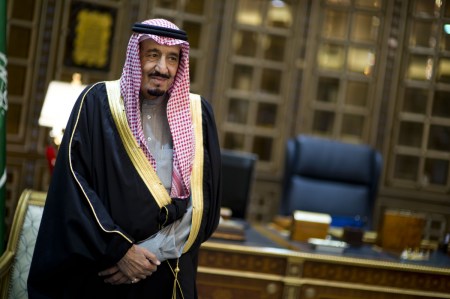
King Salman of Saudi Arabia in 2013. Flickr/Secretary of Defense

The Trump administration, working alongside its Arab allies, should promote moderate or quietist forms of Islam, and not remain neutral on religious matters. This means working with Islamic leaders, many of whom are state-funded imams, to challenge jihad on a religious basis and offer a form of faith shorn of violence.

These strategic insights come together in Morocco, where King Mohammed VI has used his religious role as commander of the faithful to inspire religious leaders to combat jihadism and urge tolerance and peace.

******************************

President Trump is visiting the Middle East. He will travel to Saudi Arabia and Israel, then visit the Vatican. Given the sequence of the first two, some observers speculated that he will attempt to revive the Israeli-Palestinian peace process, perhaps within a broader, regional framework. But different potential outcomes for Arab-Israeli relations, short of a peace settlement, may also be in the offing.

Both Saudi Arabia and Israel have proven themselves to be invaluable partners to the United States in the struggle against ISIS. An American-brokered framework whereby direct cooperation between the two is formalized—rather than a reliance on the United States as an intermediary—may create a framework to broaden the cooperation. Heightened partnership to counter the shared threat of Iran would be an obvious next step. The Trump administration’s new strategy is the creation of a regional alliance, focused on the Gulf countries but also including countries such as Egypt, Jordan and Morocco. A multilateral approach in which Israel plays a more direct and visible role in the coalition would signify a breakthrough. It would bolster confidence among Arab publics that broader cooperation and conflict resolution are warranted.

Donald Trump made the eradication of the Islamic State a priority during his campaign. He has been criticized for his more muscular strategy, as well as the desire to augment intelligence, economic and communications measures to put the screw to the organization.

It seems possible that the president is making a clean break with the Obama administration’s policy of disengagement from the Middle East. For Trump, the rubric of a “war on terrorism” seems to be appealing. Arabs appreciate the fact that, unlikely his predecessor, Trump appears to be recognizing the Shia extremist terror threat as represented by Iran and its proxy militias alongside the widely recognized Sunni jihadist threat.

In the view of this administration, this alliance should function like NATO, as an alliance (perhaps supported by the West) with multiple objectives. The eradication of Islamic State is the main objective, but the containment of Iranian influence in the region is also on the menu.

The use of a massively powerful bomb against the Islamic State in Afghanistan provided a mighty demonstration of strength, but may also have been intended to send a message about the president’s commitment to confront his adversaries with some of the most powerful tools in his arsenal.

But of course, matters are not so simple.

At the geostrategic level, Russia and the pro-Iranian Shia arc cannot be ignored politically. The alliance between the two poses layers of complexity, whereby American and Russian accounts in the Baltic states and vis à vis NATO may be dragged into the diplomatic mix. Moscow cannot be excluded from the equation in any prospective political resolution in Syria. As for Iran, Russia wields heavy influence on its government and its security sector. Trump faces a Twister-like game of challenges in navigating the array of alliances, rivalries and hostilities among the players. Yet his aspiration to eradicate the Islamic State and block Iranian expansion in the region depends on his effective management of these quandaries.

Nor do Trump’s aspirations allow for neglect of the broader counterterrorism challenge beyond military action, intelligence work and even diplomacy. He must wage an ideological war, and challenge extremist strands within Arab and Islamic societies that guarantee the perpetuation of conflict—whatever the outcomes on the battlefield—unless they are addressed.

The Trump administration, working alongside its Arab allies, should promote moderate or quietist forms of Islam, and not remain neutral on religious matters. This means working with Islamic leaders, many of whom are state-funded imams, to challenge jihad on a religious basis and offer a form of faith shorn of violence.

These strategic insights come together in Morocco, where King Mohammed VI has used his religious role as commander of the faithful to inspire religious leaders to combat jihadism and urge tolerance and peace.

King Mohammed VI has demonstrated his commitment to deeper cooperation with neighboring countries by embarking on several state visits and signing an unprecedented number of economic-partnership conventions. He has also expressed support for joint efforts to combat radicalization, and officials from Cote d’Ivoire, Niger, Tunisia, and Guinea have indicated a willingness to train their imams in Morocco.

If Trump is looking for a healthy example of Muslim leaders bringing peace through Islam, Morocco is a good place to start.

The Devil’s Triangle: At-Tanf/Abu Kamal/Ar Rusafah

May 19, 2017

The Devil’s Triangle: At-Tanf/Abu Kamal/Ar Rusafah, Israel National News, Mark Langfan, May 19, 2017

This weekend President Trump must make the stakes clear to the Sunnis gathered in Saudi Arabia to meet him.  President Trump must bring truth to Arab and Islamic fantasies.  He must tell them Israel, and the ‘West Bank’ are not the issue; the only issue is fighting Iran and controlling the At-Tanf/Abu Kamal/Ar Rusafah Triangle.  The Arabs and the Sunnis themselves must contribute blood and treasure to securing this strategic triangle and killing the Iran monster before it can metastasize into an unstoppable one.

The US and the US coalition forces have to move, and move fast to control the At-Tanf/Abu Kamal/Ar Rusafah Triangle so as to avoid an Iran that will cause the death and destruction of millions of people for many, many decades into the future.

*************************

You may have carefully read all the newspapers about the Middle East, but you will likely have never heard about the three Syria cities of At Tanf, Abu Kamal, or Ar Rusafah.  But the soon-to-be-determined military control of the geographic area bounded by these 3 Syrian cities in Syria’s south east corner will determine the fate of the entire world. 

To see the area on a US government map so that you fully understand this article, click here.

If Iran and its proxies control these three Syrian cities, Iran will have achieved its strategic goal of creating a topologic unbroken ground corridor from Iran through Iraq, through Syria, through Lebanon to the Mediterranean Sea.  If Iran fails to secure this geographic Syrian triangle, Iran’s tens of billions of dollars spent to mass-murder Syrian Sunnis to create the foundation of its neo-Safavidic Empire will collapse under its own weight, and Iran’s Khomeneist Shiite Regime will likely implode.

Therefore, next month’s military victors in the battle for this strategic triangle will dictate decades of future conflict, or future peace in the Middle East and the world.

What’s the first order of battle?  If the Islamic State leaders are truly Sunnis, American and US Coalition forces should convince the Islamic State to cede and surrender Raqqah immediately, so US coalition forces can focus on and secure the At-Tanf/Abu Kamal/Ar Rusafah triangle immediately.  Otherwise, the US coalition will have to divert precious and scarce resources to conquering Raqqah, while Iran is redeploying its forces to steal the Triangle.

The question is simple.  Does the Islamic State want the Iranian Shiites to win the At-Tanf/Abu Kamal/Ar Rusafah Triangle, to win Syria, and become the unstoppable Shiite hegemon?  Or does the Sunni Islamic State want the Shiite Iran to lose?  The catastrophic scenario would be for the US coalition forces to win the Raqqah battle against the Islamic State, only to lose the Syrian war to the Islamic Republic of Iran.

The second order of battle?  Trump’s minions must convince the Russians that it is in Russia’s ultimate strategic national interest to allow the US coalition to quickly and decisively win the At-Tanf/Abu Kamal/Ar Rusafah Triangle.  The US must convince Russia that an Iran with a ground corridor through Iraq and Syria to the Mediterranean is as catastrophic to Russian vital national security interests in 2017 as Hitler’s acquisition of Czechoslovakia and Poland was to the Soviet Union in 1939.  Then, Stalin partnered with Hitler in building Hitler the highway for his Wehrmacht to invade the Soviet Union.

Once Iran militarily digests this Iraq-Syrian land corridor, Iran won’t need Russia anymore.  Putin will have created a unstoppable Islamic Terror Superpower.  Putin should remember Stalin’s exuberant celebration of occupying half of Poland was a short-lived delusion that soon came crashing down on his head when he had to face the ugly reality of Hitler’s Operation Barbarossa, the Nazi invasion of the Soviet Union that came close to occupying Moscow itself.

Iraq is a modern-day Czechoslovakia, and Syria is a modern-day Poland.  It is the Iranian war that will lay the groundwork for the next Iranian-Safavidic violent expansion throughout the Middle East.

The third order of battle?  This weekend President Trump must make the stakes clear to the Sunnis gathered in Saudi Arabia to meet him.  President Trump must bring truth to Arab and Islamic fantasies.  He must tell them Israel, and the ‘West Bank’ are not the issue; the only issue is fighting Iran and controlling the At-Tanf/Abu Kamal/Ar Rusafah Triangle.  The Arabs and the Sunnis themselves must contribute blood and treasure to securing this strategic triangle and killing the Iran monster before it can metastasize into an unstoppable one.

The US and the US coalition forces have to move, and move fast to control the At-Tanf/Abu Kamal/Ar Rusafah Triangle so as to avoid an Iran that will cause the death and destruction of millions of people for many, many decades into the future.

Trump Policies Surprise Irans’ Extremists

May 17, 2017

Trump Policies Surprise Irans’ Extremists, Iran News Update, May 17, 2017

On the campaign trail, Donald Trump promised to be “unpredictable” and that’s certainly the case as over the past four months we’ve seen policies that have surprised other world leaders, the US public, and at times, even his own cabinet.

But could this be a good thing?

Abdulrahman al-Rashed,  the former General Manager of Al Arabiya News Channel, wrote an op-ed for Al Arabiya in which he asserted that the policies of the Trump administration have surprised and angered extremists (especially in Iran) because they cannot predict his next move and this leaves them two steps behind.

He wrote: “I believe nothing has angered extremists, be them regimes or organized radical groups, as much as the policies of US President Donald Trump has done.”

He argues that Trump’s stark contrast to the policies of former President Barack Obama are working in the US’s favour in relation to Iran, especially considering his recent mission in Iraq and Syria, and Yemen; three places that Iran is heavily involved in.

Some within the current administration have argued that Trump would be constrained by the nuclear deal, but he is finding ways around that.

al-Rashed wrote: “His Government had [expected] to respect the deal and insisted that Tehran should abide by its strict implementation. Trump did not want to be controlled by the deal.”

Others have argued that Trump would wildly discriminate against Muslim-majority countries, because of his call for all Muslims to be banned from entering the US and his subsequent travel bans, but he has reached out to the US’s middle-eastern allies and his first state visit will be to Saudi Arabia later this month.

A key topic of conversation during that meeting will be Iran’s expansionist qualities, especially regarding Iraq and Syria, Iran’s intimidation of foreign ships in the Persian Gulf and Iran’s illegal arms smuggling to Yemeni or Bahraini militias in violation of international law.

al-Rashed wrote: “President Trump is determined to deal with terrorism, not only as a security issue but as an integral political movement. He surprised everyone with his project and actions that began when he met Crown Prince Mohammed bin Salman in the White House; a program was drawn up to determine the allies he plans to cooperate with.”

It appears that Donald Trump, who wants to take down ISIS and foster peace in the Middle East, wants to work with US allies to achieve his goals.

al-Rashed wrote: “We are witnessing a collective project, Muslim governments and individuals are involved in it, and that is the difference. Trump’s policy lies in transferring responsibilities to the international community, especially to Muslim countries. This is the right step, instead of dropping the accusations through the media and be limited to security pursuits.”

How to Secure and Stabilize the Middle East

May 14, 2017

How to Secure and Stabilize the Middle East, Clarion ProjectShahriar Kia, May 14, 2017

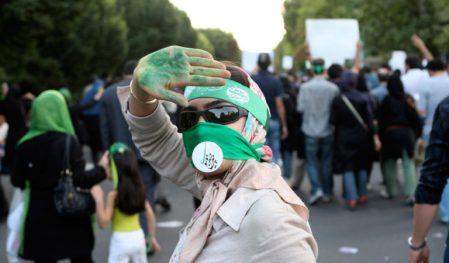
An Iranian protester during the Green Revolution (Photo: Reuters)

The opinions below are those of the author and do not necessarily reflect those of Clarion Project.

In contrast to other countries that lack a opposition that can be trusted, Iran enjoys an internationally-recognized alternative based on democratic values acknowledged across the globe.

The National Council of Resistance of Iran (NCRI) and its pivotal member, the People’s Mojahedin Organization of Iran (PMOI/MEK), is the largest and most organized opposition in the face of the Iranian regime. The NCRI enjoys widespread support inside Iran and throughout the world, with the ability to organize an uprising against the regime in Tehran. Senior Iranian regime officials have acknowledged the time and again that the main threat compromising Iran’s entire regime apparatus is none other than the PMOI/MEK. To this end, they have focused their entire efforts on physically obliterating this Iranian opposition group.

In 2009, when the Iranian people took to the streets and demanded fundamental change, their efforts went unsupported due to Obama’s appeasement policy that sought to sign the nuclear deal with Tehran at all costs. This was an opportunity that enjoyed the potential of significantly decreasing existing Middle East crises. Today, the regime in Tehran is facing crises far more dangerous than 2009.

The correct Iran policy is supporting regime change by the Iranian people and their organized and legitimate resistance. By adopting such a stance, the international community can begin to confront Iran’s notorious influence in the region and its nuclear ambitions in order to spread security in a non-nuclear Middle East free of terrorism.

***************************

U.S. Secretary of State Rex Tillerson announced at a press conference on April 19 that the White House is evaluating its policy on Iran. This policy overview will not merely cover the Iran nuclear deal, but will be a comprehensive look at all Iran-related issues.

At a press conference, Tillerson formalized Iran’s provocative and destructive measures in different fields.

“Iran is the world’s leading state sponsor of terrorism and is responsible for intensifying multiple conflicts and undermining U.S. interests in countries such as Syria, Yemen, Iraq, and Lebanon, and continuing to support attacks against Israel … An unchecked Iran has the potential to travel the same path as North Korea, and take the world along with it … Iran’s provocative actions threaten the United States, the region, and the world …” he said.

“Iran continues to have one of the world’s worst human rights records,” Tillerson added.

Defense Secretary James Mattis adopted a similar approach on April 22 at the Center for Strategic and International Studies, saying, “But we’re talking about the Mideast at an inflection point. And I would just point out right now that among the many challenges the Mideast faces, I think Iran is actually foremost … The Iranian regime, in my mind, is the single most enduring threat to stability and peace in the Middle East.”

Iran’s meddling has neutralized all efforts to resolve the region’s crises, said Bahrain Interior Minister Rashed bin Abdullah at a Gulf Cooperation Council (GCC) session, adding the region faces threats that demand cooperation to confront. He emphasized the need for unity in Gulf positions regarding strategic matters.

What is the right Iran policy?

Supporters of the Iran appeasement approach believe the correct policy is to engage the mullahs’ regime and continue dialogue. They justify this approach for two reasons: first, to contain Iran’s nuclear ambitions and second, to attempt to establish change from within by supporting so-called “moderates” inside the regime apparatus.

This is the policy pursued during the Obama years without any political or strategic reservation, and also that of previous administrations throughout the past few decades.

However, rapprochement with Tehran not only failed to contain the mullahs’ ambitions and terrorism; in fact, it further encouraged the regime and plunged the entire Middle East into insecurity and instability.

The Wall Street Journal wrote in a recent piece, “President Donald Trump’s hard-line view on Iran was at odds with State Department diplomats.”

Yet, the solution placed forward by Obama and the State Department’s experienced diplomats resulted in Iran escalating its flagrant human rights violations and expanding its devious influence throughout the Middle East.

Others believe the right Iran policy is a military solution and the U.S. must launch airstrikes targeting Iran’s nuclear sites. Although this can deliver significant blows to Iran’s ambitions and disrupt the mullahs’ efforts to obtain nuclear weapons, the consequences on regional security and stability are controversial, placing the U.S. and its allies in yet another Middle East war.

What is the durable solution? Can we avoid war while bringing an end to the spread of extremism and terrorism across the globe?

Iran is the leading state sponsor of terrorism in today’s world. Since the appeasement policy adopted by previous U.S. administrations has been fruitless in containing Iran and actually led to the current dangerous circumstances, the only viable long-term solution is to adopt a firm policy that hinges on regime change.

In contrast to other countries that lack a opposition that can be trusted, Iran enjoys an internationally-recognized alternative based on democratic values acknowledged across the globe.

The National Council of Resistance of Iran (NCRI) and its pivotal member, the People’s Mojahedin Organization of Iran (PMOI/MEK), is the largest and most organized opposition in the face of the Iranian regime. The NCRI enjoys widespread support inside Iran and throughout the world, with the ability to organize an uprising against the regime in Tehran. Senior Iranian regime officials have acknowledged the time and again that the main threat compromising Iran’s entire regime apparatus is none other than the PMOI/MEK. To this end, they have focused their entire efforts on physically obliterating this Iranian opposition group.

Following a visit paid by Senator John McCain to Albania and his meeting with Iranian opposition leader Maryam Rajavi, an analysis posted on April 27 in Iran Dideban, a state-sponsored outlet, made vivid the regime’s concern that the Revolutionary Guards (IRGC) failed to quell and destroy the PMOI/MEK.

“The IRGC’s involvement in Syria led to serious neglect. This inattention has surfaced, resulting in this group [MEK] gaining a more open hand to play a role in on-the-ground developments … It is worth noting this group has significant experience in organizing campaigns and can pose a potential security threat for the country. The use of social domestic networks inside the country and influencing grayscale correspondents are among the efforts of this group. This has launched a wave of disappointment among forces loyal to the establishment and state.”

In 2009, when the Iranian people took to the streets and demanded fundamental change, their efforts went unsupported due to Obama’s appeasement policy that sought to sign the nuclear deal with Tehran at all costs. This was an opportunity that enjoyed the potential of significantly decreasing existing Middle East crises. Today, the regime in Tehran is facing crises far more dangerous than 2009.

The correct Iran policy is supporting regime change by the Iranian people and their organized and legitimate resistance. By adopting such a stance, the international community can begin to confront Iran’s notorious influence in the region and its nuclear ambitions in order to spread security in a non-nuclear Middle East free of terrorism.

Iran: Destabilizing the Middle East Through Proxy Allies

May 11, 2017

Iran: Destabilizing the Middle East Through Proxy Allies, Clarion ProjectAmir Basiri, May 11, 2017

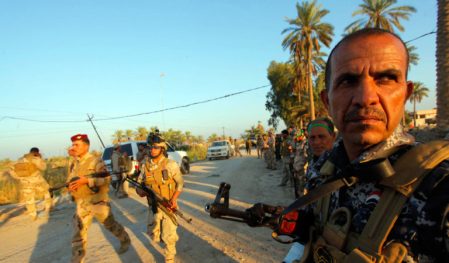
An Iranian Shiite militia in Iraq (Photo: Reuters)

It is a known fact throughout the region that the Islamic Republic of Iran founded the Lebanese Hezbollah as an offspring to expand its influence in the Middle East and gain a foothold on the shores of the Mediterranean.

U.S. National Security Advisor Lt. General H.R. McMaster recently accused Tehran of imposing the “Hezbollah model” to gain influence over various Middle East states, destabilizing the region through the process.

Such a blueprint includes targeting vulnerable governments across the region through a variety of plots while, at the same time, backing armed militia groups stationed in those countries. Hezbollah has already managed to consolidate its influence over the government of Lebanon after Michel Aoun, a Hezbollah ally, took control over the country’s presidency last year.

It has also become quite obvious that the United States, despite the highly flawed nuclear deal which supposedly aimed to curb Iran’s nuclear program, enjoys the leverage of pressuring Iran through the use of comprehensive sanctions. Tehran will likely not forget this obvious factor and knows the Trump administration can kick-start new sanctions whnever it deems necessary.

The new administration has already slapped the Iranian regime with two series of sanctions in the past three months and more can be expected.

The reference made by Trump’s national security adviser to “militias and other illegal armed groups” backed by Iran refers to the vast variety of Shiite militias in Iraq under the Baghdad-backed umbrella of the Popular Mobilization Units (PMU). These groups have their parallel in Yemen with the Houthis, who are focusing their efforts on ousting the Western-backed government.

British researchers discovered evidence indicating without a doubt how Tehran is deeply involved in keeping a “weapons pipeline” up and running for Houthis.

At the same time, Tehran continues to harass the Saudis from their southern border and threaten international shipping lines passing through the strategic Bab el Mandab waterway connecting the Red Sea to the Gulf of Aden.

This goes in line with a conglomerate of Shiite foot-soldiers Iran has rallied from Afghanistan, Pakistan and other countries for the bloodbath raging on in Syria after six long years.

Iran has abetted the barbaric tactics of the Bashar Assad regime in Syria, further demonstrating its ill intentions across the region. The PMU and Hezbollah have boosted Tehran’s efforts and role in keeping Assad in power. They have all been accused of having played atrocious roles in unspeakable war crimes, with the Khan Shaykhoun chemical attack by Assad in Idlib Province of northern Syria acting as yet another stark reminder of this reality.

Iran’s destabilizing role in nations across the Arab and Islamic worlds has been on the rise significantly with news reports seen in recent months.

The Iraqi Parliament legitimized the PMU last November through the adoption of a law aimed at maintaining this entity’s command structure and hierarchy. Iraqi Sunnis, alongside all minorities in the country including Christians, Yazidi and others, are now left extremely concerned, knowing how this measure can actually legalize the brutal retaliation measures conducted by the Shiite militias.

While Iran’s “medddling” has become obvious to the international community, officially Tehran has continued to deny its role of fueling these Middle East conflicts.

In March, Iranian Foreign Ministry spokesman Bahram Ghasemi denied “any intervention in the internal affairs of Arab countries.” The irony lies in the fact that despite such remarks, Alireza Zakani, known to be a close confidante of Iranian Supreme Leader Ali Khamenei, is also known to have boasted in remarks dating back to November 2014 of Iran controlling four Arab capitals following the Houthis’ capture of the Yemeni capital. The list included Baghdad, Beirut and Damascus.

Following eight years of the Obama administration’s disastrous Iran engagement policy, it is high time to make it crystal clear to Iran that such a trend will no longer be tolerated and must come to an end.

Iran to Launch Two New Satellites, Likely Cover for Illicit ICBM Program

May 9, 2017

Iran to Launch Two New Satellites, Likely Cover for Illicit ICBM Program, Washington Free Beacon, , May 9, 2017

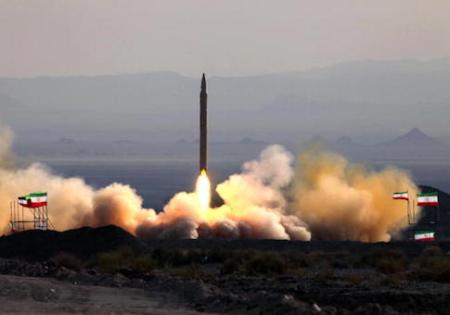
A picture taken on August 20, 2010 shows the test firing at an undisclosed location in Iran of a surface-to-surface Qiam missile, entirely designed and built domestically and powered by liquid fuel according to Defence Minister Ahmad Vahidi, a day before the Islamic republic was due to launch its Russian-built first nuclear power plant. AFP PHOTO/VAHID REZA ALAEI (Photo credit should read VAHID REZA ALAEI/AFP/Getty Images)

Iran is preparing to launch two new domestic satellites into space, according to a new announcement by Iranian military leaders that is stirring discussion among U.S. national security insiders who say the move is likely cover for the test firing of advanced intercontinental ballistic missile technology that could be used as part of Iran’s nuclear program.

The latest test comes as the Trump administration continues to engage in a comprehensive review of the Iran nuclear agreement that U.S. officials tell the Washington Free Beacon will result in a full-scale plan to “meet the challenges Iran poses with clarity and conviction.”

Iran continues to boost its military might and move forward with the testing of controversial ballistic missile technology. The expertise needed to launch satellites into space is similar to that needed to properly launch intercontinental ballistic missiles, which could potentially reach U.S. soil.

U.S. officials and national security experts have been paying close attention to Iran’s missile progress as North Korea ups its provocative moves. Tehran and Pyongyang have long traded illicit missile technology on the black market and Iran’s nuclear progress closely mirrors that of its partner.

The Iranian satellite launches also come as Iran engages in an unprecedented effort to reorganize and boost its military so it can serve as an offensive fighting force, a move that has drawn concern among U.S. national security insiders.

One State Department official, speaking only on background, told the Free Beacon that the Trump administration is moving closer to formulating a plan aimed at confronting Iran’s increasingly provocative behavior.

“As Secretary [Rex] Tillerson said, the Trump administration is currently conducting a comprehensive review of our Iran policy,” the official said. “Once we have finalized our conclusions, we will meet the challenges Iran poses with clarity and conviction.”

Iranian military leaders announced this week that they are preparing for the launch of two new domestically produced satellites.

“Now, we have two ready-to-launch satellites; one of them is Amir Kabir sensing satellite and another one is Nahid telecommunication satellite and over 97 percent of preparation works have been carried out on them,” Iranian Communications and Information Technology Minister Mahmoud Vaezi was quoted as saying Monday in the country’s state-controlled press.

Iran has a history of using space launches as cover to test and refine its ICBM technology, which remains part of its larger nuclear weapons program.

Michael Rubin, a former Pentagon adviser and expert on rogue regimes, told the Free Beacon that launches of this nature have only increased since the landmark nuclear agreement relaxed international restrictions on Iran’s military behavior.

“That Iran uses its satellite program as cover for ballistic missile development is no secret although, quite realistically, since John Kerry loosened restrictions on Iran’s ballistic missile program, they don’t need to hide quite so much,” Rubin said. “The key thing to recognize is that we’re no longer talking about just Iran’s capability.”

Rubin said that U.S. leaders should be paying close attention to the illicit Iranian-North Korean arms trade.

“When it comes to nuclear technology, Iran and North Korea are like sorority sisters swapping clothes or an old married couple sharing a toothbrush,” Rubin said. “What happens in Tehran doesn’t stay in Tehran.”

Saeed Ghasseminejad, a research fellow and Iranian regime expert at the Foundation for Defense of Democracies, called on the Trump administration to impose new sanctions on Iran as a way to roll back its provocative behavior.

The Obama administration moved in its final days in office to lift a number of sanctions on Iran that have enabled it to reap billions in cash windfalls, a portion of which has gone to fund the Islamic Republic’s military buildup.

“The best way to stop Iran’s ballistic missile program is to impose sanctions on the industries involved in the program,” Ghasseminejad said. “This includes the petrochemical, mining and metallurgy, telecommunications, automotive, oil and gas, and electronics industries. The U.S. used the industry-based sanctions to curb Iran’s nuclear program and they were very effective.”

Putin & Trump discuss Iranians on Israel’s border

May 3, 2017

Putin & Trump discuss Iranians on Israel’s border, DEBKAfile, May 3, 2017

(President Trump’s influence with Putin seems to have diminished substantially in the absence of General Flynn. — DM)

Israel was seriously dismayed Wednesday, May 3, when first reports reached Jerusalem about the telephone conversation between Presidents Donald Trump and Vladimir Putin Tuesday, during which Trump agreed to consider Putin’s plan for “de-escalation zones” in Syria, in place of the American security zones proposal. The Russian president’s plan includes the posting of Iranian military officers as co-monitors for those zones, one of which is to be located on the Syrian-Israeli border.

President Trump described the conversation as “Very good.”

The four “de-escalation zones” proposed would be situated at:

1. The northwestern province of Idlib up to the Turkish border;

2. The central Syrian province of Homs (where also the Al-Shariat air base hit by US Tomahawks last month is located);

3. The East Ghouta suburb of Damascus (including also a big military airfield);

4. The Southern region along Syria’s borders with Jordan and Syria.

The Russian president explained that the “guarantor countries” – i.e. Russia, Turkey and Iran – would appoint the monitors for the de-escalation zones.

DEBKAfile’s military and intelligence sources report that Israel was deeply concerned to discover that President Trump had nodded to Putin going forward with his plan, despite Iran’s active involvement. He was even ready to send a US official for the first time to the fourth round of the Syrian peace talks between the Syrian government and opposition in Astana Wednesday, although this process is jointly sponsored by Russia, Turkey and Iran. Stuart Jones, acting assistant Secretary of State, was sent to attend the meeting in the Kazakh capital as an observer, thereby elevating the former American representation from ambassador..

This development caused Israeli disquiet on a number of grounds:

a) The Iranian monitors for the new zones will sit directly opposite the Israeli border. Notice has gone out to Washington and Moscow that the Israeli government will on no account countenance an Iran military presence along its border.

b)  Israel also eyes with mistrust the possible deployment of Russian and Turkish offices along its border with Syria.

c)  Declaring eastern Damascus a protected zone would obstruct Israel aerial operations for keeping Iranian air shipments of advanced weapons via Syria out of Hizballah’s hands. Iran would be able to renew its shipments under full protection.

You can read more about the Russian and American “zones” for Syria in the coming issue of DEBKA Weekly out Friday, May 5. To subscribe to this publication, click here.

d)  There were also some misgivings in Israel about the way National Security Adviser H.R. McMaster characterized President Trump’s approach to foreign policy, shortly before Palestinian leader Mahmoud Abbas arrived at the White House on Wednesday.

“The president is not a super-patient man,” he said. He does not have time to “debate over doctrine, and instead seeks to challenge failed policies of the past with a businessman’s results-oriented approach,” McMaster said.

The trouble is that Middle East issues, such as the Syrian conflict and Israeli security, demand patience and rather more than a businessman’s results-oriented approach, else they may lead to such potentially disastrous consequences as an Iranian military presence that is far too near and dangerous for Israel to countenance.

Boeing Reps Meet With Iranian Terror Leader Who Threatened to ‘Destroy’ U.S. Forces

May 2, 2017

Boeing Reps Meet With Iranian Terror Leader Who Threatened to ‘Destroy’ U.S. Forces, Washington Free Beacon, May 1, 2017

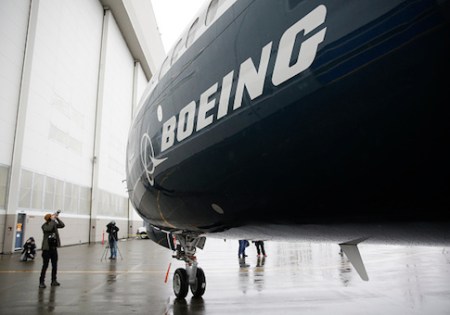
The first Boeing 737 MAX 9 airplane is pictured during its rollout for media at the Boeing factory in Renton, Washington on March 7, 2017. /Photo credit should read JASON REDMOND/AFP/Getty Images)

Boeing’s efforts to ink multi-billion dollar deals with Iran, the world’s foremost state sponsor of terror, has prompted outrage on Capitol Hill and currently is being reviewed by the Trump administration, which will have the final say on whether Boeing is granted licenses to sell new planes to Iran.

**********************************

Leaders from Boeing reportedly traveled to Tehran recently to meet and sign a deal with a top former Iranian Revolutionary Guards Corps (IRGC) member who threatened to blow up U.S. forces in the Persian Gulf region, raising new questions about the U.S. aerospace company’s continued efforts to ink multi-billion dollar deals with the Iranian regime.

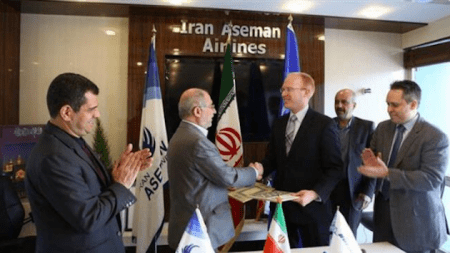
Representatives from Boeing traveled to Iran last month to meet with Hossein Alaei, CEO of Aseman Airlines, which is owned and controlled by the state. Boeing is moving forward with a $3 billion dollar deal to sell new planes to Aseman despite fierce opposition on Capitol Hill and direct evidence Iran has used commercial aircraft to ferry weapons and fighters across the region.

A photograph from the meeting shows a Boeing representative shaking hands with Alaei, who has been identified by Congress as a “prominent and longtime member of Iran’s Islamic Revolutionary Guard Corps,” which is responsible for killing and wounding scores of U.S. troops. The Boeing representative was not named in reports from the Iranian-controlled press or in information provided by U.S. foreign policy insiders.

Alaei, who was a senior figure in the IRGC before being installed as CEO of Aseman Airlines, served as commander of the IRGC Navy until 1990. Alaei oversaw the harassment of U.S. forces in the Persian Gulf and efforts by the IRGC Navy to plant mines in international waters.

Alaei was quoted during this time as threatening to “destroy” U.S. Navy assets in the region.

“We have drawn up plans whereby we will utilize all our military capability to destroy the U.S. fleet and solve the Persian Gulf issue once and forever,” Alaei was quoted as saying in 1987. “The Americans are here to fight us.”

Photo via @mdubowitz Twitter

Boeing’s efforts to ink multi-billion dollar deals with Iran, the world’s foremost state sponsor of terror, has prompted outrage on Capitol Hill and currently is being reviewed by the Trump administration, which will have the final say on whether Boeing is granted licenses to sell new planes to Iran.

Boeing’s deals with Iran are reported to be worth more than $16 billion.

The aerospace company has lobbied Congress aggressively to back the deal and was a key supporter of the Obama administration’s efforts to forge the landmark nuclear deal with Iran, which provided Tehran with billions in economic relief and cash windfalls.

“According to the U.S. Department of Commerce, an aerospace sale of this magnitude creates or sustains approximately 18,000 jobs in the United States,” Boeing said in a statement carried in Iran’s state-controlled media. “Boeing continues to follow the lead of the U.S. government with regards to working with Iran’s airlines, and any and all contracts with Iran’s airlines are contingent upon U.S. government approval.”

Senior sources on Capitol Hill who are working to stop the deal told the Washington Free Beacon that Boeing’s reported meeting with Alaei crosses the line. Representatives of major U.S. corporations should not be posing for pictures with senior IRGC members who have explicitly committed to killing U.S. soldiers, these sources said.

“If Boeing is trying to convince us they are doing their due diligence, they’re not doing a very good job,” said one senior congressional source working on the matter. “These photos of Boeing executives smiling and glad-handing with a prominent member of the Islamic Revolutionary Guard Corps are truly sickening. No self-respecting American should shake Hossein Alaei’s hands. They have American blood on them.”

Sen. Marco Rubio (R., Fla.) and Rep. Peter Roskam (R., Ill.) recently petitioned President Donald Trump to shut down these sales, citing Alaei’s role in the IRGC and Iran’s use of commercial planes to facilitate terrorism.

“Iran, the world’s leading state sponsor of terrorism, has systematically used commercial aircraft for illicit military purposes, including to transport troops, weapons, and cash to rogue regimes and terrorist groups around the world,” the lawmakers wrote. “The possibility that U.S.-manufactured aircraft could be used as tools of terror is absolutely unacceptable and should not be condoned by the U.S. government.”

US-Israel security interests converge

April 28, 2017

US-Israel security interests converge, Israel Hayom, Yoram Ettinger, April 28, 2017

In 2017, the national security interests of the U.S. and Israel have converged in ‎an unprecedented manner in response to anti-U.S. ‎Islamic terrorism; declining European posture of deterrence; drastic cuts in ‎the U.S. defense budget; an increasingly unpredictable, dangerous globe; ‎Israel’s surge of military and commercial capabilities and U.S.-Israel shared ‎values. ‎

Contrary to conventional wisdom — and traditional State Department policy — ‎U.S.-Israel and U.S.-Arab relations are not a zero-sum game. This is ‎currently demonstrated by enhanced U.S.-Israel strategic cooperation, ‎concurrently with expanded security cooperation between Israel and Egypt, ‎Jordan, Saudi Arabia and other pro-U.S. Arab countries, as well as stronger ‎cooperation between the U.S. and those same Arab countries. Unlike the ‎simplistic view of the Middle East, Arab policymakers are well aware of their ‎priorities, especially when the radical Islamic machete is at their throats. They ‎are consumed by internal and external intra-Muslim, intra-Arab violence, which ‎have dominated the Arab agenda, prior to — and irrespective of — the ‎Palestinian issue, which has never been a core cause of regional turbulence, a ‎crown-jewel of Arab policymaking or the crux of the Arab-Israeli conflict. ‎

Israel’s posture as a unique ally of the U.S. — in the Middle East and beyond — ‎has surged since the demise of the USSR, which transformed the bipolar ‎globe into a multipolar arena of conflicts, replete with highly unpredictable, ‎less controllable and more dangerous tactical threats. Israel possesses proven ‎tactical capabilities in face of such threats. Thus, Israel provides a tailwind to the ‎U.S. in the pursuit of three critical challenges that impact U.S. national security, significantly transcending the scope of the Arab-‎Israeli conflict and the Palestinian issue: ‎

‎1. To constrain/neutralize the ayatollahs of Iran, who relentlessly aspire to ‎achieve nuclear capability in order to remove the ‎U.S. from the Persian Gulf, dominate the Muslim world, and subordinate the American “modern-day Crusaders.”‎

‎2. To defeat global Islamic terrorism, which aims to topple all pro-U.S. Arab ‎regimes, expand the abode of Muslim believers and crash the abode of non-Muslim “‎infidels” in the Middle East and beyond.‎

‎3. To bolster the stability of pro-U.S. Arab regimes, which are lethally ‎threatened by the ayatollahs and other sources of Islamic terrorism.

Moreover, Israel has been the only effective regional power to check the North ‎Korean incursion into the Middle East. For instance, on Sept. 6, 2007, the ‎Israeli Air Force destroyed Syria’s nuclear site, built mostly with the support of ‎Iran and North Korea, sparing the U.S. and the globe the wrath of a ruthless, ‎nuclear Assad regime. ‎

While Israel is generally portrayed as a supplicant expecting the U.S. to extend a ‎helping hand, Adm. (ret.) James G. Stavridis, a former NATO supreme commander, ‎currently the dean of the Fletcher School of Law and Diplomacy at Tufts ‎University, says otherwise. He maintains that Israel is not a supplicant but ‎rather a unique geostrategic partner, extending the strategic hand of the U.S. ‎through a mutually beneficial, highly productive ‎relationship with the U.S.

On Jan. 5, 2017, Stavridis wrote: “Our ‎best military partner in the region, by far, is Israel … as we stand together ‎facing the challenges of the Middle East. … Israeli intelligence gathering is ‎superb. … A second zone of potentially enhanced cooperation is in technology ‎and innovation. … In addition to missile defense, doing more together in ‎advanced avionics (as we did with the F-15), miniaturization (like Israel’s small ‎airborne-warning aircraft) and the production of low-cost battlefield unmanned ‎vehicles (both air and surface) would yield strong results. … We should up our ‎game in terms of intelligence cooperation. [The Israeli intelligence ‎services] of our more segregated sectors on a wide range of trends, including the disintegration of Syria, the events in Egypt and the military and nuclear ‎capability of Iran. … Setting up a joint special-forces training and innovation ‎center for special operations in Israel would be powerful. … It truly is a case ‎of two nations that are inarguably stronger together.” ‎

Unlike other major U.S. allies in Europe, the Far East, Africa and the Middle East, ‎Israel does not require U.S. military personnel and bases in order to produce an ‎exceptionally high added value to the annual U.S. investment in — and not ‎‎”foreign aid” to — Israel’s military posture.

For example, the plant manager of Lockheed Martin, the manufacturer of the ‎F-16 and F-35 fighter planes, told me during a visit to the plant in Fort Worth, Texas: “The ‎value of the flow of lessons derived from Israel’s operation, maintenance and ‎repairs of the F-16 has yielded hundreds of upgrades, producing a mega-‎billion-dollar bonanza for Lockheed-Martin, improving research and ‎development, increasing exports and expanding employment.”

A similar ‎added value has benefitted McDonnell Douglas, the manufacturer of the F-15 fighter plane ‎in Berkeley, Missouri, as well as hundreds of U.S. defense manufacturers, ‎whose products are operated by Israel. The Jewish state — the most ‎predictable, stable, effective, reliable and unconditional ally of the U.S. — has ‎become the most cost-effective, battle-tested laboratory of the U.S. defense ‎industry. ‎

According to a former U.S. Air Force intelligence chief, Gen. George Keegan: ‎‎”I could not have procured the intelligence [provided by Israel on Soviet Air ‎Force capabilities, new Soviet weapons, electronics and jamming devices] with ‎five CIAs. … The ability of the U.S. Air Force in particular, and the Army in ‎general, to defend NATO owes more to the Israeli intelligence input than it ‎does to any other single source of intelligence.” The former chairman of the ‎Senate Appropriations Committee, Sen. Daniel Inouye, revealed that “Israel ‎provided the U.S. [operational lessons and intelligence on advanced Soviet ‎ground-to-air missiles] that would have cost the U.S. billions of dollars to find ‎out.”

On Oct. 28, 1991, in the aftermath of the First Gulf War, then-Defense ‎Secretary Dick Cheney stated: “There were many times during the course of ‎the buildup in the Gulf, and subsequent conflict, that I gave thanks for the ‎bold and dramatic action that had been taken some 10 years before [when ‎Israel destroyed Iraq’s nuclear reactor at Osirak].” The destruction of Iraq’s ‎nuclear capabilities in 1981 spared the U.S. a nuclear confrontation in 1991.

An Israel-like ally in the Persian Gulf would have dramatically minimized U.S. ‎military involvement in Persian Gulf conflicts, and drastically reduced the ‎monthly, mega-billion dollar cost of U.S. military units and bases in the ‎Gulf and Indian Ocean, as is the current Israel-effect in the eastern flank of ‎the Mediterranean.‎

Yoram Ettinger is a former ambassador and head of Second Thought: A U.S.-Israel Initiative.

Iran’s Nuclear Weapons Program: On Course, Underground, Uninspected

April 25, 2017

Iran’s Nuclear Weapons Program: On Course, Underground, Uninspected, Center for Security Policy, Clare M. Lopez, April 24, 2017

The Iranian regime’s nuclear weapons program, born in secrecy and kept hidden for years, has never skipped a beat and today continues on course in underground and military facilities to which inspectors have no access. On 21 April 2017, the National Council of Resistance of Iran (NCRI), the oldest, largest, and best organized democratic Iranian opposition group presented startling new evidence that the jihadist regime in Tehran is violating the terms of the JCPOA (Joint Comprehensive Plan of Action) agreement reached in July 2015 among the P-5 +1 (Permanent Five Members of the UN Security Council plus Germany), the IAEA (International Atomic Energy Agency), and Iran.

As will be recalled, it was the NCRI that first blew the lid off Iran’s clandestine nuclear weapons program in 2002, at a time when it had been in progress for at least fourteen years (since 1988), unbeknownst to most of the world, including the IAEA. Virtually all of the Iranian nuclear sites now known publicly were only retroactively ‘declared’ by the mullahs’ regime after exposure: the Natanz enrichment site, Isfahan conversion site, Fordow enrichment and Research and Development (R&D) site, Lavizan-Shian, and more. Regularly corroborated additional revelations since 2002 by the NCRI have built a record of credibility that should prompt a closer official look at these new reports by the U.S. State and Defense Departments, National Security Council (NSC), and White House.

Alireza Jafarzadeh, deputy director of NCRI’s Washington office, provided a devastating expose of the ongoing activities of the Organization of Defensive Innovation and Research (SPND), the Tehran-based element of the Iranian Ministry of Defense that has primary responsibility for the regime’s nuclear weapons development. The SPND, established in February 2011, was officially sanctioned by the U.S. Department of State in August 2014 for engaging in nuclear weapons R&D.   Mohsen Fakhrizadeh (aka Dr. Hassan Mohseni), the founder and director of the SPND and a veteran IRGC (Islamic Revolutionary Guards Corps) brigadier general, was designated individually under UN Security Council (UNSC) Resolution 1747 in 2007 and by the U.S. in July 2008 for his involvement in Iran’s proscribed WMD activities. Despite these designations, and the IAEA’s failure to resolve the many critical indicators of “Possible Military Dimensions” related to Iran’s nuclear program as specified in the November 2011 IAEA Board of Governors report, the July 2015 JCPOA inexplicably lifted sanctions against the SPND.

It is hardly surprising, then, to learn that the SPND not only continues critical weaponization research involving nuclear warheads, triggers, and explosives, but has expanded that work at each of seven subordinate locations. One of these, revealed by the NCRI in 2009 but never declared to the IAEA, is the Center for Research and Expansion of Technologies on Explosions and Impact (Markaz-e Tahghighat va Tose’e Fanavari-e Enfejar va Zarbeh or METFAZ), which works on triggers and high-impact, non-conventional explosives. The current METFAZ director is a Ministry of Defense engineer named Mohammad Ferdowsi, whose expertise is in high explosives. Ferdowsi also serves as chairman of the board of directors of the High-Explosive Society of Malek Ashtar University (affiliated with the Defense Ministry).

After conclusion of the July 2015 JCPOA, much of METFAZ’s personnel and work was moved to the Parchin military facility for better cover and security. Parchin Chemical Industries, an element of Iran’s Defense Industries Organization (DIO), was sanctioned by the U.S. Department of the Treasury in 2008 for importing “a chemical precursor for solid propellant oxidizer, possibly to be used for ballistic missiles.” Parchin is the location where the IAEA long suspected Iran was conducting test explosions for nuclear detonators. In October 2014, Iran finally admitted to using Parchin to test exploding bridge wires, but implausibly claimed they were not for weapons development. Equally incredibly, the IAEA concluded a secret side deal with Iran that allowed it to collect its own samples at Parchin—in which the IAEA in fact did find evidence of enriched uranium. But despite that and more evidence, the JCPOA was concluded and sanctions against Parchin Chemical Industries were lifted.

Within Parchin are twelve separate military and missile complexes. According to the NCRI’s new information, METFAZ has established a new location within one of these that is near the center of Parchin and referred to simply as the “Research Academy” in SPND internal communications. Located on the sprawling Parchin complex some 30 miles southeast of Tehran, the new METFAZ center is called the Chemical Plan of Zeinoddin and is located in a section called Plan 6. It’s completely fenced in and protected by heavy security under control of the IRGC’s Intelligence Service. What goes on there is concealed from the IAEA, and likely with good reason.

Old and New Locations for the SPND

METFAZ’s Research Academy Location within Parchin Plan 6 Area

Lambasting the Iranian regime for its ongoing regional aggression and support to terrorist organizations, as Secretary of State Tillerson did on 20 April 2017, is certainly a step in the right direction. Noting that after ten years, Iran can break out and build all the bombs it wants is also a useful observation. But neither of those comes close to fulfilling the Trump campaign pledge to “rip up” the JCPOA – or hold Iran accountable for its violations of the JCPOA. Secretary Tillerson’s 18 April letter to U.S. House of Representatives Speaker Paul Ryan, certifying that Iran was in compliance with the 2015 deal, simply cannot be squared with the NCRI’s latest revelations, which it has shared with both the U.S. government and the IAEA. Indeed, the independent Institute for Science and International Security (ISIS) issued a March 3, 2017 report in which it explicitly states about the IAEA’s 24 February 2017 Quarterly report, “Nowhere in the report does the IAEA state that Iran is fully compliant with the JCPOA, and it should not make that judgement.”

The real problem with the JCPOA—and why it needs to be ripped to shreds—is not what’s in it: it’s what’s been left out or exempted in any number of secret side deals that the U.S. and IAEA concluded with the Iranians. Among critical issues either explicitly permitted or simply not covered in the JCPOA are the following:

  • Iran keeps its entire nuclear infrastructure intact
  • Iran keeps all its centrifuges and is allowed to work on newer models
  • Iran can deny IAEA inspectors access to any site it seeks to keep off-limits
  • Iran can continue its ballistic missile nuclear weapons delivery system research, development, and testing
  • Iran’s nuclear, chemical, and biological weapons and ballistic missile collaboration with North Korea is not mentioned in the JCPOA
  • Iran’s ongoing support for terrorism is off-limits for the JCPOA

The Trump administration must make good on its campaign promises with regard to Iran, its nuclear weapons program, and the JCPOA. The U.S. with its international partners and the IAEA must demand that Iran fully implement all UN Security Council Resolutions (including the one prohibiting Iran from any nuclear enrichment activities); accept the Additional Protocol; and allow unhindered access for IAEA inspectors to all suspected centers and facilities.

Beginning to fill relevant USG positions with officers untainted by association with the failed JCPOA or Iran Lobby affiliates like NIAC (National Iranian American Council) is an imperative and urgent first step. Announcing U.S. intent to end all activities associated with the JCPOA, hold Iran to account for its human rights abuses, involvement in the 9/11 attacks, and continuing support for terrorism would be natural subsequent policy positions.

We look forward to the results of the JCPOA policy review that Secretary Tillerson has announced.