Posted tagged ‘Trump and Iran’

World’s Rallying Cry: “Free Iran”

July 4, 2017

World’s Rallying Cry: “Free Iran”, Gatestone InstituteMajid Rafizadeh, July 4, 2017

(When will Iran have her own Independence Day? — DM)

“The ruling regime is in disarray and paralyzed as never before. Iranian society is simmering with discontent and the international community is finally getting closer to the reality that appeasing the ruling theocracy is misguided…. Our people want a constitution based on freedom, democracy, and equality…. The sun of change is shining on Iran.”

****************************

“[W]e have a president of the United States who is completely and totally opposed to the regime in Tehran… he completely opposes the Iran nuclear deal signed by his predecessor.” — Ambassador John R. Bolton.

“The fact is that the Tehran regime is the central problem in the Middle East. There’s no fundamental difference between the Ayatollah Khamenei and President Rouhani — they’re two sides of the same coin. I remember when Rouhani was the regime’s chief nuclear negotiator — you couldn’t trust him then; you can’t trust him today. And it’s clear that the regime’s behavior is only getting worse… the declared policy of the United States of America should be the overthrow of the mullahs’ regime in Tehran.” — Ambassador John R. Bolton.

Any fundamental change in Iran’s theocratic establishment will reverberate across the region. Many terrorist groups will lose their major financial and weapons support. Syrian dictator Bashar Assad will lose his hold on power, which he has wielded for far too long. Iran’s major player, the Islamic Revolutionary Guards Corps (IRGC), which constantly damages the US and its allies’ national interests and incites anti-Semitism, will disappear; Hezbollah will lose its funding; “Death to America” and “Death to Israel” will fade away.

Tens of thousands of people came together in Paris on July 1 from all different corners of the world, to unite against the unspeakable atrocities committed by the Islamist state of Iran. It was the largest gathering of Iranians abroad of its kind.

The conference, organized by the National Council of Resistance of Iran (NCRI), was spurred by the desire to speak up for human rights, peace, women’s rights, freedom, democracy, and to demand victory over terrorism. Its focus was to generate awareness of the plight of Iran’s innocent and vulnerable citizens, against whom the Iranian government has been wreaking havoc — with no consequences — for decades.

Leaders, journalists, prominent figures from around the world, and scholars joined the rallying cry of “Free Iran”. The array of speakers included several prominent Americans, including former US Ambassador to the UN, John Bolton; former New York Mayor Rudy Giuliani; former House Speaker Newt Gingrich; former Attorney General Michael Mukasey; former Homeland Security Secretary Tom Ridge; former FBI Director Louis Freeh, and Congressmen Ted Poe, Robert Pittenger and Tom Garret.
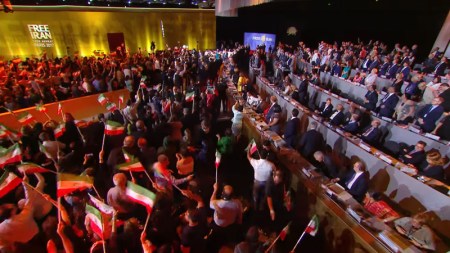
(Image source: Maryam Rajavi video screenshot)

During the eight years of Obama’s appeasement policies towards the Islamist regime of Iran, the mullahs became significantly empowered and emboldened. Iran’s opposition hopes that the appeasement of the theocratic regime in Tehran has come to an end. Ambassador Bolton pointed out:

“[W]e come at a time of really extraordinary events in the United States that the distinguish today from the circumstances one year ago. Contrary to what virtually every political commentator said, contrary to what almost every public opinion poll said, contrary to what many people said around the world, Barack Obama’s first Secretary of State Hillary Clinton is not the president of the United States.

“So for the first time in at least eight years that I’ve been coming to this event, I can say that we have a president of the United States who is completely and totally opposed to the regime in Tehran… he completely opposes the Iran nuclear deal signed by his predecessor.”

The Iranian regime is still the world leading funder of international terrorism, including the 9/11/2001 terrorist attacks on the United States, the Khobar Towers bombing in 1996, the bombings of a U.S. Marine Corps barracks in Lebanon in 1983, attacks on the Israeli embassy in Buenos Aires, Argentina, and the bombing of the AMIA Jewish community center in Buenos Aires.

It does not matter who the regime’s president is; the core imperialist foreign policy of the Iranian regime is the same as it has been for almost four decades. With the passage of time, particularly since the nuclear agreement gave them an even stronger sense of power, Iran’s regime has become more daring and destructive, leaving multitudes of human rights violations in its wake. As Bolton stated:

“The fact is that the Tehran regime is the central problem in the Middle East. There’s no fundamental difference between the Ayatollah Khamenei and President Rouhani — they’re two sides of the same coin. I remember when Rouhani was the regime’s chief nuclear negotiator — you couldn’t trust him then; you can’t trust him today. And it’s clear that the regime’s behavior is only getting worse: Their continued violations of the agreement, their work with North Korea on nuclear weapons and ballistic missiles, only continues to grow.

“And let’s be clear: Even if somebody were to say to you that the regime is in full compliance with the nuclear deal, it doesn’t make any difference. North Korea is already perilously close to the point where they can miniaturize a nuclear weapon, put it on an intercontinental ballistic missile, and hit targets in the United States. And the day after North Korea has that capability, the regime in Tehran will have it as well, simply by signing a check…. that’s why Donald Trump’s views on North Korea are so similar to his views on the regime in Tehran.”

Since 1979, the mullahs and Iran’s Islamic Revolutionary Guard Corps (IRGC) have significantly expanded their terrorist network to Iraq, Yemen, Syria and Lebanon. Iran’s main objective is to impose its Islamist laws and radical ideology on other nations, dominate them, and create an Islamic Caliphate. If the Iranian regime is allowed to continue, especially when it completes its nuclear weapons capability and delivery systems with North Korea’s help, its activities do not look as they will benefit global “health.”

Former House Speaker Newt Gingrich praised the Iranian opposition as a just and pure movement for standing against the Iranian regime: “I am very impressed by the dedication of your movement”. He added, “I come today to bring a very simple message: Iran must be free”. He also praised the leadership of Maryam Rajavi, the President-elect of the National Council of Resistance of Iran (NCRI): “She is persistent in difficult times. She is a great leader. I thank each of you on her behalf to help her make her a truly historic figure.”

It is time for the powers of the world and the Iranian opposition to join hands to counter the Iranian regime. As Ambassador Bolton made clear:

“…we must avoid allowing the regime in Tehran to achieve its long-sought objective of an arc of control from Iran, through the Baghdad government in Iraq, the Assad regime in Syria, and the Hezbollah terrorists in Lebanon — an arc of control, which if it’s allowed to form, will simply be the foundation for the next grave conflict in the Middle East.

“The regime in Tehran is not merely a nuclear-weapons threat; it’s not merely a terrorist threat; it is a conventional threat to everybody in the region who simply seeks to live in peace and security.

“The regime has failed internationally. It has failed domestically, in economics and politics — indeed its time of weakening is only accelerating, and that’s why the changed circumstances in the United States, I think, throughout Europe and here today, are so important.

“There is a viable opposition to the rule of the ayatollahs, and that opposition is centered in this room today.”

Maryam Rajavi struck a hopeful note for democratic change by saying, as the crowd cheered:

“The ruling regime is in disarray and paralyzed as never before. Iranian society is simmering with discontent and the international community is finally getting closer to the reality that appeasing the ruling theocracy is misguided…. Our people want a constitution based on freedom, democracy, and equality…. The sun of change is shining on Iran.”

Rajavi added that the international community must

“recognize the resistance of the Iranian people to overthrow the mullahs’ religious dictatorship and designate the Islamic Revolutionary Guards Corps as a terrorist organization and evict it from the entire region.”

Any fundamental change in Iran’s theocratic establishment will reverberate across the region. Many terrorist groups will lose their major financial and weapons support. Syrian dictator Bashar Assad will lose his hold on power, which he has wielded for far too long. The major player, Iran’s IRGC, which constantly damages the US and its allies’ national interests and incites anti-Semitism, will disappear; Hezbollah will lose its funding. “Death to America” and Death to Israel” will fade away. The list goes on, and leads to the eventual improvement of all human life, as these atrocities have bled their way into every country.

A united coalition can be a robust force against the ruling mullahs. But it can only be as strong as its members, and their dedication finally to achieve peace in a region that has seen far too much torture and bloodshed. It is the time for the international community and world leaders to join the Iranian opposition, more effectively to counter the Iranian regime.

As Bolton stated:

“The outcome of the president’s policy review should be to determine that the Ayatollah Khomeini’s 1979 revolution will not last until its 40th birthday…. the declared policy of the United States of America should be the overthrow of the mullahs’ regime in Tehran. The behavior and the objectives of the regime are not going to change, and therefore the only solution is to change the regime itself.”

With combined, global pressure, this long overdue change can finally become a reality.

Dr. Majid Rafizadeh is president of the International American Council on the Middle East. He is a Harvard-educated and world-renowned Iranian-American political scientist, business advisor, and author of “Peaceful Reformation in Iran’s Islam“. He can be reached at Dr.Rafizadeh@Post.Harvard.Edu.
Nikki Haley’s Comments on Iran Highlight Russian-Related Complications

June 29, 2017

Nikki Haley’s Comments on Iran Highlight Russian-Related Complications, Iran News Update, Edward Carney, June 29, 2017

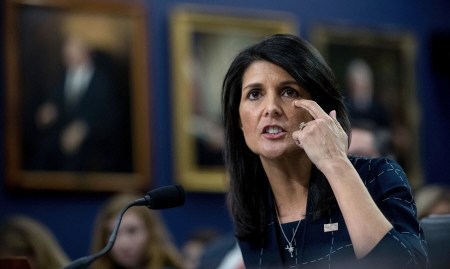
On Tuesday, Nikki Haley, the US ambassador to the United Nations delivered testimony to the House panel on foreign operations, a subcommittee of the Appropriations Committee in the US House of Representatives. In that testimony, Haley addressed multiple issues relating to the Islamic Republic of Iran, thereby reasserting the Trump administration’s assertive policies toward the Iranian regime. By most accounts those policies are still emerging, but they have already come to include purposive outreach to other adversaries of the Islamic Republic and a program of expanded sanctions on matters such as Iran’s ballistic missile program.

However, those efforts to confront and contain the Islamic Republic are arguably complicated by other aspects of the Trump administration’s policy commitments, including a focus on domestic issues and an effort to improve relations between the US and Russia, which boasts close relations with Iran in the areas of trade and military cooperation, especially as it relates to the Syrian Civil War.

While the US supports moderate rebel groups fighting against the dictatorship of Bashar al-Assad, the Iranians and Russians have been credited with turning the war in favor of Assad. Various Shiite militias are currently operating as proxies for Iran in that war, and the Iranian Revolutionary Guard Corps is increasingly playing a direct role in the conflict. Meanwhile, Russia has been providing air support for pro-Assad ground operations since 2015.

Western commentators, including officials in the Trump administration, have variously accused Russia and Iran of ignoring or actively facilitating human rights abuses by the Assad regime, including an April chemical weapons attack that killed at least 80 people in a rebel-controlled civilian area.

As the Associated Press points out, Ambassador Haley’s comments to the House panel came shortly after the White House had issued a warning to Syria regarding alleged preparations for another such chemical attack. The article specified that Pentagon officials had confirmed the intelligence underlying that warning, involving particular movements at the same Syrian air base that had been used as the staging area for the previous chemical attack on Khan Sheikhoun.

White House Press Secretary Sean Spicer said of Assad that “he and his military will pay a heavy price” if they follow through with apparent plans for another “mass murder attack using chemical weapons.” But the AP quoted Haley as saying that the administration’s remarks were not intended only for Assad, but also for Russia and Iran. Both of the Syrian allies joined in denying Assad’s responsibility for the attacks, with some officials insisting that the chemical weapons had originated in a rebel warehouse at the site of a conventional military airstrike.

The dispute over this issue and the subsequent US cruise missile strike on Shayrat air base can be seen as early examples of the escalation between Iranian allies and adversaries which is still going on to this day. In fact, Haley’s effort to fold Russia and Iran into a warning directed more explicitly against Syria is reminiscent of an incident earlier in June wherein a member of Iran’s Revolutionary Guard said that a ballistic missile strike on eastern Syria had been intended largely as a warning to the US and Saudi Arabia.

Those two traditional adversaries of the Islamic Republic have been expanding relations under the Trump administration, sometimes with explicit reference to shared anxieties over expanding Iranian influence and meddling in the broader Middle East. President Trump’s visit to Riyadh in May for an Arab-US summit coincided with the signing of trade agreements that included 110 billion dollars in arms sales to the Arab Kingdom.

But at the same time that the White House is openly siding with Saudi Arabia and its regional allies against the Iranian regime, it does not appear to be giving up on the prospect of improved relations with Russia. In fact, the Western strategy for a political solution to the Syrian Civil War seems to presently involve the expectation that Russia can be encouraged to rein in the Islamic Republic and prevent it from further sabotaging ceasefire agreements.

Recent developments have cast doubt upon the practicality of this strategy however. As the US has taken a more direct role in defending rebel groups, even resorting to the shoot-down of at least two military controlled drones and a Syrian warplane, Russia has responded by threatening to target US aircraft and to halt the use of a hotline intended to prevent mid-air collisions between the multiple powers operating in the skies over Syria.

Haley’s comments on Tuesday were indicative of a roughly matching increase in American criticism of Russia. And this criticism was not limited to the issue of chemical weapons. Haley also explained that Russia’s position on the UN Security Council allowed it to stymie US efforts to sanctions Iran and hold it to account for ongoing misbehavior in matters including the development of the Iranian nuclear program.

“[The Iranians are] going to continue their nuclear capabilities and we just gave them a lot of money to do it with,” Haley said, referring to the 2015 nuclear agreement that President Trump has described as “the worst deal ever negotiated.” She went on to highlight concerns about Iran’s sponsorship of terrorism, suggesting that nuclear weapons could find their way into the hands of terrorist groups at some point in the future, and that Russia would effectively prevent the US and its allies from doing anything to stop this.

“Yes, we would love to sanction Iran; and, yes we will continue to be loud about it; and, yes, Russia will veto it,” Haley said, according to the Washington Examiner.

But this is not to say that the Trump administration has positively brought an end to its strategy of attempting to improve relations with Russia. In fact, various reports suggest that this endeavor is even standing in the way of congressional legislation aimed at increasing national-level sanctions on both Iran and Russia. The Countering Iran’s Destabilizing Activities Act passed the Senate two weeks ago by a margin of 98 to 2, but it was subsequently stalled in the House on procedural grounds, leading Democrats to argue that the House Republican leadership was trying to protect the president’s Russian agenda.

The prospects for resolution appeared to grow dimmer on Tuesday when the Washington Post reported that energy lobbyists were urging lawmakers to reevaluate the bill on the grounds that its restrictions on doing business with Russian companies could have a punishing effect on American firms and foreign firms doing business in the US. These objections could bolster the prospects of the House leadership sending the bill to various committees for review and markup – a process that could delay a final vote by months.

As it concerns Iran, the bill would include sanctions on Iran’s ballistic missile activities and also extend all terrorism-related sanctions to the Revolutionary Guard Corps, for which Trump has urged designation as a foreign terrorist organization. This position has not changed, and it seems that neither has the Trump administration’s hardline approach to Iran policy. Some have suggested that the emerging policy is pointing in the direction of regime change, though this has not become a declared position as yet.

The Washington Examiner pointed out that one member of the House panel on foreign operations, Republican Representative Hal Rogers, had directly raised the prospect of regime change on Tuesday, asking Nikki Haley whether it is an option. The ambassador’s only response was “I don’t know.”

This coming Saturday, the National Council of Resistance of Iran will hold its annual Free Iran rally, which will include explicit calls for regime change driven by a domestic opposition movement within the Islamic Republic. The event is expected to be attended by tens of thousands of Iranian expatriates, plus hundreds of policymakers and experts from the US, Europe, and throughout the world. Notably, these dignitaries will include figures with close ties to the Trump administration, such as John Bolton, who served the second Bush administration in the position now occupied by Haley.

President Trump is fully authorized to destroy Iran in Syria

June 22, 2017

President Trump is fully authorized to destroy Iran in Syria, Israel National News, Mark Langfan, June 22, 2017

President Trump has full and plenary US Constitutional authority to wipe out Iran, and its affiliates in Syria or anywhere else for that matter, if he chooses to do so.

********************************

Last Tuesday, the 13th of June, at a Senate Foreign Relations Committee hearing, when US Secretary of State Rex Tillerson was asked if there was no legal authorization from Congress to target Syrian President Bashar Assad or Iranian proxies, Tillerson answerd, “I would agree with that.” 

Secretary of State Tillerson is mistaken.  There is plenary and continuing congressional authorization under the 2001 Authorization of Use of Military Force (AUMF) for the President to attack any country, organization, or person at all responsible for the attacks on the United States on September 11, 2001.  And, there is sufficient and conclusive evidence that Iran aided and abetted some of the 9/11 attackers before and after September 11, 2001. 

Therefore, there is full current authorization for President Trump to attack any Iranian-backed militias anywhere in the world, including but not limited to, those in Syria.

Exactly what was passed by the Congress 7 days after the United States was attacked by the Islamic barbarians in 2001?

On Sep 18, 2001, the Congress of the United States of America passed S.J. Res. 23 an Authorization of War under the United States Constitution authorizing the President, from then-President Bush, through Obama, to President Trump to engage in any military action against those who fall under the following conditions::

SECTION 1. SHORT TITLE.

•   This joint resolution may be cited as the ‘Authorization for Use of Military Force’.

SEC. 2. AUTHORIZATION FOR USE OF UNITED STATES ARMED FORCES.

•   (a) IN GENERAL– That the President is authorized to use all necessary and appropriate force against those nations, organizations, or persons he determines planned, authorized, committed, or aided the terrorist attacks that occurred on September 11, 2001, or harbored such organizations or persons, in order to prevent any future acts of international terrorism against the United States by such nations, organizations or persons.

Not that there are two sets of critical language, the first is the “aided the terrorists” language, and secondly there is the “harbored such organizations or persons.”

Wikipedia sketches out the elemental facts:

The U.S. indictment of bin Laden filed in 1998 stated that al-Qaeda “forged alliances . . . with the government of Iran and its associated terrorist group Hezbollah for the purpose of working together against their perceived common enemies.”

On May 31, 2001, Steven Emerson and Daniel Pipes wrote in The Wall Street Journal that “Officials of the Iranian government helped arrange advanced weapons and explosives training for Al-Qaeda personnel in Lebanon where they learned, for example, how to destroy large buildings.”

The 9/11 Commission Report stated that 8 to 10 of the hijackers had previously passed through Iran and their travel was facilitated by Iranian border guards. The report also found “circumstantial evidence that senior Hezbollah operatives were closely tracking the travel of some of these future muscle hijackers into Iran in November 2000.”[137]

Judge George B. Daniels ruled in a federal district court in Manhattan that Iran bears legal responsibility for providing “material support” to the 9/11 plotters and hijackers in Havlish, et al. v. Osama bin Laden, Iran, et al. Included in Judge Daniels’ findings were claims that Iran “used front companies to obtain a Boeing 757-767-777 flight simulator for training the terrorists”,

Ramzi bin al-Shibh traveled to Iran in January 2001, and an Iranian government memorandum from May 14, 2001 demonstrates Iranian culpability in planning the attacks. Defectors from Iran’s intelligence service testified that Iranian officials had “foreknowledge of the 9/11 attacks.”

Therefore, there is sufficient open-source information to invoke the 2001 AUMF to include Iran and any force assisted by Iran.

Regarding Iranian post-9/11 activities harboring al Qaeda there is extensive evidence regarding Iranian guilt.  For example there was January 16, 2009 US Treasury Memorandum entitled  Treasury Targets Al Qaida Operatives in Iran which goes into extensive detail of Iran’s active involvement in harboring and protecting al Qaeda and its operatives.

There is a more than sufficient factual predicate to invoke the 2001 AUMF against Iran, and its affiliates.

President Trump has full and plenary US Constitutional authority to wipe out Iran, and its affiliates in Syria or anywhere else for that matter, if he chooses to do so.

U.S.: Strategic Objectives in the Middle East

June 22, 2017

U.S.: Strategic Objectives in the Middle East, Gatestone InstitutePeter Huessy, June 22, 2017

On relations with the Palestinian Authority, the administration has moved to improve matters but has not moved to advocate a two-state solution — for which there is no contemplated security framework sufficient to protect Israel.

****************************

The new “test” of our alliance will be whether the assembled nations will join in removing the hateful parts of such a doctrine from their communities.

What still has to be considered is the U.S. approach to stopping Iran from filling the vacuum created by ridding the region of the Islamic State (ISIS), as well as Iran’s push for extending its path straight through to the Mediterranean.

The tectonic plates in the Middle East have shifted markedly with President Trump’s trip to Saudi Arabia and Israel, and his announced new regional policy.

The trip represented the beginning of a major but necessary shift in US security policy.

For much of the last nearly half-century, American Middle East policy has been centered on the “peace process” and how to bring Israel and the Palestinians to agreement on a “two-state” solution for two peoples — a phrase that Palestinian Authority President Mahmoud Abbas refuses to say.

First was shuttle diplomacy during 1973-74 in the Nixon administration; then second, in 1978, the Camp David agreement and the recognition of Israel by Egypt, made palatable by $7 billion in new annual US assistance to the two nations; third, the anti-Hizballah doctrine, recently accurately described by National Security Advisor General H.R. McMaster, as Iran, since 1983, started spreading its terror to Lebanon and elsewhere in the region. This last effort was often excused by many American and European analysts as a result somehow, of supposed American bad faith. Fourth, came the birth, in 1992, of the “Oslo Accords” where some Israelis and Palestinians imagined that a two-state solution was just another round of negotiations away.

Ironically, during the decade after Oslo, little peace was achieved; instead, terror expanded dramatically. The Palestinians launched three wars, “Intifadas,” against Israel; Al Qaeda launched its terror attacks on U.S. Embassies in Africa; and Iran, Hizballah, and Al Qaeda together carried out the forerunner attacks against America of 9/11/2001.

Since 9/11, despite wars in Afghanistan and Iraq, terrorism has not only failed to recede; on the contrary, it has expanded. Iran has become the world’s biggest state sponsor of terrorism, and the Islamic State (ISIS) has tried to establish a transnational “Islamic caliphate.” Literally tens of thousands of terror attacks have been carried out since 9/11 by those claiming an Islamic duty to do so. These assaults on Western civilization have taken place on bridges, cafes, night clubs, offices, military recruitment centers, theaters, markets, and sporting events — not only across the West but also in countries where Muslims have often been the primary victims.

Particularly condemnable have been the improvised explosive device (IED) attacks against U.S. soldiers in Iraq and Afghanistan, perpetrated to a great extent by Iran, according to U.S. military testimony before Congress.

All the while, we in the West keep trying to convince ourselves that, as a former American president thought, if there were a peace deal between Israel and the Palestinian Authority, most of the terrorist attacks we see in Europe and the United States “would disappear.”

No matter how hard we may rhetorically push the “peace process”, there is no arc of history that bends naturally in that direction. Rather, nations such as the United States together with its allies must create those alliances best able to meet the challenges to peace and especially defeat the totalitarian elements at the core of Islamist ideology.

If anything, the so-called Middle East “peace process” has undercut chances of achieving a sound U.S. security policy. While the search for a solution to the Israel-Palestinian “problem” dominated American thinking about Middle East peace for so many decades, other far more serious threats materialized but were often ignored, not the least of which was the rise of Iran as the world’s most aggressive terrorist.

The United States has now moved in a markedly more promising and thoughtful direction.

The new American administration has put together an emerging coalition of nations led by the United States that seeks five objectives:

(1) the defeat of Islamic State;

(2) the formation of a coalition of the major Arab nations, especially Egypt and the Kingdom of Saudi Arabia, to clean up in their own back yards financing terrorism and providing terrorists with sanctuary. As Elliott Abrams, an adviser to former U.S. President George W. Bush, cautions us, however, this will not be an easy effort: “Partnerships with repressive regimes may in some cases exacerbate rather than solve the problem for us” but, Abrams says, “gradual reform is exactly the right approach…”;

3) “driving out” sharia-inspired violence and human rights abuses from the region’s mosques and madrassas;

(4) a joint partnership with Israel as part of an emerging anti-Iran coalition — without letting relations with the Palestinian authority derail United States and Israeli security interests; and

(5) the adoption of a strategy directly to challenge Iran’s quest for regional and Islamic hegemony, while ending its role in terrorism.

Defeating Islamic State

Defeating ISIS began with an accelerated military campaign and a new American-led strategy to destroy the organization rather than to seek its containment. According to the new U.S. Secretary of Defense, James Mattis, “Our intention is that the foreign fighters do not survive the fight to return home to North Africa, to Europe, to America, to Asia. We’re going to stop them there and take apart the caliphate.”

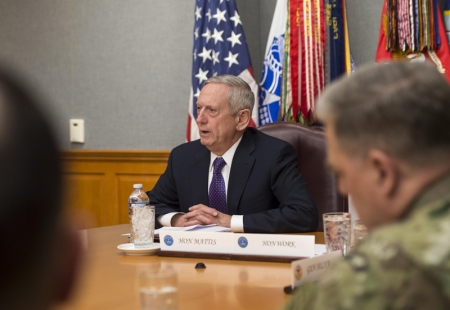
Secretary of Defense James Mattis. (Dept. of Defense/Brigitte N. Brantley)

So far, the United States coalition has driven ISIS from 55,000 square kilometers of territory in Iraq and Syria.

A New Coalition

Apart from a strategy to counter ISIS, the Trump administration also called on our allies in the Middle East to put together a new joint multi-state effort to stop financing terrorism. Leading the multi-state effort will be the Kingdom of Saudi Arabia and the United States, which together will supposedly open a new center dedicated to the elimination of terrorist financing. Positive results are not guaranteed, but it is a step in the right direction.

According to Abdul Hadi Habtoor, the center will exchange information about financing networks, adopt means to cut off funding from terrorist groups, and hopefully blacklist Iran’s jihadist army, the Islamic Revolutionary Guard Corps (IRGC). These measures in turn will help eliminate the sanctuaries from which terrorists plot and plan.

This move also places emphasis on the responsibility of states to eliminate terrorism. As President Trump said, each country — where it is sovereign — has to “carry the weight of their own self-defense“, be “pro-active” and responsible for “eradicating terrorism”, and “to deny all territory to the foot soldiers of evil”.

This determination was underscored by many Arab countries breaking diplomatic relations with Qatar for its support of Iran, the Muslim Brotherhood and ISIS. Most of Qatar’s Arab neighbors, including the Saudis, Egypt, and the UAE did so, while the US, although denouncing Qatar’s support of terrorism, continues to maintain access to, and use of, its critical military base there.

In short, the U.S. is playing good-cop, bad-cop in the region, while U.S. allies are putting together what Josh Rogin of the Washington Post described as “a regional security architecture encompassing countries on the periphery of Iran.”

Such an approach is not without risk: Turkey, allied with Iran and Qatar, has already has pledged to help Qatar defy the Gulf States’ trade cut-off. If Turkey, for example, seeks to move its promised aid shipments to Qatar through the Suez Canal, the ships could possibly be blocked by Egypt or attacked on the high seas. Does the U.S. then come to the assistance of a NATO member — Turkey — against an ally in the strategic coalition?

Drive Hateful Ideology Out

A companion challenge by the new American President underscored this new security effort. President Trump said to the assembled nations of the Islamic conference that they have to expel the ugly Islamist ideology from the mosques and madrassas that recruit terrorists and justify their actions.

Trump said: “Drive them out of your places of worship”. Such words had never been spoken so clearly by an American president, especially to the collection of nearly all the Islamic-majority countries (minus the Shi’ite bloc) gathered together.

The president’s audience doubtless understood that he was speaking of the doctrine of sharia (Islamic law). The new “test” of our alliance will be whether the assembled nations will join in removing the hateful parts of the doctrine from their communities. It was a sharp but critical departure from the previous American administration’s message in Cairo in 2009, and placed the Islamic doctrine that seeks to establish the sharia throughout the world in a contained context.

New Israeli Partnership

With Israel, the administration has cemented the next part of its strategy. Here the Trump administration successfully improved our political and military relations with Israel. Markedly so. One part of that effort was enhanced missile-defense cooperation called for in the FY18 United States defense budget, specifically to deal with Iranian and Iranian-allied missile threats.

On relations with the Palestinian Authority, the administration has moved to improve matters but has not moved to advocate a two-state solution — for which there is no contemplated security framework sufficient to protect Israel.

Challenge and Roll Back Iran

The final part of the administration’s strategy starts with a thorough review of our Iran strategy and the Joint Comprehensive Plan of Action (JCPOA), or “nuclear deal”, with Iran. As Max Singer recently wrote, even if we discount what secretive nuclear capability Iran may now have, the Iranian regime will at the very least be much closer to producing nuclear weapons down the road than when the JCPOA was agreed to.

As Ambassador John Bolton has warned the nuclear deal with Iran did nothing to restrain Iranian harmful behavior: “Defiant missile launches… support for the genocidal Assad regime… backing of then Houthi insurgency in Yemen… worldwide support for terrorism… and commitment to the annihilation of Israel” continue.

In addition, uranium enrichment, heavy water production, the concealed military dimensions of warhead development and joint missile and nuclear work with North Korea all lend a critical urgency to countering Iran’s lethal efforts. The United States did not make these counter-efforts any easier by providing to Tehran $100 billion in escrowed Iranian funds, equivalent to nearly one quarter of the Islamic Republic’s annual GDP.

The United States’ and Europe’s easing of sanctions on Iran has helped reintegrate Iran into global markets via mechanisms such as the electronic payment system run by the Society for Worldwide Interbank Financial Telecommunications (SWIFT). That, in turn, has helped Iran expand dramatically its military modernization budget by 33%, including deals worth tens of billions of dollars in military hardware with China and Russia.

Added to that is Iranian financial- and weapons-support for foreign fighters in Syria, Iraq, Yemen, Lebanon and Afghanistan. Iran’s significant support to the Houthi rebels in Yemen includes weaponry, financing and logistical support, including advanced offensive missiles. The Houthis regularly attempt to carry out missile attacks against Saudi oil facilities.

Such Iran activity is described by the Commander of U.S. Central Command, General Joseph Votel, as “the most significant threat to the Central Region and to our national interests and the interest of our partners and allies”.

As such, it can only be challenged through exactly the kind of military, political, and economic coalition the Trump administration is seeking to band together, which would include the Gulf Arab nations, especially Saudi Arabia, as well as Egypt, Jordan, and Israel.

The administration’s five-step strategy has a chance to work. It creates a policy to destroy ISIS; oppose Islamic terrorism and specifically the imposition of sharia; adopt measures to go after the financing of such terrorism; implement improvements in Gulf allies’ military capabilities — including missile defenses — parallel with pushing NATO members to meet their military spending obligations; put back into place a sound and cooperative relationship with Israel; and specifically contain and roll back Iranian hegemonic ambitions and its terror-master ways.

What still has to be considered, however, is the U.S. approach to stopping Iran from filling the vacuum created by ridding the region of ISIS, as well as Iran’s push for extending its path straight through to the Mediterranean.

If successful, some modicum of peace may be brought to the Middle East. And the arc of history will have finally been shaped toward America’s interests and those of its allies, rather than — however inadvertently — toward its mortal enemies.

Dr. Peter Huessy is President of GeoStrategic Analysis, a defense consulting firm he founded in 1981, and was the senior defense consultant at the National Defense University Foundation for more than 20 years.

What Is the Right U.S. Policy on Iran?

June 21, 2017

What Is the Right U.S. Policy on Iran? Clarion ProjectShahriar Kia, June 21, 2017

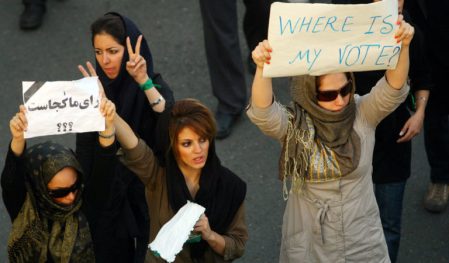
Iranian women protest election irregularities in 2009 (Photo: Getty Images)

Tillerson added. “As you know, we have designated the Quds [Force]. Our policy towards Iran is to push back on this hegemony, contain their ability to develop obviously nuclear weapons, and to work toward support of those elements inside of Iran that would lead to a peaceful transition of that government. Those elements are there, certainly as we know.”

******************************

United States Secretary of State Rex Tillerson responded to a variety of very serious questions raised by House of Representatives members in a recent hearing focusing on U.S. policy vis-à-vis Iran. Representative Ted Poe (R) from Texas touched on what many believe is the ultimate issue when he said:

“I’d like to know what the policy is of the U.S. toward Iran. Do we support the current regime? Do we support a philosophy of regime change, peaceful regime change? There are Iranians in exile all over the world. Some are here. And then there’s Iranians in Iran who don’t support the totalitarian state. So is the U.S. position to leave things as they are or set up a peaceful, long-term regime change?”

America’s top diplomat, taking into consideration how the Trump administration’s all-out Iran policy remains an issue of evaluation, answered:

“… our Iranian policy is under development.

“We continually review the merits both from the standpoint of diplomatic but also international consequences of designating the Iranian Revolutionary Guard in its entirety as a terrorist organization.” 

Tillerson added. “As you know, we have designated the Quds [Force]. Our policy towards Iran is to push back on this hegemony, contain their ability to develop obviously nuclear weapons, and to work toward support of those elements inside of Iran that would lead to a peaceful transition of that government. Those elements are there, certainly as we know.”

Iran is terrified of such a stance and responded immediately. In a tweet, Iranian Foreign Minister Mohammad Javad Zarif claimed that 75 percent of Iran’s population voted in the recent election farce back in May.

Iran’s wrath was not limited to this very issue. Following the twin ISIS attacks targeting Iran’s parliament and the tomb of Ayatollah Khomeini, leader of the Islamic revolution in Iran, senior regime officials sought to portray their apparatus as a victim of terrorism.

Failing to do so, Iranian regime officials accused the US, Saudi Arabia and the main opposition group, the People’s Mojahedin Organization of Iran (PMOI/MEK), of this terrorist plot. A few days ago, Supreme Leader Ayatollah Ali Khamenei lashed out at the US and accused Washington of bringing ISIS to life.

“Who created ISIS? Was it anyone but the U.S.? … The U.S. claim that they have established a coalition against ISIS is a lie; of course, the U.S. is against an ‘unrestrained ISIS,’ however, if anyone truly seeks to eradicate ISIS, they will have to fight against it,” he said.

Now the question is, what is Iran so concerned about and what is the right policy vis-à-vis Iran?

With Obama leaving the White House, Iran forever lost a major international backer. For eight years, the “golden era” as Iran dubbed the Obama years, any and all activities by the Iranian people and their organized opposition for change in Iran was countered by the domestic crackdowns and international hurdles, specifically by the U.S.

Obama’s neglect of Tehran’s crimes in Syria and Iraq led to the disasters we are witnessing today. Internationally, a major overhaul of U.S. policy in the region and establishing a significant Arab-American alliance in the face of Iran’s meddling has become a major concern for the mullahs.

In addition, increasing popular dissent and widespread activities by the PMOI/MEK in the past few months have also raised major concerns for the regime.

Khamenei personally intervened last week, first acknowledging the 1988 massacre, defending the Revolutionary Guards (IRGC), and those involved in the murder of over 30,000 political prisoners. Most of the victims, all executed in mass groups, were PMOI/MEK members and supporters.

Khamenei’s second concern and that of his entire apparatus is focused on the upcoming Iranian opposition’s annual convention in Paris scheduled for July 1 this year. The National Council of Resistance of Iran (NCRI), the main entity representing the Iranian opposition, hosts more than 100,000 Iranians from across the globe each year alongside hundreds of prominent dignitaries delivering their support and speeches seeking true change in Iran.

Last year alone, a very prominent delegation of American dignitaries from both sides of the political aisle included former New York Mayor Rudy Giuliani, former House Speaker Newt Gingrich, former U.S. ambassador to the UN John Bolton from the Republicans, former Democratic National Committee chairman Gov. Howard Dean, former U.S. ambassador to the UN Gov. Bill Richardson took part.

This year’s Iranian opposition rally is already brewing major concerns for Tehran as the regime understands the end of the era of appeasement has led to sweeping changes in Western policy regarding the Middle East, and most importantly Iran.

This is exactly why Tehran is going the limits to prevent the shifting of policy towards the Iranian people. Tehran’s lobbies in the U.S. and Europe are placing a comprehensive effort to demonize the images of the PMOI/MEK and the NCRI to prevent any such changes, especially in Washington.

If Iran resorts to ridiculous remarks of accusing the U.S. and Iranian opposition of staging the recent double attacks in Tehran, the correct policy is none other than supporting the Iranian people and their resistance to realize regime change in Tehran.

Naming Bin Salman Saudi heir impacts US, Israel

June 21, 2017

Naming Bin Salman Saudi heir impacts US, Israel, DEBKAfile, June 21, 2017

US President Trump is taking the lead role along with Prince Mohammed bin Salman of Saudi Arabia, Sheikh Mohammad bin Zayed Al Nahyan of the United Arab Emirates, another crown prince, Egypt’s President Abdul-Fatteh El-Sisi, and Israel’s Prime Minister Binyamin Netanyahu.

******************************

The Saudi king’s decision to elevate his son Prince Mohammed bin Salman, 31, to crown prince and heir to the throne, in place of his cousin Mohammed bin Nayef – as part of a broad reshuffle, is not merely the internal affair of the royal hierarchy, but a game-changing international event.

DEBKAfile’s analysts see it as the outcome of a global and regional process initiated by Donald Trump soon after he settled in the White House in January. With his appointment as de facto ruler of the oil kingdom, the Saudi king’s son is ready to step into his allotted place in a new US-Arab-Israeli alliance that will seek to dominate Middle East affairs. Israel will be accepted in a regional lineup for the first time alongside the strongest Sunni Arab nations who all share similar objectives, especially the aim to stop Iran.

Trump’s trip to Riyadh and Jerusalem in early May laid the cornerstone for the new US-Sunni Arab bloc versus Iran’s Shiite grouping and also cemented Israel’s co-option.

This bloc is in its infancy and has yet to display staying power and prove the wisdom of its policies. But its contours have taken shape. US President Trump is taking the lead role along with Prince Mohammed bin Salman of Saudi Arabia, Sheikh Mohammad bin Zayed Al Nahyan of the United Arab Emirates, another crown prince, Egypt’s President Abdul-Fatteh El-Sisi, and Israel’s Prime Minister Binyamin Netanyahu.

Three of those leaders already maintain strong direct – albeit discreet – ties with Israel’s prime minister, its security establishment, military and various intelligence agencies.

In a lecture on Tuesday, June 20, Israel’s chief of staff, Lt. Gen. Gady Eisenkott, spoke of the covert relations between the IDF and certain Arab nations, which he did not name. There is clearly a lot going on under the surface in various political, economic, financial, intelligence and military fields.

Recent events in the region already point to President Trump acting on important matters, such as the confrontation with Iran, the war on terror, the Syrian conflict and US intervention in the Yemen conflict, on the advice of the two Arab crown princes rather than Defense Secretary James Mattis and Secretary of State Rex Tillerson.

This was strikingly demonstrated when Trump overrode Tillerson’s recommendation to apply diplomacy for resolving the dispute that led to four Arab nations boycotting Qatar, with the Saudis in the lead, whereas the president then demanded strong action to stop Qatar’s funding of terrorists. He therefore opted for the aggressive Saudi and UAE stance against Qatar’s ruler, Sheikh Tamim bin Hamad Al Thani.

These developments bear strongly on US-Russian relations. The two crown princes maintain active ties with President Vladimir Putin. They could, of course, act as go-betweens for smoothing relations between the White House and the Kremlin. But, on the other hand, their influence could be counter-productive and goad Trump into engaging the Russians in a limited confrontation in Syria. It is hard to see Washington and Moscow coming to terms in Syria at this point when the former is closely allied to Saudi Arabia and the UAE and Moscow maintains its loyalty to Tehran.

The evolving bonds between the US, Saudi Arabia, the UAE, Egypt and Israel are the source of President Trump’s optimism about the prospects of pulling off an Israeli-Palestinian peace accord, a vision which eluded all his predecessors in the White House, while knocking over the decades-old barriers between the moderate Arab nations and the Jewish State.

The first steps towards this goal are in the making. They will include exposing parts of their hidden interaction to the light of day, as well as such important symbolic actions, as opening Arab skies to the passage of Israeli commercial flights, or direct telephone links.

None of this is expected to transpire overnight but rather over years, especially since there is opposition to the process still to overcome in the Arab world, including Saudi Arabia, and also in the United States. Critics lay into Mohammed bin Salman, who has made his mark as a visionary social and economic reformer at home, as too young, brash and impatient to rule the kingdom. His decision to entangle Saudi Arabia in the Yemen war, which many believe it cannot win, is held up as evidence of his reckless nature.

But the process switched on by Trump in Riyadh took a large stride forward on June 21, with the formalization by King Salman of his young son’s role as the top mover and shaker in the Saudi kingdom. King Salman obtained the support of 31 out of 34 members of Saudi Arabia’s Allegiance Council for confirming Prince Muhammad Bin Salman as crown prince as well as deputy prime minister and minister of defense.

Bi-Partisan Support for Bill to ‘Hold Iran Accountable’

June 16, 2017

Bi-Partisan Support for Bill to ‘Hold Iran Accountable’, Iran News Update, June 16, 2017

“It’s worth noting that the JCPOA is not unlike the Paris climate accord.

“I don’t think many people in our country or many people in this body realize that it is a non-binding political agreement that was entered into by one man using presidential executive authority and can easily be undone by one man using presidential executive authority.

“In fact, in many ways, it is easier than the Paris accord considering the president doesn’t have to take an action to exit this agreement.

All he has to do is decline to waive sanctions. I think that has been missed.

****************************

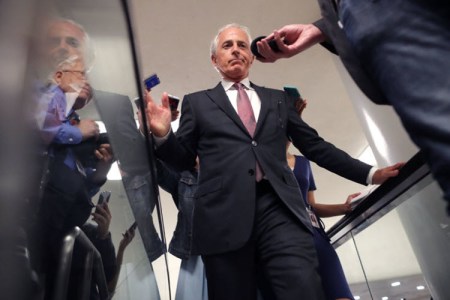
Chairman of the Senate Foreign Relations Committee, Senator Bob Corker (R-Tenn.), spoke before the Senate on Wednesday, in a bill he authored, the Countering Iran’s Destabilizing Activities Act of 2017. The legislation, has 60 bipartisan cosponsors, and is expected to pass the Senate this week. It will expand sanctions against Iranian for ballistic missile development, support for terrorism, transfer of conventional weapons to or from Iran, and human rights violations.

Senator Corker’s speech is reproduced as follows:

“Mr. President,

I rise today to speak about the Countering Iran’s Destabilizing Activities Act of 2017, which passed the Senate Foreign Relations Committee last month by a vote of 18 to 3.

“I’d like to thank the members of our committee and the co-authors of this bill for working in a constructive, bipartisan fashion to craft this legislation.

“I think it is a good example of how the Senate can still work together to tackle complex and difficult issues.

“I was in the SCIF recently – a place where senators go to read classified information – reviewing intelligence, and it truly is astounding what Iran continues to do around the world.

“For a people that are capable of so much, their foreign policy is shockingly counter to their own interest.

“We see destabilizing act after destabilizing act – from missile launches, to arms transfers, to terrorist training, to illicit financial activities, to targeting Navy ships and detaining American citizens – the list goes on and on.

“And it’s past time for us to take steps to protect the interests of the United States and our allies.

“This bill is the first time Congress has come together since the JCPOA – the Iran nuclear deal – to do just that.

“For far too long, the agreement – which I strongly opposed, as did our ranking member and presiding officer – has dictated U.S. policy throughout the Middle East.

“It’s worth noting that the JCPOA is not unlike the Paris climate accord.

“I don’t think many people in our country or many people in this body realize that it is a non-binding political agreement that was entered into by one man using presidential executive authority and can easily be undone by one man using presidential executive authority.

“In fact, in many ways, it is easier than the Paris accord considering the president doesn’t have to take an action to exit this agreement.

“I don’t think most Americans understand that. He doesn’t have to take action to exit the agreement. All he has to do is decline to waive sanctions. I think that has been missed.

“But no matter what the president decides, this bill makes it clear that the Congress intends to remain involved and will hold Iran accountable for their non-nuclear destabilizing activities.

“What the nuclear agreement failed to do was allow us to push back against terrorism, human rights issues, violations of U.N. security council resolutions relative to ballistic missile testing, and to push back against conventional arms purchases, which they are not supposed to be involved in.

“As many of us predicted at the time, Iran’s rogue behavior has only escalated since implementation of the agreement, and this bipartisan bill will give the administration tools for holding Tehran accountable.

“Let me say this. I don’t think there’s anybody in this chamber who doesn’t believe that the Trump administration – I know there’s been a lot of disagreements recently about foreign policy issues in the administration – but I don’t there’s anybody here that believes they are not going to do everything they can to push back against these destabilizing activities.

“And what we’ll be doing today and tomorrow with passage of this legislation is standing hand-in-hand with them as they do that.

“It also sends an important signal that the U.S. will no longer look the other way in the face of continued Iranian aggression.

“I want to recognize the important work of my colleagues in making this legislation possible.

“Senator Menendez has been a champion for holding Iran accountable, in this bill but also in decades of work on this issue. He truly is an asset to the Senate, and I thank him for his commitment to many issues, but especially this one.

“Senators Cotton, Rubio, and Cruz all played an important role in drafting this legislation as well.

“But finally, let me say this. This would not have been possible without the support and tireless effort of the ranking member, Senator Cardin, and his great staff. It has truly been a pleasure for me to work with him on the Russia bill that we will be voting on today at 2:00 p.m. but also on this legislation.

“We come from two very different places, representing two very different states, and yet are joined by the fact that we care deeply about making sure that the foreign policy of this country is in the national interest of our citizens and that we as a Congress and as a United States Senate are doing everything we can to drive positive foreign policy.

“I want to thank him for that and tell him I am really proud of the strong bipartisan momentum behind this legislation, which his leadership has helped make happen, and I look forward to passage of this bill.”

Obama Admin Did Not Publicly Disclose Iran Cyber-Attack During ‘Side-Deal’ Nuclear Negotiations

June 7, 2017

Obama Admin Did Not Publicly Disclose Iran Cyber-Attack During ‘Side-Deal’ Nuclear Negotiations, Washington Free Beacon, June 7, 2017

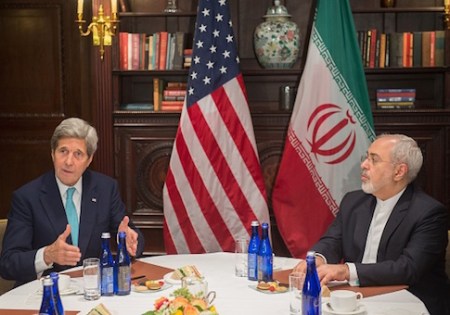
US Secretary of State John Kerry meets with Iran’s Foreign Minister Mohammad Javad Zarif on April 22, 2016 in New York. / AFP / Bryan R. Smith (Photo credit should read BRYAN R. SMITH/AFP/Getty Images)

President Trump, during his trip to the Middle East in late May, talked tough against Iran and its illicit ballistic missile program but has so far left the nuclear deal in place. A Trump State Department review of the deal is nearing completion, the Free Beacon recently reported, and some senior Trump administration officials are pushing for the public release of the so-called “secret side deals.”

Infiltrating State Department emails and internal communications about where the United States stood on a number of sensitive issues could have given the Iranians an important negotiating advantage, according to David Albright, a former U.N. weapons inspector and president of the Institute for Science and International Security.

“The [Joint Comprehensive Plan of Action] had a lot of loose language at the time and the question was whether the U.S. was going to accept it,” he told the Free Beacon, referring to the weeks immediately following the Congressional Review Period, which ended Sept. 17, and Iran’s own review process, which ended Oct. 15.

“It would be to Iran’s great benefit to know where the U.S. would be” on a number of these issues dealing with the possible military dimensions of the Iran nuclear program, he said. “If they could tell the U.S. was going to punt, they could jerk around the [International Atomic Energy Agency, or IAEA] a bit.”

“That’s essentially what happened with the IAEA,” he added.

***************************************

State Department officials determined that Iran hacked their emails and social media accounts during a particularly sensitive week for the nuclear deal in the fall of 2015, according to multiple sources familiar with the details of the cyber attack.

The attack took place within days of the deal overcoming opposition in Congress in late September that year. That same week, Iranian officials and negotiators for the United States and other world powers were beginning the process of hashing out a series of agreements allowing Tehran to meet previously determined implementation deadlines.

Critics regard these agreements as “secret side deals” and “loopholes” initially disclosed only to Congress.

Sources familiar with the details of the attack said it sent shockwaves through the State Department and the private-contractor community working on Iran-related issues.

It is unclear whether top officials at the State Department negotiating the Iran deal knew about the hack or if their personal or professional email accounts were compromised. Sources familiar with the attack believed top officials at State were deeply concerned about the hack and that those senior leaders did not have any of their email or social media accounts compromised in this particular incident.

Wendy Sherman, who served as Under Secretary of State for Political Affairs for several years during the Obama administration and was the lead U.S. negotiator of the nuclear deal with Iran, could not be reached for comment.

A spokeswoman for Albright Stonebridge LLC, where Sherman now serves as a senior counselor, said Tuesday that Sherman is “unavailable at this time and cannot be reached for comment.”

Asked about the September 2015 cyber-attack, a State Department spokesman said, “For security reasons we cannot confirm whether any hacking incident took place.”

At least four State Department officials in the Bureau of Near East Affairs and a senior State Department adviser on digital media and cyber-security were involved in trying to contain the hack, according to an email dated September 24, 2015 and multiple interviews with sources familiar with the attack.

The Obama administration kept quiet about the cyber-attack and never publicly acknowledged concerns the attack created at State, related agencies, and within the private contractor community that supports their work.

Critics of the nuclear deal said the Obama administration did not publicly disclose the cyber-attack’s impact out of fear it could undermine support right after the pact had overcome political opposition and cleared a critical Congressional hurdle.

The hacking of email addresses belonging to State Department officials and outside contractors began three days after the congressional review period for the deal ended Sept. 17, according to sources familiar with the details of the attack and the internal State Department email. That same day, Democrats in Congress blocked a GOP-led resolution to disapprove of the nuclear deal, according to sources familiar with the details of the attack and the internal State Department email. The resolution of disapproval needed 60 votes to pass but garnered just 56.

President Trump, during his trip to the Middle East in late May, talked tough against Iran and its illicit ballistic missile program but has so far left the nuclear deal in place. A Trump State Department review of the deal is nearing completion, the Free Beacon recently reported, and some senior Trump administration officials are pushing for the public release of the so-called “secret side deals.”

State Department alerts outside contractors of cyber-attack

State Department officials in the Office of Iranian Affairs on Sept. 24, 2015 sent an email to dozens of outside contractors. The email alerted the contractors that a cyber-attack had occurred and urged them not to open any email from a group of five State Department officials that did not come directly from their official state.gov accounts.

“We have received evidence that social media and email accounts are being compromised or subject to phishing messages,” the email, obtained by the Washington Free Beacon, states. “Please be advised that you should not open any link, download or open an attachment from any e-mail message that uses our names but is not directly from one of our official state.gov accounts.”

“We appreciate learning of any attempts to use our names or affiliations in this way,” stated the email. Shervin Hadjilou, the public diplomacy officer in the Office of Iranian Affairs, sent the email and cc’d four other State Department officials who deal with Iran issues, including one cyber-security expert.

Two sources familiar with the details of the hack said the State Department and outside contractors determined that Iranian officials were the perpetrators. The hack, which began Sept. 21, had compromised at least two State Department officials’ government email accounts before they regained control of them, as well as private email addresses and Facebook and other social media accounts, the source said.

“They had access to everything in those email accounts,” the source said. “Everyone in the [State Department Iranian Affairs] community was very upset—it was a major problem.”

The hack also stood out because cyber-warfare between Iran and the United States, which had been the weapon of choice between the countries for years, had cooled considerably in 2015 during the nuclear negotiations in what cyber-security experts have described as a limited détente.

Since Iran discovered the Stuxnet virus—a cyber-worm the United States and Israel planted to degrade Iran’s nuclear capabilities—in 2011, the countries have been engaged in escalating cyber warfare as Tehran’s cyber capabilities become increasingly sophisticated and destructive.

Since 2011 Iran has attacked U.S. banks and Israel’s electric grid. In 2012, Iranian hackers brought down Saudi-owned oil company Saudi Aramco, erasing information on nearly 30,000 of the company’s work stations and replacing it with a burning American flag.

Cyber-security experts have long believed that Russia helped Iran quickly build up its cyberweaponry in response to Stuxnet. A team of computer-security experts at TrapX, a Silicon Valley security firm that helps protect top military contractors from hackers, said in April they officially confirmed that Iranians were using a cyber “tool set” developed by Russians.

Tom Kellerman, a TrapX investor who also served on a commission advising the Obama administration on cyber-security, said Iranian cyberwarfare has dramatically improved over the last two or three years in large part due to Russian technical assistance.

“Much like you see the alliance between Syria, Iran, and Russia, the alliance doesn’t just relate to the distribution of kinetic weapons,” he said, but extends into cyberwarfare.

Uproar among private contracting community over cyber-attack

In the late September 2015 hack, at least two State Department officials and a handful of outside contractors lost control of access to their email and social media accounts, which were automatically forwarding emails to work and personal contacts. This spread the hack to a wider network of victims.

The private-contracting community involved in State Department Iran programs—approximately 40 private firms, some of which are based in Washington and others located throughout the United States—were outraged by the infiltration.

“They were saying ‘We’re mad—we’re angry,'” the source recalled. “We all got compromised.”

Eric Novotny, who served as a senior adviser for digital media and cyber security at the State Department at the time, was involved in trying to shut down the hack and help affected officials and private contractors regain control of their accounts. Novotny was one of the four government officials copied on Hadjilou’s Sept. 24 email.

Critics: Obama administration’s silence on hacking was needed to secure nuke deal

Critics of the Obama administration’s handling of the Iran nuclear deal argue that the State Department stayed silent about the hack because acknowledging it could have publicly undermined the pact right after it became official.

“Within hours of the Iran deal being greenlighted, Iran was already conducting cyberattacks against the very State Department that ensured passage of the [nuclear deal],” said Michael Pregent, a senior Middle East analyst at the Hudson Institute. “Acknowledging a cyberattack after the [nuclear deal] was greenlighted would be something that would immediately signal that it is a bad deal—that these are nefarious actors.”

Mark Dubowitz, the CEO of the Foundation for Defense of Democracies, said Iran’s hacking of State Department personnel at such a critical period is “just one of many of Iran’s malign activities that continued and the State Department essentially ignored while the Obama administration was working out the fine points of the nuclear deal.”

“The Obama administration didn’t acknowledge it publicly out of fear that public outrage could threaten the nuclear deal,” he said.

In early November 2015, the Wall Street Journal reported that the Iran’s hardline Revolutionary Guard military had hacked email and social-media accounts of Obama administration officials.

Yet that report wrongly tied the beginning of the uptick in Iranian cyberattacks to the arrest October 29, 2015 of Siamak Namazi, a businessman and Iranian-American scholar who has pushed for democratic reforms. Namazi and his elderly father remain imprisoned in Iran and face a 10-year sentence on espionage charges.

The Journal report also did not indicate that the attacks had occurred more than a month earlier, within three days of the end of the congressional review period, nor did it indicate any specific individual targeted nor how officials and contractors reacted to it.

The Sept. 24 email obtained by the Free Beacon shows the Iranian hacking of State Department officials occurred much earlier—the weekend after Republicans in Congress failed to push through a resolution disapproving the Iran nuclear pact, effectively sealing the foreign policy win for Obama.

The late September time period was particularly important for negotiating critical details of the nuclear deal’s implementation, what critics, including CIA Director Mike Pompeo, have labeled “secret side deals” allowing Iran to evade some restrictions in the nuclear agreement in order to meet its deadline for sanctions relief.

Among other non-public details of the pact, the side agreements involved the controversial exchange of American prisoners held in Iran for $1.7 billion in cash payments.

Infiltrating State Department emails and internal communications about where the United States stood on a number of sensitive issues could have given the Iranians an important negotiating advantage, according to David Albright, a former U.N. weapons inspector and president of the Institute for Science and International Security.

“The [Joint Comprehensive Plan of Action] had a lot of loose language at the time and the question was whether the U.S. was going to accept it,” he told the Free Beacon, referring to the weeks immediately following the Congressional Review Period, which ended Sept. 17, and Iran’s own review process, which ended Oct. 15.

“It would be to Iran’s great benefit to know where the U.S. would be” on a number of these issues dealing with the possible military dimensions of the Iran nuclear program, he said. “If they could tell the U.S. was going to punt, they could jerk around the [International Atomic Energy Agency, or IAEA] a bit.”

“That’s essentially what happened with the IAEA,” he added.

The IAEA is charged with verifying and monitoring Iran’s commitments under the nuclear agreement.

According to Albright, the IAEA ultimately accepted far less access to nuclear sites than it originally wanted. The United States and other world powers also accepted other concessions involving “loopholes” allowing Iran to exceed uranium enrichment and heavy water limits for a certain time period in order for Iran to meet implementation deadlines, he said.

“The IAEA didn’t know much at all and had to write a report [in December 2015] that it was content in knowing so little,” he said.

Others who credit Iran’s Islamic Revolutionary Guard with the cyber-attack say it may not have focused entirely on gaining leverage in the negotiations but simply demonstrating a resistance to the deal among hardline factions in the country.

“Iran has two personalities, and I think you were seeing the other personality shine through,” Kellerman said of the hack during a critical phase of the nuclear deal.

Hack used common spear-phishing technique

Sources said the September 2015 hacking incidents compromised email accounts by sending spear-phishing messages, or efforts to gain unauthorized access to confidential data by impersonating close contacts.

The phishing emails targeted both State Department and private contractors’ personal email and social media accounts, including Facebook, shutting down the users’ access and sending out emails to some of the hacked individuals contacts and forwarding other information to unfamiliar emails with Persian-sounding names, two sources told the Free Beacon.

Samuel Bucholtz, co-founder of Casaba, a cyber-security firm that conducts test-hacking for Fortune 500 companies, said the hackers were likely trying to gain access to contacts and emails. The hackers also may have tried to install malware that would provide greater access to information held on computers or the entire computer network of the organizations, he said.

“If it’s a phishing account that installs malware on your machine, then they have access to all the information on your machine,” he said. “Then they start using that foothold to start exploring access throughout the entire organization.”

Iran Developing Advanced Nuclear Capabilities, Reducing Time to Weapon

June 5, 2017

Iran Developing Advanced Nuclear Capabilities, Reducing Time to Weapon, Washington Free Beacon, June 5, 2017

Iranian President Hassan Rouhani holds a press conference in Tehran on May 22, 2017. AFP PHOTO / ATTA KENARE (Photo credit should read ATTA KENARE/AFP/Getty Images)

Ali Akbar Salehi, the head of Iran’s Atomic Energy Organization, bragged in April that Tehran is prepared to mass-produce advanced centrifuges on “short notice.” Work of this nature would greatly increase the amount of nuclear fissile material produced by Iran, prompting concerns the country could assemble a functional nuclear weapon without being detected.

The issue is complicated by the lack of access international nuclear inspectors have to Iran’s contested military sites, according to the report.

**********************************

Iran is believed to be developing advanced nuclear-related capabilities that could significantly reduce the time it needs to build a deliverable nuclear weapon, according to statements by Iranian officials that have fueled speculation among White House officials and nuclear experts that the landmark accord has heightened rather than reduced the Islamic Regime’s nuclear threat.

The head of Iran’s nuclear program recently announced the Islamic Republic could mass produce advanced nuclear centrifuges capable of more quickly enriching uranium, the key component in a nuclear weapon. Work of this nature appears to violate key clauses of the nuclear agreement that prohibits Iran from engaging in such activity for the next decade or so.

The mass production of this equipment “would greatly expand Iran’s ability to sneak-out or breakout to nuclear weapons capability,” according to nuclear verification experts who disclosed in a recent report that restrictions imposed by the Iran deal are failing to stop the Islamic Republic’s nuclear pursuits.

The latest report has reignited calls for the Trump administration to increase its enforcement of the nuclear deal and pressure international nuclear inspectors to demand greater access to Iran’s nuclear sites.

It remains unclear if nuclear inspectors affiliated with the International Atomic Energy Agency, or IAEA, have investigated Iran’s pursuit of advanced centrifuges, according to the report, which explains that greater access to Iran’s sites is needed to verify its compliance with the deal.

The report comes amid renewed concerns about Iran’s adherence to the nuclear agreement and its increased efforts to construct ballistic missiles, which violate international accords barring such behavior.

“Iran could have already stockpiled many advanced centrifuge components, associated raw materials, and the equipment necessary to operate a large number of advanced centrifuges,” according to a report by the Institute for Science and International Security. “The United States and the International Atomic Energy Agency (IAEA) need to determine the status of Iran’s centrifuge manufacturing capabilities, including the number of key centrifuge parts Iran has made and the amount of centrifuge equipment it has procured.”

Ali Akbar Salehi, the head of Iran’s Atomic Energy Organization, bragged in April that Tehran is prepared to mass-produce advanced centrifuges on “short notice.” Work of this nature would greatly increase the amount of nuclear fissile material produced by Iran, prompting concerns the country could assemble a functional nuclear weapon without being detected.

The issue is complicated by the lack of access international nuclear inspectors have to Iran’s contested military sites, according to the report.

Salehi’s declaration highlights the “profound weaknesses in the JCPOA which include lack of inspector access, highly incomplete knowledge of Iran’s centrifuge manufacturing capabilities and output, and too few centrifuge components being accounted for and monitored,” according to the report.

Iran already has manufactured more centrifuge parts than needed for the amount of nuclear work permitted under the agreement.

The terms of the agreement permit Iran to operate one advanced IR-8 centrifuge. However, Iran is known to have assembled more than half a dozen such centrifuges.

Iran also is working to construct IR-6 centrifuges, which also point to an increased focus on the production of enriched nuclear materials.

“These numbers are excessive and inconsistent with the JCPOA,” according to the report. “Moreover, in light of Salehi’s comments, the excessive production of [centrifuge] rotors may be part of a plan to lay the basis for mass production.”

Iran’s work on “any such plan is not included in Iran’s enrichment plan under the JCPOA,” according to the report.

Inspectors affiliated with the IAEA should immediately investigate the total number of centrifuge parts in Iran’s possession and determine exactly how many of these parts are currently being manufactured, the report states. The IAEA also should attempt to keep tabs on any clandestine nuclear work Iran may be engaging in.

Iran may be misleading the world about its centrifuge production and it still has not declared all materials related to this work, as is obligated under the nuclear deal.

“A key question is whether Iran is secretly making centrifuge rotor tubes and bellows at unknown locations, in violation of the JCPOA, and if it takes place, what the probability is that it goes without detection,” the report concludes.

Additionally, “the United States and the International Atomic Energy Agency (IAEA) need to determine the status of Iran’s centrifuge manufacturing capabilities, including the number of key centrifuge parts Iran has made and the amount of centrifuge equipment it has procured,” the report states.

“They need to ensure that Iran’s centrifuge manufacturing is consistent with the intent of the nuclear deal as well as the deal’s specific limitations on advanced centrifuges,” according to the report. “Moreover, the Iranian statement illuminates significant weaknesses in the Iran deal that need to be fixed.”

When asked to address the issue, a State Department official told the Washington Free Beacon that Iran’s centrifuge work remains very “limited” under the nuclear agreement.

“Under the JCPOA, consistent with Iran’s enrichment and enrichment and [research and development] plan, Iran can only engage in production of centrifuges, including centrifuge rotors and associated components, to meet the enrichment and R&D requirements of the JCPOA,” the official said. “In other words, Iran’s production of centrifuges and associated components are limited to be consistent with the small scale of R&D that is permissible under the JCPOA.”

If Iran is in violation of the deal, the United States will take concrete action to address this once the Trump administration finishes its interagency review of the Iran deal.

“The Trump administration has made clear that at least until this review is completed, we will adhere to the JCPOA and will ensure that Iran is held strictly accountable to its requirements,” the official said.

Iran and Middle East Instability

June 3, 2017

Iran and Middle East Instability, American ThinkerShahriar Kia, June 3, 2017

During President Donald Trump’s trip to the region and beyond Iran was strongly condemned by the American leader and senior Saudi officials for its support for terrorism, destructive role across the Middle East, and meddling in Syria, Iraq, and Yemen. Tehran is most specifically concerned with world leaders denouncing Iran’s human rights violations and acknowledging how the Iranian people are the main victims of the mullahs’ atrocities.

The Arabs, as the flagbearers of implementing U.S. sanctions, have launched the domino of freezing Iran’s money abroad. Iranian bank accounts in countries such as Turkey, Oman, and the UAE, especially in Dubai and Abu Dhabi, are being blocked one after another. This can be considered the prelude to comprehensive sanctions on Iran’s banking network.

***********************

The end result of Iran’s presidential election has created further rifts and launched a more intense power struggle amongst the regime’s senior ranks. Supreme Leader Ali Khamenei, fearing a repeat of the 2009 scenario of nationwide uprisings, failed to “engineer” the election results with the aim of unifying his regime apparatus. Khamenei sought to prepare conservative cleric Ebrahim Raisi as his heir by first placing him in the presidency, similar to the process he himself went through.

The elections, however, failed to provide such a finale and in fact prompted all candidates to unveil corruption in the most senior ranks. This has prompted the general public to increase their demands. Protests and demonstrations are witnessed these days in more than 30 cities and towns across Iran, with sporadic reports of clashes, following the bankruptcy of two state-run financial firms, Caspian and Arman.

Iran is also facing major foreign dilemmas, with a new international coalition shaping and targeting Tehran’s interests. The Arab-Islamic-American alliance, with the presence of 55 States, and Iran’s absence, delivered a major blow to the mullahs’ objectives in the Middle East.

On the other hand, Iranian opposition People’s Mojahedin Organization of Iran (PMOI/MEK), transferring all its members from Iraq to a number of European countries, has become ever more powerful. Through a vast network of supporters inside Iran, the PMOI/MEK was able to significantly influence the recent elections and place the regime in a quagmire like never before.

A major rally is scheduled for July 1st by supporters of the National Council of Resistance of Iran (NCRI), the political umbrella group of Iranian dissidents, including the PMOI/MEK. Policymakers and influential figures from across the globe will be gathering to provide a concrete plan to evict the mullahs’ presence from the region, how to establish freedom and democracy in Iran, and thus result in peace and stability in the Middle East. Last year more than 100,000 people took part in this convention.

During President Donald Trump’s trip to the region and beyond Iran was strongly condemned by the American leader and senior Saudi officials for its support for terrorism, destructive role across the Middle East, and meddling in Syria, Iraq, and Yemen. Tehran is most specifically concerned with world leaders denouncing Iran’s human rights violations and acknowledging how the Iranian people are the main victims of the mullahs’ atrocities.

Despite the heavy blows and new sanctions against Tehran, Khamenei has chosen to remain completely silent. This is in complete contrast to the Obama era, where the mullahs’ leader resorted to harsh outbursts in response to even the slightest hint of threats by U.S. officials.

To this end, adopting a strong approach against Tehran has proven to be correct, parallel to the weakness seen in Tehran following the presidential election.

To add insult to injury for Iran, the Trump administration has imposed sanctions on dozens of Iran’s companies, sending a highly important message.

Sanctions have now expanded from ballistic missiles and reached the human rights perspective, and specifically targeting the Revolutionary Guards (IRGC) with the objective of designating this entity as a foreign terrorist organization

The IRGC-affiliated Fars news agency described a new U.S. Senate bill as an “effort to bring Europe aboard in nuclear sanctions.”

“Foreign investment in Iran during the past four years has halved during the past four years, lowering from $4.6 billion to $2.05 billion,” according to Naseem Online citing a UN report.

The Arabs, as the flagbearers of implementing U.S. sanctions, have launched the domino of freezing Iran’s money abroad. Iranian bank accounts in countries such as Turkey, Oman, and the UAE, especially in Dubai and Abu Dhabi, are being blocked one after another. This can be considered the prelude to comprehensive sanctions on Iran’s banking network.

Is Rouhani able, or even willing?

Rouhani is neither willing nor able to carry out any measures outside of Khamenei’s framework. The entire apparatus and power structure is controlled by the Supreme Leader. As long as Iran remains under the mullahs’ regime structure, one should set aside all expectations of change emanating from within Iran. A look at Mohammad Khatami’s tenure is president from 1997 to 2005, andRouhani’s first term, are undeniable proof to this reality.

“They want to change our behavior, but changing it means changing our regime,”Khamenei said recently, signaling his red line.

Rouhani defending Iran’s missiles

The regime’s president recently said that Tehran would continue its ballistic missile program.

“… US officials should know whenever we need to technically test a missile, we will do so and will not wait for their permission,” he said in a news conference.
The Iranian regime reported recently the construction of a third underground ballistic missile production factory and will keep developing its missile program.

This came in the same week when Trump in his foreign visit described Iran as a supporter of militia groups and a threat to all Middle East countries.

Rouhani is an “utterly ruthless operator,” who had presided since 2013 over a collapsing economy and what Amnesty International called “a staggering execution spree,” murdering and imprisoning so many dissidents that Iran has per capita the highest execution rate in the world, according to Christopher Booker in a recent Telegraph article.

Obama’s departure ended the period of appeasement and golden opportunities for Tehran’s mullahs. The road ahead promises to be very difficult, to say the least.

The past four decades have proven that only regime change will bring about what the Iranian people desire and deserve. This is something that is supported by the NCRI and Rajavi’s ten-point plan, calling for a free and democratic Iran where equal opportunities are provided to all citizens regardless of gender, ethnicity, and religion. During the short campaigning season, Iranians manifested their support for Rajavi’s plan by putting up posters reading “Maryam Rajavi is our president.”