Yes, Trump’s Going to Dump the Iran Deal, Center for Security Policy, Fred Fleitz, November 15, 2016
(Interesting food for thought. — DM)

Source: National Review
In the days following Donald Trump’s victory, a variety of experts — mostly Trump critics — pronounced that, despite Trump’s frequent statements during the presidential campaign that the July 2015 nuclear deal with Iran is one of “the worst deals ever made by any country in history,” he has no choice but to stick with the agreement after he assumes office.
Iranian foreign minister Javad Zarif was one of the first to insist as much, claiming a Trump administration cannot back out of the nuclear deal because it is not a bilateral agreement between the United States and Iran but “an international understanding annexed to a Security Council resolution.”
Trita Parsi, president of the National Iranian American Council (which The Weekly Standard’s Lee Smith once described as “the tip of the spear of the Iran lobby” in the United States) echoed Zarif’s statement. In a November 11 Foreign Policy article, he argued Trump can undermine the Iran deal but cannot directly dismantle it because the JCPOA is a multilateral agreement “codified by the UN Security Council.” Any attempt by a Trump administration to renegotiate the deal would violate international law and isolate the United States, Parsi said.
Even some conservative experts have suggested Trump probably won’t try to significantly modify or discard the nuclear agreement, but will instead try to goad Iran into withdrawing by strictly enforcing the deal.
But Trump senior national-security adviser Walid Phares poured cold water on speculation that Trump plans to walk back his statements about the Iran deal, when he commented on Facebook over the weekend that the “Iran Deal will be dismantled.”
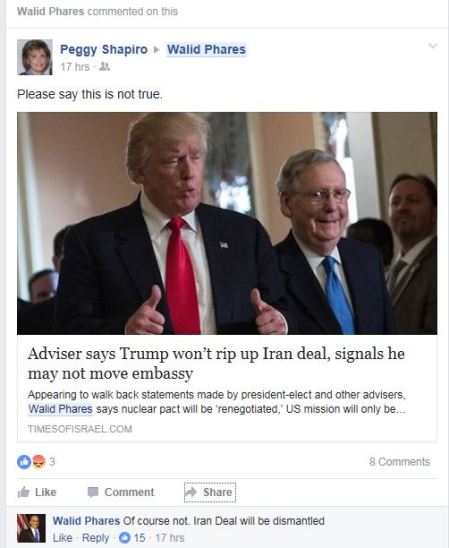
This firm statement by Phares confirmed previous statements he and Mr. Trump have made that the deal is a dangerous agreement that needs to be either significantly renegotiated or abandoned. As an expert who has followed the Iran nuclear program for many years inside and outside of government, I would like to expand on their statements by offering three key points about the nature of the deal and ten guidelines for renegotiating it.
1. The Iran deal is a dangerous fraud.
Donald Trump was exactly right when he called the Iran deal a “horrible” and “disastrous” agreement. The U.S. agreed to huge concessions to get this agreement, from no restrictions on Iran’s sponsorship of terrorism to no inspections of military facilities. There were secret side deals withheld from Congress that permitted Iran to inspect itself for past nuclear-weapons work and receive secret planeloads of cash in exchange for freeing U.S. hostages. To get the $150 billion in sanctions relief Iran wanted, there was another secret side deal — also withheld from the U.S. Congress — which granted Tehran exemptions for failing to meet some of the agreement’s key requirements.
So what did the United States get for these concessions?
Not much. The Obama administration claims the deal keeps Iran a year away from a nuclear deal for ten to 15 years. But in fact, the time to an Iranian nuclear bomb will drop dramatically under the deal, since Iran will be able to enrich uranium, develop advanced centrifuges, and, with Chinese assistance, finish construction of a heavy-water nuclear reactor that will produce one-quarter of a weapon’s worth of plutonium per year.
It will be very hard to verify the agreement since military sites — where Iran is likely to conduct covert nuclear-weapons work — are off limits to inspectors. The deal dumbed down the IAEA’s quarterly Iran reports, making it difficult for the world to know the true extent of Iran’s compliance. Certainly, there already have been reports of significant Iranian cheating.
Further, the deal was supposed to improve Iran’s international behavior.
Instead, from ballistic-missile tests to increased support to Hezbollah, Bashar al-Assad, and the Houthi rebels in Yemen, Tehran’s behavior in the Middle East has significantly worsened. Just in the last year, Iran has captured and held at gunpoint ten U.S. sailors and fired anti-ship missiles at American and UAE ships. Is this what a new era of cooperation with Iran was supposed to look like?
2. The deal is not legally binding on us.
Knowing that a bipartisan majority of Congress opposed the nuclear deal and that the U.S. Senate would never ratify it as a treaty, the Obama administration arranged to go around the Senate by negotiating the deal as an executive agreement endorsed by the U.N. Security Council. Because Security Council resolutions are binding on all U.N. members, it could therefore be argued that the nuclear deal was binding on the United States even though it had not been ratified by the Senate.
But that is not how our constitutional order works. American presidents historically have decided which international agreements are to be treated as treaties, but the Iran deal specified that it be ratified by the Iranian parliament.
If President Obama wanted to make a long-term international agreement binding on the United States, he needs consent from Congress. Anything else is a serious affront to the Constitution, and no U.N. endorsement changes that.
(This is not the only example of President Obama’s lawless approach to international agreements: The Paris climate-change agreement was deliberately negotiated to make it binding on the United States without Senate ratification and difficult for a future U.S. president to cancel. The same principles apply, however, and I expect President Trump pull out of the climate agreement as soon as possible.)
3. It’s not a true multilateral agreement.
The Obama administration also attempted to entrench the Iran deal making it a multilateral agreement, but this was just window-dressing.
The deal is technically a multilateral pact agreed to by Iran, the United States, Russia, China, France, the United Kingdom, and Germany, but it is actually a bilateral agreement negotiated almost entirely between the United States and Iran. Iran has only looked to the United States for additional concessions since the deal was announced, and if we want to end the deal, we can.
So it is clear the deal must be either discarded or substantially renegotiated, and that we have every right to do so.
The first steps to renegotiation should be (1) assembling a new anti-Iran coalition of our European allies, Israel, and the Gulf states, and (2) imposing new sanctions on Iran in response to its nuclear program, ballistic-missile program, sponsorship of terrorism, and belligerent behavior. Russia and China could be allowed into the new coalition, but they should not be given a veto over any new agreement. This coalition also must be kept out of the United Nations.
Building the new coalition and renegotiating the agreement won’t be the easiest task, but given Iran’s belligerent behavior and the power new U.S. sanctions can have, a strong president and secretary of state can do it.
An agreement that truly addresses the threat from Iran’s nuclear program and the wider threats Iran poses will require reversing all of the irresponsible concessions made to Iran by the Obama administration.
Such negotiations must start from the following ten guidelines:
- Iran must cease all uranium enrichment and uranium-enrichment research.
- Iran cannot have a heavy-water reactor or a plant to produce heavy water.
- Iran agrees to robust verification, including “anytime, anywhere” inspections by IAEA inspectors of all declared and suspect nuclear sites.
- Iran must fully and truthfully answer all questions about its past nuclear-weapons-related work.
- Iran must agree to limitations on its ballistic-missile program.
- Sanctions will only be lifted in stages, in response to Iranian compliance with the agreement.
- Iran must agree to end its meddling in regional conflicts and its sponsorship of terror.
- Threats by Iran to ships in the Persian Gulf, U.S. naval vessels, and American troops must stop.
- Iran must cease its hostility toward Israel.
- Iran must release all U.S. prisoners.
Renegotiating or terminating the Iran deal will not just end the threat from a dangerous international agreement.
It will signify that this agreement was an aberration by an incompetent U.S. president who tried to subvert the U.S. Constitution, and it would send a powerful message to the world that the Obama administration’s policies of American weakness and appeasement are over.
Trump critics have argued that renegotiating or terminating the nuclear deal would isolate the United States and hurt America’s global stature. But in reality, President Obama’s foreign policy has already undermined America’s reputation around the world.
Fixing or killing the Iran nuclear deal will be President Trump’s first step toward restoring America’s global leadership.





 anneinpt
 artaxes
 danmillerinpanama
 davidking1530
 Peter Hofman
 Joseph Wouk
 Peter
Peter Louisiana Steve
 WarSclerotic
Recent Comments