Posted tagged ‘Trump and Iran scam’

Time for US to Support Regime Change in Iran – Raymond Tanter

July 27, 2017

Time for US to Support Regime Change in Iran – Raymond Tanter, Iran News Update, July 27, 2017

(Please see also, US seeks to test Iran deal with its new inspections and The Iran dilemma of the Saudi crown prince. Is a “peaceful transition”  possible? Even if it is not, we should support it. — DM)

When asked whether the Trump administration supports “a philosophy of regime change in Iran, Secretary of State Rex Tillerson said the U.S. would work with Iranian opposition groups toward the “peaceful transition of that government.”

Sen. John McCain (R-Ariz.) echoed Tillerson’s view, saying “it’s time the Iranian people had a free and open society and a functioning democracy,” effectively a call for regime change.

The Obama quote reassuring the Iranian regime that its survival was not on the table stands in marked contrast to those of Tillerson and McCain, for whom the idea of regime change from the people of Iran is on the table, or at least under the table in and around the Trump White House.

****************************

The following is an op-ed by former US National Security Council staff member Professor Raymond Tanter on Iran policy options for the United States. The article was published on The Hill website on Wednesday, July 26:

The time may be right for President Trump to consider and pursue regime change in Iran. Consider three quotes that provide a way of looking back to look forward:

President Obama in 2013 address to the United Nations:

“We are not seeking regime change, and we respect the right of the Iranian people to access peaceful nuclear energy.”

When asked whether the Trump administration supports “a philosophy of regime change in Iran, Secretary of State Rex Tillerson said the U.S. would work with Iranian opposition groups toward the “peaceful transition of that government.”

Sen. John McCain (R-Ariz.) echoed Tillerson’s view, saying “it’s time the Iranian people had a free and open society and a functioning democracy,” effectively a call for regime change.

The Obama quote reassuring the Iranian regime that its survival was not on the table stands in marked contrast to those of Tillerson and McCain, for whom the idea of regime change from the people of Iran is on the table, or at least under the table in and around the Trump White House.

On July 1, an event was held in Paris; there, I had conversations with Rep. Ted Poe (R-Texas), who explicitly called for regime change from within Iran by supporting Iranian oppositionists, in particular, the National Council of Resistance of Iran (NCRI).

Ditto for other Trump allies, including John Bolton, former U.S. ambassador to the United Nations during the George W. Bush administration. On July 1, Bolton, said:

“There is a viable opposition to the rule of the ayatollahs, and that opposition is centered in this room today. I had said for over 10 years since coming to these events, that the declared policy of the United States of America should be … to change the regime itself. And that’s why, before 2019, we here will celebrate in Tehran!”

The Way Forward

“Trump time” suggests a period of analysis of options as the President’s National Security Council reviews Iran policy. The review could present three options to Trump.

First, follow the Obama precedent of reassuring Tehran the United States will not challenge the rule of the unelected Ayatollahs. Trump and the Congress, however, are so strongly opposed to the Iranian regime, they are unlikely to countenance the Obama policy toward Iran, which Trump considers “appeasement.” Obama lost his bet that Iran would moderate its ballistic missile testing, state-supported international terrorism, and human rights violations. His nuclear deal was inconsistent with regime change from within, e.g., via a coalition of dissident groups.

Second, order preparations for the kind of coup d’état the CIA and British MI-6 intelligence service carried out in 1953, which overthrew a democratically-elected government in Iran. “All the Shah’s Men” describes how the coup occurred and the unintended negative consequences for Iranian perceptions of America for changing Iran’s government by covert action.

Indicative of this option is an editorial in The New York Times of July 18, which sounds the alarm that, “A drumbeat of provocative words, outright threats and actions — from President Trump and some of his top aides as well as Sunni Arab leaders and American activists — is raising tensions that could lead to armed conflict with Iran.”

But regime change from within is more than just an American issue. It is a “people of Iran” issue and what they want; it is not about the U.S. military going to war with Iran, as the editorial suggests.

Third, support the pro-democracy coalition of dissidents, the NCRI, which is best able to mobilize other oppositionists into an even wider coalition. Also, there’s a new sheriff in town, President Trump, and he expressed a strong presence in his Riyadh address: Trump the deal-maker but one with core principles like “Drive them out.”

“Drive them out of your places of worship,” Trump said of extremists, “drive them out of your holy land. Drive them out of this earth.”

After the July 1 rally in Paris, Fox News reported the next day the president might defy the Iranian regime by signaling his willingness to look kindly on the resistance: “The Trump administration is potentially considering seeking a strategy to try to topple the regime.” The resistance, however, only needs American political and perhaps economic support to effect “regime change from within.”

Even if he does not go so far as to topple the regime, Trump could increase his leverage against the Ayatollahs by supporting the resistance, conditioned on its continued eschewing of terrorist tactics. Doing so is bound to weaken an already faltering regime. In this respect, the tide is turning against Tehran in favor of the opposition.

The Bottom Line

The Iranian resistance benefits from aligning with the United States because the resistance is firmly in the camp of civilized states and does not commit acts of barbarism. Hence, President Trump is more likely to reach out to the Iranian opposition during his review of Iran policy than did President Obama, who valued the nuclear deal with Tehran too much to jeopardize it by opening up to the resistance.

Dr. Raymond Tanter (@AmericanCHR) served as a senior member on the National Security Council staff in the Reagan-Bush administration and is now Professor Emeritus at the University of Michigan.

A State Department Gone Rogue on Iran

July 25, 2017

A State Department Gone Rogue on Iran, JerusalemPostMatthew R.J. Brodsky, July 24, 2017

Final round of negotiations on a nuclear deal with Iran continue in Vienna November 21, 2014. (photo credit:REUTERS)

According to a recent report, the president assigned a White House team to focus on the Iran deal and sideline the State Department so that he has more options when the issue comes to the fore again in three months.

It’s not just Iran where the president sees a problem; the secretary has been actively tugging in the opposite direction when it comes to solving the Qatar crisis and on a host of issues related to Israel as well.

In many ways, the different view at the State Department should be expected, not just due to institutional issues where diplomats usually prefer finesse to force but because of personnel considerations as well.

Barack Obama holdovers are driving the State Department’s Iran policy.

****************************

For the second time during Donald Trump’s brief tenure as president, Secretary of State Rex Tillerson and the State Department won in the inter-administration battle over the fate of the nuclear deal with Iran, formally known as the Joint Comprehensive Plan of Action (JCPOA). That victory, however, may end up being short lived given the trajectory of the administration’s overall developing policy toward the regime in Tehran and the process by which the reoccurring 90-day certification of Iran took place in April and again on July 17.

The whole ordeal cast a light on the shrinking esteem in which the president seems to hold Secretary Tillerson and the crew of Obama-era holdovers upon whose guidance he relies.

Washington was briefly abuzz on the afternoon of July 17 when rumors began to circulate that President Trump was eager to declare that Iran was in breach of the conditions laid out in the 2015 Iran Nuclear Agreement Review Act (INARA).

Those receptive antennas were further heightened given the previous signals sent. After all, the State Department already released talking points to reporters on the decision to recertify Iran. The Treasury Department also had a package of fresh sanctions on over a dozen Iranian individuals and entities ready to announce to appease the hawks who were eager to cut loose from the deal.

But Trump didn’t want to recertify Iran, nor did he want to the last time around in April. That evening, a longtime Middle East analyst close to senior White House officials involved in the discussions described the scene to me: “Tillerson essentially told the president, ‘we just aren’t ready with our allies to decertify.’ The president retorted, ‘Isn’t it your job to get our allies ready?’ to which Tillerson said, ‘Sorry sir, we’re just not ready.’” According to this source, Secretary Tillerson pulled the same maneuver when it came to recertification in April by waiting until the last minute before finally admitting the State Department wasn’t ready. On both occasions he simply offered something to the effect of, “We’ll get ‘em next time.”

That for the second time, Team Tillerson forced the president to recertify Iran because they prepared no other options appears to have left a mark on Trump.

According to a recent report, the president assigned a White House team to focus on the Iran deal and sideline the State Department so that he has more options when the issue comes to the fore again in three months.

It’s not just Iran where the president sees a problem; the secretary has been actively tugging in the opposite direction when it comes to solving the Qatar crisis and on a host of issues related to Israel as well.

In many ways, the different view at the State Department should be expected, not just due to institutional issues where diplomats usually prefer finesse to force but because of personnel considerations as well.

Most pundits have pointed to the dwindling bench of the department’s roster. After all, many positions remain unfilled. When Tillerson chose Elliott Abrams to serve as deputy secretary, a well-known conservative who served under Ronald Reagan and George W. Bush, Trump even intervened to quash the appointment. The problem, however, is more about the people already in the department, rather than those yet to be appointed or hired.

Barack Obama holdovers are driving the State Department’s Iran policy.

They include Under Secretary of State for Political Affairs Thomas Shannon; Deputy Assistant Secretary for Iran in the State Department’s Bureau of Near Eastern Affairs Chris Backemeyer, who previously served as the director for Iran at the National Security Council (NSC) under Obama; and Deputy Assistant Secretary and former US special envoy for Syria Michael Ratney. The first two were directly involved in the recertification fiasco – twice. They, among others, made their careers selling the Iran deal and are dedicated to its preservation.

In April, the first draft of the language “was full of Obama-era lines” including several falsehoods promoting the utility of the JCPOA, such as the deal verifiably puts Iran a year away from a nuclear weapon, this source explained.

“There was a huge fight after they wrote it because some said it was too pro-deal and it used all kinds of Obama language.”

“The White House went ballistic,” he said, “and they forced rewrites until they had a statement that was just a few lines.”

The revised version praised neither the deal nor Iran’s actions and pointed to the NSC-led interagency review of the JCPOA – a White House victory on the language used but a State Department win on preserving the status quo in policy.

“Backemeyer and Shannon wrote the certification,” the source confirmed, “and they were closely involved in the certification process this time around.”

For an administration that otherwise sounds determined to curtail Iran’s expansionist ambitions, it’s a wonder that the same people who brought the deal across the finish line, made careers out of selling the deal and helped fill Tehran’s financial coffers are still running the show at the State Department.

What’s more, Secretary Tillerson seems supportive of that decision or oblivious to its impact.

In either case, the department is in open insubordination to the White House and neither scenario reflects well on the secretary or his team. Nevertheless, whether or not his days are numbered, the current policy of rubber stamping Iran’s certification certainly appears to be coming to an end.

The author is a senior fellow at the Security Studies Group in Washington, DC, a senior Middle East analyst at Wikistrat and a former director of policy at the Jewish Policy Center. 

U.S. Agency Promoting Trade With Iran Despite Trump Opposition

July 24, 2017

U.S. Agency Promoting Trade With Iran Despite Trump Opposition, Washington Free Beacon, July 24, 2017

(Please see also, Trump State Dept Unsure Why Palestinian Terrorists Kill Israelis. Fire the Obama hold-overs or put them where they can not impair President Trump’s agenda. How about air-conditioned igloos in northern Alaska?– DM)

Pistachio trees at an Iranian field that farmers left behind due to the lack of water / Getty Images

The U.S. Department of Agriculture is promoting increased trade with Iran, despite clear opposition to this policy by the Trump White House, according to multiple sources who described the agency’s behavior as rogue and part of a lingering effort by the former Obama administration to promote international trade with the Islamic Republic.

A July report released by USDA praises the Obama administration’s efforts to open trade with Iran following the landmark nuclear agreement that dropped major sanctions on the Islamic Republic. The report contradicts White House policy on Iran, which has taken an increasingly hardline against increased relations with Iran under President Donald Trump.

The report is being viewed by administration insiders and regional experts as the product of efforts by the former Obama administration to promote positive propaganda about Iran in a bid to boost support for the Iran deal.

These sources viewed the report as a sign that Trump administration agencies, including USDA and even the State Department, are taking increasingly rogue action contradicting official White House policy on a range of key issues.

“White House National Security Adviser H.R. McMaster should call his office,” according to Michael Rubin, a former Pentagon adviser and expert on rogue regimes. “A key component of his job—and one that his predecessors let slide—is to coordinate policy across departments. Alas, it seems that the USDA wants to pursue an independent foreign policy, one that is detrimental to broader U.S. national interests.”

The USDA report, which touts renewed prospects for trade between the United States and Iran in light of the Iran deal, outlines “the potential for new opportunities for U.S. producers in the long run.”

The report further touts the Iran deal as an opportunity to help Iran engage with international markets, including those in the United States, to sell products such as pistachios and caviar.

“The lifting of the U.S. import ban on Iranian agricultural products, including pistachios and caviar, [represents] a large new market for Iran’s most valuable export crops,” according to the USDA report. “Arguably as important, however, was the removal of certain U.S. ‘secondary sanctions,’ penalties levied on foreign persons and companies seeking to do business in Iran, particularly in its finance, banking, insurance, and energy sectors.”

“This significant change allows Iran to attract foreign investment, import equipment, and adopt new technologies, all of which bear on Iran’s agricultural production and consumption,” according to the report.

The report further claims that the United States could face competition from Iran in regards to the pistachio market and urges the American market to brace for such a scenario.

“One example of the JCPOA’s [Joint Comprehensive Plan of Action] possible effect on U.S. producers relates to pistachios,” the report states. “With relaxed import restrictions from Iran, U.S. producers potentially face new competition from the world’s largest pistachio producer and second largest pistachio exporter. Decades of sanctions and trade restrictions have pushed Iran out of the large U.S. and European markets, but news reports have suggested that Iranian pistachio imports could resurge.”

One veteran Iran analyst who is in regular contact with the White House described the report as propaganda meant to falsely promote Iranian moderation and the benefits of legitimizing the regime.

“As with Obamacare, the Obama administration conscripted the entire federal government to propagandize on behalf of the Iran deal,” the source said. “The intelligence community produced politicized reports falsely hinting at Iran moderation. The State Department produced reports saying that the Iran deal was working. The Treasury department dismantled its anti-proliferation infrastructure and then declared it couldn’t find anyone to sanction for proliferation.”

“So it’s not surprising the Agriculture Department was tasked with producing pro-deal propaganda about how the deal would benefit Americans,” the source added. “What’s surprising is that the Trump administration hasn’t managed to put a stop to that nonsense.”

Saeed Ghasseminejad, an Iran expert at the Foundation for Defense of Democracies, said the report contradicts efforts by the White House and Congress to increase pressure on Iran as a result of its illicit ballistic missile program and ongoing support for terrorism.

“The White House and Congress seek to put pressure on the mullahs in Tehran, at the same time we see that other parts of the U.S. government are endorsing and recommending policies which are not in line with the White House and Congress’ goal,” Ghasseminejad said. “The Islamic Republic of Iran is a strategic enemy of the United States; unfortunately many in DC prefer to forget this basic point.”

USDA did not respond to multiple requests for comment on the report’s origins and who authorized its production.

What Did Trump Certify?

July 21, 2017

What Did Trump Certify? Power Line,  Paul Mirengoff, July 21, 2017

“What that really foreshadows is once the policy review is done, we’re going to see a massive increase in pressure — not just sanctions pressure but using all instruments of American power.”

****************************************

Did President Trump certify to Congress on Monday that Iran is complying with the nuclear deal? This is what virtually of all of the reporting on his action says he did.

We wrote that, early in the day, National Security Council director H. R. McMaster indicated the administration would certify Iranian compliance. The next day we reported, per Eli Lake, that Trump had balked at providing certification and came close to not doing so, but in the end certified Iranian compliance.

But the invaluable Omri Ceren of the Israel Project informs us that, contrary to “almost all major reporting,” Trump stopped short of certifying that Iran is complying with the deal. Indeed, he removed language about Iranian compliance and added language emphasizing Iranian violations. This AP story confirms Ceren’s report.

What, then, did the president certify? He certified only that Iran has met the four narrow conditions of the 2015 Corker-Cardin bill, says Ceren. The four conditions are these:

(1) Iran is implementing the deal,
(2) Iran is not in material breach,
(3) Iran is not advancing its nuclear weapons program, and
(4) sanctions relief is appropriate and vital for U.S. national security.

In limiting his certification to the four conditions, and listing several Iranian violations, the administration made it clear that, although Iran is not in “material breach,” neither is it in full compliance. This is the compromise brought about by Trump’s last-minute intervention.

What difference do the changes make? They don’t change the fact that Iran will continue to get sanctions relief, for now. Only by refusing to certify one or more of the four conditions might this have changed.

However, the changes are not without significance. For one thing, they undermine the Iranian regime’s oft-repeated talking point that the Trump administration admits Iran is complying with the terms of the deal.

For another, they may signal a shift in policy towards the deal once the Trump administration completes its broad review of the Iran deal, which is expected to happen soon. As the estimable Mark Dubowitz of the Foundation for Defense of Democracies, who reportedly is advising the administration on Iran puts it: “What that really foreshadows is once the policy review is done, we’re going to see a massive increase in pressure — not just sanctions pressure but using all instruments of American power.”

Let’s hope so.

Bi-Partisan Support for Bill to ‘Hold Iran Accountable’

June 16, 2017

Bi-Partisan Support for Bill to ‘Hold Iran Accountable’, Iran News Update, June 16, 2017

“It’s worth noting that the JCPOA is not unlike the Paris climate accord.

“I don’t think many people in our country or many people in this body realize that it is a non-binding political agreement that was entered into by one man using presidential executive authority and can easily be undone by one man using presidential executive authority.

“In fact, in many ways, it is easier than the Paris accord considering the president doesn’t have to take an action to exit this agreement.

All he has to do is decline to waive sanctions. I think that has been missed.

****************************

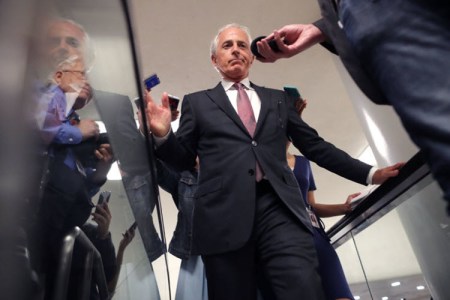
Chairman of the Senate Foreign Relations Committee, Senator Bob Corker (R-Tenn.), spoke before the Senate on Wednesday, in a bill he authored, the Countering Iran’s Destabilizing Activities Act of 2017. The legislation, has 60 bipartisan cosponsors, and is expected to pass the Senate this week. It will expand sanctions against Iranian for ballistic missile development, support for terrorism, transfer of conventional weapons to or from Iran, and human rights violations.

Senator Corker’s speech is reproduced as follows:

“Mr. President,

I rise today to speak about the Countering Iran’s Destabilizing Activities Act of 2017, which passed the Senate Foreign Relations Committee last month by a vote of 18 to 3.

“I’d like to thank the members of our committee and the co-authors of this bill for working in a constructive, bipartisan fashion to craft this legislation.

“I think it is a good example of how the Senate can still work together to tackle complex and difficult issues.

“I was in the SCIF recently – a place where senators go to read classified information – reviewing intelligence, and it truly is astounding what Iran continues to do around the world.

“For a people that are capable of so much, their foreign policy is shockingly counter to their own interest.

“We see destabilizing act after destabilizing act – from missile launches, to arms transfers, to terrorist training, to illicit financial activities, to targeting Navy ships and detaining American citizens – the list goes on and on.

“And it’s past time for us to take steps to protect the interests of the United States and our allies.

“This bill is the first time Congress has come together since the JCPOA – the Iran nuclear deal – to do just that.

“For far too long, the agreement – which I strongly opposed, as did our ranking member and presiding officer – has dictated U.S. policy throughout the Middle East.

“It’s worth noting that the JCPOA is not unlike the Paris climate accord.

“I don’t think many people in our country or many people in this body realize that it is a non-binding political agreement that was entered into by one man using presidential executive authority and can easily be undone by one man using presidential executive authority.

“In fact, in many ways, it is easier than the Paris accord considering the president doesn’t have to take an action to exit this agreement.

“I don’t think most Americans understand that. He doesn’t have to take action to exit the agreement. All he has to do is decline to waive sanctions. I think that has been missed.

“But no matter what the president decides, this bill makes it clear that the Congress intends to remain involved and will hold Iran accountable for their non-nuclear destabilizing activities.

“What the nuclear agreement failed to do was allow us to push back against terrorism, human rights issues, violations of U.N. security council resolutions relative to ballistic missile testing, and to push back against conventional arms purchases, which they are not supposed to be involved in.

“As many of us predicted at the time, Iran’s rogue behavior has only escalated since implementation of the agreement, and this bipartisan bill will give the administration tools for holding Tehran accountable.

“Let me say this. I don’t think there’s anybody in this chamber who doesn’t believe that the Trump administration – I know there’s been a lot of disagreements recently about foreign policy issues in the administration – but I don’t there’s anybody here that believes they are not going to do everything they can to push back against these destabilizing activities.

“And what we’ll be doing today and tomorrow with passage of this legislation is standing hand-in-hand with them as they do that.

“It also sends an important signal that the U.S. will no longer look the other way in the face of continued Iranian aggression.

“I want to recognize the important work of my colleagues in making this legislation possible.

“Senator Menendez has been a champion for holding Iran accountable, in this bill but also in decades of work on this issue. He truly is an asset to the Senate, and I thank him for his commitment to many issues, but especially this one.

“Senators Cotton, Rubio, and Cruz all played an important role in drafting this legislation as well.

“But finally, let me say this. This would not have been possible without the support and tireless effort of the ranking member, Senator Cardin, and his great staff. It has truly been a pleasure for me to work with him on the Russia bill that we will be voting on today at 2:00 p.m. but also on this legislation.

“We come from two very different places, representing two very different states, and yet are joined by the fact that we care deeply about making sure that the foreign policy of this country is in the national interest of our citizens and that we as a Congress and as a United States Senate are doing everything we can to drive positive foreign policy.

“I want to thank him for that and tell him I am really proud of the strong bipartisan momentum behind this legislation, which his leadership has helped make happen, and I look forward to passage of this bill.”

Obama Admin Did Not Publicly Disclose Iran Cyber-Attack During ‘Side-Deal’ Nuclear Negotiations

June 7, 2017

Obama Admin Did Not Publicly Disclose Iran Cyber-Attack During ‘Side-Deal’ Nuclear Negotiations, Washington Free Beacon, June 7, 2017

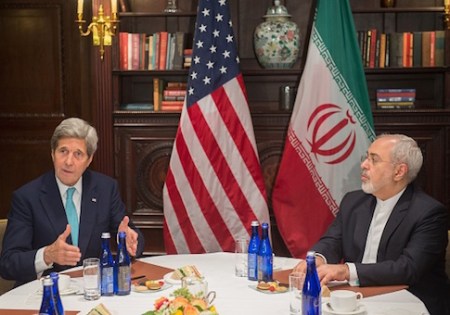
US Secretary of State John Kerry meets with Iran’s Foreign Minister Mohammad Javad Zarif on April 22, 2016 in New York. / AFP / Bryan R. Smith (Photo credit should read BRYAN R. SMITH/AFP/Getty Images)

President Trump, during his trip to the Middle East in late May, talked tough against Iran and its illicit ballistic missile program but has so far left the nuclear deal in place. A Trump State Department review of the deal is nearing completion, the Free Beacon recently reported, and some senior Trump administration officials are pushing for the public release of the so-called “secret side deals.”

Infiltrating State Department emails and internal communications about where the United States stood on a number of sensitive issues could have given the Iranians an important negotiating advantage, according to David Albright, a former U.N. weapons inspector and president of the Institute for Science and International Security.

“The [Joint Comprehensive Plan of Action] had a lot of loose language at the time and the question was whether the U.S. was going to accept it,” he told the Free Beacon, referring to the weeks immediately following the Congressional Review Period, which ended Sept. 17, and Iran’s own review process, which ended Oct. 15.

“It would be to Iran’s great benefit to know where the U.S. would be” on a number of these issues dealing with the possible military dimensions of the Iran nuclear program, he said. “If they could tell the U.S. was going to punt, they could jerk around the [International Atomic Energy Agency, or IAEA] a bit.”

“That’s essentially what happened with the IAEA,” he added.

***************************************

State Department officials determined that Iran hacked their emails and social media accounts during a particularly sensitive week for the nuclear deal in the fall of 2015, according to multiple sources familiar with the details of the cyber attack.

The attack took place within days of the deal overcoming opposition in Congress in late September that year. That same week, Iranian officials and negotiators for the United States and other world powers were beginning the process of hashing out a series of agreements allowing Tehran to meet previously determined implementation deadlines.

Critics regard these agreements as “secret side deals” and “loopholes” initially disclosed only to Congress.

Sources familiar with the details of the attack said it sent shockwaves through the State Department and the private-contractor community working on Iran-related issues.

It is unclear whether top officials at the State Department negotiating the Iran deal knew about the hack or if their personal or professional email accounts were compromised. Sources familiar with the attack believed top officials at State were deeply concerned about the hack and that those senior leaders did not have any of their email or social media accounts compromised in this particular incident.

Wendy Sherman, who served as Under Secretary of State for Political Affairs for several years during the Obama administration and was the lead U.S. negotiator of the nuclear deal with Iran, could not be reached for comment.

A spokeswoman for Albright Stonebridge LLC, where Sherman now serves as a senior counselor, said Tuesday that Sherman is “unavailable at this time and cannot be reached for comment.”

Asked about the September 2015 cyber-attack, a State Department spokesman said, “For security reasons we cannot confirm whether any hacking incident took place.”

At least four State Department officials in the Bureau of Near East Affairs and a senior State Department adviser on digital media and cyber-security were involved in trying to contain the hack, according to an email dated September 24, 2015 and multiple interviews with sources familiar with the attack.

The Obama administration kept quiet about the cyber-attack and never publicly acknowledged concerns the attack created at State, related agencies, and within the private contractor community that supports their work.

Critics of the nuclear deal said the Obama administration did not publicly disclose the cyber-attack’s impact out of fear it could undermine support right after the pact had overcome political opposition and cleared a critical Congressional hurdle.

The hacking of email addresses belonging to State Department officials and outside contractors began three days after the congressional review period for the deal ended Sept. 17, according to sources familiar with the details of the attack and the internal State Department email. That same day, Democrats in Congress blocked a GOP-led resolution to disapprove of the nuclear deal, according to sources familiar with the details of the attack and the internal State Department email. The resolution of disapproval needed 60 votes to pass but garnered just 56.

President Trump, during his trip to the Middle East in late May, talked tough against Iran and its illicit ballistic missile program but has so far left the nuclear deal in place. A Trump State Department review of the deal is nearing completion, the Free Beacon recently reported, and some senior Trump administration officials are pushing for the public release of the so-called “secret side deals.”

State Department alerts outside contractors of cyber-attack

State Department officials in the Office of Iranian Affairs on Sept. 24, 2015 sent an email to dozens of outside contractors. The email alerted the contractors that a cyber-attack had occurred and urged them not to open any email from a group of five State Department officials that did not come directly from their official state.gov accounts.

“We have received evidence that social media and email accounts are being compromised or subject to phishing messages,” the email, obtained by the Washington Free Beacon, states. “Please be advised that you should not open any link, download or open an attachment from any e-mail message that uses our names but is not directly from one of our official state.gov accounts.”

“We appreciate learning of any attempts to use our names or affiliations in this way,” stated the email. Shervin Hadjilou, the public diplomacy officer in the Office of Iranian Affairs, sent the email and cc’d four other State Department officials who deal with Iran issues, including one cyber-security expert.

Two sources familiar with the details of the hack said the State Department and outside contractors determined that Iranian officials were the perpetrators. The hack, which began Sept. 21, had compromised at least two State Department officials’ government email accounts before they regained control of them, as well as private email addresses and Facebook and other social media accounts, the source said.

“They had access to everything in those email accounts,” the source said. “Everyone in the [State Department Iranian Affairs] community was very upset—it was a major problem.”

The hack also stood out because cyber-warfare between Iran and the United States, which had been the weapon of choice between the countries for years, had cooled considerably in 2015 during the nuclear negotiations in what cyber-security experts have described as a limited détente.

Since Iran discovered the Stuxnet virus—a cyber-worm the United States and Israel planted to degrade Iran’s nuclear capabilities—in 2011, the countries have been engaged in escalating cyber warfare as Tehran’s cyber capabilities become increasingly sophisticated and destructive.

Since 2011 Iran has attacked U.S. banks and Israel’s electric grid. In 2012, Iranian hackers brought down Saudi-owned oil company Saudi Aramco, erasing information on nearly 30,000 of the company’s work stations and replacing it with a burning American flag.

Cyber-security experts have long believed that Russia helped Iran quickly build up its cyberweaponry in response to Stuxnet. A team of computer-security experts at TrapX, a Silicon Valley security firm that helps protect top military contractors from hackers, said in April they officially confirmed that Iranians were using a cyber “tool set” developed by Russians.

Tom Kellerman, a TrapX investor who also served on a commission advising the Obama administration on cyber-security, said Iranian cyberwarfare has dramatically improved over the last two or three years in large part due to Russian technical assistance.

“Much like you see the alliance between Syria, Iran, and Russia, the alliance doesn’t just relate to the distribution of kinetic weapons,” he said, but extends into cyberwarfare.

Uproar among private contracting community over cyber-attack

In the late September 2015 hack, at least two State Department officials and a handful of outside contractors lost control of access to their email and social media accounts, which were automatically forwarding emails to work and personal contacts. This spread the hack to a wider network of victims.

The private-contracting community involved in State Department Iran programs—approximately 40 private firms, some of which are based in Washington and others located throughout the United States—were outraged by the infiltration.

“They were saying ‘We’re mad—we’re angry,'” the source recalled. “We all got compromised.”

Eric Novotny, who served as a senior adviser for digital media and cyber security at the State Department at the time, was involved in trying to shut down the hack and help affected officials and private contractors regain control of their accounts. Novotny was one of the four government officials copied on Hadjilou’s Sept. 24 email.

Critics: Obama administration’s silence on hacking was needed to secure nuke deal

Critics of the Obama administration’s handling of the Iran nuclear deal argue that the State Department stayed silent about the hack because acknowledging it could have publicly undermined the pact right after it became official.

“Within hours of the Iran deal being greenlighted, Iran was already conducting cyberattacks against the very State Department that ensured passage of the [nuclear deal],” said Michael Pregent, a senior Middle East analyst at the Hudson Institute. “Acknowledging a cyberattack after the [nuclear deal] was greenlighted would be something that would immediately signal that it is a bad deal—that these are nefarious actors.”

Mark Dubowitz, the CEO of the Foundation for Defense of Democracies, said Iran’s hacking of State Department personnel at such a critical period is “just one of many of Iran’s malign activities that continued and the State Department essentially ignored while the Obama administration was working out the fine points of the nuclear deal.”

“The Obama administration didn’t acknowledge it publicly out of fear that public outrage could threaten the nuclear deal,” he said.

In early November 2015, the Wall Street Journal reported that the Iran’s hardline Revolutionary Guard military had hacked email and social-media accounts of Obama administration officials.

Yet that report wrongly tied the beginning of the uptick in Iranian cyberattacks to the arrest October 29, 2015 of Siamak Namazi, a businessman and Iranian-American scholar who has pushed for democratic reforms. Namazi and his elderly father remain imprisoned in Iran and face a 10-year sentence on espionage charges.

The Journal report also did not indicate that the attacks had occurred more than a month earlier, within three days of the end of the congressional review period, nor did it indicate any specific individual targeted nor how officials and contractors reacted to it.

The Sept. 24 email obtained by the Free Beacon shows the Iranian hacking of State Department officials occurred much earlier—the weekend after Republicans in Congress failed to push through a resolution disapproving the Iran nuclear pact, effectively sealing the foreign policy win for Obama.

The late September time period was particularly important for negotiating critical details of the nuclear deal’s implementation, what critics, including CIA Director Mike Pompeo, have labeled “secret side deals” allowing Iran to evade some restrictions in the nuclear agreement in order to meet its deadline for sanctions relief.

Among other non-public details of the pact, the side agreements involved the controversial exchange of American prisoners held in Iran for $1.7 billion in cash payments.

Infiltrating State Department emails and internal communications about where the United States stood on a number of sensitive issues could have given the Iranians an important negotiating advantage, according to David Albright, a former U.N. weapons inspector and president of the Institute for Science and International Security.

“The [Joint Comprehensive Plan of Action] had a lot of loose language at the time and the question was whether the U.S. was going to accept it,” he told the Free Beacon, referring to the weeks immediately following the Congressional Review Period, which ended Sept. 17, and Iran’s own review process, which ended Oct. 15.

“It would be to Iran’s great benefit to know where the U.S. would be” on a number of these issues dealing with the possible military dimensions of the Iran nuclear program, he said. “If they could tell the U.S. was going to punt, they could jerk around the [International Atomic Energy Agency, or IAEA] a bit.”

“That’s essentially what happened with the IAEA,” he added.

The IAEA is charged with verifying and monitoring Iran’s commitments under the nuclear agreement.

According to Albright, the IAEA ultimately accepted far less access to nuclear sites than it originally wanted. The United States and other world powers also accepted other concessions involving “loopholes” allowing Iran to exceed uranium enrichment and heavy water limits for a certain time period in order for Iran to meet implementation deadlines, he said.

“The IAEA didn’t know much at all and had to write a report [in December 2015] that it was content in knowing so little,” he said.

Others who credit Iran’s Islamic Revolutionary Guard with the cyber-attack say it may not have focused entirely on gaining leverage in the negotiations but simply demonstrating a resistance to the deal among hardline factions in the country.

“Iran has two personalities, and I think you were seeing the other personality shine through,” Kellerman said of the hack during a critical phase of the nuclear deal.

Hack used common spear-phishing technique

Sources said the September 2015 hacking incidents compromised email accounts by sending spear-phishing messages, or efforts to gain unauthorized access to confidential data by impersonating close contacts.

The phishing emails targeted both State Department and private contractors’ personal email and social media accounts, including Facebook, shutting down the users’ access and sending out emails to some of the hacked individuals contacts and forwarding other information to unfamiliar emails with Persian-sounding names, two sources told the Free Beacon.

Samuel Bucholtz, co-founder of Casaba, a cyber-security firm that conducts test-hacking for Fortune 500 companies, said the hackers were likely trying to gain access to contacts and emails. The hackers also may have tried to install malware that would provide greater access to information held on computers or the entire computer network of the organizations, he said.

“If it’s a phishing account that installs malware on your machine, then they have access to all the information on your machine,” he said. “Then they start using that foothold to start exploring access throughout the entire organization.”
Iran Developing Advanced Nuclear Capabilities, Reducing Time to Weapon

June 5, 2017

Iran Developing Advanced Nuclear Capabilities, Reducing Time to Weapon, Washington Free Beacon, June 5, 2017

Iranian President Hassan Rouhani holds a press conference in Tehran on May 22, 2017. AFP PHOTO / ATTA KENARE (Photo credit should read ATTA KENARE/AFP/Getty Images)

Ali Akbar Salehi, the head of Iran’s Atomic Energy Organization, bragged in April that Tehran is prepared to mass-produce advanced centrifuges on “short notice.” Work of this nature would greatly increase the amount of nuclear fissile material produced by Iran, prompting concerns the country could assemble a functional nuclear weapon without being detected.

The issue is complicated by the lack of access international nuclear inspectors have to Iran’s contested military sites, according to the report.

**********************************

Iran is believed to be developing advanced nuclear-related capabilities that could significantly reduce the time it needs to build a deliverable nuclear weapon, according to statements by Iranian officials that have fueled speculation among White House officials and nuclear experts that the landmark accord has heightened rather than reduced the Islamic Regime’s nuclear threat.

The head of Iran’s nuclear program recently announced the Islamic Republic could mass produce advanced nuclear centrifuges capable of more quickly enriching uranium, the key component in a nuclear weapon. Work of this nature appears to violate key clauses of the nuclear agreement that prohibits Iran from engaging in such activity for the next decade or so.

The mass production of this equipment “would greatly expand Iran’s ability to sneak-out or breakout to nuclear weapons capability,” according to nuclear verification experts who disclosed in a recent report that restrictions imposed by the Iran deal are failing to stop the Islamic Republic’s nuclear pursuits.

The latest report has reignited calls for the Trump administration to increase its enforcement of the nuclear deal and pressure international nuclear inspectors to demand greater access to Iran’s nuclear sites.

It remains unclear if nuclear inspectors affiliated with the International Atomic Energy Agency, or IAEA, have investigated Iran’s pursuit of advanced centrifuges, according to the report, which explains that greater access to Iran’s sites is needed to verify its compliance with the deal.

The report comes amid renewed concerns about Iran’s adherence to the nuclear agreement and its increased efforts to construct ballistic missiles, which violate international accords barring such behavior.

“Iran could have already stockpiled many advanced centrifuge components, associated raw materials, and the equipment necessary to operate a large number of advanced centrifuges,” according to a report by the Institute for Science and International Security. “The United States and the International Atomic Energy Agency (IAEA) need to determine the status of Iran’s centrifuge manufacturing capabilities, including the number of key centrifuge parts Iran has made and the amount of centrifuge equipment it has procured.”

Ali Akbar Salehi, the head of Iran’s Atomic Energy Organization, bragged in April that Tehran is prepared to mass-produce advanced centrifuges on “short notice.” Work of this nature would greatly increase the amount of nuclear fissile material produced by Iran, prompting concerns the country could assemble a functional nuclear weapon without being detected.

The issue is complicated by the lack of access international nuclear inspectors have to Iran’s contested military sites, according to the report.

Salehi’s declaration highlights the “profound weaknesses in the JCPOA which include lack of inspector access, highly incomplete knowledge of Iran’s centrifuge manufacturing capabilities and output, and too few centrifuge components being accounted for and monitored,” according to the report.

Iran already has manufactured more centrifuge parts than needed for the amount of nuclear work permitted under the agreement.

The terms of the agreement permit Iran to operate one advanced IR-8 centrifuge. However, Iran is known to have assembled more than half a dozen such centrifuges.

Iran also is working to construct IR-6 centrifuges, which also point to an increased focus on the production of enriched nuclear materials.

“These numbers are excessive and inconsistent with the JCPOA,” according to the report. “Moreover, in light of Salehi’s comments, the excessive production of [centrifuge] rotors may be part of a plan to lay the basis for mass production.”

Iran’s work on “any such plan is not included in Iran’s enrichment plan under the JCPOA,” according to the report.

Inspectors affiliated with the IAEA should immediately investigate the total number of centrifuge parts in Iran’s possession and determine exactly how many of these parts are currently being manufactured, the report states. The IAEA also should attempt to keep tabs on any clandestine nuclear work Iran may be engaging in.

Iran may be misleading the world about its centrifuge production and it still has not declared all materials related to this work, as is obligated under the nuclear deal.

“A key question is whether Iran is secretly making centrifuge rotor tubes and bellows at unknown locations, in violation of the JCPOA, and if it takes place, what the probability is that it goes without detection,” the report concludes.

Additionally, “the United States and the International Atomic Energy Agency (IAEA) need to determine the status of Iran’s centrifuge manufacturing capabilities, including the number of key centrifuge parts Iran has made and the amount of centrifuge equipment it has procured,” the report states.

“They need to ensure that Iran’s centrifuge manufacturing is consistent with the intent of the nuclear deal as well as the deal’s specific limitations on advanced centrifuges,” according to the report. “Moreover, the Iranian statement illuminates significant weaknesses in the Iran deal that need to be fixed.”

When asked to address the issue, a State Department official told the Washington Free Beacon that Iran’s centrifuge work remains very “limited” under the nuclear agreement.

“Under the JCPOA, consistent with Iran’s enrichment and enrichment and [research and development] plan, Iran can only engage in production of centrifuges, including centrifuge rotors and associated components, to meet the enrichment and R&D requirements of the JCPOA,” the official said. “In other words, Iran’s production of centrifuges and associated components are limited to be consistent with the small scale of R&D that is permissible under the JCPOA.”

If Iran is in violation of the deal, the United States will take concrete action to address this once the Trump administration finishes its interagency review of the Iran deal.

“The Trump administration has made clear that at least until this review is completed, we will adhere to the JCPOA and will ensure that Iran is held strictly accountable to its requirements,” the official said.

Iran to Launch Two New Satellites, Likely Cover for Illicit ICBM Program

May 9, 2017

Iran to Launch Two New Satellites, Likely Cover for Illicit ICBM Program, Washington Free Beacon, , May 9, 2017

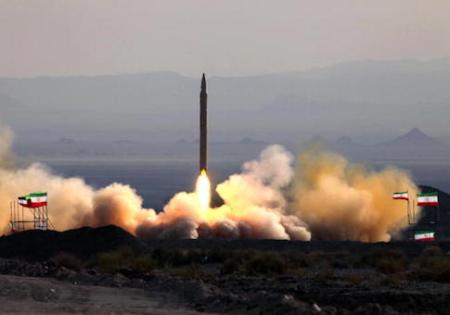
A picture taken on August 20, 2010 shows the test firing at an undisclosed location in Iran of a surface-to-surface Qiam missile, entirely designed and built domestically and powered by liquid fuel according to Defence Minister Ahmad Vahidi, a day before the Islamic republic was due to launch its Russian-built first nuclear power plant. AFP PHOTO/VAHID REZA ALAEI (Photo credit should read VAHID REZA ALAEI/AFP/Getty Images)

Iran is preparing to launch two new domestic satellites into space, according to a new announcement by Iranian military leaders that is stirring discussion among U.S. national security insiders who say the move is likely cover for the test firing of advanced intercontinental ballistic missile technology that could be used as part of Iran’s nuclear program.

The latest test comes as the Trump administration continues to engage in a comprehensive review of the Iran nuclear agreement that U.S. officials tell the Washington Free Beacon will result in a full-scale plan to “meet the challenges Iran poses with clarity and conviction.”

Iran continues to boost its military might and move forward with the testing of controversial ballistic missile technology. The expertise needed to launch satellites into space is similar to that needed to properly launch intercontinental ballistic missiles, which could potentially reach U.S. soil.

U.S. officials and national security experts have been paying close attention to Iran’s missile progress as North Korea ups its provocative moves. Tehran and Pyongyang have long traded illicit missile technology on the black market and Iran’s nuclear progress closely mirrors that of its partner.

The Iranian satellite launches also come as Iran engages in an unprecedented effort to reorganize and boost its military so it can serve as an offensive fighting force, a move that has drawn concern among U.S. national security insiders.

One State Department official, speaking only on background, told the Free Beacon that the Trump administration is moving closer to formulating a plan aimed at confronting Iran’s increasingly provocative behavior.

“As Secretary [Rex] Tillerson said, the Trump administration is currently conducting a comprehensive review of our Iran policy,” the official said. “Once we have finalized our conclusions, we will meet the challenges Iran poses with clarity and conviction.”

Iranian military leaders announced this week that they are preparing for the launch of two new domestically produced satellites.

“Now, we have two ready-to-launch satellites; one of them is Amir Kabir sensing satellite and another one is Nahid telecommunication satellite and over 97 percent of preparation works have been carried out on them,” Iranian Communications and Information Technology Minister Mahmoud Vaezi was quoted as saying Monday in the country’s state-controlled press.

Iran has a history of using space launches as cover to test and refine its ICBM technology, which remains part of its larger nuclear weapons program.

Michael Rubin, a former Pentagon adviser and expert on rogue regimes, told the Free Beacon that launches of this nature have only increased since the landmark nuclear agreement relaxed international restrictions on Iran’s military behavior.

“That Iran uses its satellite program as cover for ballistic missile development is no secret although, quite realistically, since John Kerry loosened restrictions on Iran’s ballistic missile program, they don’t need to hide quite so much,” Rubin said. “The key thing to recognize is that we’re no longer talking about just Iran’s capability.”

Rubin said that U.S. leaders should be paying close attention to the illicit Iranian-North Korean arms trade.

“When it comes to nuclear technology, Iran and North Korea are like sorority sisters swapping clothes or an old married couple sharing a toothbrush,” Rubin said. “What happens in Tehran doesn’t stay in Tehran.”

Saeed Ghasseminejad, a research fellow and Iranian regime expert at the Foundation for Defense of Democracies, called on the Trump administration to impose new sanctions on Iran as a way to roll back its provocative behavior.

The Obama administration moved in its final days in office to lift a number of sanctions on Iran that have enabled it to reap billions in cash windfalls, a portion of which has gone to fund the Islamic Republic’s military buildup.

“The best way to stop Iran’s ballistic missile program is to impose sanctions on the industries involved in the program,” Ghasseminejad said. “This includes the petrochemical, mining and metallurgy, telecommunications, automotive, oil and gas, and electronics industries. The U.S. used the industry-based sanctions to curb Iran’s nuclear program and they were very effective.”

US-Israel security interests converge

April 28, 2017

US-Israel security interests converge, Israel Hayom, Yoram Ettinger, April 28, 2017

In 2017, the national security interests of the U.S. and Israel have converged in ‎an unprecedented manner in response to anti-U.S. ‎Islamic terrorism; declining European posture of deterrence; drastic cuts in ‎the U.S. defense budget; an increasingly unpredictable, dangerous globe; ‎Israel’s surge of military and commercial capabilities and U.S.-Israel shared ‎values. ‎

Contrary to conventional wisdom — and traditional State Department policy — ‎U.S.-Israel and U.S.-Arab relations are not a zero-sum game. This is ‎currently demonstrated by enhanced U.S.-Israel strategic cooperation, ‎concurrently with expanded security cooperation between Israel and Egypt, ‎Jordan, Saudi Arabia and other pro-U.S. Arab countries, as well as stronger ‎cooperation between the U.S. and those same Arab countries. Unlike the ‎simplistic view of the Middle East, Arab policymakers are well aware of their ‎priorities, especially when the radical Islamic machete is at their throats. They ‎are consumed by internal and external intra-Muslim, intra-Arab violence, which ‎have dominated the Arab agenda, prior to — and irrespective of — the ‎Palestinian issue, which has never been a core cause of regional turbulence, a ‎crown-jewel of Arab policymaking or the crux of the Arab-Israeli conflict. ‎

Israel’s posture as a unique ally of the U.S. — in the Middle East and beyond — ‎has surged since the demise of the USSR, which transformed the bipolar ‎globe into a multipolar arena of conflicts, replete with highly unpredictable, ‎less controllable and more dangerous tactical threats. Israel possesses proven ‎tactical capabilities in face of such threats. Thus, Israel provides a tailwind to the ‎U.S. in the pursuit of three critical challenges that impact U.S. national security, significantly transcending the scope of the Arab-‎Israeli conflict and the Palestinian issue: ‎

‎1. To constrain/neutralize the ayatollahs of Iran, who relentlessly aspire to ‎achieve nuclear capability in order to remove the ‎U.S. from the Persian Gulf, dominate the Muslim world, and subordinate the American “modern-day Crusaders.”‎

‎2. To defeat global Islamic terrorism, which aims to topple all pro-U.S. Arab ‎regimes, expand the abode of Muslim believers and crash the abode of non-Muslim “‎infidels” in the Middle East and beyond.‎

‎3. To bolster the stability of pro-U.S. Arab regimes, which are lethally ‎threatened by the ayatollahs and other sources of Islamic terrorism.

Moreover, Israel has been the only effective regional power to check the North ‎Korean incursion into the Middle East. For instance, on Sept. 6, 2007, the ‎Israeli Air Force destroyed Syria’s nuclear site, built mostly with the support of ‎Iran and North Korea, sparing the U.S. and the globe the wrath of a ruthless, ‎nuclear Assad regime. ‎

While Israel is generally portrayed as a supplicant expecting the U.S. to extend a ‎helping hand, Adm. (ret.) James G. Stavridis, a former NATO supreme commander, ‎currently the dean of the Fletcher School of Law and Diplomacy at Tufts ‎University, says otherwise. He maintains that Israel is not a supplicant but ‎rather a unique geostrategic partner, extending the strategic hand of the U.S. ‎through a mutually beneficial, highly productive ‎relationship with the U.S.

On Jan. 5, 2017, Stavridis wrote: “Our ‎best military partner in the region, by far, is Israel … as we stand together ‎facing the challenges of the Middle East. … Israeli intelligence gathering is ‎superb. … A second zone of potentially enhanced cooperation is in technology ‎and innovation. … In addition to missile defense, doing more together in ‎advanced avionics (as we did with the F-15), miniaturization (like Israel’s small ‎airborne-warning aircraft) and the production of low-cost battlefield unmanned ‎vehicles (both air and surface) would yield strong results. … We should up our ‎game in terms of intelligence cooperation. [The Israeli intelligence ‎services] of our more segregated sectors on a wide range of trends, including the disintegration of Syria, the events in Egypt and the military and nuclear ‎capability of Iran. … Setting up a joint special-forces training and innovation ‎center for special operations in Israel would be powerful. … It truly is a case ‎of two nations that are inarguably stronger together.” ‎

Unlike other major U.S. allies in Europe, the Far East, Africa and the Middle East, ‎Israel does not require U.S. military personnel and bases in order to produce an ‎exceptionally high added value to the annual U.S. investment in — and not ‎‎”foreign aid” to — Israel’s military posture.

For example, the plant manager of Lockheed Martin, the manufacturer of the ‎F-16 and F-35 fighter planes, told me during a visit to the plant in Fort Worth, Texas: “The ‎value of the flow of lessons derived from Israel’s operation, maintenance and ‎repairs of the F-16 has yielded hundreds of upgrades, producing a mega-‎billion-dollar bonanza for Lockheed-Martin, improving research and ‎development, increasing exports and expanding employment.”

A similar ‎added value has benefitted McDonnell Douglas, the manufacturer of the F-15 fighter plane ‎in Berkeley, Missouri, as well as hundreds of U.S. defense manufacturers, ‎whose products are operated by Israel. The Jewish state — the most ‎predictable, stable, effective, reliable and unconditional ally of the U.S. — has ‎become the most cost-effective, battle-tested laboratory of the U.S. defense ‎industry. ‎

According to a former U.S. Air Force intelligence chief, Gen. George Keegan: ‎‎”I could not have procured the intelligence [provided by Israel on Soviet Air ‎Force capabilities, new Soviet weapons, electronics and jamming devices] with ‎five CIAs. … The ability of the U.S. Air Force in particular, and the Army in ‎general, to defend NATO owes more to the Israeli intelligence input than it ‎does to any other single source of intelligence.” The former chairman of the ‎Senate Appropriations Committee, Sen. Daniel Inouye, revealed that “Israel ‎provided the U.S. [operational lessons and intelligence on advanced Soviet ‎ground-to-air missiles] that would have cost the U.S. billions of dollars to find ‎out.”

On Oct. 28, 1991, in the aftermath of the First Gulf War, then-Defense ‎Secretary Dick Cheney stated: “There were many times during the course of ‎the buildup in the Gulf, and subsequent conflict, that I gave thanks for the ‎bold and dramatic action that had been taken some 10 years before [when ‎Israel destroyed Iraq’s nuclear reactor at Osirak].” The destruction of Iraq’s ‎nuclear capabilities in 1981 spared the U.S. a nuclear confrontation in 1991.

An Israel-like ally in the Persian Gulf would have dramatically minimized U.S. ‎military involvement in Persian Gulf conflicts, and drastically reduced the ‎monthly, mega-billion dollar cost of U.S. military units and bases in the ‎Gulf and Indian Ocean, as is the current Israel-effect in the eastern flank of ‎the Mediterranean.‎

Yoram Ettinger is a former ambassador and head of Second Thought: A U.S.-Israel Initiative.

Iran’s Nuclear Weapons Program: On Course, Underground, Uninspected

April 25, 2017

Iran’s Nuclear Weapons Program: On Course, Underground, Uninspected, Center for Security Policy, Clare M. Lopez, April 24, 2017

The Iranian regime’s nuclear weapons program, born in secrecy and kept hidden for years, has never skipped a beat and today continues on course in underground and military facilities to which inspectors have no access. On 21 April 2017, the National Council of Resistance of Iran (NCRI), the oldest, largest, and best organized democratic Iranian opposition group presented startling new evidence that the jihadist regime in Tehran is violating the terms of the JCPOA (Joint Comprehensive Plan of Action) agreement reached in July 2015 among the P-5 +1 (Permanent Five Members of the UN Security Council plus Germany), the IAEA (International Atomic Energy Agency), and Iran.

As will be recalled, it was the NCRI that first blew the lid off Iran’s clandestine nuclear weapons program in 2002, at a time when it had been in progress for at least fourteen years (since 1988), unbeknownst to most of the world, including the IAEA. Virtually all of the Iranian nuclear sites now known publicly were only retroactively ‘declared’ by the mullahs’ regime after exposure: the Natanz enrichment site, Isfahan conversion site, Fordow enrichment and Research and Development (R&D) site, Lavizan-Shian, and more. Regularly corroborated additional revelations since 2002 by the NCRI have built a record of credibility that should prompt a closer official look at these new reports by the U.S. State and Defense Departments, National Security Council (NSC), and White House.

Alireza Jafarzadeh, deputy director of NCRI’s Washington office, provided a devastating expose of the ongoing activities of the Organization of Defensive Innovation and Research (SPND), the Tehran-based element of the Iranian Ministry of Defense that has primary responsibility for the regime’s nuclear weapons development. The SPND, established in February 2011, was officially sanctioned by the U.S. Department of State in August 2014 for engaging in nuclear weapons R&D.   Mohsen Fakhrizadeh (aka Dr. Hassan Mohseni), the founder and director of the SPND and a veteran IRGC (Islamic Revolutionary Guards Corps) brigadier general, was designated individually under UN Security Council (UNSC) Resolution 1747 in 2007 and by the U.S. in July 2008 for his involvement in Iran’s proscribed WMD activities. Despite these designations, and the IAEA’s failure to resolve the many critical indicators of “Possible Military Dimensions” related to Iran’s nuclear program as specified in the November 2011 IAEA Board of Governors report, the July 2015 JCPOA inexplicably lifted sanctions against the SPND.

It is hardly surprising, then, to learn that the SPND not only continues critical weaponization research involving nuclear warheads, triggers, and explosives, but has expanded that work at each of seven subordinate locations. One of these, revealed by the NCRI in 2009 but never declared to the IAEA, is the Center for Research and Expansion of Technologies on Explosions and Impact (Markaz-e Tahghighat va Tose’e Fanavari-e Enfejar va Zarbeh or METFAZ), which works on triggers and high-impact, non-conventional explosives. The current METFAZ director is a Ministry of Defense engineer named Mohammad Ferdowsi, whose expertise is in high explosives. Ferdowsi also serves as chairman of the board of directors of the High-Explosive Society of Malek Ashtar University (affiliated with the Defense Ministry).

After conclusion of the July 2015 JCPOA, much of METFAZ’s personnel and work was moved to the Parchin military facility for better cover and security. Parchin Chemical Industries, an element of Iran’s Defense Industries Organization (DIO), was sanctioned by the U.S. Department of the Treasury in 2008 for importing “a chemical precursor for solid propellant oxidizer, possibly to be used for ballistic missiles.” Parchin is the location where the IAEA long suspected Iran was conducting test explosions for nuclear detonators. In October 2014, Iran finally admitted to using Parchin to test exploding bridge wires, but implausibly claimed they were not for weapons development. Equally incredibly, the IAEA concluded a secret side deal with Iran that allowed it to collect its own samples at Parchin—in which the IAEA in fact did find evidence of enriched uranium. But despite that and more evidence, the JCPOA was concluded and sanctions against Parchin Chemical Industries were lifted.

Within Parchin are twelve separate military and missile complexes. According to the NCRI’s new information, METFAZ has established a new location within one of these that is near the center of Parchin and referred to simply as the “Research Academy” in SPND internal communications. Located on the sprawling Parchin complex some 30 miles southeast of Tehran, the new METFAZ center is called the Chemical Plan of Zeinoddin and is located in a section called Plan 6. It’s completely fenced in and protected by heavy security under control of the IRGC’s Intelligence Service. What goes on there is concealed from the IAEA, and likely with good reason.

Old and New Locations for the SPND

METFAZ’s Research Academy Location within Parchin Plan 6 Area

Lambasting the Iranian regime for its ongoing regional aggression and support to terrorist organizations, as Secretary of State Tillerson did on 20 April 2017, is certainly a step in the right direction. Noting that after ten years, Iran can break out and build all the bombs it wants is also a useful observation. But neither of those comes close to fulfilling the Trump campaign pledge to “rip up” the JCPOA – or hold Iran accountable for its violations of the JCPOA. Secretary Tillerson’s 18 April letter to U.S. House of Representatives Speaker Paul Ryan, certifying that Iran was in compliance with the 2015 deal, simply cannot be squared with the NCRI’s latest revelations, which it has shared with both the U.S. government and the IAEA. Indeed, the independent Institute for Science and International Security (ISIS) issued a March 3, 2017 report in which it explicitly states about the IAEA’s 24 February 2017 Quarterly report, “Nowhere in the report does the IAEA state that Iran is fully compliant with the JCPOA, and it should not make that judgement.”

The real problem with the JCPOA—and why it needs to be ripped to shreds—is not what’s in it: it’s what’s been left out or exempted in any number of secret side deals that the U.S. and IAEA concluded with the Iranians. Among critical issues either explicitly permitted or simply not covered in the JCPOA are the following:

  • Iran keeps its entire nuclear infrastructure intact
  • Iran keeps all its centrifuges and is allowed to work on newer models
  • Iran can deny IAEA inspectors access to any site it seeks to keep off-limits
  • Iran can continue its ballistic missile nuclear weapons delivery system research, development, and testing
  • Iran’s nuclear, chemical, and biological weapons and ballistic missile collaboration with North Korea is not mentioned in the JCPOA
  • Iran’s ongoing support for terrorism is off-limits for the JCPOA

The Trump administration must make good on its campaign promises with regard to Iran, its nuclear weapons program, and the JCPOA. The U.S. with its international partners and the IAEA must demand that Iran fully implement all UN Security Council Resolutions (including the one prohibiting Iran from any nuclear enrichment activities); accept the Additional Protocol; and allow unhindered access for IAEA inspectors to all suspected centers and facilities.

Beginning to fill relevant USG positions with officers untainted by association with the failed JCPOA or Iran Lobby affiliates like NIAC (National Iranian American Council) is an imperative and urgent first step. Announcing U.S. intent to end all activities associated with the JCPOA, hold Iran to account for its human rights abuses, involvement in the 9/11 attacks, and continuing support for terrorism would be natural subsequent policy positions.

We look forward to the results of the JCPOA policy review that Secretary Tillerson has announced.