Posted tagged ‘Trump and Iran scam’

Kerry on Edge as Legacy Crumbles

October 17, 2017

Kerry on Edge as Legacy Crumbles, FrontPage MagazineJoseph Klein, October 17, 2017

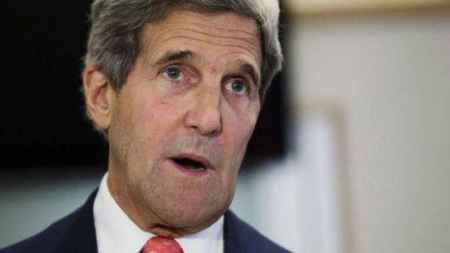
Former Secretary of State John Kerry wasted no time condemning President Trump’s decision not to recertify, and to possibly withdraw from, the disastrous nuclear deal with Iran that Kerry negotiated on behalf of his boss Barack Obama. President Trump insisted on significant improvements to the Joint Plan of Comprehensive Action (JCPOA), as the deal is formally known. The JCPOA’s fundamental flaws that President Trump wants fixed include Iran’s ability to block unfettered international inspections, the wiggle room that Iran is exploiting to continue developing and testing ballistic missiles capable of delivering nuclear weapons, and the sunset clause on nuclear enrichment that would provide Iran a clear path to becoming a nuclear armed state after the current restrictions are lifted. Obama and Kerry had promised that these issues would be dealt with satisfactorily before agreeing to the final terms of the JCPOA. Instead they caved to Iranian pressure in order to get the deal done.

Now that President Trump is trying to clean up the mess Obama and Kerry left him, Kerry has the gall to label President Trump’s decision a “reckless abandonment of facts in favor of ego and ideology” and to accuse the Trump administration of “lying to the American people.” It was the Obama administration that recklessly abandoned the facts in pressing ahead with the deal. The Obama administration lied to the American people, abandoning its own promises to ensure that the deal contained ironclad protections. Moreover, all that President Trump has done so far is to return the JCPOA to Congress for review. Had Obama followed the Constitution and submitted the JCPOA to the Senate as a treaty in the first place, the JCPOA in its present form almost certainly would not have been approved. Congress should now have the opportunity to revisit the JCPOA to determine whether the protections that the Obama administration promised are working as advertised. Congress should also consider whether time limits on Iran’s commitments continue to make sense in light of what we are now experiencing with Iran’s nuclear technology collaborator, North Korea. It bought time to turn into a full-fledged nuclear power under our noses.

Kerry had promised that the Iranian regime would be prohibited from testing ballistic missiles. This turned out to be a lie. After the JCPOA was finalized, with no such prohibition included, Iran continued to test such missiles. The Obama administration’s response was that the missiles had become a separate issue, to be dealt with under a new United Nations Security Council resolution endorsing the JCPOA.  The new resolution replaced clear prohibitions imposed on Iran’s ballistic missile program with a weak declaration in an annex that simply “calls upon” Iran not to undertake any activity such as development and test launches related to ballistic missiles designed to be capable of delivering nuclear weapons for eight years.

Iran has tested several ballistic missiles during the last two years, including two Qadr H missiles with the phrase “Israel must be wiped out” emblazoned on the sides. The commander of Iran’s Army, Major General Ataollah Salehi, had told reporters just a month before the launch of those missiles that Iran was “neither paying any attention to the resolutions against Iran, nor implementing them. This is not a breach of the JCPOA.”

Russian Ambassador to the United Nations Vitaly Churkin, spurning requests from Obama administration officials to impose sanctions against Iran under the Security Council resolution, asserted that the Iranian missile test did not violate the resolution. “A call is different from a ban so legally you cannot violate a call, you can comply with a call or you can ignore the call, but you cannot violate a call,” the Russian ambassador said. In short, the JCPOA did not cover the missile tests and the replacement UN Security Council resolution that did mention the missiles is toothless.

Deputy National Security Advisor Ben Rhodes told CNN, during an interview aired on April 6, 2015,  that under the deal’s terms then still being negotiated, “you will have anywhere, anytime, 24/7 access as it relates to the nuclear facilities that Iran has.” Rhodes claimed that “if we see a site that we need to inspect on a military facility, we can get access to that site and inspect it. So if it’s a suspicious site that we believe is related to its nuclear efforts, we can get access and inspect that site through the IAEA.” This was another lie. After the JCPOA was finalized in July 2015, Rhodes shamelessly denied that anytime, anywhere inspections were ever considered as part of the negotiations. “We never sought in this negotiation the capacity for so-called anytime, anywhere,” Rhodes said on July 14, 2015.

The JCPOA’s supporters, including Kerry, have made much of the fact that the International Atomic Energy Agency (IAEA) has on several occasions verified Iran’s compliance with its commitments under the JCPOA, keeping its stock of low-enriched uranium below the limit set forth in the JCPOA and not pursuing further construction of the Arak reactor. Iran was found to have slightly exceeded the limit on its stock of heavy water, but has remedied the problem to the IAEA’s satisfaction. IAEA chief Yukiya Amano reiterated in a statement he issued on October 9th that Iran has remained in compliance with its JCPOA commitments.

The problem, as any clear-eyed observer of the process recognizes, is that the IAEA relies on Iran for self-inspection of certain sites that the regime does not want the IAEA to inspect freely on its own. IAEA inspectors have avoided examining military sites it knows exists and has no reliable way of tracking undeclared sites. The IAEA’s explanation for not visiting any of Iran’s known military sites is that it had “no reason to ask” for access. Evidently, the IAEA is supposed to block out the fact that Iran had conducted tests relevant to nuclear bomb detonations at a military site before the JCPOA’s finalization in 2015. The IAEA should just pretend that such tests could not possibly happen again.

“Nobody is allowed to visit Iran’s military sites,” said Iran’s Head of Strategic Research Center at the Expediency Council and adviser to Supreme Leader Ayatollah Khamenei, Ali Akbar Velayati. Intimidation works. The IAEA knows not to ask.

As to the JCPOA’s sunset provisions, the Obama administration lied about that too. Kerry claimed on September 2, 2015 that the JCPOA “never sunsets. There’s no sunset in this agreement.”

This month Kerry has resorted to parsing words. He claims the phrase ‘sunset provisions’ is a “misnomer,” before then defending the JCPOA’s time limits. “We were comfortable because the cap on Iran’s low-enriched uranium stockpile remains in place until 2030,” Kerry wrote in an article published in the Washington Post late last month. In other words, let’s just kick the can down the road and hope for a more reasonable Iranian regime in 13 years that would agree to extend the time limits. In the meantime, Kerry advises us not to worry. Kerry declared, “15 or 25 years from now, we still have the same military options we have today.”

John Kerry has obviously learned nothing from the North Korean fiasco, which resulted from years of phony agreements with the rogue regime and so-called “strategic patience.” The United States clearly does not have the same military options today to deal with a nuclear armed North Korea as it did 23 years ago when former President Bill Clinton decided not to use military force to stamp out North Korea’s nuclear program at its inception. Instead, Clinton started us down the primrose path of naïve diplomacy with a duplicitous regime that now is on the verge of being able to strike the U.S. mainland with nuclear warheads delivered by intercontinental ballistic missiles. It is precisely because North Korea’s actions over the last 23 years have proven that making concessions to a rogue regime in order to obtain denuclearization commitments is so dangerous that President Trump does not want to make the same mistake with Iran.

America’s European allies are also upset with President Trump for refusing to recertify the deal and threatening to pull out if certain conditions are not met. British Prime Minister Theresa May, French President Emmanuel Macron and German Chancellor Angela Merkel issued a joint statement last Friday praising the JCPOA and its implementation. They said that the nuclear deal with Iran was “the culmination of 13 years of diplomacy and was a major step towards ensuring that Iran’s nuclear programme is not diverted for military purposes. Therefore, we encourage the US Administration and Congress to consider the implications to the security of the US and its allies before taking any steps that might undermine the JCPOA, such as re-imposing sanctions on Iran lifted under the agreement.”

Perhaps these European leaders should remember their own history. Appeasement through phony deals with a rogue dictatorship does not work, as proven by the infamous Munich Pact signed by British and French Prime Ministers Neville Chamberlain and Edouard Daladier with German Chancellor Adolf Hitler seventy-nine years ago.
A Slow Death for the Iran Deal

October 16, 2017

A Slow Death for the Iran Deal, Gatestone InstituteJohn R. Bolton, October 16, 2017

The JCPOA is also packed with provisions that have never received adequate scrutiny. Take Annex III, which envisages full-scale assistance to, and cooperation with, Iran’s “peaceful” civil nuclear efforts. Annex III contemplates facilitating Iran’s acquisition of “state of the art” light-water reactors, broader nuclear-research programs, and, stunningly, protection against “nuclear security threats” to Iran’s nuclear program.

It sounds suspiciously like the Clinton administration’s failed Agreed Framework with North Korea. Many Clinton alumni were part of Mr. Obama’s Iran negotiation team. In Washington, nothing succeeds like failure. Mr. Trump and his congressional supporters should expressly repudiate Annex III and insist that Europe, Russia and China do the same.

The Iran nuclear deal, which Mr. Trump has excoriated repeatedly, is hanging by an unraveling thread. Congress won’t improve it. American and European businesses proceed at their own peril on trade or investment with Iran. The deal should have died last week and will breathe its last shortly.

***********************************

As Abba Eban observed, “Men and nations behave wisely when they have exhausted all other resources.” So it goes with America and the Iran deal. President Trump announced Friday that the U.S. would stay in the Joint Comprehensive Plan of Action (JCPOA), even while he refused to certify under U.S. law that the deal is in the national interest. “Decertification,” a bright, shiny object for many, obscures the real issue — whether the agreement should survive. Mr. Trump has “scotch’d the snake, not kill’d it.”

While Congress considers how to respond — or, more likely, not respond — we should focus on the grave threats inherent in the deal. Peripheral issues have often dominated the debate; forests have been felled arguing over whether Iran has complied with the deal’s terms. Proposed “fixes” now abound, such as a suggestion to eliminate the sunset provisions on the deal’s core provisions.

The core provisions are the central danger. There are no real “fixes” to this intrinsically misconceived agreement. The Nuclear Non-Proliferation Treaty (NPT), to which Iran is a party, has never included sunset clauses, but the mullahs have been violating it for decades.

If the U.S. left the JCPOA, it would not need to justify the decision by showing that the Iranians have exceeded the deal’s limits on uranium enrichment (though they have). Many argued Russia was not violating the 1972 Anti-Ballistic Missile Treaty (though it likely was) when President Bush gave notice of withdrawal in 2001, but that was not the point. The issue was whether the ABM Treaty remained strategically wise for America. So too for the Iran deal. It is neither dishonorable nor unusual for countries to withdraw from international agreements that contravene their vital interests. As Charles de Gaulle put it, treaties “are like girls and roses; they last while they last.”

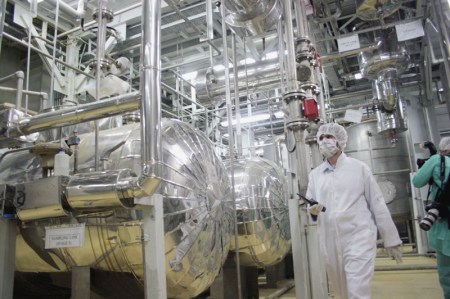
Pictured: A uranium conversion facility just outside the city of Isfahan, Iran, used as part of Iran’s uranium enrichment process. (Photo by Getty Images)

When Germany, Britain and France began nuclear negotiations with Iran in 2003, they insisted that their objective was to block the mullahs from the nuclear fuel cycle’s “front end” (uranium enrichment) as well as its “back end” (plutonium reprocessing from spent fuel). They assured Washington that Tehran would be limited to “peaceful” nuclear applications like medicine and electricity generation. Nuclear-fuel supplies and the timely removal of spent fuel from Iran’s “peaceful” reactors would be covered by international guaranties.

So firm were the Europeans that they would not even negotiate unless Iran agreed to suspend all enrichment-related activity. Under these conditions, then-Secretary of State Colin Powell agreed their effort could proceed. Today, JCPOA advocates conveniently ignore how much Barack Obama and the Europeans conceded to Iran’s insistence that it would never give up uranium enrichment.

The West’s collapse was a grave error. Regardless of JCPOA limits, Iran benefits from continued enrichment, research and development by expanding the numbers of scientists and technicians it has with firsthand nuclear experience. All this will be invaluable to the ayatollahs come the day they disdain any longer to conceal their real nuclear strategy.

Congress’s ill-advised “fixes” would only make things worse. Sens. Bob Corker and Tom Cotton suggest automatically reimposing sanctions if Iran gets within a year of having nuclear weapons. That’s a naive and dangerous proposal: Iran is already within days of having nuclear weapons, given that it can buy them from North Korea. On the deal’s first anniversary, Mr. Obama said that “Iran’s breakout time has been extended from two to three months to about a year.” At best, Corker-Cotton would codify Mr. Obama’s ephemeral and inaccurate propaganda without constraining Iran.

Such triggering mechanisms assume the U.S. enjoys complete certainty and comprehensive knowledge of every aspect of Iran’s nuclear program. In reality, there is serious risk Tehran will evade the intelligence and inspection efforts, and we will find out too late Tehran already possesses nuclear weapons.

The unanswerable reality is that economic sanctions have never stopped a relentless regime from getting the bomb. That is the most frightening lesson of 25 years of failure in dealing with Iran and North Korea. Colin Powell told me he once advised British Foreign Secretary Jack Straw: “Jack, if you want to bring the Iranians around, you have to hold an ax over their heads.” The new proposals aren’t even a dull razor blade.

The JCPOA is also packed with provisions that have never received adequate scrutiny. Take Annex III, which envisages full-scale assistance to, and cooperation with, Iran’s “peaceful” civil nuclear efforts. Annex III contemplates facilitating Iran’s acquisition of “state of the art” light-water reactors, broader nuclear-research programs, and, stunningly, protection against “nuclear security threats” to Iran’s nuclear program.

It sounds suspiciously like the Clinton administration’s failed Agreed Framework with North Korea. Many Clinton alumni were part of Mr. Obama’s Iran negotiation team. In Washington, nothing succeeds like failure. Mr. Trump and his congressional supporters should expressly repudiate Annex III and insist that Europe, Russia and China do the same.

The Iran nuclear deal, which Mr. Trump has excoriated repeatedly, is hanging by an unraveling thread. Congress won’t improve it. American and European businesses proceed at their own peril on trade or investment with Iran. The deal should have died last week and will breathe its last shortly.

John R. Bolton, former U.S. Ambassador to the United Nations, is Chairman of Gatestone Institute, a senior fellow at the American Enterprise Institute, and author of “Surrender Is Not an Option: Defending America at the United Nations and Abroad”.

This article first appeared in The Wall Street Journal and is reprinted here with the kind permission of the author.

Haley: Trump’s Goal Is to Stop Iran From Becoming ‘the Next North Korea’

October 15, 2017

Haley: Trump’s Goal Is to Stop Iran From Becoming ‘the Next North Korea’, Washington Free Beacon, October 15,2017


U.S. Ambassador to the United Nations Nikki Haley defended President Donald Trump’s stance on the Iran nuclear deal by saying he is trying to keep Iran from becoming “the next North Korea.”

Trump announced Friday he would decertify Iran’s compliance with the nuclear agreement, but he is not fully withdrawing from it. Haley argued that his toughness on Iran is a result of seeing how negotiations with North Korea failed to stop the Kim Jong Un regime from developing a nuclear program.

“Had this been done with North Korea over the past 25 years, we wouldn’t be in this situation,” Haley said on Sunday, referring to Kim’s recent missile tests. “What you see is the president is trying to make sure that Iran doesn’t become the next North Korea.”

ABC host George Stephanopoulos asked Haley if Trump’s decision sent the wrong message to North Korea because it might prevent them from negotiating with the U.S. in the future. Haley, however, said it sends the message that the U.S. will remain vigilant.

“It sends the perfect message to North Korea, which is we’re not going to engage in a bad deal,” she said. “And should we ever get into a deal, we’re going to hold you accountable.”

Haley said Iran’s technical compliance with the International Atomic Energy Agency does not mean it meets the expectations the U.S. has for national security. She cited Iran’s other violations and support for terrorism and advised against complacency in service of keeping the deal.

“What you’re seeing is, everybody is turning a blind eye to Iran and all of those violations out of trying to protect this agreement,” Haley said. “What we need to say is, we have to hold them accountable.”

In another interview Sunday on NBC’s “Meet the Press,” Haley reiterated her point that the joint partners in the Iran deal should not treat it as “too big to fail.”

“When the international community gives Iran a pass for all these things—the ballistic missile testing, the arms sales, their support of terrorism—and they look the other way all in the name of keeping the deal, then you are looking at something that’s too big to fail,” Haley said. “That’s the problem.”

Strategic decisiveness, tactical caution

October 15, 2017

Strategic decisiveness, tactical caution, Israel Hayom, Prof. Abraham Ben-Zvi, October 15, 2017

Iran is now facing a three-pronged American challenge: the steps that stem directly from the newly announced Trump Doctrine; new legislation against it; and unilateral action by Trump should Congress fail to enact new legislation, leading to the U.S. withdrawing from the pact.

In one fell swoop, through a single speech, Trump put the ball squarely in Iran’s court.

******************************

When it comes to North Korea, U.S. President Donald Trump has adopted a policy of containment and deterrence, owing to the fact that it presents a general threat.

But when it comes to Iran, things are different. On Friday, Trump unveiled a new doctrine against this component of the Axis of Evil, a doctrine that is based more on red lines and clear thresholds that would trigger American action should they be crossed.

This approach represents a creative blend of strategic decisiveness and tactical caution. The strategic decisiveness rests on his pledge to counter Iran head-on, should the need arise, over its repeated violations of key parts of the 2015 nuclear deal, and over its conduct in the region (including its ongoing ballistic missile program and its continued support for terrorist groups and destabilization efforts).

The tactical caution part is based on his recognition that a potential Iranian-American clash is not necessarily immediate, forceful or even inevitable. In other words, the White House has articulated a gradual process that gives Iranian President Hassan Rouhani a way out by mending his ways before the moment of truth arrives.

Thus, even though the Trump Doctrine is a break from the way the nuclear deal has been implemented so far, Washington will stay in it in order to improve it, hoping that its threats will have a moderating effect on the ayatollah regime. Therefore, Trump’s decision to decertify the agreement doesn’t mean that he is bent on withdrawing from it. He is still going to play by the rules, but his new doctrine presents several powerful deterrent elements.

The first: He has sent a signal to Tehran of what’s to come. Through the newly announced sanctions on the Iranian Revolutionary Guard Corps, which complement other steps the Pentagon has taken in the region to curtail Iran’s destabilizing activity, Iran now knows what’s at stake.

The second: He announced what could be a new, comprehensive and structured mechanism to punish Iran. If and when Congress decides to adopt such a mechanism, it will include a host of steps against the regime, including sanctions that are automatically imposed if Iran violates certain provisions characterized as “red lines” (say, regarding its missile program).

The third: If Congress fails to pass new legislation to punish Iran over the next two months, this will lead to the termination of the agreement as far as he is concerned – with all the consequences that this may entail.

Iran is now facing a three-pronged American challenge: the steps that stem directly from the newly announced Trump Doctrine; new legislation against it; and unilateral action by Trump should Congress fail to enact new legislation, leading to the U.S. withdrawing from the pact.

In one fell swoop, through a single speech, Trump put the ball squarely in Iran’s court.

Initial Thoughts on Trump’s Iran Speech: Do All Roads Lead to a Pull-out?

October 13, 2017

Initial Thoughts on Trump’s Iran Speech: Do All Roads Lead to a Pull-out?, Power LinePaul Mirengoff, October 13, 2017

If we take Trump’s speech at face value, it seems to me that all roads lead to terminating the deal. If Congress doesn’t act, Trump says he will terminate the deal.

**********************

President Trump has just given an address that outlines how he plans to proceed against Iran. The two main points are: (1) he will impose new sanctions to punish Iran’s Revolutionary Guard and (2) he will not certify the Iran nuclear deal.

The refusal to certify means that Congress has 60 days to act. Trump is asking it to adopt legislation, apparently already formulated, that would remedy the flaws in the Iran deal.

This legislation would become the basis for attempting, if possible with the help of our allies, to renegotiate (in effect) key terms of the deal with Iran. In the negotiations we would, among other things, try to improve the inspection regime and eliminate the sunset provisions (the ones that allow Iran eventually develop nukes).

Crucially, it seems to me on first analysis, Trump said that if Congress doesn’t act along these lines in 60 days, he will “terminate” the deal. The president thus attempts to light a fire under a Congress which, absent his threat, almost certainly would not act. He also attempts to light a fire under our allies who seemingly have no real desire to renegotiate with Iran.

If we take Trump’s speech at face value, it seems to me that all roads lead to terminating the deal. If Congress doesn’t act, Trump says he will terminate the deal.

If Congress acts, it can’t rewrite the deal. All it can do is formulate demands that, if not met by Iran, will result in termination, assuming Trump follows the hard line he took today.

If faced with congressional action and presidential resolve, Iran might agree to certain minor fixes to the deal. But it’s difficult for me to imagine the regime agreeing, for example, to drop the sunset clause.

Only a restoration of the crippling sanctions once in place would have any hope of achieving this result. But that hope would be faint. In any event, it’s unlikely that we could ever rally our allies to impose the truly crippling sanctions that former president Obama lifted.

If my preliminary analysis is correct, then Trump has taken the first step towards pulling the U.S. out of the Iran deal. He has done more, in other words, than just “splitting the baby” — i.e, satisfying hawks by decertifying and satisfying moderates by not pulling out of the deal or enlisting Congress for that purpose. If we take the speech at face value, we are on the road to pulling out.

The “compromise,” is that we are doing so in a measured way — one that is less easy for Democrats and U.S. allies persuasively to denounce. Trump is enlisting their aid by asking them to participate in a process that, in theory, could improve the deal to the point where the U.S. would stay in it.

In practice, the likelihood of substantially improving the deal seems slight. However, it is reasonable for Trump to give it a try, and reasonable for Democrats and our allies to participate in the effort.

I’ll conclude by saying that Trump’s speech was outstanding. In 20 minutes or so, he laid out the history of Iran’s evil-doing; excoriated the Iran deal Obama agreed to; and laid out his course of action going forward.

Will the administration follow that course or will key members persuade Trump to employ off-ramps? It’s difficult to say, or even to guess who the key members of the administration will be down the road. I’m inclined, though, to think that Trump will follow the course he laid out so solemnly today.

These observations are preliminary ones. I’m sure we’ll have more to say upon further reflection.

WATCH LIVE: President Trump announces decision on Iran deal

October 13, 2017

WATCH LIVE: President Trump announces decision on Iran deal, PBS via YouTube, October 13, 2017

Put Iran back on the defensive

October 13, 2017

Put Iran back on the defensive, Israel Hayom, Amnon Lord, October 13, 2017

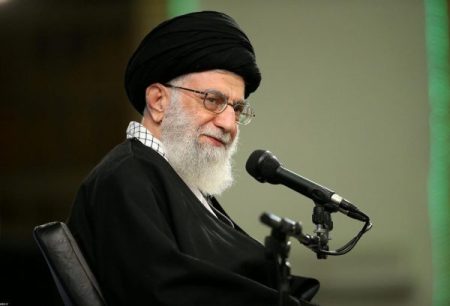
Iran’s Supreme Leader Ayatollah Ali Khamenei | Photo: Reuters

A recent interview with Brig. Gen. (ret.) Uzi Eilam, former director of the Atomic Energy Commission at the Prime Minister’s Office, has all but slipped under everyone’s radar.

During the interview, Eilam let it slip that in early 2015, when the fight against the nuclear deal with Iran was in full gear, he traveled to Washington to lobby support for the deal among Democratic senators and congressmen. Recently, we also learned that former National Security Adviser Uzi Arad and former Israeli Consul General in New York Alon Pinkas are part of a campaign by the left-wing Jewish lobby group J Street, which purports to be pro-Israel, to preserve the deal.

If the 2015 deal is so good, why is Prime Minister Benjamin Netanyahu so eager to amend it? And why did he so vehemently oppose it to begin with? If the deal is solid, why do the moderate Sunni states such as Egypt and Saudi Arabia oppose it? Why is U.S. President Donald Trump against it? Does the Israeli public really have to trust the judgment of former defense and diplomatic officials?

The truth is that it is quite bewildering that experts continue to insist on sticking to the deal when, two years in, the results are clear: Iran has massively infiltrated Syria and a new threat to Israel has emerged from the north. Those who supported the agreement apparently failed to fully understand its implications, or they knowingly covered up then-President Barack Obama’s rapprochement attempts with Iran at Israel’s expense.

Meanwhile, the Iranians have successfully taken over not only Damascus and Beirut, but also Iraq, Yemen and the Bab el Mandab Strait, a strategic waterway between Yemen on the Arabian Peninsula and Djibouti and Eritrea in the Horn of Africa. A senior intelligence official told me a month ago that there was a clear link between the approval of the nuclear agreement in July 2015 and the Russian invasion of Syria two months later. If anything, there is no doubt that Obama’s policy and the nuclear agreement paved the way for an Iranian-Russian takeover of the war-torn country.

The Israeli media all but ignored Obama’s moves over Iran. The Israeli and American intelligence agencies conducted effective warfare to sabotage the secret networks through which Iran built its nuclear program, but Obama vetoed these efforts, effectively terminating cyber warfare against Iran and lending international legitimacy to the Islamic republic’s nuclearization effort – efforts by a nation that has openly and repeatedly announced its clear intention to annihilate the State of Israel.

Above all, the nuclear agreement lifted the economic sanctions the international community had imposed on Iran. These sanctions, imposed due to American and Israeli pressure, had pushed into a corner, isolated it and placed it under constant international pressure. Obama freed Iran from this yoke and all but launched a campaign that delegitimized Israel, its government and its leader. Yet all of it was covered up by senior Israeli security officials and the Israeli media.

If Trump makes good on his threat and decertifies the nuclear deal, it will be the first step toward rectifying the situation and putting Iran back on the defensive. This would benefit Israel by pushing back the threat of an armed conflict on the northern border.

At this time, the effort to change the 2015 agreement in a way that prevents Iran from pursuing nuclear armament within eight years should be clear to the intelligence and security sages who are so supportive of the deal. North Korea barreled through two nuclear agreements negotiated by Wendy Sherman, the chief American negotiator with Iran, and emerged as a menacing nuclear threat.

Between the cabinet and the battlefield

The meeting between Netanyahu and Russian President Vladimir Putin in August, the massive military exercise in the northern sector in early September, the strike on a chemical weapons facility near Damascus last month, and defense officials’ publicly-voiced concerns about Iran’s military entrenchment in Syria, all made various pundits catch a whiff of napalm in the morning. But contrary to the perceived rise in security tensions in recent weeks, the IDF believes that chances of a flare-up on the Lebanese-Syrian front are waning.

One can argue about the scope of the strategic impact the Russian-Iranian alliance has on Israel. American analysts, who understood early on where Obama was heading with respect to Iran, believe the Russian-Iranian axis is very bad news for the United States as well as for Israel.

But the IDF has a different assessment, at least for the foreseeable future, according to which the Russian presence in Syria is deferring a potential conflict. Moreover, the Iranian presence in Syria appears less menacing when Revolutionary Guard soldiers are replaced by random Shiite militias.

The military says its multi-year work plan continues to evolve according to the dynamic map of threats from the north and it rejects claims that it is leading the IDF down the wrong path. According to a report by the Foreign Affairs and Defense Committee’s Subcommittee on the Defense Doctrine, which is an important intellectual venture led by Yesh Atid MK Ofer Shelah, the preparatory work done by the IDF to compose the multi-year work plan and its implementation so far are indeed impressive.

Nevertheless, even the apparently flattering report alludes to the fact that 11 years after the Second Lebanon War, the ground forces have yet to fully stabilize, while the Israeli Air Force has undergone a tremendous process of reinforcement. This is the military arm decision-makers continue to rely on, in conjunction with the IDF’s special forces, at the moment of truth.

Still, a critical review of the report reveals a serious problem that has not been resolved in Israel’s political reality: the interface between the political leadership and the IDF. The report criticizes the political echelon, saying it fails to provide the military with clear, written instructions and objectives. This makes it difficult for the military to adapt, outline its operational plans and build its strength.

Committees and cabinet meetings will not bring salvation. The IDF’s senior echelon must consider the fact that cabinet ministers cannot serve as a collective commander of the IDF’s operations in wartime. The cabinet was designed to supervise military moves, and while it can be called upon to decide on various operational alternatives before and during a conflict, it is up to military commanders to assume operational responsibility. The desire by lawmakers who see themselves as military experts to be involved to the point of making the military’s decisions for it is very unhealthy.

But there is one thing that can be expected from the political echelon: a decision on the strategic concept with respect to Hezbollah. Is Lebanese infrastructure a legitimate target in a potential future war, or is the IDF required to surgically deal only with Hezbollah elements? The answer to this question is not as simple as the hawks in the government would have the public believe.

Repeal and Replace In Farsi

October 13, 2017

Repeal and Replace In Farsi, Washington Free Beacon, October 13, 2017

(Are the media playing games with their headlines as usual or are their reports accurate? Here’s a link to the principal Times of Israel article cited, Netanyahu at odds with security team over Iran deal. — DM)

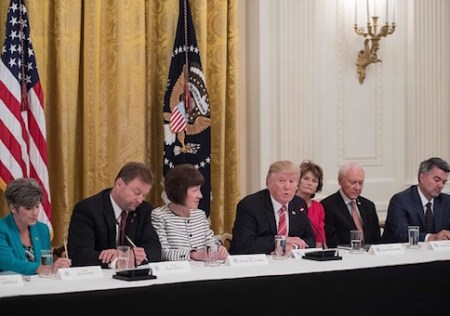
President Donald Trump is flanked by GOP senators to discuss health care / Getty Images

[T]he headlines preceding today’s remarks have been almost entirely shaped by the deal’s supporters, by the echo chamber that promoted and distorted the aims and conditions of the agreement to begin with. These were but some of the stories in Thursday’s edition of the Times of Israel: “Barak urges Trump not to decertify Iran nuke deal,” “Netanyahu at odds with security team over Iran deal,” “With Trump set to decertify Iran deal, experts tell Congress to stick to accord,” “Jewish Democrats who opposed Iran nuke deal now urge Trump to keep it.” You have to look hard for a piece detailing Iranian noncompliance, explaining the process of decertification and its relation to the overarching agreement, or quoting defenders of the president and his policy.

****************************************

President Trump is expected to announce today that he cannot certify Iran’s compliance with the terms of the agreement over its nuclear program that it entered into with the United States and five other nations in 2015. The president’s decision, according to the Iran Nuclear Agreement Review Act of 2015, will commence a 60-day expedited legislative process during which the Republican-controlled Congress may re-impose sanctions against the Islamic theocracy for its intransigence and belligerence. Sanctions, I might add, that should never have been lifted in the first place.

What is striking is that, with the exception of Senator Tom Cotton of Arkansas, none of the Republicans and Democrats who opposed the nuclear deal two years ago with such vehemence have gone out of their way to prepare the ground and make the national security case for the president’s decision.

Now, the Democrats I can understand. They are just playing to type. To say a kind word for Trump’s attempt to improve the deal would violate the secular commandment to resist his very being. The Republican silence, by contrast, is far more maddening.

This is the party that invited Bibi Netanyahu to criticize the deal in an address to a joint session of Congress. This is the party whose 2016 platform reads, “A Republican president will not be bound by” the deal and “We must retain all options in dealing with a situation that gravely threatens our security, our interests, and the survival of our friends.” This is the party that nominated and elected a president who said his “number one priority is to dismantle the disastrous deal with Iran.”

Yet the headlines preceding today’s remarks have been almost entirely shaped by the deal’s supporters, by the echo chamber that promoted and distorted the aims and conditions of the agreement to begin with. These were but some of the stories in Thursday’s edition of the Times of Israel: “Barak urges Trump not to decertify Iran nuke deal,” “Netanyahu at odds with security team over Iran deal,” “With Trump set to decertify Iran deal, experts tell Congress to stick to accord,” “Jewish Democrats who opposed Iran nuke deal now urge Trump to keep it.” You have to look hard for a piece detailing Iranian noncompliance, explaining the process of decertification and its relation to the overarching agreement, or quoting defenders of the president and his policy.

And the reason you have to look hard is that there are few elected Republicans who are taking the lead on this issue. Internal division, uncertainty, and personal rivalry may once again prevent the congressional GOP from achieving the aims it has stated loudly and proudly for years. The parallels to the attempted repeal and replacement of Obamacare are startling and, for this conservative, disturbing. “This is health care for us,” Ben Rhodes said of the Iran deal back in 2014. It would be both a diplomatic and a political disaster if the Republicans flopped as badly while trying to undo the central achievement of Barack Obama’s second term as they had while trying to undo the central achievement of his first.

Iranian noncompliance is a no-brainer. Look at the number of advanced centrifuges Iran is currently operating, its repeated violation of limits on its heavy water stocks, its underground efforts to obtain nuclear- and missile-related technologies. Look at the IAEA’s acknowledgment in September that it has difficulty verifying compliance with Section T of the Joint Comprehensive Plan of Action, which forbids “activities which could contribute to the development of a nuclear explosive device.”

And look at the Swiss cheese inspections regime. How can the president in good conscience certify compliance when no Americans are involved in the inspections, when inspections are limited to “declared” nuclear sites, when the Iranians have 24 days to prepare for IAEA inspections of other locations, when inspectors are forbidden from examining military bases? We have no idea what is going on in such places, much less in the places we do not know about. Remember: We didn’t know about the installations at Natanz and Arak until 2002 and the one at Fordow until 2009.

Of course a serious agreement would allow access to military locations. The apologies for Iranian stubbornness on this point are absurd. “For many Iranians—including those who support the nuclear deal—keeping inspectors out of military facilities is a point of national pride,” write Shashank Bengali and Ramin Mostaghim of the Los Angeles Times. Funny that national pride is okay as long as it’s Iran we’re talking about. Bengali and Mostaghim quote a “newspaper employee” in Tehran, Susan Saderi, who says, “It’s our country, and any country’s defense systems should be off limits to international inspections.”

No offense, Ms. Saderi, but you know whose defense systems are not off limits to international inspections?

  1. Associated Press from 2014: “Russians inspect Montana nuclear launch facilities.”
  2. Washington Free Beacon from 2014: “Russian Inspectors to Check U.S. Nuclear Cuts Amid Ukraine Crisis.”
  3. Fortune last August: “Russian Surveillance Plane Makes Low-Flying Pass of Capitol and Pentagon.”
  4. Wall Street Journal last August: “Top U.S. General Breaks Bread With Chinese Soldiers on North Korea’s Doorstep.”

Ok, the PLA probably didn’t allow General Dunford to count ammo stocks in Shenyang. But the point stands. The arms control treaties we signed with the Soviet Union permitted American inspectors to visit military locations. That was the whole point of trust but verify. President Obama may have trusted the Iranians—but then President Obama trusted Harvey Weinstein to oversee his daughter’s post-high school internship earlier this year. Why should Donald Trump play the patsy?

“If the political branches, [work] on a bipartisan basis on the parts of the deal we all know are flawed,” Cotton said earlier this month, “we will have the strong and unified front between Democrats and Republicans, and between Congress and the president, that the Iran deal never enjoyed. That unity will help the president forge a unified position with our allies—not only the United Kingdom, France, and Germany, but also Israel and our Arab allies. Then it will be Russia and China who must choose between a stronger deal and being isolated and in league with the ayatollahs.”

Are Republicans prepared to close ranks in a “strong and unified front” to remove the sunset clauses from the Iran deal, impose further limits on Iranian centrifuges, include Americans on IAEA inspection teams that have access to Iranian military bases, and constrain Iranian missile development? Or will they prove as disunited, feckless, spiteful, and incompetent as they did during the repeal and replace debacle?

I’m not sure I want to know the answer.

White House unveils ‘new strategy’ for Iran ahead of nuclear deal announcement

October 13, 2017

White House unveils ‘new strategy’ for Iran ahead of nuclear deal announcement, Washington ExaminerSarah Westwood, October 13, 2017

Trump is expected to apply particular pressure to the IRGC, which has been accused of human rights abuses. The IRGC’s activities, like many other Iranian offenses, did not fall under the provisions laid out by the Obama administration in the nuclear agreement.

**********************************

The Trump administration announced a “new strategy” for dealing with Iran that involves cracking down on aggressions that fall outside of the “myopic” nuclear agreement, the White House said Friday ahead of Trump’s announcement of his plan for the deal.

That strategy will focus on Iran’s ballistic missile testing, destabilizing activities throughout the region in countries like Yemen and Syria, and the violence of the Islamic Revolutionary Guard Corps, an arm of the Iranian military, the administration said.

“The Trump administration’s Iran policy will address the totality of these threats from and malign activities by the Government of Iran and will seek to bring about a change in the Iranian’s regime’s behavior,” the White House said Friday.

The plan runs the risk of antagonizing Iran to the point at which it could decide to declare the nuclear agreement has been violated. But Trump said Iran’s destabilizing activities need to be checked.

“It is time for the entire world to join us in demanding that Iran’s government end its pursuit of death and destruction,” Trump said in a statement announcing the plan.

Trump is expected to apply particular pressure to the IRGC, which has been accused of human rights abuses. The IRGC’s activities, like many other Iranian offenses, did not fall under the provisions laid out by the Obama administration in the nuclear agreement.

“We will work to deny the Iranian regime — and especially the Islamic Revolutionary Guard Corps (IRGC) — funding for its malign activities, and oppose IRGC activities that extort the wealth of the Iranian people,” the White House said. “We will rally the international community to condemn the IRGC’s gross violations of human rights and its unjust detention of American citizens and other foreigners on specious charges.”

“Most importantly, we will deny the Iranian regime all paths to a nuclear weapon,” it added.

Trump is expected to decline to certify the Iran nuclear deal during a speech on Friday, although he is not expected to scrap the deal altogether.

The president has previously described the agreement as an “embarrassment” to the U.S. and the “worst deal ever negotiated.”

The coming Israel-Iran confrontation

October 12, 2017

The coming Israel-Iran confrontation, Israel Hayom, Elliott Abrams, October 12, 2017

As one Israeli military commentator recently wrote, “If the Israeli diplomatic move fails to bear fruit, we [Israel] are headed toward a conflict with the Iranians.” That conclusion, and the Iranian moves that make it a growing possibility should be on the minds of Trump administration officials as they contemplate a new policy toward Iran’s ceaseless drive for power in the Middle East.

********************************

In the United States, discussions of Iran have for the last few years been mostly about the Joint Comprehensive Plan of Action – the nuclear deal negotiated by former President Barack Obama. In the Middle East, things are different.

This is because while we have been debating, Iran has been acting. And Israel has been reacting. Israel has struck weapon convoys in Syria a hundred times in the last five years, bombing when it saw an Iranian effort to move advanced weapons to Hezbollah in Lebanon. Last month Israel bombed the so-called Scientific Studies and Researchers Center in Masyaf, a city in central Syria, a military site where chemical weapons and precision bombs were said to be produced.

Now, there are reports that Iran is planning to build a military airfield near Damascus, where the Revolutionary Guards could build up their presence and operate; that Iran and President Bashar Assad’s regime are negotiating giving Iran its own naval pier in the port of Tartus; and that Iran may actually deploy a division of soldiers in Syria.

Such developments would be unacceptable to Israel, and it will convey this message to Russia and to the United States. Russian Defense Minister Sergei Shoigu is scheduled to visit Israel soon, after which Israeli Defense Minister Avigdor Lieberman will visit Washington. Previous Israeli efforts (during Netanyahu’s four visits to Moscow in the last year) to get Russian President Vladimir Putin to stop Iran have failed, which suggests that Israel will need to do so itself, alone – unless the new Iran policy being debated by the Trump administration leads the United States to seek ways to stop the steady expansion of Iran’s military presence and influence in the Middle East.

That remains to be seen. Rumors suggest that the Trump administration may label the IRGC a terrorist group, which could open the door to using counterterrorism authorities to stop its expansion. Whatever the debate over the JCPOA, there may well be a broader consensus in the administration that Iran’s growing military role in Iraq, Syria, Lebanon and elsewhere in the region must be countered.

Whatever the American conclusion, if Iran does indeed plan to establish a large and permanent military footprint in Syria – complete with permanent naval and air bases and a major ground force – Israel will have fateful decisions to make. Such an Iranian presence in the Mediterranean and on Israel’s border would change the military balance in the region and fundamentally change Israel’s security situation. And under the JCPOA as agreed by Obama, remember, limits on Iran’s nuclear program begin to end in only eight years, Iran may now perfect its intercontinental ballistic missile program, and there are no inspections of military sites where further nuclear weapons research may be underway.

As Senator Tom Cotton said recently, “If Iran doesn’t have a covert nuclear program today, it would be the first time in a generation.” Israel could be a decade away from a situation where Iran has nuclear weapons and has bases in Syria – and could logically therefore even place nuclear weapons in Syria, just miles from Israel’s border.

As one Israeli military commentator recently wrote, “If the Israeli diplomatic move fails to bear fruit, we [Israel] are headed toward a conflict with the Iranians.” That conclusion, and the Iranian moves that make it a growing possibility should be on the minds of Trump administration officials as they contemplate a new policy toward Iran’s ceaseless drive for power in the Middle East.

Elliott Abrams is a senior fellow for Middle East Studies at the Council on Foreign Relations. This piece is reprinted with permission and can be found on Abrams’ blog “Pressure Points.”