Posted tagged ‘Trump agenda’

Nearly 30% of illegal immigrant children at border have ties to MS-13 or other gangs

June 22, 2017

Nearly 30% of illegal immigrant children at border have ties to MS-13 or other gangs, Washington Times, Stephen Dinan, June 21, 2017

(Please see also, FBI: MS-13 Is Most Violent, Organized Gang in America.– DM)

The Health and Human Services department detains unaccompanied children caught crossing the border illegally and tries to place them with sponsors, but youths often end up with gangs. (Associated Press/File)

[T]he population of children has dropped dramatically under the Trump administration, as stiffer interior enforcement and tough talk from the president have discouraged children — and indeed all migrants — from attempting to cross the border.

That still leaves a large presence in the U.S., and MS-13 — with roots in El Salvador — is a growing threat. . . .

“We know who they are, we know they’re gang members, we know they’re criminals. But if the city, the county, doesn’t allow us to get into that jail then they’re released back into the community,” he said.
**************************

Nearly 30 percent of the illegal immigrant children the U.S. is holding in its dormitories have ties to criminal gangs, the government revealed Wednesday, suggesting that the Obama-era surge of Central Americans has fed the country’s growing problem with MS-13 and other gangs.

Federal officials refused even to guess at the true scope of the problem, telling the Senate Judiciary Committee that they can give only small snapshots of what they see. But they said the devastation on communities across the country is clear: killings and chaos, particularly among other immigrants — both legal and illegal.

The Border Patrol identified 160 teens who were known or suspected gang members when they first showed up at the border, but whom the Obama administration said it had to admit under U.S. law.

Meanwhile, a spot check this month of 138 teens being held by the federal Health and Human Services Department identified 39 with gang ties. Four of them were forced into cooperating with the gangs and 35 joined voluntarily, according to the Office of Refugee Resettlement.

“It is well-known that MS-13 actively targets and recruits children as young as 8 years old,” said Sen. Chuck Grassley, the Iowa Republican and chairman of the Judiciary Committee who called Wednesday’s hearing.

“While their illegal status and Central American heritage are a key factor in MS-13’s targeting, without a doubt the failures of the current system for handling these children is also to blame,” he said. “The current system is fraught with abuse, systematic errors and a lack of effective cooperation.”

He was stunned that no agency could say how many “UAC,” as the government dubs unaccompanied alien children, have been recruited.

The agencies point to one another and to federal laws, saying their hands are tied.

UACs are usually arrested by the Border Patrol, which is required to turn them over to the social workers at HHS within 72 hours, ending the Border Patrol’s involvement. HHS says that under the law it must try to place the children with sponsors. Other than limited circumstances, the department says, its involvement ends soon after it sends the children off.

U.S. Immigration and Customs Enforcement doesn’t get involved until a UAC is ordered deported.

That usually leaves the children with no federal supervisions once they are released to sponsors — where they are often prime recruiting targets.

Scott Lloyd, director of the HHS office that handles UAC, said his team is looking to increase monitoring of the minors and is reviewing Obama administration interpretations of policy.

He also said the population of children has dropped dramatically under the Trump administration, as stiffer interior enforcement and tough talk from the president have discouraged children — and indeed all migrants — from attempting to cross the border.

That still leaves a large presence in the U.S., and MS-13 — with roots in El Salvador — is a growing threat, authorities said.

Officials said MS-13 is involved in some drug dealing and does engage in human trafficking, but its real money-making operation is extortion. The gang threatens families — including American citizens — with violence against relatives back in Central America unless those in the U.S. pay them off.

Gang members in the U.S. take directions directly from gang commanders in El Salvador, authorities say.

Kenneth A. Blanco, acting assistant attorney general in the criminal division at the Justice Department, also said immigrants who fail to report crimes to local police are often not afraid of being deported by federal authorities, but rather fear retaliation from the gang members and other criminals who live in their neighborhoods.

He said witnesses’ names become public, making them targets for retribution.

“That really, in my 28 years, has been the fear they have of calling the police. Not so much the other way around,” he said. “They’re really scared of these people.”

That runs counter to the argument made by Democrats and some local police chiefs that illegal immigrants refuse to report crimes because they fear entanglement with federal deportation agents.

Democrats pointed to calculations by some police agencies that crime reporting among Hispanics has dropped dramatically in the months since President Trump took office.

The Democrats say that is one justification for sanctuary city policies — though Sen. Richard J. Durbin, Illinois Democrat, offered another one Wednesday. He said Chicago, which in 2011 pioneered blanket sanctuary policies, doesn’t want to protect illegal immigrants but is too poor to assist federal agents.

“Come on, Uncle Sam, where’s the money?” Mr. Durbin said.

He said Chicago and Cook County are eager to keep serious criminals and other gang members out of their communities but added that it’s up to the federal government to fund the training he said local authorities need.

“Please help us. Send us some resources,” he said.

Federal officials, though, said they are not looking for locals to do the job, but rather to allow federal officers into their facilities and to share information about releases.

“We’re asking for their cooperation,” said Matthew Albence, executive associate director of enforcement and removal operations at U.S. Immigration and Customs Enforcement.

Mr. Albence singled out the Chicago area as one of the most prominent sanctuaries. “Chicago is a large one. We haven’t been able to get into the Cook County Jail for a long time,” he said.

He also named New York City and San Francisco as top sanctuary cities.

The conversation sprang from questioning by Sen. John Kennedy, Louisiana Republican, who asked about MS-13 and other gang members who are nabbed by local authorities in sanctuary cities.

“These are evil people. It’s pretty hard to miss them. There are tattoos all over their body,” Mr. Kennedy said. “If they’re arrested and they’re in a local jail, there are some cities in the United States that would prevent you from coming in and talking to them?”

“Correct,” Mr. Albence replied.

“We know who they are, we know they’re gang members, we know they’re criminals. But if the city, the county, doesn’t allow us to get into that jail then they’re released back into the community,” he said.
U.S.: Strategic Objectives in the Middle East

June 22, 2017

U.S.: Strategic Objectives in the Middle East, Gatestone InstitutePeter Huessy, June 22, 2017

On relations with the Palestinian Authority, the administration has moved to improve matters but has not moved to advocate a two-state solution — for which there is no contemplated security framework sufficient to protect Israel.

****************************

The new “test” of our alliance will be whether the assembled nations will join in removing the hateful parts of such a doctrine from their communities.

What still has to be considered is the U.S. approach to stopping Iran from filling the vacuum created by ridding the region of the Islamic State (ISIS), as well as Iran’s push for extending its path straight through to the Mediterranean.

The tectonic plates in the Middle East have shifted markedly with President Trump’s trip to Saudi Arabia and Israel, and his announced new regional policy.

The trip represented the beginning of a major but necessary shift in US security policy.

For much of the last nearly half-century, American Middle East policy has been centered on the “peace process” and how to bring Israel and the Palestinians to agreement on a “two-state” solution for two peoples — a phrase that Palestinian Authority President Mahmoud Abbas refuses to say.

First was shuttle diplomacy during 1973-74 in the Nixon administration; then second, in 1978, the Camp David agreement and the recognition of Israel by Egypt, made palatable by $7 billion in new annual US assistance to the two nations; third, the anti-Hizballah doctrine, recently accurately described by National Security Advisor General H.R. McMaster, as Iran, since 1983, started spreading its terror to Lebanon and elsewhere in the region. This last effort was often excused by many American and European analysts as a result somehow, of supposed American bad faith. Fourth, came the birth, in 1992, of the “Oslo Accords” where some Israelis and Palestinians imagined that a two-state solution was just another round of negotiations away.

Ironically, during the decade after Oslo, little peace was achieved; instead, terror expanded dramatically. The Palestinians launched three wars, “Intifadas,” against Israel; Al Qaeda launched its terror attacks on U.S. Embassies in Africa; and Iran, Hizballah, and Al Qaeda together carried out the forerunner attacks against America of 9/11/2001.

Since 9/11, despite wars in Afghanistan and Iraq, terrorism has not only failed to recede; on the contrary, it has expanded. Iran has become the world’s biggest state sponsor of terrorism, and the Islamic State (ISIS) has tried to establish a transnational “Islamic caliphate.” Literally tens of thousands of terror attacks have been carried out since 9/11 by those claiming an Islamic duty to do so. These assaults on Western civilization have taken place on bridges, cafes, night clubs, offices, military recruitment centers, theaters, markets, and sporting events — not only across the West but also in countries where Muslims have often been the primary victims.

Particularly condemnable have been the improvised explosive device (IED) attacks against U.S. soldiers in Iraq and Afghanistan, perpetrated to a great extent by Iran, according to U.S. military testimony before Congress.

All the while, we in the West keep trying to convince ourselves that, as a former American president thought, if there were a peace deal between Israel and the Palestinian Authority, most of the terrorist attacks we see in Europe and the United States “would disappear.”

No matter how hard we may rhetorically push the “peace process”, there is no arc of history that bends naturally in that direction. Rather, nations such as the United States together with its allies must create those alliances best able to meet the challenges to peace and especially defeat the totalitarian elements at the core of Islamist ideology.

If anything, the so-called Middle East “peace process” has undercut chances of achieving a sound U.S. security policy. While the search for a solution to the Israel-Palestinian “problem” dominated American thinking about Middle East peace for so many decades, other far more serious threats materialized but were often ignored, not the least of which was the rise of Iran as the world’s most aggressive terrorist.

The United States has now moved in a markedly more promising and thoughtful direction.

The new American administration has put together an emerging coalition of nations led by the United States that seeks five objectives:

(1) the defeat of Islamic State;

(2) the formation of a coalition of the major Arab nations, especially Egypt and the Kingdom of Saudi Arabia, to clean up in their own back yards financing terrorism and providing terrorists with sanctuary. As Elliott Abrams, an adviser to former U.S. President George W. Bush, cautions us, however, this will not be an easy effort: “Partnerships with repressive regimes may in some cases exacerbate rather than solve the problem for us” but, Abrams says, “gradual reform is exactly the right approach…”;

3) “driving out” sharia-inspired violence and human rights abuses from the region’s mosques and madrassas;

(4) a joint partnership with Israel as part of an emerging anti-Iran coalition — without letting relations with the Palestinian authority derail United States and Israeli security interests; and

(5) the adoption of a strategy directly to challenge Iran’s quest for regional and Islamic hegemony, while ending its role in terrorism.

Defeating Islamic State

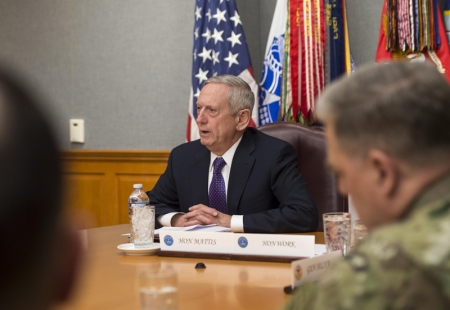
Defeating ISIS began with an accelerated military campaign and a new American-led strategy to destroy the organization rather than to seek its containment. According to the new U.S. Secretary of Defense, James Mattis, “Our intention is that the foreign fighters do not survive the fight to return home to North Africa, to Europe, to America, to Asia. We’re going to stop them there and take apart the caliphate.”

Secretary of Defense James Mattis. (Dept. of Defense/Brigitte N. Brantley)

So far, the United States coalition has driven ISIS from 55,000 square kilometers of territory in Iraq and Syria.

A New Coalition

Apart from a strategy to counter ISIS, the Trump administration also called on our allies in the Middle East to put together a new joint multi-state effort to stop financing terrorism. Leading the multi-state effort will be the Kingdom of Saudi Arabia and the United States, which together will supposedly open a new center dedicated to the elimination of terrorist financing. Positive results are not guaranteed, but it is a step in the right direction.

According to Abdul Hadi Habtoor, the center will exchange information about financing networks, adopt means to cut off funding from terrorist groups, and hopefully blacklist Iran’s jihadist army, the Islamic Revolutionary Guard Corps (IRGC). These measures in turn will help eliminate the sanctuaries from which terrorists plot and plan.

This move also places emphasis on the responsibility of states to eliminate terrorism. As President Trump said, each country — where it is sovereign — has to “carry the weight of their own self-defense“, be “pro-active” and responsible for “eradicating terrorism”, and “to deny all territory to the foot soldiers of evil”.

This determination was underscored by many Arab countries breaking diplomatic relations with Qatar for its support of Iran, the Muslim Brotherhood and ISIS. Most of Qatar’s Arab neighbors, including the Saudis, Egypt, and the UAE did so, while the US, although denouncing Qatar’s support of terrorism, continues to maintain access to, and use of, its critical military base there.

In short, the U.S. is playing good-cop, bad-cop in the region, while U.S. allies are putting together what Josh Rogin of the Washington Post described as “a regional security architecture encompassing countries on the periphery of Iran.”

Such an approach is not without risk: Turkey, allied with Iran and Qatar, has already has pledged to help Qatar defy the Gulf States’ trade cut-off. If Turkey, for example, seeks to move its promised aid shipments to Qatar through the Suez Canal, the ships could possibly be blocked by Egypt or attacked on the high seas. Does the U.S. then come to the assistance of a NATO member — Turkey — against an ally in the strategic coalition?

Drive Hateful Ideology Out

A companion challenge by the new American President underscored this new security effort. President Trump said to the assembled nations of the Islamic conference that they have to expel the ugly Islamist ideology from the mosques and madrassas that recruit terrorists and justify their actions.

Trump said: “Drive them out of your places of worship”. Such words had never been spoken so clearly by an American president, especially to the collection of nearly all the Islamic-majority countries (minus the Shi’ite bloc) gathered together.

The president’s audience doubtless understood that he was speaking of the doctrine of sharia (Islamic law). The new “test” of our alliance will be whether the assembled nations will join in removing the hateful parts of the doctrine from their communities. It was a sharp but critical departure from the previous American administration’s message in Cairo in 2009, and placed the Islamic doctrine that seeks to establish the sharia throughout the world in a contained context.

New Israeli Partnership

With Israel, the administration has cemented the next part of its strategy. Here the Trump administration successfully improved our political and military relations with Israel. Markedly so. One part of that effort was enhanced missile-defense cooperation called for in the FY18 United States defense budget, specifically to deal with Iranian and Iranian-allied missile threats.

On relations with the Palestinian Authority, the administration has moved to improve matters but has not moved to advocate a two-state solution — for which there is no contemplated security framework sufficient to protect Israel.

Challenge and Roll Back Iran

The final part of the administration’s strategy starts with a thorough review of our Iran strategy and the Joint Comprehensive Plan of Action (JCPOA), or “nuclear deal”, with Iran. As Max Singer recently wrote, even if we discount what secretive nuclear capability Iran may now have, the Iranian regime will at the very least be much closer to producing nuclear weapons down the road than when the JCPOA was agreed to.

As Ambassador John Bolton has warned the nuclear deal with Iran did nothing to restrain Iranian harmful behavior: “Defiant missile launches… support for the genocidal Assad regime… backing of then Houthi insurgency in Yemen… worldwide support for terrorism… and commitment to the annihilation of Israel” continue.

In addition, uranium enrichment, heavy water production, the concealed military dimensions of warhead development and joint missile and nuclear work with North Korea all lend a critical urgency to countering Iran’s lethal efforts. The United States did not make these counter-efforts any easier by providing to Tehran $100 billion in escrowed Iranian funds, equivalent to nearly one quarter of the Islamic Republic’s annual GDP.

The United States’ and Europe’s easing of sanctions on Iran has helped reintegrate Iran into global markets via mechanisms such as the electronic payment system run by the Society for Worldwide Interbank Financial Telecommunications (SWIFT). That, in turn, has helped Iran expand dramatically its military modernization budget by 33%, including deals worth tens of billions of dollars in military hardware with China and Russia.

Added to that is Iranian financial- and weapons-support for foreign fighters in Syria, Iraq, Yemen, Lebanon and Afghanistan. Iran’s significant support to the Houthi rebels in Yemen includes weaponry, financing and logistical support, including advanced offensive missiles. The Houthis regularly attempt to carry out missile attacks against Saudi oil facilities.

Such Iran activity is described by the Commander of U.S. Central Command, General Joseph Votel, as “the most significant threat to the Central Region and to our national interests and the interest of our partners and allies”.

As such, it can only be challenged through exactly the kind of military, political, and economic coalition the Trump administration is seeking to band together, which would include the Gulf Arab nations, especially Saudi Arabia, as well as Egypt, Jordan, and Israel.

The administration’s five-step strategy has a chance to work. It creates a policy to destroy ISIS; oppose Islamic terrorism and specifically the imposition of sharia; adopt measures to go after the financing of such terrorism; implement improvements in Gulf allies’ military capabilities — including missile defenses — parallel with pushing NATO members to meet their military spending obligations; put back into place a sound and cooperative relationship with Israel; and specifically contain and roll back Iranian hegemonic ambitions and its terror-master ways.

What still has to be considered, however, is the U.S. approach to stopping Iran from filling the vacuum created by ridding the region of ISIS, as well as Iran’s push for extending its path straight through to the Mediterranean.

If successful, some modicum of peace may be brought to the Middle East. And the arc of history will have finally been shaped toward America’s interests and those of its allies, rather than — however inadvertently — toward its mortal enemies.

Dr. Peter Huessy is President of GeoStrategic Analysis, a defense consulting firm he founded in 1981, and was the senior defense consultant at the National Defense University Foundation for more than 20 years.

What Is the Right U.S. Policy on Iran?

June 21, 2017

What Is the Right U.S. Policy on Iran? Clarion ProjectShahriar Kia, June 21, 2017

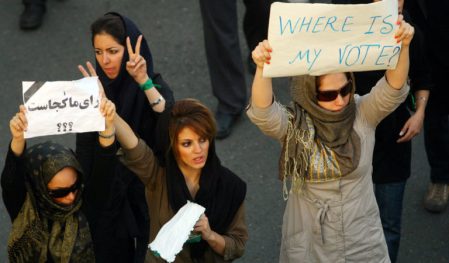
Iranian women protest election irregularities in 2009 (Photo: Getty Images)

Tillerson added. “As you know, we have designated the Quds [Force]. Our policy towards Iran is to push back on this hegemony, contain their ability to develop obviously nuclear weapons, and to work toward support of those elements inside of Iran that would lead to a peaceful transition of that government. Those elements are there, certainly as we know.”

******************************

United States Secretary of State Rex Tillerson responded to a variety of very serious questions raised by House of Representatives members in a recent hearing focusing on U.S. policy vis-à-vis Iran. Representative Ted Poe (R) from Texas touched on what many believe is the ultimate issue when he said:

“I’d like to know what the policy is of the U.S. toward Iran. Do we support the current regime? Do we support a philosophy of regime change, peaceful regime change? There are Iranians in exile all over the world. Some are here. And then there’s Iranians in Iran who don’t support the totalitarian state. So is the U.S. position to leave things as they are or set up a peaceful, long-term regime change?”

America’s top diplomat, taking into consideration how the Trump administration’s all-out Iran policy remains an issue of evaluation, answered:

“… our Iranian policy is under development.

“We continually review the merits both from the standpoint of diplomatic but also international consequences of designating the Iranian Revolutionary Guard in its entirety as a terrorist organization.” 

Tillerson added. “As you know, we have designated the Quds [Force]. Our policy towards Iran is to push back on this hegemony, contain their ability to develop obviously nuclear weapons, and to work toward support of those elements inside of Iran that would lead to a peaceful transition of that government. Those elements are there, certainly as we know.”

Iran is terrified of such a stance and responded immediately. In a tweet, Iranian Foreign Minister Mohammad Javad Zarif claimed that 75 percent of Iran’s population voted in the recent election farce back in May.

Iran’s wrath was not limited to this very issue. Following the twin ISIS attacks targeting Iran’s parliament and the tomb of Ayatollah Khomeini, leader of the Islamic revolution in Iran, senior regime officials sought to portray their apparatus as a victim of terrorism.

Failing to do so, Iranian regime officials accused the US, Saudi Arabia and the main opposition group, the People’s Mojahedin Organization of Iran (PMOI/MEK), of this terrorist plot. A few days ago, Supreme Leader Ayatollah Ali Khamenei lashed out at the US and accused Washington of bringing ISIS to life.

“Who created ISIS? Was it anyone but the U.S.? … The U.S. claim that they have established a coalition against ISIS is a lie; of course, the U.S. is against an ‘unrestrained ISIS,’ however, if anyone truly seeks to eradicate ISIS, they will have to fight against it,” he said.

Now the question is, what is Iran so concerned about and what is the right policy vis-à-vis Iran?

With Obama leaving the White House, Iran forever lost a major international backer. For eight years, the “golden era” as Iran dubbed the Obama years, any and all activities by the Iranian people and their organized opposition for change in Iran was countered by the domestic crackdowns and international hurdles, specifically by the U.S.

Obama’s neglect of Tehran’s crimes in Syria and Iraq led to the disasters we are witnessing today. Internationally, a major overhaul of U.S. policy in the region and establishing a significant Arab-American alliance in the face of Iran’s meddling has become a major concern for the mullahs.

In addition, increasing popular dissent and widespread activities by the PMOI/MEK in the past few months have also raised major concerns for the regime.

Khamenei personally intervened last week, first acknowledging the 1988 massacre, defending the Revolutionary Guards (IRGC), and those involved in the murder of over 30,000 political prisoners. Most of the victims, all executed in mass groups, were PMOI/MEK members and supporters.

Khamenei’s second concern and that of his entire apparatus is focused on the upcoming Iranian opposition’s annual convention in Paris scheduled for July 1 this year. The National Council of Resistance of Iran (NCRI), the main entity representing the Iranian opposition, hosts more than 100,000 Iranians from across the globe each year alongside hundreds of prominent dignitaries delivering their support and speeches seeking true change in Iran.

Last year alone, a very prominent delegation of American dignitaries from both sides of the political aisle included former New York Mayor Rudy Giuliani, former House Speaker Newt Gingrich, former U.S. ambassador to the UN John Bolton from the Republicans, former Democratic National Committee chairman Gov. Howard Dean, former U.S. ambassador to the UN Gov. Bill Richardson took part.

This year’s Iranian opposition rally is already brewing major concerns for Tehran as the regime understands the end of the era of appeasement has led to sweeping changes in Western policy regarding the Middle East, and most importantly Iran.

This is exactly why Tehran is going the limits to prevent the shifting of policy towards the Iranian people. Tehran’s lobbies in the U.S. and Europe are placing a comprehensive effort to demonize the images of the PMOI/MEK and the NCRI to prevent any such changes, especially in Washington.

If Iran resorts to ridiculous remarks of accusing the U.S. and Iranian opposition of staging the recent double attacks in Tehran, the correct policy is none other than supporting the Iranian people and their resistance to realize regime change in Tehran.

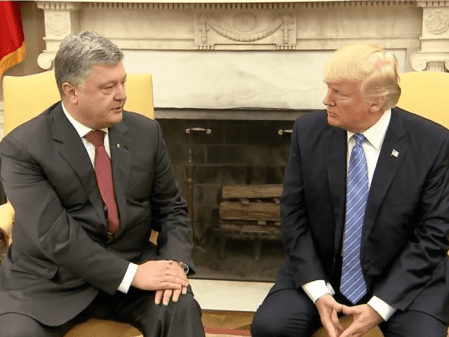
Donald Trump Meets Ukrainian President Petro Poroshenko After Sanctioning Russian-Backed Separatists

June 21, 2017

Donald Trump Meets Ukrainian President Petro Poroshenko After Sanctioning Russian-Backed Separatists, BreitbartCharlie Spiering, June 20, 2017

screenshot

President Donald Trump met with Ukrainian President Petro Poroshenko on Tuesday as his administration imposed sanctions on Russian-backed separatists in the country.

Trump said the two had “very, very good discussions,” calling Ukraine “a place that we’ve all been very much involved in.”

Behind the scenes, the White House revealed that Trump and Poroshenko discussed support for a peaceful resolution to the conflict in eastern Ukraine.

Treasury Secretary Steven Mnuchin announced sanctions on two Russian officials and several separatists in Eastern Ukraine to support the Ukrainian amidst ongoing Russian-backed conflicts in the region.

“This administration is committed to a diplomatic process that guarantees Ukrainian sovereignty, and there should be no sanctions relief until Russia meets its obligations under the Minsk agreements,” Mnuchin said Tuesday.

Poroshenko said it was a “great pleasure” to meet with Trump to discuss issues important to Ukraine and called the president a “supporter and strategic partner” of the country.

“We’re really fighting for freedom and democracy,” he said.

Naming Bin Salman Saudi heir impacts US, Israel

June 21, 2017

Naming Bin Salman Saudi heir impacts US, Israel, DEBKAfile, June 21, 2017

US President Trump is taking the lead role along with Prince Mohammed bin Salman of Saudi Arabia, Sheikh Mohammad bin Zayed Al Nahyan of the United Arab Emirates, another crown prince, Egypt’s President Abdul-Fatteh El-Sisi, and Israel’s Prime Minister Binyamin Netanyahu.

******************************

The Saudi king’s decision to elevate his son Prince Mohammed bin Salman, 31, to crown prince and heir to the throne, in place of his cousin Mohammed bin Nayef – as part of a broad reshuffle, is not merely the internal affair of the royal hierarchy, but a game-changing international event.

DEBKAfile’s analysts see it as the outcome of a global and regional process initiated by Donald Trump soon after he settled in the White House in January. With his appointment as de facto ruler of the oil kingdom, the Saudi king’s son is ready to step into his allotted place in a new US-Arab-Israeli alliance that will seek to dominate Middle East affairs. Israel will be accepted in a regional lineup for the first time alongside the strongest Sunni Arab nations who all share similar objectives, especially the aim to stop Iran.

Trump’s trip to Riyadh and Jerusalem in early May laid the cornerstone for the new US-Sunni Arab bloc versus Iran’s Shiite grouping and also cemented Israel’s co-option.

This bloc is in its infancy and has yet to display staying power and prove the wisdom of its policies. But its contours have taken shape. US President Trump is taking the lead role along with Prince Mohammed bin Salman of Saudi Arabia, Sheikh Mohammad bin Zayed Al Nahyan of the United Arab Emirates, another crown prince, Egypt’s President Abdul-Fatteh El-Sisi, and Israel’s Prime Minister Binyamin Netanyahu.

Three of those leaders already maintain strong direct – albeit discreet – ties with Israel’s prime minister, its security establishment, military and various intelligence agencies.

In a lecture on Tuesday, June 20, Israel’s chief of staff, Lt. Gen. Gady Eisenkott, spoke of the covert relations between the IDF and certain Arab nations, which he did not name. There is clearly a lot going on under the surface in various political, economic, financial, intelligence and military fields.

Recent events in the region already point to President Trump acting on important matters, such as the confrontation with Iran, the war on terror, the Syrian conflict and US intervention in the Yemen conflict, on the advice of the two Arab crown princes rather than Defense Secretary James Mattis and Secretary of State Rex Tillerson.

This was strikingly demonstrated when Trump overrode Tillerson’s recommendation to apply diplomacy for resolving the dispute that led to four Arab nations boycotting Qatar, with the Saudis in the lead, whereas the president then demanded strong action to stop Qatar’s funding of terrorists. He therefore opted for the aggressive Saudi and UAE stance against Qatar’s ruler, Sheikh Tamim bin Hamad Al Thani.

These developments bear strongly on US-Russian relations. The two crown princes maintain active ties with President Vladimir Putin. They could, of course, act as go-betweens for smoothing relations between the White House and the Kremlin. But, on the other hand, their influence could be counter-productive and goad Trump into engaging the Russians in a limited confrontation in Syria. It is hard to see Washington and Moscow coming to terms in Syria at this point when the former is closely allied to Saudi Arabia and the UAE and Moscow maintains its loyalty to Tehran.

The evolving bonds between the US, Saudi Arabia, the UAE, Egypt and Israel are the source of President Trump’s optimism about the prospects of pulling off an Israeli-Palestinian peace accord, a vision which eluded all his predecessors in the White House, while knocking over the decades-old barriers between the moderate Arab nations and the Jewish State.

The first steps towards this goal are in the making. They will include exposing parts of their hidden interaction to the light of day, as well as such important symbolic actions, as opening Arab skies to the passage of Israeli commercial flights, or direct telephone links.

None of this is expected to transpire overnight but rather over years, especially since there is opposition to the process still to overcome in the Arab world, including Saudi Arabia, and also in the United States. Critics lay into Mohammed bin Salman, who has made his mark as a visionary social and economic reformer at home, as too young, brash and impatient to rule the kingdom. His decision to entangle Saudi Arabia in the Yemen war, which many believe it cannot win, is held up as evidence of his reckless nature.

But the process switched on by Trump in Riyadh took a large stride forward on June 21, with the formalization by King Salman of his young son’s role as the top mover and shaker in the Saudi kingdom. King Salman obtained the support of 31 out of 34 members of Saudi Arabia’s Allegiance Council for confirming Prince Muhammad Bin Salman as crown prince as well as deputy prime minister and minister of defense.

Trump vs. the Deep State

June 19, 2017

Trump vs. the Deep State, PJ MediaRoger Kimball, June 18, 2017

President Donald Trump speaks in the Little Havana neighborhood of Miami, Florida, on June 15, 2017, about re-instituting some of the restrictions on travel to Cuba and U.S. business dealings with entities tied to the Cuban military and intelligence services. (Photo by JL) (Sipa via AP Images)

The sociology of the Trump presidency—and the anti-Trump “resistance”—is an unwritten chapter in recent American history.  As I say, I suspect it will have to be filed chiefly under “Snobbery, examples of,” but that’s as may be.  This much I am convinced of: 1. Those who identify the “administrative state” (the “deep state,” etc.) as our chief political problem today are correct; 2. Donald Trump really is trying to unravel (“deconstruct,” “drain”)  Leviathan; 3. The right-leaning anti-Trump campaign is so virulent because, even if unwittingly, it is itself part of the overweening bureaucrat dispensation that is the enemy of freedom; 4. Trump will survive to the extent that he is able to follow the example of his hero Andrew Jackson and challenge his challengers by pushing through his agenda undistracted from the yapping of the PC chihuahuas.

**********************************

With his typical panache, Frank Buckley asks the central political question of our time and hints at an answer with an original suggestion for remediation. The question is what to do about the “administrative state,” a.k.a., the regulatory state, the “deep state,” that Leviathan that Steve Bannon, President Trump’s chief strategist, has said he came to Washington to “deconstruct.”

As Buckley points out, that laudable goal is hedged around with difficulties, partly because the meddling class has built up such a formidably complex hive of extra-constitutional rules and regulations, partly because the populace has been supine for so long that strategies for effective rejoinder seem utopian at best.  What, really, can one do about the proliferation of “guidance,” of the statute-like interference in the conduct of business or, indeed, of everyday life?

The Kafkaesque bureaucracy stymies ordinary people at every turn as it pursues its two overriding goals: the perfection of a “progressive,” i.e., socialist agenda and—just as important—the consolidation of its own power and perquisites.

What to do? The courts can only do so much without themselves falling prey to the molasses-like blandishments of the administrative state. Effective responses seem to be few and far between.

One model, Buckley notes, was provided by Andrew Jackson who, disgusted by the encroaching sclerosis and corruption of the bureaucracy he inherited, instituted a “spoils system.” He fired 10 percent of the federal workforce and replaced it with people of his own choosing. “Was that so bad?” Buckley asks, indulging in what Latinists refer to as a “Num” question: one expecting the answer no.  As Buckley notes, even so partisan a liberal as Arthur M. Schlesinger, Jr., lulled perhaps by the historical distance of Jackson from our own time, thought that it was a positive development that  helped to restore the people’s faith in government.

Donald Trump has himself said that he would like to cut the federal workforce by 10 percent and has outlined many other cost-saving and, more to the point, bureaucracy-cutting measures. Why are these efforts, many of which have already begun to bear fruit, not universally applauded, at least among conservatives?

I do not know the answer to that question.  But it is certainly the case that Trump’s efforts are not universally applauded among conservatives.  Buckley quotes a curious tweet emitted by my friend Bill Kristol, former editor of The Weekly Standard and a paid-up member of the ever Never Trump brigade: “obviously strongly prefer normal democratic and constitutional politics. But if it comes to it, prefer the deep state to the Trump state.”

What I find so curious about this tweet is the phrase “Trump state.”  What is it?  What horror does Bill envision that would lead him to prefer what Donald Trump has on offer to the “deep state”?

Ever since Trump was nominated, I suspected that he was going to govern as a far more conventional figure than some of his campaign rhetoric might have suggested. And so it has turned out to be. Sure, he continues to broadcast eyebrow-raising tweets and make provocative statements, but look at what he has actually done:

  • Nominated, and had confirmed, Neil Gorsuch to the Supreme court.
  • Nominated a score of federal judges whose impeccable conservative credentials should be balm to conservatives like Bill Kristol.
  • Issued many executive orders and other initiatives to pare back onerous and counterproductive regulations.
  • Changed the rules of engagement in hot spots like Syria and Afghanistan so that commanders on the ground, not Washington weenies, make decisions about appropriate military responses.
  • Outlined an ambitious tax plan that would slash taxes across the board.
  • Worked diligently to unravel the monstrosity of Obamacare.
  • Undertaken on his first foreign trip a robust articulation of his “America First,” anti-terrorist policy, all while demonstrating what progress in the Middle East might look like by flying, for the first time, directly from Saudi Arabia to Israel.
  • Made it possible for entrepreneurs to exploit America’s enormous energy-producing potential by scraping the prohibitions on coal mining, opening up the Keystone and Dakota pipelines, etc. etc.
  • Reduced illegal immigration by more than 70 percent just by being president.
  • Released a budget that makes meaningful cuts in federal programs.
  • Etc., etc., etc.,

Now, Bill Kristol knows all of this.  So why does he speak of the “Trump state”? How does it differ from the “normal democratic and constitutional politics” he says he prefers?

I suspect, but do know know for sure, that the issue is largely aesthetic—what in an earlier time might have been called “snobbery.”  Bill does not like where Donald Trump hails from. I don’t means Queens, NY, but rather the unschooled precincts of the spirit that people without the right credentials inhabit by definition.  There are objective correlatives—a certain taste in ties, in victuals, even in feminine pulchritude—but it all boils down to a matter of style in the most comprehensive sense.  Bill Kristol, scion of one of the most accomplished conservative intellectual couples of the last century, has it. Donald Trump does not. Bill is Harvard, not just because he went there, but because of the intellectual manners, the habitus, he internalized.

The sociology of the Trump presidency—and the anti-Trump “resistance”—is an unwritten chapter in recent American  history.  As I say, I suspect it will have to be filed chiefly under “Snobbery, examples of,” but that’s as may be.  This much I am convinced of: 1. Those who identify the “administrative state” (the “deep state,” etc.) as our chief political problem today are correct; 2. Donald Trump really is trying to unravel (“deconstruct,” “drain”)  Leviathan; 3. The right-leaning anti-Trump campaign is so virulent because, even if unwittingly, it is itself part of the overweening bureaucrat dispensation that is the enemy of freedom; 4. Trump will survive to the extent that he is able to follow the example of his hero Andrew Jackson and challenge his challengers by pushing through his agenda undistracted from the yapping of the PC chihuahuas.

Will Trump make a peace breakthrough in 2018?

June 15, 2017

Will Trump make a peace breakthrough in 2018? DEBKAfile, June 15, 2017

(Lots of speculation about future events, but an interesting piece nevertheless. — DM)

US President Donald Trump’s goal of generating a rapid improvement of Israel’s ties with the Arab world, including the Palestinians in 2018, is not just up to Prime Minister Binyamin Netanyahu and Palestinian Authority Chairman Mahmoud Abbas, but depends largely on how the Trump administration handles the continuing conflict between Qatar and its powerful Arab opponents, Egypt, Saudi Arabia and the UAE.

Up until the end of this week, Trump had turned down the efforts of Secretary of State Rex Tillerson and Secretary of Defense James Mattis to resolve the Gulf conflict by diplomacy. Instead of heeding them, the president took the advice of the Saudi defense minister, Prince Mohammed bin Salman, and Saudi Foreign Minister Adel Al-Jubeir, who visited Washington this week. Tillerson and Mattis tried to arrange a conference between Saudi Arabia and Qatar so as to gradually ease the tensions, but Trump torpedoed the initiative by adopting Riyadh’s tough line.

A complex situation has arisen in the last few days regarding the US diplomacy for bringing Israel and the Palestinians aboard a peace process. The signs of movement on this score fluctuate between crises and some progress:

1. The Gaza electricity row falls under the first heading. Some circles contend that the crisis is artificial, since the Palestinian enclave is receiving as much power now as before. What is different is the new, intensified pressure by Egypt on the one hand and the Palestinian Authority on the other in the hope of toppling Hamas rule in the Gaza Strip or squeezing its leaders into toeing their lines. Neither Egyptian President Abel Fatteh El-Sisi nor the Palestinian Authority chairman has made headway. Hamas stubbornly refuses Cairo’s demand to sever ties with Qatar, while launching a counteroffensive to draw Israel into the dispute by making an empty threat of an “explosion.”

Israel responded with a counter-threat on Thursday, June 15: a proposal to transfer one hour’s worth of power from West Bank Palestinian towns to boost the supply to Gaza.

This maneuver kept the entire electricity issue in the court from it was tossed, Ramallah.

2. A shower of Israeli concessions is landing on the Palestinians judging by almost daily reports. Some are true and others false. But in sum, they are designed to impress President Trump with the Netanyahu government’s good will towards his peace initiative and readiness to take steps in its support. In fact, the prime minister is preparing the ground for the forthcoming arrival of Jason Greenblatt, Trump’s envoy on the Israel-Palestinian issue.

3. US Secretary of State Tillerson this week informed the Senate that the Palestinian Authority had agreed to  halt its payments to the families of Palestinian terrorists who were killed while carrying out attacks against Israelis. Palestinian officials no doubt let this be understood to demonstrate their willingness to go along with Trump’s peace initiative, without, however, have any real intention of following through.

4. Media reports and the findings of Arab research institutes add up to the following predictions on the fate of the negotiations generated by the Trump administration between Israel and the Arab world:

A. Some time during 2018, a showcase summit will be staged for Trump, Netanyahu and leading Arab rulers like Saudi King Salman, Egyptian President El-Sisi and the UAE’s Crown Prince Mohammed bin Zayed al-Nahyan.

They will publish a joint declaration signaling the phased normalization of relations with Israel by such preliminary steps as the exchange of economic and business delegations, the opening of trade offices and of Arab skies to Israeli commecial flights. None of these researchers is clear about the Palestinian role in this event.

B. Meanwhile, Israel will make concessions towards improving the lives of ordinary Palestinians, such as removing checkpoints, issuing building permits for Palestinian towns and more jobs in Israel.

C. Israel and the Palestinian Authority will expand their security cooperation. The Palestinians will be persuaded to cease their incitement against the Jewish State and stop payouts to the families of convicted Palestinian terrorists and other security offenders.

D. Direct Israeli-Palestinian negotiations will ensue, without preconditions on either side, and expand. with Arab governments sitting in.

E. At the end of a period of some years, this process will mature into a discussion of the core issues of the dispute, Palestinian statehood, future borders, settlements, Jerusalem and refugees.

In other words, the year 2018 will see the building of normal relations between Israel and Arab countries to be followed at a later date by the Israeli-Palestinian peace process. President Trump has clearly seized on relations with Riyadh, Cairo and Abu Dhabi as a lever for pushing Israel and the Palestinians into peace talks.

The idea is simple. Israel’s improved ties with the Arab world will resonate positively on Israeli-Palestinian relations. That appears to be Trump’s formula for peace. But there is a catch. It depends heavily on the US President maintaining good relations with the Arab world in the long term.

Qatar’s Comeuppance

June 15, 2017

Qatar’s Comeuppance, Gatestone InstituteRuthie Blum, June 15, 2017

Ironically, pressure from this new anti-Iran Muslim bloc in the Middle East has done more to call the world’s attention to Qatar’s key role in the spread of Islamist terrorism than years of cajoling on the part of previous administrations in Washington to get Doha to live up to its signed commitments.

***********************************

Putting Doha on the Well-Deserved Defensive

Qatar’s extensive ties to terrorism and abetting of financiers to bolster it are well-documented.

Saudi Arabia, the UAE, Egypt and Bahrain issued a statement designating 59 individuals and 12 organizations as having terror ties to Qatar. According to the statement, Doha “announces fighting terrorism on one hand and finances and supports and hosts different terrorist organizations on the other hand,” and harbors “terrorist and sectarian groups that aim to destabilize the region, including the Muslim Brotherhood, Daesh [ISIS] and Al Qaeda.”

Ironically, pressure from this new anti-Iran Muslim bloc in the Middle East has done more to call the world’s attention to Qatar’s key role in the spread of Islamist terrorism than years of cajoling on the part of previous administrations in Washington to get Doha to live up to its signed commitments.

A mere two weeks after U.S. President Donald Trump delivered his first major foreign policy speech in Riyadh to delegates from dozens Muslim/Arab countries, Bahrain announced on June 5 that it was halting all flights to Qatar for being a sponsor of radical Islamist terrorists. Immediately, Saudi Arabia joined the boycott, as did the United Arab Emirates (UAE), Egypt and Yemen, all of which also shut off access to Al Jazeera, the anti-American, anti-Semitic Qatari television network established in 1996 and operating since then to foment unrest across the Middle East and bolster the terrorist organization the Muslim Brotherhood and its offshoot, Hamas.

The emir of Qatar, Sheikh Tamim bin Hamad Al Thani, and other officials in Doha fiercely denied the charge that their government has been backing terrorism, blaming a “fake news” report on the website of the state-controlled Qatar News Agency for the eruption of the Gulf crisis.

The report, which the FBI and other U.S. security agencies believe was the result of a Russian hacking attack, quoted Al Thani calling Iran an “Islamic power,” referring to Hamas as “the legitimate representative of the Palestinian people” and saying Qatar’s relations with Israel were “good.”

Although the report did turn out to be a hoax, Qatar’s extensive ties to terrorism and abetting of financiers to bolster it are well-documented. A Foundation for Defense of Democracies (FDD) study, titled “Qatar and Terror Finance: Private Funders of al-Qaeda in Syria,” shows that while Doha has pretended for more than a decade to be partnering with the United States to defeat Al Qaeda, the monarchy, in fact, has taken no action whatsoever against the Qatari financiers of the terrorist organization’s Syrian branch, the Nusra Front, which continues to plot attacks against the West. One of the reasons that this group eluded U.S. strikes operating in Syria was that it, like America, has been fighting ISIS. Another was that it changed its name to Jabhat Fateh al-Sham (JFS or the Front for the Conquest of Syria), in an effort to distance itself from Al Qaeda. This effort was led by Qatar.

According to the FDD study, the second of a three-part document written by David Andrew Weinberg:

“…[I]ntelligence officials from Qatar and other Gulf states met several times with Nusra’s leader [in 2015] to suggest that his group could receive money, arms, and supplies after stepping away from al-Qaeda.”

While the first part of the study, released in 2014, revealed “Doha’s dismal record” during the reign of Emir Hamad Al Thani (the current monarch’s father), this one

“evaluates the publicly available evidence on Qatar’s record since then, focusing primarily on individuals sanctioned by the U.S. Treasury Department in 2014 and 2015. All of these sanctions were imposed after Qatar agreed in September 2014, as part of a U.S.-led initiative called the Jeddah Communiqué, to bring terror financiers to justice.”

Weinberg concluded that Qatar has done little or nothing to comply. On the contrary, he wrote, “The funders of certain terrorist groups still enjoy legal impunity there. Nusra/JFS appears to be foremost among them.”

It is just as unlikely that a single news item was responsible for the banding together of several Arab states to impose a blockade on Qatar as it is implausible that these states, particularly Saudi Arabia — which itself has backed and spread radical Islamist ideology — are holding Qatar accountable for its ties to global jihad. Equally simplistic is the view, expressed by Trump on Twitter, that the embargo indicated the seriousness with which the above states took his call to “drive out the terrorists and extremists” from their midst.

“During my recent trip to the Middle East I stated that there can no longer be funding of Radical Ideology. Leaders pointed to Qatar — look!” Trump tweeted on June 7.

“So good to see the Saudi Arabia visit with the King and 50 countries already paying off. They said they would take a hard line on funding extremism, and all reference was pointing to Qatar. Perhaps this will be the beginning of the end to the horror of terrorism!”

This prompted pundits on both sides of the political spectrum to question whether Trump was simply being reckless in his response, or actually announcing a shift in decades of U.S. policy regarding Qatar, home of the Al Udeid Air Base southwest of Doha. Al Udeid is not only America’s largest military base in the Middle East — with some 10,000 troops, but since 2003, it has served as forward headquarters for CENTCOM (the U.S. Central Command), and has been crucial in America’s operations in Afghanistan, Iraq and Syria.

The following day, Trump was accused of backtracking, when he phoned Al Thani and offered to “help the parties resolve their differences, including through a meeting at the White House if necessary.”

Jerusalem Post columnist Caroline Glick pointed out that this was not a case of Trump reversing his position, but rather of proposing the most reasonable course of action available:

“With the Pentagon dependent on the Qatari base, and with no clear path for unseating the emir through war or coup without risking a much larger and more dangerous conflict, the only clear option is a negotiated resolution.

“Under the circumstances, the best option for the US to openly work towards is to diminish Qatar’s regional profile and financial support for Iran and its terrorist allies and proxies.”

Nevertheless, mixed messages appeared to be emerging from the Trump administration. On June 9, Secretary of State Rex Tillerson said that the blockade was hindering U.S. operations against ISIS. On the same day, Pentagon spokesman Navy Capt. Jeff Davis asserted that the isolation of Qatar so far has had no negative impact on U.S. operations in and out of Al Udeid. “All of our supplies are getting in just fine,” he told reporters. “The Defense Logistics Agency is certainly always looking at contingency plans if they’re needed, but for right now they’re OK.”

On the day that these conflicting claims began to circulate, Saudi Arabia, the UAE, Egypt and Bahrain issued a statement designating 59 individuals and 12 organizations as having terror ties to Qatar. According to the statement, Doha “announces fighting terrorism on one hand and finances and supports and hosts different terrorist organizations on the other hand,” and harbors “terrorist and sectarian groups that aim to destabilize the region, including the Muslim Brotherhood, Daesh [ISIS] and Al Qaeda.”

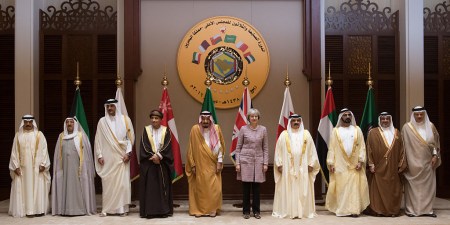
Bygone days of unity. The leaders of the Gulf states pose with British PM Theresa May at the Gulf Cooperation Council summit, on December 7, 2016 in Manama, Bahrain. (Photo by Carl Court/Getty Images)

On June 7 — the day of Trump’s phone call and two days before the release of the Saudi statement — Qatar hired of the law firm of John Ashcroft, former attorney general under President George W. Bush, to help counter terror accusations. This clearly was a calculated move, as Ashcroft had been instrumental in pushing through the post-9/11 “Uniting and Strengthening America by Providing Appropriate Tools Required to Intercept and Obstruct Terrorism Act of 2001,” more commonly known as the Patriot Act.

According to the “Scope of Engagement” of the Ashcroft retainer, its “broad purpose,” for a “flat fee” of $250,000, is to:

“provid[e] the Client with comprehensive strategic advice, legal counsel, support, and representation related to confirming, educating, assessing and reporting the Client’s efforts to combat global terrorism and its support of and compliance with international financial regulations, including compliance with United States Treasury rules and regulations.

“The firm understands the urgency of this matter and need to communicate accurate information to both a broad constituency and certain domestic agencies and leaders…will advance, advocate, represent, and protect the Client’s interests as necessary, including but not limited to the development of comprehensive legal and government affairs strategy, coordination as necessary and in the interest of the Client, assessment of the pending news and certain nations’ claims that adversely impact the Client’s reputation and pose serious risk and consequences.”

Hiring Ashcroft is not the only indication that Qatar is running scared. Another is its leaders’ simultaneous attempt to assuage fears among its populace – reported to have begun “panic-shopping” at supermarkets — and threaten fellow Gulf Cooperation Council countries that they will suffer severe financial consequences as a result of their boycott.

“If we’re going to lose a dollar, they will lose a dollar also,” warned Qatari Finance minister Ali Shareef Al Emadi. Emadi added, “Our reserves and investment funds are more than 250 percent of gross domestic product, so I don’t think there is any reason that people need to be concerned about what’s happening or any speculation on the Qatari riyal.”

In spite of Emadi’s posturing and Doha’s assertion that it is not in cahoots with Iran, Tehran announced that it has begun sending hundreds of tons of food products to Qatar. Oman, too, is transferring goods to Doha. Turkey went a step further, authorizing the dispatch of 3,000-5,000 troops to its military base in Qatar, to assist Al Thani’s regime, should it be jeopardized by the Saudi-led initiative and internal power struggles.

This unfolding of events is creating what Middle East expert Jonathan Speyer called a “clear drawing” of the “lines of confrontation between the two central power blocs in the region…”

As Speyer wrote on June 10:

“The shunting aside of little Qatar… is ultimately only a detail in the larger picture. What is more significant is the re-emergence of an overt alliance of Sunni Arab states under US leadership, following the development of military capabilities in relevant areas, and with the stated intention of challenging the Iranian regional advance and Sunni political Islam.”

Ironically, pressure from this new anti-Iran Muslim bloc in the Middle East has done more to call the world’s attention to Qatar’s key role in the spread of Islamist terrorism than years of cajoling on the part of previous administrations in Washington to get Doha to live up to its signed commitments.

Ruthie Blum is a journalist and author of “To Hell in a Handbasket: Carter, Obama and the ‘Arab Spring.'”

Iran and Middle East Instability

June 3, 2017

Iran and Middle East Instability, American ThinkerShahriar Kia, June 3, 2017

During President Donald Trump’s trip to the region and beyond Iran was strongly condemned by the American leader and senior Saudi officials for its support for terrorism, destructive role across the Middle East, and meddling in Syria, Iraq, and Yemen. Tehran is most specifically concerned with world leaders denouncing Iran’s human rights violations and acknowledging how the Iranian people are the main victims of the mullahs’ atrocities.

The Arabs, as the flagbearers of implementing U.S. sanctions, have launched the domino of freezing Iran’s money abroad. Iranian bank accounts in countries such as Turkey, Oman, and the UAE, especially in Dubai and Abu Dhabi, are being blocked one after another. This can be considered the prelude to comprehensive sanctions on Iran’s banking network.

***********************

The end result of Iran’s presidential election has created further rifts and launched a more intense power struggle amongst the regime’s senior ranks. Supreme Leader Ali Khamenei, fearing a repeat of the 2009 scenario of nationwide uprisings, failed to “engineer” the election results with the aim of unifying his regime apparatus. Khamenei sought to prepare conservative cleric Ebrahim Raisi as his heir by first placing him in the presidency, similar to the process he himself went through.

The elections, however, failed to provide such a finale and in fact prompted all candidates to unveil corruption in the most senior ranks. This has prompted the general public to increase their demands. Protests and demonstrations are witnessed these days in more than 30 cities and towns across Iran, with sporadic reports of clashes, following the bankruptcy of two state-run financial firms, Caspian and Arman.

Iran is also facing major foreign dilemmas, with a new international coalition shaping and targeting Tehran’s interests. The Arab-Islamic-American alliance, with the presence of 55 States, and Iran’s absence, delivered a major blow to the mullahs’ objectives in the Middle East.

On the other hand, Iranian opposition People’s Mojahedin Organization of Iran (PMOI/MEK), transferring all its members from Iraq to a number of European countries, has become ever more powerful. Through a vast network of supporters inside Iran, the PMOI/MEK was able to significantly influence the recent elections and place the regime in a quagmire like never before.

A major rally is scheduled for July 1st by supporters of the National Council of Resistance of Iran (NCRI), the political umbrella group of Iranian dissidents, including the PMOI/MEK. Policymakers and influential figures from across the globe will be gathering to provide a concrete plan to evict the mullahs’ presence from the region, how to establish freedom and democracy in Iran, and thus result in peace and stability in the Middle East. Last year more than 100,000 people took part in this convention.

During President Donald Trump’s trip to the region and beyond Iran was strongly condemned by the American leader and senior Saudi officials for its support for terrorism, destructive role across the Middle East, and meddling in Syria, Iraq, and Yemen. Tehran is most specifically concerned with world leaders denouncing Iran’s human rights violations and acknowledging how the Iranian people are the main victims of the mullahs’ atrocities.

Despite the heavy blows and new sanctions against Tehran, Khamenei has chosen to remain completely silent. This is in complete contrast to the Obama era, where the mullahs’ leader resorted to harsh outbursts in response to even the slightest hint of threats by U.S. officials.

To this end, adopting a strong approach against Tehran has proven to be correct, parallel to the weakness seen in Tehran following the presidential election.

To add insult to injury for Iran, the Trump administration has imposed sanctions on dozens of Iran’s companies, sending a highly important message.

Sanctions have now expanded from ballistic missiles and reached the human rights perspective, and specifically targeting the Revolutionary Guards (IRGC) with the objective of designating this entity as a foreign terrorist organization

The IRGC-affiliated Fars news agency described a new U.S. Senate bill as an “effort to bring Europe aboard in nuclear sanctions.”

“Foreign investment in Iran during the past four years has halved during the past four years, lowering from $4.6 billion to $2.05 billion,” according to Naseem Online citing a UN report.

The Arabs, as the flagbearers of implementing U.S. sanctions, have launched the domino of freezing Iran’s money abroad. Iranian bank accounts in countries such as Turkey, Oman, and the UAE, especially in Dubai and Abu Dhabi, are being blocked one after another. This can be considered the prelude to comprehensive sanctions on Iran’s banking network.

Is Rouhani able, or even willing?

Rouhani is neither willing nor able to carry out any measures outside of Khamenei’s framework. The entire apparatus and power structure is controlled by the Supreme Leader. As long as Iran remains under the mullahs’ regime structure, one should set aside all expectations of change emanating from within Iran. A look at Mohammad Khatami’s tenure is president from 1997 to 2005, andRouhani’s first term, are undeniable proof to this reality.

“They want to change our behavior, but changing it means changing our regime,”Khamenei said recently, signaling his red line.

Rouhani defending Iran’s missiles

The regime’s president recently said that Tehran would continue its ballistic missile program.

“… US officials should know whenever we need to technically test a missile, we will do so and will not wait for their permission,” he said in a news conference.
The Iranian regime reported recently the construction of a third underground ballistic missile production factory and will keep developing its missile program.

This came in the same week when Trump in his foreign visit described Iran as a supporter of militia groups and a threat to all Middle East countries.

Rouhani is an “utterly ruthless operator,” who had presided since 2013 over a collapsing economy and what Amnesty International called “a staggering execution spree,” murdering and imprisoning so many dissidents that Iran has per capita the highest execution rate in the world, according to Christopher Booker in a recent Telegraph article.

Obama’s departure ended the period of appeasement and golden opportunities for Tehran’s mullahs. The road ahead promises to be very difficult, to say the least.

The past four decades have proven that only regime change will bring about what the Iranian people desire and deserve. This is something that is supported by the NCRI and Rajavi’s ten-point plan, calling for a free and democratic Iran where equal opportunities are provided to all citizens regardless of gender, ethnicity, and religion. During the short campaigning season, Iranians manifested their support for Rajavi’s plan by putting up posters reading “Maryam Rajavi is our president.”


VA secretary says agency ‘clearly broken,’ urges action by Congress

May 31, 2017

VA secretary says agency ‘clearly broken,’ urges action by Congress, Washington TimesS.A. Miller, May 31, 2017

In this photo taken May 11, 2017, Veterans Affairs Secretary David Shulkin testifies on Capitol Hill in Washington. Shulkin is warning the VA is “still in critical condition” despite efforts to reduce wait times for medical appointments and expand care.

Veterans Affairs Secretary David Shulkin said Wednesday that the agency is “still in critical condition” with patients waiting too long for services and a bureaucracy unable to fire poorly performing employees.

Mr. Shulkin, the only holdover from the Obama administration in President Trump’s Cabinet, urged Congress to give the agency more power to discipline employees and expand the Veterans Choice program that allows vets to get treatment from private-sector doctors and hospitals.

Current rules prevent the VA from suspending or firing employees in a timely manner, including a recent case where it took more than a month to fire a psychiatrist caught watching pornography on his iPad while seeing a veteran.

“Our accountability process are clearly broken,” said Mr. Shulkin, a physician.

He said that despite limitation in the law, the VA has moved to purge executives and others for poor performance and mismanagement.

The agency recently fired the medical director and other executives in the D.C. facility and the medical director and three other executive in the Shreveport, Louisiana, facility.

A pattern of negligent and mistreatment at VA hospitals came to light in 2014. A report by CNN found that at least 40 veterans died while on long waiting lists for care at a facility in Phoenix.

More problems emerged at facilities across the country, including secret waiting lists that were kept hidden by executives in order to collect bonus pay.

The Veterans Choice Program was created in response. The program, however, was opposed by Democrats who warned it was an attempt to privatize the VA.

Mr. Trump last month signed into law a bill that extended the program.

Mr. Shulkin also credited the president with taking executive action to create a VA Office of Accountability and Whistleblower Protection, which reports directly to the secretary.

“But that isn’t enough,” Mr. Shulkin said. “We need new accountability legislation and we need that now.”

The House passed a bill to make it easier to fire bad VA employees. The Senate has yet to act.