Posted tagged ‘Terrorism’

Iran nuclear deal adoption to take place October 18

September 19, 2015

Iran nuclear deal adoption to take place October 18 Controversial accord to be implemented next month; US says Tehran must take steps to satisfy IAEA before punitive measures removed By JTA September 18, 2015, 4:50 am

Source: Iran nuclear deal adoption to take place October 18 | The Times of Israel


WASHINGTON (JTA) — The formal adoption of the Iran nuclear deal will be Oct. 18, but it is not yet clear how long it will take for Iran to satisfy conditions to relieve sanctions, top US officials said.

The senior administration officials, speaking Thursday afternoon in a conference call with reporters, outlined the steps Iran must take before inspectors with the International Atomic Energy Agency, the UN nuclear watchdog, confirm that Iran is in compliance with the nuclear deal reached in July between Iran and six major powers.

The call to reporters came the same day that the Obama administration announced that Stephen Mull, the outgoing ambassador to Poland, would be the point person for ensuring Iranian compliance with the deal.

Among other measures, Iran must remove thousands of centrifuges from its Natanz reactor, ship overseas all but 300 kilograms of 12,000 kilograms of enriched uranium and remove the center of its plutonium reactor, the officials said.

Because of how involved the measures are, the officials would not estimate how long it would take to get to “implementation day,” when the IAEA confirms compliance and sanctions are lifted. Reports have indicated that Iran is likely to comply with conditions in from between six months to a year from adoption of the deal.

“All of this will take a lot of effort and probably a fair amount of time,” said an official. “The ball is in Iran’s court — it’s hard to predict how long it will be before sanctions relief is implemented.”

The officials spoke on condition of anonymity.

One condition the Iranians must complete prior to Oct. 18, or “adoption day,” is to report to the IAEA on the possible military dimensions of its past nuclear activity. Iran has instead its nuclear research is for civilian purposes only. The deadline for Iran’s report to the IAEA is Oct. 15.

The Obama administration on Thursday said the way was clear to launch the deal now that Congress has reached the deadline to pass a bill that would kill the deal. Senate Democrats used parliamentary procedures to block votes last week, on Tuesday and then on Thursday.

Republicans oppose the deal. The Obama administration and opponents of the deal, include Israeli Prime Minister Benjamin Netanyahu, and the American Israel Public Affairs Committee for the last two months fiercely battled to influence Democrats and also the US Jewish community on the deal.

Opponents said the deal leaves Iran a nuclear threshold state, while the Obama administration argued that it was the best means of keeping Iran from acquiring a nuclear weapon.

Director of Treasury Department's Office of Foreign Assets Control Adam Szubin. (screen capture: Youtube)


The ‘Iran Deal’ Was Not Signed by Iran or Anyone Else

September 19, 2015

Neither Iran nor any other party has signed the ‘Iran Deal.’ That means there is no formal agreement. That means nothing bars Iran’s race to nuclear weapons. By: Lori Lowenthal Marcus Published: September 19th, 2015

Source: The Jewish Press » » The ‘Iran Deal’ Was Not Signed by Iran or Anyone Else

Rep. Mike Pompeo (R-KS-04)

Rep. Mike Pompeo (R-KS-04)
Photo Credit: Wikimedia


The Nuclear Iran Deal that is at the epicenter of a Congressional battle and the focus of so much attention for months is not actually any deal at all, as not one of the parties, including any representative of the Islamic Republic of Iran, has signed the Agreement.

This morning, Sept. 18, Cong. Mike Pompeo (R-KS-04) sent a letter to Secretary of State John Kerry. In that letter Pompeo informed the Secretary that while reviewing the Joint Comprehensive Plan of Action (Nuclear Iran Deal), he noted that there are no signatures on the so-called final Agreement.

Without signatures, there can be no legally binding contract.

There apparently is no “Iran Deal.”

Pompeo asked Kerry to provide a copy of the JCPOA with signatures and signing authority, so that members of Congress and the rest of the American people know that the parties to the agreement have “confirm[ed] each country’s commitment to the agreement” and that “makes clear precisely who the parties to the agreement are and the authority under which that nation entered into the agreement.”

International affairs scholar and Iran expert Michael Ledeen pointed out more than two months ago that Iran’s Ayatollah Khameini would not allow his country to sign the JCPOA. Ledeen’s point then, and today, is that the desperation exhibited by the Obama administration made clear to the Iranian leader that “there is no reason for him to approve a hated deal with the devil. It’s much better to keep talking until all the sanctions are gone, and Iran’s ‘right’ to pursue its nuclear projects is fully recognized.”

It appears that Ledeen’s prediction was dead-on. If there is no signed agreement, even the feeble conditions placed on Iran by Team Kerry’s negotiators are unenforceable.

When asked what then, is the current status of the JCPOA, assuming the administration did not just, oh, forget to distribute to Congress the signed version, Ledeen told the JewishPress.com: “It’s a verbal agreement. It means the diplomats meeting in Vienna thought it was a good agreement, but that is all. It is not enforceable.”

Ledeen said he could not think of any other major international agreement, certainly not any of the portentous nature of the Iran Deal, where lawmakers moved forward to begin implementation without having a signed agreement in place.

“Anyone who has read in the media that the ‘Iran Deal’ was signed has to now know they were lied to, it has not happened.”

So what next?

Congress could, conceivably, pass a law forbidding the lifting of sanctions. That’s been tried, you say? True, but will the same members of Congress who support the deal, the same ones who never read significant portions of the deal, and who had those portions explained to them by people who themselves never read the deal are willing to once again vote against or even bar a vote on a stay on the lifting of sanctions when they know there is nothing preventing Tehran from violating any of the purportedly agreed-to conditions? Will they really?

Cong. Pompeo’s letter to Secretary Kerry follows:

Dear Secretary Kerry:


I have reviewed the Joint Comprehensive Plan of Action (JCPOA) between the P5+1 and Islamic Republic of Iran – or at least the parts of the agreement that were provided to Congress by the administration.  As you know, pursuant to H. Res. 411, the House of Representatives considers the documents transmitted on July 19, 2015 incomplete in light of the fact that the secret side deals between the International Atomic Energy Agency (IAEA) and the Islamic Republic of Iran were not provided to Congress.  I look forward to seeing the entire agreement – including the two secret side deals that are part of the JCPOA – so that Congress may continue to evaluate the JCPOA and, depending on the outcome of the vote under the relevant provisions of the Iran Nuclear Agreement Review Act, potentially end the current and continuing prohibition of the lifting of sanctions on Iran.

During that review, I found that the copies provided to Congress of the JCPOA are not signed by any of the P5+1 members nor by Iran.  Having never seen an international agreement of this magnitude not signed by the parties or an agent of the parties, I assume this is simply an oversight or an administrative error.  That is, Congress must not have the final version of the agreement that would necessarily be signed.  I request that you provide us with copies of a final, executed copy of the JCPOA.  In the event that the JCPOA has not yet been signed by the parties, please inform us (a) when signatures will be placed on the agreement, (b) what parties will be signing, and (c) which person you anticipate will sign on behalf of each of those parties, including on behalf of the United States.

I am confident that you intended for the JCPOA to be signed by each of the P5+1 participants.  I can find no international agreement of this “historic” nature that was not signed by the parties.  Each of the past five major nuclear agreements to which the U.S. is a party – SALT I, SALT II, START I, START II and the 1994 Agreed Framework between the United States and the Democratic People’s Republic of Korea – were signed by representatives of each nation that was party to the agreement.  This is not a mere formality.  Those signatures represent the commitment of the signatory and the country on whose behalf he or she is signing.

A signature also serves to make clear precisely who the parties to the agreement are and the authority under which that nation entered into the agreement.  In short, just as with any legal instrument, signing matters.

This is particularly important with respect to JCPOA.  Iranian President Hassan Rouhani has made clear that he does not believe that JCPOA is legally binding on his nation, saying, “If the Joint Comprehensive Plan of Action is sent to (and passed by) parliament, it will create an obligation for the government.  It will mean the president, who has not signed it so far, will have to sign it.  Why should we place an unnecessary legal restriction on the Iranian people?”

Given the many benefits that will accrue to the ayatollahs, the Iranian Revolutionary Guard Corps, and other unsavory elements of the Iranian regime, I believe that Iran should, at the very least, bind itself to the few requirements placed on it under the JCPOA by signing the agreement.  I also believe that the United States and its P5+1 partners on the JCPOA should execute the agreement on behalf of their countries.  I look forward to your response.

We all do.

Palestinians launch new confrontation tactic of “localized” terror against Israel

September 15, 2015

Palestinians launch new confrontation tactic of “localized” terror against Israel, DEBKAfile, September 15, 2015

Pipes_explosive_Jerusalem_13.9.15Palestinian pipe bombs in Jerusalem

Three dates have emerged as the landmarks of a new outbreak of armed Palestinian violence against Israel: On Aug. 30, an army-police squad, on a routine operation for rounding up terrorist suspects, was waylaid in the Jenin refugee camp on the West Bank by fierce gangs armed with rocks, iron bars and firebombs. Then, on Sept. 13,an Israeli car was stoned in Jerusalem, killing the driver Alexander Levlovitch, 64. He was driving home on New Year’s Eve.

Palestinian rocks against Israeli cars are part of the regular landscape on roads in and outside Jerusalem, but this time it ended in murder.

The next day, the 14th, gangs of rampaging Palestinian youths fought Israeli police guards on Temple Mount for control of the Al Aqsa Mosque doors with rocks, blocks of concrete and iron bars, which had been hoarded inside the mosque.

DEBKAfile’s counterterrorism analysts diagnose these and allied events as the opening shots of a Palestinian uprising against Israel under a different guise. Security forces are beginning to talk about “armed localized terror.”

Its most prominent features are the collaboration for ad hoc operations betwen two or more Palestinian rival groups, and their localized nature. They tend to be planned in advance for a specific arnea [Sic].

The collaborators in the Jenin outbreak were Hamas and Islamic Jihad. For the New Year attacks, Fatah (whose leader is Mahmoud Abbas) and Hamas joined hands.

They shared five objectives:

1. To sabotage Jewish celebration of the New Year festival in Jerusalem.

2.  To ratchet up the level of Palestinian clashes with Israeli security forces by the use of firebombs and other explosive devices.

3.  To establish a dominant presence on Temple Mount, divided it among the various Palestinian factions.

4.  To bar Jewish access to the Temple Mount compound, revered as the site of the Jewish Temples.

5.  To protest Israel’s decision to outlaw the Muribitun and Muribitath gangs, established by radical Muslim groups to keep Jews out of the Temple Mount compound – if necessary by force.

Over the festival, two Jewish youths were chased and attacked at the site and alleys leading to it.

6.  To warn Jordan’s King Abdullah that the Palestinians are united against his claim to restore Hashemite Muslim custodianship over Temple Mount and Al Aqsa. They viewed the king’s plan to double the number of sentries posted at the site by the Muslim Waqf religious administration, which acts in Jordan’s name on Temple Mount, as part of the king’s takeover effort.

These Palestinian extremists are satisfied with having chalked up several gains from their new aggressive strategy against Israel:

a)  Fatah and Hamas worked well together in their first operation after years of fighting each other. Their collaboration defied and further undermined the waning influence of Palestinian Authority Chairman Mahmoud Abbas.

b)  One Israeli was killed.

Israel’s security services can claim a major success. A solid tip-off reaching the Shin Bet internal security service exposed the address of an apartment in the Old City of Jerusalem where pipe bombs were being assembled. A timely raid on Sept. 13, and the seizure of these improvised though deadly weapons averted a major disaster and mass casualties – possibly even at the Western Wall.

But in intelligence work, no single success can promise that every terror plot is foiled in the future too.

Israeli strategists, like their opposite numbers in Amman, are wracking their brains for effective penalties and deterrents to stem the rising spiral of Palestinian violence.

DEBKAfile’s counterterrorism sources discern in the new escalation certain characteristics common to the clashes seen in Arab countries in recent years between opposing populations and religious groups.

Therefore, the Palestinian terror in and around Jerusalem, spilling over from last weekend, is likely to spread to other parts of the country, also encompassing Judea and Samaria, or even igniting parts of the Israeli Arab communities in solidarity with their Palestinian kin. We may be on the brink of a full-blown intifada (uprising.),

Conscious of the peril, Prime Minister Binyamin Netanyahu called an emergency meeting for Tuesday night, Sept. 15, to be attended by Defense Minister Moshe Ya’alon, Public Security Minister Gilead Erdan, Justice Minister Ayelet Shaked, Transportation Minister, Israel Katz, the Attorney General and security services chiefs.

Our sources are skeptical about this meeting producing measures for stemming the rising tide of Palestinian terror. Netanyahu’s plan to apply conventional law and order measures, such new legislation for raising the minimal jail sentence for stone-throwers, comes too late. The stone-throwers have already turned to bombs.

Long jail sentences were taken out of the government’s hands as an effective deterrent for terror when, on June 29, a Palestinian suspect won his release from administrative detention by staging a long hunger strike. The Israeli government folded under the pressure, exposing the weakness of its legal and judicial systems as tools against terrorism.

Then, on Aug. 11, Netanyahu and Ya’alon told Israeli soldiers facing Palestinian aggression that henceforth they were only allowed to fire in the air, unless they faced imminent threat to their lives.

This order was issued to cut down on the number of dead terrorists and the negative statistics in world media. But in the arenas of confrontation, the Palestinians, no longer afraid of death or injury, were encouraged to escalate their assaults and reach the current new threshold of confrontation.

Israel unfazed by PA threat to end Oslo accords, declare Palestine occupied state

September 7, 2015

Israel unfazed by PA threat to end Oslo accords, declare Palestine occupied state Palestinian Authority always warning it will ‘jump off a cliff,’ says official, accusing Abbas of engaging in ‘brinkmanship’ while refusing to negotiate By Raphael Ahren September 7, 2015, 3:48 pm

Source: Israel unfazed by PA threat to end Oslo accords, declare Palestine occupied state | The Times of Israel

Mahmoud Abbas, right, meeting with French politician Bruno Lemaire in Ramallah on September 5, 2015. (AFP/ABBAS MOMANI)

Mahmoud Abbas, right, meeting with French politician Bruno Lemaire in Ramallah on September 5, 2015. (AFP/ABBAS MOMANI)

Israel is unimpressed by reports about the Palestinians reportedly threatening radical unilateral moves at the United Nations, a senior Israeli official said Monday, accusing the Palestinian Authority of “brinkmanship” while reiterating Jerusalem’s willingness to immediately resume bilateral peace negotiations.

“We view these threats with a certain amount of skepticism,” the official told The Times of Israel, speaking on condition of anonymity because he was not authorized to discuss the matter with the press. “The Palestinians routinely negotiate through brinkmanship. If they don’t get what they demand, they threaten to jump off the cliff.”

The Palestinian leadership has threatened to resign, to dismantle the PA and even to dissolve the Oslo Accords several times over the last few months, the official added.

New reports indicate that PA President Mahmoud Abbas is planning to make a drastic announcement at the United Nations General Assembly this month, declaring Palestine a state under occupation and dissolving the Oslo Accords and other bilateral agreements with Israel. While it remains unclear what implications such a move would entail, some warn that it could spell the end to Israeli-PA security coordination and place all responsibility for the governance of the West Bank in the hands of Israel as the occupying power.

“The prime minister is ready for the immediate resumption of peace talks without any preconditions, but the Palestinians refuse to engage,” the Israeli official said. “By placing unnecessary preconditions on the talks, they make the resumption of talks impossible. Then, after preventing talks from happening, they run to international community and say no negotiations, crisis, drastic action is required. But it’s a charade.”

The only reason for the absence of meaningful negotiations is the Palestinians’ refusal to negotiate, the official added. “It’s time the international community refused to accept this charade and told the Palestinians that it’s time to return to talks with Israel. It’s the only way to move forward.”

Israeli officials on Monday refused to comment on the record about the Palestinians’ possible démarche at the UN. In private conversations, they deemed it a toothless “provocation,” but acknowledged that they were nevertheless concerned, because no one really knows what exactly Ramallah is up to and how Jerusalem will react.

While generally considered an unlikely scenario, the Palestinians’ annulment of the Oslo Accords could have serious implications, as they regulate security and economic cooperation between Israel and the PA.

On the other hand, the threat to declare Palestine “a state under occupation” appears less threatening, as it might have no concrete implications.

“It’s an empty statement,” said Alan Baker, a retired Israeli diplomat and former legal adviser to the Foreign Ministry. “I don’t think it has any significance whatsoever. Nothing Abbas says, no declaration he makes at the UN, will change anything on the ground.”

The only thing it would achieve, Baker said, is to invalidate his status as president of the PA, as well as the legitimacy of the Palestinian parliament and courts. “It would also open up the opportunity for Israel to do whatever it deems necessary to protect its security and political interest, and could even cause possible termination of security and economic cooperation and other measures that are intended for the benefit of the Palestinian people.”

Is it even possible for Palestine to become a “state under occupation”? In his speech in New York later this month, Abbas will point to the General Assembly’s 2012 decision to accept “Palestine” as a non-member observer state and argue that Israel refuses to end the occupation of his state.

However, some argue that only existing states can be considered occupied, such as France during World War II or, more recently, Ukraine’s Crimea, which was occupied by Russia. But “Palestine” seeks to achieve statehood while under occupation, a situation without historical precedent. A state can only become “occupied” if parts or all of the territory it controlled is in effective control of another power, some legal scholars argue. That would not be the case here.

The Palestinians, however, are likely to argue that a sovereign “Palestine” existed before the 1967 Six Day War, when Israeli captured the West Bank and Gaza Strip, even though that appears to be a difficult position to defend among international law scholars.

Khamenei Publishes Book About The Annihilation Of Israel

September 5, 2015

Khamenei Publishes Book About The Annihilation Of Israel

By Missing Peace

Source: Khamenei Publishes Book About The Annihilation Of Israel | Missing Peace | missingpeace.eu | EN

Khamenei during meeting with IRGC veterans

Iran’s Supreme Leader, Ayatollah Ali Khamenei, just published a book in which he outlines a ‘slow and painful’ strategy to annihilate Israel.

The 416-page book, titled Palestine, was edited by Saeed Solh-Mirzai–but received full approval from Khamenei’s office and is thus Khamenei’s most authoritative document regarding his views on the issue, the Goldstone Institute think tank reported.

The book was published only weeks after six world powers, including the United States, reached a controversial agreement about Iran’s nuclear weapons program.

Khamenei’s plan for Israel will promote “the hegemony of Iran” while it will remove “the West’s hegemony” from the Middle East, the Ayatollah claims in the book. How this goal will be reached is described in detail by Khamenei.

“Israel has no right to exist” is the central theme of the book. Khamenei uses three words to describe the destruction of Israel. “One is “nabudi,” which means “annihilation.” The other is “imha,” which means “fading out.” And finally, there is “zaval,” meaning “effacement,” the Gatestone Institute reported.

The annihilation of Israel will not be achieved via conventional warfare, Khamenei argues, but via a never ending string of terror attacks and low-intensity conflict that will make life unbearable for the Israeli Jews.

In the end, they would pack their bags and leave the country for another country in the West–or return to their country of origin–because many Israelis have dual citizenship, the Iranian Supreme Leader thinks. This same way of thinking caused Yasser Arafat to launch the Second Intifada, but Israelis never even contemplated leaving the country during the five years of continuing terror.

Khamenei writes that his strategy for the annihilation of the Jewish State has nothing to do with anti-Semitism but with “well-established Islamic principles.”

The overriding principle is that Israel was established on territory that belongs to the Ummah (Islamic nation) and, therefore, is part of the Dar al-Islam (house of Islam). Such land can never be ceded to non-Muslims and must be brought under Muslim control again.

There are, however, three other reasons Khamenei gave for the mandatory destruction of Israel.

The first is that Israel, which he labels “adou” (enemy) and “doshman” (foe), is the ally of the “Great Satan” (United States) and is conspiring with the U.S. in an “evil scheme” to dominate the heartland of the Ummah.

The second reason is that Israel has become “Kaffir al-Harbi,” a hostile infidel because of the numerous wars it fought against Muslim armies.

The third reason Israel must be destroyed is that it “occupies” Jerusalem, the third holy city in Islam, according to Khamenei, who is honored with the title “The flagbearer of Jihad to liberate Jerusalem” on the cover of the book. He writes that one of his “most cherished wishes” is to pray in Jerusalem one day.

Khamenei is counting on increasing “Israel fatigue” in the international community that makes it more likely that the world will force his version of the one-state solution upon Israel, he thinks.

What is this solution?

The Supreme Leader wants to organize a referendum among at least 8 million Palestinian Arabs and their descendants and only 2.2 million Israeli Jews, those who did not immigrate to Israel.

The United Nations would run the affairs in the new country until the referendum takes place; and after that, Khamenei would be willing to let the Jews continue to live in the new “Palestine” as second-class citizens (Dhimmi’s).

Khamenei also boasts that Iran was behind the Second Lebanon War between Israel and Hezbollah in 2006 and the 22-day long war with Hamas in Gaza last year.

In his book, Khamenei denies the Holocaust and writes that he regards it as “a propaganda ploy” or a disputed claim. “If there was such a thing we don’t know why it happened and how,” he claimed.

Amir Taheri, the Iranian journalist who wrote the Gatestone article, added the following:

Khamenei has been in contact with professional Holocaust deniers since the 1990s. In 2000, he invited Swiss Holocaust-denier Jürgen Graf to Tehran and received him in private audiences. French Holocaust-denier Roger Garaudy, a Stalinist who converted to Islam, was also feted in Tehran as “Europe’s’ greatest living philosopher.”

It was with Khamenei’s support that former President Mahmoud Ahmadinejad set up a “Holocaust-research center” led by Muhammad-Ali Ramin, an Iranian functionary with links to German neo-Nazis who also organized annual “End of Israel” seminars.

Despite efforts to disguise his hatred of Israel in Islamic terms, the book makes it clear that Khamenei is more influenced by Western-style anti-Semitism than by classical Islam’s checkered relations with Jews.

His argument about territories becoming “irrevocably Islamic” does not wash, if only because of its inconsistency. He has nothing to say about vast chunks of former Islamic territory, including some that belonged to Iran for millennia, now under Russian rule.

Nor is he ready to embark on Jihad to drive the Chinese out of Xinjiang, a Muslim khanate until the late 1940s.

Israel, which in terms of territory accounts for one per cent of Saudi Arabia, is a very small fry.

Khamenei’s book has been published in Farsi, the language of Iran. An Arab translation is expected soon.


Obama’s Politicized Intelligence

August 29, 2015

Obama’s Politicized Intelligence, Washington Free Beacon, August 28, 2015

(Please see also, Pentagon Not Targeting Islamic State Training Camps. Is there anything that Obama has not distorted for political purposes? — DM)

“Analysts,” reports the Daily Beast, “have been pushed to portray the group as weaker than the analysts believe it actually is.” This sort of dishonesty helps no one—except a president whose primary concern is leaving office with his reputation for ending wars intact, and the military brass who wish to remain in his good graces.

**********************

The anniversary of the U.S. war against the Islamic State passed with little notice. It was August 7 of last year that President Obama authorized the first airstrikes against ISIS in Iraq, a campaign he expanded a month later to include targets in Syria. So far this month, the president has delivered remarks on the Voting Rights Act, his deal with Iran, the budget, clean energy, and Hurricane Katrina. ISIS? Not a peep.

Obama’s quiet because the war is not going well. Despite the loss of Tikrit earlier this year, the Islamic State’s western boundary is stable, and its eastern boundary now encroaches on Damascus. The president’s air campaign is one of the most limited and desultory America has fought in decades—ranking last in daily averages of strike sorties and bombs dropped. In late July, when the Turks permitted America the use of their air bases to launch attacks on ISIS, a “senior administration official” told the New York Times that the decision was “a game changer.” In the ensuing days the number of airstrikes in Syria actually fell.

The growing number of U.S. advisers—there are now more than 3,300 American military personnel in Iraq—has been unable to repair the damage wrought on the Iraqi Army by sectarian and political purges after our 2011 withdrawal. Even as the administration brags about killing more than 10,000 ISIS terrorists, a number that strains credulity, the Caliphate has become more deeply entrenched in its territory, and inspires attacks abroad.

Meanwhile the congressional authorization that the president sought is dead. One of our most gifted generals predicts the conflict will last “10 to 20 years.” And now comes news that the Pentagon is investigating whether intelligence assessments of ISIS have been manipulated for political reasons. “Analysts,” reports the Daily Beast, “have been pushed to portray the group as weaker than the analysts believe it actually is.” This sort of dishonesty helps no one—except a president whose primary concern is leaving office with his reputation for ending wars intact, and the military brass who wish to remain in his good graces.

What’s especially galling about this allegation is that Obama and the Democratic Party have spent years spuriously accusing President Bush of lying the United States into war in 2003. Spend a moment thinking of what the news cycle would be if George W. were still our president and the Pentagon inspector general opened an investigation into whether the bureaucracy was sprucing up intelligence to make it politically palatable: The chorus of “Bush lied, people died” would be deafening, Congress would demand investigations, the national security leak machine would start humming, John Conyers would reconvene his mock impeachment hearing, and the entire controversy would be set against the backdrop of antiwar marches and publicized denunciations of militaristic policy. What have we instead? ABC’s Good Morning America mentioned the Pentagon investigation. No other broadcast network did.

It’s an unanticipated consequence of Barack Obama’s presidency: his immobilization of the antiwar legions, the way his election immediately neutered the zealots who, if a Republican were in office, would be marching against drone strikes and mass surveillance and war in Afghanistan and air war in Libya, Syria, Iraq and proxy war in Yemen. What does it say about the left that the most spirited attacks on Obama national security policy have come from the right: On drones, surveillance, and congressional authorization for war, you are far more likely to hear criticism from Ted Cruz or Rand Paul than from the politicians who rode into office denouncing Bush’s misadventure in Iraq. The protestors who flooded New York in 2004 and fell to the ground at the D.C. “Die-In” in 2007—they either support the president or are too busy with Occupy Wall Street and Black Lives Matter to care.

Obama has thus been allowed to wage a war for more than a year not only without the authorization he called for but also without the accountability that pressure from his left would bring. He’s flying solo, and below him are an endless, inconclusive war, a terrorist state built on sharia law and sex slavery, rampant chemical weapons use, civilian casualties, and a refugee crisis that is causing social, economic, and political instability in Europe. The only thing missing from this picture is outrage—elite fury over the geopolitical and humanitarian results of the president’s evasive policy, of doing only the bare minimum necessary to convince people that you aren’t ignoring the problem.

There’s no outrage because the media, our bipartisan political establishment, and indeed the American people themselves are unwilling to face the scope of the challenge the Islamic State presents. To uproot it we would have to send U.S. ground forces to Iraq in large numbers, not just special forces operating in tandem with unrestricted air support. We would have to retake and hold ground lost in the years since we departed Iraq, and we would have to commit to remaining in Iraq and Syria for a long time. To deal a blow to radical Islam that would deter recruitment, stop the bandwagon effect, and secure America from attack by militants and their fellow-travelers would require a military and economic commitment the United States, and least of all our president, is simply not prepared to make.

Easier to perform the illusion of activity, of success and advance, so that all the boxes are checked, all our consciences placated. Easier to pretend that the problem of ISIS can be “contained” and that our new ally Iran can handle the situation in its emerging capacity as regional hegemon. Easier to go about our business, to spin or outright ignore the war our country has been waging in Iraq and Syria for more than a year. So much easier not to worry about what’s happening over there—until, that is, the enemy attacks us here.

Pentagon Not Targeting Islamic State Training Camps

August 29, 2015

Pentagon Not Targeting Islamic State Training Camps No airstrikes against 60 camps producing 1,000 fighters monthly

BY:
August 28, 2015 4:40 pm

Source: Pentagon Not Targeting Islamic State Training Camps | Washington Free Beacon

The Pentagon has not conducted airstrikes against an estimated 60 Islamic State (IS) training camps that are supplying thousands of fighters each month to the terror group, according to defense and intelligence officials.

The camps are spread throughout Islamic State-controlled areas of Iraq and Syria and are off limits in the U.S.-led international bombing campaign because of concerns about collateral damage, said officials familiar with planning and execution of the yearlong bombing campaign.

Additionally, the IS (also known as ISIS or ISIL) camps have been so successful that Islamic State leaders are considering expanding the camps to Libya and Yemen. Both states have become largely ungoverned areas in recent years.

The failure to target the training camps with U.S. and allied airstrikes is raising questions among some defense and intelligence officials about the commitment of President Obama and his senior aides to the current anti-IS strategy of degrading and ultimately destroying the terror group.

“If we know the location of these camps, and the president wants to destroy ISIS, why are the camps still functioning?” one official critical of the policy asked.

The camps are regarded by U.S. intelligence analysts as a key element in the terror group’s successes in holding and taking new territory. The main benefit of the training camps is that they are providing a continuous supply of new fighters.

IS training camps

An additional worry of intelligence analysts is that some of the foreign fighters being trained in the camps will eventually return to their home countries in Europe and North America to carry out terror attacks.

A White House spokesman declined to comment on the failure to bomb the terror camps and referred questions to the Pentagon.

Pentagon spokesman Maj. Roger M. Cabiness declined to say why no training camps have been bombed. “I am not going to be able to go into detail about our targeting process,” he said.

Cabiness said the U.S.-led coalition has “hit ISIL [an alternative abbreviation for the Islamic State] with more than 6,000 airstrikes.”

“The coalition has also taken out thousands of fighting positions, tanks, vehicles, bomb factories, and training camps,” he said. “We have also stuck their leadership, including most recently on Aug. 18 when a U.S. military airstrike removed Fadhil Ahmad al-Hayali, also known as Hajji Mutazz, the second in command of the terrorist group, from the battlefield.”

Efforts also are being taken to disrupt IS finances and “make it more difficult for the group to attract new foreign fighters,” Cabiness said in an email.

A Central Command spokesman also declined to provide details of what he said were “operational engagements” against IS training camps.

“Once a target is identified as performing a hostile act, or is part of an obvious hostile force, a training camp for example, we prosecute that target in accordance with the coalition rules of engagement and the law of armed conflict,” the spokesman said.

According to the defense and intelligence officials, one reason the training camps have been off limits is that political leaders in the White House and Pentagon fear hitting them will cause collateral damage. Some of the camps are located near civilian facilities and there are concerns that casualties will inspire more jihadists to join the group.

However, military officials have argued that unless the training camps are knocked out, IS will continue to gain ground and recruit and train more fighters for its operations.

Disclosure that the IS training camps are effectively off limits to the bombing campaign comes as intelligence officials in the Defense Intelligence Agency (DIA) and U.S. Central Command, which is in charge of the conflict, have alleged that senior U.S. officials skewed intelligence reports indicating the U.S. strategy against IS is not working or has been less effective than officials have claimed in public.

The Islamic State controls large parts of Syria and Iraq and has attracted tens of thousands of jihadists in both countries and from abroad. The exact number of fighters is not known but intelligence estimates have indicated the numbers have increased over the past year.

The military campaign, known as Operation Inherent Resolve, appears to be floundering despite a yearlong campaign of airstrikes and military training programs aimed to bolstering Iraqi military forces.

A review of Central Command reports on airstrikes since last year reveals that no attacks were carried out against training camps.

Targets instead included Islamic State vehicles, buildings, tactical units, arms caches, fighting positions, snipers, excavators, mortar and machine gun positions, bunkers, and bomb factories.

The risk-averse nature of the airstrike campaign was highlighted last month by Brig. Gen. Thomas Weidley, chief of staff for what the military calls Combined Joint Task Force-Operation Inherent Resolve.

“The coalition continues to use air power responsibly,” Weidley said July 1. “Highly precise deliveries, detailed weaponeering, in-depth target development, collateral damage mitigation, and maximized effects on Daesh, are characteristics of coalition airstrike operation in Iraq and Syria.”

Daesh is another name for the Islamic State.

“The coalition targeting process minimizes collateral damage and maximizes precise effects on Daesh,” Weidley said earlier. “Air crews are making smart decisions and applying tactical patience every day.”

Other coalition spokesman have indicated that targeting has been limited to reaction strikes against operational groups of IS fighters. “When Daesh terrorists expose themselves and their equipment, we will strike them,” Col. Wayne Marotto said May 27.

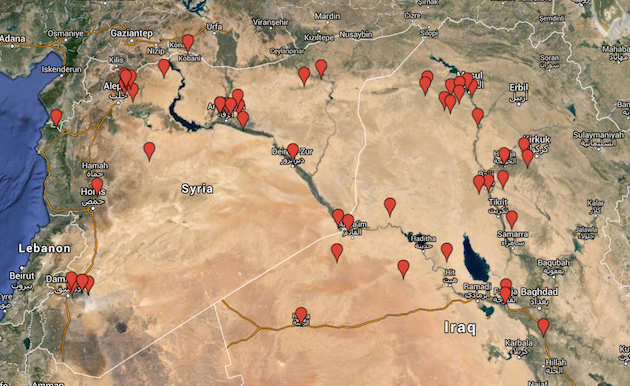
The military website Long War Journal published a map showing 52 IS training camps and noted that some may no longer be operating because of the U.S.-led bombing campaign.

According the map, among the locations in Iraq and Syria where IS is operating training camps are Mosul, Raqqah, Nenewa, Kobane, Aleppo, Fallujah, and Baiji.

The group MEMRI obtained a video of an IS training camp in Nenewa Province, Iraq, dated Oct. 1, 2014.

The video shows a desert outpost with tan tents and around 100 fighters who take part in hand-to-hand combat exercises, weapons training, and religious indoctrination.

Aymenn Jawad Al-Tamimi, an analyst with the Middle East Forum, in June translated details of IS training purportedly obtained from a manual produced by a pro-IS operative in Mosul named Omar Fawaz.

Among those involved in ideological training for IS jihadists in Iraq is Bahraini cleric Turki Binali, who wrote an unofficial biography of IS leader Abu Bakr al-Baghdadi, Al-Tamimi stated in a blog post June 24.

According to a document thought to be written by Fawaz, training differs for native Iraqis and Syrians as opposed to foreign fighters, who generally are less experienced militarily than the regional trainees.

The document also reveals IS plans to export military manpower abroad, including Libya.

“Sessions for the muhajireen [foreign fighters] brothers last 90 days or more, and at the highest level deal with organization, determination, and intelligence operation, including training on heavy weaponry in addition to comprehensive Sharia sessions and multiple tests,” according to a translation of the document. “Sessions for the Ansar from the people of Iraq and al-Sham range between 30 to 50 days.”

The process begins with an application form and questionnaire regarding education, skills, viewpoints, and whether their backgrounds can be verified.

The training then includes physical fitness, martial arts practice, weapons training, and ideological indoctrination.

After a week of training, jihadists with special abilities are selected and placed in units. The units include special forces, air defense, sniper units, a “caliphate army,” an “army of adversity,” and administrative units for those capable of using electronic devices and accounting.

“The rest are distributed in fronts and camps after the end of the military camp training according to where they are needed,” the report said, noting that all graduates are tested in Sharia at the conclusion of their training.

The New York Times reported Tuesday that the Pentagon inspector general is investigating allegations that military officials doctored intelligence reports in an attempt to present more optimistic accounts of the U.S. military’s efforts in the conflict.

The probe was triggered by a DIA analyst who stated that Central Command officials were improperly rewriting intelligence assessments prepared for policy makers, including President Obama.

The Daily Beast reported Wednesday that senior military and intelligence officials inappropriately pressured U.S. terrorism analysts to alter estimates of the strength of the Islamic State to portray the group as weaker.

Central Command, on its website, stated that in the year since the Iraq operation began on Aug. 7, 2014, a total of 6,419 air strikes were carried out.
Targets damaged or destroyed include 119 tanks, 340 Humvees, 510 staging areas, 3,262 buildings, 2,577 fighting positions, 196 oil infrastructure targets, and 3,680 “other” targets not further identified.

Iran official: We will never end fight against Israel

August 29, 2015

Iran official: We will never end fight against Israel In third successive denial of softened stance, Khamenei aide says fighting ‘illegal Zionist regime’ is ‘immutable policy’ By Times of Israel staff August 29, 2015, 2:47 pm

Source: Iran official: We will never end fight against Israel | The Times of Israel

Iran's President Hassan Rouhani, right, welcomes British Foreign Secretary Philip Hammond at the start of their meeting in his office, in Tehran, Iran, Monday, Aug. 24, 2015. (AP Photo/Ebrahim Noroozi)

Iran’s President Hassan Rouhani, right, welcomes British Foreign Secretary Philip Hammond at the start of their meeting in his office, in Tehran, Iran, Monday, Aug. 24, 2015. (AP Photo/Ebrahim Noroozi)

An aide to Iranian Supreme Leader Ayatollah Ali Khamenei on Saturday dismissed remarks by British Foreign Secretary Phillip Hammond that Tehran has changed its stance on Israel, insisting that fighting the “illegal Zionist regime” is an ongoing policy of the Islamic Republic, the semi-official Fars news agency reported.

“[The] fight against the illegal Zionist regime is one of the immutable policies of Iran, which has always been maintained,” Seyed Mahmoud Nabavi said.

Hammond was in Iran on Sunday and Monday for the reopening of the British embassy in Tehran, and said that Iranian President Hassan Rouhani had indicated a “more nuanced approach” to Israel’s existence. Hammond said Khamenei’s “revolutionary sloganizing” should be distinguished from “what Iran actually does in the conduct of its foreign policy.”

Nabavi said Hammond’s comments were “incorrect since one of the driving goals of the Islamic Revolution has been campaign against the arrogant powers,” according to Fars.

“We haven’t recognized the Zionist regime since the beginning of the Islamic Revolution and such a policy will continue,” Nabavi said.

This is the third time this week that a senior Iranian official has repudiated Hammond’s claims of a shift in stance on Israel. The Iranian Foreign Ministry also dismissed the remarks, saying that Israel “had no place in diplomatic talks between Tehran and London,” Fars reported.

“We have rejected such media hype (before) and during Mr. Hammond’s trip to Iran, we just discussed potentials of bilateral relations, fighting extremism and terrorism, etc.,” Foreign Ministry spokeswoman Marziyeh Afkham told reporters in Tehran on Wednesday.

“There were no talks on the Zionist regime and the report that Iran has changed its position is denied,” she said.

On Tuesday, Hussein Sheikholeslam, a foreign affairs adviser to parliament speaker Ali Larijani, said that Israel “should be annihilated,” and that the thawing relations with the West would not translate into a shift in Tehran’s position on the Jewish state.

Sheikholeslam told Iranian media that contrary to remarks by Hammond, “Our positions against the usurper Zionist regime have not changed at all; Israel should be annihilated and this is our ultimate slogan.”

Sen. Cotton to Visit Israel for More Ammunition against Iran Deal

August 28, 2015

He will arrive Sunday and will be “updated on strategic issues,” meaning Iran. By: Tzvi Ben-Gedalyahu Published: August 28th, 2015

Source: The Jewish Press » » Sen. Cotton to Visit Israel for More Ammunition against Iran Deal

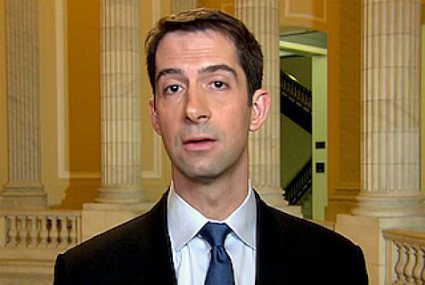
Arkansas Sen. Tom Cotton.

Sen. Tom Cotton, one of the loudest voices against the nuclear deal with Iran, will arrive in Israel on Sunday for a week-long visit that can be assumed is aimed at arming him with more ammunition to try to shoot down the nuclear Iran agreement in the Senate.

The Israel government announced:

U.S. Senator Tom Cotton (R-AR) will be visiting Israel from Sunday, August 30, to Saturday, September 5, 2015. During his trip to Israel, the Senator will be updated on strategic and diplomatic issues, as well as other major developments in the region.

Senator Cotton, in office as of January 2015, serves on the Armed Services, Intelligence, and Banking committees.

Updating him on “strategic and diplomatic issues” just before Congress returns from a summer recess with the Iran deal the number one item on the agenda means that Prime Minister Binyamin Netanyahu will send Sen. Cotton back with a suitcase full of arguments to try to win a veto-proof majority against the deal when it comes for a vote.

Sen. Cotton was behind the controversial letter that he and several senators sent to Iran to “inform” it that a nuclear deal would not be binding on the next president.

Earlier this month, he told Israeli reporters that the Obama administration has not made it clear to Iran that it could use force to prevent a nuclear-armed Iran. He then said that the U.S. Armed Forces could bomb Iran’s nuclear program “back to zero.”

Sen. Corker stated:

You can destroy facilities. I don’t think any military expert in the United States or elsewhere would say the U.S. military is not capable to setting Iran’s nuclear facilities back to day zero,

Can we eliminate it forever? No, because any advanced industrialized country can develop nuclear weapons in four to seven years, from zero. But we can set them back to day zero.

That is music to the ears of Prime Minister Netanyahu, and the timing of next week’s visit is not coincidental.

The Prime Minister and President Barack Obama are desperately campaigning against and for the deal, respectively.

Media continue to report more evidence that the deal is full of holes and that Iran already is has taken moves to get around it, such as the report Thursday that it has built an addition to its Parchin nuclear facility.

However, party loyalty usually is paramount to intellectual honesty. New York Democratic Sen. Charles Schumer came out against the deal and promptly faced a campaign prevent him from becoming the next party leader in the Senate to succeed retiring Sen. Harry Reid, who backs the deal.

Even Tennessee Republican Sen. Bob Corker admits that Obama will win. He told The Tennessean:

Understand that at this moment it looks very unlikely that we’ll have a veto-proof majority to disapprove, but I know we’re going to have a bipartisan majority that will disapprove.

The Hill reported that President Obama lacks only five out of 15 undecided Democratic senators to prevent a veto-proof majority against the agreement.

Two Hundred Retired Generals, Flag Officers Call on Congress to Reject Iran Deal

August 27, 2015

Two Hundred Retired Generals, Flag Officers Call on Congress to Reject Iran Deal

BY:
August 26, 2015 2:02 pm

Source: Two Hundred Retired Generals, Flag Officers Call on Congress to Reject Iran Deal | Washington Free Beacon

John Kerry

John Kerry / AP

Nearly two hundred retired generals and admirals sent a letter to Congress asking members to oppose the Iran deal, the Washington Post reported Wednesday.

The retired officers warned in the letter that the nuclear deal was “unverifiable” and would “threaten the national security and vital interests of the United States” by providing Iran a 10-year path to a nuclear bomb and handing the regime $150 billion in sanctions relief:

In summary, this agreement will enable Iran to become far more dangerous, render the Mideast still more unstable and introduce new threats to American interests as well as our allies. In our professional opinion, far from being an alternative to war, the Joint Comprehensive Plan of Action makes it likely that the war the Iranian regime has waged against us since 1979 will continue, with far higher risks to our national security interests. Accordingly, we urge the Congress to reject this defective accord.

Earlier this month, a group of 36 flag officers sent a dueling letter to Congress in support of the nuclear deal. The letter was organized with help from the White House, the Washington Free Beacon reported.


Here the full letter :

http://apps.washingtonpost.com/g/documents/world/read-an-open-letter-from-retired-generals-and-admirals-opposing-the-iran-nuclear-deal/1703/