Posted tagged ‘Terrorism’

The IDF’s Misplaced Trust in the Palestinian Authority

February 3, 2016

The IDF’s Misplaced Trust in the Palestinian Authority The new major threat inside Israeli communities enters a new phase.

February 3, 2016 Caroline Glick

Source: The IDF’s Misplaced Trust in the Palestinian Authority | Frontpage Mag

Amjad Sakari made no effort to hide his feelings and intentions towards Israel. The soldier in the Palestinian security forces filled his Facebook page with paeans to Saddam Hussein. Last weekend he published two posts indicating his imminent plan to carry out a terrorist attack.

In other words, if the PA forces he served had been serious about preventing their members from carrying out terrorist attacks, they could have easily prevented Sakari from driving to an IDF checkpoint between Ramallah and Beit El Sunday morning, opening fire and wounding three soldiers – one critically. Sakari, who was killed in the course of his attack, was the third member of the US-backed PA security forces who engaged in terrorism in the past two months.

On December 3, Mazen Ariba, an officer in the PA’s US-sponsored Preventive Security Forces opened fire on Israelis at the Hizma checkpoint north of Jerusalem. Ariba wounded two Israelis – one critically – before he was shot and killed.

Ariba, was PLO Secretary General Saeb Erekat’s nephew. Erekat made a very public condolence call to Ariba’s home. Ariba was posthumously hailed as a hero.

Two weeks ago, the Shin Bet arrested Ala’a Barkawi, an officer in the PA’s US-supported intelligence services. Barkawi was a member of a three-man terror cell that carried out a shooting attack against IDF forces operating in Tulkarm earlier last month.

Sunday night Prime Minister Binyamin Netanyahu demanded that PA President Mahmoud Abbas condemn the terrorism carried out by forces operating under his command. Abbas rejected Netanyahu’s demand and instead doubled down in supporting terrorism.

According to Channel 2, in US-mediated discussions between the two leaders, Abbas demanded that Israeli hand over Sakari’s body.

The IDF’s relationship with the Palestinian security forces is becoming a source of concern. The now five month old Palestinian terror campaign is entering a new phase, with direct attacks inside Israeli communities becoming a new major threat.

While many commanders on the ground in Judea and Samaria hold few illusions about the long-term viability of their cooperation with their US-trained Palestinian counterparts, senior IDF commanders serve as their greatest advocates and apologists. Following the murders of Dafna Meir and Shlomit Krigman late last week, the IDF’s senior commanders insisted yet again that Israel must do nothing to harm the PA security forces.

Sakari’s attack didn’t dampen their enthusiasm.

In a radio interview Monday morning, Defense Minister Moshe Yaalon reported that Palestinian forces foil about twenty percent of the terror plots. In so proclaiming the day after a Palestinian security officer gunned down three IDF troops, Yaalon made clear that the IDF will change nothing in its cooperative position towards them.

For their part, almost immediately after word got out that Sakari served in the PA forces, senior IDF commanders set out to control the damage. Sakari, they told reporters, was but a marginal figure in an unimpressive unit. He did not serve in any of the seven battalions deployed to the Palestinian population centers that were trained by the US military in Jordan. His actions, they insisted, were not indicative of a wider phenomenon within the PA security forces.

Both Yaalon and his senior commanders were doubtlessly telling the truth. But that doesn’t mean that all is well with the PA security forces.

Sakari served as a driver for the PA’s General Prosecutor Ahmed Hanoun. As such, he may have been a member of an unimportant unit, although certainly he had access to some of the most senior members of the PA. But as intelligence officers, Ariba and Barkawi were members of the core of the forces.

But in the final analysis, whether or not Ariba, Barkawi and Sakari were important operatives is beside the point. The main problem with the Palestinian security forces is that by their very nature, they are inherently hostile to Israel and supportive of terrorism.

PA forces are commanded by terrorists from Fatah and other affiliated PLO terror groups. The tens of thousands of men under arms in these forces are recruited from these terrorist groups.

The Palestinian Authority which they serve itself supports terrorism. On a practical level, as Deputy Foreign Minister Tzipi Hotovely relayed in a Wall Street Journal op-ed last week, the PA spends 16 percent of its donor financed annual budget paying salaries to terrorists jailed in Israeli prisons and stipends to their families. Moreover, the PA’s heroes are all terrorists. Its media and school system daily incite Palestinians to take up arms against Israelis and murder them. Murad Adais, who murdered Dafna Meir in her home in Otniel two weeks ago told investigators that he decided to murder Jews after watching incendiary PA media broadcasts.

In trusting the security cooperation they receive from the PA, our military leaders are mistaking inputs for outputs. That is, they assume that because they receive cooperation from these forces, these forces are inherently friendly. But again, the opposite is the case.

The PA is cooperating with the IDF today for two reasons. First, at present, Abbas believes that he has more to gain from cooperating with Israel than he does from Hamas. Second, at present, Abbas controls the bulk of his forces.

Both of these variables are likely to change, and Israel can do nothing to keep them constant.

In the past, both Abbas and his predecessor Yassir Arafat assessed at various points that they were better off cooperating with Hamas against Israel than with Israel against Hamas. Their decisions in 1996, from 2000 to 2007, and intermittently ever since, have had little to do with Israel’s positions. Indeed, their shifts from Israel to Hamas have often occurred at times when Israel did the most to support them.

As for Abbas’s control over his forces, this too can change on a dime. For years, Palestinian sources have insisted that these forces feel no intrinsic loyalty to Abbas. They stay with Abbas because he pays them.

Ideologically, these men under arms are free floaters. Nothing they believe is a bar for shifting their loyalties to Hamas. More to the point, all the US financial transfers to the PA security forces won’t stop any of the US-trained Palestinian forces from moonlighting as Hamas, Fatah or Hezbollah terrorists. They’ve done it in the past and they will do it again.

The instrumental, and necessarily temporary nature of Palestinian security cooperation with the IDF tells us three things.

First, the IDF needs to ditch its current counterterror strategy which is based on the wrongheaded assumption that we can rely on the PA security forces. Central Command needs to develop contingency plans for neutralizing these forces. These contingency plans don’t need to be made public. But to the extent that aspects of the plans can be quietly implemented, they should be implemented as quickly as possible.

Second, IDF commanders need to stop praising these hostile forces. At some point in the not so distant future the IDF will be required to fight these forces. When that day comes, the IDF’s enthusiastic tributes to their great cooperation with these terror-supporting forces will come back to haunt us. How will we be able to explain why our actions are necessary to allies to whom we have praised these hostile forces? This brings us to the final thing we need to recognize about these Palestinian forces. It was a major strategic blinder for Israel to support the US’s decision to train them. By supporting the US training program, Israel has given the US an incentive to deny the hostile nature of these forces.

Even worse than guaranteeing that the US will be unwilling to accept that in training these forces its military built a terror army, is that threat these forces pose. Today seven US-trained Palestinian combat battalions are deployed close to Israel’s major urban centers. Their fighting skills far surpass anything Israel has had to deal with in campaigns to date against Palestinian terror onslaughts.

As IDF commanders have warned over the years, due to the American training these terror-supporting anti-Israel forces have received, they can overrun small Israeli communities. They can carry out mass terror onslaughts in larger ones, on both sides of the armistice lines.

Following Sakari’s attack, Monday morning the IDF encircled Ramallah, barring non-residents from entering the city. The move was first announced by Palestinian security forces. So clearly the IDF coordinated the move with them before implementing it.

It is all well and good that the Palestinians continue to cooperate with the IDF, to the extent that the do. But Sakari’s attack must serve as a wake-up call. The defense establishment needs to quit relying on and praising this cooperation.

Because it will end. And if we are not prepared, the end will be very bad for Israel, and for the IDF.

 Critical Injuries in Jerusalem Attack, 3 Terrorists Dead [video]

February 3, 2016

By: David Israel Published: February 3rd, 2016

Source: The Jewish Press » » Critical Injuries in Jerusalem Attack, 3 Terrorists Dead

ID cards of the three terrorists who carried out attack at Jerusalem's Damascus Gate.

ID cards of the three terrorists who carried out attack at Jerusalem’s Damascus Gate.
Photo Credit: social media

A young female Border Guard officer was critically injured Wednesday afternoon in a combined stabbing and shooting attack by three terrorists at the Shechem (Damascus) Gate of the Old City of Jerusalem. Another female Border Guard police officer was seriously wounded and a third person was less severely injured. Numerous others were badly traumatized from the scene.

Aftermath of attack at Damascus gate entrance to Old City of Jerusalem.

Security forces initially prevented the Magen David Adom paramedics from going near the attackers for fear of a pipe bomb the terrorists were carrying.

According to Jerusalem police, three terrorists armed with Carl Gustav M/45 sub-machine guns, knives and explosives arrived at the Damascus Gate and were immediately identified by Border Guard officers at the site. They stopped them for questioning; one terrorist handed his ID card, the other pulled out his gun and started shooting. Two female Border Guards were injured and all three of the terrorists were neutralized.

The critically injured female officer, 20, was rushed to the Trauma Center at Hadassah Mount Scopus Medical Center, as was the second female officer, 19, who was stabbed in the neck. A man, 21, was injured lightly; he was treated at the scene and then evacuated to the hospital as well.

Two pipe bombs were successfully dismantled by sappers from the security force, according to Israel Police spokesperson Micky Rosenfeld.

The three terrorists were residents of Qabatiya, in the Jenin area of Samaria, with no prior history of security offenses, according to Israeli security sources.

All three of the attackers — Ahmed Rajeh Zakarneh, Mohamed Ahmed Kmail and Ahmed Najeh Abu Al-Rub – were killed.

Top U.S. General: ‘I Do Not Have Authority’ to Offensively Attack Taliban

February 2, 2016

Top U.S. General: ‘I Do Not Have Authority’ to Offensively Attack Taliban, BreitbartEdwin Mora, February 2, 2016

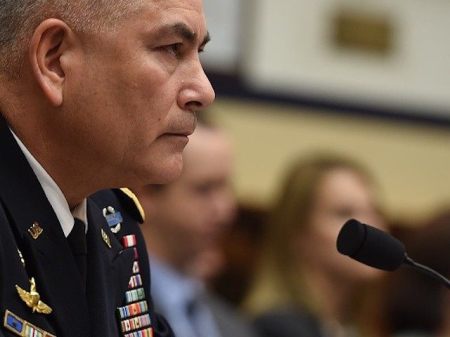
Top Gen in AfghanistanJIM WATSON/AFP/Getty Images

WASHINGTON, D.C. — The U.S. military, since President Obama declared that American troops had ceased their combat mission at the end of 2014, has only been able to attack the Taliban from a defensive position, the top commander of American and NATO forces in Afghanistan told lawmakers.

“I have the authority to protect our coalition members against any insurgency — Haqqani [Network], Taliban, al Qaeda — if they’re posing as a threat to our coalition forces,”testified the commander, Gen. John Campbell, before the House Armed Services Committee.

The general’s comments came in response to Rep. Jim Bridenstine (R-OK)asking if he had the authority to attack the Taliban, which has stepped up attacks since the end of 2014 and has been linked to the deteriorating security conditions in the Afghanistan.

“If the Taliban are attacking coalition forces, then I have everything I need to do that,” responded Gen. Campbell, who is expected to retire soon. “To attack the Taliban just because they’re Taliban, I do not have that authority.”

“It is astonishing that we have an authority to go after the Taliban and the president is preventing us from doing that,” proclaimed Bridenstine.

The Oklahoma Republican argued that the Authorization for Use of Military Force (AUMF) 2001, passed by Congress and signed into law by the U.S. president at the time, grants the top commander the authority to use the necessary force against the Taliban.

Rep. Bridenstine questioned, “Yet, the president, it seems, is saying you can’t attack the Taliban even though they were responsible for September 11?”

“What I think is we adjusted our mission in 2015,” explained Campbell. “We went away from combat operations and we worked with the Afghans to build their capabilities to go after the Taliban.”

President Obama declared an end to the U.S. combat mission in December 2014, marking the beginning of the train, assist, and advise (TAA) role for the American troops on January 1, 2015.

While testifying, Gen. Campbell noted that with only 9,800 U.S. service members in Afghanistan, carrying out the TAA mission is difficult.

“Again if the Taliban are attacking or pose a threat to coalition forces, I have everything I need to provide that force protection,” reiterated Campbell. “To go after the Taliban because they’re Taliban, I don’t do that sir.”

At least 21 American service members have been killed and another 79 wounded since President Obama adjusted the mission so that U.S. troops are unable to attack the Taliban from an offensive position. The majority of the total 2,227 American military deaths and 20,109 injuries since the war began in October 2001 have taken place under President Obama’s watch.

Rep. Bridenstine quoted the Authorization for Use of Military Force (AUMF) 2001.

“That the President is authorized to use all necessary and appropriate force against those nations, organizations, or persons he determines planned, authorized, committed, or aided the terrorist attacks that occurred on September 11, 2001, or harbored such organizations or persons, in order to prevent any future acts of international terrorism against the United States by such nations, organizations or persons,” states the AUMF.

The Taliban has been accused of providing safe haven to al Qaeda members involved in orchestrating the September 11, 2001 attacks on the U.S. homeland, including the late jihadist leader Osama bin Laden.

President Obama is currently expected to reduce the U.S. military presence in Afghanistan to 5,500 troops by the time he left office in 2017.

“We’ll have a very limited ability to do TAA with 5,500,” said Gen. Campbell, who signaled that the U.S. military will stay in Afghanistan for years beyond 2017.

Obama has nominated Army Lt. Gen. John Nicholson, Jr., to replace the outgoing commander.

President Obama has been hesitant to call the Taliban a terrorist group.

Ya’alon: The conflict might never be resolved

January 22, 2016

Ya’alon: The conflict might never be resolved Defense Minister pessimistic about Israel-Palestinian conflict, says it has no solution so long as the PA incites against Israel.

By Kobi Finkler

First Publish: 1/22/2016, 5:46 AM

Source: Ya’alon: The conflict might never be resolved – Defense/Security – News – Arutz Sheva

Ya’alon at WIZO conference                                               Eli Dassa

The conflict with the Palestinian Arabs will “never be solved” so long as the Palestinian Arabs continue to incite their children against Israel, Defense Minister Moshe Ya’alon said Thursday.

Speaking at the World WIZO conference in Tel Aviv, Ya’alon hailed Israel’s success in stopping mass terrorist attacks, a success which, he claimed, has caused the enemy to change its plans and carry out “lone wolf” attacks.

“Due to our success in preventing mass casualty terrorist attacks, our enemies are employing attacks by individuals. We will defeat this wave of terror as well. Israel has the ability to cope with any challenge and develop security measures to protect against all forms of terrorism,” he stressed.

He then went on to express a pessimistic view of the conflict with the Palestinians.

“As long as the Palestinians educate their children to hate us, to kill us, to admire the martyr – the conflict will never be resolved,” said the Defense Minister, adding, “We must implement a policy of the stick against terrorism and the carrot to Palestinians who simply want to live their lives. We must find a way to live our lives in which most Palestinians do not threaten us and benefit from the Israeli economy. We are here, they are here and we must learn to live together.”

Ya’alon also referred to the Hezbollah terror cell from Tulkarem which was exposed by Israeli security forces and was operating under guidelines received from Juad Nasrallah, son of Hezbollah leader Hassan Nasrallah.

“Hezbollah is indeed operating in Judea and Samaria, as do other terrorist groups such as the Islamic Jihad; they are all metastases of Iran. Hezbollah, via Iran, is trying to lure Palestinians and Israeli Arabs to carry out terror attacks within Israel,” he said.

As for Iran, the Defense Minister said that Iran is the greatest threat to Israel today, repeating comments he made earlier this week.

“While the nuclear program is currently suspended due to the agreement with the international community, within 10-15 years and possibly earlier than that, when they feel comfortable financially, they will continue to develop nuclear weapons,” he warned.

Meanwhile, stressed the Defense Minister, the Iranians are working to arm Hezbollah with missiles and weapons. “They finance Hamas in its jihadist war against Israel, and are also working along the northern border,” he said.

Finally, Ya’alon stressed the importance of Israeli public diplomacy within the international community in order to combat the Palestinian propaganda.

“The Marmara which was sent under the auspices of Turkey was made up of jihadists, European statesmen whom I call naive, and anti-Semites,” said Ya’alon.

“When an Israeli officer ordered the Marmara to retreat, the answer he received was ‘go back to Auschwitz.’ The Marmara is an expression of the spirit among some members of the international community who are acting against Israel. The propaganda war is very difficult because it is driven by widespread anti-Semitism and delegitimization of Israel, and so it is hard to fight it,” he added, noting that the international community does not understand how much it is led astray by the pro-Palestinian propaganda.

“Israel’s public diplomacy war requires each of us to become a warrior on social networks, and to speak up for Israel. I call on you, the women of WIZO, to take part in this fight,” said Ya’alon.

Palestinians: Western Media’s Ignorance and Bias

January 21, 2016

Palestinians: Western Media’s Ignorance and Bias by Khaled Abu Toameh January 21, 2016 at 5:00 am

Source: Palestinians: Western Media’s Ignorance and Bias


  • Foreign journalists based in Jerusalem and Tel Aviv have for years refused to report on the financial corruption and human rights violations that are rife under the Palestinian Authority (PA) and Hamas regimes. Palestinian “suffering” and the “evil” of the Israeli “occupation” are the only admissible topics.
  • Another Ramallah-based colleague shared that a few years ago he received a request from a cub correspondent to help arrange an interview with Yasser Arafat. Except at that point, Arafat had been dead for several years. Fresh out of journalism school and unknowledgeable about the Middle East, the journalist was apparently considered by his editors a fine candidate for covering the Israeli-Palestinian conflict.
  • Western reporters would do well to remember that journalism in this region is not about being pro-Israel or pro-Palestinian. Rather, it is about being “pro” the truth, even when the truth runs straight up against what they would prefer to believe.

Two Western journalists recently asked to be accompanied to the Gaza Strip to interview Jewish settlers living there.

No, this is not the opening line of a joke. These journalists were in Israel at the end of 2015, and they were deadly serious.

Imagine their embarrassment when it was pointed out to them that Israel had completely pulled out of the Gaza Strip ten years ago.

You have to have some pity for them. These foreign colleagues were rookies who aimed to make an impression by traveling to a “dangerous” place such as the Gaza Strip to report on the “settlers” living there. Their request, however, did not take anyone, even my local colleagues, by surprise.

These “parachute journalists,” as they are occasionally called, are catapulted into the region without being briefed on the basic facts of the Israeli-Palestinian conflict. Sadly, correspondents such as these are more the rule than the exception. A particular clueless British reporter springs to mind:

When Israel assassinated Hamas’s founder and spiritual leader, Ahmed Yasmin, in 2004, a British newspaper dispatched its crime reporter to Jerusalem to cover the event. To this reporter, the region, as well as Hamas, were virgin territory. His editors had sent him to the Middle East, he said, because no one else was willing to go.

Well, our hero reported on the assassination of Ahmed Yassin from the bar of the American Colony Hotel. His byline claimed that he was in the Gaza Strip and had interviewed relatives of the slain leader of Hamas.

Sometimes one feels as if one is some sort of a lightning rod for these tales. Another Ramallah-based colleague shared that a few years ago he received a request from a cub correspondent to help arrange an interview with Yasser Arafat. Except at that point, Arafat had been dead for several years. Fresh out of journalism school and unknowledgeable about the Middle East, the journalist was apparently considered by his editors a fine candidate for covering the Israeli-Palestinian conflict.

In the three decades of covering this beat, journalists of this type have become quite familiar to me. They board a plane, read an article or two in the Times and feel ready to be experts on the Israeli-Palestinian conflict.

Some of them have even assured me that before 1948 there was a Palestinian state here with East Jerusalem as its capital. Like the ill-informed young colleagues who wished to interview the nonexistent Jewish settlers in the Gaza Strip of 2015, they were somewhat taken aback to learn that prior to 1967, the West Bank had been under the control of Jordan, while the Gaza Strip had been ruled by Egypt.

Is there some difference between an Arab citizen of Israel and a Palestinian from the West Bank or Gaza Strip? My foreign colleagues may well not be able to say. Does the Hamas charter really state that the Islamist movement seeks to replace Israel with an Islamic empire? If so, my international co-workers may not be able to tell you.

One memorable journalist, several years ago, asked to visit the “destroyed” city of Jenin, where “thousands of Palestinians had been massacred by Israel in 2002.” She was referring to the IDF operation in the Jenin refugee camp where nearly 60 Palestinians, many of them gunmen, and 23 IDF soldiers were killed in a battle.

Pity aside, this degree of incomprehension — and professional laziness — is difficult to imagine in the Internet age.

But when it comes to covering the Israeli-Palestinian conflict, ignorance apparently is bliss. Misconceptions about what goes on here plague the international media. The binary good guy/bad guy designation tops the list. Someone has to be the good guy (the Palestinians are assigned that job) and someone has to be the bad guy (the Israelis get that one). And everything gets refracted through that prism.

Yet the problem is deeper still. Many Western journalists covering the Middle East do not feel the need to conceal their hatred for Israel and for Jews. But when it comes to the Palestinians, these journalists see no evil. Foreign journalists based in Jerusalem and Tel Aviv have for years refused to report on the financial corruption and human rights violations that are rife under the Palestinian Authority (PA) and Hamas regimes. They possibly fear being considered “Zionist agents” or “propagandists” for Israel.

Finally, there are the local journalists hired by Western reporters and media outlets to help the cover the conflict. These journalists may refuse to cooperate on any story that is deemed “anti-Palestinian.” Palestinian “suffering” and the “evil” of the Israeli “occupation” are the only admissible topics. Western journalists, for their part, are keen not to anger their Palestinian colleagues: they do not wish to be denied access to Palestinian sources.

Thus, the international media’s indifference in the face of the current wave of stabbings and car-rammings against Israelis should come as no surprise. One would be hard-pressed to find a Western journalist or a media organization referring to Palestinian assailants as “terrorists.” In fact, international headlines often show more sympathy toward Palestinian attackers who are killed in the line of aggression than toward the Israelis who were attacked in the first place.

Of course, the above tales hardly apply to all foreign journalists. Some correspondents from the US, Canada, Australia and Europe are both very knowledgeable and very fair. Unfortunately, however, these represent but a small group among mainstream media in the West.

Western reporters, especially those who are “parachuted” into the Middle East, would do well to remember that journalism in this region is not about being pro-Israel or pro-Palestinian. Rather, it is about being “pro” the truth, even when the truth runs straight up against what they would prefer to believe.

Khaled Abu Toameh is an award-winning journalist based in Jerusalem.

  • Follow Khaled Abu Toameh on Twitter


Islamist militants in Aleppo, Syria, got reinforcements from Turkey

January 21, 2016

Islamist militants in Aleppo, Syria, got reinforcements from Turkey – Russian Foreign Ministry

Published time: 21 Jan, 2016 12:25 Edited time: 21 Jan, 2016 13:14

Source: Islamist militants in Aleppo, Syria, got reinforcements from Turkey – Russian Foreign Ministry — RT News

© Hosam Katan


Terrorists have increased their activities ahead of the next week’s inter-Syrian talks, with insurgents in the Syrian province of Aleppo receiving reinforcements from Turkey, Russia’s Foreign Ministry said.

The much-anticipated talks between the Syrian government and different opposition groups are scheduled to take place in the Swiss city of Geneva on January 25.

“Unfortunately, in recent days, it’s especially noticeable that ahead of the planned start of the inter-Syrian negotiations in Geneva the activities of terrorist groups have intensified. Obviously, they’re trying to turn the tide in their favor on the battlefield,” Foreign Ministry spokeswoman Maria Zakharova said during a briefing in Moscow.

Read more

Al-Qadam district south of Damascus © RT Arabic

According to Zakharova, Attempts to launch counter-attacks against the government forces were performed by Al-Nusra Front and Ahrar ash-Sham groups, which “got serious reinforcements from Turkey.”

The increased activity of the terrorists was witnessed in several suburbs of Damascus, Homs and Idlib provinces of Syria, she added.

Russia will continue providing humanitarian assistance to the civilian population in Syria, Zakharova stressed.

She reiterated that Russia’s Emergencies Ministry has performed 30 flights “not only to Syria, but also to Lebanon and Jordan” in January, delivering 600 tons of food and essentials for those affected by the conflict.

Besides humanitarian assistance, “Russia has also been involved in evacuation of citizens who want to leave dangerous areas,” she added.

Zakharova said that Moscow was “surprised” by recent comments from Washington, in which “representatives of the US State Department said that they don’t see Russia’s efforts in regard to providing humanitarian aid to Syria.”

“This is very strange, especially since the State Department allegedly sees everything, including Russian tanks that are being flown in or crawling into the territory of other states, but there’s no humanitarian aid in sight,” she said.

Read more

U.S. Secretary of State John Kerry shakes hands with Russian Foreign Minister Sergey Lavrov before their meeting on Syria, in Zurich, Switzerland, January 20, 2016. © Jacquelyn Martin

Zakharova said that Russia is concerned over Ankara’s increased military incursions into Syria, adding that “it cannot be ruled out that… fortifications [built by Turkey] along the Syrian-Turkish border may be used by militant groups as strongholds.

“While all parties involved pin their hopes on the start of a meaningful and… inclusive dialogue between the Syrian government and the opposition, external forces continue to help militants in Syria, including terrorist groups, providing them with arms and ammunition,” she stressed.

According to the spokeswoman, the Syrian government has sent an official appeal to UN secretary-general and chairman of the UN Security Council over “repeated incursions of Turkish troops into Syrian border areas.”

Since March 2011, Syria has been engulfed in a bloody civil war, in which over 250,000 lives were lost, according to UN estimates.

During those years, the Syrian government of President Bashar Assad battled various opposition and terror groups, including Islamic State (IS, formerly ISIS) and Al-Nusra Front.

Report: Kerry May Have Exposed Israeli Collaborator on Erekat’s Team

January 18, 2016

Report: Kerry May Have Exposed Israeli Collaborator on Erekat’s Team

By: David Israel Published: January 18th, 2016

Source: The Jewish Press » » Report: Kerry May Have Exposed Israeli Collaborator on Erekat’s Team

Palestinian Authority official Seab Erekat meets John Kerry  Wednesday under photo of the golden-domed mosque on the Temple Mount.

Palestinian Authority official Seab Erekat meets John Kerry Wednesday under photo of the golden-domed mosque on the Temple Mount.
Photo Credit: Flash 90

Following reports that an employee of the PLO negotiation affairs department who worked for 20 year as an aide to Palestinian negotiator Saeb Erekat in Ramallah was arrested for “collaborating with Israel,” on Monday the London-based Arabic daily Rai Al-Youm revealed that the order to search for an Israeli spy on the negotiations team came two weeks ago from PA Chairman Mahmoud Abbas, who realized private conversations of PA seniors regarding their political position were known to the US based on Israeli information.

According to Rai Al-Youm, the protocols from secret high level meetings in Ramallah had been leaked to Israel for many years, and the Israelis regularly passed them on to Washington. As State Department officials were turning on the pressure on Abbas to reach a political compromise in the peace negotiations, they revealed their knowledge of intricate details of the Palestinian position, which raised Abbas’s suspicions about a leak. The chairman began questioning European officials, who confirmed to him that the US was receiving a regular flow of information about PA internal meetings from Israel.

Apparently, part of the reason why the arrest of the PLO Israeli collaborator has only taken place this week had to do with the attempt to keep the internal investigation away from Saeb Erekat himself, who only learned about the arrest a week ago. Erekat has been the PLO chief negotiator for years and was renowned for his uncompromising position.

The final round in the negotiations opened in July 2013, with Tzipi Livni heading the Israeli team, vs. Erekatr at the head of the Palestinian team. The talks came to a halt April 2014, when Israel balked on releasing the fourth group of security prisoners, and in response the PA applied unilaterally to join 15 UN institutions, in violation of the peace accords. The anxious negotiator at that part of the encounter was Secretary of State John Kerry, who was desperately trying to push both sides to continue the negotiations.

At some point there, in April 2014, Kerry apparently cited raw information the US was not supposed to have, thus exposing a 20-year operation Israel maintained inside the PLO top command.

About the Author: David writes news at JewishPress.com.

ISIS Followers Plan to Take over Gaza Strip

January 13, 2016

ISIS Followers Plan to Take over Gaza Strip

by Khaled Abu Toameh

January 12, 2016 at 5:00 am

Source: ISIS Followers Plan to Take over Gaza Strip

  • In the video produced by the pro-ISIS Palestinian Islamic Army (PIA), Hamas leaders are denounced for aligning themselves with moderate Arab leaders in the Gulf, who are described as “criminals and enemies of Islam.”
  • Apparently, Hamas has been too kind to Christians living in the Gaza Strip. The narrator blasts Hamas leaders for offering greetings to Christians on their holidays.
  • It seems that there may be valid reasons for Egypt’s reluctance to reopen the Rafah border crossing with Gaza, as well as to Israel’s opposition to lifting the naval blockade on Gaza — initiated to prevent weapons from being imported to Hamas and other extremists in Gaza. The PIA video provides proof that the Gaza Strip has become a hub for jihadi groups posing a murderous threat not only to Israel and “the West,” but also to Muslims who are deemed by the terrorists as lacking in religious standards.

A new group calling itself the Palestinian Islamic Army (PIA) has popped up in the Gaza Strip, signaling incontrovertibly the growing influence of the Islamic State (ISIS) among Palestinians.

A thirty-minute video put out by the PIA shows its followers pledging allegiance to ISIS “Caliph” Abu Bakr Al-Baghdadi, and paints Hamas leaders as “apostates” and “infidels” for failing to implement Islamic sharia law in the Gaza Strip. The video constitutes proof positive that the ISIS ideology has infiltrated Gaza — a truth that Hamas has unsuccessfully been trying to conceal for the past year.

A frame from the recent video produced in Gaza by the Palestinian Islamic Army (PIA), in which the PIA followers pledge allegiance to ISIS “Caliph” Abu Bakr Al-Baghdadi.

In the video, Hamas leaders Ismail Haniyeh and Khaled Mashaal are denounced for aligning themselves with moderate Arab leaders in the Gulf, who are described as “criminals and enemies of Islam.” Apparently, Hamas has been too kind to Christians living in the Gaza Strip. The narrator blasts Hamas leaders for offering greetings to Christians on their holidays and condolences on the death of some of the community’s members. Hamas leaders are featured making visits to Christian “polytheists” in the Strip.

Yet Christians are not the only bedfellows prohibited to Hamas by the PIA. The video also damns Hamas leaders for their alliance with the Shiite Muslims of Iran and Lebanese Hezbollah. For the PIA, Hezbollah leader Hassan Nasrallah is a “Satan” waging war on Sunni Muslims. And this “Satan” is in good company: “The Hamas government in the Gaza Strip is a sect of apostasy and blasphemy,” the PIA video declares. Muslims are urged vigorously to distance themselves from the heretical Hamas.

The PIA holds Hamas responsible for the deaths of 11 of its members in the Gaza Strip. “The Hamas members executed them in front of their mothers, and left the wounded to die after preventing ambulances from reaching them,” the video charges. “One of those killed in this massacre was brother Saeb Abu Obaida, who was executed by Hamas in cold blood.” According to the video, Abu Obaida was the “emir” of the PIA in the Gaza Strip.

One of the leaders and founders of the ISIS-affiliated PIA, Mu’taz Daghmash (known by his nickname Abu Al-Majd), was killed in an Israeli airstrike two years ago — much to the satisfaction of Hamas. The video reveals that arch-terrorist Daghmash was involved in the 2006 abduction of Israeli soldier Gilad Shalit and the assassination of two Palestinian security commanders in the Gaza Strip — Musa Arafat and Jad Tayeh.

A second jihadi mentioned in the video, Sultan Al-Harbi, is described as a senior member of ISIS who received military training in Yemen, Sudan and Libya before returning to the Gaza Strip. He too was killed last year in an Israeli airstrike.

Nidal Al-Ashi (aka Abu Huraira) was another PIA member in good standing, before becoming the first Palestinian to be killed in Syria while fighting for ISIS. Al-Ashi participated in multiple rocket attacks on “the enemies of Allah, the Jews,” and attacks on churches and other Christian targets in Gaza, as well attacks as on Western journalists and diplomats.

Egyptian security officials have attested repeatedly that the Gaza Strip has become a major exporter of jihadis to Sinai. Events have proven those officials correct. It seems that there may be valid reasons for Egypt’s reluctance to reopen the Rafah border crossing with Gaza, as well as to Israel’s opposition to lifting the naval blockade on Gaza — initiated to prevent weapons from being imported to Hamas and other extremists in the Gaza Strip. The PIA video provides definitive proof that the Gaza Strip has become a hub for jihadi groups posing a murderous threat not only to Israel and “the West,” but also to Muslims who are deemed by the terrorists as lacking in religious standards.

Hamas has brought nothing but havoc to its people in the Gaza Strip. As for the Palestinian Authority and its leader, Mahmoud Abbas, all that is left for them is to be grateful for the presence of Israel in the West Bank. Without the Israeli military, Hamas and ISIS would eat Abbas and his Palestinian Authority for breakfast. One wonders: Is this the sort of state that Palestinians are seeking to establish?

Khaled Abu Toameh is an award-winning journalist based in Jerusalem.

Electronic Doomsday for the US?

January 13, 2016

Electronic Doomsday for the US? The Electromagnetic Pulse (EMP)

by Peter Huessy

January 13, 2016 at 4:45 am

Source: Electronic Doomsday for the US?


  • The recent North Korean nuclear and the Iranian ballistic missile tests are serious deadly threats to the United States. North Korea’s latest bomb test is being widely dismissed by “experts” because the apparent yield is around 10 kilotons or less – which just so happens to be exactly the right amount for an electromagnetic pulse (EMP) explosion.
  • An EMP attack on the U.S. would leave the country with no electricity, no communications, no transportation, no fuel, no food, and no running water.
  • “Our increasing dependence on advanced electronics systems results in the potential for an increased EMP vulnerability… and if unaddressed makes EMP employment by an adversary an attractive asymmetric option.” — EMP Commission
  • The recent military writings and exercises of potential adversaries would combine EMP with cyber-attacks, sabotage, and kinetic attacks against the national electric grid and other critical infrastructures.

Contrary to some “expert” analysis, both the recent North Korean nuclear and the Iranian ballistic missile tests are deadly serious threats to the United States.

The danger to the United States is particularly consequential due to the close military cooperation of North Korea and Iran. Their combined capabilities, as demonstrated recently, could very well signal a future nuclear attack of the electromagnetic pulse type, for which the U.S., at the moment, is totally unprepared.

The threat to the United States from an electromagnetic pulse (EMP) attack — the high-altitude detonation of a nuclear weapon over the United States — is so potentially catastrophic that both the 2004 and 2008 reports of the Congressional EMP Commission said so openly — probably in the hope that the public warning would spur the nation and the Department of Defense to action. [1]

Even an EMP attack from a single 10-kiloton nuclear weapon — of the type now in North Korea’s arsenal — could cause cascading failures which could black out the U.S. Eastern Grid for months or years, and devastate the civilian economy. An EMP, detonated at an altitude above 30-70 kilometers, could be delivered by a short-range missile fired off a freighter, hundreds of kilometers off U.S. shores.

The result would be no communications, no transportation, no fuel, no food, and no water for a decade or more. That would be true for at least the entire eastern half of the United States, where most of the population lives. National Geographic has described it as an “Electronic Armageddon.”

An illustrative rendering of an EMP attack on the United States. (Image source: Video screenshot from “33 Minutes”)

Despite these previous warnings and North Korea’s recent bomb test — its fourth known nuclear test since 2006 — “experts” are dismissing a nuclear threat from North Korea as of little concern because the apparent yield of the bomb was in the neighborhood of 10 kilotons or less.

Hydrogen Bombs, or thermonuclear weapons, which is what North Korea claimed to have detonated, produce yields higher than those.

In fact, however, these experts may be way off base. The yield of an EMP explosion is lower. The North Korean bomb capability that was tested may therefore well be that of a super-EMP.

Neutron bombs, or Enhanced Radiation Weapons such as Super-EMP weapons, are essentially very low yield H-Bombs. They typically have yields of 1-10 kilotons, exactly like North Korea’s device. Indeed, because of their very low yield, all four North Korean nuclear tests look like Super-EMP weapons.

A Super-EMP weapon is designed to produce special effects (gamma rays, in the case of Super-EMP). A Super-EMP warhead, while having a seemingly insignificant explosive yield, could be far more deadly and dangerous to the United States than the most powerful H-Bomb ever built.

Russia’s Tsar H-Bomb, (known as Tsar Bomba), the most powerful H-Bomb ever detonated, produced during its test in October 1961 a yield of 60 megatons. It would have been capable of flattening everything in the state of Rhode Island. [2]

A Super-EMP weapon, however, detonated 300 kilometers above the center of the U.S., could destroy the entire nation’s industrial and military capacity, and kill a large percentage of the American people, by taking down the U.S. electrical grid. Once destroyed, the grid’s elements would take decades to rebuild.[3]

Even if the U.S. were to protect its electrical infrastructure from such a threat — legislation to protect the grid is now in Congress, primarily thanks to Rep. Trent Franks (R-Arizona) — the parallel vulnerability of U.S. military forces to an EMP attack would be just as serious.

We know the Department of Defense has testified to Congress that 99% of the electricity for continental U.S. military bases comes from the civilian grid. Our military bases would thereby be without electrical power for decades as well. Unfortunately, the thousands of electrical transformers destroyed by an EMP attack were not primarily built in America. Even if they were, they require at least a five-year lead-time for production.

Overseas power-projection from U.S. military bases would be effectively impossible without an operational grid. Moreover, after such an EMP attack, the national focus would be on saving millions of Americans from mass starvation and preserving societal existence, not on going “over there” to fight a war or defend U.S. interests.

If the EMP attack were executed anonymously, say, by a missile launched off a freighter at sea close-in to the United States, we would probably not even know against whom to retaliate. Thus, classical deterrence would not work, further “inviting” such an attack.

In 1999, for example, at a high level meeting in Vienna of a Congressional delegation with senior members of the Russian government, Vladimir Lukin, the chairman of the Duma’s Foreign Affairs Committee, angry with American policy in the Balkans, issued the following threat: “If we really wanted to hurt you with no fear of retaliation, we would launch a Submarine-launched Ballistic Missile (SLBM), [and] we would detonate a nuclear weapon high above your country and shut down your power grid.”

Congressman Curt Weldon, (R-PA), the American delegation chair, who understood Russian, turned to his Maryland colleague, (Roscoe Bartlett, D-MD) and asked, “Roscoe, did you hear what he said?”

The chairman of the State Duma Geopolitics Commission, Alexander Shabanov, smiled and said, “And if that one doesn’t work, we have plenty of spares”.[4]

Thus a nuclear weapon designed specifically for EMP attack, what Russian experts call a “Super-EMP” warhead, would constitute a worst-case threat.

A single Super-EMP warhead, detonated in the sky 300 kilometers over the center of the U.S., would generate such a powerful EMP field over all 48 contiguous United States that, not only would a protracted nationwide blackout result, but even the best protected U.S. military forces and C3I on all military bases—if not sufficiently protected– could also be at risk.

The technology to protect the electrical grid is relatively straightforward and inexpensive. But only with action now could the grid be protected sufficiently to give the US industrial and economic capability a fighting chance to survive an “Electronic Armageddon”.

It is also possible to protect military assets through “hardening,” but doing so after production and the fielding of equipment is time-consuming and costly. The sooner the U.S. starts with hardening its equipment, sooner the job will get done. The U.S. is seriously behind schedule in what is required to protect it.

It is not as if the threat is “over the horizon.” Russia and China already have Super-EMP warheads. Moreover, according to the Congressional EMP Commission, the design of Super-EMP warheads is no secret: “Certain types of relatively low-yield nuclear weapons can be employed to generate potentially catastrophic EMP effects over wide geographic areas, and designs for variants of such weapons may have been illicitly trafficked for a quarter-century.”

The EMP Commission warned that non-state actors — terrorists — could also pose an EMP threat: “What is different now is that some potential sources of EMP threats are difficult to deter — they can be terrorist groups that have no state identity, have only one or a few weapons, and are motivated to attack the U.S. without regard for their own safety.”

The EMP Commission also warned that the Department of Defense has failed to maintain adequate EMP protection for U.S. military forces since the end of the Cold War:

“The end of the Cold War relaxed the discipline for achieving EMP survivability within the Department of Defense, and gave rise to the perception that an erosion of EMP survivability of military forces was an acceptable risk. EMP simulation and test facilities have been mothballed or dismantled, and research concerning EMP phenomena, hardening design, testing, and maintenance has been substantially decreased. However, the emerging threat environment, characterized by a wide spectrum of actors that include near-peers, established nuclear powers, rogue nations, sub-national groups, and terrorist organizations that either now have access to nuclear weapons and ballistic missiles or may have such access over the next 15 years have combined to place the risk of EMP attack and adverse consequences on the US to a level that is not acceptable.”

The EMP Commission further warned that even U.S. strategic forces and C3I may be at risk from an EMP attack:

“Current policy is to continue to provide EMP protection to strategic forces and their controls. The Department of Defense must continue to pursue the strategy for strategic systems to ensure that weapons delivery systems of the New Triad [land, sea and air] are EMP survivable, and that there is, at a minimum, a survivable ‘thin-line’ of command and control capability to detect threats and direct the delivery systems.”[5]

U.S. strategic forces today are also relatively more vulnerable than they were during the Cold War: they are far less numerous and located on fewer bases, so an adversary could more easily target peak EMP fields on each base. Compared to Cold War era systems, the more modern and sophisticated C3I systems for command and control of U.S. strategic forces could be vulnerable to EMP, unless they are hardened to withstand such electromagnetic pulse attacks. This is also true for the entire industrial infrastructure, the most critical of which is the electrical grid.

The EMP Commission also warned that as U.S. conventional forces become more dependent upon high-technology, they also become more vulnerable to EMP attack:

“The situation for general-purpose forces (GPF) is more complex. The success of these forces depends on the application of a superior force at times and places of our choosing. We accomplish this by using a relatively small force with enormous technological advantages due to superior information flow, advanced warfighting capabilities, and well-orchestrated joint combat operations. Our increasing dependence on advanced electronics systems results in the potential for an increased EMP vulnerability of our technologically advanced forces, and if unaddressed makes EMP employment by an adversary an attractive asymmetric option.”

The above alarming assessments about the vulnerability of U.S. military forces to EMP attack are what the EMP Commission decided must be stated publicly, in its unclassified Executive Summary. The EMP Commission submitted a separate, classified, report to the Department of Defense analyzing these and many other vulnerabilities in far greater detail.

What progress has the Department of Defense (DoD) made to protect itself and the nation from EMP attacks since the reports were completed?

When the EMP Commission terminated in 2008, it was on the understanding that DoD would move aggressively to protect U.S. military forces from EMP, and report biennially to Congress on progress being made implementing the EMP Commission recommendations. The only unclassified biennial report from DoD indicates that there were still serious deficiencies in protecting U.S. military forces from EMP in 2011.

On April 7, 2015, the North American Aerospace Defense Command (NORAD) chief, Admiral William Gortney, announced that NORAD was moving critical assets back into the nuclear bunker inside Cheyenne Mountain and spending $700 million to harden the mountain further against a potential nuclear EMP attack from North Korea. That the nation’s most critical C3I node is just now being adequately protected does not bode well for the preparedness of U.S. military forces as a whole for an EMP Doomsday scenario.[6]

Fortunately, Congress re-established the EMP Commission in the recently completed and passed Fiscal Year 2016 National Defense Authorization Act, to serve as a watchdog on U.S. preparedness and the fast-evolving EMP threat.

The recent military writings and exercises of potential adversaries, for example, combine EMP with cyber-attacks, sabotage, and kinetic attacks against the national electric grid and other critical infrastructures — a decisive new way of warfare described by Russian experts as a “Revolution in Military Affairs.”[7]

The U.S. response has recently gotten some important traction. The House, on November 16, 2015, unanimously passed the Critical Infrastructure Protection Act (CIPA — House of Representatives bill number HR 1073).

CIPA directs the Department of Homeland Security (DHS) to educate emergency planners and first responders at all levels of government about the EMP threat, and to prepare plans to protect and recover the electric grid and other critical infrastructures from an EMP attack and from natural EMP that can be generated by a rare solar super-storm. The House Energy and Commerce Committee also passed provisions to secure the electric grid from EMP, including by stockpiling spare parts and incorporating the SHIELD Act, which gives new authorities to the U.S. Federal Energy Regulatory Commission to protect the grid.

Protecting the national electric grid from EMP is necessary to preserve the existence of American civilization, to sustain U.S. military power-projection capabilities, and it would also mitigate worst-case threats from cyber warfare, sabotage, kinetic attacks, and even severe weather. CIPA and SHIELD are the crowning achievements of Rep. Trent Franks (R-AZ), who for years has been the conscience of the Congress, warning about the existential threat from EMP. [8]

While both bills now await action in the Senate, there is an increasing threat from Iran, which recently successfully tested two nuclear-capable missiles, and from a North Korean satellite, the KSM-3, which regularly orbits over North America at the optimum trajectory to evade U.S. national missile defenses. If the KSM-3 were to carry a nuclear weapon, it would project an EMP field over all of the 48 contiguous United States.

North Korea is Iran’s strategic partner, and there is a treaty between the two countries that obligates the sharing of scientific and military technology.

North Korea’s military recently carried out what some have described as an attempted test from a submerged barge, an indication that an earlier test failure has not derailed its underwater missile program, according to U.S. defense officials.

Add North Korea’s missile capability and a super EMP weapon to this potential, and the significance of the recent North Korean nuclear test comes into better focus. The possibility of a North Korean or Iranian EMP attack seems to be gathering strength.

We may have already seen what such an attack might look like. During the 2014 Gaza War, Hamas, the Syrian Electronic Army, and Iran attempted mass cyber-attacks, coordinated with massive missile strikes, on Israel’s electrical grid. Hamas launched over 5000 rockets and missiles against Israel. Prepared, Israel’s cyber defenses defeated the cyber-attacks, and the Iron Dome missile defense system shot down all the missiles aimed at the Israeli grid.[9]

There are important lessons here. Missile and cyber defenses work: they are critically important parts of any national security strategy.

Israel had also made a prior decision to harden its grid against threats by EMP attacks. The combined efforts of this crucial ally of ours gives us a roadmap to follow: robust missile defenses to defend the homeland from EMP-armed missiles; cyber defenses to protect critical assets and the infrastructure; and EMP defenses to protect national security and defense assets and the electrical grid from attack.

Both the 2004 and 2008, EMP Commission reports urged America’s leaders to protect against such threats as EMP. The House of Representatives has now passed the necessary legislation to protect the grid. The Senate has a champion — Senator Ron Johnson (R-WI), who has pledged to secure Senate passage.

But there are serious pressures working against its passage. Too many “experts” currently dismiss any such threat to the American homeland.

Just recently, for instance, a former intelligence specialist in the U.S. government, Paul Pilar, argued in The National Interest that Iranian ballistic missiles were “here to stay” and were simply elements of Iran’s defenses – and, despite repeated Iranian calls for “Death to America,” were no threat to the United States homeland or its overseas interests.[10]

Such conventional complacency, such as calling ISIS the jay-vee team, is not uncommon in Washington, D.C. The National Intelligence Estimate on Iran in 2007 argued that Iran had stopped all its nuclear weapons work in 2003[11]; the International Atomic Energy Administration has now determined that Iran’s nuclear work had continued to at least 2009.[12]

Unfortunately, there is real-world experience — in Israel — that such threats from missiles and cyber-attacks are constantly serious and looming: the entire job of an adversary is to look for weak spots to attack.

There always seem to be those who wish to downplay all threats and are reluctant even to invest in an “insurance premium.” The consequences of failing to protect America against such threats, however, will be far more serious than future embarrassment for some head-in-the-sand bureaucrats.

An EMP attack would shut down the country; lead to the loss of millions of lives, and set it back into effective defenselessness.

It is a threat as serious as any estimates of what a mushroom cloud at the height of the Cold War would have entailed. Instead, it kills by sending the country back to what former House Speaker Newt Gingrich has described as early 18th century America: people would not be able to function in even the simplest of ways. Buildings would be left standing but the ability to live in them would not. People would be unable to move about, eat, drink, shop or communicate.

It therefore requires full attention, in this era of increased cyber-sophistication, especially among enemies of the West, to see that an EMP attack is never “invited” to happen in the U.S.

Peter Huessy is President of GeoStrategic Analysis of Potomac, Maryland and Senior Defense Consultant to the Mitchell Institute of the Air Force Association and a guest lecture at the US Naval Academy on nuclear deterrent policy and the founder of the 36 year AFA-NDIA-ROA Congressional Breakfast Seminar Series on Nuclear Deterrence, Missile Defense, Arms Control, Proliferation and Defense Policy.


[1] Previous such threat analysis had been classified; the Report of the Commission to Assess the Threat to the United States from Electromagnetic Pulse (EMP) Attack, July 2004 and April 2008 was issued in both classified and unclassified versions; see also Henry F. Cooper and Peter Vincent Pry, “The Threat to Melt the Electric Grid,” Wall Street Journal, April 30, 2015; and Former Director of Central Intelligence, R. James Woolsey, testimony before the U.S. Congress, May 21, 2013.

[2] “Big Ivan”, The Tsar Bomba”, Viktor Adamsky and Yuri Smirnov, 1994, “Moscow’s Biggest Bomb”.

[3] EMP Commission, April 2008.

[4] Committee on Armed Services, House of Representatives, July 22, 2004, Hearing on the Report of the Commission to Assess the Threat to the US from Electromagnetic Pulse Attack.

[5] “Report of the Commission to Assess the Threat to the United States from Electromagnetic Pulse (EMP) Attack”, Volume I: Executive Report; hereinafter cited as EMP Commission Report 2004.

[6] EMP Commission Report 2004, p. 47.

[7] “Defense Science Board (DSB) Task Force on the Survivability of Systems and Assets to Electromagnetic Pulse (EMP) and other Nuclear Weapon Effects (NWE)”, Summary Report No. 1, Interim Report of the DSB Task Force, 2011. See also Dr. Peter Vincent Pry, Apocalypse Unknown: The Struggle to Protect America from an Electromagnetic Pulse Catastrophe, Task Force on National and Homeland Security, 2013, pp. 158-164.

[8] For a good history of these efforts, see Congressman Trent Franks, remarks at the AFA-NDIA-ROA Congressional Breakfast Seminar, December 17, 2015, transcript available from Peter Huessy at AFA (Phuessy@afa.org).

[9] Information from Uzi Rubin, President of Rubicon, to the authors.

[10] See an excellent rejoinder by Emily Landau and Shimon Stein, INSS, National Defense University, “Iran’s Ballistic Missiles Are Actually a Huge Problem“, January 5, 2016.

[11] Paul Pillar spoke approvingly of the 2007 NIE at “The Iran National Intelligence Estimate and Intelligence Assessment Capabilities”, December 20, 2007, the Brookings Institution.

[12] IAEA Board Report: Joint Comprehensive Plan of Action implementation and verification and monitoring in the Islamic Republic of Iran in light of United Nations Security Council Resolution 2231 (2015), Resolution adopted by the Board of Governors on 15 December 2015.

New Islamic State Branch Sets Up Camp In The Vicinity Of The Israeli Border On The Golan Heights

January 12, 2016

New Islamic State Branch Sets Up Camp In The Vicinity Of The Israeli Border On The Golan Heights

By Missing Peace

Source: New Islamic State Branch Sets Up Camp In The Vicinity Of The Israeli Border On The Golan Heights | Missing Peace | missingpeace.eu | EN

At the end of December, Western Journalism reported that ISIS leader Abu Bakr al-Baghdadi threatened to turn Israel into a graveyard for Jews and that the IDF is preparing for a possible attack by Islamic State affiliate Wilayat Sinai in the south of Israel.

The Jihadi group in Sinai changed its name from Ansar Bait al Maqdis into Wilayat Sinai (Sinai Province) in December 2014, when the organization swore allegiance to Islamic State in Syria and Iraq.

Since then, the group has become more powerful and now possesses advanced weaponry. The group has also claimed responsibility for the downing of a Russian civilian airplane over northern Sinai at the beginning of November 2015. Islamic State in the Sinai Peninsula has become ISIS’ most effective branch in the Middle East, and the IDF believes that when Islamic State attacks Israel, Wilayat Sinai will be at the forefront of the assault.

On New Year’s Eve, however, news broke that another ISIS affiliate is amassing troops on Israel’s border with Syria on the Golan Heights. The Liwa Shuhada al-Yarmuk, or Yarmuk Martyrs Brigades in English, has set up camp a few kilometers from the border with Israel and is now attacking Jabhat al-Nusra, the Al-Qaeda branch in Syria that controls most of the border with Israel on the Golan Heights. The group currently has six hundred fighters but possesses tanks and other heavy weaponry.

The Israeli security forces refer to Shuhada Yarmuk as Shuha-Daesh (Daesh is the Arab acronym for ISIS). The organization that was once part of the Western-backed Free Syrian Army rules over 40,000 people on the Syrian Golan Heights and is only 10 to 15 kilometers away from the Israeli border.

The IDF discovered the activities of the group in the border area a few weeks ago when two massive explosions rocked the town of El-Hmidaiah, some 400 meters from the Quneitra border crossing on the Golan Heights. The explosions turned out to be two car bombs that the ISIS branch used against Jabhat al-Nusra positions in the area. Since then, Shuhada Yarmuk has seized control over some abandoned UNDOF observation posts in the region and has turned them into bases.

While the Israeli army does not expect an immediate attack on Israeli positions or communities on the Golan Heights, the 366th division of the IDF is preparing for any eventuality.

The area next to the border with Israel is hotly contested by Islamist groups and the Iranian-backed coalition that includes Hezbollah and the Syrian army. On New Year’s Eve, these coalition forces finally launched the long-awaited offensive to re-capture the northern part of the border area with Israel and stormed the village of Samdaniya al-Gharbiya close to the border.

The coalition forces used the first winter storm in the area to launch the attack, and pushed towards the strategically important town of Hamdanieh that was lost two years ago. The coalition troops receive air support from Russian warplanes. The Syrian Observatory for Human Rights reported that 30 airstrikes were carried out by the Russian air force over the last 24 hours in the Quneitra Province.

For the moment, the offensive seems to be limited to the northern Golan Heights in Syria, where the Syrian regime always enjoyed the support of the Druze population in Khader and Majdel Shams (the large Druze village at the foot of Mount Hermon in Israel). This is the same area where Hezbollah tried to gain a foothold earlier in 2015.

A new map that was published by the Institute of War at the end of December shows the new ISIS foothold near Kuneitra on the Golan Heights, west of the Syrian town Deraa.

The map gives a good idea of Islamic State’s strategy in Syria, where it has focused on establishing footholds in the south and west over the last year for two reasons. One is to cut Bashar al-Assad’s government in Damascus off from the large cities in northwestern Syria and the coastal plain in the Latakia Province, and the second is to push slowly in the direction of Lebanon and Israel.

See the map here: ISIS Sanctuary MASTER 21 DEC 2015

Remember, this is what ISIS leader Al-Baghdadi said when he threatened Israel at the end of December:

“The Jews thought we forgot Palestine and that they had distracted us from it. Not at all Jews, we did not forget Palestine for a moment. With the help of Allah, we will not forget it … The pioneers of the jihadist fighters will surround you on a day that you think is distant, and we know is close. We are getting closer every day.”

The presence of Wilayat Sinai and Liwa Shuhada al-Yarmuk at Israel’s southern and northern border show that Al-Baghdadi’s words were more than rhetoric. Islamic State is not only preparing for a future attack on Israel but has already begun to destabilize the Jewish state.

The way Arab terrorists now operate within Israel bears all the hallmarks of Islamic State’s vision of the Jihad against the non-Muslims. The lone wolf attacks that Arabs carry out against Jewish targets in Israel were first propagated by an ISIS ideologue by the name of Musab al-Suri, who wrote a 1600-page manifesto that propagated ‘individual terrorism.’

The latest example of these lone-wolf assaults was the shooting attack in Tel Aviv on Friday evening that claimed the lives of three Israeli citizens and wounded ten others. The attack was carried out by an Israeli Arab from the Wadi Ara region and was similar to what ISIS terrorists recently did in Paris and San Bernardino in the U.S.

This article first appeared on Western Journalism Arizona U.S.A.