Posted tagged ‘Terrorism’

EXCLUSIVE: Turkey ‘protects & supplies’ Al-Nusra camps at its border – Syria’s YPG to RT

March 4, 2016

EXCLUSIVE: Turkey ‘protects & supplies’ Al-Nusra camps at its border – Syria’s YPG to RT

Published time: 4 Mar, 2016 05:04 Edited time: 4 Mar, 2016 09:51

Source: EXCLUSIVE: Turkey ‘protects & supplies’ Al-Nusra camps at its border – Syria’s YPG to RT — RT News

And now a statement from the State Department ?

Read also : https://warsclerotic.wordpress.com/2016/03/04/state-department-issues-new-warning-about-terrorist-threat-to-u-s-citizens/#comment-84060

Jabhat Al-Nusra terrorists have pitched their camps right next to the border and receive regular supplies from the Turkish side, Syrian Kurdish forces told RT’s Lizzie Phelan, who traveled with YPG to investigate suspicious activity there.

An RT crew has filmed a number of vehicles coming through the Bab al-Salam crossing on the Turkish-Syrian border, on the outskirts of the northern town of Azaz, which is partially controlled by Al-Nusra, according to reports.

“We can actually see here the important border town of Azaz, that Turkey is determined to prevent YPG from taking. Just a little beyond that you can see the Bab al-Salam border crossing and a heavy flow of vehicles coming from Turkey into Azaz,” the RT correspondent said, reporting from the Turkey-Syria border, an area that TV crews rarely gain access to.

https://www.instagram.com/p/BCc9siFSq4o/

“When we zoom in we can see Turkish military vehicles, probably around a kilometer away, maybe less. And just in front here’s another small village that YPG say Al-Nusra uses for training,” Phelan said.

“Beyond that we can see the Turkish flag flying, that’s on the Turkish side of the border, and through there the YPG says they monitor a regular supply of weapons coming from Turkey to that Al-Nusra camp.”

2.&just a few km from Nusra controlled Azaz that is determined 2 prevent YPG from taking.

There were reports of dozens of Turkish military vehicles crossing into Kurdish northern Syria, with servicemen digging trenches in the area. Turkey’s “provocative” military buildup on the border and shelling of the Syrian territory could thwart the fragile truce and disrupt the peace process in the Arab Republic, the head of the Russian ceasefire monitoring center Lt. Gen. Sergey Kuralenko said this week.

Read more

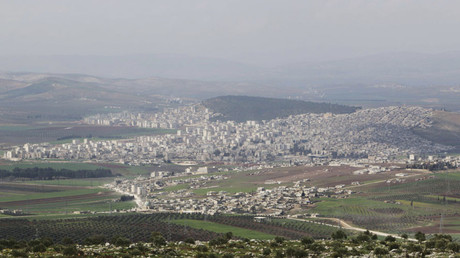
A general view shows the Kurdish city of Afrin, in Aleppo's countryside March 18, 2015. © Mahmoud Hebbo

The ceasefire in Syria, which came into force on February 27, brokered by leading world powers, including the US and Russia, is designed to pave the way to reconciliation between the Syrian government and moderate rebel forces. They would together agree on a peaceful transition in the country. Some of the forces in Syria, including IS and Al-Nusra, are not subject to the ceasefire.

Experts have been criticizing moderate rebel forces, but even they think that the situation is shifting now.

Moderate rebels used to be “a fable, a pure lie,” Syrian political analyst Taleb Ibrahim told RT.

“Everyone remembers what happened to the rebels who had been trained in Turkish camps by the CIA, and when they returned to Syria, and turned to Al-Nusra Front”.

However, the situation is starting to change slowly, as more and more Syrian rebel fighters “discover that they are destroying their country and serving external plans to divide Syria.”

Russian aircraft continue to carry out airstrikes against Al-Nusra front militants to “stabilize the situation” in the regions north of the city of Aleppo, the Russian Defense Ministry said in a statement.

READ MORE: Russia presents proof of Turkey’s role in ISIS oil trade

There have been at least 31 violations of the Syrian ceasefire over the past three days, Russian Foreign Ministry spokeswoman Maria Zakharova said on Wednesday, adding that during the same period the number of local ceasefire agreements between various factions had increased to 38.

State Department Issues New Warning About Terrorist Threat to U.S. Citizens

March 4, 2016

State Department Issues New Warning About Terrorist Threat to U.S. Citizens

BY:
March 3, 2016 5:59 pm

Source: State Department Issues New Warning About Terrorist Threat to U.S. Citizens – Washington Free Beacon

Did the state department declare now Turkey as a criminal state ?

The State Department issued a new Worldwide Caution on Thursday that warned about the ongoing terrorist threat to U.S. citizens across the world from groups like ISIS and al Qaeda.

“Current information suggests that ISIL, al-Qa’ida, Boko Haram, al-Shabaab, and other terrorist groups continue to plan terrorist attacks in multiple regions,” the State Department said in a release updating the Worldwide Caution, using another name for ISIS.

“Recent terrorist attacks, whether by those affiliated with terrorist entities, copycats, or individual perpetrators, serve as a reminder that U.S. citizens need to maintain a high level of vigilance and take appropriate steps to increase their security awareness. ”

The new alert replaced a previous alert issued in July of last year, months before ISIS launched terror attacks in Paris that killed 130 people last November. Authorities believe that ISIS continue to plot attacks against U.S. and Western interests worldwide, especially in the Middle East, North Africa, Europe, and Asia, the new alert stated.

The State Department warning cited major terrorist attacks that have been carried out in France, Belgium, Mali, Turkey, and other countries, and emphasized that U.S. citizens are at risk of kidnapping by operatives from ISIS, al Qaeda, and other groups. It noted that terrorists targeting U.S. citizens at home and abroad generally focus on places that attract crowds, including sporting events, hotels, restaurants, and public transportation systems.

“Extremists may use conventional or non-conventional weapons and target both official and private interests,” the State Department warning said. “Examples of such targets include high-profile sporting events, residential areas, business offices, hotels, clubs, restaurants, places of worship, schools, public areas, shopping malls, and other tourist destinations both in the United States and abroad where U.S. citizens gather in large numbers, including during holidays.”

The alert included information about threats in various regions, including Europe, the Middle East and North Africa, and parts of Asia. It noted that “credible information” indicated that all countries in Europe are “vulnerable” to attacks from terrorist organizations.

“Authorities believe there is a high likelihood terror attacks in Europe will continue as European members of ISIL return from Syria and Iraq. European governments are taking action to guard against terrorist attacks; however, all European countries remain potentially vulnerable,” the warning said.

The agency also reminded U.S. citizens that it is a crime to provide support to terrorist groups like ISIS.

“Private U.S. citizens are strongly discouraged from traveling to any country to join in armed conflict.  U.S. citizens are reminded that fighting on behalf of or providing other forms of support to designated terrorist organizations, including ISIL, can constitute the provision of material support for terrorism, which is a serious crime that can result in penalties including prison time and large fines,” the alert warned.

American citizens have been arrested for attempting to join or provide material support to ISIS. More than 200 Americans have tried to fight for ISIS, the head of the FBI said in 2015.

Report: Hamas fully restocked its missile arsenal

March 4, 2016

Hamas said to have fully restocked its missile arsenal Israeli assessment says terror group back at rocket total from before Operation Protective Edge, just 1.5 years later.

By Ari Yashar

First Publish: 3/4/2016, 10:24 AM

Source: Report: Hamas fully restocked its missile arsenal – Defense/Security – News – Arutz Sheva

Hamas terrorists parade rockets (file)
Flash 90

Just over a year-and-a-half has passed since Israel’s government agreed to a ceasefire with the Hamas terrorist organization in August 2014, ending Operation Protective Edge, but new Israeli assessments indicate Hamas has already fully restocked its missile arsenal.

The appraisal, reported by Walla on Friday, notes that most of the missiles that bring Hamas back to the amount it had before it launched its third terror war on the Jewish state are of a shorter-range, and are domestically produced and therefore of a lower quality.

Back in June 2014 the terror group had around 12,000 rockets of various ranges, including long-range missiles. According to reports Hamas used around 4,600 of its rockets during the Operation, and another 4,000 or so were damaged in Israeli strikes, leaving the terrorists with a third of their arsenal by the end of the fighting.

But in the 18 months that have passed, Hamas has worked intensively to rebuild its military capabilities while largely ignoring the civilian population in Gaza that continues to suffer from poor conditions, to the point that the UN has estimated Gaza will be “unlivable” by 2020.

Hamas has been rebuilding its terror tunnel system breaching into Israel, and likewise has ramped up its domestic production of rockets given that the Israeli naval blockade and Egyptian construction of a buffer zone has largely cut off the influx of weapons to the terrorists. However, Hamas is unceasing in its efforts to illegally smuggle in materials for building weapons and digging tunnels.

In addition to the many short-range missiles held by Hamas it has added many mortar shells, which were proven to be lethally effective in the last round of fighting.

Israel estimates that the number of Hamas terrorists and members of the various Hamas mechanisms in Gaza including its civilian police force stands at roughly 40,000 people. Around half of that number are members of the terror group’s Al-Qassam Brigades, with around 1,000 of them working on the tunnel digging project.

Mohammed Deif remains the terror chief for Hamas, after having survived a sixth assassination attempt by Israel against him during Protective Edge, and is playing a key role in rebuilding the terror group’s capabilities. Deif is supported by Yahya Sanwar, who serves as a sort of “defense minister” for him – Sanwar sat in an Israeli jail for 22 years before being released in the 2011 Shalit deal.

Deif, who is missing his legs from previous assassination attempts, had his wife and son killed in the strike that missed him during the Operation.

According to a report as Protective Edge wound down, Israel delayed striking Deif three full days when it had concrete information on his whereabouts due to a ceasefire agreement, thereby missing the chance to take out the elusive terrorist – even though Hamas had breached numerous ceasefires during the war.

Amos Yadlin, formerly the head of Military Intelligence, revealed in August 2014 that in the last attempt on Deif’s life in 2006, “instead of a one ton bomb, we decided to shoot two quarter ton bombs in order to avoid hitting innocent civilians. One of them didn’t explode, and Deif survived.”

Why is Israel sitting around waiting for the next war with Hamas?

March 4, 2016

Why is Israel sitting around waiting for the next war with Hamas? The terror group’s cross-border tunnels represent a grave threat to Gaza-adjacent communities, but for now Israel’s military planners prefer uneasy quiet to war

By Judah Ari Gross March 4, 2016, 10:14 am

Source: Why is Israel sitting around waiting for the next war with Hamas? | The Times of Israel

srael’s Defense Ministry and its army recognize that Hamas in Gaza is gearing up for a fight. Since the end of the 2014 conflict, the terror group has been digging tunnels, improving rockets, amassing weapons, training fighters — and yet Israel’s military has been largely quiet.

Last Tuesday, the head of Military Intelligence Maj.-Gen. Hertzi Halevy warned a Knesset committee that the deteriorating humanitarian crisis in the Gaza Strip could further push the coastal enclave into desperation and war with Israel.

Hamas has set up military outposts right along the border, and last week, Defense Minister Moshe Ya’alon told reporters that Hamas is building “both defensive and attack tunnels — we’re not kidding ourselves.”

The writing is not just on the wall, it is in the newspaper and the parliamentary record.

Palestinian militants from the Islamic Jihad's armed wing, the al-Quds Brigades, squat in a tunnel used for ferrying rockets and mortars back and forth in preparation for the next conflict with Israel, as they take part in military training in the south of the Gaza Strip on March 3, 2015. (AFP/Mahmud Hams)

Palestinian militants from the Islamic Jihad’s armed wing, the al-Quds Brigades, squat in a tunnel used for ferrying rockets and mortars back and forth in preparation for the next conflict with Israel, as they take part in military training in the south of the Gaza Strip on March 3, 2015. (AFP/Mahmud Hams)

“There are inevitable threats coming down the pike. And certainly [Prime Minister Benjamin] Netanyahu and Ya’alon are sure that Israel’s going to be attacked again,” Dr. Natan Sachs, a fellow at the Brookings Institution’s Center for Middle East Policy, told The Times of Israel.

So if conflict is inevitable, the question becomes: Why is Israel allowing its sworn enemy to rearm and better entrench itself for the next round? Why allow Hamas to dig tunnels, when they constitute a significant potential weapon against Israel?

Strictly from a tactical standpoint, it is always preferable to catch your opponents with their pants down. But the strategic gains of another tunnel-busting operation, Israel’s military planners believe, pale in comparison to the cost — especially because a victory for Israel in such a conflict would not completely eliminate its root cause, Hamas.

Palestinians stand near a road flooded with rainwater following heavy rains, in Khan Younis in the southern Gaza Strip on January 24, 2016. (Abed Rahim Khatib/Flash90)

Palestinians stand near a road flooded with rainwater following heavy rains, in Khan Younis in the southern Gaza Strip on January 24, 2016. (Abed Rahim Khatib/Flash90)

Moreover, that conflict would be detrimental to the people of southern Israel and the State of Israel, the very groups such a war would trying to help.

For what would be the umpteenth time, a military operation in Gaza would disrupt the daily lives and economy of southern Israel, which has scarcely recovered from 2014’s Operation Protective Edge; it would again devastate Gaza, catching the Strip’s civilians between the terrorists who use them as human shields and the IDF; it would again wreak diplomatic havoc on Israel as a country, as photographs and videos of war-torn Gaza would appear in newspapers and computer screens around the world.

Though the murmurs and rumors of a possible normalization of ties with Turkey could change the facts on the ground, most experts agree: War with Hamas is inevitable. “But the timing of it is not at all inevitable,” according to Sachs. “It could be two years, it could be very soon — within the next few months — but it could also be in four or five years.”

Escalating towards war

Hamas appears to be stuck in a state of cognitive dissonance. On the one hand it denies intentions to escalate violence, while on the other it does everything in its power to provoke the Israeli public.

“We’re not interested in war. We’re interested in tahdiya (temporary calm) and quiet,” a senior Hamas official told The Times of Israel this month.

‘There are no overt indications that Hamas is intending to start a new confrontation’

Hamas has professed its lack of interest in renewed conflict not only to Israeli news outlets but also, reportedly, to its allies.

“There have been communications from Hamas via Qatar and Turkey that they are not looking for a confrontation,” Mark Heller, a senior analyst at the Institute for National Security Studies, told the Canadian Globe and Mail newspaper in an interview earlier this month.

“There are no overt indications that Hamas is intending to start a new confrontation,” Heller said.

That matches the consensus among the country’s defense officials, including the head of IDF operations, Maj. Gen. Nitzan Alon, who told reporters earlier this month that Hamas is not yet prepared to start a conflict with Israel.

The threat is coming and the threat is real, but Hamas is not interested in war today, Alon said.

But at the same time, the terror group is actively antagonizing Jewish communities surrounding the Gaza Strip.

Palestinian militants of the Izz ad-Din al-Qassam, the armed wing of Hamas, burn a fake Israeli bus during an anti-Israel rally in the southern Gaza Strip city of Rafah on February 26, 2016. (Abed Rahim Khatib/Flash90)

Palestinian militants of the Izz ad-Din al-Qassam, the armed wing of Hamas, burn a fake Israeli bus during an anti-Israel rally in the southern Gaza Strip city of Rafah, February 26, 2016. (Abed Rahim Khatib/Flash90)

Residents claim they can actually hear Hamas digging tunnels. This is unlikely, as the soil and rocks in the area are not capable of transmitting sound well enough. More likely, the industrial and military sounds coming out of the Gaza Strip, which have been recorded within Israel, are a misinformation effort by Hamas designed to terrorize and disturb the population of southern Israel. And it is working.

“For 15 minutes we heard detonations and explosions. Afterwards there was total silence — and then calls in Arabic, that sounded like the war cries of fighters,” a resident of one of the Jewish communities outside the Gaza Strip told the Yedioth Ahronoth newspaper last week. “It is terrifying.”

Those residents, who have been living under the threat of Hamas attacks — previously in the form of Qassam rockets and now in the form of tunnels — are pushing for the government to act before a terror cell enters a Jewish community and carries out an attack.

‘Advanced capabilities’

Under the actual threat of Hamas and the panicked pressure from citizens who read reports of Hamas bragging about its tunnel infrastructure and see photographs of military outposts near the border with Israel, the government has made a variety of statements to reassure the public that it is taking the threat seriously.

Last week, Netanyahu promised local government officials that the army was “likely to find an imminent solution to the problem of tunnels from Gaza.”

Still from an August 2015 Hamas video purporting to show a Gaza tunnel dug under the Israeli border (Ynet screenshot)

Still from an August 2015 Hamas video purporting to show a Gaza tunnel dug under the Israeli border (Ynet screenshot)

Earlier this month, IDF Chief of Staff Gadi Eisenkot hinted at technological developments to detect and eliminate these tunnels, citing “advanced capabilities” and presumably referring to the rumored tunnel detection system that Israel has been developing in response to the underground threat from Gaza.

Perhaps most overtly, Maj. Gen. Yoav Mordechai intimated to Palestinian media about surreptitious efforts by Israel to destroy the tunnels.

When asked if Israel was responsible for the recent rash of tunnel collapses, Mordechai, who serves as Israel’s coordinator of government activities in the territories, responded: “God knows. I would suggest the residents of the Gaza Strip not occupy themselves with the tunnels and get away from them, especially after seeing the results in recent days.”

Eisenkot, during the same speech in which he pointed to “advanced capabilities,” also pointed to the possibility of a preemptive strike, saying the option was “being discussed in the places where it needs to be discussed.”

Hitting them first

Israel has carried out preemptive strikes in the past. By far the clearest example is Israel’s bombing runs against Egyptian planes that helped kick off the Six Day War in 1967, which crippled the Egyptian Air Force and gave Israel near total air superiority throughout the conflict. More recently, when Syria began developing a nuclear reactor, Israeli jets bombed the facility in 2007.

“Preemptive action makes sense if your adversary is getting stronger and you have a certainty — or very high likelihood — that there’s going to be a conflict,” Sachs said over the phone.

Dr. Natan Sachs (Courtesy)

Dr. Natan Sachs (Courtesy)

On the latter there seems to be widespread agreement. The former point, however, is not so clear.

“The question with Hamas is that though they are building their arsenal, are they getting substantially stronger such that a war now would be better for us than a war later?” Sachs asked.

And his answer is no.

Israel is technologically and militarily leaps and bounds beyond a Hamas at full capacity. The terror group is no pushover; another round of conflict will lead to Israeli civilian and military casualties, but regardless of any gains made by Hamas with its tunnels and weaponry, Israel’s advantage over Hamas will remain “overwhelming,” Sachs said.

In an article, “Past Lessons and Future Objectives: A Preemptive Strike on Hamas Tunnels,” Amos Yadlin, director of the Institute for National Security Studies and former head of Military Intelligence, argues in favor of a preemptive strike on Hamas’s tunnels, saying that option is second only to a technological solution to counteract the tunnels that is not yet “ripe for use.”

However, Yadlin said, that strike will only be effective if it has a “a clear strategic objective that, unlike all previous military encounters, has the potential to effect a fundamental change in the balance of power and the dynamics between the sides.”

The problem, however, is that Israel lacks that clear objective, since for Netanyahu and Ya’alon “potential losses loom far larger than potential gains,” Sachs argued.

At this point another conflict would not oust Hamas. It would just be another case of Israel pulling up weeds, knowing they will simply grow back in another few years.

And the cost for a preemptive strike would be dear. In exchange for the comparative benefits of fighting a less prepared Hamas, Israel would have to give up something precious: its quiet.

Not peace, but quiet

The current “quiet” in southern Israel is tense, strained and threatened by the possibility of terrorists infiltrating Jewish communities through underground tunnels and killing the inhabitants. But albeit flawed, the quiet is crucial, and the more of it the better.

Though they may be afraid, the residents of Jewish communities surrounding the Gaza Strip are still working in the fields along the border — producing food and making money.

A few years of respite can allow the south to rebound and rebuild. The difference between a war with Hamas in Gaza today versus one tomorrow is “huge,” Sachs said.

Children in Kiryat Malachi run toward a bomb shelter Friday. A residential building in the southern city was hit by a rocket Thursday, killing three. (photo credit: IDF Spokesperson)

Illustration. Children in the southern Israeli city of Kiryat Malachi run toward a bomb shelter during Operation Pillar of Defense in 2012. (Yuval Haker/IDF Spokesperson)

“If you have to hide every day in a bomb shelter, you can’t have a normal life or much of an economic life,” Sachs said. “Ariel Sharon, who was not a big peacenik, extolled the virtues of just some quiet.”

Sharon was specifically referring to northern Israel, which in the mid-2000s was at risk of rocket fire from Hezbollah in Lebanon, but the same logic applies to the residents of southern Israel.

“That extra amount of time of quiet would be enormous for the people in the south of Israel, and it would be enormous for Israel diplomatically,” Sachs said.

In addition, a preemptive attack or large-scale operation in the vein of 2014’s Protective Edge, 2012’s Operation Pillar of Defense or 2008-2009’s Operation Cast Lead would not actually solve anything.

Israeli army troops operating in Gaza during Operation Protective Edge (IDF Spokesperson's Unit)

Israeli army troops operating in Gaza during Operation Protective Edge (IDF Spokesperson’s Unit)

“Another round, fought by the same rules, is not recommended; it will only exact high costs from both sides while producing no positive results for Israel’s long-term security,” Yadlin wrote in his article for the think tank earlier this month.

“If you’re going to bring down Hamas, if you have a plan for what happens afterward, if you reasonably think you’d be better off, then there would be a logic for going to war. You could end this cycle of recurring conflicts, and then you wouldn’t have another 2,000 dead in two years,” Sachs said.

“But the assessment of Netanyahu and Ya’alon is that they don’t want to bring down Hamas because they don’t see a viable alternative. Therefore, biding their time and postponing the conflict, from their perspective, is the goal,” he said.

Turkey, Egypt and unintended escalation

The nature of Israel’s standoff with Hamas leaves it highly vulnerable to rapid and unwanted escalation, according to Sachs, who is currently writing a book on Israel’s grand strategy and worldview.

“There’s this unofficial tit for tat, this macabre menu of what the price for each thing is,” Sachs said.

A rocket launched from the Gaza Strip that lands in an open field, for instance, “costs” Hamas an Israeli airstrike on one of its unmanned training facilities.

Illustrative. A man holds part of a rocket that exploded and fell inside the Israeli border with the Gaza Strip on August 20, 2014. (photo credit: Edi Israel/Flash90)

Illustrative. A man holds part of a rocket that exploded and fell inside the Israeli border with the Gaza Strip on August 20, 2014. (Edi Israel/Flash90)

A more serious assault on Israel would result in a more serious response against Hamas, which can quickly escalate into all-out war.

That has been the pattern of the ongoing conflict with Hamas, and it will likely remain the modus operandi until something dramatic happens, like an overthrow of Hamas — which is something no one in the Israeli government is seriously considering, Sachs said.

But a possible game-changer in this dynamic could be in the works.

“A lot of these rumblings about changing things in Gaza — which have not been changed in 10 years — have to do with a deal with Turkey,” Sachs said.

Turkish President Recep Tayyip Erdogan addresses a joint press conference with Yemen's president at the presidential complex in Ankara on February 16, 2016. (AFP / ADEM ALTAN)

Turkish President Recep Tayyip Erdogan addresses a joint press conference with Yemen’s president at the presidential complex in Ankara on February 16, 2016. (AFP / ADEM ALTAN)

The ongoing talks with the Turks, who hold some sway over Hamas, and the potential for an export-only seaport for Gaza, which would grant the coastal enclave some economic relief, could alter the nature of the conflict and may be closer than expected.

Ankara and Jerusalem may release a joint statement “in the coming days,” the Turkish Hurriyet Daily News quotes the country’s Foreign Minister, Mevlut Cavusoglu, as saying.

Israel has been largely quiet on the negotiations with Turkey, save for Defense Minister Ya’alon who has displayed a healthy amount of skepticism at the prospect and expressed a generous dose of criticism toward Turkish President Recep Tayyip Erdogan.

“I am not sure that it will be possible to reach an arrangement of relations with Turkey. Perhaps we’ll succeed, but they will have to address our conditions in order to overcome existing obstacles,” Moshe Ya’alon told a press conference in Bern, Switzerland, earlier this month during an official visit.

“Turkey is hosting in Istanbul the terror command post of Hamas abroad. We cannot accept this,” he said, as an example.

Turkey's President Recep Tayyip Erdogan, right, shakes hands with Hamas leader Khaled Mashal, left, prior to their meeting at the Presidential palace in Ankara, Turkey, August 12, 2015 (AP/Press Presidency Press Service)

Turkey’s President Recep Tayyip Erdogan, right, shakes hands with Hamas leader Khaled Mashal, left, prior to their meeting at the presidential palace in Ankara, Turkey, August 12, 2015 (AP/Press Presidency Press Service)

And Ya’alon is not alone in his criticism and general wariness of an agreement with Turkey. Both Russia and Egypt, two crucial allies for Israel, have expressed concerns over the move.

“It is going to annoy the Egyptians tremendously. They have already signaled that they don’t like this because Egypt has very strained relations with Turkey and Hamas, and the Muslim Brotherhood,” Sachs said.

Normalized ties would also mean “giving Turkey a role in Gaza, even an unofficial role in Gaza, which might tie Israel’s hands if and when Hamas violates agreements,” Sachs said.

But there are benefits to normalizing ties with Turkey. Clout with the NATO member-state can help Israel diplomatically around the world and strategically in Syria. Ankara could also become a buyer for Israel’s natural gas fields as they come online, an issue that is of the utmost importance to Netanyahu, Sachs said.

But until some long-term resolution for Gaza can be found, the best Israel can hope for is just some more time until the next conflict.

“Palestinian” Broadcasting Company Being Sued for War Crimes, Incitement to Murder Jews

March 4, 2016

Palestinian” Broadcasting Company Being Sued for War Crimes, Incitement to Murder Jews

By Pamela Geller on March 3, 2016

Source: “Palestinian” Broadcasting Company Being Sued for War Crimes, Incitement to Murder Jews | Pamela Geller

An Israel-based international lawfare group is filing a class-action suit against the heads of the Palestinian Broadcasting Corporation for inciting viewers to murder Jews.

Shurat HaDin-The Israel Law Center intends to sue Riyad al-Hassan and Ahmed Assaf for war crimes at the International Criminal Court at the Hague, after collecting thousands of signatures from plaintiffs, according to a video on its website and Facebook page.

STOP PALESTINIANS INCITEMENT TO MURDER, Shurat Hadin, March 2, 2016:

Shurat HaDin is going on the offense against those inciting to murder Jews. The extremist broadcasts on Palestinian Television have broken records in recent months. In the present wave of terror, many terrorists have been spurred into action after seeing provocative programs that call explicitly to kill Israelis.

Shurat HaDin has initiated a worldwide campaign to prosecute the heads of Palestinian Television for incitement. There is precedent for a complaint such as this: The Rwanda War Crimes Tribunal ruled that incitement to murder and genocide is a war crime. Our goal is to recruit thousands of individuals from around the world to join in complaint against the heads of the Palestinian Broadcasting Corporation. We are preparing to submit the complaint in the International Criminal Court in the Hague.

To join the complaint and demand the prosecution of the heads of Palestinian Television for war crimes go HERE.

<Stop Palestinian Television’s Incitement to Murder! 

Join thousands of others and demand the prosection of Palestinian broadcasters for war crimes in the Hague.


Again, PA warns it’ll end security coordination

March 4, 2016

Again, PA warns it’ll end security coordination For the umpteenth time, Ramallah threatens to end its security coordination with Israel. This time, ‘officially.’

By Gil Ronen First Publish: 3/3/2016, 10:07 PM

Source: Again, PA warns it’ll end security coordination – Defense/Security – News – Arutz Sheva

A delegation from the Palestinian Authority (PA) “officially warned Israeli authorities” several days ago that the Palestinian government would end its security coordination with Israel if the state did not “commit to past agreements,” a member of the PLO executive committee told the Bethlehem-based Ma’an news agency Thursday.

Wassel Abu Youssef said the head of PA Intelligence, Majed Faraj, as well as the Palestinian Minister of Civil Affairs, Hussein al-Sheikh, and the head of PA preventive security, Ziyad Hab al-Reeh, met with an Israeli security delegation to deliver the warning.

The PA delegation informed their Israeli counterparts that the PLO Central Council came to an official decision to work towards ending security coordination with Israel if the “current situation” were to continue, Abu Youssef said.

Abu Youssef reportedly added that the PA leadership does not fear the consequences of ending security coordination, as Israel is already “carrying out an open war against Palestinians.”

He added that the decision to end security coordination has the support of other Arab countries.

Abu Youssef told Ma’an that the PA leadership expects that Israeli authorities will try to pressure the PA to reconsider its stance.

PA chairman Mahmoud Abbas threatened to end security coordination in a speech at the United Nations General Assembly on October 30, and similar threats have been issued countless times by PA officials.

The unwritten agreement between Israel and the PA appears to allow the PA to carry out rampant murderous incitement against Israel, as long as it cooperates with Israel on other levels. As a result of the PA’s incitement, Arabs have been waging a cruel campaign of shootings and stabbings, which are all supposedly carried out by “lone wolves” or groups of two or three terrorists, without a central command.

According to the Ministry of Foreign Affairs, from September 13, 2015 to February 26, 2016 (last Friday), 33 people were murdered, and 359 people were injured by Palestinian terrorists. The attacks included 192 stabbings, 75 shootings and 39 vehicular attacks.

There have been additional attacks since last Friday, including an infiltration into the community of Eli Wednesday.

Another Tunnel Collapse in Gaza, 1 Dead, 1 Missing Following IDF Action [video]

March 4, 2016

The Jewish Press » » Another Tunnel Collapse in Gaza, 1 Dead, 1 Missing Following

By: David Israel Published: March 3rd, 2016

Source: The Jewish Press » » Another Tunnel Collapse in Gaza, 1 Dead, 1 Missing Following IDF Action

IDF tunnel detection and demolition machines
Photo Credit: Screenshot

The Hamas underground construction business continues to suffer blows as yet another tunnel, this one in Khan Yunis, has collapsed Thursday afternoon, News 0404 reported. One terrorist was killed and at least one is missing, possibly under the rubble. Khan Yunis, in the southern part of the Gaza Strip, is about an equal distance from either the Egyptian border to the south or Israel to the east.

Two Hamas terrorists were killed in an earlier tunnel collapse in the southern Gaza Strip on Tuesday night.

One week earlier, seven Hamas terrorists succumbed to a tunnel collapse in northern Gaza.

According to Ma’an, Israeli forces crossed the Gaza border east of Khan Younis on Wednesday morning, advancing 300 feet into the Strip where their bulldozers leveled land. Locals said the soldiers were destroying tunnels.

Hamas has been voicing its suspicions recently that its tunnels aren’t collapsing all by themselves and that Israel or Egypt or both are helping it along. So far this season Hamas has reported the collapse of 11 different tunnels.

Deputy Hamas leader Ismail Haniyeh last month said the terror organization has launched an investigation to discover why so many tunnels have been collapsing, burying so many Hamas martyrs. Haniyeh claimed the military arm of Hamas, the Izz al-Din al-Qassam Brigades, discovered underground cameras and sensors intended to expose the tunnels project and the Hamas activities therein.

Has Israel finally discovered a cure for the tunnels? It’s either that or the Hamas quality control dept. is sleeping on the job.

Hamas claims to have rebuilt many of the tunnels that were destroyed in its 2014 devastating provocation of Israel. Last week, Israel threatened to seal the border crossings to the Gaza Strip as punishment to the terror organization’s obsession with tunnel digging.

In February, Faris Atilla, Israel’s liaison coordinator for Gaza, said in a statement that “Israel knows Hamas and some contractors and dealers use the construction materials for other purposes,” suggesting they were being stolen and used for terror tunnel building.

IDF machinery inside the Gaza Strip during search for terrorist tunnels, February, 2016 (ForISRAEL2014).

SPECIAL REPORT : Ezra Levant (The Rebel Media) in Europa

March 3, 2016

SPECIAL REPORT: Does Ezra’s fact-finding trip to Europe reveal Canada’s future?

Published on Feb 29, 2016

Ezra Levant spent the week on assignment in Europe for TheRebel.media. In his first show back in Canada, Ezra gives an overview of what he saw –Is it a glimpse at Canada’s Islamified future? MORE: http://www.therebel.media/ezra_s_euro…

Special report: Inside Muslim majority neighborhoods of Malmo, Sweden

Published on Mar 1, 2016

Ezra Levant of TheRebel.media continues his series on the effects of Muslim mass migration on Europe, this time with interviews with Muslim men in Malmo, Sweden. However, the conversation that troubled him most was one with a non-Muslim, native Swedish woman. MORE:

What happens when Muslims in Cologne are asked about New Year’s rape riot?

Published on Mar 2, 2016

Ezra Levant continues his fact-finding mission in Europe by visiting Cologne, Germany, including the city’s Muslim majority neighborhood. MORE: http://www.therebel.media/special_rep…

(H/T Vederso )

‘Sunshine of the spotless mind’: Russia rebuts NATO accusation of it ‘weaponizing’ migrant crisis

March 3, 2016

Sunshine of the spotless mind’: Russia rebuts NATO accusation of it ‘weaponizing’ migrant crisis

Published time: 3 Mar, 2016 03:57

Source: ‘Sunshine of the spotless mind’: Russia rebuts NATO accusation of it ‘weaponizing’ migrant crisis — RT News

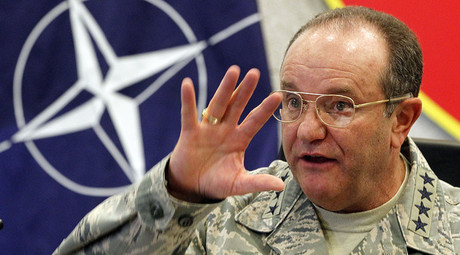
U.S. Air Force Gen. Philip Breedlove, commander of the U.S. European Command and Supreme Allied Commander for Europe © Jonathan Ernst
Moscow was amused by the top NATO General’s claims that it is using the refugee crisis as a “weapon” against the West, with the Defense Ministry’s spokesman saying such rhetoric reaffirms concerns of Breedlove’s apparent dislocation of memory.

In front of the Senate Armed Services Committee this week, top NATO General Philip Breedlove accused Moscow of siding with the Syrian President and deliberately fueling the displacement of Syrians.

“Together, Russia and the Assad regime are deliberately weaponizing migration in an attempt to overwhelm European structures and break European resolve,” Breedlove told the committee.

Read more

U.S. General Philip Breedlove. © Ciro De Luca

Insisting that the influx of migrants to Europe benefited Moscow, Breedlove noted that foreign militants who have been fighting in Syria are now returning back home, where they might use their battlefield skills.

Breedlove added that the alleged strategy was used by both Russian and Syrian presidents to create a distraction for the western countries that have been busy tackling the crisis and did not notice its root cause: “Indiscriminate weapons used by both Bashar al-Assad, and the non-precision use of weapons by the Russian forces.”

Russian Ministry of Defense spokesman Igor Konashenkov called the latest allegations a “recurrence” of the NATO general’s traditional rhetoric which only reaffirms concerns about Breedlove’s “memory dislocation.”

“Taking into account that such recurrence of the ‘sunshine of the spotless mind’ appeared right before the scheduled meeting of the Armed Services Committee, there is no wonder that a decision has been made by the US congressmen to replace him on his post of the Commander-in-Chief of the NATO Joint Force in Europe,” Konashenkov said.

Konashenkov once again pointed out that Moscow could not have possibly been the reason for the refugee crisis, which began long before Russia launched its anti-terror operations in Syria. And unlike the anti-ISIS coalition, Russia’s operations in Syria have alleviated the refugee crisis in the country and led to the first step of the establishment of a peace-making process, Konashenkov added.

“Essential is the fact that as a results of the Russian operation, the UN is registering the reduction of refugee flows from Syria and a process of reconciliation has been initiated, which is something the Western so-called “anti-ISIS coalition” has been unable to achieve over the previous three years of their “fight” against terrorism,” Konashenkov stated.

Responding to the “indiscriminate” and “non-precision” bombing claims, Konashenkov reminded the NATO general that precision of airstrike depends not only on smart weapons, but also on proper intelligence, pilot’s skills and aiming systems of the aircraft.

“Sole reliance on ‘supersmart’ or ‘superprecision’ weapons leads American hawks to tragic mistakes with fatal consequences, as it was repeatedly observed in Afghanistan, Iraq, and since recently – in Syria,” Konashenkov said.

WATCH: Hamas Emulates Islamic State Executions of Israelis in New Propaganda Videos

March 2, 2016

WATCH: Hamas Emulates Islamic State Executions in New Propaganda Videos

by Deborah Danan

1 Mar 2016

Source: WATCH: Hamas Emulates Islamic State Executions of Israelis in New Propaganda Videos

TEL AVIV – A new propaganda video showing terrorists simulating Islamic State-style executions of Israeli soldiers is one of the latest in a series of Hamas-produced videos showcasing terrorist skills and demonstrations.

The clip shows three masked Hamas terrorists in camouflage carrying out synchronized throat-slittings of three IDF soldiers in front of a cheering crowd.

MEMRI gathered a series of clips shown on Gaza TV, including “how-to” clips for would-be terrorists to carry out suicide bombings, beheadings, and stabbings.

One of the clips shows a rally in the Gaza town of Rafah in which the murder of Eitam and Dalia Henkin is reenacted. The narrator hails the terrorists responsible for the murder as “heroes” and heaps further praise on them for executing the couple in front of their young children, while leaving the children themselves unharmed.

Israeli investigators said the terrorists would likely have continued their massacre had the parents not put up a struggle, which caused one of the gunmen to accidentally shoot his accomplice in the hand, prompting both attackers to flee the scene, Arutz 7 reported.

In another scene, actors dressed as Israeli civilians and soldiers board a bus, followed by a suicide bomber. The bus then explodes, apparently killing all those on board.

Hamas recently aired a music video encouraging terrorists to resume suicide bombings in Israeli cities. The video featured Jewish flesh being “roasted” and the smoking remains of a bombed Egged bus.