Posted tagged ‘Terrorism’

Turkey warplanes hit Kurdish PKK camps in northern Iraq

March 14, 2016

Turkey warplanes hit Kurdish PKK camps in northern Iraq – Turkish army

Published time: 14 Mar, 2016 08:16 Edited time: 14 Mar, 2016 09:27

Source: Turkey warplanes hit Kurdish PKK camps in northern Iraq – Turkish army — RT News

© Murad Sezer
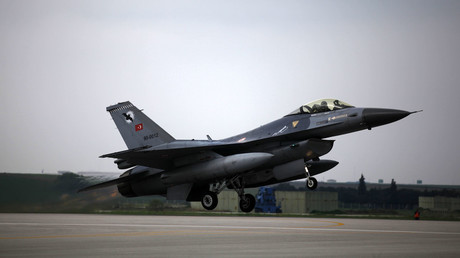
Turkish warplanes bombed camps belonging to the Kurdistan Workers’ Party (PKK) in the north of Iraq early on Monday, Turkey’s army has confirmed. The strikes come less than 24 hours after a car bomb in Ankara killed at least 37 people.

A total of 11 fighter jets were involved in the bombardment of the PKK positions. Eighteen targets were hit, including ammunition depots and shelters, the Turkish military said in a statement, as cited by Reuters.

Turkey believes the PKK is a terrorist organization and Ankara has blamed the Kurdish separatist group for a number of recent terrorist attacks in the country, including Sunday’s car bomb at a transport hub in the Turkish capital, which killed at least 37 people and injured dozens more.

Turkish security officials claimed on Monday that a woman who joined the PKK in 2013 was one of the two suspects behind the car bombing in Ankara, according to Reuters. They said that the woman was born in 1992 and was from the eastern Turkish city of Kars.

Read more

Turkish F-16 fighter jets. © Fatih Saribas

Speaking after the attack, Turkish President Recep Tayyip Erdogan said he would bring terrorism “to its knees,” and that the Turkish state would “never give up using its right of self-defense.”

“All of our security forces, with its soldiers, police and village guards, have been conducting a determined struggle against terror organizations at the cost of their lives,” Erdogan said in a written statement, as cited by the Hurriyet Daily News. “These attacks, which threaten our country’s integrity and our nation’s unity and solidarity, do not weaken our resolve in fighting terrorism but bolster our determination,” he added.

The Turkish Air Force bombed at least five PKK targets in Iraq on March 9, with Ankara claiming 67 militants were killed.

On December 9, 10 Turkish F-16 fighter jets targeted Kurdish positions in northern Iraq, with the Turkish military saying that its targets were “destroyed in an aerial campaign.

These strikes came days after Turkey had deployed about 150 troops and 25 tanks to a base in Iraq’s Nineveh province, without bothering to get permission from Baghdad. Ankara argued that its soldiers were sent to northern Iraq after a threat from Islamic State (IS, formerly ISIS/ISIL) to Turkish military instructors training anti-terrorist forces in the area.

Erdogan had rejected a request from Baghdad to withdraw the troops, claiming that the Turkish military is present in Iraq “as instructors.”

A two-year truce to a decades-long conflict between Ankara and the Kurds was shattered in July. Turkey has launched a security crackdown in the predominantly Kurdish south east of Turkey, while also striking Kurdish positions in Iraq and Syria.

On Monday, Turkey announced it would implement a new 24-hour curfew in the south-eastern town of Sirnak to try and carry out operations against Kurdish militants.

Speaking to RT, Ertugrul Kurkcu, Honorary President of the Peoples’ Democratic Party (HDP), said that Ankara’s crackdown was failing to distinguish between the militants and the general civilian population who support Kurdish rights.

“This is a crackdown not on the PKK, but on the civilian population and Kurds who have been supporting our party, who have been supporting Kurds’ rights,” he said.

“And they were targeted during this crackdown. The government’s figures are incorrect… According to our figures, until this day, 652 civilians have lost their lives during the curfew in the cities of Cizre, Silopi, Sirnak and Nusaybin. And of these, 97 are children and 94 are women.”

US embassy issued warning on impending attack in Ankara 2 days before Sunday blast

March 14, 2016

US embassy issued warning on impending attack in Ankara 2 days before Sunday blast

Published time: 14 Mar, 2016 09:09 Edited time: 14 Mar, 2016 09:26

Source: US embassy issued warning on impending attack in Ankara 2 days before Sunday blast — RT News

Emergency workers work at the explosion site in Ankara, Turkey March 13, 2016 © Stringer
The US embassy in Turkey issued a security warning to American citizens two days before a blast caused by a suicide car bomb hit the center of Ankara on Sunday evening. At least 37 people were killed and 125 injured in the explosion.

The American embassy had warned on its website about a “potential plot to attack Turkish government buildings and housing in the Bahcelievler neighborhood,” in Çankaya District, where the Turkish National Library is located among other landmarks. “US citizens should avoid this area,” the embassy stated.

“We advise US citizens to review their personal security plans, remain aware of your surroundings and local events, monitor local news stations for updates, and follow local authority instructions,” it added on Friday.

The Sunday blast, the second attack in the administrative heart of the city in under a month, occurred near Guven Park and Kizilay Square, several kilometers from Bahcelievler. The site of the explosion is close to the Justice and Interior Ministries, a top courthouse, and the former office of the country’s prime minister. The blast, which could be heard several kilometres away, appears to have been triggered by a car exploding near a bus stop, Turkish broadcaster TRT reported, adding that the site is a major transportation hub.

“It’s a car bomb, [it happened] in the heart of Ankara… and today is Sunday, many people may be outside,” Turkish journalist Onur Burcak Belli told RT by phone, adding that the scene of the blast is “very close to a shopping mall.”

While no one has claimed responsibility for the attack, two senior security officials told Reuters that the initial findings suggested that members of the outlawed Kurdistan Workers’ Party (PKK) or an affiliated group were responsible. The PKK has been waging an armed struggle for Kurdish autonomy since 1984.

On Friday, Turkish Interior Minister Efkan Ala said that new military operations against PKK members could be expected in several mostly Kurdish-populated towns in the east of the country. The Turkish military operation against PKK militants in the southeast was launched in July 2015, breaking a ceasefire agreement that had held for two years. The Turkish crackdown against the Kurds has been criticized by human rights groups. Amnesty International reported in January that at least 150 civilians, women and children among them, have been killed in the Turkish military operation, saying that some 200,000 people had been put at risk and were being denied access to services due to strict curfews.

READ MORE: Turkey keeps shelling Kurds, backing terrorist groups in Syria – Russian MoD

In February, 28 people were killed and 61 injured in a blast in Ankara, when a car bomb, reportedly targeting military personnel, went off close to the parliament building. Turkish Prime Minister Ahmet Davutoglu immediately blamed a Syrian Kurdish militia fighter for the attack, which further proved that the YPG was a terrorist organization, the PM said. “Yesterday’s attack was directly targeting Turkey and the perpetrator is the YPG and the divisive terrorist organization the PKK. All necessary measures will be taken against them,” Davutoglu said in a televised speech. Within hours, Turkish warplanes bombed PKK bases in northern Iraq, and shelled YPG positions in northern Syria, a security source told Reuters.

Tanks for nothing! US-backed Syrian rebel division attacked & looted by Al-Qaeda affiliate

March 14, 2016

Tanks for nothing! US-backed Syrian rebel division attacked & looted by Al-Qaeda affiliate

Published time: 14 Mar, 2016 05:52

Source: Tanks for nothing! US-backed Syrian rebel division attacked & looted by Al-Qaeda affiliate — RT News

An Islamist Syrian rebel group Jabhat al-Nusra fighter © Hamid Khatib


In what could be one of the worst failures of the Pentagon’s program to arm Syrian rebels, several bases with American weapons, armored vehicles and US-trained fighters were captured by Al-Nusra Front. The jihadists and “moderate rebels” are blaming each other for the attack.

READ MORE: ‘Truce hasn’t changed anything, terrorists intensified attacks’ – Aleppo residents to RT

Division 13 of the Free Syrian Army (FSA), which had received both US weapons and training, on Sunday said it was attacked by Al-Nusra Front militants – radical Islamist fighters affiliated with Al-Qaeda. The jihadists looted the FSA group’s depots in the town of Maarrat Al-Nuuman in Syria’s Idlib province.

Read more

Though it has widely been reported that weapons and dozens of Division 13 fighters have been captured, there are conflicting accounts of how much the jihadists could actually carry. Some media reports claimed that the haul included US-supplied TOW anti-tank missiles, firearms and ammunition, and unspecified armored vehicles, including a tank. The rebel group’s chief has denied they have lost anti-tank missiles, telling AFP that only “light weapons” have been taken.

Moreover, up to 40 Division 13 fighters have been taken hostage and four killed, the Syrian Observatory for Human Rights has said, though the remote “sources on the ground” routinely cited by the UK-based organization are often hard to verify.

Adding to the rebel group’s dismay, Al-Nusra was also the first to release an online statement – blaming Division 13 for provoking the attack. In turn, the rebels denied attacking Al-Nusra and accused them of an unexpected armed assault on a checkpoint, set up at the request of the local population.

The reason reportedly given by the US-backed group as to why they couldn’t have attacked the Islamists? Too weak for the job.

The feud between the militant factions, once close allies in fighting Syrian President Bashar Assad’s forces, has been brewing for some time, according to AP. Al-Nusra has recently suppressed demonstrations and arrested protesters in the city of Idlib, and reportedly replaced the tricolor of the Syrian rebels with the black Al-Qaeda flag there.

On Friday, in Maaret al-Numan, motorcyclists waving the black flag of Al-Nusra threatened to fire on a protest, shouting “Allahu akbar” or “God is greatest.”

Read more

Members of Al-Qaeda-affiliated Nusra Front. © Ammar Abdullah

Interestingly, Al-Nusra has a history of looting US-backed opposition forces: last summer, jihadists kidnapped members of the US-trained Division 30, while in September a whole stock of US-supplied weapons and hardware was captured.

The Pentagon’s failed rebel-training program was canceled in October, after dozens of US-trained rebels abandoned Division 30 and handed the weapons they had been supplied to Al-Nusra upon crossing from Turkey into Syria.

However, the head of US Central Command, General Lloyd Austin, proposed to restart training for Syria’s so-called “moderate” rebels.

A month later, the US State Department admitted that some of the “moderates” had been successfully recruited by Al-Nusra in Syria.

READ MORE: ‘US created monster of al-Qaeda, yet believes Iran supported 9/11 terrorists’ (OP-ED)

Islamic Jihad calls for mass murder of Jews

March 13, 2016

Islamic Jihad calls for mass murder of Jews ‘inside their towns’ Islamic Jihad chief Ahmed al-Modallal leads mass demonstration, calls for more terrorist infiltrations.

By Dalit Halevi

First Publish: 3/13/2016, 12:22 PM

Source: Islamic Jihad calls for mass murder of Jews – Defense/Security – News – Arutz Sheva

Islamic Jihad terrorists during Gaza “victory” parade
Flash 90

A senior Islamic Jihad official called upon followers to carry out mass murder of Jews “inside their settlements”, during a mass demonstration the group held on Friday.

The Islamic terror group, which killed hundreds of Israelis in suicide bombings and shooting attacks across the country, is now pushing for a new wave of attacks.

Ahmed al-Modallal spoke at the rally, rejected condemnations by the United States and European Union, saying that “The Americans and Europeans won’t stop this intifada, which will continue to strike at the heart of the occupation”.

Al-Modallal called upon the Islamic faithful in Jerusalem and Judea and Samaria to organize mass attacks “in the heart of [Israeli] settlements”.

“We call on our people in Jerusalem and Judea and Samaria to send out groups to block the Occupation’s roads and settlers, and to strike at the settlements with thousands [of terrorists]; let the arms of the Mujahedeen strike at the heart of the settlers, so that these criminals will know they will never be safe on Palestinian land.”

In the past few weeks terrorists have attempted on numerous occasions to target Jewish families in their homes in the Samaria region, marking a relatively new tactic in the ongoing wave of terrorism.

In one case, a father fought off two terrorists who attempted to slaughter his wife and children inside his home in the town of Eli. Other infiltrations have been thwarted in Yitzhar and Kedumim.

Breaking news : Al Qaeda gunmen kill 16 in Ivory Coast beach attack

March 13, 2016

Al Qaeda gunmen kill 16 in Ivory Coast beach attack GRAND BASSAM, Ivory Coast

By Ange Aboa and Joe Penney

Sun Mar 13, 2016 3:55pm EDT

Source: Al Qaeda gunmen kill 16 in Ivory Coast beach attack | Reuters

Soldiers stand guard in front of the Etoile du Sud hotel in Bassam, Ivory Coast, March 13, 2016.
Reuters/Luc Gnago

Gunmen from the North African branch of Al Qaeda killed 16 people, including four Europeans, at a beach resort town in Ivory Coast on Sunday, the latest in a string of deadly attacks across West Africa.

Six shooters targeted hotels on a beach at Grand Bassam, a weekend retreat popular with westerners about 40 km (25 miles) east of the commercial capital Abidjan, before being killed in clashes with Ivorian special forces.

“Six attackers came onto the beach in Bassam this afternoon,” said Ivorian President Alassane Ouattara during a visit to the site. “We have 14 civilians and two special forces soldiers who were unfortunately killed.”

A French man was killed in the attack, according to a French foreign ministry spokesman. The nationalities of the other dead was not yet known, but four were European, one officer said during a briefing attended by a Reuters reporter.

The reporter saw the bodies of three white people at Grand Bassam’s Chelsea Hotel and another in the Hotel Etoile du Sud next door.

A U.S. State Department spokesperson, who declined to be further identified, said the department was not aware of any U.S. citizen being injured or killed in the attack “at this time.”

Al Qaeda in the Islamic Maghreb (AQIM), which has carried out other recent attacks in the region, claimed responsibility for Sunday’s shootings, according to the U.S.-based SITE intelligence monitoring group, citing an AQIM statement.


Gunmen all dressed in black opened fire around lunchtime while people were eating and drinking at the beachside bars and restaurants or swimming in the ocean.

“I saw seven dead that I filmed. There were four attackers,” said Dramane Kima, who showed the video of the bodies to Reuters.

He also took pictures of grenades and ammunition clips that he believed had been left behind by the attackers.

Security forces moved to evacuate the area surrounding the beach. Bullet holes riddled vehicles nearby and some windows had been shot out.

“They started shooting and everyone just started running. There were women and children running and hiding,” said another witness, Marie Bassole. “It started on the beach. Whoever they saw, they shot at.”

GROWING THREAT

Barely two months ago, Islamist fighters killed dozens of people in a hotel and cafe frequented by foreigners in neighboring Burkina Faso’s capital, Ouagadougou. Gunmen also attacked a hotel in the Malian capital Bamako late last year.

Both of those attacks were claimed by AQIM, raising concern that Islamist militants were extending their reach beyond their traditional zones of operation in the Sahara and arid Sahel region.

Though previously untouched by Islamist violence, Ivory Coast, French-speaking West Africa’s largest economy and the world’s top cocoa producer, has long been considered a target for militants. It has been on high alert since the Ouagadougou attacks.

French President Francois Hollande on Sunday pledged support, denouncing Sunday’s shootings as a “cowardly attack”.

“France will bring its logistical support and intelligence to Ivory Coast to find the attackers. It will pursue and intensify its cooperation with its partners in the fight against terrorism,” Hollande said in a statement.

(Additional reporting by Joe Bavier, Writing by Edward McAllister, Editing by Ruth Pitchford)


More here :

VIDEO: Jihadis SHOOT Westerners at Popular Ivory Coast Beach Resorts Shout ALLAHU AKBAR, Women, Children SHOT DEAD

ByPamela Gelleron March 13, 2016
Video :


Islamic State Closing in on Germany

March 13, 2016

Islamic State Closing in on Germany Stabbing Is First ISIS-Inspired Attack on German Soil

by Soeren Kern March 13, 2016 at 5:00 am

Source: Islamic State Closing in on Germany

  • Hans-Georg Maaßen, the head of Germany’s domestic intelligence agency (BfV), warned that the Islamic State was deliberately planting jihadists among the refugees flowing into Europe, and reported that the number of Salafists in Germany has now risen to 7,900. This is up from 7,000 in 2014 and 5,500 in 2013.
  • “Salafists want to establish an Islamic state in Germany.” — Hans-Georg Maaßen, director, BfV, German intelligence.
  • More than 800 German residents — 60% of whom are German passport holders — have joined the Islamic State in Syria and Iraq. Of these, roughly one-third have returned to Germany. — Federal Criminal Police Office.
  • Up to 5,000 European jihadists have returned to the continent after obtaining combat experience on the battlefields of the Middle East. — Rob Wainwright, head of Europol.

A 15-year-old German girl of Moroccan descent stabbed and seriously wounded a police officer in Hanover. The stabbing appears to be the first lone-wolf terrorist attack in Germany inspired by the Islamic State.

The incident occurred at the main train station in Hanover on the afternoon of February 26, when two police officers noticed that the girl — identified only as Safia S. — was observing and following them.

The officers approached the girl, who was wearing an Islamic headscarf, and asked her to present her identification papers. After handing over her ID, she stabbed one of the officers in the neck with a six-centimeter kitchen knife.

According to police, the attack happened so quickly that the 34-year-old officer, who was rushed to the hospital, was unable to defend himself. After her arrest, police found that Safia was also carrying a second, larger knife.

“The perpetrator did not display any emotion,” a police spokesperson said. “Her only concern was for her headscarf. She was concerned that her headscarf be put back on properly after she was arrested. Whether the police officer survived, she did not care.”

On March 3, Hanover Public Prosecutor Thomas Klinge revealed that Safia had travelled to the Turkish-Syrian border in November 2015 to join the Islamic State, but that her mother had persuaded her to return to Germany on January 28.

Last month, Safia S., a 15-year-old German girl of Moroccan descent, stabbed and seriously wounded a police officer in Hanover, in what appears to be the first lone-wolf terrorist attack in Germany inspired by the Islamic State.

According to police, the stabbing was premeditated: unable to join the Islamic State in Syria, Safia had determined to carry out an attack against the police in Germany.

Safia is being charged with attempted murder. She is also being charged with a terrorism offense. According to prosecutors, by travelling to Turkey to join the Islamic State, the girl violated Section 89a of the German Criminal Code, “Preparation of a serious violent offense endangering the state.”

The newspaper, Die Welt, reported that Safia had been part of the local Salafist scene since 2008 — she was only seven years old at the time. She had appeared in Islamist propaganda videos alongside Pierre Vogel, a convert to Islam and one of the best-known Salafist preachers in Germany. In those videos, Vogel praised Safia for wearing a headscarf to school and for being able to recite verses from the Koran.

Safia’s brother, Saleh, is reportedly being held in a jail in Turkey, where he was arrested for trying to join the Islamic State.

Until now, the only other successful Islamist attack in Germany took place at Frankfurt Airport in March 2011, when Arid Uka, an ethnic Albanian from Kosovo, shot and killed two United States airmen and seriously wounded two others. Uka was later sentenced to life in prison.

On February 4, 2016, German police arrested four members of an ISIS cell allegedly planning jihadist attacks in Berlin. In coordinated raids, more than 450 police searched homes and businesses linked to the cell in Berlin, Lower Saxony and North Rhine-Westphalia.

The ringleader — a 35-year-old Algerian who was staying at a refugee shelter with his wife and two children in Attendorn — arrived in Germany in the fall of 2015. Posing as an asylum seeker from Syria, the Algerian, identified only as Farid A., is said to have received military training with the Islamic State in Syria.

Also arrested were: a 49-year-old Algerian living in Berlin under a fake French identity; a 30-year-old Algerian living in Berlin with a valid residence permit; and a 26-year-old Algerian, allegedly with ties to Islamists in Belgium, who is living in a refugee shelter in Hanover.

The men allegedly were planning to attack Checkpoint Charlie, the iconic Cold War crossing point between East and West Berlin. They also allegedly were planning to attack the Alexanderplatz, a large public square and transportation hub in the center of Berlin.

On February 8, German police arrested an alleged ISIS commander who was living at a refugee shelter in the small town of Sankt Johann. The 32-year-old jihadist, known only as Bassam and posing as a Syrian asylum seeker, had entered Germany in the fall of 2015. German intelligence authorities were unaware of the man’s true identity until the German newsmagazine, Der Spiegel, interviewed him after receiving a tip from other Syrians at the shelter. Bassam said the accusations against him are false: “I want to learn German and work as a cook,” he said.

In a February 5 interview with ZDF television, Hans-Georg Maaßen, the head of Germany’s domestic intelligence agency (Bundesamt für Verfassungsschutz, BfV), warned that the Islamic State was deliberately planting jihadists among the refugees flowing into Europe. “The terror risk is very high,” he said.

On February 4, the Berliner Zeitung quoted Maaßen as saying that the BfV had received more than 100 warnings that there were Islamic State fighters among the refugees currently living in Germany. Some of the jihadists are known to have entered Germany using fake or stolen passports.

Maaßen also revealed that the BfV knows of 230 attempts by Salafists to canvass German refugee shelters in search of new recruits. In a recent interview with the Berlin newspaper, Der Tagesspiegel, Maaßen said that the number of Salafists in Germany has now risen to 7,900. This is up from 7,000 in 2014; 5,500 in 2013; 4,500 in 2012, and 3,800 in 2011.

Although Salafists make up only a small fraction of the estimated six million Muslims living in Germany today, intelligence officials warn that most of those attracted to Salafi ideology are impressionable young Muslims who, at a moment’s notice, are willing to carry out terrorist acts in the name of Islam.

In an annual report, the BfV described Salafism as the “most dynamic Islamist movement in Germany.” It added:

“The absolutist nature of Salafism contradicts significant parts of the German constitutional order. Specifically, Salafism rejects the democratic principles of separation of state and religion, popular sovereignty, religious and sexual self-determination, gender equality and the fundamental right to physical integrity.”

In an interview with the Frankfurter Allgemeine Zeitung, Maaßen warned: “Salafists want to establish an Islamic state in Germany.”

On February 16, more than 200 German police raided the homes of 44 Salafists in the northern city state of Bremen. The Interior Minister of Bremen, Ulrich Mäurer, said he had ordered the closure of the Islamic Association of Bremen (Islamischen Fördervereins Bremen) for the alleged recruiting of jihadists for the Islamic State:

“It is rather apocalyptic that we have people living in the middle of our city who are prepared, from one day to the next, to participate massively in the terror of the Islamic State.”

In December 2014, authorities in Bremen shut down another Salafist group, the Culture and Family Association (Kultur- und Familieverein, KUF), after some of its members joined the Islamic State.

More than 800 German residents — 60% of whom are German passport holders — have joined the Islamic State in Syria and Iraq, according to Die Welt, based on the most recent data compiled by the Federal Criminal Police Office (Bundeskriminalamt, BKA). Of these, roughly one-third have returned to Germany. Around 130 others have been killed on the battlefield, including at least a dozen suicide bombers.

In a February 19 interview with the Neue Osnabrücker Zeitung, the head of Europol, Rob Wainwright, said that up to 5,000 European jihadists have returned to the continent after obtaining combat experience on the battlefields of the Middle East. He added that further jihadist attacks in Europe were to be expected:

“Europe is now facing the greatest terrorist threat in more than ten years. We expect that ISIS or other Islamist groups will carry out an attack somewhere in Europe, with the aim of achieving high losses among the civilian population. In addition, there is the threat posed by lone-wolf attackers. The growing number of foreign fighters presents the member states of the EU with completely new challenges.”

A recent poll conducted by YouGov for the news agency, Deutsche Presse Agentur (DPA), found that 66% of Germans expect the Islamic State to carry out a jihadist attack on German soil in 2016. Only 17% of those surveyed believe there will be no attack; 17% said they did not have an opinion.

Speaking at a gathering of international police in Berlin on February 25, Hans-Georg Maaßen, the spy chief, warned that Germany is not an island: “We have to assume that we will become the target of jihadist attacks, and we need to be prepared.”

Soeren Kern is a Senior Fellow at the New York-based Gatestone Institute. He is also Senior Fellow for European Politics at the Madrid-based Grupo de Estudios Estratégicos / Strategic Studies Group. Follow him on Facebook and on Twitter. His first book, Global Fire, will be out in 2016.

Ya’alon warns Hamas: We will hit even harder

March 13, 2016

Ya’alon warns Hamas: We will hit even harder next time After first casualties in Gaza since October, Defense Minister Ya’alon warns Hamas against further attacks on Israel.

By Arutz Sheva Staff First Publish: 3/12/2016, 10:53 PM

Source: Ya’alon warns Hamas: We will hit even harder – Defense/Security – News – Arutz Sheva

sraeli Defense Minister Moshe Ya’alon warned the Hamas terror group on Saturday night against further escalations, following a spate of violence over the weekend.

On Friday night Hamas terrorists fired four rockets into Israel, from the Gaza Strip. Hours later, Israeli fighters bombed four Hamas targets inside Gaza.

Hamas claimed that two civilians were killed in the strikes, and on Saturday the terror organization threatened further attacks on Israel.

“The blood of the children killed in the Zionist raid will not flow in vain,” Hamas warned in a statement.

Ya’alon responded to the comments, noting that Israel was capable of inflicting serious damage on Hamas.

During an event in Tel Aviv honoring wounded IDF veterans, Ya’alon pointed out that despite the terror organization’s rhetoric, it was Hamas that initiated the violence.

“Just yesterday we saw once again proof that [hostile] states, organizations, and groups seek to harm us just because of who we are,” Ya’alon said, referencing attacks by Hamas and renewed threats by Iran.

Israel’s military response in Gaza, Ya’alon pointed out, “came when a terror group running wild in the Gaza Strip fired rockets at Israel.”

Ya’alon emphasized that Israel would not tolerate rocket fire into its territory, and would respond to Hamas attacks with military force.

“We won’t tolerate attempts to disrupt life in southern Israel. That’s why we responded last night with force against Hamas assets in the Strip; and we know how to hit a lot harder if the attacks continue. Hamas runs Gaza and as far as we are concerned, it is responsible for any attacks emanating from there.”

Chilling revelations: Diyarbakır, city of the dead and missing (RT EXCLUSIVE)

March 12, 2016

Chilling revelations: Diyarbakır, city of the dead and missing (RT EXCLUSIVE)

Published time: 12 Mar, 2016 09:22

Source: Chilling revelations: Diyarbakır, city of the dead and missing (RT EXCLUSIVE) — RT News

An RT crew has visited Diyarbakır, the unofficial capital of the Turkish Kurds, to throw light on the gruesome consequences of Turkey’s crackdown on the Kurdish population. RT’s William Whiteman talked to the relatives of one of the victims.

RT took an exclusive look into the mass killings of civilians allegedly committed by the Turkish military, filming the mourning of those who lost their loved ones as a result of the ongoing crackdown.

Read more

Buildings, which were damaged during the security operations and clashes between Turkish security forces and Kurdish militants, are seen in the southeastern town of Cizre in Sirnak province, Turkey March 2, 2016. © Sertac Kayar

Friday prayers in Diyarbakir have also become a manifestation of the deep divide between the locals and the Turkish government.

In a further effort to quash Kurdish descent, Turkish authorities now require imams to read government-approved sermons. Thousands of local Kurds are protesting this move by boycotting the city’s main mosque and holding prayers in a nearby park.

The imam speaks in both Kurdish and Turkish, condemning the government’s actions.

RT’s William Whiteman witnessed Turkish military helicopters flying overhead in Diyarbakir, while the explosions and gunfire of the continuing military operation could be heard.

In the city’s Sur district, Turkish security services have continuously waged a military operation against the Kurdistan Workers’ Party (PKK) and its affiliated groups, as part of the ongoing government operation across the region.

Whiteman spoke to the weeping mother of 17-year-old girl Rozerin Cukur. She was killed in a military bombardment of Sur while she was visiting the district with friends in early January. With access to the area now cut off by the fighting, her body has never been recovered. Sadly, she is one of many such cases.

Rozerin’s father, Mustafa, could be found at a nearby memorial for the missing dead.

“We saw the news of her death reported on state TV and the internet. The reports included Rozerin’s ID information, discovered beside her body,” the father told RT.

Through hunger striking, the families here have managed to pressure the government into returning just two of the missing bodies. But the condition they were in was appalling.

“Of the bodies that have been recovered, parts of their flesh and internal organs had been eaten by a stray dog,” Mustafa said. “The bodies were riddled with thousands of bullet holes. It seems that the military continued to shoot them long after they were dead.”

“They were only identifiable through DNA testing,” Mustafa claimed.

RT spoke to the co-presidents of the local Kurdish People’s Democratic Party (HDP) branch about the plight of these families.

“Of the local residents killed in Sur, 14 bodies are yet to be recovered. They have been lying in the open for a long time, first under the siege, and now under the curfew,” Ömer Önen, co-president of HDP office of Diyarbakir, told RT. “Without the bodies, the families have been unable to hold funerals.”

Önen explained that by denying the people in Diyarbakir the right to give their loved ones a traditional Islamic burial, the Turkish government is violating human rights and the sanctity of religious traditions.

Every Saturday in Diyarbakir, the families of people who disappeared during the peak of the Turkish-Kurdish conflict in the 1980s and ‘90s gather to demand information on their missing loved ones. Now they are being joined by the families of new victims, with Rozerin’s parents among them.

Previously RT showed exclusive footage from the city of Cizre, destroyed by Turkish government forces during an anti-Kurdish military operation that ended there only two days ago.

The Turkish government offensive on the mostly Kurdish southeastern regions of the country was launched back in July of 2015 with strict 24-hour curfews imposed on several Kurdish towns.

On Friday RT requested comments on the ongoing anti-Kurdish crackdown in Turkey from aid groups and rights organizations, such as HRW, MSF International, the ICRC, the OHCHR, and Amnesty International. There has been no answer so far.

In the meantime, Turkey has claimed it will continue its operations against Kurdish militia – to ensure peace in the region.

“We will continue our operations to eliminate the PKK. This is necessary to ensure peace in the region,” said Efkan Ala, the Turkish interior minister.

Washington says Ankara has the right to fight terrorists, but only within international law.

“While we have certainly acknowledged Turkey’s right to defend itself against terrorists, and the PKK is a terrorist organization that we have recognized [as such], we have also, and I’ve said it many times from this podium, called on [Turkey] to do so in accordance with the international law and obligations that they [Turkey] have,” US State Department spokesman John Kirby said.

Turkey bombs multiple PKK locations in northern Iraq, 67 militants killed

March 12, 2016

Turkey bombs multiple PKK locations in northern Iraq, 67 militants killed

Published time: 12 Mar, 2016 17:02

Source: Turkey bombs multiple PKK locations in northern Iraq, 67 militants killed — RT News

Turkish F-16 fighter jets. © Fatih Saribas / Reuters

The Turkish Air Force has delivered airstrikes in at least five locations on the territory of neighboring Iraq, targeting strongholds of the Kurdish militia, various media reported. The Turkish military claims 67 militants of the Kurdistan Workers’ Party (PKK) have been killed.
Read more

© Umit Bektas

Turkish warplanes have attacked PKK targets in northern Iraq, including the headquarters of the PKK leadership situated right on the Iraq-Iran border in the Qandil Mountains, reportedly hitting the settlements of Avasin, Basyan, Haftanin, Metina and Qandil, Reuters reports, citing the army.

The airstrikes took place on Wednesday, March 9, according to Turkey’s state-run Anadolu Agency. The agency cites an unnamed security source who claimed that 14 F-16 and F-4 fighter jets participated in the assault, bombing PKK camps, arms depots and bunkers.

READ MORE: ‘We are afraid but won’t leave our land’: Syrian Kurds who survived Turkish shelling tell RT

Beginning July 2015, after the two-year truce between Ankara and the Kurds was scrapped, Turkey has been delivering regular airstrikes against Kurdish militia in neighboring Iraq and shelling Kurdish settlements in Syria as well.

The PKK is demanding autonomy for Kurds in Turkey’s south-east, and is listed as terrorist organization #1 by the Turkish government.

READ MORE: ‘Out of question’: Erdogan rules out Turkish troop withdrawal from Iraq

In early December 2015, Turkey deployed about 150 troops and 25 tanks to a base in Iraq’s Nineveh province, without bothering to get permission from Baghdad. Ankara argued that its soldiers were sent to northern Iraq after a threat from Islamic State (IS, formerly ISIS/ISIL) to Turkish military instructors training anti-terrorist forces in the area.

Read more

© Umit Bektas

Turkey’s president Recep Tayyip Erdogan rejected a request from Baghdad to withdraw the troops, claiming that the Turkish military is present in Iraq “as instructors.”

On Friday, Turkish Interior Minister Efkan Ala said that Ankara is preparing another military operation against the Kurdish PPK in the country’s south-east. The minister announced plans to introduce curfews in three districts, saying that eight other districts have been “cleared of terrorists.”

In an interview Friday at the Foreign Ministry in Moscow, Russian Deputy Foreign Minister Gennady Gatilov criticized Turkey for shelling Kurdish positions on Syrian territory, alleging that Ankara is turning a blind eye to arms supplies to terrorists.

Gatilov stressed that such practices must stop in order “to provide a more constructive atmosphere for the intra-Syrian talks and a more durable cease-fire,” Bloomberg reported.

Obama sees Netanyahu as most disappointing of all Mideast leaders

March 11, 2016

Obama sees Netanyahu as most disappointing of all Mideast leaders — report

The Atlantic: Israeli PM is ‘in his own category’ when it comes to those who frustrate US president; article cites ‘condescending’ lecture by PM, asserts that Obama sees Netanyahu as ‘too fearful and politically paralyzed’ to secure two-state solution

By Times of Israel staff March 10, 2016, 4:39 pm

Source: Obama sees Netanyahu as most disappointing of all Mideast leaders — report | The Times of Israel

US President Barack Obama and Prime Minister Benjamin Netanyahu at a welcoming ceremony for the president at Ben Gurion Airport, March 20, 2013. (photo credit: Marc Israel Sellem/Pool/Flash90)

Prime Minister Benjamin Netanyahu “is in his own category” when it comes to the Middle East leaders who have most deeply disappointed President Barack Obama, according to a major overview of the Obama presidency, featuring numerous interviews with the president, published online Thursday by The Atlantic.

In the piece, headlined “The Obama Doctrine,” writer Jeffrey Goldberg goes to great lengths to trace the president’s growing disillusionment, over the course of his presidency, with the possibility of changing the region for the better. “Some of his deepest disappointments concern Middle Eastern leaders themselves,” Goldberg writes. Of these, “Benjamin Netanyahu is in his own category.”

 According to Goldberg, “Obama has long believed that Netanyahu could bring about a two-state solution that would protect Israel’s status as a Jewish-majority democracy, but is too fearful and politically paralyzed to do so.”

To illustrate Obama’s impatience with Netanyahu, one of several Middle Eastern leaders said to have questioned the president’s understanding of the region, Goldberg relates an incident during an undated Obama-Netanyahu meeting, at which the Israeli prime minister “launched into something of a lecture about the dangers of the brutal region in which he lives.”

Obama, relates Goldberg, “felt that Netanyahu was behaving in a condescending fashion, and was also avoiding the subject at hand: peace negotiations. Finally, the president interrupted the prime minister: ‘Bibi, you have to understand something,’ he said. ‘I’m the African American son of a single mother, and I live here, in this house. I live in the White House. I managed to get elected president of the United States. You think I don’t understand what you’re talking about, but I do.’”

Turkish Prime Minister Recep Tayyip Erdogan (left) with US President Barack Obama during a bilateral meeting (photo credit: AP/Pablo Martinez Monsivais)

Turkish Prime Minister Recep Tayyip Erdogan, left, with US President Barack Obama during a bilateral meeting in 2011. (photo credit: AP/Pablo Martinez Monsivais)

The piece does not single out Netanyahu as the only regional leader to “frustrate him immensely.” Obama now thinks of Turkey’s President Recep Tayyip Erdoğan, who he had hoped could bridge the East-West divide, as “a failure and an authoritarian, one who refuses to use his enormous army to bring stability to Syria,” Goldberg writes.

He also says Obama two years ago took Jordan’s King Abdullah II aside at an international summit because he was unhappy that the monarch was badmouthing him. “Obama said he had heard that Abdullah had complained to friends in the U.S. Congress about his leadership, and told the king that if he had complaints, he should raise them directly. The king denied that he had spoken ill of him.”

“In recent days,” Goldberg continues, “the president has taken to joking privately, ‘All I need in the Middle East is a few smart autocrats.’ Obama has always had a fondness for pragmatic, emotionally contained technocrats, telling aides, ‘If only everyone could be like the Scandinavians, this would all be easy.’”

US President Obama delivering his famed Cairo Speech in 2009. The president highlighted the need for social progress in his first major address to the Muslim world. (photo credit: screen capture, YouTube)

US President Barack Obama speaks in Cairo on June 4, 2009. (photo credit: screen capture, YouTube)

According to Goldberg, Obama now acknowledges that a goal of his Cairo speech in 2009, early in his presidency, in which he sought to persuade Muslims to look honestly at the sources of their unhappiness and stop blaming Israel for all their problems, has proved unsuccessful.

He quotes Obama as follows: “My argument was this: Let’s all stop pretending that the cause of the Middle East’s problems is Israel… We want to work to help achieve statehood and dignity for the Palestinians, but I was hoping that my speech could trigger a discussion, could create space for Muslims to address the real problems they are confronting — problems of governance, and the fact that some currents of Islam have not gone through a reformation that would help people adapt their religious doctrines to modernity. My thought was, I would communicate that the U.S. is not standing in the way of this progress, that we would help, in whatever way possible, to advance the goals of a practical, successful Arab agenda that provided a better life for ordinary people.”

What unfolded over the following three years, Goldberg goes on, “as the Arab Spring gave up its early promise, and brutality and dysfunction overwhelmed the Middle East,” left Obama bleak. “The unraveling of the Arab Spring darkened the president’s view of what the U.S. could achieve in the Middle East, and made him realize how much the chaos there was distracting from other priorities,” Goldberg writes.

Undated file image posted on a militant website on January 14, 2014, shows Islamic State fighters marching in Raqqa, Syria. (AP/Militant Website)

Undated file image posted on a militant website on January 14, 2014, shows Islamic State fighters marching in Raqqa, Syria. (AP/Militant Website)

More recently, says Goldberg, the rise of the Islamic State terror group has “deepened Obama’s conviction that the Middle East could not be fixed — not on his watch, and not for a generation to come.”

In the piece, Goldberg quotes Obama castigating Islamic State in the most bitter tones, as “the distillation of every worst impulse.” Says Obama: “The notion that we are a small group that defines ourselves primarily by the degree to which we can kill others who are not like us, and attempting to impose a rigid orthodoxy that produces nothing, that celebrates nothing, that really is contrary to every bit of human progress— it indicates the degree to which that kind of mentality can still take root and gain adherents in the 21st century.”

Obama is also quoted praising Israelis’ ability to withstand a relentless climate of terrorism. Writes Goldberg of the US president: “Several years ago, he expressed to me his admiration for Israelis’ ‘resilience’ in the face of constant terrorism, and it is clear that he would like to see resilience replace panic in American society.”

A worker outside the Bushehr nuclear power plant in Iran (photo credit: Vahid Salemi/AP)

A worker outside the Bushehr nuclear power plant in Iran (photo credit: AP/Vahid Salemi)

Relating to last July’s nuclear agreement with Iran, on which he and Netanyahu disagreed so profoundly and so publicly, Obama told Goldberg as recently as January that he wasn’t bluffing when he said in 2012 that he would have attacked Iran to prevent it from getting a nuclear weapon. “I actually would have,” Goldberg quotes Obama saying, in reference to a strike on the Iranian nuclear facilities, “If I saw them break out… This was in the category of an American interest.”

Where he and Netanyahu differed, Goldberg elaborates, is that “Netanyahu wanted Obama to prevent Iran from being capable of building a bomb, not merely from possessing a bomb.”

Much of the article relates to Obama’s decision not to strike at Syria after President Bashar Assad used chemical weapons against his own people in the summer of 2013 — a landmark volte face in his presidency. Goldberg reveals, however, that Secretary of State John Kerry has continued to press Obama “to violate Syria’s sovereignty” and “launch missiles at specific regime targets, under cover of night, to ‘send a message’ to the regime.” The president has insistently refused these requests, Goldberg writes, “and seems to have grown impatient” with Kerry’s lobbying. “Recently, when Kerry handed Obama a written outline of new steps to bring more pressure to bear on Assad, Obama said, ‘Oh, another proposal?’”

President Barack Obama and John Kerry (photo credit: AP/Carolyn Kaster)

US President Barack Obama and US Secretary of State John Kerry (photo credit: AP/Carolyn Kaster)

Goldberg concludes the piece by arguing that Obama “has placed some huge bets” in foreign policy — notably where the Iran deal is concerned. When Goldberg told him last May that he was “nervous” about the deal, Obama replied: “Look, 20 years from now, I’m still going to be around, God willing. If Iran has a nuclear weapon, it’s my name on this… I think it’s fair to say that in addition to our profound national-security interests, I have a personal interest in locking this down.”

For supporters of the president, Goldberg sums up, “his strategy makes eminent sense: Double down in those parts of the world where success is plausible, and limit America’s exposure to the rest. His critics believe, however, that problems like those presented by the Middle East don’t solve themselves — that, without American intervention, they metastasize.”