Posted tagged ‘Syrian war’

Erdogan tells US: Stop backing the Kurds

August 30, 2016

Erdogan tells US: Stop backing the Kurds, DEBKAfile, August 30, 2016
5 (1)

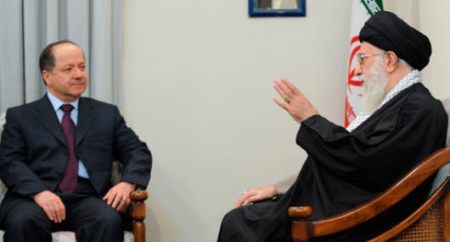
US-Turkish discord over the Turkish army’s onslaught on the Kurds of northern Syria reached a new low Wednesday, Aug. 30, when the presidential palace spokesman Ibrahim Kalin said in Ankara: “The US must revise its policy of supporting Kurdish forces.”

The demand came after a senior US official called on “all the armed actors in the fight against the Islamic State in northern Syria to stand down,” in an effort to contain the new conflict dragging northern Syria into further chaos.

The call was addressed equally to Ankara to freeze its military operations in Syria and to the Kurdish PYD-YPG militia to halt the flow of fraternal reinforcements for defending Mabij, the Syrian town the militia wrested from ISIS earlier this month with US assistance.

DEBKAfile’s military sources report that the Turkish army and Kurdish forces are already tensely aligned for a decisive battle over Manbij that will determine the outcome of the Turkish invasion of Aug. 24. President Tayyip Erdogan calculates that a Turkish victory will force the Kurds to retreat to the eastern bank of the Euphrates and away from the Turkish border, while Kurdish leaders are determined to halt the Turkish army at the gates of the town, and so brand the invasion a fiasco and carry off an epic victory.

The Obama administration is making a huge effort to avert this confrontation. In the hope of reining in the Turks, Vice President Joe Biden arrived in Ankara on the day their army crossed the Syrian border and met them halfway by issuing an ultimatum to the Kurds to withdraw to east of the Euphrates or else lose US support.

Unheeding of the US warning, the Kurds went forward to build up their fighting strength and engage the Turkish army.

Ankara suspects that the Americans are continuing notwithstanding to give the Kurds weapons and assistance on the quiet.

Washington fears that a Turkish-Kurdish showdown in Manbij will further destabilize the military situation such as it is in northern Syria and northern Iraq, and all their efforts to persuade the Kurds to lead the ground forces of the coalition offensives against ISIS will go for nothing.

In an earlier report on Monday, DEBKAfile covered the conflict between Turkey and the Kurds as it unfolded after the Turkish invasion.

An all-out Turkish-Kurdish war has boiled over in northern Syria since the Turkish army crossed the border last Wednesday, Aug. 24 for the avowed aim of fighting the Islamic State and pushing the Syrian Kurdish YPG militia back. Instead of falling back, the Kurds went on the offensive and are taking a hammering. This raging confrontation has stalled the US-led coalition offensive against ISIS and put on indefinite hold any US plans for campaigns to drive the jihadists out of their Syrian and Iraqi capitals of Raqqa and Mosul.

The Kurdish militia ground troops, who were backed by the US and assigned the star role in these campaigns, are now fully engaged in fighting Turkey. And, in another radical turnaround, Iraqi Kurdish leaders (of the Kurdish Regional Republic) have responded by welcoming Iran to their capital, in retaliation for the US decision to join forces with Turkey at the expense of Kurdish aspirations.

The KRG’s Peshmerga are moreover pitching in to fight with their Syrian brothers. Together, they plan to expel American presence and influence from both northern Syria and northern Iraq in response to what they perceive as a US sellout of the Kurds.

DEBKAfile’s military analysts trace the evolving steps of this escalating complication of the Syrian war and its wider impact:

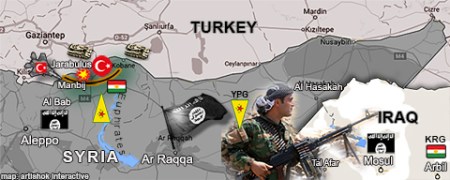
  • Since cleansing Jarablus of ISIS, Turkey has thrown large, additional armored and air force into the battle against the 35.000-strong YPG Kurdish fighters. This is no longer just a sizeable military raid, as Ankara has claimed, but a full-fledged war operation. Turkish forces are continuing to advancing in three directions and by Sunday, Aug. 28 had struck 15-17km deep inside northern Syria across a 100km wide strip.
    Their targets are clearly defined: the Kurdish enclave of Afrin in northwest Syria and the Kurdish enclave of Qamishli and Hassaka in the east, in order to block the merger of Kurdish enclaves into a contiguous Syrian Kurdish state.
    Another goal was Al-Bab north of and within range of Aleppo for a role in a major theater of the Syrian conflict. To reach Al-Bab, the Turkish force would have to fight its way through Kurdish-controlled territory.
  • The Turks are also using a proxy to fight the Syrian Kurds. Thousands of Syrian Democratic Army (SDF) rebels, whom they trained and supplied to fight Syria’s Bashar Assad army and the Islamic State, have been diverted to targeting the Kurds under the command of Turkish officers, to which Turkish elite forces are attached.
  • A Turkish Engineering Corps combat unit is equipped for crossing the Euphrates River and heading east to push the Kurds further back. Contrary to reports, the Turkish have not yet crossed the river itself or pushed the Kurds back – only forded a small stream just east of Jarablus. The main Kurdish force is deployed to the south not the east of the former ISIS stronghold.
KurdishWar480
  • Neither have Turkish-backed Syrian forces captured Manbij, the town 35km south of Jarablus which the Kurds with US support captured from ISIS earlier this month. Contrary to claims by Ankara’s spokesmen, those forces are still only 10-15km on the road to Mabij.
  • Sunday, heavy fighting raged around a cluster of Kurdish villages, Beir Khoussa and Amarneh, where the Turks were forced repeatedly to retreat under Kurdish counter attacks. Some of the villages were razed to the ground by the Turkish air force and tanks. At least 35 villagers were reported killed.
  • In four days of fierce battles, the Kurds suffered 150 dead and the Turkish side, 60.
  • DEBKAfile military sources also report preparations Sunday to evacuate US Special Operations Forces and helicopter units from the Rmeilan air base near the Syrian-Kurdish town of Hassaka. If the fighting around the base intensifies, they will be relocated in northern Iraq.
  • Fighters of the Iraqi-Kurdish Peshmerga were seen removing their uniforms and donning Syrian YPG gear before crossing the border Sunday and heading west to join their Syrian brothers in the battle against Turkey.
  • The KRG President Masoud Barazani expects to travel to Tehran in the next few days with an SOS for Iranian help against the US and the Turks. On the table for a deal is permission from Irbil for the Iranian Revolutionary Guards to win their first military bases in the Iraqi Kurdish republic, as well as transit for Iranian military forces to reach Syria through Kurdish territory..
First Palestinians in Syria war – under Hizballah

June 19, 2016

First Palestinians in Syria war – under Hizballah, DEBKAfile, June 19, 2016

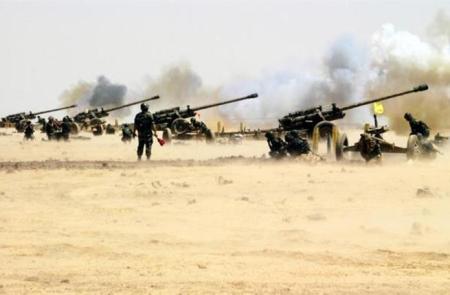
Hezbollah_Zabadani_12.8.15Hizballah artillery in action in Syria

On Sunday, June 19, helicopters of the Syrian Air Force started transporting Palestinian militia fighters from the Damascus area to the Deir-ez-Zor region of eastern Syria, DEBKAfile’s military sources said in an exclusive report. They are joining Hizballah troops in an all-out assault on Islamic State’s grip on the area, notably the Euphrates River valley.

The Hizballah buildup was first revealed by DEBKAfile Friday, June 17.

It is the first time since the Syrian war began in 2011 that Palestinians are fighting for the regime of President Bashar Assad under the direct command of Hizballah. It is also the first time Palestinian forces are engaged in direct combat with ISIS.

The Palestinian troops are from a militia set up by Syrian and Iranian military intelligence officers called the al-Jaleel Forces, or the “Young Men Return to Palestine Movement”. It was armed and trained for terrorist attacks deep inside Israeli territory.

However, after Russian President Vladimir Putin promised Israeli Prime Minister Binyamin Netanyahu, during their June 9 meeting in Moscow, that no terror forces of any kind, whether Iranian, Syrian or Hizballah, would be allowed to set foot in southern Syria, or gain access to Israel’s northern border, the Palestinian militia was reassigned to the eastern Syrian front to boost the Hizballah operation against ISIS.

In the last hours, the Palestinian fighters were transferred from Damascus to al-Qusour near Deir ez-Zor and some, according to DEBKAfile’s military and intelligence sources, were sent directly into battle against ISIS as soon as they arrived in the area, and immediately suffered losses. Syrian sources name three fatalities as Mohamed Abbas, Eid al-Mohamed and Essam al-Abbas, with no further details.

On Friday, June 17, our military sources first revealed the new Hizballah mission: 

Hizballah this week ordered a general military call-up for their biggest combat mission in the Syrian war since their forces began fighting in support of the Assad regime in 2013, DEBKAfile military forces report.

Iran’s Lebanese proxy has been assigned the task of expelling the Islamic State from broad areas it occupied in the Deir ez-Zor region of eastern Syria and, in particular, the Euphrates River valley which connects eastern Syria and western Iraq.

This Hizballah offensive is designed to open the way for the pro-Iranian Shiite Popular Mobilization Forces and the Badar Forces militias which entered the ISIS-held Iraqi town of Fallujah Friday June 17 to move west and up the Iraqi side of the valley. The two militias spearheaded the Fallujah operation under the command of Iran’s Maj. Gen. Qassem Soleimani of the Revolutionary Guards and Ground Corps Brig. Gen. Mohammad Pakpour.

The plan is for Hizballah forces to meet these pro-Iranian militia forces on the Syria-Iraq border and so gain control over the most important strategic land pass between Iraq and Syria.

Whereas the pro-Iranian militias in Iraq are fighting under US air cover, Hizballah is assured of Russian air support in Syria.  And so, for the first time in the Syria conflict and its own history, Hizballah will receive air cover from both the US and Russia, the two superpowers now coordinating their military moves in Syria and Iraq.

This strategy, which essentially connects the Syrian and Iraqi campaigns against ISIS, was charted on June 9, at a secret meeting in Tehran of the Russian, Iranian and Syrian defense chiefs.

DEBKAfile military sources in Washington say that the operation’s plan was put before President Barack Obama and he sanctioned it as part of the war on ISIS.

In the run-up to the Syrian segment of the plan, Hizballah is transferring substantial combat strength from Lebanon into Syria, and emptying its other Syrian fronts, especially around Aleppo, for the large-scale concentration around Palmyra.

The Hizballah force will start out by targeting the Syrian town of Al-Sukhna, 63km south of Palmyra and 136km north of Deir ez-Zor, thus gaining command of M20, the main highway link between northern to eastern Syria. DEBKAfile military sources say that this military offensive by Hizballah against ISIS, with combined US-Russian support, threatens to transform a terrorist organization dedicated to fighting Israel in the service of Iran into one of the most powerful armies in the Middle East. Israel cannot stop this happening. The former Israel defense ministers who harangued this week against the Netanyahu government’s alleged “scaremongering” willfully ignored this dangerous development. They must also be held at least partly accountable for the failure of Israel’s air raids over Syria to diminish Hizballah’s military capabilities.

US intelligence misses cues to terror – again

June 13, 2016

US intelligence misses cues to terror – again, DEBAfile,June 13, 2016

Moner_Mohammad_AbusalhaMoner Mohammad Abusalha, the suicide bomber who was the Orlando killer’s buddy

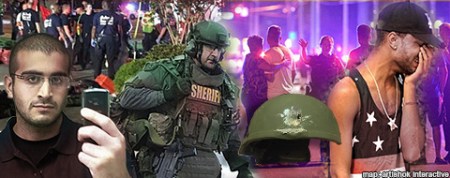
Omar Mir Seddique Mateen, a US Muslim citizen aged 29, son of Afghan migrants, perpetrated the deadliest shooting attack in American history on June 12, when he massacred 50 people and injured 53 at the Pulse gay club in Orlando, Florida, with an AR 15 assault rifle and a Glock 17 handgun.

The guns were purchased legally a few days earlier at a local shop. This alone ought to have alerted the various US intelligence and surveillance agencies responsible for countering terrorism – except that, for lack of coordination, they missed the fact that a man twice questioned by the FBI was suddenly loading up on deadly weapons.

Mateen fit the profile of an Islamic terrorist, whose attributes the incumbent US administration consistently refuses to acknowledge: He was a Muslim, whose Afghan immigrant father is a Taliban supporter; a religious extremist, who recently made the pilgrimage to Mecca; he was divorced, known for violence, and licensed as a security officer to carry a gun.

The Orlando killer had long been overdue for close monitoring – or least a flag to prevent him from working as a security officer or carrying arms.

In 2013-14, the FBI interviewed him after he made “inflammatory remarks” to a colleague, before closing its investigation.

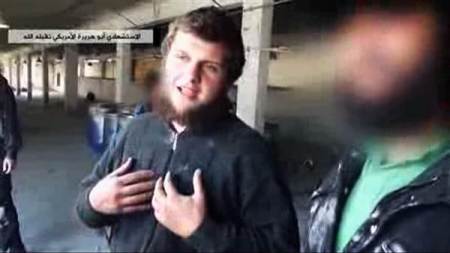
In 2014, the FBI hauled him in again over a connection with Mohammad Abu-Salha, a 22-year old Palestinian American. They had grown up together at the small Florida coastal town of Fort Pierce. Abu Salha went off to Syria, joined the al Qaeda-linked Nusra Front and killed himself in a suicide attack by driving a massive truck bomb into a restaurant filled with Syrian government soldiers.

Yet the FBI against closed the file on Mateen after determining that the links between the two young Muslims did not warrant a full-dress inquiry.

Compiling all the known data on the Orlando killer with the results of the FBI interviews with him would have placed him high on the list of suspects and called in for further questioning.

The oversights of US law enforcement, intelligence and security agencies recur each time Islamists terrorist strike. The Ramadan 2016 attack in Orlando showed that no lessons had been learned from the lapses that led to 9/11.

The FBI erred gravely in closing the case over the Mateen connection with the Palestinian American suicide bomber. This explains why senior FBI officials are down-playing the importance of that connection.

When he was exculpated, the federal authorities also discontinued electronic surveillance of the terrorist’s movements. So they missed his mounting extremism, his frequent attendance at a mosque led by a radical imam, who regularly incited his flock to murder (“Gays must die”). He thus kept his Security Officer’s ID which gave him access to secure government sites. His name was kept on the list of licensees for carrying firearms.

It is especially hard to understand the lackadaisical handling by federal agents of this prime suspect when the FBI Director James Comey was reiterating: “The Islamic State remains the top threat America is facing.”

Before entering the Pulse night club with the intent to slaughter those partying inside, Mateen called 911 and swore allegiance to the leader of the ‘Islamic State’ Abu Bakr al-Baghdadi, and recalled Tamerlan and Dzhokhar, the brothers responsible for the 2013 Boston Marathon terror attack.

Orlando_Terror480

For 20 minutes, the dispatchers did not understanding what he was saying and lost the chance to triangulate his cellular phone’s location and send police to nab him.

At the door of the club, he got into a brief exchange of fire with policeman before going in. Mateen went from room to room, firing well aimed semi-automatic rounds, killing tens of people, wounding tens more, and rounding up 30 people as hostages. He knew enough from his experience as a security guard to lock them in the restrooms which had no windows.

Long before the police, the city hall or any other official entity came to their senses, the club’s management sent a message via social networks: ‘Everyone get out of pulse and keep running.’

For three precious hours, dozens of police cars and ambulances, with FBI agents, dog handlers, special bomb disposal units, and other security officials huddled outside the club without doing anything. During these hours only a few shots sounded and many of those wounded lost their lives from blood loss and lack of medical treatment.

Only at 5 am, did the special anti-terror unit enter the scene, with one team using small detonators and firing at the terrorist to distract him while a force of 9 officers blew up the opposite wall and broke a hole through which officers could enter, fire and kill the terrorist. This entire event took 4 minutes.

Despite the three-hour wait, not enough ambulances had reached the scene, and some of the casualties had to be driven in civilian vehicles.

Mateen committed his murderous assault on the 300 partygoers at the Pulse club with ease, due to a number of factors:

  1. US law enforcement agencies have shown inexplicable tolerance toward Islamist extremists to the point that the Orlando killer was free to purchase an unlimited amount of deadly weapons.
  2. Due to lack of coordination between intelligence and law enforcement agencies, this killer was able to gain employment with a firm that trains its personnel in the use of firearms.
  3. As soon as the local police were alerted to gunfire at the door of the club, they should have swarmed in to neutralize the killer. The three-hour wait for the SWAT team’s arrival betokened weakness and an unwillingness to fight, so leaving the horrendous event in the hands of the terrorist.
  4. Pinning the dreadful episode on lack of gun control avoids the issue. Terrorists will always find murder weapons – if not guns, then homemade bombs like the Boston Marathon brothers, kitchen knives or vehicles. Even in countries with strict gun control, there is always a black market.

IRGC routed in Syria by new missile

May 16, 2016

IRGC routed in Syria by new missile, DEBKAfile, May 16, 2016

Khan_tuman_ambush_5.16

[N]either the Iranians nor Hizballah can win the war for Assad.

***************************

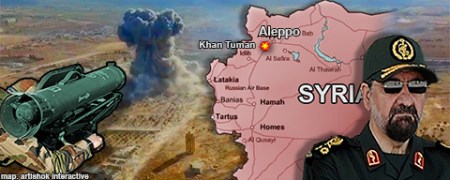
The battle on May 6 in the village of Khan Touman, located southwest of Aleppo near Route 5, the main highway leading to Damascus, will go down in the annals of the Syrian war as the biggest defeat suffered by the Iranian Revolutionary Guard Corps (IRGC) and Hizballah, as well as the battle that changed the face of the war.

DEBKAfile’s military and intelligence sources report that an Iranian force consisting of IRGC troops and Hizballah was ambushed by fighters from the Jaysh al Fath organization, part of the Nusra Front.

Until this battle took place, Iranian and Hizballah commanders in Syria did not know that the rebels had received a shipment of MILAN antitank missiles provided by Turkey and funded by Saudi Arabia.

The encounter with the advanced weapon system brought the IRGC and Hizballah to rout.

The Iranians admitted that 17 of their fighters fell in the battle, including 13 from the IRGC’s “Karbala” Division that is usually based in Iran, and 22 were wounded. Among the dead were two Iranian brigadier generals. At least ten IRGC troops were taken prisoner by the rebels. Five or seven Iranian troops were executed immediately, and an unknown number were taken from the area to an undisclosed location.

Hizballah claimed that none of its troops were killed or taken prisoner. However, that statement was actually an attempt to hide that at least 15 of its fighters were killed. According to intelligence sources that monitored the battle, Hizballah’s death toll was even higher.

The defeat was a major shock to the Iranian and Hizballah hierarchies In Tehran and Beirut, and officials vowed that revenge would be coming soon.

The immediate result of the shock was the appointment of Gen. Mohsen Rezaei, commander of the IRGC 26 years ago in the 1980s, who retired years ago and was a candidate in several presidential elections.

DEBKAfile’s sources report that Rezaei is one of the only IRGC commanders to have visited many times in the West, mainly to participate in international conferences, and has spoken freely with Western military and intelligence officers on the situation in Iran and the Middle East.

It is hard to believe that he will succeed in turning the clock back for Iran and Hizballah in Syria. Rezaei’s appointment indicates confusion   or panic in the Iranian hierarchy that does not know how to respond to the defeat.

KhanTuman480

In addition, it is still not clear whether Rezaei will replace Gen. Qassem Soleimanias commander of Iran’s forces in Syria, or be subordinate to him.

DEBKAfile’s military sources point out that bringing Rezaei to Syria does not resolve Iran and Hizballah’s main military problem, as the battle in Khan Touman showed. If the rebels continue to receive advanced weapons like antitank and antiaircraft missiles, they will become superior to the three military forces fighting for Syrian President Bashar Assad, namely Iran’s standing army and IRGC troops, the Syrian army and Hizballah.

In other words, neither the Iranians nor Hizballah can win the war for Assad.

Seven days after the battle, the commander of Hizballah’s forces in Syria, Mustafa Bader Al-din, was killed by a ground-to-ground missile strike near the Damascus international airport. Later claims by various sources that he was killed in battle at Khan Touman were actually attempts to conceal the two biggest military blows suffered by the Iranians and Hizballah in Syria

US, Russia aim to ‘decapitate’ Syrian military

May 7, 2016

US, Russia aim to ‘decapitate’ Syrian military, DEBKAfile, May 7, 2016

Assad_dressed_in_military_uniform10.12

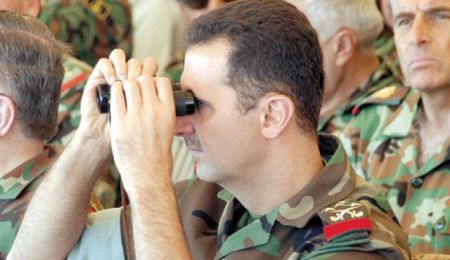
The US, Russia and the Syrian rebels started discussions this weekend over the composition of a list of Syrian generals who will be dishonorably discharged over war crimes they committed during the country’s civil war, DEBKAfile’s military and intelligence sources say in an exclusive report.

The generals will not face trial at an international tribunal over their war crimes. They will be able to leave Syria along with their families and their possessions, just like President Bashar Assad and his clan.

Our sources add that atop the list are the commanders of the Syrian air force who carried out the majority of the Assad regime’s attacks on the rebels over the past five years, including the atrocities of the past few days.

The sources say that the Americans and the Russians intend to “decapitate” the command but leave the military’s structure in its current form while integrating rebel fighters and commanders into its units. The rebel commanders are to receive ranks equivalent to their current ones in the new Syrian army.

DEBKAfile’s exclusive report on Wednesday, May 4, that Russia is ready to discuss the terms for Assad’s ouster surprised and stunned the political and military hierarchy in Tehran. In urgent consultations held the same day, it was decided to dispatch Iran’s deputy foreign minister for Arab and African affairs, Hossein Amir-Abdollahian, to Moscow without delay in order to determine whether the report was accurate.

The senior Iranian diplomat arrived in the Russian capital the following day and met with Deputy Foreign Minister Mikhail Bogdanov, the chief strategist of Russia’s Middle East policy.

Immediately after the meeting, Amir-Abdollahian said Iran will continue supporting Assad and the Syrian people in fighting terrorism, and make efforts to achieve success at intra-Syrian talks, namely the negotiations in Geneva between the Assad regime and the Syrian opposition. The Iranian diplomat did not say a single word about Assad’s future.

However, Moscow was one step ahead of Tehran. Shortly before Amir-Abdollahian deplaned in the Russian capital, Russian Foreign Minister Sergei Lavrov made a bombshell statement, saying “Assad is not our ally, by the way. Yes, we support him in the fight against terrorism and in preserving the Syrian state. But he is not an ally like Turkey is the ally of the United States.”

Our sources said it was a put-down for both Washington and Ankara, whose relationship has deteriorated recently.

DEBKAfile’s military sources report that Assad has not failed to notice the latest developments, and he continues to use Syrian, Iranian and Hizballah forces to attack the rebels in the parts of Aleppo that they control. This comes despite the announcement on Saturday, May 7, by Moscow and the Russian military in Syria that the ceasefire in the northwestern city had been extended by 72 hours.

Assad is keeping the Syrian army in reserve to defend his region against the US-Russian plan to depose him.

Is Obama plotting yet again to harm embattled Israel?

April 19, 2016

Is Obama plotting yet again to harm embattled Israel? American ThinkerVictor Sharpe, April 19, 2016

According to a report dated April 16, 2016 in the sometimes reliable Debka Special Report,Israel’s top political leaders and military commanders were stunned and shocked last weekend when they found out that US President Barack Obama and Russian President Vladimir Putin have agreed to support the return of the Golan to Syria.”

If this is true, Barack Hussein Obama is plotting yet again a way to torment the Jewish state with yet another vile edict, one which clearly has nothing to do with enlightened statecraft but much more to do with evil witchcraft.

The occupant in the Oval Office cannot salivate enough at the prospect of harming Israel’s security and survivability. No doubt he is fulfilling a malevolent pact he has made with a cabal of Islamists and extreme leftists; both of which ideologies have satanic hatred for Israel.

With this threat hanging over the strategic territory known as the Golan Heights, it is time once again to learn its history and Biblical significance.  Even as modern day Syria is convulsed in a murderous and bloody civil war with untold thousands dead and maimed; even as its tyrant, Bashir al-Assad, fights for his political and physical life; even with all this, he nevertheless spews forth his hatred of Israel and his call to take away the Golan Heights from the Jewish state.

But so do those “rebels” who are fighting him and thus remind us of the famous aphorism: “better the devil you know,” or better still, “a plague on all your houses.”

Those of us who have stood on the Golan’s 1,700 foot steep escarpment, are struck by its immense strategic value overlooking Israel’s fertile Hula Valley and the beautiful harp-shaped lake below, called in Hebrew, Kinneret (better known as the Sea of Galilee.)

But during Syria’s occupation of the territory, no agriculture of any significance took place and no restoration of its terrain was ever undertaken. Instead, the Golan was a giant Syrian army artillery encampment whose sole purpose was to deliberately rain down upon Israeli farmers, fishermen and villagers an endless barrage of shells.

So what is the history of the Golan Heights and what is its overwhelming biblical significance to the reconstituted Jewish state? Perhaps we should return primarily to the biblical books of Joshua and Numbers.

Before the Tribes of Israel would cross the River Jordan and enter the Promised Land, the first among them had already taken possession of territory east of the River Jordan. These were the half tribes of Manasseh, Gad, and Reuben who liberated the Bashan and Gilead from the Amorites.

Biblical Bashan incorporates today’s Golan Heights. Gilead is the fertile land, which lies in what is the north eastern area of today’s Kingdom of Jordan:

“ … a little balm, and a little honey, spices and myrrh, nuts and almonds” (Gen 43:11.)

 It was Canaan, west of the Jordan, (including today’s so-called West Bank) which would pose the formidable challenge to Joshua bin Nun, the general leading the Israelite tribes.

So it was that Moses, the Lawgiver, spoke to the children of Gad and Reuben thus:
“Shall your brethren go to war, and shall you sit here?” (Numbers 32:6) The leaders of the two tribes replied that they would indeed send their warriors west into Canaan and fight alongside their brethren while their families would remain behind.

“We will build sheepfolds here for our cattle and cities for our little ones. But we ourselves will go ready armed before the children of Israel until we have brought them unto their place: and our little ones shall dwell in fenced cities because of the inhabitants of the land. We will not return unto our houses until the children of Israel have inherited every man his inheritance.” (Numbers 32: 16-18)

The story of reconstituted Israel and its people is mirrored in the biblical story of those ancient ancestors. The young men and women of modern Israel have gone again and again from their homes; be they villages, towns or cities, to the borders and established communities there in times of danger and peril, just like those young men did from the biblical tribes of Gad and Reuben.

The Jewish pioneers of today in Judea and Samaria — the biblical and ancestral heartland known today as the “West Bank” — are no different.

But the world has chosen to demonize them as ‘‘obstacles to peace” and an impediment to the creation of a fraudulent Arab state to be called Palestine; a state that has never existed in all of recorded history; and certainly not as a sovereign independent Arab state.

The pioneers are now called “settlers” and their homes and farms derisively called “settlements.” It matters not to the infernal chorus that sings the international siren song of hate and ignorance that these pioneers are returned to their ancestral homesteads and seek to take up their ploughshares to sow, to plant and re-possess their homeland.

But the purpose of this article is also to learn about the biblical and post biblical history of the Jewish descendants of Gad, Reuben and Manasseh. Such facts, of course, will not persuade the likes of Barack Hussein Obama as he plots and schemes.
 The Bashan region, now known as the Golan Heights, is a part of the biblical territory promised to the Patriarch Abraham and the people of Israel for an everlasting covenant — the Covenant of the Parts — recounted in Genesis 15. The city of Bashan was a refuge city (Deut, 4:43).

During the biblical period of the Jewish Kings, a battle high on the Golan took place between King Ahab and the army of Aram. A Jewish victory occurred at the present site of Kibbutz Afik, which lies a few miles east of Lake Kinneret, the Sea of Galilee.

After the end of the Babylonian Exile, and during the Second Temple Period, Jews returned to their homes on the Golan. Subsequently the returnees were attacked by gentiles and Judah Maccabee brought his forces up to the Heights to defend them.

At the conclusion of the Hasmonean Period, King Alexander Yannai finally re-conquered the Golan and Jews returned yet again. They rebuilt communities in central Golan, including the major cities of Banias and Susita, which formed part of the defense of the Golan.

Their residents fought heroically against the Roman legions during the Great Revolt of 135 AD, known also as the Second Uprising. It was led by the charismatic Shimon Bar Kokhba, known as the “Son of a Star” and a Jewish folk hero. Some 10,000 residents of Gamla alone perished fighting against Rome.

Second century Jewish coins were found on the Golan after its liberation during the last days of the June, 1967 Six Day War. These ancient coins were inscribed with the words, “For the Redemption of Holy Jerusalem.”

In the succeeding period of the Talmudic Period, Jewish communities flourished and expanded. Archaeologists have found the remains of 34 synagogues on the Golan. Jewish life on the Golan largely ended after the defeat of the Byzantine army by Arabs from Arabia carrying the new banner of Islam and the region descended into a long period of neglect.

But Jewish life returned yet again in the latter years of the 19th century when members of the Bnei Yehuda society from Safed purchased land on the Golan. In 1891, Baron Rothschild purchased around 18,000 acres in what is present day Ramat Magshimim.

The Jewish pioneers of the First Aliyah (immigration) began to farm land they had purchased in the Horan region until the Turkish Ottoman occupiers evicted them in 1898. Their land was then seized, and in 1923 the entire Golan was given away by Britain to the French Mandate over Syria and Lebanon.

Zionist leaders had earlier demanded the Golan be included within the new Jewish National Home because of its immense historical roots in biblical and post-biblical Jewish history. But Jewish liberation of the ancestral land was not possible until Israel was forced to fight for its very survival during the Six Day War.

The Golan is only 60 miles from Haifa; and the slopes of Mount Hermon, the highest point in the region, are the present eyes and ears of Israel. The Golan Heights were officially annexed to Israel in 1980. But it was the left wing Israeli Prime Minister, Yitzhak Rabin, who first offered to give the Heights away in 1994.

Since then, Israelis have winced at the wrenching offers made by subsequent left leaning Israeli governments and politicians who declared publicly their desire to give the entire Heights to the Syrians in return for a delusional peace. The overwhelming majority of Israelis are adamantly opposed to any such suggestion.

The Baker-Hamilton Iraq Study Group suggested that a way out for the United States from its Iraqi imbroglio would be for Israel to give the Golan Heights away to Syria. This, it was believed by the ISG, would bring Syria into responsible nationhood and wean her away from support of the “insurgents” attacking Iraqi and U.S assets. Of course this was before the successes of the “Surge” instituted by General Petraus made such a suggestion moot.

President Obama mistakenly renewed diplomatic relations with Syria as a way, he believed, of distancing the Arab dictatorship from its alliance with Iran. This was yet another delusional act by the current U.S. President whose foreign policy is in tatters.

But Obama’s carrot to the Syrian dictator, should it ever be resurrected, inevitably will be the Golan Heights. Again and again, he chooses to appease Arab and Muslim tyrants and it is becoming more and more apparent that indeed he is preparing to apply brutal pressure against Israel to force it to give away yet more of its biblical patrimony.

 But what would such pressure on Israel to withdraw from the Golan Heights mean? Bringing down the Israeli radar stations on the Hermon Massif to the valley floor below would seriously degrade any warning of future hostile Syrian attacks.

It would further hamper Israel’s ability to prevent attacks upon it by Syrian forces and by Hezb’allah, now armed to the teeth by the Iranian mullahs and with an estimated 150,000 missiles aimed at Israel and hidden among Lebanese civilians.

To put any trust in an Arab nation, especially the Iranian-backed Syrian regime, is truly mind boggling. Besides which, the so-called rebels fighting the Syrian regime have already stated that their ambition is also to take the Golan from Israel at the same time that they plan on making Syria yet another Islamic Republic and a future part of an Islamic Caliphate.

And consider this. The British colonial power gave away the Golan to France’s Syrian colony in 1923. Syria attacked Israel in 1967 and lost the Golan. Syria had occupied it for 44 years. Israel’s liberation of the Golan has lasted nearly 50 years. Ask yourself then, who has possessed the Golan the longest?

Any thought of being brutally forced by Obama and Putin to abandon biblical Bashan (the Golan) with its immense strategic value to such Islamist foes as exist in Syria would be a betrayal of a loyal ally of the United States and of those first Jewish ancestors on the Golan who long ago “built sheepfolds for their cattle and cities for their little ones.”


Are North Koreans fighting in Syria? It’s not as far-fetched as it sounds.

March 26, 2016

Are North Koreans fighting in Syria? It’s not as far-fetched as it sounds, Stars and Stripes, Adam Taylor, The Washington Post, March 25, 2016

(North Korea and Iran also have long-standing ties, Iran has substantial funds due to the Iran Scam, and North Korea is desperate for money. — DM)

This week, representatives of Western-backed Syrian opposition delegation in Geneva told Russian state media that President Bashar Assad had a surprising new ally on the Syrian battlefield: militia units from North Korea.

“Two North Korean units are there, which are Chalma-1 and Chalma-7,” Asaad az-Zoubi, head of the High Negotiations Committee to Syrian peace talks in the Swiss city, reportedly told Tass news agency Tuesday.

In any other context, the presence of soldiers from the internationally isolated and geographically distant country North Korea might seem absurd. However, the civil war in Syria has emerged as a mini-world war over the past five years, with foreign fighters from at least 86 countries believed to be fighting there.

The Syrian regime headed by Assad is already known to have the support of a number of international partners, including Russia, Iran and the Lebanese militia group Hezbollah. And this isn’t the first time that there have been reports of soldiers from the Hermit Kingdom being involved in the conflict.

In 2013, Rami Abdulrahman, director of the London-based Syrian Observatory for Human Rights, told Saudi-owned Arabic newspaper Al-Sharq al-Awsat that a small number of North Koreans were in Syria, to provide logistical and planning support.

“The exact number of the officers is not known, but there are definitely 11 to 15 North Korean officers, most of whom speak Arabic,” Abdulrahman said, according to a translation published by South Korean outlet Chosun Ilbo. Abdulrahman’s report was followed up the next year by another from Jane’s Defence Weekly, which reported that North Korea was assisting helping Syria improve its missile capabilities.

These reports are hard to confirm, but many experts believe they are credible: North Korea and Syria have had a military relationship for decades and there’s little sign it’s been shaken recently.

“The North Koreans have been involved with Syria since the late-1960s,” says Joseph S. Bermudez Jr., a contributor to 38 North, an analysis website affiliated with the U.S.-Korea Institute at John Hopkins School of Advanced International Studies. That involvement included providing advisers and air defense troops immediately after the 1967 and 1973 wars with Israel, Bermudez says, and stretches to the modern era, when North Korea is believed to have provided technology used to help build the secret al-Kibar nuclear site in Syria, which was destroyed by an Israeli airstrike in 2007.

“Syria is one of North Korea’s longest standing and deepest political and military relationships,” Andrea Berger of the Royal United Services Institute adds. In a report published last year, Berger had described how the relationship was originally based upon military training but eventually graduated to weapons sales, including ballistic missiles and chemical weapons. Remarkably, the relationship between North Korea and Syria does appear to have survived to the present day, Berger noted, despite U.N. sanctions on North Korea which should, in theory, curtail them: It may even have thrived, with state media in both countries loudly publicizing the regular high-level meetings between Syria and North Korea.

Bermudez says that since the Arab Spring began, there have been a number of reports that small teams of North Korean soldiers were providing logistical support to the Syrian regime. However, he notes that some more recent seem to suggest North Korean soldiers are actively playing a role in fighting in Syria. “While I can’t confirm these reports,” Bermudez says, “it would not be out of character for North Korea to do so, as they historically have provided small ‘regime support’ forces to countries in crisis in Africa.”

Berger agrees. “Military to military cooperation between the two countries, including on-the-ground presence of North Korean troops, would be in keeping with the history of their bilateral relationship,” she says.

(Bermudez also notes that the reference to North Korean units being named “Chalma” could be a reference to the Kalma airfield in North Korea.)

Not everyone is so sure. Philip Smyth, a researcher at the University of Maryland who studies groups allied to the Syrian regime, says that he has also recently seen a number of vague reports about North Koreans fighting for Assad in Syrian news sources that are sympathetic to the regime. However, he wasn’t sure of their accuracy.

“Often, they would confuse Afghan Shia Hazara fighters for ‘Chinese’ or ‘Koreans,’ ” Smyth says, referring to an Afghan minority known to fight alongside the Syrian regime.

North Korean authorities have denied any military involvement in the past, with state news agency KCNA writing in 2013 that “foreign media” were “floating misinformation.”

But with North Korea increasingly cash-strapped, analysts have noted that it has increasingly sent citizens abroad to earn foreign money. These citizens often work in conditions that Marzuki Darusman, the special rapporteur on human rights in North Korea, has referred to as “forced labor.” For Pyongyang, perhaps the Syrian war is a payday.

Despite reports, Syria’s Palmyra and Iraq’s Mosul not on verge of liberation

March 24, 2016

Despite reports, Syria’s Palmyra and Iraq’s Mosul not on verge of liberation, DEBKAfile, March 24, 2016

In complete contrast with media reports issued on Thursday morning, the Iraqi army is not preparing to liberate Mosul, the country’s second largest city, and the Syrian army is not on the verge of capturing Palmyra.

DEBKAfile‘s intelligence and military sources report that the Syrian army is not capable of taking over the historic city without support from the Russian air force. On President Vladimir Putin’s orders, the Russian military has recently reduced its support of the Syrian army to a minimum until Damascus agrees to negotiate with the opposition regarding the country’s future.

The sources add that the Iraqi army does not intend to attack ISIS-held Mosul at any time in the near future, and has even reduced its forces near the city by sending a number of battalions to Baghdad to protect the capital from attacks by the terrorist organization.

Russia to keep S-400 in Syria until Saudi warplanes leave Turkey

March 16, 2016

Russia to keep S-400 in Syria until Saudi warplanes leave Turkey, DEBKAfile, March 16, 2016

F15-fighter-jetsSaudi F-15 bombers

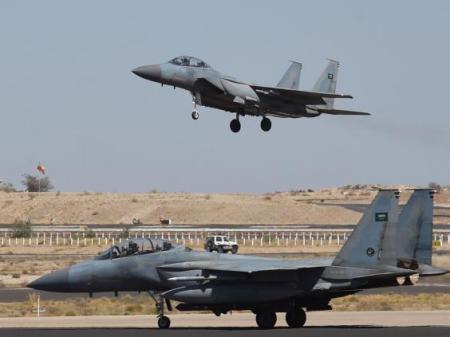
The highly-advanced S-400 air defense missiles will also eventually be evacuated from Syria, said high-ranking officials in Moscow on Wednesday, March 17, according to an exclusive DEBKAfile report. But their presence for now is crucial in view of the continuing Saudi buildup of warplanes in Turkey, close to the Syrian border.

Our military sources disclose that the initial Saudi deployment of four warplanes to the Turkish air base of Incirlik earlier this month, has been expanded to sixteen, while Saudi officials declare that Riyadh and Ankara are preparing to intervene jointly in the Syrian conflict.

According to our sources, Turkish armored and infantry troops have already crossed the border and set up positions in the northern Syrian province of Idlib, just a few hundred meters inside the border.

Russian Foreign Minister Sergei Lavrov referred Sunday, March 14, to evidence of “a creeping expansion by Turkey in the sovereign nation of Syria.”

This was taken as a warning that Moscow would not tolerate any further Turkish encroachments in Syria, any more than it would accept Saudi air force intrusions of Syrian air space.

The Russians infer from Turkish military movements that Ankara aims to establish enclaves inside Syria as no-fly or security zones, which Moscow has consistently opposed. The presence of the top-grade S-400 anti-air missiles in Syria is meant to obstruct this plan and discourage Turkish and Saudi aerial flights over Syria.

At the same time, the presence of the S-400 missiles close by is a worry for the Israeli Air force.  The batteries, currently positioned at the Latakia base, would cover a broad stretch of air space over northern and central Israel if they were moved further south.

A word of reassurance on this score was understood to have come from Russian military sources Wednesday. They said that the S-400 would be removed eventually, leaving behind only the Pantsir-S1 anti-air missile systems, which have never posed a challenge to the Israeli air force in the last decade.

DEBKAfile’s military sources also confirm that Putin has so far kept his promise to Prime Minister Binyamin Netanyahu to withhold advanced S-400 and S-300 air defense missiles from Iran, by executing a series of delays.

On Feb. 17, Iranian military officials announced a ceremony the next day at the Caspian port of Astrakhan for the handover of the first batch of S-300s. The ceremony never took place.

This week, Russian arms industry sources announced that the missiles would be not be delivered to Iran before August or September – another delay, which is unlikely to  be the last.

Netanyahu phones Putin for clarifications on the South Syrian ceasefire

February 24, 2016

Netanyahu phones Putin for clarifications on the South Syrian ceasefire, DEBKAfile, February 24, 2016

PutinBibi2-480

Prime Minister Binyamin Netanyahu phoned President Vladimir Putin Wednesday Feb. 24, to find out how the partial Syrian ceasefire due to go into effect Saturday Feb. 27 will affect Israel’s northern border security. According to the Kremlin statement, “The two leaders discussed the Middle East and reached agreement to hold a number of high-level contact meetings.”

Agreement was also reached on “a range of contact [meetings] on the high and highest level, taking into consideration the 25tyh anniversary of the establishment of diplomatic relations between the two countries,” the communiqué went on to say.

The language and content of this communiqué struck DEBKAfile’s diplomatic sources as oddly off the point compared with statements that came after past conversations.

It is hard to believe that the Russian President, while deeply immersed in tense exchanges with President Barack Obama and Iran’s Hassan Rouhani for tying up the ends of the approaching Syrian ceasefire, would give his attention to the celebration of a historic event.

The words did however convey the impression that the Russian leader was making an effort to calm Israel’s apprehensions about the coming stage of the Syrian crisis.

According to our sources, Netanyahu put in the call to Putin when he learned that the Russian and American presidents had agreed to get the partial ceasefire started in southern Syria, namely on the front closest to the borders of Israel and Jordan.

Israeli and Jordanian military officials have been trying to get a picture of how these arrangements would work and affect their national security, but Washington and Moscow are similarly tightlipped on information. This is also the reaction the Israeli Foreign Ministry’s Director General Dore Gold found when he called on Russian Foreign Minister Sergei Lavrov in Moscow on Feb. 18. The minister was polite but avoided direct answers to questions.

Israel is most deeply troubled by the possibility that Syrian army, Iranian and Hizballah forces currently in offensive momentum in South Syria will exploit the cessation of hostilities to advance towards its Golan border with hostile intent.

With only three days to go before the truce goes into effect, Israel has still not received any clear answers about whether the Russian air force will continue to strike Syrian rebel elements deemed “terrorists” unabated in close proximity to its northern borders.

US officials have tried in the last 24 hours to assuage Israel’s concerns, but they are no more forthcoming with clear information than the Russians.

Netanyahu therefore picked up the phone to the Russian president, with whom he maintains a friendly dialogue, to find out what was ahead in the wake of the truce and to ask for guarantees that Syrian, Iranian and Hizballah forces would not permitted to take advantage of the lull to gain ground.

The prime minister also asked Putin about the huge $14bn arms deal in negotiation with Tehran.

He is most unlikely to have been appeased by the bone the Russian president threw him about a joint celebration of an anniversary. The record is not assuring. In early January, Putin promised Netanyahu that he would make sure that Hizballah forces would not be part of the Russian-backed Syrian army offensive in the South. But then, on Jan. 27, a large Hizballah force entered the southern town of Daraa and Russian air strikes drew ever closer to the Israeli border, until explosions could be heard in Israel from a distance of no more than a few hundred meters.