Posted tagged ‘Syrian military’

Iranians and Walid suicide units on Golan border

July 8, 2016

Iranians & Walid suicide units on Golan border, DEBKAfile, July 8, 2016

GolanIsrael_military

A flurry of false Hizballah claims amid rising military tension this week was designed to cover up a direct Israeli hit of the Iranian Revolutionary Guards HQ in South Syria, DEBKAfile military and intelligence sources disclose.

Whereas Hizballah reported on July 5 that Israeli helicopters had attacked Syrian army positions near the Golan town of Quneitra, in fact, one of the two Israeli “Tamuz” IDF rockets fired on July 4, in response to stray cross-border Syrian army mortar shells, struck the Syrian Ministry of Finance building near Quneitra, which housed Iranian Guards and Hizballah regional headquarters. An unknown number of Iranian officers were killed as a result.

On July 6, Hizballah sources reported a high level of tension at its east Lebanese outposts in Hasbaya, al-Qarqoub and Mount Hermon, indicating possible preparations to retaliate for the Iranian casualties.

The mortar shells that occasionally stray into Israel are aimed by the Syrian forces in Quneitra at Syrian rebel engineering units, which are digging an anti-tank trench on the town’s southern edge to prevent Syrian tanks from mounting an all-out assault against them (See attached map).

These skirmishes are put in the shade by the dangerous gains by Islamist terrorists in southern Syria.

Both ISIS and al-Qaeda’s Nusra Front have overrun the entire Syrian strip bordering on Israel and Jordan – a distance of 106km from Daraa up to the Druze villages of Mount Hermon.

The Islamists have seized control of this strategic borderland by taking advantage of the fighting between Syrian army and Syrian rebel forces in southern Syria.

Israel and Jordan were also remiss. The IDF and the Jordanian Army were so busy trying to prevent the Syrian army, the Iranian Revolutionary Guards and Hizballah from encroaching on their northern defense lines in northern Jordan and the Golan that they failed to notice the Islamic terrorists creeping up on their borders.

The terrorist presence which Israel finds most alarming is that of the “Khaled Bin Al-Walid Army” – a militia linked to both ISIS and al-Qaeda, which now controls a 36km band bordering on central and southern Golan from south Quneitra to the Jordan-Israel-Syria tri-border area – opposite Hamat Gader and Shaar HaGolan (See map).

The Khaled Bin Al-Walid Army was spawned by a union between the Islamist Liwa Shouada Yarmouk and Mouthana Islamic Movement militias. Its commander is Abu Abdullah al-Madani,  a Palestinian from Damascus, who is one of al-Qaeda’s veteran fighters. Close to Osama Bin-Laden, he fought with hhimagainst the Americans when they invaded Afghanistan 15 years ago. Ten years ago, he moved to Iraq, still fighting Americans, now alongside the al-Qaeda commander Abu Musab al-Zarqawi.

When al-Qaeda was defeated in Iraq, al-Madani moved to Syria.

DEBKAfile counter terror sources report that this veteran of Islamist terrorism, who is believed to be in touch wit Bin Laden’s successor Ayman al Zawahri, is active in three areas:

1. He is purchasing and stockpiling chemical weapons – a high priced commodity frequently traded among various Syrian rebel organizations.

2. Abu Abdullah al-Madani is recruiting from his militia suicide units for which he is personally training for operations inside Israel. DEBKAfile sources say that his plan is being taken very seriously by Israel security chiefs.

3. He is maintaining operational ties with Al Nusra commanders in the border region, possibly seeking access to the Israeli border through their turf for his chemical weapons and suicide units.
ISIS routs new US-backed Syrian force at Abu Kemal

July 1, 2016

ISIS routs new US-backed Syrian force at Abu Kemal, DEBKAfile, July 1, 2016

2

A battle on June 29 between ISIS and a pro-American Syrian rebel force near the Syria-Iraq border will go down as one of the most striking defeats ever suffered by an American-backed Syrian force trained in Jordan in the annals of the war on terror.

It was not the first, say DEBKAfile’s military and intelligence sources. In August 2015, a force from Al Qaeda’s affiliate Nusra Front destroyed a similar rebel force called Division 30. And 12 hours earlier, on June 28, ISIS suicide bombers murdered 44 people in a bloodbath at Ataturk international airport in Istanbul.

The following timeline of events is instructive:

1. In March and April of this year, military instructors from the CIA, together with Jordanian intelligence officers and special operations units, established a new militia to fight ISIS called the New Syria Army. Most of the recruits were from Syrian refugee camps. The US furnished the militia with funds and advanced weapons.

2. They were trained by US and Jordanian military instructors at Jordan’s al-Rukban base in the Berm area on the Syrian border.

3. In May, American commanders in Jordan decided that the militia would launch its first mission in eastern Syria near the border with Iraq.

4. In June, it became clear to the Americans and the Jordanians that the time had come for the new force to go into action.

There were five reasons:

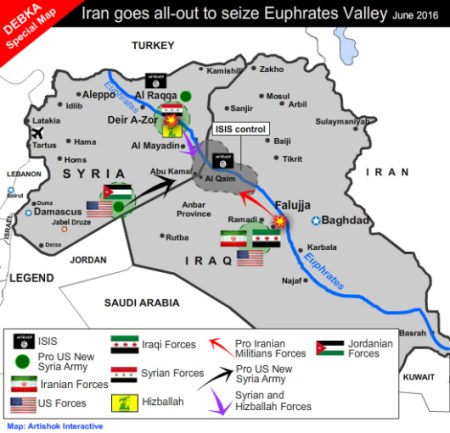
A. After the capture of the Iraqi city of Fallujah from ISIS, the pro-Iranian Shiite militias that participated in the campaign, namely the Popular Mobilization Forces and the Badar Forces, had started moving west toward the Iraq-Syria border (see map).

B. Syrian army and Hizballah forces had embarked on a parallel eastward movement from the vicinity of Deir ez-Zor toward the Iraqi border (see map). Their goal was to link up with the Iraqi Shiite militias on the Syrian-Iraqi border and create a land bridge for the use of all pro-Iranian forces in the two countries.

C. Washington and Amman regarded this development as dangerous and resolved to preempt it.

D. To that end, the New Syria Army was to be sent into action to take the town of Abu Kamal near the border.

E. The commanders assumed that the loss of Abu Kamal would deal a blow to ISIS forces in eastern Syria and plant a pro-American wedge against the linkup of the two pro-Iranian forces and so foil their projected land bridge athwart Iraq and Syria. .

5. On June 21, an ISIS suicide bomber driving a stolen Jordanian military truck blew himself up in the area of Jordan’s al-Rukban base on the Syrian border, in an attempt to avert the coming Abu Kemal attack by inflicting heavy losses on the new militia.  Most of those killed were Jordanian border guards.

6. After the attack, US and Jordanian helicopters airlifted the new militia combatants to a forward base set up at al-Tanf inside Iraq, 230 kilometers from Abu Kamal. They were attacked twice by Russian air strikes in an effort to thwart the pro-US militia’s return to Syria.

7. On June 29, the new Syrian force nonetheless launched its attack, under the direction of Jordanian special operations and military intelligence officers, and the supervision of American elite forces officers at the US-Jordanian war room north of Amman.

8. However, the new Syrian militia was speedily ambushed by ISIS, which apparently was tipped off about the impending attack and its routes of approach. Dozens of Syrian militiamen were killed or wounded, and the force fled from the battlefield. Those unable to flee were shot dead or decapitated.

9. The Jordanian officers who commanded the force were among those who fled.

10. ISIS videos of the battle showed that advanced US military equipment provided the militiamen had fallen into the terrorist organization’s hands, recalling the sights from Iraq of two years ago, when ISIS captured as booty masses of American military hardware from fleeing troops.

The US and Jordan once again failed to establish a Syrian force capable of fighting ISIS. They also lost the chance to gain control of the situation in eastern and southern Syria.

No official in Washington was ready to comment on the battle.

US, Russia aim to ‘decapitate’ Syrian military

May 7, 2016

US, Russia aim to ‘decapitate’ Syrian military, DEBKAfile, May 7, 2016

Assad_dressed_in_military_uniform10.12

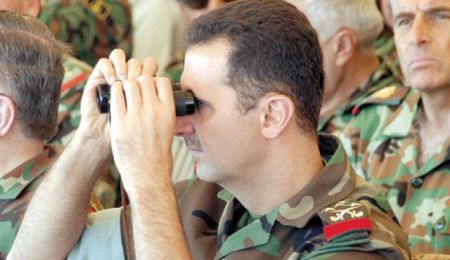
The US, Russia and the Syrian rebels started discussions this weekend over the composition of a list of Syrian generals who will be dishonorably discharged over war crimes they committed during the country’s civil war, DEBKAfile’s military and intelligence sources say in an exclusive report.

The generals will not face trial at an international tribunal over their war crimes. They will be able to leave Syria along with their families and their possessions, just like President Bashar Assad and his clan.

Our sources add that atop the list are the commanders of the Syrian air force who carried out the majority of the Assad regime’s attacks on the rebels over the past five years, including the atrocities of the past few days.

The sources say that the Americans and the Russians intend to “decapitate” the command but leave the military’s structure in its current form while integrating rebel fighters and commanders into its units. The rebel commanders are to receive ranks equivalent to their current ones in the new Syrian army.

DEBKAfile’s exclusive report on Wednesday, May 4, that Russia is ready to discuss the terms for Assad’s ouster surprised and stunned the political and military hierarchy in Tehran. In urgent consultations held the same day, it was decided to dispatch Iran’s deputy foreign minister for Arab and African affairs, Hossein Amir-Abdollahian, to Moscow without delay in order to determine whether the report was accurate.

The senior Iranian diplomat arrived in the Russian capital the following day and met with Deputy Foreign Minister Mikhail Bogdanov, the chief strategist of Russia’s Middle East policy.

Immediately after the meeting, Amir-Abdollahian said Iran will continue supporting Assad and the Syrian people in fighting terrorism, and make efforts to achieve success at intra-Syrian talks, namely the negotiations in Geneva between the Assad regime and the Syrian opposition. The Iranian diplomat did not say a single word about Assad’s future.

However, Moscow was one step ahead of Tehran. Shortly before Amir-Abdollahian deplaned in the Russian capital, Russian Foreign Minister Sergei Lavrov made a bombshell statement, saying “Assad is not our ally, by the way. Yes, we support him in the fight against terrorism and in preserving the Syrian state. But he is not an ally like Turkey is the ally of the United States.”

Our sources said it was a put-down for both Washington and Ankara, whose relationship has deteriorated recently.

DEBKAfile’s military sources report that Assad has not failed to notice the latest developments, and he continues to use Syrian, Iranian and Hizballah forces to attack the rebels in the parts of Aleppo that they control. This comes despite the announcement on Saturday, May 7, by Moscow and the Russian military in Syria that the ceasefire in the northwestern city had been extended by 72 hours.

Assad is keeping the Syrian army in reserve to defend his region against the US-Russian plan to depose him.


