Posted tagged ‘Syria’

Syria – the war can be limited,

May 11, 2016

Syria – the war can be limited

by Thierry Meyssan

| Damascus (Syria) | 11 May 2016

Source: Syria – the war can be limited, by Thierry Meyssan

Every time the Syrian Arab Army beats the jihadists, new combatants arrive in Syria in their thousands. We are therefore forced to admit that this war is being cultivated from the exterior, and that it will last as long as soldiers are sent to die. So we must understand the exterior reasons which continue to maintain it. Then, and only then, can we elaborate a strategy which will spare lives.

The antique «Silk Road» linked Iran with the Syrian coast by crossing Iraq and passing by Palmyra. It is geographically impossible to open other main communication routes across the desert. Consequently, the city has become the central challenge of the war in Syria. After having been occupied for a year by Daesh, it was liberated by the Syrian Arab Army, and has just presented two concerts , televised in Syria and Russia, to celebrate the victory over terrorism.

Syria has been at war now for more than five years. Those who supported the conflict first explained it as an extension of the «Arab Spring». But no-one today uses this explanation. Simply because the governments which developed from these «Springs» have already been overthrown. Far from being a struggle for democracy, these events were no more than a tactic for changing secular régimes to the profit of the Muslim Brotherhood.

It is now alleged that the Syrian «Spring» was hijacked by other forces, and that the «revolution » – which never existed – has been devoured by jihadists who are all too real.

As President Vladimir Putin pointed out, primarily, the behaviour of the Western and Gulf powers is incoherent. It is impossible on a battlefield to combat both jihadists and the Republic at the same time as pretending to take a third position. But no-one has publicly taken sides, and so the war continues.

The truth is that this war has no interior cause. It is the fruit of an environment which is not regional, but global. When war was declared by the US Congress in 2003 with the vote on the Syrian Accountability Act, Dick Cheney’s objective was to steal the gigantic reserves of Syrian gas. We know today that the «Peak Oil» scare did not signal the end of oil reserves, and that Washington will soon be exploiting other forms of hydrocarbons in the Gulf of Mexico. The strategic objectives of the United States have thus changed. As from now, their objective is to contain the economic and political development of China and Russia by forcing them to engage in commerce exclusively by maritime routes which are controlled by their aircraft-carriers.

As soon as he arrived in power in 2012, President Xi Jinping announced his country’s intention to free itself from these constraints and to build two new continental commercial routes to the European Union. The first route would build on the antique traces of the Silk Road, the second would pass via Russia and on to Germany. Immediately, two conflicts appeared – first of all, the war in Syria was no longer directed at régime change, but at creating chaos, while the same chaos broke out, for no better reason, in Ukraine. Then, Belarus contacted Turkey and the United States, expanding the Northern barricade which splits Europe in two. Thus, two endless conflicts block both routes.

The good news is that no-one can negotiate victory in Ukraine against defeat in Syria, since both wars have the same objective. The bad news is that the chaos will continue on both fronts as long as China and Russia have been unable to build another route.

Consequently, there is nothing to be gained by negotiation with people who are being paid to maintain the conflict. It would be better to think pragmatically and accept that these are simply the means for Washington to cut the Silk Roads. Only then will it be possible to untangle the numerous competing interests and stabilise all the inhabited areas.

Why Middle Eastern Leaders Are Talking to Putin, Not Obama

May 9, 2016

Why Middle Eastern Leaders Are Talking to Putin, Not Obama, Politico, Dennis Ross, May 8, 2016

John Hinderaker at Power Line writes,

Dennis Ross is a respected, if thoroughly conventional, expert on the Middle East. A Democrat, he has served in both Republican and Democratic administrations as an adviser and envoy. Ross served in the State Department as Hillary Clinton’s Special Advisor for the Persian Gulf and Southwest Asia. Subsequently, he joined President Obama’s National Security Council staff as a Special Assistant to the President and Senior Director for the Central Region, which includes the Middle East, the Persian Gulf, Afghanistan, Pakistan and South Asia. So when Ross writes, in Politico, that Obama’s foreign policy weakness is hurting American interests, we should take notice.

— DM)

Putin and Middle Eastern leaders understand the logic of coercion. It is time for us to reapply it.

*****************************

The United States has significantly more military capability in the Middle East today than Russia—America has 35,000 troops and hundreds of aircraft; the Russians roughly 2,000 troops and, perhaps, 50 aircraft—and yet Middle Eastern leaders are making pilgrimages to Moscow to see Vladimir Putin these days, not rushing to Washington. Two weeks ago, Israeli Prime Minister Benjamin Netanyahu traveled to see the Russian president, his second trip to Russia since last fall, and King Salman of Saudi Arabia is planning a trip soon. Egypt’s president and other Middle Eastern leaders have also made the trek to see Putin.

Why is this happening, and why on my trips to the region am I hearing that Arabs and Israelis have pretty much given up on President Barack Obama? Because perceptions matter more than mere power: The Russians are seen as willing to use power to affect the balance of power in the region, and we are not.

Putin’s decision to intervene militarily in Syria has secured President Bashar Assad’s position and dramatically reduced the isolation imposed on Russia after the seizure of Crimea and its continuing manipulation of the fighting in Ukraine. And Putin’s worldview is completely at odds with Obama’s. Obama believes in the use of force only in circumstances where our security and homeland might be directly threatened. His mindset justifies pre-emptive action against terrorists and doing more to fight the Islamic State. But it frames U.S. interests and the use of force to support them in very narrow terms. It reflects the president’s reading of the lessons of Iraq and Afghanistan, and helps to explain why he has been so reluctant to do more in Syria at a time when the war has produced a humanitarian catastrophe, a refugee crisis that threatens the underpinnings of the European Union, and helped to give rise to Islamic State. And, it also explains why he thinks that Putin cannot gain—and is losing—as a result of his military intervention in Syria.

But in the Middle East it is Putin’s views on the uses of coercion, including force to achieve political objectives, that appears to be the norm, not the exception—and that is true for our friends as well as adversaries. The Saudis acted in Yemen in no small part because they feared the United States would impose no limits on Iranian expansion in the area, and they felt the need to draw their own lines. In the aftermath of the nuclear deal, Iran’s behavior in the region has been more aggressive, not less so, with regular Iranian forces joining the Revolutionary Guard now deployed to Syria, wider use of Shiite militias, arms smuggling into Bahrain and the eastern province of Saudi Arabia, and ballistic missile tests.

Russia’s presence has not helped. The Russian military intervention turned the tide in Syria and, contrary to Obama’s view, has put the Russians in a stronger position without imposing any meaningful costs on them. Not only are they not being penalized for their Syrian intervention, but the president himself is now calling Vladimir Putin and seeking his help to pressure Assad—effectively recognizing who has leverage. Middle Eastern leaders recognize it as well and realize they need to be talking to the Russians if they are to safeguard their interests. No doubt, it would be better if the rest of the world defined the nature of power the way Obama does. It would be better if, internationally, Putin were seen to be losing. But he is not.

This does not mean that we are weak and Russia is strong. Objectively, Russia is declining economically and low oil prices spell increasing financial troubles—a fact that may explain, at least in part, Putin’s desire to play up Russia’s role on the world stage and his exercise of power in the Middle East. But Obama’s recent trip to Saudi Arabia did not alter the perception of American weakness and our reluctance to affect the balance of power in the region. The Arab Gulf states fear growing Iranian strength more than they fear the Islamic State—and they are convinced that the administration is ready to acquiesce in Iran’s pursuit of regional hegemony. Immediately after the president’s meeting at the Gulf Cooperation Council summit, Abdulrahman al-Rashed, a journalist very well connected to Saudi leaders, wrote: “Washington cannot open up doors to Iran allowing it to threaten regional countries … while asking the afflicted countries to settle silently.”

As I hear on my visits to the region, Arabs and Israelis alike are looking to the next administration. They know the Russians are not a force for stability; they count on the United States to play that role. Ironically, because Obama has conveyed a reluctance to exercise American power in the region, many of our traditional partners in the area realize they may have to do more themselves. That’s not necessarily a bad thing unless it drives them to act in ways that might be counterproductive. For example, had the Saudis been more confident about our readiness to counter the Iranian-backed threats in the region, would they have chosen to go to war in Yemen—a costly war that not surprisingly is very difficult to win and that has imposed a terrible price? Obama has been right to believe that the regional parties must play a larger role in fighting the Islamic State. He has, unfortunately, been wrong to believe they would do so if they thought we failed to see the bigger threat they saw and they doubted our credibility.

Indeed, so long as they question American reliability, there will be limits to how much they will expose themselves—whether in fighting the Islamic State, not responding to Russian entreaties, or even thinking about assuming a role of greater responsibility for Palestinian compromises on making peace with Israel. To take advantage of their recognition that they may need to run more risks and assume more responsibility in the region, they will want to know that America’s word is good and there will be no more “red lines” declared but unfulfilled; that we see the same threats they do; and that U.S. leaders understand that power affects the landscape in the region and will not hesitate to reassert it.

Several steps would help convey such an impression:

⧫ Toughen our declaratory policy toward Iran about the consequences of cheating on the Joint Comprehensive Plan of Action to include blunt, explicit language on employing force, not sanctions, should the Iranians violate their commitment not to pursue or acquire a nuclear weapon;

⧫ Launch contingency planning with GCC states and Israel—who themselves are now talking—to generate specific options for countering Iran’s growing use of Shiite militias to undermine regimes in the region. (A readiness to host quiet three-way discussions with Arab and Israeli military planners would signal we recognize the shared threat perceptions, the new strategic realities, and the potentially new means to counter both radical Shiite and Sunni threats.)

⧫ Be prepared to arm the Sunni tribes in Iraq if Prime Minister Haider al-Abadi continues to be blocked from doing so by the Iranians and the leading militias;

⧫ In Syria, make clear that if the Russians continue to back Assad and do not force him to accept the Vienna principles (a cease-fire, opening humanitarian corridors, negotiations and a political transition), they will leave us no choice but to work with our partners to develop safe havens with no-fly zones.

Putin and Middle Eastern leaders understand the logic of coercion. It is time for us to reapply it.


America’s Outrageous Ultimatum: Syria as the Libya of the Levant

May 7, 2016

America’s Outrageous Ultimatum: Syria as the Libya of the Levant

07.05.2016 Author: Tony Cartalucci

Source: America’s Outrageous Ultimatum: Syria as the Libya of the Levant | New Eastern Outlook

How the United States presumes to possess the authority to determine the fate of a sovereign nation thousands of miles from its own shores in the Middle East is never explained by US Secretary of State John Kerry when he recently announced a new ultimatum leveled at Damascus. Nor is it explained why Syria should capitulate to US demands to begin a political transition that has demonstrably left other nations across the Middle East and North Africa (MENA) divided, destroyed, and safe-havens for state-sponsored terrorism years after “successful” US-backed regime change has been achieved – Libya most notably.

Yet despite all of this, according to the Associate Press (AP) in their article, “Kerry warns Assad to start transition by Aug. 1  or else,” the United States fully expects Damascus to concede to a “political transition” engineered by Washington, leaving the nation in the hands of verified terrorists linked directly to the political and militant forces currently laying waste to Libya and those nations that put them into power.

The article reports:

Secretary of State John Kerry warned Syria’s government and its backers in Moscow and Tehran on Tuesday that they face an August deadline for starting a political transition to move President Bashar Assad out, or they risk the consequences of a new U.S. approach toward ending the 5-year-old civil war.   

AP would also claim:

…it’s unlikely that the Obama administration, so long opposed to an active American combat role in Syria, would significantly boost its presence beyond the 300 special forces it has authorized thus far in the heart of a U.S. presidential election season. More feasible might be U.S. allies like Saudi Arabia giving the rebels new weapons to fight Assad, such as portable surface-to-air missiles.

Again, the US is making demands of “Syria’s government and its backers in Moscow” while it is openly allied with Saudi Arabia who is admittedly backing US State Department-listed foreign terrorist organizations including the Al Nusra Front – quite literally Al Qaeda in Syria and Iraq.

This point has inconveniently surfaced even across the West’s own media, including the Independent in an article titled, “Turkey and Saudi Arabia alarm the West by backing Islamist extremists the Americans had bombed in Syria.” In it states that:

Turkey and Saudi Arabia are actively supporting a hardline coalition of Islamist rebels against Bashar al-Assad’s regime that includes al-Qaeda’s affiliate in Syria, in a move that has alarmed Western governments. 

The two countries are focusing their backing for the Syrian rebels on the combined Jaish al-Fatah, or the Army of Conquest, a command structure for jihadist groups in Syria that includes Jabhat al-Nusra, an extremist rival to Isis which shares many of its aspirations for a fundamentalist caliphate.

Despite superficial attempts to portray Al Nusra at “arms length” from Saudi Arabia, and thus from Saudi Arabia’s closest and most valuable ally, Washington, the inseparable nature of those the US and Saudi Arabia are supporting and those they claim not to support is documented fact.

America Essentially Demands Syria’s Surrender to Al Qaeda

Considering the verified nature of the so-called “opposition” in Syria and the verifiable nature of what US foreign policy has done to Libya – leaving it to this day in the hands of state-sponsored terrorist organizations including the notorious “Islamic State” or ISIS – what the US is essentially demanding of Syria and its allies is capitulation to Al Qaeda.

It is a surreal full-circle US foreign policy has made, from first creating Al Qaeda in the late 1980’s jointly with Saudi Arabia and elements within the Pakistani government, then claiming to have been struck egregiously by the terrorist organization on September 11, 2001 triggering over a decade of very profitable war, before finally arriving in Libya and Syria beginning in 2011 where once again US politicians found themselves standing shoulder-to-shoulder with literal commanders of Al Qaeda and its affiliates, waging proxies wars against their collective enemies.

Indeed, US Senator John McCain would find himself in a Libya utterly devastated by NATO at the end of 2011, shaking hands with the commander of US State Department-listed foreign terrorist organization, the Libyan Islamic Fighting Group (LIFG) – literally Al Qaeda in Libya. The LIFG commander, Abdelhakim Belhadj, had at one point been arrested by the US before being handed over to the Libyan government and imprisoned for his terrorism.

Syria’s Clear Course of Action

Syria is undoubtedly being overrun by heavily armed and extremely dangerous terrorists backed by foreign powers. These are terrorists that have proven already in Libya, that upon coming to power, they will first carry out genocide against their ethnic and political enemies, then transform Syria into a devastated wasteland and springboard for terrorism and proxy war elsewhere in the region – likely Iran and then southern Russia.Syria’s only clear course of action is to resist and defeat these terrorist factions and restore order within the nation’s boundaries. It must do this by interdicting terrorists and their supplies along the Turkish-Syrian border in the north, and the Jordanian-Syrian border in the south. It is abundantly clear that the terrorists operating within Syria cannot sustain their fighting capacity without significant and constant logistical support from their foreign sponsors beyond Syria’s borders. This fact alone, undermines the legitimacy of the so-called “uprising” and “civil war” in Syria that upon closer examination is clearly a proxy invasion.

The US’s Clear Course of Action

The US itself, in its own military manuals (MCWP 3-35.3) regarding combat operations, states in reference to defeating terrorism that:

In countering this threat, [it should be determined] whether it is internally or externally directed terrorism. Terrorism rooted externally must be severed from its roots. Against internal terrorism, [attempts should be made] to penetrate the infrastructure and destroy the leadership of the terrorist groups.

The US has already boasted of having struck hard at the leadership of various terrorist groups in Syria it claims to be at war with, yet these groups appear unfazed. This is precisely because the terrorism is being direct externally, from Turkey and Jordan where the US itself has based its forces for its ongoing Syrian operations. The clear and obvious course of action for the US is to identify the “roots” of this externally directed terrorism and “sever” them.

However, the US refuses to do this. Instead, even as it continues its feigned war against terrorism in Syria, it is doubling down on support for its proxies, including Turkey, Jordan, and Saudi Arabia, who in turn, are harboring, arming, funding, training, and directly supporting the very terrorist groups the US claims to be fighting.

US Secretary of State John Kerry threatens a “new approach” by the US in Syria, if Syria does not capitulate to what is essentially the end of its existence as a functioning nation-state. The “new approach” is likely simply the continuation of existing plans to incrementally invade and occupy Syrian territory, particularly in the east through the infiltration of Iraq-based Kurds operating under US proxy Masoud Barzani, as well as to trigger a cross-border incident north of Aleppo by using their ISIS proxies to attack Turkish targets – reminisced of staged attacks Ankara had planned earlier during the war to justify the invasion and occupation of northern Syria.

Warning the world of the “success” America’s previous “political transitions” have wrought in Libya or Iraq, and raising awareness of the current nature of US-Saudi support for Al Qaeda and other terrorist groups in Syria today, is essential in undermining the legitimacy and authority upon which the US is attempting to base its demands directed at Damascus. The demands are illegitimate and the authority they are made with constitutes not principles nor rule of law, but naked and unjust aggression that must be resisted today lest it succeed and set a precedent for further acts of injustice against other nations tomorrow.
http://journal-neo.org/2016/05/07/america-s-outrageous-ultimatum-syria-as-the-libya-of-the-levant/

Gun attack on Turkish editor outside court during his trial for exposing Turkey-Syria weapons convoy( video )

May 6, 2016

Gun attack on Turkish editor outside court during his trial for exposing Turkey-Syria weapons convoy

Published time: 6 May, 2016 14:42 Edited time: 6 May, 2016 15:48

Source: Gun attack on Turkish editor outside court during his trial for exposing Turkey-Syria weapons convoy — RT News

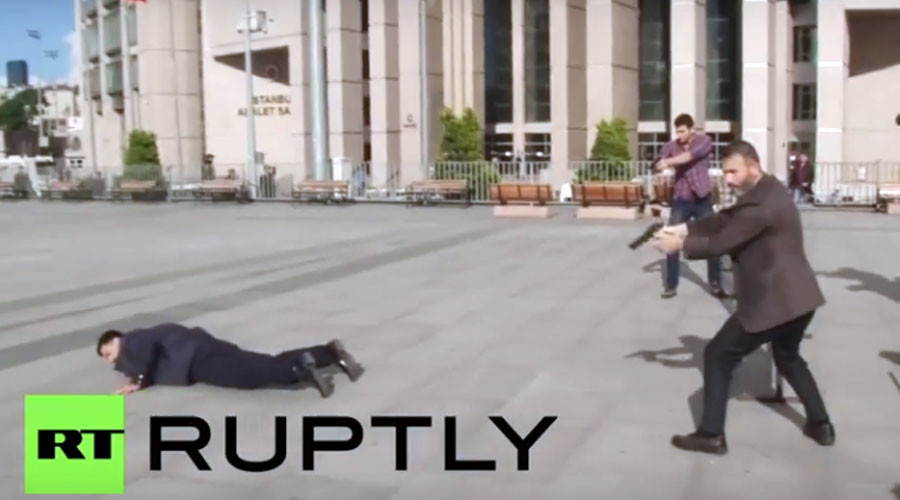
An assailant has tried to shoot the editor-in-chief of Turkey’s Cumhuriyet newspaper Can Dündar , before the court was to announce the verdict on his case, Reuters reported, citing witnesses. The paper had published reports implicating the Turkish government in having links with extremists.

The gunman shouted “traitor” before firing at least three shots at the journalist, an eyewitness told Reuters, adding that Dündar, who was unarmed, was not injured in the incident.

Reportedly at least one journalist who was covering Dündar’s trial was injured, however.

READ MORE: ‘Govt. trying to hide’: Turkey closes then postpones trials of two leading opposition journalists

Dündar, 54, and his colleague, chief of Ankara bureau of Cumhuriyet, Erdem Gul, 49, stand accused of trying to topple the government, something they allegedly attempted to do in May 2015 by publishing a video purporting to reveal truckloads of arms shipments to Syria overseen by Turkish intelligence.

The Cumhuriyet report in May 2015 claimed that Turkey’s state intelligence agency was helping to transfer weapons to Syria by trucks.

Both Dündar and Erdem spent 92 days in jail, almost half of that time in solitary confinement, before the Constitutional Court ruled in February that their pre-trial detention was a violation of their rights.

READ MORE: Jailed Turkish journalists say arrests were aimed at sending ‘clear message’ to the press

President Recep Tayyip Erdogan repeatedly stated that the trucks really belonged to the MIT intelligence agency, but were carrying aid to Turkmens in Syria, who are fighting both Assad’s forces and Islamic State (IS, formerly ISIS/ISIL).

The journalists remain under judicial supervision and are banned from leaving the country, according to the state-run Anatolia news agency.

READ MORE: Erdogan: ‘I don’t respect court ruling to free Cumhuriyet journalists’

Their detention fuelled criticism from international human rights groups, as well as from the EU. US Vice President Joe Biden said that Turkey was setting a poor example for the region by intimidating the media.

The journalists’ arrests and trial prompted numerous protests across Turkey.

Cessation of hostilities in Aleppo to be announced in coming hours

May 3, 2016

Cessation of hostilities in Aleppo to be announced in coming hours – Lavrov

Published time: 3 May, 2016 11:55 Edited time: 3 May, 2016 13:34

Source: Cessation of hostilities in Aleppo to be announced in coming hours – Lavrov — RT News

A cessation of hostilities in the Syrian city of Aleppo will be announced in the coming hours, Russian Foreign Minister Sergey Lavrov said on Tuesday after talks with UN Syria envoy Staffan de Mistura.

Lavrov added that the US and Russian militaries are currently holding talks on the Aleppo ceasefire.
“I hope that in the coming hours such an agreement will be announced,” the minister said after the meeting in Moscow.

According to UN special envoy Staffan de Mistura, the stalled Syria peace talks could be resumed if an Aleppo ceasefire is agreed. He added that there is now a possibility to relaunch the ceasefire by extending local truces.

I have a feeling and a hope that we can relaunch this,” De Mistura said. “We all hope that … in a few hours we can relaunch the cessation of hostilities. If we can do this, we will be back on the right track.”

Lavrov also announced the creation of a new Russian-US monitoring center in Geneva, Switzerland, which will oversee ceasefire violations in Syria.

“We are grateful to the UN for its help in solving logistical issues on the creation of this center in Geneva where the militaries of the two countries will discuss face-to-face specific developments on the ground,” he said.

Moscow is also urging Washington to distinguish between extremists and the Syrian opposition, Lavrov added.

To make the ceasefire work and make it inclusive, our partners must do everything possible to remove the moderate opposition, which relies on foreign support, from the positions occupied by the terrorists.

Lavrov also called for an extended ceasefire in Syria. “Of course, there are separate groups who would like to undermine the cessation of hostilities, to provoke an escalation [of the crisis]. We can’t let them do it,” he said.

Lavrov also warned against any calls for a ground operation in Syria.

Russia is concerned, and not just us alone, about Turkey’s shelling of the Syrian territory, continued creation of certain security zones in Syria, not to mention the increasing calls for a ground operation.”

Moscow is convinced “that such calls come from those who are not interested in the real political settlement [of Syrian crisis] and who rely on a military solution.”

“We are convinced that this is the way to a catastrophic situation, and such appeals should be stopped,” Lavrov said.

In April, the Geneva peace talks were gridlocked after the Saudi-backed Syrian opposition withdrew from the negotiations, citing the deteriorating situation in Aleppo.

Acknowledging the increasingly shaky state of the ceasefire in Syria, de Mistura then expressed hope that Russia and the US could breathe new impetus into the process, halting the fighting on the ground and solidifying the political transition process.

On Monday, the Free Syrian Army refused to recognize partial ceasefires or local lulls in violence, claiming that if the UN-backed truce was not implemented in full, the group would reserve its right to withdraw from the Geneva talks and respond to any attacks.

Muslim Countries Slam Israel—For Protecting them

April 28, 2016

Muslim Countries Slam Israel—For Protecting them, Front Page MagazineP. David Hornik, April 28, 2016

OIC

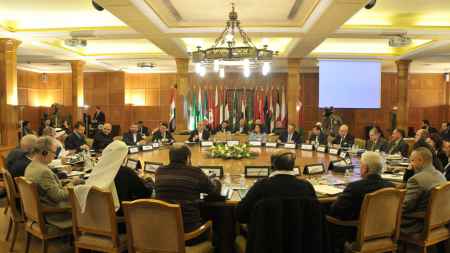
On Tuesday the Organization of Islamic Cooperation held an “emergency,” “extraordinary” meeting in Jeddah, Saudi Arabia.

The OIC includes violence-wracked countries and failed states like Syria, Iraq, Yemen, Libya, Afghanistan, Nigeria, and others, as well as severely poor and dysfunctional countries like Burkina Faso, Somalia, Bangladesh, and others. Not a single one of the organization’s 57 countries is a frontrunner in terms of freedom and prosperity, and most are far below that level.

But the topic of Tuesday’s “emergency meeting” was that on April 17 Israeli prime minister Benjamin Netanyahu said that: “Israel will never withdraw from the Golan Heights.”

The meeting’s final communiquéCondemns strongly Israel, the occupying power, and its macabre acts to change the legal status, demographic composition, and institutional structure of the occupied Syrian Golan.” It also “expresses unconditional support for the legitimate right of the Syrian people to restore their full sovereignty on the occupied Syrian Golan.”

The Arab League—whose 22 member states make up a sizable chunk of the OIC—had already weighed in on Netanyahu’s words on April 21, calling for a special criminal court to be set up and put Israel on trial for the transgression.

The Golan was controlled by Syria from 1948 to 1967, during which time Syrian gunners often fired at the Israeli communities below and forced their residents to sleep in bomb shelters. Israel captured the Golan from Syria in the 1967 Six Day War—and fortunately, since then, has kept it and developed it.

Today, with Syria devolved into Hobbesian war and fragmentation, the Heights are all the more strategically vital to Israel, and the idea of trading them for “peace” has—at least in the Israeli discourse—died a well-deserved death. The Golan, by the way, constitutes less than 1 percent of Syrian territory, and Syria’s loss of it almost 50 years ago is the least of its problems.

But there is further irony in the Arab League’s and the OIC’s reactions to Netanyahu’s words.

At present, Israel is engaged in tight strategic cooperation with two of its neighbors—Egypt and Jordan—against ISIS, one of the two most dangerous of the entities now fighting it out in Syria. More broadly, according to numerous reports, as well as hints dropped by Israeli and some Arab leaders, Israel and Sunni Arab states—led by Saudi Arabia—are also working together against the Iranian axis, the second of the two most threatening forces now operating in Syria.

Not only, then, do the Arab and Muslim countries as corporate bodies denounce Israel as a “macabre” criminal even as it acts as a crucial ally of not a few of these countries. They also react with outrage to the very Israeli policy—retaining the Golan—that keeps Israel strong in the face of the threats emanating from Syrian territory.

The signers of Tuesday’s communiqué in Jeddah know that there no longer exists a “Syrian people” to which sovereignty on the Golan could be restored. Some of the signers also know that a strong Israel is now one of the guarantors of their survival; and more specifically, that Israel’s presence on the Golan helps shield Jordan from imminent peril.

That Netanyahu’s words about keeping the Golan continue to spark fierce denunciations, then, reflects something deeper: an ongoing, profound antipathy to Israeli—that is, Jewish—control of any land in what is seen as, by rights, a Muslim domain. From that standpoint, even for Israel to hold onto a sliver of what used to be Syria, won in a defensive war almost half a century ago, is intolerable.

That same antipathy was on display earlier this month when seven Arab countries—including Egypt—got UNESCO to pass a particularly vicious resolution negating any Jewish connection to Judaism’s most sacred sites in Jerusalem, declaring them exclusively Muslim sites, and going so far as to accuse Israel of “planting Jewish fake graves in…Muslim cemeteries.” (Among the “yea” votes: France, Spain, and Sweden.)

These rhetorical eruptions suggest that, despite the growing behind-the-scenes collaborations, Israel remains very far from being accepted and legitimized in the region. Its best bet is to keep building its power, which gets some of its neighbors to deal with it pragmatically and rationally.

As for the Arab and Muslim countries, their continuing hang-up with the geographically tiny Jewish state, and repeated displays of ganging up on it in righteous fury, are unedifying and linked to their inability to tackle their real problems.

Why Israel Should Keep the Golan Heights

April 27, 2016

Why Israel Should Keep the Golan Heights, American ThinkerSteve Postal, April 27, 2016

On Sunday, April 17, Israeli Prime Minister Benjamin Netanyahu (“Bibi”) convened a cabinet meeting on the Golan Heights stating that the “time has come for the international community to finally recognize that the Golan Heights will remain under Israel’s sovereignty permanently.” He spoke these words from Ma’aleh Gamla, next to the ruins of the historic Gamla, a Judean city to which the Romans laid siege in 67 CE during the Great Revolt (also known as the First Jewish/Roman War) (66-73 CE). In this battle, Roman soldiers slaughtered 4,000 Jews, while another 5,000 perished having “thrown themselves down” a ravine to their deaths in either an attempt to flee or in a mass suicide (Josephus, The Wars of the Jews, 4:1:9:80).

Bibi’s statements at Gamla followed reports that the United States and Russia were working on a draft peace resolution to the Syrian Civil War that would label the entire Golan Heights as Syrian territory. On April 19, U.S. State Department John Kirby stated “The US position on the issue is unchanged…Those territories are not part of Israel and the status of those territories should be determined through negotiations.” The Organization of Islamic Cooperation (OIC), the Arab League, Syria, and Germany rejected Netanyahu’s comments.

Despite most of the world seemingly poised to throw Israel under the bus over this issue, Israel should continue to assert its sovereignty over the Golan. Israel has a stronger claim to the Golan than Syria does, the Golan is of essential strategic value to Israel and the free world, and given increased threats and development of the land, that value has only appreciated.

Israel has a Stronger Claim to the Golan than Syria

Israel gained control of two-thirds of the Golan Heights following Syria’s defeat in the 1967 Six-Day War. (Israel later applied Israeli law to these territories in a de-facto annexation in 1981.) Syria gained independence in 1945. Before that, the Golan was part of the French Empire (1923-1945), jointly administered between the British and French Empires (1917-1923) and part of the (Turkish) Ottoman Empire for approximately 400 years preceding 1917. So, Syria had control of the Israeli-administered part of the Golan for 22 years (1945-1967), while Israel has had it for 49 years (1967 to the present). Israel has a stronger claim to the Israeli-controlled part of the Golan, given that it has been Israeli longer than it has been Syrian.

The Great Strategic Value of the Golan…

Enemies of Israel, both past and present, have used the high elevation of the Golan Heights against her. The ancient, pre-Arab Assyrian Empire literally looked down on ancient northern kingdom of Israel from the Heights. Assyria’s conquest of Israel in 722 BCE was launched from the Golan.

Fast-forward almost 2,700 years, and the Golan served similar aims for Israel’s enemies. Prior to the 1967 Six-Day War, modern Syria, like ancient Assyria, held the high ground over Israel from the Heights. (See cross-section and topographical maps on page 6 and 18, here). This topography enabled Syria to shell Israeli towns with ease, and sponsor Fatah fedayeen attacks from the Golan. Since gaining parity in elevation with the Syrians following the Six-Day War, the Syria/Israel border has been largely quiet. Given the many other conflicts in the Middle East, some of which I list here, that is a good thing for the world as well as Israel.

…Has Only Appreciated Given Current Threats

Israel’s (and the free world’s) enemies have grown stronger, and closer in proximity to Israel since the outbreak of the Syrian Civil War. Therefore, giving up the Golan would be foolish, and would most likely result in it being controlled by forces hostile to Israel and the West. The Islamic State and other jihadist groups, in addition to forces aligned with Syrian government (including Hizb’allah and the Iranian Revolutionary Guards (IRG)) are all vying for territory adjacent to the Israeli-controlled Golan Heights (see map). On April 22, the Islamic State captured the Salam al Jawlan Dam, approximately 17 miles away from Gamla. This victory puts the Islamic State closer to Israel than Tijuana, Mexico is to San Diego, California.

Hizb’allah has increased its presence in Syria in the past few years. During the Syrian Civil War, Israel killed Hizb’allah commanders/arch-terrorists Imad Mughniyeh in Quneitra (a town in the Syrian-controlled part of the Golan) and Samir Kuntar right outside of Damascus, in addition to six Hizb’allah fighters in Quneitra. A January 2016 article estimated that Hizb’allah has 8,000 troops in Syria. Hizb’allah is reportedly building a fortified base in Syria housing long-range missiles to use to attack Israel in a future war. Syria has also supplied Hizb’allah with tanks to create an armored division. Despite anti-smuggling efforts by Israel, Hizb’allah currently has between 100,000 to 130,000 rockets total (dispersed in Lebanon and Syria) that are more guided and precise, in addition to up to 12 Yakhont anti-ship cruise missiles with which to strike Israel. Hizb’allah is also preparing to invade Israel in a future war. If Israel relinquishes the Golan, there is a greater risk that Israel would be fighting Hizb’allah in both Lebanon and the Heights. On the other hand, Israel’s retention of its share of the Heights would serve as a strategic advantage in a future war.

Iran has also expanded its presence in Syria, not only through its proxy Hizb’allah. In January 2015, Israel reportedly killed an Iranian Revolutionary Guards (IRG) general on the Syrian side of the Golan, while in October 2015 the Islamic State killed a senior IRG commander in Aleppo. In October 2015, the Wall Street Journal estimated that approximately 20,000 foreign Shiite fighters were fighting in Syria, backed by Iran and Hizb’allah. These include Afghanis. Since the onset of the Syrian Civil War, Iran is increasingly encouraging its citizens, including those of Afghani origin, to buy property in Syria in strategic places, including Homs and Damascus. Just as Iran transferred populations to settle Lebanon in the 1980s during the creation of Hizb’allah, it is now aiding its people in settling Syria. Rather than seeing Iran as a stabilizing force in the region in the fight against the Islamic State, most Israelis, including Israeli Defense Minister Moshe Ya’alon, and Americans alike see Iran as an increasingly destabilizing force. Israel and the world need the Golan to balance against growing Iranian hegemony.

Water Remains a Vital Concern

Giving the Golan to Syria would once again place Israel’s enemies in a position to threaten its water supply via border skirmishes and diversion of water, as Syria did in the 1950s and during the War over Water (1964-1967). Israel relies on Lake Kinneret/the Sea of Galilee as the source of a significant amount of its water, and of its National Water Carrier.

The Golan is now an Integral Part of the Israeli Economy

Israel has developed the Golan to be a vital part of its economy that produces goods and services for both Israel and the world, including several wineries, a brewery, a mineral water distribution company, and a ski resort on Mt. Hermon. It also contains vast lands for agriculture, meat, and dairy production. Israelis and world travelers travel to the Golan for tourism, and about 20,000 Israelis live there. The Golan is also thought to contain a great amount of oil and natural gas deposits. Once tapped into, these resources could make Israel more energy self-sufficient, as well as provide the West with reliable sources of energy. It doesn’t make sense that Israel would uproot all of this only to hand the land over to its sworn enemies.

Israel is the Protector of the Golan’s Rich Archaeological Sites

The Golan also contains several archeological sites greatly cherished by the free world. Many of these sites date back to Antiquity and are painstakingly excavated and safeguarded by Israel, including: Gamla, Hippos/Sussita, Katzrin Ancient Village, the ruins of the Byzantine Christian monastery at Kursi, Nimrod Fortress, Um el-Kanatir, and the ancient Stonehenge-like monument Gilgal Refaim. If these sites were no longer protected by Israel, they could find themselves in the hands of a jihadist group like the Islamic State, which destroyed world-renowned archeological sites like the Temple of Ba’al, Jonah’s Tomb, and the ancient ruins of Nimrud and Nineveh.

To Whom Would Israel Give the Golan Back?

On a practical level, it is difficult for Israel to return the Golan to Syria because Syria effectively no longer exists. It is unlikely that the world powers will succeed in reconstructing Syria as it was before the civil war. The Islamic State controls about half of the country in the east, and pockets in the west. The Kurds control most of the north. The Syrian government doesn’t even control all that remains, with opposition forces (including jihadist groups) and Druze maintaining autonomous regions in the west.

Since the Syrian government does not control all of Syria, it cannot guarantee that other groups won’t use the Golan against Israel. But asking the Syrian government to guarantee such a thing, even if Syria were intact, is ridiculous. Syria is Israel’s historic archenemy, and has supported and harbored jihadist groups such as Fatah, Hamas, Hizb’allah, and the Iranian Revolutionary Guards (IRG).

Conclusion

Several Israeli politicians have opposed the prospect of increased Iranian and Hizb’allah presence in Syria following a future peace deal, and believe that these two pose a greater threat given their capabilities than the Islamic State. But purging Iran and Hizb’allah from Syria in a peace deal is a pipe dream given Syria’s alliances with Iran and Hizb’allah, Russia’s alliance with Iran, and the United States’ détente with Iran. Unless the goal of a Syrian peace deal is to open up yet another jihadist front against Israel, any final deal should preserve the right of Israel to retain its two-thirds of the Golan Heights. Enshrining this right in international law would strengthen the security of Israel and the free world. Continued Israeli sovereignty in the Golan is of great strategic value to Israel and the West, especially in these troubled times.

 

Top Senate Democrat chides Netanyahu over ‘untimely’ Golan remarks

April 22, 2016

Top Senate Democrat chides Netanyahu over ‘untimely’ Golan remarks, Jerusalem Post, April 22, 2016

(So Netanyahu should remain silent when Obama and Putin propose to give Golan to Israel’s long time enemy, Syria? — DM)

Sen. Ben Cardin, the top Democrat on the Senate Foreign Affairs Committee, counseled Israel to focus more on peace with the Palestinians.

Sen. Ben Cardin, the top Democrat on the Senate Foreign Affairs Committee, said declaring Israeli ownership of the Golan Heights was not “timely” while Syria was mired in civil war.

He counseled Israel to focus more on peace with the Palestinians.

“Syria is in a state of war, the whole area is in flux,” Cardin, D-Md., said Thursday when he was asked about Prime Minister Benjamin Netanyahu’s declaration this week that “the Golan Heights will forever remain in Israel’s hands.”

“I don’t think it’s timely to figure out what’s happening in the north when there is an active war in Syria,” Cardin said of Netanyahu.

“Ultimately you’re going to need to have some type of recognition factor and you don’t have a government you can negotiate with and talk with in Syria,” said Cardin, who was meeting foreign policy reporters during a break from Senate votes.

The Obama administration this week reiterated longstanding US policy that the strategic plateau captured by Israel in the 1967 Six-Day War was not part of Israel, and that its fate should be determined through negotiations.

“I would love to see a peace process and deal with the West Bank and Gaza,” he said. “And that to me is the most important chapter for Israel right now, is to advance the peace process toward a two-state solution for the Palestinians and Israelis. That to me is the most urgent need.”

Cardin is close to pro-Israel groups and has made clear in the past that he believes it is wrong to place the burden on Israel to renew talks, saying that the Palestinians must end incitement and return to talks with Israel suspended in 2014.

He was one of just four Senate Democrats who voted last year against the Iran nuclear deal, which Netanyahu vehemently opposed, and the senator was in the region just weeks ago, and met with Netanyahu.

Cardin also said he favors renewing the Iran Sanctions Act, due to expire this year, although Obama administration officials fear its renewal would rankle Iran and undercut the sanctions relief for nuclear rollback deal.

Cardin said there was broad agreement in Congress that the act needs renewing in order to keep in place sanctions that would be revived if Iran violates the deal. Obama administration officials say the president has the discretion to kick in sanctions should he need to.

The senator said he also hopes to pass new sanctions against Iran for testing ballistic missiles, a violation of UN Security Council resolutions. Current Republican proposals to renew the Iran Sanctions Act or to sanction Iran for its missile testing seem aimed at undercutting the Iran deal, Cardin said, a path he opposes even though he voted against the deal.

Syrian official answers Netanyahu: We will use all available means to recapture the Golan

April 17, 2016

Syrian official answers Netanyahu: We will use all available means to recapture the Golan, Jerusalem PostMaayan Groisman, April 17, 2016

(Please see also, Netanyahu to battle Obama, Putin over the Golan. — DM)

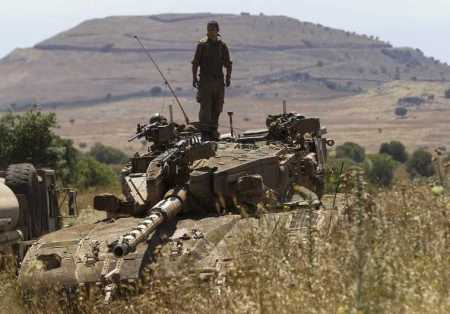
ShowImage (24)An IDF soldier stands atop a tank near Alonei Habashan on the Golan Heights, close to the ceasefire line between Israel and Syria. (photo credit:REUTERS)

In a first reaction to Prime Minister Benjamin Netanyahu’s declaration that “Israel will never leave the Golan Heights,” Syrian Foreign Minister Faisal al-Miqdad said Sunday that Syria is prepared to use every possible means to recapture the area, including military means.

“The Syrian Golan is an occupied Arab land according to the UN Security Council’s resolutions, and the presence of the United Nations Disengagement Observer Forces proves this,” Miqad said in an interview with the Lebanon-based TV channel al-Mayadeen.

“We have never renounced the resistance and we are ready to recapture the Golan in all possible ways, including military ways. Israel wants to provoke us, but we will never surrender,” Miqdad added.

Regarding Syria’s cooperation with Russia, he stated that “the daily communication between the Syrian leadership and the Russian leadership continues. We believe that the Russian policy leans on the international law and on UN Security Council resolutions.

“Neither Russian President Vladimir Putin nor any other president in the world would have accepted the indecent Israeli logic regarding the Golan,” Miqdad argued.

At the opening of a special cabinet meeting held for the first time ever on the Golan Heights on Sunday, PM Netanyahu declared: “The time has come after 40 years for the international community to finally recognize that the Golan Heights will remain forever under Israeli sovereignty.”

U.S. Delivers 3,000 Tons Of Weapons And Ammo To Al-Qaeda & Co in Syria

April 9, 2016

U.S. Delivers 3,000 Tons Of Weapons And Ammo To Al-Qaeda & Co in Syria

by b

April 08, 2016

Source: M of A – U.S. Delivers 3,000 Tons Of Weapons And Ammo To Al-Qaeda & Co in Syria

The United States via its Central Intelligence Agency is still delivering thousands of tons of additional weapons to al-Qaeda and others in Syria.

The British military information service Janes found the transport solicitation for the shipment on the U.S. government website FedBizOps.gov. Janes writes:

The FBO has released two solicitations in recent months looking for shipping companies to transport explosive material from Eastern Europe to the Jordanian port of Aqaba on behalf of the US Navy’s Military Sealift Command.Released on 3 November 2015, the first solicitation sought a contractor to ship 81 containers of cargo that included explosive material from Constanta in Bulgaria to Aqaba.

The cargo listed in the document included AK-47 rifles, PKM general-purpose machine guns, DShK heavy machine guns, RPG-7 rocket launchers, and 9K111M Faktoria anti-tank guided weapon (ATGW) systems. The Faktoria is an improved version of the 9K111 Fagot ATGW, the primary difference being that its missile has a tandem warhead for defeating explosive reactive armour (ERA) fitted to some tanks.

The Janes author tweeted the full article (copy here).

One ship with nearly one thousand tons of weapons and ammo left Constanta in Romania on December 5. The weapons are from Bulgaria, Croatia and Romania. It sailed to Agalar in Turkey which is a military pier and then to Aqaba in Jordan. Another ship with more than two-thousand tons of weapons and ammo left in late March, followed the same route and was last recorded on its way to Aqaba on April 4.

We already knew that the “rebels” in Syria received plenty of weapons during the official ceasefire. We also know that these “rebels” regularly deliver half of their weapon hauls from Turkey and Jordan to al-Qaeda in Syria (aka Jabhat al-Nusra):

Hard-core Islamists in the Nusra Front have long outgunned the more secular, nationalist, Western-supported rebels. According to FSA officers, Nusra routinely harvests up to half the weapons supplied by the Friends of Syria, a collection of countries opposed to Assad, ..

U.S. and Turkey supported “rebels” took part in the recent attack on Tal al-Eis against Syrian government forces which was launched with three suicide bombs by al-Qaeda in Syria. This was an indisputable breaking of the ceasefire agreement negotiated between Russia and the U.S. It is very likely that some of the weapons and ammunition the U.S. delivered in December were used in this attack.

Millions of rifle, machine-gun and mortar shots, thousands of new light and heavy weapons and hundreds of new anti-tank missiles were delivered by the U.S.. Neither Turkey nor Jordan use such weapons of Soviet provenience. These weapons are going to Syria where, as has been reported for years by multiple independent sources, half of them go directly to al-Qaeda.

From historic experience we can be sure that the consequence of this weaponizing of takfiris will be not only be the death of “brown people” in the Middle East, but also attacks on “western” people and interests.

Skyscrapers falling in New York and hundreds of random people getting killed in Paris, Brussels, London and (likely soon) Berlin seem not enough to deter the politicians and “experts” that actively support this criminal war on Syria and its people.