Posted tagged ‘Syria’

Syrian Brotherhood Stands Nearer to ISIS Than to U.S.

September 17, 2014

Syrian Brotherhood Stands Nearer to ISIS Than to U.S., The Investigative Project on Terrorism, Ravi Kumar, September 16, 2014

(Wouldn’t it be grand if our dear leaders knew what they are doing, why and what they hope to accomplish? — DM)
1063

Yusuf Al Qaradawi, an influential Brotherhood cleric living in Qatar, joined in criticizing the American military campaign against ISIS. “I totally disagree with [ISIS] ideology and means,” he wrote on Twitter, “but I don’t at all accept that the one to fight it is America, which does not act in the name of Islam but rather in its own interests, even if blood is shed.”

***************

While the United States tries to build a coalition of Arab allies to join the fight against the terrorist group ISIS, now known as the Islamic State, one group which stands to benefit directly is coming out against Western intervention and expressing unity with other radical jihadists.

A Syrian Muslim Brotherhood spokesman says attacks on the Islamic State by the United States and its allies are not the answer.

“Our battle with ISIS is an intellectual battle,” Omar Mushaweh said in a statement published Sept. 9 on the Syrian Brotherhood’s official website, “and we wish that some of its members get back to their sanity, we really distinguish between those in ISIS who are lured and brainwashed and they might go back to the path of righteous, and between those who has foreign agendas and try to pervert the way of the [Syrian] revolution.”

Rather, the first target for any Western intervention should be dictator Bashar al-Assad’s regime, Mushaweh asserts, according to a translation of his comments by the Investigative Project on Terrorism.

Such comments should reinforce Western concerns about the Syrian Brotherhood, whose members are prominent among the Free Syrian Army (FSA), one of the supposedly moderate factions in the Syrian civil war which receive U.S. training and weapons. And it shows the challenge of finding truly moderate allies on the ground in Syria. Compared to ISIS, the FSA might be considered moderate. Then again, ISIS was so ruthlessly violent that al-Qaida disavowed the group in February.

In addition, the Syrian Brotherhood openly mourned the death last week of a commander in Ahrar Al Asham, a Syrian faction with ties to al-Qaida.

Mushaweh’s views about the U.S. intervention are shared by other Brotherhood members. Another Brotherhood leader, Zuher Salem, minimized the ISIS threat by comparing current American rhetoric to that which preceded the 2003 Iraq invasion.

“All of these tales that are being told by America about the primitive, terrorist and threatening nature of the Islamic State are similar to the tales that have been told in regard to the Weapons of Mass Destruction in Iraq, and about the crimes against humanity,” Salem wrote in an article published Sept. 13 by the Arab East Center, a think tank associated with the Muslim Brotherhood. “It is trifling to race with others to condemn terrorism and the killing of the American journalist, because we should be aware the aim of this anti ISIS coalition is to pave the way for an Iranian hegemony over the region.”

Yusuf Al Qaradawi, an influential Brotherhood cleric living in Qatar, joined in criticizing the American military campaign against ISIS. “I totally disagree with [ISIS] ideology and means,” he wrote on Twitter, “but I don’t at all accept that the one to fight it is America, which does not act in the name of Islam but rather in its own interests, even if blood is shed.”

While both are Sunni Muslim movements, each seeking to establish a global Islamic Caliphate, ISIS views the Brotherhood as too passive, while the Brotherhood sees ISIS as being unnecessarily violent in pursuing its aims.

The two have common enemies, however, including the ruling regimes of Saudi Arabia, Egypt, United Arab Emirates, and Jordan, which have worked to cripple the Brotherhood, and which ISIS considers infidel regimes which should be toppled in pursuit of a broader Islamic Caliphate.

In another indication the Syrian Brotherhood is no moderating force, it issued a statement on its website Sept. 10 mourning the killing of Ahrar Al Asham leader Hassan Aboud in a suicide bombing.

“Syria has given a  constellation of the best of its sons, and the bravest leaders of the Islamic front and Ahrar Al Sham,” the head of the Brotherhood’s political bureau, Hassan Al Hashimi, said in the statement translated by the IPT. “We consider them Martyrs.”

Ahrar Al Sham is a radical group co-founded by Abu Khaled al-Suri, who was al-Qaida chief Ayman al-Zawahiri’s designated representative in Syria. Al-Suri was killed in February in a suicide bombing believed to be carried out by ISIS.

Aboud made clear his ideological links to al-Qaida clear in a July 2013 Twitter post. “May God have mercy on the Mujahid Sheikh Abdullah Azzam. He was a scholar of Jihad and the morality.” Azzam was considered a mentor to Osama bin Laden, and pushed conspiracy theories involving Jewish and Christian plots against Islam.

The Brotherhood official mourning Aboud, Al Hashimi, has visited the United States a couple of times since the Syrian civil war started.

He spoke at the controversial Dar al-Hijrah mosque in northern Virginia on Nov. 17, 2013, as part of a program organized by the Syrian Emergency Task Force (SETF). The SETF has worked closely with Muslim Brotherhood members and some of its officials have expressed anti-Semitic statements and solidarity with Hamas.

Still, the SETF has partnered with the State Department to implement training projects in Syria. Last December, the SETF’s executive director endorsed working with a coalition of Syrian opposition groups called the Islamic Front, even though several entities involved, including Ahrar Al-Sham, had fought with ISIS and the radical Jabhat al-Nusra, or al-Nusra Front. Four Islamic Front affiliates also endorsed a declaration calling for “the rule of sharia and making it the sole source of legislation” in a post-Assad Syria.

The announcement of the event was distributed to the Dar Al Hijrah mailing list, but without mentioning that Al Hashimi is the head of the political bureau of the Muslim Brotherhood.
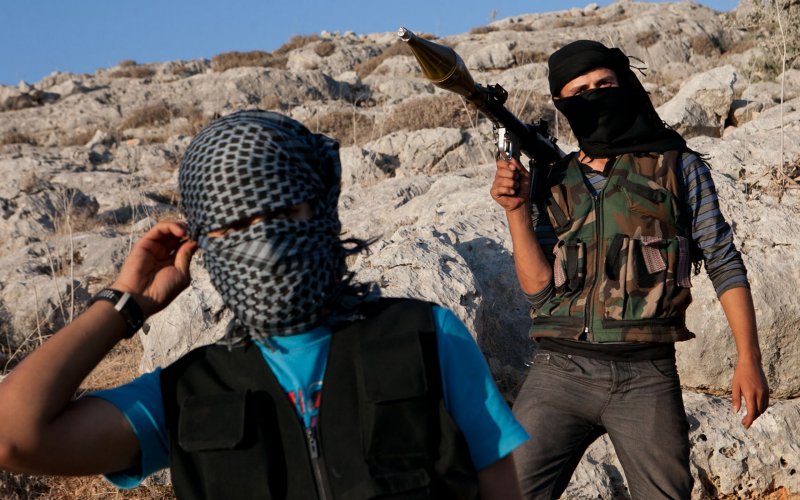
Who Are These ‘Moderate’ Syrians Obama Wants to Pit Against ISIS?

September 15, 2014

Who Are These ‘Moderate’ Syrians Obama Wants to Pit Against ISIS? Daily BeastJamie Dettmer, September 15, 2014

(Will Obama send a battalion of like minded savants, who claim that Islam is peaceful, to convince their “moderate” inferiors in Koranic wisdom that Islam really is peaceful and freedom loving? Perhaps he should accompany them.– DM)

ModeratesDaniel Leal-Olivas/AFP/Getty

Like other countries convulsed by Arab Spring insurrections, there was a mismatch between Western expectations and perceptions and the thinking and religious views of the majority involved in the fighting, and that was a year before the emergence of ISIS. The war back then was clearly becoming more sectarian and Islamic—the trajectory was obvious.

*********************

There were few modern democrats among the armed opposition to Assad two years ago. There are far fewer now. So who can Obama trust not to turn Western-supplied weapons against us later?

The young rebels and opposition activists gathered in a school to discuss how the northern Syrian town of Al Bab should be governed after the departure of Bashar al Assad’s soldiers were taken aback by the question: “Why aren’t there any women here?” It was the summer of 2012, more than 12 months into the uprising against the Syrian president, and more than a year before Abu Bakr al Baghdadi announced the formation of his al Qaeda breakaway, the Islamic State of Syria and Sham, or ISIS.

Initial surprise at my question was followed by smirks. The young men who had talked about ushering in a new era of modern democracy and freedom in Syria pushed forward a nervous young imam to explain. “It is not in our tradition for men and women to mix,” he said. “They can have their own meeting, if they want. And if we need advice on some issues, we can ask them.” There were some chuckles at this. So much for democracy, at least in its Western guise.

Later that night I sat with two local sheikhs who explained how they were forming a court to adjudicate civil disputes and rule on criminal cases. “We will use Sharia law,” said Abdulbaset Kuredy. “What else is there? After Assad, the whole country will be governed by Sharia.” Then he launched into a condemnation of the corrupt West and its acceptance of homosexuality and same-sex marriage. The sheikhs were aligned with the Free Syrian Army, the rebel group now touted in Washington as the “moderates” to support in the fight against Assad on the one hand, ISIS on the other.

There was nothing I saw in Al Bab in August 2012—still early days in the insurrection that is now halfway through its fourth year—that led me to feel that if the Syrian uprising toppled Assad, it would lead to an inclusive, minority-respecting, and more or less democratic outcome. Like other countries convulsed by Arab Spring insurrections, there was a mismatch between Western expectations and perceptions and the thinking and religious views of the majority involved in the fighting, and that was a year before the emergence of ISIS. The war back then was clearly becoming more sectarian and Islamic—the trajectory was obvious.

After two years of brutal and barbaric sectarian warfare, the Syrian rebellion has seen an even greater hardening of sectarian attitudes among Syrian opponents of Assad and his regime, which is dominated by members of the minority Alawite sect. Many secular activists from the urban areas of Damascus or Aleppo withdrew long ago, sickened by what the uprising was becoming. They were appalled at the rise of the jihadists and their cruelty, worried by the strength of Islamist factions among the rural fighters who are the backbone of the militias. The center did not hold.

A key element in President Obama’s strategy to halt the jihadist campaign of terror across the Levant involves reversing his earlier decision to refrain from fully backing so-called moderate Syrian rebels with arms and training. Exasperated by infighting among the leaders of the Syrian National Council and the Free Syrian Army, and worried by the weakening of the more secular elements, the Obama administration basically left the uprising alone. Critics like Sen. John McCain say that helped the rise of extremists like ISIS.

Now the president is asking Congress for $500 million to bolster rebels he kept at arm’s length to give them weapons and pay for training these insurgents he once derided as ineffectual “former doctors, farmers, pharmacists and so forth.”

But we shouldn’t imagine this is a change of policy in line with President George W. Bush’s “freedom agenda” or the “New Beginning” philosophy of Obama’s 2009 address in Cairo that sought to mend relations between the U.S. and the Arab world.

In his 13-minute speech last week, Obama did not mention the word “democracy” once—nor, for that matter, did “freedom” make any appearance. The arming and training of Syrian rebels is about U.S. national security interests and the rolling back of the jihadists.

But the decision to do so prompts a key question once again: Who are the moderates? Who in rebel ranks can be trusted not to turn Western-supplied weapons against the West later, or switch sides as we’ve seen in Mali and other countries racked by Islamist rebellions? Who can receive arms that won’t be shared with ISIS or the official al Qaeda affiliate in Syria, Jabhat al-Nusra? Who won’t embarrass the West by engaging in some act of egregious cruelty, torturing prisoners or executing foes?

There were not many moderates around two years ago, as I found in Al Bab then, and there are far fewer now. A year ago the town was overrun by ISIS and many of the young rebels joined the group; others who remained loyal to brigades affiliated with the FSA pulled out. The bulk of those, according to locals, hooked up with the Islamic Front, a coalition of Islamist militias who are the second largest fighting insurgent formation after ISIS. The front has close ties with al-Nusra.

The Obama administration’s frustration with the rebellion and distrust of the insurgents were overlooked briefly a year ago, when Obama’s “red line” was crossed and Assad used chemical weapons against rebels and civilians. The administration considered taking action. Under skeptical questioning by some lawmakers, Secretary of State John Kerry insisted last summer: “The opposition has increasingly become more defined by its moderation, more defined by the breadth of its membership, and more defined by its adherence to some, you know, democratic process and to an all-inclusive, minority-protecting constitution, which will be broad-based and secular with respect to the future of Syria.”

That wasn’t the case then and it isn’t now. Shortly after Kerry’s comments, a respected British defense consultancy, IHS Jane’s, released a study claiming that more than half of the rebels battling to oust Assad were either jihadists or hardline Islamists.

“There are certainly moderates remaining,” says Jonathan Schanzer, a Mideast expert with the Washington-based think tank the Foundation for the Defense of Democracies. “The problem is that they are few in number and lacking in support. They have been marginalized by U.S., European, Turkish, and Arab policies that have only served to boost the presence and capabilities of the more radical factions. It’s unclear to me how Washington’s new approach can help reverse this trend in an urgent or expeditious manner—which is what is needed.”

Most of the militias that are effective fighting formations and have scored off-and-on successes on the battlefield against ISIS are not moderate by Western standards. Most are Islamist to varying degrees and some, like Ahrar al-Sham, which lost most of its top leaders this week in a bomb attack in Idlib, are dedicated to establishing a Sunni theocracy in Syria. They don’t subscribe to transnational jihadism, but they do have strong ties to al-Nusra, which is part of the al Qaeda international franchise.

The most effective anti-ISIS fighters are with the Kurdish self-defense forces of the YPG, but because of their links with the Turkish separatist PKK, which is designated as a terrorist organization by the United States and European countries, they can’t be included in groups that receive Western backing.

According to a report issued this week by the International Crisis Group, the “mainstream” rebel opposition is caught in a desperate plight, “locked in a two-front war against the regime and IS [Islamic State or ISIS], their position is more precarious than at any time since the fighting began.”

ISIS has pressed an offensive north of Aleppo and is threatening to deliver a severe blow to rebel opposition groups by cutting off their supply lines to Turkey. If this can’t be stopped, the Crisis Group warns, the loss “would reverberate throughout the country, pushing many to give up the fight or join a more powerful militant force: IS.”

So speed is also of the essence. But not only is the Obama administration going to find it hard to select rebel groups it can work with, it will also have the problem of persuading them to focus on ISIS at the expense of their struggle against Assad, and if the regime starts making up more ground, that in turn could ignite local Sunni anger to the benefit of the jihadists.

There are already signs emerging that key Islamist groups aren’t ready to fall into line with the Obama agenda. This week a deal was struck between IS and an important Islamist coalition, the Syrian Revolutionaries Front, which is made up of about 20,000 fighters.

According to the Syrian Observatory for Human Rights, a U.K.-based Syrian opposition monitoring group, the jihadists and the Front have agreed “not to attack each other” while fighting the principal enemy, Assad.

Obama aide won’t say who’s joined coalition — or what he wants them to do

September 14, 2014

Obama aide won’t say who’s joined coalition — or what he wants them to do, Washington ExaminerLuke Rosiak, September 14, 2014

(Last night I saw upon the stair
A little man who wasn’t there.
He wasn’t there again today.
Oh how I wish he’d go away! — DM)

White House Chief of Staff Denis McDonough repeatedly declined to say whether any other countries have agreed to provide troops on the ground in Syria as a part of President Obama’s efforts to build a coalition.

He repeatedly said Americans would hear the news from Secretary of State John Kerry later this week.

But then he said that the president wasn’t looking for boots-on-the-ground troops, after all.

“Other [countries] have suggested that they’re willing to do that, but that’s not what we’re looking for right now,” McDonough said.

Building a coalition of other countries taking action in Syria against the Islamic State of Iraq and Syria is an essential part of Obama’s plan, which attempts to avoid unilateral action.

Obama has said that the 500-plus new troops he has deployed would be there in a training capacity and not as fighters.

That leaves the question of where the “boots on the ground” will come from.

“There’s not a single military adviser that’s come to you and said you can defeat [the Islamic State] without troops on the ground,” “Meet the Press” moderator Chuck Todd said, a statement with which McDonough agreed.

Turkey’s Frankenstein Monster

September 13, 2014

Turkey’s Frankenstein Monster, Gatestone InstituteBurak Bekdil, September 13, 2014

(Please see also Turkey’s ties to Hamas no obstacle in war on Islamic State.– DM)

Last June, Turkey’s own Frankenstein, who went by the name of ISIS, attacked the Turkish consulate compound in Mosul, and took 49 Turks, including the consul general, hostage.

The hostages are still in captivity. So is Turkey.

For each [Islamic] sect, the other is “not even Muslim.”

It all began when Turkey’s leaders thought they could build a Sunni belt under Turkish hegemony, and resting geographically under the Crescent and Star. For that to actually happen, Tunisia, Libya, Egypt, Lebanon, Syria and Iraq had to be ruled by Sunni — preferably Muslim Brotherhood-type — leaderships subservient to Ankara.

This Turkish gambit came at a time when the turbulent Middle East was even more turbulent than it always is: the Arab Spring had unmasked a 14-century-long hatred between Islam’s two main sects, a schism started by rival clans in the Prophet Muhammad’s tribe, the Quraysh. This is a feud that would survive beyond even their imagination.

Syria, with which Turkey shares a 500-mile border, was sadly being ruled by a Nusayri (Syrian Alawite), an offshoot of the Shia faith. Bashar al-Assad soon became, as the Sicilians say, “a stone in (then Prime Minister, now President) Recep Tayyip Erdoğan’s shoe.”

In the background, the Sunni-Shia feud was heating up. The Turks failed to get the message. In 2013, Iraq’s acting defense minister, Saadoun al-Dulaimi, accused Turkey of controlling Sunni anti-government protests in (Shia majority) Iraq.

For some time the United States even toyed with the idea of creating a “moderate crescent” of Sunni nations in order to contain Shia Iran, Shia-controlled Iraq and Lebanon’s Hizbullah.

The sectarian blindness explained a lot of complexities: Why, for instance, King Abdullah of Saudi Arabia fiercely supported the Syrian opposition, or sent troops across the border into neighboring Bahrain to help stamp out a Shia uprising there; why al-Qaeda’s leaders called on jihadists to join the fighting in Syria; or why, for Erdoğan, al-Assad was the “butcher of Damascus,” while Sudan’s Sunni leader Omar al-Bashir, with an international arrest warrant for crimes against humanity and the killing of hundreds of thousands, was “just an innocent friend.” The hatred explains, even to this date, why the Shia and Sunnis in Iraq kill each other by the thousands every month and bomb each other’s mosques.

The Wahhabis are virulently anti-Shia, and vice versa. They view the Shia as satanic “rejectionists.” And, for their part, the Shia view the Wahhabis as simply perverted. For each sect the other is “not even Muslim.” Saudi schools teach pupils that Shi’ism is simply a Jewish heresy.

In 2006, senior Wahhabi cleric Abdul Rahman al-Barrak released a fatwa which stated that the Shia are “infidels, apostates and hypocrites … [and] they are more dangerous than Jews or Christians.” Al-Qaeda’s younger twin, al-Nusrah, declared in 2012: “The blessed operations will continue until the land of Syria is purified from the filth of the Nusayris and the Sunnis are relieved from their oppression.”

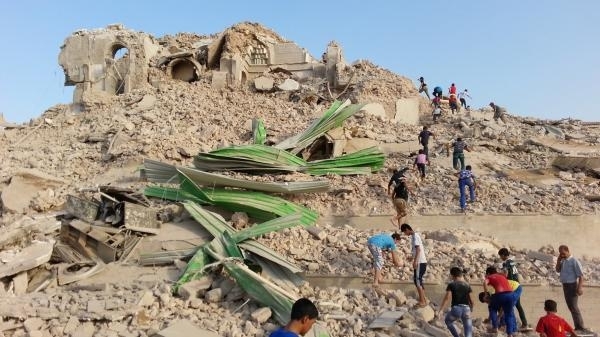
690The wreckage of the Shrine of Jonah, in Mosul, Iraq, which was destroyed by insurgents of the Islamic State in July 2014.

The Sunni supremacist Erdoğan would therefore even shake hands with Satan for the downfall of the Nusayri al-Assad. And he did. Turkey quickly became the mentor of all Syrian opposition groups which, ideally, would first defeat al-Assad, then form an Islamist government and volunteer to become a de facto colony of the emerging Turkish Empire.

At the outset, Turkey’s support was about policy and planning: conference after conference, meeting after meeting, declaration after declaration. The innocent Turks were merely expending diplomatic efforts to end the bloody civil war in a neighboring country.

In reality, Ankara slowly made Turkey’s southeast a hub for every color of radical Islamist militant arriving from dozens of different countries, including thousands from Europe. The militants would cross the border into Syria, fight al-Assad’s forces, go back to Turkey, get medical treatment there if necessary, replenish their weapons and ammunition and go back to fight again. In an audio recording leaked on the internet in March, Turkey’s top intelligence officer admits that, “Turkey has so far sent 2,000 trucks full of weapons and ammunition into Syria.”

Last June, Turkey’s own Frankenstein monster, who went by the name of the Islamic State of Iraq and Syria [ISIS] — later reflagged as “The Islamic State” [IS] — appeared at its old master’s doors. IS attacked the Turkish consulate compound in the northern Iraqi city of Mosul, after having captured large swathes of Syrian and Iraqi territory. It also took 49 Turks, including the consul general, hostage.

Ironically, only a day before the attack on the Turkish consulate, an opposition parliamentarian, speaking in parliament, warned that the consulate was exposed to the risk of an attack from ISIS — to which the government benches replied loudly: “Stop telling lies!” And only 20 hours before the Turkish consulate was attacked, Turkey’s then-Foreign Minister, Ahmet Davutoglu, tweeted that “We have taken all precautions at the Mosul consulate general.”

The hostages are still in captivity. So is Turkey, strategically and militarily. When U.S. Secretary of Defense Chuck Hagel arrived in Ankara on Sept. 8 to discuss a joint methodology to fight IS, and asked the Turks what services they could offer, the most important Turks in Ankara, including Erdoğan, shyly looked in the air and explained why they could not actively or publicly engage IS. And so 49 unfortunate Turks are still in the hands of the Turkish Frankenstein.

More than two years ago Davutoglu prophesized that al-Assad’s days in power were numbered. In a span of weeks, he predicted, the “butcher of Damascus would go.” But there is another man who can compete with Davutoglu in any “Realistic Guesses on the Future of the Middle East” competition. At the end of 2011 when the last US troops left Iraq, President Barack Obama described Iraq as “sovereign, stable and self-reliant.”

Obama, the Islamic State and Islam, the enemy which shall not be named

September 12, 2014

Obama, the Islamic State and Islam, the enemy which shall not be named, Dan Miller’s Blog, September 11, 2014

Islam is the greatest threat to the civilized world. Obama denies that it is any threat and maintains that it is peaceful.

Obama's excellent foreign policy

Minutes into His address to the nation (full text here) on the eve of two September 11 attacks, one in 2001 and another in 2012, Obama stated:

Now let’s make two things clear: ISIL is not “Islamic.” No religion condones the killing of innocents, and the vast majority of ISIL’s victims have been Muslim. And ISIL is certainly not a state. It was formerly al Qaeda’s affiliate in Iraq, and has taken advantage of sectarian strife and Syria’s civil war to gain territory on both sides of the Iraq-Syrian border. It is recognized by no government, nor the people it subjugates. ISIL is a terrorist organization, pure and simple. And it has no vision other than the slaughter of all who stand in its way. [Emphasis added.]

In a region that has known so much bloodshed, these terrorists are unique in their brutality. They execute captured prisoners. They kill children. They enslave, rape, and force women into marriage. They threatened a religious minority with genocide. In acts of barbarism, they took the lives of two American journalists – Jim Foley and Steven Sotloff. [Emphasis added.]

Obama remains faithful to His views of Islam, as expressed during His Cairo address.

So let there be no doubt: Islam is a part of America. And I believe that America holds within her the truth that regardless of race, religion, or station in life, all of us share common aspirations – to live in peace and security; to get an education and to work with dignity; to love our families, our communities, and our God. These things we share. This is the hope of all humanity.

I have argued the characteristics of Islam and that the Islamic State has its roots in Islam in detail here, here and elsewhere; little purpose would be served by repetition. This summary should be sufficient for present purposes.

Here is a video of Israeli Prime Minister Netanyahu’s September 11th comments on Obama’s September 10th address. Keep in mind that Netanyahu is compelled to say nice things about Obama whenever he possibly can, even if to do so requires that he stretch a point or two or three. But listen to Netanyahu’s comments, quite divergent from Obama’s, on Islam and Islamist states — including Iran — which seek an Islamic caliphate for the entire world through fear and terror. The relevant differences among the Islamist states are principally on the nature of the desired caliphate. There was a master race, now there is a master faith. Islam’s master religion is at least as evil as Nazism master race. Clarity and courage are needed. Do we have them? Obama does not.

The Islamic State is at least as Islamic as Nazism was German

Winston Churchill spoke about Nazism early and often. Here is what he said during a 1934 radio broadcast:

Many of Churchill’s comments on Nazi Germany might be applied to Islam. As PM Netanyahu said, then there was a “master race.” Now, there is a “master religion.” What are we to do about it?

Was Nazism Germanic? Millions of Germans believed it to be. They were enthralled by the Chief Imam of Nazism, Hitler. Germany’s preparations for war with civilization went into full swing when Imam Hitler rose from the depths to control Germany. If Obama had been President in the mid 1930’s and had proclaimed His intention to battle Nazism, might He have said something like this?

Now let’s make two things clear: Nazism is not Germanic. German culture does not condone the killing of innocents, and the vast majority of Nazism’s victims have been German. Nazism is a terrorist organization, pure and simple. And it has no vision other than the slaughter of all who stand in its way. [Emphasis added.]

Nazi Germany’s “vision” was not merely the “slaughter of all who stand in her way.” That, along with the fear and submission its slaughter induced, was its strategy. The Nazi vision, to be achieved through its strategy, was the expansion of the “fatherland” through the “peaceful” surrender, and military conquest of Europe if necessary, for the imposition of Nazism throughout the region.

The vision of the Islamic State, its Islamic allies, cohorts and opponents, reflects their vision of Islam — the expansion of “true” Islam throughout the non-Islamic (and apostate Islamic) world and the imposition of the “true” version of Islam on non-Muslims and apostates. They differ principally in what they consider “true” Islam.

There is at least one difference between “moderate” Islamists and the Islamic State: the Islamic State does not pretend to desire peace; “moderate” Muslims do. Like “moderate” Islamists, Nazi Germany professed its peaceful nature and claimed to desire no more than to right wrongs committed against ethnic Germans in Czechoslovakia and elsewhere. Its claims of good will and a peaceful soul were accepted by Neville Obama Chamberlain and many other naive leftists in Britain and Europe.

As noted in a Washington Times editorial,

Whether by the name al Qaeda, Taliban, al-Shabab, Boko Haram, Islamic State, ISIS or ISIL, the Islamist goal is one and the same — the destruction of the West and the defining values of civilization. The only appropriate response is to crush those who would threaten those values. It’s not an occasion for dialogue, appeasement or negotiation. [Emphasis added.]

Neither is it the time to arm “moderate” Islamists on the ground that they will help to eliminate the horrors of the Islamic State.

Obama claims that He will arm and support “moderate” Islamists.

Across the border, in Syria, we have ramped up our military assistance to the Syrian opposition. Tonight, I again call on Congress to give us additional authorities and resources to train and equip these fighters. In the fight against ISIL, we cannot rely on an Assad regime that terrorizes its people; a regime that will never regain the legitimacy it has lost. Instead, we must strengthen the opposition as the best counterweight to extremists like ISIL, while pursuing the political solution necessary to solve Syria’s crisis once and for all. [Emphasis added.]

Presumably, Obama has in mind arming the “moderate” opposition to the Syrian regime. There may be some moderates, but does the Obama administration know who they are? Does it know that they are capable of resisting, successfully, the theft of their U.S. supplied armaments by non-moderates?

There are approximately 100,000 Syrian rebels,

including the al Qaeda-linked Nusra Front and the powerful Islamic Front rebel umbrella group, currently fighting the Islamic State group in Syria

Has the “vetted, moderate” Free Syrian Army been vetted and is it “moderate?”

As President Obama laid out his “strategy” last night for dealing with ISIS in Iraq and Syria, and as bipartisan leadership in Congress push to approve as much as $4 billion to arm the Syrian “rebels,” it should be noted that the keystone to his anti-Assad policy — the “vetted moderate” Free Syrian Army (FSA) — is now admitting that they, too, are working with the Islamic State. [Emphasis added.]

. . . .

On Monday, the Daily Star in Lebanon quoted a FSA brigade commander saying that his forces were working with the Islamic State and Jabhat al-Nusra, al-Qaeda’s official Syrian affiliate — both U.S.-designated terrorist organizations — near the Syrian/Lebanon border.

“We are collaborating with the Islamic State and the Nusra Front by attacking the Syrian Army’s gatherings in … Qalamoun,” said Bassel Idriss, the commander of an FSA-aligned rebel brigade.

“We have reached a point where we have to collaborate with anyone against unfairness and injustice,” confirmed Abu Khaled, another FSA commander who lives in Arsal.

“Let’s face it: The Nusra Front is the biggest power present right now in Qalamoun and we as FSA would collaborate on any mission they launch as long as it coincides with our values,” he added. [Emphasis added.]

. . . .

[T]his time last year the bipartisan conventional wisdom amongst the foreign policy establishment was that the bulk of the Syrian rebel forces were moderates, a fiction refuted by a Rand Corporation study published last September that found nearly half of the Syrian “rebels” were jihadists or hard-core Islamists. [Emphasis added.}

. . . [M]ultiple arms shipments from the U.S. to the “vetted moderate” FSA were suspiciously raided and confiscated by ISIS and Jabhat al-Nusra, prompting the Obama administration and the UK to suspend weapons shipments to the FSA last December.

In April, the Obama administration again turned on the CIA weapons spigot to the FSA, and Obama began calling for an additional $500 million for the “vetted moderate” rebels, but by July the weapons provided to the FSA were yet again being raided and captured by ISIS and other terrorist groups. Remarkably, one Syrian dissident leader reportedly told Al-Quds al-Arabi that the FSA had lost $500 million worth of arms to rival “rebel” groups, much of which ended up being sold to unknown parties in Turkey and Iraq. [Emphasis added.]

At the same time U.S.-provided FSA weapons caches were being mysteriously raided by ISIS and Jabhat al-Nusra, one of the senior FSA commanders in Eastern Syria, Saddam al-Jamal, defected to ISIS. In March, Jabhat al-Nusra joined forces with the FSA Liwa al-Ummah brigade to capture a Syrian army outpost in Idlib. Then in early July I reported on FSA brigades that had pledged allegiance to ISIS and surrendered their weapons after their announcement of the reestablishment of the caliphate. More recently, the FSA and Jabhat al-Nusra teamed up last month to capture the UN Golan Heights border crossing in Quneitra on the Syria/Israel border, taking UN peacekeepers hostage.

Obama’s coalition 

As argued at The Clarion Project,

The U.S. must also be prepared for the pro-Islamist members of its coalition against the Islamic State to predictably support Islamism. [Emphasis added.]

A cataclysmic revelation? Hardly. But does Obama consider it a problem? Most likely He does not. Might He see it as an opportunity?

Secular Syrian opposition figures complain that Qatar and Turkey are sidelining them by supporting the Muslim Brotherhood and other Islamists. When the U.S. worked with Qatar in removing the Qaddafi regime in Libya, Qatar exercised its influence to benefit the Islamist forces. Libya is experiencing bloody fighting between Islamist and secular forces today.

Qatar continues to support the Muslim Brotherhood, Hamas and the Islamic Front, specifically Ahrar al-Sham. An Ahrar al-Sham leader named Abu Khaled al-Souri had high-level Al-Qaeda ties and was killed by the Islamic State. Jabhat al-Nusra and other Al-Qaeda-linked figures see Qatar as friendly territory.

Saudi Arabia, which has agreed to help support rebels fighting the Islamic State, has already been supporting the Islamic Front, specifically Zahran Alloush’s Army of Islam (or Jaysh al-Islam). His ideology is similar to that of Al-Qaeda/Jabhat al-Nusra.

The Saudis also back a coalition named the Syrian Revolutionary Council. It condemned the United Kingdom for sentencing Islamist cleric Raed Salah for inciting terrorism. He was previously imprisoned in Israel for financing Hamas and working with an Iranian intelligence operative.

Which if any national members of Obama’s coalition support non-Islamic concepts such as freedom of religion, of the media and of speech? It is my understanding that they oppose them, even on rare occasions when they claim to accept them in modest ways.

What else is wrong with the Obama Strategy?

Here’s a taste, even from MSNBC:

Many problems with Obama’s approach to Islamic terrorism are already obvious and more will become apparent with time. As we wait, shall we prepare for Christmas?


Iran may end up the winner in Iraq

September 12, 2014

Iran may end up the winner in Iraq, Blackfive, September 11, 2014

The only winner that comes out of this in the short-term is Iran.  Shiite factions get defended in Iraq, Iran basically gets a free pass, and we (the west) end up doing the dirty work.  How is this beneficial to us?

**********************

I read thru the statement that President Obama made last night regarding his plan to address ISIS (which he kept calling ISIL) and I’d like to address some of the problems we will face with this.

As someone who’s actually developed the plans to address problems in Iraq and Syria, and had to brief them to senior leaders, I have a hard time understanding why it has taken so long for him to address this, and why he’s picking the ‘strategy’ that he has.  I have agreed, up to now, with the cautious approach- that ‘picking sides’ in Syria is fraught with huge problems.  NONE of the groups fighting in Syria are in any way trustworthy- it would be like trying to pick one Mafia family in NY to help clean up crime problems.  No one you work with would benefit you in the end.  And ultimately, you may end up with a result you still don’t like.

Syria plans had an especially troubling problem- we had ZERO guidance from above on exactly what the end state was to be- we ended up having to develop multiple plans based on assumptions that no senior leader had given guidance on.  No, the CENTCOM commander wasn’t the problem- HE wasn’t getting guidance either.  Neither Mattis nor Austin either one knew what we really wanted to end up with.  So, we built plans based on minimal intervention all the way thru full-on ops.  From humanitarian assistance missions thru ‘BOG’ ops.  From containment thru air power only, to SOF-only training assistance.  And then we went back and re-did them.  Several times.   We had no choice- we could only assume, based on our collective experience, on what the end state could be.  We used Bosnia, Iraq, AFG, DS-1, and a few others as ‘models’.  Plus, we considered different types of UN missions that may be used as approaches, in case we had to support only those.

What we also had to contend with was the fact that, at the time, Iraq was in NO WAY to be a part of the mission set.  We had zero troops there; we had no presence, and even tho our own intel told us that the border area of Iraq and Syria was the real ‘hot zone’ developing, we could not address any activity there.  All of our effort was to ‘contain’ within the borders of Syria, and try to prevent further refugee problems into Lebannon and Jordan.  Especially Jordan.  Pay SPECIAL attention to the Jordanian issue should we start hitting Syria hard- there are going to be real problems along that border as people flee areas of Syria and Iraq.  AQ and ISIS may use that as a ‘distraction’ to force our hand there, and really end up with problems we haven’t prepared for.  Remember, there are hundreds of thousands of refugees along the border, and its a complete powder keg readly to go up in flames at the slightest provocation.

Now that Iraq territory has to be worked into the mix, at least we will have areas of ‘safe zones’ working with the Kurds that allow us some help.  Erbil airport is a good backup location, and I’m assuming they will use that as a potential staging area.  It’s new, it’s got a HUGE runway, and it’s close-by.  Fueling will be the most logical, if we can secure it further.

As someone who worked ops in Yemen and SOM and other areas, using these as ‘models’ for what we intend to do in Iraq is fraught with enormous issues- these are missions that are very very different than what is needed to address ISIS (if you want a very good rundown of this, go to Bill Roggio’s column here.)  We have ‘advisors’ deep into these missions, and the end-states are very very different.  In fact, end-states in Syria and Iraq are completely different- so addressing ISIS across them is NOT going to be simple.  Air power alone isn’t going to do it, and you are not going to get Kurds or Iraqi’s to chase ISIS into Syria to combat them- and that’s exactly what ISIS is going to do.

The one issue that remains to be seen is how ISIS-supporting factions take on Baghdad; this is the nightmare scenario that could very well develop as a counter to US-centered actions.  The fact that Baghdad becomes a focus is a very real fear; it would force the Iraqi gov’t and forces to abandon northern Iraq to concentrate on securing that area alone, leaving the Kurds as the only support we’d have up north.  And that ain’t enough.

Another problem we could not solve internally was this issue of ‘sharing intel’ with anyone.  How the HELL do we share intel with these guys?  We can’t even legally brief the mayor of NYC (deBlasio) because he doesn’t have a clearance; there is NO such thing as ‘REL YEMEN’ or ‘REL IRAQ’ or ‘REL SYRIA’ for classified, useful intel info.  So we’d be breaking the law to even attempt it.  And we’ve been working with the Yems for years.

The only winner that comes out of this in the short-term is Iran.  Shiite factions get defended in Iraq, Iran basically gets a free pass, and we (the west) end up doing the dirty work.  How is this beneficial to us?

Let me ask all of you this- and leave your estimates in the comments- how big of a force do you think this is going to take to support?  PBO said 475 additional will be sent; that’s basically a company, and that ain’t gonna do it.  If we use air power alone, how many do you THINK that will take?  I’ll look at your estimates and let you know in a few days how close you are.

Wolf

Obama’s Foreign Policy of Empty Words

September 9, 2014

Obama’s Foreign Policy of Empty Words, Front Page Magazine, September 9, 2014

(Obama’s words have rarely contained substance, even facially. 

Suppose Obama were to surprise the world with words not empty but full of apparent substance. His words, at times, appeared to be substantively meaningful but turned out not to have been. Might it be too late for him to sway the decreasingly free and democratic world now, regardless of what he might say? Perhaps we will find out on Wednesday, when he makes a speech about dealing with the Islamic State. — DM)

Obama's empty words

To paraphrase Demosthenes, the greater this administration’s ready tongue, the greater distrust it inspires in our allies, and the greater boldness it creates in our enemies. Or to put it in my old man’s more earthy terms when I smarted off, “Don’t let your mouth write checks your ass can’t cash.” Obama has been bouncing foreign policy checks from Ukraine to the South China Sea, and most points in between.

**************************

That line from John Ford’s classic The Man Who Shot Liberty Valance contains wisdom everyone from peasant to king knew before our modern age and its smug illusions. Go back 2,400 years, and you can hear it from the Athenian orator Demosthenes as he chastises his fellow citizens for responding to Macedonian aggression by “forever debating the question and never making any progress” and issuing “empty decrees.” “All words, apart from action,” Demosthenes warned, “seem vain and idle, especially from Athenian lips: for the greater our reputation for a ready tongue, the greater the distrust it inspires in all men.” We’ve had several years now of watching Obama and his foreign policy team prove this eternal truth as they have feebly and fecklessly responded to crisis after crisis in Ukraine, Syria, and a dozen other venues.

Just in the last few weeks we have heard a lot of bluster about Islamic State, the rampaging jihadists in northern Iraq who have left in their wake a trail of traditional Muslim mayhem–- sectarian cleansing, forced conversion, slaving, rape, torture, slaughter, and Koran-inspired beheadings, including two American journalists. In response to these decisive deeds, Obama has thundered that he will “degrade and destroy” the “cancer.” In an op-ed co-written with British Prime Minister David Cameron, he has vowed that the allies “will not be cowed by barbaric killers.” His vice president Joe Biden, with his usual trite hyperbole, has threatened, “We will follow them to the gate of hell until they are brought to justice.” And Secretary of State John Kerry, after the beheading of journalist James Foley, has warned, “The world must know that the United States of America will never back down in the face of such evil. ISIL and the wickedness it represents must be destroyed, and those responsible for this heinous, vicious atrocity will be held accountable.” “By whom” is the question the passive voice artfully leaves unanswered.

To paraphrase Demosthenes, the greater this administration’s ready tongue, the greater distrust it inspires in our allies, and the greater boldness it creates in our enemies. Or to put it in my old man’s more earthy terms when I smarted off, “Don’t let your mouth write checks your ass can’t cash.” Obama has been bouncing foreign policy checks from Ukraine to the South China Sea, and most points in between.

Indeed, the deeds necessary to back these loud boasts have been few. That should not surprise us, since Obama has said and done much to tell the world that we will not act decisively, relying instead on verbal processes and gestures of force like bombing some trucks to create a telegenic illusion of action. He started his presidency with the “apology tour,” on which he called the U.S. “arrogant, dismissive, derisive,” confessed that we are “still working through some of our own darker periods in our history,” proclaimed that we “will be willing to acknowledge past errors where those errors have been made,” confessed that “too often we set [our] principles aside as luxuries that we could no longer afford” and so “we went off course,” and promised that we “are working to improve our democracy.” How could such a tainted and flawed state have the moral authority to act with the confidence and decisiveness that his recent rhetoric implies?

Likewise his domestic deeds have undercut the capacity to enforce his tough foreign policy words. Because of cuts to the military budget––inspired in part by his desire to reduce the U.S. to merely one unexceptional member of an international coalition that supposedly can maintain global order and create collective security––our military capacity is destined “to be an increasingly hollow force,” as Bret Stephens writes, “with the Army as small as it was in 1940, before conscription; a Navy the size it was in 1917, before our entry into World War I; an Air Force flying the oldest—and smallest—fleet of planes in its history; and a nuclear arsenal no larger than it was during the Truman administration.”

Commensurate with this undercutting of America’s armed forces have been Obama’s empty bluster and careless language, something dangerous coming from the Commander-in-Chief of the greatest military power in history. “Leading from behind” in Libya, the vanishing “red line” in Syria, the juvenile scolding of Putin “that in the 21st century, the borders of Europe cannot be redrawn with force, that international law matters,” the “no strategy” gaffe about the “jayvee” jihadists of the Islamic State–– all were instantly refuted and discredited by facts on the ground created by hard men of brutal action. Libya is not a democracy, but the jihadist version of Road Warrior. Syria’s Bashar al Assad is winning in Syria by slaughtering close to 200,000 men, women, and children. The Islamic State still controls northern Iraq and Syria, and still sits at the gates of Baghdad. And Putin has snatched Crimea and is closing in on eastern Ukraine. Throw in Obama’s penchant for berating allies like Israel, ignoring the interests of others like Jordan, Egypt, and Saudi Arabia, undercutting vulnerable states like Poland and the Czech Republic, and appeasing genocidal mullahs in Iran, and is it any surprise that his words “inspire greater distrust” in everyone except our enemies?

Of course, Obama’s habit of using words to substitute for politically risky deeds is universal in the West. We just saw a NATO confab in which a lot of big talk for the reporters end up so much smoke when the details are parsed. NATO leaders have agreed “to establish a so-called spearhead force of several thousand troops designed to move into trouble spots at short notice,” as The Wall Street Journal reported. Talk about closing the barn door after the Russian bear has got loose. I’m sure Putin is trembling over the thought of “several thousand” NATO troops that someday might materialize to stop his adventurism. If NATO isn’t acting now, what makes anyone think this special “spearhead force” will act in the future, even if NATO members do create it? As Charles Krauthammer writes, the force “is a feeble half-measure. Not only will troops have to be assembled, dispatched, transported and armed as the fire bell is ringing, but the very sending will require some affirmative and immediate decision by NATO. Try getting that done. The alliance is famous for its reluctant, slow and fractured decision-making.”

And haven’t we heard this sort of braggadocio before from Europe? Remember the 60,000-man “rapid reaction force” the EU was going to create so that they could avoid any further embarrassment of having “cowboy” Americans pull their foreign policy irons out of the fire, as happened in Bosnia and Kosovo? Given that only three European NATO members honor the 2% of GDP minimum for military spending, it’s unlikely that the money for creating this alleged “deterrent” will ever be budgeted, not with EU economies in the doldrums, and widespread grumbling over “austerity” budgets. No wonder that, as the Journal reports, “most details of the force . . . remained to be settled.” But don’t worry, NATO leaders have “committed” to spending the 2% on defense they “committed” to in 2002 and subsequently ignored. Better read the fine print: the commitment is non-binding and will be implemented over a 10-year period. Who knows how much more of the old Soviet Empire Vladimir will have taken back by then.

“Word, words, words,” as Hamlet says. But words useful for politicians who want to avoid the risk and uncertainty of action, and don’t want to face disgruntled voters at the polls. And when this perennial calculus is joined to the progressive belief that an exploitative, racist, neo-imperialist America is disqualified by its sins from being the guarantor of global order and stability, you get the world we are rapidly becoming––a Darwinian jungle of feral violence, illiberal hegemons, thug-nations, and nuclear-armed terrorist states.

A look at the Islamic State militants in Syria

August 28, 2014

A look at the Islamic State militants in Syria, AP The Big StoryZeina Karam, August 28, 2014

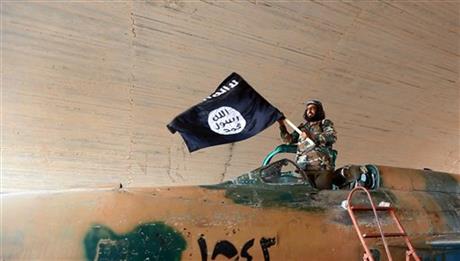
460xThis undated image posted on Wednesday, Aug. 27, 2014 by the Raqqa Media Center of the Islamic State group, a Syrian opposition group, which has been verified and is consistent with other AP reporting, shows a fighter of the Islamic State group waving their flag from inside a captured government fighter jet following the battle for the Tabqa air base, in Raqqa, Syria on Sunday. A U.N. commission on Wednesday accused the extremist Islamic State organization of committing crimes against humanity with attacks on civilians, as pictures emerged of the extremists’ bloody takeover of a Syrian military air base that added to the international organization’s claims. (AP Photo/ Raqqa Media Center of the Islamic State group

BEIRUT (AP) — As the U.S. strikes Islamic State targets in Iraq, extremists belonging to the same militant group across the border in Syria are capturing new territory and becoming bolder by the day.

There, in its power base, the Islamic State group controls thousands of square kilometers (miles) of territory, including most of Syria’s oil-producing region. In the areas under its control, it has established an elaborate governing system that oversees every aspect of people’s lives.

The U.S. has begun surveillance flights over Syria as a possible precursor for airstrikes against Islamic State targets there. U.S. Army Gen. Martin Dempsey, chairman of the Joint Chiefs of Staff, has said the group cannot be defeated “without addressing that side of the organization which resides in Syria.”

A look at the Islamic State group in Syria:

SCOPE AND SIZE

By some estimates, the Islamic State group occupies up to 35 percent of Syria, or about a third of the country. It has consolidated its hold over an impressive stretch of territory from its westernmost end on the outskirts of the city of Aleppo, across northern Syria and most of the east. It spreads into most of the Sunni-dominated areas of northern and western Iraq, right up to the edges of Baghdad. That terrain includes the oil fields of Syria’s eastern Deir el-Zour province and parts of Hassakeh. It also includes parts of Aleppo province, including the major towns of Manbej and al-Bab, where the group’s black flags flutter over government buildings and main squares. Because it controls territory on both sides of the border, the group can move fighters, weapons and goods between Iraq and Syria with relative ease.

CALIPHATE CAPITAL

The Islamic State’s declared capital is Raqqa, a city in northeastern Syria along the Euphrates River. With a population of 500,000, Raqqa is the group’s power base. Foreign fighters, some with their families, have flocked there from all over the world. Although it always has been a conservative city with strong tribal presence, Raqqa was once a diverse, thriving commercial center. Today, it is patrolled 24 hours a day by vice squads known as the Hisba — armed fighters in long robes who make sure their strict interpretation of Islam is observed. The militants have banned music and smoking, and have forced women to cover up. They have carried out beheadings in the main square for violators of Shariah, or Islamic law. People who were killed have had their bodies hung from crosses. The group recently imposed a curriculum in Raqqa schools, scrapping subjects such as philosophy and chemistry.

RESOURCES AND GOVERNING

The group controls virtually all major oil fields of eastern Syria, including the Omar oil field, Syria’s largest, with a capacity to produce 75,000 barrels a day. According to several activists, the group has resumed some pumping and has secured revenue by selling crude oil at lower-than-market prices and exporting to Iraq and Turkey through middlemen with tankers. The group also enjoys other assets, such as three major border crossings, grain silos and the al-Furat dam, Syria’s largest. In the past two years, the group has become entrenched in parts of Syria, establishing a governing system that includes administrative offices, Islamic courts and traffic police.

MILITARY STRENGTH

The group is a formidable fighting force in Syria, battling anyone who stands in its way. Since about the beginning of the year, the group has been engaged in a war of attrition with Western-backed rebels, overwhelming their outposts and picking off towns and villages one by one through force and intimidation. Hundreds of people have been killed in the fighting, which has detracted from the rebellion’s main goal of toppling President Bashar Assad. More recently, the jihadists have turned their attention to Assad’s forces, seizing a series of military bases, including the Tabqa airfield in Raqqa province. Following its blitz in Iraq, the group has moved tanks, cannons, Humvees and surface-to-surface missiles into Syria, parading the hardware recently in Raqqa. Most of the group’s leaders are believed to be in Syria, including Omar al-Shishani, a Chechen and one of its most prominent military figures.

ASSAD’S ACTIONS

Assad has recently stepped up airstrikes against strongholds of the Islamic State group, perhaps to try to ward off U.S. involvement, to show he can do the job himself and to portray himself as a partner for the international community. The Syrian government has opened the door for potential cooperation with the U.S. to contain the Islamic State group but says any strikes should be done in coordination with Damascus. That’s a problem for the U.S., which risks appearing on the same side as Assad, whose ouster the Obama administration has sought for years. U.S. strikes against the Islamic State group in Syria may help Assad by legitimizing his government at the expense of those seeking to topple him. Any U.S. airstrikes would likely focus on areas near the Iraqi border and militant targets such as training camps in Raqqa, where Assad’s air defense capabilities are almost nonexistent.

COMPLICATIONS

U.S. airstrikes in Syria against the Islamic State group would be much more complicated than in Iraq, where they are sanctioned by Baghdad and where battle lines are more clearly drawn. The picture in Syria is more complex, with a host of military players operating in close proximity to each other, including the Islamic State group, the al-Qaida-linked Nusra Front, Western-backed rebels and pro-government forces. While the Western-backed rebels have urged the U.S. to extend airstrikes to target the Islamic State group, more hard-line groups in Syria oppose any U.S. involvement.

Syria could work with West against ‘terror’

August 25, 2014

Syria could work with West against ‘terror’

Syrian FM says Damascus open to co-operation at both regional and international level to combat Islamic State fighters.

Last updated: 25 Aug 2014 13:34

via Syria could work with West against ‘terror’ – Middle East – Al Jazeera English.


Muallem said Syria must be involved in co-ordinating any air strikes against the Islamic State in Syria [AP]
 

Syrian Foreign Minister Walid Muallem has said that his country is ready to work with the international community to battle against “terrorists” within the framework of a recent UN resolution.

In a news conference in Damascus on Monday, he also warned that Syria must be involved in co-ordinating any air strikes against the Islamic State group in Syria, after the US said it was considering extending operations into Syrian territory.

“Syria is ready for co-operation and co-ordination at the regional and international level to fight terrorism and implement UN Security Council resolution 2170,” Muallem said.

He confirmed, in response to a question, that the country’s willingness to do so would extend to co-operating with the US and the UK.

Muallem added that Syria was willing to participate in such efforts as part of a regional or international coalition, or on the basis of bilateral cooperation.

However, he noted: “We must feel that the co-operation is serious and not double standards.

“Any violation of Syria’s sovereignty would be an act of aggression.”

Al Jazeera’s Rula Amin, reporting from Akkar, in neighbouring Lebanon said the successes of the Islamic State group were pushing old rivals into allies.

The self-declared jihadist Islamic State group has made advances in several parts of Syria, including most recently Raqqa province, where it seized the army’s last provincial outpost on Sunday.

The UN Security Council passed a rare unanimous resolution on August 15 intended to weaken armed groups in Iraq and Syria by choking off their funding and stemming the flow of foreign fighters.

The resolution targeted both the Islamic State group and al-Nusra Front, which is al-Qaeda’s Syrian affiliate.

Syria’s government considers not only these two groups, but all those fighting to overthrow President Bashar al-Assad to be “terrorists”.

Meanwhile on Monday, Russian Foreign Minister Sergey Lavrov urged Western and Arab governments to overcome their distaste for Assad and engage with him to fight the Islamic State.

“I think Western politicians are already realising the growing and fast-spreading threat of terrorism,” Lavrov said, referring to Islamic State advances in Syria and Iraq.

“And they will soon have to choose what is more important: a [Syrian] regime change to satisfy personal antipathies, risking deterioration of the situation beyond any control, or finding pragmatic ways to unite efforts against the common threat.”

Russia has been Assad’s most prominent international backer in the civil war that broke out in early 2011 and in which the US and the West, as well as many Gulf and Arab states, backed the rebels seeking to oust him

Syrian civil war death toll rises to more than 191,300, according to UN

August 22, 2014

Syrian civil war death toll rises to more than 191,300, according to UN Human rights office says figure includes additional killings from earlier periods as well as deaths since last report in July 2013

Associated Press in Geneva theguardian.com, Friday 22 August 2014 11.22 BST

via Syrian civil war death toll rises to more than 191,300, according to UN | World news | theguardian.com.


A Syrian man cries as he sits oamong the rubble of a building
following a reported barrel-bomb attack by Assad forces in Aleppo
earlier this month Photograph: Baraa Al-Halabi/AFP/Getty Images
 

The death toll from Syria‘s civil war has risen to more than 191,300 people, the United Nations has said.

The figures for March 2011 to April 2014 are the first to issued by the UN’s human rights office since July 2013, when it documented more than 100,000 killed.

The UN’s top human rights official, Navi Pillay, who oversees the Geneva-based office, said the figures are so much higher because they include additional killings from earlier periods, as well as deaths since the last report. The exact figure of confirmed deaths is 191,369, Pillay said.

“As the report explains, tragically it is probably an underestimate of the real total number of people killed during the first three years of this murderous conflict,” she said.

Pillay, the UN high commissioner for human rights, criticised what she described as the world’s “paralysis” over the fighting in Syria, which “has dropped off the international radar” in the face of so many other armed conflicts.

In January, her office said it had stopped updating the death toll, blaming a lack of access in Syria and its inability to verify source material. It was unclear why it has released new figures now.

The UN also would not endorse anyone else’s count, including the widely quoted figures from the Britain-based Syrian Observatory for Human Rights, which has closely counted the deaths since Syria’s crisis began in March 2011. On Thursday, the observatory said the number of deaths has reached 180,000.