Posted tagged ‘Syria’

Peshmerga head speaks of struggle against IS

October 18, 2014

Peshmerga head speaks of struggle against IS, Al-Monitor, Faraj Obaji, October 17, 2014
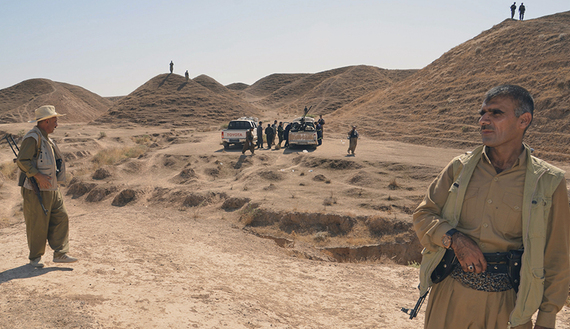
Kurdish peshmerga fighters stand guard around vehicles left behind by fleeing Islamic State militants during clashes in the al-Zerga area near Tikrit cityKurdish peshmerga fighters stand guard around vehicles with weapons and ammunition left behind by fleeing Islamic State militants during clashes in the al-Zerga area near Tikrit city in Salahuddin province, Oct. 8, 2014. (photo by REUTERS)

Commenting on the criticism of certain Kurdish parties inside Kobani, regarding the lack of support provided by KRG to the besieged city, he said, “Despite the differences with certain Kurdish political parties in the city, the KRG expressed its readiness to support our brothers in the city and we asked Washington and its allies to help the resisting Kurdish fighters.

“We helped them as much as possible, and the KRG’s president affirmed this. But, we cannot offer more. We are still waiting for international aid. The region initially includes 5 million people, add to that one and a half million displaced from Syria and the Iraqi provinces. We are helping them and taking care of them, and this is a huge burden.”

******************

Eliminating the Islamic State (IS) in Iraq does not seem to be an easy mission that will happen anytime soon; it seems rather impossible. The terrorist attacks against Iraq exposed how weak the Iraqi army is, how fragile its military structure and intelligence services are, and how it is unable to protect its country against any attack.

Some believe that the responsibility of the army’s failure to fight IS should be borne by the political authority ruling the country since 2004, which was unable to build an army based on a unified doctrine. Others consider the policies adopted by former Prime Minister Nouri al-Maliki faulty and the maliciousness allowed the terrorist group to enter the country, while the political conflicts between the central government and the Sunni leaderships provided an embracing environment for the group in Sunni provinces.

Secretary-General of the Ministry of Peshmerga Lt. Gen. Jabbar Yawar spoke to An-Nahar regarding the situation in Iraq in general, and in the Kurdistan Regional Government (KRG) in particular, in light of the IS threat, which occupied a number of Iraqi provinces, reaching the besieged Kobani.

The peshmerga harasses IS

The Kurdish military leader welcomed the international aid provided to the KRG, which is fighting a crucial battle against IS. He said, “The military aid which reached KRG saved it from falling into the hands of the terrorist group and allowed peshmerga forces to move from the negative defense position to the striker position, inflicting heavy losses on IS.”

Yawar does not hesitate to say, “The peshmerga forces’ position in the fight against IS is much better than the Iraqi army’s position. We are in a continuous fight along the 1,050-kilometer [650-mile] border of five Iraqi provinces, starting from Mosul to Erbil and passing through Kirkuk, Saladin and Diyala.”

He said, “The peshmerga forces have liberated the Mosul Dam and continues to liberate the rest of the regions that have fallen into the hands of IS, while creating plans to completely achieve this.”

The fall of Mosul and Anbar

Yawar attributed the fall of Mosul and Anbar to several reasons, most importantly, the fragility of the army in both provinces. He said, “The army in Mosul was fragile, and its six military units failed to withstand IS. There were also the political conflicts between the Sunni blocs and the government in Baghdad, which prevented these forces from fighting IS in Mosul, Saladin and parts of Kirkuk. These forces either handed over their advanced and heavy weapons to the group and fled, or joined and began to fight alongside IS.”

“The lack of a unified fighting doctrine among the army, and the shortage of air support, were all elements that contributed in the army’s quick collapse and IS’ occupation of a number of Iraqi provinces, especially the Sunni ones,” he said.

The difficulty in liberating Sunni regions

On the subject of the army’s situation in provinces in general, Yawar said that he found “a certain difficulty in liberating the Sunni-dominated regions from IS, such as Anbar, Saladin and Mosul, especially after it fell into the hands of the terrorists who took over its weapons on June 10.” He said that although they used all available means, the Iraqi forces were unable to liberate the city of Heet in Anbar and Tikrit, the center of Saladin province. “The situation on the field unfortunately proves that IS only controls the Sunni-dominated regions. We hope that our Sunni brothers, who are suffering the group’s injustice, will cooperate with the federal government and the KRG in order to eliminate this terrorist group,” he explained.

How did IS reach Erbil’s borders?

When asked how IS was able to reach KRG even though its intentions to occupy the region were obvious, Yawar answered with regret: “We knew before the group attacked Mosul on June 10 that it was up to no good in Iraq and Mosul. We were alerted by the joint committees and meetings that we used to hold in Baghdad, that there were some suspicious and dangerous movements on the borders with Syria. We were advised to strike them at an early stage, but we did not listen. The federal government and its former prime minister, Nouri al-Maliki, believed our proposals were political outbidding. Even when IS attacked Mosul, we asked them to allow us to support the federal forces there, but they told us that they were able to fight back themselves. Then Mosul fell, its residents fled and, due to Maliki’s faulty policy, IS was able to reach Baghdad’s borders.”

When asked why the terrorist group was able to reach Erbil, Yawar said, “When IS’ attack began, the peshmerga fought with all its strength, but it does not own advanced weapons such as the ones the group took from Mosul, because Maliki’s government never reinforced, trained or funded the peshmerga forces, although they are official governmental forces, according to the federal constitution.

“Despite all this, the peshmerga withstood IS from June 10 until the beginning of August. However, when we ran out of munitions and had no source of getting any, the group was able to penetrate our defense and move toward Erbil. Yet, thanks to Washington’s assistance and some of the countries participating in the international alliance, we were able to change the negative defense equation in Erbil and attack IS to liberate our lands,” he said.

Baghdad will not fall

The Kurdish leader ruled out the possibility of Baghdad falling for the time being, according to the available security data. “Until now, the Iraqi army can protect Baghdad and prevent the penetration of IS, which has spread in neighboring regions, such as Amiriya, Fallujah, Saqlawiyah and Ramadi,” he said.

We helped Kobani as much as we could

Commenting on the criticism of certain Kurdish parties inside Kobani, regarding the lack of support provided by KRG to the besieged city, he said, “Despite the differences with certain Kurdish political parties in the city, the KRG expressed its readiness to support our brothers in the city and we asked Washington and its allies to help the resisting Kurdish fighters.

“We helped them as much as possible, and the KRG’s president affirmed this. But, we cannot offer more. We are still waiting for international aid. The region initially includes 5 million people, add to that one and a half million displaced from Syria and the Iraqi provinces. We are helping them and taking care of them, and this is a huge burden.”

Yawar said, “The region has not been able to help Kobani like it should, due to its tough and complex geographic location, as it is 300 kilometers [185 miles] from the Syrian border, and it’s hard for aid to reach it. Kobani’s situation is geographically similar to Gaza or Sinjar.”

Raids

Yawar is not afraid that IS, which he believes is an extension of al-Qaeda in Afghanistan, will persist. He said, “The situation in Iraq and Syria today is similar to that of Tora Bora and Afghanistan. The airstrikes are beneficial for the peshmerga, Kobani and even for the Iraqi government, as they halt the advance of IS militants and drain them. These strikes also destroy IS warehouses and heavy weapons. But, to free these areas completely from IS, a comprehensive international operation should be put in place, like the one in Afghanistan, and there should be an actual training campaign for the Iraqi forces to defend themselves. However, I rule out the possibility of a foreign land intervention in Iraq, with the existing conflict between the ruling political parties.”

No Kurdish expansion

Political circles have been talking about a Kurdish expansion in an attempt to build the awaited state. In this regard, Yawar says, “We are part of the federal state, and neither of us expands into the other’s territories. Until now, there aren’t any official international borders between us and the federal state. We have some problems in many regions administratively. But the KRG and Baghdad are both facing IS threat. We should destroy it first, then resort to the constitution to solve the pending problems with the Baghdad government regarding the land, oil, the budget and Peshmerga.”


While the world watches IS, Iran quietly advances

October 17, 2014

While the world watches IS, Iran quietly advances‘

Moderate’ Tehran is gaining control over larger chunks of territory — Lebanon, parts of Syria and Iraq, and now Yemen, where a vital Israeli sea route is now threatened

By Avi Issacharoff

October 17, 2014, 1:43 pm

via While the world watches IS, Iran quietly advances | The Times of Israel.


Armed Yemeni Shiite Houthi anti-government rebels sit in the back of a pick-up truck as they drive near the state television compound in the capital of Sana'a, September 21, 2014. (photo credit: AFP/Mohammed Huwais)
Armed Yemeni Shiite Houthi anti-government rebels sit in the back of a pick-up truck as they drive near the state television compound in the capital of Sana’a, September 21, 2014. (photo credit: AFP/Mohammed Huwais)

hile the entire world follows breathlessly the battles between Kurdish forces and the Islamic State in Kobani, the Syrian city on the border between Turkey and Syria, Iran is slowly completing an impressive takeover of Yemen.

On Tuesday, Houthi separatists took control of the strategic Yemeni port city of Hodeida, west of the capital, Sana’a. They captured the airport to the south of the city on the same day. This came after the September 21 Houthi takeover of Sana’a itself.

The Houthi, Zaidi Shi’a (one of the Shi’a sects), have enjoyed the close support in recent years of the Iranian Revolutionary Guards and its al-Quds Brigades, responsible for foreign theaters.

This should arouse worry in Israel. Yemen, due to its strategic location, commands what for Israel is a strategic waterway — the exit from the Rea Sea to the Indian Ocean, also known as Bab al-Mandab. The presence of Revolutionary Guards forces on such a critical shipping lane for the Israeli economy, facilitating access not only to the Indian Ocean but also to targets like Iran itself, could present significant problems for Israeli ships passing through. At the beginning of the 1970s, Palestinian terror groups attacked Israeli ships that passed through Bab al-Mandab. It is possible that the Iranians will try to use the same tactics with the Houthis.

But beyond the Israeli angle, developments in Yemen in recent weeks, and indeed since the  beginning of the Arab Spring there, are a classic example of the shifting sands in the Middle East.

In November 2011, Yemeni president Ali Abdullah Saleh quit after 33 years. He was one of the longest-serving leaders in the Middle East, similar to Muammar Qaddafi in Libya. They were the same age, and the lynch that killed Qaddafi in 2011 was, it seems, one of the factors that led to Saleh stepping down on his own accord. In his place, Abd Rabbo Mansour Hadi was appointed president.


Yemeni politician Ahmed Awad bin Mubarak during a visit to the Shiite rebel stronghold of Saada,  September 19, 2014. photo credit: AFP/MOHAMMED HUWAIS)

Yemeni politician Ahmed Awad bin Mubarak during a visit to the Shiite rebel stronghold of Saada, September 19, 2014. photo credit: AFP/Mohammed Huwais)


But for the Houthi, this personal change was not enough. They wanted a bigger slice of the government pie, and, likely with Iranian encouragement, they sought to take over the country, as they are still attempting to do now. In recent months, the Houthi have recorded significant military achievements, the most important being the capture of Sana’a. They managed to take over government offices and other strategic facilities, and then agreed to stop fighting — but only if a new government made up of technocrats was appointed.

President Hadi, with UN mediation, agreed. But when he tried to appoint one of his associates, Ahmed Awad bin Mubarak, as prime minister, he was met with a strident refusal on the part of the Houthi.

Meanwhile, the Sunni extremists operating throughout Yemen, especially al-Qaeda, did not look favorably upon this assertion of power by the Zaidi Shi’ites, who make up about 30% of the country’s population. Last Thursday, during a Houthi demonstration against the appointment of bin Mubarak, a suicide bomber detonated himself in the crowd marching in Sana’a, killing 47. This development caused President Hadi to withdraw from his plan to appoint bin Mubarak, and only on Monday did all the parties agree to the appointment of the former Yemeni ambassador to the UN, Khaled Baha, as the new prime minister.

But then came the next day’s events — the occupation of Hodeida — which knocked everything back to square one. And if that wasn’t enough, on the same day, southern separatists demonstrated in cities in the south, notably Aden, demanding independence and the recreation of the People’s Republic of South Yemen.

It is uncertain where Yemen is heading. What is clear, however, is that in the shadow of attacks and massacres from the Islamic State, the Shi’ite axis headed by Iran is not resting for a moment. During the Houthi demonstrations, passwords appeared that sounded like they were taken directly from the Iranian Islamic Revolution’s phrasebook: “Death to America, death to Israel, curse the Jews.”


Armed Yemeni Shiite Hawthi anti-government rebels shout slogans as they man a checkpoint erected after the Hawthi group seized northern districts of the capital Sanaa on September 21, 2014 (photo credit: AFP/MOHAMMED HUWAIS)

Armed Yemeni Shiite Houthi anti-government rebels shout slogans as they man a checkpoint erected after the group seized northern districts of the capital of Sana’a on September 21, 2014. (photo credit: AFP/Mohammed Huwais)


Many of the participants probably don’t even know where Israel is. But Iran’s influence goes well beyond slogans, and the Saudis are anxiously keeping an eye on the developments to the south. Riyadh knows that the Iranians have transferred weapons to the Houthi, and it is trying to help foil the smuggling from Iran to northern Yemen. Revolutionary Guards forces were caught by the Yemeni army during the fighting, and the Saudis are worried that the new Iranian expedition will try to produce unrest in their Shi’ite areas.

So while the American (and Israeli) media focuses almost obsessively on the maps of IS’s takeover, “moderate” Iran is succeeding with a little less noise to gain control over even larger chunks of territory: Lebanon, parts of Syria and Iraq, and now Yemen.

Next month, six months of talks over the Iranian nuclear program will end, likely without a major breakthrough. But even without nuclear weapons, it looks like the Iranians are doing just fine.

The Islamic State’s changing tactics

And now to the Sunni threat. IS, despite aerial attacks by the Americans and their coalition partners, is not stopping. True, its rate of progress is not as rapid as in the good old days of Mosul, but it is still capturing parts of Kobani.

How is it possible that even the mighty air power of several armies, led by the US, cannot defeat IS?

The answer, it seems, lies in the tactical level.


A Syrian Kurd gestures as thick smoke rises following an airstrike by the US-led coalition in Kobani, Syria as fighting continued between Syrian Kurds and Islamic State forces, on Monday, October 13, 2014. (photo credit: AP Photo/Lefteris Pitarakis)

A Syrian Kurd gestures as thick smoke rises following an airstrike by the US-led coalition in Kobani, Syria, as fighting continued between Syrian Kurds and Islamic State forces, on Monday, October 13, 2014. (photo credit: AP/Lefteris Pitarakis)


IS commanders understood that their convoys of Toyota 4x4s are easy prey for American drones and planes, and so they changed their method of transportation. They are able to reach their destinations, but not in such an open manner, using motorcycles and private cars. They also left their black garb in Iraq, along with their identifying flags.

Second, they are using various methods to foil the aircrafts’ ability to target them, including burning hundreds of tires in order to create thick smoke above battle areas.

Third, and this might be the most problematic for the Americans, the moment IS forces enter urban environments, US pilots — especially those flying fighter jets (as opposed to attack helicopters) — are having trouble distinguishing between friend and foe without direction from the ground. But there is no intention to fix this. US President Barack Obama’s decision not to put boots on the ground, as understandable as it is politically, makes it difficult for the coalition forces.

In order to create targets, intelligence is needed. And without the presence of intelligence personnel and special forces on the ground, there is not sufficient information, it turns out, to stop the advance of IS.


Police used tear gas and water cannon on October 8, 2014 in Ankara to disperse demonstrators protesting against the attacks launched by Islamic State insurgents targeting the Syrian town of Ain al-Arab, known as Kobani by the Kurds, and the lack of action by their government. (Photo credit: AFP/ADEM ALTAN)

Police use tear gas and water cannon in Ankara on October 8, 2014, to disperse demonstrators protesting against the attacks launched by Islamic State insurgents targeting the Syrian town of Kobani by the Kurds, and the lack of action by their government. (photo credit: AFP/Adem Altan)


Finally, a word about the allies America chose for herself in the Middle East — Qatar and Turkey — is necessary. They both finance Hamas, and Doha, at least, has helped IS members in the past on one level or another. It’s hard to believe, but the current administration in Washington chose these two countries as partners within the framework of its policy of rapprochement with Arab and Muslim countries generally.

This week, National Security Adviser Susan Rice praised Ankara’s decision to allow coalition aircraft to use Turkish airports to attack IS targets. Ankara immediately denied the claim. Furthermore, on Monday, Turkish aircraft attacked the Kurdish underground in southeast Turkey. The only place from which it is possible to transfer supplies to the beleaguered Kurds in Kobani is the Turkish border. But the leaders in Ankara reject this possibility out of hand.

It seems that saving their brothers in Gaza is more urgent.

It’s official: U.S. will build new Syrian rebel force to battle Islamic State

October 16, 2014

It’s official: U.S. will build new Syrian rebel force to battle Islamic State, McClatchy DC, Hannah Allam, October 15, 2014

(Phase Two of “Operation We Got It Wrong Again.” Will Kurds or newbies be supplied, equipped and trained? By whom will the “moderates” be vetted and trained? By now focusing on the Syrian political opposition, will we be distancing ourselves from Assad’s supporter Iran?– DM)

Airstrike KobaniSmoke rises following an airstrike by US-led coalition aircraft in Kobani, Syria, during fighting between Syrian Kurds and the militants of Islamic State group, Oct. 9, 2014. (AP Photo/Lefteris Pitarakis)

This time, Allen said, the United States and its allies will work to strengthen the political opposition and make sure it’s tied to “a credible field force” that will have undergone an intense vetting process.

******************

— John Allen, the retired Marine general in charge of coordinating the U.S.-led coalition’s response to the Islamic State, confirmed Wednesday what Syrian rebel commanders have complained about for months – that the United States is ditching the old Free Syrian Army and building its own local ground force to use primarily in the fight against the Islamist extremists.

“At this point, there is not formal coordination with the FSA,” Allen told reporters at the State Department.

That was perhaps the bluntest answer yet to the question of how existing Syrian rebel forces might fit into the U.S. strategy to fight the Islamic State. Allen said the United States’ intent is to start from scratch in creating a home-grown, moderate counterweight to the Islamic State.

For most of the three years of the Syrian conflict, the U.S. ground game hinged on rebel militias that are loosely affiliated under the banner of the Free Syrian Army, or FSA. Their problems were no secret: a lack of cohesion, uneven fighting skills and frequent battlefield coordination with the al Qaida loyalists of the Nusra Front.

This time, Allen said, the United States and its allies will work to strengthen the political opposition and make sure it’s tied to “a credible field force” that will have undergone an intense vetting process.

“It’s not going to happen immediately,” Allen said. “We’re working to establish the training sites now, and we’ll ultimately go through a vetting process and beginning to bring the trainers and the fighters in to begin to build that force out.”

The Syrian arena is important, Allen said, but to the U.S., “the emergency in Iraq right now is foremost in our thinking.” There will be a simultaneous training-and-equipping campaign for Iraq, where the U.S.-trained military collapsed during the Islamic State’s summer offensive.

Allen said the new training program is “for those elements of the Iraqi national security forces that will have to be refurbished and then put back into the field,” with the ultimate goal of reclaiming Iraqi territories seized by the Islamic State.

Allen sounded confident that the United States and its allies could juggle two massive training efforts even as the Islamic State has shown itself to be resilient under weeks of coalition airstrikes.

“We have the capacity to do both, and there is significant coalition interest in participating in both,” Allen said of the twin force-building efforts in Iraq and Syria.

But, as he stressed repeatedly in his remarks, “it’s going to take a while.”

Ahmad Tomeh, who was just re-elected prime minister of the Syrian opposition’s interim government, told McClatchy that Allen met six leaders of the political opposition during his trip to Istanbul last week, but had no talks with any of the ground commanders, including the vetted, trained commanders the U.S. has been supporting. They asked for increased help, Tomeh said, but got no commitment.

The UN’s terrorism apologists

October 15, 2014

The UN’s terrorism apologists, New York Daily News, October 15, 2014

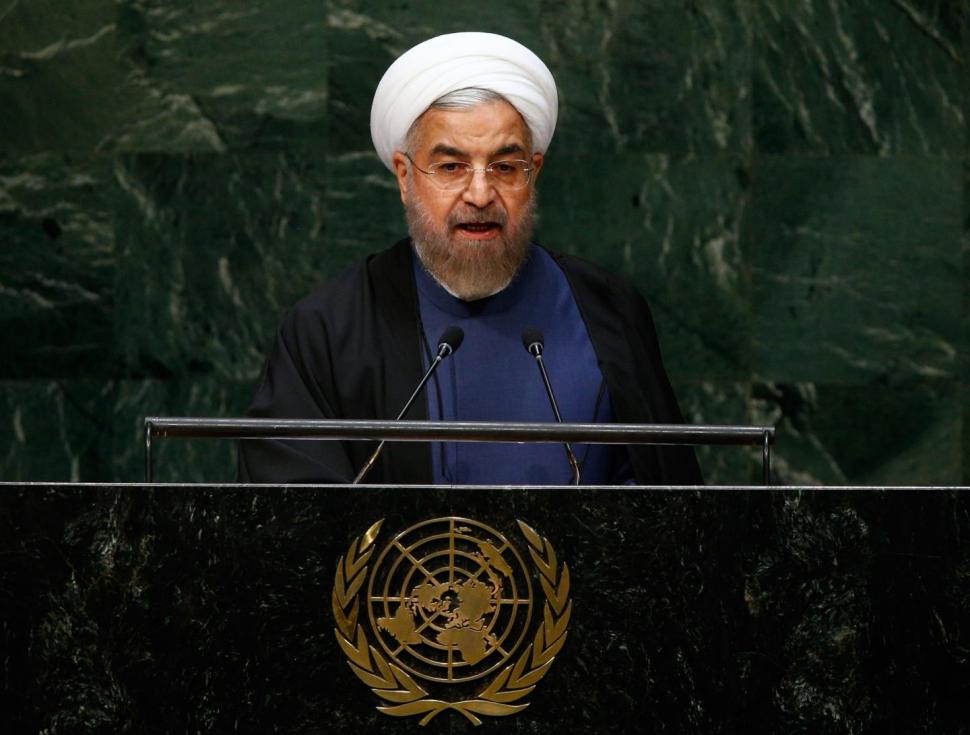
bayefsky16e-1-webHassan Rouhani of Iran.

It’s a two-step charade. First, since the UN has no definition of terrorism, state sponsors of terrorism happily denounce “terrorism” at the very same time as they promote it. Second, the terrorist funders and weapons suppliers redirect the world’s attention to the supposed “root causes” of terrorism.

On Oct. 7, at the legal committee meeting at UN headquarters, Hezbollah-controlled Lebanon listed “root causes that may lead to radicalism such as . . . poverty, social exclusion and marginalization” along with “Islamophobia.”

Iranian President Hassan Rouhani played the same card in an address to the General Assembly in September when he whined about “Iranophobia.

******************

While we are looking for terrorists sneaking across borders, lurking in mosques and holed up in caves, pro-terrorist ideology is spreading across America and around the globe — disseminated in plain sight from the United Nations, in the heart of New York City.

Over the past week, the UN’s top legal committee — a General Assembly body where all 193 states are represented — met to discuss terrorism. The webcasts are broadcast globally in multiple languages. The documents are translated and disseminated on a mammoth website free of charge.

It’s a two-step charade. First, since the UN has no definition of terrorism, state sponsors of terrorism happily denounce “terrorism” at the very same time as they promote it. Second, the terrorist funders and weapons suppliers redirect the world’s attention to the supposed “root causes” of terrorism.

Conveniently, the catalog of root causes of terrorism dreamed up in these circles never includes religiously driven bigotry doled out by anti-Semites and misogynist, homophobic sociopaths — whose need to torture, rape and kill requires no deep explanation.

A quick moral inversion, and the terrorist becomes the victim.

The UN was full of such dangerous canards last week.

On Oct. 7, at the legal committee meeting at UN headquarters, Hezbollah-controlled Lebanon listed “root causes that may lead to radicalism such as . . . poverty, social exclusion and marginalization” along with “Islamophobia.”

Iranian President Hassan Rouhani played the same card in an address to the General Assembly in September when he whined about “Iranophobia.”

Iran is the leading state sponsor of terrorism. And to the organization’s great shame, Iran is also the president of the so-called “Non-Aligned Movement” — a group of nations routinely aligned against the West. As such, Iran speaks for 120 UN member states — a majority of the 193 UN countries.

Here’s the Iranian speech to the UN legal beagles that was webcast Oct. 7: “Terrorism should not be equated with the legitimate struggle of peoples under colonial or alien domination and foreign occupation for self-determination and national liberation.”

Here’s state sponsor of terrorism North Korea on the same day: “Domination and interference, poverty and social inequality, and racial or religious discrimination constitute the root cause of terrorism. International efforts to put an end to terrorism should be preceded by removing the root cause of terrorism.”

All 56 member states of the Organization of Islamic Cooperation have signed on to the Islamic Convention on Combating International Terrorism, which gives a green light to killing Israelis, Americans and anybody else deemed fair game. The treaty says: “Peoples’ struggle, including armed struggle against foreign occupation, aggression, colonialism and hegemony, aimed at liberation and self-determination . . . shall not be considered a terrorist crime.”

Speaking on behalf of the Organization of Islamic Cooperation on Oct. 7, Egypt reiterated this pro-terror exemption clause. Over the course of Oct. 7 and 8, the UN trumpeted support for the Iranian and Organization of Islamic Cooperation call to arms from half of all the speakers.

Compounding the efficacy of this outrage, unfortunately, is the Obama administration. With great fanfare, on Sept. 24,, President Obama chaired a Security Council meeting that unanimously adopted a resolution on foreign terrorist fighters.

But the only reason everybody could agree that “terrorism constitutes one of the most serious threats to international peace and security” was because terrorism was left undefined.

Moreover, the Security Council didn’t just denounce terrorism. It demanded we “address the conditions conducive to the spread of terrorism.” Next it insisted we “counter the violent, extremist narrative that can incite terrorist acts.” And then it ordered us to “address the conditions conducive to the spread of violent extremism.”

In other words, Obama sold us an infinite regression. Because at the UN, the buck never stops with radical Islamists or the governments that support them.

‘Inherent Resolve’: Military campaign against ISIS gets a name

October 15, 2014

‘Inherent Resolve’: Military campaign against ISIS gets a name, Fox News, October 15, 2014

(How about naming the enemy, Islamism? That would not be suitably multicultural. Here are some of the names for the U.S. military operation suggested by Foreign Policy Situation Report readers (via e-mail):

The response to my request for names of the US mission against IS was overwhelming. It’s hard to draw any conclusions from the names offered, but I will say this: SitRep has an engaged, intelligent and global audience (I got responses from all over the world), and the names offered up show a huge disparity in opinion. Some show resolve, while others reflect a growing criticism – one might say cynicism – of Obama’s strategy. Some of the best are below; email me if you’d like to receive the full list.

Operation Empty Chair; Operation Oops, Sorry About That; Operation Good Intentions; Operation Seriously?  Again?; Operation Passive-Aggressive; Operation Coalition of the Dragged Kicking and Screaming; Operation Did I Leave My Keys Here?; Operation Slam Dunk; Operation IS you IS, or IS you Ain’t? Operation Syri-ous about Iraqi Freedom; and Operation Iraqi Freedom 2: Electric Boogaloo.

Make sense. How about “Inherent Dithering?” — DM)

ff_isis_101514US strategy failing as ISIS militants march on

More than two months after the U.S. first launched airstrikes against the Islamic State, the military mission has a name: “Inherent Resolve.”

A senior military source confirmed to Fox News that “Inherent Resolve” officially has been chosen as the title of the operation.

The name comes after questions were raised about why the administration had not named a mission that has escalated to involve several coalition partners and hundreds of airstrikes in both Iraq and Syria.

As of Sunday, the U.S. had conducted nearly 400 strikes in both countries. The number has risen since then – on Wednesday, the U.S. military said it launched another 18 airstrikes overnight near the contested Syrian city of Kobani, intensifying an air campaign against Islamic State militants’ efforts to capture the city near the Turkish border.

Why the mission was not named until now is unclear.

Every U.S. military intervention since the invasion of Panama in 1989, code-named Operation Just Cause, has had a name.

Even the operation to combat Ebola in West Africa was given an operational name the same day it was announced: Operation United Assistance.

An unnamed Defense official was quoted in a recent Wall Street Journal report suggesting the administration was reluctant to name the anti-ISIS mission because: “If you name it, you own it. … And they don’t want to own it.”

But Pentagon spokesman Rear Adm. John Kirby rejected that claim.

He said earlier this month that officials were considering a potential title. Kirby explained that one reason for waiting to name the operation has to do with the complex evolution of the mission.

The demise of ‘responsibility to protect’ at the U.N.

October 15, 2014

The demise of ‘responsibility to protect’ at the U.N., Washington Times, Clifford D. May, October 14, 2014

(The UN’s “responsibility to protect” doctrine now applies principally to groups favored by the multicultural international community, such as the “Palestinians” from wicked Israel, disfavored by the international community. Those needing protection from Islamic terror must look elsewhere. But where? The U.S. of Obama?– DM)

UN logoIllustration on the illusion of “Responsibility to Protect” by Linas Garsys

[I]’s ludicrous to propose that the U.N. Security Council — whose permanent members include neo-Soviet Russia and anti-democratic China — should be vested with the authority to pass judgment on the legitimacy of such missions.

While the Islamic State is currently attracting the most attention, it is the Islamic Republic of Iran — which has been using proxies to kill Americans on and off for the past 35 years — that could soon have nuclear weapons as well as missiles to deliver them to targets anywhere in the world. Hezbollah and other terrorist groups offer an alternative means of delivery. Iran’s radical Shia rulers are more sophisticated than the Sunni jihadis displaying disembodied heads on pikes. However, their goals differ little from those of their rivals.

[T]he notion of an international community that can prevent or halt mass atrocities is a chimera.

***************

Remember R2P? Not to be confused with R2-D2 (a robotic character in the “Star Wars” movies), “Responsibility to Protect” was an international “norm” proposed by United Nations Secretary-General Kofi Annan following the genocide in Rwanda in 1994 and the mass murders in the Bosnian town of Srebrenica a year later. The idea was for the “international community” to assume an obligation to intervene, militarily if necessary, to prevent or halt mass atrocities.

Why has R2P not been invoked to stop the slaughters being carried out in Syria and Iraq? Why isn’t it mentioned in regard to the Syrian-Kurdish city of Kobani, which, as I write this, may soon be overrun by barbarians fighting for what they call the Islamic State?

Here’s the story: In 2009, Mr. Annan’s successor, U.N. Secretary-General Ban Ki-moon, issued a report on “implementing” R2P. The foreign-policy establishment cheered. For example, Louise Arbour, a former U.N. high commissioner for human tights, called R2P “the most important and imaginative doctrine to emerge on the international scene for decades.” Anne-Marie Slaughter, an academic who served under Hillary Clinton at the State Department, went further, hailing R2P as “the most important shift in our conception of sovereignty since the Treaty of Westphalia in 1648.”

In 2011, President Obama cited R2P as his primary justification for using military force to prevent Libyan dictator Moammar Gadhafi from attacking the opposition stronghold of Benghazi.

If that was the apogee of R2P, the nadir was not far off. The intervention in Libya has led to chaos and bloodshed with no end in sight. Meanwhile, in Syria, four years ago this spring, Bashar Assad brutally cracked down on peaceful protesters.

Mr. Obama made Mr. Assad’s removal American policy but overruled the recommendation of his national security advisers to assist Syrian nationalist opposition groups. Civil war erupted. Self-proclaimed jihadis from around the world flocked to Syria to fight on behalf of the Sunnis. The opposition was soon dominated by the al Nusra Front, an al Qaeda affiliate, and the Islamic State (also known as ISIS or ISIL), whose leader, Abu Bakr al-Baghdadi, broke with al Qaeda and, audaciously, declared himself caliph, or supreme leader.

As for Mr. Assad, he is supported by the Islamic Republic of Iran, deploying both its elite Quds Force (designated in 2007 by the U.S. government as a terrorist organization) and Hezbollah, a Lebanon-based militia loyal to Iran’s supreme leader, Ayatollah Ali Khamenei. Russia also backs Mr. Assad, even supplying on-the-ground military intelligence specialists.

With no U.N.-approved R2P effort to rescue the innocent civilians of the region from these brutal forces, the death toll in Syria and Iraq has topped 200,000, and the number of refugees is in the millions.

Failed experiments, like crises, should not go to waste. Among the lessons to be learned from the R2P debacle: First, the notion of an international community that can prevent or halt mass atrocities is a chimera. If such work is going to get done, the United States has to do it, perhaps supported by a coalition of the willing and, with few exceptions, not particularly able. Second, it’s ludicrous to propose that the U.N. Security Council — whose permanent members include neo-Soviet Russia and anti-democratic China — should be vested with the authority to pass judgment on the legitimacy of such missions. Third, American power should be used primarily in pursuit of American interests. Sometimes that will include humanitarian interventions, but that’s a decision for Americans to make.

This, too, should be clear: While the Islamic State is currently attracting the most attention, it is the Islamic Republic of Iran — which has been using proxies to kill Americans on and off for the past 35 years — that could soon have nuclear weapons as well as missiles to deliver them to targets anywhere in the world. Hezbollah and other terrorist groups offer an alternative means of delivery. Iran’s radical Shia rulers are more sophisticated than the Sunni jihadis displaying disembodied heads on pikes. However, their goals differ little from those of their rivals.

In response to this dire and deteriorating situation, Mr. Obama should be instructing his advisers to present him with a range of strategic options. I’d recommend conceptualizing the global conflict not as disconnected “overseas contingency operations,” and not as akin to World War II, but more like the Cold War. That is to say, the United States should plan for a long, low-intensity struggle. In particular, we should support those willing to fight the jihadis who threaten them.

Economic weapons can be powerful if used correctly, which has not been the case in the past. For example, though sanctions brought Iran’s rulers to the negotiating table, premature relief from sanctions pressure has encouraged Iranian intransigence as the talks proceeded.

Also long overdue is a serious war of ideas — it’s insufficient to leave that to Bill Maher and Ben Affleck on HBO. Bottom line: We are not really engaged in a conflict against “violent extremism” or even “terrorism.” What we’re confronting are ideologies derived from fundamentalist readings of Islamic scripture. Proponents of those ideologies stress the supremacy of one religion — much as communists stressed the supremacy of one class, and Nazis of one race. There is no reason to suppose that saying this clearly, rather than obfuscating, will radicalize Muslims not already favorably inclined toward killing infidels.

Our aim should be, to borrow a phrase from Mr. Obama, to “degrade and eventually defeat” jihadism. Nothing is more imperative than preventing Iran’s rulers from taking the next, short steps toward a nuclear-weapons capability that they clearly intend to use to threaten not just their neighbors, but also Americans for decades to come. For an American president, this is where the R2P needs to begin.


How to defeat Islamic State’s war machine

October 15, 2014

How to defeat Islamic State’s war machine, Al-MonitorMetin Turcan, October 14, 2014

(Which team is the “junior varsity?”

The article suggests the obvious need for close air support using trained ground forces to guide aircraft to strike useful targets. The U.S. has trained “boots” capable of doing that, but Obama continues to assert that the U.S. will have no ground combat presence in Iraq or Syria. U.S. spotters would need be in combat areas, would be targeted by Islamic State forces and would therefore need to engage in combat. Non-U.S. target spotters, in addition to needing substantial technical training, would also need to be capable of communicating with aircraft pilots. In many if not most case, spotters capable of communicating in English would be needed. –DM)

Although much has been written to explain the tactical military successes of the Islamic State (IS), there has not yet been a comprehensive assessment of how, since June 2014, IS has managed to rule over terrain larger than Lebanon to include 8 million Iraqis and Syrians.

How has it been possible that in a short three months IS has been able to control extensive terrain, with 3,000 IS fighters capturing Mosul, which was guarded by 30,000 Iraqi soldiers, and after seizing Mosul on June 10 engage in battles two days later with Iraqi forces in towns north of Baghdad, 230 miles from Mosul?

Although one can allude to the delayed reaction of the international community, the lack of strong military opposition to IS, the international support IS has acquired and the support from Sunni tribes and political bodies in areas it captures, none of it defies the reality that — at the tactical level — IS is an extremely lethal and effective war machine. To understand this key determinant of IS gains, one has to understand that reality. This article will attempt to analyze the factors contributing to IS’ military efficiency, particularly at the tactical level.

Factors that boost tactical effectiveness of IS can be summarized as fluid and decentralized command and control structure; novel hybrid military tactics blending conventional warfare with terrorist tactics; effective use of armored platforms in offensive operations; dispersion; preservation of momentum at all costs; effective exploitation of topographic and human terrains; simplicity and flexibility in planning; and conducting operations and high levels of initiative and morale.

Fluid and decentralized command control structure

IS does not have permanent and centralized command and control structure in the traditional sense of warfare. Unlike contemporary armies of the world, IS doesn’t make sharp distinctions between strategic, operative and tactical levels. In their traditional warfare, tactical achievements is the way to achieve strategic objectives. For IS, the basic goal is to score tactical successes and expand on them step by step. Deviating from the traditional approach, what IS fields is a bottom-up command structure focused on a fast pace for small military achievements. At the moment, US-led airstrikes have been mostly against IS communication and training facilities. It is extraordinary that there is not a single control facility that has been hit by allied airstrikes.

IS warfare combines and hybridizes terrorist tactics, urban guerrilla warfare and conventional warfare.

IS is adept enough to conduct armor attacks at night and is skilled in accurate firing of their main tank guns with thermal cameras, and is capable of planting improvised explosive devices in critical areas and routes. It wages hybridized guerrilla warfare and conventional armored warfare by deploying eight to 10 men teams carrying out building-by-building, block-by-block clear and hold operations in urban terrain.

After the recent air attacks, IS has dispersed its forces to the extreme. Its teams have been minimized to two or three vehicles and eight to 10 men. Their concealment has been highly professional. IS’ executive orders are brief, setting out what the mission is in simple terms, leaving how it is to be carried out to field units.

It is imperative to acknowledge that a typical IS militant is endowed with a win-win mindset that assures him that to kill in jihad is a blessing, but if he is martyred he will end up in paradise also. No wonder IS combatants are high-adrenalin fighters who can kill and get killed without hesitation.

A typical IS operation goes like this: An IS armored unit of tanks or a mobile unit of eight to 12 fighters with two to three vehicles are informed by WhatsApp, a message on Facebook or Twitter or phone text message, and if this mode is not available through their own radio net, to assemble at a certain place at a certain time. This is the first time we are seeing combat units making use of social media in combat operations. Before its operations, IS disseminates propaganda messages via social media to enemy fighters and civilians living in the targeted urban settlements to demoralize and dishearten them. IS operations and logistics units that are thus alerted assemble at a meeting point within two to three hours, and after another 1 ½ hours of coordination discussions and logistics preparations the operation is underway.

One must remember that a regular IS tank driver is trained to drive his tank at night with a thermal camera, and that the commander of the team has enough tactical military knowledge to best deploy his tanks. Then it is a matter of attacking the enemy’s weakest point, preferably after the morning prayers. Vehicles stage the first phase of the attacks, followed by infantry attacks that depend on the nature of the enemy’s opposition. In these attacks, IS has been remarkably successful in creating a balance between the phased campaign design and maintaining the tempo of warfare. The high tempo of combat is routine for an IS fighter, but usually too high for opposing soldiers.

How to defeat IS?

How to first stop IS and then defeat it? The secret is in a concept that has so far been lacking the forces fighting IS in Syria and Iraq: Close air support that can only be provided by intense cooperation between ground troops and air units. Coalition air attacks so far are at least limiting IS advances; close cooperation between ground forces and armed helicopters such as AH-64 or fixed-wing platforms such as A-10 Thunderbolts can enable full integration of each air mission with fire and movement of ground forces, and bring the end to IS.

The question then becomes how the US-led coalition can provide that level of air support, and who has the substantial technical know-how and military expertise needed on the ground.

We know special forces elements of countries contributing to the coalition are participating in operations to provide precision target guiding with laser pointers. But this has been limited. Then what can be the solution?

Either the local forces fighting against IS will have to learn this technique that requires high military expertise, or special detachments formed by countries contributing to the coalition will be assigned to each combat zone or to major units as a close air support coordinator. It is no surprise then that the hottest topic in ongoing military discussions is who will provide this close air support and how. When tailoring strategies of close air support, one should keep in mind that IS has MANPADs (man-portable air defense systems) that make air units providing close air support highly vulnerable in their low-speed and low-altitude missions.


Kurds make grisly discoveries after retaking ISIS-held territory

October 15, 2014

Kurds make grisly discoveries after retaking ISIS-held territory, Hot Air, Noah Rothman, October 14, 2014

(How serious are we and our coalition of the unwilling about at least degrading the Islamic State? — DM)

There is mixed news from the two fronts in Iraq and Syria where coalition airpower and indigenous partner forces on the ground are fighting Islamic State militants.

Near the Syrian border city of Kobani, reports indicate that Kurdish defenders are beginning to make some gains as they continue to defend the city against the ISIS onslaught. A key hill atop which ISIS fighters famously planted their flag late last week has reportedly been retaken by Kurdish forces.

“The advance came as the US said it had conducted 21 air strikes near the town, slowing down the IS advance,” the BBC revealed. “Tall Shair hill had been captured more than 10 days ago by IS militants.”

As ISIS retreated from the front near the Syrian-Turkish border, Kurdish forces made a series of gruesome discoveries.

“Refugees in Suruc, Turkey, have told how relatives and neighbors were beheaded by [ISIS] militants, while another spoke of how he had seen ‘hundreds’ of decapitated corpses in the besieged town,” The Independent reported on Tuesday.

Amin Fajar (38) a father-of-four who left Kobane and made it across the border and into Suruc, told a British newspaper: “I have seen tens, maybe hundreds, of bodies with their heads cut off.

“Others with just their hands or legs missing. I have seen faces with their eyes or tongues cut out – I can never forget it for as long as I live.”

The Daily Telegraph confirmed The Independent’s reporting about the activities in which ISIS engaged in the areas under their control:

“I have seen tens, maybe hundreds, of bodies with their heads cut off. Others with just their hands or legs missing. I have seen faces with their eyes or tongues cut out — I can never forget it for as long as I live,” Amin Fajar, a 38-year-old father of four, told the Daily Mail about the incredible scene in Kobane.

“They put the heads on display to scare us all.”

Another resident, 13-year-old Dillyar, watched as his cousin Mohammed, 20, was captured and beheaded by the black-clad jihadis as the pair tried to flee the battle-scarred town.

“They pushed him to the ground and sawed his head off, shouting, ‘Allahu Akbar,’ ” the boy said. “I see it in my dreams every night and every morning I wake up and remember everything.”

This unconfirmed video featuring Kurdish fighters in Kobani, flagged by Jeff Gauvin, reveals the extent of the damage done to the city over the course of weeks of fighting.

While America’s partners on the ground are enjoying some successes in Syria, the dispatches from Iraq are far more grim.

There, ISIS continues its siege on Anbar province in preparation for an assault on the capital city of Baghdad. After taking control of a military training base on Monday, CNN reported that ISIS has surrounded one of the largest Iraqi airbases in the country on Tuesday and is preparing to take it.

“According to police sources,” CNN’s Ben Wedeman reported, “the Ayman Asad Airbase, which is about 110 miles to the west of Baghdad – one of the biggest bases in Anbar province – is now surrounded by ISIS fighters, and the people on the base are expecting an attack within the coming hours on that base.”

“We understand that there are Iraqi soldiers who have already fled the base,” Wedeman continued. “We were getting reports for several hours that some of the soldiers had left, shedding their uniforms, leaving their weapons behind.”

That depressing revelation should concern military advisors who believe Iraqi forces defending Baghdad can hold out against an ISIS assault on Baghdad despite outnumbering the attackers by a reported six-to-one ratio. These latest developments reinforce the position of Army Chief of Staff Gen. Raymond Odierno who said with some trepidation recently he was only “somewhat” confident Baghdad could hold out.

Kurds Left Helpless as Kobane Falls to Islamic State: Turkey’s Border Wars (Dispatch 1)

October 15, 2014

 Vice News via You Tube, October 14, 2014

(Whose side is our NATO ally, Turkey, on in Kobane? The (“non-Islamic”) Islamic State or those best able to combat it effectively? How about the Obama Nation?  — DM)

The danger of Obama’s strategy of linking Iran and ISIS for Israel.

October 15, 2014

The danger of Obama’s strategy of linking Iran and ISIS for Israel.AuthorBy Barry Shaw October 14, 2014

via The danger of Obama’s strategy of linking Iran and ISIS for Israel..


The danger of Obama's strategy of linking Iran and ISIS for Israel

In fifty days of Gaza conflict, Israel launched 5500 precision air strikes against terror targets. In 70+ days the US launched less than 400 strikes in Iraq and Syria against ISIS. Why?

It’s not lack of planes and fire power. It’s a lack of political will, despite all the rhetoric of having to degrade and defeat the Islamic State rampage and mayhem.

Despite Obama’s late decision to launch air strikes he has only tickled the enemy. He could do more. He won’t. He doesn’t want to. What is the reason for this procrastination?

Part of the reason for Obama’s reticence in attacking ISIS with more force seems to be contained in a think tank policy document he commissioned entitled

The Iran Project. Iran and its Neighbors. Regional Implications for US Policy of a Nuclear Agreement.”

Experts who signed off on this document include Thomas Pickering, Brent Scowcroft, Daniel Kurtzer, Nicholas Platt, and Zbigniew Brzezinski.

The document mistakenly sees the possibility of using ISIS to drive Iran and Israel closer together in a common cause. This misguided strategic fantasy is described thus, “If ISIS were to continue to progress, Israel and Iran might find themselves with a common enemy.”

The dream of bringing Iran and Israel together seems so devoutly to be wished by the Obama Administration that it surmounts any political reality to facts on the ground.

Could this be the reason that America has not applied the full measure of air power at its disposal in killing and driving back ISIS?

US president is cynically allowing thousands to be slaughtered in front of our eyes for a strategy that will never happen

If it is, it’s dangerous and false thinking. It appears as if the US president is cynically allowing thousands to be slaughtered in front of our eyes for a strategy that will never happen.

Does he, or his experts, really think that Iran and Israel will join his feckless coalition out of joint fear of ISIS? If so, he is dead wrong.

In contrast to President Obama’s recent statements, the document does call ISIS a state of sorts. “ISIS is no longer just aterrorist group but represents a hybrid state/non-state threat.”

The top strategic experts explain themselves thus,“In parts of the territory it now controls, ISIS exercises akind of governance: it collects revenue, executes brutal Islamist law, has apolice force, andcontrols a jihadist conventional army.”

The only force that is bravely standing and confronting ISIS on the ground are the Kurds, and yet Obama is still not arming them directly. He should. Instead, the documents points to the US Administration playing a double game by recruiting not only Iran but also Tehran’s ally Assad to fight against ISIS;

Syrian forces should be urged by Tehran to attack ISIS directly in Syria. Syrian military commanders, security personnel, and top government officials should be motivated to avoid an ISIS victory.”

However you read this, the Administration think tank policy document is calling on the White House to back an Iranian, Assad, even Hezbollah coalition to fight ISIS in Syria.

A nuclear agreement with Iran runs through the document. It is the center piece of a US Middle East policy. At parts it reads like an illusion world of smoke and mirrors. “A nuclear agreement could help the United States and its allies find common ground with Iran for a creative response to ISIS, although the United States must avoid seeming to ally itself with the Shi’a and thereby enhance the appeal of radicals to Sunnis.”

It is hard to comprehend a policy in which the ISIS threat is seemingly put off until after the signing of a nuclear agreement with Iran on the supposition that it will make for closer buddies between the rival states in the region. As if Saudi Arabia and Erdogan would link arms with Ayatollahs and Assad to defeat ISIS. If only! Putting off a strong direct attack on ISIS until after a nuclear deal with Iran is dangerous wishful thinking, not foreign policy.

The mixing of two unrelated issues, a nuclear deal with Iran and the threat of ISIS, leads to a muddling Middle East strategy. The dangers implied here is that it is impossible to defeat ISIS without a nuclear deal, and from that stems the desire to rush through a nuclear deal in order to solve the ISIS issue.

“The degradation and defeat of ISIS presents an opportunity for America to work even-handedly with the nations of the region to achieve a common goal. Cooperation with Iran would thus take place within a larger regional grouping that should include the Gulf States and Turkey in addition to the Government of Iraq.”

The reason this is doomed to failure is in the description of the nuclear deal that the Administration is trying to reach. It talks of “limiting” the Iranian program, “lengthening” the time for Iran to reach nuclear breakout, and “reducing” the risk that Iran “might” acquire nuclear weapons. It does not talk of stopping Iran’s march to a nuclear weapon.

Israel sees ISIS creeping closer to its border. It can visibly see the Al-Nusra terror group on the Golan Heights. ISIS is not far away, and the document states the threat for Israel;

“The ‘Islamic State’ declared an end tothe 1916 British and French-imposed Sykes—Picot borders, and announced that its next goal would be to free Palestine.”

This threat would give Israel a justification to get into the fight. If it did, it is more likely to assist the Kurds than get into bed with Iran, as the document wrongly suggests. Albeit indirectly arming and trained the brave Kurds, before the ISIS threat becomes a face-to-face confrontation for Israel, could become a necessity for Israel.

There is a case to be made for Israel to arm the Kurds, particularly in Iraq. The Kurds are as close to America and sympathetic to Israel’s plight in a radical region. They are more democratically minded than other players in the region. They have proven themselves to be the only courageous fighters on the ground in Iraq.

Israel sees convergence of interests with Saudi Arabia, Jordan, and Egypt over the growing threat of the ISIS brand of Islamic terror. As happened with its conflict against Hamas and Islamic Jihad in Gaza, it is reasonable to assume that these countries will turn a blind eye to Israel arming the Kurds.

Israel looks on the Kurds with great sympathy, but it could do more. Helping them overcome their confrontation with ISIS would be one way for Israel to demonstrate to the world what a small, but courageous and just, coalition can achieve in a regional war against radical Islamic terror.

As the document states, “if allowed to consolidate its control over large parts of Syria and Iraq, ISIS would also represent a terrorist threat to the American homeland.”