Posted tagged ‘Syria’

ISIS capture of Jordanian pilot puts US and Jordan in conflicting dilemmas, may be pivotal to anti-terror war

December 25, 2014

ISIS capture of Jordanian pilot puts US and Jordan in conflicting dilemmas, may be pivotal to anti-terror war, DEBKAfile, December 25, 2014

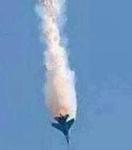
F-16_down_Syria_24.12.14A Jordanian air force F-16 downed over Syria

DEBKAfile’s military and intelligence sources add that Middle East military and aviation control centers are quite sure that the Jordanian warplane was hit by an ISIS missile, while making low passes over the terrorist organization’s Syrian headquarters at Raqqa in violation of the pilot’s orders.

*****************

The US military is going to great lengths to deny any evidence that ISIS shot down the Jordanian Air Force F-16 which came down Wednesday, Dec. 24 over the northern Syrian town of Raqaa. First Lieutenant Muath al-Kasaesbeh, aged 27, was the first Arab pilot to be taken prisoner by the Islamic State. The US Central Command statement said: “We can say with certainty that it was an aircraft crash and the plane was not downed by ISIL as was claimed by the terrorist organization.”

This contradicted an earlier statement by the Jordanian Information Minister Mohammad Momani that the plane had crashed after being hit by a ground-air missile. DEBKAfile’s military and intelligence sources add that Middle East military and aviation control centers are quite sure that the Jordanian warplane was hit by an ISIS missile, while making low passes over the terrorist organization’s Syrian headquarters at Raqqa in violation of the pilot’s orders.

The Jordanians are making intense efforts to deter the jihadis from harming 1st Lt. Kasaesbeh.The Hashemite Kingdom’s armed forces warned that “IS and its supporters would be held responsible for the pilot’s safety and his life.”

The pilot belongs to the Bedouin tribe of Bararsha near Kerak in southern Jordan, which boasts several army generals. They and the tribal chiefs are bringing all their influence to bear to obtain his release.

American military is joining the effort to save the Jordanian pilot – from different motives, which are geared more to sustaining the goals and tactics pursued by the US and the coalition in the war on the Islamic State.
Thursday, Central Command chief Gen. Lloyd J. Austin, who is in charge of US and coalition operations in Iraq and Syria, released a long communiqué praising Jordan for its military actions in the battle, adding: “We will not tolerate ISIL’s attempts to misrepresent or exploit this unfortunate aircraft crash for its own purposes.”

The US general’s message was designed to reassure Jordanian Air Force pilots and dissuade them from dropping out of the coalition air campaign for fear of being shot down by an ISIS missile. The three other Arab coalition members, Saudi Arabia, Bahrain and the United Arab Emirates, must also be kept from quitting.

The share of the four Arab air forces in the war is too weighty to forfeit.

ISIS leader Abu Bakr Al Baghdadi has not doubt calculated his stake in keeping the Jordanian pilot alive and at risk to scare fellow Arab pilots from continuing to take part in US-led bombing missions against his forces.

Furthermore, the Bararsha, like other South Jordanian Bedouin tribes, is known around the region for producing fierce fighters and their relentless pursuit of blood revenge.

Al Baghdadi may opt to avoid antagonizing them for this reason, as well as in the hope of a tangible benefit: ISIS is already using the smuggling routes of southern Jordan as channels to the groups his organization has planted in Sinai, Egypt and eastern Libya. He may decide to go one better and build an alliance with those very tribes behind the backs of the Americans and Jordan’s Abdullah II.

Such an eventuality would add a new dimension to the war on the Islamist terrorists.

The unlikely founding fathers of the Islamic State

December 24, 2014

The unlikely founding fathers of the Islamic State

 By Missing Peace

via The unlikely founding fathers of the Islamic State | Missing Peace | missingpeace.eu | EN.


Islamic State

The rise of the Islamic State (sometimes called ISIL) is commonly seen in the West as something that emerged more or less out of the blue. US President Obama for instance has said the dramatic rise of IS was not anticipated by the intelligence services of the US.

That’s not true, however. At about the time that Obama made this claim, European diplomats stationed in Syria told a journalist working for an Asian newspaper that the CIA had repeatedly warned the US government of the danger posed to America by the IS. The CIA termed it the greatest threat to the US since the Second World War, according to the diplomats.

So it may be more accurate to say it was Obama himself who underestimated the danger of the Islamist movement, and who chose to ignore the CIA’s warnings.

Why? Because heeding those CIA warnings would have meant admitting that US policy in Syria and Iraq had failed, and that his disengagement policy in the Middle East needed significant adjusting.

Von Oppenheim’s Jihad strategy

As we will see,the Islamic State ‘s current campaign of Jihad is not only unsurprising but is in large measure the result of a strategy that has been known for  more than a hundred and twenty years and was devised by a German diplomat of Jewish origin.

That diplomat was Max von Oppenheim, born in Cologne in 1860 to a Jewish banking family whose members converted to Catholicism after his birth.

Von Oppenheim traveled throughout the Middle East in the last years of the 19th century, visiting Syria, Mesopotamia (now called Iraq), the Persian Gulf, Morocco and Egypt. After his return to Germany, he published his observations in a two-volume book. He studied law and, later, Arabic in Egypt, and in 1896 was became an attaché at German’s embassy in Cairo, Egypt.

During that Egyptian stint, von Oppenheim authored 467 reports on the Middle East, including a lengthy report on the rise of the Pan-Islamic movement. These influenced and to an extent even determined German policies in the region. He eventually became a key adviser to the German emperor Wilhelm.

On the eve of Wilhelm’s visit to the Middle East in 1889, von Oppenheim recommended that Germany support the emerging Islamist movement. This, he argued, would benefit German interests in the region. On one hand, the Germans were without colonies in the Middle East. On the other, the area’s Muslims sought an end to the dominance of the Christian powers – Great Britain, France and Russia – in a region with a Muslim-majority population. There was therefore a shared interest. The Muslims alone were not able to bring an end to foreign domination. And German was anxious to expand its influence in the Middle East at the expense of the French and British.

In his report to the emperor on Pan-Islamism, Von Oppenheim explained that the Muslims already had established a Caliphate, an overarching state, in the Middle East in the seventh century and that state had existed for centuries. The German diplomat argued that the Ottoman Turks had managed to breathe new life into this state and had succeeded in attracting Muslimloyalty to the Sultan/Caliph.

The Muslim masses increasingly viewed the Ottoman leader as the protector of Islam and its holy sites, Von Oppenheim wrote. He concluded that if the Sultan would issue a fatwa calling for Jihad, three hundred million Muslims could be counted upon to rise in revolt and put an end to Anglo-French dominance in the Middle East.

The mission, in his words, was therefore “to unleash Muslim fanaticism that would border on madness”.

Von Oppenheim’s plan led to a pact between Germany and the Ottoman Empire.  However, the concept of a massive jihad that might have produced a German-Turkish victory over the Allies in the First World War failed completely.

Mainly, this was the result of fundamental errors in his analysis. Von Oppenheim ignored the internal divisions in the Muslim world, for instance. And he over-estimated the extent of Arab acceptance of the Turkish Caliph’s authority.

But along with a group of German Middle East experts, Von Oppenheim succeeded in establishing Islamist groups that did in fact begin to execute the planned Jihad in certain Muslim countries.

In November 1914, he dispatched a 136-page plan entitled “Revolutionizing the Islamic territories of our enemies” to his emperor. The plan was quickly approved and Von Oppenheim’s team was provided with the necessary funds. Shortly afterwards, Von Oppenheim’s terrorist groups began deploying suicide attacks as a means of achieving their goals. In India, for instance, a group of 25 Jihadists attacked British targets.

German experts

The German experts recognized that there was a risk the forces of jihad would eventually be out of control and turn into an offensive against the West. The unfolding of events after the defeat of Germany and Turkey in World War I and the emergence of Franco-British domination over the Middle East resulting in the Sykes Picot agreement proved them right.

Sykes-Picot, in particular, resulted in a redefined Middle East of states whose borders were drawn by the French and British. These borders however failed to take account of the tribal nature that had long characterized the Middle East. They also ignored the sharp divisions between Sunni and Shiite Muslims.

The so-called Arab Spring in 2010 represented a kind of turning point. Dictatorships in the area had prevented some of the states that emerged under British-French influence from falling apart. Their leaders had more or less succeeded in curbing sectarian violence within their borders.

But then came the fall of dictators like Iraq’s Saddam Hussein, Egypt’s Hosni Mubarak and Gaddafi of Libya. These changes, plus the uprising against Assad in Syria and the reduction in the United States’ Middle East influence finally offered Islamists the opportunity to establish a new order based on their interpretation of Islam.

Immediately after proclaiming the establishment of an Islamic State in Iraq and Syria, ISIL was able to triumphantly announce – with a certain degree of justification – that the Sykes-Picot era had finally come to an end.

Hitler and Husseini

Following the failure of Von Oppenheim’s plan in World War I, a second German attempt was made by Hitler through his alliance with the Islamist, Haj Amin al-Husseini.

Husseini originally harbored pan-Arab ambitions, aspiring to become the leader of the Arab world. He eventually settled for becoming the Grand Mufti of Palestine and the de facto leader of the Palestinian Arabs.

Husseini and Hitler shared a deep hatred of the Jews and other common interests. Hitler sought an Arab leader who would promote his agenda of world domination in the Middle East. Husseini in turn needed a Western ally who would prevent the creation of a Jewish state in Palestine and put an end to Western domination of Muslim countries.

Husseini’s collaboration with the Nazis is well known. It went well beyond preventing the emergence of a Jewish state in the Middle East. For example, Hitler took the decision to embrace the so-called ‘Entlosung ’, the strategy of systematically exterminating European Jewry, a few hours after a meeting with Husseini. During that meeting, Husseini had exerted pressure on Hitler to solve the “Jewish problem” once and for all.

In 1944, Husseini succeeded in preventing a deal between the Germans and the Allied forces in which 5,000 Jewish children would be exchanged for Allied prisoners of war, and frustrated the escape of 14,000 Jewish children from Hungary. Almost all of these children were later murdered in the Nazi death camps.

Husseini spent much of World War II living in Berlin, establishing his headquarters in a confiscated Jewish mansion. The Nazis provided him with funds to undertake a range of Islamic projects in Europe and beyond.

He developed a plan to establish death camps in Arab countries for the intended extermination of the Jews in the Middle East. This failed because of the 1942 defeat of the advancing German army at El Alamein, Egypt and the collapse of Hitler’s Africa Korps.    Most of the Middle East’s Jews thus escaped the Holocaust.

Husseini escaped prosecution for war crimes after World War II, largely for political reasons. He was thus able to continue to lead the jihad against Israel and keep the Islamist movement alive. In May1946, carrying a false passport, he escaped from French custody and fled to Egypt. Once in Cairo, he founded a new army al-Jihad al-Muqaddas, under the leadership of another Nazi collaborator, al-Qawuqii. With a training camp near the Libyan border, its soldiers prepared for the ”struggle against the Zionists” and participated in the War of Independence in 1948.

Following the Arab defeat in the 1948 war, Husseini united the Islamists under his leadership in a new organization called the Islamic World Congress (IWC). Among its other prominent members: Sayyid Qutb, the ideologue of the Muslim Brotherhood; and the Iranian Islamic spiritual leader Abd al-Qasim al-Kashani. One of Kashani students was Ruhollah Khomeini who went on in 1979 to lead Iran’s Islamic revolution.

Husseini moved the headquarters of the Islamic World Congress (IWC) to Karachi, Pakistan,in 1949. He appointed Dr. Inamullah Khan as its Secretary General. Khan, known for his hatred of Jews, nevertheless became the recipient of the prestigious 1988 Templeton Prize for Progress in. This prize had been awarded in previous years to Mother Teresa and Aleksandr Solzhenitsyn.

Syrian Islamist Maaruf al-Dawalibi, who had also collaborated with the Nazis, was Husseini’s successor. In 1984, he declared at a United Nations seminar that Hitler had been right when he wanted to exterminate the Jews because of their belief that they were God’s chosen people. In the same speech, he repeated the classic anti-Semitic blood libel that the Talmud commands the Jews to drink the blood of non-Jews at Passover.

Jihad in Europe

Said Ramadan, the son-in-law of the founder of the Muslim Brotherhood, Hassan al-Banna, was asked by Husseini to spread the Islamist ideology in Europe. In 1958, Ramadan fled to Geneva due to the repression of the Muslim Brotherhood in Egypt and Syria. In 1959, Ramadan wrote a dissertation on Islamic Sharia law called “Islamic Law: Its Scope and Equity” for the University of Cologne in which he called upon European Muslims to fight against Western secular culture in Europe.

Ramadan, aided by money from al-Husseini’s Nazi funds and later with the financial help of Saudi Arabia, began a process whereby local Muslim communities in Europe came under the control of the IWC and the Muslim Brotherhood. By 2000, many Muslim communities in Europe had adopted the Islamist ideology of the Muslim Brotherhood and were led by members of the organization.

After Ramadan’s death, Ali GhalebHimmat, one of his lieutenants, became the leader of one of Europe’s most important beachheads of radicalIslam – a mosque in the German city of Munich. The mosque had beenestablished by Muslims who had fought for the Nazis.

Together with the Syrian Islamist Yusuf Mustafa Nada Ibada, Himmat built a global financial network for the Muslim Brotherhood. In 1988, they founded the al-Taqwa bank that was involved in financing the Al Qaeda attack on the United States on 11 September 2011. The main architect of the attack on the US was Aiman al-Zawahiri, the current leader of Al Qaeda. He is the grandson of Abd al-WahhabAzzam, who was the spiritual leader of Hajj Amin al-Husseini. Al-Wahhab was the brother of Abd al-Rahman Azzam , the first Secretary General of the Arab League. During World War II, Abd al-Rahman Azzam worked as a secret agent for the Nazis under al-Husseini.

From Hassan al-Banna to ISIL

Prior to his membership of Al-Qaeda, the Egyptian Al-Zawahiri was the leader of Tanzim al-Jihad, the group responsible for the assassination of President Anwar Sadat. He was strongly influenced by Sayyid Qutb, the ideologue of the Muslim Brotherhood.

In one of his writings, he wrote that Qutb started the Islamic revolution against the enemies of Islam in the Middle East and beyond. This bloody revolution continues up to this day, wrote Al-Zawahiri. He fully endorsed Qutb’s view that the establishment of the kingdom of Allah on earth cannot be achieved through prayer and preaching alone. In order to reach this goal, it was necessary that those who did not recognize Allah’s authority should be killed.

According to Qutb and al-Zawahiri, Islam permits killing people in Jihad for Allah.

Al-Zawahiri also explained the importance of the mobilization for Jihad against the enemies of Islam. Since the end of the Anglo-French domination in the Middle East, these enemies had been replaced by the United States and Israel.

This Jihad is not – like the Sufi version of Islam says – a spiritual struggle of the Muslim, but is the ultimate battle between Islam and the infidels and their societies. This is the main theme that connects all Islamist groups and that is practiced by Al Qaeda, Hamas, Hezbollah, Islamic State, Boko Haram (whose name means Western education is forbidden) and many other Islamist movements.

In this view, Jihad against the Jews (and other infidels) becomes a primary religious duty. In this respect, there is no difference between the ideas of Khomeini, Khamenei, Al Qutb, Bin Laden, Al-Zawahiri, al-Husseini, IS leader al-Baghdadi, the current Brotherhood ideologue Yusuf al-Qaradawi and Hamas leaders.

All have said publicly that the Jews control the world and that they are the enemies of Allah and must be expelled from Muslim land (meaning Palestine) or they are to be killed. They also stated that Jihad should continue until Islam rules the world.

So the ideology of the Islamic State is not new. It is rooted in the ideology of Islamists who previously, not coincidentally, collaborated with the Nazis.

The similarities between the methods of IS and those of the Nazis are striking as well as the ideology that underlies those methods. For Islamic State, the ‘ubermensch’ is a Muslim who has abandoned the state of barbaric negligence (Jahaliyah) which in IS view also prevails in Arab countries and that is typical of the West. Jahaliyah existed before the advent of Muhammad and the goal of Islamists is to bring the Umma, the Islamic world community, back to the early days of Islam and the path of the upright Caliphs who led the Islamic empire at the time.

Muslim Brotherhood founder Hassan al-Banna, who was an admirer of Hitler and Mussolini, had the model of the SS in mind when he founded the so-called shock battalions. These battalions intended to do what ISIL is now doing in Iraq and Syria. So it comes as no surprise that a variation on al-Banna’s slogan can now be seen on the black flags of Islamic State: ‘Allah is our objective, the Koran is our constitution, the Prophet our leader; struggle is our way and death for Allah is our highest aspiration. ‘

This article is partly based on research by Middle East expert professor Barry Rubin
IS captures Jordanian pilot after warplane crashes in Syria

December 24, 2014

IS captures Jordanian pilot after warplane crashes in Syria

via BBC News – IS captures Jordanian pilot after warplane crashes in Syria.


Photo posted online by Raqqa Media Center purportedly showing Jordanian pilot Flight Lieutenant Moaz Youssef al-Kasasbeh captured by Islamic State militants near the Syrian city of Raqqa (24 December 2014)
The pro-IS Raqqa Media Center posted photos purportedly showing the captured Jordanian pilot

slamic State (IS) militants have captured the pilot of a Jordanian warplane that crashed in northern Syria, Jordan’s military has confirmed.

The jihadist group claimed it had shot down the jet with a heat-seeking missile near the city of Raqqa.

It published photographs showing the pilot, who has been named as Flight Lieutenant Moaz Youssef al-Kasasbeh.

This is the first US-led coalition aircraft to be lost on IS territory since air strikes began in September.

Jordan is one of four Arab states which have bombed targets in Syria.

Plea for mercyThe confirmation that a Jordanian pilot had been captured came in a statement carried by the state news agency, Petra.


Photo published by Raqqa Media Center purportedly showing wreckage of downed Jordanian warplane near IS-held Syrian city of Raqqa (24 December 2014)
IS fighters were shown loading the wreckage of the Jordanian aircraft on to a vehicle
Photo published by Raqqa Media Center purportedly showing wreckage of downed Jordanian warplane near IS-held Syrian city of Raqqa (24 December 2014)
Jordan’s military said the jet was one of several involved in a raid on IS hideouts in the Raqqa region
Photo published by Raqqa Media Center purportedly showing wreckage of downed Jordanian warplane near IS-held Syrian city of Raqqa (24 December 2014)
The aircraft appeared to come down near a river or lake, outside the city of Raqqa

“During a mission Wednesday morning conducted by several Royal Jordanian Air Force planes against hideouts of the IS terrorist organisation in the Raqqa region, one of the planes went down and the pilot was taken hostage,” a military source was quoted as saying.

“Jordan holds the group and its supporters responsible for the safety of the pilot and his life,” the source added.

The source did not name the pilot, but Petra published a photo of Flt Lt Kasasbeh above its report.

line

Analysis: Jonathan Marcus, BBC defence correspondent

We do not know yet if the Jordanian aircraft suffered an engine failure or other technical problem, or if it was actually downed by IS air defences.

IS has been assumed to have a limited air defence capability – based not least on the sorts of shoulder-fired missiles that are rife in the region.

IS fighters have downed Iraqi and Syrian government aircraft and helicopters in the past. We also know that IS has overrun a number of Syrian air defence bases.

It is not clear if IS has personnel capable of operating any of these more sophisticated Soviet or Russian-supplied systems.

The US-led coalition permanently monitors the nature of the air defence threat and if the Jordanian aircraft was shot down then any potential lessons will be fed into the ongoing air campaign.

line

Earlier, the UK-based Syrian Observatory for Human Rights, said it had received reports from its network of activists that IS members had taken “an Arab pilot prisoner after shooting his plane down with an anti-aircraft missile near the city of Raqqa”.

The pro-IS Raqqa Media Center also posted a photo on its Facebook page showing armed men taking the pilot out of what appeared to be a lake or river.

The man appeared able to stand but was bleeding from the mouth. He was wearing only a white T-shirt and was soaking wet.

A caption identified him as Lt Kasasbeh and later a photo appearing to show his military ID card was published.


Moaz Youssef al-Kasasbeh

Photo on Moaz Youssef al-Kasasbeh's Facebook page showing him standing next to a Jordanian air force jet
  • Born in the city of Karak in Jordan in 1988, he is 26 years old
  • Has been a Royal Jordanian Air Force pilot for six years
  • Currently holds the rank of flight lieutenant
  • One of eight children, he got married in July
line

Lt Kasasbeh’s father, Youssef al-Kasasbeh, confirmed his son had been captured in Syria in an interview with the Jordanian newspaper, Saraya.

Youssef al-Kasasbeh said he found out the news after the head of the RJAF informed another of his sons.

He appealed to IS leaders: “May Allah plant mercy in your hearts and may you release my son.”

The air forces of Jordan, the US, UAE, Saudi Arabia, and Bahrain have carried out hundreds of air strikes on IS in Syria in the past three months.

Many of the targets have been in and around Raqqa, which is the de facto capital of the “caliphate” whose creation IS proclaimed in June.

German author Juergen Todenhoefer recently met Islamic State fighters in Raqqa and filmed daily life

Syrian government warplanes also regularly bomb Raqqa and the surrounding province. On Tuesday, an air strike killed more than 20 people, according to the Syrian Observatory.

Australia, Belgium, Canada, Denmark, France, the Netherlands and UK have joined the US in conducting air strikes on IS in neighbouring Iraq.

The BBC’s Jim Muir in Beirut says the latest news will raise concern among the coalition nations about the level of armament available to the militants and the defensive measures deployed by coalition jets.

It may further diminish the appetite of Arab nations to take part in such operation, our correspondent adds.

Map of IS areas of control

ISIS Closing in on Israel from the North and the South

December 24, 2014

SIS Closing in on Israel from the North and the South

The Fiscal Times

By Riyadh Mohammed December 23, 2014 6:30 AM

via ISIS Closing in on Israel from the North and the South – Yahoo Finance.


The war against ISIS is taking a dangerous, perhaps inevitable turn. The terror organization has been keen to expand to southern Syria and the Syrian capital of Damascus. Now it says it has recruited three Syrian rebel groups operating in the south of the country in an area bordering the Israeli occupied Golan Heights — that have switched their loyalties to ISIS.

This switch means that Israel, the U.S.’s closest ally in the Middle East, could be threatened from the southwest by the Egyptian ISIS group of Ansar Bait al-Maqdis in Sinai and by ISIS in southern Syria.

The ISIS war is not going well at all for the US-led alliance in Syria. ISIS and al-Nusra Front, al-Qaeda’s branch in Syria, are still the dominant rebel groups in the country. The U.S.-backed Free Syrian Army is still not a reliable fighting force.

Related: Reports of U.S. Ground Fighters Emerge as ISIS Gains in Iraq

The three rebel groups that just joined ISIS could make that situation even worse. Two of the groups are small in number, but the Yarmouk Martyrs Brigade has hundreds of fighters. The Yarmouk Brigades has been at odds with al-Nusra Front and switched now to join what leaders of all thrwee groups believe is the future of Islam.

“If Israel was attacked by ISIS, America would expect a proportionate response by Israel, which is militarily capable of defending itself,” said Geoffrey Levin, a professor at New York University. “America would counsel against sustained Israeli involvement because it could threaten the tacit alliance between America, Iran, Turkey, and several Arab states against ISIS.”

“More recent reports indicated a closer alliance with [the Islamic State] due to tensions with JN [al-Nusra Front],” said Jasmine Opperman, a researcher at Terrorism Research & Analysis Consortium (TRAC). She said al-Nusra attacked the headquarters of the Yarmouk Brigade in southern Syria in early December 2014 following clashes between the two groups.

Al-Yarmuk Martyrs Brigade controlled an area near the Jordan-Israel border in March 2013. That same month, the brigade took as hostages some of the United Nations peacekeeping mission soldiers. Even so, Israel reportedly allowed the brigade to have its wounded fighters treated in Israeli hospitals.

Related: Iraq’s ‘Bodyguards’ Subvert the War Against ISIS

ISIS has been known for launching surprise attacks and opening new battlefronts when it seems to be losing. ISIS also has been criticized by many Arabs and Muslims for not taking its fight to Israel and instead fighting fellow Arabs and Muslims. An attack aimed at Israel may boost ISIS’s popularity in the Arab world and refresh its recruitment and funding efforts.

On the other hand, some of ISIS’s top military commanders were former officers in Saddam Hussein’s army, and they may resort to what Saddam did in the 1991 Gulf War when he attacked Israel with mid-range rockets, hoping to drag the Israelis into a conflict that he was losing.

An Israeli retaliation in 1991 could have jeopardized the U.S-led coalition that then included Arab countries like Egypt, Syria and Saudi Arabia. The same is true now.

WHY THIS MATTERS

Despite some recent tensions between the countries, Israel remains America’s closest ally in the Middle East. Attacks on Israel by ISIS or affiliated groups could further escalate war in the region, or they could further strain ties between the Obama administration and the Israeli government.

Related: This Laser Could Take Out ISIS

“It would be more likely a sign of desperation, as were Saddam’s attempts to lure Israel into the 1991 war as a way of breaking the Arab coalition against him,” said NYU’s Levin. At that time, continuous pressure from the first Bush administration and the installation of the Patriot anti-rocket system convinced the Israelis to refrain from reacting to Saddam’s attack.

Israel could launch a preemptive attack to destroy or significantly damage these ISIS-affiliated units whether by air or by ground forces. Israel used its advanced air force to launch attacks in Syria several times since the beginning of Syrian civil war in 2011.

Meanwhile, Israel has recently boosted its defenses in the Golan Heights, saying its main concern was to prevent any major weapon transfer from Syria to Hezbollah, the Lebanese guerrilla organization that has engaged in several rounds of war with the Israelis since the 1980s.

This article was updated at 3 p.m. on Tuesday, Dec. 23.

Bedouin Trackers on the Border: The War Next Door (Part 5)

December 23, 2014

Bedouin Trackers on the Border: The War Next Door (Part 5),  Vice News via You Tube, December 23, 2014


ISIS sneaks behind US-backed Kurdish victories in Iraq to retake Baiji refinery city

December 22, 2014

ISIS sneaks behind US-backed Kurdish victories in Iraq to retake Baiji refinery city, DEBKAfile, December 22, 2014

IraqBaiji

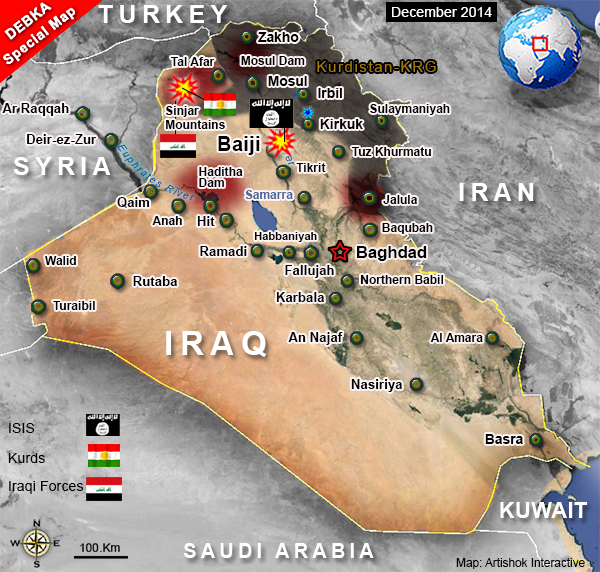
American, Kurdish and Iraqi officials have hailed as a “major victory” the release of thousands of distressed members of the Yazdi community, trapped for four months on on Mt. Sinjar in northern Iraq, since Islamic State thugs overran their town. Many more fled to Syria while Yazdi women were kidnapped.

This was a necessary rescue operation, but hardly a major victory, say DEBKAfile’s military experts. ISIS continues to maintain its grip on vast stretches of Iraq and Syria, defying the efforts of sparse US and coalition air strikes to dislodge them – beyond minor tactical withdrawals.

The town of Sinjar is not mentioned in the US and Kurdish releases, because large sections are still in jihadi hands.

Even less is heard about the situation on the northern Iraqi-Syrian border, where Abu Bakr Al-Baghdadi has achieved almost total supremacy.

But the most telling omission by the US-led allies is the fact that, while they focused on Mt. Sinjar, ISIS forces restored their siege of Baiji, Iraq’s main oil refinery center, after pushing Iraqi troops out.

This happened after a majority of the local Sunni tribes who fought alongside the Iraqi army up until November, switched sides.

The tribal chiefs complained that the Iraqi Prime Minister Haider al-Abadi, who was installed in Baghdad with Washington’s support last year, as a figure able to unite the country’s Sunni and Shiite communities for the war on ISIS, reneged on his promise of pay checks and weapons for the tribesmen who threw in their lot with the national army.

Instead, he is accused of aggravating disunity in the armed forces by firing Sunni officers and replacing them with officers loyal to Iraq’s pro-Iranian Shiite militias, who take their orders from Iranian Revolutionary Guards Corps commanders.

DEBKAfile’s military and counter-terrorism sources describe the current military state of play in Iraq as bizarre, fought on three more or less disconnected levels:

1.  In the north, a mixed Iraqi-Kurdish force, accompanied by US military advisers, is poised to attack the key town of Tal Afar, which lies 50 km west of Mosul.

Friday, Dec. 21, they took the town’s Iraqi military base that fell to ISIS in June. But, like in Sinjar, the assault force has not yet occupiedy the town.

This Tel Afar operation was a compromise in the disagreement the Iraqis and Kurds had with Washington. They asserted they were fully capable of recapturing Mosul from the Islamists, while the US military advisers disagreed and warned that this offensive was doomed to failure.

2.   While Iraqi and Kurdish peshmerga forces are concentrating their assaults on areas where ISIS forces are thin on the ground (like Mt. Sinjar), the jihadis are throwing strength into capturing and controlling the Iraqi and Syrian oil industries (like Baiji). They are by now accruing revenues running into $2 to 2.5 billion, despite falling crude prices. In fact they are dumping the looted oil for $25-30 per barrel, well below the world market prices.

3.  Washington is sparing too little attention for the ISIS outgrowths mushrooming outside Iraq and Israel – especially in Libya, Egypt and Egyptian Sinai.

Syrian rebel Yarmouk Brigades ditch US and Israel allies, defect to ISIS

December 18, 2014

Syrian rebel Yarmouk Brigades ditch US and Israel allies, defect to ISIS, DEBKAfile, December 17, 2014

SyriaGolanISIS

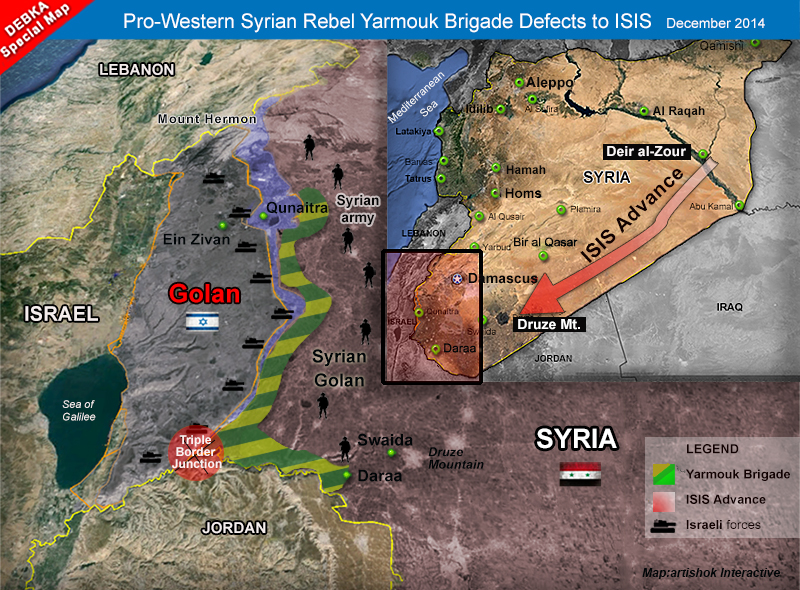
The Syrian rebel militia Al Yarmouk Shuhada Brigades, backed and trained for two years by US officers, mostly CIA experts, in Jordan, and supported by the Israeli army, has abruptly dumped these sponsors and joined up with the Islamic State in Iraq and Syria, DEBKAfile’s exclusive military and counter-terrorism sources reveal.

The sudden defection of this 2,000-strong anti-Assad force leaves IDF defense formations on the Golan, US and Jordanian deployments in the northern part of the kingdom, and pro-Western rebel conquests in southern Syria in danger of collapse.

The Brigades’ jump into the radical jihadi camp was negotiated in the last two weeks by its commander Mousab Ali Qarfan, who also goes by the name of Mousab Zaytouneh. He was in direct contact with ISIS chief Abu Baqr Al-Baghdadi, whom our sources report has recently relocated from Iraq to his northern Syrian headquarters at al-Raqqa.

Unlike the Sinai Islamists, Ansar Beit al Maqdis, the Yarmouk Brigades did not pledge allegiance to ISIS. The ir pact was forged as an operational alliance, which is just as grave a peril for the rebel militias’ abandoned allies.

For Israel, in particular, the new development is fraught with three dangers:

1. The Yarmouk Brigades are strung out along Israel’s Golan border with Syria, from the UN peacekeepers camp opposite Kibbutz Ein Zivan (see map) in the north, down to the Israeli-Syrian-Jordanian border junction in the south. The Brigades therefore sit along 45 of the total 76 kilometers of the Syrian-Israeli border. This means that a long stretch of Israel’s Golan border with Syria has fallen under the control of the Islamic State.

2.  This militia also commands sections of the Syrian-Jordanian border, as well as districts of the southern Syrian town of Deraa. Therefore, the link between Jordan and southern Syria, which served American strategic interests, is now under military threat.

3.  Islamic State forces are preparing to take advantage of their new asset with a buildup near the Druze Mountains (see map) for a rapid push south towards the town of Deraa, where they will join forces with their new ally.

Saudi Government Daily: U.S. Secretly Cooperating With Iran At Arabs’ Expense

December 15, 2014

Saudi Government Daily: U.S. Secretly Cooperating With Iran At Arabs’ Expense, MEMRI, December 14, 2014

(Fact, fiction or a mix of both? — DM)

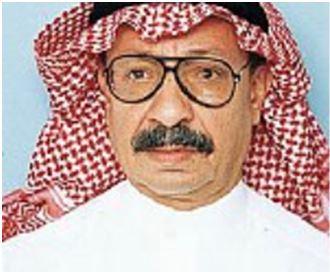
Yousuf Al-Kuwailit, who writes the editorials of the Saudi government daily Al-Rai, opined in a December 7, 2014 editorial that, despite the tension that has ostensibly prevailed between the U.S. and Iran ever since the Islamic Revolution, in practice there is secret cooperation between them. As part of this cooperation, he said, Iraq has become nothing but an arena for assuring the interests of these two countries, and Iran has been granted freedom of action in Syria and Lebanon.

Referring to the U.S.-Iran nuclear talks, he said they were a farce that would end in contracts and deals, and perhaps even an alliance, between the two countries. He therefore called on the Arabs not to regard the U.S. as a reliable ally, and warned that the U.S. may force the Gulf states to reconcile with Iran, to the detriment of their interests.

The following are excerpts from the article: [1]

21428Yousuf Al-Kuwailit

“The U.S. appointed the Shah as policeman of the Arab Gulf, turned Iran into a base for conflict with the USSR, and provided Iran with up-to-date weaponry and a nuclear reactor. [Iran, for its part] attempted to take advantage of this situation, as it saw itself as a superpower. [Only] the strength of the USSR… prevented Iran from undertaking military adventures outside its own borders. With [the rise to power of Ayatollah Ruhollah] Khomeini, despite everything that happened at the U.S. Embassy [in Tehran in 1980], when dozens of its staffers were taken hostage and [then-U.S. president Jimmy] Carter carried out a reckless and unsuccessful operation [in attempt to free them]… [despite all this] nothing spoiled the U.S.’s relationship with this country, which it considers one of its strategic and economic outposts by virtue of its location and its history. So the farce… about Iran’s nuclear reactors and non-conventional weapons has taken a clear and final direction, in the form of several deals [between the two countries]…

“Cyrus [the Great],[2] who attacked and destroyed the Arabs, is the spiritual father of the Nazi trend that has characterized Iran’s governments, whether secular or religious. Racial supremacism vis-à-vis the Arabs is a popular [Iranian] obsession. It exists and it is eternal, and even if the mullahs don black turbans [indicating that they are] descendants of the Prophet and have Arab roots, they do not really recognize these roots, but do this only in order to market their national policy to us, prior to marketing their religious school of thought [i.e. the Shi’a]. Anyone who thinks that diplomatic arrangements are aimed at anchoring coexistence between the Arabs and the Iranian ‘Aryans’ is disregarding the nature of the historical reasons [for the tension between the two sides] and its deep roots in the [Iranian] public mentality.

“In order to better understand the unfolding of events, [we need to realize that]  the U.S. and its allies set out the initial plan to divide the Arab [regions] a long time ago, and that the Sikes-Picot agreement is only the first outcome [of that plan]. [We must also realize] that handing over Iraq [to Iran], and annexing Syria and later Lebanon to it, and the [silent] agreement [between the two countries] that Iran would have a free hand in these countries – all these  are only a prelude to  more dangerous activity.

“[Accordingly], relying on the U.S. or thinking it a reliable ally without properly understanding the strategic changes and aims, place us in a situation [of self-delusion], because all the historic elements of power see how positions and policies change but interests remain. This principle will be ultimately applied to all the countries that have a relationship with the U.S., whether economic or strategic, because the Arabs are part of a geographic area whose borders are changing, including through the disappearance of the centrally[-ruled] state in favor of states [based on] sect or nationality.

“One simple event in recent days is the Iranian Air Force’s incursion into Iraq to attack ISIS positions, which the U.S. confirmed but Iran denied. At the same time, the U.S. also ignores the incursion of [Iranian] ground troops under the command of [IRGC Qods Forces commander] Qassem Soleymani into Iraq, [which has been taking place] ever since the U.S. first started managing [Iraq’s] affairs… [In fact,] U.S. Secretary of State John Kerry stated that any Iranian military attack on ISIS was positive. This exposes the significant coordination between the two countries, and belies the statements of U.S. military circles denying any cooperation or coordination [with Iran] in the war on ISIS…

“In the era of [former Iraqi prime minister Nouri] Al-Maliki, Iraq become nothing but an arena for assuring the interests of two players: Iran and the U.S. This came about as part of an agreement that began with [head of the occupational authority of Iraq after the 2003 invasion Paul] Bremer, and no Iraqi government will put an end to it, unless the Iraqis [dare to] oppose their homeland’s dependence on another country – something that is difficult and complicated to do.

“Ultimately, even if the talk about the American-Iranian hostility is true, everything points towards new contracts between the two which are likely to turn into alliance. We could possibly see catastrophic days if the U.S. forces the Gulf states to reconcile with Iran, which will end in a way that will not serve our interests. This is an outcome that should not surprise us, if the reality of [U.S.-Gulf] friendship evolves into [U.S.] dictates [to the Gulf states].”


Endnotes:

[1] Al-Riyadh  (Saudi Arabia), December 7, 2014.

[2] Cyrus the Great founded the Achaemenid Empire, circa 600 BCE.

Is Obama ready for an about-face to recognize Assad? Will Syria provide the strike force against ISIS?

December 14, 2014

Is Obama ready for an about-face to recognize Assad? Will Syria provide the strike force against ISIS?, DEBKAfile, December 14, 2014

bashar_al_assad_12.14Bashar Assad gets a new lease of life

Netanyahu will ask Washington to exercise its veto against the Palestinian motion. But the Obama administration would rather not, since it supports the Palestinians in principle.

Israel may therefore find itself this time ranged against a united US-Russian front on the Palestinian issue, Moscow’s reward for Washington lining up behind its plan for Syria.

Netanyahu told a cabinet meeting in Jerusalem Sunday, Dec. 14, that Israel would “rebuff any UN moves to set a timetable for withdrawal from territory.” He said Israel now faced a possible diplomatic offensive “to force upon us” such a withdrawal within two years.

*****************

High expectations based on unconfirmed reports swirled around Arab capitals Sunday, Dec. 14, that US President Barack Obama, in league with Moscow and Tehran, had turned his longstanding anti-Assad policy on its head. He was said to be willing to accept Bashar Assad’s rule and deem the Syrian army the backbone of the coalition force battling the Islamic State in Iraq and the Levant.

If these expectations are borne out by the Obama administration, the Middle East would face another strategic upheaval: The US and Russia would be on the same side, a step toward mending the fences between them after the profound rupture over Ukraine, and the Washington-Tehran rapprochement would be expanded.

The Lebanese Hizballah and its leader, Hassan Nasrallah would be vindicated in the key role they played in buttressing President Assad in power.

But for Saudi Arabia and Israel, an Obama turnaround on Assad would be a smack in the face.

The Saudis along with most of the Gulf emirates staked massive monetary and intelligence resources in the revolution to topple the Syrian ruler.

Israel never went all-out in its support for the Syrian uprising, but focused on creating a military buffer zone under rebel rule in southern Syria, in order to keep the hostile Syrian army, Hizballah and elements of the Iranian Revolutionary Guard Corps fighting for Assad at a distance from its northern borders with Syria and Lebanon.

If Obama goes through with accepting the Assad regime, Israel will have to write off most of its military investment in Syria. In any case, Israel’s intelligence agencies misjudged the Syrian situation from the first; until a year ago, they kept on insisting that Assad’s days were numbered.

DEBKAfile’s Arab sources single out major pointers to the approach of a reversal of Syrian policy in Washington:

1.  The resignation of Chuck Hagel as defense secretary last month. Hagel was adamant in advocating Assad’s ouster.

2.  No more than one sentence was devoted to the Syrian conflict in the Gulf Cooperation Council’s (GCC) summit’s resolutions in Doha last week, despite its centrality to inter-Arab affairs: the summit called for “a political solution” of the Syrian issue that would “ensure Syria’s security, stability and territorial integrity.”

Not a word on Assad’s removal from power.

3.  DEBKAfile’s Washington and Moscow sources report that the Syrian issue was destined to figure large in the Rome talks between US Secretary of State John Kerry and Russian Foreign Minister Sergey Lavrov Sunday, Dec. 14.

The Kremlin is making US acceptance of its plan for ending the Syrian conflict the condition for joining the US-European line on the Palestinian demand that next week’s UN Security Council session set a two-year deadline for Palestinian statehood within 1967 border. The text calls for Israeli “occupation of Palestinian territory captured in the 1967 war” to end by November 2016.

France, Britain and Germany are in efforts to draft a resolution of their own.

So any deal Kerry and Lavrov are able to finalize for a tradeoff between the Palestinian and Syria issues will be put before Israeli Prime Minister Binyamin Netanyahu when he meets the US secretary in Rome Monday, Dec. 15.

Netanyahu will ask Washington to exercise its veto against the Palestinian motion. But the Obama administration would rather not, since it supports the Palestinians in principle.

Israel may therefore find itself this time ranged against a united US-Russian front on the Palestinian issue, Moscow’s reward for Washington lining up behind its plan for Syria.

Moscow proposes that the Syrian opposition throw in the towel and both sides accept a truce – especially in the long battle for Aleppo – for the re-convening of the Geneva 2 peace conference in Moscow, with America’s support and participation. Provincial elections would then take place in Syria to bring the Assad government and opposition elements into collaborating in the various ruling institutions.

Russian Deputy Foreign Minister Mikhail Bogdanov spent two days in Damascus last week to work on the details of this blueprint with Bashar Assad, after which he commented tellingly that he was “in contact with our American partners.”

Russian officials then elaborated on their plan before Hizballah and opposition representatives in Turkey.

Even the US Senate bill calling for fresh sanctions against Moscow and the supply of $350 million worth of military aid to Ukraine under the Ukraine Freedom Support Act is unlikely to rock the Kerry-Lavrov Middle East boat.

President Obama is unlikely to affix his signature to the bill and President Vladimir Putin will take it in his stride if he sees progress in reaching an agreement with the United States on Syria.

Even the American threat to station medium-range nuclear missiles in Europe following Moscow’s refusal to endorse the Intermediate-Range Nuclear Forces Treaty failed to cast a cloud over the Kerry-Lavrov encounter.

The two top diplomats have a solid history of progress in forging diplomatic accords on thorny international issues (e.g. Iran’s nuclear program and Syria’s chemical weapons).

If they fail this time, Netanyahu’s talks with Kerry will be lighter and smoother. But if a Syria-Palestinian tradeoff is forged between the two powers, Israel may for the first time find itself on a collision course with a joint US-Russian front on the Palestinian issue.

Netanyahu told a cabinet meeting in Jerusalem Sunday, Dec. 14, that Israel would “rebuff any UN moves to set a timetable for withdrawal from territory.” He said Israel now faced a possible diplomatic offensive “to force upon us” such a withdrawal within two years.

Therefore, the Israeli air strikes against a shipment of Russian missiles for Syria for Hizballah last Monday, Dec. 8, may be seen as an act of defiance against this nascent big-power partnership. Our sources reveal that Moscow was not alone in demanding “explanations” for Israel’s “aggressive” – so too did Washington.

Israel air strikes wiped out Russian hardware for thwarting US no-fly zone plan over Syria

December 10, 2014

Israel air strikes wiped out Russian hardware for thwarting US no-fly zone plan over Syria, DEBKAfile, December 8, 2014

Israeli_jets_of_bombing_two_installations_inside_Syria7.12.14Israel jets bombing Syrian targets

High-ranking American military sources revealed Monday, Dec. 8, that Israel’s air strikes near Damascus the day before wiped out newly-arrived Russian hardware including missiles that were dispatched post haste to help Syria and Hizballah frustrate a US plan for a no-fly zone over northern Syria.

The advanced weapons were sent over, as DEBKAfile reported exclusively Sunday, after Russian President Vladimir Putin learned that the Obama administration and the Erdogan government were close to a final draft on a joint effort to activate a no-fly zone that would bar Syrian air force traffic over northern Syria.

The Kremlin has repeatedly warned – of late in strong messages through back channels – that the establishment of a no-fly or buffer zone in any part of Syria would be treated as direct American intervention in the Syria war and result in Russian military intervention for defending the Assad regime.

According to the US-Turkish draft, American warplanes would be allowed to take off from the Turkish airbase of Incirlik in the south for operations against Syrian warplanes, assault helicopters or drones entering the no-go zone. Thus far, Ankara has only permitted US surveillance aircraft and drones the use of Incirlik for tracking the movements of Islamic State fighters in northern Syria.

The Obama administration was long deterred from implementing a no-fly zone plan by the wish to avoid riling Moscow or facing the hazards of Syria’s world-class air defense system.

But Washington was recently won over to the plan by a tacit deal with Damascus for American jets to be allowed entry to help Kurdish fighters defend their northern Syrian enclave of Kobani against capture by al Qaeda’s IS invaders.

However, the US administration turned down a Turkish demand to extend the no-fly zone from their border as far as Aleppo, Syria’s largest city, over which Syrian army forces are battling rebels and advancing slowly into the town.

The no-fly zone planned by US strategists would be narrow – between a kilometer and half a kilometer deep inside Syria. However Moscow is standing fast against any such plan and objects to US planes making free of Syrian airspace, a freedom they are now afforded over Kobani.

To drive this point home, the Russians delivered a supply of advanced anti-air missiles and radar, whose use by the Syrian army and transfer to Hizballah in Lebanon were thwarted by the Israeli air strikes Sunday.

Moscow reacted swiftly and angrily with a Note to the United Nations Monday accusing Israel of “aggressive action” and demanding “that such attacks should not happen again… Moscow is deeply worried by this dangerous development, the circumstances of which demand an explanation.”

The Assad regime has held back from reacting to past Israeli air raids for preventing advanced weaponry from reaching Hizballah. This time, spokesmen in Damascus warned that their government’s response would be clandestine and cause Israel “unimaginable harm.”